|
|

|
Source: Bright's OE Grammar, page b0320, entry 12 View original page image as: [TIFF] [PNG] [View previous entry] [View next entry] |
[Comment on this entry] [View comments] |
The following entry has been hand-corrected once. |
|
Source: Bright's OE Grammar, page b0357, entry 3 View original page image as: [TIFF] [PNG] [View previous entry] [View next entry] |
[Comment on this entry] [View comments] |
The following entry has been hand-corrected once. |
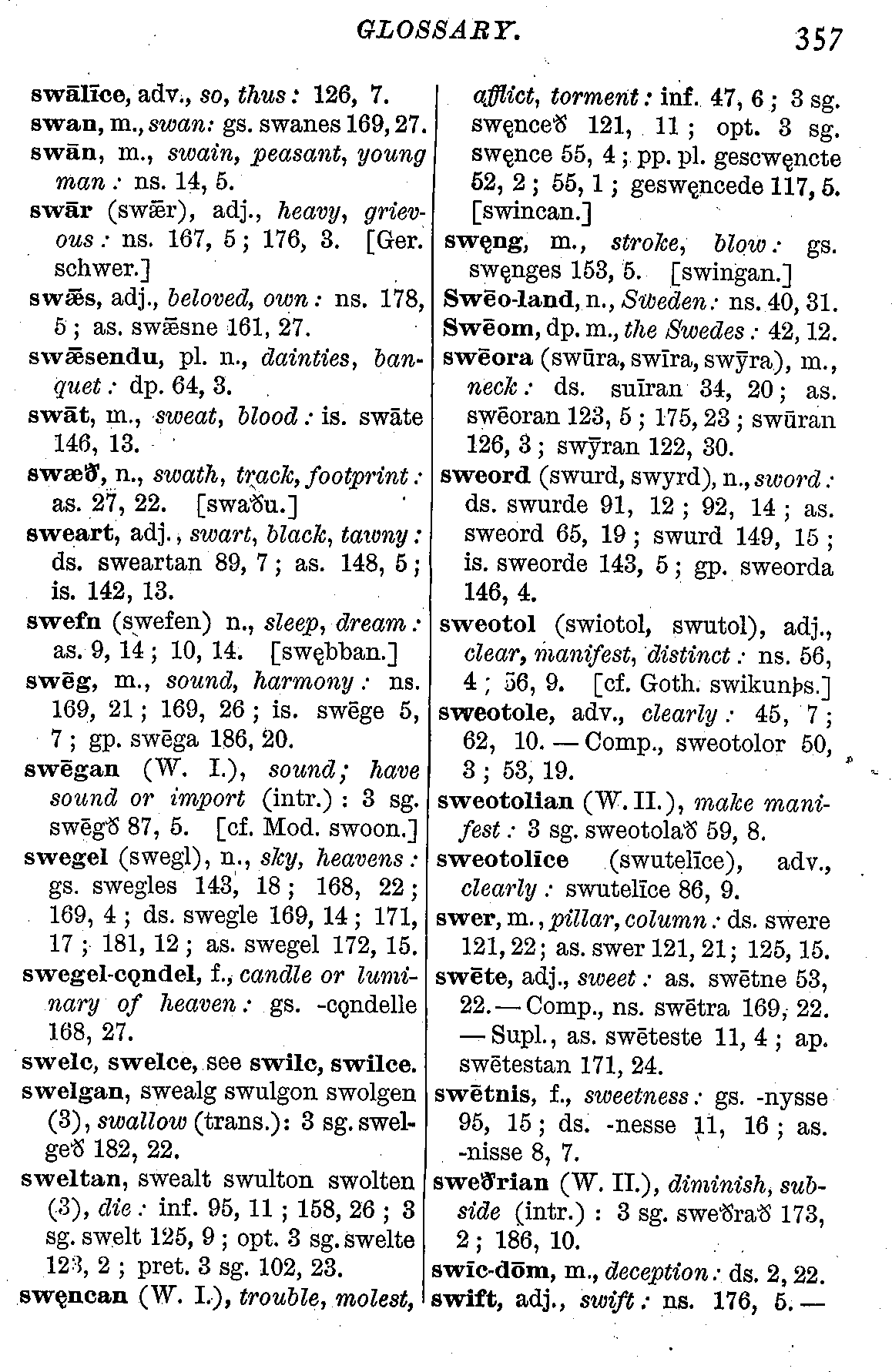
sw n
m
swain,
peasant,
young
man
n
m
swain,
peasant,
young
man
|
Source: Bright's OE Grammar, page b0371, entry 1 View original page image as: [TIFF] [PNG] [View previous entry] [View next entry] |
[Comment on this entry] [View comments] |
The following entry has been hand-corrected once. |
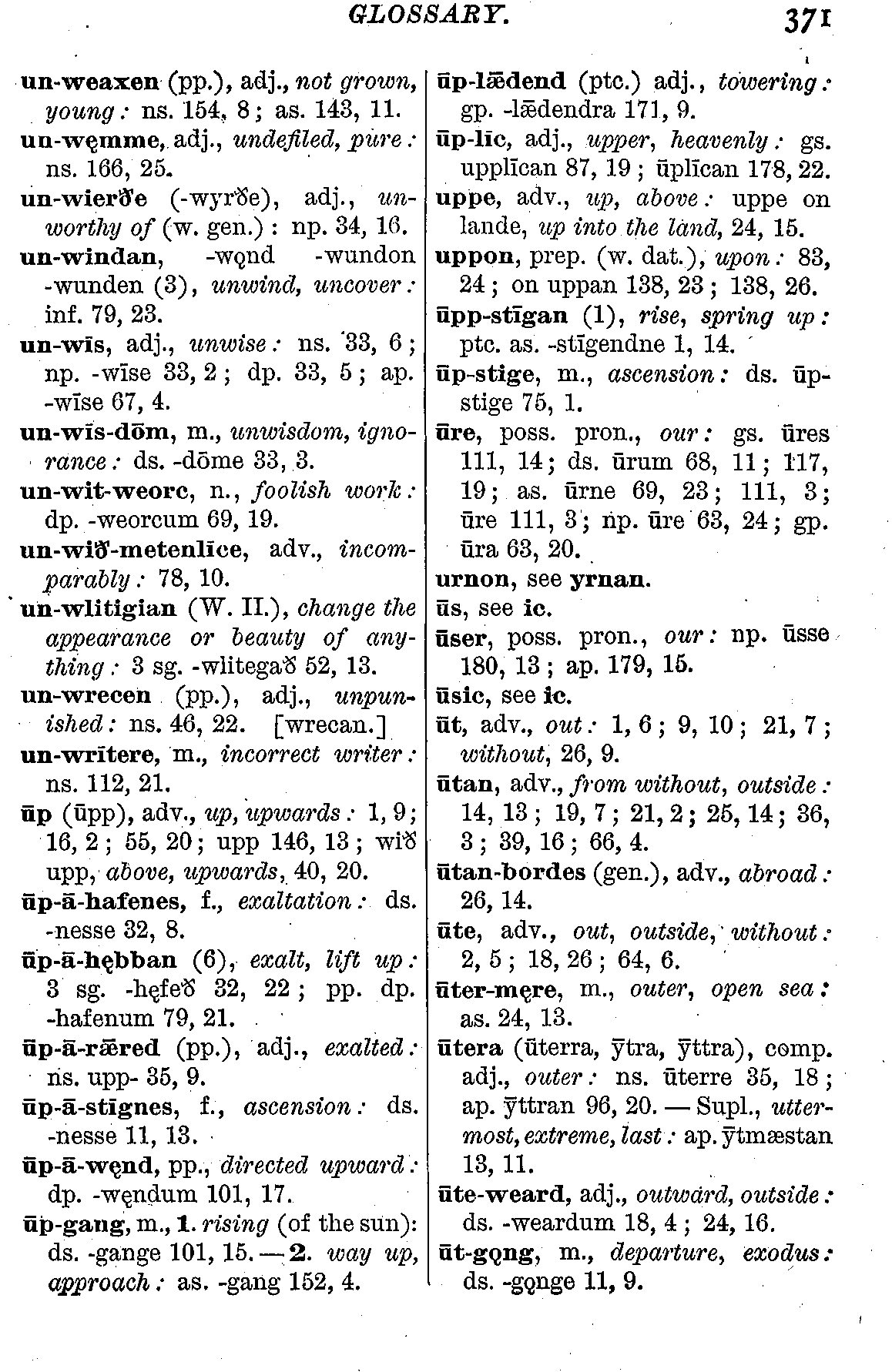
un-weaxen (pp) adj not grown, young
|
Source: Cleasby/Vigfusson, page b0007, entry 23 View original page image as: [TIFF] [PNG] [View previous entry] [View next entry] |
[Comment on this entry] [View comments] |
The following entry has been hand-corrected once. |
AFLA,
að,
[cp.
Swed.
afvel,
breed,
slock:
Dan.
avling,
farming;
avls-
gaard,
farm;
faareavl,
qvægavl,
breed
of
sheep
or
cattle.
In
Norse
(mod.)
avle
is
to
harvest;
Swed.
afla,
to
beget.
In
the
Icel.
verb
afla
the
idea
of
producing
or
gathering
prevails,
whereas
the
nouns
branch
off;
the
weak
afli
chiefly
denotes
produce,
means,
stores,
resources,
troops,
forces;
the
strong
one
--
afl
--
force
alone.
Yet
such
phrases
as
ramr
at
afli
indi-
cate
something
besides
the
mere
notion
of
strength.
In
the
mod.
Scandin.
idioms
--
Dan.,
Swed.,
Norse
--
there
are
no
traces
left
of
the
idea
of
'force:'
cp.
the
Lat.
opes
and
copiae.
The
Icel.
spelling
and
pronunciation
with
bl
(abl)
is
modern,
perhaps
from
the
time
of
the
Reformation:
cp.
the
words
efla
etc.
with
a
changed
vowel.
The
root
is
OP-,
as
shewn
in
Lat.
ope,
opes,
the
o
being
changed
into
a
?].
I.
with
gen.
of
the
thing,
to
gain,
acquire,
earn,
procure;
vandara
at
gæta
fengins
fjár
en
afla
þess
(a
proverb);
þá
bjöggu
þeir
skip
ok
öfluðu
manna
til,
got
men
to
man
it,
Eg.
170.
 .
the
phrase,
afla
sér
fjár
ok
frægðar,
to
earn
fame
and
wealth,
of
young
heroes
going
sea-roving;
fóru
um
sumarit
í
víking
ok
öfluðu
sér
fjár,
Eg.
4;
afla
sér
fjár
ok
frama,
Fs.
5;
fjár
ok
virðingar,
id.;
hann
hafði
aflat
sér
fjár
(made
money)
í
hólmgöngum,
Eg.
49;
aflaði
þessi
bardagi
honum
mikillar
frægðar,
brought
him
great
fame,
Fms.
ii.
307;
kom
honum
í
hug,
at
honum
mundi
mikillar
framkvæmdar
afla,
bring
him
great
ad-
vantage,
Eb.
112.
2.
as
a
law
term,
to
cause,
inflict
a
wound;
ef
maðr
aflar
einum
blóðs
eðr
bens
af
heiptugri
hendi,
N.
G.
L.
i.
387.
II.
with
acc.,
mostly
in
unclassical
writers,
but
now
rare,
to
earn;
aflaði
hann
þar
fé
mikit,
Fms.
vii.
80;
aflandi
þann
thesaur
er,,
655
xxxii.
i;
hafit
ér
ok
mikit
í
aflat,
Al.
159;
mun
ek
til
hafa
atferð
ok
eljun
at
afla
mér
annan
við,
to
contrive,
Ld.
318,
where,
however,
the
excellent
vellum
MS.
A.
M.
309,
4to,
has
gen.
--
annars
viðar
--
more
classically,
as
the
Saga
in
other
passages
uses
the
gen.,
e.
g.
afla
sér
manna
ok
hrossa,
to
procure
horses
and
men,
l.
c.
little
below.
.
reflex.,
e-m
aflask
e-t,
gains,
Fb.
163.
.
the
phrase,
afla
sér
fjár
ok
frægðar,
to
earn
fame
and
wealth,
of
young
heroes
going
sea-roving;
fóru
um
sumarit
í
víking
ok
öfluðu
sér
fjár,
Eg.
4;
afla
sér
fjár
ok
frama,
Fs.
5;
fjár
ok
virðingar,
id.;
hann
hafði
aflat
sér
fjár
(made
money)
í
hólmgöngum,
Eg.
49;
aflaði
þessi
bardagi
honum
mikillar
frægðar,
brought
him
great
fame,
Fms.
ii.
307;
kom
honum
í
hug,
at
honum
mundi
mikillar
framkvæmdar
afla,
bring
him
great
ad-
vantage,
Eb.
112.
2.
as
a
law
term,
to
cause,
inflict
a
wound;
ef
maðr
aflar
einum
blóðs
eðr
bens
af
heiptugri
hendi,
N.
G.
L.
i.
387.
II.
with
acc.,
mostly
in
unclassical
writers,
but
now
rare,
to
earn;
aflaði
hann
þar
fé
mikit,
Fms.
vii.
80;
aflandi
þann
thesaur
er,,
655
xxxii.
i;
hafit
ér
ok
mikit
í
aflat,
Al.
159;
mun
ek
til
hafa
atferð
ok
eljun
at
afla
mér
annan
við,
to
contrive,
Ld.
318,
where,
however,
the
excellent
vellum
MS.
A.
M.
309,
4to,
has
gen.
--
annars
viðar
--
more
classically,
as
the
Saga
in
other
passages
uses
the
gen.,
e.
g.
afla
sér
manna
ok
hrossa,
to
procure
horses
and
men,
l.
c.
little
below.
.
reflex.,
e-m
aflask
e-t,
gains,
Fb.
163.
 .
absol.,
njót
sem
þú
hefir
aflat,
of
ill-earned
means,
Nj.
37.
.
absol.,
njót
sem
þú
hefir
aflat,
of
ill-earned
means,
Nj.
37.
 .
part,
aflandi,
Njarð.
366.
2.
now
used
absol.
to
fish,
always
with
acc.;
a
standing
phrase
in
Icel.,
the
acc.
only
being
used
in
that
particular
connection.
III.
with
dat.
in
the
sense
of
to
perform,
manage,
be
able
to;
hann
aflaði
brátt
mikilli
vinnu,
ok
var
hagr
vel,
Fms.
i.
289;
fyr
mun
hann
því
afla
en
ek
færa
honum
höfuð
mitt,
it
will
sooner
happen,
Fms.
iv.
291,
where
the
Hkr.
reads
orka;
bauð
út
leiðangri,
sem
honum
þótti
landit
mestu
mega
afla,
to
the
utmost
that
the
country
could
produce,
Fms.
x.
118;
ekki
aflar
harm
því
at
standa
í
móti
yðr,
he
is
not
man
enough
to
stand
against
you,
Fas.
iii.
.
part,
aflandi,
Njarð.
366.
2.
now
used
absol.
to
fish,
always
with
acc.;
a
standing
phrase
in
Icel.,
the
acc.
only
being
used
in
that
particular
connection.
III.
with
dat.
in
the
sense
of
to
perform,
manage,
be
able
to;
hann
aflaði
brátt
mikilli
vinnu,
ok
var
hagr
vel,
Fms.
i.
289;
fyr
mun
hann
því
afla
en
ek
færa
honum
höfuð
mitt,
it
will
sooner
happen,
Fms.
iv.
291,
where
the
Hkr.
reads
orka;
bauð
út
leiðangri,
sem
honum
þótti
landit
mestu
mega
afla,
to
the
utmost
that
the
country
could
produce,
Fms.
x.
118;
ekki
aflar
harm
því
at
standa
í
móti
yðr,
he
is
not
man
enough
to
stand
against
you,
Fas.
iii.
|
Source: Cleasby/Vigfusson, page b0010, entry 33 View original page image as: [TIFF] [PNG] [View previous entry] [View next entry] |
[Comment on this entry] [View comments] |
The following entry has been hand-corrected once. |
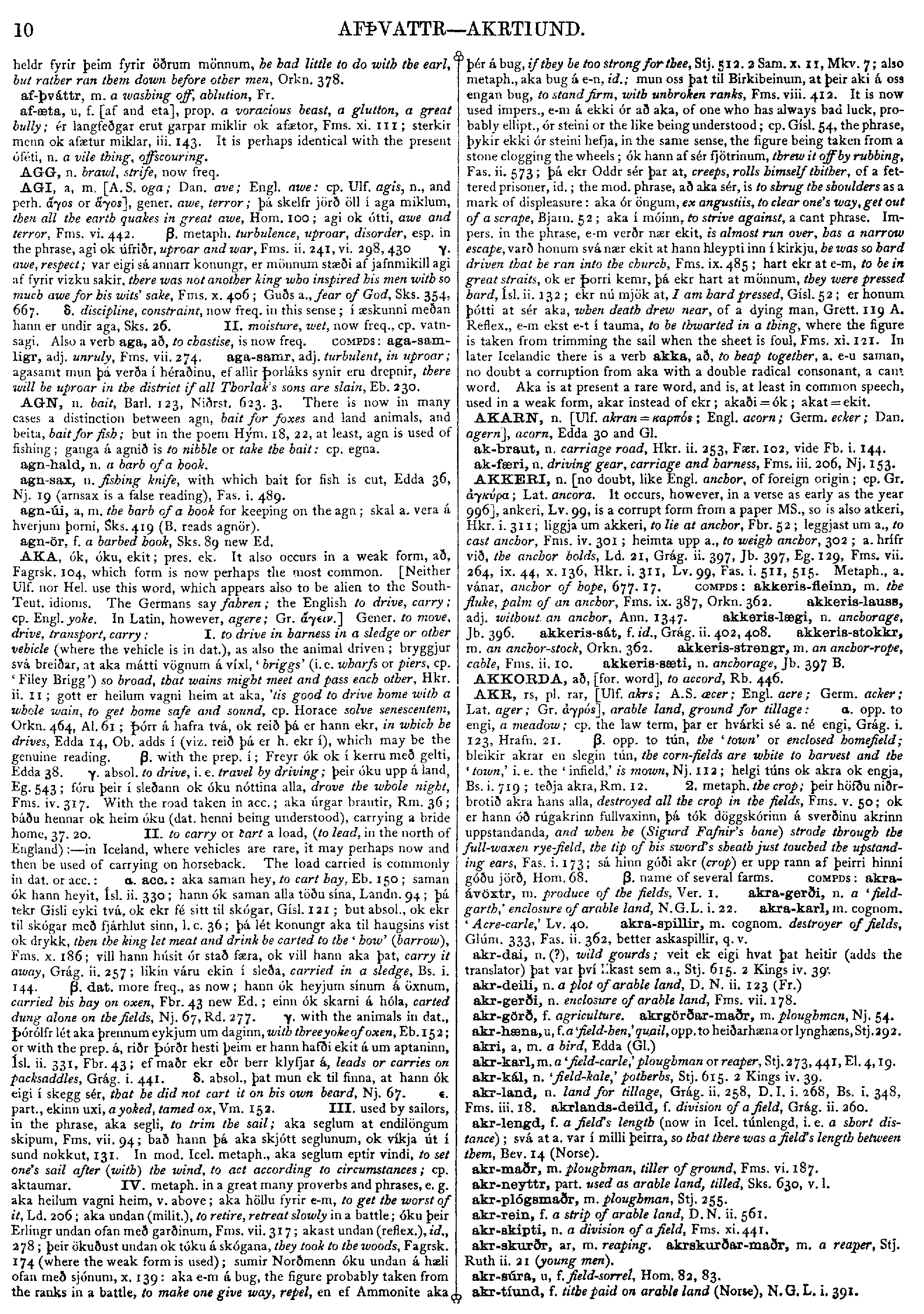
akr-skurðr, ar, m. reaping, akrskurðar-maðr, m. a reaper, Stj. Ruth ii. 21 (young men).
|
Source: Cleasby/Vigfusson, page b0015, entry 1 View original page image as: [TIFF] [PNG] [View previous entry] [View next entry] |
[Comment on this entry] [View comments] |
The following entry has been hand-corrected once. |
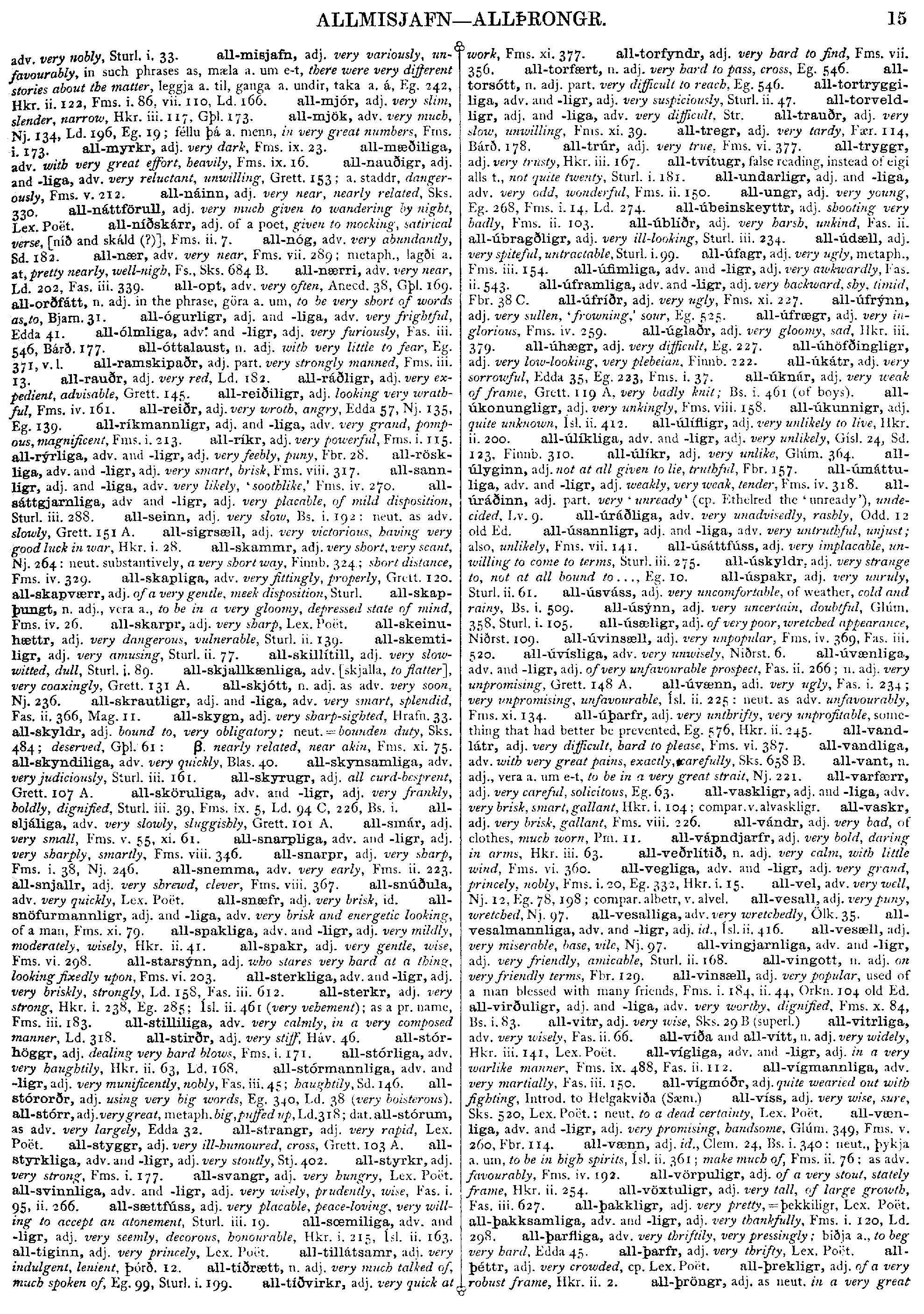
adv.
very
nobly,
Sturl.
i.
33.
all-misjafn,
adj.
very
variously,
un-
favourably,
in
such
phrases
as,
mæla
a.
um
e-t,
there
were
very
different
stories
about
the
matter,
leggja
a.
til,
ganga
a.
undir,
taka
a.
á,
Eg.
242,
Hkr.
ii.
123,
Fms.
i.
86,
vii.
no,
Ld.
166.
all-mjór,
adj.
very
slim,
slender,
narrow,
Hkr.
iii.
117,
Gþl.
173.
all-mjök,
adv.
very
much,
Nj.
134,
Ld.
196,
Eg.
19;
féllu
þá
a.
menn,
in
very
great
numbers,
Fms.
i.
173.
all-myrkr,
adj.
very
dark,
Fms.
ix.
23.
all-mæðiliga,
adv.
with
very
great
effort,
heavily,
Fms.
ix.
16.
all-nauðigr,
adj.
and
-liga,
adv.
very
reluctant,
unwilling,
Grett.
153;
a.
staddr,
danger-
ously,
Fms.
v.
212.
all-náinn,
adj.
very
near,
nearly
related,
Sks.
330.
all-náttförull,
adj.
very
much
given
to
wandering
by
night,
Lex.
Poët.
all-níðskárr,
adj.
of
a
poet,
given
to
mocking,
satirical
verse,
[níð
and
skáld
(?)],
Fms.
ii.
7.
all-nóg,
adv.
very
abundantly,
Sd.
182.
all-nær,
adv.
very
near,
Fms.
vii.
289;
metaph.,
lagði
a.
at,
pretty
nearly,
well-nigh,
Fs.,
Sks.
684
B.
all-nærri,
adv.
very
near,
Ld.
202,
Fas.
iii.
339.
all-opt,
adv.
very
often,
Anecd.
38,
Gþl.
169.
all-orðfátt,
n.
adj.
in
the
phrase,
göra
a.
urn,
to
be
very
short
of
words
as
to,
Bjarn.
31.
all-ógurligr,
adj.
and
-liga,
adv.
very
frightful,
Edda
41.
all-ólmliga,
adv.
and
-ligr,
adj.
very
furiously,
Fas.
iii.
546,
Bárð.
177.
áll-óttalaust,
n.
adj.
with
very
little
to
fear,
Eg.
371,
v.
l.
all-ramskipaðr,
adj.
part,
very
strongly
manned,
Fms.
iii.
13.
all-rauðr,
adj.
very
red,
Ld.
182.
all-ráðligr,
adj.
very
ex-
pedient,
advisable,
Grett.
145.
all-reiðiligr,
adj.
looking
very
wrath-
ful,
Fms.
iv.
161.
all-reiðr,
adj.
very
wroth,
angry,
Edda
57,
Nj.
135,
Eg.
139.
all-ríkmarmligr,
adj.
and
-liga,
adv.
very
grand,
pomp-
ous,
magnificent,
Fms.
i.
213.
all-ríkr,
adj.
very
powerful,
Fms.
i.
115.
all-rýrliga.,
adv.
and
-ligr,
adj.
very
feebly,
puny,
Fbr.
28.
all-rösk-
liga,
adv.
and
-ligr,
adj.
very
smart,
brisk,
Fms.
viii.
317.
all-sann-
ligr,
adj.
and
-liga,
adv.
very
likely,
'soothlike,'
Fms.
iv.
270.
all-
sáttgjarnliga,
adv
and
-ligr,
adj.
very
placable,
of
mild
disposition,
Sturl.
iii.
288.
all-seinn,
adj.
very
slow,
Bs.
i.
192:
neut.
as
adv.
slowly,
Grett.
151
A.
all-sigrsæll,
adj.
very
victorious,
having
very
good
luck
in
war,
Hkr.
i.
28.
all-skammr,
adj.
very
short,
very
scant,
Nj.
264:
neut.
substantively,
a
very
short
way,
Finnb.
324;
short
distance,
Fms.
iv.
329.
all-skapliga,
adv.
very
fittingly,
properly,
Grett.
120.
all-skapværr,
adj.
of
a
very
gentle,
meek
disposition,
Sturl.
all-skap-
þungt,
n.
adj.,
vera
a.,
to
be
in
a
very
gloomy,
depressed
state
of
mind,
Fms.
iv.
26.
all-skarpr,
adj.
very
sharp,
Lex.
Poët.
all-skeinu-
hættr,
adj.
very
dangerous,
vulnerable,
Sturl.
ii.
139.
all-skemti-
ligr,
adj.
very
amusing,
Sturl.
ii.
77.
all-skillítill,
adj.
very
slow-
witted,
dull,
Sturl.
j.
89.
all-skjallkænliga,
adv.
[skjalla,
to
flatter],
very
coaxingly,
Grett.
131
A.
all-skjótt,
n.
adj.
as
adv.
very
soon,
Nj.
236.
all-skrautligr,
adj.
and
-liga,
adv.
very
smart,
splendid,
Fas.
ii.
366,
Mag.
11.
all-skygn,
adj.
very
sharp-sighted,
Hrafn.
33.
all-skyldr,
adj.
bound
to,
very
obligatory;
neut.
==
bounden
duty,
Sks.
484;
deserved,
Gþl.
61:
.
nearly
related,
near
akin,
Fms.
xi.
75.
all-skyndiliga,
adv.
very
quickly,
Blas.
40.
all-skynsamliga,
adv.
very
judiciously,
Stud.
iii.
161.
all-skyrugr,
adj.
all
curd-besprent,
Grett.
107
A.
all-sköruliga,
adv.
and
-ligr,
adj.
very
frankly,
boldly,
dignified,
Sturl.
iii.
39,
Fms.
ix.
5,
Ld.
94
C,
226,
Bs.
i.
all-
sljáliga,
adv.
very
slowly,
sluggishly,
Grett.
101
A.
all-smár,
adj.
very
small,
Fms.
v.
55,
xi.
61.
all-snarpliga,
adv.
and
-ligr,
adj.
very
sharply,
smartly,
Fms.
viii.
346.
all-snarpr,
adj.
very
sharp,
Fms.
i.
38,
Nj.
246.
all-snemma,
adv.
very
early,
Fms.
ii.
223.
all-snjallr,
adj.
very
shrewd,
clever,
Fms.
viii.
367.
all-snúðula,
adv.
very
quickly,
Lex.
Poët.
all-snæfr,
adj.
very
brisk,
id.
all-
snöfurmannligr,
adj.
and
-liga,
adv.
very
brisk
and
energetic
looking,
of
a
man,
Fms.
xi.
79.
all-spakliga,
adv.
and
-ligr,
adj.
very
mildly,
moderately,
wisely,
Hkr.
ii.
41.
all-spakr,
adj.
very
gentle,
wise,
Fms.
vi.
298.
all-starsýnn,
adj.
who
stares
very
hard
at
a
thing,
looking
fixedly
upon,
Fms.
vi.
203.
all-sterkliga,
adv.
and
-ligr,
adj.
very
briskly,
strongly,
Ld.
158,
Fas.
iii.
612.
all-sterkr,
adj.
very
strong,
Hkr.
i.
238,
Eg.
285;
Ísl.
ii.
461
(very
vehement);
as
a
pr.
name,
Fms.
iii.
183.
all-stilliliga,
adv.
very
calmly,
in
a
very
composed
manner,
Ld.
318.
all-stirðr,
adj.
very
stiff,
Háv.
46.
all-stór-
höggr,
adj.
dealing
very
hard
blows,
Fms.
i.
171.
all-stórliga,
adv.
very
haughtily,
Hkr.
ii.
63,
Ld.
168.
all-stórmannliga,
adv.
and
-ligr,
adj.
very
munificently,
nobly,
Fas.
iii.
45;
haughtily,
Sd.
146.
all-
stórorðr,
adj.
using
very
big
words,
Eg.
340,
Ld.
38
(very
boisterous).
all-stórr,
adj.
very
great,
metaph.
big,
puffed
up,
Ld.
318;
dat.
all-stórum,
as
adv.
very
largely,
Edda
32.
all-strangr,
adj.
very
rapid,
Lex.
Poët.
all-styggr,
adj.
very
ill-humoured,
cross,
Grett.
103
A.
all-
styrkliga,
adv.
and
-ligr,
adj.
very
stoutly,
Stj.
402.
all-styrkr,
adj.
very
strong,
Fms.
i.
177.
all-svangr,
adj.
very
hungry,
Lex.
Poët.
all-svinnliga,
adv.
and
-ligr,
adj.
very
wisely,
prudently,
wise,
Fas.
i.
95,
ii.
266.
all-sættfúss,
adj.
very
placable,
peace-loving,
very
will-
ing
to
accept
an
atonement,
Sturl.
iii.
19.
all-sœmiliga,
adv.
and
-ligr,
adj.
very
seemly,
decorous,
honourable,
Hkr.
i.
215,
Ísl.
ii.
163.
all-tiginn,
adj.
very
princely,
Lex.
Poët.
all-tillátsamr,
adj.
very
indulgent,
lenient,
þórð.
12.
all-tíðrætt,
n.
adj.
very
much
talked
of,
much
spoken
of,
Eg.
99,
Sturl.
i.
199.
all-tíðvirkr,
adj.
very
quick
at
work,
Fms.
xi.
377.
all-torfyndr,
adj.
very
hard
to
find,
Fms.
vii.
356.
all-torfært,
n.
adj.
very
hard
to
pass,
cross,
Eg.
546.
all-
torsótt,
n.
adj.
part,
very
difficult
to
reach,
Eg.
546.
all-tortryggi-
liga,
adv.
and
-ligr,
adj.
very
suspiciously,
Sturl.
ii.
47.
all-torveld-
ligr,
adj.
and
-liga,
adv.
very
difficult,
Str.
all-trauðr,
adj.
very
slow,
unwilling,
Fms.
xi.
39.
all-tregr,
adj.
very
tardy,
Fær.
114,
Bárð.
178.
all-trúr,
adj.
very
true.
Fms.
vi.
377.
all-tryggr,
adj.
very
trusty,
Hkr.
iii.
167.
all-tvítugr,
false
reading,
instead
of
eigi
alls
t.,
not
quite
twenty,
Sturl.
i.
181.
all-undarligr,
adj.
and
-liga,
adv.
very
odd,
wonderful,
Fms.
ii.
150.
all-ungr,
adj.
very
young,
Eg.
268,
Fms.
i.
14,
Ld.
274.
all-úbeinskeyttr,
adj.
shooting
very
badly,
Fms.
ii.
103.
all-úblíðr,
adj.
very
harsh,
unkind,
Fas.
ii.
all-úbragðligr,
adj.
very
ill-looking,
Sturl.
iii.
234.
all-údæll,
adj.
very
spiteful,
untractable,
Sturl.
i.
99.
all-úfagr,
adj.
very
ugly,
metaph.,
Fms.
iii.
154.
all-úfimliga,
adv.
and
-ligr,
adj.
very
awkwardly,
Fas.
ii.
543.
all-úframliga,
adv.
and
-ligr,
adj.
very
backward,
shy,
timid,
Fbr.
38
C.
all-úfríðr,
adj.
very
ugly,
Fms.
xi.
227.
all-úfrýnn,
adj.
very
sullen,
'frowning,'
sour,
Eg.
525.
all-úfrægr,
adj.
very
in-
glorious,
Fms.
iv.
259.
all-úglaðr,
adj.
very
gloomy,
sad,
Hkr.
iii.
379.
all-úhægr,
adj.
very
difficult,
Eg.
227.
all-úhöfðingligr,
adj.
very
low-looking,
very
plebeian,
Finnb.
222.
all-úkátr,
adj.
very
sorrowful,
Edda
35,
Eg.
223,
Fms.
i.
37.
all-úknár,
adj.
very
weak
of
frame,
Grett.
119
A,
very
badly
knit;
Bs.
i.
461
(of
boys).
all-
úkonungligr,
adj.
very
unkingly,
Fms.
viii.
158.
all-úkunnigr,
adj.
quite
unknown,
Ísl.
ii.
412.
all-úlífligr,
adj.
very
unlikely
to
live,
Hkr.
ii.
200.
all-úlíkliga,
adv.
and
-ligr,
adj.
very
unlikely,
Gísl.
24,
Sd.
123,
Finnb.
310.
all-úlíkr,
adj.
very
unlike,
Glúm.
364.
all-
úlyginn,
adj.
not
at
all
given
to
lie,
truthful,
Fbr.
157.
all-úmáttu-
liga,
adv.
and
-ligr,
adj.
weakly,
very
weak,
tender,
Fms.
iv.
318.
all-
úráðinn,
adj.
part,
very
'unready'
(cp.
Ethelred
the
'unready'),
unde-
cided,
Lv.
9.
all-úráðliga,
adv.
very
unadvisedly,
rashly,
Odd.
12
old
Ed.
all-úsannligr,
adj.
and
-liga,
adv.
very
untruthful,
unjust;
also,
unlikely,
Fms.
vii.
141.
all-úsáttfúss,
adj.
very
implacable,
un-
willing
to
come
to
terms,
Sturl.
iii.
275.
all-úskyldr.
adj.
very
strange
to,
not
at
all
bound
to...,
Eg.
10.
all-úspakr,
adj.
very
unruly,
Sturl.
ii.
61.
all-úsváss,
adj.
very
uncomfortable,
of
weather,
cold
and
rainy,
Bs.
i.
509.
all-úsýnn,
adj.
very
uncertain,
doubtful,
Glúm.
358,
Sturl.
i.
105.
all-úsæligr,
adj.
of
very
poor,
wretched
appearance,
Niðrst.
109.
all-úvinsæll,
adj.
very
unpopular,
Fms.
iv.
369,
Fas.
iii.
520.
all-úvísliga,
adv.
very
unwisely,
Niðrst.
6.
all-úvænliga.,
adv.
and
-ligr,
adj.
of
very
unfavourable
prospect,
Fas.
ii.
266;
n.
adj.
very
unpromising,
Grett.
148
A.
all-úvænn,
adi.
very
ugly,
Fas.
i.
234;
very
unpromising,
unfavourable,
Ísl.
ii.
225:
neut.
as
adv.
unfavourably,
Fms.
xi.
134.
all-úþarfr,
adj.
very
unthrifty,
very
unprofitable,
some-
thing
that
had
better
be
prevented,
Eg.
576,
Hkr.
ii.
245.
all-vand-
látr,
adj.
very
difficult,
hard
to
please,
Fms.
vi.
387.
all-vandliga,
adv.
with
very
great
pains,
exactly,
carefully,
Sks.
658
B.
all-vant,
n.
adj.,
vera
a.
um
e-t,
to
be
in
a
very
great
strait,
Nj.
221.
all-varfærr,
adj.
very
careful,
solicitous,
Eg.
63.
all-vaskligr,
adj.
and
-liga,
adv.
very
brisk,
smart,
gallant,
Hkr.
i.
104;
compar.
v.
alvaskligr.
all-vaskr,
adj.
very
brisk,
gallant,
Fms.
viii.
226.
all-vandr,
adj.
very
bad,
of
clothes,
much
worn,
Pm.
11.
all-vápndjarfr,
adj.
very
bold,
daring
in
arms,
Hkr.
iii.
63.
all-veðrlítið,
n.
adj.
very
calm,
with
little
wind,
Fms.
vi.
360.
all-vegliga,
adv.
and
-ligr,
adj.
very
grand,
princely,
nobly,
Fms.
i.
20,
Eg.
332,
Hkr.
i.
15.
all-vel,
adv.
very
well,
Nj.
12,
Eg.
78,
198;
compar.
albetr,
v.
alvel.
all-vesall,
adj.
very
puny,
wretched,
Nj.
97.
all-vesalliga,
adv.
very
wretchedly,
Ölk.
35.
all-
vesalmannliga,
adv.
and
-ligr,
adj.
id.,
Ísl.
ii.
416.
all-vesæll,
adj.
very
miserable,
base,
vile,
Nj.
97.
all-vingjarnliga,
adv.
and
-ligr,
adj.
very
friendly,
amicable,
Sturl.
ii.
168.
all-vingott,
n.
adj.
on
very
friendly
terms,
Fbr.
129.
all-vinsæll,
adj.
very
popular,
used
of
a
man
blessed
with
many
friends,
Fms.
i.
184,
ii.
44,
Orkn.
104
old
Ed.
all-virðuligr,
adj.
and
-liga,
adv.
very
worthy,
dignified,
Fms.
x.
84,
Bs.
i.
83.
all-vitr,
adj.
very
wise,
Sks.
29
B
(superl.)
all-vitrliga,
adv.
very
wisely,
Fas.
ii.
66.
all-víða
and
all-vítt,
n.
adj.
very
widely,
Hkr.
iii.
141,
Lex.
Poët.
all-vígliga,
adv.
and
-ligr,
adj.
in
a
very
warlike
manner,
Fms.
ix.
488,
Fas.
ii.
112.
all-vígmannliga,
adv.
very
martially,
Fas.
iii.
150.
all-vígmóðr,
adj.
quite
wearied
out
with
fighting,
Introd.
to
Helgakviða
(Sæm.)
all-víss,
adj.
very
wise,
sure,
Sks.
520,
Lex.
Poët.:
neut.
to
a
dead
certainty,
Lex.
Poët.
all-væn-
liga,
adv.
and
-ligr,
adj.
very
promising,
handsome,
Glúm.
349,
Fms.
v.
260,
Fbr.
114.
all-vænn,
adj.
id.,
Clem.
24,
Bs.
i.
340:
neut.,
þykja
a.
um,
to
be
in
high
spirits,
Ísl.
ii.
361;
make
much
of,
Fms.
ii.
76;
as
adv.
favourably,
Fms.
iv.
192.
all-vörpuligr,
adj.
of
a
very
stout,
stately
frame,
Hkr.
ii.
254.
all-vöxtuligr,
adj.
very
tall,
of
large
growth,
Fas.
iii.
627.
all-þakkligr,
adj.
very
pretty,
=
þekkiligr,
Lex.
Poët,
all-þakksamliga,
adv.
and
-ligr,
adj.
very
thankfully,
Fms.
i.
120,
Ld.
298.
all-þarfliga,
adv.
very
thriftily,
very
pressingly;
biðja
a.,
to
beg
very
hard,
Edda
45.
all-þarfr,
adj.
very
thrifty,
Lex.
Poët.
all-
þéttr,
adj.
very
crowded,
cp.
Lex.
Poët.
all-þrekligr,
adj.
of
a
very
robust
frame,
Hkr.
ii.
2.
all-þröngr,
adj.
as
neut.
in
a
very
great
|
Source: Cleasby/Vigfusson, page b0027, entry 2 View original page image as: [TIFF] [PNG] [View previous entry] [View next entry] |
[Comment on this entry] [View comments] |
The following entry has been hand-corrected once. |
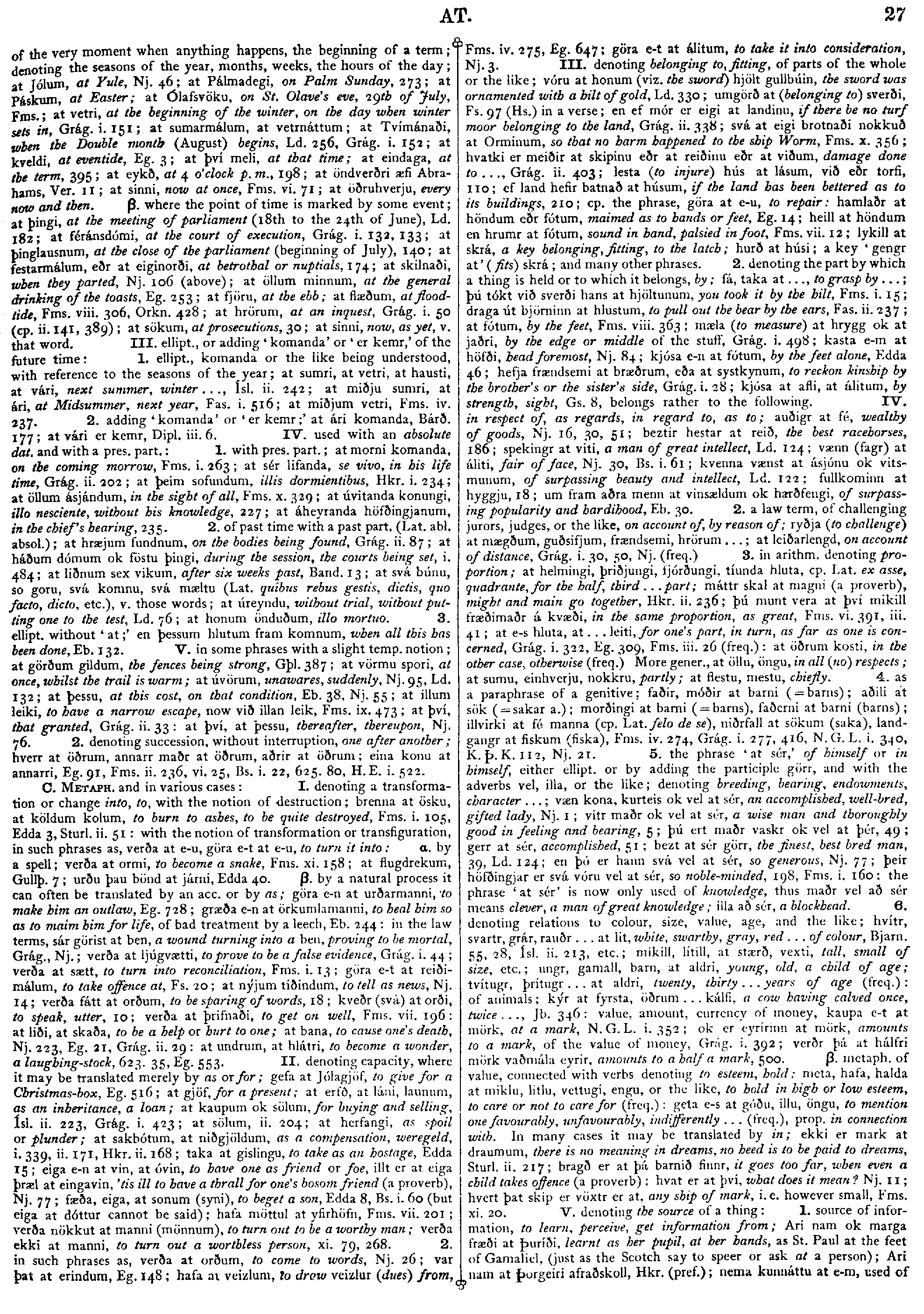
C.
METAPH.
and
in
various
cases:
I.
denoting
a
transforma-
tion
or
change
into,
to,
with
the
notion
of
destruction;
brenna
at
ösku,
at
köldum
kolum,
to
burn
to
ashes,
to
be
quite
destroyed,
Fms.
i.
105,
Edda
3,
Sturl.
ii.
51:
with
the
notion
of
transformation
or
transfiguration,
in
such
phrases
as,
verða
at
e-u,
göra
e-t
at
e-u,
to
turn
it
into:
a.
by
a
spell;
verða
at
ormi,
to
become
a
snake,
Fms.
xi.
158;
at
flugdrekum,
Gullþ.
7;
urðu
þau
bönd
at
járni,
Edda
40.
P.
by
a
natural
process
it
can
often
be
translated
by
an
acc.
or
by
as;
göra
e-n
at
urðarmanni,
'
t
o
make
him
an
outlaw,
Eg.
728;
græða
e-n
at
orkumlamanni,
to
heal
him
so
as
to
maim
him
for
life,
of
bad
treatment
by
a
leech,
Eb.
244:
in
the
law
terms,
sár
görist
at
ben,
a
wound
turning
into
a
ben,
proving
to
be
mortal,
Grág.,
Nj.;
verða
at
ljúgvætti,
to
prove
to
be
a
false
evidence,
Grág.
i.
44;
verða
at
sætt,
to
turn
into
reconciliation,
Fms.
i.
13;
göra
e-t
at
reiði
málum,
to
take
offence
at,
Fs.
20;
at
nýjum
tíðindum,
to
tell
as
news,
Nj.
14;
verða
fátt
at
orðum,
to
be
sparing
of
words,
18;
kveðr
(svá)
at
orði,
to
speak,
utter,
10;
verða
at
þrifnaði,
to
geton
well,
Fms.
vii.
196:
at
liði,
at
skaða,
to
be
a
help
or
hurt
to
one;
at
bana,
to
cause
one's
death,
Nj.
223,
Eg.
21,
Grág.
ii.
29:
at
undrum,
at
hlátri,
to
become
a
wonder,
a
laughing-stock,
623.
35,
Eg.
553.
II.
denoting
capacity,
where
it
may
be
translated
merely
by
as
or
for;
gefa
at
Jólagjöf,
to
give
for
a
Christmas-box,
Eg.
516;
at
gjöf,
for
a
present;
at
erfð,
at
láni,
launum,
as
an
inheritance,
a
loan;
at
kaupum
ok
sökum,
for
buying
and
selling,
Ísl.
ii.
223,
Grág.
i.
423;
at
solum,
ii.
204;
at
herfangi,
as
spoil
or
plunder;
at
sakbótum,
at
niðgjöldum,
as
a
compensation,
weregeld,
i.
339,
ii.
171,
Hkr.
ii.
168;
taka
at
gíslingu,
to
take
as
an
hostage,
Edda
15;
eiga
e-n
at
vin,
at
óvin,
to
have
one
as
friend
or
foe,
illt
er
at
eiga
þræl
at
eingavin,
'tis
ill
to
have
a
thrall
for
one's
bosom
friend
(a
proverb),
Nj.
77;
fæða,
eiga,
at
sonum
(syni),
to
beget
a
son,
Edda
8,
Bs.
i.
60
(but
eiga
at
dóttur
cannot
be
said);
hafa
möttul
at
yfirhöfn,
Fms.
vii.
201;
verða
nökkut
at
manni
(mönnum),
to
turn
out
to
be
a
worthy
man;
verða
ekki
at
manni,
to
turn
out
a
worthless
person,
xi.
79,
268.
2.
in
such
phrases
as,
verða
at
orðum,
to
come
towards,
Nj.
26;
var
þat
at
erindum,
Eg.
148;
hafa
at
veizlum,
to
draw
veizlur
(dues)
from,
'Fms.
iv.
275,
Eg.
647;
gora
e-t
at
álitum,
to
take
it
into
consideration,
Nj-3.
III.
denoting
belonging
to,
fitting,
of
parts
of
the
whole
or
the
like;
vóru
at
honum
(viz.
the
sword)
hjölt
gullbúin,
the
sword
was
ornamented
with
a
hilt
of
gold,
Ld.
330;
umgörð
at
(belonging
to)
sverði,
Fs.
97
(Hs.)
in
a
verse;
en
ef
mór
er
eigi
at
landinu,
if
there
be
no
turf
moor
belonging
to
the
land,
Grág.
ii.
338;
svá
at
eigi
brotnaði
nokkuð
at
Orminum,
so
that
no
harm
happened
to
the
ship
Worm,
Fms.
x.
356;
hvatki
er
meiðir
at
skipinu
eðr
at
reiðinu
eðr
at
viðum,
damage
done
t
o
...,
Grág.
ii.
403;
lesta
(to
injure)
hús
at
lásum,
við
eðr
torfi,
110;
ef
land
hefir
batnað
at
húsum,
if
the
land
has
been
bettered
as
to
its
buildings,
210;
cp.
the
phrase,
göra
at
e-u,
to
repair:
hamlaðr
at
höndum
eðr
fótum,
maimed
as
to
hands
or
feet,
Eg.
14;
heill
at
höndum
en
hrumr
at
fótum,
sound
in
band,
palsied
in
foot,
Fms.
vii.
12;
lykill
at
skrá,
a
key
belonging,
fitting,
to
the
latch;
hurð
at
húsi;
a
key
'gengr
at'
(fits)
skrá;
and
many
other
phrases.
2.
denoting
the
part
by
which
a
thing
is
held
or
to
which
it
belongs,
by;
fá,
taka
at...,
to
grasp
by
...;
þú
tókt
við
sverði
hans
at
hjöltunum,
you
took
it
by
the
bill,
Fms.
i.
15;
draga
út
björninn
at
hlustum,
to
pull
out
the
bear
by
the
ears,
Fas.
ii.
237;
at
fótum,
by
the
feet,
Fms.
viii.
363;
mæla
(to
measure)
at
hrygg
ok
at
jaðri,
by
the
edge
or
middle
of
the
stuff,
Grág.
i.
498;
kasta
e-m
at
höfði,
head
foremost,
Nj.
84;
kjósa
e-n
at
fótum,
by
the
feet
alone,
Edda
46;
hefja
frændsemi
at
bræðrum,
eða
at
systkynum,
to
reckon
kinship
by
the
brother's
or
the
sister's
side,
Grág.
i.
28;
kjósa
at
afli,
at
álitum,
by
strength,
sight,
Gs.
8,
belongs
rather
to
the
following.
IV.
in
respect
of,
as
regards,
in
regard
to,
as
to;
auðigr
at
fé,
wealthy
of
goods,
Nj.
16,
30,
51;
beztir
hestar
at
reið,
the
best
racehorses,
186;
spekingr
at
viti,
a
man
of
great
intellect,
Ld.
124;
vænn
(fagr)
at
áliti,
fair
of
face,
Nj.
30,
Bs.
i.
61;
kvenna
vænst
at
ásjónu
ok
vits
munum,
of
surpassing
beauty
and
intellect,
Ld.
122;
fullkominn
at
hyggju,
18;
um
fram
aðra
menn
at
vinsældum
ok
harðfengi,
of
surpass-
ing
popularity
and
hardihood,
Eb.
30.
2.
a
law
term,
of
challenging
jurors,
judges,
or
the
like,
on
account
of,
by
reason
of;
ryðja
(to
challenge)
at
mægðum,
guðsifjum,
frændsemi,
hrörum
...;
at
leiðarlengd,
on
account
of
distance,
Grág.
i.
30,
50,
Nj.
(freq.)
3.
in
arithm.
denoting
pro
portion;
at
helmingi,
þriðjungi,
fjórðungi,
tíunda
hluta,
cp.
Lat.
ex
asse,
quadrante,
for
the
half,
third...
part;
máttr
skal
at
magni
(a
proverb),
might
and
main
go
together,
Hkr.
ii.
236;
þú
munt
vera
at
því
mikill
fræðimaðr
á
kvæði,
in
the
same
proportion,
as
great,
Fms.
vi.
391,
iii.
41;
at
e-s
hluta,
at...
leiti,
for
one's
part,
in
turn,
as
far
as
one
is
con
cerned,
Grág.
i.
322,
Eg.
309,
Fms.
iii.
26
(freq.):
at
öðrum
kosti,
in
the
other
case,
otherwise
(freq.)
More
gener.,
at
öllu,
öngu,
in
all
(no)
respects;
at
sumu,
einhverju,
nokkru,
partly;
at
flestu,
mestu,
chiefly.
4.
as
a
paraphrase
of
a
genitive;
faðir,
móðir
at
barni
(=
barns);
aðili
at
sök
(=
sakar
a.);
morðingi
at
barni
(=
barns),
faðerni
at
barni
(barns);
illvirki
at
fé
manna
(cp.
Lat.
felo
de
se),
niðrfall
at
sökum
(saka),
land
gangr
at
fiskum
(fiska),
Fms.
iv.
274,
Grág.
i.
277,
416,
N.
G.
L.
i.
340,
K.
Þ.
K.
112,
Nj.
21.
5.
the
phrase
'at
sér,'
of
himself
or
in
himself,
either
ellipt.
or
by
adding
the
participle
görr,
and
with
the
adverbs
vel,
ilia,
or
the
like;
denoting
breeding,
bearing,
endowments,
character
...;
væn
kona,
kurteis
ok
vel
at
sér,
an
accomplished,
well-bred,
gifted
lady,
Nj.
I;
vitr
maðr
ok
vel
at
sér,
a
wise
man
and
thoroughly
good
in
feeling
and
bearing,
5;
þú
ert
maðr
vaskr
ok
vel
at
þér,
49;
gerr
at
sér,
accomplished,
51;
bezt
at
sér
görr,
the
finest,
best
bred
man,
39,
Ld.
124;
en
þó
er
hann
svá
vel
at
sér,
so
generous,
Nj.
77;
þeir
höfðingjar
er
svá
vóru
vel
at
sér,
so
noble-minded,
198,
Fms.
i.
160:
the
phrase
'at
sér'
is
now
only
used
of
knowledge,
thus
maðr
vel
að
sér
means
clever,
a
man
of
great
knowledge;
illa
að
sér,
a
blockhead.
6.
denoting
relations
to
colour,
size,
value,
age,
and
the
like;
hvitr,
svartr,
grár,
rauðr
...
at
lit,
white,
swarthy,
gray,
red
...
of
colour,
Bjarn.
55,
28,
Ísl.
ii.
213,
etc.;
mikill,
litill,
at
stærð,
vexti,
tall,
small
of
size,
etc.;
ungr,
gamall,
barn,
at
aldri,
young,
old,
a
child
of
age;
tvítugr,
þrítugr
...
at
aldri,
twenty,
thirty
...
years
of
age
(freq.):
of
animals;
kyr
at
fyrsta,
öðrum
...
kálfi,
a
cow
having
calved
once,
twice...,
Jb.
346:
value,
amount,
currency
of
money,
kaupa
e-t
at
mörk,
at
a
mark,
N.
G.
L.
1.
352;
ok
er
eyririnn
at
mörk,
amounts
to
a
mark,
of
the
value
of
money,
Grág.
i.
392;
verðr
þá
at
hálfri
murk
vaðmála
eyrir,
amounts
to
a
half
a
mark,
500.
.
metaph.
of
value,
connected
with
verbs
denoting
to
esteem,
hold;
meta,
hafa,
halda
at
miklu,
litlu,
vettugi,
engu,
or
the
like,
to
hold
in
high
or
low
esteem,
to
care
or
not
to
care
for
(freq.):
geta
e-s
at
góðu,
illu,
öngu,
to
mention
one
favourably,
unfavourably,
indifferently
...
(freq.),
prop,
in
connection
with.
In
many
cases
it
may
be
translated
by
in;
ekki
er
mark
at
draumum,
there
is
no
meaning
in
dreams,
no
heed
is
to
be
paid
to
dreams,
Sturl.
ii.
217;
bragð
er
at
þá
barnið
finnr,
it
goes
too
far,
when
even
a
child
takes
offence
(a
proverb):
hvat
er
at
því,
what
does
it
mean?
Nj.
11;
hvert
þat
skip
er
vöxtr
er
at,
any
ship
of
mark,
i.
e.
however
small,
Fms.
xi.
2O.
V.
denoting
the
source
of
a
thing:
1.
source
of
infor
mation,
to
learn,
perceive,
get
information
from;
Ari
nam
ok
marga
fræði
at
Þuríði,
learnt
as
her
pupil,
at
her
hands,
as
St.
Paul
at
the
feet
of
Gamaliel,
(just
as
the
Scotch
say
to
speer
or
ask
at
a
person);
Ari
nam
at
Þorgeiri
afraðskoll,
Hkr.
(pref.);
nema
kunnáttu
at
e-m,
used
of
|
Source: Cleasby/Vigfusson, page b0030, entry 9 View original page image as: [TIFF] [PNG] [View previous entry] [View next entry] |
[Comment on this entry] [View comments] |
The following entry has been hand-corrected once. |
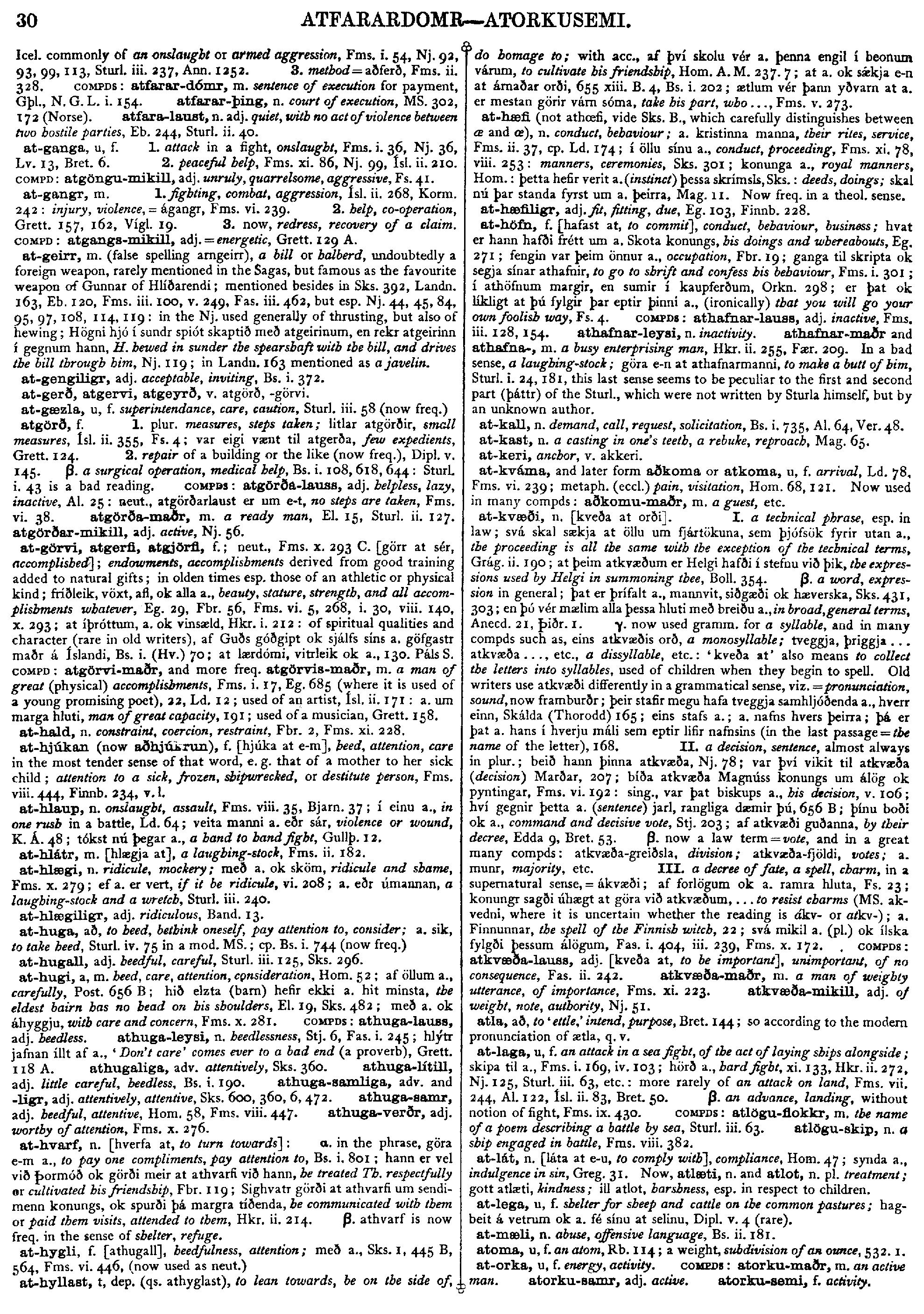
at-görvi, atgerfl, atgjörfl, f.; neut., Fms. x. 293 C. [görr at sér, accomplished] ; endowments, accomplishments derived from good training added to natural gifts; in olden times esp. those of an athletic or physical kind; fríðleik, vöxt, afl, ok alla a., beauty, stature, strength, and all accom- plishments whatever, Eg. 29, Fbr. 56, Fms. vi. 5, 268, i. 30, viii 140, x. 293; at íþróttum, a. ok vinsæld, Hkr. i. 212: of spiritual qualities and character (rare in old writers), af Guðs góðgipt ok sjálfs sins a. göfgastr maðr á Íslandi, Bs. i. (Hv.) 70; at lærdómi, vitrleik ok a., 130. Páls S. COMPD: atgörvi-maðr, and more freq. atgörvis-maðr, m. a man of great (physical) accomplishments, Fms. i. 17, Eg. 685 (where it is used of a young promising poet), 22, Ld. 12; used of an artist, Ísl. ii. 171: a. um marga hluti, man of great capacity, 191; used of a musician, Grett. 158.
|
Source: Cleasby/Vigfusson, page b0034, entry 35 View original page image as: [TIFF] [PNG] [View previous entry] [View next entry] |
[Comment on this entry] [View comments (1)] |
The following entry has been hand-corrected once. |
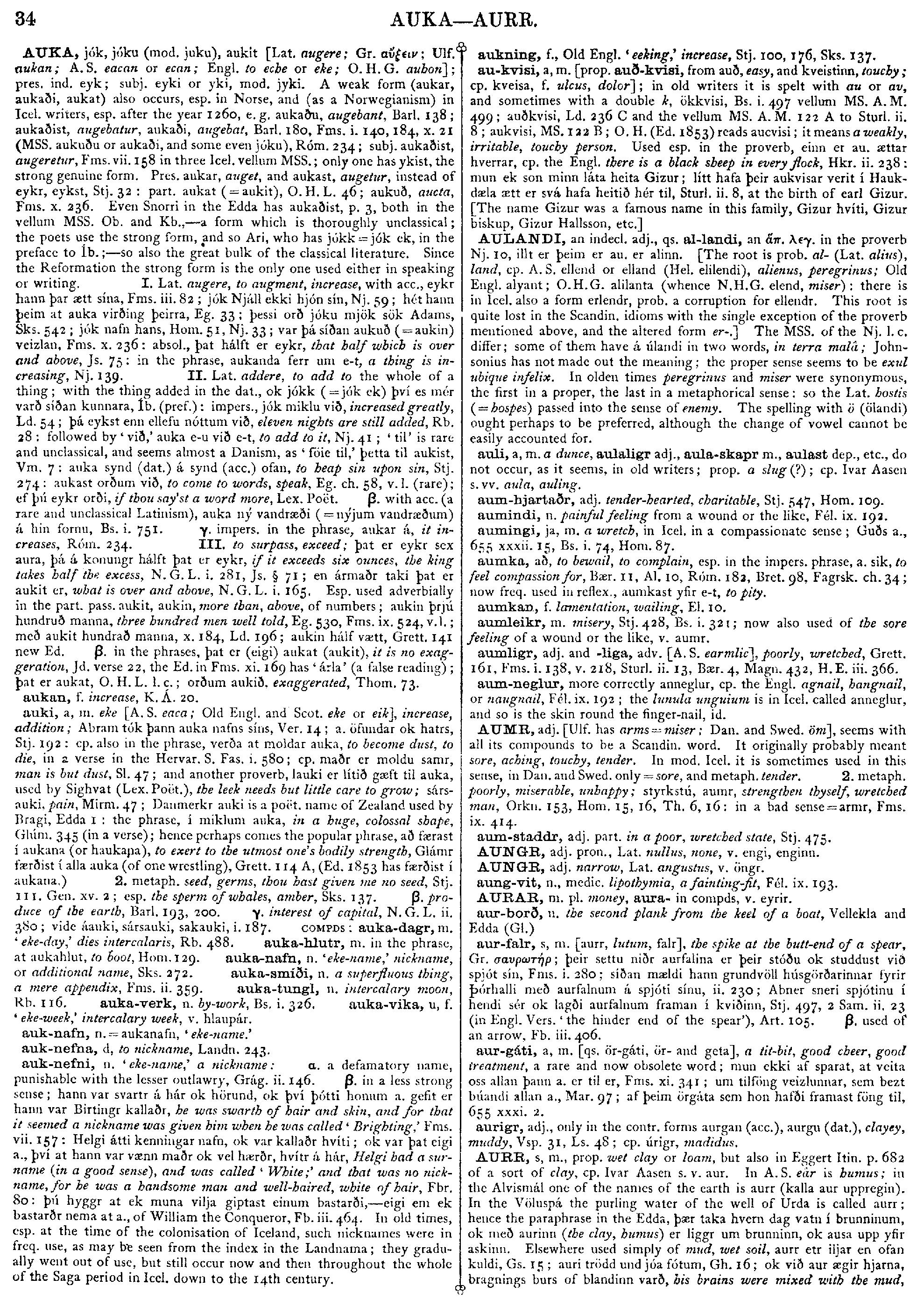
AUSA,
jós,
josu
(mod.
jusu),
ausit;
pres.
ind.
eyss;
subj.
eysi
or
ysi,
mod.
jysi
(hauriret),
cp.
Lat.
haurio,
haus-it;
not
found
in
Goth,
or
in
Germ.
I.
to
sprinkle,
with
dat.
of
the
liquid,
and
the
object
in
acc.
or
with
a
prep.;
Þær
taka
hvern
dag
vatn
í
brunninum,
ok
ausa
(viz.
Því)
upp
yfir
askinn,
.
.
.
pour
it
over
the
ash-boughs,
Edda.
II;
ef
maðr
eyss
eldi
(fire,
embers,)
Grág.
ii.
128;
a.
síld
ór
netjum,
to
empty
the
nets
of
the
herrings,
GÞl.
427:
a.
út,
to
pour
out,
fé,
Grett.
126.
2.
ausa
moldu,
to
sprinkle
with
mould,
bury;
hlóðu
Þeir
at
grjóti
ok
jósu
at
moldu,
Eg.
300;
er
hann
höfðu
moldu
ausit,
Bjarn.
II;
salr
ausinn
moldu,
his
chamber
sprinkled
with
mould
(poët.),
Hervar.
S.;
ausinn
haugi,
Ýt.
26.
.
ausa
vatni
is
a
standing
phrase
for
a
sort
of
baptism
used
in
the
last
centuries,
at
least,
of
the
heathen
age.
The
child
when
born
was
sprinkled
with
water
and
named,
yet
without
the
intervention
of
a
priest;
this
rite
is
mentioned
as
early
as
in
the
Hávamál,
one
of
the
very
oldest
mythological
didactic
poems
on
record,
where
it
is
attributed
even
to
Odin;
ef
ek
skal
Þegn
ungan
verpa
vatni
á,
if
I
am
to
throw
water
on
a
young
thane,
159;
Jósu
vatni
Jarl
létu
heita,
Jóð
ól
Edda
jósu
vatni,
hörvi
svartan,
hétu
Þræl,
Rm.
7,
31;
sá
var
siðr
göfigra
manna,
at
vanda
menn
mjök
til
at
ausa
vatni
ok
gefa
nafn;...
Sigurðr
jarl
jós
sveininn
vatni
ok
kallaði
Hákon,
Hkr.
i.
118;
Eiríkr
ok
Gunn-
hildr
áttu
son
er
Haraldr
konungr
jós
vatni
ok
gaf
nafn
sitt,
122;
eptir
um
daginn
jós
Hákon
konungr
Þann
svein
vatni
ok
gaf
nafn
sitt,
135,
Fms.
i.
66,
xi.
2;
fæddi
Þóra
sveinbarn
ok
var
Grimr
nefndr
er
vatni
var
ausinn,
Eb.
26;
enn
áttu
Þau
Skallagrímr
son,
sá
var
vatni
ausinn
ok
nafn
gefit
ok
kallaðr
Egill,
Eg.
146,
147,
166,
Ld.
108,
Gísl.
32
(of
Snorre
Gode);
and
so
in
many
instances
from
Icel.,
Norway,
and
the
Orkneys,
all
of
them
of
the
heathen
age.
The
Christian
term
is
skíra,
q.
v.
3.
metaph.
of
scolding
or
abuse;
hrópi
ok
rógi
ef
Þú
eyss
á
holl
regin,
Ls.
4;
ausa
sauri
á
e-n,
to
bespatter
with
foul
language,
ausask
sauri
á
(recipr.),
Bjarn.
33;
a.
e-m
e-u
í
augu
upp,
to
throw
in
one's
face,
Eg.
576;
hann
jós
upp
(poured
out)
Þar
fyrir
alÞýðu
öllum
glæpum
föður
síns,
Mart.
80;
um
verka
Þann
er
hverr
jós
á
annan,
Bjarn.
42.
II.
of
a
horse,
to
kick
or
lash
out
with
his
hinder
feet,
opp.
to
prjóna,
to
rear
up
and
strike
with
the
fore
feet;
hestrinn
tók
at
frýsa,
blása
ok
ausa,
Greg.
49;
at
merrin
eysi,
Sturl.
ii.
40
C.
III.
to
pump,
esp.
a
ship,
with
the
ship
in
acc.;
Hallfreðr
jós
at
sínum
hlut,
Fs.
113,
Grett.
95
A,
Fbr.
173,
N.
G.
L.
i.
102:
a.
bát
sinn,
to
make
water,
Fms.
vii.
331.
|
Source: Cleasby/Vigfusson, page b0041, entry 86 View original page image as: [TIFF] [PNG] [View previous entry] [View next entry] |
[Comment on this entry] [View comments] |
The following entry has been hand-corrected once. |
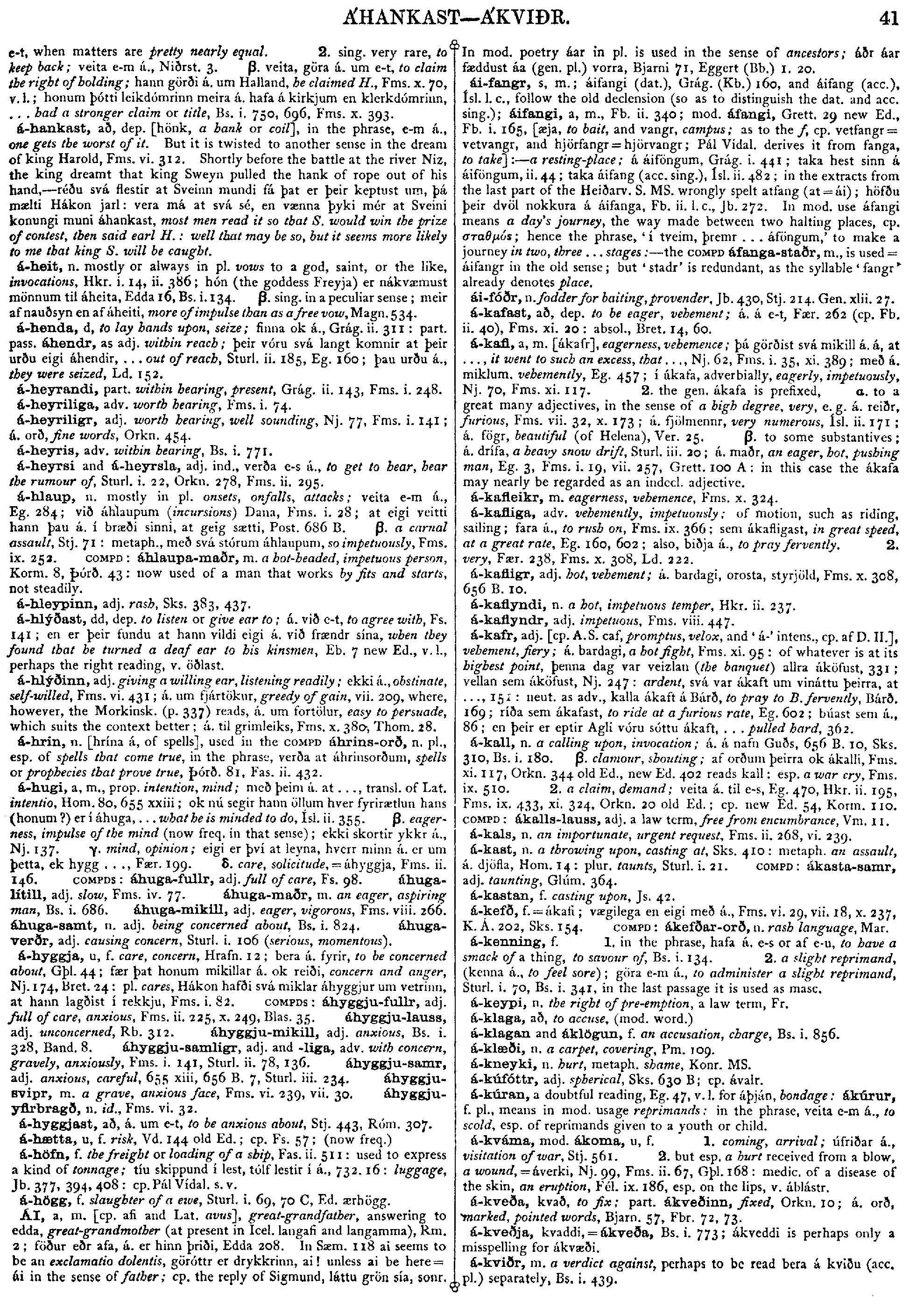
ÁLKA, u, f. an auk, alca L., Edda (Gl.): álku-ungi, a, m. a young auk, Fs. 147: metaph. a long neck, in the phrase, teygja álkuna (cant).
| Result Page: |  |
Previous | 10 11 12 13 14 15 16 17 18 19 20 21 22 23 24 25 26 27 28 | Next |  |
Germanic Lexicon Project (main page)
This search system was written by
Sean Crist
Please consider
volunteering
to correct the data in these online dictionaries.
No rights reserved. Feel free to use these data in any way you please.