|
|

|
Source: Bosworth/Toller, page b0078, entry 14 View original page image as: [TIFF] [PNG] [View previous entry] [View next entry] |
[Comment on this entry] [View comments] |
The following entry has been hand-corrected once. |
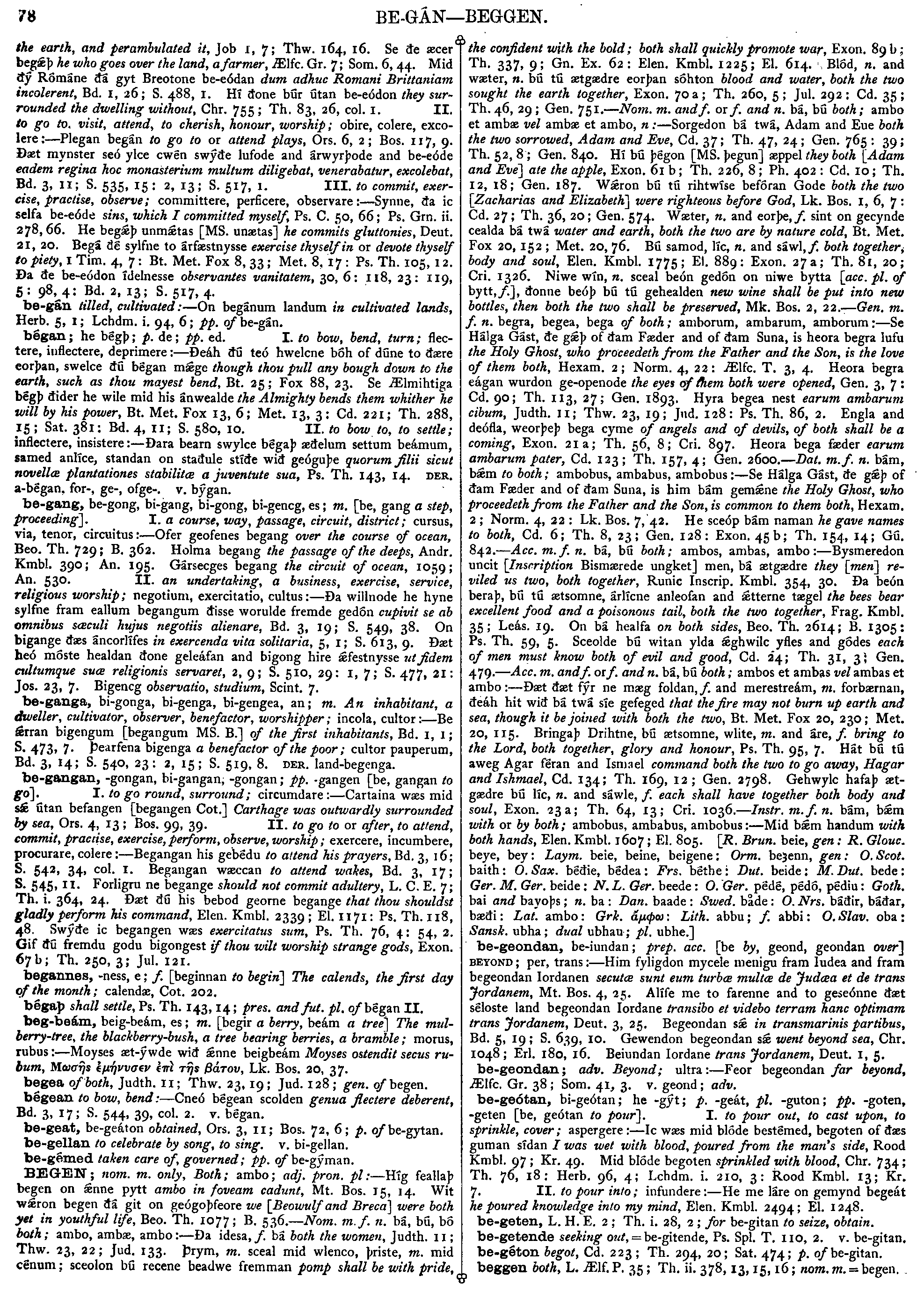
BEGEN;
nom.
m.
only,
Both;
ambo;
adj.
pron.
pl
:--
Híg
feallaþ
begen
on
 nne
pytt
ambo
in
foveam
cadunt,
Mt.
Bos.
15,
14.
Wit
wron
begen
ðá
git
on
geógoþfeore
we
[Beowulf
and
Breca]
were
both
yet
in
youthful
life,
Beo.
Th.
1077;
B.
536.
-
Nom.
m.
f.
n.
bá,
bú,
bó
both;
ambo,
ambæ,
ambo
:--
Ða
idesa,
f.
bá
both
the
women,
Judth.
11;
Thw.
23,
22;
Jud.
133.
Þrym,
m.
sceal
mid
wlenco,
þriste,
m.
mid
cénum;
sceolon
bú
recene
beadwe
fremman
pomp
shall
be
with
pride,
the
confident
with
the
bold;
both
shall
quickly
promote
war,
Exon.
89
b
;
Th.
337,
9;
Gn.
Ex.
62
:
Elen.
Kmbl.
1225;
El.
614.
Blód,
n.
and
wæter,
n.
bú
tú
ætgædre
eorþan
sóhton
blood
and
water,
both
the
two
sought
the
earth
together,
Exon.
70
a;
Th.
260,
5
;
Jul.
292
:
Cd.
35;
Th.
46,
29;
Gen.
751.
-
Nom.
m.
and
f.
or
f.
and
n.
bá,
bú
both;
ambo
et
ambæ
vel
ambæ
et
ambo,
n
:--
Sorgedon
bá
twá,
Adam
and
Eue
both
the
two
sorrowed,
Adam
and
Eve,
Cd.
37;
Th.
47,
24;
Gen.
765
:
39;
Th.
52,
8;
Gen.
840.
Hí
bú
þégon
[MS.
þegun]
æppel
they
both
[Adam
and
Eve]
ate
the
apple,
Exon.
61
b
;
Th.
226,
8
;
Ph.
402
:
Cd.
10
;
Th.
12,
18;
Gen.
187.
Wron
bú
tú
rihtwíse
befóran
Gode
both
the
two
[Zacharias
and
Elizabeth]
were
righteous
before
God,
Lk.
Bos.
1,
6,
7
:
Cd.
27;
Th.
36,
20;
Gen.
574.
Wæter,
n.
and
eorþe,
f.
sint
on
gecynde
cealda
bá
twá
water
and
earth,
both
the
two
are
by
nature
cold,
Bt.
Met.
Fox
20,
152
;
Met.
20,
76.
Bú
samod,
líc,
n.
and
sáwl,
f.
both
together,
body
and
soul,
Elen.
Kmbl.
1775;
El.
889
:
Exon.
27
a
;
Th.
81,
20;
Cri.
1326.
Niwe
wín,
n.
sceal
beón
gedón
on
niwe
bytta
[acc.
pl.
of
bytt,
f.],
ðonne
beóþ
bú
tú
gehealden
new
wine
shall
be
put
into
new
bottles,
then
both
the
two
shall
be
preserved,
Mk.
Bos.
2,
22.
-
Gen.
m.
f.
n.
begra,
begea,
bega
of
both;
amborum,
ambarum,
amborum
:--
Se
Hálga
Gást,
ðe
gþ
of
ðam
Fæder
and
of
ðam
Suna,
is
heora
begra
lufu
the
Holy
Ghost,
who
proceedeth
from
the
Father
and
the
Son,
is
the
love
of
them
both,
Hexam.
2
;
Norm.
4,
22
:
Ælfc.
T.
3,
4.
Heora
begra
eágan
wurdon
ge-openode
the
eyes
of
them
both
were
opened,
Gen.
3,
7
:
Cd.
90;
Th.
113,
27;
Gen.
1893.
Hyra
begea
nest
earum
ambarum
cibum,
Judth.
11;
Thw.
23,
19;
Jud.
128
:
Ps.
Th.
86,
2.
Engla
and
deófla,
weorþeþ
bega
cyme
of
angels
and
of
devils,
of
both
shall
be
a
coming,
Exon.
21
a;
Th.
56,
8;
Cri.
897.
Heora
bega
fæder
earum
ambarum
pater,
Cd.
123;
Th.
157,
4
;
Gen.
2600.
-
Dat.
m.
f.
n.
bám,
bm
to
both;
ambobus,
ambabus,
ambobus
:--
Se
Hálga
Gást,
ðe
gþ
of
ðam
Fæder
and
of
ðam
Suna,
is
him
bám
gemne
the
Holy
Ghost,
who
proceedeth
from
the
Father
and
the
Son,
is
common
to
them
both,
Hexam.
2
;
Norm.
4,
22
:
Lk.
Bos.
7,
42.
He
sceóp
bám
naman
he
gave
names
to
both,
Cd.
6;
Th.
8,
23;
Gen.
128
:
Exon.
45
b;
Th.
154,
14;
Gú.
842.
-
Acc.
m.
f.
n.
bá,
bú
both;
ambos,
ambas,
ambo
:--
Bysmeredon
uncit
[Inscription
Bismærede
ungket]
men,
bá
ætgædre
they
[men]
reviled
us
two,
both
together,
Runic
Inscrip.
Kmbl.
354,
30.
Ða
beón
beraþ,
bú
tú
ætsomne,
árlícne
anleofan
and
tterne
tægel
the
bees
bear
excellent
food
and
a
poisonous
tail,
both
the
two
together,
Frag.
Kmbl.
35;
Leás.
19.
On
bá
healfa
on
both
sides,
Beo.
Th.
2614;
B.
1305
:
Ps.
Th.
59,
5.
Sceolde
bú
witan
ylda
ghwilc
yfles
and
gódes
each
of
men
must
know
both
of
evil
and
good,
Cd.
24;
Th.
31,
3;
Gen.
479.
-
Acc.
m.
and
f.
or
f.
and
n.
bá,
bú
both;
ambos
et
ambas
vel
ambas
et
ambo
:--
Ðæt
ðæt
fýr
ne
mæg
foldan,
f.
and
merestreám,
m.
forbærnan,
ðeáh
hit
wið
bá
twá
síe
gefeged
that
the
fire
may
not
burn
up
earth
and
sea,
though
it
be
joined
with
both
the
two,
Bt.
Met.
Fox
20,
230;
Met.
20,
115.
Bringaþ
Drihtne,
bú
ætsomne,
wlite,
m.
and
áre,
f.
bring
to
the
Lord,
both
together,
glory
and
honour,
Ps.
Th.
95,
7.
Hát
bú
tú
aweg
Agar
féran
and
Ismael
command
both
the
two
to
go
away,
Hagar
and
Ishmael,
Cd.
134;
Th.
169,
12
;
Gen.
2798.
Gehwylc
hafaþ
ætgædre
bú
líc,
n.
and
sáwle,
f.
each
shall
have
together
both
body
and
soul,
Exon.
23
a
;
Th.
64,
13;
Cri.
1036.
-
Instr.
m.
f.
n.
bám,
bm
with
or
by
both;
ambobus,
ambabus,
ambobus
:--
Mid
bm
handum
with
both
hands,
Elen.
Kmbl.
1607;
El.
805.
[R.
Brun.
beie,
gen
:
R.
Glouc.
beye,
bey
:
Laym.
beie,
beine,
beigene
:
Orm.
be
nne
pytt
ambo
in
foveam
cadunt,
Mt.
Bos.
15,
14.
Wit
wron
begen
ðá
git
on
geógoþfeore
we
[Beowulf
and
Breca]
were
both
yet
in
youthful
life,
Beo.
Th.
1077;
B.
536.
-
Nom.
m.
f.
n.
bá,
bú,
bó
both;
ambo,
ambæ,
ambo
:--
Ða
idesa,
f.
bá
both
the
women,
Judth.
11;
Thw.
23,
22;
Jud.
133.
Þrym,
m.
sceal
mid
wlenco,
þriste,
m.
mid
cénum;
sceolon
bú
recene
beadwe
fremman
pomp
shall
be
with
pride,
the
confident
with
the
bold;
both
shall
quickly
promote
war,
Exon.
89
b
;
Th.
337,
9;
Gn.
Ex.
62
:
Elen.
Kmbl.
1225;
El.
614.
Blód,
n.
and
wæter,
n.
bú
tú
ætgædre
eorþan
sóhton
blood
and
water,
both
the
two
sought
the
earth
together,
Exon.
70
a;
Th.
260,
5
;
Jul.
292
:
Cd.
35;
Th.
46,
29;
Gen.
751.
-
Nom.
m.
and
f.
or
f.
and
n.
bá,
bú
both;
ambo
et
ambæ
vel
ambæ
et
ambo,
n
:--
Sorgedon
bá
twá,
Adam
and
Eue
both
the
two
sorrowed,
Adam
and
Eve,
Cd.
37;
Th.
47,
24;
Gen.
765
:
39;
Th.
52,
8;
Gen.
840.
Hí
bú
þégon
[MS.
þegun]
æppel
they
both
[Adam
and
Eve]
ate
the
apple,
Exon.
61
b
;
Th.
226,
8
;
Ph.
402
:
Cd.
10
;
Th.
12,
18;
Gen.
187.
Wron
bú
tú
rihtwíse
befóran
Gode
both
the
two
[Zacharias
and
Elizabeth]
were
righteous
before
God,
Lk.
Bos.
1,
6,
7
:
Cd.
27;
Th.
36,
20;
Gen.
574.
Wæter,
n.
and
eorþe,
f.
sint
on
gecynde
cealda
bá
twá
water
and
earth,
both
the
two
are
by
nature
cold,
Bt.
Met.
Fox
20,
152
;
Met.
20,
76.
Bú
samod,
líc,
n.
and
sáwl,
f.
both
together,
body
and
soul,
Elen.
Kmbl.
1775;
El.
889
:
Exon.
27
a
;
Th.
81,
20;
Cri.
1326.
Niwe
wín,
n.
sceal
beón
gedón
on
niwe
bytta
[acc.
pl.
of
bytt,
f.],
ðonne
beóþ
bú
tú
gehealden
new
wine
shall
be
put
into
new
bottles,
then
both
the
two
shall
be
preserved,
Mk.
Bos.
2,
22.
-
Gen.
m.
f.
n.
begra,
begea,
bega
of
both;
amborum,
ambarum,
amborum
:--
Se
Hálga
Gást,
ðe
gþ
of
ðam
Fæder
and
of
ðam
Suna,
is
heora
begra
lufu
the
Holy
Ghost,
who
proceedeth
from
the
Father
and
the
Son,
is
the
love
of
them
both,
Hexam.
2
;
Norm.
4,
22
:
Ælfc.
T.
3,
4.
Heora
begra
eágan
wurdon
ge-openode
the
eyes
of
them
both
were
opened,
Gen.
3,
7
:
Cd.
90;
Th.
113,
27;
Gen.
1893.
Hyra
begea
nest
earum
ambarum
cibum,
Judth.
11;
Thw.
23,
19;
Jud.
128
:
Ps.
Th.
86,
2.
Engla
and
deófla,
weorþeþ
bega
cyme
of
angels
and
of
devils,
of
both
shall
be
a
coming,
Exon.
21
a;
Th.
56,
8;
Cri.
897.
Heora
bega
fæder
earum
ambarum
pater,
Cd.
123;
Th.
157,
4
;
Gen.
2600.
-
Dat.
m.
f.
n.
bám,
bm
to
both;
ambobus,
ambabus,
ambobus
:--
Se
Hálga
Gást,
ðe
gþ
of
ðam
Fæder
and
of
ðam
Suna,
is
him
bám
gemne
the
Holy
Ghost,
who
proceedeth
from
the
Father
and
the
Son,
is
common
to
them
both,
Hexam.
2
;
Norm.
4,
22
:
Lk.
Bos.
7,
42.
He
sceóp
bám
naman
he
gave
names
to
both,
Cd.
6;
Th.
8,
23;
Gen.
128
:
Exon.
45
b;
Th.
154,
14;
Gú.
842.
-
Acc.
m.
f.
n.
bá,
bú
both;
ambos,
ambas,
ambo
:--
Bysmeredon
uncit
[Inscription
Bismærede
ungket]
men,
bá
ætgædre
they
[men]
reviled
us
two,
both
together,
Runic
Inscrip.
Kmbl.
354,
30.
Ða
beón
beraþ,
bú
tú
ætsomne,
árlícne
anleofan
and
tterne
tægel
the
bees
bear
excellent
food
and
a
poisonous
tail,
both
the
two
together,
Frag.
Kmbl.
35;
Leás.
19.
On
bá
healfa
on
both
sides,
Beo.
Th.
2614;
B.
1305
:
Ps.
Th.
59,
5.
Sceolde
bú
witan
ylda
ghwilc
yfles
and
gódes
each
of
men
must
know
both
of
evil
and
good,
Cd.
24;
Th.
31,
3;
Gen.
479.
-
Acc.
m.
and
f.
or
f.
and
n.
bá,
bú
both;
ambos
et
ambas
vel
ambas
et
ambo
:--
Ðæt
ðæt
fýr
ne
mæg
foldan,
f.
and
merestreám,
m.
forbærnan,
ðeáh
hit
wið
bá
twá
síe
gefeged
that
the
fire
may
not
burn
up
earth
and
sea,
though
it
be
joined
with
both
the
two,
Bt.
Met.
Fox
20,
230;
Met.
20,
115.
Bringaþ
Drihtne,
bú
ætsomne,
wlite,
m.
and
áre,
f.
bring
to
the
Lord,
both
together,
glory
and
honour,
Ps.
Th.
95,
7.
Hát
bú
tú
aweg
Agar
féran
and
Ismael
command
both
the
two
to
go
away,
Hagar
and
Ishmael,
Cd.
134;
Th.
169,
12
;
Gen.
2798.
Gehwylc
hafaþ
ætgædre
bú
líc,
n.
and
sáwle,
f.
each
shall
have
together
both
body
and
soul,
Exon.
23
a
;
Th.
64,
13;
Cri.
1036.
-
Instr.
m.
f.
n.
bám,
bm
with
or
by
both;
ambobus,
ambabus,
ambobus
:--
Mid
bm
handum
with
both
hands,
Elen.
Kmbl.
1607;
El.
805.
[R.
Brun.
beie,
gen
:
R.
Glouc.
beye,
bey
:
Laym.
beie,
beine,
beigene
:
Orm.
be enn,
gen
:
O.
Scot.
baith
:
O.
Sax.
béðie,
bédea
:
Frs.
béthe
:
Dut.
beide
:
M.
Dut.
bede
:
Ger.
M.
Ger.
beide
:
N.
L.
Ger.
beede
:
O.
Ger.
pédé,
pédó,
pédiu
:
Goth.
bai
and
bayoþs
;
n.
ba
:
Dan.
baade
:
Swed.
både
:
O.
Nrs.
báðir,
báðar,
bæði
:
Lat.
ambo
:
Grk.
&alpha-tonos;
enn,
gen
:
O.
Scot.
baith
:
O.
Sax.
béðie,
bédea
:
Frs.
béthe
:
Dut.
beide
:
M.
Dut.
bede
:
Ger.
M.
Ger.
beide
:
N.
L.
Ger.
beede
:
O.
Ger.
pédé,
pédó,
pédiu
:
Goth.
bai
and
bayoþs
;
n.
ba
:
Dan.
baade
:
Swed.
både
:
O.
Nrs.
báðir,
báðar,
bæði
:
Lat.
ambo
:
Grk.
&alpha-tonos;

 :
Lith.
abbu
;
f.
abbi
:
O.
Slav.
oba
:
Sansk.
ubha;
dual
ubhau;
pl.
ubhe.]
:
Lith.
abbu
;
f.
abbi
:
O.
Slav.
oba
:
Sansk.
ubha;
dual
ubhau;
pl.
ubhe.]
|
Source: Bosworth/Toller, page b0163, entry 16 View original page image as: [TIFF] [PNG] [View previous entry] [View next entry] |
[Comment on this entry] [View comments] |
The following entry has been hand-corrected once. |
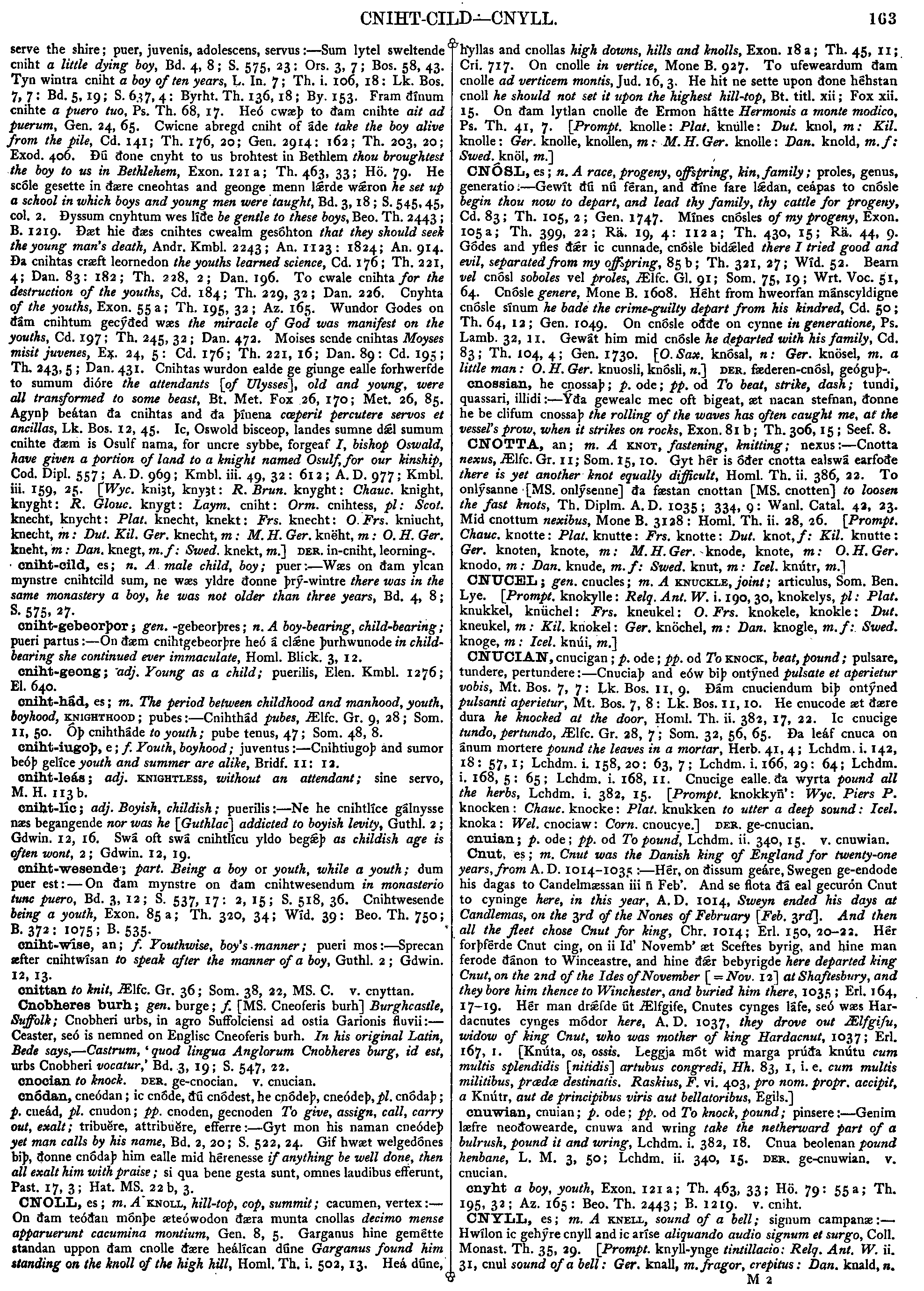
CNÓSL)
es;
n.
A
race,
progeny,
offspring,
kin,
family;
proles,
genus,
generatio
:--
Gewít
ðú
nú
féran,
and
ðíne
fare
ldan,
ceápas
to
cnósle
begin
thow
now
to
depart,
and
lead
thy
family,
thy
cattle
for
progeny,
Cd.
83;
Th.
105,
2;
Gen.
1747.
Mínes
cnósles
of
my
progeny,
Exon.
105a;
Th.
399,
22;
Rä.
19,
4:
112a;
Th.
430,
15;
Rä.
44,
9.
Gódes
and
yfles
ðr
ic
cunnade,
cnósle
bidled
there
I
tried
good
and
evil,
separated
from
my
offspring,
85b;
Th.
321,
27;
Wld.
52.
Bearn
vel
cnósl
soboles
vel
proles,
Ælfc.
Gl.
91;
Som.
75,
19;
Wrt.
Voc.
51,
64.
Cnósle
genere,
Mone
B.
1608.
Héht
from
hweorfan
mánscyldigne
cnósle
sínum
he
bade
the
crime-guilty
depart
from
his
kindred,
Cd.
50;
Th.
64,
12;
Gen.
1049.
On
cnósle
oððe
on
cynne
in
generatione,
Ps.
Lamb.
32,
11.
Gewát
him
mid
cnósle
he
departed
with
his
family,
Cd.
83;
Th.
104,
4;
Gen.
1730.
[O.
Sax.
knósal,
n:
Ger.
knösel,
m.
a
little
man:
O.
H.
Ger.
knuosli,
knósli,
n.]
DER.
fæderen-cnósl,
geóguþ-.
|
Source: Bosworth/Toller, page b0175, entry 1 View original page image as: [TIFF] [PNG] [View previous entry] [View next entry] |
[Comment on this entry] [View comments] |
The following entry has been hand-corrected once. |
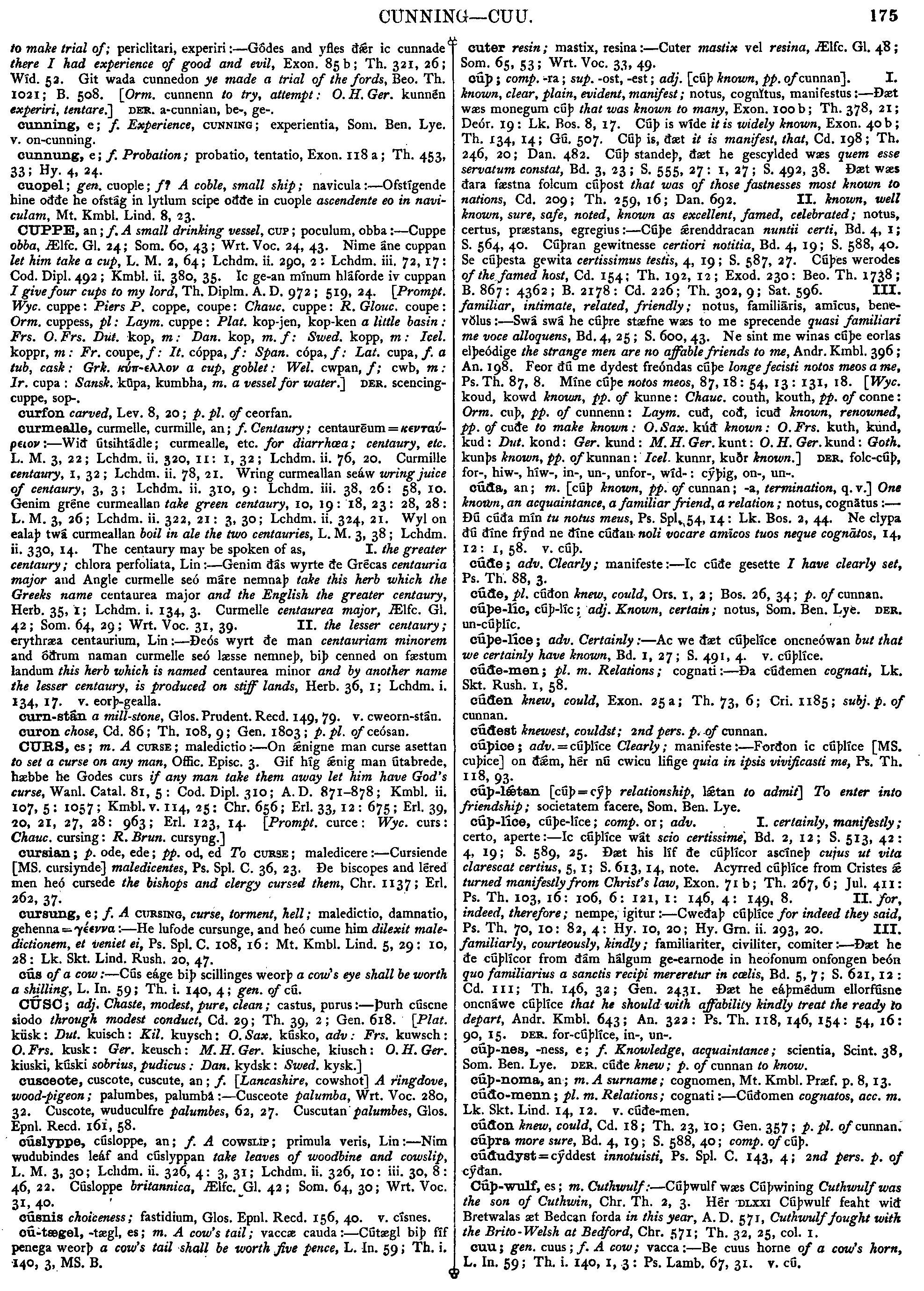
to
make
trial
of;
periclitari,
experiri
:--
Gódes
and
yfles
ðr
ic
cunnade
there
I
had
experience
of
good
and
evil,
Exon.
85b;
Th.
321,
26;
Wíd.
52.
Git
wada
cunnedon
ye
made
a
trial
of
the
fords,
Beo.
Th.
1021;
B.
508.
[Orm.
cunnenn
to
try,
attempt:
O.
H.
Ger.
kunnén
experiri,
tentare.]
DER.
a-cunnian,
be-,
ge-.
|
Source: Bosworth/Toller, page b0224, entry 2 View original page image as: [TIFF] [PNG] [View previous entry] [View next entry] |
[Comment on this entry] [View comments (1)] |
The following entry has been hand-corrected once. |
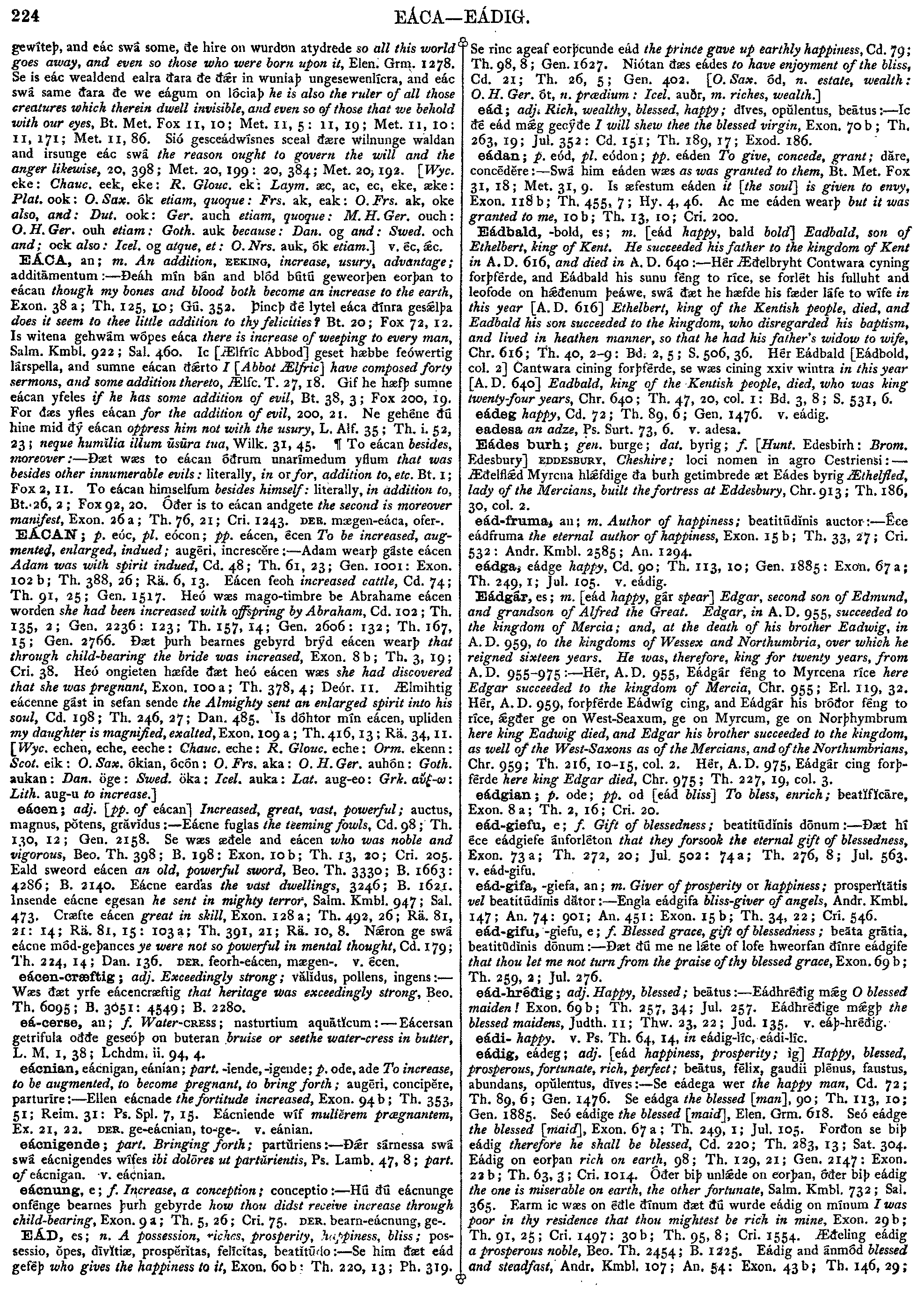
EÁCA,
an;
m.
An
addition,
EEKING,
increase,
usury,
advantage;
addit mentum
:--
Ðeáh
mín
bán
and
blód
bútú
geweorþen
eorþan
to
eácan
though
my
bones
and
blood
both
become
an
increase
to
the
earth,
Exon.
38
a;
Th.
125,
10;
Gú.
352.
Þincþ
ðé
lytel
eáca
ðínra
geslþa
does
it
seem
to
thee
little
addition
to
thy
felicities?
Bt.
20;
Fox
72,
12.
Is
witena
gehwám
wópes
eáca
there
is
increase
of
weeping
to
every
man,
Salm.
Kmbl.
922;
Sal.
460.
Ic
[Ælfríc
Abbod]
geset
hæbbe
feówertig
lárspella,
and
sumne
eácan
ðrto
I
[Abbot
Ælfric]
have
composed
forty
sermons,
and
some
addition
thereto,
Æ-acute;lfc.
T.
27,
18.
Gif
he
hæfþ
sumne
eácan
yfeles
if
he
has
some
addition
of
evil,
Bt.
38,
3;
Fox
200,
19.
For
dæs
yfles
eácan
for
the
addition
of
evil,
200,
21.
Ne
gehéne
ðú
hine
mid
ðý
eácan
oppress
him
not
with
the
usury,
L.
Alf.
35;
Th.
i.
52,
23;
neque
hum
mentum
:--
Ðeáh
mín
bán
and
blód
bútú
geweorþen
eorþan
to
eácan
though
my
bones
and
blood
both
become
an
increase
to
the
earth,
Exon.
38
a;
Th.
125,
10;
Gú.
352.
Þincþ
ðé
lytel
eáca
ðínra
geslþa
does
it
seem
to
thee
little
addition
to
thy
felicities?
Bt.
20;
Fox
72,
12.
Is
witena
gehwám
wópes
eáca
there
is
increase
of
weeping
to
every
man,
Salm.
Kmbl.
922;
Sal.
460.
Ic
[Ælfríc
Abbod]
geset
hæbbe
feówertig
lárspella,
and
sumne
eácan
ðrto
I
[Abbot
Ælfric]
have
composed
forty
sermons,
and
some
addition
thereto,
Æ-acute;lfc.
T.
27,
18.
Gif
he
hæfþ
sumne
eácan
yfeles
if
he
has
some
addition
of
evil,
Bt.
38,
3;
Fox
200,
19.
For
dæs
yfles
eácan
for
the
addition
of
evil,
200,
21.
Ne
gehéne
ðú
hine
mid
ðý
eácan
oppress
him
not
with
the
usury,
L.
Alf.
35;
Th.
i.
52,
23;
neque
hum lia
ilium
lia
ilium
 sra
tua,
Wilk.
31,
45.

To
eácan
besides,
moreover
:--
Ðæt
wæs
to
eácan
óðrum
unar
sra
tua,
Wilk.
31,
45.

To
eácan
besides,
moreover
:--
Ðæt
wæs
to
eácan
óðrum
unar medum
yflum
that
was
besides
other
innumerable
evils:
literally,
in
or
for,
addition
to,
etc.
Bt.
1;
Fox
2,
11.
To
eácan
himselfum
besides
himself:
literally,
in
addition
to,
Bt.
26,
2;
Fox
92,
20.
Óðer
is
to
eácan
andgete
the
second
is
moreover
manifest,
Exon.
26
a;
Th.
76,
21;
Cri.
1243.
DER.
mægen-eáca,
ofer-.
medum
yflum
that
was
besides
other
innumerable
evils:
literally,
in
or
for,
addition
to,
etc.
Bt.
1;
Fox
2,
11.
To
eácan
himselfum
besides
himself:
literally,
in
addition
to,
Bt.
26,
2;
Fox
92,
20.
Óðer
is
to
eácan
andgete
the
second
is
moreover
manifest,
Exon.
26
a;
Th.
76,
21;
Cri.
1243.
DER.
mægen-eáca,
ofer-.
|
Source: Bosworth/Toller, page b0337, entry 16 View original page image as: [TIFF] [PNG] [View previous entry] [View next entry] |
[Comment on this entry] [View comments (1)] |
The following entry has been hand-corrected once. |
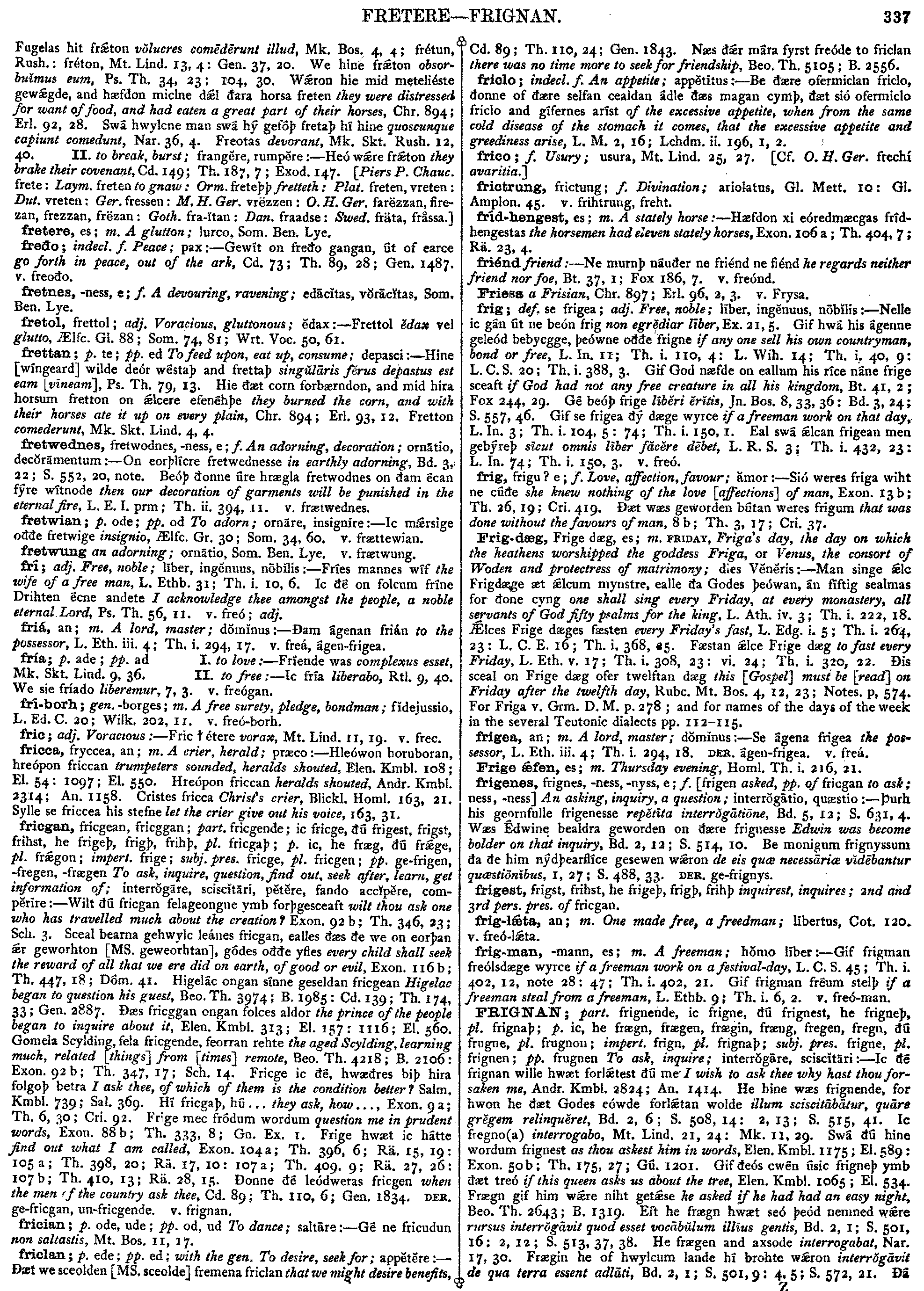
fricgan,
fricgean,
fricggan;
part.
fricgende;
ic
fricge,
ðú
frigest,
frigst,
frihst,
he
frigeþ,
frigþ,
frihþ,
pl.
fricgaþ;
p.
ic,
he
fræg,
ðú
frge,
pl.
frgon;
impert.
frige;
subj.
pres.
fricge,
pl.
fricgen;
pp.
ge-frigen,
-fregen,
-frægen
To
ask,
inquire,
question,
find
out,
seek
after,
learn,
gel
information
of;
interr gre,
scisctri,
p
gre,
scisctri,
p tre,
fando
accpre,
comprre
:--
Wilt
ðú
fricgan
felageongne
ymb
forþgesceaft
wilt
thou
ask
one
who
has
travelled
much
about
the
creation?
Exon.
92
b;
Th.
346,
23;
Sch.
3.
Sceal
bearna
gehwylc
leánes
fricgan,
ealles
ðæs
ðe
we
on
eorþan
r
geworhton
[MS.
geweorhtan],
gódes
oððe
yfles
every
child
shall
seek
the
reward
of
all
that
we
ere
did
on
earth,
of
good
or
evil,
Exon.
116
b;
Th.
447,
18;
Dóm.
41.
Higelác
ongan
sínne
geseldan
fricgean
Higelac
began
to
question
his
guest,
Beo.
Th.
3974;
B.
1985:
Cd.
139;
Th.
174,
33;
Gen.
2887.
Ðæs
fricggan
ongan
folces
aldor
the
prince
of
the
people
began
to
inquire
about
it,
Elen.
Kmbl.
313;
El.
157:
1116;
El.
560.
Gomela
Scylding,
fela
fricgende,
feorran
rehte
the
aged
Scylding,
learning
much,
related
[things]
from
[times]
remote,
Beo.
Th.
4218;
B.
2106:
Exon.
92
b;
Th.
347,
17;
Sch.
14.
Fricge
ic
ðé,
hwæðres
biþ
hira
folgoþ
betra
I
ask
thee,
of
which
of
them
is
the
condition
better?
Salm.
Kmbl.
739;
Sal.
369.
Hí
fricgaþ,
hú
.
.
.
they
ask,
how
.
.
.
,
Exon.
9
a;
Th.
6,
30;
Crl.
92.
Frige
mee
fródum
wordum
question
me
in
prudent
words,
Exon.
88
b;
Th.
333,
8;
Gn.
Ex.
1.
Frige
hwæt
ic
hátte
find
out
what
I
am
called.
Exon.
1043;
Th.
396,
6;
Rä.
15,
19:
105
a;
Th.
398,
20;
Rä.
17,
10:
107
a;
Th.
409,
9;
Rä.
27,
26:
107
b;
Th.
410,
13;
Rä.
28,
15.
Ðonne
ðé
leódweras
fricgen
when
the
men
of
the
country
ask
thee,
Cd.
89;
Th.
110,
6;
Gen.
1834.
DER.
ge-fricgan,
un-fricgende.
v.
frignan.
tre,
fando
accpre,
comprre
:--
Wilt
ðú
fricgan
felageongne
ymb
forþgesceaft
wilt
thou
ask
one
who
has
travelled
much
about
the
creation?
Exon.
92
b;
Th.
346,
23;
Sch.
3.
Sceal
bearna
gehwylc
leánes
fricgan,
ealles
ðæs
ðe
we
on
eorþan
r
geworhton
[MS.
geweorhtan],
gódes
oððe
yfles
every
child
shall
seek
the
reward
of
all
that
we
ere
did
on
earth,
of
good
or
evil,
Exon.
116
b;
Th.
447,
18;
Dóm.
41.
Higelác
ongan
sínne
geseldan
fricgean
Higelac
began
to
question
his
guest,
Beo.
Th.
3974;
B.
1985:
Cd.
139;
Th.
174,
33;
Gen.
2887.
Ðæs
fricggan
ongan
folces
aldor
the
prince
of
the
people
began
to
inquire
about
it,
Elen.
Kmbl.
313;
El.
157:
1116;
El.
560.
Gomela
Scylding,
fela
fricgende,
feorran
rehte
the
aged
Scylding,
learning
much,
related
[things]
from
[times]
remote,
Beo.
Th.
4218;
B.
2106:
Exon.
92
b;
Th.
347,
17;
Sch.
14.
Fricge
ic
ðé,
hwæðres
biþ
hira
folgoþ
betra
I
ask
thee,
of
which
of
them
is
the
condition
better?
Salm.
Kmbl.
739;
Sal.
369.
Hí
fricgaþ,
hú
.
.
.
they
ask,
how
.
.
.
,
Exon.
9
a;
Th.
6,
30;
Crl.
92.
Frige
mee
fródum
wordum
question
me
in
prudent
words,
Exon.
88
b;
Th.
333,
8;
Gn.
Ex.
1.
Frige
hwæt
ic
hátte
find
out
what
I
am
called.
Exon.
1043;
Th.
396,
6;
Rä.
15,
19:
105
a;
Th.
398,
20;
Rä.
17,
10:
107
a;
Th.
409,
9;
Rä.
27,
26:
107
b;
Th.
410,
13;
Rä.
28,
15.
Ðonne
ðé
leódweras
fricgen
when
the
men
of
the
country
ask
thee,
Cd.
89;
Th.
110,
6;
Gen.
1834.
DER.
ge-fricgan,
un-fricgende.
v.
frignan.
|
Source: Bosworth/Toller, page b0420, entry 9 View original page image as: [TIFF] [PNG] [View previous entry] [View next entry] |
[Comment on this entry] [View comments] |
The following entry has been hand-corrected once. |
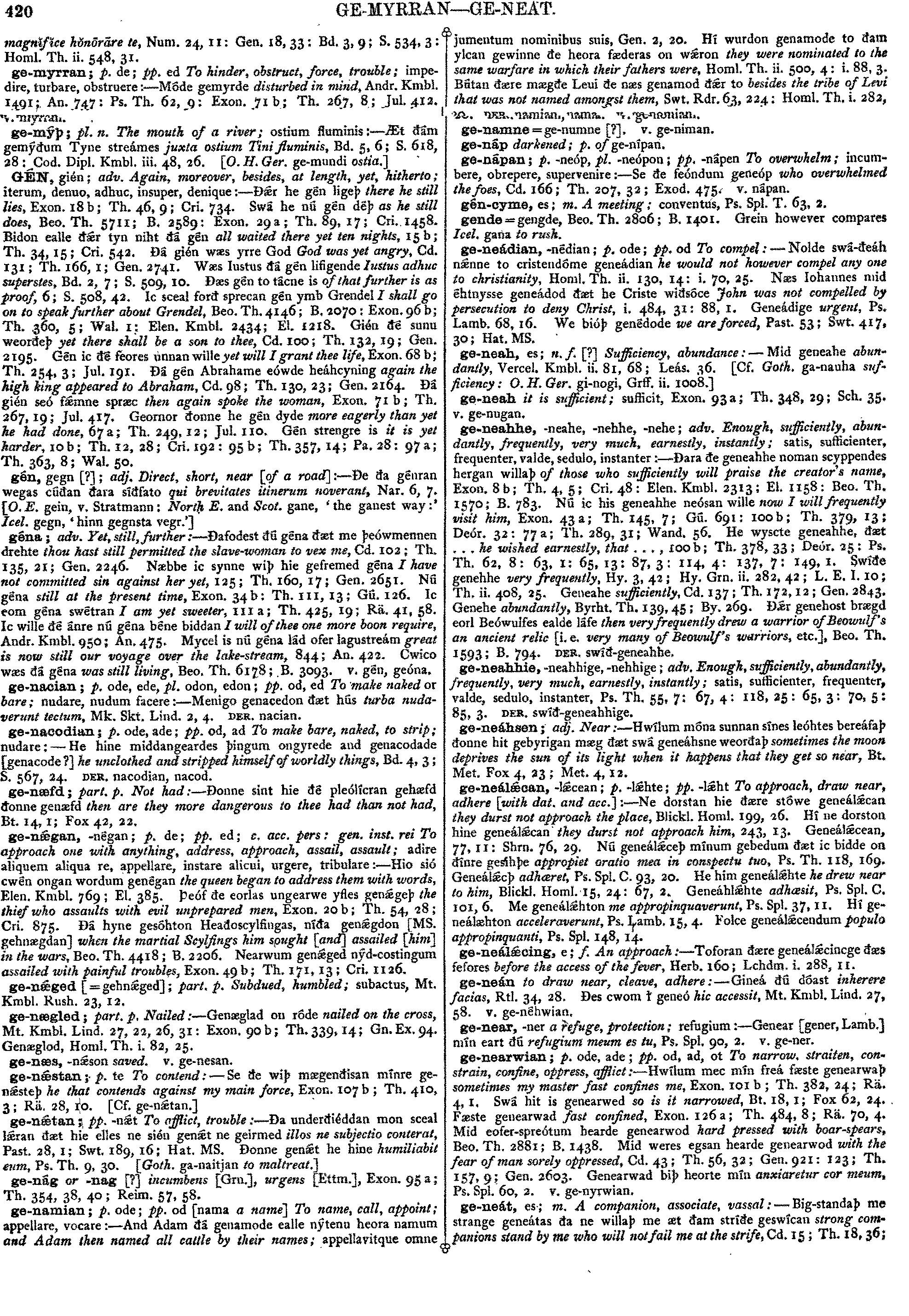
ge-ngan,
-négan;
p.
de;
pp.
ed;
c.
acc.
pers:
gen.
inst.
rei
To
approach
one
with
anything,
address,
approach,
assail,
assault;
adire
aliquem
aliqua
re,
appellare,
instare
alicui,
urgere,
tribulare
:--
Hio
sió
cwén
ongan
wordum
genégan
the
queen
began
to
address
them
with
words,
Elen.
Kmbl.
769;
El,
385.
Þeóf
ðe
eorlas
ungearwe
yfles
gengeþ
the
thief
who
assaults
with
evil
unprepared
men,
Exon.
20
b;
Th.
54,
28;
Cri,
875.
Ðá
hyne
gesóhton
Heaðoscylfingas,
níða
gengdon
[MS.
gehnægdan]
when
the
martial
Scylfings
him
sought
[and]
assailed
[him]
in
the
wars,
Beo.
Th.
4418;
B.
2206.
Nearwum
genged
nýd-costingum
assailed
with
painful
troubles,
Exon.
49
b;
Th.
171,
13;
Cri.
1126.
|
Source: Bosworth/Toller, page b0449, entry 2 View original page image as: [TIFF] [PNG] [View previous entry] [View next entry] |
[Comment on this entry] [View comments] |
The following entry has been hand-corrected once. |
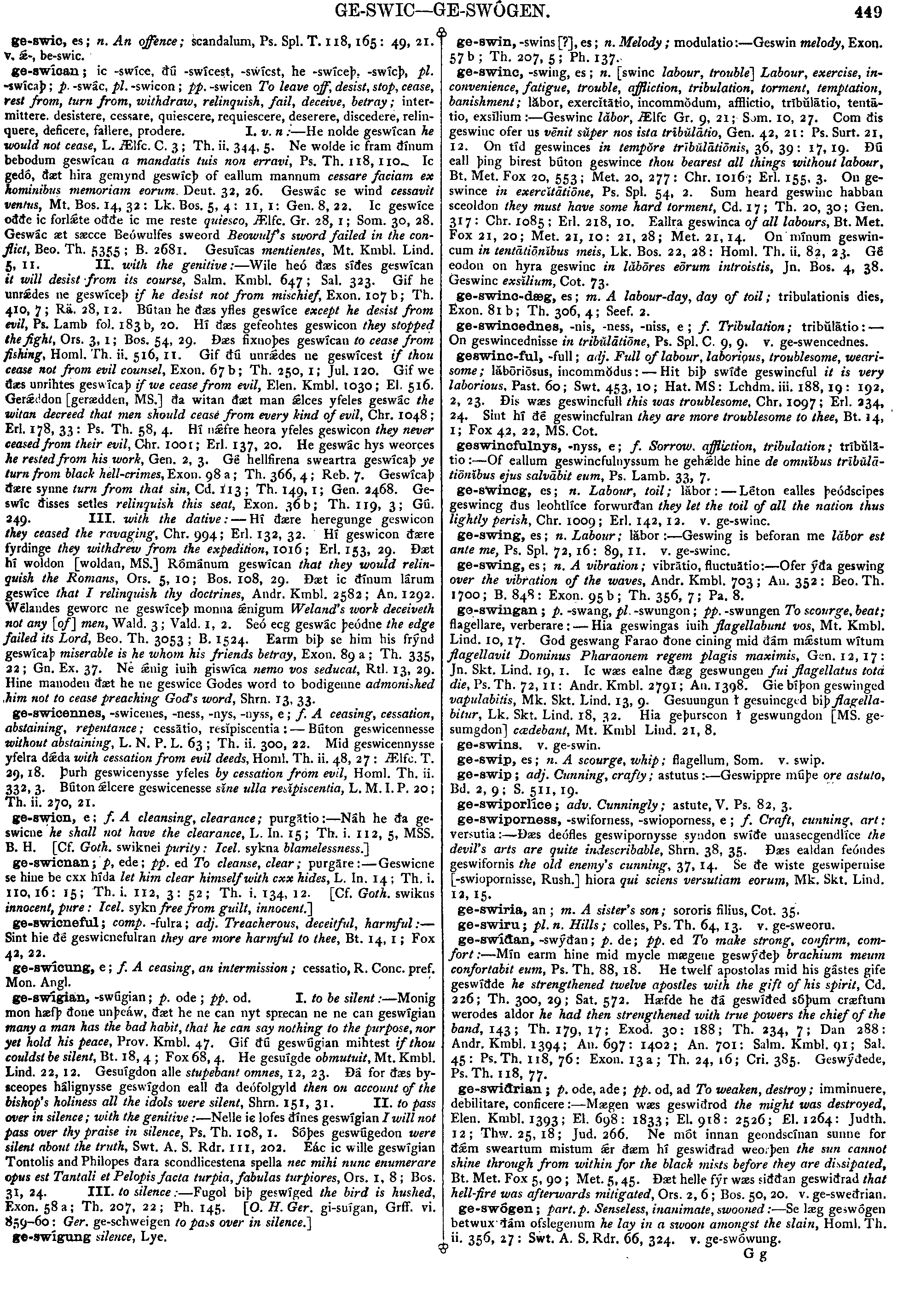
ge-swícan;
ic
-swíce,
ðú
-swícest,
-swícst,
he
-swíceþ.
-swícþ,
pl.
-swícaþ;
p.
-swác,
pl.
-swicon;
pp.
-swicen
To
leave
off,
desist,
stop,
cease,
rest
from,
turn
from,
withdraw,
relinquish,
fail,
deceive,
betray;
intermittere,
desistere,
cessare,
quiescere,
requiescere,
deserere,
discedere,
relinquere,
deficere,
fallere,
prodere.
I.
v.
n
:--
He
nolde
geswícan
he
would
not
cease,
L.
Ælfc.
C.
3;
Th.
ii.
344,
5.
Ne
wolde
ic
fram
ðínum
bebodum
geswícan
a
mandatis
tuis
non
erravi,
Ps.
Th.
118,
110.
Ic
gedó,
ðæt
hira
gemynd
geswícþ
of
eallum
mannum
cessare
faciam
ex
hominibus
memoriam
eorum.
Deut.
32,
26.
Geswác
se
wind
cessavit
ventus,
Mt.
Bos.
14,
32:
Lk.
Bos.
5,
4:
11,
1:
Gen.
8,
22.
Ic
geswíce
oððe
ic
forlte
oððe
ic
me
reste
quiesco,
Ælfc.
Gr.
28,
1;
Som.
30,
28.
Geswác
æt
sæcce
Beówulfes
sweord
Beowulf's
sword
failed
in
the
conflict,
Beo.
Th.
5355;
B.
2681.
Gesuícas
mentientes,
Mt.
Kmbl.
Lind.
5,
11.
II.
with
the
genitive
:--
Wile
heó
ðæs
síðes
geswícan
it
will
desist
from
its
course,
Salm.
Kmbl.
647;
Sal.
323.
Gif
he
unrdes
ne
geswíceþ
if
he
desist
not
from
mischief,
Exon.
107
b;
Th.
410,
7;
Rä.
28,
12.
Bútan
he
ðæs
yfles
geswíce
except
he
desist
from
evil,
Ps.
Lamb
fol.
183
b,
20.
Hí
ðæs
gefeohtes
geswicon
they
stopped
the
fight,
Ors.
3,
1;
Bos.
54,
29.
Ðæs
fixnoþes
geswícan
to
cease
from
fishing,
Homl.
Th.
ii.
516,
11.
Gif
ðú
unrdes
ne
geswícest
if
thou
cease
not
from
evil
counsel,
Exon.
67
b;
Th.
250,
1;
Jul.
120.
Gif
we
ðæs
unrihtes
geswícaþ
if
we
cease
from
evil,
Elen.
Kmbl.
1030;
El.
516.
Gerddon
[gerædden,
MS.]
ða
witan
ðæt
man
lces
yfeles
geswác
the
witan
decreed
that
men
should
cease
from
every
kind
of
evil,
Chr.
1048;
Erl.
178,
33:
Ps.
Th.
58,
4.
Hí
nfre
heora
yfeles
geswicon
they
never
ceased
from
their
evil,
Chr.
1001;
Erl.
137,
20.
He
geswác
hys
weorces
he
rested
from
his
work,
Gen.
2,
3.
Gé
hellfirena
sweartra
geswícaþ
ye
turn
from
black
hell-crimes.
Exon.
98
a;
Th.
366,
4;
Reb.
7.
Geswícaþ
ðære
synne
turn
from
that
sin,
Cd.
113;
Th.
149,
1;
Gen.
2468.
Geswíc
ðisses
setles
relinquish
this
seat,
Exon.
36
b;
Th.
119,
3;
Gú.
249.
III.
with
the
dative
:--
Hí
ðære
heregunge
geswicon
they
ceased
the
ravaging,
Chr.
994;
Erl.
132,
32.
Hí
geswicon
ðære
fyrdinge
they
withdrew
from
the
expedition,
1016;
Erl.
153,
29.
Ðæt
hí
woldon
[woldan,
MS.]
Rómánum
geswícan
that
they
would
relinquish
the
Romans,
Ors.
5,
10;
Bos.
108,
29.
Ðæt
ic
ðínum
lárum
geswíce
that
I
relinquish
thy
doctrines,
Andr.
Kmbl.
2582;
An.
1292.
Wélandes
geworc
ne
geswíceþ
monna
nigum
Weland's
work
deceiveth
not
any
[of]
men,
Wald.
3;
Vald.
1,
2.
Seó
ecg
geswác
þeódne
the
edge
failed
its
Lord,
Beo.
Th.
3053;
B.
1524.
Earm
biþ
se
him
his
frýnd
geswícaþ
miserable
is
he
whom
his
friends
betray,
Exon.
89
a;
Th.
335,
22;
Gn.
Ex.
37.
Ne
nig
iuih
giswíca
nemo
vos
seducat,
Rtl.
13,
29.
Hine
manoden
ðæt
he
ne
geswice
Godes
word
to
bodigenne
admonished
him
not
to
cease
preaching
God's
word,
Shrn.
13,
33.
|
Source: Bosworth/Toller, page b0570, entry 1 View original page image as: [TIFF] [PNG] [View previous entry] [View next entry] |
[Comment on this entry] [View comments (3)] |
The following entry has been hand-corrected once. |
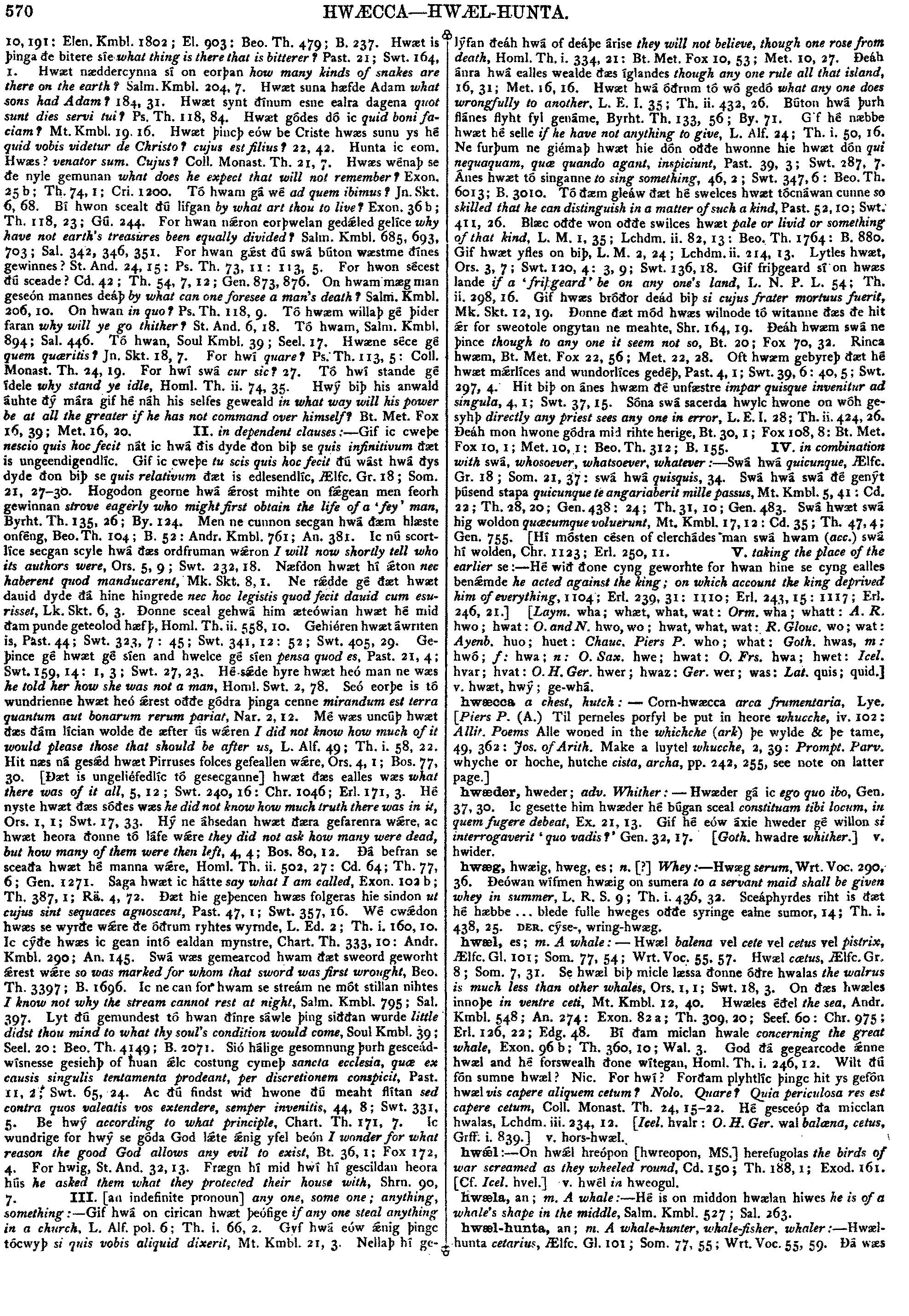
10,
191:
Elen.
Kmbl.
1802;
El.
903:
Beo.
Th.
479;
B.
237.
Hwæt
is
þinga
ðe
bitere
síe
what
thing
is
there
that
is
bitterer?
Past.
21;
Swt.
164,
1.
Hwæt
næddercynna
sí
on
eorþan
how
many
kinds
of
snakes
are
there
on
the
earth?
Salm.
Kmbl.
204,
7.
Hwæt
suna
hæfde
Adam
what
sons
had
Adam?
184,
31.
Hwæt
synt
ðínum
esne
ealra
dagena
quot
sunt
dies
servi
tui?
Ps.
Th.
118,
84.
Hwæt
gódes
dó
ic
quid
boni
faciam?
Mt.
Kmbl.
19,
16.
Hwæt
þincþ
eów
be
Criste
hwæs
sunu
ys
hé
quid
vobis
videtur
de
Christo?
cujus
est
filius?
22,
42.
Hunta
ic
eom.
Hwæs?
venator
sum.
Cujus?
Coll.
Monast.
Th.
21,
7.
Hwæs
wénaþ
se
ðe
nyle
gemunan
what
does
he
expect
that
will
not
remember?
Exon.
25
b;
Th.
74,
1;
Cri.
1200.
Tó
hwam
gá
wé
ad
quem
ibimus?
Jn.
Skt.
6,
68.
Bí
hwon
scealt
ðú
lifgan
by
what
art
thou
to
live?
Exon.
36
b;
Th.
118,
23;
Gú.
244.
For
hwan
nron
eorþwelan
gedled
gelíce
why
have
not
earth's
treasures
been
equally
divided?
Salm.
Kmbl.
685,
693,
703;
Sal.
342,
346,
351.
For
hwan
gst
ðú
swá
búton
wæstme
ðínes
gewinnes?
St.
And.
24,
15:
Ps.
Th.
73,
11:
113,
5.
For
hwon
sécest
ðú
sceade?
Cd.
42;
Th.
54,
7,
12;
Gen.
873,
876.
On
hwam
mæg
man
geseón
mannes
deáþ
by
what
can
one
foresee
a
man's
death?
Salm.
Kmbl.
206,
10.
On
hwan
in
quo?
Ps.
Th.
118,
9.
Tó
hwæm
willaþ
gé
þider
faran
why
will
ye
go
thither?
St.
And.
6,
18.
Tó
hwam,
Salm.
Kmbl.
894;
Sal.
446.
Tó
hwan,
Soul
Kmbl.
39;
Seel.
17.
Hwæne
séce
gé
quem
quæritis?
Jn.
Skt.
18,
7.
For
hwí
quare?
Ps.
Th.
113,
5:
Coll.
Monast.
Th.
24,
19.
For
hwí
swá
cur
sic?
27.
Tó
hwi
stande
gé
ídele
why
stand
ye
idle,
Homl.
Th.
ii.
74,
35.
Hwý
biþ
his
anwald
áuhte
ðý
mára
gif
hé
náh
his
selfes
geweald
in
what
way
will
his
power
be
at
all
the
greater
if
he
has
not
command
over
himself?
Bt.
Met.
Fox
16,
39;
Met.
16,
20.
II.
in
dependent
clauses
:--
Gif
ic
cweþe
nescio
quis
hoc
fecit
nát
ic
hwá
ðis
dyde
ðon
biþ
se
quis
infinitivum
ðæt
is
ungeendigendlíc.
Gif
ic
cweþe
tu
scis
quis
hoc
fecit
ðú
wást
hwá
ðys
dyde
ðon
biþ
se
quis
relativum
ðæt
is
edlesendlíc,
Ælfc.
Gr.
18;
Som.
21,
27-30.
Hogodon
georne
hwá
rost
mihte
on
fgean
men
feorh
gewinnan
strove
eagerly
who
might
first
obtain
the
life
of
a
'fey'
man,
Byrht.
Th.
135,
26;
By.
124.
Men
ne
cunnon
secgan
hwá
dæm
hlæste
onféng,
Beo.
Th.
104;
B.
52:
Andr.
Kmbl.
761;
An.
381.
Ic
nú
scortlíce
secgan
scyle
hwá
ðæs
ordfruman
wron
I
will
now
shortly
tell
who
its
authors
were,
Ors.
5,
9;
Swt.
232,
18.
Næfdon
hwæt
hí
ton
nec
haberent
quod
manducarent,
Mk.
Skt.
8,
1.
Ne
rdde
gé
ðæt
hwæt
dauid
dyde
ðá
hine
hingrede
nec
hoc
legistis
quod
fecit
dauid
cum
esurisset,
Lk.
Skt.
6,
3.
Ðonne
sceal
gehwá
him
æteówian
hwæt
hé
mid
ðam
punde
geteolod
hæfþ,
Homl.
Th.
ii.
558,
10.
Gehiéren
hwæt
áwriten
is,
Past.
44;
Swt.
323,
7:
45;
Swt.
341,
12:
52;
Swt.
405,
29.
Geþince
gé
hwæt
gé
síen
and
hwelce
gé
síen
pensa
quod
es,
Past.
21,
4;
Swt.
159,
14:
1,
3;
Swt.
27,
23.
Hé
sde
hyre
hwæt
heó
man
ne
wæs
he
told
her
how
she
was
not
a
man,
Homl.
Swt.
2,
78.
Seó
eorþe
is
tó
wundrienne
hwæt
heó
rest
oððe
gódra
þinga
cenne
mirandum
est
terra
quantum
aut
bonarum
rerum
pariat,
Nar.
2,
12.
Mé
wæs
uncúþ
hwæt
ðæs
ðám
lícian
wolde
ðe
æfter
ús
wren
I
did
not
know
how
much
of
it
would
please
those
that
should
be
after
us,
L.
Alf.
49;
Th.
i.
58,
22.
Hit
næs
ná
gesd
hwæt
Pirruses
folces
gefeallen
wre,
Ors.
4,
1;
Bos.
77,
30.
[Ðæt
is
ungeliéfedlíc
tó
gesecganne]
hwæt
ðæs
ealles
wæs
what
there
was
of
it
all,
5,
12;
Swt.
240,
16:
Chr.
1046;
Erl.
171,
3.
Hé
nyste
hwæt
ðæs
sóðes
wæs
he
did
not
know
how
much
truth
there
was
in
it,
Ors.
1,
1;
Swt.
17,
33.
Hý
ne
áhsedan
hwæt
ðæra
gefarenra
wre,
ac
hwæt
heora
ðonne
tó
láfe
wre
they
did
not
ask
how
many
were
dead,
but
how
many
of
them
were
then
left,
4,
4;
Bos.
80,
12.
Ðá
befran
se
sceaða
hwæt
hé
manna
wre.
Homl.
Th.
ii.
502,
27:
Cd.
64;
Th.
77,
6;
Gen.
1271.
Saga
hwæt
ic
hátte
say
what
I
am
called,
Exon.
102
b;
Th.
387,
1;
Rä.
4,
72,
Ðæt
hie
geþencen
hwæs
folgeras
hie
sindon
ut
cujus
sint
sequaces
agnoscant,
Past.
47,
1;
Swt.
357,
16.
Wé
cwdon
hwæs
se
wyrðe
wre
ðe
óðrum
ryhtes
wyrnde,
L.
Ed.
2;
Th.
i.
160,
10.
Ic
cýðe
hwæs
ic
gean
intó
ealdan
mynstre,
Chart.
Th.
333,
10:
Andr.
Kmbl.
290;
An.
145.
Swá
wæs
gemearcod
hwam
ðæt
sweord
geworht
rest
wre
so
was
marked
for
whom
that
sword
was
first
wrought,
Beo.
Th.
3397;
B.
1696.
Ic
ne
can
for
hwam
se
streám
ne
mót
stillan
nihtes
I
know
not
why
the
stream
cannot
rest
at
night,
Salm.
Kmbl.
795;
Sal.
397.
Lyt
ðú
gemundest
tó
hwan
ðínre
sáwle
þing
siððan
wurde
little
didst
thou
mind
to
what
thy
soul's
condition
would
come,
Soul
Kmbl.
39;
Seel.
20:
Beo.
Th.
4149;
B.
2071.
Sió
hálige
gesomnung
þurh
gesceádwísnesse
gesiehþ
of
huan
lc
costung
cymeþ
sancta
ecclesia,
quæ
ex
causis
singulis
tentamenta
prodeant,
per
discretionem
conspicit,
Past.
11,
2;
Swt.
65,
24.
Ac
ðú
findst
wið
hwone
ðú
meaht
flítan
sed
contra
quos
valeatis
vos
extendere,
semper
invenitis,
44,
8;
Swt.
331,
5.
Be
hwý
according
to
what
principle,
Chart.
Th.
171,
7.
Ic
wundrige
for
hwý
se
góda
God
lte
nig
yfel
beón
I
wonder
for
what
reason
the
good
God
allows
any
evil
to
exist,
Bt.
36,
1;
Fox
172,
4.
For
hwig,
St.
And.
32,
13.
Frægn
hí
mid
hwí
hí
gescildan
heora
hús
he
asked
them
what
they
protected
their
house
with,
Shrn.
90,
7.
III.
[an
indefinite
pronoun]
any
one,
some
one;
anything,
something
:--
Gif
hwá
on
cirican
hwæt
þeófige
if
any
one
steal
anything
in
a
church,
L.
Alf.
pol.
6;
Th.
i.
66,
2.
Gyf
hwá
eów
nig
þingc
tócwyþ
si
quis
vobis
aliquid
dixerit,
Mt.
Kmbl.
21,
3.
Nellaþ
hí
gelýfan
ðeáh
hwá
of
deáþe
árise
they
will
not
believe,
though
one
rose
from
death,
Homl.
Th.
i.
334,
21:
Bt.
Met.
Fox
10,
53;
Met.
10,
27.
Ðeáh
ánra
hwá
ealles
wealde
ðæs
íglandes
though
any
one
rule
all
that
island,
16,
31;
Met.
16,
16.
Hwæt
hwá
óðrum
tó
wó
gedó
what
any
one
does
wrongfully
to
another,
L.
E.
I.
35;
Th.
ii.
432,
26.
Búton
hwá
þurh
flánes
flyht
fyl
genáme,
Byrht.
Th.
133,
56;
By.
71.
Gif
hé
næbbe
hwæt
hé
selle
if
he
have
not
anything
to
give,
L.
Alf.
24;
Th.
i.
50,
16.
Ne
furþum
ne
giémaþ
hwæt
hie
dón
oððe
hwonne
hie
hwæt
dón
qui
nequaquam,
quæ
quando
agant,
inspiciunt,
Past.
39,
3;
Swt.
287,
7.
Ánes
hwæt
tó
singanne
to
sing
something,
46,
2;
Swt.
347,
6:
Beo.
Th.
6013;
B.
3010.
Tó
ðæm
gleáw
ðæt
hé
swelces
hwæt
tócnáwan
cunne
so
skilled
that
he
can
distinguish
in
a
matter
of
such
a
kind,
Past.
52,
10;
Swt.
411,
26.
Blæc
oððe
won
oððe
swilces
hwæt
pale
or
livid
or
something
of
that
kind,
L.
M.
1,
35;
Lchdm.
ii.
82,
13:
Beo.
Th.
1764:
B.
880.
Gif
hwæt
yfles
on
biþ,
L.
M.
2,
24;
Lchdm.
ii.
214,
13.
Lytles
hwæt,
Ors.
3,
7;
Swt.
120,
4:
3,
9;
Swt.
136,
18.
Gif
friþgeard
sí
on
hwæs
lande
if
a
'friþgeard'
be
on
any
one's
land,
L.
N.
P.
L.
54;
Th.
ii.
298,
16.
Gif
hwæs
bróðor
deád
biþ
si
cujus
frater
mortuus
fuerit,
Mk.
Skt.
12,
19.
Ðonne
ðæt
mód
hwæs
wilnode
tó
witanne
ðæs
ðe
hit
r
for
sweotole
ongytan
ne
meahte,
Shr.
164,
19.
Ðeáh
hwæm
swá
ne
þince
though
to
any
one
it
seem
not
so,
Bt.
20;
Fox
70,
32.
Rinca
hwæm,
Bt.
Met.
Fox
22,
56;
Met.
22,
28.
Oft
hwæm
gebyreþ
ðæt
hé
hwæt
mrlíces
and
wundorlíces
gedéþ,
Past.
4,
1;
Swt.
39,
6:
40,
5;
Swt.
297,
4.
Hit
biþ
on
ánes
hwæm
ðé
unfæstre
impar
quisque
invenitur
ad
singula,
4,
1;
Swt.
37,
15.
Sóna
swá
sacerda
hwylc
hwone
on
wóh
gesyhþ
directly
any
priest
sees
any
one
in
error,
L.
E.
I.
28;
Th.
ii.
424,
26.
Ðeáh
mon
hwone
gódra
mid
rihte
herige,
Bt.
30,
1;
Fox
108,
8:
Bt.
Met.
Fox
10,
1;
Met.
10,
1:
Beo.
Th.
312;
B.
155.
IV.
in
combination
with
swá,
whosoever,
whatsoever,
whatever
:--
Swá
hwá
quicunque,
Ælfc.
Gr.
18;
Som.
21,
37:
swá
hwá
quisquis,
34.
Swá
hwá
swá
ðé
genýt
þúsend
stapa
quicunque
té
angariaberit
mille
passus,
Mt.
Kmbl.
5,
41:
Cd.
22;
Th.
28,
20;
Gen.
438:
24;
Th.
31,
10;
Gen.
483.
Swá
hwæt
swá
hig
woldon
quæcumque
voluerunt,
Mt.
Kmbl.
17,
12:
Cd.
35;
Th.
47,
4;
Gen.
755.
[Hí
mósten
césen
of
clerchádes
man
swá
hwam
(acc.)
swá
hí
wolden,
Chr.
1123;
Erl.
250,
ii.
V.
taking
the
place
of
the
earlier
se
:--
Hé
wið
ðone
cyng
geworhte
for
hwan
hine
se
cyng
ealles
benmde
he
acted
against
the
king;
on
which
account
the
king
deprived
him
of
everything,
1104;
Erl.
239,
31:
1110;
Erl.
243,
15:
1117;
Erl.
246,
21.]
[Laym.
wha;
whæt,
what,
wat:
Orm.
wha;
whatt:
A.
R.
hwo;
hwat:
O.
and
N.
hwo,
wo;
hwat,
what,
wat:
R.
Glouc.
wo;
wat:
Ayenb.
huo;
huet:
Chauc.
Piers
P.
who;
what:
Goth.
hwas,
m:
hwó;
f:
hwa;
n:
O.
Sax.
hwe;
hwat:
O.
Frs.
hwa;
hwet:
Icel.
hvar;
hvat:
O.
H.
Ger.
hwer;
hwaz:
Ger.
wer;
was:
Lat.
quis;
quid.]
v.
hwæt,
hwý;
ge-whá.
|
Source: Bosworth/Toller, page b0593, entry 13 View original page image as: [TIFF] [PNG] [View previous entry] [View next entry] |
[Comment on this entry] [View comments] |
The following entry has been hand-corrected once. |
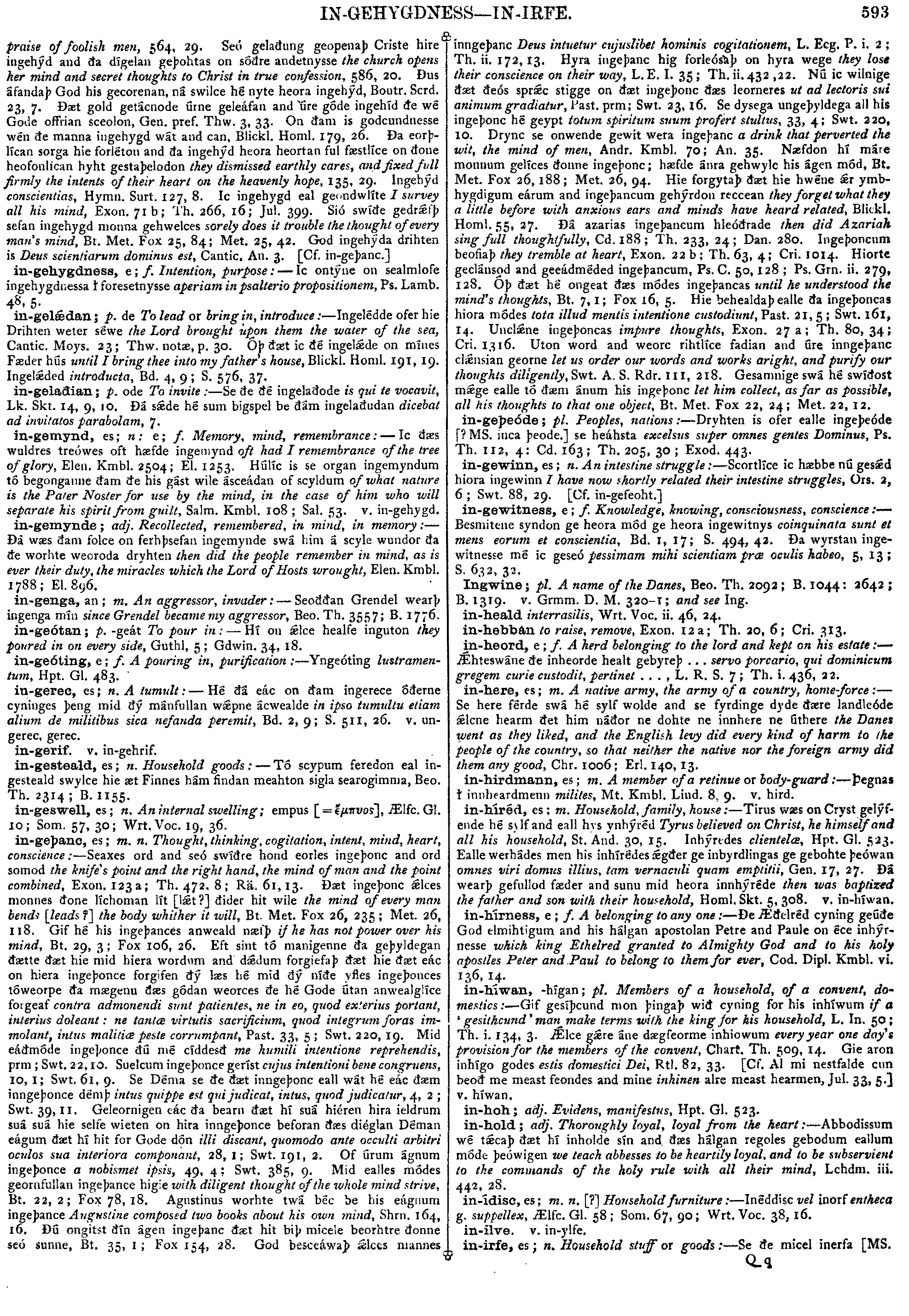
in-geþanc,
es
;
m.
n.
Thought,
thinking,
cogitation,
intent,
mind,
heart,
conscience
:--
Seaxes
ord
and
seó
swíðre
hond
eorles
ingeþonc
and
ord
somod
the
knife's
point
and
the
right
hand,
the
mind
of
man
and
the
point
combined,
Exon.
123
a
;
Th.
472.
8
;
Rä.
61,
13.
Ðæt
ingeþonc
lces
monnes
ðone
líchoman
lít
[lt?]
ðider
hit
wile
the
mind
of
every
man
bends
[leads
?]
the
body
whither
it
will,
Bt.
Met.
Fox
26,
235
;
Met.
26,
118.
Gif
hé
his
ingeþances
anweald
næfþ
if
he
has
not
power
over
his
mind,
Bt.
29,
3;
Fox
106,
26.
Eft
sint
tó
manigenne
ða
geþyldegan
ðætte
ðæt
hie
mid
hiera
wordum
and
ddum
forgiefaþ
ðæt
hie
ðæt
eác
on
hiera
ingeþonce
forgifen
ðý
læs
hé
mid
ðý
níðe
yfles
ingeþonces
tóweorpe
ða
mægenu
ðæs
gódan
weorces
ðe
hé
Gode
útan
anwealglíce
forgeaf
contra
admonendi
sunt
patientes,
ne
in
eo,
quod
exterius
portant,
interius
doleant
:
ne
tantæ
virtutis
sacrificium,
quod
integrum
foras
immolant,
intus
malitiæ
peste
corrumpant,
Past.
33,
5
;
Swt.
220,
19.
Mid
eádmóde
ingeþonce
ðú
mé
cíddesð
me
humili
intentione
reprehendis,
prm;
Swt.
22,
10.
Suelcum
ingeþonce
geríst
cujus
intentioni
bene
congruens,
10,
1;
Swt.
61,
9.
Se
Déma
se
ðe
ðæt
inngeþonc
eall
wát
hé
eác
ðæm
inngeþonce
démþ
intus
quippe
est
qui
judicat,
intus,
quod
judicatur,
4,
2;
Swt.
39,
11.
Geleornigen
eác
ða
bearn
ðæt
hí
suá
hiéren
hira
ieldrum
suá
suá
hie
selfe
wieten
on
hira
inngeþonce
beforan
ðæs
diéglan
Déman
eágum
ðæt
hí
hit
for
Gode
dón
illi
discant,
quomodo
ante
occulti
arbitri
oculos
sua
interiora
componant,
28,
1
;
Swt.
191,
2.
Of
úrum
ágnum
ingeþonce
a
nobismet
ipsis,
49,
4:
Swt.
385,
9,
Mid
ealles
módes
geornfullan
ingeþance
higie
with
diligent
thought
of
the
whole
mind
strive,
Bt.
22,
2;
Fox
78,
18.
Agustinus
worhte
twá
béc
be
his
eágnum
ingeþance
Augustine
composed
two
books
about
his
own
mind,
Shrn.
164,
16.
Ðú
ongitst
ðín
ágen
ingeþanc
ðæt
hit
biþ
micele
beorhtre
ðonne
seó
sunne,
Bt.
35,
1
;
Fox
154,
28.
God
besceáwaþ
lces
mannes
inngeþanc
Deus
intuetur
cujuslibet
hominis
cogitationem,
L.
Ecg.
P.
i.
2
;
Th.
ii.
172,
13.
Hyra
ingeþanc
hig
forleósaþ
on
hyra
wege
they
lose
their
conscience
on
their
way,
L.
E.
I.
35;
Th.
ii.
432
,22.
Nú
ic
wilnige
ðæt
ðeós
sprc
stigge
on
ðæt
ingeþonc
ðæs
leorneres
ut
ad
lectoris
sui
animum
gradiatur,
Past.
prm;
Swt.
23,
16.
Se
dysega
ungeþyldega
all
his
ingeþonc
hé
geypt
totum
spiritum
suum
profert
stultus,
33,
4;
Swt.
220,
10.
Drync
se
onwende
gewit
wera
ingeþanc
a
drink
that
perverted
the
wit,
the
mind
of
men,
Andr.
Kmbl.
70;
An.
35.
Næfdon
hí
máre
monnum
gelíces
ðonne
ingeþonc;
hæfde
ánra
gehwylc
his
ágen
mód,
Bt.
Met.
Fox
26,
188;
Met.
26,
94.
Hie
forgytaþ
ðæt
hie
hwéne
r
ymb-hygdigum
éarum
and
ingeþancum
gehýrdon
reccean
they
forget
what
they
a
little
before
with
anxious
ears
and
minds
have
heard
related,
Blickl.
Homl.
55,
27.
Ðá
azarias
ingeþancum
hleóðrade
then
did
Azariah
sing
full
thoughtfully,
Cd.
188;
Th.
233,
24;
Dan.
280.
Ingeþoncum
beofiaþ
they
tremble
at
heart,
Exon.
22
b;
Th.
63,
4;
Cri.
1014.
Hiorte
geclánsod
and
geeádméded
ingeþancum,
Ps.
C.
50,
128
;
Ps.
Grn.
ii.
279,
128.
Óþ
ðæt
hé
ongeat
ðæs
módes
ingeþancas
until
he
understood
the
mind's
thoughts,
Bt.
7,
1;
Fox
16,
5.
Hie
behealdaþ
ealle
ða
ingeþoncas
hiora
módes
tota
illud
mentis
intentione
custodiunt,
Past.
21,
5
;
Swt.
161,
14.
Unclne
ingeþoncas
impure
thoughts,
Exon.
27
a;
Th.
80,
34;
Cri.
1316.
Uton
word
and
weorc
rihtlíce
fadian
and
úre
inngeþanc
clnsian
georne
let
us
order
our
words
and
works
aright,
and
purify
our
thoughts
diligently,
Swt.
A.
S.
Rdr.
111,
218.
Gesamnige
swá
hé
swíðost
mge
ealle
tó
ðæm
ánum
his
ingeþonc
let
him
collect,
as
far
as
possible,
all
his
thoughts
to
that
one
object,
Bt.
Met.
Fox
22,
24;
Met.
22,
12.
|
Source: Bosworth/Toller, page b0709, entry 7 View original page image as: [TIFF] [PNG] [View previous entry] [View next entry] |
[Comment on this entry] [View comments] |
The following entry has been hand-corrected once. |
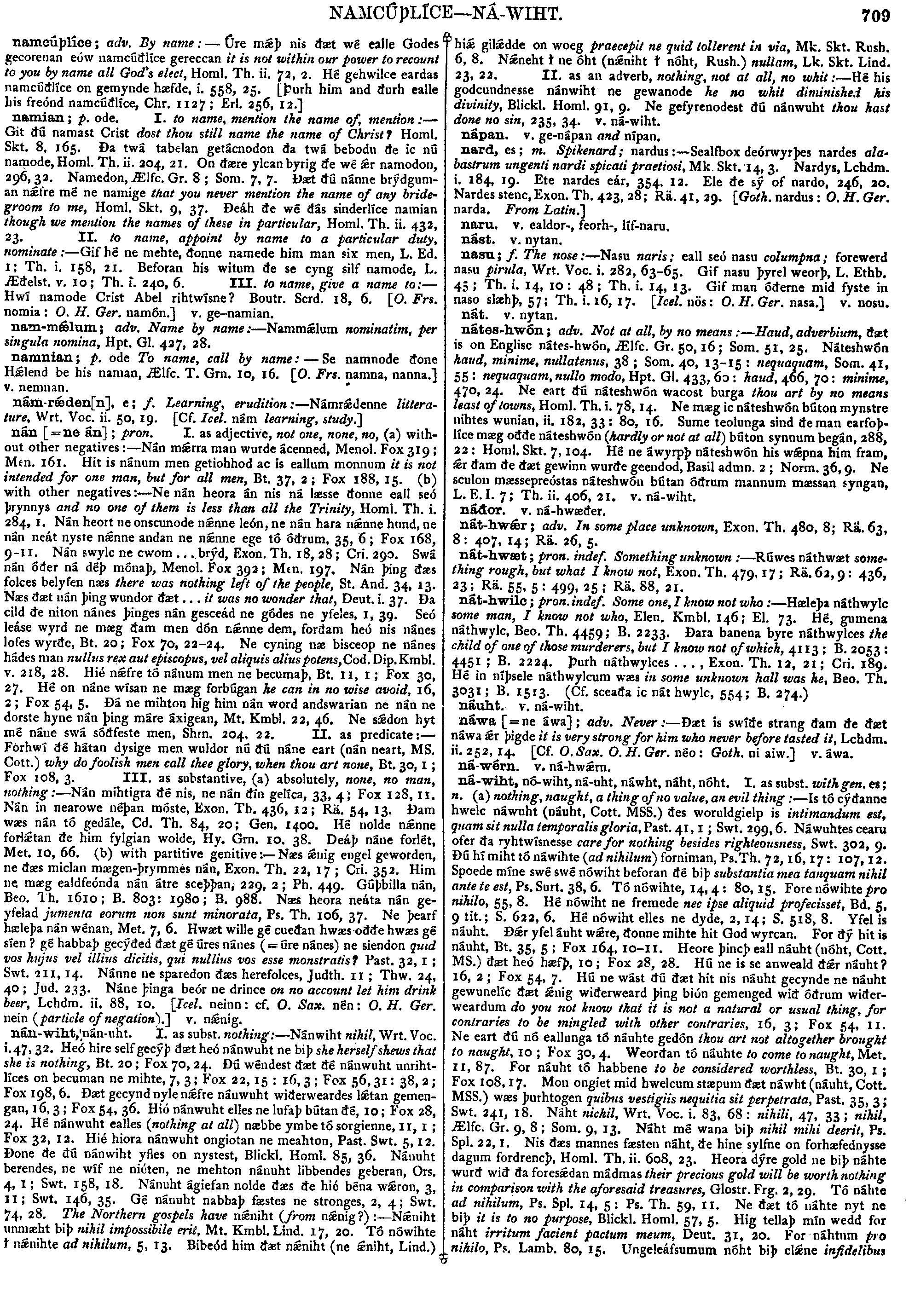
nán-wiht,
nán-uht.
I.
as
subst.
nothing
:--
Nánwiht
nihil,
Wrt.
Voc.
i.
47,
32.
Heó
hire
self
gecýþ
ðæt
heó
nánwuht
ne
biþ
she
herself
shews
that
she
is
nothing,
Bt.
20;
Fox
70,
24.
Ðú
wéndest
ðæt
ðé
nánwuht
unrihtlíces
on
becuman
ne
mihte,
7,
3
;
Fox
22,
15
:
16,
3
;
Fox
56,
31:
38,
2
;
Fox
198,
6.
Ðæt
gecynd
nyle
nfre
nánwuht
wiðerweardes
ltan
gemengan,
16,
3;
Fox
54,
36.
Hió
nánwuht
elles
ne
lufaþ
bútan
ðé,
10;
Fox
28,
24.
Hé
nánwuht
ealles
(nothing
at
all)
næbbe
ymbe
tó
sorgienne,
11,
1
;
Fox
32,
12.
Hié
hiora
nánwuht
ongiotan
ne
meahton,
Past.
Swt.
5,
12.
Ðone
ðe
ðú
nánwiht
yfles
on
nystest,
Blickl.
Homl.
85,
36.
Nánuht
berendes,
ne
wíf
ne
niéten,
ne
mehton
nánuht
libbendes
geberan,
Ors.
4,
1
;
Swt.
158,
18.
Nánuht
ágiefan
nolde
ðæs
ðe
hié
béna
wron,
3,
11
;
Swt.
146,
35.
Gé
nánuht
nabbaþ
fæstes
ne
stronges,
2,
4
;
Swt.
74,
28.
The
Northern
gospels
have
nniht
(from
nnig?)
:--
Nniht
unmæht
biþ
nihil
impossibile
erit,
Mt.
Kmbl.
Lind.
17,
20.
Tó
nówihte
 nnihte
ad
nihilum,
5,
13.
Bibeód
him
ðæt
nniht
(ne
niht,
Lind.)
hi
gildde
on
woeg
praecepit
ne
quid
tollerent
in
via,
Mk.
Skt.
Rush.
6,
8.
Náneht
ne
óht
(nniht
nóht,
Rush.)
nullam,
Lk.
Skt.
Lind.
23,
22.
II.
as
an
adverb,
nothing,
not
at
all,
no
whit
:--
Hé
his
godcundnesse
nánwiht
ne
gewanode
he
no
whit
diminished
his
divinity,
Blickl.
Homl.
91,
9.
Ne
gefyrenodest
ðú
nánwuht
thou
hast
done
no
sin,
235,
34.
v.
ná-wiht.
nnihte
ad
nihilum,
5,
13.
Bibeód
him
ðæt
nniht
(ne
niht,
Lind.)
hi
gildde
on
woeg
praecepit
ne
quid
tollerent
in
via,
Mk.
Skt.
Rush.
6,
8.
Náneht
ne
óht
(nniht
nóht,
Rush.)
nullam,
Lk.
Skt.
Lind.
23,
22.
II.
as
an
adverb,
nothing,
not
at
all,
no
whit
:--
Hé
his
godcundnesse
nánwiht
ne
gewanode
he
no
whit
diminished
his
divinity,
Blickl.
Homl.
91,
9.
Ne
gefyrenodest
ðú
nánwuht
thou
hast
done
no
sin,
235,
34.
v.
ná-wiht.
| Result Page: | 1 2 3 4 | Next |  |
Germanic Lexicon Project (main page)
This search system was written by
Sean Crist
Please consider
volunteering
to correct the data in these online dictionaries.
No rights reserved. Feel free to use these data in any way you please.