|
|

Tip: In the search results, you can click on any word or abbreviation for more information.
|
Source: Cleasby/Vigfusson, page b0257, entry 9 View original page image as: [TIFF] [PNG] [View previous entry] [View next entry] |
[Comment on this entry] [View comments] |
The following entry has been hand-corrected once. |
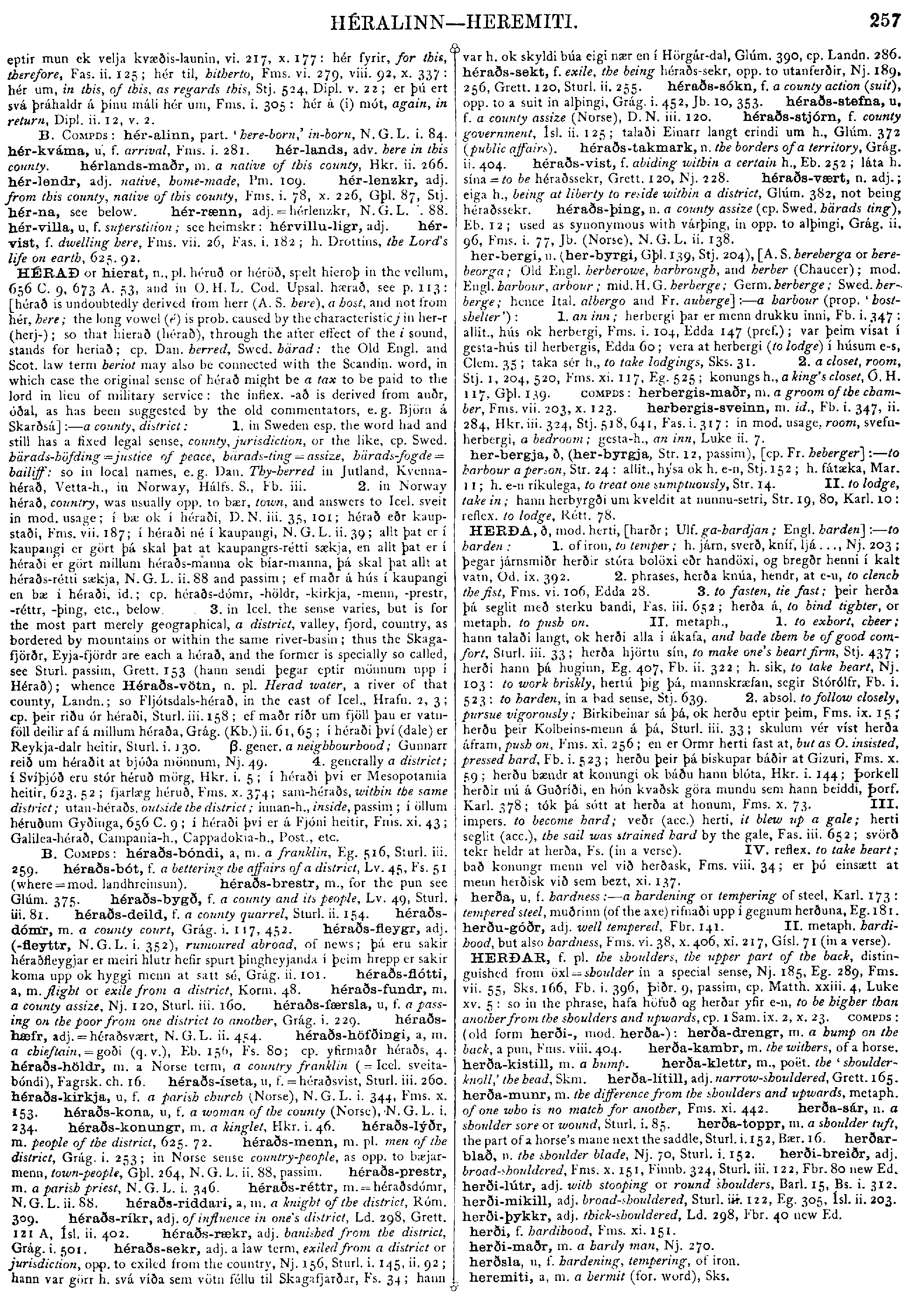
HERÐAR, f. pl. the shoulders, the upper part of the back, distinguished from öxl = shoulder in a special sense, Nj. 185, Eg. 289, Fms. vii. 55, Sks. 166, Fb. i. 396, Þiðr. 9, passim, cp. Matth. xxiii. 4, Luke xv. 5: so in the phrase, hafa hofuð og herðar yfir e-n, to be higher than another from the shoulders and upwards, cp. 1 Sam. ix. 2, x. 23. COMPDS: (old form herði-, mod. herða-): herða-drengr, m. a hump on the back, a pun, Fms. viii. 404. herða-kambr, m. the withers, of a horse. herða-kistill, m. a hump. herða-klettr, m., poët. the 'shoulder-knoll,' the head, Skm. herða-lítill, adj. narrow-shouldered, Grett. 165. herða-munr, m. the difference from the shoulders and upwards, metaph. of one who is no match for another, Fms. xi. 442. herða-sár, n. a shoulder sore or wound, Sturl. i. 85. herða-toppr, m. a shoulder tuft, the part of a horse's mane next the saddle, Sturl. i. 152, Bær. 16. herðar-blað, n. the shoulder blade, Nj. 70, Sturl. i. 152. herði-breiðr, adj. broad-shouldered, Fms. x. 151, Finnb. 324, Sturl. iii. 122, Fbr. 80 new Ed. herði-lútr, adj. with stooping or round shoulders, Barl. 15, Bs. i. 312. herði-mikill, adj. broad-shouldered, Sturl. iii. 122, Eg. 305, Ísl. ii. 203. herði-þykkr, adj. thick-shouldered, Ld. 298, Fbr. 40 new Ed.
|
Source: Cleasby/Vigfusson, page b0259, entry 7 View original page image as: [TIFF] [PNG] [View previous entry] [View next entry] |
[Comment on this entry] [View comments] |
The following entry has been hand-corrected once. |
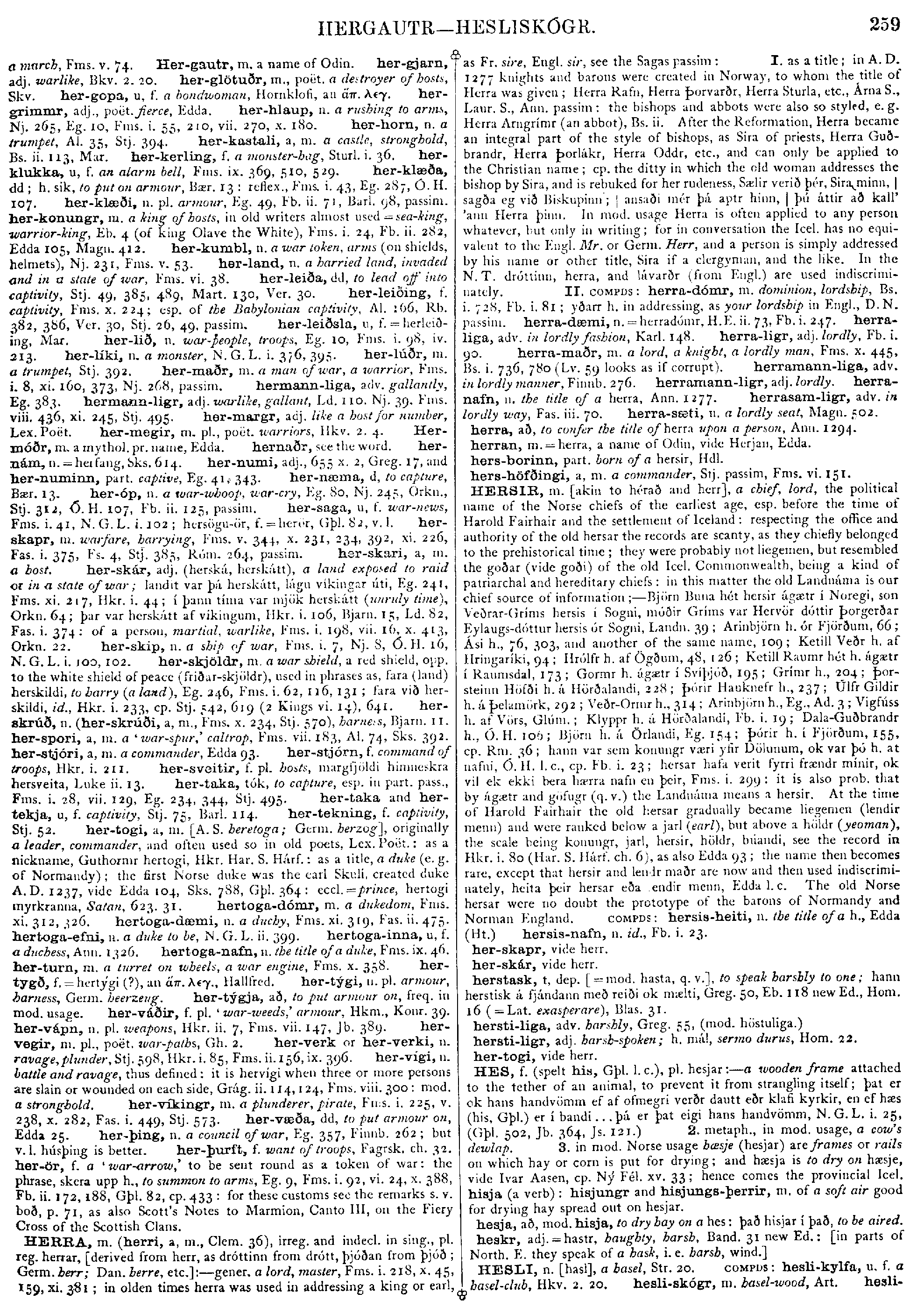
HERSIR, m. [akin to hérað and herr], a chief, lord, the political name of the Norse chiefs of the earliest age, esp. before the time of Harold Fairhair and the settlement of Iceland: respecting the office and authority of the old hersar the records are scanty, as they chiefly belonged to the prehistorical time; they were probably not liegemen, but resembled the goðar (vide goði) of the old Icel. Commonwealth, being a kind of patriarchal and hereditary chiefs: in this matter the old Landnáma is our chief source of information; -- Björn Buna hét hersir ágætr í Noregi, son Veðrar-Gríms hersis í Sogni, móðir Gríms var Hervör dóttir Þorgerðar Eylaugs-dóttur hersis ór Sogni, Landn. 39; Arinbjörn h. ór Fjörðum, 66; Ási h., 76, 303, and another of the same name, 109; Ketill Veðr h. af Hringaríki, 94; Hrólfr h. af Ögðum, 48, 126; Ketill Raumr hét h. ágætr í Raumsdal, 173; Gormr h. ágætr í Svíþjóð, 195; Grímr h., 204; Þorsteinn Höfði h. á Hörðalandi, 228; Þórir Hauknefr h., 237; Úlfr Gildir h. á Þelamörk, 292; Veðr-Ormr h., 314; Arinbjörn h., Eg., Ad. 3; Vigfúss h. af Vörs, Glúm.; Klyppr h. á Hörðalandi, Fb. i. 19; Dala-Guðbrandr h., Ó. H. 106; Björn h. á Örlandi, Eg. 154; Þórir h. í Fjörðum, 155, cp. Rm. 36; hann var sem konungr væri yfir Dölunum, ok var þó h. at nafni, Ó. H. l.c., cp. Fb. i. 23; hersar hafa verit fyrri frændr mínir, ok vil ek ekki bera hærra nafn en þeir, Fms. i. 299: it is also prob. that by ágætr and göfugr (q.v.) the Landnáma means a hersir. At the time of Harold Fairhair the old hersar gradually became liegemen (lendir menn) and were ranked below a jarl (earl), but above a höldr (yeoman), the scale being konungr, jarl, hersir, höldr, búandi, see the record in Hkr. i. 80 (Har. S. Hárf. ch. 6), as also Edda 93; the name then becomes rare, except that hersir and lendr maðr are now and then used indiscriminately, heita þeir hersar eða lendir menn, Edda l.c. The old Norse hersar were no doubt the prototype of the barons of Normandy and Norman England. COMPDS: hersis-heiti, n. the title of a h., Edda (Ht.) hersis-nafn, n. id., Fb. i. 23.
|
Source: Cleasby/Vigfusson, page b0262, entry 27 View original page image as: [TIFF] [PNG] [View previous entry] [View next entry] |
[Comment on this entry] [View comments] |
The following entry has been hand-corrected once. |
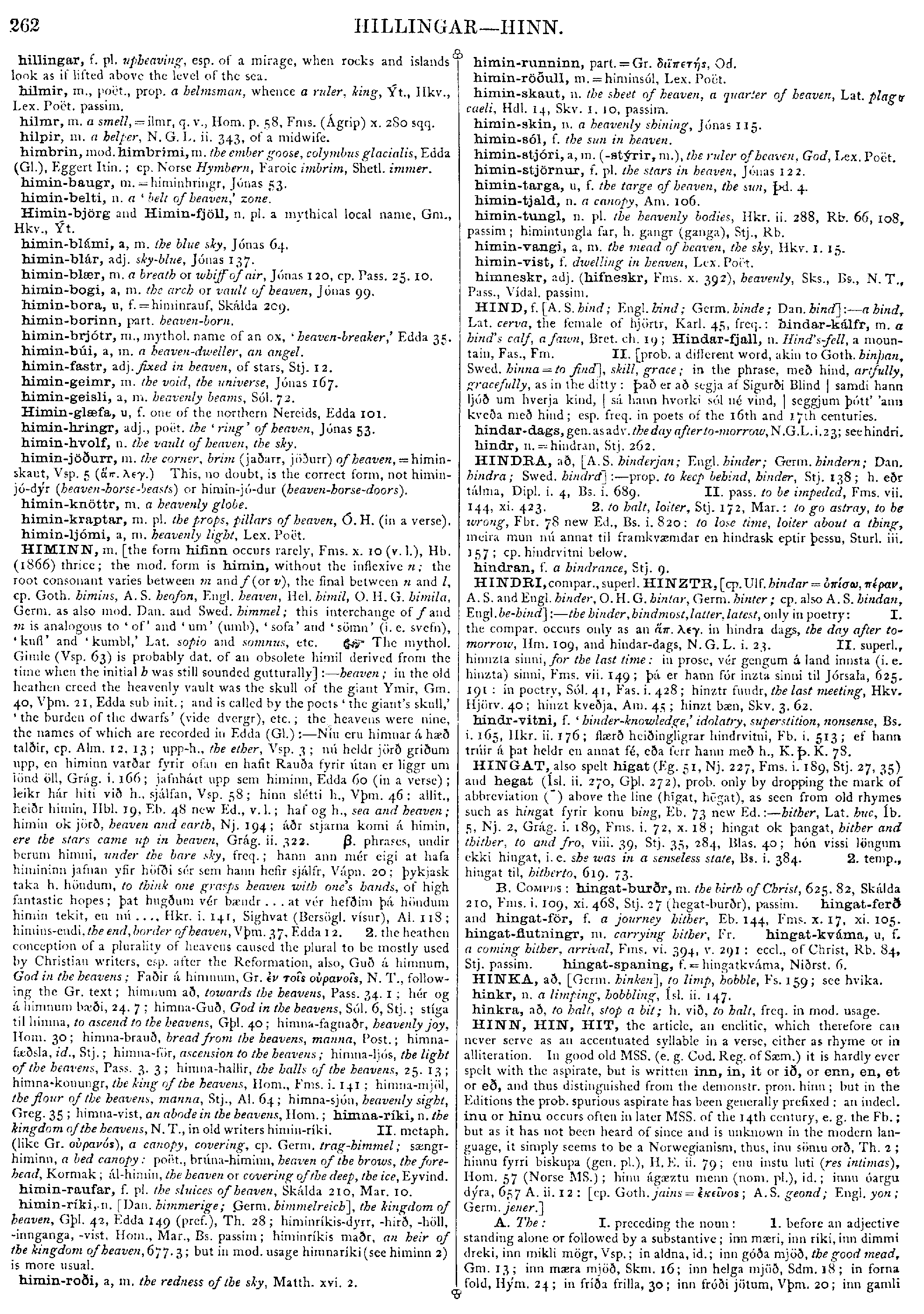
HIMINN,
m.
[the
form
hifinn
occurs
rarely,
Fms.
x.
10
(v.l.),
Hb.
(1866)
thrice;
the
mod.
form
is
himin,
without
the
inflexive
n;
the
root
consonant
varies
between
m
and
f
(or
v),
the
final
between
n
and
l,
cp.
Goth.
himins,
A.
S.
heofon,
Engl.
heaven,
Hel.
himil,
O.
H.
G.
himila,
Germ.
as
also
mod.
Dan.
and
Swed.
himmel;
this
interchange
of
f
and
m
is
analogous
to
'of'
and
'um'
(umb),
'sofa'
and
'sömn'
(i.e.
svefn),
'kufl'
and
'kumbl,'
Lat.
sopio
and
somnus,
etc.
UNCERTAIN
The
mythol.
Gimle
(Vsp.
63)
is
probably
dat.
of
an
obsolete
himil
derived
from
the
time
when
the
initial
h
was
still
sounded
gutturally]
:--
heaven;
in
the
old
heathen
creed
the
heavenly
vault
was
the
skull
of
the
giant
Ymir,
Gm.
40,
Vþm.
21,
Edda
sub
init.;
and
is
called
by
the
poets
'the
giant's
skull,'
'the
burden
of
the
dwarfs'
(vide
dvergr),
etc.;
the
heavens
were
nine,
the
names
of
which
are
recorded
in
Edda
(Gl.)
:--
Níu
eru
himnar
á
hæð
talðir,
cp.
Alm.
12,
13;
upp-h.,
the
ether,
Vsp.
3;
nú
heldr
jörð
griðum
upp,
en
himinn
varðar
fyrir
ofan
en
hafit
Rauða
fyrir
útan
er
liggr
um
lönd
öll,
Grág.
i.
166;
jafnhárt
upp
sem
himinn,
Edda
60
(in
a
verse);
leikr
hár
hiti
við
h.,
sjálfan,
Vsp.
58;
hinn
slétti
h.,
Vþm.
46:
allit.,
heiðr
himin,
Hbl.
19,
Eb.
48
new
Ed.,
v.l.;
haf
og
h.,
sea
and
heaven;
himin
ok
jörð,
heaven
and
earth,
Nj.
194;
áðr
stjarna
komi
á
himin,
ere
the
stars
came
up
in
heaven,
Grág.
ii.
322.
 .
phrases,
undir
berum
himni,
under
the
bare
sky,
freq.;
hann
ann
mér
eigi
at
hafa
himininn
jafnan
yfir
höfði
sér
sem
hann
hefir
sjálfr,
Vápn.
20;
þykjask
taka
h.
höndum,
to
think
one
grasps
heaven
with
one's
hands,
of
high
fantastic
hopes;
þat
hugðum
vér
bændr
...
at
vér
hefðim
þá
höndum
himin
tekit,
en
nú
...,
Hkr.
i.
141,
Sighvat
(Bersögl.
vísur),
Al.
118;
himins-emdi,
the
end,
border
of
heaven,
Vþm.
37,
Edda
12.
2.
the
heathen
conception
of
a
plurality
of
heavens
caused
the
plural
to
be
mostly
used
by
Christian
writers,
esp.
after
the
Reformation,
also,
Guð
á
himnum,
God
in
the
heavens;
Faðir
á
himnum,
Gr.
GREEK,
N.
T.,
following
the
Gr.
text;
himnum
að,
towards
the
heavens,,
Pass.
34.
1;
hér
og
á
himnum
bæði,
24.
7:
himna-Guð,
God
in
the
heavens,
Sól.
6,
Stj.;
stíga
til
himna,
to
ascend
to
the
heavens,
Gþl.
40;
himna-fagnaðr,
heavenly
joy,
Hom.
30;
himna-brauð,
bread
from
the
heavens,
manna,
Post.;
himna-fæðsla,
id.,
Stj.;
himna-för,
ascension
to
the
heavens;
himna-ljós,
the
light
of
the
heavens,
Pass.
3.
3;
hinma-hallir,
the
halls
of
the
heavens,
25.
13;
himna-konungr,
the
king
of
the
heavens,
Hom.,
Fms.
i.
141;
himna-mjöl,
the
flour
of
the
heavens,
manna,
Stj.,
Al.
64;
himna-sjón,
heavenly
sight,
Greg.
35;
himna-vist,
an
abode
in
the
heavens,
Hom.;
himna-ríki,
n.
the
kingdom
of
the
heavens,
N.
T.,
in
old
writers
himin-ríki.
II.
metaph.
(like
Gr.
GREEK),
a
canopy,
covering,
cp.
Germ.
trag-himmel;
sængr-himinn,
a
bed
canopy:
poët.,
brúna-himinn,
heaven
of
the
brows,
the
forehead,
Kormak;
ál-himin,
the
heaven
or
covering
of
the
deep,
the
ice,
Eyvind.
.
phrases,
undir
berum
himni,
under
the
bare
sky,
freq.;
hann
ann
mér
eigi
at
hafa
himininn
jafnan
yfir
höfði
sér
sem
hann
hefir
sjálfr,
Vápn.
20;
þykjask
taka
h.
höndum,
to
think
one
grasps
heaven
with
one's
hands,
of
high
fantastic
hopes;
þat
hugðum
vér
bændr
...
at
vér
hefðim
þá
höndum
himin
tekit,
en
nú
...,
Hkr.
i.
141,
Sighvat
(Bersögl.
vísur),
Al.
118;
himins-emdi,
the
end,
border
of
heaven,
Vþm.
37,
Edda
12.
2.
the
heathen
conception
of
a
plurality
of
heavens
caused
the
plural
to
be
mostly
used
by
Christian
writers,
esp.
after
the
Reformation,
also,
Guð
á
himnum,
God
in
the
heavens;
Faðir
á
himnum,
Gr.
GREEK,
N.
T.,
following
the
Gr.
text;
himnum
að,
towards
the
heavens,,
Pass.
34.
1;
hér
og
á
himnum
bæði,
24.
7:
himna-Guð,
God
in
the
heavens,
Sól.
6,
Stj.;
stíga
til
himna,
to
ascend
to
the
heavens,
Gþl.
40;
himna-fagnaðr,
heavenly
joy,
Hom.
30;
himna-brauð,
bread
from
the
heavens,
manna,
Post.;
himna-fæðsla,
id.,
Stj.;
himna-för,
ascension
to
the
heavens;
himna-ljós,
the
light
of
the
heavens,
Pass.
3.
3;
hinma-hallir,
the
halls
of
the
heavens,
25.
13;
himna-konungr,
the
king
of
the
heavens,
Hom.,
Fms.
i.
141;
himna-mjöl,
the
flour
of
the
heavens,
manna,
Stj.,
Al.
64;
himna-sjón,
heavenly
sight,
Greg.
35;
himna-vist,
an
abode
in
the
heavens,
Hom.;
himna-ríki,
n.
the
kingdom
of
the
heavens,
N.
T.,
in
old
writers
himin-ríki.
II.
metaph.
(like
Gr.
GREEK),
a
canopy,
covering,
cp.
Germ.
trag-himmel;
sængr-himinn,
a
bed
canopy:
poët.,
brúna-himinn,
heaven
of
the
brows,
the
forehead,
Kormak;
ál-himin,
the
heaven
or
covering
of
the
deep,
the
ice,
Eyvind.
|
Source: Cleasby/Vigfusson, page b0267, entry 1 View original page image as: [TIFF] [PNG] [View previous entry] [View next entry] |
[Comment on this entry] [View comments] |
The following entry has been hand-corrected once. |
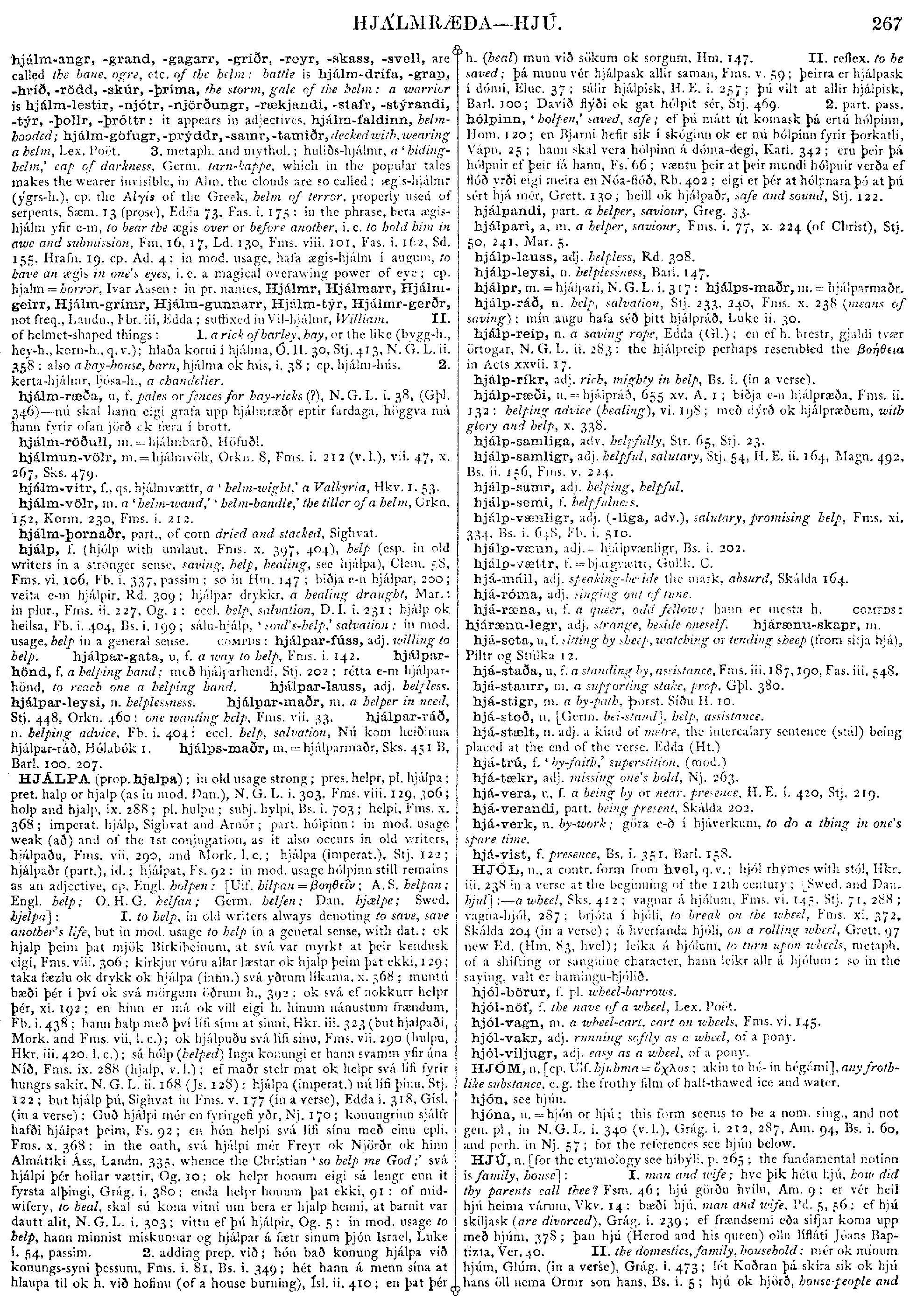
hjálm-angr, -grand, -gagarr, -gríðr, -reyr, -skass, -svell, are called the bane, ogre, etc. of the helm: battle is hjálm-drífa, -grap, -hríð, -rödd, -skúr, -þrima, the storm, gale of the helm: a warrior is hjálm-lestir, -njótr, -njörðungr, -rækjandi, -stafr, -stýrandi, -týr, -þollr, -þróttr: it appears in adjectives, hjálm-faldinn, helm-hooded; hjálm-göfugr, -prýddr, -samr, -tamiðr, decked with, wearing a helm, Lex. Poët. 3. metaph. and mythol.; huliðs-hjálmr, a 'hiding-helm,' cap of darkness, Germ. tarn-kappe, which in the popular tales makes the wearer invisible, in Alm. the clouds are so called; ægis-hjálmr (ýgrs-h.), cp. the GREEK of the Greek, helm of terror, properly used of serpents, Sæm. 13 (prose), Edda 73, Fas. i. 175: in the phrase, bera ægishjálm yfir e-m, to bear the ægis over or before another, i.e. to hold him in awe and submission, Fm. 16, 17, Ld. 130, Fms. viii. 101, Fas. i. 162, Sd. 155, Hrafn. 19, cp. Ad. 4: in mod. usage, hafa ægis-hjálm í augum, to have an ægis in one's eyes, i.e. a magical overawing power of eye; cp. hjalm = horror, Ivar Aasen: in pr. names, Hjálmr, Hjálmarr, Hjálm-geirr, Hjálm-grímr, Hjálm-gunnarr, Hjálm-týr, Hjálmr-gerðr, not freq., Landn., Fbr. iii, Edda; suffixed in Vil-hjálmr, William. II. of helmet-shaped things: 1. a rick of barley, hay, or the like (bygg-h., hey-h., korn-h., q.v.); hlaða korni í hjálma, Ó. H. 30, Stj. 413, N. G. L. ii. 358: also a hay-house, barn, hjálma ok hús, i. 38; cp. hjálm-hús. 2. kerta-hjálmr, ljósa-h., a chandelier.
|
Source: Cleasby/Vigfusson, page b0267, entry 9 View original page image as: [TIFF] [PNG] [View previous entry] [View next entry] |
[Comment on this entry] [View comments] |
The following entry has been hand-corrected once. |
HJÁLPA (prop. hjalpa); in old usage strong; pres. helpr, pl. hjálpa; pret. halp or hjalp (as in mod. Dan.), N. G. L. i. 303, Fms. viii. 129, 306; holp and hjalp, ix. 288; pl. hulpu; subj. hylpi, Bs. i. 703; helpi, Fms. x. 368; imperat. hjálp, Sighvat and Arnór; part. hólpinn: in mod. usage weak (að) and of the 1st conjugation, as it also occurs in old writers, hjálpaðu, Fms. vii. 290, and Mork. l.c.; hjálpa (imperat.), Stj. 122; hjálpaðr (part.), id.; hjálpat, Fs. 92: in mod. usage hólpinn still remains as an adjective, cp. Engl. holpen: [Ulf. hilpan = GREEK; A. S. helpan; Engl. help; O. H. G. helfan; Germ. helfen; Dan. hjælpe; Swed. hjelpa]: I. to help, in old writers always denoting to save, save another's life, but in mod. usage to help in a general sense, with dat.; ok hjalp þeim þat mjök Birkibeinum, at svá var myrkt at þeir kendusk eigi, Fms. viii. 306; kirkjur vóru allar læstar ok hjalp þeim þat ekki, 129; taka fæzlu ok drykk ok hjálpa (infin.) svá yðrum líkama, x. 368; muntú bæði þér í því ok svá mörgum öðrum h., 392; ok svá ef nokkurr helpr þér, xi. 192; en hinn er má, ok vill eigi h. hinum nánustum frændum, Fb. i. 438; hann halp með því lífi sínu at sinni, Hkr. iii. 323 (but hjalpaði, Mork. and Fms. vii, l.c.); ok hjálpuðu svá lífi sínu, Fms. vii. 290 (hulpu, Hkr. iii. 420, l.c.); sá hólp (helped) Inga konungi er hann svamm yfir ána Níð, Fms. ix. 288 (hjalp, v.l.); ef maðr stelr mat ok helpr svá lífi fyrir hungrs sakir, N. G. L. ii. 168 (Js. 128); hjálpa (imperat.) nú lífi þínu, Stj. 122; but hjálp þú, Sighvat in Fms. v. 177 (in a verse), Edda i. 318, Gísl. (in a verse); Guð hjálpi mér en fyrirgefi yðr, Nj. 170; konungrinn sjálfr hafði hjálpat þeim, Fs. 92; en hón helpi svá lífi sínu með einu epli, Fms. x. 368: in the oath, svá hjálpi mér Freyr ok Njörðr ok hinn Almáttki Áss, Landn. 335, whence the Christian 'so help me God;' svá hjálpi þer hollar vættir, Og. 10; ok helpr honum eigi sá lengr enn it fyrsta alþingi, Grág. i. 380; enda helpr honum þat ekki, 91: of midwifery, to heal, skal sú kona vitni um bera er hjalp henni, at barnit var dautt alit, N. G. L. i. 303; vittu ef þú hjálpir, Og. 5: in mod. usage to help, hann minnist miskunnar og hjálpar á fætr sínum þjón Israel, Luke i. 54, passim. 2. adding prep. við; hón bað konung hjálpa við konungs-syni þessum, Fms. i. 81, Bs. i. 349; hét hann á menn sína at hlaupa til ok h. við hofinu (of a house burning), Ísl. ii. 410; en þat þér h. (heal) mun við sökum ok sorgum, Hm. 147. II. reflex. to be saved; þá munu vér hjálpask allir saman, Fms. v. 59; þeirra er hjálpask í dómi, Eluc. 37; sálir hjálpisk, H. E. i. 257; þú vilt at allir hjálpisk, Barl. 100; Davíð flýði ok gat hólpit sér, Stj. 469. 2. part. pass. hólpinn, 'holpen,' saved, safe; ef þú mátt út komask þá ertú hólpinn, Hom. 120; en Bjarni hefir sik í skóginn ok er nú hólpinn fyrir Þorkatli, Vápn. 25; hann skal vera hólpinn á dóma-degi, Karl. 342; eru þeir þá hólpnir ef þeir fá hann, Fs. 66; væntu þeir at þeir mundi hólpnir verða ef flóð yrði eigi meira en Nóa-flóð, Rb. 402; eigi er þér at hólpnara þó at þú sért hjá mér, Grett. 130; heill ok hjálpaðr, safe and sound, Stj. 122.
|
Source: Cleasby/Vigfusson, page b0268, entry 7 View original page image as: [TIFF] [PNG] [View previous entry] [View next entry] |
[Comment on this entry] [View comments] |
The following entry has been hand-corrected once. |
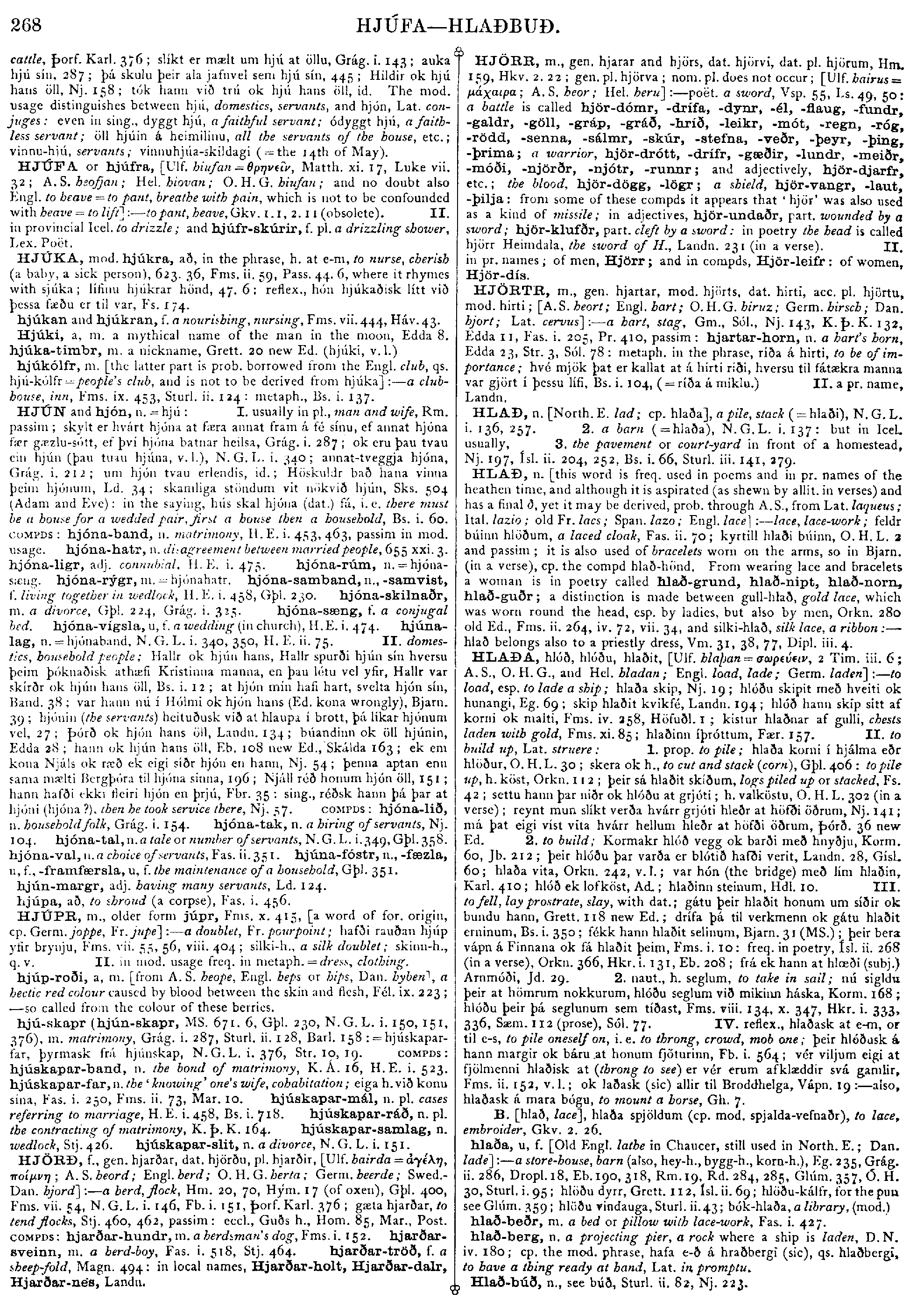
HJÚN and hjón, n. = hjú: I. usually in pl., man and wife, Rm. passim; skylt er hvárt hjóna at færa annat fram á fé sínu, ef annat hjóna fær gæzlu-sótt, ef því hjóna batnar heilsa, Grág. i. 287; ok eru þau tvau ein hjún (þau tuau hjúna, v.l.), N. G. L. i. 340; annat-tveggja hjóna, Grág. i. 212; um hjón tvau erlendis, id.; Höskuldr bað hana vinna þeim hjónum, Ld. 34; skamliga stöndum vit nökvið hjún, Sks. 504 (Adam and Eve): in the saying, hús skal hjóna (dat.) fá, i.e. there must be a house for a wedded pair, first a house then a household, Bs. i. 60. COMPDs: hjóna-band, n. matrimony, H. E. i. 453, 463, passim in mod. usage. hjóna-hatr, n. disagreement between married people, 655 xxi. 3. hjóna-ligr, adj. connubial, H. E. i. 475. hjóna-rúm, n. = hjónasæng. hjóna-rýgr, m. = hjónahatr. hjóna-samband, n., -samvist, f. living together in wedlock, H. E. i. 458, Gþl. 230. hjóna-skilnaðr, m. a divorce, Gþl. 224, Grág. i. 325. hjóna-sæng, f. a conjugal bed. hjóna-vígsla, u, f. a wedding (in church), H. E. i. 474. hjúna-lag, n. = hjónaband, N. G. L. i. 340, 350, H. E. ii. 75. II. domestics, household people; Hallr ok hjún hans, Hallr spurði hjún sín hversu þeim þóknaðisk athæfi Kristinna manna, en þau létu vel yfir, Hallr var skírðr ok hjún hans öll, Bs. i. 12; at hjón mín hafi hart, svelta hjón sín, Band. 38; var hann nú í Hólmi ok hjón hans (Ed. kona wrongly), Bjarn. 39; hjónin (the servants) heituðusk við at hlaupa í brott, þá líkar hjónum vel, 27; Þórð ok hjón hans öll, Landn. 134; búandinn ok ::ll hjúnin, Edda 28; hann ok hjún hans öll, Eb. 108 new Ed., Skálda 163; ek em kona Njáls ok ræð ek eigi síðr hjón en hann, Nj. 54; þenna aptan enn sama mælti Bergþóra til hjóna sinna, 196; Njáll réð honum hjón öll, 151; hann hafði ekki fleiri hjón en þrjú, Fbr. 35: sing., réðsk hann þá þar at hjóni (hjóna?). then he took service there, Nj. 57. COMPDS: hjóna-lið, n. household folk, Grág. i. 154. hjóna-tak, n. a hiring of servants, Nj. 104. hjóna-tal, n. a tale or number of servants, N. G. L. i. 349, Gþl. 358. hjóna-val, n. a choice of servants, Fas. ii. 351. hjúna-fóstr, n., -fæzla, u, f., -framfærsla, u, f. the maintenance of a household, Gþl. 351.
|
Source: Cleasby/Vigfusson, page b0269, entry 10 View original page image as: [TIFF] [PNG] [View previous entry] [View next entry] |
[Comment on this entry] [View comments] |
The following entry has been hand-corrected once. |
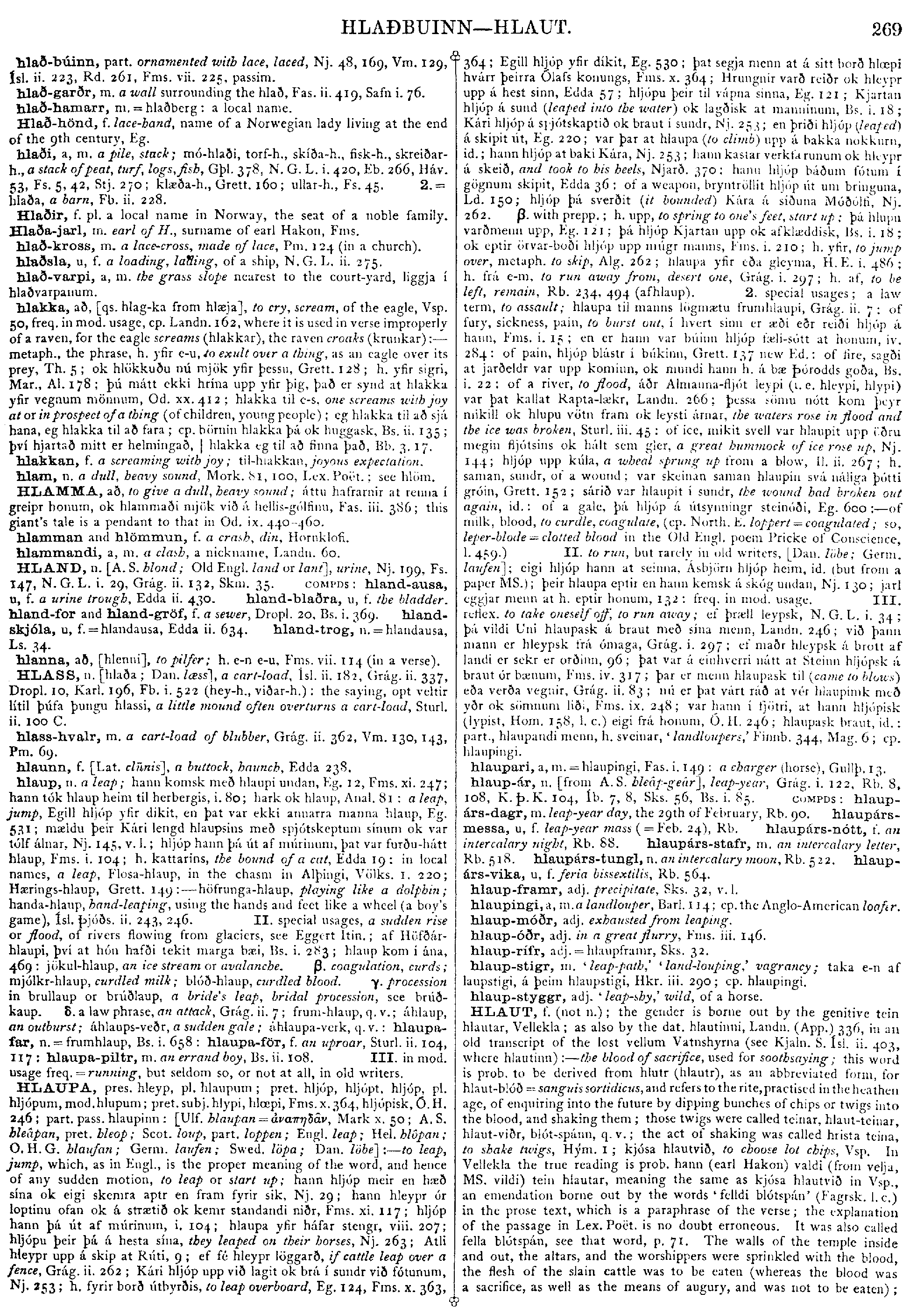
hlakka, að, [qs. hlag-ka from hlæja], to cry, scream, of the eagle, Vsp. 50, freq. in mod. usage, cp. Landn. 162, where it is used in verse improperly of a raven, for the eagle screams (hlakkar), the raven croaks (krunkar) :-- metaph., the phrase, h. yfir e-u, to exult over a thing, as an eagle over its prey, Th. 5; ok hlökkuðu nú mjök yfir þessu, Grett. 128; h. yfir sigri, Mar., Al. 178; þú mátt ekki hrína upp yfir þig, það er synd at hlakka yfir vegnum mönnum, Od. xx. 412; hlakka til e-s, one screams with joy at or in prospect of a thing (of children, young people); eg hlakka til að sjá hana, eg hlakka til að fara; cp. börnin hlakka þá ok huggask, Bs. ii. 135; því hjartað mitt er helmingað, | hlakka eg til að finna það, Bb. 3. 17.
|
Source: Cleasby/Vigfusson, page b0269, entry 21 View original page image as: [TIFF] [PNG] [View previous entry] [View next entry] |
[Comment on this entry] [View comments] |
The following entry has been hand-corrected once. |
hlaup,
n.
a
leap;
hann
komsk
með
hlaupi
undan,
Eg.
12,
Fms.
xi.
247;
hann
tók
hlaup
heim
til
herbergis,
i.
80;
hark
ok
hlaup,
Anal.
81:
a
leap,
jump,
Egill
hljóp
yfir
díkit,
en
þat
var
ekki
annarra
manna
hlaup,
Eg.
531;
mældu
þeir
Kári
lengd
hlaupsins
með
spjótskeptum
sínum
ok
var
tólf
álnar,
Nj.
145,
v.l.;
hljóp
hann
þá
út
af
múrinum,
þat
var
furðu-hátt
hlaup,
Fms.
i.
104;
h.
kattarins,
the
bound
of
a
cat,
Edda
19:
in
local
names,
a
leap,
Flosa-hlaup,
in
the
chasm
in
Alþingi,
Völks.
1.
220;
Hærings-hlaup,
Grett.
149
:--
höfrunga-hlaup,
playing
like
a
dolphin;
handa-hlaup,
hand-leaping,
using
the
hands
and
feet
like
a
wheel
(a
boy's
game),
Ísl.
Þjóðs.
ii.
243,
246.
II.
special
usages,
a
sudden
rise
or
flood,
of
rivers
flowing
from
glaciers,
see
Eggert
Itin.;
af
Höfðárhlaupi,
því
at
hón
hafði
tekit
marga
bæi,
Bs.
i.
283;
hlaup
kom
í
ána,
469:
jökul-hlaup,
an
ice
stream
or
avalanche.
.
coagulation,
curds;
mjólkr-hlaup,
curdled
milk;
blóð-hlaup,
curdled
blood.
 .
procession
in
brullaup
or
brúðlaup,
a
bride's
leap,
bridal
procession,
see
brúðkaup.
.
procession
in
brullaup
or
brúðlaup,
a
bride's
leap,
bridal
procession,
see
brúðkaup.
 .
a
law
phrase,
an
attack,
Grág.
ii.
7;
frum-hlaup,
q.v.;
áhlaup,
an
outburst;
áhlaups-veðr,
a
sudden
gale;
áhlaupa-verk,
q.v.:
hlaupa-far,
n.
=
frumhlaup,
Bs.
i.
658:
hlaupa-för,
f.
an
uproar,
Sturl.
ii.
104,
117:
hlaupa-piltr,
m.
an
errand
boy,
Bs.
ii.
108.
III.
in
mod.
usage
freq.
=
running,
but
seldom
so,
or
not
at
all,
in
old
writers.
.
a
law
phrase,
an
attack,
Grág.
ii.
7;
frum-hlaup,
q.v.;
áhlaup,
an
outburst;
áhlaups-veðr,
a
sudden
gale;
áhlaupa-verk,
q.v.:
hlaupa-far,
n.
=
frumhlaup,
Bs.
i.
658:
hlaupa-för,
f.
an
uproar,
Sturl.
ii.
104,
117:
hlaupa-piltr,
m.
an
errand
boy,
Bs.
ii.
108.
III.
in
mod.
usage
freq.
=
running,
but
seldom
so,
or
not
at
all,
in
old
writers.
|
Source: Cleasby/Vigfusson, page b0269, entry 22 View original page image as: [TIFF] [PNG] [View previous entry] [View next entry] |
[Comment on this entry] [View comments] |
The following entry has been hand-corrected once. |
HLAUPA,
pres.
hleyp,
pl.
hlaupum;
pret.
hljóp,
hljópt,
hljóp,
pl.
hljópum,
mod.
hlupum;
pret.
subj.
hlypi,
hlœpi,
Fms.
x.
364,
hljópisk,
Ó.
H.
246;
part.
pass.
hlaupinn:
[Ulf.
hlaupan
=
GREEK,
Mark
x.
50;
A.
S.
hleâpan,
pret.
hleop;
Scot.
loup,
part.
loppen;
Engl.
leap;
Hel.
hlôpan;
O.
H.
G.
hlaufan;
Germ.
laufen;
Swed.
löpa;
Dan.
löbe]
:--
to
leap,
jump,
which,
as
in
Engl.,
is
the
proper
meaning
of
the
word,
and
hence
of
any
sudden
motion,
to
leap
or
start
up;
hann
hljóp
meir
en
hæð
sína
ok
eigi
skemra
aptr
en
fram
fyrir
sik,
Nj.
29;
hann
hleypr
ór
loptinu
ofan
ok
á
straetið
ok
kemr
standandi
niðr,
Fms.
xi.
117;
hljóp
hann
þá
út
af
múrinum,
i.
104;
hlaupa
yfir
háfar
stengr,
viii.
207;
hljópu
þeir
þá
á
hesta
sína,
they
leaped
on
their
horses,
Nj.
263;
Atli
hleypr
upp
á
skip
at
Rúti,
9;
ef
fé
hleypr
löggarð,
if
cattle
leap
over
a
fence,
Grág.
ii.
262;
Kári
hljóp
upp
við
lagit
ok
brá
í
sundr
við
fótunum,
Nj.
253;
h.
fyrir
borð
útbyrðis,
to
leap
overboard,
Eg.
124,
Fms.
x.
363,
364;
Egill
hljóp
yfir
díkit,
Eg.
530;
þat
segja
menn
at
á
sitt
borð
hlœpi
hvárr
þeirra
Ólafs
konungs,
Fms.
x.
364;
Hrungnir
varð
reiðr
ok
hleypr
upp
á
hest
sinn,
Edda
57;
hljópu
þeir
til
vápna
sinna,
Eg.
121;
Kjartan
hljóp
á
sund
(leaped
into
the
water)
ok
lagðisk
at
manninum,
Bs.
i.
18;
Kári
hljóp
á
spjótskaptið
ok
braut
í
sundr,
Nj.
253;
en
þriði
hljóp
(leaped)
á
skipit
út,
Eg.
220;
var
þar
at
hlaupa
(to
climb)
upp
á
bakka
nokkurn,
id.;
hann
hljóp
at
baki
Kára,
Nj.
253;
hann
kastar
verkfarunum
ok
hleypr
á
skeið,
and
took
to
his
heels,
Njarð.
370;
hann
hljóp
báðum
fótum
í
gögnum
skipit,
Edda
36:
of
a
weapon,
bryntröllit
hljóp
út
um
bringuna,
Ld.
150;
hljóp
þá
sverðit
(it
bounded)
Kára
á
síðuna
Móðólfi,
Nj.
262.
.
with
prepp.;
h.
upp,
to
spring
to
ones
feet,
start
up;
þá
hlupu
varðmenn
upp,
Eg.
121;
þá
hljóp
Kjartan
upp
ok
afklæddisk,
Bs.
i.
18;
ok
eptir
örvar-boði
hljóp
upp
múgr
manns,
Fms.
i.
210;
h.
yfir,
to
jump
over,
metaph.
to
skip,
Alg.
262;
hlaupa
yfir
eða
gleyma,
H.
E.
i.
486;
h.
frá
e-m,
to
run
away
from,
desert
one,
Grág.
i.
297;
h.
af,
to
be
left,
remain,
Rb.
234,
494
(afhlaup).
2.
special
usages;
a
law
term,
to
assault;
hlaupa
til
manns
lögmætu
frumhlaupi,
Grág.
ii.
7:
of
fury,
sickness,
pain,
to
burst
out,
í
hvert
sinn
er
æði
eðr
reiði
hljóp
á
hann,
Fms.
i.
15;
en
er
hann
var
búinn
hljóp
fæli-sótt
at
honum,
iv.
284:
of
pain,
hljóp
blástr
í
búkinn,
Grett.
137
new
Ed.:
of
fire,
sagði
at
jarðeldr
var
upp
kominn,
ok
mundi
hann
h.
á
bæ
Þórodds
goða,
Bs.
i.
22:
of
a
river,
to
flood,
áðr
Almanna-fljót
leypi
(i.e.
hleypi,
hlypi)
var
þat
kallat
Rapta-lækr,
Landn.
266;
þessa
sömu
nótt
kom
þeyr
mikill
ok
hlupu
vötn
fram
ok
leysti
árnar,
the
waters
rose
in
flood
and
the
ice
was
broken,
Sturl.
iii.
45:
of
ice,
mikit
svell
var
hlaupit
upp
öðru
megin
fljótsins
ok
hált
sem
gler,
a
great
hummock
of
ice
rose
up,
Nj.
144;
hljóp
upp
kúla,
a
wheal
sprung
up
from
a
blow,
Il.
ii.
267;
h.
saman,
sundr,
of
a
wound;
var
skeinan
saman
hlaupin
svá
náliga
þótti
gróin,
Grett.
152;
sárið
var
hlaupit
í
sundr,
the
wound
had
broken
out
again,
id.:
of
a
gale,
þá
hljóp
á
útsynningr
steinóði,
Eg.
600
:--
of
milk,
blood,
to
curdle,
coagulate,
(cp.
North.
E.
loppert
=
coagulated;
so,
leper-blode
=
clotted
blood
in
the
Old
Engl.
poem
Pricke
of
Conscience,
l.
459.)
II.
to
run,
but
rarely
in
old
writers,
[Dan.
löbe;
Germ.
laufen];
eigi
hljóp
hann
at
seinna,
Ásbjörn
hljóp
heim,
id.
(but
from
a
paper
MS.);
þeir
hlaupa
eptir
en
hann
kemsk
á
skóg
undan,
Nj.
130;
jarl
eggjar
menn
at
h.
eptir
honum,
132:
freq.
in
mod.
usage.
III.
reflex.
to
take
oneself
off,
to
run
away;
ef
þræll
leypsk,
N.
G.
L.
i.
34;
þá
vildi
Uni
hlaupask
á
braut
með
sína
menn,
Landn.
246;
við
þann
mann
er
hleypsk
frá
ómaga,
Grág.
i.
297;
ef
maðr
hleypsk
á
brott
af
landi
er
sekr
er
orðinn,
96;
þat
var
á
einhverri
nátt
at
Steinn
hljópsk
á
braut
ór
bænum,
Fms.
iv.
317;
þar
er
menn
hlaupask
til
(came
to
blows)
eða
verða
vegnir,
Grág.
ii.
83;
nú
er
þat
várt
ráð
at
vér
hlaupimk
með
yðr
ok
sömnum
liði,
Fms.
ix.
248;
var
hann
í
fjötri,
at
hann
hljópisk
(lypist,
Hom.
158,
l.c.)
eigi
frá
honum,
Ó.
H.
246;
hlaupask
braut,
id.:
part.,
hlaupandi
menn,
h.
sveinar,
'landloupers,'
Finnb.
344,
Mag.
6;
cp.
hlaupingi.
|
Source: Cleasby/Vigfusson, page b0272, entry 1 View original page image as: [TIFF] [PNG] [View previous entry] [View next entry] |
[Comment on this entry] [View comments] |
The following entry has been hand-corrected once. |
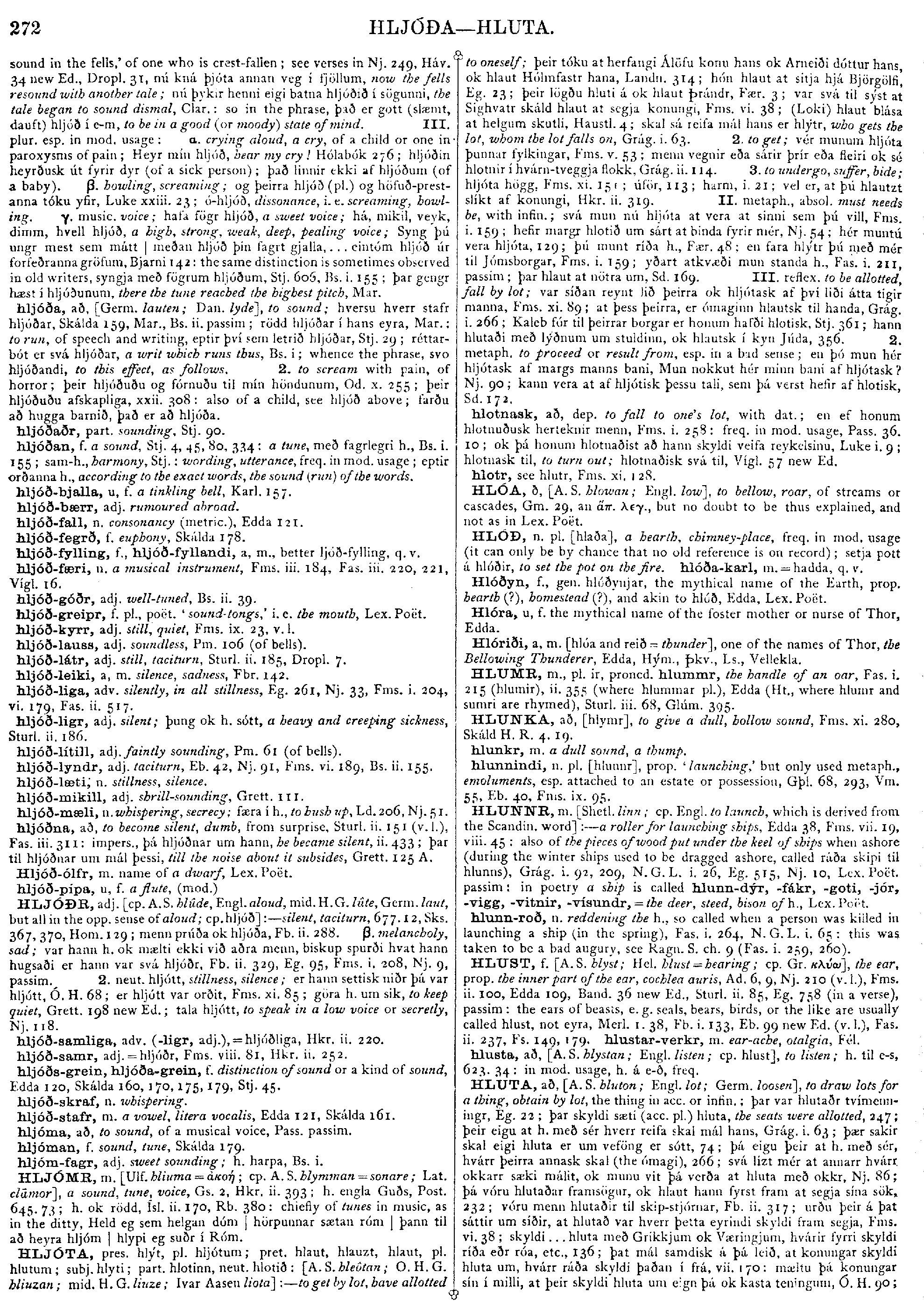
sound
in
the
fells,'
of
one
who
is
crest-fallen;
see
verses
in
Nj.
249,
Háv.
34
new
Ed.,
Dropl.
31,
nú
kná
þjóta
annan
veg
í
fjöllum,
now
the
fells
resound
with
another
tale;
nú
þykir
henni
eigi
batna
hljóðið
í
sögunni,
the
tale
began
to
sound
dismal,
Clar.:
so
in
the
phrase,
það
er
gott
(slæmt,
dauft)
hljóð
í
e-m,
to
be
in
a
good
(or
moody)
state
of
mind.
III.
plur.
esp.
in
mod.
usage:
 .
crying
aloud,
a
cry,
of
a
child
or
one
in
paroxysms
of
pain;
Heyr
mín
hljóð,
hear
my
cry!
Hólabók
276;
hljóðin
heyrðusk
út
fyrir
dyr
(of
a
sick
person);
það
linnir
ekki
af
hljóðum
(of
a
baby).
.
howling,
screaming;
og
þeirra
hljóð
(pl.)
og
höfuð-prestanna
tóku
yfir,
Luke
xxiii.
23;
ó-hljóð,
dissonance,
i.e.
screaming,
howling.
.
music.
voice;
hafa
fögr
hljóð,
a
sweet
voice;
há,
mikil,
veyk,
dimm,
hvell
hljóð,
a
high,
strong,
weak,
deep,
pealing
voice;
Syng
þú
ungr
mest
sem
mátt
|
meðan
hljóð
þín
fagrt
gjalla,
...
eintóm
hljóð
úr
forfeðranna
gröfum,
Bjarni
142:
the
same
distinction
is
sometimes
observed
in
old
writers,
syngja
með
fögrum
hljóðum,
Stj.
606,
Bs.
i.
155;
þar
gengr
hæst
í
hljóðunum,
there
the
tune
reached
the
highest
pitch,
Mar.
.
crying
aloud,
a
cry,
of
a
child
or
one
in
paroxysms
of
pain;
Heyr
mín
hljóð,
hear
my
cry!
Hólabók
276;
hljóðin
heyrðusk
út
fyrir
dyr
(of
a
sick
person);
það
linnir
ekki
af
hljóðum
(of
a
baby).
.
howling,
screaming;
og
þeirra
hljóð
(pl.)
og
höfuð-prestanna
tóku
yfir,
Luke
xxiii.
23;
ó-hljóð,
dissonance,
i.e.
screaming,
howling.
.
music.
voice;
hafa
fögr
hljóð,
a
sweet
voice;
há,
mikil,
veyk,
dimm,
hvell
hljóð,
a
high,
strong,
weak,
deep,
pealing
voice;
Syng
þú
ungr
mest
sem
mátt
|
meðan
hljóð
þín
fagrt
gjalla,
...
eintóm
hljóð
úr
forfeðranna
gröfum,
Bjarni
142:
the
same
distinction
is
sometimes
observed
in
old
writers,
syngja
með
fögrum
hljóðum,
Stj.
606,
Bs.
i.
155;
þar
gengr
hæst
í
hljóðunum,
there
the
tune
reached
the
highest
pitch,
Mar.
| Result Page: |  |
Previous | 3 4 5 6 7 8 9 10 11 12 13 14 15 16 17 18 19 20 21 | Next |  |
Germanic Lexicon Project (main page)
This search system was written by
Sean Crist
Please consider
volunteering
to correct the data in these online dictionaries.
No rights reserved. Feel free to use these data in any way you please.