|
|

|
Source: Bosworth/Toller, page d0622, entry 12 View original page image as: [TIFF] [PNG] [View previous entry] [View next entry] |
[Comment on this entry] [View comments] |
The following entry has been hand-corrected once. |
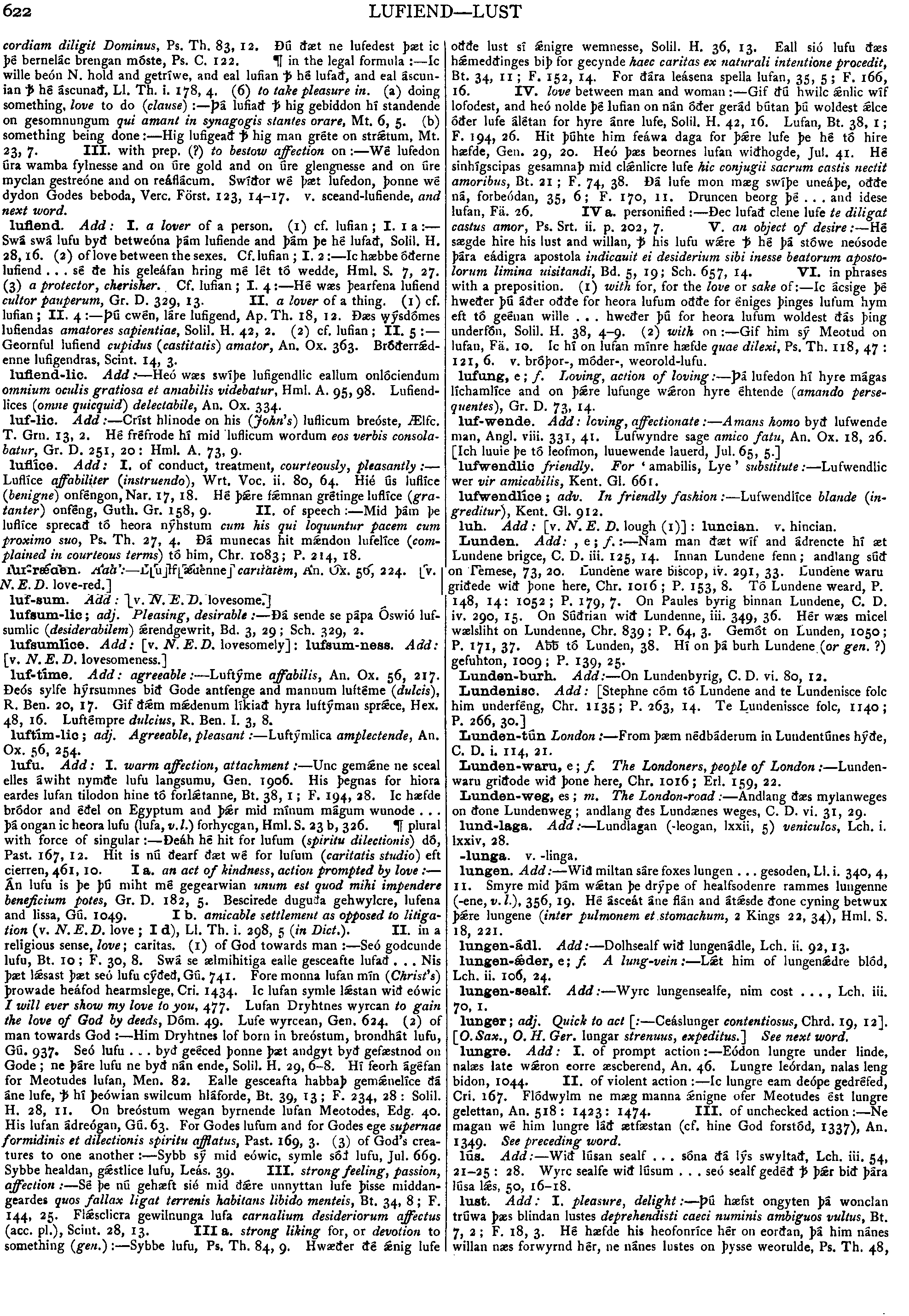
lufu.
Add:
I.
warm
affection,
attachment
:--
Unc
gem ne
ne
sceal
elles
áwiht
nymðe
lufu
langsumu,
Gen.
1906.
His
þegnas
for
hiora
eardes
lufan
tilodon
hine
tó
forltanne,
Bt.
38,
1;
F.
194,
28.
Ic
hæfde
bródor
and
éðel
on
Egyptum
and
þr
mid
mínum
mágum
wunode
...
þá
ongan
ic
heora
lufu
(lufa,
v.
l.)
forhycgan,
Hml.
S.
23
b,
326.

plural
with
force
of
singular
:--
Ðeáh
hé
hit
for
lufum
(spiritu
dileclionis)
dó,
Past.
167,
12.
Hit
is
nú
ðearf
ðæt
wé
for
lufum
(caritatis
studio)
eft
cierren,
461,
10.
I
a.
an
act
of
kindness,
action
prompted
by
love
:--
Án
lufu
is
þe
þú
miht
mé
gegearwian
unum
est
quod
mihi
impendere
beneficium
poles,
Gr.
D.
182,
5.
Bescirede
duguda
gehwylcre,
lufena
and
lissa,
Gú.
1049.
I
b.
amicable
settlement
as
opposed
to
litigation
(v.
N.
E.
D.
love
;
I
d),
Ll.
Th.
i.
298,
5
(in
Dict.).
II.
in
a
religious
sense,
love;
caritas.
(1)
of
God
towards
man
:--
Seó
godcunde
lufu,
Bt.
10
;
F.
30,
8.
Swá
se
ælmihitiga
ealle
gesceafte
lufað
.
.
.
Nis
þæt
lsast
þæt
seó
lufu
cýðeð,
Gú.
741.
Fore
monna
lufan
mín
(Christ's)
Þrowade
heáfod
hearmslege,
Cri.
1434.
Ic
lufan
symle
lstan
wið
eówic
I
will
ever
show
my
love
to
you,
477.
Lufan
Dryhtnes
wyrcan
to
gain
the
love
of
God
by
deeds,
Dóm.
49.
Lufe
wyrcean,
Gen.
624.
(2)
of
man
towards
God
:--
Him
Dryhtnes
lof
born
in
breóstum,
brondhát
lufu,
Gú.
937.
Seó
lufu
.
.
.
byil
geéced
þonne
þæt
andgyt
byð
gefæstnod
on
Gode
;
ne
þare
lufu
ne
byð
nán
ende,
Solil.
H.
29,
6-8.
Hí
feorh
ágéfan
for
Meotudes
lufan,
Men.
82.
Ealle
gesceafta
habbaþ
gemnelíce
ðá
áne
lufe,
ne
ne
sceal
elles
áwiht
nymðe
lufu
langsumu,
Gen.
1906.
His
þegnas
for
hiora
eardes
lufan
tilodon
hine
tó
forltanne,
Bt.
38,
1;
F.
194,
28.
Ic
hæfde
bródor
and
éðel
on
Egyptum
and
þr
mid
mínum
mágum
wunode
...
þá
ongan
ic
heora
lufu
(lufa,
v.
l.)
forhycgan,
Hml.
S.
23
b,
326.

plural
with
force
of
singular
:--
Ðeáh
hé
hit
for
lufum
(spiritu
dileclionis)
dó,
Past.
167,
12.
Hit
is
nú
ðearf
ðæt
wé
for
lufum
(caritatis
studio)
eft
cierren,
461,
10.
I
a.
an
act
of
kindness,
action
prompted
by
love
:--
Án
lufu
is
þe
þú
miht
mé
gegearwian
unum
est
quod
mihi
impendere
beneficium
poles,
Gr.
D.
182,
5.
Bescirede
duguda
gehwylcre,
lufena
and
lissa,
Gú.
1049.
I
b.
amicable
settlement
as
opposed
to
litigation
(v.
N.
E.
D.
love
;
I
d),
Ll.
Th.
i.
298,
5
(in
Dict.).
II.
in
a
religious
sense,
love;
caritas.
(1)
of
God
towards
man
:--
Seó
godcunde
lufu,
Bt.
10
;
F.
30,
8.
Swá
se
ælmihitiga
ealle
gesceafte
lufað
.
.
.
Nis
þæt
lsast
þæt
seó
lufu
cýðeð,
Gú.
741.
Fore
monna
lufan
mín
(Christ's)
Þrowade
heáfod
hearmslege,
Cri.
1434.
Ic
lufan
symle
lstan
wið
eówic
I
will
ever
show
my
love
to
you,
477.
Lufan
Dryhtnes
wyrcan
to
gain
the
love
of
God
by
deeds,
Dóm.
49.
Lufe
wyrcean,
Gen.
624.
(2)
of
man
towards
God
:--
Him
Dryhtnes
lof
born
in
breóstum,
brondhát
lufu,
Gú.
937.
Seó
lufu
.
.
.
byil
geéced
þonne
þæt
andgyt
byð
gefæstnod
on
Gode
;
ne
þare
lufu
ne
byð
nán
ende,
Solil.
H.
29,
6-8.
Hí
feorh
ágéfan
for
Meotudes
lufan,
Men.
82.
Ealle
gesceafta
habbaþ
gemnelíce
ðá
áne
lufe,
 hí
þeówian
swilcum
hláforde,
Bt.
39,
13
;
F.
234,
28
:
Solil.
H.
28,
11.
On
breóstum
wegan
byrnende
lufan
Meotodes,
Edg.
40.
His
lufan
ádreógan,
Gú.
63.
For
Godes
lufum
and
for
Godes
ege
supernae
formidinis
et
dilectionis
spiritu
afflatus,
Past.
169,
3.
(3)
of
God's
creatures
to
one
another
:--
Sybb
sý
mid
eówic,
symle
sóð
lufu.
Jul.
669.
Sybbe
healdan,
gstlice
lufu,
Leás.
39.
III.
strong
feeling,
passion,
affection
:--
Sé
þe
nú
gehæft
sié
mid
ðre
unnyttan
lufe
þisse
middangeardes
quos
fallax
ligat
terrenis
habitans
libido
menteis,
Bt.
34,
8;
F.
144,
25.
Flsclicra
gewilnunga
lufa
carnalium
desideriorum
affectus
(acc.
pl.
),
Scint.
28,
13.
III
a.
strong
liking
for,
or
devotion
to
something
(gen.
)
:--
Sybbe
lufu,
Ps.
Th.
84,
9.
Hwæðer
ðé
nig
lufe
oððe
lust
sí
nigre
wemnesse,
Solil.
H.
36,
13.
Eall
sió
lufu
ðæs
hmedðinges
biþ
for
gecynde
haec
caritas
ex
naturali
intentione
procedit,
Bt.
34,
11
;
F.
152,
14.
For
ðára
leásena
spella
lufan,
35,
5
;
F.
166,
16.
IV.
love
between
man
and
woman
:--
Gif
ðú
hwilc
nlic
wíf
lofodest,
and
heó
nolde
þé
lufian
on
nán
óðer
gerád
bútan
þú
woldest
lce
óðer
lufe
álétan
for
hyre
ánre
lufe,
Solil.
H.
42,
16.
Lufan,
Bt.
38,
l;
F.
194,
26.
Hit
þúhte
him
feáwa
daga
for
þre
lufe
þe
hé
tó
hire
hæfde,
Gen.
29,
20.
Heó
þæs
beornes
lufan
wiðhogde,
Jul.
41.
Hé
sinhígscipas
gesamnaþ
mid
clnlicre
lufe
hic
conjugii
sacrum
castis
nectit
amoribus,
Bt.
21
;
F.
74,
38.
Ðá
lufe
mon
mæg
swíþe
uneáþe,
oððe
ná,
forbeódan,
35,
6;
F.
170,
11.
Druncen
beorg
þé
.
.
.
and
idese
lufan,
Fä.
26.
IV
a.
personified
:--
Ðec
lufað
clene
lufe
te
diligat
castus
amor,
Ps.
Srt.
ii.
p.
202,
7.
V.
an
object
of
desire
:--
Hú
sægde
hire
his
lust
and
willan,
his
lufu
wre
hé
þá
stówe
neósode
þára
eádigra
apostola
indicauit
ei
desiderium
sibi
inesse
beatorum
apostolorum
limina
uisitandi,
Bd.
5,
19;
Sch.
657,
14.
VI.
in
phrases
with
a
preposition.
(1)
with
for,
for
the
lofe
or
sake
of
:--
Ic
ácsige
þé
hweðer
þú
áðer
oððe
for
heora
lufum
oððe
for
éniges
þinges
lufum
hym
eft
tó
geénan
wille
.
.
.
hweðer
þú
for
heora
lufum
woldest
ðás
þing
underfón,
Solil.
H.
38,
4-9.
(2)
with
on
:--
Gif
him
sý
Meotud
on
lufan,
Fä.
10.
Ic
hí
on
lufan
mínre
hæfde
juae
dilexi,
Ps.
Th.
118,
47
:
121,
6.
v.
bróbor-,
móder-,
weorold-lufu.
hí
þeówian
swilcum
hláforde,
Bt.
39,
13
;
F.
234,
28
:
Solil.
H.
28,
11.
On
breóstum
wegan
byrnende
lufan
Meotodes,
Edg.
40.
His
lufan
ádreógan,
Gú.
63.
For
Godes
lufum
and
for
Godes
ege
supernae
formidinis
et
dilectionis
spiritu
afflatus,
Past.
169,
3.
(3)
of
God's
creatures
to
one
another
:--
Sybb
sý
mid
eówic,
symle
sóð
lufu.
Jul.
669.
Sybbe
healdan,
gstlice
lufu,
Leás.
39.
III.
strong
feeling,
passion,
affection
:--
Sé
þe
nú
gehæft
sié
mid
ðre
unnyttan
lufe
þisse
middangeardes
quos
fallax
ligat
terrenis
habitans
libido
menteis,
Bt.
34,
8;
F.
144,
25.
Flsclicra
gewilnunga
lufa
carnalium
desideriorum
affectus
(acc.
pl.
),
Scint.
28,
13.
III
a.
strong
liking
for,
or
devotion
to
something
(gen.
)
:--
Sybbe
lufu,
Ps.
Th.
84,
9.
Hwæðer
ðé
nig
lufe
oððe
lust
sí
nigre
wemnesse,
Solil.
H.
36,
13.
Eall
sió
lufu
ðæs
hmedðinges
biþ
for
gecynde
haec
caritas
ex
naturali
intentione
procedit,
Bt.
34,
11
;
F.
152,
14.
For
ðára
leásena
spella
lufan,
35,
5
;
F.
166,
16.
IV.
love
between
man
and
woman
:--
Gif
ðú
hwilc
nlic
wíf
lofodest,
and
heó
nolde
þé
lufian
on
nán
óðer
gerád
bútan
þú
woldest
lce
óðer
lufe
álétan
for
hyre
ánre
lufe,
Solil.
H.
42,
16.
Lufan,
Bt.
38,
l;
F.
194,
26.
Hit
þúhte
him
feáwa
daga
for
þre
lufe
þe
hé
tó
hire
hæfde,
Gen.
29,
20.
Heó
þæs
beornes
lufan
wiðhogde,
Jul.
41.
Hé
sinhígscipas
gesamnaþ
mid
clnlicre
lufe
hic
conjugii
sacrum
castis
nectit
amoribus,
Bt.
21
;
F.
74,
38.
Ðá
lufe
mon
mæg
swíþe
uneáþe,
oððe
ná,
forbeódan,
35,
6;
F.
170,
11.
Druncen
beorg
þé
.
.
.
and
idese
lufan,
Fä.
26.
IV
a.
personified
:--
Ðec
lufað
clene
lufe
te
diligat
castus
amor,
Ps.
Srt.
ii.
p.
202,
7.
V.
an
object
of
desire
:--
Hú
sægde
hire
his
lust
and
willan,
his
lufu
wre
hé
þá
stówe
neósode
þára
eádigra
apostola
indicauit
ei
desiderium
sibi
inesse
beatorum
apostolorum
limina
uisitandi,
Bd.
5,
19;
Sch.
657,
14.
VI.
in
phrases
with
a
preposition.
(1)
with
for,
for
the
lofe
or
sake
of
:--
Ic
ácsige
þé
hweðer
þú
áðer
oððe
for
heora
lufum
oððe
for
éniges
þinges
lufum
hym
eft
tó
geénan
wille
.
.
.
hweðer
þú
for
heora
lufum
woldest
ðás
þing
underfón,
Solil.
H.
38,
4-9.
(2)
with
on
:--
Gif
him
sý
Meotud
on
lufan,
Fä.
10.
Ic
hí
on
lufan
mínre
hæfde
juae
dilexi,
Ps.
Th.
118,
47
:
121,
6.
v.
bróbor-,
móder-,
weorold-lufu.
|
Source: Bosworth/Toller, page d0646, entry 15 View original page image as: [TIFF] [PNG] [View previous entry] [View next entry] |
[Comment on this entry] [View comments] |
The following entry has been hand-corrected once. |
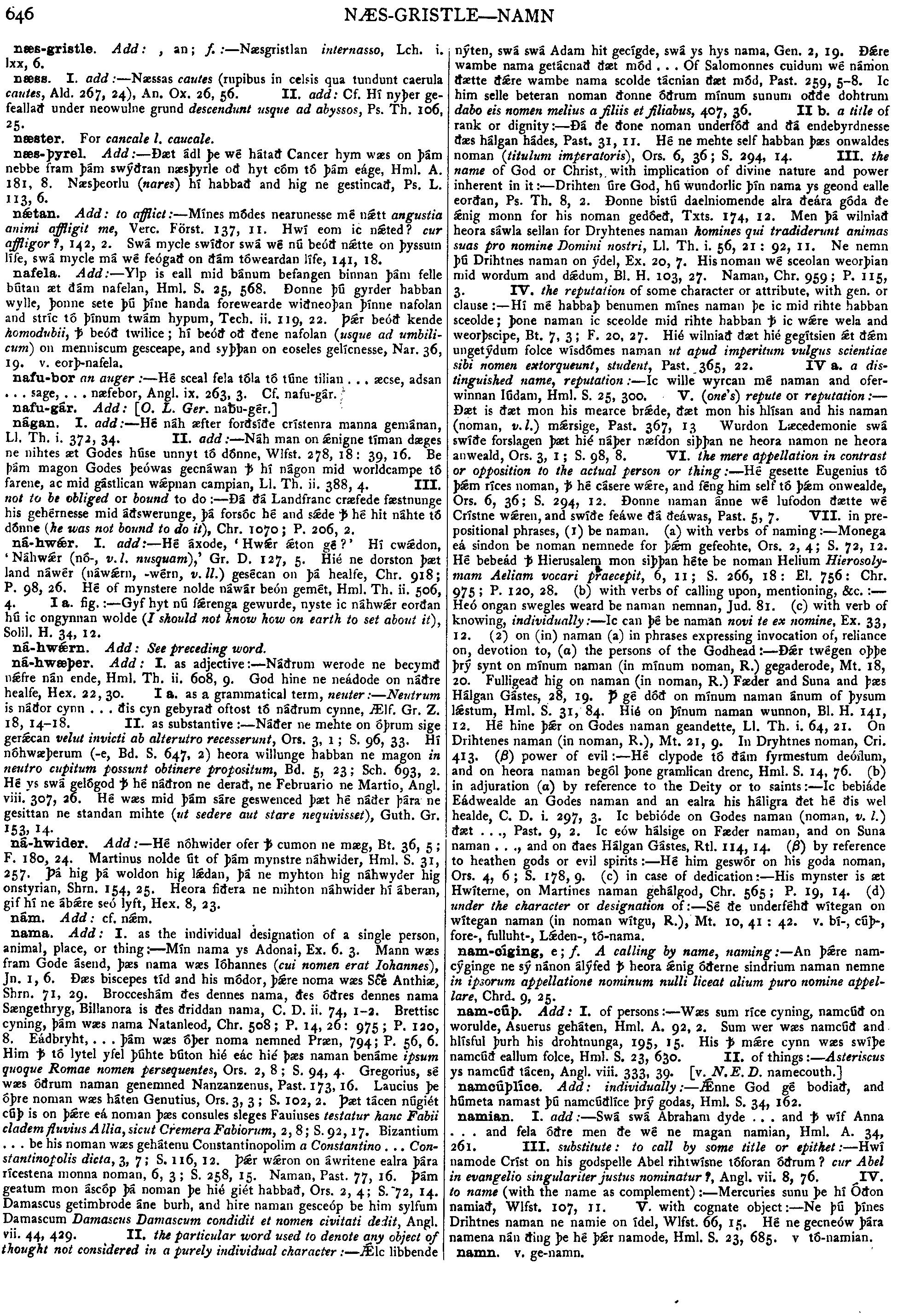
nama.
Add:
I.
as
the
individual
designation
of
a
single
person,
animal,
place,
or
thing
:--
Mín
nama
ys
Adonai,
Ex.
6.
3.
Mann
wæs
fram
Gode
ásend,
þæs
nama
wæs
Ióhannes
(cui
nomen
erat
Johannes),
Jn.
l,
6.
Ðæs
biscepes
tíd
and
his
módor,
þre
noma
wæs
SUNCERTAIN
Anthiæ,
Shrn.
71,
29.
Brocceshám
ðes
dennes
nama,
ðes
dennes
nama
Sængethryg,
Billanora
is
ðes
ðriddan
nama,
C.
D.
ii.
74,
1-2.
Brettisc
cyning,
þám
wæs
nama
Natanleod,
Chr.
508
;
P.
14,
26:
975
;
P.
120,
8.
Eádbryht,
.
.
.
þám
wæs
óþer
noma
nemned
Præn,
794;
P.
56,
6.
Him
tó
lytel
yfel
þúhte
búton
hié
eác
hié
þæs
naman
benáme
ipsum
quoque
Romae
nomen
persequentes,
Ors.
2,
8;
S.
94,
4.
Gregorius,
sé
wæs
óðrum
naman
genemned
Nanzanzenus,
Past.
173,
16.
Laucius
þe
óþre
noman
wæs
háten
Genutius,
Ors.
3,
3
;
S.
102,
2.
Þæt
tácen
núgiét
cúþ
is
on
þre
eá
noman
þæs
consules
sleges
Fauiuses
testatur
hanc
Fabii
cladem
fluvius
Allia,
sicut
Cremera
Fabiorum,
2,
8;
S.
92,
17,
Bizantium
.
.
.
be
his
noman
wæs
gehátenu
Constantinopolim
a
Consiantino
.
.
,
Constantinofolis
dicta,
3,
7
;
S.
116,
12.
Þr
wron
on
áwritene
ealra
þára
rícestena
monna
noman,
6,
3
;
S.
258,
15.
Naman,
Past.
77,
16.
Þám
geatum
mon
áscóp
þá
noman
þe
hié
giét
habbað,
Ors.
2,
4;
S.
72,
14.
Damascus
getimbrode
áne
burh,
and
hire
naman
gesceóp
be
him
sylfum
Damascum
Damascus
Damascum
condidit
et
nomen
civitati
dedit,
Angl.
vii.
44,
429.
II,
the
particular
word
used
to
denote
any
object
of
thought
not
considered
in
a
purely
individual
character:--
Æ-acute;lc
libbende
nýten,
swá
swá
Adam
hit
gecígde,
swá
ys
hys
nama,
Gen.
2,
19.
Ðre
wambe
nama
getácnað
ðæt
mód
.
.
.
Of
Salomonnes
cuidum
wé
námon
ðætte
ðre
wambe
nama
scolde
tácnian
ðæt
mód,
Past.
259,
5-8.
Ic
him
selle
beteran
noman
ðonne
ððrum
mínum
sunum
oððe
dohtrum
dabo
eis
nomen
melius
a
filiis
et
filiabus,
407,
36.
II
b.
a
title
of
rank
or
dignity
:--
Ðá
ðe
ðone
noman
underfóð
and
ðá
endebyrdnesse
ðæs
hálgan
hádes,
Past.
31,
11.
Hé
ne
mehte
self
habban
þæs
onwaldes
noman
(titulum
imperatoris),
Ors.
6,
36;
S.
294,
14.
III.
the
name
of
God
or
Christ,
with
implication
of
divine
nature
and
power
inherent
in
it
:--
Drihten
úre
God,
hú
wundorlic
þín
nama
ys
geond
ealle
eorðan,
Ps.
Th.
8,
2.
Ðonne
bistú
daelniomende
alra
ðeára
góda
ðe
nig
monn
for
his
noman
gedóeð,
Txts.
174,
12.
Men
þá
wilniað
heora
sáwla
sellan
for
Dryhtenes
naman
homines
qui
tradiderunt
animas
suas
pro
nomine
Domini
nostri,
Ll.
Th.
i.
56,
21:
92,
11.
Ne
nemn
þú
Drihtnes
naman
on
ýdel,
Ex.
20,
7.
His
noman
wé
sceolan
weorþian
mid
wordum
and
ddum,
Bl.
H.
103,
27.
Naman,
Chr.
959;
P.
115,
3..
IV.
the
reputation
of
some
character
or
attribute,
with
gen.
or
clause
:--
Hí
mé
habbaþ
benumen
mínes
naman
þe
ic
mid
rihte
habban
sceolde;
þone
naman
ic
sceolde
mid
rihte
habban
ic
wre
wela
and
weorþscipe,
Bt.
7,
3;
F.
20,
27.
Hié
wilniað
ðæt
hié
gegítsien
t
ðm
ungetýdum
folce
wísdó;mes
naman
ut
apud
imperitum
vulgus
scientiae
sibi
nomen
extorqueunt,
student,
Past.
365,
22.
IV
a.
a
distinguished
name,
reputation:--
Ic
wille
wyrcan
mé
naman
and
ofer-winnan
lúdam,
Hml.
S.
25,
300.
V.
(one's)
repute
or
reputation:--
Ðæt
is
ðæt
mon
his
mearce
brde,
ðæt
mon
his
hlísan
and
his
naman
(noman,
v.
l.)
mrsige,
Past.
367,
13
Wurdon
Læcedemonie
swá
swíde
forslagen
þæt
hié
náþer
næfdon
siþþan
ne
heora
namon
ne
heora
anweald,
Ors.
3,
I;
S.
98,
8.
VI.
the
mere
appellation
in
contrast
or
opposition
to
the
actual
person
or
thing:--
Hé
gesette
Eugenius
tó
þm
ríces
noman,
hé
cásere
wre,
and
féng
him
self
tó
þm
onwealde,
Ors.
6,
36;
S.
294,
12.
Ðonne
naman
ánne
wé
lufodon
ðætte
wé
Crístne
wren,
and
swíðe
feáwe
ðá
ðeáwas,
Past.
5,
7.
VII.
in
prepositional
phrases,
(1)
be
naman.
(a)
with
verbs
of
naming
:--
Monega
eá
sindon
be
noman
nemnede
for
þm
gefeohte,
Ors.
2,
4;
S.
72,
12.
Hé
bebead
Hierusalem
mon
siþþan
héte
be
noman
Helium
Hierosolymam
Aeliam
vocari
praecepit,
6,
11;
S.
266,
18
:
El.
756:
Chr.
975;
P.
120,
28.
(b)
with
verbs
of
calling
upon,
mentioning,
&c.
:--
Heó
ongan
swegles
weard
be
naman
nemnan,
Jud.
81.
(c)
with
verb
of
knowing,
individually:--
Ic
can
þé
be
naman
novi
te
ex
nomine,
Ex.
33,
12.
(2)
on
(in)
naman
( )
in
phrases
expressing
invocation
of,
reliance
on,
devotion
to,
(a)
the
persons
of
the
Godhead
:--
Ðr
twégen
oþþe
þrý
synt
on
mínum
naman
(in
mínum
noman,
R.)
gegaderode,
Mt.
18,
20.
Fulligeað
hig
on
naman
(in
noman,
R.
)
Fæder
and
Suna
and
þæs
Hálgan
Gástes,
28,
19.
Þ-bar;
gé
dóð
on
mínum
naman
ánum
of
þysum
lstum,
Hml.
S.
31,
84.
Hié
on
þínum
naman
wunnon,
Bl.
H.
141,
12.
Hé
hine
þr
on
Godes
naman
geandette,
Ll.
Th.
i.
64,
21.
On
Drihtenes
naman
(in
noman,
R.),
Mt.
21,
9.
In
Dryhtnes
noman,
Cri.
413
(
)
in
phrases
expressing
invocation
of,
reliance
on,
devotion
to,
(a)
the
persons
of
the
Godhead
:--
Ðr
twégen
oþþe
þrý
synt
on
mínum
naman
(in
mínum
noman,
R.)
gegaderode,
Mt.
18,
20.
Fulligeað
hig
on
naman
(in
noman,
R.
)
Fæder
and
Suna
and
þæs
Hálgan
Gástes,
28,
19.
Þ-bar;
gé
dóð
on
mínum
naman
ánum
of
þysum
lstum,
Hml.
S.
31,
84.
Hié
on
þínum
naman
wunnon,
Bl.
H.
141,
12.
Hé
hine
þr
on
Godes
naman
geandette,
Ll.
Th.
i.
64,
21.
On
Drihtenes
naman
(in
noman,
R.),
Mt.
21,
9.
In
Dryhtnes
noman,
Cri.
413
( )
power
of
evil
:--
Hé
clypode
tó
ðám
fyrmestum
deóflum,
and
on
heora
naman
begól
þone
gramlican
drenc,
Hml.
S.
14,
76.
(b)
in
adjuration
()
by
reference
to
the
Deity
or
to
saints
:--
Ic
bebiáde
Eádwealde
an
Godes
naman
and
an
ealra
his
háligra
ðet
hé
ðis
wel
healde,
C.
D.
i.
297,
3.
Ic
bebióde
on
Godes
naman
(noman,
v.
l.)
ðæt
.
.
.,
Past.
9,
2.
Ic
eów
hálsige
on
Fæder
naman,
and
on
Suna
naman
.
.
.,
and
on
ðaes
Hálgan
Gástes,
Rtl.
114,
14.
()
by
reference
to
heathen
gods
or
evil
spirits
:--
Hé
him
geswór
on
his
goda
noman,
Ors.
4,
6
;
S.
178,
9.
(c)
in
case
of
dedication
:--
His
mynster
is
æt
Hwíterne,
on
Martines
naman
gehálgod,
Chr.
565;
P.
19,
14.
(d)
under
the
character
or
designation
of
:--
Sé
ðe
underféhð
wítegan
on
wítegan
naman
(in
noman
wítgu,
R.),
Mt.
10,
41
:
42.
v.
bí-,
cúþ-,
fore-,
fulluht-,
Lden-,
tó-nama.
)
power
of
evil
:--
Hé
clypode
tó
ðám
fyrmestum
deóflum,
and
on
heora
naman
begól
þone
gramlican
drenc,
Hml.
S.
14,
76.
(b)
in
adjuration
()
by
reference
to
the
Deity
or
to
saints
:--
Ic
bebiáde
Eádwealde
an
Godes
naman
and
an
ealra
his
háligra
ðet
hé
ðis
wel
healde,
C.
D.
i.
297,
3.
Ic
bebióde
on
Godes
naman
(noman,
v.
l.)
ðæt
.
.
.,
Past.
9,
2.
Ic
eów
hálsige
on
Fæder
naman,
and
on
Suna
naman
.
.
.,
and
on
ðaes
Hálgan
Gástes,
Rtl.
114,
14.
()
by
reference
to
heathen
gods
or
evil
spirits
:--
Hé
him
geswór
on
his
goda
noman,
Ors.
4,
6
;
S.
178,
9.
(c)
in
case
of
dedication
:--
His
mynster
is
æt
Hwíterne,
on
Martines
naman
gehálgod,
Chr.
565;
P.
19,
14.
(d)
under
the
character
or
designation
of
:--
Sé
ðe
underféhð
wítegan
on
wítegan
naman
(in
noman
wítgu,
R.),
Mt.
10,
41
:
42.
v.
bí-,
cúþ-,
fore-,
fulluht-,
Lden-,
tó-nama.
|
Source: Bosworth/Toller, page d0697, entry 29 View original page image as: [TIFF] [PNG] [View previous entry] [View next entry] |
[Comment on this entry] [View comments (1)] |
The following entry has been hand-corrected once. |
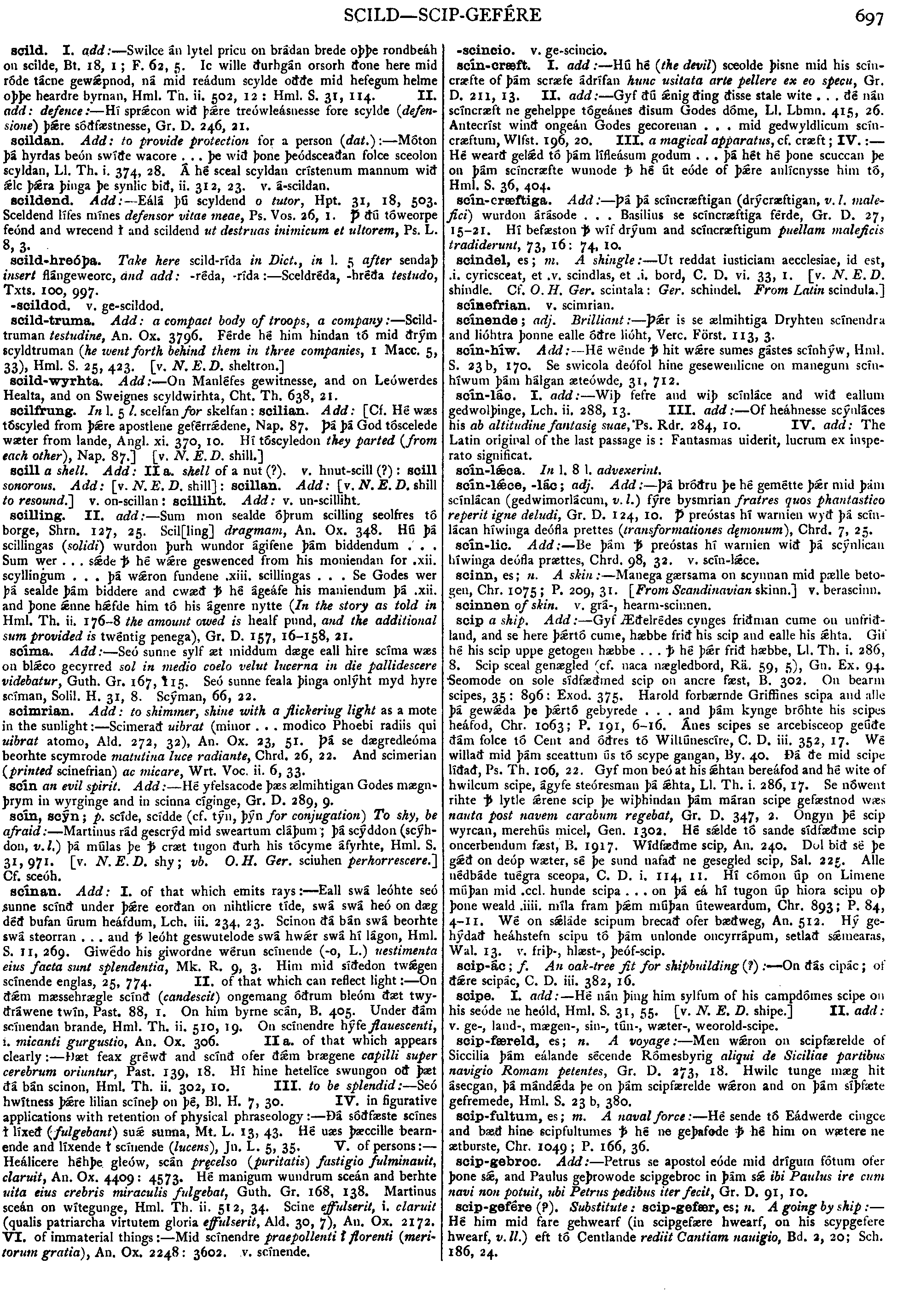
scip
a
ship.
Add
:--
Gyf
Æðelrédes
cynges
friðman
cume
on
iunfriðland,
and
se
here
þrtó
cume,
hæbbe
frið
his
scip
and
ealle
his
hta.
Gif
hé
his
scip
uppe
getogen
hæbbe
.
.
.
hé
þr
frið
hæbbe,
Ll.
Th.
i.
286,
8.
Scip
sceal
genægled
(cf.
naca
nægledbord,
Rä.
59,
5),
Gn.
Ex.
94.
Seomode
on
sole
sídfæðmed
scip
on
ancre
fæst,
B.
302.
On
bearm
scipes,
35:
896:
Exod.
375.
Harold
forbærnde
Griffines
scipa
and
alle
þá
gewda
þe
þrtó
gebyrede
.
.
.
and
þám
kynge
bróhte
his
scipes
heáfod,
Chr.
1063;
P.
191,
6-16.
Ánes
scipes
se
arcebisceop
geúðe
ðám
folce
tó
Cent
and
óðres
tó
Wiltúnescíre,
C.
D.
iii.
352,
17.
Wé
willað
mid
þám
sceattum
ús
tó
scype
gangan,
By.
40.
Ðá
ðe
mid
scipe
líðað,
Ps.
Th.
106,
22.
Gyf
mon
beó
at
his
htan
bereáfod
and
hé
wite
of
hwilcum
scipe,
ágyfe
steóresman
þá
hta,
Ll.
Th.
i.
286,
17.
Se
nówent
rihte
lytle
rene
scip
þe
wiþhindan
þám
máran
scipe
gefæstnod
wæs
nauta
post
navem
carabum
regebat,
Gr.
D.
347,
2.
Ongyn
þé
scip
wyrcan,
merehús
micel,
Gen.
1302.
Hé
slde
tó
sande
sídfæðme
scip
oncerbendum
fæst,
B.
1917.
Wídfæðme
scip,
An.
240.
Dol
bið
sé
þe
gð
on
deóp
wæter,
sé
þe
sund
nafað
ne
gesegled
scip,
Sal.
225.
Alle
nédbáde
tuégra
sceopa,
C.
D.
i.
114,
11.
Hí
comon
úp
on
Limene
múþan
mid
.ccl.
hunde
scipa
.
.
.
on
þá
eá
hí
tugon
úp
hiora
scipu
oþ
þone
weald
.iiii.
míla
fram
þm
múþan
úteweardum,
Chr.
893;
P.
84,
4-11.
Wé
on
sláde
scipum
brecað
ofer
bæðweg,
An.
512.
Hý
gehýdað
heáhstefn
scipu
tó
þám
unlonde
oncyrrápum,
setlað
smearas,
Wal.
13.
v.
friþ-,
hlæst-,
þeóf-scip.
|
Source: Bosworth/Toller, page d0698, entry 25 View original page image as: [TIFF] [PNG] [View previous entry] [View next entry] |
[Comment on this entry] [View comments] |
The following entry has been hand-corrected once. |
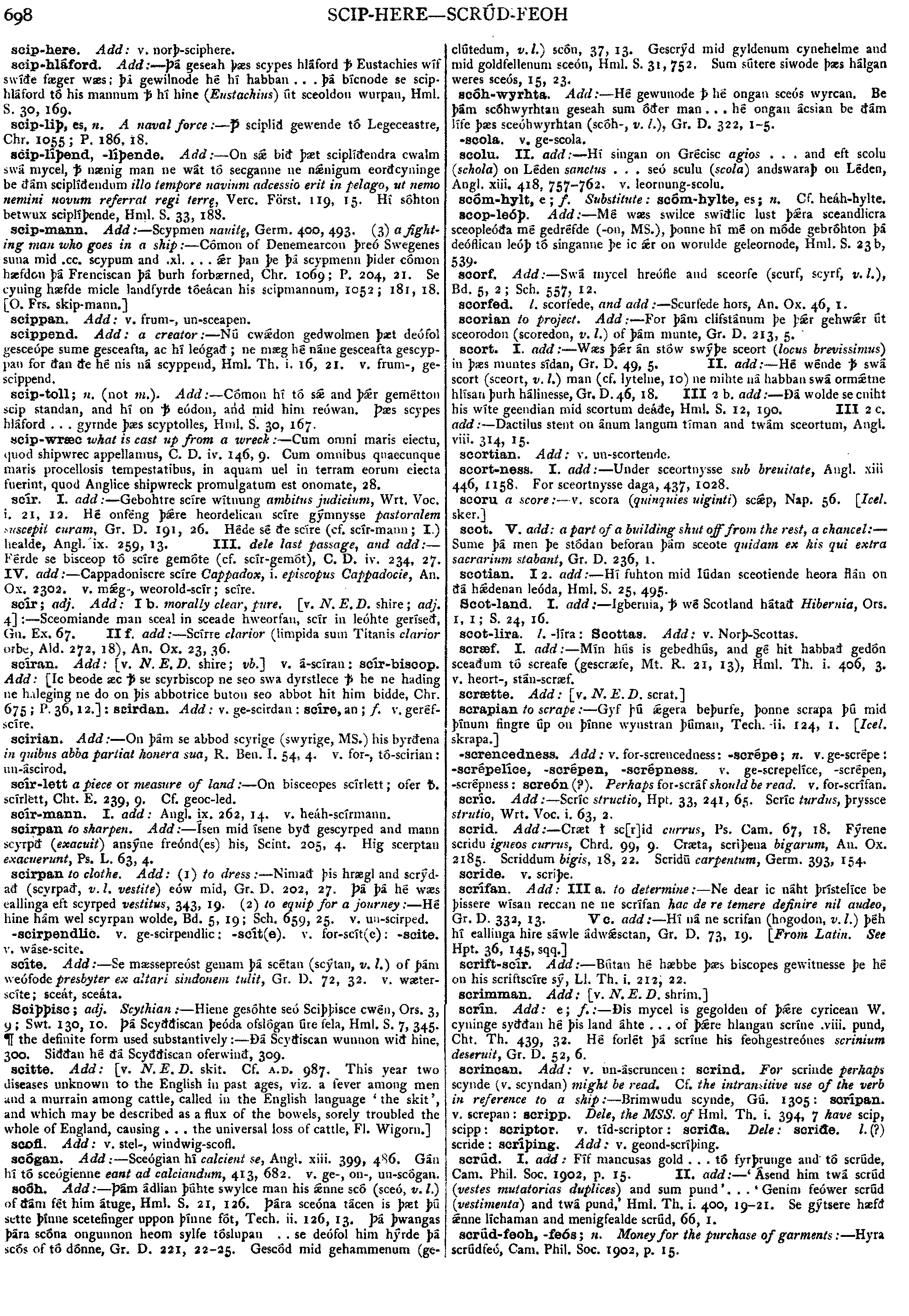
scóh-wyrhta.
Add
:--
Hé
gewunode
hé
ongan
sceós
wyrcan.
Be
þám
scóhwyrhtan
geseah
sum
óðer
man
.
.
.
hé
ongan
ácsian
be
ðám
lífe
þæs
sceóhwyrhtan
(scóh-,
v.
l.),
Gr.
D.
322,
1-5.
|
Source: Bosworth/Toller, page d0714, entry 35 View original page image as: [TIFF] [PNG] [View previous entry] [View next entry] |
[Comment on this entry] [View comments] |
The following entry has been hand-corrected once. |
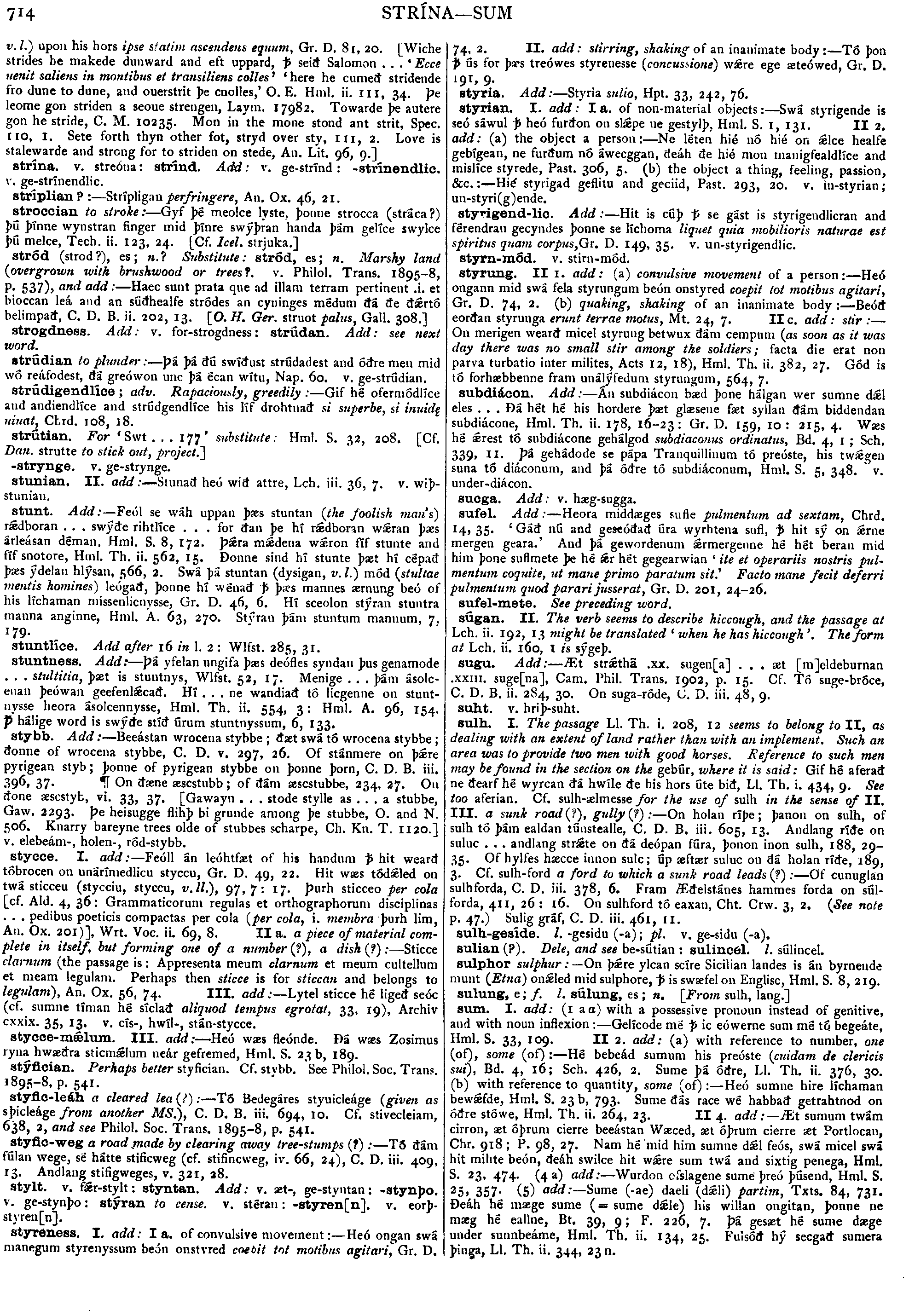
sulh.
I.
The
passage
Ll.
Th.
i.
208,
12
seems
to
belong
to
II
,
as
dealing
with
an
extent
of
land
rather
than
with
an
implement.
Such
an
area
was
to
provide
two
men
with
good
horses.
Reference
to
such
men
may
be
found
in
the
section
on
the
gebúr,
where
it
is
said:
Gif
hé
aferað
ne
ðearf
hé
wyrcan
ðá
hwíle
ðe
his
hors
úte
bið,
Ll.
Th.
i.
434,
9.
See
too
aferian.
Cf.
sulh-ælmesse
for
the
use
of
sulh
in
the
sense
of
II.
III.
a
sunk
road
(?),
gully(?)
:--
On
holan
ríþe;
þanon
on
sulh,
of
sulh
tó
þám
ealdan
túnstealle,
C.
D.
B.
iii.
605,
13.
Andlang
ríðe
on
suluc
.
.
.
andlang
strte
on
ðá
deópan
fúra,
þonon
inon
sulh,
188,
29-35.
Of
hylfes
hæcce
innon
sulc;
úp
æftær
suluc
on
ðá
holan
ríðe,
189,
3.
Cf.
sulh-ford
a
ford
to
which
a
sunk
road
leads
(?)
:--
Of
cunuglan
sulhforda,
C.
D.
iii.
378,
6.
Fram
Æðelstánes
hammes
forda
on
súlforda,
411,
26:
16.
On
sulhford
tó
eaxan,
Cht.
Crw.
3,
2.
(See
note
p.
47.)
Sulig
gráf,
C.
D.
iii.
461,
11.
|
Source: Bosworth/Toller, page d0715, entry 6 View original page image as: [TIFF] [PNG] [View previous entry] [View next entry] |
[Comment on this entry] [View comments] |
The following entry has been hand-corrected once. |
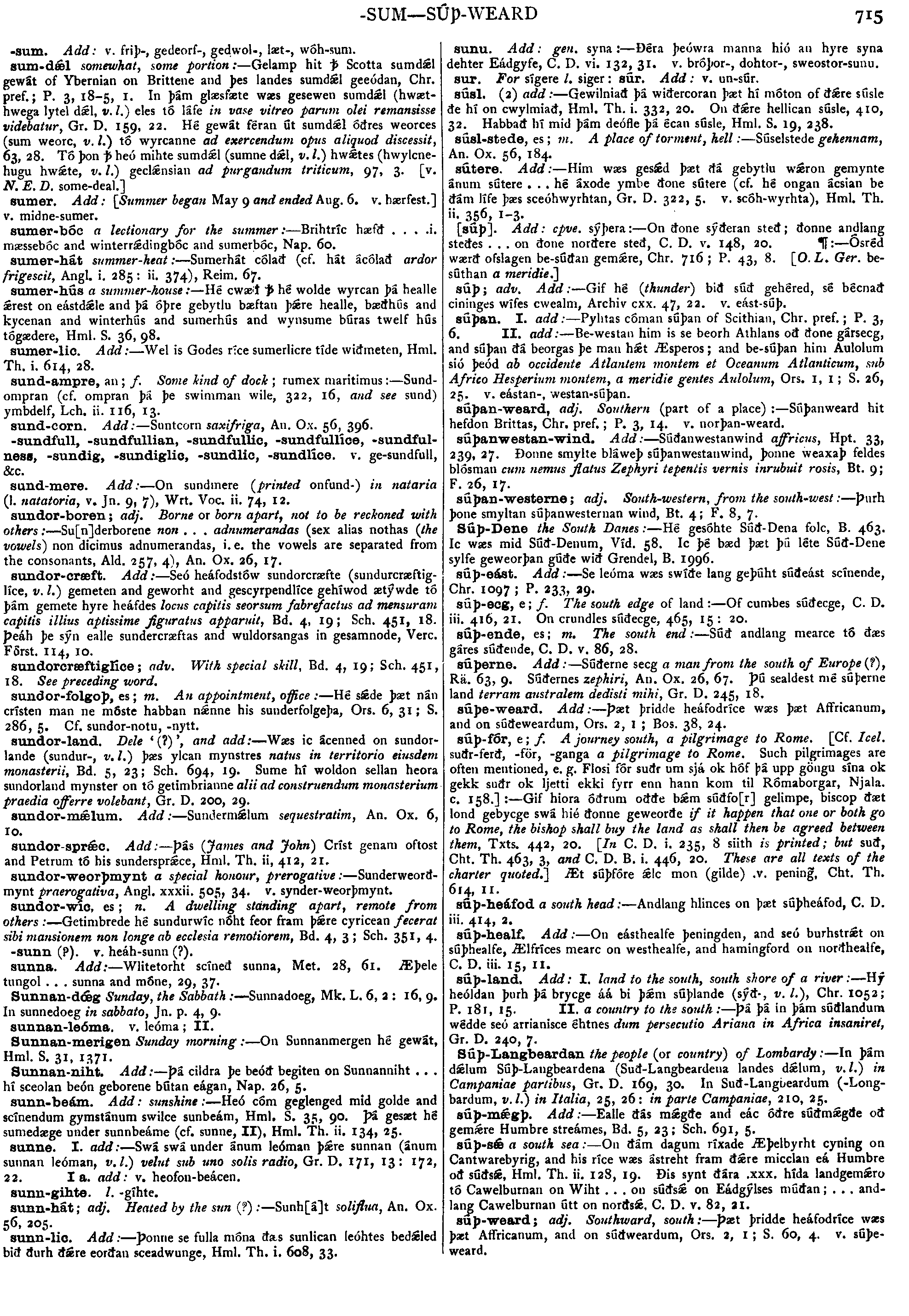
sumer-hús
a
summer-hause
:--
Hé
cwæð
hé
wolde
wyrcan
þá
healle
rest
on
eástdle
and
þá
óþre
gebytlu
bæftan
þre
healle,
bæðhús
and
kycenan
and
winterhús
and
sumerhús
and
wynsume
búras
twelf
hús
tógædere,
Hml.
S.
36,
98.
|
Source: Bosworth/Toller, page d0751, entry 50 View original page image as: [TIFF] [PNG] [View previous entry] [View next entry] |
[Comment on this entry] [View comments] |
The following entry has been hand-corrected once. |
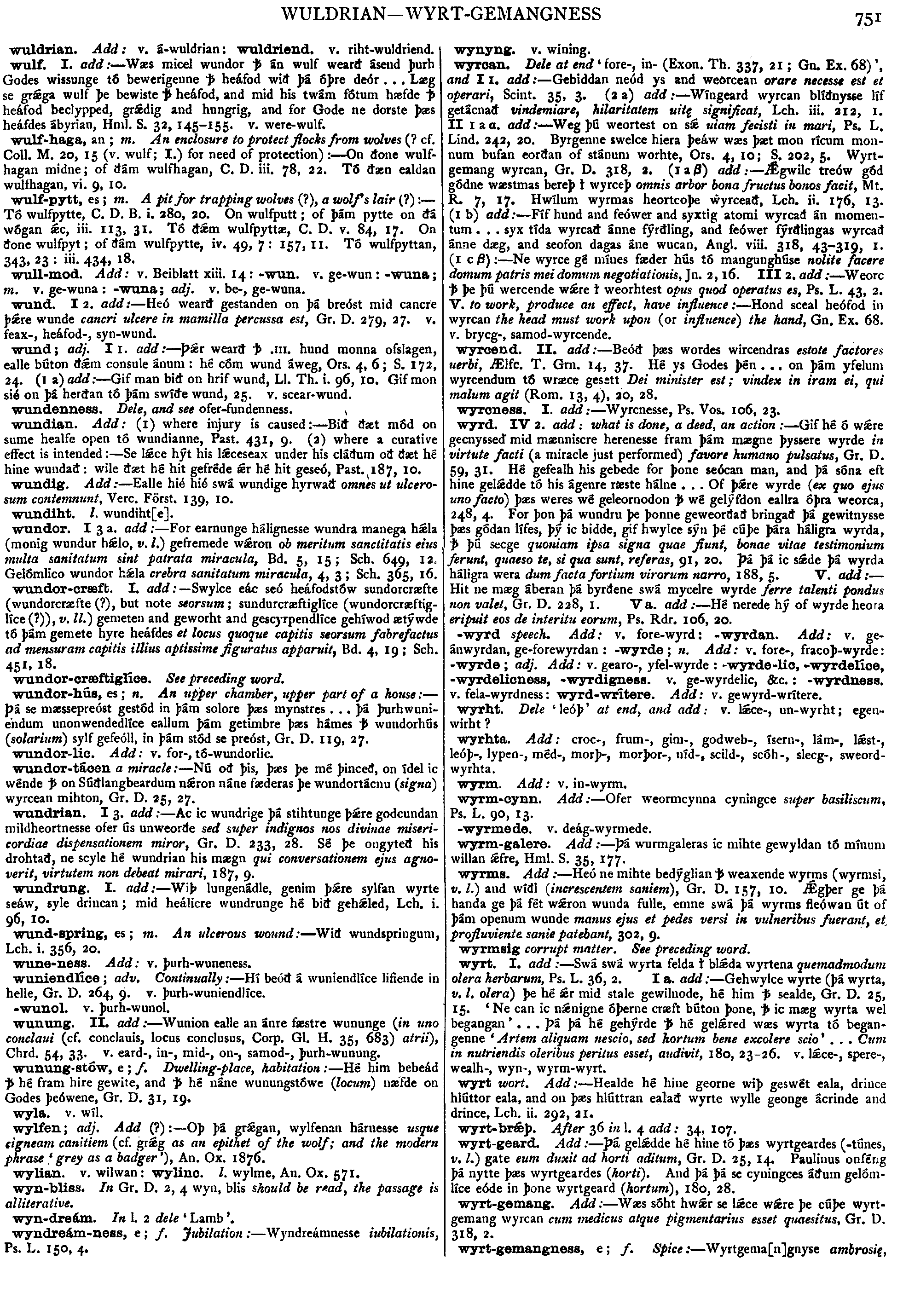
wyrt-gemang.
Add
:--
Wæs
sóht
hwr
se
lce
wre
þe
cúþe
wyrt-gemang
wyrcan
cum
medicus
atque
pigmentarius
esset
quaesitus,
Gr.
D.
318,
2.
|
Source: Bosworth/Toller, page d0765, entry 79 View original page image as: [TIFF] [PNG] [View previous entry] [View next entry] |
[Comment on this entry] [View comments] |
The following entry has been hand-corrected once. |
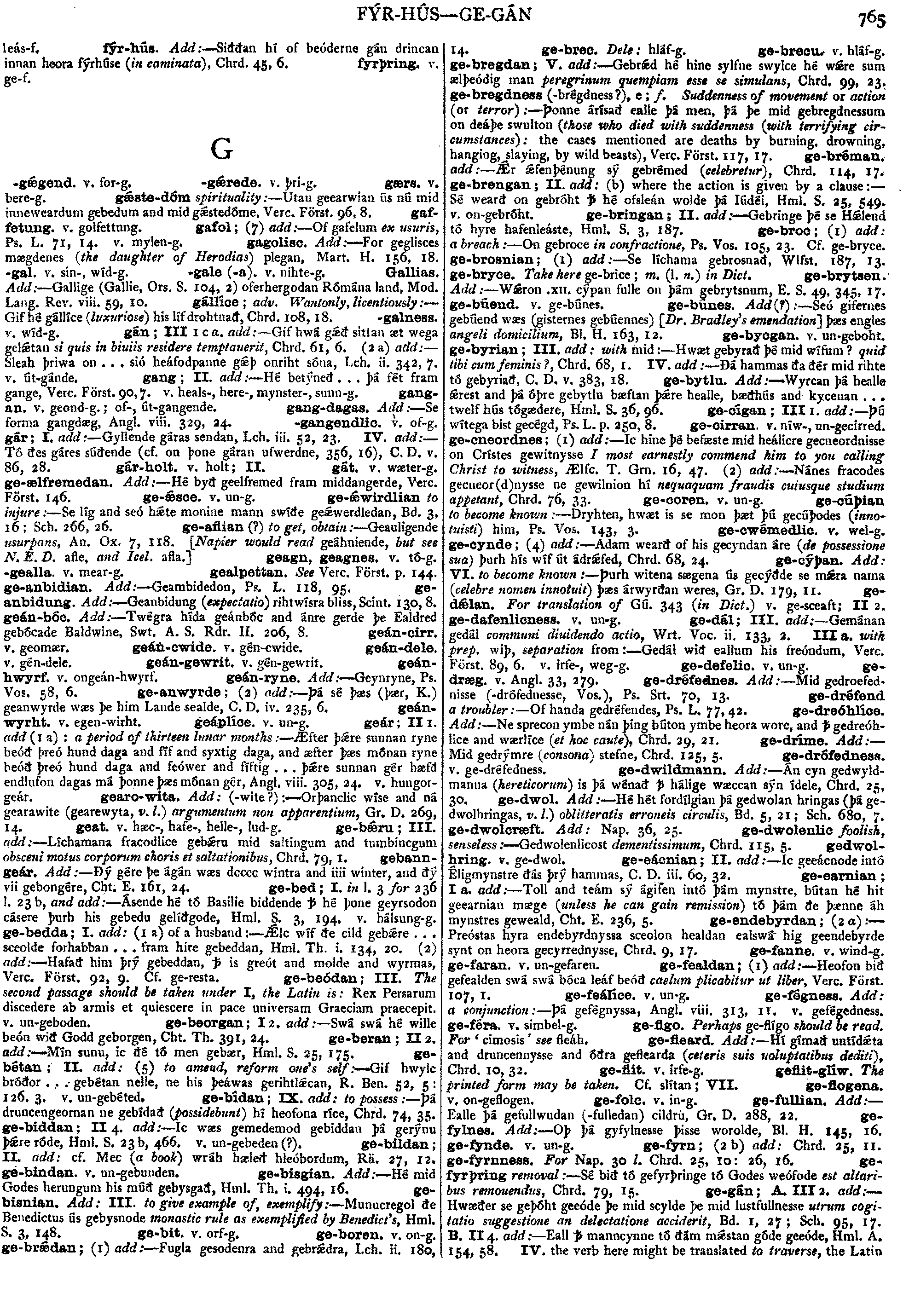
ge-bytlu.
Add
:--
Wyrcan
þá
healle
rest
and
þá
óþre
gebytlu
bæftan
þre
healle,
bæðhús
and
kycenan
...
twelf
hús
tógædere,
Hml.
S.
36,
96.
|
Source: Bright's OE Grammar, page b0334, entry 32 View original page image as: [TIFF] [PNG] [View previous entry] [View next entry] |
[Comment on this entry] [View comments] |
The following entry has been hand-corrected once. |
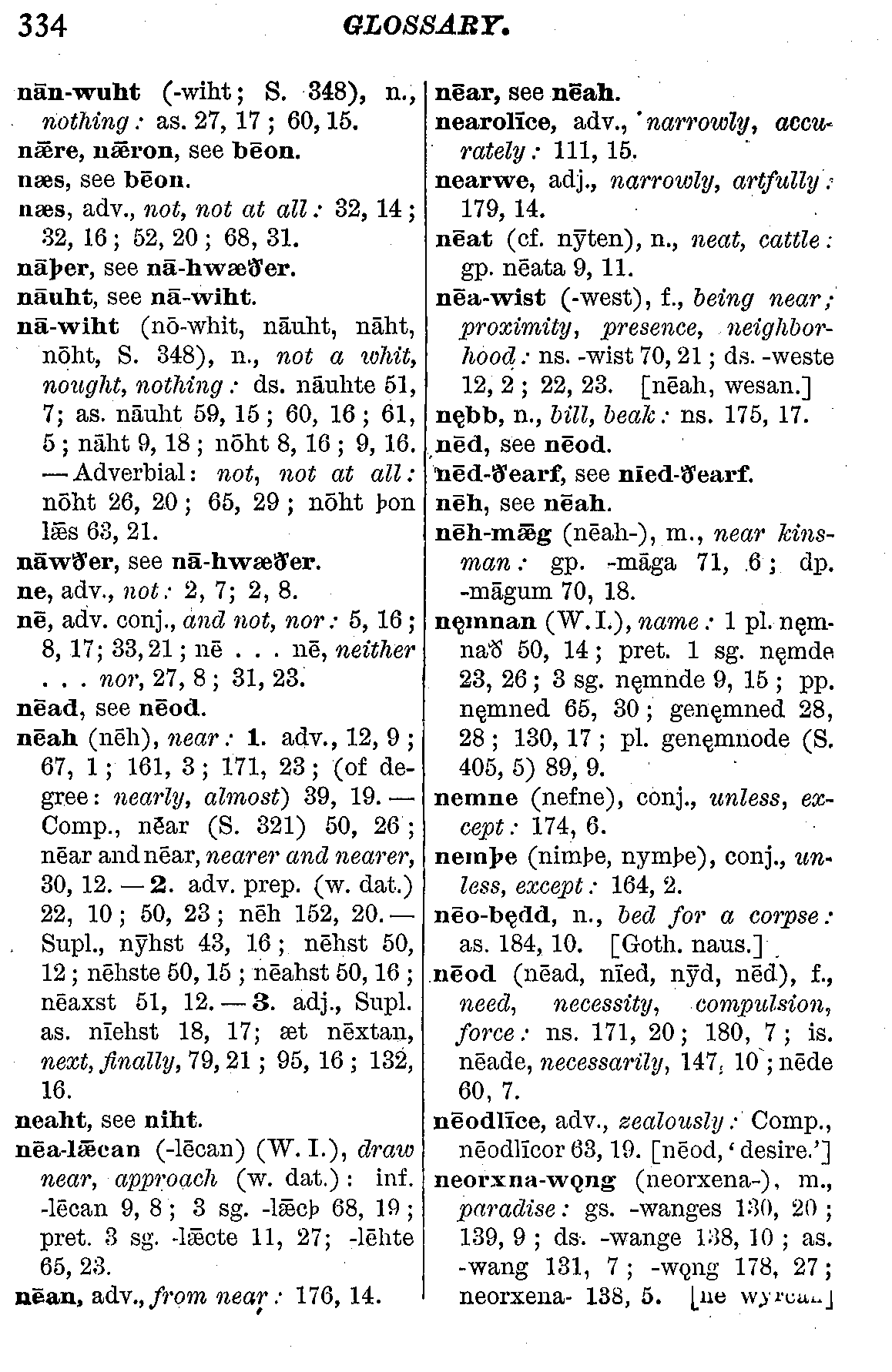
neorxna-wong (neorxena-) m paradise
[ne wyrcan]
|
Source: Cleasby/Vigfusson, page b0726, entry 45 View original page image as: [TIFF] [PNG] [View previous entry] [View next entry] |
[Comment on this entry] [View comments] |
The following entry has been hand-corrected once. |
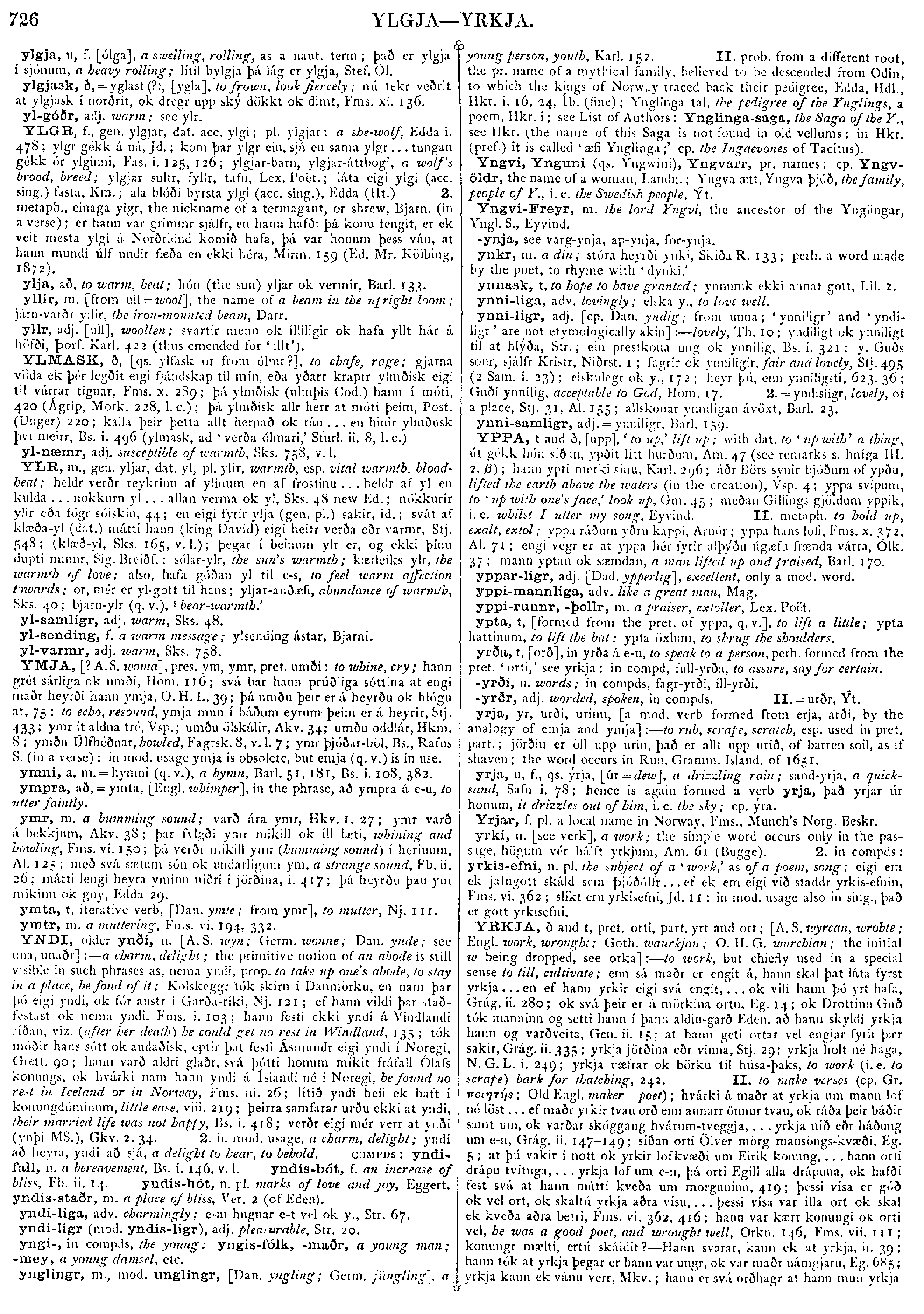
YRKJA, ð and t, pret. orti, part. yrt and ort; [A.S. wyrcan, wrohte; Engl. work, wrought; Goth. waurkjan; O.H.G. wurchian; the initial w being dropped, see orka] :-- to work, but chiefly used in a special sense to till, cultivate; enn sá maðr er engit á, hann skal þat láta fyrst yrkja ... en ef hann yrkir eigi svá engit, ... ok vili hann þó yrt hafa, Grág. ii. 280; ok svá þeir er á mörkina ortu, Eg. 14; ok Drottinn Guð tók manninn og setti hann í þann aldin-garð Eden, að hann skyldi yrkja hann og varðveita, Gen. ii. 15; at hann geti ortar vel engjar fyrir þær sakir, Grág. ii. 335; yrkja jörðina eðr vinna, Stj. 29; yrkja holt né haga, N.G.L. i. 249; yrkja ræfrar ok börku til húsa-þaks, to work (i.e. to scrape) bark for thatching, 242. II. to make verses (cp. Gr. GREEK; Old Engl. maker = poet); hvárki á maðr at yrkja um mann lof né löst... ef maðr yrkir tvau orð enn annarr önnur tvau, ok ráða þeir báðir samt um, ok varðar skóggang hvárum-tveggja, ... yrkja níð eðr háðung um e-n, Grág. ii. 147-149; síðan orti Ölver mörg mansöngs-kvæði, Eg. 5; at þú vakir í nott ok yrkir lofkvæði um Eirik konung, ... hann orti drápu tvítuga, ... yrkja lof um e-n, þá orti Egill alla drápuna, ok hafði fest svá at hann mátti kveða um morguninn, 419; þessi vísa er góð ok vel ort, ok skaltú yrkja aðra vísu, ... þessi vísa var ílla ort ok skal ek kveða aðra betri, Fms. vi. 362, 416; hann var kærr konungi ok orti vel, he was a good poet, and wrought well, Orkn. 146, Fms. vii. 111; konungr mælti, ertú skáldit? -- Hann svarar, kann ek at yrkja, ii. 39; hann tók at yrkja þegar er hann var ungr, ok var maðr námgjarn, Eg. 685; yrkja kann ek vánu verr, Mkv.; hann er svá orðhagr at hann mun yrkja
| Result Page: |  |
Previous | 2 3 4 5 6 7 8 9 10 11 |
Germanic Lexicon Project (main page)
This search system was written by
Sean Crist
Please consider
volunteering
to correct the data in these online dictionaries.
No rights reserved. Feel free to use these data in any way you please.