|
|

|
Source: Bosworth/Toller, page b0603, entry 5 View original page image as: [TIFF] [PNG] [View previous entry] [View next entry] |
[Comment on this entry] [View comments (1)] |
The following entry has been hand-corrected once. |
lá.
I.
interj.
Lo!
Oh!
Ah!
:--
Lá
næddrena
cyn
Oh!
generation
of
vipers,
Mt.
Kmbl.
3,
7:
12,
34.
Lá
ðú
líccetere,
7,
5.
Lá
freónd
amice,
22,
12.
Lá
Drihten
Domine,
Ps.
Th.
21,
17:
118,
176.
Lá
hú
oft
hí
gremedon
hine
quotiens
exacerbaverunt
eum!
Ps.
Spl.
77,
45.
Áfæst
lá
and
hí
lá
hí
and
wel
lá
well
and
ðyllíce
óðre
syndon
englisc
interjectiones,
Ælfc.
Gr.
48;
Som.
49,
28.
Weg
lá
weg
lá
euge,
euge,
Ps.
Th.
69,
4.
Wá
lá
se
tówyrpþ
ðæt
tempel
ua
qui
destruit
templum,
Mk.
Skt.
15,
29.
Wá
lá
áhte
ic
mínra
handa
geweald
alas!
had
I
power
over
my
hands,
Cd.
19;
Th.
23,
32;
Gen.
368.
Wá
lá
wá
heu,
proh
dolor!
Bd.
2,
1;
8.
501,
14.
Wei
lá
wei,
[cf.
Chauc.
weilawey
Shakspere
welladay]
Bt.
35,
6;
Fox
170,
12,
Cott.
MS.
Wel
lá
men
wel
oh!
men,
34,
8;
Fox
144,
23.
Wel
lá,
Bt.
Met.
Fox
21,
1;
Met.
21,
1.
II.
Enclitic
particle
used
to
emphasise
interrogation,
exclamation,
entreaty,
affirmation,
negation
:--
Understenst
ðú
lá
sentisne,
wylt
ðú
lá
visne,
Ælfc.
Gr.
44;
Som.
45,
47.
Is
ð r
genoh
lá
satisne
est,
Som.
46,
40.
Hú
lá
ne
wurpe
wé
þrý
cnihtas
intó
ðam
fýre
why,
did
not
we
cast
three
youths
into
the
fire?
Homl.
Th.
ii.
20,
12.
Wénst
ðú
lá
ðæt
ðú
beó
álýsed
fram
ðisum
tintregum
do
you
suppose
then
that
you
will
be
released
from
these
torments?
Homl.
Th.
i.
424,
29.
Dá
cwæþ
ic
hwæt
is
ðæt
lá
then
said
I
'what
then
is
that?'
Bt.
34,
5;
Fox
140,
14,
Hwæt
is
ðæt
lá
þinga?
38,
3;
Fox
200,
2.
Hwæt
is
ðis
lá
manna?
Elen.
Kmmbl.
1802;
El.
903.
Hwæt
biþ
hit
lá
elles
búton
flsc
seoddan
se
écea
dl
of
biþ
hwæt
biþ
lá
elles
seó
láf
búton
wvrma
mete
why,
what
else
is
it
but
flesh
when
the
eternal
part
is
away?
what
else
then
is
the
remnant
but
worms
food?
Blickl.
Homl.
111,
31.
Hwr
biþ
lá
ðonne
se
ídla
lust?
hwær
beóþ
ðonne
ða
symbelnessa?
58,
16.
Is
ðis
lá
wundorlíc
and
winsum
spell
this
is
indeed
a
wonderful
and
delightful
speech,
Bt.
34,
5;
Fox
140,
10.
Ðæt
lá
mæg
secgan
se
ðe
sóð
and
riht
fremeþ
that
indeed
may
he
say
who
does
truth
and
right,
Beo.
Th.
3404;
B.
1700:
5720;
B.
2864.
Ðæt
lá
wæs
fæger,
Cd.
223;
Th.
293,
18;
Sat.
457.
Uton
lá
geþencan
let
us
then
determine,
227;
Th.
305,
9;
Sat.
644.
Ac
feor
ðæt
lá
sí
ðæt
...
sed
absit
ut
...
Bd.
1,
27,
S.
490,
24.
Ic
ðæs
lá
wísce
ðæt
wegas
míne
on
ðínum
willan
weorðan
gereahte
I
do
indeed
wish
that
my
ways
may
be
directed
according
to
thy
will;
utinam
dirigantur
viæ
meæ,
Ps.
Th.
118,
5.
Bidde
ic
ðé
lá
gif
...
precorque
si
...
Bd.
3,
13;
S.
538,
40:
4,
3;
S.
568,
27:
Dóm.
L.
6,
65.
Nese
lá
nese,
Bt.
27,
2;
Fox
96,
27.
v.
eálá.
r
genoh
lá
satisne
est,
Som.
46,
40.
Hú
lá
ne
wurpe
wé
þrý
cnihtas
intó
ðam
fýre
why,
did
not
we
cast
three
youths
into
the
fire?
Homl.
Th.
ii.
20,
12.
Wénst
ðú
lá
ðæt
ðú
beó
álýsed
fram
ðisum
tintregum
do
you
suppose
then
that
you
will
be
released
from
these
torments?
Homl.
Th.
i.
424,
29.
Dá
cwæþ
ic
hwæt
is
ðæt
lá
then
said
I
'what
then
is
that?'
Bt.
34,
5;
Fox
140,
14,
Hwæt
is
ðæt
lá
þinga?
38,
3;
Fox
200,
2.
Hwæt
is
ðis
lá
manna?
Elen.
Kmmbl.
1802;
El.
903.
Hwæt
biþ
hit
lá
elles
búton
flsc
seoddan
se
écea
dl
of
biþ
hwæt
biþ
lá
elles
seó
láf
búton
wvrma
mete
why,
what
else
is
it
but
flesh
when
the
eternal
part
is
away?
what
else
then
is
the
remnant
but
worms
food?
Blickl.
Homl.
111,
31.
Hwr
biþ
lá
ðonne
se
ídla
lust?
hwær
beóþ
ðonne
ða
symbelnessa?
58,
16.
Is
ðis
lá
wundorlíc
and
winsum
spell
this
is
indeed
a
wonderful
and
delightful
speech,
Bt.
34,
5;
Fox
140,
10.
Ðæt
lá
mæg
secgan
se
ðe
sóð
and
riht
fremeþ
that
indeed
may
he
say
who
does
truth
and
right,
Beo.
Th.
3404;
B.
1700:
5720;
B.
2864.
Ðæt
lá
wæs
fæger,
Cd.
223;
Th.
293,
18;
Sat.
457.
Uton
lá
geþencan
let
us
then
determine,
227;
Th.
305,
9;
Sat.
644.
Ac
feor
ðæt
lá
sí
ðæt
...
sed
absit
ut
...
Bd.
1,
27,
S.
490,
24.
Ic
ðæs
lá
wísce
ðæt
wegas
míne
on
ðínum
willan
weorðan
gereahte
I
do
indeed
wish
that
my
ways
may
be
directed
according
to
thy
will;
utinam
dirigantur
viæ
meæ,
Ps.
Th.
118,
5.
Bidde
ic
ðé
lá
gif
...
precorque
si
...
Bd.
3,
13;
S.
538,
40:
4,
3;
S.
568,
27:
Dóm.
L.
6,
65.
Nese
lá
nese,
Bt.
27,
2;
Fox
96,
27.
v.
eálá.
|
Source: Bosworth/Toller, page b0716, entry 14 View original page image as: [TIFF] [PNG] [View previous entry] [View next entry] |
[Comment on this entry] [View comments] |
The following entry has been hand-corrected once. |
nese
(
=
ne
sí)
;
adv.
No
(the
opposite
of
gese)
:--
Wylt
ðú
ðis?
Nese
vis
hoc
?
Non,
Ælfc.
Gr.
38;
Som.
40,
13.
Wylt
ðú
wé
gadriaþ
hig?
Ðá
cwæþ
hé,
Nese
(non),
Mt.
Kmbl.
13,
29.
Syllaþ
ús
of
eówrum
ele
...
Ðá
andswarudun
ða
gleáwan,
Nese,
25,
9.
Ðá
cwæþ
hé
:
Nese
(Lind.
næsæ)
fæder
Abraham,
Lk.
Skt.
16,
30.
Sume
cwdon,
he
is
gód;
óðre
cwdon,
nese
(Lind.
næse),
ac
hé
beswícþ
ðis
folc,
Jn.
Skt.
7,
12.
Næsi,
Jn.
Skt,
Lind.
21,
5.
Hwæðer
ðú
swelces
áuht
geworhtes
habbe.
Nese,
nese,
Bt.
14,
1
;
Fox
40,
26,
33.
|
Source: Bosworth/Toller, page b0740, entry 2 View original page image as: [TIFF] [PNG] [View previous entry] [View next entry] |
[Comment on this entry] [View comments] |
The following entry has been hand-corrected once. |
offrung,
ofrung,
e;
f.
I.
the
offering
of
a
sacrifice
or
gift
:--
Hit
wæs
gewunelíc
on
ealdum
dagum,
ðæt
man
Gode
ðyllíce
lác
offrode
on
cucan
orfe;
ac
seó
offrung
is
nú
unálýfedlíc.
Homl.
Th.
ii.
456,
35.
II.
an
offering,
sacrifice:-
Ic
áxige
hwr
seó
offrung
(victima)
sig
.
.
.
God
foresceáwaþ
ða
offrunge,
Gen.
22,
7-8.
Hwæðer
is
máre,
ðe
offrung
(ofrung,
MS.
A.
),
ðe
ðæt
weofud
ðe
gehálgaþ
ða
offrunge
(ofrunge,
MS.
A.
)?
Mt.
Kmbl.
23,
19.
Melu
oððe
offrung
ador,
Ælfc.
Gr.
9,
21;
Som.
10,
32.
Offrung
sacrificium,
Wrt.
Voc.
i.
28,
49.
Ofrung
oblatio,
28,
43.
Wylt
ðú
ús
syllan
offrunge
hostias
quoque
et
holocausta
da
nobis,
Ex.
10,
25.
Ofrunga
libamina,
sacrificia,
Hpt.
Gl.
487,
72.
Offrunga
holocausta,
509,
61:
holocaustomata,
521,
71.
[O.
L.
Ger.
offrenga:
O.
H.
Ger.
Opfarunga.]
|
Source: Bosworth/Toller, page b0793, entry 9 View original page image as: [TIFF] [PNG] [View previous entry] [View next entry] |
[Comment on this entry] [View comments (1)] |
The following entry has been hand-corrected once. |
réðe;
adj.
Fierce,
cruel,
savage.
It
glosses
the
following
Latin
words,
efferus,
Ælfc.
Gr.
14;
Som.
16,
57
:
ferus,
38;
Som.
41,
45
:
trux,
9,
67;
Som.
14,
10
:
ferox,
9,
66;
Som.
14,
6
:
Wet.
Voc.
ii.
108,
37
:
funestus,
34,
12
:
infestus,
45,
26
:
durus,
crudelis,
asper,
142,
19
:
severus,
immansuetus,
142,
44
:
austerus,
1,
20
:
furibundus,
valde
iracundus,
Hpt.
450,
1
:
truculentus,
518,
34.
Roeðe
asper,
Lk.
Skt.
Lind.
3,
5.
I.
applied
to
persons
(a)
in
a
bad
sense
:--
Ðes
(Ishmael)
byþ
réðe
(ferus)
man
and
winþ
wið
ealle
and
ealle
wið
hyne,
Gen.
16,
12.
Ealle
his
hta
ríce
réðe
mann
gedle
may
a
rich
and
cruel
man
divide
all
his
possessions;
scrutetur
foenerator
omnem
substantiam
ejus
(Grein
takes
reðemann
and
compares
Gothic
raþjo),
Ps.
Th.
108,
11.
Gif
hé
(a
king)
his
folc
ofsit,
ðon
biþ
hé
tyrannus,
ðæt
is
réðe,
Ælfc.
Gr.
50,
20;
Som.
51,
47.
Grim
and
grdig,
reóc
and
réðe
(Grendel),
Beo.
Th.
244;
B.
122.
Ðá
wæs
ellenwód,
yrre
and
réðe,
frécne
and
ferþgrim
fæder
wið
dehter,
Exon.
Th.
251,
5;
Jul.
140.
Sum
árleás
hine
wolde
sleán
on
his
heáfde,
ac
ðæt
wpen
wand
áweg
of
ðæs
réðan
handum,
Homl.
Th.
ii.
510,
23.
Burhrúnan,
réðe
furie,
Wrt.
Voc.
ii.
151,
77.
Twegen
ðe
hæfdon
deófolseócnesse
wron
swíðe
réðe
(saevi
nimis),
Mt.
Bos.
8,
28.
Ealle
swíðe
erre-wron.
Ðá
wæs
heora
sum
réðra
and
hátheortra
ðonne
ðá
óðre,
Blickl.
Homl.
223,
6.
(b)
of
justifiable
severity,
severe,
stern,
austere,
zealous
:--
Strang
wæs
and
réðe
se
ðe
wætrum
weóld
(the
Deity
at
the
time
of
the
flood),
Cd.
Th.
83,
8;
Gen.
1376.
Biþ
ðonne
(at
the
day
of
judgment)
ríces
weard
réðe
and
meahtig,
yrre
and
egesful,
Exon.
Th.
93,
19;
1528.
Réðe
biþ
Dryhten
æt
ðam
dóme,
Soul
Kmbl.
196;
Seel.
Verc.
98.
Óðer
biscop,
réðes
módes
mon
austerioris
animi
vir,
Bd.
3,
5;
S.
527,
20.
Réðe
and
stræce
for
ryhtwísnesse
justitiae
severitate
districti,
Past.
5,
1;
Swt.
41,
19.
Ðá
wæs
se
bysceop
mycle
ðig
réðra
on
gódum
weorcum
ðe
hé
ymbe
ða
cúðlícan
méde
gehýrde,
Shrn.
98,
19.
God
sylfa
ðonne
ne
gýmeþ
nnges
mannes
hreowe
.
.
.
ac
biþ
ðonne
réðra
and
þearlwísra
ðonne
nig
wilde
deór,
oððe
fre
nig
mód
gewurde,
Blickl.
Homl.
95,
30.
Wolde
heofona
helm
helle
weallas
forbrecan
...
réðust
ealra
cyninga
(Christ
at
the
harrowing
of
hell),
Exon.
Th.
461,
16;
Hö.
36.
II.
applied
to
animals,
wild,
savage,
fierce
:--
Réðe
deór
bellua,
Wrt.
Voc.
i.
22,
40.
Réðe
nýten
feralis
bestia,
ii.
147,
53.
Rib
reáfiaþ
réðe
wyrmas,
Soul
Kmbl.
221;
Seel.
113.
III.
applied
to
things
(punishment,
calamity,
etc.),
severe,
cruel,
fierce,
dire
:--
Réðe
wyrd
fortuna
aspera,
Bt.
40,
1;
Fox
236,
6-7.
Wæs
þreálíc
þing
þeódum
tóweard,
réðe
wíte,
Cd.
Th.
79,
30;
Gen.
1319.
Wearð
him
on
slpe
gecýðed
ðætte
ríces
gehwæs
réðe
sceolde
gelimpan
eorðan
dreámas
ende
wurðan
on
sleep
was
made
known
to
him
that
of
every
kingdom
a
terrible
end
should
befall,
an
end
be
of
the
joy
of
earth,
223,
4;
Dan.
114.
Líg
reád
and
reáðe,
Dóm.
L.
152.
Réðe,
Exon.
Th.
51,
3;
Cri.
810.
Sprecan
réðe
word
(of
the
judgment
passed
on
the
wicked),
50,
11;
Cri.
798.
Hé
him
sylfum
réðne
ðóm
and
heardne
geearnaþ,
Blickl.
Homl.
95,
34.
Regnas
réðe,
háte
of
heofenum,
Ps.
Th.
104,
28
:
Met.
7,
27.
Réðum
wítum
ferocibus
cruciatibus,
Hpt.
Gl.
487,
10.
Mid
ðý
hí
cwdon
ðæt
ðæt
is
wundor
ðæt
ðú
swá
réðe
forhæfednesse
and
swá
hearde
habban
wylt
andswarede
hé
:
'Heardran
and
réðran
ic
geseah'
cum
dicerent
:
'Mirum
quod
tam
austeram
tenere
continentiam
velis,'
respondebat
:
'Austeriora
ego
vidi,'
Bd.
5,
12;
S.
631,
34.
v.
un-réðe.
|
Source: Bosworth/Toller, page b0795, entry 6 View original page image as: [TIFF] [PNG] [View previous entry] [View next entry] |
[Comment on this entry] [View comments] |
The following entry has been hand-corrected once. |
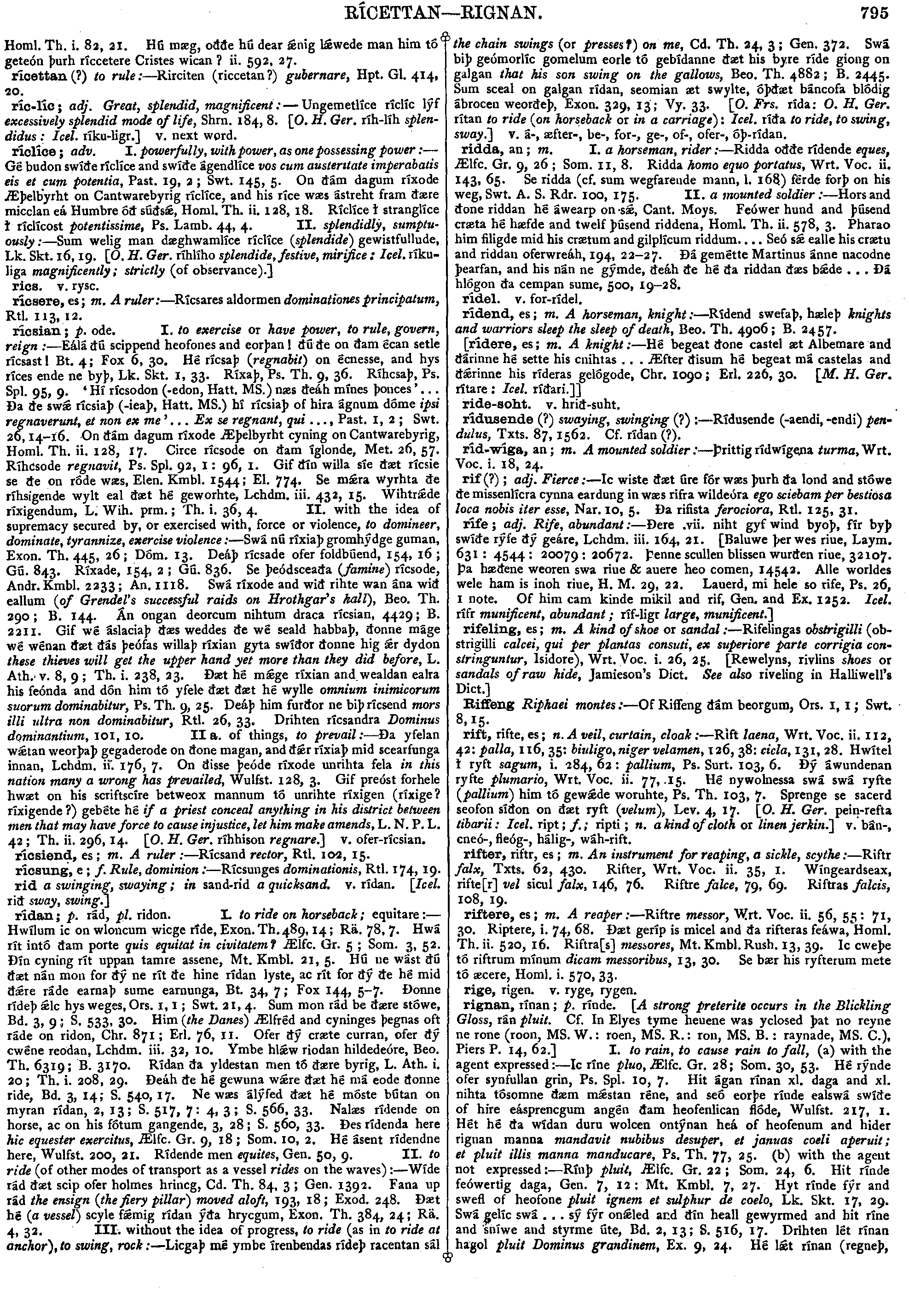
rícsian;
p.
ode.
I.
to
exercise
or
have
power,
to
rule,
govern,
reign
:--
Eálá
ðú
scippend
heofones
and
eorþan!
ðú
ðe
on
ðam
écan
setle
rícsast!
Bt.
4;
Fox
6,
30.
Hé
rícsaþ
(regnabit)
on
écnesse,
and
hys
ríces
ende
ne
byþ,
Lk.
Skt.
1,
33.
Ríxaþ,
Ps.
Th.
9,
36.
Ríhcsaþ,
Ps.
Spl.
95,
9.
'Hí
rícsodon
(-edon,
Hatt.
MS.)
næs
ðeáh
mínes
þonces'
...
Ða
ðe
sw
rícsiaþ
(-ieaþ,
Hatt.
MS.)
hí
rícsiaþ
of
hira
ágnum
dóme
ipsi
regnaverunt,
et
non
ex
me'...
Ex
se
regnant,
qui
...,
Past.
1,
2;
Swt.
26,
14-16.
On
ðám
dagum
ríxode
Æþelbyrht
cyning
on
Cantwarebyrig,
Homl.
Th.
ii.
128,
17.
Circe
rícsode
on
ðam
íglonde,
Met.
26,
57.
Ríhcsode
regnavit,
Ps.
Spl.
92,
1
:
96,
1.
Gif
ðín
willa
síe
ðæt
rícsie
se
ðe
on
róde
wæs,
Elen.
Kmbl.
1544;
El.
774.
Se
mra
wyrhta
ðe
ríhsigende
wylt
eal
ðæt
hé
geworhte,
Lchdm.
iii.
432,
15.
Wihtrde
ríxigendum,
L.
Wih.
prm.
;
Th.
i.
36,
4.
II.
with
the
idea
of
supremacy
secured
by,
or
exercised
with,
force
or
violence,
to
domineer,
dominate,
tyrannize,
exercise
violence
:--
Swá
nú
ríxiaþ
gromhýdge
guman,
Exon.
Th.
445,
26;
Dóm.
13.
Deáþ
rícsade
ofer
foldbúend,
154,
16;
Gú.
843.
Ríxade,
154,
2;
Gú.
836.
Se
þeódsceaða
(famine)
rícsode,
Andr.
Kmbl.
2233;
An.
1118.
Swá
ríxode
and
wið
rihte
wan
ána
wið
eallum
(of
Grendel's
successful
raids
on
Hrothgar's
hall),
Beo.
Th.
290;
B.
144.
Án
ongan
deorcum
nihtum
draca
rícsian,
4429;
B.
2211.
Gif
wé
áslaciaþ
ðæs
weddes
ðe
wé
seald
habbaþ,
ðonne
máge
wé
wénan
ðæt
ðás
þeófas
willaþ
ríxian
gyta
swíðor
ðonne
hig
r
dydon
these
thieves
will
get
the
upper
hand
yet
more
than
they
did
before,
L.
Ath.
v.
8,
9;
Th.
i.
238,
23.
Ðæt
hé
mge
ríxian
and
wealdan
ealra
his
feónda
and
dón
him
tó
yfele
ðæt
ðæt
he
wylle
omnium
inimicorum
suorum
dominabitur,
Ps.
Th.
9,
25.
Deáþ
him
furðor
ne
biþ
rícsend
mors
illi
ultra
non
dominabitur,
Rtl.
26,
33.
Drihten
rícsandra
Dominus
dominantium,
101,
10.
II
a.
of
things,
to
prevail
:--
Ða
yfelan
wtan
weorþaþ
gegaderode
on
ðone
magan,
and
ðr
ríxiaþ
mid
scearfunga
innan,
Lchdm.
ii.
176,
7.
On
ðisse
þeóde
ríxode
unrihta
fela
in
this
nation
many
a
wrong
has
prevailed,
Wulfst.
128,
3.
Gif
preóst
forhele
hwæt
on
his
scriftscíre
betweox
mannum
tó
unrihte
ríxigen
(ríxige?
ríxigende?)
gebéte
hé
if
a
priest
conceal
anything
in
his
district
between
men
that
may
have
force
to
cause
injustice,
let
him
make
amends,
L.
N.
P.
L.
42;
Th.
ii.
296,
14.
[O.
H.
Ger.
ríhhison
regnare.]
v.
ofer-rícsian.
|
Source: Bosworth/Toller, page b0838, entry 18 View original page image as: [TIFF] [PNG] [View previous entry] [View next entry] |
[Comment on this entry] [View comments] |
The following entry has been hand-corrected once. |
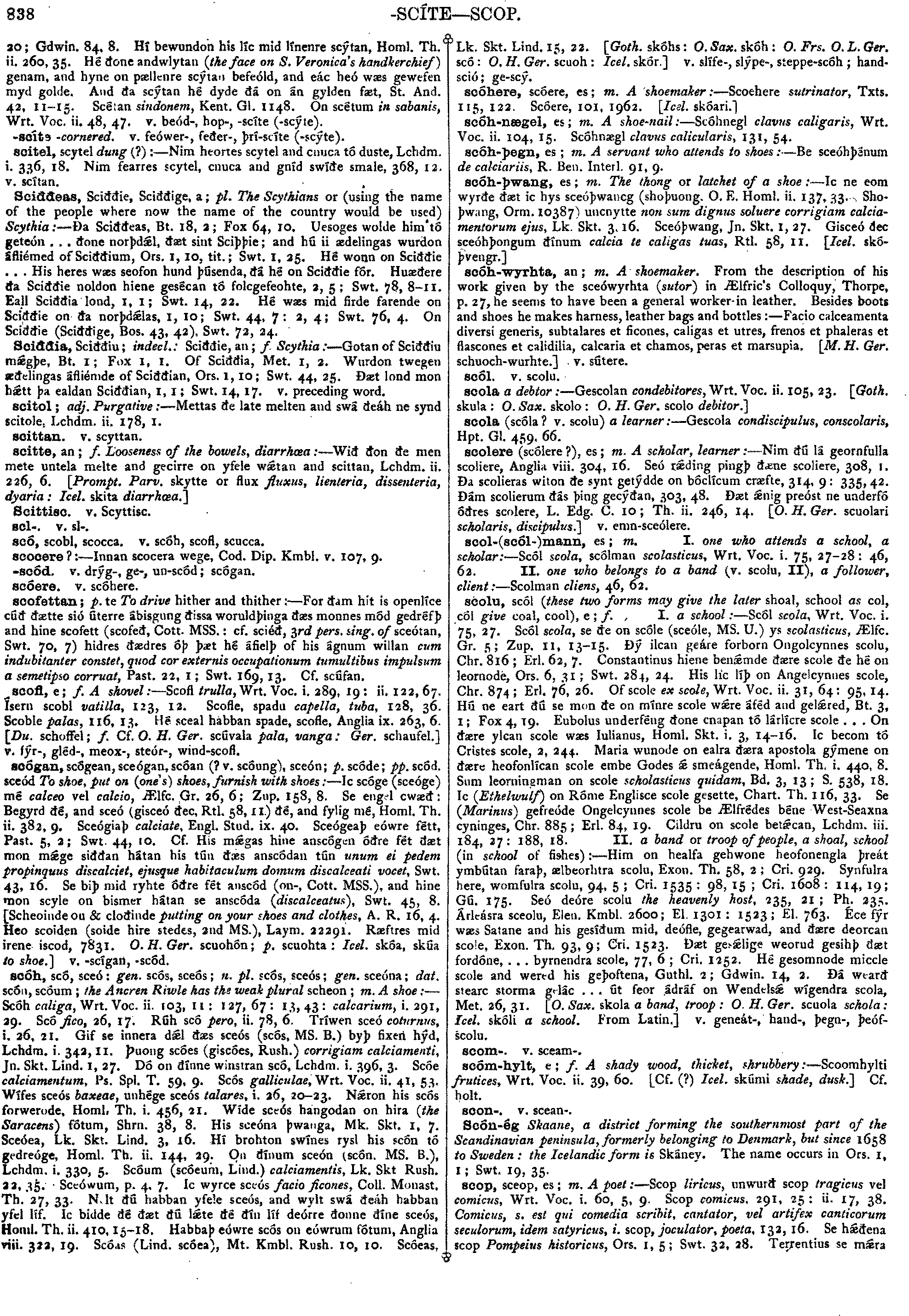
scóh,
scó,
sceó
:
gen.
scós,
sceós;
n.
pl.
scós,
sceós;
gen.
sceóna;
dat.
scón,
scóum;
the
Ancren
Riwle
has
the
weak
plural
scheon;
m.
A
shoe
:--
Scóh
caliga,
Wrt.
Voc.
ii.
103,
11
:
127,
67
:
13,
43
:
calcarium,
i.
291,
29.
Scó
fico,
26,
17.
Rúh
scó
pero,
ii.
78,
6.
Tríwen
sceó
coturnus,
i.
26,
21.
Gif
se
innera
dl
ðæs
sceós
(scós,
MS.
B.)
byþ
fixen
hýd,
Lchdm.
i.
342,
11.
Þuong
scóes
(giscóes,
Rush.)
corrigiam
calciamenti,
Jn.
Skt.
Lind.
1,
27.
Dó
on
ðínne
winstran
scó,
Lchdm.
i.
396,
3.
Scóe
calciamentum,
Ps.
Spl.
T.
59,
9.
Scós
galliculae,
Wrt.
Voc.
ii.
41,
53.
Wífes
sceós
baxeae,
unhége
sceós
talares,
i.
26,
20-23.
Nron
his
scós
farwerode,
Homl,
Th.
i.
456,
21.
Wíde
sceós
hangodan
on
hira
(the
Saracens)
fótum,
Shrn.
38,
8.
His
sceóna
þwanga,
Mk.
Skt.
1,
7.
Sceóea,
Lk.
Skt.
Lind.
3,
16.
Hí
brohton
swínes
rysl
his
scón
tó
gedreóge,
Homl.
Th.
ii.
144,
29.
On
ðínum
sceón
(scón.
MS.
B.),
Lchdm.
i.
330,
5.
Scóum
(scóeum,
Lind.)
calciamentis,
Lk.
Skt
Rush.
22,
35.
Sceówum,
p.
4,
7.
Ic
wyrce
sceós
facio
ficones,
Coll.
Monast,
Th.
27,
33.
Nilt
ðú
habban
yfele
sceós,
and
wylt
swá
ðeáh
habban
yfel
líf.
Ic
bidde
ðé
ðæt
ðú
lte
ðe
ðín
líf
deórre
ðonne
ðíne
sceós,
Homl.
Th.
ii.
410,
15-18.
Habbaþ
eówre
scós
on
eówrum
fótum,
Anglia
viii.
322,
29.
Scóas
(Lind.
scóea),
Mt.
Kmbl.
Rush.
10,
10.
Scóeas,
Lk.
Skt.
Lind.
15,
22.
[Goth.
skóhs
:
O.
Sax.
skóh
:
O.
Frs.
O.
L.
Ger.
scó
:
O.
H.
Ger.
scuoh
:
Icel.
skór.]
v.
slífe-,
slýpe-,
steppe-scóh;
hand-sció;
ge-scý.
|
Source: Bosworth/Toller, page b0862, entry 13 View original page image as: [TIFF] [PNG] [View previous entry] [View next entry] |
[Comment on this entry] [View comments] |
The following entry has been hand-corrected once. |
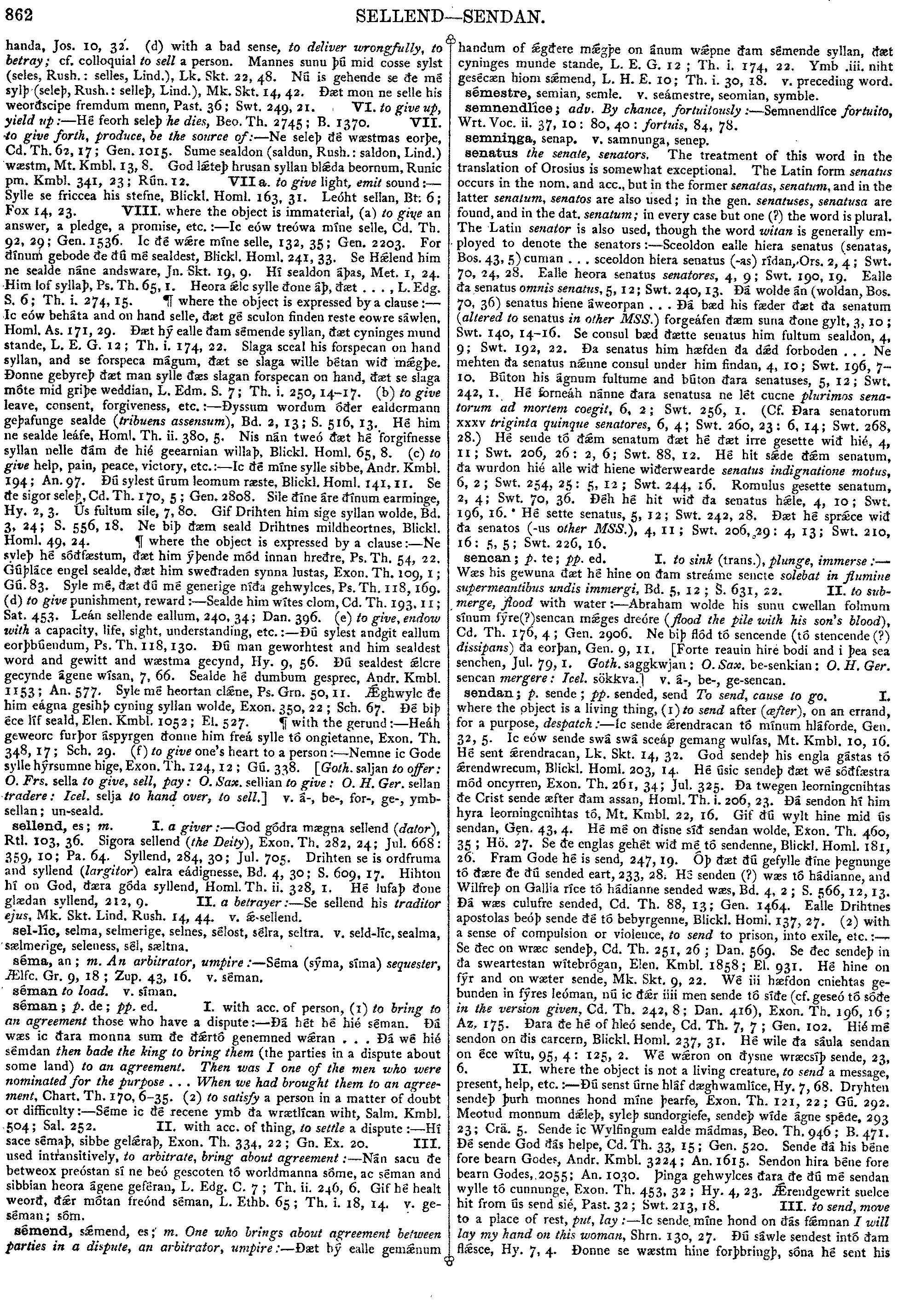
sendan;
p.
sende
;
pp.
sended,
send
To
send,
cause
to
go.
I.
where
the
object
is
a
living
thing,
(i)
to
send
after
(æfter),
on
an
errand,
for
a
purpose,
despatch:--
Ic
sende
rendracan
tó
mínum
hláforde.
Gen.
32,
5.
Ic
eów
sende
swá
swá
sceáp
gemang
wulfas.
Mt.
Kmbl.
10,
16.
Hé
sent
rendracan,
Lk.
Skt.
14,
32.
God
sendeþ
his
engla
gástas
tó
rendwrecum,
Blickl.
Homl.
203,
14.
Hé
úsic
sendeþ
ðæt
wé
sóðfæstra
mód
oncyrren,
Exon.
Th.
261,
34;
Jul.
325.
Ða
twegen
leorningcnihtas
ðe
Crist
sende
æfter
ðam
assan,
Homl.
Th.
i.
206,
23.
Ðá
sendon
hí
him
hyra
leorningcnihtas
tó,
Mt.
Kmbl.
22,
16.
Gif
ðú
wylt
hine
mid
ús
sendan,
Gen.
43,
4.
Hé
mé
on
ðisne
sið
sendan
wolde,
Exon.
Th.
460,
35
;
Hö.
27.
Se
ðe
englas
gehét
wið
mé
tó
sendenne,
Blickl.
Homl.
181,
26.
Fram
Gode
hé
is
send,
247,
19.
Óþ
ðæt
ðú
gefylle
ðíne
þegnunge
tó
ðære
ðe
ðú
sended
eart,
233,
28;
Hé
senden
(?)
wæs
tó
hádianne,
and
Wilfreþ
on
Gallia
ríce
tó
hádianne
sended
wæs.
Bd.
4,
2
;
S.
566,
12,
13.
Ðá
wæs
culufre
sended,
Cd.
Th.
88,
13;
Gen.
1464.
Ealle
Drihtnes
apostolas
beóþ
sende
ðé
tó
bebyrgenne,
Blickl.
Homl.
137,
27.
(2)
with
a
sense
of
compulsion
or
violence,
to
send
to
prison,
into
exile,
etc.
:--
Se
ðec
on
wræc
sendeþ,
Cd.
Th.
251,
26
;
Dan.
569.
Se
ðec
sendeþ
in
ða
sweartestan
wítebrógan,
Elen.
Kmbl.
1858;
El.
931.
Hé
hine
on
fýr
and
on
wæter
sende,
Mk.
Skt.
9,
22.
Wé
iii
hæfdon
cniehtas
gebunden
in
fýres
leóman,
nú
ic
ðr
iiii
men
sende
tó
síðe
(cf.
geseó
tó
sóðe
in
the
version
given.
Cd.
Th.
242,
8;
Dan.
416),
Exon.
Th.
196,
16
;
Az.
175.
Ðara
ðe
hé
of
hleó
sende,
Cd.
Th.
7,
7
;
Gen.
102.
Hié
mé
sendon
on
ðis
carcern,
Blickl.
Homl.
237,
31.
Hé
wile
ða
sáula
sendan
on
éce
wítu,
95,
4:
125,
2.
Wé
wron
on
ðysne
wræcsíþ
sende,
23,
6.
II.
where
the
object
is
not
a
living
creature,
to
send
a
message,
present,
help,
etc.
:--
Ðú
senst
úrne
hláf
dæghwamlíce,
Hy.
7,
68.
Dryhten
sendeþ
þurh
monnes
hond
míne
þearfe,
Exon.
Th.
121,
22;
Gú.
292.
Meotud
monnum
dleþ,
syleþ
sundorgiefe,
sendeþ
wíde
ágne
spéde,
293
23;
Crá.
5.
Sende
ic
Wylfingum
ealde
mádmas,
Beo.
Th.
946
;
B.
471.
Ðé
sende
God
ðás
helpe.
Cd.
Th.
33,
15
;
Gen.
520.
Sende
ðá
his
béne
fore
bearn
Godes,
Andr.
Kmbl.
3224;
An.
1615.
Sendon
hira
béne
fore
bearn
Godes,
2055;
An.
1030.
Þinga
gehwylces
ðara
ðe
ðú
mé
sendan
wylle
tó
cunnunge,
Exon.
Th.
453,
32
;
Hy.
4,
23.
Æ-acute;rendgewrit
suelce
hit
from
ús
send
sié,
Past.
32
;
Swt.
213,
18.
III.
to
send,
move
to
a
place
of
rest,
put,
lay:--
Ic
sende
míne
hond
on
ðás
fmnan
I
will
lay
my
hand
on
this
woman,
Shrn.
130,
27.
Ðú
sáwle
sendest
intó
ðam
flsce,
Hy.
7,
4.
Ðonne
se
wæstm
hine
forþbringþ,
sóna
hé
sent
his
|
Source: Bosworth/Toller, page b0968, entry 2 View original page image as: [TIFF] [PNG] [View previous entry] [View next entry] |
[Comment on this entry] [View comments] |
The following entry has been hand-corrected once. |
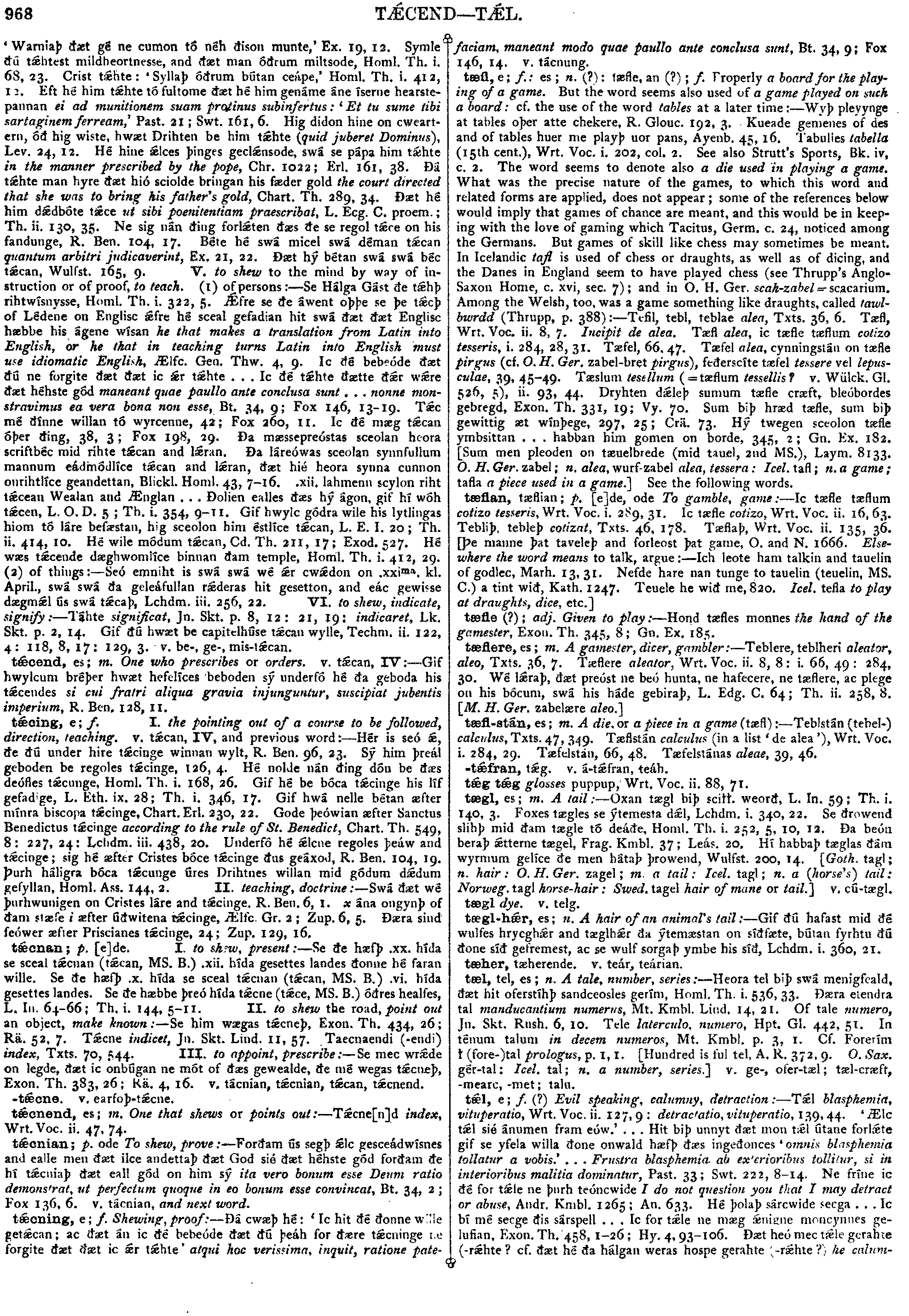
tcing,
e;
f.
I.
the
pointing
out
of
a
course
to
be
followed,
direction,
teaching.
v.
tcan,
IV,
and
previous
word
:--
Hér
is
seó
,
ðe
ðú
under
hire
tcinge
winnan
wylt,
R.
Ben.
96,
23.
Sý
him
þreál
geboden
be
regoles
tcinge,
126,
4.
Hé
nolde
nán
ðing
dón
be
ðæs
deófles
tcunge,
Homl.
Th.
i.
168,
26.
Gif
hé
be
bóca
tcinge
his
líf
gefadige,
L.
Eth.
ix.
28;
Th.
i.
346,
17.
Gif
hwá
nelle
bétan
æfter
mínra
biscopa
tcinge,
Chart.
Erl.
230,
22.
Gode
þeówian
æfter
Sanctus
Benedictus
tcinge
according
to
the
rule
of
St.
Benedict,
Chart.
Th.
549,
8:
227,
24:
Lchdm.
iii.
438,
20.
Underfó
hé
lcne
regoles
þeáw
and
tcinge;
sig
hé
æfter
Cristes
bóce
tcinge
ðus
geáxod,
R.
Ben.
104,
19.
Þurh
háligra
bóca
tcunge
úres
Drihtnes
willan
mid
gódum
ddum
gefyllan,
Homl.
Ass.
144,
2.
II.
teaching,
doctrine
:--
Swá
ðæt
wé
þurhwunigen
on
Cristes
láre
and
tcinge,
R.
Ben.
6,
1.
x
ána
ongynþ
of
ðam
stæfe
i
æfter
úðwitena
rcinge,
Ælfc.
Gr.
2;
Zup.
6,
5.
Ðæra
sind
feówer
æfter
Priscianes
tcinge,
24;
Zup.
129,
16.
|
Source: Bosworth/Toller, page b1030, entry 11 View original page image as: [TIFF] [PNG] [View previous entry] [View next entry] |
[Comment on this entry] [View comments] |
The following entry has been hand-corrected once. |
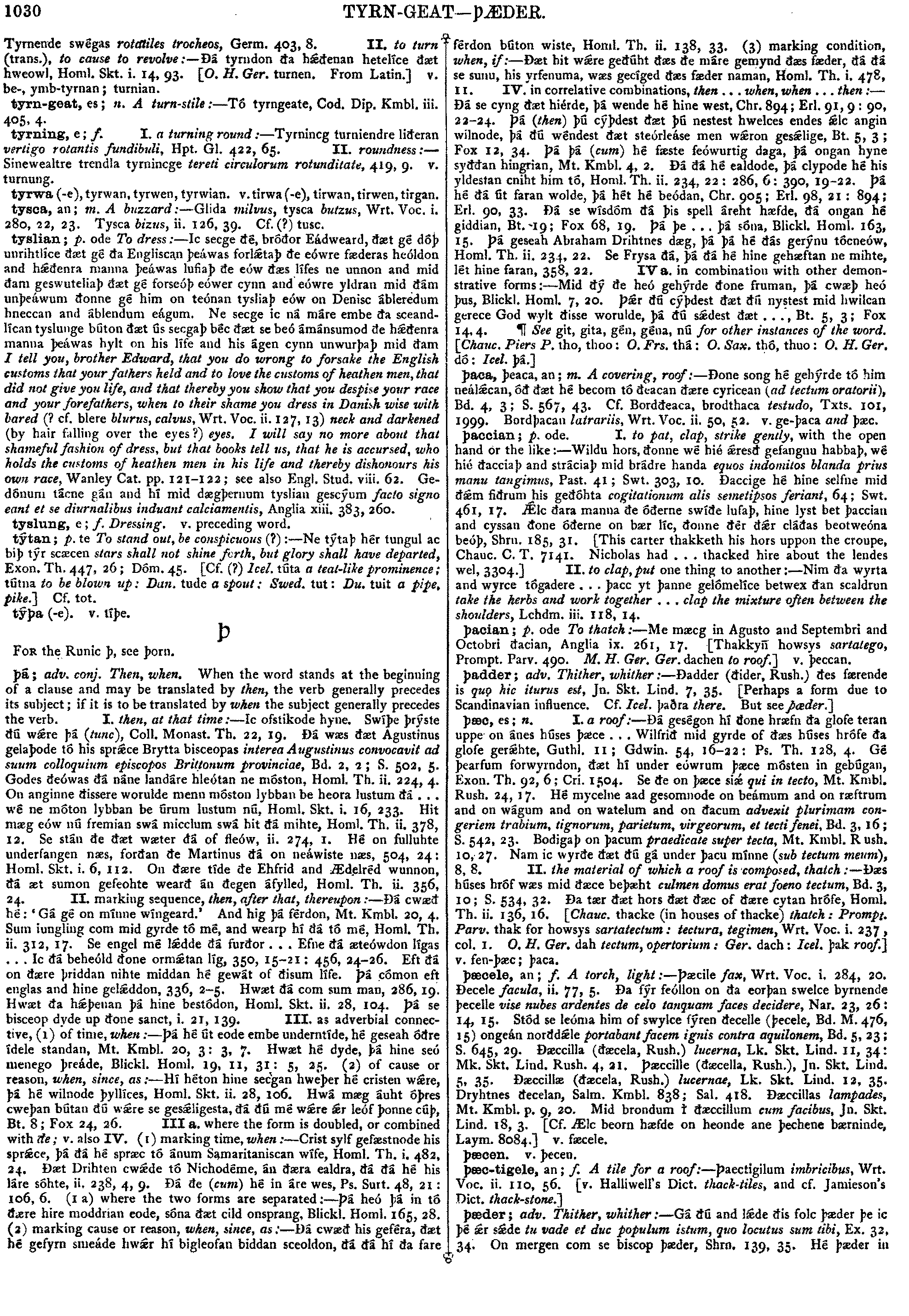
þá;
adv.
conj.
Then,
when.
When
the
word
stands
at
the
beginning
of
a
clause
and
may
be
translated
by
then,
the
verb
generally
precedes
its
subject;
if
it
is
to
be
translated
by
when
the
subject
generally
precedes
the
verb.
I.
then,
at
that
time
:--
Ic
ofstikode
hyne.
Swíþe
þrýste
ðú
wre
þá
(tunc),
Coll.
Monast.
Th.
22,
19.
Ðá
wæs
ðæt
Agustinus
gelaþode
tó
his
sprce
Brytta
bisceopas
interea
Augustinus
convocavit
ad
suum
colloquium
episcopos
Brittonum
provinciae,
Bd.
2,
2;
S.
502,
5.
Godes
ðeówas
ðá
náne
landáre
hleótan
ne
móston,
Homl.
Th.
ii.
224,
4.
On
anginne
ðissere
worulde
menn
móston
lybban
be
heora
lustum
ðá
...
wé
ne
móton
lybban
be
úrum
lustum
nú,
Homl.
Skt.
i.
16,
233.
Hit
mæg
eów
nú
fremian
swá
micclum
swá
hit
ðá
mihte,
Homl.
Th.
ii.
378,
12.
Se
stán
ðe
ðæt
wæter
ðá
of
fleów,
ii.
274,
1.
Hé
on
fulluhte
underfangen
næs,
forðan
ðe
Martinus
ðá
on
neáwiste
næs,
504,
24
:
Homl.
Skt.
i.
6,
112.
On
ðære
tíde
ðe
Ehfrid
and
Ædelréd
wunnon,
ðá
æt
sumon
gefeohte
wearð
án
ðegen
áfylled,
Homl.
Th.
ii.
356,
24.
II.
marking
sequence,
then,
after
that,
thereupon
:--
Ðá
cwæð
hé
:
'Gá
gé
on
mínne
wíngeard.'
And
hig
þá
férdon,
Mt.
Kmbl.
20,
4.
Sum
iungling
com
mid
gyrde
tó
mé,
and
wearp
hí
ðá
tó
mé,
Homl.
Th.
ii.
312,
17.
Se
engel
mé
ldde
ðá
furðor
...
Efne
ðá
æteówdon
lígas
...
Ic
ðá
beheóld
ðone
ormtan
líg,
350,
15-21
:
456,
24-26.
Eft
ðá
on
ðære
þriddan
nihte
middan
hé
gewát
of
ðisum
lífe.
Þá
cómon
eft
englas
and
hine
gelddon,
336,
2-5.
Hwæt
ðá
com
sum
man,
286,
19.
Hwæt
ða
hþenan
þá
hine
bestódon,
Homl.
Skt.
ii.
28,
104.
Þá
se
bisceop
dyde
up
ðone
sanct,
i.
21,
139.
III.
as
adverbial
connective,
(1)
of
time,
when
:--
Þá
hé
út
eode
embe
underntíde,
hé
geseah
óðre
ídele
standan,
Mt.
Kmbl.
20,
3
:
3,
7.
Hwæt
hé
dyde,
þá
hine
seó
menego
þreáde,
Blickl.
Homl.
19,
11,
31
:
5,
25.
(2)
of
cause
or
reason,
when,
since,
as
:--
Hí
héton
hine
secgan
hweþer
hé
cristen
wre,
þá
hé
wilnode
þyllíces,
Homl.
Skt.
ii.
28,
106.
Hwá
mæg
áuht
óþres
cweþan
bútan
ðú
wre
se
gesligesta,
ðá
ðú
mé
wre
r
leóf
þonne
cúþ,
Bt.
8;
Fox
24,
26.
III
a.
where
the
form
is
doubled,
or
combined
with
ðe;
v.
also
IV.
(1)
marking
time,
when
:--
Crist
sylf
gefæstnode
his
sprce,
þá
ðá
hé
spræc
tó
ánum
Samaritaniscan
wífe,
Homl.
Th.
i.
482,
24.
Ðæt
Drihten
cwde
tó
Nichodéme,
án
ðæra
ealdra,
ðá
ðá
hé
his
láre
sóhte,
ii.
238,
4,
9.
Ðá
ðe
(cum)
hé
in
áre
wes,
Ps.
Surt.
48,
21
:
106,
6.
(1
a)
where
the
two
forms
are
separated
:--
Þá
heó
þá
in
tó
ðære
hire
moddrian
eode,
sóna
ðæt
cild
onsprang,
Blickl.
Homl.
165,
28.
(2)
marking
cause
or
reason,
when,
since,
as
:--
Ðá
cwæð
his
geféra,
ðæt
hé
gefyrn
smeáde
hwr
hí
bigleofan
biddan
sceoldon,
ðá
ðá
hí
ða
fare
férdon
búton
wiste,
Homl.
Th.
ii.
138,
33.
(3)
marking
condition,
when,
if
:--
Ðæt
hit
wre
geðúht
ðæs
ðe
máre
gemynd
ðæs
fæder,
ðá
ðá
se
sunu,
his
yrfenuma,
wæs
gecíged
ðæs
fæder
naman,
Homl.
Th.
i.
478,
l
l.
IV.
in
correlative
combinations,
then
...
when,
when
...
then
:--
Ðá
se
cyng
ðæt
hiérde,
þá
wende
hé
hine
west,
Chr.
894;
Erl.
91,
9
:
90,
22-24.
Þá
(then)
þú
cýþdest
ðæt
þú
neatest
hwelces
endes
lc
angin
wilnode,
þá
ðú
wéndest
ðæt
steórleáse
men
wron
geslige,
Bt.
5,
3;
Fox
12,
34.
Þá
þá
(cum)
hé
fæste
feówurtig
daga,
þá
ongan
hyne
syððan
hingrian,
Mt.
Kmbl.
4,
2.
Ðá
ðá
hé
ealdode,
þá
clypode
hé
his
yldestan
cniht
him
tó,
Homl.
Th.
ii.
234,
22
:
286,
6
:
390,
19-22.
Þá
hé
ðá
út
faran
wolde,
þá
hét
hé
beódan,
Chr.
905;
Erl.
98,
21
:
894;
Erl.
90,
33.
Ðá
se
wísdóm
ðá
þis
spell
áreht
hæfde,
ðá
ongan
hé
giddian,
Bt.
19;
Fox
68,
19.
Þá
þe
...
þá
sóna,
Blickl.
Homl.
163,
15.
Þá
geseah
Abraham
Drihtnes
dæg,
þá
þá
hé
ðás
gerýnu
tócneów,
Homl.
Th.
ii.
234,
22.
Se
Frysa
ðá,
þá
ðá
hé
hine
gehæftan
ne
mihte,
lét
hine
faran,
358,
22.
IV
a.
in
combination
with
other
demonstrative
forms
:--
Mid
ðý
ðe
heó
gehýrde
ðone
fruman,
þá
cwæþ
heó
þus,
Blickl.
Homl.
7,
20.
Þr
ðú
cýþdest
ðæt
ðú
nystest
mid
hwilcan
gerece
God
wylt
ðisse
worulde,
þá
ðú
sdest
ðæt
.
.
.
,
Bt.
5,
3;
Fox
14,
4.

See
git,
gita,
gén,
géna,
nú
for
other
instances
of
the
word.
[Chauc.
Piers
P.
tho,
thoo
:
O.
Frs.
thá
:
O.
Sax.
thó,
thuo
:
O.
H.
Ger.
dó
:
Icel.
þá]
|
Source: Bosworth/Toller, page b1102, entry 9 View original page image as: [TIFF] [PNG] [View previous entry] [View next entry] |
[Comment on this entry] [View comments] |
The following entry has been hand-corrected once. |
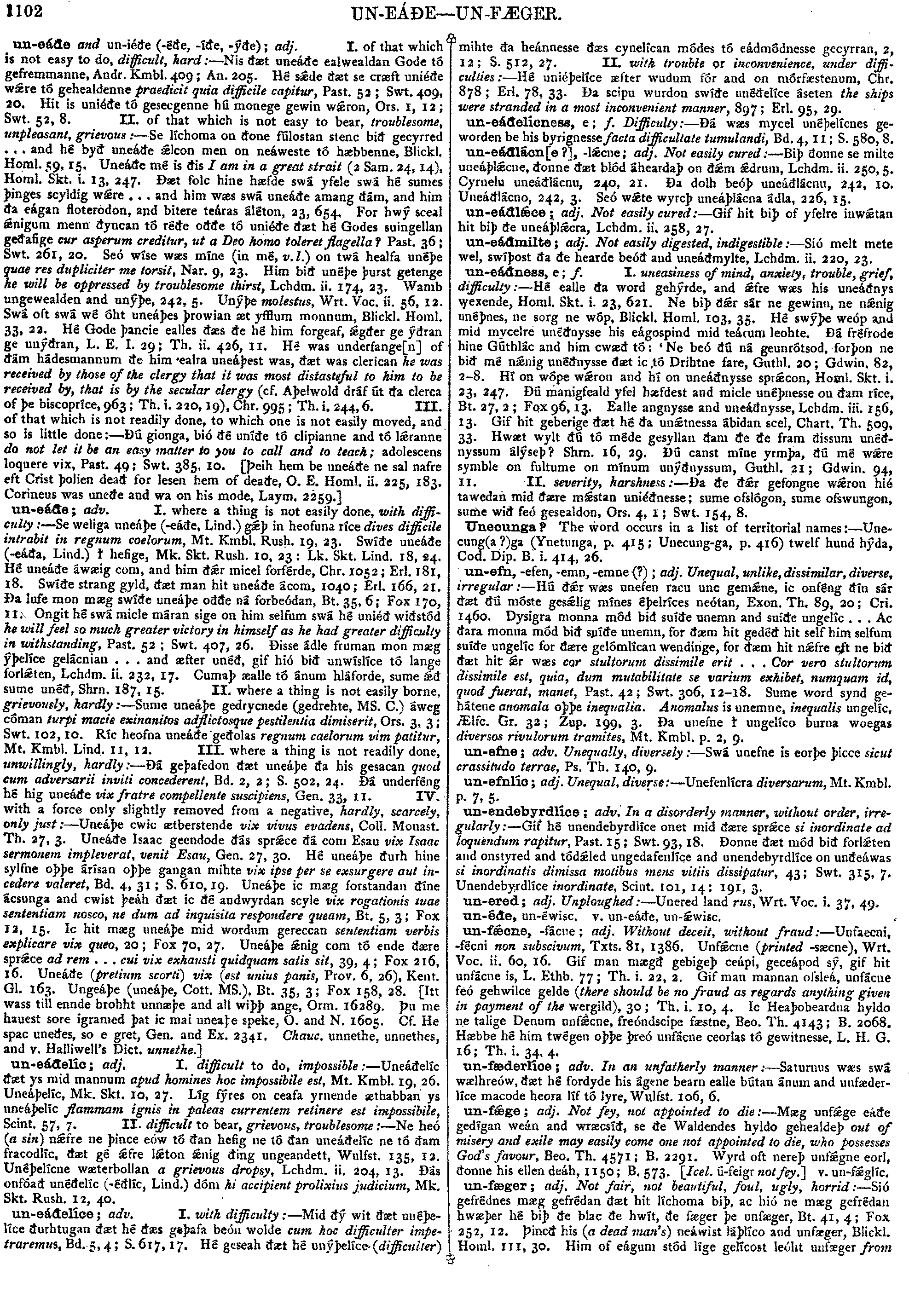
un-eáðness,
e;
f.
I.
uneasiness
of
mind,
anxiety,
trouble,
grief,
difficulty
:--
Hé
ealle
ða
word
gehýrde,
and
fre
wæs
his
uneáðnys
wexende,
Homl.
Skt.
i.
23,
621.
Ne
biþ
ðr
sár
ne
gewinu,
ne
nnig
unéþnes,
ne
sorg
ne
wóp,
Blickl.
Homl.
103,
35.
Hé
swýþe
weóp
and
mid
mycelre
unéðnysse
his
eágospind
mid
teárum
leohte.
Ðá
fréfrode
hine
Gúthlác
and
him
cwæð
tó:
'Ne
beó
ðú
ná
geunrótsod,
forþon
ne
bið
mé
nnig
unéðnysse
ðæt
ic
tó
Drihtne
fare,
Guthl.
20;
Gdwin.
82,
2-8.
Hí
on
wópe
wron
and
hí
on
uneáðnysse
sprcon,
Homl.
Skt.
i.
23,
247.
Ðú
manigfeald
yfel
hæfdest
and
micle
unéþnesse
on
ðam
ríce,
Bt.
27,
2;
Fox
96,
13.
Ealle
angnysse
and
uneáðnysse,
Lchdm.
iii.
156,
13.
Gif
hit
geberige
ðæt
hé
ða
untnessa
ábidan
scel,
Chart.
Th.
509,
33.
Hwæt
wylt
ðú
tó
méde
gesyllan
ðam
ðe
ðe
fram
ðissum
unéðnyssum
álýseþ?
Shrn.
16,
29.
Ðú
canst
míne
yrmþa,
ðú
mé
wre
symble
on
fultume
on
mínum
unýðnyssum,
Guthl.
21;
Gdwin.
94,
11.
II.
severity,
harshness
:--
Ða
ðe
ðr
gefongne
wron
hié
tawedan
mid
ðære
mstan
uniéðnesse;
sume
ofslógon,
sume
ofswungon,
sume
wið
feó
gesealdon,
Ors.
4,
1;
Swt.
154,
8.
| Result Page: |  |
Previous | 1 2 3 4 5 | Next |  |
Germanic Lexicon Project (main page)
This search system was written by
Sean Crist
Please consider
volunteering
to correct the data in these online dictionaries.
No rights reserved. Feel free to use these data in any way you please.