|
|

|
Source: Bosworth/Toller, page b0213, entry 1 View original page image as: [TIFF] [PNG] [View previous entry] [View next entry] |
[Comment on this entry] [View comments] |
The following entry has been hand-corrected once. |
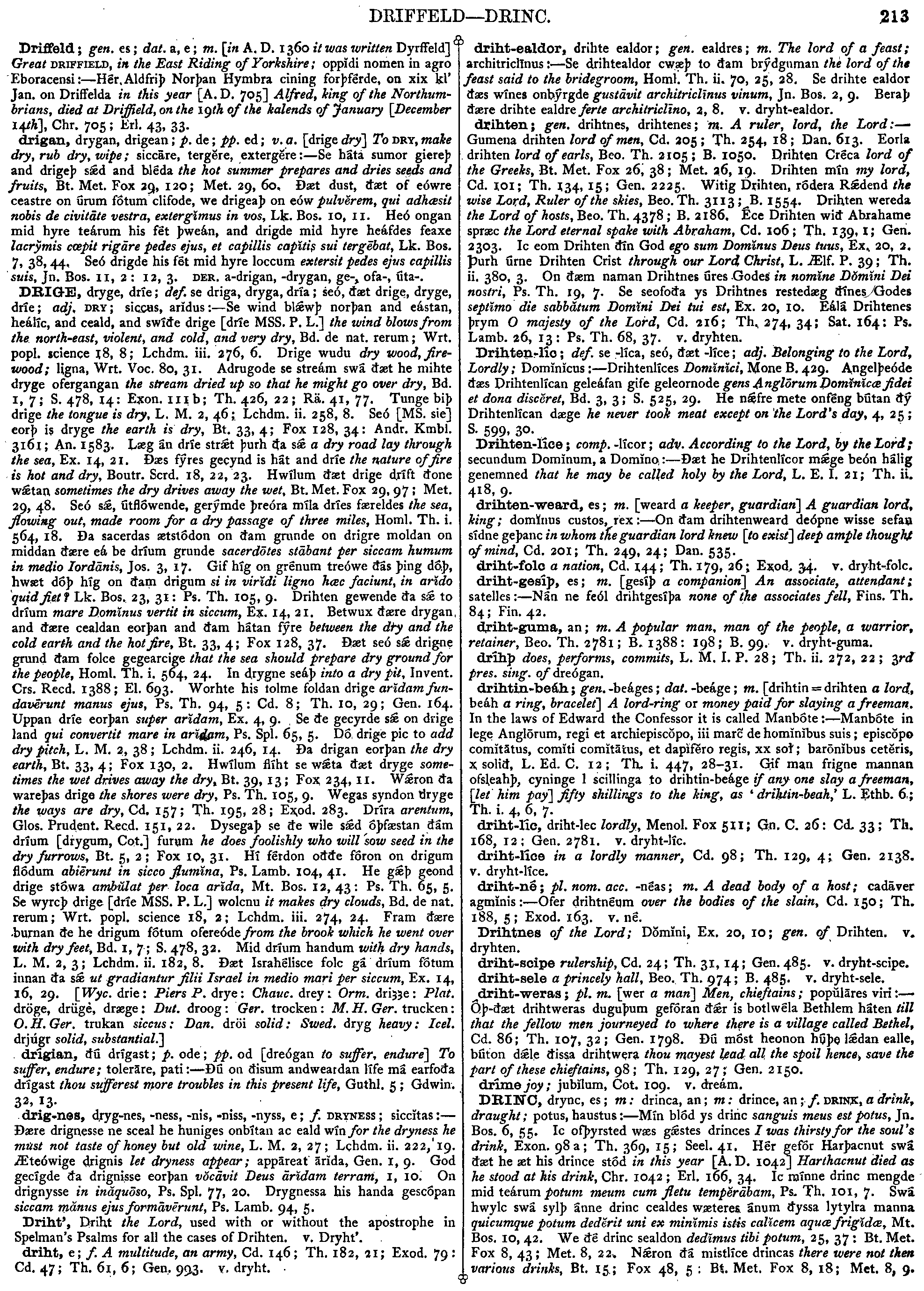
Driffeld;
gen.
es;
dat.
a,
e;
m.
[in
A.
D.
1360
it
was
written
Dyrffeld]
Great
DRIFFIELD,
in
the
East
Riding
of
Yorkshire;
opp di
nomen
in
agro
Eboracensi
:--
Hér
Aldfriþ
Norþan
Hymbra
cining
forþférde,
on
xix
kl'
Jan.
on
Driffelda
in
this
year
[A.
D.
705]
Alfred,
king
of
the
Northumbrians,
died
at
Driffield,
on
the
19th
of
the
kalends
of
January
[December
14th],
Chr.
705;
Erl.
43,
33.
di
nomen
in
agro
Eboracensi
:--
Hér
Aldfriþ
Norþan
Hymbra
cining
forþférde,
on
xix
kl'
Jan.
on
Driffelda
in
this
year
[A.
D.
705]
Alfred,
king
of
the
Northumbrians,
died
at
Driffield,
on
the
19th
of
the
kalends
of
January
[December
14th],
Chr.
705;
Erl.
43,
33.
|
Source: Bosworth/Toller, page b0259, entry 17 View original page image as: [TIFF] [PNG] [View previous entry] [View next entry] |
[Comment on this entry] [View comments] |
The following entry has been hand-corrected once. |
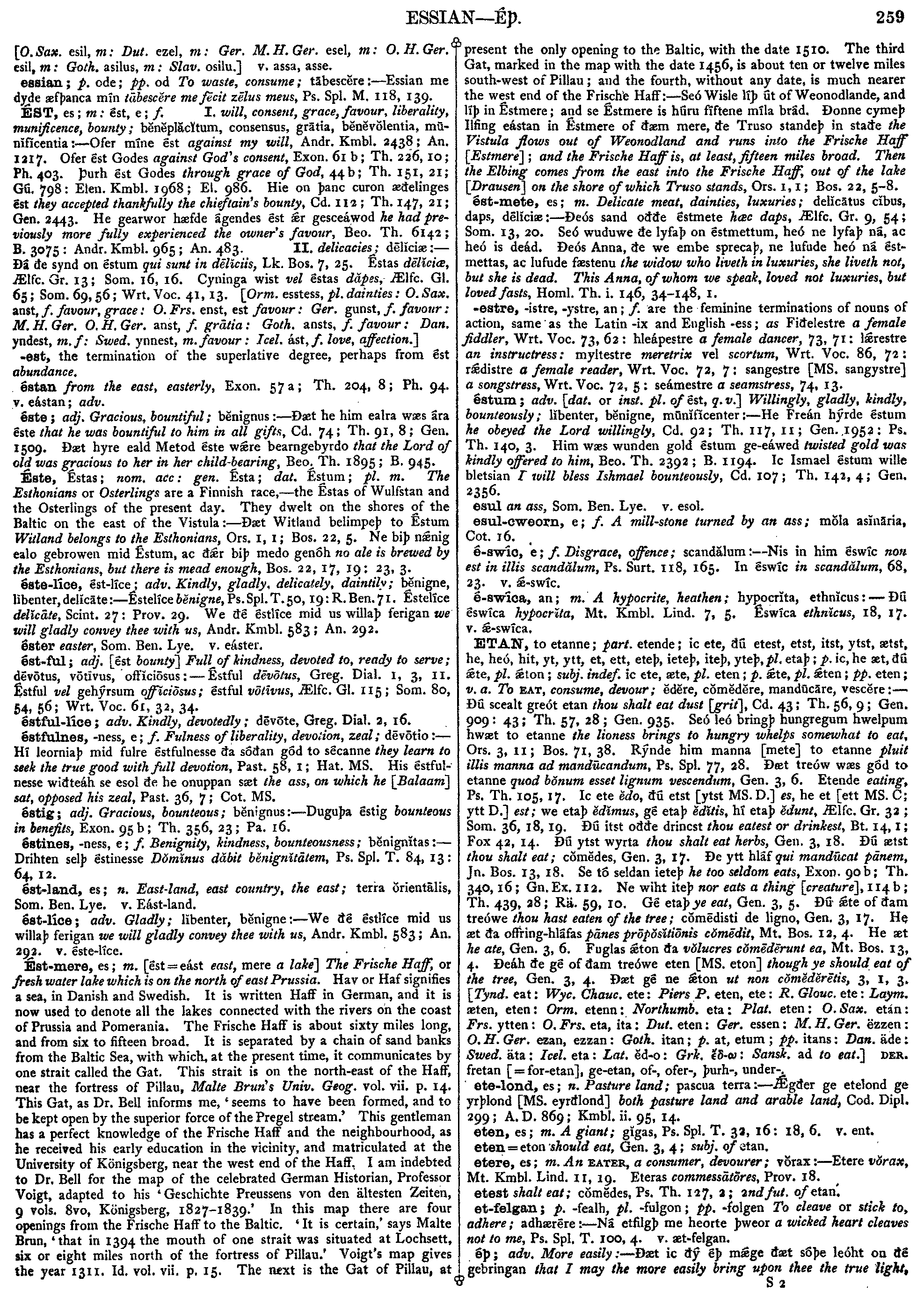
Ést-mere, es; m. [ést = eást east, mere a lake] The Frische Haff, or fresh water lake which is on the north of east Prussia. Hav or Haf signifies a sea, in Danish and Swedish. It is written Haff in German, and it is now used to denote all the lakes connected with the rivers on the coast of Prussia and Pomerania. The Frische Haff is about sixty miles long, and from six to fifteen broad. It is separated by a cham of sand banks from the Baltic Sea, with which, at the present time, it communicates by one strait called the Gat. This strait is on the north-east of the Haff, near the fortress of Pillau, Malte Brunts Univ. Geog. vol. vii. p. 14. This Gat, as Dr. Bell informs me, 'seems to have been formed, and to be kept open by the superior force of the Pregel stream.' This gentleman has a perfect knowledge of the Frische Haff and the neighbourhood, as he received his early education in the vicinity, and matriculated at the University of Königsberg, near the west end of the Haff. I am indebted to Dr. Bell for the map of the celebrated German Historian, Professor Voigt, adapted to his 'Geschichte Preussens von den ältesten Zeiten, 9 vols. 8vo, Königsberg, 1827-1839.' In this map there are four openings from the Frische Haff to the Baltic. 'It is certain,' says Malte Brun, 'that in 1394 the mouth of one strait was situated at Lochsett, six or eight miles north of the fortress of Pillau.' Voigt's map gives the year 1311. Id. vol. vii. p. 15. The next is the Gat of Pillau, at present the only opening to the Baltic, with the date 1510. The third Gat, marked in the map with the date 1456, is about ten or twelve miles south-west of Pillau; and the fourth, without any date, is much nearer the west end of the Frische Haff :-- Seó Wisle líþ út of Weonodlande, and líþ in Éstmere; and se Éstmere is húru fíftene míla brád. Ðonne cymeþ Ilfing eástan in Éstmere of ðæm mere, ðe Truso standeþ in staðe the Vistula flows out of Weonodland and runs into the Frische Haf [Estmere]; and the Frische Haff is, at least, fifteen miles broad. Then the Elbing comes from the east into the Frische Haff, out of the lake [Drausen] on the shore of which Truso stands, Ors. 1, 1; Bos. 22, 5-8.
|
Source: Bosworth/Toller, page b0309, entry 3 View original page image as: [TIFF] [PNG] [View previous entry] [View next entry] |
[Comment on this entry] [View comments] |
The following entry has been hand-corrected once. |
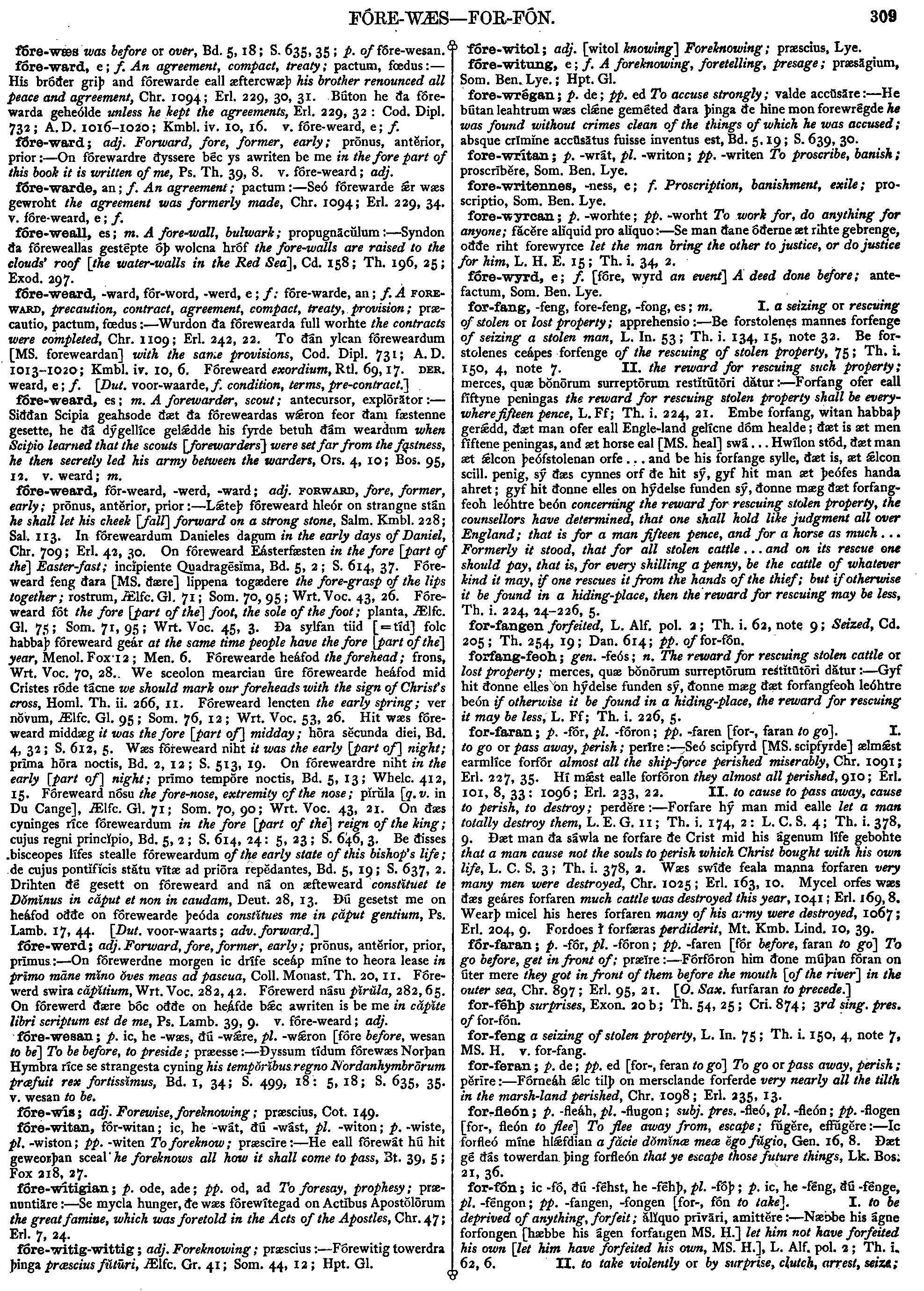
fóre-ward;
adj.
Forward,
fore,
former,
early;
pr nus,
ant
nus,
ant rior,
prior
:--
On
fórewardre
ðyssere
béc
ys
awriten
be
me
in
the
fore
part
of
this
book
it
is
written
of
me,
Ps.
Th.
39,
8.
v.
fóre-weard;
adj.
rior,
prior
:--
On
fórewardre
ðyssere
béc
ys
awriten
be
me
in
the
fore
part
of
this
book
it
is
written
of
me,
Ps.
Th.
39,
8.
v.
fóre-weard;
adj.
|
Source: Bosworth/Toller, page b0346, entry 26 View original page image as: [TIFF] [PNG] [View previous entry] [View next entry] |
[Comment on this entry] [View comments (1)] |
The following entry has been hand-corrected once. |
fullian,
fulligan,
fulwian,
to
fullianne;
part.
fulligende;
ic
fullige,
ðú
fullast,
he
fullaþ,
pl.
fulliaþ;
p.
fullode,
ede;
pp.
fullod,
ed;
v.
trans.
To
FULL
or
make
white
as
a
fuller
[fullere,
q.v.],
to
baptize;
alb re,
canddum
f
re,
canddum
f cre,
bapt
cre,
bapt zre
=
GREEK.
A
word
of
doubtful
origin.
It
is
by
some
connected
with
the
verb
which
appears
in
Gothic
as
weihan
to
sanctify,
See
fulluht.
Ongunnon
hí
men
l
zre
=
GREEK.
A
word
of
doubtful
origin.
It
is
by
some
connected
with
the
verb
which
appears
in
Gothic
as
weihan
to
sanctify,
See
fulluht.
Ongunnon
hí
men
l ran
and
fullian
ipsi
prædcre
et
baptzre
cœp
ran
and
fullian
ipsi
prædcre
et
baptzre
cœp runt,
Bd.
1,
26;
S.
488,
4:
1,
27;
S.
493,
25.
Se
ðe
me
sende
to
fullianne
on
wætere
qui
msit
me
baptzre
in
quam,
Jn.
Bos.
1.
33.
Iohannes
wæs
on
wéstene
fulligende
fuit
Joannes
in
deserto
baptzans,
Mk.
Bos.
1,
4.
Ic
fullige
on
wætere
go
baptzo
in
qua,
Jn.
Bos.
1,
26.
Hwí
fullast
ðú
quid
baptzas?
1,
25.
Se
ðe
fullaþ
on
Hálgum
Gáste
qui
baptzat
in
Sprtu
Sancto,
1,
33:
3,
26:
L.
C.
E.
4;
Th.
i.
360,
30.
Iohannes
fullode
ða
ðe
him
to
cómon
John
baptized
those
who
came
to
him,
Homl.
Th.
i.
352,
16:
Jn.
Bos.
1,
28,
31:
3,
22,
23:
4,
2:
10,
40.
Lraþ
ealle
þeóda,
and
fulligeaþ
hig
d
runt,
Bd.
1,
26;
S.
488,
4:
1,
27;
S.
493,
25.
Se
ðe
me
sende
to
fullianne
on
wætere
qui
msit
me
baptzre
in
quam,
Jn.
Bos.
1.
33.
Iohannes
wæs
on
wéstene
fulligende
fuit
Joannes
in
deserto
baptzans,
Mk.
Bos.
1,
4.
Ic
fullige
on
wætere
go
baptzo
in
qua,
Jn.
Bos.
1,
26.
Hwí
fullast
ðú
quid
baptzas?
1,
25.
Se
ðe
fullaþ
on
Hálgum
Gáste
qui
baptzat
in
Sprtu
Sancto,
1,
33:
3,
26:
L.
C.
E.
4;
Th.
i.
360,
30.
Iohannes
fullode
ða
ðe
him
to
cómon
John
baptized
those
who
came
to
him,
Homl.
Th.
i.
352,
16:
Jn.
Bos.
1,
28,
31:
3,
22,
23:
4,
2:
10,
40.
Lraþ
ealle
þeóda,
and
fulligeaþ
hig
d cte
omnes
gentes,
baptzantes
eos,
Mt.
Bos.
28,
19.
Ðæt
he
hine
fullode
that
he
might
baptize
him,
3,
13.
Iohannes
se
Fulluhtere
cwæþ,
witodlíce
ic
eów
fullige
on
wætere,
to
ddbóte;
se
ðe
æfter
me
towerd
ys
...
he
eów
fullaþ
on
Hálgum
Gáste,
Mt.
Bos.
3,
11;
Joon
Baptist
saide,
forsothe
Y
cristene
[
=
waische]
cte
omnes
gentes,
baptzantes
eos,
Mt.
Bos.
28,
19.
Ðæt
he
hine
fullode
that
he
might
baptize
him,
3,
13.
Iohannes
se
Fulluhtere
cwæþ,
witodlíce
ic
eów
fullige
on
wætere,
to
ddbóte;
se
ðe
æfter
me
towerd
ys
...
he
eów
fullaþ
on
Hálgum
Gáste,
Mt.
Bos.
3,
11;
Joon
Baptist
saide,
forsothe
Y
cristene
[
=
waische]
 ou
in
water,
in
to
penaunce;
forsothe
he
that
is
to
cumme
after
me
...
he
shal
baptise,
or
cristen
ow
in
the
Holy
Goost,
Wyc:
Joannes
Baptista
dixit,
go
qudem
baptzo
vos
in
qua
in
pœntentiam;
qui
autem
post
me
vent
ou
in
water,
in
to
penaunce;
forsothe
he
that
is
to
cumme
after
me
...
he
shal
baptise,
or
cristen
ow
in
the
Holy
Goost,
Wyc:
Joannes
Baptista
dixit,
go
qudem
baptzo
vos
in
qua
in
pœntentiam;
qui
autem
post
me
vent rus
est
...
ipse
vos
baptzbit
in
Sprtu
Sancto,
Vulg.
'In
Anturs
of
Arther,
end
of
13th
century,
we
find,
st.
xviii.
lines
4,
5
:--
pp.
Fulled
whitened,
baptized:
R.
Glouc.
A.D.
1297;
3
p.
Follede;
pp.
y-fulled,
fulled;
s.
fullynge:
Piers
P.
1362,
Wrt.
small
8vo.
London,
Pickering,
1842,
pp.
244,
322,
fullynge
baptizing,
whitening:
398,
fullynge
baptizing.
After
this,
we
do
not
find
fulled,
y-fulled,
fullynge;
yet
in
A.
Sax.
Mk.
Bos.
9,
3,
we
have
fullere:
Wyc.
1389,
fullere
[or
walkere
of
cloth,
note]:
Tynd.
1526
and
Eng.
version
1611,
fuller.
Baptem
and
Baptym
with
the
verb
Baptise
is
used
by
Wycliffe,
and
Baptyme
and
Baptyzyn
by
the
compiler
of
the
Promptorium.
Wycliffe
also
uses
the
1st
person
of
the
verb
I
waisch
in
Mt.
3,
11;
and
the
two
forms
of
the
pp.
waischen,
waischun,
in
Mt.
3,
6,
and
Mk.
10,
38,
39.
The
form
Bapteme
seems
to
have
been
introduced
into
the
language,
through
the
French,
by
Robert
Manning,
called
de
Brunne,
from
Bourne,
near
Depyng
in
Lincolnshire,
in
his
translation
of
Peter
Langtoft's
Chronicle,
and
to
have
been
current,
with
slight
variation
in
the
orthography,
till
nearly
the
middle
of
the
16th
century
=
1550.
Thus
the
forms
Baptim
and
Baptime
appear
in
the
version
of
the
N.T.
by
Tyndale
in
1526,
and
Baptym,
Baptyme
in
that
by
Cranmer
in
1539.
In
the
version
made
by
Coverdale
and
other
Protestant
exiles
at
Geneva
in
1559,
in
the
Anglo-Rhemish
version
made
by
Cardinal
Alien
and
other
Romanists
at
Rheims
in
1559,
and
in
the
authorized
version
of
1611,
the
word
is
written
Baptisme.
This
last
form
is
also
found
in.
Piers
P.
p.
398.
Ormin
only
uses
the
verb
to
dip,
once
:--
Unnderr
waterr
dippesst,
H.
1551.
In
Goth.
and
in
other
divisions
of
the
Teutonic
as
well
as
in
the
Swed.
and
Dan.
divisions
of
the
Scandinavian
branch
of
the
Gothic
language,
a
noun
and
verb
are
used
expressive
of
dipping,
e.g.
Goth.
daupyan,
daupeins:
O.
H.
Ger.
doufan,
doufa:
Dut.
doopen,
doop;
Ger.
taufen,
taufe:
Swed.
döpa.
döpelse:
Dan.
döbe,
daab.'
Orm.
ii.
626,
627.
Dyppan
is
also
used
in
the
Rushworth
Gloss.
v.
fulwian.
DER.
ge-fullian,
-fulwian:
un-gefullod.
rus
est
...
ipse
vos
baptzbit
in
Sprtu
Sancto,
Vulg.
'In
Anturs
of
Arther,
end
of
13th
century,
we
find,
st.
xviii.
lines
4,
5
:--
pp.
Fulled
whitened,
baptized:
R.
Glouc.
A.D.
1297;
3
p.
Follede;
pp.
y-fulled,
fulled;
s.
fullynge:
Piers
P.
1362,
Wrt.
small
8vo.
London,
Pickering,
1842,
pp.
244,
322,
fullynge
baptizing,
whitening:
398,
fullynge
baptizing.
After
this,
we
do
not
find
fulled,
y-fulled,
fullynge;
yet
in
A.
Sax.
Mk.
Bos.
9,
3,
we
have
fullere:
Wyc.
1389,
fullere
[or
walkere
of
cloth,
note]:
Tynd.
1526
and
Eng.
version
1611,
fuller.
Baptem
and
Baptym
with
the
verb
Baptise
is
used
by
Wycliffe,
and
Baptyme
and
Baptyzyn
by
the
compiler
of
the
Promptorium.
Wycliffe
also
uses
the
1st
person
of
the
verb
I
waisch
in
Mt.
3,
11;
and
the
two
forms
of
the
pp.
waischen,
waischun,
in
Mt.
3,
6,
and
Mk.
10,
38,
39.
The
form
Bapteme
seems
to
have
been
introduced
into
the
language,
through
the
French,
by
Robert
Manning,
called
de
Brunne,
from
Bourne,
near
Depyng
in
Lincolnshire,
in
his
translation
of
Peter
Langtoft's
Chronicle,
and
to
have
been
current,
with
slight
variation
in
the
orthography,
till
nearly
the
middle
of
the
16th
century
=
1550.
Thus
the
forms
Baptim
and
Baptime
appear
in
the
version
of
the
N.T.
by
Tyndale
in
1526,
and
Baptym,
Baptyme
in
that
by
Cranmer
in
1539.
In
the
version
made
by
Coverdale
and
other
Protestant
exiles
at
Geneva
in
1559,
in
the
Anglo-Rhemish
version
made
by
Cardinal
Alien
and
other
Romanists
at
Rheims
in
1559,
and
in
the
authorized
version
of
1611,
the
word
is
written
Baptisme.
This
last
form
is
also
found
in.
Piers
P.
p.
398.
Ormin
only
uses
the
verb
to
dip,
once
:--
Unnderr
waterr
dippesst,
H.
1551.
In
Goth.
and
in
other
divisions
of
the
Teutonic
as
well
as
in
the
Swed.
and
Dan.
divisions
of
the
Scandinavian
branch
of
the
Gothic
language,
a
noun
and
verb
are
used
expressive
of
dipping,
e.g.
Goth.
daupyan,
daupeins:
O.
H.
Ger.
doufan,
doufa:
Dut.
doopen,
doop;
Ger.
taufen,
taufe:
Swed.
döpa.
döpelse:
Dan.
döbe,
daab.'
Orm.
ii.
626,
627.
Dyppan
is
also
used
in
the
Rushworth
Gloss.
v.
fulwian.
DER.
ge-fullian,
-fulwian:
un-gefullod.
|
Source: Bosworth/Toller, page b0401, entry 8 View original page image as: [TIFF] [PNG] [View previous entry] [View next entry] |
[Comment on this entry] [View comments] |
The following entry has been hand-corrected once. |
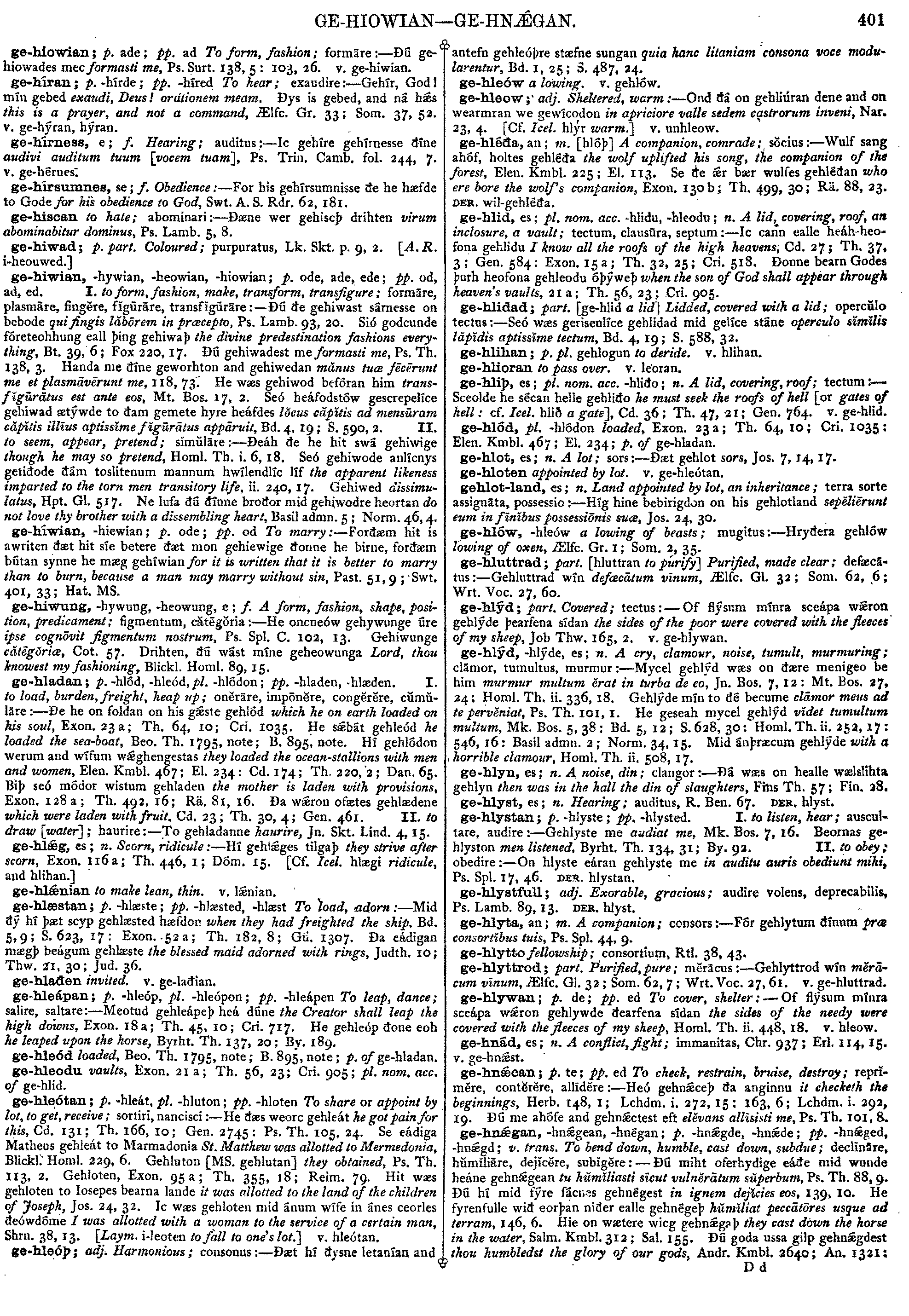
ge-híwian, -hiewian; p. ode; pp. od To marry :-- Forðæm hit is awriten ðæt hit síe betere ðæt mon gehiewige ðonne he birne, forðæm bútan synne he mæg gehíwian for it is written that it is better to marry than to burn, because a man may marry without sin, Past. 51, 9; Swt. 401, 33; Hat. MS.
|
Source: Bosworth/Toller, page b0410, entry 22 View original page image as: [TIFF] [PNG] [View previous entry] [View next entry] |
[Comment on this entry] [View comments] |
The following entry has been hand-corrected once. |
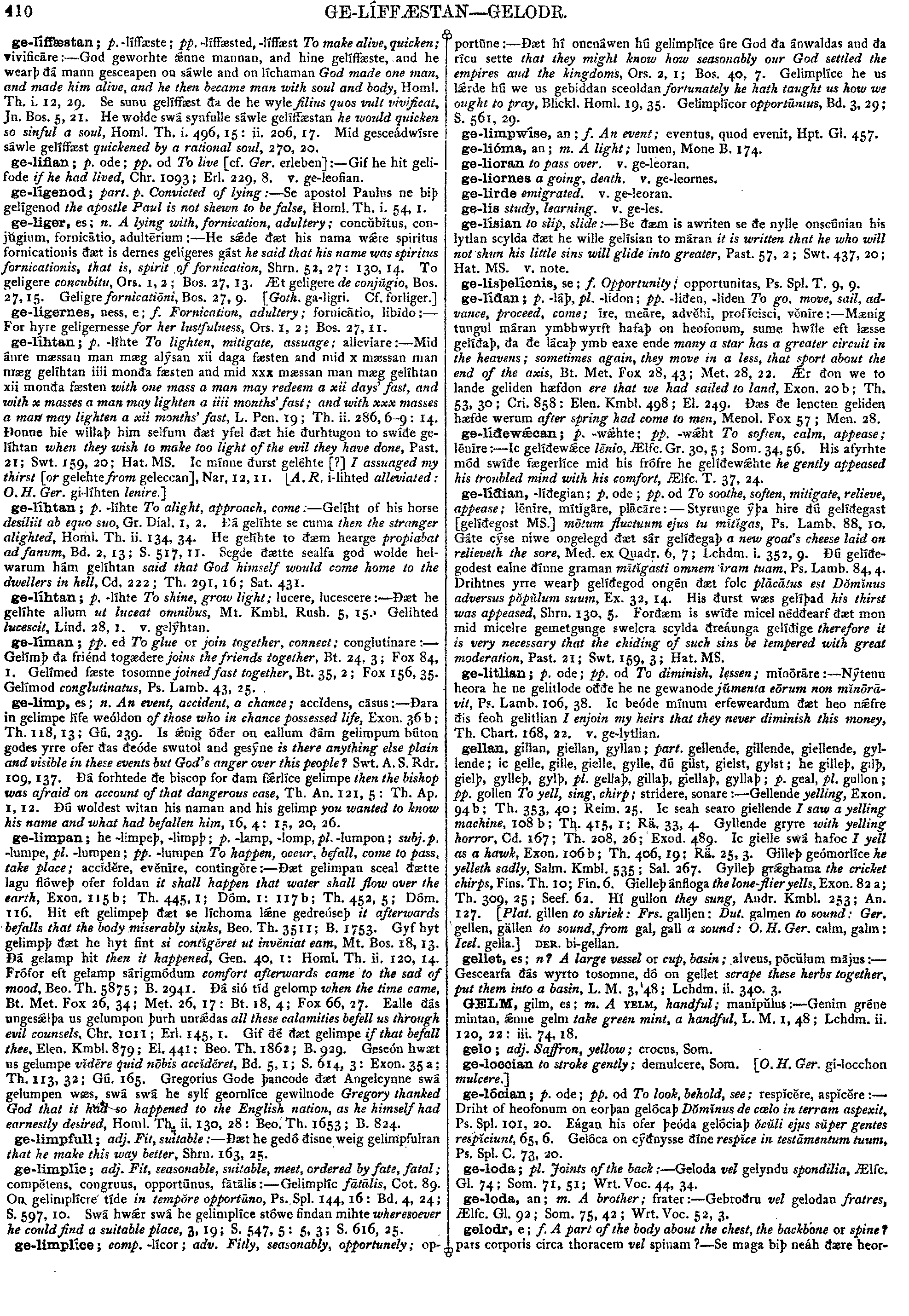
ge-lísian to slip, slide :-- Be ðæm is awriten se ðe nylle onscúnian his lytlan scylda ðæt he wille gelísian to máran it is written that he who will not shun his little sins will glide into greater, Past. 57, 2; Swt. 437, 20; Hat. MS. v. note.
|
Source: Bosworth/Toller, page b0467, entry 1 View original page image as: [TIFF] [PNG] [View previous entry] [View next entry] |
[Comment on this entry] [View comments] |
The following entry has been hand-corrected once. |
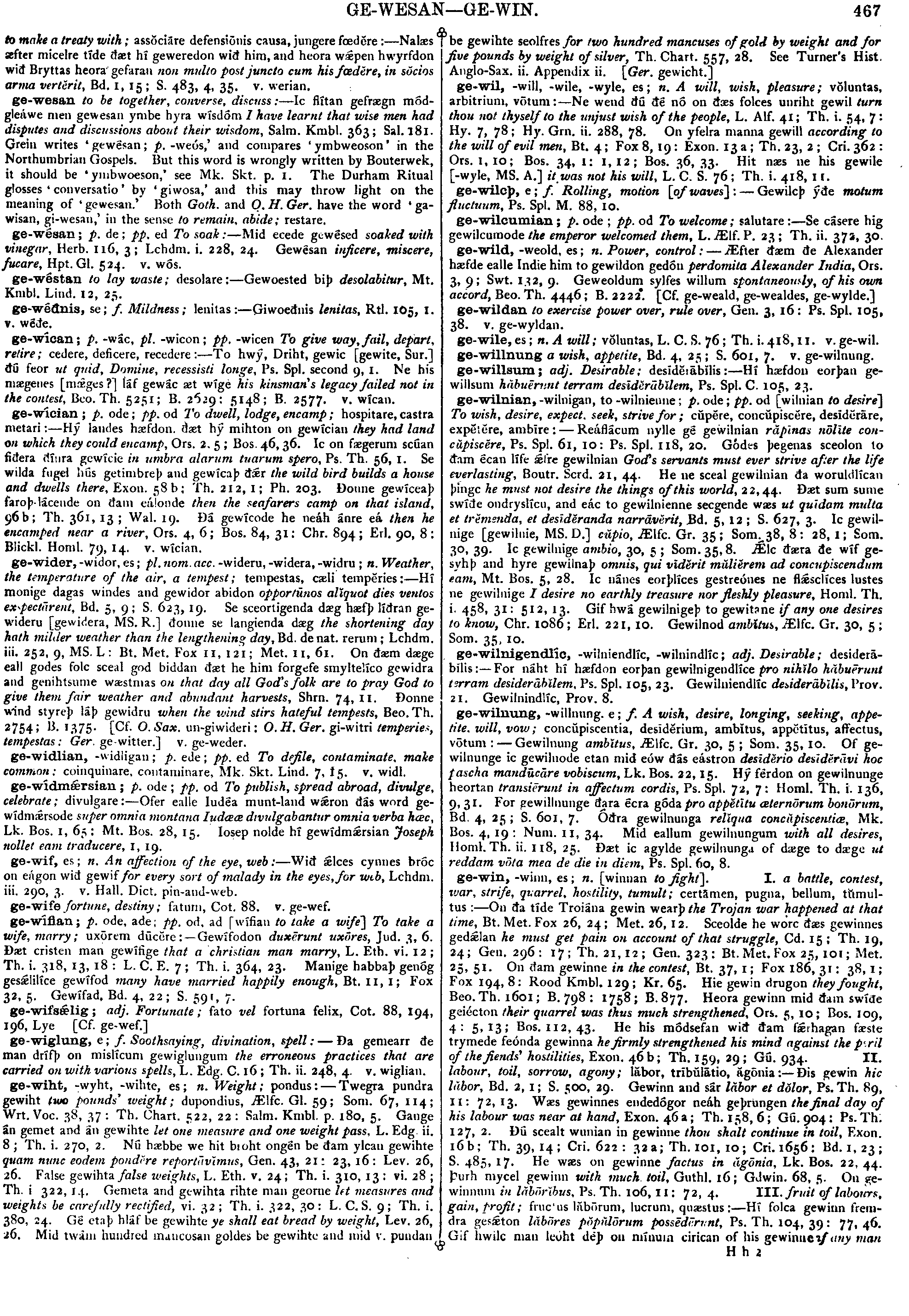
ge-wesan to be together, converse, discuss :-- Ic flítan gefrægn módgleáwe men gewesan ymbe hyra wísdóm I have learnt that wise men had disputes and discussions about their wisdom, Salm. Kmbl. 363; Sal. 181. Grein writes 'gewésan; p. -weós,' and compares 'ymbweoson' in the Northumbrian Gospels. But this word is wrongly written by Bouterwek, it should be 'ymbwoeson,' see Mk. Skt. p. 1. The Durham Ritual glosses 'conversatio' by 'giwosa,' and this may throw light on the meaning of 'gewesan.' Both Goth. and O. H. Ger. have the word 'gawisan, gi-wesan,' in the sense to remain, abide; restare.
|
Source: Bosworth/Toller, page b0470, entry 35 View original page image as: [TIFF] [PNG] [View previous entry] [View next entry] |
[Comment on this entry] [View comments] |
The following entry has been hand-corrected once. |
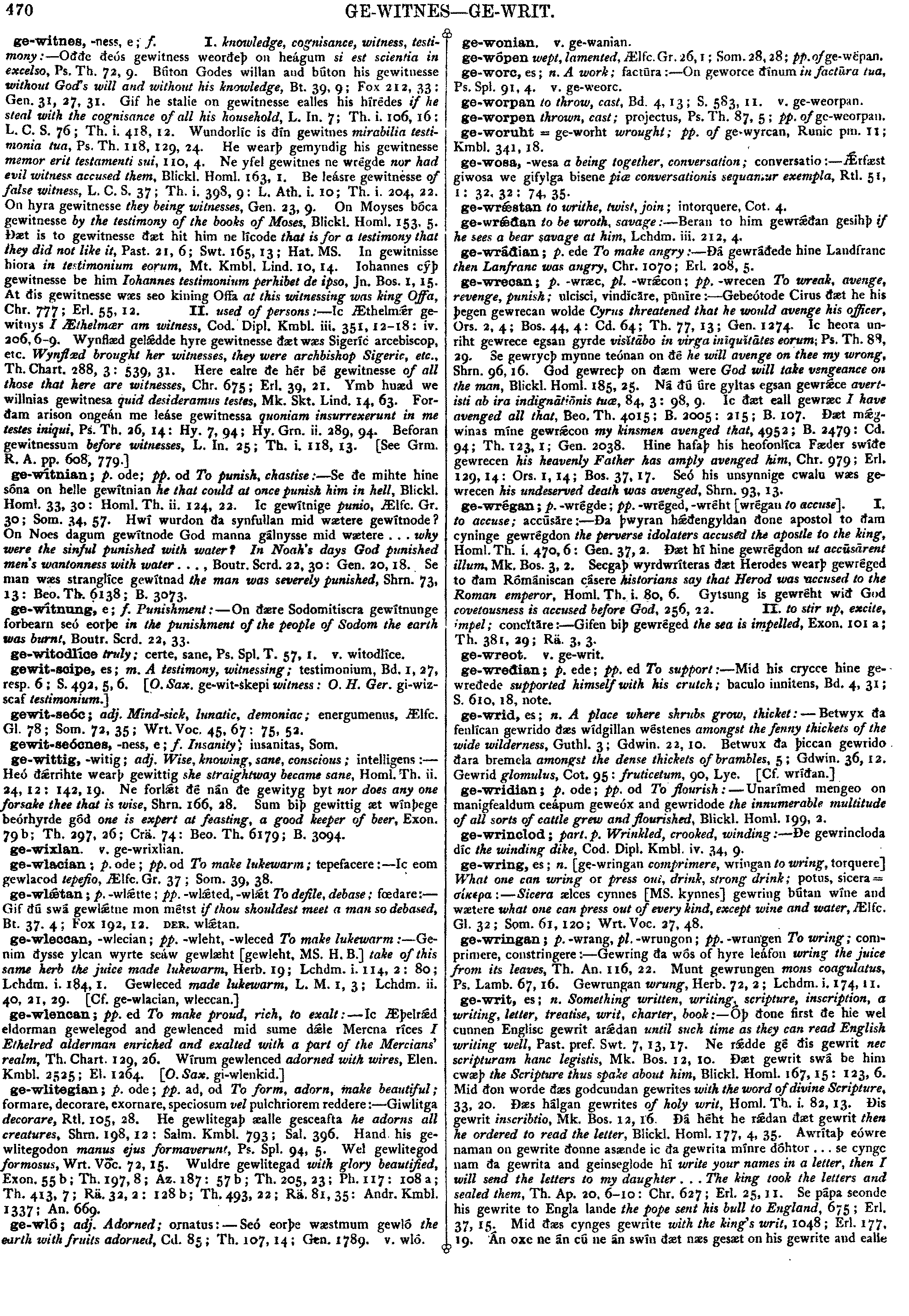
ge-writ,
es;
n.
Something
written,
writing,
scripture,
inscription,
a
writing,
letter,
treatise,
writ,
charter,
book
:--
Óþ
ðone
first
ðe
hie
wel
cunnen
Englisc
gewrit
ardan
until
such
time
as
they
can
read
English
writing
well,
Past.
pref.
Swt.
7,
13,
17.
Ne
rdde
gé
ðis
gewrit
nec
scripturam
hanc
legistis,
Mk.
Bos.
12,
10.
Ðæt
gewrit
swá
be
him
cwæþ
the
Scripture
thus
spake
about
him,
Blickl.
Homl.
167,
15:
123,
6.
Mid
ðon
worde
ðæs
godcundan
gewrites
with
the
word
of
divine
Scripture,
33,
20.
Ðæs
hálgan
gewrites
of
holy
writ,
Homl.
Th.
i.
82,
13.
Ðis
gewrit
inscribtio,
Mk.
Bos.
12,
16.
Ðá
héht
he
rdan
ðæt
gewrit
then
he
ordered
to
read
the
letter,
Blickl.
Homl.
177,
4,
35.
Awrítaþ
eówre
naman
on
gewrite
ðonne
asænde
ic
ða
gewrita
mínre
dóhtor
...
se
cyngc
nam
ða
gewrita
and
geinseglode
hí
write
your
names
in
a
letter,
then
I
will
send
the
letters
to
my
daughter
...
The
king
took
the
letters
and
sealed
them,
Th.
Ap.
20,
6-10:
Chr.
627;
Erl.
25,
11.
Se
pápa
seonde
his
gewrite
to
Engla
lande
the
pope
sent
his
bull
to
England,
615;
Erl.
37,
15.
Mid
ðæs
cynges
gewrite
with
the
king's
writ,
1048;
Erl.
177.
19.
Án
oxe
ne
án
cú
ne
án
swín
ðæt
næs
gesæt
on
his
gewrite
and
ealle
ða
gewrita
wron
gebroht
to
him
syððan
there
was
not
an
ox
nor
a
cow
nor
a
swine
that
was
not
put
in
his
book
[Doomsday
Book],
and
all
the
writings
were
brought
to
him
afterwards,
1085;
Erl.
218,
37:
Homl.
Th.
i.
30,
2.
Ðis
gewrit
this
treatise,
Swt.
A.
S.
Rdr.
56,
1.
Ðeáh
ðe
gewrita
oft
nemnan
ealle
ða
land
Media
though
books
often
call
all
those
lands
Media,
Ors.
1,
1;
Bos.
16,
30.
Ðæs
gewritu
secgaþ
as
books
say,
Exon.
60
a;
Th.
220,
1;
Ph.
313:
Chr.
973;
Erl.
124,
22;
Edg.
14:
109
b;
Th.
420,
9;
Rä.
40,
1.
Swá
wítgan
us
on
gewritum
cýðaþ
as
sages
tell
us
in
books,
56
a;
Th.
199,
24;
Ph.
30:
Elen.
Kmbl.
1651;
El.
827.
We
rdaþ
on
hálgum
gewritum
we
read
in
holy
writings,
Homl.Th.
ii.
356,
19.
On
gewritum
in
scripturis,
Ps.
Th.
86,
5.
Us
gewritu
secgaþ
the
Scriptures
tell
us,
Cd.
55;
Th.
68,
23;
Gen.
1121:
79;
Th.
98,
15;
Gen.
1630:
119;
Th.
154,
30;
Gen.
2563:
Elen.
Kmbl.
1345;
El.
674.
Ða
hálgan
gewreotu
the
holy
Scriptures,
Blickl.
Homl.
15,
8:
17,
21.
On
gewritu
settan
to
record
in
books,
Elen.
Kmbl.
1305,
1313;
El.
654,
658.
Tuegen
hleáperas
Ælfréd
cyning
sende
mid
gewritum
king
Alfred
sent
two
couriers
with
letters,
Chr.
889;
Erl.
86,
24.
Úre
bisceopas
to
me
gewreoto
sende
our
bishops
sent
me
letters,
Blickl.
Homl.
187,
4.
Ic
hæfde
r
on
óðre
wísan
awriten
ymbe
mín
yrfe
and
hæfde
monegum
mannum
ða
gewritu
óðfæst
I
had
previously
written
in
another
way
about
my
inheritance
and
had
entrusted
the
writings
to
many
men,
Chart.
Th.
490,
29:
541,
22.
DER.
rend-,
erfe-,
firn-,
hand-,
mæg-,
ofer-,
riht-,
yrfe-gewrit.
|
Source: Bosworth/Toller, page b0471, entry 1 View original page image as: [TIFF] [PNG] [View previous entry] [View next entry] |
[Comment on this entry] [View comments] |
The following entry has been hand-corrected once. |
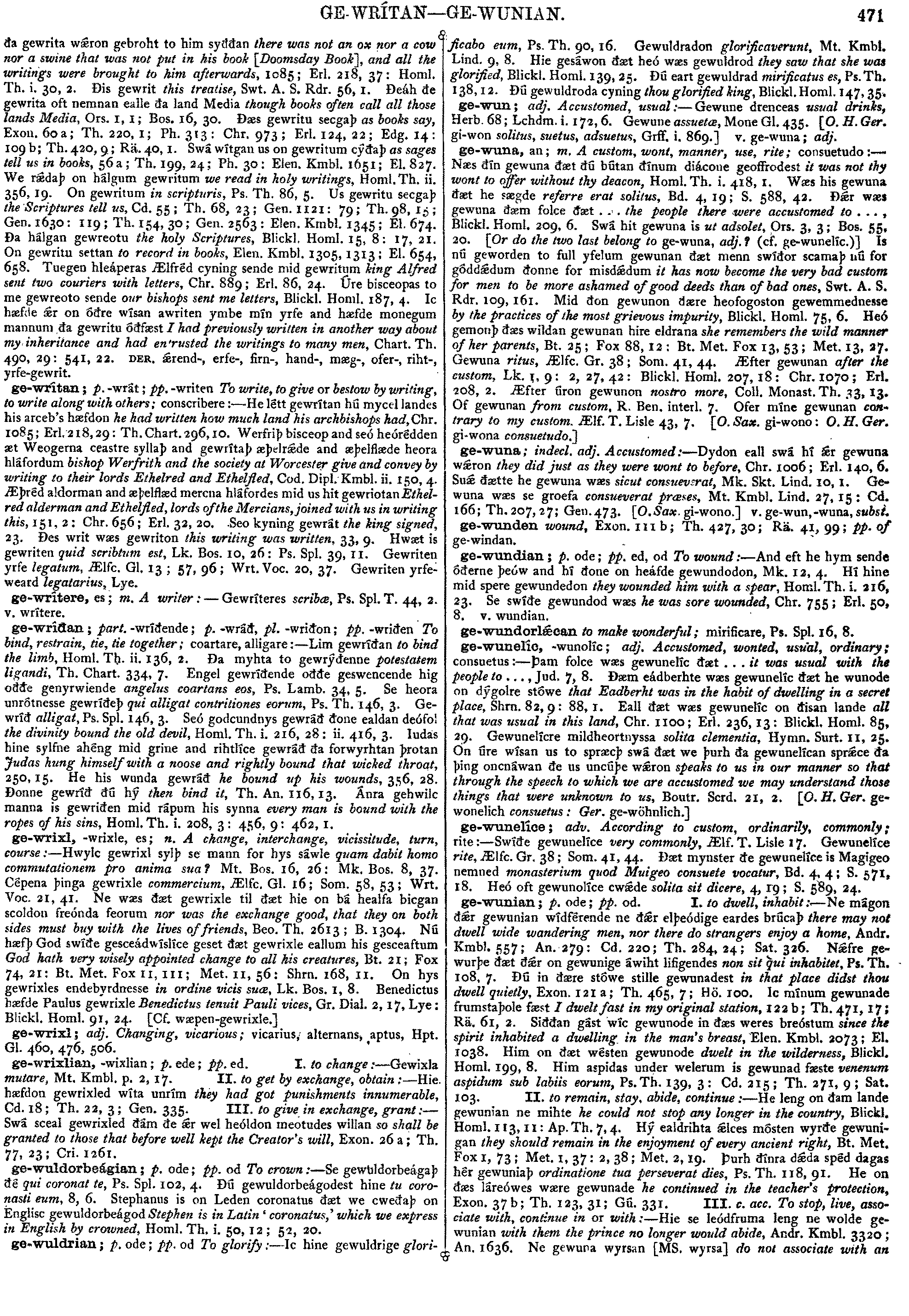
ge-wrítan;
p.
-wrát;
pp.
-writen
To
write,
to
give
or
bestow
by
writing,
to
write
along
with
others;
conscribere
:--
He
létt
gewrítan
hú
mycel
landes
his
arceb's
hæfdon
he
had
written
how
much
land
his
archbishops
had,
Chr.
1085;
Erl.
218,
29:
Th.
Chart.
296,
10.
Werfriþ
bisceop
and
seó
heórédden
æt
Weogerna
ceastre
syllaþ
and
gewrítaþ
æþelrde
and
æþelflæde
heora
hláfordum
bishop
Werfrith
and
the
society
at
Worcester
give
and
convey
by
writing
to
their
lords
Ethelred
and
Ethelfled,
Cod.
Dipl.
Kmbl.
ii.
150,
4.
Æþréd
aldorman
and
æþelflæd
mercna
hláfordes
mid
us
hit
gewriotan
Ethelred
alderman
and
Ethelfled,
lords
ofthe
Mercians,
joined
with
us
in
writing
this,
151,
2:
Chr.
656;
Erl.
32,
20.
Seo
kyning
gewrát
the
king
signed,
23.
Ðes
writ
wæs
gewriton
this
writing
was
written,
33,
9.
Hwæt
is
gewriten
quid
scribtum
est,
Lk.
Bos.
10,
26:
Ps.
Spl.
39,
11.
Gewriten
yrfe
legatum,
Ælfc.
Gl.
13;
57,
96;
Wrt.
Voc.
20,
37.
Gewriten
yrfeweard
legatarius,
Lye.
|
Source: Bosworth/Toller, page b0490, entry 19 View original page image as: [TIFF] [PNG] [View previous entry] [View next entry] |
[Comment on this entry] [View comments] |
The following entry has been hand-corrected once. |
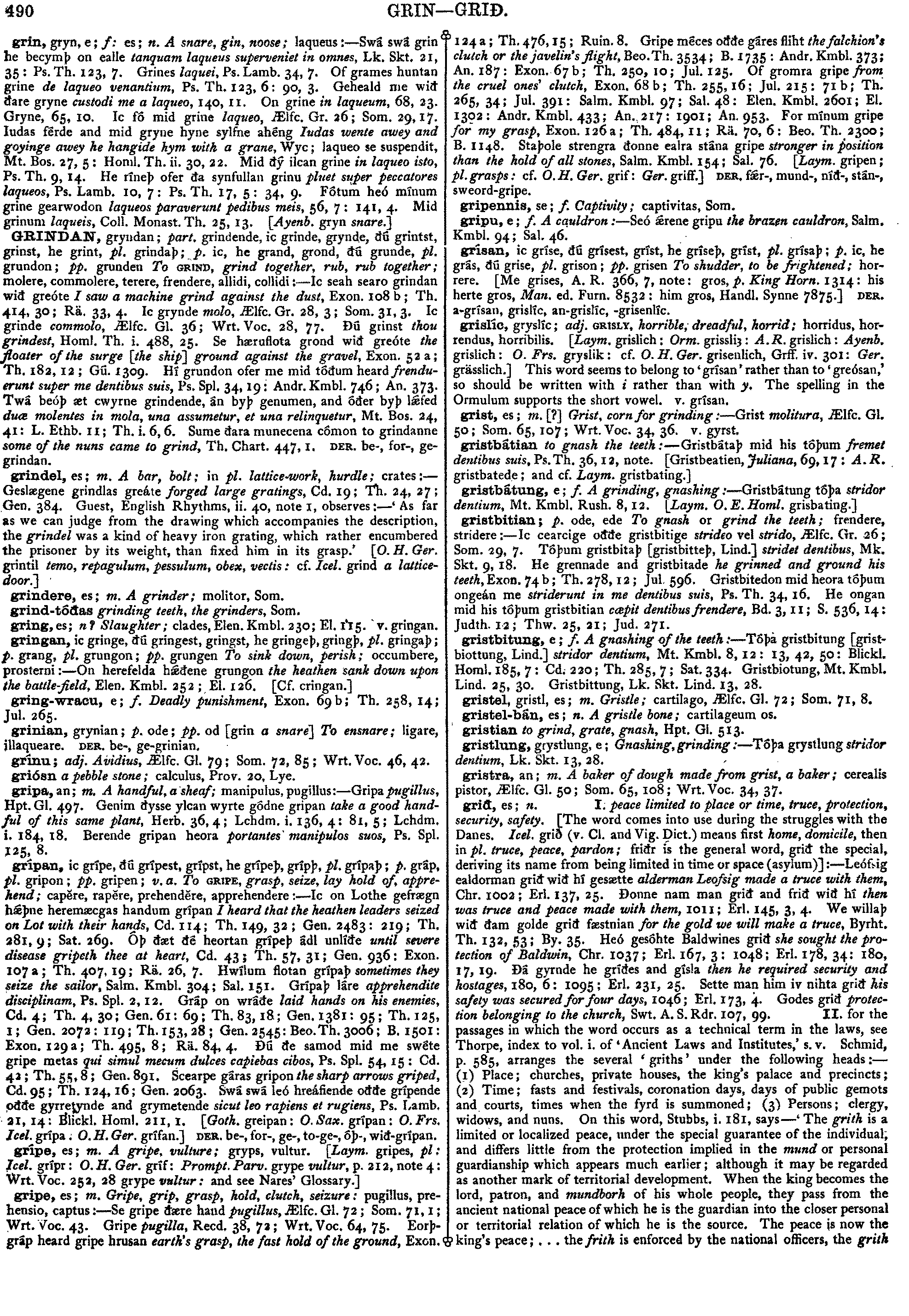
grislíc,
gryslíc;
adj.
GRISLY,
horrible;
dreadful,
horrid;
horridus,
horrendus,
horribilis.
[Laym.
grislich:
Orm.
grissli:
A.
R.
grislich:
Ayenb.
grislich:
O.
Frs.
gryslik:
cf.
O.
H.
Ger.
grisenlich,
Grff.
iv.
301:
Ger.
grässlich.]
This
word
seems
to
belong
to
'grísan'
rather
than
to
'greósan,'
so
should
be
written
with
i
rather
than
with
y.
The
spelling
in
the
Ormulum
supports
the
short
vowel.
v.
grísan.
| Result Page: |  |
Previous | 1 2 3 4 5 6 7 8 9 10 11 12 | Next |  |
Germanic Lexicon Project (main page)
This search system was written by
Sean Crist
Please consider
volunteering
to correct the data in these online dictionaries.
No rights reserved. Feel free to use these data in any way you please.