|
|

|
Source: Cleasby/Vigfusson, page b0113, entry 31 View original page image as: [TIFF] [PNG] [View previous entry] [View next entry] |
[Comment on this entry] [View comments] |
The following entry has been hand-corrected once. |
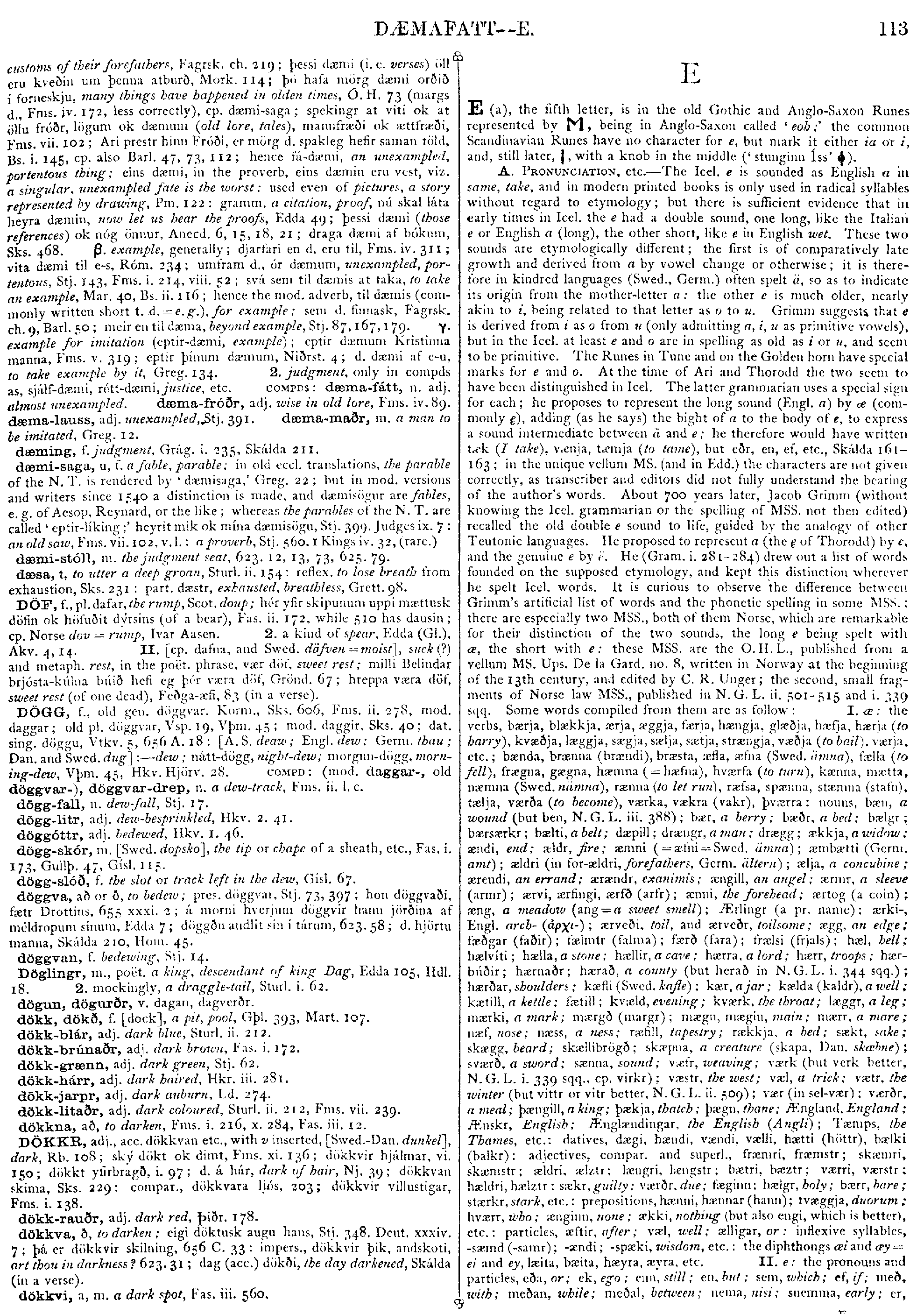
A.
PRONUNCIATION,
etc.
--
The
Icel.
e
is
sounded
as
English
a
in
same,
take,
and
in
modern
printed
books
is
only
used
in
radical
syllables
without
regard
to
etymology;
but
there
is
sufficient
evidence
that
in
early
times
in
Icel.
the
e
had
a
double
sound,
one
long,
like
the
Italian
e
or
English
a
(long),
the
other
short,
like
e
in
English
wet.
These
two
sounds
are
etymologically
different;
the
first
is
of
comparatively
late
growth
and
derived
from
a
by
vowel
change
or
otherwise;
it
is
therefore
in
kindred
languages
(Swed.,
Germ.)
often
spelt
ä,
so
as
to
indicate
its
origin
from
the
mother-letter
a:
the
other
e
is
much
older,
nearly
akin
to
i,
being
related
to
that
letter
as
o
to
u.
Grimm
suggests
that
e
is
derived
from
i
as
o
from
u
(only
admitting
a,
i,
u
as
primitive
vowels),
but
in
the
Icel.
at
least
e
and
o
are
in
spelling
as
old
as
i
or
u,
and
seem
to
be
primitive.
The
Runes
in
Tune
and
on
the
Golden
horn
have
special
marks
for
e
and
o.
At
the
time
of
Ari
and
Thorodd
the
two
seem
to
have
been
distinguished
in
Icel.
The
latter
grammarian
uses
a
special
sign
for
each;
he
proposes
to
represent
the
long
sound
(Engl.
a)
by
UNCERTAIN
(commonly
 ),
adding
(as
he
says)
the
bight
of
a
to
the
body
of
e,
to
express
a
sound
intermediate
between
ä
and
e;
he
therefore
would
have
written
UNCERTAIN
(I
take),
UNCERTAIN,
UNCERTAIN
(to
tame),
but
eðr,
en,
ef,
etc.,
Skálda
161-163;
in
the
unique
vellum
MS.
(and
in
Edd.)
the
characters
are
not
given
correctly,
as
transcriber
and
editors
did
not
fully
understand
the
bearing
of
the
author's
words.
About
700
years
later,
Jacob
Grimm
(without
knowing
the
Icel.
grammarian
or
the
spelling
of
MSS.
not
then
edited)
recalled
the
old
double
e
sound
to
life,
guided
by
the
analogy
of
other
Teutonic
languages.
He
proposed
to
represent
a
(the
of
Thorodd)
by
e,
and
the
genuine
e
by
ë.
He
(Gram.
i.
281-284)
drew
out
a
list
of
words
founded
on
the
supposed
etymology,
and
kept
this
distinction
wherever
he
spelt
Icel.
words.
It
is
curious
to
observe
the
difference
between
Grimm's
artificial
list
of
words
and
the
phonetic
spelling
in
some
MSS.;
there
are
especially
two
MSS.,
both
of
them
Norse,
which
are
remarkable
for
their
distinction
of
the
two
sounds,
the
long
e
being
spelt
with
æ,
the
short
with
e:
these
MSS.
are
the
O.
H.
L.,
published
from
a
vellum
MS.
Ups.
De
la
Gard.
no.
8,
written
in
Norway
at
the
beginning
of
the
13th
century,
and
edited
by
C.
R.
Unger;
the
second,
small
fragments
of
Norse
law
MSS.,
published
in
N.
G.
L.
ii.
501-515
and
i.
339
sqq.
Some
words
compiled
from
them
are
as
follow:
I.
æ:
the
verbs,
bærja,
blækkja,
ærja,
æggja,
færja,
hængja,
glæðja,
hæfja,
hærja
(to
harry),
kvæðja,
læggja,
sægja,
sælja,
sætja,
strængja,
væðja
(to
bail),
værja,
etc.;
bænda,
brænna
(brændi),
bræsta,
æfla,
æfna
(Swed.
ämna),
fælla
(to
fell),
frægna,
gægna,
hæmna
(
=
hæfna),
hværfa
(to
turn),
kænna,
mætta,
næmna
(Swed.
nämna),
rænna
(to
let
run),
ræfsa,
spænna,
stæmna
(stafn),
tælja,
værða
(to
become),
værka,
vækra
(vakr),
þværra:
nouns,
bæn,
a
wound
(but
ben,
N.
G.
L.
iii.
388);
bær,
a
berry;
bæðr,
a
bed;
bælgr;
bærsærkr;
bælti,
a
belt;
dæpill;
drængr,
a
man;
drægg;
ækkja,
a
widow;
ændi,
end;
ældr,
fire;
æmni
(
=
æfni
=
Swed.
ämna);
æmbætti
(Germ.
amt);
ældri
(in
for-ældri,
forefathers,
Germ.
ältern);
ælja,
a
concubine;
ærendi,
an
errand;
ærændr,
exanimis;
ængill,
an
angel;
ærmr,
a
sleeve
(armr);
ærvi,
ærfingi,
ærfð
(arfr);
ænni,
the
forehead;
ærtog
(a
coin);
æng,
a
meadow
(ang
=
a
sweet
smell);
Ærlingr
(a
pr.
name);
ærki-,
Engl.
arch-
(GREEK);
ærveði,
toil,
and
ærveðr,
toilsome;
ægg,
an
edge;
fæðgar
(faðir);
fælmtr
(falma);
færð
(fara);
frælsi
(frjals);
hæl,
hell;
hælviti;
hælla,
a
stone;
hællir,
a
cave;
hærra,
a
lord;
hærr,
troops;
hærbúðir;
hærnaðr;
hærað,
a
county
(but
herað
in
N.
G.
L.
i.
344
sqq.);
hærðar,
shoulders;
kæfli
(Swed.
kafle);
kær,
a
jar;
kælda
(kaldr),
a
well;
kætill,
a
kettle;
fætill;
kvæld,
evening;
kværk,
the
throat;
læggr,
a
leg;
mærki,
a
mark;
mærgð
(margr);
mægn,
mægin,
main;
mærr,
a
mare;
næf,
nose;
næss,
a
ness;
ræfill,
tapestry;
rækkja,
a
bed;
sækt,
sake;
skægg,
beard;
skællibrögð;
skæpna,
a
creature
(skapa,
Dan.
skæbne);
sværð,
a
sword;
sænna,
sound;
væfr,
weaving;
værk
(but
verk
better,
N.
G.
L.
i.
339
sqq.,
cp.
virkr):
væstr,
the
west;
væl,
a
trick;
vætr,
the
winter
(but
vittr
or
vitr
better,
N.
G.
L.
ii.
509);
vær
(in
sel-vær);
værðr,
a
meal;
þængill,
a
king;
þækja,
thatch;
þægn,
thane;
Ængland,
England;
Ænskr,
English;
Ænglændingar,
the
English
(Angli);
Tæmps,
the
Thames,
etc.:
datives,
dægi,
hændi,
vændi,
vælli,
hætti
(höttr),
bælki
(balkr):
adjectives,
compar.
and
superl.,
fræmri,
fræmstr;
skæmri,
skæmstr;
ældri,
ælztr;
længri,
længstr;
bætri,
bæztr;
værri,
værstr;
hældri,
hælztr:
sækr,
guilty;
værðr,
due;
fæginn;
hælgr,
holy;
bærr,
bare;
stærkr,
stark,
etc.:
prepositions,
hænni,
hænnar
(hann);
tvæggja,
duorum;
hværr,
who;
ænginn,
none;
ækki,
nothing
(but
also
engi,
which
is
better),
etc.:
particles,
æftir,
after;
væl,
well;
ælligar,
or:
inflexive
syllables,
-sæmd
(-sanir);
-ændi;
-spæki,
wisdom,
etc.:
the
diphthongs
æi
and
æy
=
ei
and
ey,
læita,
bæita,
hæyra,
æyra,
etc.
II.
e:
the
pronouns
and
particles,
eða,
or;
ek,
ego;
enn,
still;
en,
but;
sem,
which;
ef,
if;
með,
with;
meðan,
while;
meðal,
between;
nema,
nisi;
snemma,
early;
er,
),
adding
(as
he
says)
the
bight
of
a
to
the
body
of
e,
to
express
a
sound
intermediate
between
ä
and
e;
he
therefore
would
have
written
UNCERTAIN
(I
take),
UNCERTAIN,
UNCERTAIN
(to
tame),
but
eðr,
en,
ef,
etc.,
Skálda
161-163;
in
the
unique
vellum
MS.
(and
in
Edd.)
the
characters
are
not
given
correctly,
as
transcriber
and
editors
did
not
fully
understand
the
bearing
of
the
author's
words.
About
700
years
later,
Jacob
Grimm
(without
knowing
the
Icel.
grammarian
or
the
spelling
of
MSS.
not
then
edited)
recalled
the
old
double
e
sound
to
life,
guided
by
the
analogy
of
other
Teutonic
languages.
He
proposed
to
represent
a
(the
of
Thorodd)
by
e,
and
the
genuine
e
by
ë.
He
(Gram.
i.
281-284)
drew
out
a
list
of
words
founded
on
the
supposed
etymology,
and
kept
this
distinction
wherever
he
spelt
Icel.
words.
It
is
curious
to
observe
the
difference
between
Grimm's
artificial
list
of
words
and
the
phonetic
spelling
in
some
MSS.;
there
are
especially
two
MSS.,
both
of
them
Norse,
which
are
remarkable
for
their
distinction
of
the
two
sounds,
the
long
e
being
spelt
with
æ,
the
short
with
e:
these
MSS.
are
the
O.
H.
L.,
published
from
a
vellum
MS.
Ups.
De
la
Gard.
no.
8,
written
in
Norway
at
the
beginning
of
the
13th
century,
and
edited
by
C.
R.
Unger;
the
second,
small
fragments
of
Norse
law
MSS.,
published
in
N.
G.
L.
ii.
501-515
and
i.
339
sqq.
Some
words
compiled
from
them
are
as
follow:
I.
æ:
the
verbs,
bærja,
blækkja,
ærja,
æggja,
færja,
hængja,
glæðja,
hæfja,
hærja
(to
harry),
kvæðja,
læggja,
sægja,
sælja,
sætja,
strængja,
væðja
(to
bail),
værja,
etc.;
bænda,
brænna
(brændi),
bræsta,
æfla,
æfna
(Swed.
ämna),
fælla
(to
fell),
frægna,
gægna,
hæmna
(
=
hæfna),
hværfa
(to
turn),
kænna,
mætta,
næmna
(Swed.
nämna),
rænna
(to
let
run),
ræfsa,
spænna,
stæmna
(stafn),
tælja,
værða
(to
become),
værka,
vækra
(vakr),
þværra:
nouns,
bæn,
a
wound
(but
ben,
N.
G.
L.
iii.
388);
bær,
a
berry;
bæðr,
a
bed;
bælgr;
bærsærkr;
bælti,
a
belt;
dæpill;
drængr,
a
man;
drægg;
ækkja,
a
widow;
ændi,
end;
ældr,
fire;
æmni
(
=
æfni
=
Swed.
ämna);
æmbætti
(Germ.
amt);
ældri
(in
for-ældri,
forefathers,
Germ.
ältern);
ælja,
a
concubine;
ærendi,
an
errand;
ærændr,
exanimis;
ængill,
an
angel;
ærmr,
a
sleeve
(armr);
ærvi,
ærfingi,
ærfð
(arfr);
ænni,
the
forehead;
ærtog
(a
coin);
æng,
a
meadow
(ang
=
a
sweet
smell);
Ærlingr
(a
pr.
name);
ærki-,
Engl.
arch-
(GREEK);
ærveði,
toil,
and
ærveðr,
toilsome;
ægg,
an
edge;
fæðgar
(faðir);
fælmtr
(falma);
færð
(fara);
frælsi
(frjals);
hæl,
hell;
hælviti;
hælla,
a
stone;
hællir,
a
cave;
hærra,
a
lord;
hærr,
troops;
hærbúðir;
hærnaðr;
hærað,
a
county
(but
herað
in
N.
G.
L.
i.
344
sqq.);
hærðar,
shoulders;
kæfli
(Swed.
kafle);
kær,
a
jar;
kælda
(kaldr),
a
well;
kætill,
a
kettle;
fætill;
kvæld,
evening;
kværk,
the
throat;
læggr,
a
leg;
mærki,
a
mark;
mærgð
(margr);
mægn,
mægin,
main;
mærr,
a
mare;
næf,
nose;
næss,
a
ness;
ræfill,
tapestry;
rækkja,
a
bed;
sækt,
sake;
skægg,
beard;
skællibrögð;
skæpna,
a
creature
(skapa,
Dan.
skæbne);
sværð,
a
sword;
sænna,
sound;
væfr,
weaving;
værk
(but
verk
better,
N.
G.
L.
i.
339
sqq.,
cp.
virkr):
væstr,
the
west;
væl,
a
trick;
vætr,
the
winter
(but
vittr
or
vitr
better,
N.
G.
L.
ii.
509);
vær
(in
sel-vær);
værðr,
a
meal;
þængill,
a
king;
þækja,
thatch;
þægn,
thane;
Ængland,
England;
Ænskr,
English;
Ænglændingar,
the
English
(Angli);
Tæmps,
the
Thames,
etc.:
datives,
dægi,
hændi,
vændi,
vælli,
hætti
(höttr),
bælki
(balkr):
adjectives,
compar.
and
superl.,
fræmri,
fræmstr;
skæmri,
skæmstr;
ældri,
ælztr;
længri,
længstr;
bætri,
bæztr;
værri,
værstr;
hældri,
hælztr:
sækr,
guilty;
værðr,
due;
fæginn;
hælgr,
holy;
bærr,
bare;
stærkr,
stark,
etc.:
prepositions,
hænni,
hænnar
(hann);
tvæggja,
duorum;
hværr,
who;
ænginn,
none;
ækki,
nothing
(but
also
engi,
which
is
better),
etc.:
particles,
æftir,
after;
væl,
well;
ælligar,
or:
inflexive
syllables,
-sæmd
(-sanir);
-ændi;
-spæki,
wisdom,
etc.:
the
diphthongs
æi
and
æy
=
ei
and
ey,
læita,
bæita,
hæyra,
æyra,
etc.
II.
e:
the
pronouns
and
particles,
eða,
or;
ek,
ego;
enn,
still;
en,
but;
sem,
which;
ef,
if;
með,
with;
meðan,
while;
meðal,
between;
nema,
nisi;
snemma,
early;
er,
|
Source: Cleasby/Vigfusson, page b0159, entry 55 View original page image as: [TIFF] [PNG] [View previous entry] [View next entry] |
[Comment on this entry] [View comments] |
The following entry has been hand-corrected once. |
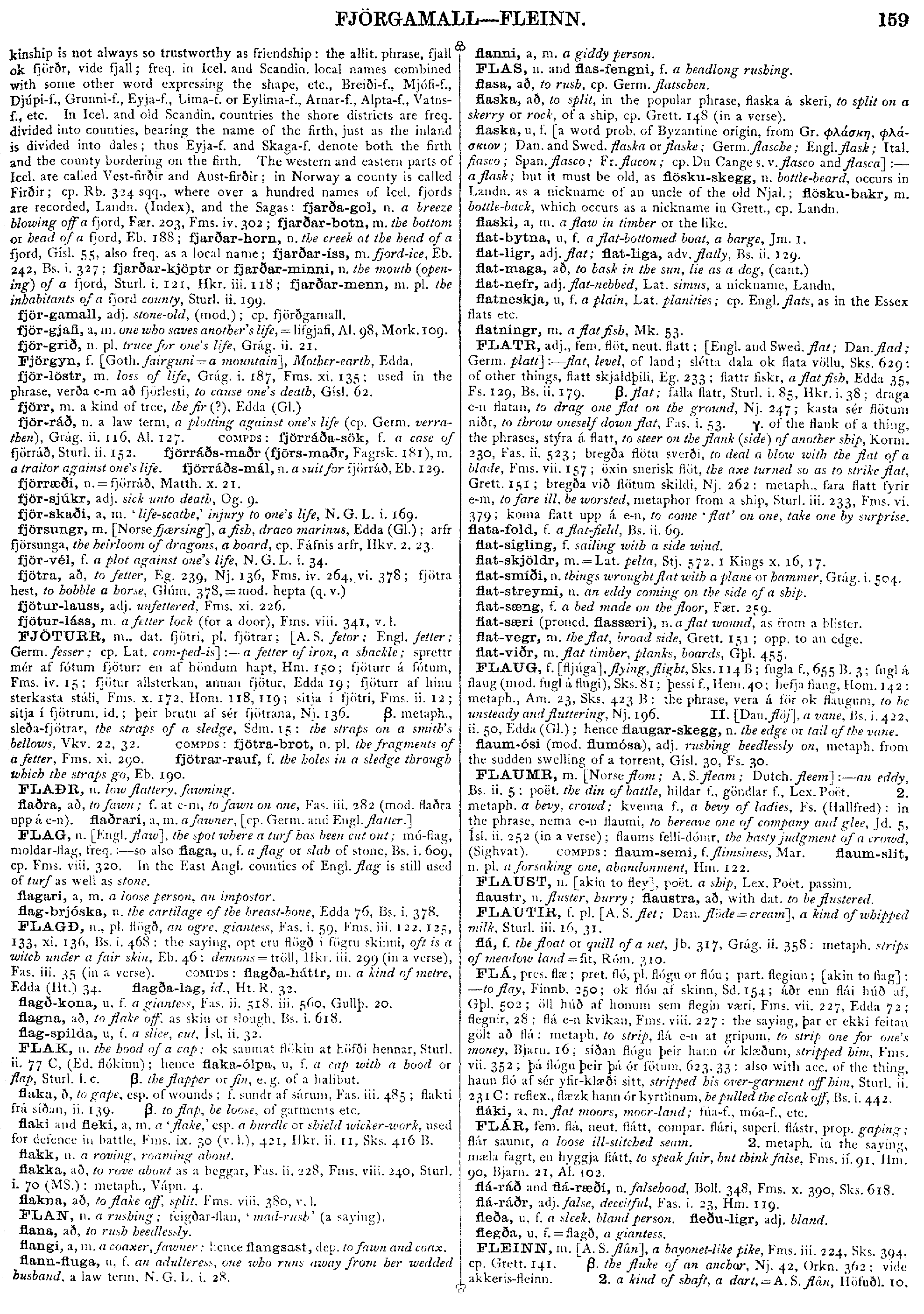
flat-særi (proncd. flassæri), n. a flat wound, as from a blister.
|
Source: Cleasby/Vigfusson, page b0173, entry 21 View original page image as: [TIFF] [PNG] [View previous entry] [View next entry] |
[Comment on this entry] [View comments] |
The following entry has been hand-corrected once. |
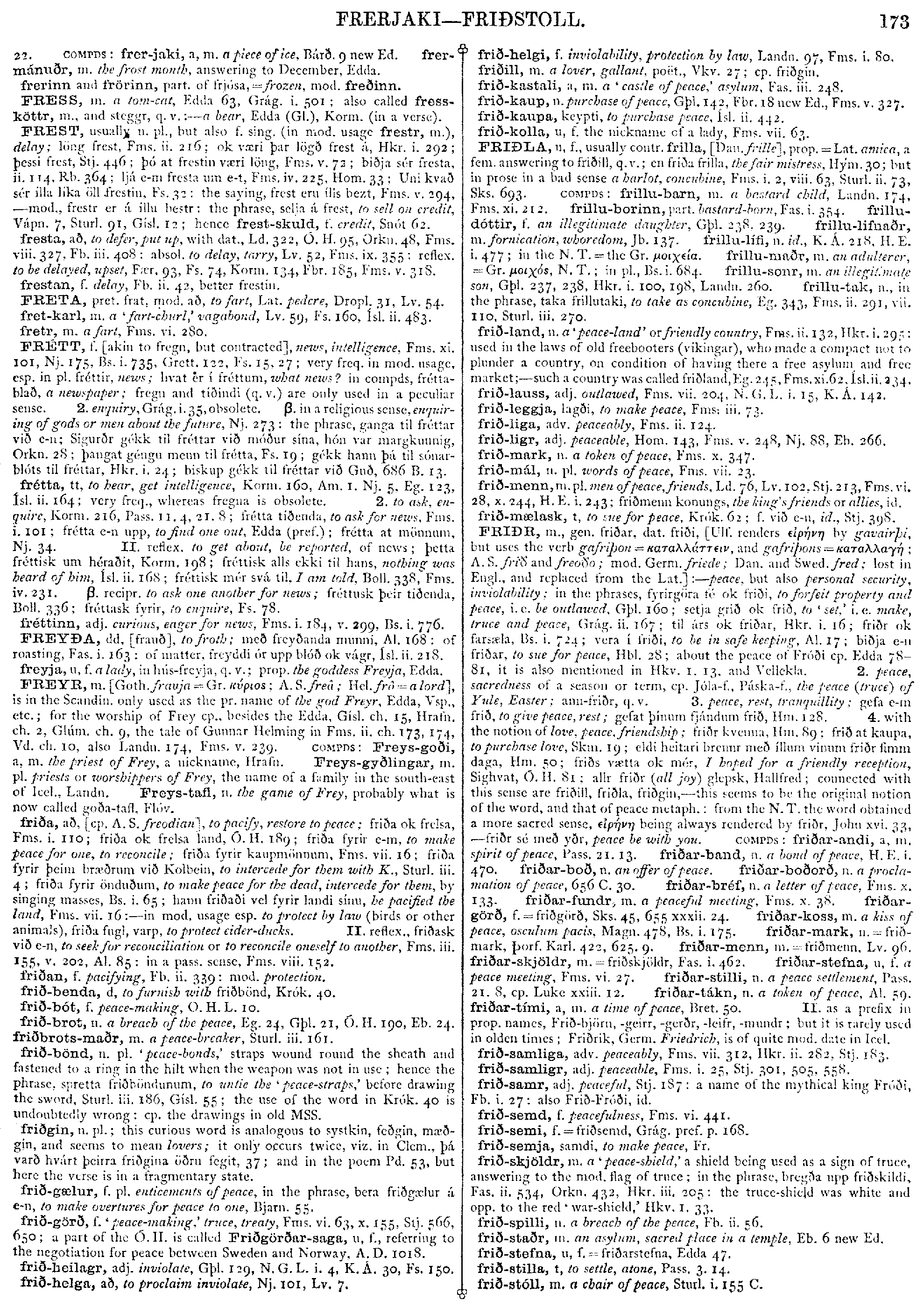
frið-bönd, n. pl. 'peace-bonds,' straps wound round the sheath and fastened to a ring in the hilt when the weapon was not in use; hence the phrase, spretta friðböndunum, to untie the 'peace-straps,' before drawing the sword, Sturl. iii. 186, Gísl. 55; the use of the word in Krók. 40 is undoubtedly wrong: cp. the drawings in old MSS.
|
Source: Cleasby/Vigfusson, page b0180, entry 6 View original page image as: [TIFF] [PNG] [View previous entry] [View next entry] |
[Comment on this entry] [View comments] |
The following entry has been hand-corrected once. |
lengi
f.
ok
kvað
eigi
nei
við,
he
was
cross
and
said
not
downright
no,
Þorf.
Karl.
388.
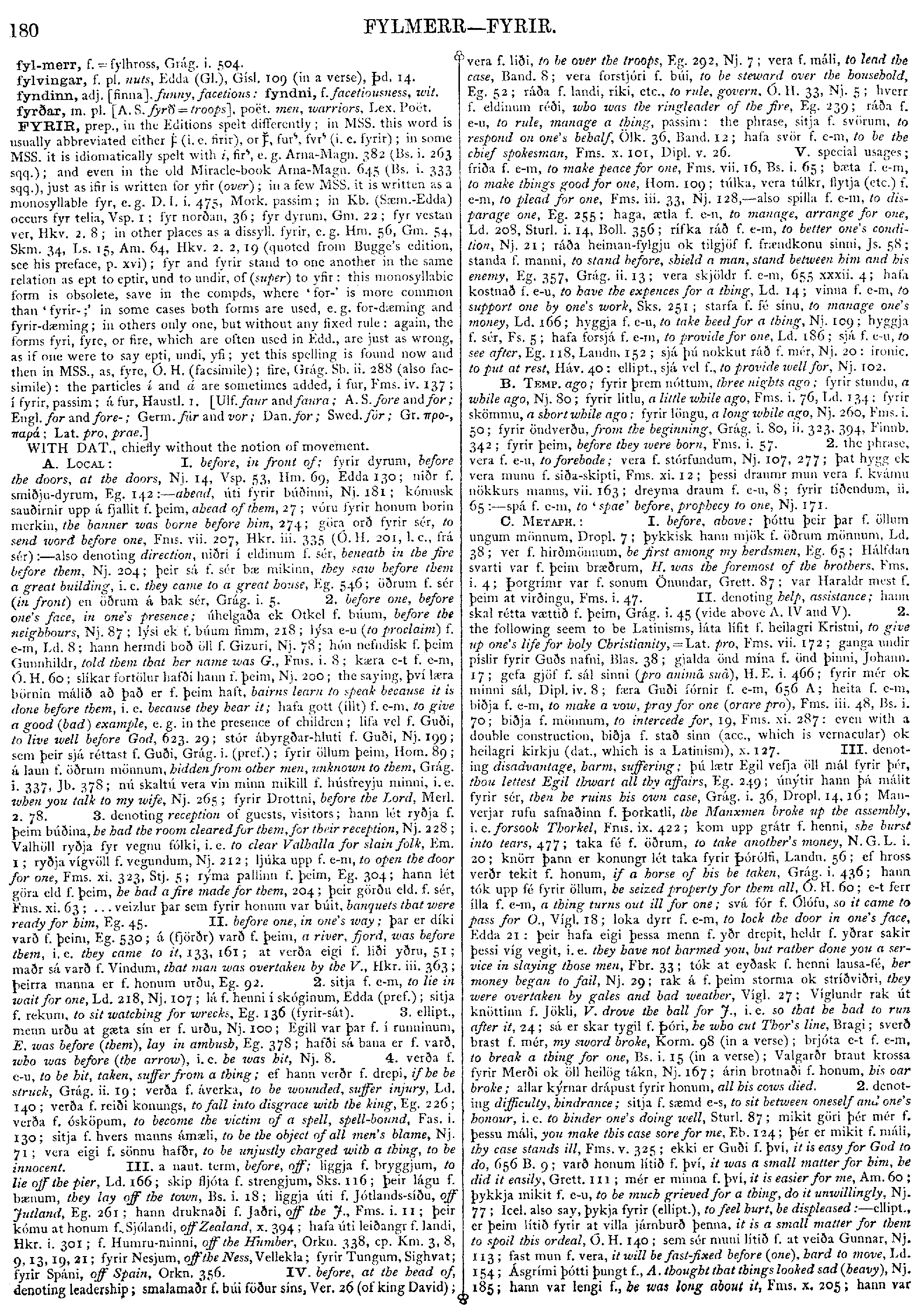
IV.
in
a
causal
sense,
for,
because
of,
Lat.
per,
pro;
sofa
ek
né
mákat
fugls
jarmi
fyrir,
I
cannot
sleep
for
the
shrill
cry
of
birds,
Edda
16
(in
a
verse);
hon
undi
sér
hvergi
f.
verkjum,
she
had
no
rest
for
pains,
Bjarn.
69;
fyrir
gráti,
tárum,
=
Lat.
prae
lacrymis;
fyrir
harmi,
for
sorrow;
f.
hlátri,
for
laughter,
as
in
Engl.;
þeir
æddust
f.
einni
konu,
they
went
mad
for
the
sake
of
one
woman,
Sól.
11;
ílla
fært
f.
ísum,
scarce
passable
for
ice,
Fms.
xi.
360;
hætt
var
at
sitja
útar
f.
Miðgarðs-ormi,
Edda
35;
hann
var
lítt
gengr
f.
sárinu,
he
could
hardly
walk
for
the
wound,
Fbr.
178;
fyrir
hræðslu,
for
fear,
Hbl.
26;
heptisk
vegrinn
f.
þeim
meinvættum
sem
...,
Fs.
4;
gáðu
þeir
eigi
f.
veiðum
at
fá
heyjanna,
because
of
fishing
they
took
no
care
to
make
hay,
Landn.
30;
fyrir
riki
konungs,
for
the
king's
power,
Eg.
67,
117;
fyrir
ofríki
manna,
Grág.
i.
68;
fyrir
hví,
for
why?
Eluc.
4;
fyrir
hví
þeir
væri
þar,
Eg.
375;
fyrir
því,
at
...,
for
that,
because,
Edda
35,
Fms.
i.
22,
vii.
330,
Ld.
104;
en
fyrir
því
nú
at,
now
since,
Skálda
171;
nú
fyrir
því
at,
id.,
169:
the
phrase,
fyrir
sökum,
for
the
sake
of,
because
of,
passim;
vide
sök.
V.
by,
by
the
force
of;
öxlin
gékk
ór
liði
fyrir
högginu,
the
shoulder
was
disjointed
by
the
force
of
the
stroke,
Háv.
52.
2.
denoting
contest;
falla
f.
e-m,
to
fall
before
one,
i.e.
fighting
against
one,
Fms.
i.
7,
iv.
9,
x.
196;
verða
halloki
f.
e-m,
to
be
overcome
in
fighting
one,
Ld.
146;
látask
f.
e-m,
to
perish
by
one,
Eb.
34;
hafa
bana
f.
e-m,
to
be
slain
by
one,
Nj.
43;
þeir
kváðu
fá
fúnað
hafa
f.
honum,
263;
mæddisk
hann
f.
þeim,
he
lost
his
breath
in
fighting
them,
Eg.
192;
láta
ríki
f.
e-m,
to
lose
the
kingdom
before
another,
i.e.
so
that
the
latter
gains
it,
264;
láta
lausar
eignir
mínar
f.
þér,
505;
láta
hlut
sinn
f.
e-m,
Fs.
47;
standask
f.
e-m,
to
stand
one's
ground
before
one,
Edda
(pref.);
hugðisk
hann
falla
mundu
f.
sjóninni
einni
saman,
that
he
would
sink
before
his
glance,
28,
Hým.
12;
halda
hlut
f.
e-m,
Ld.
54;
halda
frið
ok
frelsi
f.
várum
óvinum,
Fms.
viii.
219;
fara
mun
ek
sem
ek
hefi
áðr
ætlað
f.
þínum
draum
(thy
dream
notwithstanding),
Ld.
216;
þér
farit
hvárt
er
þér
vilit
f.
mér,
you
go
wherever
you
like
for
me,
so
far
as
I
am
concerted,
Fær.
37;
halda
vöku
f.
sér,
to
keep
oneself
awake,
Fms.
i.
216.
 .
with
verbs,
flýja,
hlaupa,
renna,
stökkva
f.
e-m,
to
fly,
leap,
run
before
one,
i.e.
to
be
pursued,
Bs.
i.
774,
Grág.
ii.
359;
at
hann
rynni
f.
þrælum
hans,
Ld.
64;
fyrir
þessum
úfriði
stökk
Þangbrandr
til
Noregs,
180;
skyldi
hann
ganga
ór
á
f.
Hofsmönnum,
Landn.
178;
ganga
f.
e-u,
to
give
way
before,
yield
to
a
thing,
Fms.
i.
305,
x.
292;
vægja
f.
e-m,
to
yield
to
one,
give
way,
Eg.
21,
187,
Nj.
57,
Ld.
234.
VI.
against;
verja
land
f.
e-m,
Eg.
32;
verja
landit
f.
Dönum
ok
öðrum
víkingum,
Fms.
i.
23;
til
landvarnar
f.
víkingum,
Eg.
260;
landvarnar-maðr
f.
Norðmönnum,
Fms.
vi.
295;
gæta
brúarinnar
f.
bergrisum,
Edda
17;
gæt
þín
vel
f.
konungi
ok
hans
mönnum,
guard
thee
well
against
the
king
and
his
men,
Eg.
113;
góð
aðstoð
f.
tröllum
ok
dvergum,
Bárð.
163;
beiða
Baldri
griða
f.
allskonar
háska,
Edda
36;
auðskæðr
f.
höggum,
Eg.
770.
VII.
in
the
sense
of
being
driven
before;
fyrir
straumi,
veðri,
vindi,
before
the
stream,
wind,
weather
(forstreymis,
forvindis),
Grág.
ii.
384,
Fms.
vii.
262;
halda
f.
veðri,
to
stand
before
the
wind,
Róm.
211.
2.
rýrt
mun
verða
f.
honum
smá-mennit,
he
will
have
an
easy
game
with
the
small
people,
Nj.
94:
ellipt.,
hafði
sá
bana
er
f.
varð,
8;
sprakk
f.,
16,
91.
VIII.
fyrir
sér,
of
oneself,
esp.
of
physical
power;
mikill
f.
sér,
strong,
powerful;
lítill
f.
sér,
weak,
feeble,
Nj.
20,
Ísl.
ii.
368,
Eg.
192;
þér
munuð
kalla
mik
lítinn
mann
f.
mér,
Edda
33;
minnstr
f.
sér,
smallest,
weakest,
Eg.
123;
gildr
maðr
f.
sér,
Ísl.
ii.
322,
Fms.
ii.
145;
herðimaðr
mikiil
f.
sér,
a
hardy
man,
Nj.
270;
hvat
ert
þú
f.
þér,
what
kind
of
fellow
art
thou?
Clem.
33;
vera
einn
f.
sér,
to
be
a
strange
fellow,
Grett.
79
new
Ed.;
Icel.
also
say,
göra
mikið
(lítið)
f.
sér,
to
make
oneself
big
(little).
.
sjóða
e-t
f.
sér,
to
hesitate,
saunter,
Nj.
154;
mæla
f.
munni,
to
talk
between
one's
teeth,
to
mutter,
Orkn.
248,
Nj.
249.
IX.
denoting
manner
or
quality;
hvítr
f.
hærum,
white
with
hoary
hairs,
Fms.
vi.
95,
Fas.
ii.
540;
gráir
fyrir
járnum,
grey
with
steel,
of
a
host
in
armour,
Mag.
5;
hjölt
hvít
f.
silfri,
a
hilt
white
with
silver
=
richly
silvered,
Eb.
226.
X.
as
adverb
or
ellipt.,
1.
ahead,
in
front,
=
á
undan,
Lat.
prae,
opp.
to
eptir;
þá
var
eigi
hins
verra
eptir
ván,
er
slíkt
fór
fyrir,
as
this
came
first,
preceded,
Nj.
34;
at
einhverr
mundi
fara
heim
fyrir,
that
some
one
would
go
home
first
(to
spy),
Eg.
580;
Egill
fór
f.,
E.
went
in
before,
id.;
at
vér
ríðim
þegar
f.
í
nótt,
283.
.
first;
hann
stefndi
f.
málinu,
en
hann
mælti
eptir,
one
pronounced
the
words
first,
but
the
other
repeated
after
him,
Nj.
35;
mun
ek
þar
eptir
göra
sem
þér
gerit
f.,
I
shall
do
to
you
according
as
you
do
first,
90
:--
temp.,
sjau
nóttum
f.,
seven
nights
before,
Grág.
ii.
217.
2.
to
the
fore,
at
hand,
present;
þar
var
fyrir
fjöldi
boðsmanna,
a
host
of
guests
was
already
to
the
fore,
i.e.
before
the
bride
and
bridegroom
came,
Nj.
11;
úvíst
er
at
vita
hvar
úvinir
sitja
á
fleti
fyrir,
Hm.
1;
skal
þá
lögmaðr
þar
f.
vera,
he
shall
be
there
present,
Js.
3;
heima
í
túni
fyrir,
Fær.
50;
þar
vóru
fyrir
Hildiríðar-synir,
Eg.
98;
var
honum
allt
kunnigt
fyrir,
he
knew
all
about
the
localities,
583;
þeim
ómögum,
sem
f.
eru,
who
are
there
already,
i.e.
in
his
charge,
Grág.
i.
286:
of
things,
föng
þau
er
f.
vóru,
stores
that
were
to
the
fore,
at
hand,
Eg.
134.
3.
fore,
opp.
to
'back,'
of
clothes;
slæður
settar
f.
allt
gullknöppum,
Eg.
516;
bak
ok
fyrir,
back
and
front,
=
bak
ok
brjóst,
Mar.
XI.
in
the
phrase,
e-m
verðr
e-t
fyrir,
a
thing
is
before
one,
i.e.
one
takes
that
and
that
step,
acts
so
and
so
in
an
emergency;
nú
verðr
öðrum
þeirra
þat
f.,
at
hann
kveðr,
now
if
the
other
part
alleges,
that
...,
Grág.
i.
362;
Kolbeini
varð
ekki
f.,
K.
had
no
resource,
i.e.
lost
his
head,
Sturl.
iii.
285
:--
the
phrase,
e-t
mælisk
vel
(ílla)
fyrir,
a
thing
is
well
(ill)
reported
of;
víg
Gunnars
spurðisk
ok
mæltisk
ílla
fyrir
um
allar
sveitir,
Nj.
117,
Sturl.
ii.
151;
mun
þat
vel
f.
mælask,
people
will
like
it
well,
Nj.
29,
Þórð.
55
new
Ed.;
ílla
mun
þat
f.
mælask
at
ganga
á
sættir
við
frændr
sína,
Ld.
238;
ok
er
lokit
var,
mæltisk
kvæðit
vel
f.,
the
people
praised
the
poem,
Fms.
vii.
113.
XII.
in
special
senses,
either
as
prep.
or
adv.
(vide
A.
V.
above);
segja
leið
f.
skipi,
to
pilot
a
ship,
Eg.
359;
segja
f.
skipi,
to
say
a
prayer
for
a
new
ship
or
for
any
ship
going
to
sea,
Bs.
i.
774,
Fms.
x.
480;
mæla
f.
e-u,
to
dictate,
Grág.
ii.
266;
mæla
f.
minni,
to
bring
out
a
toast,
vide
minni;
mæla
f.
sætt,
i.
90;
skipa,
koma
e-u
f.,
to
arrange,
put
right;
ætla
f.
e-u,
to
make
allowance
for;
trúa
e-m
f.
e-u,
to
entrust
one
with;
það
fer
mikið
f.
e-u
(impers.),
it
is
of
great
compass,
bulky;
hafa
f.
e-u,
to
have
trouble
with
a
thing;
leita
f.
sér,
to
enquire;
biðjask
f.,
to
say
one's
prayers,
vide
biðja;
mæla
fyrir,
segja
f.,
etc.,
to
order,
Nj.
103,
Js.
3:
of
a
spell
or
solemn
speaking,
hann
mælti
svá
f.,
at
...,
Landn.
34;
spyrjask
f.,
to
enquire,
Hkr.
ii.
333;
búask
f.,
to
prepare,
make
arrangement,
Landn.
35,
Sks.
551;
skipask
f.,
to
draw
up,
Nj.
197;
leggjask
f.,
to
lie
down
in
despair,
Bs.
i.
194;
spá
fyrir,
to
'spae'
before,
foretell;
þeir
menn
er
spá
f.
úorðna
hluti,
Fms.
i.
96;
segja
f.,
to
foretell,
76,
Bb.
332;
Njáll
hefir
ok
sagt
f.
um
æfi
hans,
Nj.
102;
vita
e-t
f.,
to
'wit'
beforehand,
know
the
future,
98;
sjá
e-t
f.,
to
foresee,
162;
ef
þat
er
ætlat
f.,
fore-ordained,
id.
.
with
verbs,
flýja,
hlaupa,
renna,
stökkva
f.
e-m,
to
fly,
leap,
run
before
one,
i.e.
to
be
pursued,
Bs.
i.
774,
Grág.
ii.
359;
at
hann
rynni
f.
þrælum
hans,
Ld.
64;
fyrir
þessum
úfriði
stökk
Þangbrandr
til
Noregs,
180;
skyldi
hann
ganga
ór
á
f.
Hofsmönnum,
Landn.
178;
ganga
f.
e-u,
to
give
way
before,
yield
to
a
thing,
Fms.
i.
305,
x.
292;
vægja
f.
e-m,
to
yield
to
one,
give
way,
Eg.
21,
187,
Nj.
57,
Ld.
234.
VI.
against;
verja
land
f.
e-m,
Eg.
32;
verja
landit
f.
Dönum
ok
öðrum
víkingum,
Fms.
i.
23;
til
landvarnar
f.
víkingum,
Eg.
260;
landvarnar-maðr
f.
Norðmönnum,
Fms.
vi.
295;
gæta
brúarinnar
f.
bergrisum,
Edda
17;
gæt
þín
vel
f.
konungi
ok
hans
mönnum,
guard
thee
well
against
the
king
and
his
men,
Eg.
113;
góð
aðstoð
f.
tröllum
ok
dvergum,
Bárð.
163;
beiða
Baldri
griða
f.
allskonar
háska,
Edda
36;
auðskæðr
f.
höggum,
Eg.
770.
VII.
in
the
sense
of
being
driven
before;
fyrir
straumi,
veðri,
vindi,
before
the
stream,
wind,
weather
(forstreymis,
forvindis),
Grág.
ii.
384,
Fms.
vii.
262;
halda
f.
veðri,
to
stand
before
the
wind,
Róm.
211.
2.
rýrt
mun
verða
f.
honum
smá-mennit,
he
will
have
an
easy
game
with
the
small
people,
Nj.
94:
ellipt.,
hafði
sá
bana
er
f.
varð,
8;
sprakk
f.,
16,
91.
VIII.
fyrir
sér,
of
oneself,
esp.
of
physical
power;
mikill
f.
sér,
strong,
powerful;
lítill
f.
sér,
weak,
feeble,
Nj.
20,
Ísl.
ii.
368,
Eg.
192;
þér
munuð
kalla
mik
lítinn
mann
f.
mér,
Edda
33;
minnstr
f.
sér,
smallest,
weakest,
Eg.
123;
gildr
maðr
f.
sér,
Ísl.
ii.
322,
Fms.
ii.
145;
herðimaðr
mikiil
f.
sér,
a
hardy
man,
Nj.
270;
hvat
ert
þú
f.
þér,
what
kind
of
fellow
art
thou?
Clem.
33;
vera
einn
f.
sér,
to
be
a
strange
fellow,
Grett.
79
new
Ed.;
Icel.
also
say,
göra
mikið
(lítið)
f.
sér,
to
make
oneself
big
(little).
.
sjóða
e-t
f.
sér,
to
hesitate,
saunter,
Nj.
154;
mæla
f.
munni,
to
talk
between
one's
teeth,
to
mutter,
Orkn.
248,
Nj.
249.
IX.
denoting
manner
or
quality;
hvítr
f.
hærum,
white
with
hoary
hairs,
Fms.
vi.
95,
Fas.
ii.
540;
gráir
fyrir
járnum,
grey
with
steel,
of
a
host
in
armour,
Mag.
5;
hjölt
hvít
f.
silfri,
a
hilt
white
with
silver
=
richly
silvered,
Eb.
226.
X.
as
adverb
or
ellipt.,
1.
ahead,
in
front,
=
á
undan,
Lat.
prae,
opp.
to
eptir;
þá
var
eigi
hins
verra
eptir
ván,
er
slíkt
fór
fyrir,
as
this
came
first,
preceded,
Nj.
34;
at
einhverr
mundi
fara
heim
fyrir,
that
some
one
would
go
home
first
(to
spy),
Eg.
580;
Egill
fór
f.,
E.
went
in
before,
id.;
at
vér
ríðim
þegar
f.
í
nótt,
283.
.
first;
hann
stefndi
f.
málinu,
en
hann
mælti
eptir,
one
pronounced
the
words
first,
but
the
other
repeated
after
him,
Nj.
35;
mun
ek
þar
eptir
göra
sem
þér
gerit
f.,
I
shall
do
to
you
according
as
you
do
first,
90
:--
temp.,
sjau
nóttum
f.,
seven
nights
before,
Grág.
ii.
217.
2.
to
the
fore,
at
hand,
present;
þar
var
fyrir
fjöldi
boðsmanna,
a
host
of
guests
was
already
to
the
fore,
i.e.
before
the
bride
and
bridegroom
came,
Nj.
11;
úvíst
er
at
vita
hvar
úvinir
sitja
á
fleti
fyrir,
Hm.
1;
skal
þá
lögmaðr
þar
f.
vera,
he
shall
be
there
present,
Js.
3;
heima
í
túni
fyrir,
Fær.
50;
þar
vóru
fyrir
Hildiríðar-synir,
Eg.
98;
var
honum
allt
kunnigt
fyrir,
he
knew
all
about
the
localities,
583;
þeim
ómögum,
sem
f.
eru,
who
are
there
already,
i.e.
in
his
charge,
Grág.
i.
286:
of
things,
föng
þau
er
f.
vóru,
stores
that
were
to
the
fore,
at
hand,
Eg.
134.
3.
fore,
opp.
to
'back,'
of
clothes;
slæður
settar
f.
allt
gullknöppum,
Eg.
516;
bak
ok
fyrir,
back
and
front,
=
bak
ok
brjóst,
Mar.
XI.
in
the
phrase,
e-m
verðr
e-t
fyrir,
a
thing
is
before
one,
i.e.
one
takes
that
and
that
step,
acts
so
and
so
in
an
emergency;
nú
verðr
öðrum
þeirra
þat
f.,
at
hann
kveðr,
now
if
the
other
part
alleges,
that
...,
Grág.
i.
362;
Kolbeini
varð
ekki
f.,
K.
had
no
resource,
i.e.
lost
his
head,
Sturl.
iii.
285
:--
the
phrase,
e-t
mælisk
vel
(ílla)
fyrir,
a
thing
is
well
(ill)
reported
of;
víg
Gunnars
spurðisk
ok
mæltisk
ílla
fyrir
um
allar
sveitir,
Nj.
117,
Sturl.
ii.
151;
mun
þat
vel
f.
mælask,
people
will
like
it
well,
Nj.
29,
Þórð.
55
new
Ed.;
ílla
mun
þat
f.
mælask
at
ganga
á
sættir
við
frændr
sína,
Ld.
238;
ok
er
lokit
var,
mæltisk
kvæðit
vel
f.,
the
people
praised
the
poem,
Fms.
vii.
113.
XII.
in
special
senses,
either
as
prep.
or
adv.
(vide
A.
V.
above);
segja
leið
f.
skipi,
to
pilot
a
ship,
Eg.
359;
segja
f.
skipi,
to
say
a
prayer
for
a
new
ship
or
for
any
ship
going
to
sea,
Bs.
i.
774,
Fms.
x.
480;
mæla
f.
e-u,
to
dictate,
Grág.
ii.
266;
mæla
f.
minni,
to
bring
out
a
toast,
vide
minni;
mæla
f.
sætt,
i.
90;
skipa,
koma
e-u
f.,
to
arrange,
put
right;
ætla
f.
e-u,
to
make
allowance
for;
trúa
e-m
f.
e-u,
to
entrust
one
with;
það
fer
mikið
f.
e-u
(impers.),
it
is
of
great
compass,
bulky;
hafa
f.
e-u,
to
have
trouble
with
a
thing;
leita
f.
sér,
to
enquire;
biðjask
f.,
to
say
one's
prayers,
vide
biðja;
mæla
fyrir,
segja
f.,
etc.,
to
order,
Nj.
103,
Js.
3:
of
a
spell
or
solemn
speaking,
hann
mælti
svá
f.,
at
...,
Landn.
34;
spyrjask
f.,
to
enquire,
Hkr.
ii.
333;
búask
f.,
to
prepare,
make
arrangement,
Landn.
35,
Sks.
551;
skipask
f.,
to
draw
up,
Nj.
197;
leggjask
f.,
to
lie
down
in
despair,
Bs.
i.
194;
spá
fyrir,
to
'spae'
before,
foretell;
þeir
menn
er
spá
f.
úorðna
hluti,
Fms.
i.
96;
segja
f.,
to
foretell,
76,
Bb.
332;
Njáll
hefir
ok
sagt
f.
um
æfi
hans,
Nj.
102;
vita
e-t
f.,
to
'wit'
beforehand,
know
the
future,
98;
sjá
e-t
f.,
to
foresee,
162;
ef
þat
er
ætlat
f.,
fore-ordained,
id.
|
Source: Cleasby/Vigfusson, page b0184, entry 30 View original page image as: [TIFF] [PNG] [View previous entry] [View next entry] |
[Comment on this entry] [View comments] |
The following entry has been hand-corrected once. |
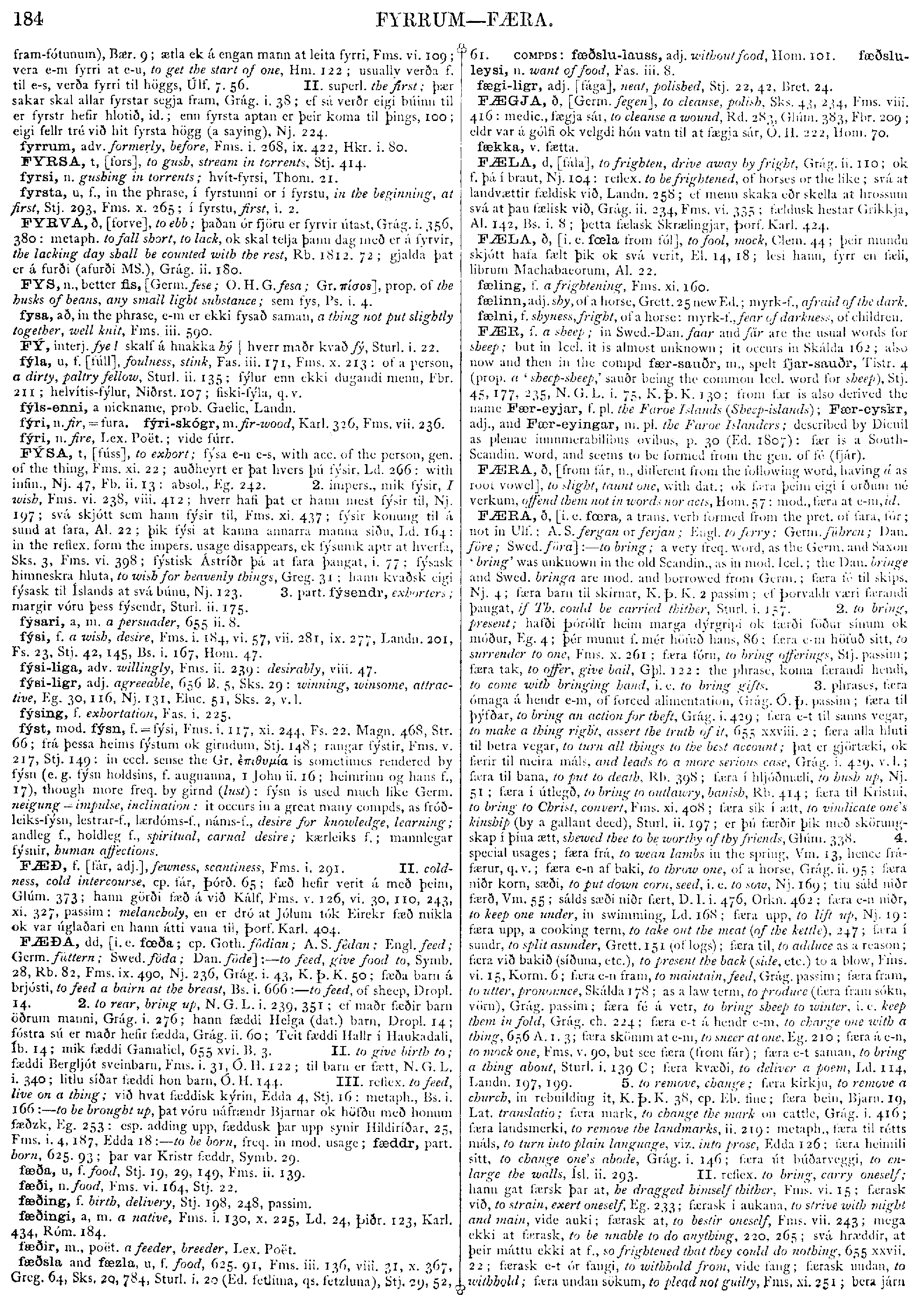
FÆGJA, ð, [Germ. fegen], to cleanse, polish, Sks. 43, 234, Fms. viii. 416: medic., fægja sár, to cleanse a wound, Rd. 283, Glúm. 383, Fbr. 209; eldr var á gólfi ok velgdi hón vatn til at fægja sár, Ó. H. 222, Hom. 70.
|
Source: Cleasby/Vigfusson, page b0197, entry 9 View original page image as: [TIFF] [PNG] [View previous entry] [View next entry] |
[Comment on this entry] [View comments] |
The following entry has been hand-corrected once. |
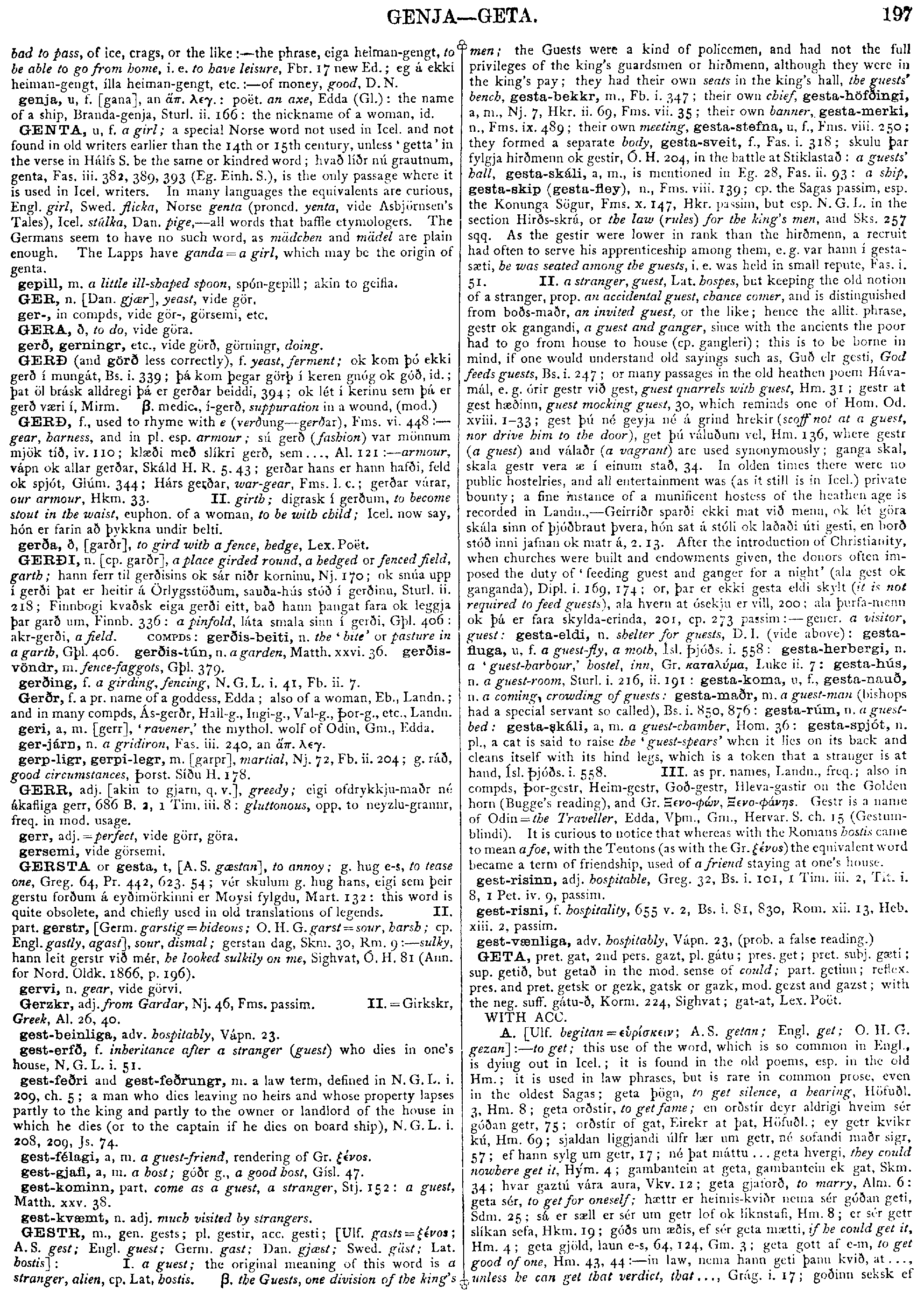
GERÐ
(and
görð
less
correctly),
f.
yeast,
ferment;
ok
kom
þó
ekki
gerð
í
mungát,
Bs.
i.
339;
þá
kom
þegar
görþ
í
keren
gnóg
ok
góð,
id.;
þat
öl
brásk
alldregi
þá
er
gerðar
beiddi,
394;
ok
lét
í
kerinu
sem
þá
er
gerð
væri
í,
Mirm.
.
medic.,
í-gerð,
suppuration
in
a
wound,
(mod.)
|
Source: Cleasby/Vigfusson, page b0221, entry 1 View original page image as: [TIFF] [PNG] [View previous entry] [View next entry] |
[Comment on this entry] [View comments] |
The following entry has been hand-corrected once. |
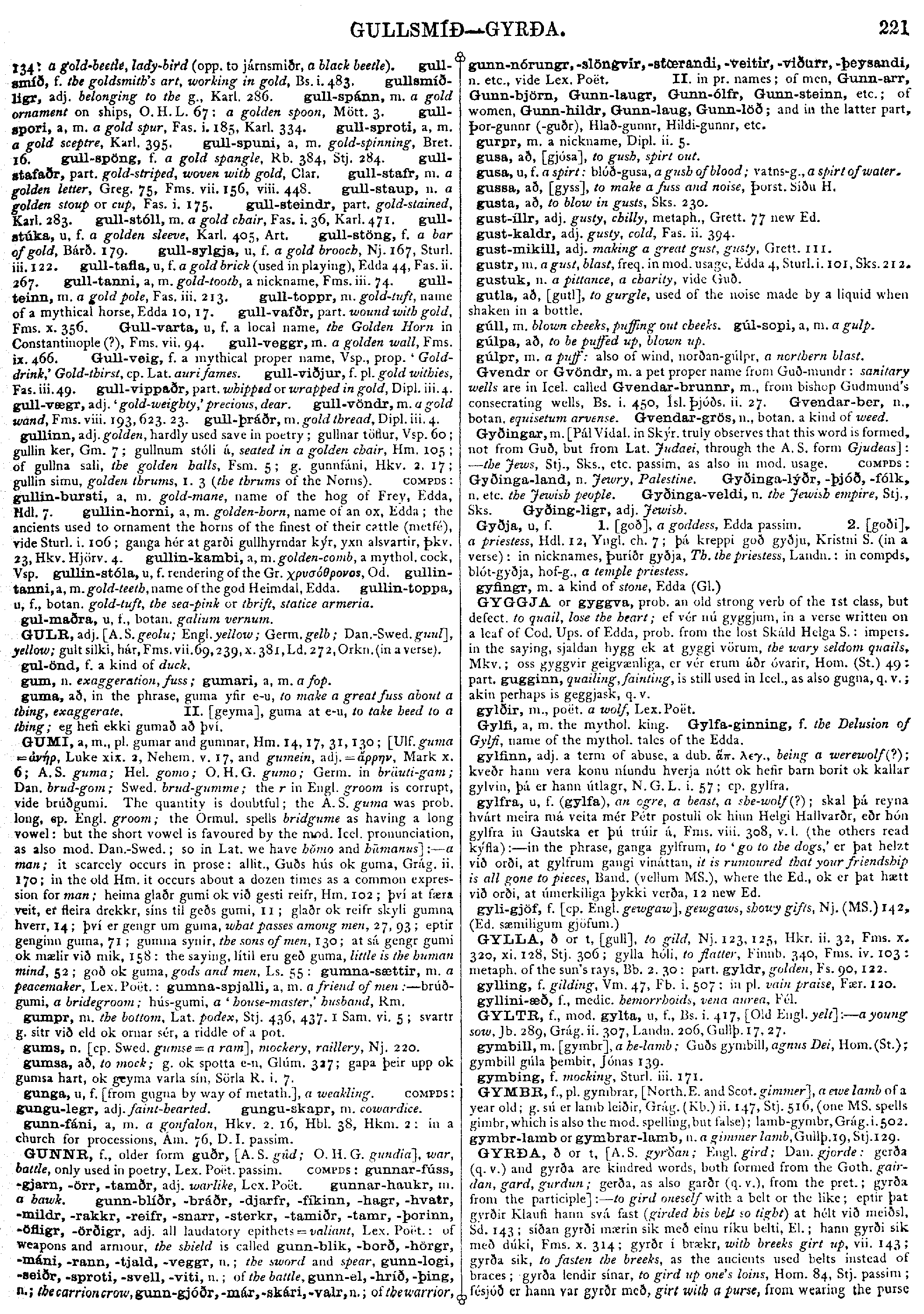
134: a gold-beetle, lady-bird (opp. to járnsmiðr, a black beetle). gull-smíð, f. the goldsmith's art, working in gold, Bs. i. 483. gullsmíð-ligr, adj. belonging to the g., Karl. 286. gull-spánn, m. a gold ornament on ships, O. H. L. 67: a golden spoon, Mött. 3. gull-spori, a, m. a gold spur, Fas. i. 185, Karl. 334. gull-sproti, a, m. a gold sceptre, Karl. 395. gull-spuni, a, m. gold-spinning, Bret. 16. gull-spöng, f. a gold spangle, Rb. 384, Stj. 284. gull-stafaðr, part. gold-striped, woven with gold, Clar. gull-stafr, m. a golden letter, Greg. 75, Fms. vii. 156, viii. 448. gull-staup, n. a golden stoup or cup, Fas. i. 175. gull-steindr, part. gold-stained, Karl. 283. gull-stóll, m. a gold chair, Fas. i. 36, Karl. 471. gull-stúka, u, f. a golden sleeve, Karl. 405, Art. gull-stöng, f. a bar of gold, Bárð. 179. gull-sylgja, u, f. a gold brooch, Nj. 167, Sturl. iii. 122. gull-tafla, u, f. a gold brick (used in playing), Edda 44, Fas. ii. 267. gull-tanni, a, m. gold-tooth, a nickname, Fms. iii. 74. gull-teinn, m. a gold pole, Fas. iii. 213. gull-toppr, m. gold-tuft, name of a mythical horse, Edda 10, 17. gull-vafðr, part. wound with gold, Fms. x. 356. Gull-varta, u, f. a local name, the Golden Horn in Constantinople (?), Fms. vii. 94. gull-veggr, m. a golden wall, Fms. ix. 466. Gull-veig, f. a mythical proper name, Vsp., prop. 'Gold-drink,' Gold-thirst, cp. Lat. auri fames, gull-viðjur, f. pl. gold withies, Fas. iii. 49. gull-vippaðr, part. whipped or wrapped in gold, Dipl. iii. 4. gull-vægr, adj. 'gold-weighty,' precious, dear. gull-vöndr, m. a gold wand, Fms. viii. 193, 623. 23. gull-þráðr, m. gold thread, Dipl. iii. 4.
|
Source: Cleasby/Vigfusson, page b0225, entry 3 View original page image as: [TIFF] [PNG] [View previous entry] [View next entry] |
[Comment on this entry] [View comments] |
The following entry has been hand-corrected once. |
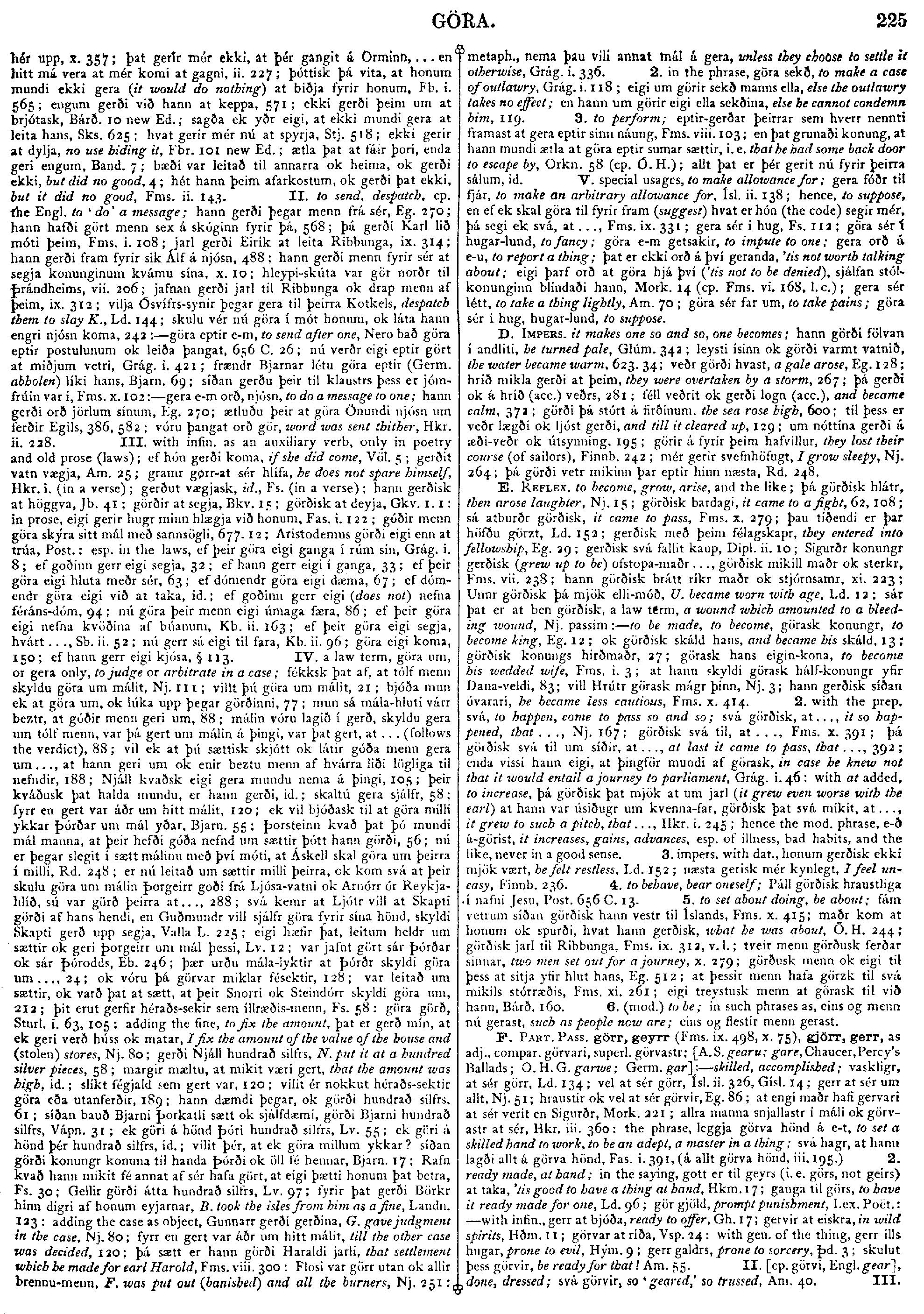
E. REFLEX, to become, grow, arise, and the like; þá görðisk hlátr, then arose laughter, Nj. 15; görðisk bardagi, it came to a fight, 62, 108; sá atburðr görðisk, it came to pass, Fms. x. 279; þau tíðendi er þar höfðu görzt, Ld. 152; gerðisk með þeim félagskapr, they entered into fellowship, Eg. 29; gerðisk svá fallit kaup, Dipl. ii. 10; Sigurðr konungr gerðisk (grew up to be) ofstopa-maðr ..., görðisk mikill maðr ok sterkr, Fms. vii. 238; hann görðisk brátt ríkr maðr ok stjórnsamr, xi. 223; Unnr görðisk þá mjök elli-móð, U. became worn with age, Ld. 12; sár þat er at ben görðisk, a law term, a wound which amounted to a bleeding wound, Nj. passim :-- to be made, to become, görask konungr, to become king, Eg. 12; ok görðisk skáld hans, and became his skáld, 13; görðisk konungs hirðmaðr, 27; görask hans eigin-kona, to become his wedded wife, Fms. i. 3; at hann skyldi görask hálf-konungr yfir Dana-veldi, 83; vill Hrútr görask mágr þinn, Nj. 3; hann gerðisk síðan óvarari, he became less cautious, Fms. x. 414. 2. with the prep. svá, to happen, come to pass so and so; svá görðisk, at ..., it so happened, that ..., Nj. 167; görðisk svá til, at ..., Fms. x. 391; þá görðisk svá til um síðir, at..., at last it came to pass. that ..., 392; enda vissi hann eigi, at þingför mundi af görask, in case he knew not that it would entail a journey to parliament, Grág. i. 46: with at added, to increase, þá görðisk þat mjök at um jarl (it grew even worse with the earl) at hann var úsiðugr um kvenna-far, görðisk þat svá mikit, at ..., it grew to such a pitch, that ..., Hkr. i. 245; hence the mod. phrase, e-ð á-görist, it increases, gains, advances, esp. of illness, bad habits, and the like, never in a good sense. 3. impers. with dat., honum gerðisk ekki mjök vært, he felt restless, Ld. 152; næsta gerisk mér kynlegt, I feel uneasy, Finnb. 236. 4. to behave, bear oneself; Páll görðisk hraustliga í nafni Jesu, Post. 656 C. 13. 5. to set about doing, be about; fám vetrum síðan görðisk hann vestr til Íslands, Fms. x. 415; maðr kom at honum ok spurði, hvat hann gerðisk, what he was about, Ó. H. 244; görðisk jarl til Ribbunga, Fms. ix. 312, v. l.; tveir menn görðusk ferðar sinnar, two men set out for a journey, x. 279; görðusk menn ok eigi til þess at sitja yfir hlut hans, Eg. 512; at þessir menn hafa görzk til svá mikils stórræðis, Fms. xi. 261; eigi treystusk menn at görask til við hann, Bárð. 160. 6. (mod.) to be; in such phrases as, eins og menn nú gerast, such as people now are; eins og flestir menn gerast.
|
Source: Cleasby/Vigfusson, page b0243, entry 9 View original page image as: [TIFF] [PNG] [View previous entry] [View next entry] |
[Comment on this entry] [View comments] |
The following entry has been hand-corrected once. |
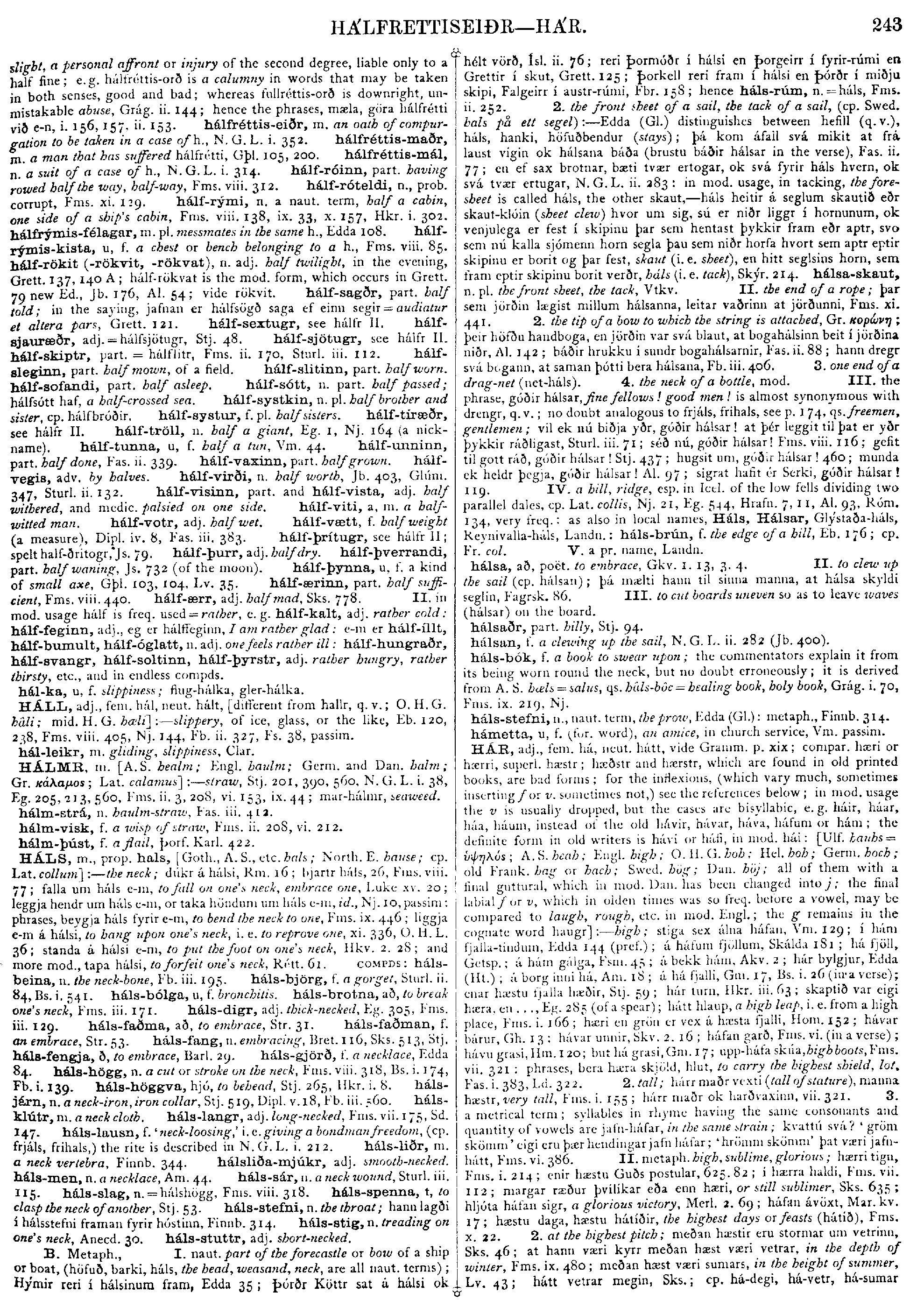
HÁLS, m., prop. hals, [Goth., A. S., etc. hals; North. E. hause; cp. Lat. collum] :-- the neck; dúkr á hálsi, Rm. 16; bjartr háls, 26, Fms. viii. 77; falla um háls e-m, to fall on one's neck, embrace one, Luke xv. 20; leggja hendr um háls e-m, or taka höndum um háls e-m, id., Nj. 10, passim: phrases, beygja háls fyrir e-m, to bend the neck to one, Fms. ix. 446; liggja e-m á hálsi, to hang upon one's neck, i.e. to reprove one, xi. 336, O. H. L. 36; standa á hálsi e-m, to put the foot on one's neck, Hkv. 2. 28; and more mod., tapa hálsi, to forfeit one's neck, Rétt. 61. COMPDS: háls-beina, n. the neck-bone, Fb. iii. 195. háls-björg, f. a gorget, Sturl. ii. 84, Bs. i. 541. háls-bólga, u, f. bronchitis. háls-brotna, að, to break one's neck, Fms. iii. 171. háls-digr, adj. thick-necked, Eg. 305, Fms. iii. 129. háls-faðma, að, to embrace, Str. 31. háls-faðman, f. an embrace, Str. 53. háls-fang, n. embracing, Bret. 116, Sks. 513, Stj. háls-fengja, ð, to embrace, Barl. 29. háls-gjörð, f. a necklace, Edda 84. háls-högg, n. a cut or stroke on the neck, Fms. viii. 318, Bs. i. 174, Fb. i. 139. háls-höggva, hjó, to behead, Stj. 265, Hkr. i. 8. háls-járn, n. a neck-iron, iron collar, Stj. 519, Dipl. v. 18, Fb. iii. 560. háls-klútr, m. a neck cloth. háls-langr, adj. long-necked, Fms. vii. 175, Sd. 147. háls-lausn, f. 'neck-loosing,' i.e. giving a bondman freedom, (cp. frjáls, frihals,) the rite is described in N. G. L. i. 212. háls-liðr, m. a neck vertebra, Finnb. 344. hálsliða-mjúkr, adj. smooth-necked. háls-men, n. a necklace, Am. 44. háls-sár, n. a neck wound, Sturl. iii. 115. háls-slag, n. = hálshögg, Fms. viii. 318. háls-spenna, t, to clasp the neck of another, Stj. 53. háls-stefni, n. the throat; hann lagði í hálsstefni framan fyrir hóstinn, Finnb. 314. háls-stig, n. treading on one's neck, Anecd. 30. háls-stuttr, adj. short-necked.
|
Source: Cleasby/Vigfusson, page b0249, entry 21 View original page image as: [TIFF] [PNG] [View previous entry] [View next entry] |
[Comment on this entry] [View comments] |
The following entry has been hand-corrected once. |
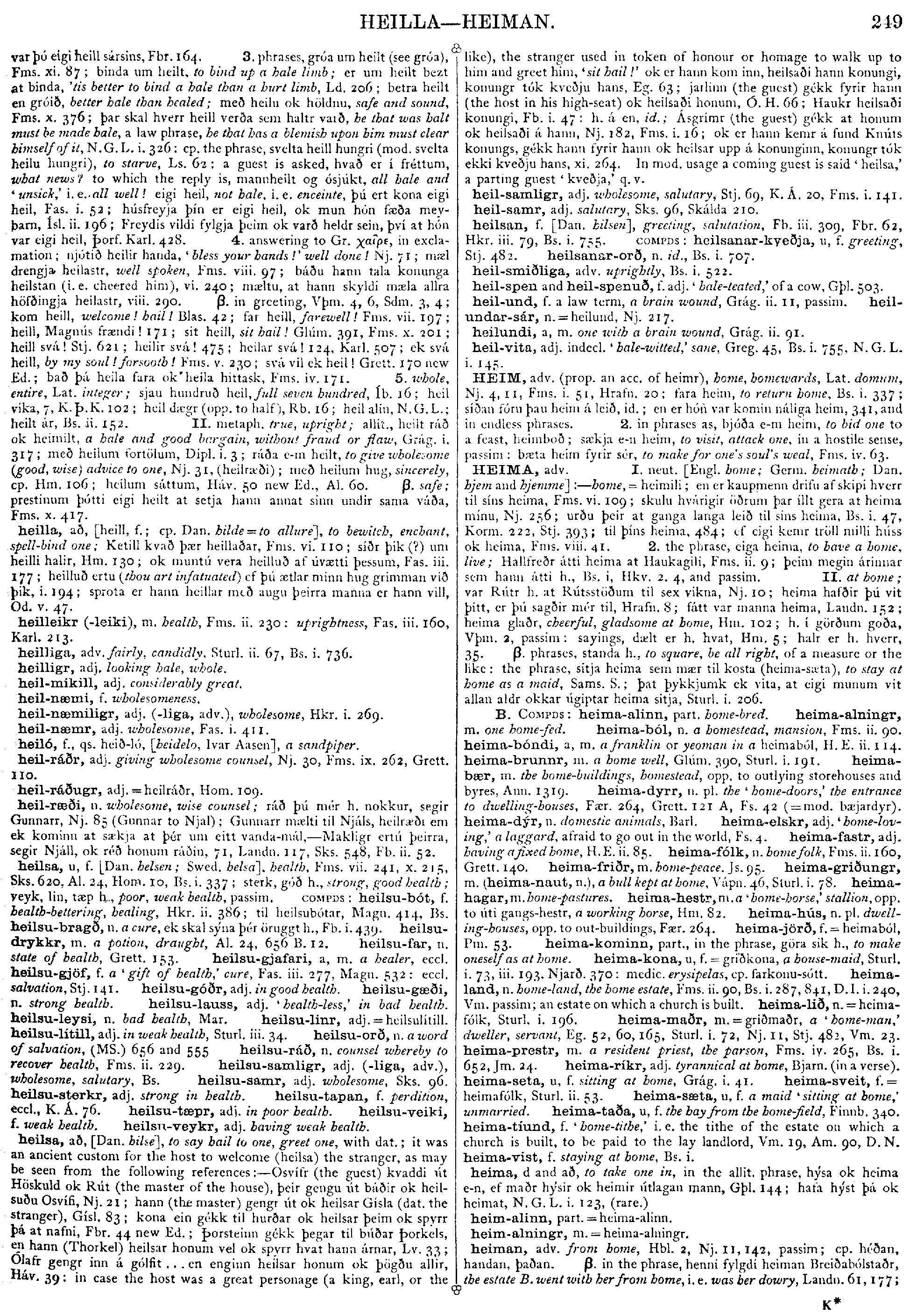
heil-und, f. a law term, a brain wound, Grág. ii. 11, passim. heilundar-sár, n. = heilund, Nj. 217.
| Result Page: |  |
Previous | 10 11 12 13 14 15 16 17 18 19 20 21 22 23 24 25 | Next |  |
Germanic Lexicon Project (main page)
This search system was written by
Sean Crist
Please consider
volunteering
to correct the data in these online dictionaries.
No rights reserved. Feel free to use these data in any way you please.