|
|

Tip: In the search results, you can click on any word or abbreviation for more information.
|
Source: Bosworth/Toller, page b0150, entry 4 View original page image as: [TIFF] [PNG] [View previous entry] [View next entry] |
[Comment on this entry] [View comments] |
The following entry has been hand-corrected once. |
cehhettung, e; f. A laughing in a cackling manner, a laugh of scorn, scorn; cachinnus, contemptus :-- Hwelce cehhettunge ge woldon ðæs habban, and mid hwelcum hleahtre ge woldon beón astyred what scorn ye would have at this, and with what laughter ye would be moved, Bt. 16, 2; Fox 52, 4. v. ceahhetung.
|
Source: Bosworth/Toller, page b0150, entry 20 View original page image as: [TIFF] [PNG] [View previous entry] [View next entry] |
[Comment on this entry] [View comments] |
The following entry has been hand-corrected once. |
cempa,
an;
m.
[camp
war,
battle,
-a,
q.
v.]
A
soldier,
warrior,
CHAMPION;
miles,
bellator,
athleta
=
GREEK
:--
Cempa
miles
vel
athleta,
Wrt.
Voc.
72,
68.
Se
cempa
oferwon
frécnessa
fela
the
champion
overcame
many
perils,
Exon.
35a;
Th.
113,
2;
Gú.
151:
Andr.
Kmbl.
922;
An.
461:
Byrht.
Th.
135,
17;
By.
119:
Beo.
Th.
2629;
B.
1312.
Ðá
ða
cempan
hine
ahéngon,
hí
námon
his
reáf,
and
worhton
feówer
d las,
lcum
cempan
ánne
dl
milites
cum
crucifixissent
eum,
acceperunt
vestimenta
ejus,
et
fecerunt
quatuor
partes,
unicuique
militi
partem,
Jn.
Bos.
19,
23.
Scyld
sceal
cempan
a
shield
shall
be
for
a
soldier,
Exon.
91a;
Th.
341,
22;
Gn.
Ex.
130:
Beo.
Th.
3901;
B.
1948:
Andr.
Kmbl.
460;
An.
230.
Woldun
hý
geteón
in
orwénnysse
Meotudes
cempan
they
would
draw
God's
soldier
into
despair,
Exon.
41a;
Th.
136,
28;
Gú.
548:
Salm.
Kmbl.
279;
Sal.
139.
Húslfatu
hálegu
cempan
genamon
the
warriors
took
the
holy
vessels
of
sacrifice,
Cd.
210;
Th.
260,
9;
Dan.
707:
Fins.
Th.
29;
Fin.
14.
We
his
þegnas
sind,
gecoren
to
cempum
we
are
his
thanes,
chosen
to
[be
his]
warriors,
Andr.
Kmbl.
647;
An.
324.
Alten
cempa
a
soldier
who
has
served
his
time,
a
veteran;
emeritus,
Ælfc.
Gl.
7;
Som.
56,
62;
Wrt.
Voc.
18,
15.
Gecorene
cempan
chosen
soldiers,
adjutants;
optiones,
7;
Som.
56,
64;
Wrt.
Voc.
18,
17.
Cempena
yldest
a
chief
of
soldiers,
a
commander;
militum
tribunus,
Ors.
4,
9;
Bos.
91,
18.
Twá
hund
cempna
[
=
cempena]
two
hundred
[of]
soldiers:
manipulus,
Ælfc.
Gl.
7;
Som.
56,
75;
Wrt.
Voc.
18,
27.
Fíf
hund
cempena
ealdor
a
commander
of
five
hundred
soldiers;
cohors,
7;
Som.
56,
61;
Wrt.
Voc.
18,
14.
DER.
féðe-cempa,
sige-.
las,
lcum
cempan
ánne
dl
milites
cum
crucifixissent
eum,
acceperunt
vestimenta
ejus,
et
fecerunt
quatuor
partes,
unicuique
militi
partem,
Jn.
Bos.
19,
23.
Scyld
sceal
cempan
a
shield
shall
be
for
a
soldier,
Exon.
91a;
Th.
341,
22;
Gn.
Ex.
130:
Beo.
Th.
3901;
B.
1948:
Andr.
Kmbl.
460;
An.
230.
Woldun
hý
geteón
in
orwénnysse
Meotudes
cempan
they
would
draw
God's
soldier
into
despair,
Exon.
41a;
Th.
136,
28;
Gú.
548:
Salm.
Kmbl.
279;
Sal.
139.
Húslfatu
hálegu
cempan
genamon
the
warriors
took
the
holy
vessels
of
sacrifice,
Cd.
210;
Th.
260,
9;
Dan.
707:
Fins.
Th.
29;
Fin.
14.
We
his
þegnas
sind,
gecoren
to
cempum
we
are
his
thanes,
chosen
to
[be
his]
warriors,
Andr.
Kmbl.
647;
An.
324.
Alten
cempa
a
soldier
who
has
served
his
time,
a
veteran;
emeritus,
Ælfc.
Gl.
7;
Som.
56,
62;
Wrt.
Voc.
18,
15.
Gecorene
cempan
chosen
soldiers,
adjutants;
optiones,
7;
Som.
56,
64;
Wrt.
Voc.
18,
17.
Cempena
yldest
a
chief
of
soldiers,
a
commander;
militum
tribunus,
Ors.
4,
9;
Bos.
91,
18.
Twá
hund
cempna
[
=
cempena]
two
hundred
[of]
soldiers:
manipulus,
Ælfc.
Gl.
7;
Som.
56,
75;
Wrt.
Voc.
18,
27.
Fíf
hund
cempena
ealdor
a
commander
of
five
hundred
soldiers;
cohors,
7;
Som.
56,
61;
Wrt.
Voc.
18,
14.
DER.
féðe-cempa,
sige-.
|
Source: Bosworth/Toller, page b0152, entry 8 View original page image as: [TIFF] [PNG] [View previous entry] [View next entry] |
[Comment on this entry] [View comments (1)] |
The following entry has been hand-corrected once. |
CEÓSAN.
ciósan,
ic
ceóse,
ðú
ceósest,
cýst,
he
ceóseþ,
cýst,
císt,
pl.
ceósaþ;
p.
ic,
he
ceás,
cés,
ðú
cure,
pl.
curon;
impert.
ceós,
pl.
ceósaþ;
pp.
coren;
v.
a.
I.
to
CHOOSE,
select,
elect;
legere,
seligere,
eligere
:--
Ðæt
hí
woldon
óðerra
wera
ceósan
that
they
would
make
a
choice
of
other
husbands,
Ors.
1,
10;
Bos.
32,
32.
He
héht
him
wine
ceósan
he
commanded
him
to
choose
friends,
Cd.
90;
Th.
112,
8;
Gen.
1867:
Runic
pm.
29;
Kmbl.
345,
15
;
Hick.
Thes.
i.
135.
Drihten
ðé
císt
the
lord
will
choose
thee,
Deut.
28,
9.
Hí
leófne
ceósaþ
ofer
woruldwélan
they
choose
the
beloved
above
worldly
wealth,
Exon.
62b;
Th.
230,
29;
Ph.
479.
Bebodu
ðíne
ic
ceás
mandata
tua
elegi,
Ps.
Spl.
118,
173.
Hér
Eádgár,
Engla
cyning,
ceás
him
óðer
leóht,
and
ðis
wáce
forlét
líf
here,
A.
D.
975,
Edgar,
king
of
the
Angles,
chose
him
another
light,
and
left
this
frail
life,
Chr.
975;
Erl.
124,
30;
Edg.
22:
1041;
Erl.
169,
10.
Æ-acute;fæste
men
him
ðá
wlc
cnron
UNCERTAIN
the
pious
men
chose
them
a
dwelling
there,
Cd.
86;
Th.
108,
9;
Gen.
1803:
Andr.
Kmbl.
808;
An.
404.
Ceós
ðé
geféran
and
feoht
ongén
Amalech
elige
viros
et
pugna
contra
Amalec,
Ex.
17,
9:
Deut.
17,
15.
Ðæt
ic
neóbed
ceóse
that
I
may
choose
a
death-bed,
Exon.
63b;
Th.
235,
7;
Ph.
553.
Ðæt
se
cyning
him
ceóse
sumne
wísne
man
ut
provideat
rex
virum
sapientem,
Gen.
41,
33:
Ps.
Th.
105,
5.
Ceósan
us
eard
in
wuldre
may
we
choose
us
a
dwelling
in
glory,
Cd.
217;
Th.
277,
14;
Sat.
204.
Ðæt
he
óðer
líf
cure
that
he
chose
another
life,
Bd.
5,
19;
S.
638,
6.
Æ-acute;r
he
bl
cure
ere
he
chose
the
funeral
pile,
Beo.
Th.
5629;
B.
2818:
Exon.
100a;
Th.
376,
20;
Seel.
157.
Ðæt
hí
him
cyning
curan
ut
regem
sibi
eligerent,
Bd.
1,
1;
S.
474,
22.
Ðéh
ðe
fell
curen
synnigra
cynn
though
the
race
of
sinners
chose
death,
Andr.
Kmbl.
3217;
An.
1611.
II.
to
accept
by
choice
or
what
is
offered,
to
accept;
oblatum
accipere,
accipere
:--
Ðæt
he
ðone
cynedóm
ciósan
wolde
that
he
would
accept
the
kingdom,
Beo.
Th.
4742;
B.
2376.
Hie
curon
æðelinges
ést
they
accepted
the
chieftain's
bounty,
Cd.
112;
Th.
147,
20;
Gen.
2442.
[Wyc.
Piers
P.
Chauc.
R.
Glouc.
chese:
Laym.
cheosen:
Orm.
chesenn:
Plat.
kösen,
kören:
O.
Sax.
kiosan,
keosan:
Frs.
kiezjen,
tziezjen:
O.
Frs.
kiasa,
tziesa:
Dut.
kiezen:
Ger.
kiesen:
M.
H.
Ger.
kiusen,
kiesen:
O.
H.
Ger.
kiusan,
kiosan:
Goth.
kiusan:
Dan.
keise:
Icel.
kjósa:
Lat.
gustare:
Grk.
GREEK
:
Sansk.
jush
to
like,
be
fond
of,
choose.]
DER.
a-ceósan,
forþ-,
ge-,
on-,
wið-,
wiðer-.
|
Source: Bosworth/Toller, page b0158, entry 9 View original page image as: [TIFF] [PNG] [View previous entry] [View next entry] |
[Comment on this entry] [View comments] |
The following entry has been hand-corrected once. |
CLÁTE, an; f. The herb CLOT-bur, a bur that sticks to clothes, burdock, goose-grass, clivers; philanthropos = GREEK , lappa, arctium lappa, galium aparine, Lin :-- Ðás wyrte man philanthropos nemneþ, ðæt ys on úre geþeóde menlufigende, forðý heó wyle hrædlíce to ðam men geclyfian: ða man eác óðrum naman cláte nemneþ this herb is called philanthropes, that is in our language men-loving, because it will readily cleave to a man: it is also named by another name clivers, Herb. 174, 1; Lchdm. i. 306, 2-5: Ælfc. Gl. 40; Som. 63, 105; Wrt. Voc. 30, 53: 41; Som. 63, 108; Wrt. Voc. 30, 56: 66, 67. Cláte lappa, Wrt. Voc. 67, 75: 79, 41: Ælfc. Gl. 40; Som. 63, 91; Wrt. Voc. 30, 41. Wið ceolan swile clátan wyl on ealaþ for swelling of throat boil burdock in ale, L. M. 1, 12; Lchdm. ii. 56, 3: I. 45; Lchdm. ii. 110, 13: 2, 53; Lchdm. ii. 274, 3. Nim ða smalan clátan take the small burdock, 1, 39; Lchdm. ii. 100, 23. Genim doccan oððe clátan, ða ðe swimman wolde take dock or clote, such as would swim, 1, 50; Lchdm. ii. 122, 22. [Wyc. clote, cloote: Chauc. clote-lefe a leaf of the clot-bur: Ger. M. H. Ger. klette. f: O. H. Ger. kletta, kledda. f.]
|
Source: Bosworth/Toller, page b0159, entry 1 View original page image as: [TIFF] [PNG] [View previous entry] [View next entry] |
[Comment on this entry] [View comments] |
The following entry has been hand-corrected once. |
clivus,
rupes,
promontorium
:--
Ða
ludéi
lddon
Crist
to
ánum
clife,
and
woldon
hine
niðerascúfan
the
Jews
led
Christ
to
a
cliff,
and
would
cast
him
down,
Homl.
Th.
ii.
236,
33.
Æt
Eádwines
clife
at
Edwin's
cliff,
Chr.
761;
Th.
89,
24,
col.
1.
Ðæt
hí
ne
hlipen
on
ðæt
scorene
clif
that
they
leap
not
down
the
abrupt
cliff,
Past.
33,
1;
Hat.
MS.
41a.
9.
Be
clifum
on
the
cliffs,
Exon.
81b;
Th.
306,
15;
Secf.
UNCERTAIN
8.
Ðæt
hie
Geáta
clifu
ongitan
meahton
that
they
might
perceive
the
cliffs
of
the
Gauts,
Beo.
Th.
3826;
B.
1911.
Ofer
cald
cleofu
over
the
cold
cliffs,
Andr.
Kmbl.
619;
An.
310:
Exon.
101b;
Th.
384,
15;
Rä.
4,
28.
Ðú
hluttor
ltest
wæter
of
clife
clnum
thou
lettest
forth
clear
waters
from
the
pure
rock,
Exon.
55a;
Th.
194,
11;
Az.
137:
Bt.
Met.
Fox
5,
25;
Met.
5,
13.
Se
ðe
gecyrde
clyf
on
wyllan
wætera
qui
convertit
rupem
in
fontes
aquarum,
Ps.
Spl.
M.
C.
113,
8.
God
clifu
cyrreþ
on
wæteres
wellan
God
turneth
rocks
into
wells
of
water,
Ps.
Th.
113,
8.
Clif
promontorium,
Ælfc.
Gl.
67;
Som.
69,
117;
Wrt.
Voc.
41,
67.
Nílus
seó
eá,
hyre
wylme,
is
neáh
ðæm
clife
ðære
Reádan
Ss
the
spring
of
the
river
Nile
is
near
the
promontory
of
the
Red
Sea,
Ors.
1,
1;
Bos.
17,
19,
29.
[O.
Sax.
klif,
n.
a
rock;
Dut.
klip,
f.
a
rock,
cliff:
Kil.
kleppe,
klippe
rupes,
petra;
Ger.
klippe,
f.
rupes:
O.
H.
Ger.
clep
promontorium:
Dan.
klippe,
m.
f.
a
rock,
cliff:
Swed.
klippa,
f:
Icel.
klif,
n.
a
cliff]
DER.
brim-clif,
ég-,
heáh-,
holm-,
stán-,
weal-.
|
Source: Bosworth/Toller, page b0159, entry 7 View original page image as: [TIFF] [PNG] [View previous entry] [View next entry] |
[Comment on this entry] [View comments (1)] |
The following entry has been hand-corrected once. |
cliflan,
cleofian,
cliofian,
clyfian;
p.
ode;
pp.
od
To
cleave,
adhere;
adhærere
:--
Hí
willaþ
clifian
on
ðm
monnum
they
will
cleave
to
the
men,
Bt.
16,
3;
Fox
54,
19.
Woldon
hí
on
ðam
clifian
they
would
cleave
to
him,
16,
3;
Fox
56,
10:
L.
M.
1,
2;
Lchdm.
ii.
38,
20.
His
flsces
lima
clifaþ
lc
on
óðrum
each
of
the
limbs
of
his
flesh
cleaves
to
another,
Past.
47;
Hat.
MS.
Ðín
tunge
clifaþ
to
ðínum
goman
thy
tongue
cleaveth
to
thy
gums,
Homl.
Th.
ii.
530,
28.
To
ðære
lifre
clifiaþ
adhærent
jecori,
Lev.
1,
8.
Ðæt
dust,
ðæt
of
eówre
ceastre
on
úrum
fótum
clifode,
we
drígeaþ
on
eów
pulverem,
qui
adhæsit
nobis
de
civitate
vestra,
extergimus
in
vos,
Lk.
Bos.
10,
11.
[Wyc.
cleuyde
cleaved:
Laym.
cleouieþ
cleaveth:
O.
Sax.
klibón:
UNCERTAIN
Dut.
kleeven:
Ger.
kleben,
kleiben:
O.
H.
Ger.
klebén,
klebjan.]
DER.
æt-clifian,
ge-,
on-,
to-,
to-ge-.
|
Source: Bosworth/Toller, page b0168, entry 20 View original page image as: [TIFF] [PNG] [View previous entry] [View next entry] |
[Comment on this entry] [View comments (2)] |
The following entry has been hand-corrected once. |
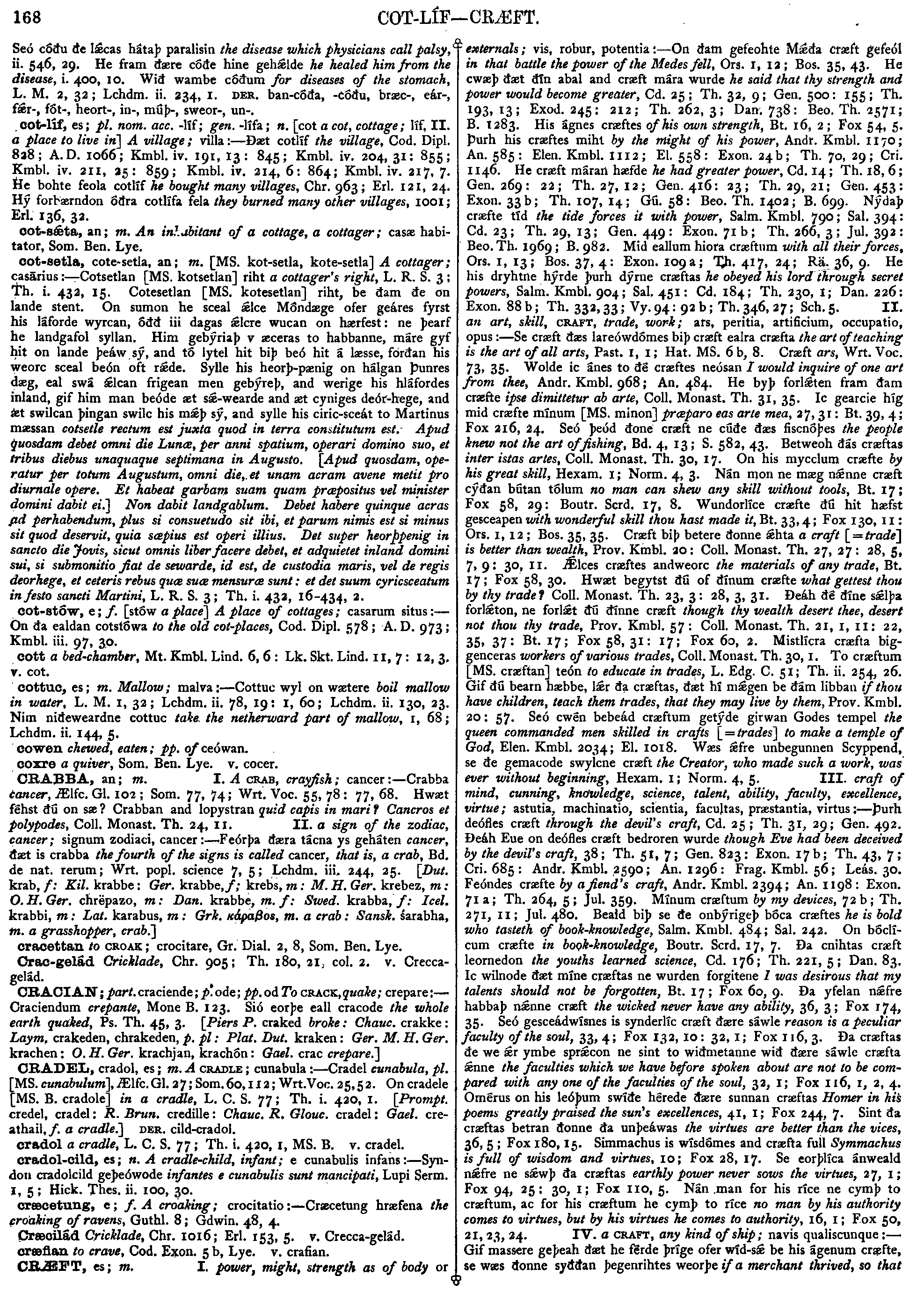
CRÆFT,
es;
m.
I.
power,
might,
strength
as
of
body
or
externals;
vis,
robur,
potentia
:--
On
ðam
gefeohte
Mða
cræft
gefeól
in
that
battle
the
power
of
the
Medes
fell,
Ors.
l,
12;
Bos.
35,
43.
He
cwæþ
ðæt
ðín
abal
and
cræft
mára
wurde
he
said
that
thy
strength
and
power
would
become
greater,
Cd.
25;
Th.
32,
9;
Gen.
500:
155;
Th.
193,
13;
Exod.
245;
212;
Th.
262,
3;
Dan.
738:
Beo.
Th.
2571;
B.
1283.
His
ágnes
cræftes
of
his
own
strength,
Bt.
16,
2;
Fox
54,
5.
Þurh
his
cræftes
miht
by
the
might
of
his
power,
Andr.
Kmbl.
1170;
An.
585:
Elen.
Kmbl.
1112;
El.
558:
Exon.
24b;
Th.
70,
29;
Cri.
1146.
He
cræft
máran
hæfde
he
had
greater
power,
Cd.
14;
Th.
18,
6;
Gen.
269:
22;
Th.
27,
12;
Gen.
416:
23;
Th.
29,
21;
Gen.
453:
Exon.
33b;
Th.
107,
14;
Gú.
58:
Beo.
Th.
1402;
B.
699.
Nýdaþ
cræfte
tíd
the
tide
forces
it
with
power,
Salm.
Kmbl.
790;
Sal.
394:
Cd.
23;
Th.
29,
13;
Gen.
449:
Exon.
71b;
Th.
266,
3;
Jul.
392:
Beo.
Th.
1969;
B.
982.
Mid
eallum
hiora
cræftum
with
all
their
forces,
Ors.
1,
13;
805.
37,
4:
Exon.
109a;
Th.
417,
24;
Rä.
36,
9.
He
his
dryhtne
hýrde
þurh
dýrne
cræftas
he
obeyed
his
lord
through
secret
powers,
Salm.
Kmbl.
904;
Sal.
451:
Cd.
184;
Th.
230,
1;
Dan.
226:
Exon.
88b;
Th.
332,
33;
Vy.
94:
92b;
Th.
346,
27;
Sch.
5.
II.
an
art,
skill,
CRAFT,
trade,
work;
ars,
peritia,
artificium,
occupatio,
opus
:--
Se
cræft
ðæs
lareówdómes
biþ
cræft
ealra
cræfta
the
art
of
teaching
is
the
art
of
all
arts,
Past.
1,
1;
Hat.
MS.
6b,
8.
Cræft
ars.
Wrt.
Voc.
73,
35.
Wolde
ic
ánes
to
ðé
cræftes
neósan
I
would
inquire
of
one
art
from
thee,
Andr.
Kmbl.
968;
An.
484.
He
byþ
forlten
fram
ðam
cræfte
ipse
dimittetur
ab
arte,
Coll.
Monast.
Th.
31,
35.
Ic
gearcie
híg
mid
cræfte
mínum
[MS.
minon]
præparo
eas
arte
mea,
27,
31:
Bt.
39,
4;
Fox
216,
24.
Seó
þeód
ðone
cræft
ne
cúðe
ðæs
fiscnóþes
the
people
knew
not
the
art
of
fishing,
Bd.
4,
13;
S.
582,
43.
Betweoh
ðás
cræftas
inter
istas
artes,
Coll.
Monast.
Th.
30,
17.
On
his
mycclum
cræfte
by
his
great
skill,
Hexam.
1;
Norm.
4,
3.
Nán
mon
ne
mæg
nnne
cræft
cýðan
bútan
tólum
no
man
can
shew
any
skill
without
tools,
Bt.
17;
Fox
58,
29:
Boutr.
Scrd.
17,
8.
Wundorlíce
cræfte
ðú
hit
hæfst
gesceapen
with
wonderful
skill
thou
hast
made
it,
Bt.
33,
4;
Fox
130,
11:
Ors.
l,
12;
Bos.
35,
35.
Cræft
biþ
betere
ðonne
hta
a
craft
[
=
trade]
is
better
than
wealth,
Prov.
Kmbl.
20:
Coll.
Monast.
Th.
27,
27:
28,
5,
7,
9:
30,
11.
Æ-acute;lces
cræftes
andweorc
the
materials
of
any
trade,
Bt.
17;
Fox
58,
30.
Hwæt
begytst
ðú
of
ðínum
cræfte
what
gettest
thou
by
thy
trade?
Coll.
Monast.
Th.
23,
3:
28,
3,
31.
Ðeáh
ðé
ðíne
slþa
forlton,
ne
forlt
ðú
ðínne
cræft
though
thy
wealth
desert
thee,
desert
not
thou
thy
trade,
Prov.
Kmbl.
57:
Coll.
Monast.
Th.
21,
1,
11:
22,
35,
37:
Bt.
17;
Fox
58,
31:
17;
Fox
60,
2.
Mistlícra
cræfta
big genceras
workers
of
various
trades,
Coll.
Monast.
Th.
30,
1.
To
cræftum
[MS.
cræftan]
teón
to
educate
in
trades,
L.
Edg.
C.
51;
Th.
ii.
254,
26.
Gif
ðú
bearn
hæbbe,
lr
ða
cræftas,
ðæt
hí
mgen
be
ðám
libban
if
thou
have
children,
teach
them
trades,
that
they
may
live
by
them,
Prov.
Kmbl.
20:
57.
Seó
cwén
bebeád
cræftum
getýde
girwan
Godes
tempel
the
queen
commanded
men
skilled
in
crafts
[=
trades]
to
make
a
temple
of
God,
Elen.
Kmbl.
2034;
El.
1018.
Wæs
fre
unbegunnen
Scyppend,
se
ðe
gemacode
swylcne
cræft
the
Creator,
who
made
such
a
work,
was
ever
without
beginning.
Hexam.
1;
Norm.
4,
5.
III.
craft
of
mind,
cunning,
knowledge,
science,
talent,
ability,
faculty,
excellence,
virtue;
astutia,
machinatio,
scientia,
facultas,
præstantia,
virtus
:--
Þurh
deófles
cræft
through
the
devil's
craft,
Cd.
25;
Th.
31,
29;
Gen.
492.
Ðeáh
Eue
on
deófles
cræft
bedroren
wurde
though
Eve
had
been
deceived
by
the
devil's
craft,
38;
Th.
51,
7;
Gen.
823:
Exon.
17b;
Th.
43,
7;
Cri.
685:
Andr.
Kmbl.
2590;
An.
1296:
Frag.
Kmbl.
56;
Leas.
UNCERTAIN
30.
Feóndes
cræfte
by
a
fiend's
craft,
Andr.
Kmbl.
2394;
An.
1198:
Exon.
71a;
Th.
264,
5;
Jul.
359.
Mínum
cræftum
by
my
devices,
72b;
Th.
271,
11;
Jul.
480.
Beald
biþ
se
ðe
onbýrigeþ
bóca
cræftes
he
is
bold
who
tasieth
of
book-knowledge,
Salm.
Kmbl.
484;
Sal.
242.
On
bóclícum
cræfte
in
book-knowledge,
Boutr.
Scrd.
17,
7.
Ða
cnihtas
cræft
leornedon
the
youths
learned
science,
Cd.
176;
Th.
221,
5;
Dan.
83.
Ic
wilnode
ðæt
míne
cræftas
ne
wurden
forgitene
I
was
desirous
that
my
talents
should
not
be
forgotten,
Bt.
17;
Fox
60,
9.
Ða
yfelan
nfre
habbaþ
nnne
cræft
the
wicked
never
have
any
ability,
36,
3;
Fox
174,
35.
Seó
gesceádwísnes
is
synderlíc
cræft
ðære
sáwle
reason
is
a
peculiar
faculty
of
the
soul,
33,
4;
Fox
132,
10:
32,
1;
Fox
116,
3.
Ða
cræftas
de
we
r
ymbe
sprcon
ne
sint
to
wiðmetanne
wið
ðære
sáwle
cræfta
nne
the
faculties
which
we
have
before
spoken
about
are
not
to
be
compared
with
any
one
of
the
faculties
of
the
soul,
32,
1;
Fox
116,
1,
2,
4.
Omérus
on
his
leóþum
swíðe
hérede
ðære
sunnan
cræftas
Homer
in
his
poems
greatly
praised
the
sun's
excellences,
41,
1;
Fox
244,
7.
Sint
ða
cræftas
betran
ðonne
ða
unþeáwas
the
virtues
are
better
than
the
vices,
36.
5;
Fox
180,
15.
Simmachus
is
wísdðmes
and
cræfta
full
Symmachus
is
full
of
wisdom
and
virtues,
10;
Fox
28,
17.
Se
eorþlíca
ánweald
nfre
ne
swþ
ða
cræftas
earthly
power
never
sows
the
virtues,
27,
1;
Fox
94,
25:
30,
1;
Fox
110,
5.
Nán
man
for
his
ríce
ne
cymþ
to
cræftum,
ac
for
his
cræftum
he
cymþ
to
ríce
no
man
by
his
authority
comes
to
virtues,
but
by
his
virtues
he
comes
to
authority,
16,
1;
Fox
50,
21,
23,
24.
IV.
a
CRAFT,
any
kind
of
ship;
navis
qualiscunque
:--
Gif
massere
geþeah
ðæt
he
férde
þríge
ofer
wíd-s
be
his
ágenum
cræfte,
se
wæs
ðonne
syððan
þegenrihtes
weorþe
if
a
merchant
thrived,
so
that
genceras
workers
of
various
trades,
Coll.
Monast.
Th.
30,
1.
To
cræftum
[MS.
cræftan]
teón
to
educate
in
trades,
L.
Edg.
C.
51;
Th.
ii.
254,
26.
Gif
ðú
bearn
hæbbe,
lr
ða
cræftas,
ðæt
hí
mgen
be
ðám
libban
if
thou
have
children,
teach
them
trades,
that
they
may
live
by
them,
Prov.
Kmbl.
20:
57.
Seó
cwén
bebeád
cræftum
getýde
girwan
Godes
tempel
the
queen
commanded
men
skilled
in
crafts
[=
trades]
to
make
a
temple
of
God,
Elen.
Kmbl.
2034;
El.
1018.
Wæs
fre
unbegunnen
Scyppend,
se
ðe
gemacode
swylcne
cræft
the
Creator,
who
made
such
a
work,
was
ever
without
beginning.
Hexam.
1;
Norm.
4,
5.
III.
craft
of
mind,
cunning,
knowledge,
science,
talent,
ability,
faculty,
excellence,
virtue;
astutia,
machinatio,
scientia,
facultas,
præstantia,
virtus
:--
Þurh
deófles
cræft
through
the
devil's
craft,
Cd.
25;
Th.
31,
29;
Gen.
492.
Ðeáh
Eue
on
deófles
cræft
bedroren
wurde
though
Eve
had
been
deceived
by
the
devil's
craft,
38;
Th.
51,
7;
Gen.
823:
Exon.
17b;
Th.
43,
7;
Cri.
685:
Andr.
Kmbl.
2590;
An.
1296:
Frag.
Kmbl.
56;
Leas.
UNCERTAIN
30.
Feóndes
cræfte
by
a
fiend's
craft,
Andr.
Kmbl.
2394;
An.
1198:
Exon.
71a;
Th.
264,
5;
Jul.
359.
Mínum
cræftum
by
my
devices,
72b;
Th.
271,
11;
Jul.
480.
Beald
biþ
se
ðe
onbýrigeþ
bóca
cræftes
he
is
bold
who
tasieth
of
book-knowledge,
Salm.
Kmbl.
484;
Sal.
242.
On
bóclícum
cræfte
in
book-knowledge,
Boutr.
Scrd.
17,
7.
Ða
cnihtas
cræft
leornedon
the
youths
learned
science,
Cd.
176;
Th.
221,
5;
Dan.
83.
Ic
wilnode
ðæt
míne
cræftas
ne
wurden
forgitene
I
was
desirous
that
my
talents
should
not
be
forgotten,
Bt.
17;
Fox
60,
9.
Ða
yfelan
nfre
habbaþ
nnne
cræft
the
wicked
never
have
any
ability,
36,
3;
Fox
174,
35.
Seó
gesceádwísnes
is
synderlíc
cræft
ðære
sáwle
reason
is
a
peculiar
faculty
of
the
soul,
33,
4;
Fox
132,
10:
32,
1;
Fox
116,
3.
Ða
cræftas
de
we
r
ymbe
sprcon
ne
sint
to
wiðmetanne
wið
ðære
sáwle
cræfta
nne
the
faculties
which
we
have
before
spoken
about
are
not
to
be
compared
with
any
one
of
the
faculties
of
the
soul,
32,
1;
Fox
116,
1,
2,
4.
Omérus
on
his
leóþum
swíðe
hérede
ðære
sunnan
cræftas
Homer
in
his
poems
greatly
praised
the
sun's
excellences,
41,
1;
Fox
244,
7.
Sint
ða
cræftas
betran
ðonne
ða
unþeáwas
the
virtues
are
better
than
the
vices,
36.
5;
Fox
180,
15.
Simmachus
is
wísdðmes
and
cræfta
full
Symmachus
is
full
of
wisdom
and
virtues,
10;
Fox
28,
17.
Se
eorþlíca
ánweald
nfre
ne
swþ
ða
cræftas
earthly
power
never
sows
the
virtues,
27,
1;
Fox
94,
25:
30,
1;
Fox
110,
5.
Nán
man
for
his
ríce
ne
cymþ
to
cræftum,
ac
for
his
cræftum
he
cymþ
to
ríce
no
man
by
his
authority
comes
to
virtues,
but
by
his
virtues
he
comes
to
authority,
16,
1;
Fox
50,
21,
23,
24.
IV.
a
CRAFT,
any
kind
of
ship;
navis
qualiscunque
:--
Gif
massere
geþeah
ðæt
he
férde
þríge
ofer
wíd-s
be
his
ágenum
cræfte,
se
wæs
ðonne
syððan
þegenrihtes
weorþe
if
a
merchant
thrived,
so
that
|
Source: Bosworth/Toller, page b0173, entry 34 View original page image as: [TIFF] [PNG] [View previous entry] [View next entry] |
[Comment on this entry] [View comments] |
The following entry has been hand-corrected once. |
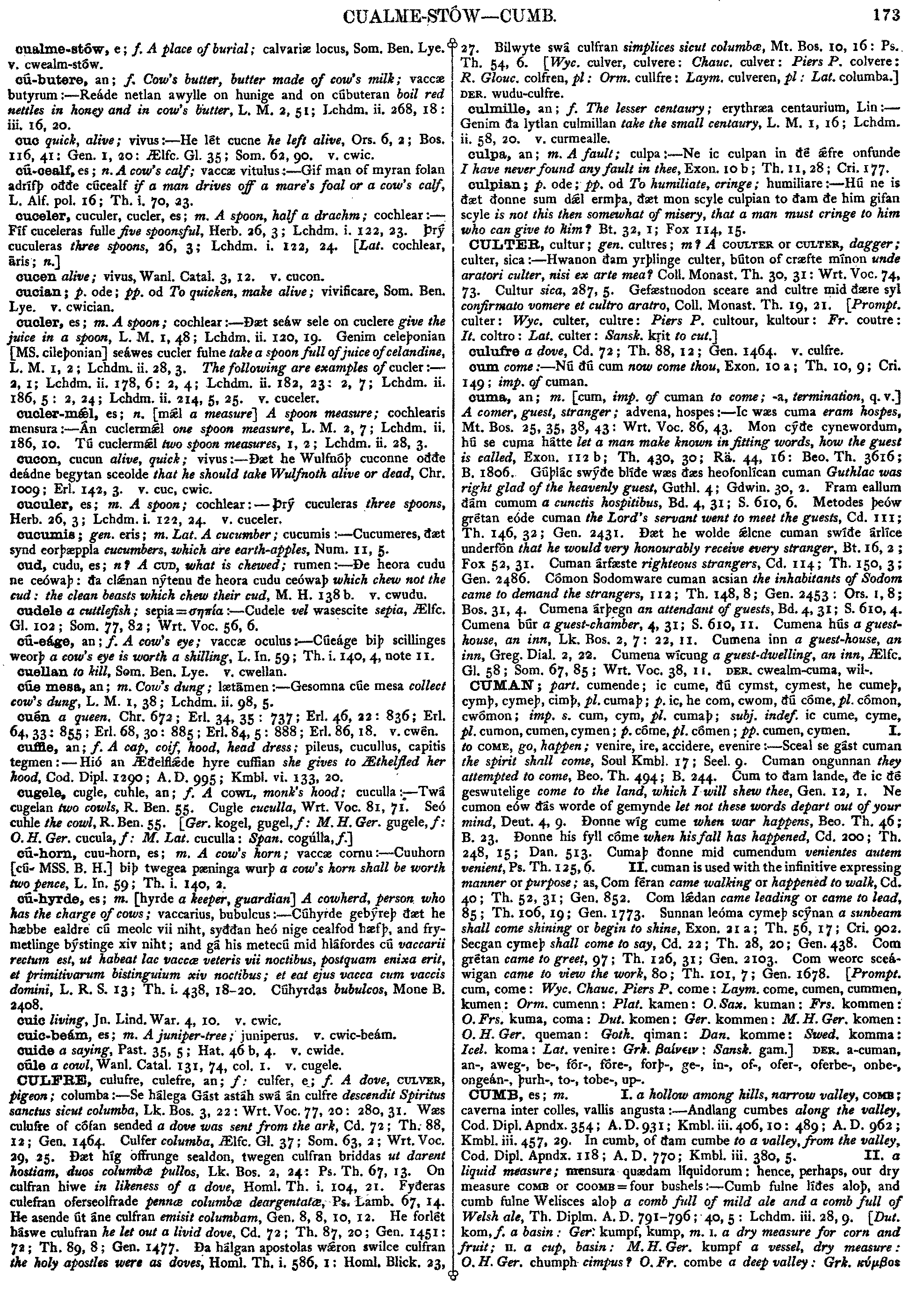
cuma,
an;
m.
[cum,
imp.
of
cuman
to
come;
-a,
termination,
q.
v.]
A
comer,
guest,
stranger;
advena,
hospes
:--
Ic
wæs
cuma
eram
hospes,
Mt.
Bos.
25,
35,
38,
43:
Wrt.
Voc.
86,
43.
Mon
cýðe
cynewordum,
hú
se
cuma
hátte
let
a
man
make
known
in
fitting
words,
how
the
guest
is
called,
Exon.
112b;
Th.
430,
30;
Rä.
44,
16:
Beo.
Th.
3616;
B.
1806.
Gúþlác
swýðe
blíðe
wæs
ðæs
heofonlícan
cuman
Guthlac
was
right
glad
of
the
heavenly
guest,
Guthl.
4;
Gdwin.
30,
2.
Fram
eallum
ðám
cumum
UNCERTAIN
a
cunctis
hospitibus,
Bd.
4,
31;
S.
610,
6.
Metodes
þeów
grétan
eóde
cuman
the
Lord's
servant
went
to
meet
the
guests,
Cd.
111;
Th.
146,
32;
Gen.
2431.
Ðæt
he
wolde
lcne
cuman
swíde
árlíce
underfón
that
he
would
very
honourably
receive
every
stranger,
Bt.
16,
2;
Fox
52,
31.
Cuman
árfæste
righteous
strangers,
Cd.
114;
Th.
150,
3;
Gen.
2486.
Cómon
Sodomware
cuman
acsian
the
inhabitants
of
Sodom
came
to
demand
the
strangers,
112;
Th.
148,
8;
Gen.
2453:
Ors.
l,
8;
Bos.
31,
4.
Cumena
árþegn
an
attendant
of
guests,
Bd.
4,
31;
S.
610,
4.
Cumena
búr
a
guest-chamber,
4,
31;
S.
610,
11.
Cumena
inn
a
guesthouse,
an
inn,
Lk.
Bos.
2,
7:
22,
11.
Cumena
inn
a
guest-house,
an
inn,
Greg.
Dial.
2,
22.
Cumena
wícung
a
guest-dwelling,
an
inn,
Ælfc.
Gl.
58;
Som.
67,
85;
Wrt.
Voc.
38,
11.
DER.
cwealm-cuma,
wil-.
|
Source: Bosworth/Toller, page b0174, entry 38 View original page image as: [TIFF] [PNG] [View previous entry] [View next entry] |
[Comment on this entry] [View comments (1)] |
The following entry has been hand-corrected once. |
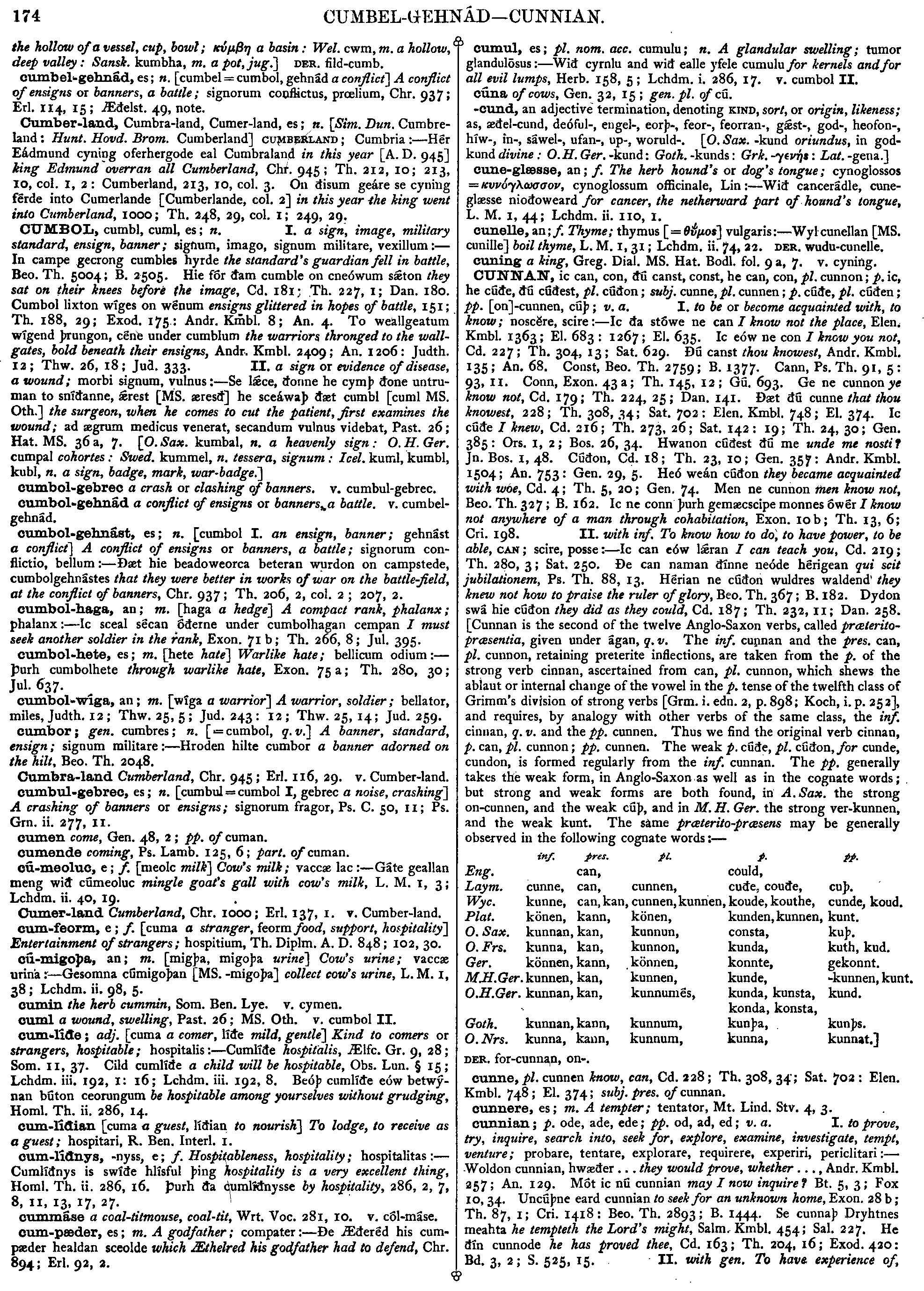
cunnian; p. ode, ade, ede; pp. od, ad, ed; v. a. I. to prove, try, inquire, search into, seek for, explore, examine, investigate, tempt, venture; probare, tentare, explorare, requirere, experiri, periclitari :-- Woldon cunnian, hwæðer. . . they would prove, whether. . . , Andr. Kmbl. 257; An. 129. Mót ic nú cunnian may I now inquire? Bt. 5, 3; Fox 10, 34. Uncúþne eard cunnian to seek for an unknown home, Exon. 28b; Th. 87, 1; Cri. 1418: Beo. Th. 2893; B. 1444. Se cunnaþ Dryhtnes meahta he tempteth the Lord's might, Salm. Kmbl. 454; Sal. 227. He ðín cunnode he has proved thee, Cd. 163; Th. 204, 16; Exod. 420: Bd. 3, 2; S. 525, 15. II. with gen. To have, experience of,
|
Source: Bosworth/Toller, page b0176, entry 28 View original page image as: [TIFF] [PNG] [View previous entry] [View next entry] |
[Comment on this entry] [View comments] |
The following entry has been hand-corrected once. |
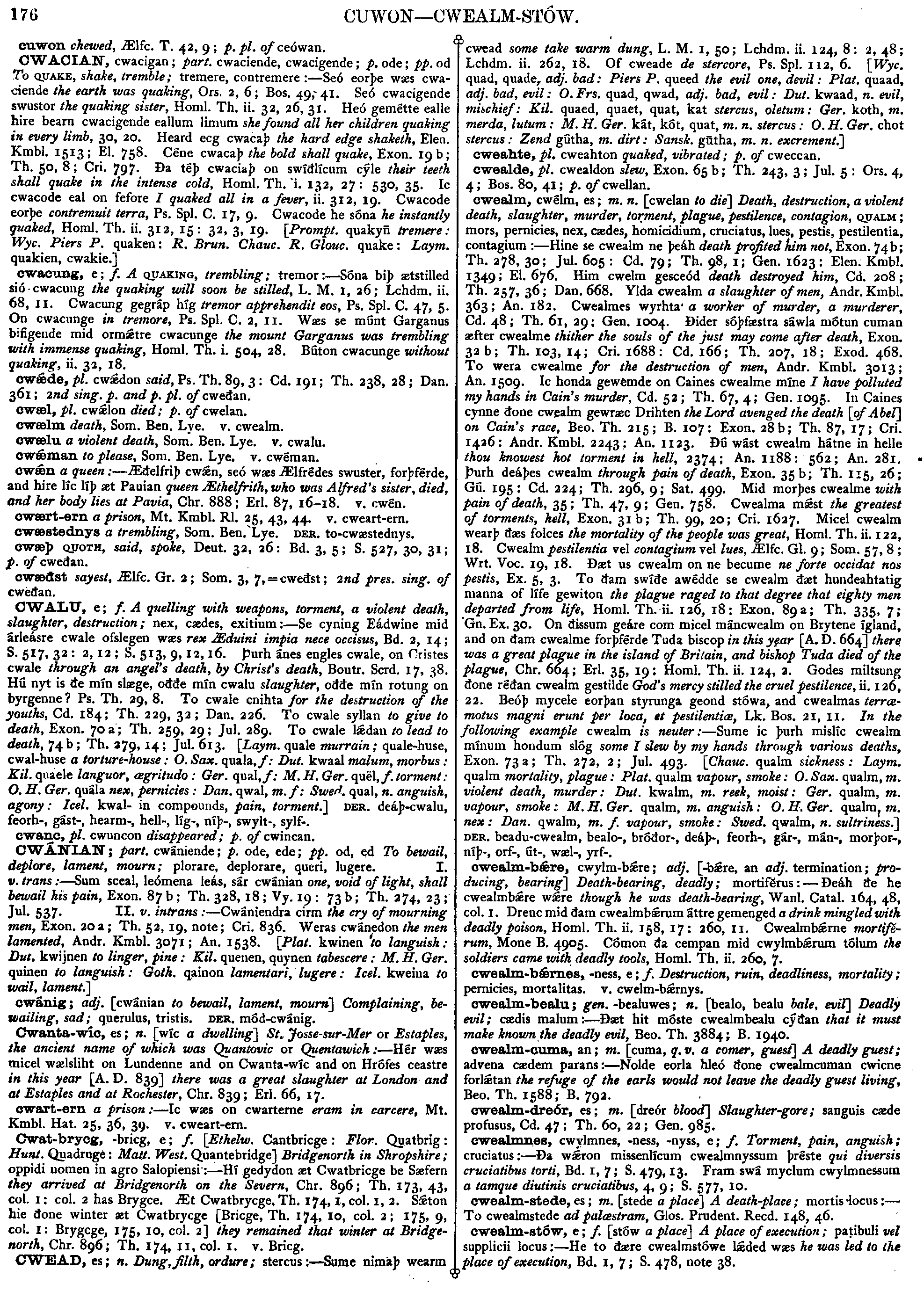
cwealm-cuma,
an;
m.
[cuma,
q.
v.
a
comer,
guest]
A
deadly
guest;
advena
cædem
parans
:--
Nolde
eorla
hleó
ðone
cwealmcuman
cwicne
forltan
the
refuge
of
the
earls
would
not
leave
the
deadly
guest
living,
Beo.
Th.
1588;
B.
792.
| Result Page: |  |
Previous | 1 2 3 4 5 6 7 8 9 10 11 12 13 14 15 16 17 18 | Next |  |
Germanic Lexicon Project (main page)
This search system was written by
Sean Crist
Please consider
volunteering
to correct the data in these online dictionaries.
No rights reserved. Feel free to use these data in any way you please.