|
|

|
Source: Bosworth/Toller, page b0598, entry 22 View original page image as: [TIFF] [PNG] [View previous entry] [View next entry] |
[Comment on this entry] [View comments] |
The following entry has been hand-corrected once. |
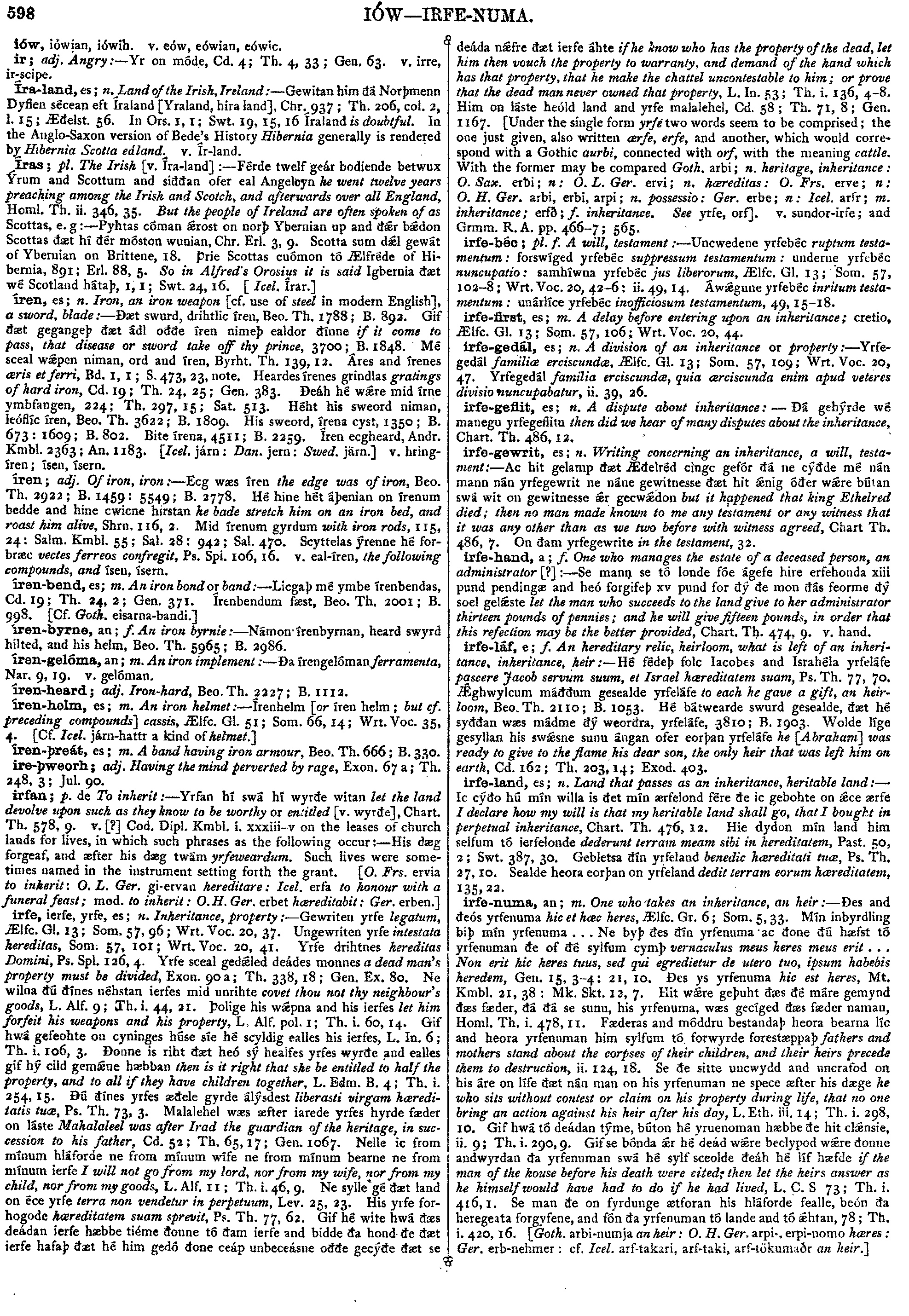
irfe-láf,
e;
f.
An
hereditary
relic,
heirloom,
what
is
left
of
an
inheritance,
inheritance,
heir
:--
Hé
fédeþ
folc
Iacobes
and
Israhéla
yrfeláfe
pascere
Jacob
servum
suum,
et
Israel
hæreditatem
suam,
Ps.
Th.
77,
70.
Æ-acute;ghwylcum
máððum
gesealde
yrfeláfe
to
each
he
gave
a
gift,
an
heirloom,
Beo.Th.
2110;
B.
1053.
Hé
bátwearde
swurd
gesealde,
ðæt
hé
syððan
wæs
mádme
ðý
weorðra,
yrfeláfe,
3810;
B.
1903.
Wolde
líge
gesyllan
his
sw sne
sunu
ángan
ofer
eorþan
yrfeláfe
he
[Abraham]
was
ready
to
give
to
the
flame,
his
dear
son,
the
only
heir
that
was
left
him
on
earth,
Cd.
162;
Th.
203,
14
;
Exod.
403.
sne
sunu
ángan
ofer
eorþan
yrfeláfe
he
[Abraham]
was
ready
to
give
to
the
flame,
his
dear
son,
the
only
heir
that
was
left
him
on
earth,
Cd.
162;
Th.
203,
14
;
Exod.
403.
|
Source: Bosworth/Toller, page b0602, entry 20 View original page image as: [TIFF] [PNG] [View previous entry] [View next entry] |
[Comment on this entry] [View comments] |
The following entry has been hand-corrected once. |
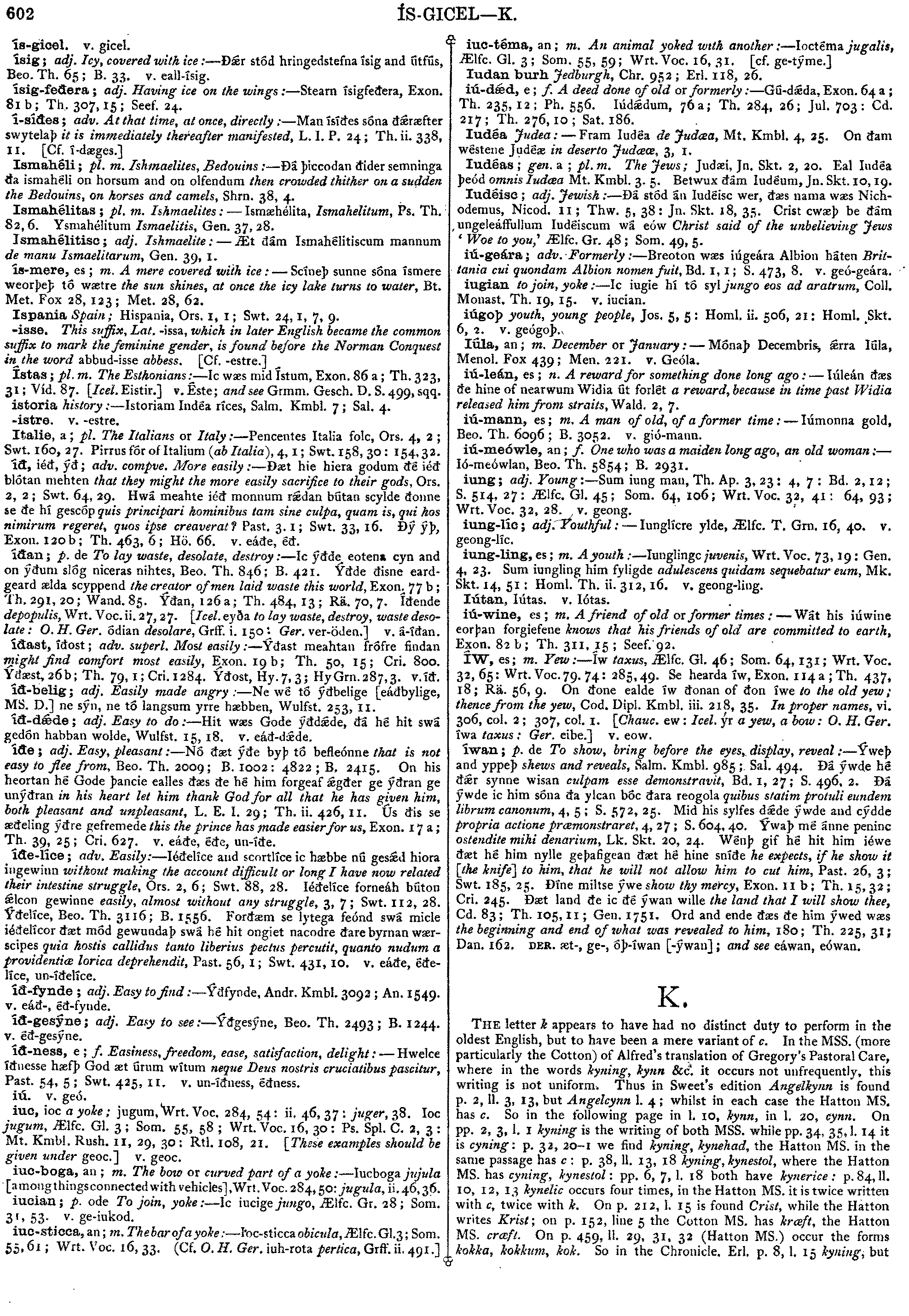
íð-dde;
adj.
Easy
to
do
:--
Hit
wæs
Gode
ýðdde,
ðá
hé
hit
swá
gedón
habban
wolde,
Wulfst.
15,
18.
v.
eáð-dde.
|
Source: Bosworth/Toller, page b0603, entry 7 View original page image as: [TIFF] [PNG] [View previous entry] [View next entry] |
[Comment on this entry] [View comments] |
The following entry has been hand-corrected once. |
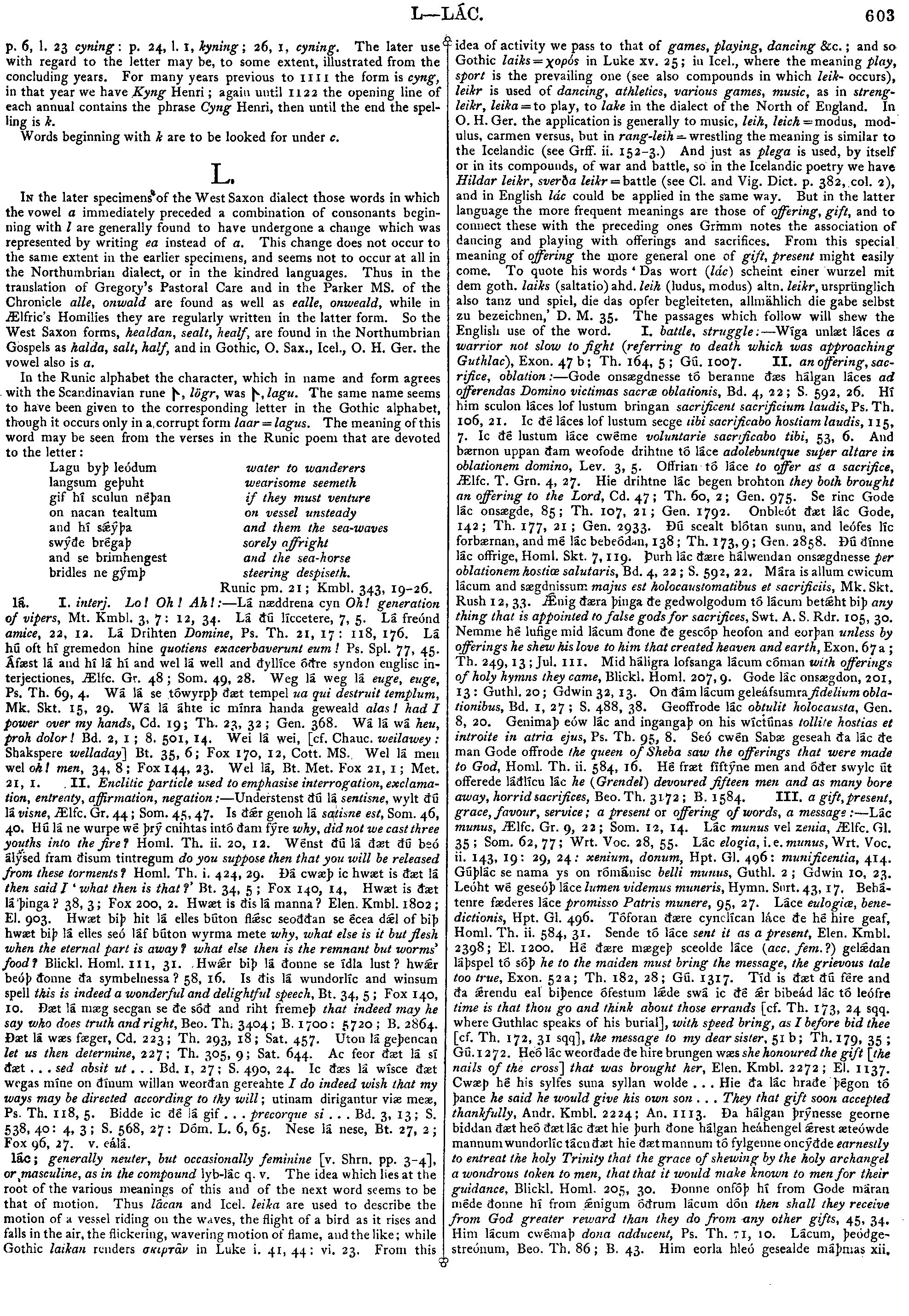
idea
of
activity
we
pass
to
that
of
games,
playing,
dancing
&c.
;
and
so
Gothic
laiks
=
 o
o &omicron-tonos;s
in
Luke
xv.
25;
in
Icel.,
where
the
meaning
play,
sport
is
the
prevailing
one
(see
also
compounds
in
which
leik-
occurs),
leikr
is
used
of
dancing,
athletics,
various
games,
music,
as
in
strengleikr,
leika
=
to
play,
to
lake
in
the
dialect
of
the
North
of
England.
In
O.
H.
Ger.
the
application
is
generally
to
music,
leih,
leich
=
modus,
modulus,
carmen
versus,
but
in
rang-leih
=
wrestling
the
meaning
is
similar
to
the
Icelandic
(see
Grff.
ii.
152-3.)
And
just
as
plega
is
used,
by
itself
or
in
its
compounds,
of
war
and
battle,
so
in
the
Icelandic
poetry
we
have
Hildar
leikr,
sverða
leikr
=
battle
(see
Cl.
and
Vig.
Dict.
p.
382,
col.
2),
and
in
English
lác
could
be
applied
in
the
same
way.
But
in
the
latter
language
the
more
frequent
meanings
are
those
of
offering,
gift,
and
to
connect
these
with
the
preceding
ones
Grimm
notes
the
association
of
dancing
and
playing
with
offerings
and
sacrifices.
From
this
special,
meaning
of
offering
the
more
general
one
of
gift,
present
might
easily
come.
To
quote
his
words
'Das
wort
(lác)
scheint
einer
wurzel
mit
dem
goth.
laiks
(saltatio)
ahd.
leih
(ludus,
modus)
altn.
leikr,
ursprünglich
also
tanz
and
spiel,
die
das
oper
begleiteten,
allmählich
die
gabe
selbst
zu
bezeichnen,'
D.
M.
35.
The
passages
which
follow
will
shew
the
English
use
of
the
word.
I.
battle,
struggle
:--
Wíga
unlæt
láces
a
warrior
not
slow
to
fight
(referring
to
death
which
was
approaching
Guthlac),
Exon.
47
b;
Th.
164,
5;
Gú.
1007.
II.
an
offering,
sacrifice,
oblation
:--
Gode
onsægdnesse
tó
beranne
ðæs
hálgan
láces
ad
offerendas
Domino
victimas
sacræ
oblationis,
Bd.
4,
22;
S.
592,
26.
Hí
him
sculon
láces
lof
lustum
bringan
sacrificent
sacrificium
laudis,
Ps.
Th.
106,
21.
Ic
ðé
láces
lof
lustum
secge
tibi
sacrificabo
hostiam
laudis,
115,
7.
Ic
ðé
lustum
láce
cwéme
voluntarie
sacrificabo
tibi,
53,
6.
And
bærnon
uppan
ðam
weofode
drihtne
tó
láce
adolebuntque
super
altare
in
oblationem
domino,
Lev.
3,
5.
Offrian
tó
láce
to
offer
as
a
sacrifice,
Ælfc.
T.
Grn.
4,
27.
Hie
drihtne
lác
begen
brohton
they
both
brought
an
offering
to
the
Lord,
Cd.
47;
Th.
60,
2;
Gen.
975.
Se
rinc
Gode
lác
onsægde,
85;
Th.
107,
21;
Gen.
1792.
Onbleót
ðæt
lác
Gode,
142;
Th.
177,
21;
Gen.
2933.
Ðú
scealt
blótan
sunu,
and
leófes
lác
forbærnan,
and
mé
lác
bebeódan,
138;
Th.
173,
9;
Gen.
2858.
Ðú
ðínne
lác
offrige,
Homl.
Skt.
7,
119.
Þurh
lác
ðære
hálwendan
onsægdnesse
per
oblationem
hostiæ
salutaris,
Bd.
4,
22;
S.
592,
22.
Mára
is
allum
cwicum
lácum
and
sægdnissum
majus
est
holocaustomatibus
et
sacrificiis,
Mk.
Skt.
Rush
12,
33.
Æ-acute;nig
ðæra
þinga
ðe
gedwolgodum
tó
lácum
betht
biþ
any
thing
that
is
appointed
to
false
gods
for
sacrifices,
Swt.
A.
S.
Rdr.
105,
30.
Nemme
hé
lufige
mid
lácum
ðone
ðe
gescóp
heofon
and
eorþan
unless
by
offerings
he
shew
his
love
to
him
that
created
heaven
and
earth,
Exon.
67
a;
Th.
249,
13;
Jul.
111.
Mid
háligra
lofsanga
lácum
cóman
with
offerings
of
holy
hymns
they
came,
Blickl.
Homl.
207,
9.
Gode
lác
onsægdon,
201,
13:
Guthl.
20;
Gdwin
32,
13.
On
ðám
lácum
geleáfsumra
fidelium
oblationibus,
Bd.
1,
27;
S.
488,
38.
Geoffrode
lác
obtulit
holocausta,
Gen.
8,
20.
Genimaþ
eów
lác
and
ingangaþ
on
his
wíctúnas
tollite
hostias
et
introite
in
atria
ejus,
Ps.
Th.
95,
8.
Seó
cwén
Sabæ
geseah
ða
lác
ðe
man
Gode
offrode
the
queen
of
Sheba
saw
the
offerings
that
were
made
to
God,
Homl.
Th.
ii.
584,
16.
Hé
fræt
fíftýne
men
and
óðer
swylc
út
offerede
láðlícu
lác
he
(Grendel)
devoured
fifteen
men
and
as
many
bore
away,
horrid
sacrifices,
Beo.
Th.
3172;
B.
1584.
III.
a
gift,
present,
grace,
favour,
service;
a
present
or
offering
of
words,
a
message
:--
Lác
munus,
Ælfc.
Gr.
9,
22;
Som.
12,
14.
Lác
munus
vel
zenia,
Ælfc.
Gl.
35;
Som.
62,
77;
Wrt.
Voc.
28,
55.
Lác
elogia,
i.e.
munus,
Wrt.
Voc.
ii.
143,
19:
29,
24:
xenium,
donum,
Hpt.
Gl.
496:
munificentia,
414.
Gúþlác
se
nama
ys
on
rómánisc
belli
munus,
Guthl.
2;
Gdwin
10,
23.
Leóht
wé
geseóþ
láce
lumen
videmus
muneris,
Hymn.
Surt.
43,
17,
Behátenre
fæderes
láce
promisso
Patris
munere,
95,
27.
Láce
eulogiæ,
benedictionis,
Hpt.
Gl.
496.
Tóforan
ðære
cynclícan
láce
ðe
hé
hire
geaf,
Homl.
Th.
ii.
584,
31.
Sende
tó
láce
sent
it
as
a
present,
Elen.
Kmbl.
2398;
El.
1200.
Hé
ðære
mægeþ
sceolde
láce
(acc.
fem.?)
geldan
láþspel
tó
sóþ
he
to
the
maiden
must
bring
the
message,
the
grievous
tale
too
true,
Exon.
52
a;
Th.
182,
28;
Gú.
1317.
Tíd
is
ðæt
ðú
fére
and
ða
rendu
eal
biþence
ófestum
lde
swá
ic
ðé
r
bibeád
lác
tó
leófre
time
is
that
thou
go
and
think
about
those
errands
[cf.
Th.
173,
24
sqq.
where
Guthlac
speaks
of
his
burial],
with
speed
bring,
as
I
before
bid
thee
[cf.
Th.
172,
31
sqq],
the
message
to
my
dear
sister,
51
b;
Th.
179,
35;
Gú.1272.
Heó
lác
weorðade
ðe
hire
brungen
wæs
she
honoured
the
gift
[the
nails
of
the
cross]
that
was
brought
her,
Elen.
Kmbl.
2272;
El.
1137.
Cwæþ
hé
his
sylfes
suna
syllan
wolde
...
Hie
ða
lác
hraðe
þégon
tó
þance
he
said
he
would
give
his
own
son
...
They
that
gift
soon
accepted
thankfully,
Andr.
Kmbl.
2224;
An.
1113.
Ða
hálgan
þrýnesse
georne
biddan
ðæt
heó
ðæt
lác
ðæt
hie
þurh
ðone
hálgan
heáhengel
rest
æteówde
mannum
wundorlíc
tácn
ðæt
hie
ðæt
mannum
tó
fylgenne
oncýðde
earnestly
to
entreat
the
holy
Trinity
that
the
grace
of
shewing
by
the
holy
archangel
a
wondrous
token
to
men,
that
that
it
would
make
known
to
men
for
their
guidance,
Blickl.
Homl.
205,
30.
Ðonne
onfóþ
hí
from
Gode
máran
méde
ðonne
hí
from
nigum
óðrum
lácum
dón
then
shall
they
receive
from
God
greater
reward
than
they
do
from
any
other
gifts,
45.
34.
Him
lácum
cwémaþ
dona
adducent,
Ps.
Th.
72,
10.
Lácum,
þeódgestreónum,
Beo.
Th.
86;
B.
43.
Him
eorla
hleó
gesealde
máþmas
xii.
het
hine
mid
ðæm
lácum
leóde
secean,
3740;
B.
1868.
Culufre
gewát
fleógan
eft
mid
lácum
hire
(the
olive
branch),
Cd.
72;
Th.
88,
28;
Gen.
1472.
Hí
geopenodon
heora
hordfatu
and
him
lác
geoffrodon
gold
and
récels
and
myrram
they
opened
their
treasures,
and
presented
unto
him
gifts;
gold,
and
frankincense,
and
myrrh
[Mt.
2,
11],
Homl.
Th
i.
78,
27.
Lác
gifan.
Exon.
100
b;
Th.
380,
2;
Rä.
1,
1.
Bringan
lác
and
luftácen
to
bring
gifts
and
love-tokens,
Beo.
Th.
3730;
B.
1863.
Lc
munera,
Ps.
Spl.
T.
14,
6.
IV.
medicine
:--
Heofendlícere
láe
[
=
heofenlícere
láce]
cælestis
medicinæ,
Hpt.
Gl.
415,
36.
Lác
medicamine,
507,
77.
Lác
medicamenti,
527,18.
[Laym.1st
MS.
lac,
2nd
MS.
lock
gift:
Orm.
lac
a
sacrifice,
offering
Gen.
a.
Ex.
loac;
Piers
P.
laik
a
game.]
v.
ag-,
fen-,
beadu-,
berne-,
brýd-,
cwic-,
feoht-,
freó-,
ge-,
hmed-,
heaðu-,
lyb-,
mæsse-,
reáf-,
s-,
scín-,
wed-,
wíf-,
wíte-lác.
It
also
occurs
in
proper
names,
e.g.
Gúþ-lác,
Hyge-lác.
&omicron-tonos;s
in
Luke
xv.
25;
in
Icel.,
where
the
meaning
play,
sport
is
the
prevailing
one
(see
also
compounds
in
which
leik-
occurs),
leikr
is
used
of
dancing,
athletics,
various
games,
music,
as
in
strengleikr,
leika
=
to
play,
to
lake
in
the
dialect
of
the
North
of
England.
In
O.
H.
Ger.
the
application
is
generally
to
music,
leih,
leich
=
modus,
modulus,
carmen
versus,
but
in
rang-leih
=
wrestling
the
meaning
is
similar
to
the
Icelandic
(see
Grff.
ii.
152-3.)
And
just
as
plega
is
used,
by
itself
or
in
its
compounds,
of
war
and
battle,
so
in
the
Icelandic
poetry
we
have
Hildar
leikr,
sverða
leikr
=
battle
(see
Cl.
and
Vig.
Dict.
p.
382,
col.
2),
and
in
English
lác
could
be
applied
in
the
same
way.
But
in
the
latter
language
the
more
frequent
meanings
are
those
of
offering,
gift,
and
to
connect
these
with
the
preceding
ones
Grimm
notes
the
association
of
dancing
and
playing
with
offerings
and
sacrifices.
From
this
special,
meaning
of
offering
the
more
general
one
of
gift,
present
might
easily
come.
To
quote
his
words
'Das
wort
(lác)
scheint
einer
wurzel
mit
dem
goth.
laiks
(saltatio)
ahd.
leih
(ludus,
modus)
altn.
leikr,
ursprünglich
also
tanz
and
spiel,
die
das
oper
begleiteten,
allmählich
die
gabe
selbst
zu
bezeichnen,'
D.
M.
35.
The
passages
which
follow
will
shew
the
English
use
of
the
word.
I.
battle,
struggle
:--
Wíga
unlæt
láces
a
warrior
not
slow
to
fight
(referring
to
death
which
was
approaching
Guthlac),
Exon.
47
b;
Th.
164,
5;
Gú.
1007.
II.
an
offering,
sacrifice,
oblation
:--
Gode
onsægdnesse
tó
beranne
ðæs
hálgan
láces
ad
offerendas
Domino
victimas
sacræ
oblationis,
Bd.
4,
22;
S.
592,
26.
Hí
him
sculon
láces
lof
lustum
bringan
sacrificent
sacrificium
laudis,
Ps.
Th.
106,
21.
Ic
ðé
láces
lof
lustum
secge
tibi
sacrificabo
hostiam
laudis,
115,
7.
Ic
ðé
lustum
láce
cwéme
voluntarie
sacrificabo
tibi,
53,
6.
And
bærnon
uppan
ðam
weofode
drihtne
tó
láce
adolebuntque
super
altare
in
oblationem
domino,
Lev.
3,
5.
Offrian
tó
láce
to
offer
as
a
sacrifice,
Ælfc.
T.
Grn.
4,
27.
Hie
drihtne
lác
begen
brohton
they
both
brought
an
offering
to
the
Lord,
Cd.
47;
Th.
60,
2;
Gen.
975.
Se
rinc
Gode
lác
onsægde,
85;
Th.
107,
21;
Gen.
1792.
Onbleót
ðæt
lác
Gode,
142;
Th.
177,
21;
Gen.
2933.
Ðú
scealt
blótan
sunu,
and
leófes
lác
forbærnan,
and
mé
lác
bebeódan,
138;
Th.
173,
9;
Gen.
2858.
Ðú
ðínne
lác
offrige,
Homl.
Skt.
7,
119.
Þurh
lác
ðære
hálwendan
onsægdnesse
per
oblationem
hostiæ
salutaris,
Bd.
4,
22;
S.
592,
22.
Mára
is
allum
cwicum
lácum
and
sægdnissum
majus
est
holocaustomatibus
et
sacrificiis,
Mk.
Skt.
Rush
12,
33.
Æ-acute;nig
ðæra
þinga
ðe
gedwolgodum
tó
lácum
betht
biþ
any
thing
that
is
appointed
to
false
gods
for
sacrifices,
Swt.
A.
S.
Rdr.
105,
30.
Nemme
hé
lufige
mid
lácum
ðone
ðe
gescóp
heofon
and
eorþan
unless
by
offerings
he
shew
his
love
to
him
that
created
heaven
and
earth,
Exon.
67
a;
Th.
249,
13;
Jul.
111.
Mid
háligra
lofsanga
lácum
cóman
with
offerings
of
holy
hymns
they
came,
Blickl.
Homl.
207,
9.
Gode
lác
onsægdon,
201,
13:
Guthl.
20;
Gdwin
32,
13.
On
ðám
lácum
geleáfsumra
fidelium
oblationibus,
Bd.
1,
27;
S.
488,
38.
Geoffrode
lác
obtulit
holocausta,
Gen.
8,
20.
Genimaþ
eów
lác
and
ingangaþ
on
his
wíctúnas
tollite
hostias
et
introite
in
atria
ejus,
Ps.
Th.
95,
8.
Seó
cwén
Sabæ
geseah
ða
lác
ðe
man
Gode
offrode
the
queen
of
Sheba
saw
the
offerings
that
were
made
to
God,
Homl.
Th.
ii.
584,
16.
Hé
fræt
fíftýne
men
and
óðer
swylc
út
offerede
láðlícu
lác
he
(Grendel)
devoured
fifteen
men
and
as
many
bore
away,
horrid
sacrifices,
Beo.
Th.
3172;
B.
1584.
III.
a
gift,
present,
grace,
favour,
service;
a
present
or
offering
of
words,
a
message
:--
Lác
munus,
Ælfc.
Gr.
9,
22;
Som.
12,
14.
Lác
munus
vel
zenia,
Ælfc.
Gl.
35;
Som.
62,
77;
Wrt.
Voc.
28,
55.
Lác
elogia,
i.e.
munus,
Wrt.
Voc.
ii.
143,
19:
29,
24:
xenium,
donum,
Hpt.
Gl.
496:
munificentia,
414.
Gúþlác
se
nama
ys
on
rómánisc
belli
munus,
Guthl.
2;
Gdwin
10,
23.
Leóht
wé
geseóþ
láce
lumen
videmus
muneris,
Hymn.
Surt.
43,
17,
Behátenre
fæderes
láce
promisso
Patris
munere,
95,
27.
Láce
eulogiæ,
benedictionis,
Hpt.
Gl.
496.
Tóforan
ðære
cynclícan
láce
ðe
hé
hire
geaf,
Homl.
Th.
ii.
584,
31.
Sende
tó
láce
sent
it
as
a
present,
Elen.
Kmbl.
2398;
El.
1200.
Hé
ðære
mægeþ
sceolde
láce
(acc.
fem.?)
geldan
láþspel
tó
sóþ
he
to
the
maiden
must
bring
the
message,
the
grievous
tale
too
true,
Exon.
52
a;
Th.
182,
28;
Gú.
1317.
Tíd
is
ðæt
ðú
fére
and
ða
rendu
eal
biþence
ófestum
lde
swá
ic
ðé
r
bibeád
lác
tó
leófre
time
is
that
thou
go
and
think
about
those
errands
[cf.
Th.
173,
24
sqq.
where
Guthlac
speaks
of
his
burial],
with
speed
bring,
as
I
before
bid
thee
[cf.
Th.
172,
31
sqq],
the
message
to
my
dear
sister,
51
b;
Th.
179,
35;
Gú.1272.
Heó
lác
weorðade
ðe
hire
brungen
wæs
she
honoured
the
gift
[the
nails
of
the
cross]
that
was
brought
her,
Elen.
Kmbl.
2272;
El.
1137.
Cwæþ
hé
his
sylfes
suna
syllan
wolde
...
Hie
ða
lác
hraðe
þégon
tó
þance
he
said
he
would
give
his
own
son
...
They
that
gift
soon
accepted
thankfully,
Andr.
Kmbl.
2224;
An.
1113.
Ða
hálgan
þrýnesse
georne
biddan
ðæt
heó
ðæt
lác
ðæt
hie
þurh
ðone
hálgan
heáhengel
rest
æteówde
mannum
wundorlíc
tácn
ðæt
hie
ðæt
mannum
tó
fylgenne
oncýðde
earnestly
to
entreat
the
holy
Trinity
that
the
grace
of
shewing
by
the
holy
archangel
a
wondrous
token
to
men,
that
that
it
would
make
known
to
men
for
their
guidance,
Blickl.
Homl.
205,
30.
Ðonne
onfóþ
hí
from
Gode
máran
méde
ðonne
hí
from
nigum
óðrum
lácum
dón
then
shall
they
receive
from
God
greater
reward
than
they
do
from
any
other
gifts,
45.
34.
Him
lácum
cwémaþ
dona
adducent,
Ps.
Th.
72,
10.
Lácum,
þeódgestreónum,
Beo.
Th.
86;
B.
43.
Him
eorla
hleó
gesealde
máþmas
xii.
het
hine
mid
ðæm
lácum
leóde
secean,
3740;
B.
1868.
Culufre
gewát
fleógan
eft
mid
lácum
hire
(the
olive
branch),
Cd.
72;
Th.
88,
28;
Gen.
1472.
Hí
geopenodon
heora
hordfatu
and
him
lác
geoffrodon
gold
and
récels
and
myrram
they
opened
their
treasures,
and
presented
unto
him
gifts;
gold,
and
frankincense,
and
myrrh
[Mt.
2,
11],
Homl.
Th
i.
78,
27.
Lác
gifan.
Exon.
100
b;
Th.
380,
2;
Rä.
1,
1.
Bringan
lác
and
luftácen
to
bring
gifts
and
love-tokens,
Beo.
Th.
3730;
B.
1863.
Lc
munera,
Ps.
Spl.
T.
14,
6.
IV.
medicine
:--
Heofendlícere
láe
[
=
heofenlícere
láce]
cælestis
medicinæ,
Hpt.
Gl.
415,
36.
Lác
medicamine,
507,
77.
Lác
medicamenti,
527,18.
[Laym.1st
MS.
lac,
2nd
MS.
lock
gift:
Orm.
lac
a
sacrifice,
offering
Gen.
a.
Ex.
loac;
Piers
P.
laik
a
game.]
v.
ag-,
fen-,
beadu-,
berne-,
brýd-,
cwic-,
feoht-,
freó-,
ge-,
hmed-,
heaðu-,
lyb-,
mæsse-,
reáf-,
s-,
scín-,
wed-,
wíf-,
wíte-lác.
It
also
occurs
in
proper
names,
e.g.
Gúþ-lác,
Hyge-lác.
|
Source: Bosworth/Toller, page b0604, entry 6 View original page image as: [TIFF] [PNG] [View previous entry] [View next entry] |
[Comment on this entry] [View comments] |
The following entry has been hand-corrected once. |
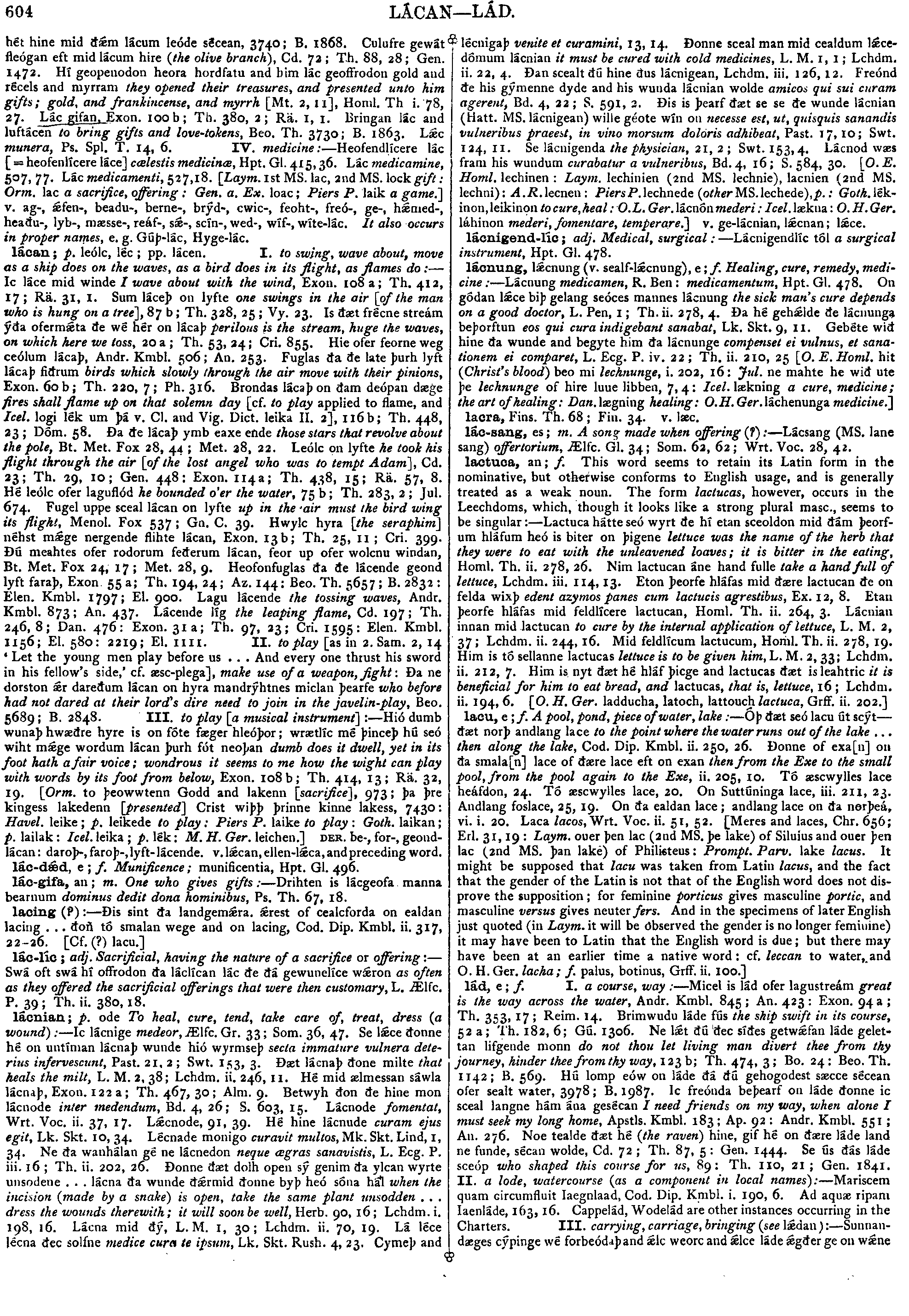
lácnian;
p.
ode
To
heal,
cure,
tend,
take
care
of,
treat,
dress
(a
wound)
:--
Ic
lácnige
medeor,
Ælfc.
Gr.
33;
Som.
36,
47.
Se
lce
ðonne
hé
on
untíman
lácnaþ
wunde
hió
wyrmseþ
secta
immature
vulnera
deterius
infervescunt,
Past.
21,
2;
Swt.
153,
3.
Ðæt
lácnaþ
ðone
milte
that
heals
the
milt,
L.
M.
2,
38;
Lchdm.
ii.
246,
11.
Hé
mid
ælmessan
sáwla
lácnaþ,
Exon.
122
a;
Th.
467,
30;
Alm.
9.
Betwyh
ðon
ðe
hine
mon
lácnode
inter
medendum,
Bd.
4,
26;
S.
603,
15.
Lácnode
fomentat,
Wrt.
Voc.
ii.
37,
17.
Lcnode,
91,
39.
Hé
hine
lácnude
curam
ejus
egit,
Lk.
Skt.
10,
34.
Lécnade
monigo
curavit
multos,
Mk.
Skt.
Lind,
1,
34.
Ne
ða
wanhálan
gé
ne
lácnedon
neque
ægras
sanavistis,
L.
Ecg.
P.
iii.
16;
Th.
ii.
202,
26.
Ðonne
ðæt
dolh
open
sý
genial
ða
ylcan
wyrte
unsodene
...
lácna
ða
wunde
ðrmid
ðonne
byþ
heó
sóna
hál
when
the
incision
(made
by
a
snake)
is
open,
take
the
same
plant
unsodden
...
dress
the
wounds
therewith;
it
will
soon
be
well,
Herb.
90,
16;
Lchdm.
i.
198,
16.
Lácna
mid
ðý,
L.
M.
1,
30;
Lchdm.
ii.
70,
19.
Lá
léce
lécna
ðec
solfne
medice
cura
te
ipsum,
Lk.
Skt.
Rush.
4,
23.
Cymeþ
and
lécnigaþ
venite
et
curamini,
13,
14.
Ðonne
sceal
man
mid
cealdum
lcedómum
lácnian
it
must
be
cured
with
cold
medicines,
L.
M.
1,
1;
Lchdm.
ii.
22,
4.
Ðan
scealt
ðú
hine
ðus
lácnigean,
Lchdm.
iii.
126,
12.
Freónd
ðe
his
gýmenne
dyde
and
his
wunda
lácnian
wolde
amicos
qui
sui
curam
agerent,
Bd.
4,
22;
S.
591,
2.
Ðis
is
þearf
ðæt
se
se
ðe
wunde
lácnian
(Hatt.
MS.
lácnigean)
wille
géote
wín
on
necesse
est,
ut,
quisquis
sanandis
vulneribus
praeest,
in
vino
morsum
doloris
adhibeat,
Past.
17,
10;
Swt.
124,
11.
Se
lácnigenda
the
physician,
21,
2;
Swt.
153,
4.
Lácnod
wæs
fram
his
wundum
curabatur
a
vulneribus,
Bd.
4,
16;
S.
584,
30.
[O.
E.
Homl.
lechinen:
Laym.
lechinien
(2nd
MS.
lechnie),
lacnien
(2nd
MS.
lechni):
A.
R.
lecnen:
Piers
P.
lechnede
(other
MS.
lechede),
p.:
Goth.
lékinon,
leikinon
to
cure,
heal:
O.
L.
Ger.
lácnón
mederi:
Icel.
lækna:
O.
H.
Ger.
láhinon
mederi,
fomentare,
temperare.]
v.
ge-lácnian,
lcnan;
lce.
|
Source: Bosworth/Toller, page b0604, entry 13 View original page image as: [TIFF] [PNG] [View previous entry] [View next entry] |
[Comment on this entry] [View comments] |
The following entry has been hand-corrected once. |
lád,
e;
f.
I.
a
course,
way
:--
Micel
is
lád
ofer
lagustreám
great
is
the
way
across
the
water,
Andr.
Kmbl.
845;
An.
423:
Exon.
94
a;
Th.
353,
17;
Reim.
14.
Brimwudu
láde
fús
the
ship
swift
in
its
course,
52
a;
Th.
182,
6;
Gú.
1306.
Ne
lt
ðú
ðec
síðes
getwfan
láde
gelettan
lifgende
monn
do
not
thou
let
living
man
divert
thee
from
thy
journey,
hinder
thee
from
thy
way,
123
b;
Th.
474,
3;
Bo.
24:
Beo.
Th.
1142
;
B.
569.
Hú
lomp
eów
on
láde
ðá
ðú
gehogodest
sæcce
sécean
ofer
sealt
water,
3978;
B.
1987.
Ic
freónda
beþearf
on
láde
ðonne
ic
sceal
langne
hám
ána
gesécan
I
need
friends
on
my
way,
when
alone
I
must
seek
my
long
home,
Apstls.
Kmbl.
183;
Ap.
92:
Andr.
Kmbl.
551;
An.
276.
Noe
tealde
ðæt
hé
(the
raven)
hine,
gif
hé
on
ðære
láde
land
ne
funde,
sécan
wolde,
Cd.
72;
Th.
87,
5:
Gen.
1444.
Se
ús
ðás
láde
sceóp
who
shaped
this
course
for
us,
89:
Th.
110,
21;
Gen.
1841.
II.
a
lode,
watercourse
(as
a
component
in
local
names)
:--
Mariscem
quam
circumfluit
Iaegnlaad,
Cod.
Dip.
Kmbl.
i.
190,
6.
Ad
aquæ
ripam
Iaenláde,
163,
16.
Cappelád,
Wodelád
are
other
instances
occurring
in
the
Charters.
III.
carrying,
carriage,
bringing
(see
ldan)
:--
Sunnandæges
cýpinge
wé
forbeódaþand
lc
weorc
and
lce
láde
gðer
ge
on
wne
ge
on
horse
ge
on
byrdene
we
forbid
Sunday
traffic
and
all
work
and
all
carrying
(of
goods,
&c.)
both
by
waggon
and
by
horse
and
by
the
man
himself,
L.
N.
P.
L.
55;
Th.
ii.
298,
22.
[The
word
lád
in
this
passage
can
hardly
be
translated
'journeying
;'
for,
in
the
first
place,
such
a
meaning
does
not
well
suit
the
phrase
on
byrdene,
and,
next,
some
journeying
was
allowed.
Thus,
L.
E.
I.
24;
Th.
ii.
420,
21-,
it
is
said
no
secular
work
was
to
be
done
'bútan
hwam
gebyrige
ðæt
hé
nýde
faran
scyle;
ðonne
mót
hé
swá
rídan
swá
rówan
swá
swilce
færelde
faran
swylce
tó
his
wege
gehyrige.'
The
threefold
division
of
the
means
of
carriage
seems
to
be
that
found
in
the
Icelandic
law
where,
dealing
with
the
observance
of
Sunday,
it
is
said
of
the
amount
that
might
be
carried
in
journeying
on
that
day
'er
rétt
at
bera
á
sjálfum
see
(
=
on
byrdene)
eþa
fara
á
skipi
eþa
bera
á
hrossi.']
On
sumon
hé
sceal
láde
ldan
on
some
lands
the
'genéat'
has
to
furnish
means
of
carriage,
L.
R.
S.
2;
Th.
1.
432,
14.
Cf.
436,
5-6
:--
Hé
sceal
beón
gehorsad
ðæt
hé
mge
tó
hláfordes
seáme
ðæt
syllan
oððe
sylf
ldan.
The
word
used
in
both
cases
in
the
Latin
translation
is
summagium,
in
reference
to
which,
and
to
the
English
words
which
it
translates,
may
be
quoted
Thorpe's
explanation
in
his
glossary:
'Lád,
seám,
summagium.
A
service,
which
consisted
in
supplying
the
lord
with
beasts
of
burthen,
or,
as
defined
by
Roquefort
(voce
somey):
"Service
qu'un
vassal
devoit
à
son
seigneur,
et
qui
consistoit
à
faire
faire
quelques
voyages
par
ses
bêtes
de
somme."
See
Spelman
sub
voce,
and
Du
Cange
voce
Sagma.'
The
phrase
láde
ldan
occurs
in
a
similar
passage,
dealing
with
the
duties
of
the
'geneát;
in
Cod.
Dip.
Kmbl.
iii.
450,
31-
:--
Se
geneát
[at
Dyddanham]
sceal
wyrcan
swá
on
lande,
swá
of
lande,
hweðer
swá
man
být
and
rídan,
and
auerian,
and
láde
ldan,
dráfe
drífan,
and
fela
óðra
þinga
dón.
The
later
English
lode
seems
to
keep
this
meaning.
Thus
Prompt.
Parv.
310,
loode
or
caryage
vectura;
lodysmanne
vector,
lator,
vehicularius:
the
verb
lead
is
found
with
the
sense
of
carry,
e.g.
p.
62
cartyn
or
lede
wythe
a
carte;
and
in
the
note,
and
again
in
a
note
on
p.
293,
we
have
the
phrases
'to
lede
dong,'
'to
lede
wheet,'
&c.
See
also
scip-lád.
IV.
Sustenance,
provision,
means
of
subsistence
:--
Ne
sceal
se
dryhtnes
þeów
in
his
módsefan
máre
gelufian
eorþan
htwelan
ðonne
his
ánes
gemet
ðæt
hé
his
líchoman
láde
hæbbe
nor
shall
the
servant
of
the
Lord
love
more
of
earth's
possessions,
than
a
sufficiency
for
himself,
that
he
may
have
sustenance
for
his
body,
Exon.
38
a;
Th.
125,
27;
Gú.
360.
With
this
use
of
lád
may
be
compared
the
later
English
lif-lode
which,
besides
the
meaning
conduct,
has
that
of
sustenance
:--
Heo
tilede
here
lyflode
...
heo
fonden
hem
sustynance
ynow,
R.
Glouc.
41,
22:
Prompt.
Parv.
lyvelode
victus;
lyflode
or
warysone
donativum.
So
O.
H.
Ger.
líb-leita
victus,
annona,
alimonium.
[In
further
illustration
of
lád
the
following
native
and
foreign
words
are
given.
Orm.
Þe
steoressmann
a lokeþþ
till
an
steorrne
þatt
stannt
a
still
...
forr
þatt
he
wile
follhenn
a
þatt
ilike
steorrness
lade
(guidance);
o
lade
on
the
way:
A.
R.
lode
burthen
(v.
III):
Mod.
E.
lode-star:
Icel.
leið.
I.
a
way,
course,
road.
II.
a
levy:
O.
H.
Ger.
leita,
funus,
ducatus;
pl.
exequiæ;
see
also
compounds
of
leiti,
Grff.
ii.
187].
DER.
brim-,
eá-,
ge-,
in-,
lagu-,
líf-,
mere-,
s-,
scip-,
út-,
ýð-lád.
lokeþþ
till
an
steorrne
þatt
stannt
a
still
...
forr
þatt
he
wile
follhenn
a
þatt
ilike
steorrness
lade
(guidance);
o
lade
on
the
way:
A.
R.
lode
burthen
(v.
III):
Mod.
E.
lode-star:
Icel.
leið.
I.
a
way,
course,
road.
II.
a
levy:
O.
H.
Ger.
leita,
funus,
ducatus;
pl.
exequiæ;
see
also
compounds
of
leiti,
Grff.
ii.
187].
DER.
brim-,
eá-,
ge-,
in-,
lagu-,
líf-,
mere-,
s-,
scip-,
út-,
ýð-lád.
|
Source: Bosworth/Toller, page b0607, entry 7 View original page image as: [TIFF] [PNG] [View previous entry] [View next entry] |
[Comment on this entry] [View comments] |
The following entry has been hand-corrected once. |
lce-dóm,
es;
m.
Medicine,
a
medicine,
remedy,
cure
:--
Lcedóm
medecina,
Wrt.
Voc.
74,
5:
Lchdm.
ii.
16,
9-27.
Lécedom,
Kent.
Gl.
148.
Lcedóm
malagma,
Wrt.
Voc.
ii.
75,
59:
cura,
92,
61.
In
untrymnisse
wæs
ðú
lcedóme
in
infirmitate
sis
medecina,
Rtl.
105,
13.
On
ðare
smyrunge
biþ
lcedóm
and
sinna
forgifnes
and
ne
biþ
ná
hádung
unction
is
medicinal,
and
in
it
there
is
forgiveness
of
sins,
but
there
is
no
ordination,
L.
Ælfc.
P.
48;
Th.
ii.
384,
32.
Ýdel
biþ
se
lcedóm
ðe
ne
mæg
ðone
untruman
gehlan
vain
is
the
medicine
that
cannot
heal
the
sick,
Homl.
Th.
i.
60,
34.
Búton
hé
ðone
tíman
árédige
ðæs
lcedómes
ðonne
biþ
hit
swutol
ðæt
se
lácnigenda
forliésþ
ðone
cræft
his
lcedómes
nisi
cum
tempore
medicamenta
conveniant,
constat
procul
dubio,
quod
medendi
officium
amittant,
Past.
21,
2;
Swt.
153,
3-5.
Hwí
ne
bidst
ðú
ðé
lífes
lcedómes
æt
lífes
freán,
Dóm.
L.
6,
81.
Mycel
wund
behófaþ
mycles
lcedómes
grande
vulnus
grandioris
curam
medelæ
desiderat,
Bd.
4,
25;
S.
599,
40.
Tó
lcedóme
and
tó
hle
untrumra
manna
ad
medelam
infirmantium,
3,
10;
S.
534,
24.
For
hwylcum
lcedóme
pro
aliquo
remedio,
L.
Ecg.
C.
21;
Th.
ii.
156,
14.
Becuman
tó
ðam
sóþan
lcedóme
pervenire
ad
veram
medelam,
L.
Ecg.
P.
i.
4;
Th.
ii.
174,
4:
Blickl.
Homl.
107,
15.
Ne
hogaþ
hé
be
ðam
heofenlícan
lcedóme,
Homl.
Th.
ii.
470,
56.
Wið
untrumnysse
lcedóm
scan
medicamentum
contra
ægritudines
explorare,
Bd.
1,
27;
S.
494.
18.
Him
lcedom
bron
illis
solent
adferre
medelam,
4,
6;
S.
574,
10.
Ðá
sóhte
Colemannus
ðysse
unsibbe
lcedóm
quæsivit
Colmanus
huic
dissensioni
remedium,
4,
4;
S.
571.
6.
Ic
wolde
ymbe
ðone
lcedóm
ðara
ðínra
lára
hwéne
máre
gehýran
remedia
audiendi
avidus
vehementer
efflagito,
Bt.
22,
1;
Fox
76,
17.
Ús
is
nédþearf
ðæt
wé
sécan
ðone
lcedóm
úre
sáuwle,
Blickl.
Homl.
97,
31.
Þurh
his
lcedóm
by
means
of
the
remedy
he
has
provided,
Cd.
226;
Th.
301,
30;
Sat.
589.
Lcedóm
findan,
Exon.
31
a;
Th.
96,
13;
Cri.
1573.
Lcedómas,
see
Lchdm.
ii.
pp.
2-16:
pp.
158-174.
Hí
tó
ðám
dweoligendum
lcedómum
deófolgylde
éfeston
ad
erratica
idolatriæ
medicamina
concurrebant,
Bd.
4,
27;
S.
604,
7.
Tó
lécedómum
écum
ad
remedia
æterna,
Rtl.
23,
26.
Untrymnessa
lcedómes
onféngon
languorum
remedia
conquisiere,
Bd.
3,
17;
S.
544,
47.
Lege
on
lcedómas
ða
ðe
út
teón
ða
yfelan
wtan
apply
remedies
that
may
draw
out
the
evil
humour,
L.
M.
1,
4;
Lchdm.
ii.
46,
26.
[O.
E.
Homl.
if
he
lechedom
con,
i.
111,
2:
Orm.
Drihhtiness
Iæchedom
and
sawless
ehe
sallfe,
1851:
O.
H.
Ger.
láh-tuom
medicina,
medicamentum,
fomentum:
cf.
Icel.
læknis-dómr
medicine:
Dan.
læge-dom
medicine,
healing
power,
cure.]
|
Source: Bosworth/Toller, page b0608, entry 10 View original page image as: [TIFF] [PNG] [View previous entry] [View next entry] |
[Comment on this entry] [View comments] |
The following entry has been hand-corrected once. |
LÆ-acute;DAN;
p.
de;
pp.
lded,
ld
TO
LEAD,
conduct,
take,
carry,
bring,
bring
forth,
produce
[the
word
translates
the
Latin
verbs
ducere,
ferre
with
many
of
their
compounds]
:--
Ic
naman
Drihtnes
herige
and
hine
mid
lofsange
lde
swylce
laudabo
nomen
Dei
mei
cum
cantico,
et
magnificabo
eum
in
laude,
Ps.
Th.
68,
31.
Twegen
gemacan
ðú
ltst
in
tó
ðam
arce
bina
induces
in
arcam,
Gen.
6,
19.
Se
wísa
mon
eall
his
líf
lt
on
gefeán
[cf.
orsorg
líf
ldaþ
woruldmen
wíse,
Bt.
Met.
Fox
7,
80;
Met.
7,
40]
duces
serenus
ævum,
Bt.
12;
Fox.
36,
24,
Se
blinda
gyf
hé
blindne
lt
cæcus
si
cæco
ducatum
præstet,
Mt.
Kmbl.
15,
14.
Lét,
Dóm.
L.
18,
294.
Se
ðe
nimeþ
 ldeþ
synne
middangeardes
qui
tollit
peccatum
mundi,
Jn.
Skt.
Lind.
1,
29.
Gé
cunnon
hwæt
se
hláford
is
se
ðisne
here
ldeþ,
Exon.
16
a;
Th.
36,
11;
Cri.
574.
Man
ða
moldan
nimeþ
and
men
wíde
geond
eorþan
ldaþ
tó
reliquium
the
earth
is
taken,
and
men
carry
it
far
and
wide
over
the
world
as
relics,
Blickl.
Homl.
127,
16.
Hí
hergiaþ
and
tó
scipe
ldaþ
they
harry
and
carry
off
the
plunder
to
their
ships,
Swt.
A.
S.
Rdr.
109,
137.
Hí
Crist
heriaþ
and
him
lof
ldaþ
Crist
they
laud
and
to
him
bring
praise,
Hy.
7,
25;
Hy.
Grn.
ii.
287,
25.
Ic
wille
ácwellan
cynna
gehwylc
ðara
ðe
lyft
and
flód
ldaþ
and
fédaþ
I
will
destroy
every
kind
that
air
and
water
produce
and
nourish,
Cd.
65;
Th.
78,
25;
Gen.
1298.
Wæstme
tydraþ
ealle
ða
on
Libanes
ldaþ
[MS.
ldeþ]
on
beorge
cwice
cederbeámas
ða
ðú
sylfa
gesettest
cedri
Libani
quas
plantasti,
Ps.
Th.
103,
16.
Ða
men
mon
ldde
tó
Winteceastre
tó
ðæm
cynge
the
men
were
brought
to
Winchester
to
the
king,
Chr.
897;
Erl.
96,
10.
Se
deófol
hire
genam
and
ldde
hine
on
swíðe
heáhne
munt
assumpsit
eum
diabolus
in
montem
excelsum
valde,
Mt.
Kmbl.
4,
8:
Blickl,
Homl.
27,
16.
Ðá
cwæþ
hé
tó
ðam
engle
ðe
hine
ldde
then
said
he
to
the
angel
that
conducted
him,
43,
32.
Eal
ðæt
folc
hine
ldde
mid
gefeán,
249,
21.
Ecgbryht
ldde
fierd
wið
Norþanhymbre
Egbert
led
a
force
against
the
Northumbrians,
Chr.
827;
Erl.
64,
7.
Hé
wæs
ofslegen
mid
ealle
ðý
weorude
ðe
hé
ldde,
Bd.
1,
34;
S.
499,
34.
Hé
onbeád
ðæt
hé
of
Róme
cóme
and
ðæt
betste
rende
ldde
mandavit
se
venisse
de
Roma
ac
nuncium
ferre
optimum,
1,
25;
S.
486,
26.
Hé
ancorlíf
ldde
vitam
solitariam
duxerat,
4,
27;
S.
603,
28.
Hé
ldde
eduxit,
Blickl.
Gl.
Hé
hine
ldde
forþ
tó
ðon
cafortúne
ðæs
húses.
Blickl.
Homl.
219,
20.
Lde
mon
hider
tó
ús
sumne
untrumne
mon.
Ðá
ldde
mon
forþ
sumne
blindne
mon
of
Angelcynne.
Wæs
hé
rest
lded
tó
Brytta
biscopum
adducatur
aliquis
æger
...
Allatus
est
quidam
de
genere
Anglorum,
oculorum
lute
privatus;
qui
oblatus
Brittonum
sacerdotibus,
Bd,
2,
2;
S.
502,
21-5.
Ðá
Abraham
hte
ldde
of
Egypta
éðelmearce,
Cd.
90;
Th.
112,
20;
Gen.
1873.
Hé
hét
smiðian
áne
lytle
róde
ða
hé
lvdde
on
his
swíðran
he
ordered
a
little
cross
to
be
forged,
that
he
laid
upon
his
right
hand,
Homl.
Th.
ii.
304,
16.
His
ðegnas
lddon
him
tó
ðone
eosol
his
disciples
brought
the
ass
to
him,
Blickl.
Homl.
71,
6.
On
hæftnéd
lddon
led
into
captivity,
79,
22.
Ða
fíf
cyningas
mit
húde
lddan
(predati
sunt)
Loth
gebundenne,
Prud.
2
a.
Mé
lddon
me
deduxerunt,
Ps.
Spl.
42,
3.
Ða
ilcan
ðe
r
landgemre
lddon
the
same
that
before
had
marked
the
boundaries
of
the
land,
Chart.
Th.
376,
19.
Hettend
lddon
út
mid
htum
abrahames
mg
of
Sodoma
byrig,
Cd.
94;
Th.
121,
17;
Gen.
2011.
Ne
ld
ðú
ús
in
costunge
lead
us
not
into
temptation,
Hy.
6,
27;
Hy.
Grn.
ii.
286,
27,
Ld
út
mid
ðé
educ
tecum,
Gen.
8,
17.
Ðá
cwæþ
hé
tó
his
geréfan
lde
in
ðás
menn
and
gearwa
úre
þénunga
præcepit
dispensatori
domus
suæ
dicen:
Introduc
viros
domum,
et
instrue
convivium,
43,
16.
Ðá
cwæþ
hé
lde
hig
tó
mé
adduc,
inquit,
eos
ad
me,
48,
9.
Ldaþ
hig
forþ
and
forbearnaþ
hig
producite
eam
ut
comburatur,
38,
24.
Fare
gé
tó
eówrum
húse
and
lde
eówerne
gingstan
bróðor
tó
mé
vos
abite
in
domos
vestras
et
fratrem
vestrum
minimum
ad
me
adducite,
42,
20.
Gáþ
and
ldaþ
út
ðæt
wíf
producite
eam,
Jos.
6,
22.
Lde
seó
eorþe
forþ
cuce
nítenu
producat
terra
animam
viventem,
Gen.
1,
24.
Ldæ
þrounc
tollat
crucem,
Mk.
Skt.
Lind.
8,
34.
Hé
his
ða
menniscan
gecynd
on
heofenas
ldon
wolde
he
would
take
his
human
nature
into
heaven,
Blickl.
Homl.
127,
24.
Hé
hét
his
líchoman
up
ádón
and
ldon
tó
Wintonceastre
translatus
in
Ventam
civitatem,
Bd.
3,
7;
S.
529,
24:
Blickl.
Homl.
193,
10.
Hé
forðon
cóme
ðæt
hé
sceolde
mete
ldan
propter
victum
adferendum,
Bd,
4,
22;
S.
591,
8.
Hí
hæfdon
rend
ðe
hí
him
ldan
sceolden
haberent
aliquid
legationis
quod
deberent
ad
illum
perferre,
5,
10;
S.
624,
22.
Ne
dorste
siððn
nán
Scotta
cininga
ldan
here
on
ðás
þeóda,
Chr.
603;
Erl.
21,
16.
Sceal
ic
ldan
ðínne
sunu
eft
tó
ðam
lande
ðe
ðú
of
férdest?
Beó
wær
æt
ðam
ðæt
ðú
nfre
mínne
sunu
ðyder
ne
lde
numquid
reducere
debeo
frilium
tuum
ad
locum,
de
quo
egressus
es?
Cave,
ne
quando
reducas
filium
meum
illuc,
Gen.
24,
4-5.
Wíf
ldan
to
take
a
wife,
Lchdm.
iii.
190,
5:
212,
8.
Þuhte
mé
ðæt
ic
gesáwe
treów
on
lyft
ldan
methought
that
I,
saw
a
tree
borne
aloft,
Rood
Kmbl.
9;
Kr.
5.
Wudu
mót
him
weaxan
tánum
ldan
wood
may
grow,
be
productive
of
twigs,
Exon.
119
b;
Th.
458,
23;
Hy.
Grn.
ii.
285,
105.
Ecbyrht
munuclíf
wæs
ldende
on
Hibernia,
Bd.
3,
27
tit,;
S.
558,
8.
Hé
wæs
eft
swá
r
lof
ldende
he
was
again
as
before
bringing
forth
praise,
Andr.
Kmbl.
2952;
An.
1479.
Se
ána
ealra
heáma
up
ldendra
it
alone
of
all
trees
that
bear
on
high
their
branches,
Exon.
58
b;
Th.
209,
30;
Ph.
178.
Sagaþ
Matheus
ðætte
se
Hlend
wre
lded
on
wésten,
Blickl.
Homl.
27,
4.
Ðá
wæs
geond
ða
werþeóde
wíde
lded
mre
morgenspel
then
was
a
mighty
report
carried
far
and
wide
among
the
people,
Elen.
Kmbl.
1935;
El.
969.
Feorran
lded
brought
from
far,
Exon.
107
b;
Th.
411,
2;
Rä
29,
6.
Ðæt
wæs
ld
æt
Licitfelda
that
[the
exculpation
from
the
charge]
was
produced
at
Lichfield,
Chart.
Th.
373,
34.
Tó
ðam
écan
setle
ðæs
heofonlícan
ríces
lded
wæs
ad
æternam
regni
cælestis
sedem
translatus
est,
Bd.
2,
1;
S.
500,
11.
Forðon
of
Breotone
nædran
on
scipum
ldde
wron
nam
de
Brittania
adlati
serpentes,
Bd.
1,
1;
S.
474,
34.
[Laym.
læden
to
lead,
take:
Orm.
ledenn
uw
to
conduct
yourselves:
A.
R.
lede
lif:
Gen.
and
Ex.
leden
song
to
sing:
O.
Sax.
lédian
to
lead,
bring,
bear:
O.
L.
Ger.
lédian,
leidan
ducere,
deducere:
O.
Frs.
léda
to
lead,
conduct:
Icel.
leiða:
O.
H.
Ger.
leitan:
Ger.
leiten.]
v.
lád,
III.
á-,
an-,
for-,
ge-,
in-.
on-,
óþ-,
út-,
wið-ldan.
ldeþ
synne
middangeardes
qui
tollit
peccatum
mundi,
Jn.
Skt.
Lind.
1,
29.
Gé
cunnon
hwæt
se
hláford
is
se
ðisne
here
ldeþ,
Exon.
16
a;
Th.
36,
11;
Cri.
574.
Man
ða
moldan
nimeþ
and
men
wíde
geond
eorþan
ldaþ
tó
reliquium
the
earth
is
taken,
and
men
carry
it
far
and
wide
over
the
world
as
relics,
Blickl.
Homl.
127,
16.
Hí
hergiaþ
and
tó
scipe
ldaþ
they
harry
and
carry
off
the
plunder
to
their
ships,
Swt.
A.
S.
Rdr.
109,
137.
Hí
Crist
heriaþ
and
him
lof
ldaþ
Crist
they
laud
and
to
him
bring
praise,
Hy.
7,
25;
Hy.
Grn.
ii.
287,
25.
Ic
wille
ácwellan
cynna
gehwylc
ðara
ðe
lyft
and
flód
ldaþ
and
fédaþ
I
will
destroy
every
kind
that
air
and
water
produce
and
nourish,
Cd.
65;
Th.
78,
25;
Gen.
1298.
Wæstme
tydraþ
ealle
ða
on
Libanes
ldaþ
[MS.
ldeþ]
on
beorge
cwice
cederbeámas
ða
ðú
sylfa
gesettest
cedri
Libani
quas
plantasti,
Ps.
Th.
103,
16.
Ða
men
mon
ldde
tó
Winteceastre
tó
ðæm
cynge
the
men
were
brought
to
Winchester
to
the
king,
Chr.
897;
Erl.
96,
10.
Se
deófol
hire
genam
and
ldde
hine
on
swíðe
heáhne
munt
assumpsit
eum
diabolus
in
montem
excelsum
valde,
Mt.
Kmbl.
4,
8:
Blickl,
Homl.
27,
16.
Ðá
cwæþ
hé
tó
ðam
engle
ðe
hine
ldde
then
said
he
to
the
angel
that
conducted
him,
43,
32.
Eal
ðæt
folc
hine
ldde
mid
gefeán,
249,
21.
Ecgbryht
ldde
fierd
wið
Norþanhymbre
Egbert
led
a
force
against
the
Northumbrians,
Chr.
827;
Erl.
64,
7.
Hé
wæs
ofslegen
mid
ealle
ðý
weorude
ðe
hé
ldde,
Bd.
1,
34;
S.
499,
34.
Hé
onbeád
ðæt
hé
of
Róme
cóme
and
ðæt
betste
rende
ldde
mandavit
se
venisse
de
Roma
ac
nuncium
ferre
optimum,
1,
25;
S.
486,
26.
Hé
ancorlíf
ldde
vitam
solitariam
duxerat,
4,
27;
S.
603,
28.
Hé
ldde
eduxit,
Blickl.
Gl.
Hé
hine
ldde
forþ
tó
ðon
cafortúne
ðæs
húses.
Blickl.
Homl.
219,
20.
Lde
mon
hider
tó
ús
sumne
untrumne
mon.
Ðá
ldde
mon
forþ
sumne
blindne
mon
of
Angelcynne.
Wæs
hé
rest
lded
tó
Brytta
biscopum
adducatur
aliquis
æger
...
Allatus
est
quidam
de
genere
Anglorum,
oculorum
lute
privatus;
qui
oblatus
Brittonum
sacerdotibus,
Bd,
2,
2;
S.
502,
21-5.
Ðá
Abraham
hte
ldde
of
Egypta
éðelmearce,
Cd.
90;
Th.
112,
20;
Gen.
1873.
Hé
hét
smiðian
áne
lytle
róde
ða
hé
lvdde
on
his
swíðran
he
ordered
a
little
cross
to
be
forged,
that
he
laid
upon
his
right
hand,
Homl.
Th.
ii.
304,
16.
His
ðegnas
lddon
him
tó
ðone
eosol
his
disciples
brought
the
ass
to
him,
Blickl.
Homl.
71,
6.
On
hæftnéd
lddon
led
into
captivity,
79,
22.
Ða
fíf
cyningas
mit
húde
lddan
(predati
sunt)
Loth
gebundenne,
Prud.
2
a.
Mé
lddon
me
deduxerunt,
Ps.
Spl.
42,
3.
Ða
ilcan
ðe
r
landgemre
lddon
the
same
that
before
had
marked
the
boundaries
of
the
land,
Chart.
Th.
376,
19.
Hettend
lddon
út
mid
htum
abrahames
mg
of
Sodoma
byrig,
Cd.
94;
Th.
121,
17;
Gen.
2011.
Ne
ld
ðú
ús
in
costunge
lead
us
not
into
temptation,
Hy.
6,
27;
Hy.
Grn.
ii.
286,
27,
Ld
út
mid
ðé
educ
tecum,
Gen.
8,
17.
Ðá
cwæþ
hé
tó
his
geréfan
lde
in
ðás
menn
and
gearwa
úre
þénunga
præcepit
dispensatori
domus
suæ
dicen:
Introduc
viros
domum,
et
instrue
convivium,
43,
16.
Ðá
cwæþ
hé
lde
hig
tó
mé
adduc,
inquit,
eos
ad
me,
48,
9.
Ldaþ
hig
forþ
and
forbearnaþ
hig
producite
eam
ut
comburatur,
38,
24.
Fare
gé
tó
eówrum
húse
and
lde
eówerne
gingstan
bróðor
tó
mé
vos
abite
in
domos
vestras
et
fratrem
vestrum
minimum
ad
me
adducite,
42,
20.
Gáþ
and
ldaþ
út
ðæt
wíf
producite
eam,
Jos.
6,
22.
Lde
seó
eorþe
forþ
cuce
nítenu
producat
terra
animam
viventem,
Gen.
1,
24.
Ldæ
þrounc
tollat
crucem,
Mk.
Skt.
Lind.
8,
34.
Hé
his
ða
menniscan
gecynd
on
heofenas
ldon
wolde
he
would
take
his
human
nature
into
heaven,
Blickl.
Homl.
127,
24.
Hé
hét
his
líchoman
up
ádón
and
ldon
tó
Wintonceastre
translatus
in
Ventam
civitatem,
Bd.
3,
7;
S.
529,
24:
Blickl.
Homl.
193,
10.
Hé
forðon
cóme
ðæt
hé
sceolde
mete
ldan
propter
victum
adferendum,
Bd,
4,
22;
S.
591,
8.
Hí
hæfdon
rend
ðe
hí
him
ldan
sceolden
haberent
aliquid
legationis
quod
deberent
ad
illum
perferre,
5,
10;
S.
624,
22.
Ne
dorste
siððn
nán
Scotta
cininga
ldan
here
on
ðás
þeóda,
Chr.
603;
Erl.
21,
16.
Sceal
ic
ldan
ðínne
sunu
eft
tó
ðam
lande
ðe
ðú
of
férdest?
Beó
wær
æt
ðam
ðæt
ðú
nfre
mínne
sunu
ðyder
ne
lde
numquid
reducere
debeo
frilium
tuum
ad
locum,
de
quo
egressus
es?
Cave,
ne
quando
reducas
filium
meum
illuc,
Gen.
24,
4-5.
Wíf
ldan
to
take
a
wife,
Lchdm.
iii.
190,
5:
212,
8.
Þuhte
mé
ðæt
ic
gesáwe
treów
on
lyft
ldan
methought
that
I,
saw
a
tree
borne
aloft,
Rood
Kmbl.
9;
Kr.
5.
Wudu
mót
him
weaxan
tánum
ldan
wood
may
grow,
be
productive
of
twigs,
Exon.
119
b;
Th.
458,
23;
Hy.
Grn.
ii.
285,
105.
Ecbyrht
munuclíf
wæs
ldende
on
Hibernia,
Bd.
3,
27
tit,;
S.
558,
8.
Hé
wæs
eft
swá
r
lof
ldende
he
was
again
as
before
bringing
forth
praise,
Andr.
Kmbl.
2952;
An.
1479.
Se
ána
ealra
heáma
up
ldendra
it
alone
of
all
trees
that
bear
on
high
their
branches,
Exon.
58
b;
Th.
209,
30;
Ph.
178.
Sagaþ
Matheus
ðætte
se
Hlend
wre
lded
on
wésten,
Blickl.
Homl.
27,
4.
Ðá
wæs
geond
ða
werþeóde
wíde
lded
mre
morgenspel
then
was
a
mighty
report
carried
far
and
wide
among
the
people,
Elen.
Kmbl.
1935;
El.
969.
Feorran
lded
brought
from
far,
Exon.
107
b;
Th.
411,
2;
Rä
29,
6.
Ðæt
wæs
ld
æt
Licitfelda
that
[the
exculpation
from
the
charge]
was
produced
at
Lichfield,
Chart.
Th.
373,
34.
Tó
ðam
écan
setle
ðæs
heofonlícan
ríces
lded
wæs
ad
æternam
regni
cælestis
sedem
translatus
est,
Bd.
2,
1;
S.
500,
11.
Forðon
of
Breotone
nædran
on
scipum
ldde
wron
nam
de
Brittania
adlati
serpentes,
Bd.
1,
1;
S.
474,
34.
[Laym.
læden
to
lead,
take:
Orm.
ledenn
uw
to
conduct
yourselves:
A.
R.
lede
lif:
Gen.
and
Ex.
leden
song
to
sing:
O.
Sax.
lédian
to
lead,
bring,
bear:
O.
L.
Ger.
lédian,
leidan
ducere,
deducere:
O.
Frs.
léda
to
lead,
conduct:
Icel.
leiða:
O.
H.
Ger.
leitan:
Ger.
leiten.]
v.
lád,
III.
á-,
an-,
for-,
ge-,
in-.
on-,
óþ-,
út-,
wið-ldan.
|
Source: Bosworth/Toller, page b0610, entry 8 View original page image as: [TIFF] [PNG] [View previous entry] [View next entry] |
[Comment on this entry] [View comments] |
The following entry has been hand-corrected once. |
lne;
adj.
Granted
as
a
ln
[q.
v.],
granted
for
a
time
only,
not
permanent,
transitory,
temporary,
frail
[generally
used
as
an
epithet
of
things
of
this
world
when
they
are
contrasted
with
those
of
the
next]
:--
Ac
ic
wolde
witan
hweðer
ðé
þuhte
be
ðam
ðe
ðú
hæfst
hweðer
hyt
wére
ðe
lne
ðe
ce
but
I
would
know
whether
you
thought
of
what
you
have,
that
it
was
temporary
or
eternal,
Shrn.
176,
29.
Hér
biþ
feoh
lne
hér
biþ
freónd
lne
hér
biþ
mon
lne
in
this
world
shall
not
wealth
endure,
or
friend,
or
man,
Exon.
78
a;
Th.
292,
32;
Wand.
108
:
Elen.
Kmbl.
2539;
El.
1272.
Ðis
lne
líf
ðe
wé
lifiaþ
on
this
transitory
life
in
which
we
live,
Ps.
Th.
62,
3.
Ðis
deáde
líf,
lne
on
londe,
Exon.
82
a;
Th.
309,
32;
Seef.
66.
Ðeós
lne
gesceaft
[the
world],
20
a;
Th.
52,
34;
Cri.
843.
Ðis
is
lne
dreám
[the
present
life],
Cd.
169;
Th.
211,
25;
Exod.
531.
Lnes
landes
bryce
fructus,
Wrt.
Voc,
ii.
39,
31.
Lnan
lífes
leahtras,
Exon.
62
b;
Th.
229,
16;
Ph.
456
:
Cd.
156;
Th.
194,
29;
Exod.
268.
Ende
him
on
becom
ðisses
lnan
lífes
there
came
upon
him
an
end
of
this
life
which
is
but
for
a
moment,
Blickl.
Homl.
113,
8.
Ne
biddan
wé
úrne
Drihten
ðyses
lnan
welan,
ne
ðyssa
eorþlícra
geofa
ðe
hrædlíce
from
monnum
gewítaþ,
20,
11.
Se
dæg
wæs
fruma
ðyses
lnan
leóhtes,
and
hé
biþ
fruma
ðæs
écan
æfterfylgendan,
133,
10.
Má
dereþ
monna
gehwylcum
módes
unþeáw
ðonne
mettrymnes
lnes
líchoman,
Bt.
Met.
Fox
26,
225;
Met.
26,
119.
Eádgár
ðis
wáce
forlét
líf
ðis
lne,
Chr.
975;
Erl.
124,
32.
Suelce
hé
cwde
ic
eów
onlne
ðás
gewítendan
and
ic
eów
geselle
ða
þurwuniendan.
Gif
ðonne
ðæs
monnes
mód
and
his
lufu
biþ
behleápen
eallunga
on
ða
lnan
sibbe
ðonne
ne
mæg
hé
nfre
becuman
tó
ðære
ðe
him
geseald
is
relinquo
scilicet
transitoriam,
do
mansuram.
Si
ergo
in
ea
cor,
quæ
relicta
est,
figitur,
nunquam
ad
illam
quæ
danda
est,
pervenitur,
Past.
46,
5;
Swt.
350,
12-16.
Monnes
lífdagas
lne
syndan,
Ps.
Th.
102,
24.
Æ-acute;ghwilc
þing
ðe
on
ðís
andweardan
lífe
lícaþ
lnu
sindon
eorþlícu
þing
á
fleóndu
everything
that
pleases
in
this
present
life,
transient
are
they,
earthly
things
ever
fleeting,
Bt.
Met.
Fox
21,
58;
Met.
21,
29.
Sceoldon
sécan
dreám
after
deáþe,
and
ðás
lnan
gestreón,
ídle
htwelan
forhogodon,
Apstls.
Kmbl.
166;
Ap.
83.
Gylt
gefremmaþ
þurh
líchaman
léne
geþohtas,
Ps.
C.
50,
15;
Ps.
Grn.
ii.
277,
15.
[O.
E.
Homl.
if
we
forleosað
þas
lenan
worldþing,
i.
105,
30
:
O.
Sax.
léhni
(fehu,
werold).]
DER.
un-lne.
|
Source: Bosworth/Toller, page b0613, entry 2 View original page image as: [TIFF] [PNG] [View previous entry] [View next entry] |
[Comment on this entry] [View comments] |
The following entry has been hand-corrected once. |
LÆ-acute;TAN,
p.
lét,
leórt;
pp.
lten.
The
ellipsis
of
a
verb
in
the
infinitive,
the
meaning
of
which
may
be
inferred
from
the
context,
not
unfrequently
takes
place
after
ltan;
and
the
connection
of
many
of
the
meanings
which
follow
with
the
simple
one
seems
explainable
in
this
way.
I.
to
LET,
allow,
permit,
suffer
:--
God
lt
him
fyrst
ðæt
hé
his
mándda
geswíce
God
allows
him
time
that
he
may
cease
from
his
crimes,
Homl.
Th.
i.
268,
32.
Ðonne
ne
lteþ
hé
ús
nó
costian
ofer
gemet
then
he
will
not
let
us
be
tempted
beyond
measure,
Blickl.
Homl.
13,
8.
Gif
Drihten
ðé
lteþ
ðone
teóþan
dl
ánne
habban
if
the
Lord
lets
thee
have
only
the
tenth
part,
51,
3.
God
lét
hí
habban
ágenne
cyre,
Homl.
Th.
i.
10,
19.
Ne
leórt
nigne
monno
tó
fylgenne
hine
non
admisit
quemquam
sequi
se,
Mk.
Skt.
Lind.
5,
37.
Ðá
onlýsde
hé
hine
and
lét
hine
féran
æfter
ðam
biscope
absolvit
eum,
et
post
Theodorum
ire
permisit,
Bd.
4,
1;
S.
565,
3.
Se
déma
lét
ða
módor
tó
ðam
suna
on
synderlícre
clýsingce
the
judge
allowed
the
mother
to
come
to
the
son
in
a
chamber
apart,
Homl.
Skt.
4,
342.
Se
éca
Drihten
hine
sylfne
lét
ldon
on
ða
heán
dúne
the
Lord
eternal
allowed
himself
to
be
led
on
to
the
high
mountain,
Blickl.
Homl.
33,
10.
Drihten
ealle
ða
gefylde
ða
ðe
hié
on
eorþan
léton
hingrian
and
þyrstan
for
his
naman
the
Lord
had
filled
all
those
who
let
themselves,
or
were
content
to,
hunger
and
thirst
for
his
name's
sake
[cf.
in
Icel.
láta
with
a
reflex.
infin.],
159,
17.
Lt
beón
ealne
dæg
let
it
be
all
day,
L.
M.
2,
22;
Lchdm.
ii.
206,
25.
Ltaþ
gðer
weaxan
sinite
utraque
crescere,
Mt.
Kmbl.
13,
30.
Léte
pateretur,
Wrt.
Voc.
ii.
67,
4.
Hé
lifde
búton
synnum
ðeáh
ðe
hé
hine
léte
costian,
Blickl.
Homl.
33,
17.
Ltan
nánne
lybban
to
let
none
live,
Ex.
14,
5.
Se
ðe
mýn
blód
nolde
ltan
ágeótan
he
that
would
not
suffer
my
blood
to
be
shed,
Nicod.
20;
Thw.
10,
17.
Léton,
Exon.
46
b;
Th.
152,
3;
Gú.
921.
Gif
ðú
ðé
wilt
dón
manegra
beteran
ðonne
scealt
ðú
ðé
ltan
ánes
wyrsan
if
thou
wilt
make
thyself
the
superior
of
many,
thou
must
allow
thyself
to
be
the
inferior
of
one,
Bt.
32,
1;
Fox
114,
14.
II.
to
let
[alone],
let
go,
give
up,
dismiss,
leave,
forsake,
let
[blood]
:--
Ne
recce
ic
hwæt
hí
déman.
Ic
lte
tó
ðínum
dóme
má
ðonne
tó
hiora
I
care
not
what
judgements
they
make.
I
give
myself
up,
or
trust,
to
your
judgement
more
than
to
theirs,
Bt.
38,
5;
Fox
206,
14.
Hwý
nelt
ðú
géman
ðæt
mín
sweostor
mé
lt
áne
þegnian
why
dost
thou
not
heed
that
my
sister
leaves
me
to
serve
alone?
Blickl.
Homl.
67,
31.
Hé
lt
his
hláfordes
gebod
tó
giémeliéste
he
leaves
to
neglect
[neglects]
his
lord's
command,
Past.
17,
8;
Swt.
121,
14.
Ltt
ðonne
án
ðæt
gefeoht
sume
hwíle
he
lets
the
battle
alone
then
for
some
time,
33,
7;
Swt.
227,
10.
Hé
cwæþ
tó
him
ltaþ
ðæt
nett
on
ða
swíðran
healfe
ðæs
réwettes
...
hig
léton
dixit
eis
mittite
in
dexteram
nauigii
rete
...
miserunt,
Jn.
Skt.
21,
6.
Ðæt
ic
sylf
ongeat
ne
lét
ic
ðæt
unwriten
what
I
myself
knew,
I
did
not
leave
unwritten,
Bd.
pref;
S.
472,
26.
God
hine
lét
frigne
God
left
him
free,
Homl.
Th.
i.
18,
29.
Ic
lét
míne
wylne
tó
ðé
ego
dedi
ancillam
meam
in
sinum
tuum,
Gen.
16,
5.
Se
arcebiscop
lét
hit
eall
tó
heora
gene
rde
the
archbishop
left
it
all
to
their
own
discretion,
Chart.
Th.
341,
11.
God
hí
hðenum
leódum
lét
tó
anwealde
God
left
them
to
the
power
of
heathen
nations,
Jud.
1,
8.
Hé
lét
hí
tó
handa
Madian
tradidit
illos
in
manu
Madian,
6,
1.
Ðá
gyrnde
se
cyng
ealra
ðæra
þegna
ðe
ða
eorlas
r
hæfdon,
and
hí
létan
hí
ealle
him
tó
handa,
Chr.
1048;
Erl.
180,
9.
Gé
forsáwon
eall
mín
geþeaht
and
léton
eów
tó
giémeléste
ðonne
ic
eów
cídde
despexistis
omne
consilium
meum
et
increpationes
meas
neglexistis,
Past,
36,
1;
Swt.
247,
22.
Swá
swá
hit
his
yldran
létan
and
lfdan
ðam
tó
gewealde
as
his
parents
left
and
bequeathed
it
to
be
at
his
disposal,
L.
O.
14;
Th.
i.
184,
3;
Lchdm.
iii.
286,
15.
Hine
eft
ðm
mannum
hálne
and
gesundne
ágeaf
ðám
ðe
hine
r
deádne
léton
gave
him
back
safe
and
sound
to
the
men
who
before
had
left
him
dead,
Blickl.
Homl.
219,
22.
Lt
ðíne
lác
beforan
ðam
altare
relinque
munus
tuum
ad
altare,
Mt.
Kmbl.
5,
24.
Lt
ðú
him
blód
on
dre
let
blood
for
him
from
a
vein,
L.
M.
1,
4;
Lchdm.
ii.
46,
22.
Beó
ðú
be
ðínum
and
lt
mé
be
mínum
be
thou
with
thine,
and
leave
me
with
mine,
Lchdm.
iii.
288,
8.
Gif
hé
tóþ
of
ásleá
lt
hig
frige
dentem
si
excusserit,
dimittet
eos
liberos,
Ex.
21,
27.
Lte
hig
frige,
26.
Wé
lraþ
ðæt
man
nig
ne
lte
unbiscpod
tó
lange,
Wulfst.
120,
15.
Lte
[ðæt
feoh]
án
and
fó
se
ágend
tó
let
him
give
up
[the
property],
and
let
the
owner
take
it,
L.
H.
E.
7;
Th.
i.
30,
9:
12;
Th.
i.
34,
12.
Hwilce
hwíle
hine
wille
Drihten
hér
on
worlde
ltan
how
long
the
Lord
will
leave
him
in
this
world,
Blickl.
Homl.
125,
9.
Hé
sceal
ltan
his
unnyttan
geþancas
of
his
móde
he
must
dismiss
his
idle
thoughts
from
his
mind,
Wulfst.
234,
26.
Ðonne
hé
hí
nyle
ltan
tó
hiera
ágnum
wilnungum
quos
in
sua
desideria
non
relaxat,
Past.
50,
4;
Swt.
391,
22.
Hé
nó
be
ðæm
ánum
ltan
wolde
ac
ofer
ðone
gársecg
ðone
ylecan
leóman
ðæs
fullan
geleáfan
áspringan
lét
he
would
not
leave
off
when
that
[the
spreading
of
the
gospel
over
part
of
the
world]
only
was
done,
but
caused
the
same
beam
of
the
perfect
faith
to
spring
forth
across
the
ocean
[to
England],
Lchdm.
iii.
432,
16.
Wið
poccum
swíðe
sceal
mon
blód
ltan,
L.
M.
1,
40;
Lchdm.
ii.
106,
3.
Nis
him
blód
tó
ltanne,
35;
Lchdm.
ii.
82,
16.
III.
to
let,
cause,
make,
get,
have,
cause
to
be,
place
:--
Ic
hine
symble
gehýre
and
míne
mildse
ofer
ðone
lte
I
will
ever
hear
him,
and
my
mercy
shall
be
upon
that
man,
Wulfst.
264,
11.
Swá
hí
hiora
lufe
neár
Gode
ltaþ
swá
hí
bióþ
orsorgru
the
nearer
to
God
they
place
their
love,
the
more
free
are
they
from
care,
Bt.
39,
7;
Fox
222,
24:
40,
7;
Fox
242,
26-28.
Hé
lét
betwux
him
and
mínum
feóndum
ðæt
hé
nfre
gesewen
[wæs]
fram
him
posuit
tenebras
latibulum
suum,
Ps.
Th.
17,
11.
Ðá
fór
hé
norþryhte
be
ðæm
lande
lét
him
ealne
weg
ðæt
wéste
land
on
ðæt
steórbord
then
he
sailed
due
north
along
the
coast:
he
had
the
waste
land
all
the
way
on
his
starboard,
Ors.
1,
1;
Swt.
17,
10.
Ða
hé
lét
standan
beforan
ymbeútan
ða
eardungstówe
quos
stare
fecit
circa
tabernaculm,
Num.
11,
24.
Hé
sette
scole
and
on
ðære
hé
lét
cnihtas
lran
he
set
up
a
school,
and
had
boys
taught
in
it;
instituit
scholam
in
qua
pueri
literis
erudirentur,
Bd.
3,
18;
S.
545,
45.
Se
cing
lét
gerídan
ealle
ða
land
ðe
his
módor
áhte
him
tó
handa,
Chr.
1042;
Erl.
169,
19:
1023;
Erl.
162,
35:
1035;
Erl.
164,
22.
Wit
ðæt
ðá
létan
and
unéþelíce
þurhtugan
ðæt
hé
ðæs
geþafa
wolde
beón
with
difficulty
we
got
him
to
assent
to
it,
Bd.
5,
4;
S.
617,
17.
Hí
léton
hig
hádian
tó
bisceopum
they
got
themselves
ordained
bishops,
1053;
Erl.
188,
14.
IV.
to
make
a
thing
appear
[so
and
so],
make
as
if,
make
out,
profess,
pretend,
estimate,
consider,
suppose,
think
:--
Ic
léto
existimabo,
Lk.
Skt.
Lind.
13,
18.
Hé
léttes
arbitretur,
Jn.
Skt.
Lind.
16,
2.
Ne
ltaþ
wé
non
dissimulamus,
Wrt.
Voc.
ii.
62,
22.
Ealle
wé
ltaþ
efendýrne
Engliscne
and
Deniscne
we
estimate
all
at
the
same
amount,
Englishman
and
Dane,
L.
A.
G.
2;
Th.
i.
152,
12.
[Cf.
Icel.
manngjöld
skyldi
jöfn
látin
ok
spora-höggit.]
Ðonne
wé
ðisses
middangeardes
welan
foresettaþ
and
ús
leófran
ltaþ
ðonne
ða
lufan
ðara
heofonlícra
eádignessa
cum
mundi
divitias
amori
cælestium
præponimus,
Bd.
3,
19;
S.
548,
16.
Fela
is
ðæra
ðe
embe
bletsunga
oððe
unbletsunga
leóhtlíce
ltaþ
many
are
there
that
esteem
lightly
of
blessings
or
cursings
[cf.
Piers
P.
iv.
160-161
moste
peple
...
leten
mekenesse
a
maistre
and
Mede
a
mansed
schrewe.
Loue
lete
of
hir
lite
and
lewte
it
lasse:
Orm.
7523-
uss
birrþ
lætenn
unnorneli
and
litell
off
uss
sellfenn
and
lætenn
wel
off
oþre
menn],
L.
I.
P.
6;
Th.
ii.
310,
36.
Gé
beótlíce
lætaþ
ye
boast,
Wulfst.
46,
15.
Hý
þencaþ
and
ltaþ
ðæt
tó
warscype,
ðæt
hý
óðre
mágan
pcan,
55,
2.
Hé
lét
ðæt
hyt
Dryhtnes
sylfes
andwlyta
wre
he
supposed
that
it
was
the
face
of
the
Lord
himself,
St.
Andr.
42,
9.
Ðá
sendun
hig
mid
searwum
ða
ðe
rihtwíse
léton
observantes
miserunt
insidiatores
qui
se
justos
simularent,
Lk.
Skt.
20,
20.
Ðá
léton
hý
sume
ðæt
ðæt
mycel
unrd
wre
some
of
them
considered
it
a
very
bad
plan,
Chr.
1052;
Erl.
179,
32.
Manige
léton
ðæt
hit
cometa
wre
many
supposed
that
it
was
a
comet,
1097;
Er1.234,
13.
Ðæs
ðe
men
léton
as
men
supposed,
Erl.
234,
17.
Hí
hí
selfe
léton
gðer
ge
for
heáne
ge
for
unwrste
they
considered
themselves
as
abject
and
undone;
ultima
propemodum
desperatione
tabuerunt
[cf.
Piers
P.
xv.
5
somme
leten
me
for
a
lorel],
Ors.
3,
1;
Swt.
98,
22.
Léton
ðá
gedwealde
men,
swylce
Simon
Godes
sylfes
sunu
wre.
Wulfst.
99,
7.
Ðæt
man
þurh
ðæt
lte
ðæt
hé
sí
ðæs
legeres
wyrðe
so
that
for
that
reason
it
be
considered
that
he
is
worthy
of
such
burial,
L.
Edg.
C.
29;
Th.
ii.
250,
17.
Ðæt
hé
ða
ðe
him
underþiédde
síen
lte
him
gelíce
æqualem
se
subditis
deputet,
Past.
17,
1;
Swt.
107,
15.
Ðæt
cild
ðe
læg
on
cradele
ða
gýtseras
lton
efenscyldig
and
hit
gewittig
wre,
L.
C.
S.
77;
Th.
i.
420,
2.
Ic
wælle
léta
æstimabo,
Lk.
Skt.
Lind.
13,
20.
Se
ealdormonn
sceal
ltan
hine
selfne
gelícne
his
hiéremonnum,
Past.
17,
1;
Swt.
107,
8.
V.
to
behave
towards,
treat
:--
Ðam
elþeódigan
and
útancumenan
ne
lt
ðú
nó
uncúþlíce
wið
hine
as
regards
the
alien
and
foreigner
do
not
behave
unkindly
towards
him
[cf.
Icel.
björn
lætr
allblítt
við
hana],
L.
Alf.
47;
Th.
i.
54,
20.
VI.
to
let
[land,
&c.]
:--
Eádward
cyning
and
ða
híwan
in
Wintanceastre
ltaþ
tó
Dænewulfe
bisceope
twentig
hída
landes,
Chart.
Th.
158,
7.
Ðá
com
sum
óðer
and
beád
máre
ðonne
ðe
óðer
r
sealde
and
se
cyng
hit
létt
ðam
menn
ðe
him
máre
beád
then
some
other
man
came
and
offered
more
than
the
other
had
before
given,
and
the
king
let
it
to
the
man
that
offered
more,
Chr.
1086;
Erl.
220,
10.
Ðá
hý
létan
him
tó
ðæt
land
æt
Eádburge
byrig,
Cod.
Dip.
Kmbl.
iv.
76,
5:
Chart.
Th.
151,
6.
VII.
with
adverbs
:--
Ðás
óðre
ltaþ
ðone
n
áweg
on
sopinum
these
others
let
the
n
fall
away
in
the
supine,
Ælfc.
Gr.
28;
Som.
31,
60.
Ælmr
abbod
hí
ltan
áweg
they
let
abbot
Aylmer
go
away,
Chr.
1011;
Erl.
145,
13.
Ðá
cwdon
ða
witan
ðæt
betere
wre
ðæt
man
ðene
áþ
áweg
léte
ðonne
hine
man
sealde
...
Ðá
lét
hé
ðone
áþ
áweg
then
the
witan
said
that
it
would
be
better
that
the
oath
should
be
dispensed
with
than
that
it
should
be
taken
...
Then
he
omitted
the
oath,
Chart.
Th.
289,
24-30.
Æt
ealre
ðære
hergunge
and
æt
eallum
ðám
hearmum
ðe
r
ðam
gedón
wre
r
ðæt
friþ
geset
wre
man
eall
onweig
lte
and
nán
man
ðæt
ne
wræce
ne
bóte
ne
bidde
as
regards
all
the
harrying
and
all
the
injuries
that
were
done
before
the
peace
was
made,
let
it
all
be
dismissed,
and
let
no
man
avenge
it
or
ask
for
compensation,
L.
Eth.
ii.
6;
Th.
i.
288,
3.
Petrus
cnucode
óþ
ðæt
hí
hine
inn
léton
Peter
knocked
until
they
let
him
in,
Homl.
Th.
i.
382,
23.
Hé
lt
him
eáþelíce
ymbe
ðæt
he
takes
it
easily,
Wulfst.
298,
30:
Homl.
Skt.
4,
342.
[Goth.
létan:
O.
Sax.
látan:
O.
Fries.
léta:
Icel.
láta:
O.
H.
Ger.
lázan.]
DER.
á-,
for-,
ge-,
of-,
on-,
tó-
ltan.
|
Source: Bosworth/Toller, page b0615, entry 5 View original page image as: [TIFF] [PNG] [View previous entry] [View next entry] |
[Comment on this entry] [View comments] |
The following entry has been hand-corrected once. |
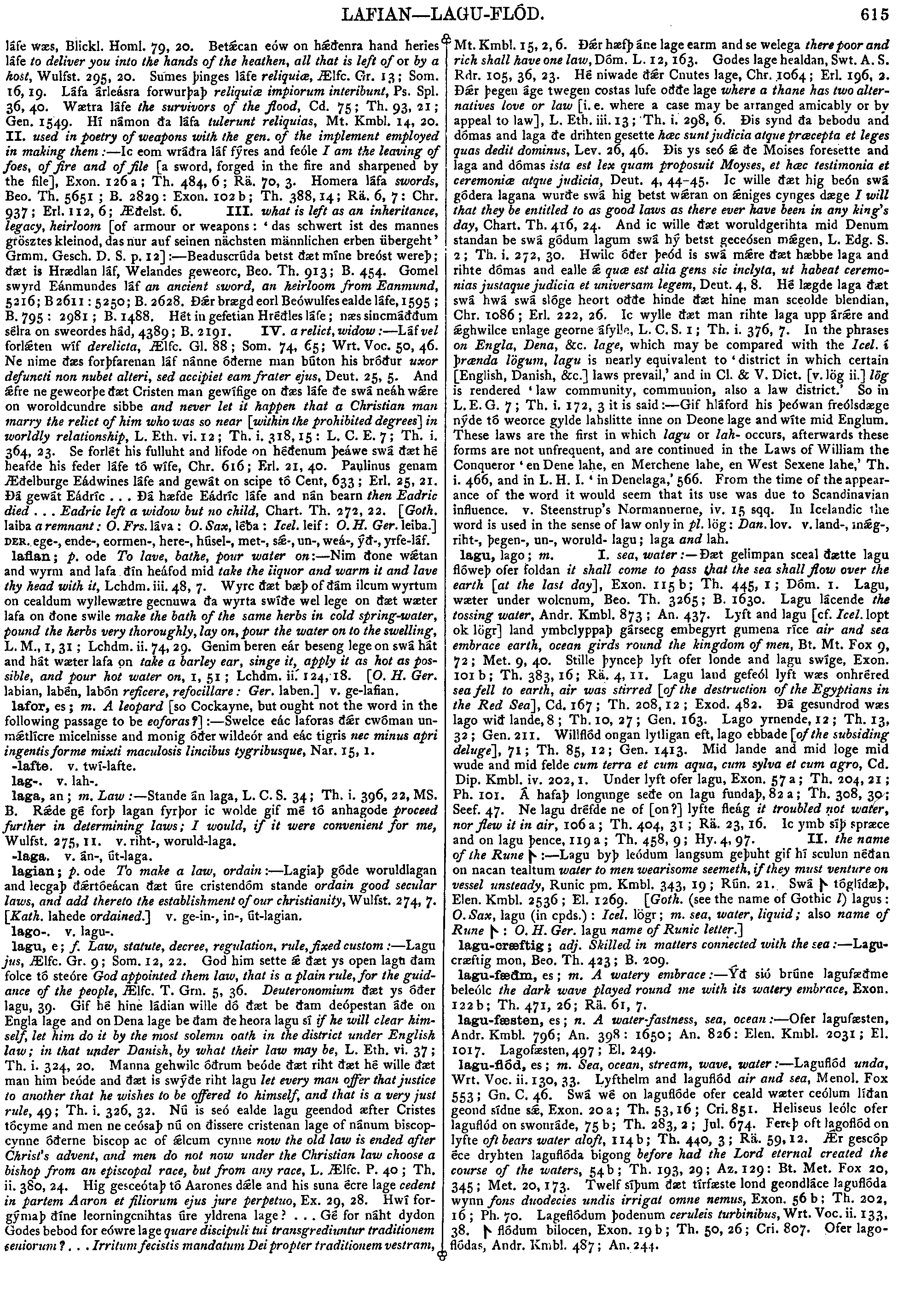
laga,
an;
m.
Law
:--
Stande
án
laga,
L.
C.
S.
34;
Th.
i.
396,
22,
MS.
B.
Rde
gé
forþ
lagan
fyrþor
ic
wolde
gif
mé
tó
anhagode
proceed
further
in
determining
laws;
I
would,
if
it
were
convenient
for
me,
Wulfst,
275,
11.
v.
riht-,
woruld-laga.
| Result Page: |  |
Previous | 13 14 15 16 17 18 19 20 21 22 23 24 25 26 27 28 29 30 31 | Next |  |
Germanic Lexicon Project (main page)
This search system was written by
Sean Crist
Please consider
volunteering
to correct the data in these online dictionaries.
No rights reserved. Feel free to use these data in any way you please.