|
|

Tip: In the search results, you can click on any word or abbreviation for more information.
|
Source: Bosworth/Toller, page b0688, entry 11 View original page image as: [TIFF] [PNG] [View previous entry] [View next entry] |
[Comment on this entry] [View comments] |
The following entry has been hand-corrected once. |
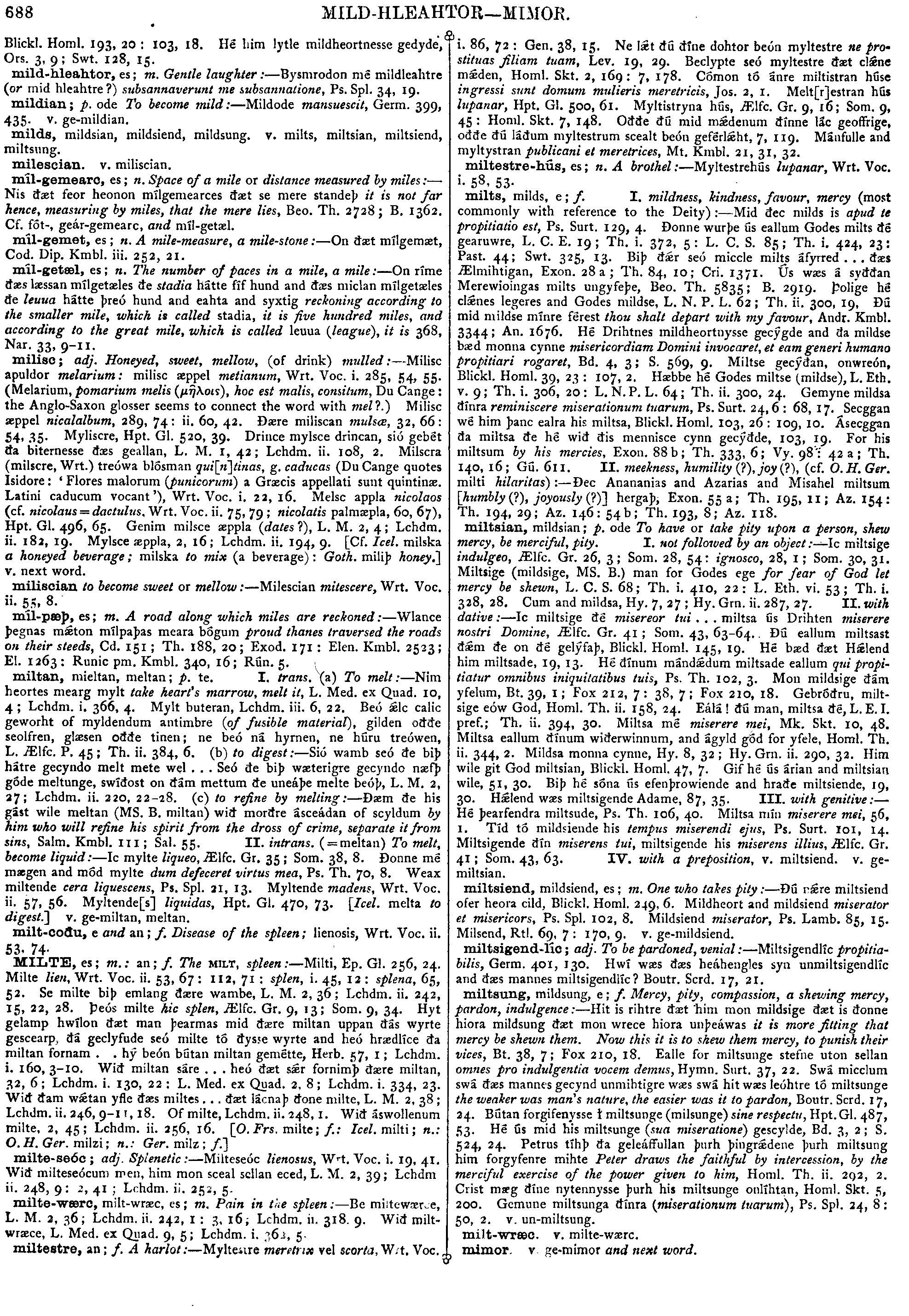
miltan,
mieltan,
meltan;
p.
te.
I.
trans.
(a)
To
melt
:--
Nim
heortes
mearg
mylt
take
heart's
marrow,
melt
it,
L.
Med.
ex
Quad.
10,
4;
Lchdm.
i.
366,
4.
Mylt
buteran,
Lchdm.
iii.
6,
22.
Beó
 lc
calic
geworht
of
myldendum
antimbre
(of
fusible
material),
gilden
oððe
seolfren,
glæsen
oððe
tinen;
ne
beó
ná
hyrnen,
ne
húru
treówen,
L.
Ælfc.
P.
45;
Th.
ii.
384,
6.
(b)
to
digest
:--
Sió
wamb
seó
ðe
biþ
hátre
gecyndo
melt
mete
wel
...
Seó
ðe
biþ
wæterigre
gecyndo
næfþ
góde
meltunge,
swíðost
on
ðám
mettum
ðe
uneáþe
melte
beóþ,
L.
M.
2,
27;
Lchdm.
ii.
220,
22-28.
(c)
to
refine
by
melting
:--
Ðæm
ðe
his
gást
wile
meltan
(MS.
B.
miltan)
wið
morðre
ásceádan
of
scyldum
by
him
who
will
refine
his
spirit
from
the
dross
of
crime,
separate
it
from
sins,
Salm.
Kmbl.
111;
Sal.
55.
II.
intrans.
(
=
meltan)
To
melt,
become
liquid
:--
Ic
mylte
liqueo,
Ælfc.
Gr.
35;
Som.
38,
8.
Ðonne
mé
mægen
and
mód
mylte
dum
defeceret
virtus
mea,
Ps.
Th.
70,
8.
Weax
miltende
cera
liquescens,
Ps.
Spl.
21,
13.
Myltende
madens,
Wrt.
Voc.
ii.
57,
56.
Myltende[s]
liquidas,
Hpt.
Gl.
470,
73.
[Icel.
melta
to
digest.]
v.
ge-miltan,
meltan.
lc
calic
geworht
of
myldendum
antimbre
(of
fusible
material),
gilden
oððe
seolfren,
glæsen
oððe
tinen;
ne
beó
ná
hyrnen,
ne
húru
treówen,
L.
Ælfc.
P.
45;
Th.
ii.
384,
6.
(b)
to
digest
:--
Sió
wamb
seó
ðe
biþ
hátre
gecyndo
melt
mete
wel
...
Seó
ðe
biþ
wæterigre
gecyndo
næfþ
góde
meltunge,
swíðost
on
ðám
mettum
ðe
uneáþe
melte
beóþ,
L.
M.
2,
27;
Lchdm.
ii.
220,
22-28.
(c)
to
refine
by
melting
:--
Ðæm
ðe
his
gást
wile
meltan
(MS.
B.
miltan)
wið
morðre
ásceádan
of
scyldum
by
him
who
will
refine
his
spirit
from
the
dross
of
crime,
separate
it
from
sins,
Salm.
Kmbl.
111;
Sal.
55.
II.
intrans.
(
=
meltan)
To
melt,
become
liquid
:--
Ic
mylte
liqueo,
Ælfc.
Gr.
35;
Som.
38,
8.
Ðonne
mé
mægen
and
mód
mylte
dum
defeceret
virtus
mea,
Ps.
Th.
70,
8.
Weax
miltende
cera
liquescens,
Ps.
Spl.
21,
13.
Myltende
madens,
Wrt.
Voc.
ii.
57,
56.
Myltende[s]
liquidas,
Hpt.
Gl.
470,
73.
[Icel.
melta
to
digest.]
v.
ge-miltan,
meltan.
|
Source: Bosworth/Toller, page b0688, entry 20 View original page image as: [TIFF] [PNG] [View previous entry] [View next entry] |
[Comment on this entry] [View comments] |
The following entry has been hand-corrected once. |
miltsian,
mildsian;
p.
ode
To
have
or
take
pity
upon
a
person,
shew
mercy,
be
merciful,
pity.
I.
not
followed
by
an
object
:--
Ic
miltsige
indulgeo,
Ælfc.
Gr.
26,
3;
Som.
28,
54:
ignosco,
28,
1;
Som.
30,
31.
Miltsige
(mildsige,
MS.
B.)
man
for
Godes
ege
for
fear
of
God
let
mercy
be
shewn,
L.
C.
S.
68;
Th.
i.
410,
22:
L.
Eth.
vi.
53;
Th.
i.
328,
28.
Cum
and
mildsa,
Hy.
7,
27;
Hy.
Grn.
ii.
287,
27.
II.
with
dative
:--
Ic
miltsige
ðé
misereor
tui
...
miltsa
ús
Drihten
miserere
nostri
Domine,
Ælfc.
Gr.
41;
Som.
43,
63-64.
Ðú
eallum
miltsast
ðm
ðe
on
ðé
gelýfaþ,
Blickl.
Homl.
145,
19.
Hé
bæd
ðæt
Hlend
him
miltsade,
19,
13.
Hé
ðínum
mánddum
miltsade
eallum
qui
propitiatur
omnibus
iniquitatibus
tuis,
Ps.
Th.
102,
3.
Mon
mildsige
ðám
yfelum,
Bt.
39,
1;
Fox
212,
7:
38,
7;
Fox
210,
18.
Gebróðru,
miltsige
eów
God,
Homl.
Th.
ii.
158,
24.
Eálá!
ðú
man,
miltsa
ðé,
L.
E.
I.
pref.;
Th.
ii.
394,
30.
Miltsa
mé
miserere
mei,
Mk.
Skt.
10,
48.
Miltsa
eallum
ðínum
wiðerwinnum,
and
ágyld
gód
for
yfele,
Homl.
Th.
ii.
344,
2.
Mildsa
monna
cynne,
Hy.
8,
32;
Hy.
Grn.
ii.
290,
32.
Him
wile
git
God
miltsian,
Blickl.
Homl.
47,
7.
Gif
hé
ús
árian
and
miltsian
wile,
51,
30.
Biþ
hé
sóna
ús
efenþrowiende
and
hraðe
miltsiende,
19,
30.
Hlend
wæs
miltsigende
Adame,
87,
35.
III.
with
genitive
:--
Hé
þearfendra
miltsude,
Ps.
Th.
106,
40.
Miltsa
mín
miserere
mei,
56,
1.
Tíd
tó
mildsiende
his
tempus
miserendi
ejus,
Ps.
Surt.
101,
14.
Miltsigende
ðín
miserens
tui,
miltsigende
his
miserens
illius,
Ælfc.
Gr.
41;
Som.
43,
63.
IV.
with
a
preposition,
v.
miltsiend.
v.
gemiltsian.
|
Source: Bosworth/Toller, page b0691, entry 19 View original page image as: [TIFF] [PNG] [View previous entry] [View next entry] |
[Comment on this entry] [View comments (1)] |
The following entry has been hand-corrected once. |
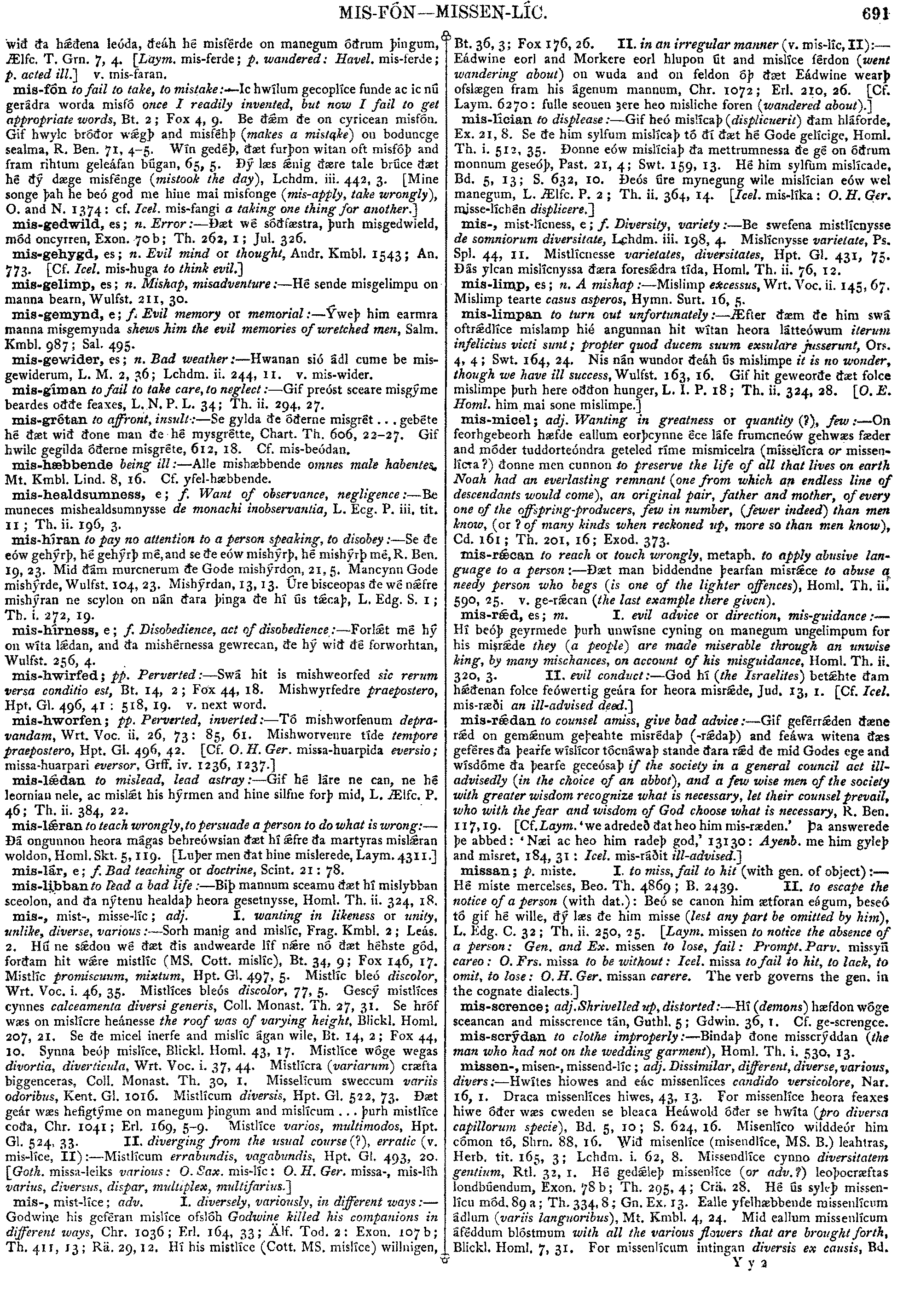
mis-,
mist-,
misse-líc;
adj.
I.
wanting
in
likeness
or
unity,
unlike,
diverse,
various
:--
Sorh
manig
and
mislíc,
Frag.
Kmbl.
2;
Leás.
2.
Hú
ne
sdon
wé
ðæt
ðis
andweaede
líf
nre
nó
ðæt
héhste
gód,
forðam
hit
wre
mistlíc
(MS.
Cott.
mislíc),
Bt.
34,
9;
Fox
146,
17.
Mistlíc
promiscuum,
mixtum,
Hpt.
Gl.
497,
5.
Mistlíc
bleó
discolor,
Wrt.
Voc.
i.
46,
35.
Mistlíces
bleós
discolor,
77,
5.
Gescý
mistlíces
cynnes
calceamenta
diversi
generis,
Coll.
Monast.
Th.
27,
31.
Se
hróf
wæs
on
mislícre
heánesse
the
roof
was
of
varying
height,
Blickl.
Homl.
207,
21.
Se
ðe
micel
inerfe
and
mislíc
ágan
wile,
Bt.
14,
2;
Fox
44,
10.
Synna
beóþ
mislíce,
Blickl.
Homl.
43,
17.
Mistlíce
wóge
wegas
divortia,
diverticula,
Wrt.
Voc.
i.
37,
44.
Mistlícra
(variarum)
cræfta
biggenceras,
Coll.
Monast.
Th.
30,
1.
Misselícum
sweccum
variis
odoribus,
Kent.
Gl.
1016.
Mistlícum
diversis,
Hpt.
Gl.
522,
73.
Ðæt
geár
wæs
hefigtýme
on
manegum
þingum
and
mislícum
...
þurh
mistlíce
coða,
Chr.
1041;
Erl.
169,
5-9.
Mistlíce
varios,
multimodos,
Hpt.
Gl.
524,
33.
II.
diverging
from
the
usual
course(?),
erratic
(v.
mis-líce,
II)
:--
Mistlícum
errabundis,
vagabundis,
Hpt.
Gl.
493,
20.
[Goth.
missa-leiks
various:
O.
Sax.
mis-líc:
O.
H.
Ger.
missa-,
mis-líh
varius,
diversus,
dispar,
multiplex,
multifarius.]
|
Source: Bosworth/Toller, page b0691, entry 21 View original page image as: [TIFF] [PNG] [View previous entry] [View next entry] |
[Comment on this entry] [View comments] |
The following entry has been hand-corrected once. |
mis-lícian to displease :-- Gif heó mislícaþ (displicuerit) ðam hláforde, Ex. 21, 8. Se ðe him sylfum mislícaþ tó ðí ðæt hé Gode gelícige, Homl. Th. i. 512, 35. Ðonne eów mislíciaþ ða mettrumnessa ðe gé on óðrum monnum geseóþ, Past. 21, 4; Swt. 159, 13. Hé him sylfum mislícade, Bd. 5, 13; S. 632, 10. Ðeós úre mynegung wile mislícian eów wel manegum, L. Ælfc. P. 2; Th. ii. 364, 14. [Icel. mis-líka: O. H. Ger. misse-líchén displicere.]
|
Source: Bosworth/Toller, page b0699, entry 21 View original page image as: [TIFF] [PNG] [View previous entry] [View next entry] |
[Comment on this entry] [View comments] |
The following entry has been hand-corrected once. |
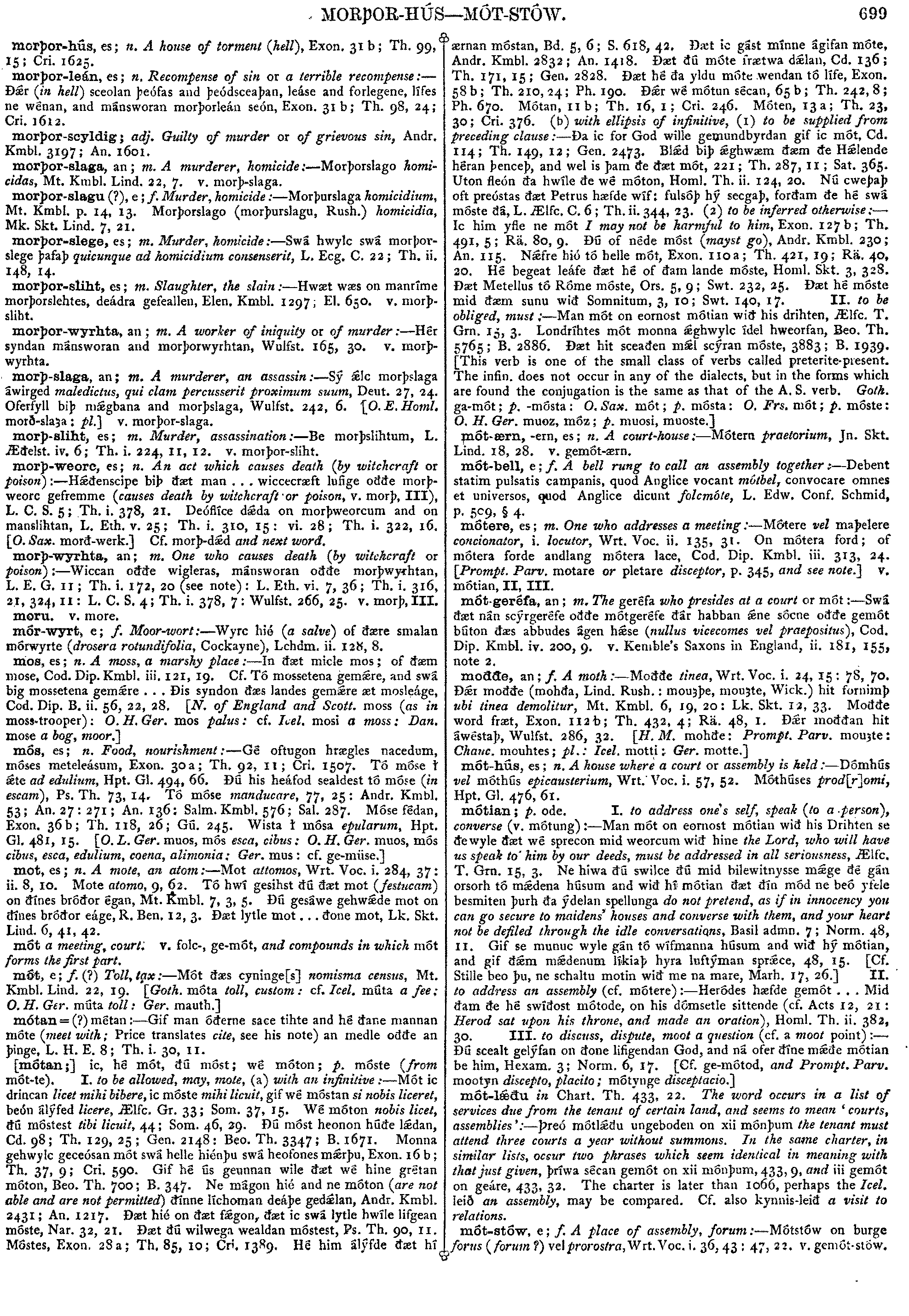
[mótan;]
ic,
hé
mót,
ðú
móst;
wé
móton;
p.
móste
(from
mót-te).
I.
to
be
allowed,
may,
mote,
(a)
wiih
an
infinitive
:--
Mót
ic
drincan
licet
mihi
bibere,
ic
móste
mihi
licuit,
gif
wé
móstan
si
nobis
liceret,
beón
álýfed
licere,
Ælfc.
Gr.
33;
Som.
37,
15.
Wé
móton
nobis
licet,
ðú
móstest
tibi
licuit,
44;
Som.
46,
29.
Ðú
móst
heonon
húðe
ldan,
Cd.
98;
Th.
129,
25;
Gen.
2148:
Beo.
Th.
3347;
B.
1671.
Monna
gehwylc
geceósan
mót
swá
helle
hiénþu
swá
heofones
mrþu.
Exon.
16
b;
Th.
37,
9;
Cri.
590.
Gif
hé
ús
geunnan
wile
ðæt
wé
hine
grétan
móton.
Beo.
Th.
700;
B.
347.
Ne
mágon
hié
and
ne
móton
(are
not
able
and
are
not
permitted)
ðínne
líchoman
deáþe
gedlan,
Andr.
Kmbl.
2431;
An.
1217.
Ðæt
hié
on
ðæt
fgon,
ðæt
ic
swá
lytle
hwíle
lifgean
móste,
Nar.
32,
21.
Ðæt
ðú
wilwega
wealdan
móstest,
Ps.
Th.
90,
11.
Móstes,
Exon.
28
a;
Th.
85,
10;
Cri.
1389.
Hé
him
álýfde
ðæt
hí
ærnan
móstan.
Bd.
5,
6;
S.
618,
42.
Ðæt
ic
gást
mínne
ágifan
móte.
Andr.
Kmbl.
2832;
An.
1418.
Ðæt
ðú
móte
írætwa
dlan,
Cd.
136;
Th.
171,
15;
Gen.
2828.
Ðæt
hé
ða
yldu
móte
wendan
tó
lífe,
Exon.
58
b;
Th.
210,
24;
Ph.
190.
Ðr
wé
mótun
sécan,
65
b;
Th.
242,
8;
Ph.
670.
Mótan,
11
b;
Th.
16,
1;
Cri.
246.
Móten,
13
a;
Th.
23,
30;
Cri.
376.
(b)
with
ellipsis
of
infinitive,
(1)
to
be
supplied
from
preceding
clause
:--
Ða
ic
for
God
wille
gemundbyrdan
gif
ic
mót,
Cd.
114;
Th.
149,
12;
Gen.
2473.
Bld
biþ
ghwæm
ðæm
ðe
Hlende
héran
þenceþ,
and
wel
is
þam
ðe
ðæt
mót,
221;
Th.
287,
11;
Sat.
365.
Uton
fleón
ða
hwíle
ðe
wé
móton.
Homl.
Th.
ii.
124,
20.
Nú
cweþaþ
oft
preóstas
ðæt
Petrus
hæfde
wíf:
fulsóþ
hý
secgaþ,
forðam
ðe
hé
swá
móste
ðá,
L.
Ælfc.
C.
6;
Th.
ii.
344,
23.
(2)
to
be
inferred
otherwise
:--
Ic
him
yfle
ne
mót
I
may
not
be
harmful
to
him,
Exon.
127
b;
Th.
491,
5;
Rä.
80,
9.
Ðú
of
néde
móst
(mayst
go),
Andr.
Kmbl.
230;
An.
115.
Nfre
hió
tó
helle
mót,
Exon.
110
a;
Th.
421,
19;
Rä.
40,
20.
Hé
begeat
leáfe
ðæt
hé
of
ðam
lande
móste.
Homl.
Skt.
3,
328.
Ðæt
Metellus
tó
Róme
móste,
Ors.
5,
9;
Swt.
232,
25.
Ðæt
hé
móste
mid
ðæm
sunu
wið
Somnitum,
3,
10;
Swt.
140,
17.
II.
to
be
obliged,
must
:--
Man
mót
on
eornost
mótian
wið
his
drihten,
Ælfc.
T.
Grn.
15,
3.
Londríhtes
mót
monna
ghwylc
ídel
hweorfan,
Beo.
Th.
5765;
B.
2886.
Ðæt
hit
sceaðen
ml
scýran
móste,
3883;
B.
1939.
[This
verb
is
one
of
the
small
class
of
verbs
called
preterite-present.
The
infin.
does
not
occur
in
any
of
the
dialects,
but
in
the
forms
which
are
found
the
conjugation
is
the
same
as
that
of
the
A.S.
verb.
Goth.
ga-mót;
p.
-mósta:
O.
Sax.
mót;
p.
mósta:
O.
Frs.
mót;
p.
móste:
O.H.
Ger.
muoz,
móz;
p.
muosi,
muoste.]
|
Source: Bosworth/Toller, page b0700, entry 9 View original page image as: [TIFF] [PNG] [View previous entry] [View next entry] |
[Comment on this entry] [View comments (2)] |
The following entry has been hand-corrected once. |
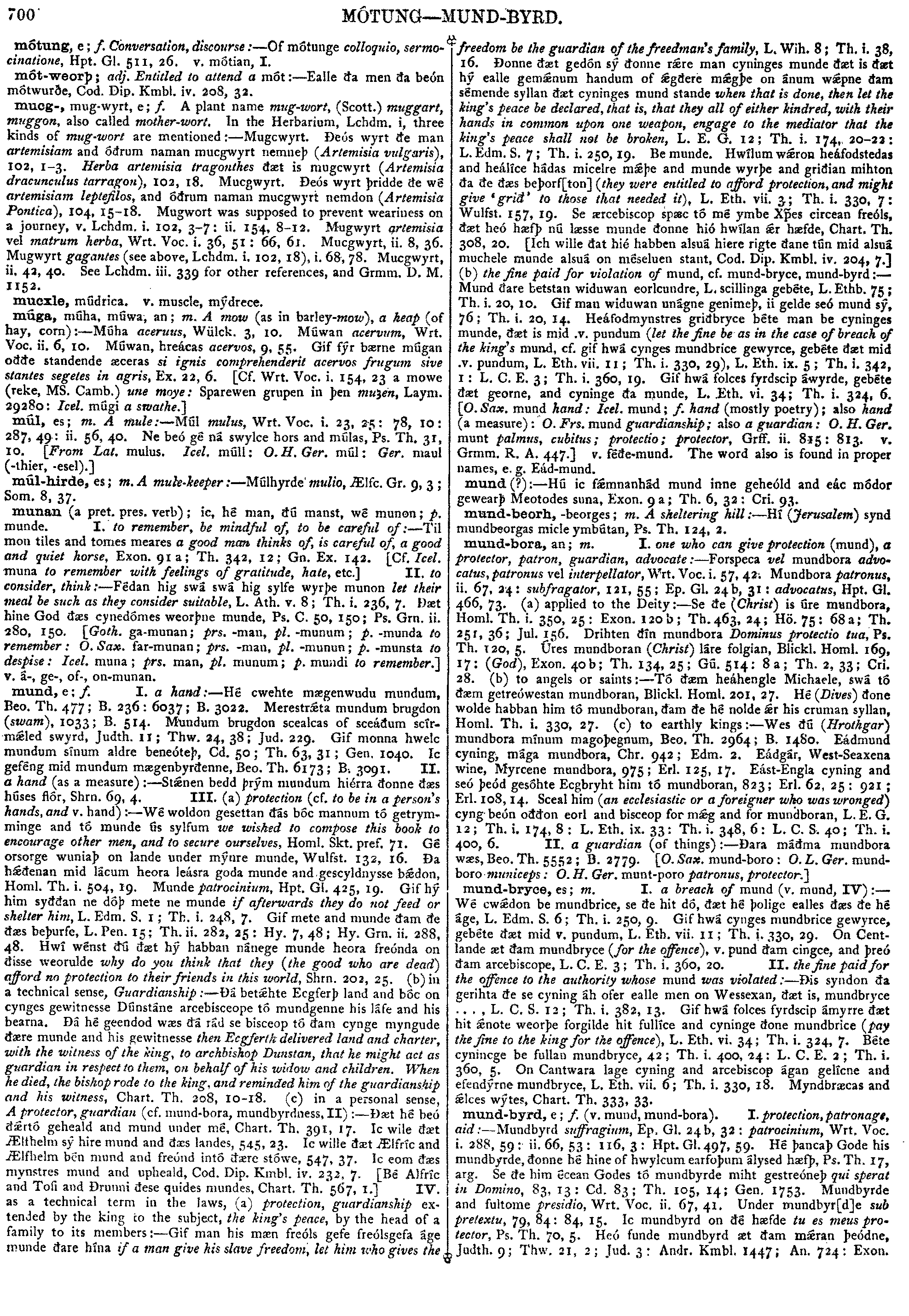
mund,
e;
f.
I.
a
hand
:--
Hé
cwehte
mægenwudu
mundum,
Beo.
Th.
477;
B.
236
:
6037;
B.
3022.
Merestrta
mundum
brugdon
(swam),
1033;
B.
514.
Mundum
brugdon
scealcas
of
sceáðum
scír mled
swyrd,
Judth.
11;
Thw.
24,
38;
Jud.
229.
Gif
monna
hwelc
mundum
sínum
aldre
beneóteþ,
Cd.
50;
Th.
63,
31;
Gen.
1040.
Ic
geféng
mid
mundum
mægenbyrðenne.
Beo.
Th.
6173;
B.
3091.
II.
a
hand
(as
a
measure)
:--
Stnen
bedd
þrým
mundum
hiérra
ðonne
ðæs
húses
flór,
Shrn.
69,
4.
III.
(a)
protection
(cf.
to
be
in
a
person's
hands,
and
v.
hand)
:--
Wé
woldon
gesettan
ðás
bóc
mannum
tó
getrym
minge
and
tó
munde
ús
sylfum
we
wished
to
compose
this
book
to
encourage
other
men,
and
to
secure
ourselves,
Homl.
Skt.
pref.
71.
Gé
orsorge
wuniaþ
on
lande
under
mýnre
munde.
Wulfst.
132,
16.
Ða
hðenan
mid
lácum
heora
leásra
goda
munde
and
gescyldnysse
bdon,
Homl.
Th.
i.
504,
19.
Munde
pafrocinium,
Hpt.
Gl.
425,
19.
Gif
hý
him
syððan
ne
dóþ
mete
ne
munde
if
afterwards
they
do
not
feed
or
shelter
him,
L.
Edm.
S.
l;
Th.
i.
248,
7.
Gif
mete
and
munde
ðam
ðe
ðæs
beþurfe,
L.
Pen.
15;
Th.
ii.
282,
25
:
Hy.
7,
48
;
Hy.
Grn.
ii.
288,
48.
Hwí
wénst
ðú
ðæt
hý
habban
nánege
munde
heora
freónda
on
ðisse
weorulde
why
do
you
think
that
they
(the
good
who
are
dead)
afford
no
protection
to
their
friends
in
this
world,
Shrn.
202,
25.
(b)
in
a
technical
sense,
Guardianship
:--
Ðá
bethte
Ecgferþ
land
and
bóc
on
cynges
gewitnesse
Dúnstáne
arcebisceope
tó
mundgenne
his
láfe
and
his
bearna.
Ðá
hé
geendod
wæs
ðá
rád
se
bisceop
tó
ðam
cynge
myngude
ðære
munde
and
his
gewitnesse
then
Ecgferth
delivered
land
and
charter,
with
the
witness
of
the
king,
to
archbishop
Dunstan,
that
he
might
act
as
guardian
in
respect
to
them,
on
behalf
of
his
widow
and
children.
When
he
died,
the
bishop
rode
to
the
king,
and
reminded
him
of
the
guardianship
and
his
witness,
Chart.
Th.
208,
10-18.
(c)
in
a
personal
sense,
A
protector,
guardian
(cf.
mund-bora,
mundbyrdness,
II)
:--
Ðæt
hé
beó
ðrtó
geheald
and
mund
under
mé.
Chart.
Th.
391,
17.
Ic
wile
ðæt
Ælthelrn
sý
hire
mund
and
ðæs
landes,
545,
23.
Ic
wille
ðæt
Ælfríc
and
Ælfhelm
bén
mund
and
freónd
intó
ðære
stówe,
547,
37.
Ic
eom
ðæs
mynstres
mund
and
upheald,
Cod.
Dip.
Kmbl.
iv.
232,
7.
[Bé
Alfríc
and
Tofi
and
Ðrunni
ðese
quides
mundes.
Chart.
Th.
567,
I.]
IV.
as
a
technical
term
in
the
laws,
(a)
protection,
guardianship
extended
by
the
king
to
the
subject,
the
king's
peace,
by
the
head
of
a
family
to
its
members
:--
Gif
man
his
mæn
freóls
gefe
freólsgefa
áge
munde
ðare
hína
if
a
man
give
his
slave
freedom,
let
him
who
gives
the
freedom
be
the
guardian
of
the
freedman's
family,
L.
Win.
8;
Th.
i.
38,
16.
Ðonne
ðæt
gedón
sý
ðonne
rre
man
cyninges
munde
ðæt
is
ðæt
hý
ealle
gemnum
handum
of
gðere
mgþe
on
ánum
wpne
ðam
sémende
syllan
ðæt
cyninges
mund
stande
when
that
is
done,
then
let
the
king's
peace
be
declared,
that
is,
that
they
all
of
either
kindred,
with
their
hands
in
common
upon
one
weapon,
engage
to
the
mediator
that
the
king's
peace
shall
not
be
broken,
L.
E.
G.
12;
Th.
i.
174,
20-22:
L.
Edm.
S.
7;
Th.
i.
250,
19.
Be
munde.
Hwílum
wron
heáfodstedas
and
heálíce
hádas
micelre
m;þe
and
munde
wyrþe
and
griðian
mihton
ða
ðe
ðæs
beþorf[ton]
(they
were
entitled
to
afford
protection,
and
might
give
'grið'
to
those
that
needed
it),
L.
Eth.
vii.
3;
Th.
i.
330,
7:
Wulfst.
157,
19.
Se
ærcebiscop
spsec
tó
mé
ymbe
X&p-tilde;es
circean
freóls,
ðæt
heó
hæfþ
nú
læsse
munde
ðonne
hió
hwílan
r
hæfde.
Chart.
Th.
308,
20.
[lch
wille
ðat
hié
habben
alsuá
hiere
rigte
ðane
tún
mid
alsuá
muchele
munde
alsuá
on
méseluen
stant.
Cod.
Dip.
Kmbl.
iv.
204,
7.]
(b)
the
fine
paid
for
violation
of
mund,
cf.
mund-bryce,
mund-byrd
:--
Mund
ðare
betstan
widuwan
eorlcundre,
L.
scillinga
gebéte,
L.
Ethb.
75
;
Th.
i.
20,
10.
Gif
man
widuwan
unágne
genimeþ,
ii
gelde
seó
mund
sý,
76;
Th.
i.
20,
14.
Heáfodmynstres
griðbryce
béte
man
be
cyninges
munde,
ðæt
is
mid
.v.
pundum
(let
the
fine
be
as
in
the
case
of
breach
of
the
king's
mund,
cf.
gif
hwá
cynges
mundbrice
gewyrce,
gebéte
ðæt
mid
.v.
pundum,
L.
Eth.
vii.
11;
Th.
i.
330,
29),
L.
Eth.
ix.
5
;
Th.
i.
342,
l:
L.
C.
E.
3;
Th.
i.
360,
19.
Gif
hwá
folces
fyrdscip
áwyrde,
gebéte
ðæt
georne,
and
cyninge
ða
munde,
L.
.
Eth.
vi.
34;
Th.
i.
324,
6.
[O.
Sax.
mund
hand:
Icel.
mund;
f.
hand
(mostly
poetry);
also
hand
(a
measure):
O.
Frs.
mund
guardianship;
also
a
guardian:
O.
H.
Ger.
munt
palmus,
cubitus;
protectio;
protector,
Grff.
ii.
815:
813.
v.
Grmm.
R.
A.
447.]
v.
féðe-mund.
The
word
also
is
found
in
proper
names,
e.
g.
Eád-mund
mled
swyrd,
Judth.
11;
Thw.
24,
38;
Jud.
229.
Gif
monna
hwelc
mundum
sínum
aldre
beneóteþ,
Cd.
50;
Th.
63,
31;
Gen.
1040.
Ic
geféng
mid
mundum
mægenbyrðenne.
Beo.
Th.
6173;
B.
3091.
II.
a
hand
(as
a
measure)
:--
Stnen
bedd
þrým
mundum
hiérra
ðonne
ðæs
húses
flór,
Shrn.
69,
4.
III.
(a)
protection
(cf.
to
be
in
a
person's
hands,
and
v.
hand)
:--
Wé
woldon
gesettan
ðás
bóc
mannum
tó
getrym
minge
and
tó
munde
ús
sylfum
we
wished
to
compose
this
book
to
encourage
other
men,
and
to
secure
ourselves,
Homl.
Skt.
pref.
71.
Gé
orsorge
wuniaþ
on
lande
under
mýnre
munde.
Wulfst.
132,
16.
Ða
hðenan
mid
lácum
heora
leásra
goda
munde
and
gescyldnysse
bdon,
Homl.
Th.
i.
504,
19.
Munde
pafrocinium,
Hpt.
Gl.
425,
19.
Gif
hý
him
syððan
ne
dóþ
mete
ne
munde
if
afterwards
they
do
not
feed
or
shelter
him,
L.
Edm.
S.
l;
Th.
i.
248,
7.
Gif
mete
and
munde
ðam
ðe
ðæs
beþurfe,
L.
Pen.
15;
Th.
ii.
282,
25
:
Hy.
7,
48
;
Hy.
Grn.
ii.
288,
48.
Hwí
wénst
ðú
ðæt
hý
habban
nánege
munde
heora
freónda
on
ðisse
weorulde
why
do
you
think
that
they
(the
good
who
are
dead)
afford
no
protection
to
their
friends
in
this
world,
Shrn.
202,
25.
(b)
in
a
technical
sense,
Guardianship
:--
Ðá
bethte
Ecgferþ
land
and
bóc
on
cynges
gewitnesse
Dúnstáne
arcebisceope
tó
mundgenne
his
láfe
and
his
bearna.
Ðá
hé
geendod
wæs
ðá
rád
se
bisceop
tó
ðam
cynge
myngude
ðære
munde
and
his
gewitnesse
then
Ecgferth
delivered
land
and
charter,
with
the
witness
of
the
king,
to
archbishop
Dunstan,
that
he
might
act
as
guardian
in
respect
to
them,
on
behalf
of
his
widow
and
children.
When
he
died,
the
bishop
rode
to
the
king,
and
reminded
him
of
the
guardianship
and
his
witness,
Chart.
Th.
208,
10-18.
(c)
in
a
personal
sense,
A
protector,
guardian
(cf.
mund-bora,
mundbyrdness,
II)
:--
Ðæt
hé
beó
ðrtó
geheald
and
mund
under
mé.
Chart.
Th.
391,
17.
Ic
wile
ðæt
Ælthelrn
sý
hire
mund
and
ðæs
landes,
545,
23.
Ic
wille
ðæt
Ælfríc
and
Ælfhelm
bén
mund
and
freónd
intó
ðære
stówe,
547,
37.
Ic
eom
ðæs
mynstres
mund
and
upheald,
Cod.
Dip.
Kmbl.
iv.
232,
7.
[Bé
Alfríc
and
Tofi
and
Ðrunni
ðese
quides
mundes.
Chart.
Th.
567,
I.]
IV.
as
a
technical
term
in
the
laws,
(a)
protection,
guardianship
extended
by
the
king
to
the
subject,
the
king's
peace,
by
the
head
of
a
family
to
its
members
:--
Gif
man
his
mæn
freóls
gefe
freólsgefa
áge
munde
ðare
hína
if
a
man
give
his
slave
freedom,
let
him
who
gives
the
freedom
be
the
guardian
of
the
freedman's
family,
L.
Win.
8;
Th.
i.
38,
16.
Ðonne
ðæt
gedón
sý
ðonne
rre
man
cyninges
munde
ðæt
is
ðæt
hý
ealle
gemnum
handum
of
gðere
mgþe
on
ánum
wpne
ðam
sémende
syllan
ðæt
cyninges
mund
stande
when
that
is
done,
then
let
the
king's
peace
be
declared,
that
is,
that
they
all
of
either
kindred,
with
their
hands
in
common
upon
one
weapon,
engage
to
the
mediator
that
the
king's
peace
shall
not
be
broken,
L.
E.
G.
12;
Th.
i.
174,
20-22:
L.
Edm.
S.
7;
Th.
i.
250,
19.
Be
munde.
Hwílum
wron
heáfodstedas
and
heálíce
hádas
micelre
m;þe
and
munde
wyrþe
and
griðian
mihton
ða
ðe
ðæs
beþorf[ton]
(they
were
entitled
to
afford
protection,
and
might
give
'grið'
to
those
that
needed
it),
L.
Eth.
vii.
3;
Th.
i.
330,
7:
Wulfst.
157,
19.
Se
ærcebiscop
spsec
tó
mé
ymbe
X&p-tilde;es
circean
freóls,
ðæt
heó
hæfþ
nú
læsse
munde
ðonne
hió
hwílan
r
hæfde.
Chart.
Th.
308,
20.
[lch
wille
ðat
hié
habben
alsuá
hiere
rigte
ðane
tún
mid
alsuá
muchele
munde
alsuá
on
méseluen
stant.
Cod.
Dip.
Kmbl.
iv.
204,
7.]
(b)
the
fine
paid
for
violation
of
mund,
cf.
mund-bryce,
mund-byrd
:--
Mund
ðare
betstan
widuwan
eorlcundre,
L.
scillinga
gebéte,
L.
Ethb.
75
;
Th.
i.
20,
10.
Gif
man
widuwan
unágne
genimeþ,
ii
gelde
seó
mund
sý,
76;
Th.
i.
20,
14.
Heáfodmynstres
griðbryce
béte
man
be
cyninges
munde,
ðæt
is
mid
.v.
pundum
(let
the
fine
be
as
in
the
case
of
breach
of
the
king's
mund,
cf.
gif
hwá
cynges
mundbrice
gewyrce,
gebéte
ðæt
mid
.v.
pundum,
L.
Eth.
vii.
11;
Th.
i.
330,
29),
L.
Eth.
ix.
5
;
Th.
i.
342,
l:
L.
C.
E.
3;
Th.
i.
360,
19.
Gif
hwá
folces
fyrdscip
áwyrde,
gebéte
ðæt
georne,
and
cyninge
ða
munde,
L.
.
Eth.
vi.
34;
Th.
i.
324,
6.
[O.
Sax.
mund
hand:
Icel.
mund;
f.
hand
(mostly
poetry);
also
hand
(a
measure):
O.
Frs.
mund
guardianship;
also
a
guardian:
O.
H.
Ger.
munt
palmus,
cubitus;
protectio;
protector,
Grff.
ii.
815:
813.
v.
Grmm.
R.
A.
447.]
v.
féðe-mund.
The
word
also
is
found
in
proper
names,
e.
g.
Eád-mund
|
Source: Bosworth/Toller, page b0703, entry 34 View original page image as: [TIFF] [PNG] [View previous entry] [View next entry] |
[Comment on this entry] [View comments] |
The following entry has been hand-corrected once. |
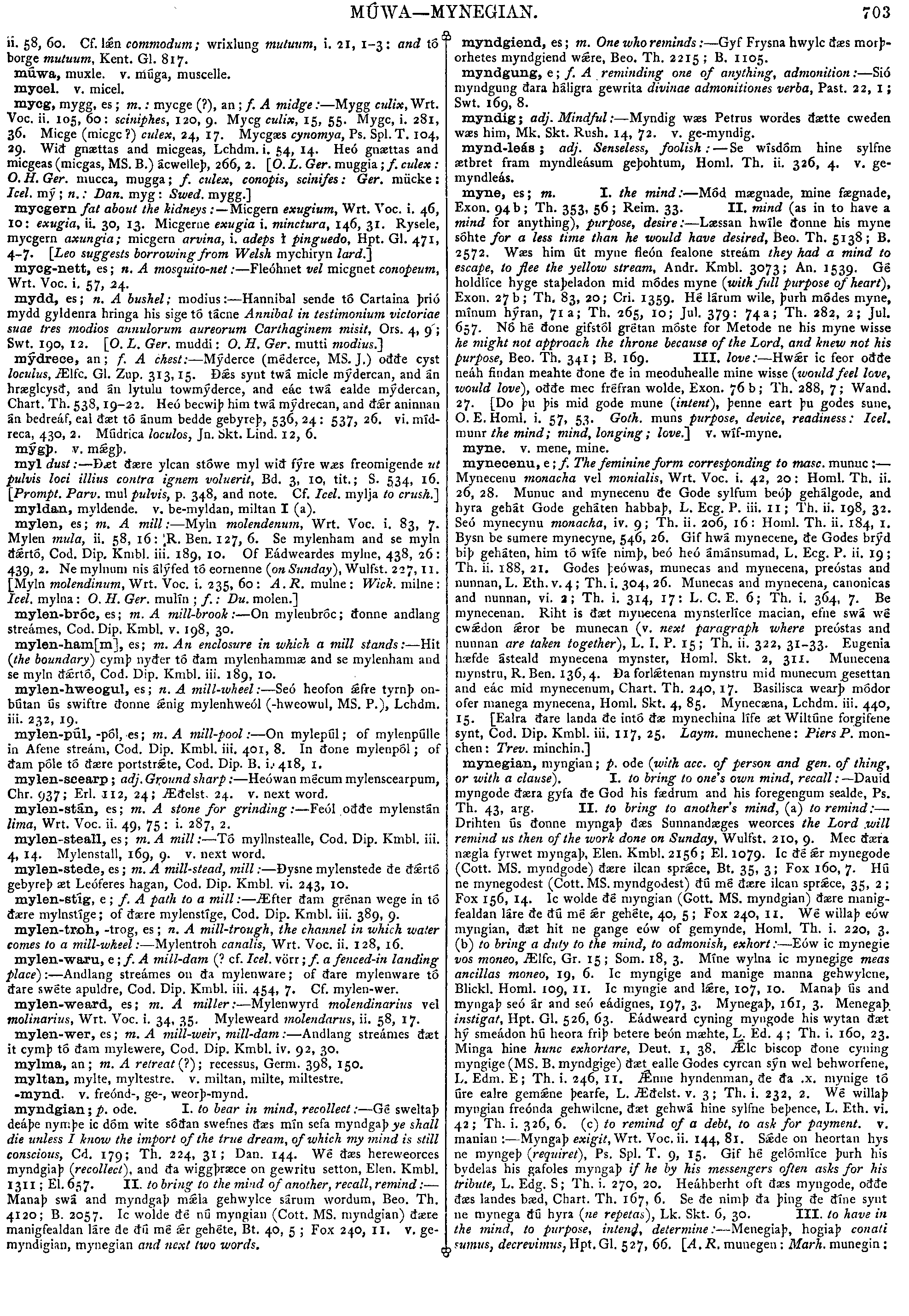
myne,
es;
m.
I.
the
mind
:--
Mód
mægnade,
mine
fægnade,
Exon.
94
b;
Th.
353,
56;
Reim.
33.
II.
mind
(as
in
to
have
a
mind
for
anything),
purpose,
desire
:--
Læssan
hwíle
ðonne
his
myne
sóhte
for
a
less
time
than
he
would
have
desired,
Beo.
Th.
5138;
B.
2572.
Wæs
him
út
myne
fleón
fealone
streám
they
had
a
mind
to
escape,
to
flee
the
yellow
stream,
Andr.
Kmbl.
3073;
An.
1539.
Gé
holdlíce
hyge
staþeladon
mid
módes
myne
(with
full
purpose
of
heart),
Exon.
27
b;
Th.
83,
20;
Cri.
1359.
Hé
lárum
wile,
þurh
módes
myne,
mínum
hýran,
71
a;
Th.
265,
10;
Jul.
379:
74a;
Th.
282,
2;
Jul.
657.
Nó
hé
ðone
gifstól
grétan
móste
for
Metode
ne
his
myne
wisse
he
might
not
approach
the
throne
because
of
the
Lord,
and
knew
not
his
purpose,
Beo.
Th.
341;
B.
169.
III.
love
:--
Hwr
ic
feor
oððe
neáh
findan
meahte
ðone
ðe
in
meoduhealle
mine
wisse
(would
feel
love,
would
love),
oððe
mec
fréfran
wolde,
Exon.
76
b;
Th.
288,
7;
Wand.
27.
[Do
þu
þis
mid
gode
mune
(intent),
þenne
eart
þu
godes
sune,
O.
E.
Homl.
i.
57,
53.
Goth.
muns
purpose,
device,
readiness:
Icel.
munr
the
mind;
mind,
longing;
love.]
v.
wíf/myne.
|
Source: Bosworth/Toller, page b0704, entry 14 View original page image as: [TIFF] [PNG] [View previous entry] [View next entry] |
[Comment on this entry] [View comments] |
The following entry has been hand-corrected once. |
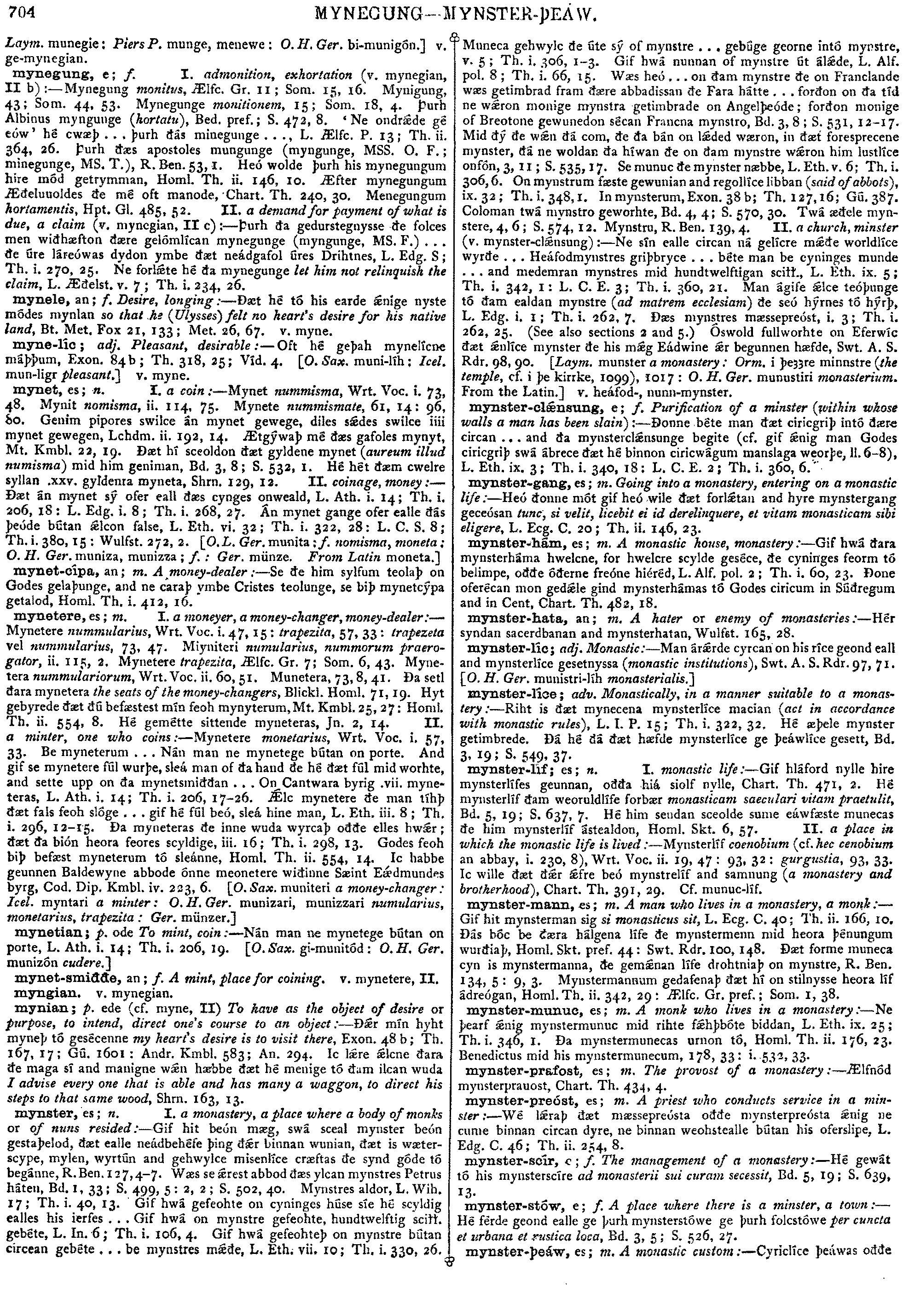
mynster-gang,
es;
m.
Going
into
a
monastery,
entering
on
a
monastic
life
:--
Heó
ðonne
mót
gif
heó
wile
ðæt
forltan
and
hyre
mynstergang
geceósan
tunc,
si
velit,
licebit
ei
id
derelinquere,
et
vitam
monasticam
sibi
eligere,
L.
Ecg.
C.
20;
Th.
ii.
146,
23.
|
Source: Bosworth/Toller, page b0712, entry 6 View original page image as: [TIFF] [PNG] [View previous entry] [View next entry] |
[Comment on this entry] [View comments] |
The following entry has been hand-corrected once. |
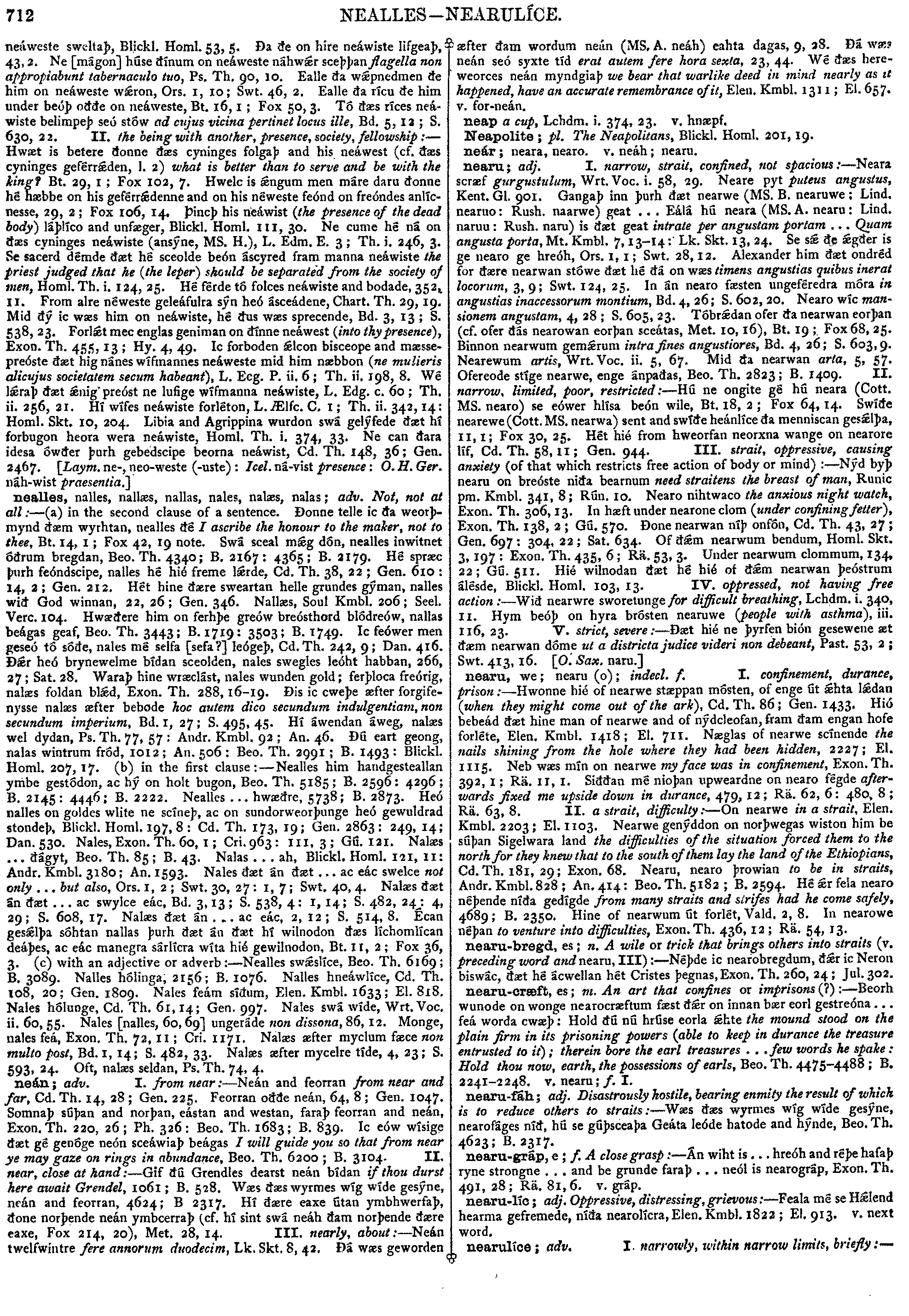
nearu;
adj.
I.
narrow,
strait,
confined,
not
spacious
:--
Neara
scræf
gurgustulum,
Wrt.
Voc.
i.
58,
29.
Neare
pyt
puteus
angustus,
Kent.
Gl.
901.
Gangaþ
inn
þurh
ðæt
nearwe
(MS.
B.
nearuwe
:
Lind.
nearuo
:
Rush.
naarwe)
geat
...
Eálá
hú
neara
(MS.
A.
nearu
:
Lind.
naruu
:
Rush.
naru)
is
ðæt
geat
intrate
per
angustam
portam
...
Quam
angusta
porta,
Mt.
Kmbl.
7,
13-14
:
Lk.
Skt.
13,
24.
Se
s
ðe
gðer
is
ge
nearo
ge
hreóh,
Ors.
1,
1
;
Swt.
28,
12.
Alexander
him
ðæt
ondréd
for
ðære
nearwan
stówe
ðæt
hé
ðá
on
wæs
timens
angustias
quibus
inerat
locorum,
3,
9;
Swt.
124,
25.
In
án
nearo
fæsten
ungeféredra
móra
in
angustias
inaccessorum
montium,
Bd.
4,
26;
S.
602,
20.
Nearo
wíc
mansionem
angustam,
4,
28
;
S.
605,
23.
Tóbrdan
ofer
ða
nearwan
eorþan
(cf.
ofer
ðás
nearowan
eorþan
sceátas,
Met.
10,
16),
Bt.
19
;
Fox
68,
25.
Binnon
nearwum
gemrum
intra
fines
angustiores,
Bd.
4,
26;
S.
603,
9.
Nearewum
artis,
Wrt.
Voc.
ii.
5,
67.
Mid
ða
nearwan
arta,
5,
57.
Ofereode
stíge
nearwe,
enge
ánpaðas,
Beo.
Th.
2823;
B.
1409.
II.
narrow,
limited,
poor,
restricted
:--
Hú
ne
ongite
gé
hú
neara
(Cott.
MS.
nearo)
se
eówer
hlísa
beón
wile,
Bt.
18,
2
;
Fox
64,
14.
Swíðe
nearewe
(Cott.
MS.
nearwa)
sent
and
swiðe
heánlíce
ða
menniscan
geslþa,
11,
1;
Fox
30,
25.
Hét
hié
from
hweorfan
neorxna
wange
on
nearore
líf,
Cd.
Th.
58,
11
;
Gen.
944.
III.
strait,
oppressive,
causing
anxiety
(of
that
which
restricts
free
action
of
body
or
mind)
:--
Nýd
byþ
nearu
on
breóste
niða
bearnum
ineed
straitens
the
breast
of
man,
Runic
pm.
Kmbl.
541,
8;
Rún.
10.
Nearo
nihtwaco
the
anxious
night
watch,
Exon.
Th.
306,
13.
In
hæft
under
nearone
clom
(under
confining
fetter),
Exon.
Th.
138,
2
;
Gú.
570.
Ðone
nearwan
níþ
onfón,
Cd.
Th.
43,
27
;
Gen.
697
:
304,
22;
Sat.
634.
Of
ðm
nearwum
bendum,
Homl.
Skt.
3,
197
:
Exon.
Th.
435,
6
;
Rä.
53,
3.
Under
nearwum
clommum,134,
22
;
Gú.
511.
Hié
wilnodan
ðæt
hé
hié
of
ðm
nearwan
þeóstrum
álésde,
Blickl.
Homl.
103,
13.
IV.
oppressed,
not
having
free
action
:--
Wið
nearwre
sworetunge
for
difficult
breathing,
Lchdm.
i.
340,
11.
Hym
beóþ
on
hyra
brósten
nearuwe
(people
with
asthma),
iii.
116,
23.
V.
strict,
severe
:--
Ðæt
hié
ne
þyrfen
bión
gesewene
æt
ðæm
nearwan
dóme
ut
a
districta
judice
videri
non
debeant,
Past.
53,
2
;
Swt.
413,
16.
[O.
Sax.
naru.]
|
Source: Bosworth/Toller, page b0712, entry 8 View original page image as: [TIFF] [PNG] [View previous entry] [View next entry] |
[Comment on this entry] [View comments] |
The following entry has been hand-corrected once. |
nearu-bregd,
es
;
n.
A
wile
or
trick
that
brings
others
into
straits
(v.
preceding
word
and
nearu,
III)
:--
Néþde
ic
nearobregdum,
ðr
ic
Neron
biswác,
ðæt
hé
ácwellan
hét
Cristes
þegnas,
Exon.
Th.
260,
24;
Jul.
302.
| Result Page: |  |
Previous | 1 2 3 4 5 6 7 8 9 10 11 12 13 14 15 16 17 18 19 | Next |  |
Germanic Lexicon Project (main page)
This search system was written by
Sean Crist
Please consider
volunteering
to correct the data in these online dictionaries.
No rights reserved. Feel free to use these data in any way you please.