|
|

|
Source: Cleasby/Vigfusson, page b0502, entry 19 View original page image as: [TIFF] [PNG] [View previous entry] [View next entry] |
[Comment on this entry] [View comments] |
The following entry has been hand-corrected once. |
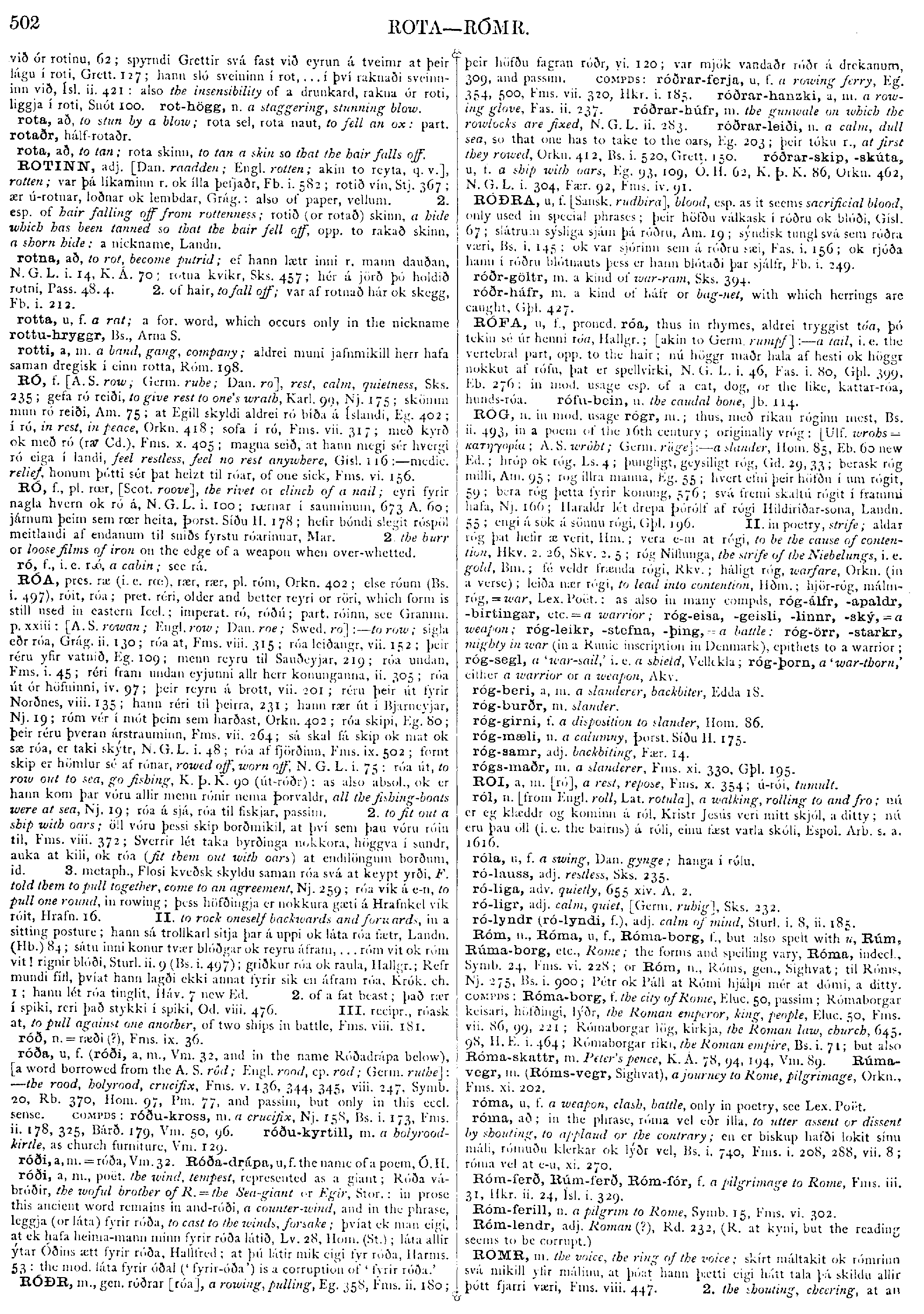
róðr-háfr, m. a kind of háfr or bag-net, with which herrings are caught, Gþl. 427.
|
Source: Cleasby/Vigfusson, page b0503, entry 7 View original page image as: [TIFF] [PNG] [View previous entry] [View next entry] |
[Comment on this entry] [View comments] |
The following entry has been hand-corrected once. |
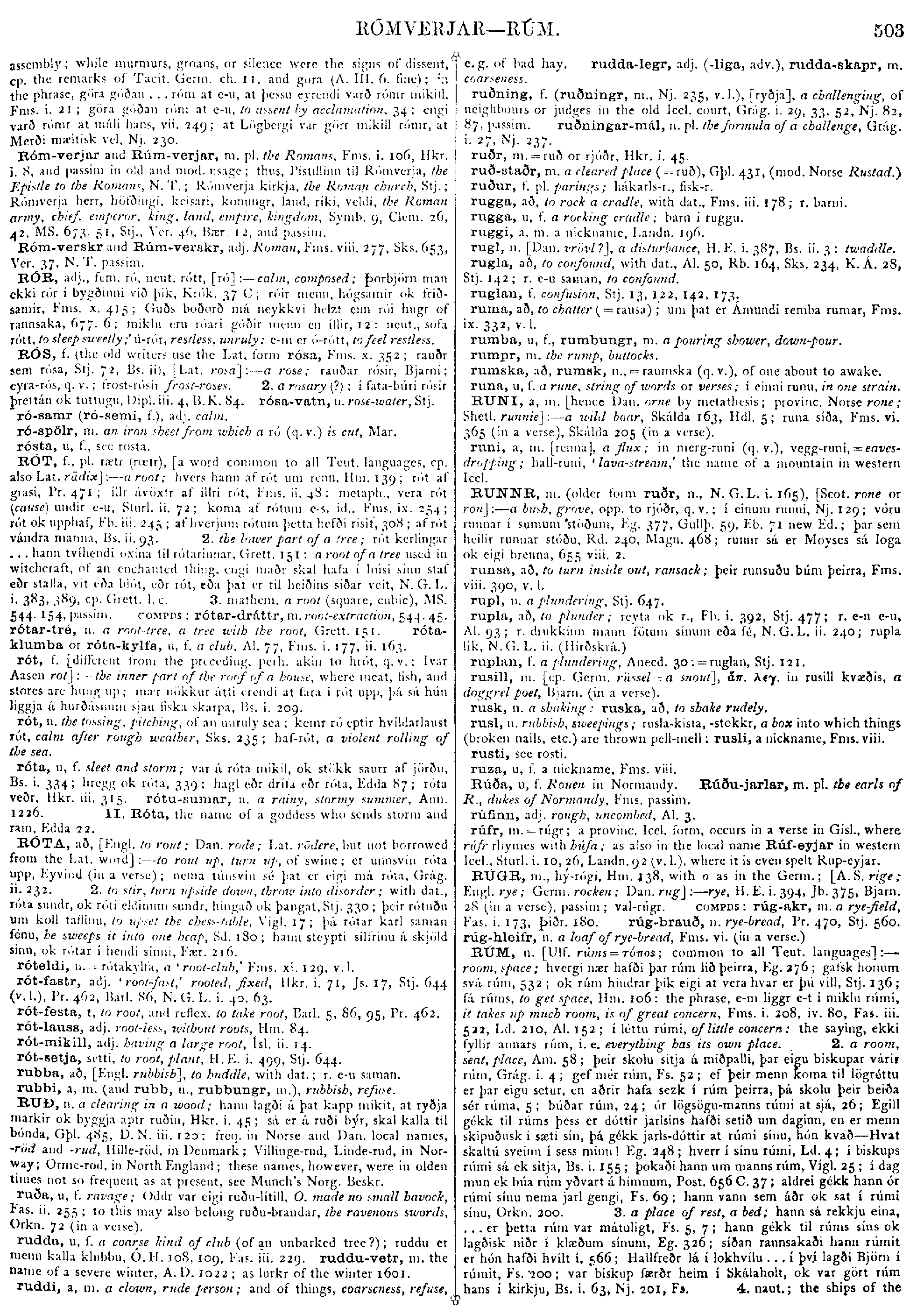
ró-spölr, m. an iron sheet from which a ró (q.v.) is cut, Mar.
|
Source: Cleasby/Vigfusson, page b0503, entry 50 View original page image as: [TIFF] [PNG] [View previous entry] [View next entry] |
[Comment on this entry] [View comments] |
The following entry has been hand-corrected once. |
rusl, n. rubbish, sweepings; rusla-kista, -stokkr, a box inlo which things (broken nails, etc.) are thrown pell-mell: rusli, a nickname, Fms. viii.
|
Source: Cleasby/Vigfusson, page b0504, entry 13 View original page image as: [TIFF] [PNG] [View previous entry] [View next entry] |
[Comment on this entry] [View comments] |
The following entry has been hand-corrected once. |
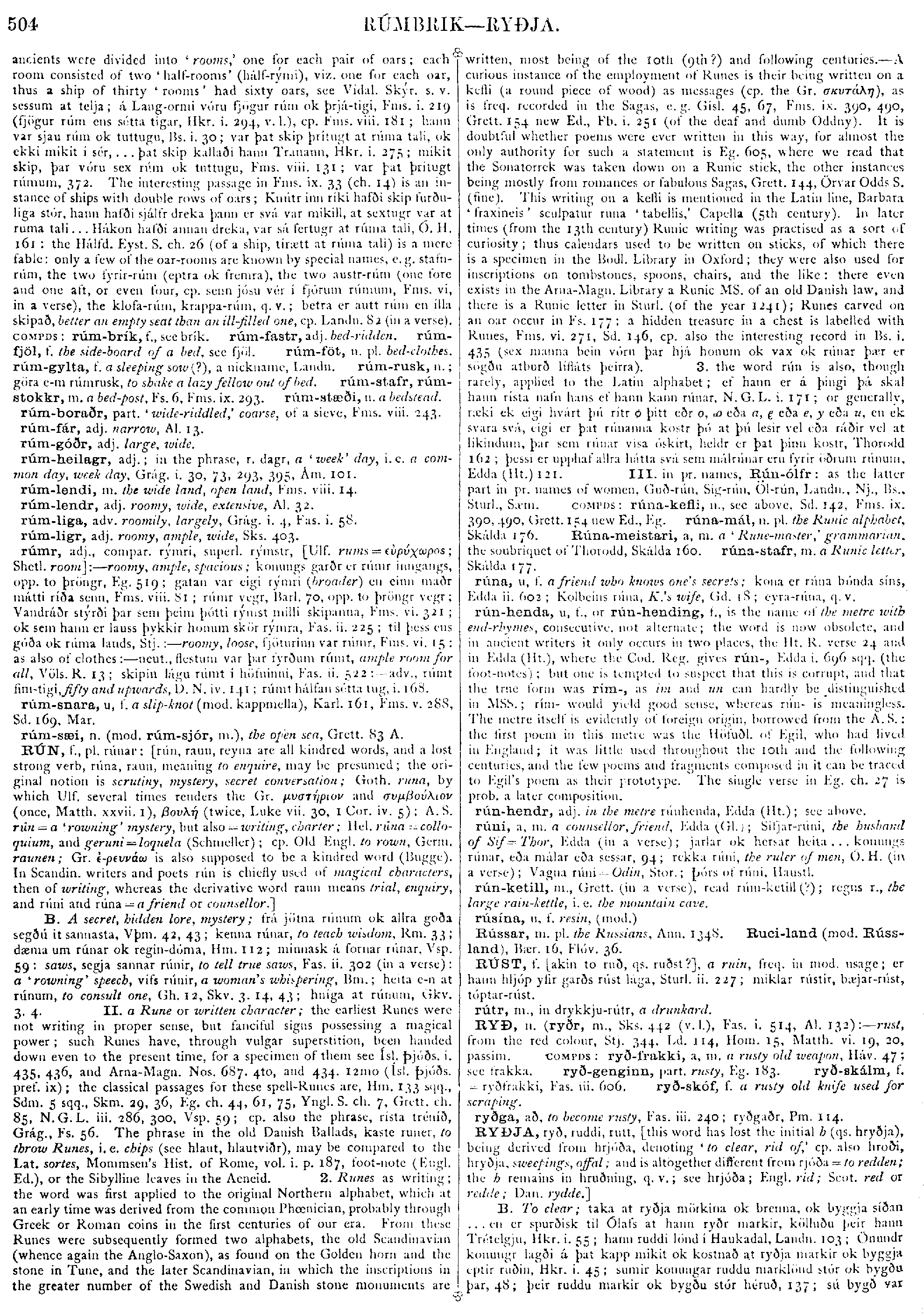
RÚN, f., pl. rúnar: [rún, raun, reyna are all kindred words, and a lost strong verb, rúna, raun, meaning to enquire, may be presumed; the original notion is scrutiny, mystery, secret conversation; Gotb. runa, by which Ulf. several times renders the Gr. GREEK and GREEK (once, Matth. xxvii. 1), GREEK (twice, Luke vii. 30, 1 Cor. iv. 5); A.S. rún = a 'rowning' mystery, but also = writing, charter; Hel. rûna = colloquium, and geruni = loquela (Schmeller); cp. Old Engl. to rown, Germ.raunen; Gr. GREEK is also supposed to be a kindred word (Bugge). In Scandin. writers and poets rún is chiefly used of magical characters, then of writing, whereas the derivative word raun means trial, enquiry, and rúni and rúna = a friend or counsellor.] B. A secret, hidden lore, mystery; frá jötna rúnum ok allra goða segðú it sannasta, Vþm. 42, 43; kenna rúnar, to teach wisdom, Rm. 33; dæma um rúnar ok regin-dóma, Hm. 112; minnask á fornar rúnar, Vsp. 59: saws, segja sannar rúnir, to tell true saws, Fas. ii. 302 (in a verse): a 'rowning' speech, vifs rúnir, a woman's whispering, Bm.; heita e-n at rúnum, to consult one, Gh. 12, Skv. 3. 14, 43; hniga at rúnum, Gkv. 3. 4. II. a Rune or written character; the earliest Runes were not writing in proper sense, but fanciful signs possessing a magical power; such Runes have, through vulgar superstition, been handed down even to the present time, for a specimen of them see Ísl. Þjóðs. i.435, 436, and Arna-Magn. Nos. 687. 4 to, and 434. 12 mo (Ísl. Þjóðs.pref. ix); the classical passages for these spell-Runes are, Hm. 133 sqq.,Sdm. 5 sqq., Skm. 29, 36, Eg. ch. 44, 61, 75, Yngl. S. ch. 7, Grett. ch. 85, N.G.L. iii. 286, 300, Vsp. 59; cp. also the phrase, rísta trénið,Grág., Fs. 56. The phrase in the old Danish Ballads, kaste runer, to throw Rúnes, i.e. chips (see hlaut, hlautviðr), may be compared to the Lat. sortes, Mommsen's Hist, of Rome, vol. i. p. 187, foot-note (Engl. Ed.), or the Sibylline leaves in the Aeneid. 2. Runes as writing;the word was first applied to the original Northern alphabet, which at an early time was derived from the common Phœnician, probably through Greek or Roman coins in the first centuries of our era. From these Runes were subsequently formed two alphabets, the old Scandinavian (whence again the Anglo-Saxon), as found on the Golden horn and the stone in Tune, and the later Scandinavian, in which the inscriptions in the greater number of the Swedish and Danish stone monuments are written, most being of the 10th (9th?) and following centuries. -- A curious instance of the employment of Runes is their being written on a kefli (a round piece of wood) as messages (cp. the Gr. GREEK), as is freq. recorded in the Sagas, e.g. Gísl. 45, 67, Fms. ix. 390, 490, Grett. 154 new Ed., Fb. i. 251 (of the deaf and dumb Oddny). It is doubtful whether poems were ever written in this way, for almost the only authority for such a statement is Eg. 605, where we read that the Sonatorrek was taken down on a Runic stick, the other instances being mostly from romances or fabulous Sagas, Grett. 144, Örvar Odds S.(fine). This writing on a kefli is mentioned in the Latin line, Barbara 'fraxineis' sculpatur runa 'tabellis,' Capella (5th century). In later times (from the 13th century) Runic writing was practised as a sort of curiosity; thus calendars used to be written on sticks, of which there is a specimen in the Bodl. Library in Oxford; they were also used for inscriptions on tombstones, spoons, chairs, and the like: there even exists in the Arna-Magn. Library a Runic MS. of an old Danish law, and there is a Runic letter in Sturl. (of the year 1241); Runes carved on an oar occur in Fs. 177: a hidden treasure in a chest is labelled with Runes, Fms. vi. 271, Sd. 146, cp. also the interesting record in Bs. i. 435 (sex manna bein vóru þar hjá honum ok vax ok rúnar þær er sögðu atburð lifláts þeirra). 3. the word rún is also, though rarely, applied to the Latin alphabet; ef hann er á þingi þá skal hann rísta nafn hans ef hann kann rúnar, N.G.L. i. 171; or generally, ræki ek eigi hvárt þú rítr ô UNCERTAIN þitt eðr o, (O?) UNCERTAIN eða a, (z?) UNCERTAIN eða e, y eða u, en ek svara svá, eigi er þat rúnanna kostr þó at þú lesir vel eða ráðir vel at líkindum, þar sem rúnar visa óskírt, heldr er þat þinn kostr, Thorodd 162; þessi er upphaf allra hátta svá sem málrúnar eru fyrir öðrum minum, Edda (Ht.) 121. III. in pr. names, Rún-ólfr: as the latter part in pr. names of women, Guð-rún, Sig-rún, Öl-rún, Landn., Nj., Bs., Sturl., Sæm. COMPDS: rúna-kefli, n., see above, Sd. 142, Fms. ix. 390, 490, Grett. 154 new Ed., Eg. rúna-mál, n. pl. the Runic alphabet, Skfálda 176. Rúna-meistari, a, m. a 'Rune-master,' grammarian, the soubriquet of Thorodd, Skálda 160. rúna-stafr, m. a Runic letter, Skálda 177.
|
Source: Cleasby/Vigfusson, page b0506, entry 25 View original page image as: [TIFF] [PNG] [View previous entry] [View next entry] |
[Comment on this entry] [View comments] |
The following entry has been hand-corrected once. |
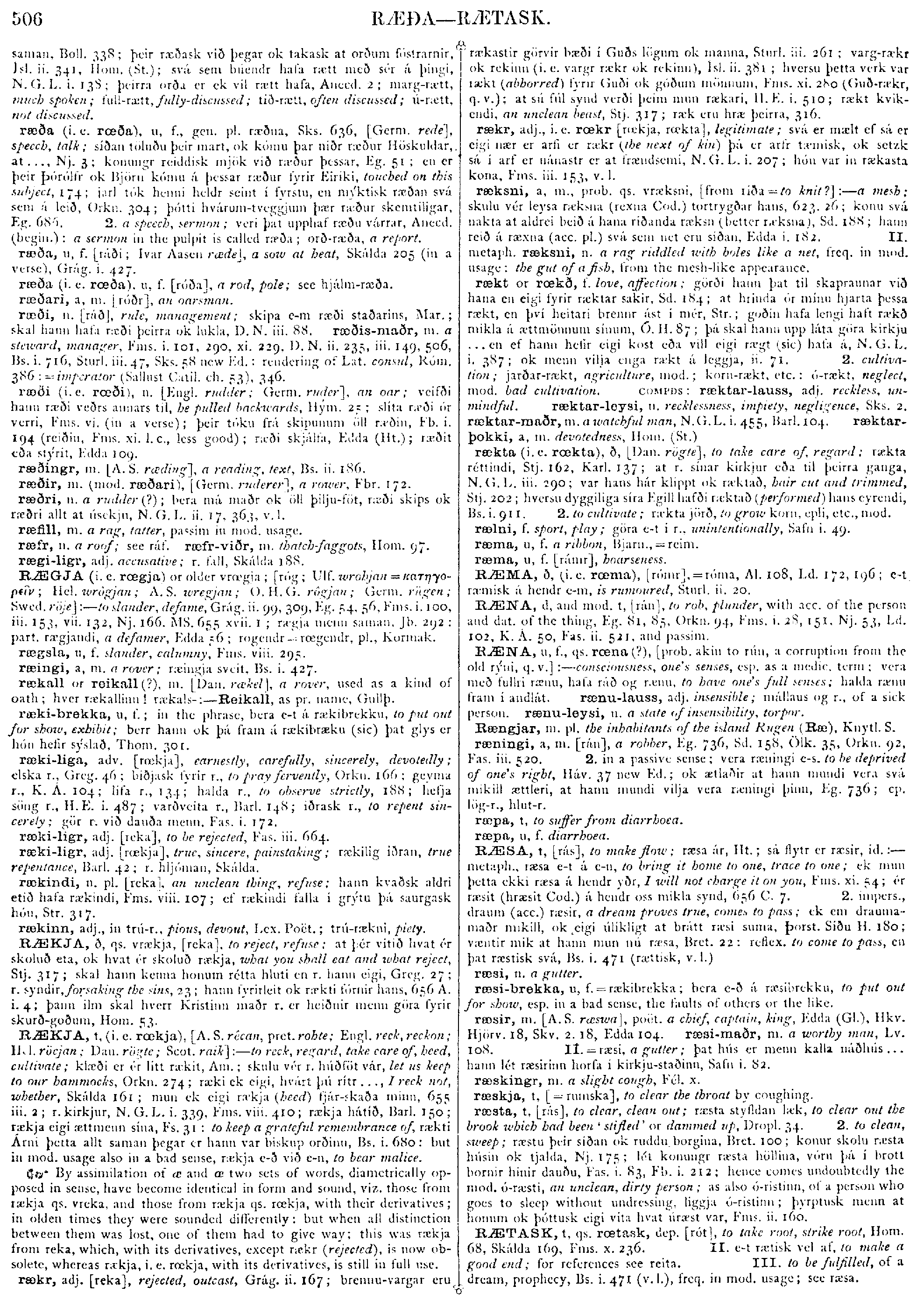
RÆKJA, t, (i. e. rœkja), [A.S. rêcan, pret. rohte; Engl. reck, reckon; Hel. röcjan; Dan. rögte; Scot, raik] :-- to reck, regard, take care of, heed, cultivate; klæði er ér lítt rækit, Am.; skulu vér r. húðföt vár, let us keep to our hammocks, Orkn. 274; ræki ek eigi, hvárt þú rítr ..., I reck not, whether, Skálda 161; mun ek eigi rækja (heed) fjár-skaða minn, 655 iii. 2; r. kirkjur, N.G.L. i. 339, Fms. viii. 410; rækja hátíð, Barl. 150; rækja eigi ættmenn sína, Fs. 31: to keep a grateful remembrance of, rækti Árni þetta allt saman þegar er hann var biskup orðinn, Bs. i. 680: but in mod. usage also in a bad sense, rækja e-ð við e-n, to bear malice. (UNCERTAIN) By assimilation of æ and œ two sets of words, diametrically opposed in sense, have become identical in form and sound, viz. those from rækja qs. vreka, and those from rækja qs. rœkja, with their derivatives; in olden times they were sounded differently: but when all distinction between them was lost, one of them had to give way; this was rækja from reka, which, with its derivatives, except rækr (rejected), is now obsolete, whereas rækja, i.e. rœkja, with its derivatives, is still in full use.
|
Source: Cleasby/Vigfusson, page b0506, entry 47 View original page image as: [TIFF] [PNG] [View previous entry] [View next entry] |
[Comment on this entry] [View comments] |
The following entry has been hand-corrected once. |
ræsta, t, [rás], to clear, clean out; ræsta styfldan læk, to clear out the brook which had been 'stifled' or dammed up, Dropl. 34. 2. to clean, sweep; ræstu þeir síðan ok ruddu borgina, Bret. 100; konur skolu ræsta húsin ok tjalda, Nj. 175; lét konungr ræsta höllina, vóru þá í brott bornir hinir dauðu, Fas. i. 83, Fb. i. 212; hence comes undoubtedly the mod. ó-ræsti, an unclean, dirty person; as also ó-ristinn, of a person who goes to sleep without undressing, liggja ó-ristinn; þyrptusk menn at honum ok þóttusk eigi vita hvat úræst var, Ems. ii. 160.
|
Source: Cleasby/Vigfusson, page b0507, entry 12 View original page image as: [TIFF] [PNG] [View previous entry] [View next entry] |
[Comment on this entry] [View comments] |
The following entry has been hand-corrected once. |
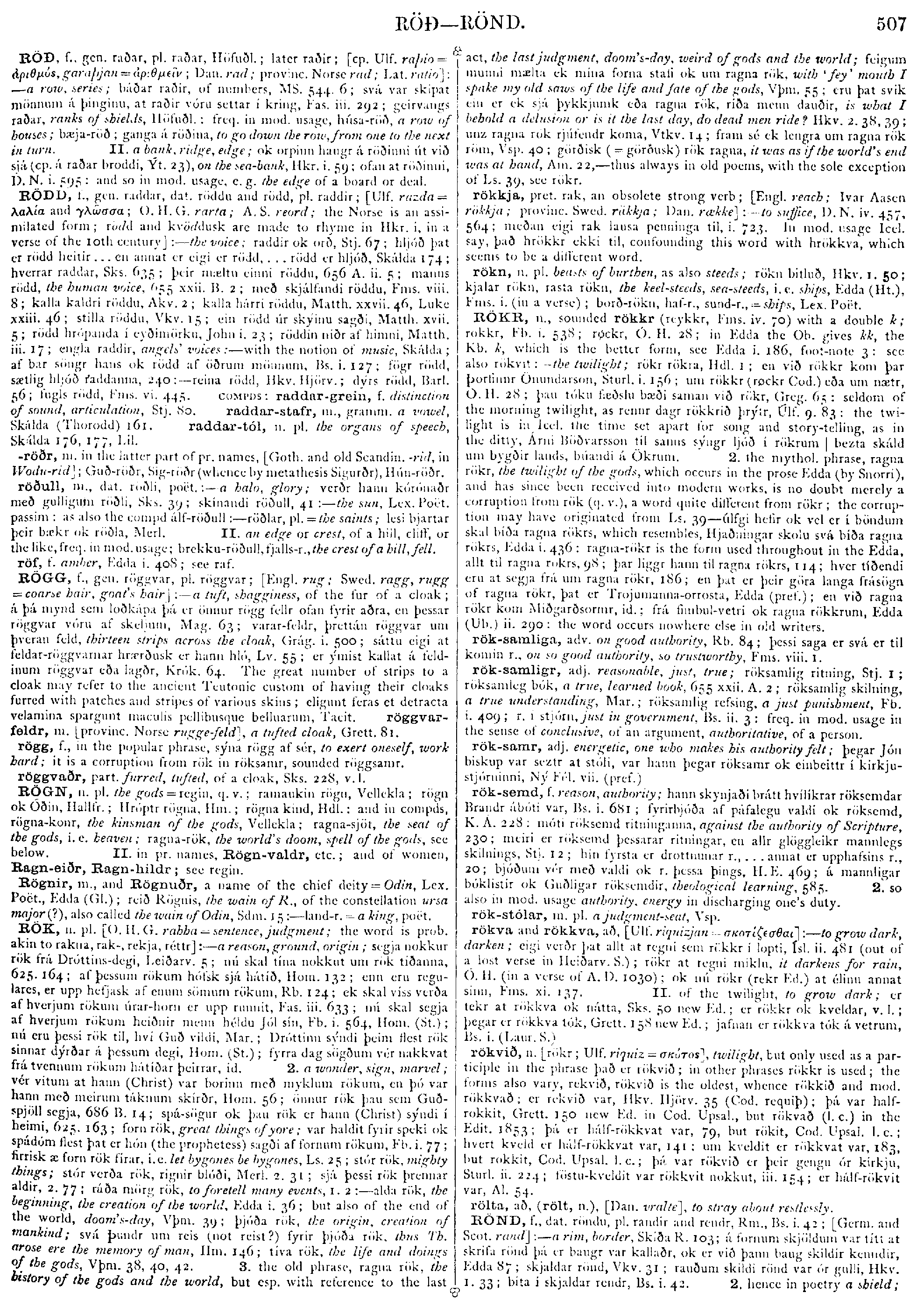
rökkja, pret. rak, an obsolete strong verb; [Engl. reach; Ivar Aasen rökkja; provinc. Swed. räkkja; Dan. række] :-- to suffice, D.N. iv. 457, 564; meðan eigi rak lausa penninga til, i. 723. In mod. usage Icel. say, það hrökkr ekki til, confounding this word with hrökkva, which seems to be a different word.
|
Source: Cleasby/Vigfusson, page b0507, entry 14 View original page image as: [TIFF] [PNG] [View previous entry] [View next entry] |
[Comment on this entry] [View comments] |
The following entry has been hand-corrected once. |
RÖKR, n., sounded rökkr (reykkr, Fms. iv. 70) with a double k; rokkr, Fb. i. 538; røckr, Ó.H. 28; in Edda the Ób. gives kk, the Kb. k, which is the better form, see Edda i. 186, foot-note 3: see also rökvit: - the twilight; rökr rökra, Hdl. 1; en við rökkr kom þar Þorfinnr Önundarson, Sturl. i. 156; um rökkr (røckr Cod.) eða um nætr, Ó.H. 28; þau tóku fæðslu bæði saman við rökr, Greg. 65: seldom of the morning twilight, as rennr dagr rökkrið þrýtr, Úlf. 9. 83: the twilight is in Icel. the time set apart for song and story-telling, as in the ditty, Árni Böðvarsson til sanns sýngr ljóð í rökrum | bezta skáld um bygðir lands, búandi á Ökrum. 2. the mythol. phrase, ragna rökr, the twilight of the gods, which occurs in the prose Edda (by Snorri),and has since been received into modern works, is no doubt merely a corruption from rök (q.v.), a word quite different from rökr; the corruption may have originated from Ls. 39 -- úlfgi hefir ok vel er í böndum skal bíða ragna rökrs, which resembles, Hjaðningar skolu svá bíða ragna rökrs, Edda i. 436: ragna-rökr is the form used throughout in the Edda, allt til ragna rökrs, 98; þar liggr hann til ragna rökrs, 114; hver tíðendi eru at segja frá um ragna rökr, 186; en þát er þeir göra langa frásögn of ragna rökr, þat er Trojumanna-orrosta, Edda (pref.); en við ragna rökr kom Miðgarðsormr, id.; frá fimbul-vetri ok ragna rökkrum, Edda (Ub.) ii. 290: the word occurs nowhere else in old writers.
|
Source: Cleasby/Vigfusson, page b0508, entry 14 View original page image as: [TIFF] [PNG] [View previous entry] [View next entry] |
[Comment on this entry] [View comments] |
The following entry has been hand-corrected once. |
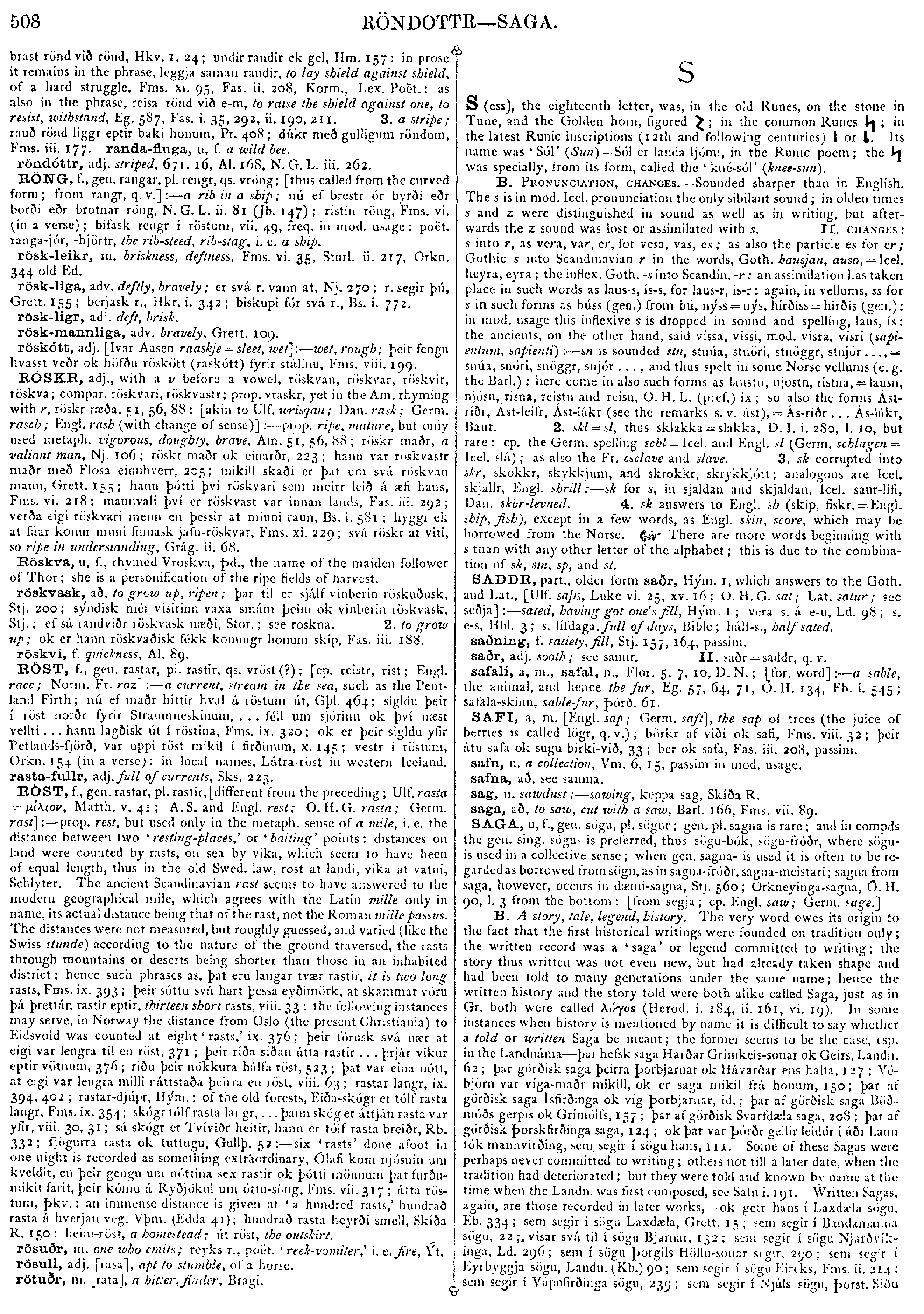
RÖST, f., gen. rastar, pl. rastir, [different from the preceding; Ulf. rasta = GREEK, Matth. v. 41; A.S. and Engl. rest; O.H.G. rasta; Germ. rast] :-- prop. rest, but used only in the metaph. sense of a mile, i.e. the distance between two 'resting-places,' or 'baiting' points: distances on land were counted by rasts, on sea by vika, which seem to have been of equal length, thus in the old Swed. law, rost at landi, vika at vatni, Schlyter. The ancient Scandinavian rast seems to have answered to the modern geographical mile, which agrees with the Latin mille only in name, its actual distance being that of the rast, not the Roman mille passus. The distances were not measured, but roughly guessed, and varied (like the Swiss stunde) according to the nature of the ground traversed, the rasts through mountains or deserts being shorter than those in an inhabited district; hence such phrases as, þat eru langar tvaer rastir, it is two long rasts, Fms. ix. 393; þeir sóttu svá hart þessa eyðimörk, at skammar vóru þá þrettán rastir eptir, thirteen short rasts, viii. 33: the following instances may serve, in Norway the distance from Oslo (the present Christiania) to Eidsvold was counted at eight 'rasts,' ix. 376; þeir fórusk svá nær at eigi var lengra til en röst, 371; þeir ríða síðan útta rastir ... þrjár vikur eptir vötnum, 376; riðu þeir nökkura hálfa röst, 523; þat var eina nótt, at eigi var lengra milli náttstaða þeirra en röst, viii. 63; rastar langr, ix. 394, 402; rastar-djúpr, Hým.: of the old forests, Eiða-skógr er tólf rasta langr, Fms. ix. 354; skógr tólf rasta langr, ... þann skóg er áttján rasta var yfir, viii. 30, 31; sá skógr er Tvíviðr heitir, hann er tólf rasta breiðr, Rb. 332; fjögurra rasta ok tuttugu, Gullþ. 52 :-- six 'rasts' done afoot in one night is recorded as something extraordinary, Ólafi kom njósnin um kveldit, en þeir gengu um nóttina sex rastir ok þótti mönnum þat furðu-mikit farit, þeir kómu á Ryðjökul um óttu-söng, Fms. vii. 317; átta röstum, Þkv.: an immense distance is given at 'a hundred rasts,' hundrað rasta á hverjan veg, Vþm. (Edda 41); hundrað rasta heyrði smell, Skíða R. 150: heim-röst, a homestead; út-röst, the outskirt.
|
Source: Cleasby/Vigfusson, page b0508, entry 19 View original page image as: [TIFF] [PNG] [View previous entry] [View next entry] |
[Comment on this entry] [View comments] |
The following entry has been hand-corrected once. |
S (ess), the eighteenth letter, was, in the old Runes, on the stone in Tune, and the Golden horn, figured RUNE; in the common Runes RUNE; in the latest Runic inscriptions (12th and following centuries) RUNE or RUNE Its name was 'Sól' (Sun) -- Sól er landa ljómi, in the Runic poem; the RUNE was specially, from its form, called the 'kné-sól' (knee-sun). B. PRONUNCIATION, CHANGES. -- Sounded sharper than in English. The s is in mod. Icel. pronunciation the only sibilant sound; in olden times s and z were distinguished in sound as well as in writing, but afterwards the z sound was lost or assimilated with s. II. CHANGES: s into r, as vera, var, er, for vesa, vas, es; as also the particle es for er; Gothic s into Scandinavian r in the words, Goth. hausjan, auso, = Icel. heyra, eyra; the infiex. Goth. -s into Scandin. -r: an assimilation has taken place in such words as laus-s, ís-s, for laus-r, ís-r: again, in vellums, ss for s in such forms as búss (gen.) from bú, nýss = nýs, hirðiss = hirðis (gen.): in mod. usage this inflexive s is dropped in sound and spelling, laus, ís: the ancients, on the other hand, said víssa, víssi, mod. vísra, vísri (sapientum, sapienti) :-- sn is sounded stn, stnúa, stnöri, stnöggr, stnjór ..., = snúa, snöri, snöggr, snjór ..., and thus spelt in some Norse vellums (e.g. the Barl.): here come in also such forms as laustn, njostn, ristna, = lausn, njósn, risna, reistn and reisn, O.H.L. (pref.) ix; so also the forms Ást-ríðr, Ást-leifr, Ást-lákr (see the remarks s.v. ást), = Ás-ríðr ... Ás-lákr, Baut. 2. skl = sl, thus sklakka = slakka, D.I. i. 280, l. 10, but rare: cp. the Germ. spelling schl = Icel. and Engl. sl (Germ. schlagen = Icel. slá); as also the Fr. esclave and slave. 3. sk corrupted into skr, skokkr, skykkjum, and skrokkr, skrykkjótt; analogous are Icel. skjallr, Engl. shrill :-- sk for s, in sjaldan and skjaldan, Icel. saur-lífi, Dan. skör-levned. 4. sk answers to Engl. sh (skip, fiskr, = Engl.ship, fish), except in a few words, as Engl. skin, score, which may be borrowed from the Norse. (???)UNCERTAIN There are more words beginning with s than with any other letter of the alphabet; this is due to the combination of sk, sm, sp, and st.
| Result Page: |  |
Previous | 275 276 277 278 279 280 281 282 283 284 285 286 287 288 289 290 291 292 293 | Next |  |
Germanic Lexicon Project (main page)
This search system was written by
Sean Crist
Please consider
volunteering
to correct the data in these online dictionaries.
No rights reserved. Feel free to use these data in any way you please.