|
|

|
Source: Cleasby/Vigfusson, page b0166, entry 65 View original page image as: [TIFF] [PNG] [View previous entry] [View next entry] |
[Comment on this entry] [View comments] |
The following entry has been hand-corrected once. |
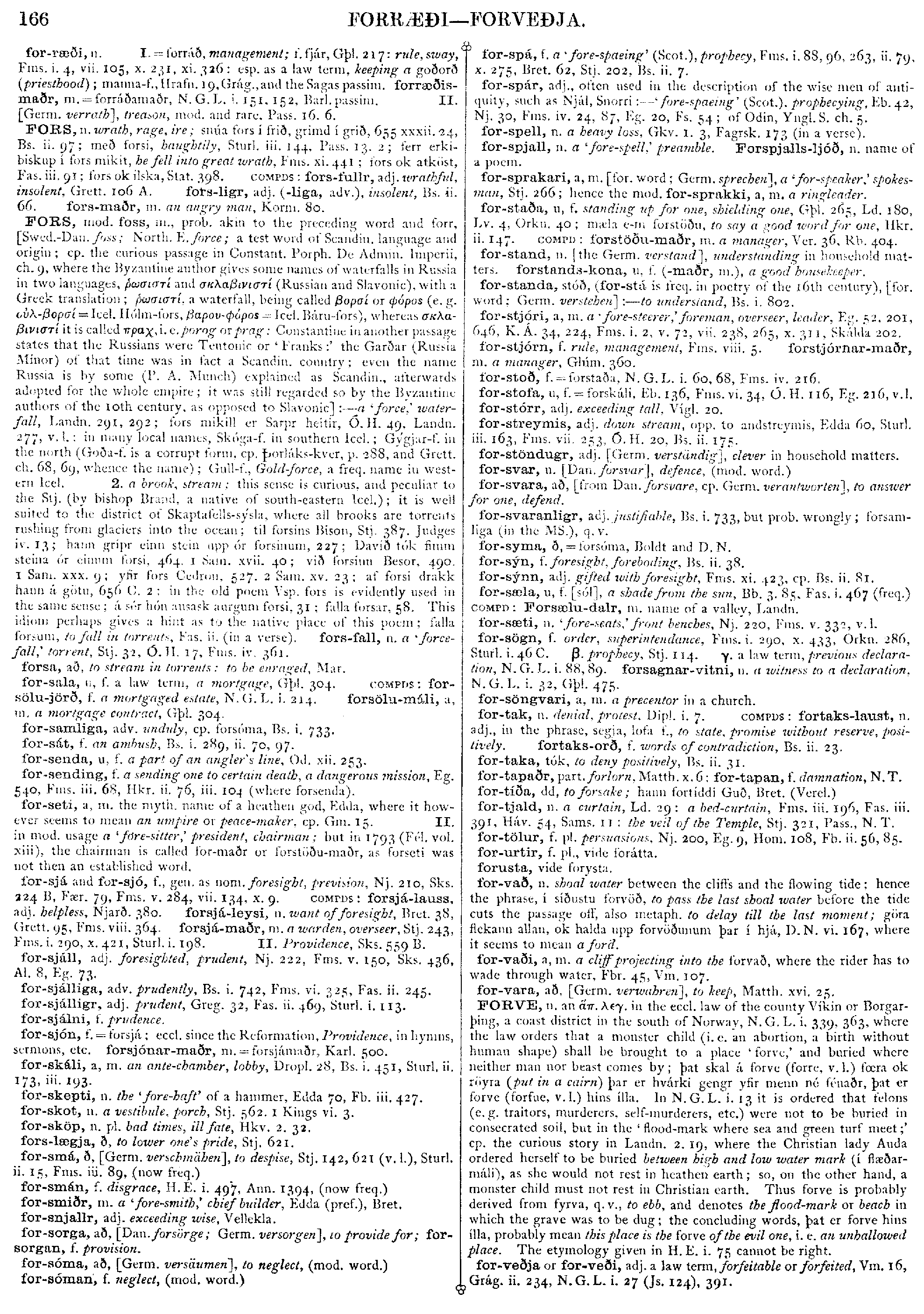
FORVE, n. an GREEK. in the eccl. law of the county Víkin or Borgarþing, a coast district in the south of Norway, N. G. L. i. 339, 363, where the law orders that a monster child (i.e. an abortion, a birth without human shape) shall be brought to a place 'forve,' and buried where neither man nor beast comes by; þat skal á forve (forre, v.l.) fœra ok röyra (put in a cairn) þar er hvárki gengr yfir menn né fénaðr, þat er forve (forfue, v.l.) hins ílla. In N. G. L. i. 13 it is ordered that felons (e.g. traitors, murderers, self-murderers, etc.) were not to be buried in consecrated soil, but in the 'flood-mark where sea and green turf meet;' cp. the curious story in Landn. 2. 19, where the Christian lady Auda ordered herself to be buried between high and low water mark (í flæðarmáli), as she would not rest in heathen earth; so, on the other hand, a monster child must not rest in Christian earth. Thus forve is probably derived from fyrva, q.v., to ebb, and denotes the flood-mark or beach in which the grave was to be dug; the concluding words, þat er forve hins ílla, probably mean this place is the forve of the evil one, i.e. an unhallowed place. The etymology given in H. E. i. 75 cannot be right.
|
Source: Cleasby/Vigfusson, page b0167, entry 25 View original page image as: [TIFF] [PNG] [View previous entry] [View next entry] |
[Comment on this entry] [View comments] |
The following entry has been hand-corrected once. |
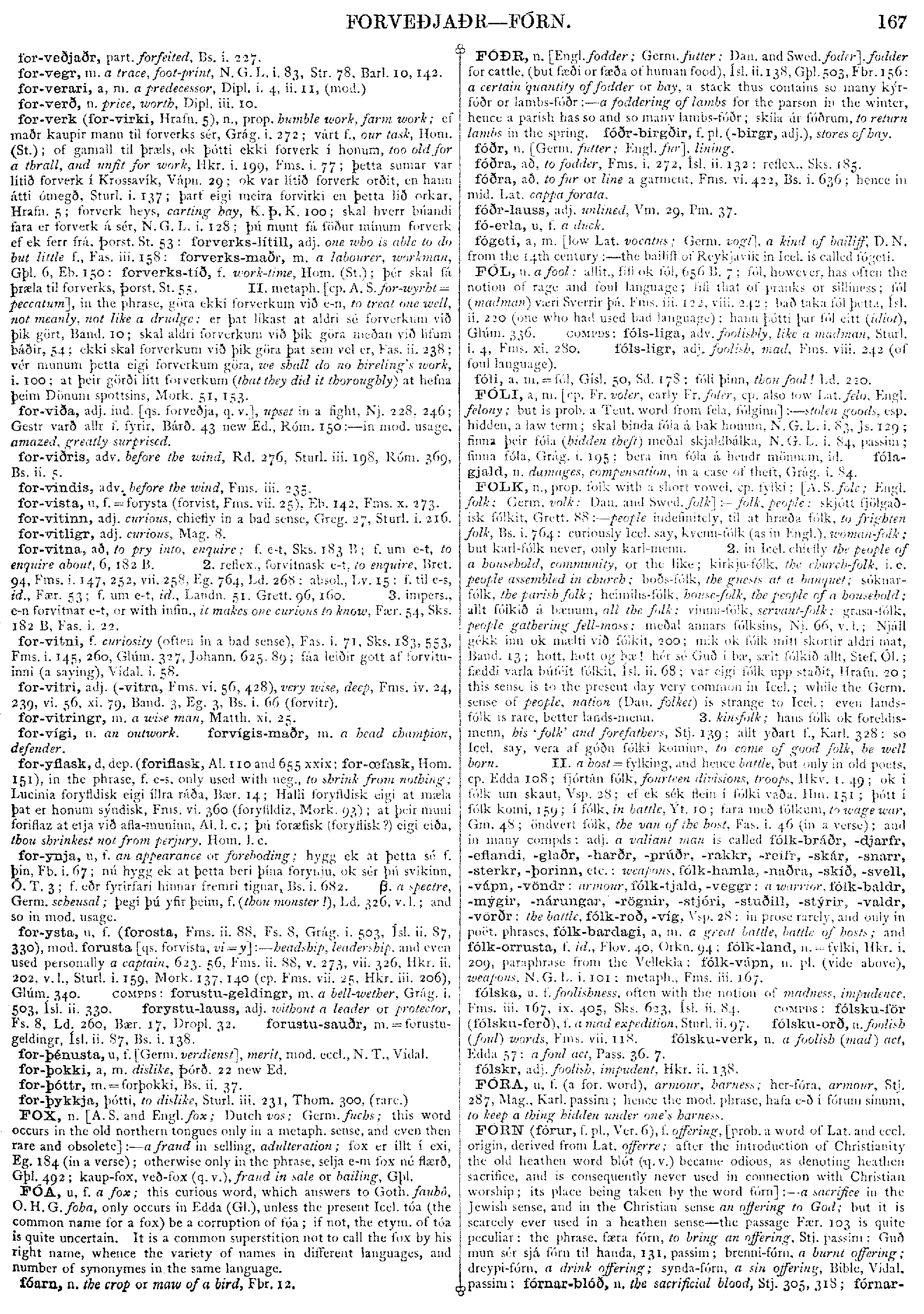
FÓA, u, f. a fox; this curious word, which answers to Goth. fauhô, O. H. G. foha, only occurs in Edda (Gl.), unless the present Icel. tóa (the common name for a fox) be a corruption of fóa; if not, the etym. of tóa is quite uncertain. It is a common superstition not to call the fox by his right name, whence the variety of names in different languages, and number of synonymes in the same language.
|
Source: Cleasby/Vigfusson, page b0168, entry 1 View original page image as: [TIFF] [PNG] [View previous entry] [View next entry] |
[Comment on this entry] [View comments] |
The following entry has been hand-corrected once. |
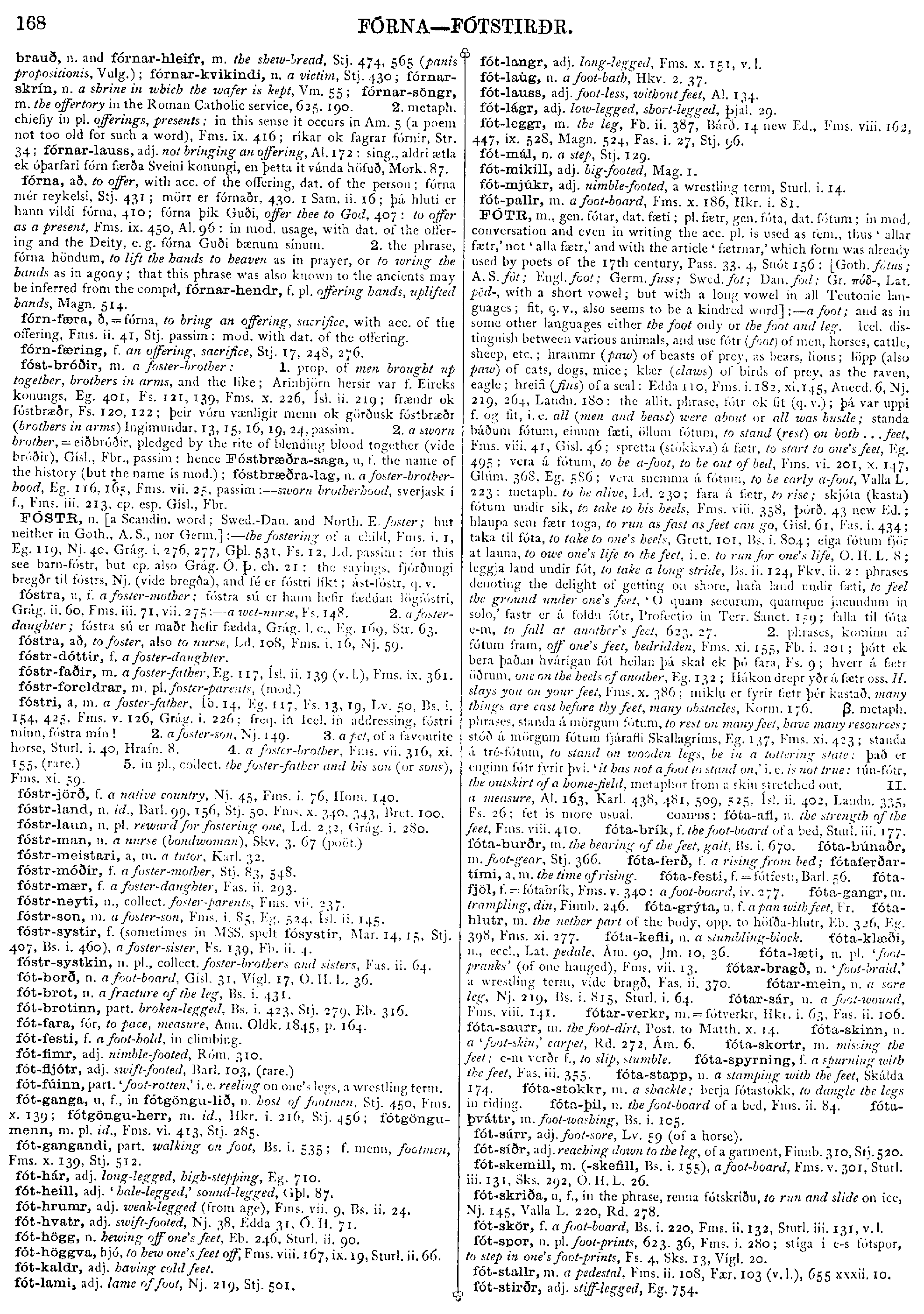
brauð, n. and fórnar-hleifr, m. the shew-bread, Stj. 474, 565 (panis propositionis, Vulg.); fórnar-kvikindi, n. a victim, Stj. 430; fórnar-skrín, n. a shrine in which the wafer is kept, Vm. 55; fórnar-söngr, m. the offertory in the Roman Catholic service, 625. 190. 2. metaph. chiefly in pl. offerings, presents; in this sense it occurs in Am. 5 (a poem not too old for such a word), Fms. ix. 416; ríkar ok fagrar fórnir, Str. 34; fórnar-lauss, adj. not bringing an offering, Al. 172: sing., aldri ætla ek óþarfari fórn færða Sveini konungi, en þetta it vánda höfuð, Mork. 87.
|
Source: Cleasby/Vigfusson, page b0168, entry 51 View original page image as: [TIFF] [PNG] [View previous entry] [View next entry] |
[Comment on this entry] [View comments] |
The following entry has been hand-corrected once. |
FÓTR,
m.,
gen.
fótar,
dat.
fæti;
pl.
fætr,
gen.
fóta,
dat.
fótum;
in
mod.
conversation
and
even
in
writing
the
acc.
pl.
is
used
as
fem.,
thus
'allar
fætr,'
not
'alla
fætr,'
and
with
the
article
'fætrnar,'
which
form
was
already
used
by
poets
of
the
17th
century,
Pass.
33.
4,
Snót
156:
[Goth.
fôtus;
A.
S.
fôt;
Engl.
foot;
Germ.
fuss;
Swed.
fot;
Dan.
fod;
Gr.
GREEK-,
Lat.
p d-,
with
a
short
vowel;
but
with
a
long
vowel
in
all
Teutonic
languages;
fit,
q.v.,
also
seems
to
be
a
kindred
word]
:--
a
foot;
and
as
in
some
other
languages
either
the
foot
only
or
the
foot
and
leg.
Icel.
distinguish
between
various
animals,
and
use
fótr
(foot)
of
men,
horses,
cattle,
sheep,
etc.;
hrammr
(paw)
of
beasts
of
prey,
as
bears,
lions;
löpp
(also
paw)
of
cats,
dogs,
mice;
klær
(claws)
of
birds
of
prey,
as
the
raven,
eagle;
hreifi
(fins)
of
a
seal:
Edda
110,
Fms.
i.
182,
xi.
145,
Anecd.
6,
Nj.
219,
264,
Landn.
180:
the
allit.
phrase,
fótr
ok
lit
(q.v.);
þá
var
uppi
f.
og
fit,
i.e.
all
(men
and
beast)
were
about
or
all
was
bustle;
standa
báðum
fótum,
einum
fæti,
öllum
fótum,
to
stand
(rest)
on
both
...
feet,
Fms.
viii.
41,
Gísl.
46;
spretta
(stökkva)
á
fætr,
to
start
to
one's
feet,
Eg.
495;
vera
á
fótum,
to
be
a-foot,
to
be
out
of
bed,
Fms.
vi.
201,
x.
147,
Glúm.
368,
Eg.
586;
vera
snemma
á
fótum,
to
be
early
a-foot,
Valla
L.
223:
metaph.
to
be
alive,
Ld.
230;
fara
á
fætr,
to
rise;
skjóta
(kasta)
fótum
undir
sik,
to
take
to
his
heels,
Fms.
viii.
358,
Þórð.
43
new
Ed.;
hlaupa
sem
fætr
toga,
to
run
as
fast
as
feet
can
go,
Gísl.
61.
Fas.
i.
434;
taka
til
fóta,
to
take
to
one's
heels,
Grett.
101,
Bs.
i.
804;
eiga
fótum
fjör
at
launa,
to
owe
one's
life
to
the
feet,
i.e.
to
run
for
one's
life,
O.
H.
L.
8;
leggja
land
undir
fót,
to
take
a
long
stride,
Bs.
ii.
124,
Fkv.
ii.
2:
phrases
denoting
the
delight
of
getting
on
shore,
hafa
land
undir
fæti,
to
feel
the
ground
wider
one's
feet,
'O
quam
securum,
quamque
jucundum
in
solo,'
fastr
er
á
foldu
fótr,
Profectio
in
Terr.
Sanct.
159;
falla
til
fóta
e-m,
to
fall
at
another's
feet,
623.
27.
2.
phrases,
kominn
af
fotum
fram,
off
one's
feet,
bedridden,
Fms.
xi.
155,
Fb.
i.
201;
þótt
ek
bera
þaðan
hvárigan
fót
heilan
þá
skal
ek
þó
fara,
Fs.
9;
hverr
á
fætr
öðrum,
one
on
the
heels
of
another,
Eg.
132;
Hákon
drepr
yðr
á
fætr
oss,
H.
slays
you
on
your
feet,
Fms.
x.
386;
miklu
er
fyrir
fætr
þér
kastað,
many
things
are
cast
before
thy
feet,
many
obstacles,
Korm.
176.
d-,
with
a
short
vowel;
but
with
a
long
vowel
in
all
Teutonic
languages;
fit,
q.v.,
also
seems
to
be
a
kindred
word]
:--
a
foot;
and
as
in
some
other
languages
either
the
foot
only
or
the
foot
and
leg.
Icel.
distinguish
between
various
animals,
and
use
fótr
(foot)
of
men,
horses,
cattle,
sheep,
etc.;
hrammr
(paw)
of
beasts
of
prey,
as
bears,
lions;
löpp
(also
paw)
of
cats,
dogs,
mice;
klær
(claws)
of
birds
of
prey,
as
the
raven,
eagle;
hreifi
(fins)
of
a
seal:
Edda
110,
Fms.
i.
182,
xi.
145,
Anecd.
6,
Nj.
219,
264,
Landn.
180:
the
allit.
phrase,
fótr
ok
lit
(q.v.);
þá
var
uppi
f.
og
fit,
i.e.
all
(men
and
beast)
were
about
or
all
was
bustle;
standa
báðum
fótum,
einum
fæti,
öllum
fótum,
to
stand
(rest)
on
both
...
feet,
Fms.
viii.
41,
Gísl.
46;
spretta
(stökkva)
á
fætr,
to
start
to
one's
feet,
Eg.
495;
vera
á
fótum,
to
be
a-foot,
to
be
out
of
bed,
Fms.
vi.
201,
x.
147,
Glúm.
368,
Eg.
586;
vera
snemma
á
fótum,
to
be
early
a-foot,
Valla
L.
223:
metaph.
to
be
alive,
Ld.
230;
fara
á
fætr,
to
rise;
skjóta
(kasta)
fótum
undir
sik,
to
take
to
his
heels,
Fms.
viii.
358,
Þórð.
43
new
Ed.;
hlaupa
sem
fætr
toga,
to
run
as
fast
as
feet
can
go,
Gísl.
61.
Fas.
i.
434;
taka
til
fóta,
to
take
to
one's
heels,
Grett.
101,
Bs.
i.
804;
eiga
fótum
fjör
at
launa,
to
owe
one's
life
to
the
feet,
i.e.
to
run
for
one's
life,
O.
H.
L.
8;
leggja
land
undir
fót,
to
take
a
long
stride,
Bs.
ii.
124,
Fkv.
ii.
2:
phrases
denoting
the
delight
of
getting
on
shore,
hafa
land
undir
fæti,
to
feel
the
ground
wider
one's
feet,
'O
quam
securum,
quamque
jucundum
in
solo,'
fastr
er
á
foldu
fótr,
Profectio
in
Terr.
Sanct.
159;
falla
til
fóta
e-m,
to
fall
at
another's
feet,
623.
27.
2.
phrases,
kominn
af
fotum
fram,
off
one's
feet,
bedridden,
Fms.
xi.
155,
Fb.
i.
201;
þótt
ek
bera
þaðan
hvárigan
fót
heilan
þá
skal
ek
þó
fara,
Fs.
9;
hverr
á
fætr
öðrum,
one
on
the
heels
of
another,
Eg.
132;
Hákon
drepr
yðr
á
fætr
oss,
H.
slays
you
on
your
feet,
Fms.
x.
386;
miklu
er
fyrir
fætr
þér
kastað,
many
things
are
cast
before
thy
feet,
many
obstacles,
Korm.
176.
 .
metaph.
phrases,
standa
á
mörgum
fótum,
to
rest
on
many
feet,
have
many
resources;
stóð
á
mörgum
fótum
fjárarli
Skallagríms,
Eg.
137,
Fms.
xi.
423;
standa
á
tré-fótum,
to
stand
on
wooden
legs,
be
in
a
tottering
state:
það
er
enginn
fótr
fyrir
því,
'it
has
not
a
foot
to
stand
on,'
i.e.
is
not
true:
tún-fótr,
the
outskirt
of
a
home-field,
metaphor
from
a
skin
stretched
out.
II.
a
measure,
Al.
163,
Karl.
438,
481,
509,
525.
Ísl.
ii.
402,
Landn.
335,
Fs.
26;
fet
is
more
usual.
COMPDS:
fóta-afl,
n.
the
strength
of
the
feet,
Fms.
viii.
410.
fóta-brík,
f.
the
foot-board
of
a
bed,
Sturl.
iii.
177.
fóta-burðr,
m.
the
bearing
of
the
feet,
gait,
Bs.
i.
670.
fóta-búnaðr,
m.
foot-gear,
Stj.
366.
fóta-ferð,
f.
a
rising
from
bed;
fótaferðar-tími,
a,
m.
the
time
of
rising.
fóta-festi,
f.
=
fótfesti,
Barl.
56.
fóta-fjöl,
f.
=
fótabrík,
Fms.
v.
340:
a
foot-board,
iv.
277.
fóta-gangr,
m.
trampling,
din,
Finnb.
246.
fóta-grýta,
u,
f.
a
pan
with
feet,
Fr.
fóta-hlutr,
m.
the
nether
part
of
the
body,
opp.
to
höfða-hlutr,
Eb.
326,
Eg.
398,
Fms.
xi.
277.
fóta-kefli,
n.
a
stumbling-block.
fóta-klæði,
n.,
eccl.,
Lat.
pedale,
Ám.
90,
Jm.
10,
36.
fóta-læti,
n.
pl.
'foot-pranks'
(of
one
hanged),
Fms.
vii.
13.
fótar-bragð,
n.
'foot-braid,'
a
wrestling
term,
vide
bragð.
Fas.
ii.
370.
fótar-mein,
n.
a
sore
leg,
Nj.
219,
Bs.
i.
815,
Sturl.
i.
64.
fótar-sár,
n.
a
foot-wound,
Fms.
viii.
141.
fótar-verkr,
m.
=
fótverkr,
Hkr.
i.
63,
Fas.
ii.
106.
fóta-saurr,
m.
the
foot-dirt,
Post.
to
Matth.
x.
14.
fóta-skinn,
n.
a
'foot-skin,'
carpet,
Rd.
272,
Ám.
6.
fóta-skortr,
m.
missing
the
feet;
e-m
verðr
f.,
to
slip,
stumble.
fóta-spyrning,
f.
a
spurning
with
the
feet,
Fas.
iii.
355.
fóta-stapp,
n.
a
stamping
with
the
feet,
Skálda
174.
fóta-stokkr,
m.
a
shackle;
berja
fótastokk,
to
dangle
the
legs
in
riding.
fóta-þil,
n.
the
foot-board
of
a
bed,
Fms.
ii.
84.
fóta-þváttr,
m.
foot-washing,
Bs.
i.
105.
.
metaph.
phrases,
standa
á
mörgum
fótum,
to
rest
on
many
feet,
have
many
resources;
stóð
á
mörgum
fótum
fjárarli
Skallagríms,
Eg.
137,
Fms.
xi.
423;
standa
á
tré-fótum,
to
stand
on
wooden
legs,
be
in
a
tottering
state:
það
er
enginn
fótr
fyrir
því,
'it
has
not
a
foot
to
stand
on,'
i.e.
is
not
true:
tún-fótr,
the
outskirt
of
a
home-field,
metaphor
from
a
skin
stretched
out.
II.
a
measure,
Al.
163,
Karl.
438,
481,
509,
525.
Ísl.
ii.
402,
Landn.
335,
Fs.
26;
fet
is
more
usual.
COMPDS:
fóta-afl,
n.
the
strength
of
the
feet,
Fms.
viii.
410.
fóta-brík,
f.
the
foot-board
of
a
bed,
Sturl.
iii.
177.
fóta-burðr,
m.
the
bearing
of
the
feet,
gait,
Bs.
i.
670.
fóta-búnaðr,
m.
foot-gear,
Stj.
366.
fóta-ferð,
f.
a
rising
from
bed;
fótaferðar-tími,
a,
m.
the
time
of
rising.
fóta-festi,
f.
=
fótfesti,
Barl.
56.
fóta-fjöl,
f.
=
fótabrík,
Fms.
v.
340:
a
foot-board,
iv.
277.
fóta-gangr,
m.
trampling,
din,
Finnb.
246.
fóta-grýta,
u,
f.
a
pan
with
feet,
Fr.
fóta-hlutr,
m.
the
nether
part
of
the
body,
opp.
to
höfða-hlutr,
Eb.
326,
Eg.
398,
Fms.
xi.
277.
fóta-kefli,
n.
a
stumbling-block.
fóta-klæði,
n.,
eccl.,
Lat.
pedale,
Ám.
90,
Jm.
10,
36.
fóta-læti,
n.
pl.
'foot-pranks'
(of
one
hanged),
Fms.
vii.
13.
fótar-bragð,
n.
'foot-braid,'
a
wrestling
term,
vide
bragð.
Fas.
ii.
370.
fótar-mein,
n.
a
sore
leg,
Nj.
219,
Bs.
i.
815,
Sturl.
i.
64.
fótar-sár,
n.
a
foot-wound,
Fms.
viii.
141.
fótar-verkr,
m.
=
fótverkr,
Hkr.
i.
63,
Fas.
ii.
106.
fóta-saurr,
m.
the
foot-dirt,
Post.
to
Matth.
x.
14.
fóta-skinn,
n.
a
'foot-skin,'
carpet,
Rd.
272,
Ám.
6.
fóta-skortr,
m.
missing
the
feet;
e-m
verðr
f.,
to
slip,
stumble.
fóta-spyrning,
f.
a
spurning
with
the
feet,
Fas.
iii.
355.
fóta-stapp,
n.
a
stamping
with
the
feet,
Skálda
174.
fóta-stokkr,
m.
a
shackle;
berja
fótastokk,
to
dangle
the
legs
in
riding.
fóta-þil,
n.
the
foot-board
of
a
bed,
Fms.
ii.
84.
fóta-þváttr,
m.
foot-washing,
Bs.
i.
105.
|
Source: Cleasby/Vigfusson, page b0169, entry 6 View original page image as: [TIFF] [PNG] [View previous entry] [View next entry] |
[Comment on this entry] [View comments] |
The following entry has been hand-corrected once. |
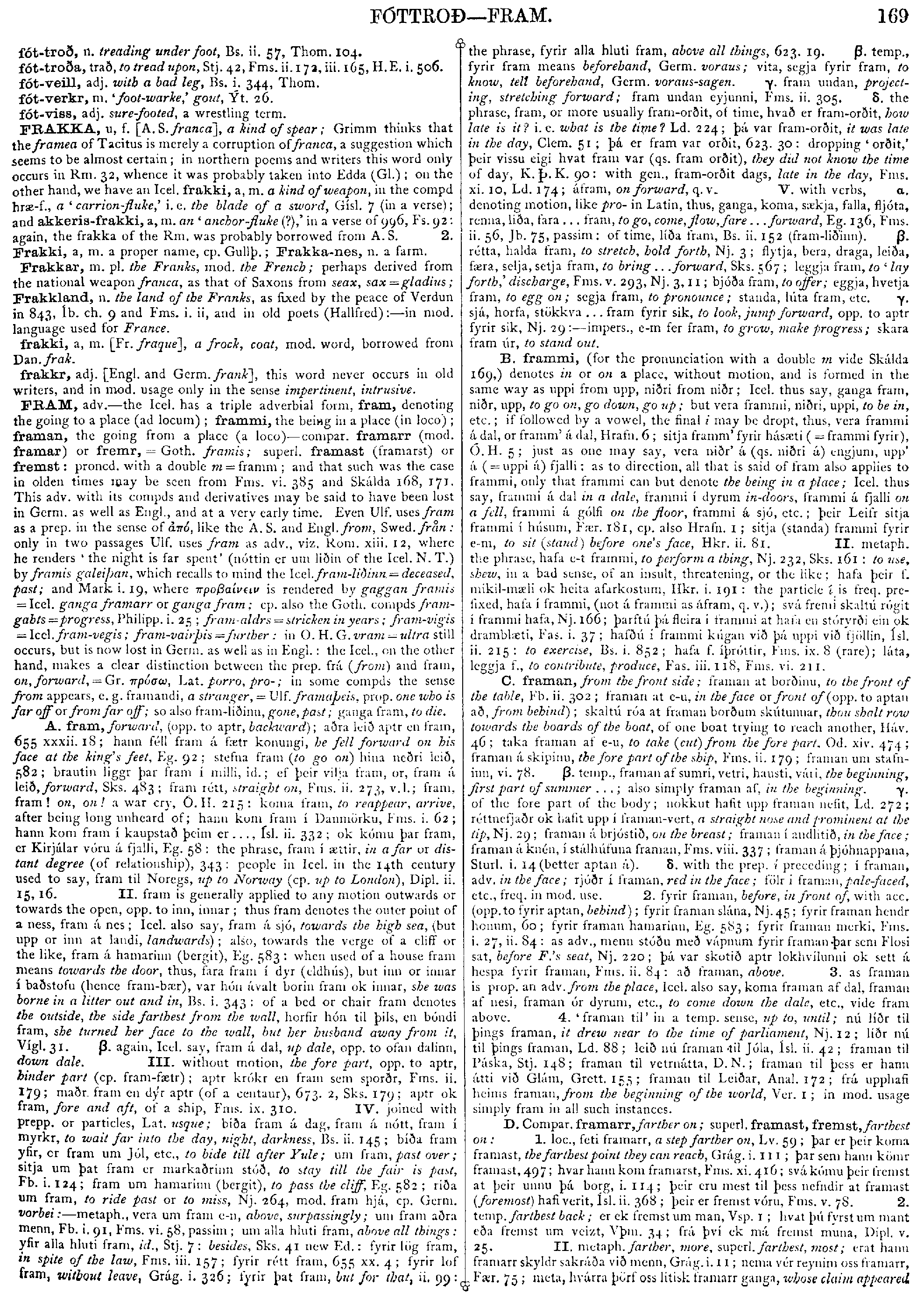
FRAKKA, u, f. [A. S. franca], a kind of spear; Grimm thinks that the framea of Tacitus is merely a corruption of franca, a suggestion which seems to be almost certain; in northern poems and writers this word only occurs in Rm. 32, whence it was probably taken into Edda (Gl.); on the other hand, we have an Icel. frakki, a, m. a kind of weapon, in the compd hræ-f., a 'carrion-fluke,' i.e. the blade of a sword, Gísl. 7 (in a verse); and akkeris-frakki, a, m. an 'anchor-fluke (?),' in a verse of 996, Fs. 92: again, the frakka of the Rm. was probably borrowed from A. S. 2. Frakki, a, m. a proper name, cp. Gullþ.; Frakka-nes, n. a farm.
|
Source: Cleasby/Vigfusson, page b0169, entry 10 View original page image as: [TIFF] [PNG] [View previous entry] [View next entry] |
[Comment on this entry] [View comments] |
The following entry has been hand-corrected once. |
FRAM, adv. -- the Icel. has a triple adverbial form, fram, denoting the going to a place (ad locum); frammi, the being in a place (in loco); framan, the going from a place (a loco) -- compar. framarr (mod. framar) or fremr, = Goth. framis; superl. framast (framarst) or fremst: proncd. with a double m = framm; and that such was the case in olden times may be seen from Fms. vi. 385 and Skálda 168, 171. This adv. with its compds and derivatives may be said to have been lost in Germ. as well as Engl., and at a very early time. Even Ulf. uses fram as a prep. in the sense of GREEK, like the A. S. and Engl. from, Swed. från: only in two passages Ulf. uses fram as adv., viz. Rom. xiii. 12, where he renders 'the night is far spent' (nóttin er um liðin of the Icel. N. T.) by framis galeiþan, which recalls to mind the Icel. fram-liðinn = deceased, past; and Mark i. 19, where GREEK is rendered by gaggan framis = Icel. ganga framarr or ganga fram; cp. also the Goth. compds fram-gahts = progress, Philipp. i. 25; fram-aldrs = stricken in years; fram-vigis = Icel. fram-vegis; fram-vairþis = further: in O. H. G. vram = ultra still occurs, but is now lost in Germ. as well as in Engl.: the Icel., on the other hand, makes a clear distinction between the prep. frá (from) and fram, on, forward, = Gr. GREEK, Lat. porro, pro-; in some compds the sense from appears, e.g. framandi, a stranger, -- Ulf. framaþeis, prop. one who is far off or from far off; so also fram-liðinn, gone, past; ganga fram, to die.
|
Source: Cleasby/Vigfusson, page b0171, entry 26 View original page image as: [TIFF] [PNG] [View previous entry] [View next entry] |
[Comment on this entry] [View comments] |
The following entry has been hand-corrected once. |
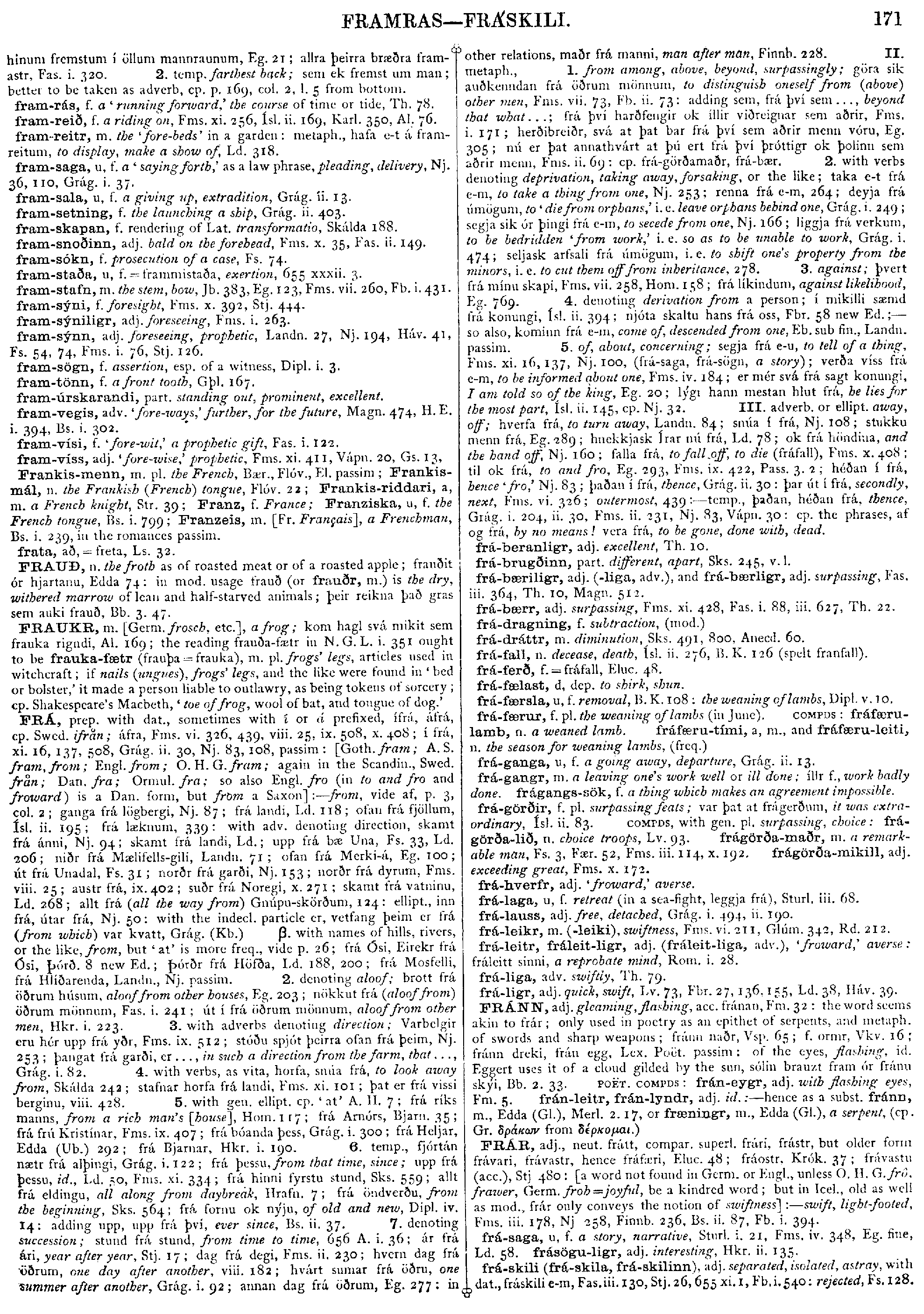
FRÁ,
prep.
with
dat.,
sometimes
with
í
or
á
prefixed,
ífrá,
áfrá,
cp.
Swed.
ifrån;
áfra,
Fms.
vi.
326,
439,
viii.
25,
ix.
508,
x.
408;
í
frá,
xi.
16,
137,
508,
Grág.
ii.
30,
Nj.
83,
108,
passim:
[Goth.
fram;
A.
S.
fram,
from;
Engl.
from;
O.
H.
G.
fram;
again
in
the
Scandin.,
Swed.
från;
Dan.
fra;
Ormul.
fra;
so
also
Engl.
fro
(in
to
and
fro
and
froward)
is
a
Dan.
form,
but
from
a
Saxon]
:--
from,
vide
af,
p.
3,
col.
2;
ganga
frá
lögbergi,
Nj.
87;
frá
landi,
Ld.
118;
ofan
frá
fjöllum,
Ísl.
ii.
195;
frá
læknum,
339:
with
adv.
denoting
direction,
skamt
frá
ánni,
Nj.
94;
skamt
frá
landi,
Ld.;
upp
frá
bæ
Una,
Fs.
33,
Ld.
206;
niðr
frá
Mælifells-gili,
Landn.
71;
ofan
frá
Merki-á,
Eg.
100;
ut
frá
Unadal,
Fs.
31;
norðr
frá
garði,
Nj.
153;
norðr
frá
dyrum,
Fms.
viii.
25;
austr
frá,
ix.
402;
suðr
frá
Noregi,
x.
271;
skamt
frá
vatninu,
Ld.
268;
allt
frá
(all
the
way
from)
Gnúpu-skörðum,
124:
ellipt.,
inn
frá,
útar
frá,
Nj.
50:
with
the
indecl.
particle
er,
vetfang
þeim
er
frá
(from
which)
var
kvatt,
Grág.
(Kb.)
.
with
names
of
hills,
rivers,
or
the
like,
from,
but
'at'
is
more
freq.,
vide
p.
26;
frá
Ósi,
Eirekr
frá
Ósi,
Þórð.
8
new
Ed.;
Þórðr
frá
Höfða,
Ld.
188,
200;
frá
Mosfelli,
frá
Hlíðarenda,
Landn.,
Nj.
passim.
2.
denoting
aloof;
brott
frá
öðrum
húsum,
aloof
from
other
houses,
Eg.
203;
nökkut
frá
(aloof
from)
öðrum
mönnum,
Fas.
i.
241;
út
í
frá
öðrum
mönnum,
aloof
from
other
men,
Hkr.
i.
223.
3.
with
adverbs
denoting
direction;
Varbelgir
eru
hér
upp
frá
yðr,
Fms.
ix.
512;
stóðu
spjót
þeirra
ofan
frá
þeim,
Nj.
253;
þangat
frá
garði,
er
...,
in
such
a
direction
from
the
farm,
that
...,
Grág.
i.
82.
4.
with
verbs,
as
vita,
horfa,
snúa
frá,
to
look
away
from,
Skálda
242;
stafnar
horfa
frá
landi,
Fms.
xi.
101;
þat
er
frá
vissi
berginu,
viii.
428.
5.
with
gen.
ellipt.
cp.
'at'
A.
II.
7;
frá
riks
manns,
from
a
rich
man's
[house],
Hom.
117;
frá
Arnórs,
Bjarn.
35;
frá
frú
Kristínar,
Fms.
ix.
407;
frá
bóanda
þess,
Grág.
i.
300;
frá
Heljar,
Edda
(Ub.)
292;
frá
Bjarnar,
Hkr.
i.
190.
6.
temp.,
fjórtán
nætr
frá
alþingi,
Grág.
i.
122;
frá
þessu,
from
that
time,
since;
upp
frá
þessu,
id.,
Ld.
50,
Fms.
xi.
334;
frá
hinni
fyrstu
stund,
Sks.
559;
allt
frá
eldingu,
all
along
from
daybreak,
Hrafn.
7;
frá
öndverðu,
from
the
beginning,
Sks.
564;
frá
fornu
ok
nýju,
of
old
and
new,
Dipl.
iv.
14:
adding
upp,
upp
frá
því,
ever
since,
Bs.
ii.
37.
7.
denoting
succession;
stund
frá
stund,
from
time
to
time,
656
A.
i.
36;
ár
frá
ári,
year
after
year,
Stj.
17;
dag
frá
degi,
Fms.
ii.
230;
hvern
dag
frá
öðrum,
one
day
after
another,
viii.
182;
hvárt
sumar
frá
öðru,
one
summer
after
another,
Grág.
i.
92;
annan
dag
frá
öðrum,
Eg.
277:
in
other
relations,
maðr
frá
manni,
man
after
man,
Finnb.
228.
II.
metaph.,
1.
from
among,
above,
beyond,
surpassingly;
göra
sik
auðkenndan
frá
öðrum
mönnum,
to
distinguish
oneself
from
(above)
other
men,
Fms.
vii.
73,
Fb.
ii.
73:
adding
sem,
frá
því
sem
...,
beyond
that
what
...;
frá
því
harðfengir
ok
íllir
viðreignar
sem
aðrir,
Fms.
i.
171;
herðibreiðr,
svá
at
þat
bar
frá
því
sem
aðrir
menn
vóru,
Eg.
305;
nú
er
þat
annathvárt
at
þú
ert
frá
því
þróttigr
ok
þolinn
sem
aðrir
menn,
Fms.
ii.
69:
cp.
frá-görðamaðr,
frá-bær.
2.
with
verbs
denoting
deprivation,
taking
away,
forsaking,
or
the
like;
taka
e-t
frá
e-m,
to
take
a
thing
from
one,
Nj.
253;
renna
frá
e-m,
264;
deyja
frá
úmögum,
to
'die
from
orphans,'
i.e.
leave
orphans
behind
one,
Grág.
i.
249;
segja
sik
ór
þingi
frá
e-m,
to
secede
from
one,
Nj.
166;
liggja
frá
verkum,
to
be
bedridden
'from
work,'
i.e.
so
as
to
be
unable
to
work,
Grág.
i.
474;
seljask
arfsali
frá
úmögum,
i.e.
to
shift
one's
property
from
the
minors,
i.e.
to
cut
them
off
from
inheritance,
278.
3.
against;
þvert
frá
mínu
skapi,
Fms.
vii.
258,
Hom.
158;
frá
líkindum,
against
likelihood,
Eg.
769.
4.
denoting
derivation
from
a
person;
í
mikilli
sæmd
frá
konungi,
Ísl.
ii.
394;
njóta
skaltu
hans
frá
oss,
Fbr.
58
new
Ed.;
--
so
also,
kominn
frá
e-m,
come
of,
descended
from
one,
Eb.
sub
fin.,
Landn.
passim.
5.
of,
about,
concerning;
segja
frá
e-u,
to
tell
of
a
thing,
Fms.
xi.
16,
137,
Nj.
100,
(frá-saga,
frá-sögn,
a
story);
verða
víss
frá
e-m,
to
be
informed
about
one,
Fms.
iv.
184;
er
mér
svá
frá
sagt
konungi,
I
am
told
so
of
the
king,
Eg.
20;
lýgi
hann
mestan
hlut
frá,
he
lies
for
the
most
part,
Ísl.
ii.
145,
cp.
Nj.
32.
III.
adverb.
or
ellipt.
away,
off;
hverfa
frá,
to
turn
away,
Landn.
84;
snúa
í
frá,
Nj.
108;
stukku
menn
frá,
Eg.
289;
hnekkjask
Írar
nú
frá,
Ld.
78;
ok
frá
höndina,
and
the
hand
off,
Nj.
160;
falla
frá,
to
fall
off,
to
die
(fráfall),
Fms.
x.
408;
til
ok
frá,
to
and
fro,
Eg.
293,
Fms.
ix.
422,
Pass.
3.
2;
héðan
í
frá,
hence
'fro,'
Nj.
83;
þaðan
í
frá,
thence,
Grág.
ii.
30:
þar
ut
í
frá,
secondly,
next,
Fms.
vi.
326;
outermost,
439
:--
temp.,
þaðan,
héðan
frá,
thence,
Grág.
i.
204,
ii.
30,
Fms.
ii.
231,
Nj.
83,
Vápn.
30:
cp.
the
phrases,
af
og
frá,
by
no
means!
vera
frá,
to
be
gone,
done
with,
dead.
|
Source: Cleasby/Vigfusson, page b0171, entry 39 View original page image as: [TIFF] [PNG] [View previous entry] [View next entry] |
[Comment on this entry] [View comments] |
The following entry has been hand-corrected once. |
frá-gangr, m. a leaving one's work well or ill done; íllr f., work badly done, frágangs-sök, f. a thing which makes an agreement impossible.
|
Source: Cleasby/Vigfusson, page b0172, entry 10 View original page image as: [TIFF] [PNG] [View previous entry] [View next entry] |
[Comment on this entry] [View comments] |
The following entry has been hand-corrected once. |
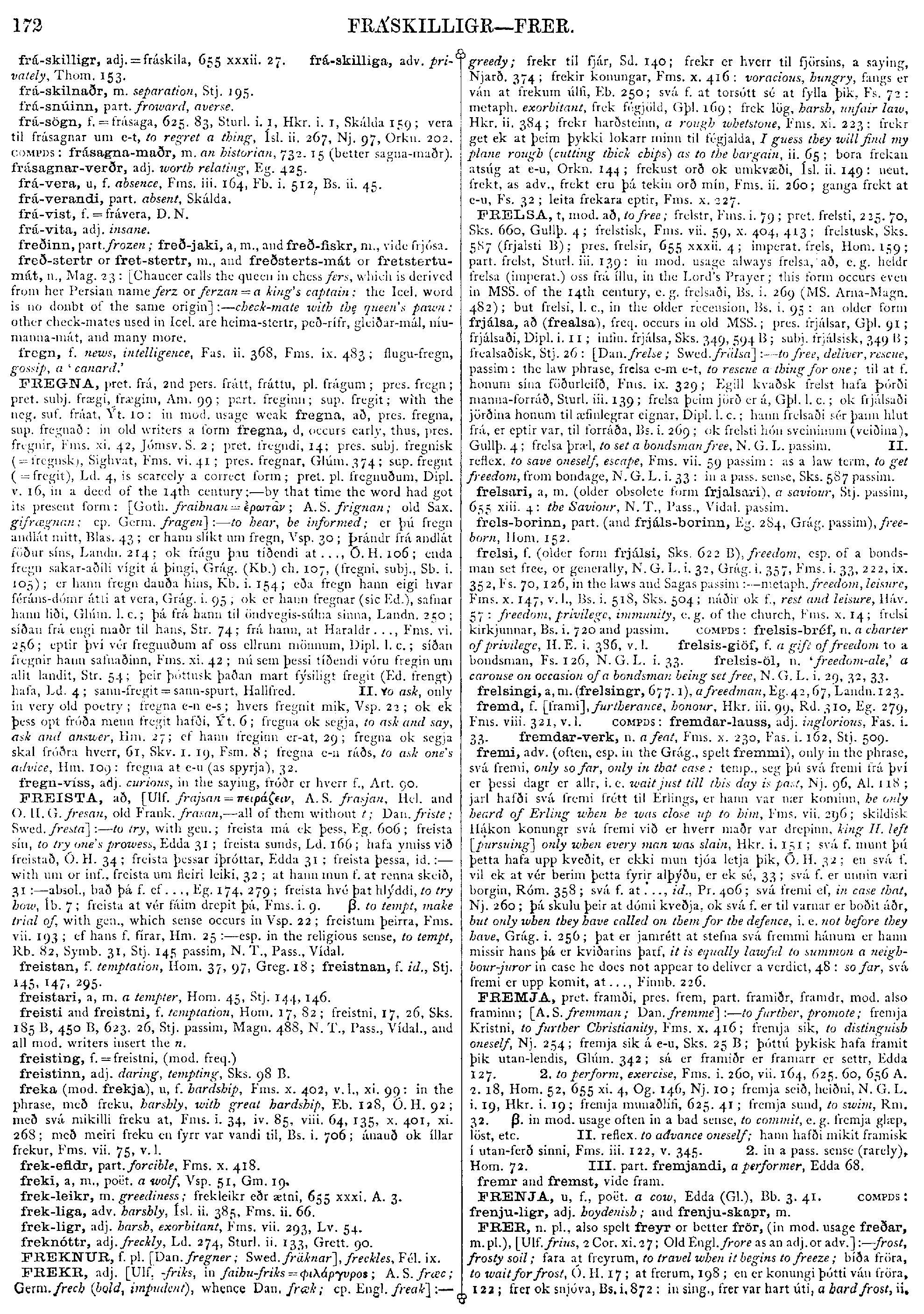
freð-stertr or fret-stertr, m., and freðsterts-mát or fretstertu-mát, n., Mag. 23: [Chaucer calls the queen in chess fers, which is derived from her Persian name ferz or ferzan = a king's captain; the Icel. word is no doubt of the same origin] :-- check-mate with the queen's pawn: other check-mates used in Icel. are heima-stertr, peð-rífr, gleiðar-mál, níumanna-mát, and many more.
|
Source: Cleasby/Vigfusson, page b0172, entry 14 View original page image as: [TIFF] [PNG] [View previous entry] [View next entry] |
[Comment on this entry] [View comments] |
The following entry has been hand-corrected once. |
FREISTA,
að,
[Ulf.
frajsan
=
GREEK,
A.
S.
frasjan,
Hel.
and
O.
H.
G.
fresan,
old
Frank.
frasan,
--
all
of
them
without
t;
Dan.
friste;
Swed.
fresta]
:--
to
try,
with
gen.;
freista
má
ek
þess,
Eg.
606;
freista
sín,
to
try
one's
prowess,
Edda
31;
freista
sunds,
Ld.
166;
hafa
ymiss
við
freistað,
Ó.
H.
34;
freista
þessar
íþróttar,
Edda
31;
freista
þessa,
id.
:--
with
um
or
inf.,
freista
um
fleiri
leiki,
32;
at
hann
mun
f.
at
renna
skeið,
31
:--
absol.,
bað
þá
f.
ef
...,
Eg.
174,
279;
freista
hvé
þat
hlýddi,
to
try
how,
Íb.
7;
freista
at
vér
fáim
drepit
þá,
Fms.
i.
9.
.
to
tempt,
make
trial
of,
with
gen.,
which
sense
occurs
in
Vsp.
22;
freistum
þeirra,
Fms.
vii.
193;
ef
hans
f.
fírar,
Hm.
25
:--
esp.
in
the
religious
sense,
to
tempt,
Rb.
82,
Symb.
31,
Stj.
145
passim,
N.
T.,
Pass.,
Vídal.
| Result Page: |  |
Previous | 227 228 229 230 231 232 233 234 235 236 237 238 239 240 241 242 243 244 245 | Next |  |
Germanic Lexicon Project (main page)
This search system was written by
Sean Crist
Please consider
volunteering
to correct the data in these online dictionaries.
No rights reserved. Feel free to use these data in any way you please.