|
|

|
Source: Bosworth/Toller, page b1168, entry 13 View original page image as: [TIFF] [PNG] [View previous entry] [View next entry] |
[Comment on this entry] [View comments] |
The following entry has been hand-corrected once. |
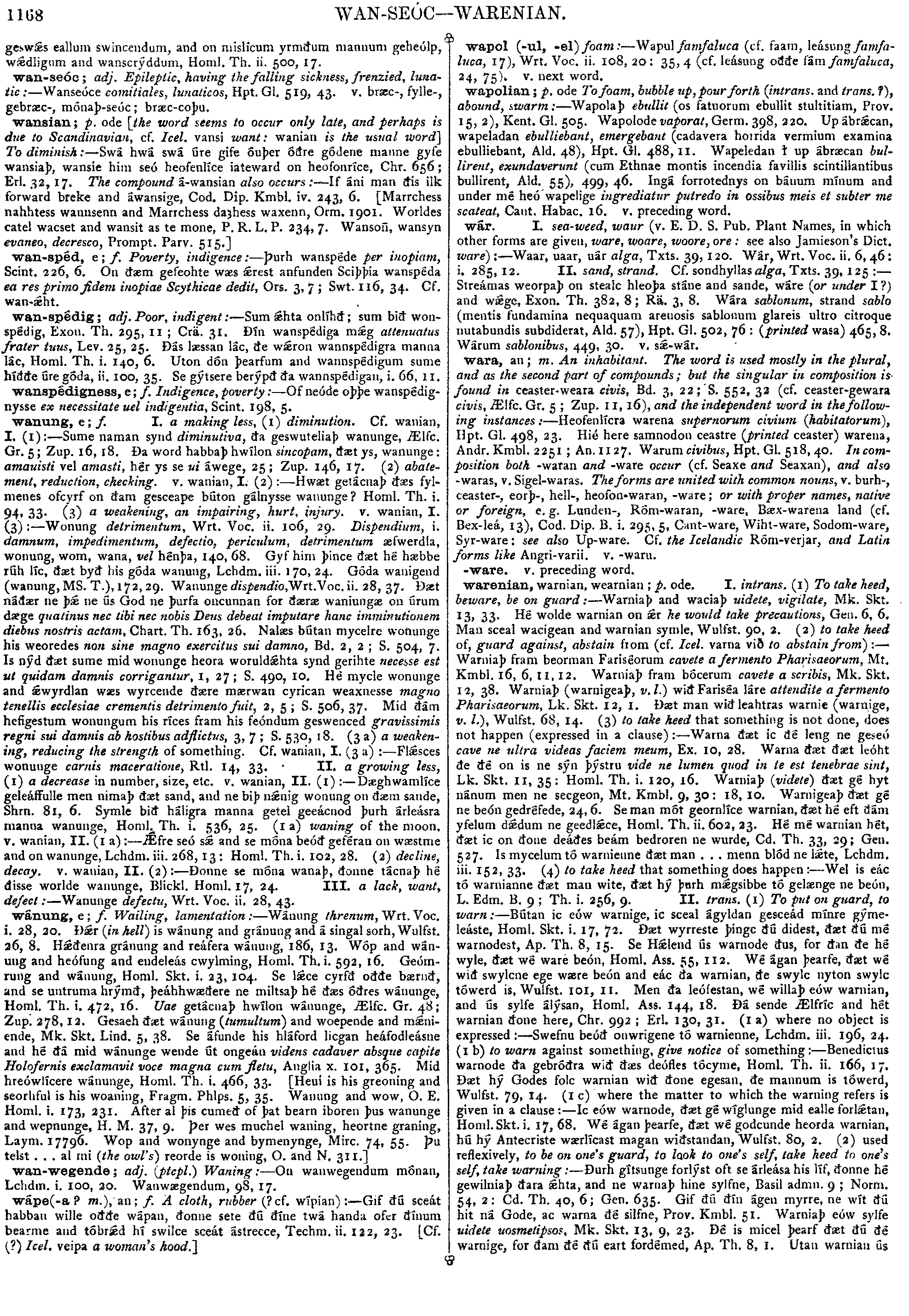
wár.
I.
sea-weed,
waur
(v.
E.
D.
S.
Pub.
Plant
Names,
in
which
other
forms
are
given,
ware,
woare,
woore,
ore
:
see
also
Jamieson's
Dict.
ware):--
Waar,
uaar,
uár
alga,
Txts.
39,
120.
Wár.
Wrt.
Voc.
ii.
6,
46:
i.
285,
12.
II.
sand,
strand.
Cf.
sondhyllas
alga,
Txts.
39,
125
:--
Streámas
weorpaþ
on
stealc
hleoþa
stáne
and
sande,
wáre
(or
under
I
?)
and
w ge,
Exon.
Th.
382,
8;
Rä.
3,
8.
Wára
sablonum,
strand
sablo
(mentis
fundamina
nequaquam
areuosis
sablonum
glareis
ultro
citroque
nutabundis
subdiderat,
Ald.
57),
Hpt.
Gl.
502,
76
:
(printed
wasa)
465,
8.
Wárum
sablonibus,
449,
30.
v.
s-wár.
ge,
Exon.
Th.
382,
8;
Rä.
3,
8.
Wára
sablonum,
strand
sablo
(mentis
fundamina
nequaquam
areuosis
sablonum
glareis
ultro
citroque
nutabundis
subdiderat,
Ald.
57),
Hpt.
Gl.
502,
76
:
(printed
wasa)
465,
8.
Wárum
sablonibus,
449,
30.
v.
s-wár.
|
Source: Bosworth/Toller, page b1168, entry 16 View original page image as: [TIFF] [PNG] [View previous entry] [View next entry] |
[Comment on this entry] [View comments] |
The following entry has been hand-corrected once. |
warenian,
warnian,
wearnian
;
p.
ode.
I.
intrans.
(1)
To
take
heed,
beware,
be
on
guard
:--
Warniaþ
and
waciaþ
uidete,
vigilate,
Mk.
Skt.
13,
33.
Hé
wolde
warnian
on
r
he
would
take
precautions,
Gen.
6,
6,
Man
sceal
wacigean
and
warnian
symle,
Wulfst.
90,
2.
(2)
to
take
heed
of,
guard
against,
abstain
from
(cf.
Icel.
varna
við
to
abstain
from)
:--
Warniaþ
fram
beorman
Fariséorum
cavete
a
fermento
Pharisaeorum,
Mt.
Kmbl.
16,
6,
11,
12.
Warniaþ
fram
bócerum
cavete
a
scribis.
Mk.
Skt.
12,
38.
Warniaþ
(warnigeaþ,
v.
l.)
wið
Fariséa
láre
attendite
a
fermento
Pharisaeorum,
Lk.
Skt.
12,
1.
Ðæt
man
wið
leahtras
warnie
(warnige,
v.
l.).
Wulfst.
68,
14.
(3)
to
take
heed
that
something
is
not
done,
does
not
happen
(expressed
in
a
clause)
:--
Warna
ðæt
ic
ðé
leng
ne
geseó
cave
ne
ultra
videas
faciem
meum,
Ex.
10,
28.
Warna
ðæt
ðæt
leóht
ðe
ðé
on
is
ne
sýn
þýstru
vide
ne
lumen
quod
in
te
est
tenebrae
sint,
Lk.
Skt.
II,
35:
Homl.
Th.
i.
120,
16.
Warniaþ
(videte)
ðæt
gé
hyt
nánum
men
ne
secgeon,
Mt.
Kmbl.
9,
30:
18,
10.
Warnigeaþ
ðæt
gé
ne
beón
gedrefede,
24,
6.
Se
man
mót
geornlíce
warnian,
ðæt
hé
eft
ðám
yfelum
ddum
ne
geedlce,
Homl.
Th.
ii.
602,
23.
Hé
mé
warnian
hét,
ðæt
ic
on
ðone
deáðes
beám
bedroren
ne
wurde,
Cd.
Th.
33,
29;
Gen.
527.
Is
mycelum
tó
warnienne
ðæt
man
.
.
.
menn
blód
ne
lte,
Lchdm.
iii.
152,
33.
(4)
to
take
heed
that
something
does
happen
:--
Wel
is
eác
tó
warnianne
ðæt
man
wite,
ðæt
hý
þurh
mgsibbe
tó
gelænge
ne
beón,
L.
Edm.
B.
9
;
Th.
i.
256,
9.
II.
trans.
(1)
To
put
on
guard,
to
warn
:--
Bútan
ic
eów
warnige,
ic
sceal
ágyldan
gesceád
mínre
gýme leáste,
Homl.
Skt.
i.
17,
72.
Ðæt
wyrreste
þingc
ðú
didest,
ðæt
ðú
mé
warnodest,
Ap.
Th.
8,
15.
Se
Hlend
ús
warnode
ðus,
for
ðan
ðe
hé
wyle,
ðæt
wé
ware
beón,
Homl.
Ass.
55,
112.
Wé
ágan
þearfe,
ðæt
wé
wið
swylcne
ege
wære
beón
and
eác
ða
warnian,
ðe
swylc
nyton
swylc
tówerd
is.
Wulfst.
101,
11.
Men
ða
leófestan,
wé
willaþ
eów
warnian,
and
ús
sylfe
álýsan,
Homl.
Ass.
144,
18.
Ðá
sende
Ælfríc
and
hét
warnian
ðone
here,
Chr.
992
;
Erl.
130,
31.
(1
a)
where
no
object
is
expressed
:--
Swefnu
beóð
onwrigene
tó
warnienne,
Lchdm.
iii.
196,
24.
(1
b)
to
warn
against
something,
give
notice
of
something
:--
Benedicius
warnode
ða
gebróðra
wið
ðæs
deófles
tócyme,
Homl.
Th.
ii.
166,
17.
Ðæt
hý
Godes
folc
warnian
wið
ðone
egesan,
ðe
mannum
is
tówerd,
Wulfst.
79,
14.
(1
c)
where
the
matter
to
which
the
warning
refers
is
given
in
a
clause
:--
Ic
eów
warnode,
ðæt
gé
wíglunge
mid
ealle
forltan,
Homl.
Skt.
i.
17,
68.
Wé
ágan
þearfe,
ðæt
wé
godcunde
heorda
warnian,
hú
hý
Antecriste
wærlícast
magan
wiðstandan,
Wulfst.
80,
2.
(2)
used
reflexively,
to
be
on
one's
guard,
to
look
to
one's
self,
take
heed
to
one's
self,
take
warning
:--
Ðurh
gítsunge
forlýst
oft
se
árleása
his
líf,
ðonne
hé
gewilniaþ
ðara
hta,
and
ne
warnaþ
hine
sylfne,
Basil
admn.
9
;
Norm.
54,
2:
Cd.
Th.
40,
6;
Gen.
635.
Gif
ðú
ðín
ágen
myrre,
ne
wít
ðú
hit
ná
Gode,
ac
warna
ðé
silfne,
Prov.
Kmbl.
51.
Warniaþ
eów
sylfe
uidete
uosmetipsos,
Mk.
Skt.
13,
9,
23.
Ðé
is
micel
þearf
ðæt
ðú
ðé
warnige,
for
ðam
ðé
ðú
eart
fordémed,
Ap.
Th.
8,
1.
Utan
warnian
ús
leáste,
Homl.
Skt.
i.
17,
72.
Ðæt
wyrreste
þingc
ðú
didest,
ðæt
ðú
mé
warnodest,
Ap.
Th.
8,
15.
Se
Hlend
ús
warnode
ðus,
for
ðan
ðe
hé
wyle,
ðæt
wé
ware
beón,
Homl.
Ass.
55,
112.
Wé
ágan
þearfe,
ðæt
wé
wið
swylcne
ege
wære
beón
and
eác
ða
warnian,
ðe
swylc
nyton
swylc
tówerd
is.
Wulfst.
101,
11.
Men
ða
leófestan,
wé
willaþ
eów
warnian,
and
ús
sylfe
álýsan,
Homl.
Ass.
144,
18.
Ðá
sende
Ælfríc
and
hét
warnian
ðone
here,
Chr.
992
;
Erl.
130,
31.
(1
a)
where
no
object
is
expressed
:--
Swefnu
beóð
onwrigene
tó
warnienne,
Lchdm.
iii.
196,
24.
(1
b)
to
warn
against
something,
give
notice
of
something
:--
Benedicius
warnode
ða
gebróðra
wið
ðæs
deófles
tócyme,
Homl.
Th.
ii.
166,
17.
Ðæt
hý
Godes
folc
warnian
wið
ðone
egesan,
ðe
mannum
is
tówerd,
Wulfst.
79,
14.
(1
c)
where
the
matter
to
which
the
warning
refers
is
given
in
a
clause
:--
Ic
eów
warnode,
ðæt
gé
wíglunge
mid
ealle
forltan,
Homl.
Skt.
i.
17,
68.
Wé
ágan
þearfe,
ðæt
wé
godcunde
heorda
warnian,
hú
hý
Antecriste
wærlícast
magan
wiðstandan,
Wulfst.
80,
2.
(2)
used
reflexively,
to
be
on
one's
guard,
to
look
to
one's
self,
take
heed
to
one's
self,
take
warning
:--
Ðurh
gítsunge
forlýst
oft
se
árleása
his
líf,
ðonne
hé
gewilniaþ
ðara
hta,
and
ne
warnaþ
hine
sylfne,
Basil
admn.
9
;
Norm.
54,
2:
Cd.
Th.
40,
6;
Gen.
635.
Gif
ðú
ðín
ágen
myrre,
ne
wít
ðú
hit
ná
Gode,
ac
warna
ðé
silfne,
Prov.
Kmbl.
51.
Warniaþ
eów
sylfe
uidete
uosmetipsos,
Mk.
Skt.
13,
9,
23.
Ðé
is
micel
þearf
ðæt
ðú
ðé
warnige,
for
ðam
ðé
ðú
eart
fordémed,
Ap.
Th.
8,
1.
Utan
warnian
ús
|
Source: Bosworth/Toller, page b1171, entry 16 View original page image as: [TIFF] [PNG] [View previous entry] [View next entry] |
[Comment on this entry] [View comments] |
The following entry has been hand-corrected once. |
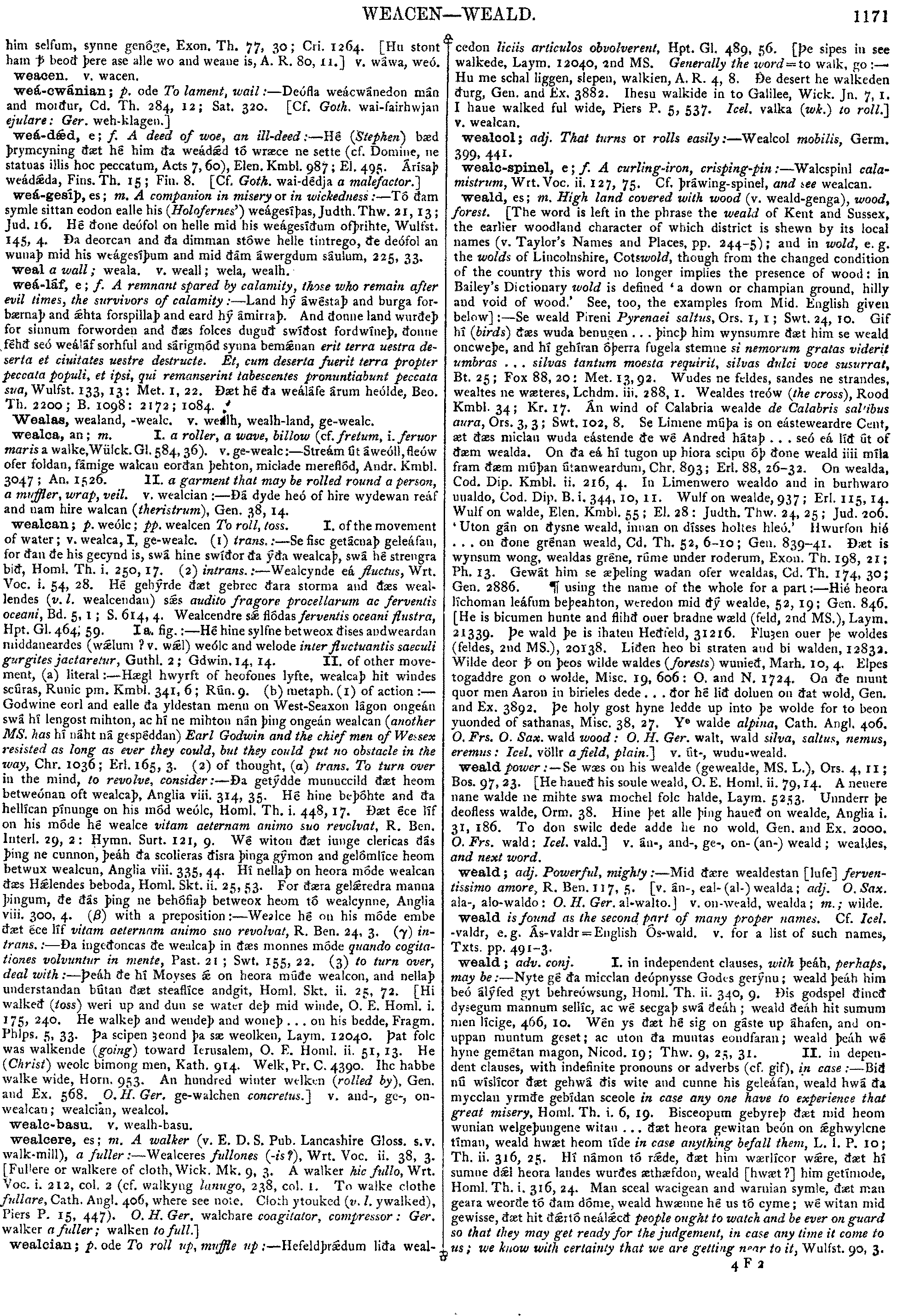
weald,
es;
m.
High
land
covered
with
wood
(v.weald-genga),
wood,
forest.
[The
word
is
left
in
the
phrase
the
weald
of
Kent
and
Sussex,
the
earlier
woodland
character
of
which
district
is
shewn
by
its
local
names
(v.
Taylor's
Names
and
Places,
pp.
244-5)
;
and
in
wold,
e.
g.
the
wolds
of
Lincolnshire,
Cotswold,
though
from
the
changed
condition
of
the
country
this
word
no
longer
implies
the
presence
of
wood:
in
Bailey's
Dictionary
wold
is
defined
'a
down
or
champian
ground,
hilly
and
void
of
wood.'
See,
too,
the
examples
from
Mid.
English
given
below]
:--
Se
weald
Pireni
Pyrenaei
saltus,
Ors.
1.
1;
Swt.
24,
10.
Gif
hí
(birds)
ðæs
wuda
benugen
.
.
.
þincþ
him
wynsumre
ðæt
him
se
weald
oncweþe,
and
hí
gehíran
óþerra
fugela
stemine
si
nemorum
gratas
viderit
umbras
.
.
.
silvas
tantum
moesta
requirit,
silvas
dulci
voce
susurrat,
Bt.
25;
Fox
88,
20:
Met.
13,
92.
Wudes
ne
feldes,
sandes
ne
strandes,
wealtes
ne
wæteres,
Lchdm.
iii.
288,
1.
Wealdes
treów
(the
cross),
Rood
Kmbl.
34;
Kr.
17.
Án
wind
of
Calabria
wealde
de
Calabris
ILLEGIBLE
aura,
Ors.
3,
3;
Swt.
102,
8.
Se
Limene
múþa
is
on
eásteweardre
Cent,
æt
ðæs
miclan
wuda
eástende
ðe
wé
Andred
hátaþ
.
.
.
seó
eá
líð
út
of
ðæm
wealda.
On
ða
eá
hí
tugon
up
híora
scipu
óþ
ðone
weald
iiii
míla
fram
ðæm
múþan
útanweardum,
Chr.
893;
Erl.
88,
26-32.
On
wealda,
Cod.
Dip.
Kmbl.
ii.
216,
4.
In
Limenwero
wealdo
and
in
burhwaro
uualdo,
Cod.
Dip.
B.
i.
344,
10,
11.
Wulf
on
wealde,
937;
Erl.
115,
14.
Wulf
on
walde,
Elen.
Kmbl.
55
;
El.
28
:
Judth.
Thw.
24,
25
;
Jud.
206.
'
Uton
gán
on
ðysne
weald,
innan
on
dísses
holtes
hleó.
'
Hwurfon
hié
.
.
.
on
ðone
grénan
weald,
Cd.
Th.
52,
6-10;
Gen.
839-41.
Ðæt
is
wynsum
wong,
wealdas
gréne,
rúme
under
roderum,
Exon.
Th.
198,
21;
Ph.
13.
Gewát
him
se
æþeling
wadan
ofer
wealdas,
Cd.
Th.
174,
30;
Gen.
2886.

using
the
name
of
the
whole
for
a
part
:--
Hié
heora
líchoman
leáfum
bebeahton,
weredon
mid
ðý
wealde,
52,
19;
Gen.
846.
[He
is
bicumen
hunte
and
flihð
ouer
bradne
wæld
(feld,
2nd
MS.
),
Laym.
21339.
Þe
wald
þe
is
ihaten
Heðield,
31216.
Flu en
ouer
þe
woldes
(feldes,
2nd
MS.
),
20138.
Lðen
heo
bi
straten
and
bi
walden,
12832.
Wilde
deor
en
ouer
þe
woldes
(feldes,
2nd
MS.
),
20138.
Lðen
heo
bi
straten
and
bi
walden,
12832.
Wilde
deor
 on
þeos
wilde
waldes
(forests)
wunieð,
Marh.
10,
4.
Elpes
togaddre
gon
o
wolde.
Misc.
19,
606:
O.
and
N.
1724.
On
ðe
munt
quor
men
Aaron
in
birieles
dede.
.
.
ðor
hé
lið
doluen
on
ðat
wold,
Gen.
and
Ex.
3892.
Þe
holy
gost
hyne
ledde
up
into
þe
wolde
for
to
beon
yuonded
of
sathanas,
Misc.
38,
27.
Y
on
þeos
wilde
waldes
(forests)
wunieð,
Marh.
10,
4.
Elpes
togaddre
gon
o
wolde.
Misc.
19,
606:
O.
and
N.
1724.
On
ðe
munt
quor
men
Aaron
in
birieles
dede.
.
.
ðor
hé
lið
doluen
on
ðat
wold,
Gen.
and
Ex.
3892.
Þe
holy
gost
hyne
ledde
up
into
þe
wolde
for
to
beon
yuonded
of
sathanas,
Misc.
38,
27.
Y walde
alpina,
Cath.
Angl.
406.
O.
Frs.
O.
Sax.
wald
wood:
O.
H.
Ger.
walt,
wald
silva,
saltus,
nemus,
eremus:
Icel.
völlr
a
field,
plain.]
v.
út-,
wudu-weald.
walde
alpina,
Cath.
Angl.
406.
O.
Frs.
O.
Sax.
wald
wood:
O.
H.
Ger.
walt,
wald
silva,
saltus,
nemus,
eremus:
Icel.
völlr
a
field,
plain.]
v.
út-,
wudu-weald.
|
Source: Bosworth/Toller, page b1172, entry 2 View original page image as: [TIFF] [PNG] [View previous entry] [View next entry] |
[Comment on this entry] [View comments] |
The following entry has been hand-corrected once. |
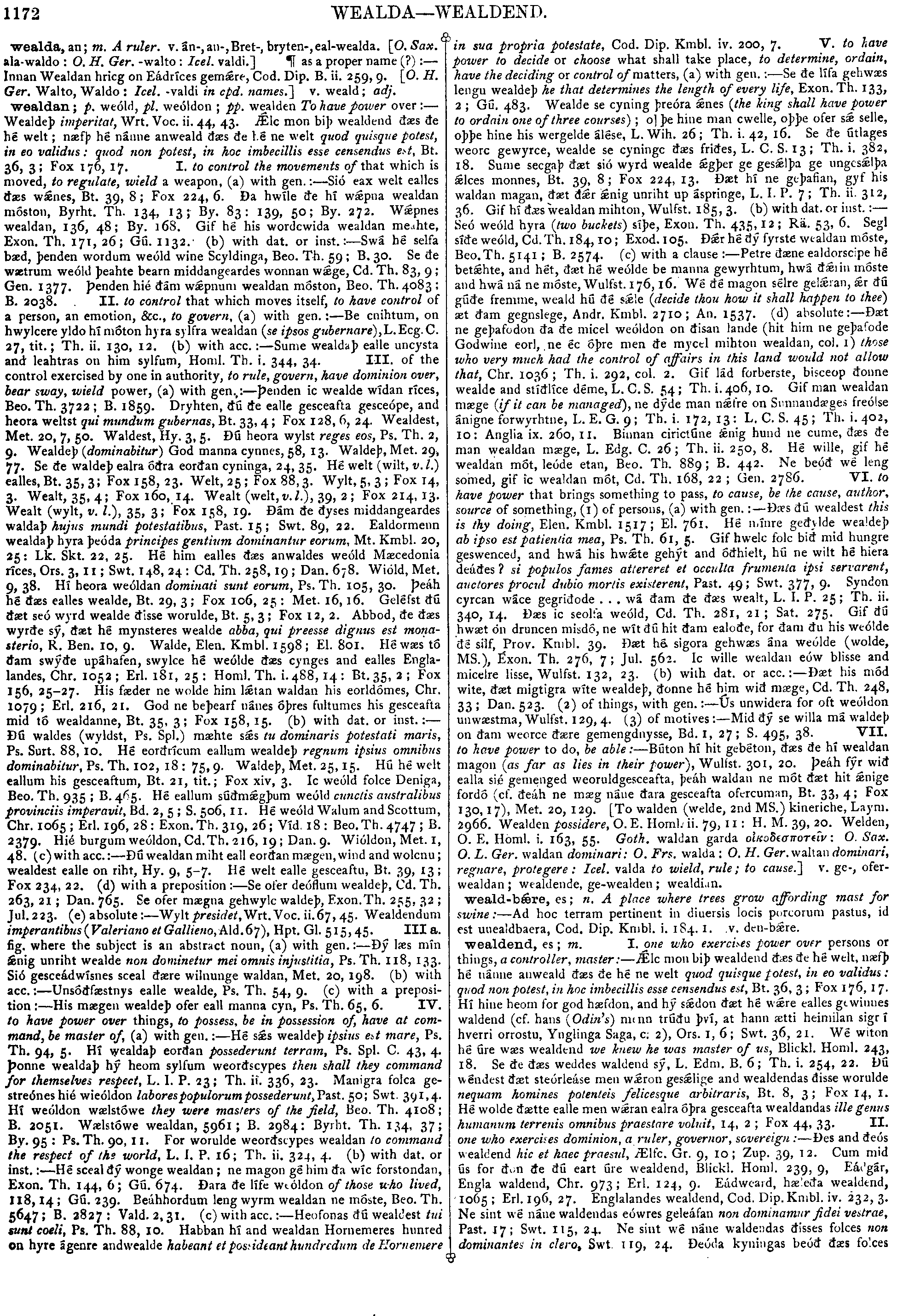
wealdan;
p.
weóld,
pl.
weóldon;
pp.
wealden
To
have
power
over:--Wealdeþ
imperitat,
Wrt.
Voc.
ii.
44,
43.
Æ-acute;lc
mon
biþ
wealdend
ðæs
ðe
hé
welt;
næfþ
hé
nánne
anweald
ðæs
ðe
hé
ne
welt
quod
quisque
potest,
in
eo
validus:
quod
non
potest,
in
hoc
imbecillis
esse
censendus
est,
Bt.
36,
3;
Fox
176,
17.
I.
to
control
the
movements
of
that
which
is
moved,
to
regulate,
wield
a
weapon,
(a)
with
gen.:--Sió
eax
welt
ealles
ðæs
wnes,
Bt.
39,
8;
Fox
224,
6.
Ða
hwíle
ðe
hí
wpna
wealdan
móston,
Byrht.
Th.
134,
13;
By.
83:
139,
50;
By.
272.
Wpnes
wealdan,
136,
48;
By.
168.
Gif
hé
his
wordcwida
wealdan
meahte,
Exon.
Th.
171,
26;
Gú.
1132.
(b)
with
dat.
or
inst.:--Swá
hé
selfa
bæd,
þenden
wordum
weóld
wine
Scyldinga,
Beo.
Th.
59;
B.
30.
Se
ðe
wætrum
weóld
þeahte
bearn
middangeardes
wonnan
wge,
Cd.
Th.
83,
9;
Gen.
1377.
Þenden
hié
ðám
wpnum
wealdan
móston,
Beo.
Th.
4083;
B.
2038.
II.
to
control
that
which
moves
itself,
to
have
control
of
a
person,
an
emotion,
&c.,
to
govern,
(a)
with
gen.:--Be
cnihtum,
on
hwylcere
yldo
hí
móton
hyra
sylfra
wealdan
(se
ipsos
gubernare),
L.
Ecg.
C.
27,
tit.;
Th.
ii.
130,
12.
(b)
with
acc.:--Sume
wealdaþ
ealle
uncysta
and
leahtras
on
him
sylfum,
Homl.
Th.
i.
344,
34.
III.
of
the
control
exercised
by
one
in
authority,
to
rule,
govern,
have
dominion
over,
bear
sway,
wield
power,
(a)
with
gen.:--Þenden
ic
wealde
wídan
ríces,
Beo.
Th.
3722;
B.
1859.
Dryhten,
ðú
ðe
ealle
gesceafta
gesceópe,
and
heora
weltst
qui
mundum
gubernas,
Bt.
33,
4;
Fox
128,
6,
24.
Wealdest,
Met.
20,
7,
50.
Waldest,
Hy.
3,
5.
Ðú
heora
wylst
reges
eos,
Ps.
Th.
2,
9.
Wealdeþ
(dominabitur)
God
manna
cynnes,
58,
13.
Waldeþ,
Met.
29,
77.
Se
ðe
waldeþ
ealra
óðra
eorðan
cyninga,
24,
35.
Hé
welt
(wilt,
v.
l.)
ealles,
Bt.
35,
3;
Fox
158,
23.
Welt,
25;
Fox
88,
3.
Wylt,
5,
3;
Fox
14,
3.
Wealt,
35,
4;
Fox
160,
14.
Wealt
(welt,
v.
l.),
39,
2;
Fox
214,
13.
Wealt
(wylt,
v.
l.),
35,
3;
Fox
158,
19.
Ðám
ðe
ðyses
middangeardes
waldaþ
hujus
mundi
potestatibus,
Past.
15;
Swt.
89,
22.
Ealdormenn
wealdaþ
hyra
þeóda
principes
gentium
dominantur
eorum,
Mt.
Kmbl.
20,
25:
Lk.
Skt.
22,
25.
Hé
him
ealles
ðæs
anwaldes
weóld
Mæcedonia
ríces,
Ors.
3,
11;
Swt.
148,
24:
Cd.
Th.
258,
19;
Dan.
678.
Wiold,
Met.
9,
38.
Hí
heora
weóldan
dominati
sunt
eorum,
Ps.
Th.
105,
30.
Þeáh
hé
ðæs
ealles
wealde,
Bt.
29,
3;
Fox
106,
25:
Met.
16,
16.
Geléfst
ðú
ðæt
seó
wyrd
wealde
ðisse
worulde,
Bt.
5,
3;
Fox
12,
2.
Abbod,
ðe
ðæs
wyrðe
sý,
ðæt
hé
mynsteres
wealde
abba,
qui
preesse
dignus
est
monasterio,
R.
Ben.
10,
9.
Walde,
Elen.
Kmbl.
1598;
El.
801.
Hé
wæs
tó
ðam
swýðe
upáhafen,
swylce
hé
weólde
ðæs
cynges
and
ealles
Englalandes,
Chr.
1052;
Erl.
181,
25:
Homl.
Th.
i.
488,
14:
Bt.
35,
2;
Fox
156,
25-27.
His
fæder
ne
wolde
him
ltan
waldan
his
eorldómes,
Chr.
1079;
Erl.
216,
21.
God
ne
beþearf
nánes
óþres
fultumes
his
gesceafta
mid
tó
wealdanne,
Bt.
35,
3;
Fox
158,
15.
(b)
with
dat.
or
inst.:--Ðú
waldes
(wyldst,
Ps.
Spl.)
mæhte
ss
tu
dominaris
potestati
maris,
Ps.
Surt.
88,
10.
Hé
eorðrícum
eallum
wealdeþ
regnum
ipsius
omnibus
dominabitur,
Ps.
Th.
102,
18:
75,
9.
Waldeþ,
Met.
25,
15.
Hú
hé
welt
eallum
his
gesceaftum,
Bt.
21,
tit.;
Fox
xiv,
3.
Ic
weóld
folce
Deniga,
Beo.
Th.
935;
B.
465.
Hé
eallum
súðmgþum
weóld
cunctis
australibus
provinciis
imperavit,
Bd.
2,
5;
S.
506,
11.
Hé
weóld
Walum
and
Scottum,
Chr.
1065;
Erl.
196,
28:
Exon.
Th.
319,
26;
Víd.
18:
Beo.
Th.
4747;
B.
2379.
Hié
burgum
weóldon,
Cd.
Th.
216,
19;
Dan.
9.
Wióldon,
Met.
1,
48.
(c)
with
acc.:--Ðú
wealdan
miht
eall
eorðan
mægen,
wind
and
wolcnu;
wealdest
ealle
on
riht,
Hy.
9,
5-7.
Hé
welt
ealle
gesceaftu,
Bt.
39,
13;
Fox
234,
22.
(d)
with
a
preposition:--Se
ofer
deóflum
wealdeþ,
Cd.
Th.
263,
21;
Dan.
765.
Se
ofer
mægna
gehwylc
waldeþ,
Exon.
Th.
255,
32;
Jul.
223.
(e)
absolute:--Wylt
president,
Wrt.
Voc.
ii.
67,
45.
Wealdendum
imperantibus
(Valeriano
et
Gallieno,
Ald.
67),
Hpt.
Gl.
515,
45.
III
a.
fig.
where
the
subject
is
an
abstract
noun,
(a)
with
gen.:--Ðý
læs
mín
nig
unriht
wealde
non
dominetur
mei
omnis
injustitia,
Ps.
Th.
118,
133.
Sió
gesceádwísnes
sceal
ðære
wilnunge
waldan,
Met.
20,
198.
(b)
with
acc.:--Unsóðfæstnys
ealle
wealde,
Ps.
Th.
54,
9.
(c)
with
a
preposition:--His
mægen
wealdeþ
ofer
eall
manna
cyn,
Ps.
Th.
65,
6.
IV.
to
have
power
over
things,
to
possess,
be
in
possession
of,
have
at
command,
be
master
of,
(a)
with
gen.:--Hé
ss
wealdeþ
ipsius
est
mare,
Ps.
Th.
94,
5.
Hí
wealdaþ
eorðan
possederunt
terram,
Ps.
Spl.
C.
43,
4.
Þonne
wealdaþ
hý
heom
sylfum
weorðscypes
then
shall
they
command
for
themselves
respect,
L.
I.
P.
23;
Th.
ii.
336,
23.
Manigra
folca
gestreónes
hié
wieóldon
labores
populorum
possederunt,
Past.
50;
Swt.
391,
4.
Hí
weóldon
wælstówe
they
were
masters
of
the
field,
Beo.
Th.
4108;
B.
2051.
Wælstówe
wealdan,
5961;
B.
2984:
Byrht.
Th.
134,
37;
By.
95:
Ps.
Th.
90,
11.
For
worulde
weorðscypes
wealdan
to
command
the
respect
of
the
world,
L.
I.
P.
16;
Th.
ii.
324,
4.
(b)
with
dat.
or
inst.:--Hé
sceal
ðý
wonge
wealdan;
ne
magon
gé
him
ða
wíc
forstondan,
Exon.
Th.
144,
6;
Gú.
674.
Ðara
ðe
lífe
weóldon
of
those
who
lived,
118,
14;
Gú.
239.
Beáhhordum
leng
wyrm
wealdan
ne
móste,
Beo.
Th.
5647;
B.
2827:
Vald.
2,
31.
(c)
with
acc.:--Heofonas
ðú
wealdest
tui
sunt
coeli,
Ps.
Th.
88,
10.
Habban
hí
and
wealdan
Hornemeres
hunred
on
hyre
ágenre
andwealde
habeant
et
possideant
hundredum
de
Hornemere
in
sua
propria
potestate,
Cod.
Dip.
Kmbl.
iv.
200,
7.
V.
to
have
power
to
decide
or
choose
what
shall
take
place,
to
determine,
ordain,
have
the
deciding
or
control
of
matters,
(a)
with
gen.:--Se
ðe
lífa
gehwæs
lengu
wealdeþ
he
that
determines
the
length
of
every
life,
Exon.
Th.
133,
2;
Gú.
483.
Wealde
se
cyning
þreóra
nes
(the
king
shall
have
power
to
ordain
one
of
three
courses);
oþþe
hine
man
cwelle,
oþþe
ofer
s
selle,
oþþe
hine
his
wergelde
álése,
L.
Wih.
26;
Th.
i.
42,
16.
Se
ðe
útlages
weorc
gewyrce,
wealde
se
cyningc
ðæs
friðes,
L.
C.
S.
13;
Th.
i.
382,
18.
Sume
secgaþ
ðæt
sió
wyrd
wealde
gþer
ge
geslþa
ge
ungeslþa
lces
monnes,
Bt.
39,
8;
Fox
224,
13.
Ðæt
hí
ne
geþafian,
gyf
his
waldan
magan,
ðæt
ðr
nig
unriht
up
áspringe,
L.
I.
P.
7;
Th.
ii.
312,
36.
Gif
hí
ðæs
wealdan
mihton,
Wulfst.
185,
3.
(b)
with
dat.
or
inst.:--Seó
weóld
hyra
(two
buckets)
síþe,
Exon.
Th.
435,
12;
Rä.
53,
6.
Segl
síðe
weóld,
Cd.
Th.
184,
10;
Exod.
105.
Ðr
hé
dý
fyrste
wealdan
móste,
Beo.
Th.
5141;
B.
2574.
(c)
with
a
clause:--Petre
ðæne
ealdorscipe
hé
bethte,
and
hét,
ðæt
hé
weólde
be
manna
gewyrhtum,
hwá
ðrin
móste
and
hwá
ná
ne
móste,
Wulfst.
176,
16.
Wé
ðé
magon
sélre
gelran,
r
ðú
gúðe
fremme,
weald
hú
ðé
sle
(decide
thou
how
it
shall
happen
to
thee)
æt
ðam
gegnslege,
Andr.
Kmbl.
2710;
An.
1537.
(d)
absolute:--Ðæt
ne
geþafodon
ða
ðe
micel
weóldon
on
ðisan
lande
(hit
him
ne
geþafode
Godwine
eorl,
ne
éc
óþre
men
ðe
mycel
mihton
wealdan,
col.
1)
those
who
very
much
had
the
control
of
affairs
in
this
land
would
not
allow
that,
Chr.
1036;
Th.
i.
292,
col.
2.
Gif
lád
forberste,
bisceop
ðonne
wealde
and
stíðlíce
déme,
L.
C.
S.
54;
Th.
i.
406,
10.
Gif
man
wealdan
mæge
(if
it
can
be
managed),
ne
dýde
man
nfre
on
Sunnandæges
freólse
ánigne
forwyrhtne,
L.
E.
G.
9;
Th.
i.
172,
13:
L.
C.
S.
45;
Th.
i.
402,
10:
Anglia
ix.
260,
11.
Binnan
cirictúne
nig
hund
ne
cume,
ðæs
ðe
man
wealdan
mæge,
L.
Edg.
C.
26;
Th.
ii.
250,
8.
Hé
wille,
gif
hé
wealdan
mót,
leóde
etan,
Beo.
Th.
889;
B.
442.
Ne
beóð
wé
leng
somed,
gif
ic
wealdan
mót,
Cd.
Th.
168,
22;
Gen.
2786.
VI.
to
have
power
that
brings
something
to
pass,
to
cause,
be
the
cause,
author,
source
of
something,
(1)
of
persons,
(a)
with
gen.:--Ðæs
ðú
wealdest
this
is
thy
doing,
Elen.
Kmbl.
1517;
El.
761.
Hé
nánre
geðylde
wealdeþ
ab
ipso
est
patientia
mea,
Ps.
Th.
61,
5.
Gif
hwelc
folc
bið
mid
hungre
geswenced,
and
hwá
his
hwte
gehýt
and
óðhielt,
hú
ne
wilt
hé
hiera
deáðes?
si
populos
fames
attereret
et
occulta
frumenta
ipsi
servarent,
auctores
procul
dubio
mortis
existerent,
Past.
49;
Swt.
377,
9.
Syndon
cyrcan
wáce
gegriðode
.
.
.
wá
ðam
ðe
ðæs
wealt,
L.
I.
P.
25;
Th.
ii.
340,
14.
Ðæs
ic
seolfa
weóld,
Cd.
Th.
281,
21;
Sat.
275.
Gif
ðú
hwæt
on
druncen
misdó,
ne
wít
ðú
hit
ðam
ealoðe,
for
ðam
ðu
his
weólde
ðé
silf,
Prov.
Kmbl.
39.
Ðæt
hé
sigora
gehwæs
ána
weólde
(wolde,
MS.),
Exon.
Th.
276,
7;
Jul.
562.
Ic
wille
wealdan
eów
blisse
and
micelre
lisse,
Wulfst.
132,
23.
(b)
with
dat.
or
acc.:--Ðæt
his
mód
wite,
ðæt
migtigra
wíte
wealdeþ,
ðonne
hé
hjm
wið
mæge,
Cd.
Th.
248,
33;
Dan.
523.
(2)
of
things,
with
gen.:--Ús
unwidera
for
oft
weóldon
unwæstma,
Wulfst.
129,
4.
(3)
of
motives:--Mid
ðý
se
willa
má
waldeþ
on
ðam
weorce
ðære
gemengdnysse,
Bd.
1,
27;
S.
495,
38.
VII.
to
have
power
to
do,
be
able:--Búton
hí
hit
gebéton,
ðæs
ðe
hí
wealdan
magon
(as
far
as
lies
in
their
power),
Wulist.
301,
20.
Þeáh
fýr
wið
ealla
sié
gemenged
weoruldgesceafta,
þeáh
waldan
ne
mót
ðæt
hit
nige
fordó
(cf.
ðeáh
ne
mæg
náue
ðara
gesceafta
ofercuman,
Bt.
33,
4;
Fox
130,
17),
Met.
20,
129.
[To
walden
(welde,
2nd
MS.)
kineriche,
Laym.
2966.
Wealden
possidere,
O.
E.
Homl.
ii.
79,
11:
H.
M.
39,
20.
Welden,
O.
E.
Homl.
i.
163,
55.
Goth.
waldan
garda
GREEK:
O.
Sax.
O.
L.
Ger.
waldan
dominari:
O.
Frs.
walda:
O.
H.
Ger.
waltan
dominari,
regnare,
protegere:
Icel.
valda
to
wield,
rule;
to
cause.]
v.
ge-,
ofer-wealdan;
wealdende,
ge-wealden;
wealdian.
|
Source: Bosworth/Toller, page b1173, entry 17 View original page image as: [TIFF] [PNG] [View previous entry] [View next entry] |
[Comment on this entry] [View comments] |
The following entry has been hand-corrected once. |
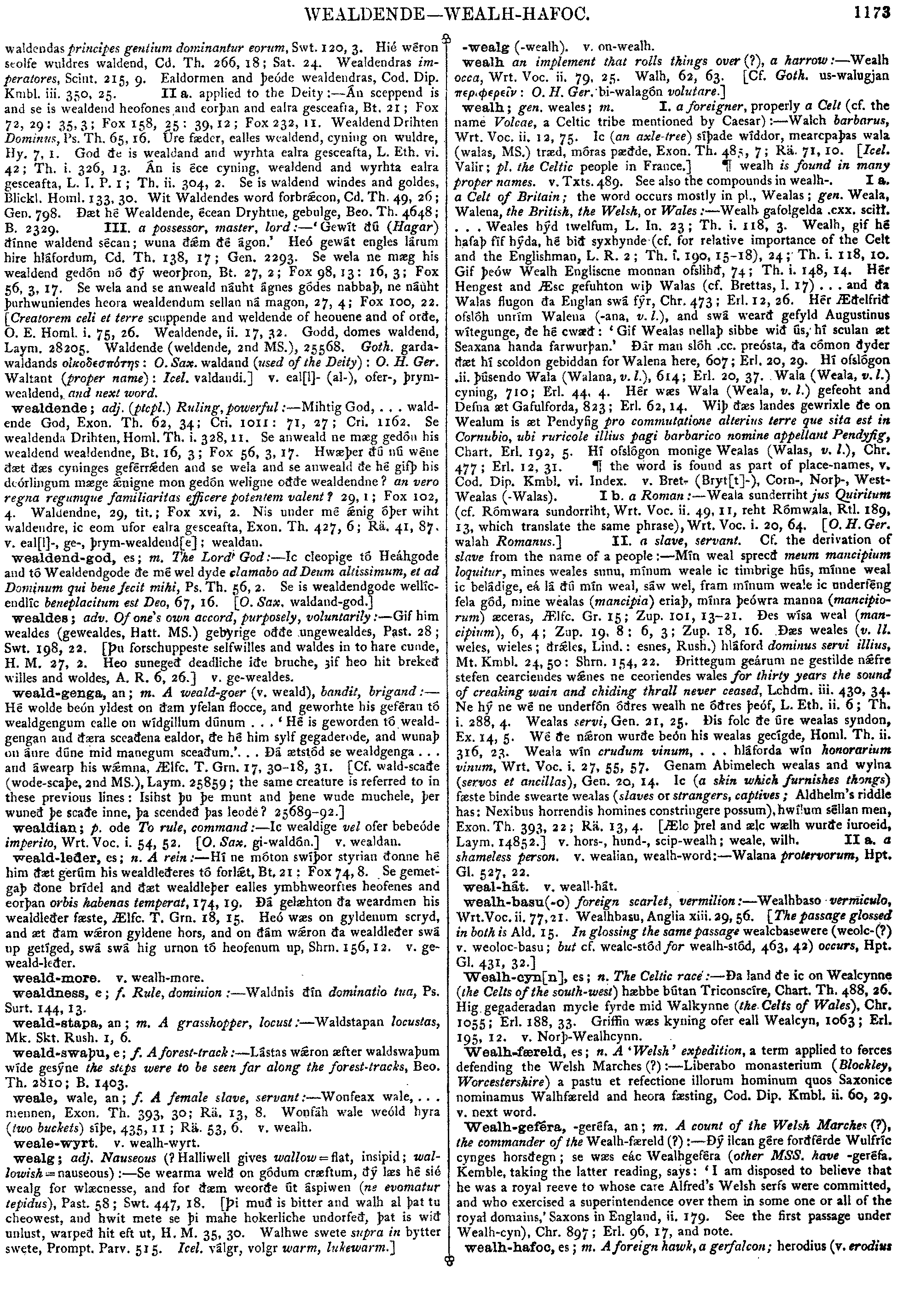
wealh;
gen.
weales;
m.
I.
a
foreigner,
properly
a
Celt
(cf.
the
name
Volcae,
a
Celtic
tribe
mentioned
by
Caesar):--Walch
barbarus,
Wrt.
Voc.
ii.
12,
75.
Ic
(an
axle-tree)
síþade
wíddor,
mearcpaþas
wala
(walas,
MS.)
træd,
móras
pæðde,
Exon.
Th.
485,
7;
Rä.
71,
10.
[Icel.
Valir;
pl.
the
Celtic
people
in
France.]

wealh
is
found
in
many
proper
names.
v.
Txts.
489.
See
also
the
compounds
in
wealh-.
I
a.
a
Celt
of
Britain;
the
word
occurs
mostly
in
pl.,
Wealas;
gen.
Weala,
Walena,
the
British,
the
Welsh,
or
Wales:--Wealh
gafolgelda
.cxx.
sci .
.
.
.
Weales
hýd
twelfum,
L.
In.
23;
Th.
i.
118,
3.
Wealh,
gif
hé
hafaþ
fíf
hýda,
hé
bið
syxhynde
(cf.
for
relative
importance
of
the
Celt
and
the
Englishman,
L.
R.
2;
Th.
i.
190,
15-18),
24;
Th.
i.
118,
10.
Gif
þeów
Wealh
Engliscne
monnan
ofslihð,
74;
Th.
i.
148,
14.
Hér
Hengest
and
Æsc
gefuhton
wiþ
Walas
(cf.
Brettas,
l.
17)
.
.
.
and
ða
Walas
flugon
ða
Englan
swá
fýr,
Chr.
473;
Erl.
12,
26.
Hér
Æðelfrið
ofslóh
unrím
Walena
(-ana,
v.
l.),
and
swá
wearð
gefyld
Augustinus
wítegunge,
ðe
hé
cwæð:
'Gif
Wealas
nellaþ
sibbe
wið
ús,
hí
sculan
æt
Seaxana
handa
farwurþan.'
Ðár
man
slóh
.cc.
preósta,
ða
cómon
ðyder
ðæt
hí
scoldon
gebiddan
for
Walena
here,
607;
Erl.
20,
29.
Hí
ofslógon
.ii.
þúsendo
Wala
(Walana,
v.
l.),
614;
Erl.
20,
37.
Wala
(Weala,
v.
l.)
cyning,
710;
Erl.
44,
4.
Hér
wæs
Wala
(Weala,
v.
l.)
gefeoht
and
Defna
æt
Gafulforda,
823;
Erl.
62,
14.
Wiþ
ðæs
landes
gewrixle
ðe
on
Wealum
is
æt
Pendyfig
pro
commutatione
alterius
terre
que
sita
est
in
Cornubio,
ubi
ruricole
illius
pagi
barbarico
nomine
appellant
Pendyfig,
Chart.
Erl.
192,
5.
Hí
ofslógon
monige
Wealas
(Walas,
v.
l.),
Chr.
477;
Erl.
12,
31.

the
word
is
found
as
part
of
place-names,
v.
Cod.
Dip.
Kmbl.
vi.
Index,
v.
Bret-
(Bryt[t]-),
Corn-,
Norþ-,
West-Wealas
(-Walas).
I
b.
a
Roman:--Weala
sunderriht
jus
Quiritum
(cf.
Rómwara
sundorriht,
Wrt.
Voc.
ii.
49,
11,
reht
Rómwala,
Rtl.
189,
13,
which
translate
the
same
phrase),
Wrt.
Voc.
i.
20,
64.
[O.
H.
Ger.
walah
Romanus.]
II.
a
slave,
servant.
Cf.
the
derivation
of
slave
from
the
name
of
a
people:--Mín
weal
sprecð
meum
mancipium
loquitur,
mines
weales
sunu,
mínum
weale
ic
timbrige
hús,
mínne
weal
ic
beládige,
eá
lá
ðú
mín
weal,
sáw
wel,
fram
mínum
weale
ic
underféng
fela
gód,
mine
wealas
(mancipia)
eriaþ,
mínra
þeówra
manna
(mancipiorum)
æceras,
Ælfc.
Gr.
15;
Zup.
101,
13-21.
Ðes
wísa
weal
(mancipium),
6,
4;
Zup.
19,
8:
6,
3;
Zup.
18,
16.
Ðæs
weales
(v.
ll.
weles,
wieles;
ðrles,
Lind.:
esnes,
Rush.)
hláford
dominus
servi
illius,
Mt.
Kmbl.
24,
50:
Shrn.
154,
22.
Ðrittegum
geárum
ne
gestilde
nfre
stefen
cearciendes
wnes
ne
ceoriendes
wales
for
thirty
years
the
sound
of
creaking
wain
and
chiding
thrall
never
ceased,
Lchdm.
iii.
430,
34.
Ne
hý
ne
wé
ne
underfón
óðres
wealh
ne
óðres
þeóf,
L.
Eth.
ii.
6;
Th.
i.
288,
4.
Wealas
servi,
Gen.
21,
25.
Ðis
folc
ðe
úre
wealas
syndon,
Ex.
14,
5.
Wé
ðe
nron
wurðe
beón
his
wealas
gecígde,
Homl.
Th.
ii.
316,
23.
Weala
wín
crudum
vinum,
.
.
.
hláforda
wín
honorarium
vinum,
Wrt.
Voc.
i.
27,
55,
57.
Genam
Abimelech
wealas
and
wylna
(servos
et
ancillas],
Gen.
20,
14.
Ic
(a
skin
which
furnishes
thongs)
fæste
binde
swearte
wealas
(slaves
or
strangers,
captives;
Aldhelm's
riddle
has:
Nexibus
horrendis
hommes
constringere
possum),
hwílum
séllan
men,
Exon.
Th.
393,
22;
Rä.
13,
4.
[Ælc
þrel
and
ælc
wælh
wurðe
iuroeid,
Laym.
14852.]
v.
hors-,
hund-,
scip-wealh;
weale,
wilh.
II
a.
a
shameless
person.
v.
wealian,
wealh-word:--Walana
protervorum,
Hpt.
Gl.
527,
22.
.
.
.
.
Weales
hýd
twelfum,
L.
In.
23;
Th.
i.
118,
3.
Wealh,
gif
hé
hafaþ
fíf
hýda,
hé
bið
syxhynde
(cf.
for
relative
importance
of
the
Celt
and
the
Englishman,
L.
R.
2;
Th.
i.
190,
15-18),
24;
Th.
i.
118,
10.
Gif
þeów
Wealh
Engliscne
monnan
ofslihð,
74;
Th.
i.
148,
14.
Hér
Hengest
and
Æsc
gefuhton
wiþ
Walas
(cf.
Brettas,
l.
17)
.
.
.
and
ða
Walas
flugon
ða
Englan
swá
fýr,
Chr.
473;
Erl.
12,
26.
Hér
Æðelfrið
ofslóh
unrím
Walena
(-ana,
v.
l.),
and
swá
wearð
gefyld
Augustinus
wítegunge,
ðe
hé
cwæð:
'Gif
Wealas
nellaþ
sibbe
wið
ús,
hí
sculan
æt
Seaxana
handa
farwurþan.'
Ðár
man
slóh
.cc.
preósta,
ða
cómon
ðyder
ðæt
hí
scoldon
gebiddan
for
Walena
here,
607;
Erl.
20,
29.
Hí
ofslógon
.ii.
þúsendo
Wala
(Walana,
v.
l.),
614;
Erl.
20,
37.
Wala
(Weala,
v.
l.)
cyning,
710;
Erl.
44,
4.
Hér
wæs
Wala
(Weala,
v.
l.)
gefeoht
and
Defna
æt
Gafulforda,
823;
Erl.
62,
14.
Wiþ
ðæs
landes
gewrixle
ðe
on
Wealum
is
æt
Pendyfig
pro
commutatione
alterius
terre
que
sita
est
in
Cornubio,
ubi
ruricole
illius
pagi
barbarico
nomine
appellant
Pendyfig,
Chart.
Erl.
192,
5.
Hí
ofslógon
monige
Wealas
(Walas,
v.
l.),
Chr.
477;
Erl.
12,
31.

the
word
is
found
as
part
of
place-names,
v.
Cod.
Dip.
Kmbl.
vi.
Index,
v.
Bret-
(Bryt[t]-),
Corn-,
Norþ-,
West-Wealas
(-Walas).
I
b.
a
Roman:--Weala
sunderriht
jus
Quiritum
(cf.
Rómwara
sundorriht,
Wrt.
Voc.
ii.
49,
11,
reht
Rómwala,
Rtl.
189,
13,
which
translate
the
same
phrase),
Wrt.
Voc.
i.
20,
64.
[O.
H.
Ger.
walah
Romanus.]
II.
a
slave,
servant.
Cf.
the
derivation
of
slave
from
the
name
of
a
people:--Mín
weal
sprecð
meum
mancipium
loquitur,
mines
weales
sunu,
mínum
weale
ic
timbrige
hús,
mínne
weal
ic
beládige,
eá
lá
ðú
mín
weal,
sáw
wel,
fram
mínum
weale
ic
underféng
fela
gód,
mine
wealas
(mancipia)
eriaþ,
mínra
þeówra
manna
(mancipiorum)
æceras,
Ælfc.
Gr.
15;
Zup.
101,
13-21.
Ðes
wísa
weal
(mancipium),
6,
4;
Zup.
19,
8:
6,
3;
Zup.
18,
16.
Ðæs
weales
(v.
ll.
weles,
wieles;
ðrles,
Lind.:
esnes,
Rush.)
hláford
dominus
servi
illius,
Mt.
Kmbl.
24,
50:
Shrn.
154,
22.
Ðrittegum
geárum
ne
gestilde
nfre
stefen
cearciendes
wnes
ne
ceoriendes
wales
for
thirty
years
the
sound
of
creaking
wain
and
chiding
thrall
never
ceased,
Lchdm.
iii.
430,
34.
Ne
hý
ne
wé
ne
underfón
óðres
wealh
ne
óðres
þeóf,
L.
Eth.
ii.
6;
Th.
i.
288,
4.
Wealas
servi,
Gen.
21,
25.
Ðis
folc
ðe
úre
wealas
syndon,
Ex.
14,
5.
Wé
ðe
nron
wurðe
beón
his
wealas
gecígde,
Homl.
Th.
ii.
316,
23.
Weala
wín
crudum
vinum,
.
.
.
hláforda
wín
honorarium
vinum,
Wrt.
Voc.
i.
27,
55,
57.
Genam
Abimelech
wealas
and
wylna
(servos
et
ancillas],
Gen.
20,
14.
Ic
(a
skin
which
furnishes
thongs)
fæste
binde
swearte
wealas
(slaves
or
strangers,
captives;
Aldhelm's
riddle
has:
Nexibus
horrendis
hommes
constringere
possum),
hwílum
séllan
men,
Exon.
Th.
393,
22;
Rä.
13,
4.
[Ælc
þrel
and
ælc
wælh
wurðe
iuroeid,
Laym.
14852.]
v.
hors-,
hund-,
scip-wealh;
weale,
wilh.
II
a.
a
shameless
person.
v.
wealian,
wealh-word:--Walana
protervorum,
Hpt.
Gl.
527,
22.
|
Source: Bosworth/Toller, page b1174, entry 13 View original page image as: [TIFF] [PNG] [View previous entry] [View next entry] |
[Comment on this entry] [View comments] |
The following entry has been hand-corrected once. |
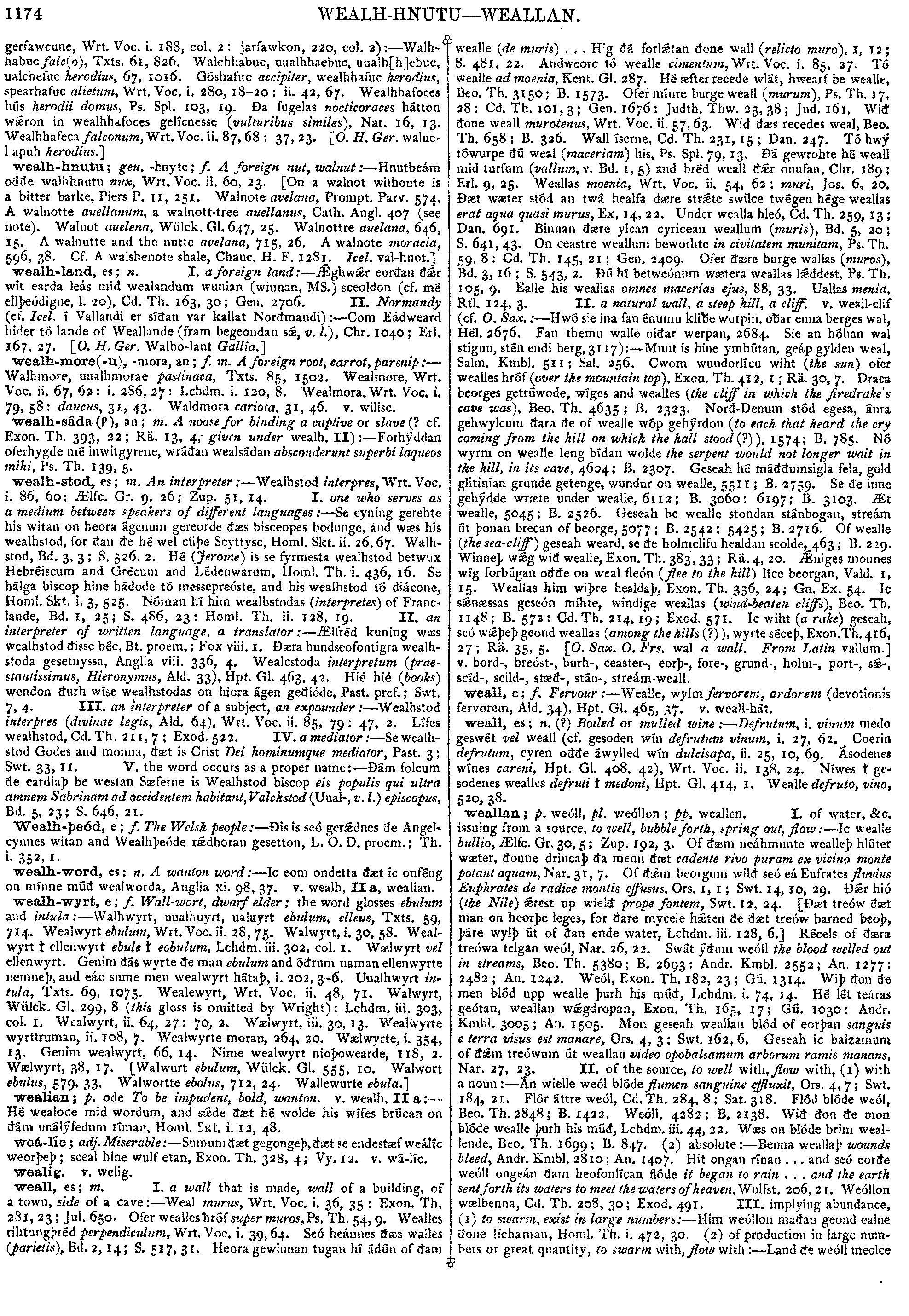
weall,
es;
m.
I.
a
wall
that
is
made,
wall
of
a
building,
of
a
town,
side
of
a
cave:--Weal
murus,
Wrt.
Voc.
i.
36,
35:
Exon.
Th.
281,
23;
Jul.
650.
Ofer
wealles
hróf
super
muros,
Ps.
Th.
54,
9.
Wealles
rihtungþréd
perpendiculum,
Wrt.
Voc.
i.
39,
64.
Seó
heánnes
ðæs
walles
(parietis),
Bd.
2,
14;
S.
517,
31.
Heora
gewinnan
tugan
hí
ádún
of
ðam
wealle
(de
muris)
.
.
.
Hig
ðá
forltan
ðone
wall
(relicto
muro),
1,
12;
S.
481,
22.
Andweorc
tó
wealle
cimentum,
Wrt.
Voc.
i.
85,
27.
Tó
wealle
ad
moenia,
Kent.
Gl.
287.
Hé
æfter
recede
wlát,
hwearf
be
wealle,
Beo.
Th.
3150;
B.
1573.
Ofer
mínre
burge
weall
(murum),
Ps.
Th.
17,
28:
Cd.
Th.
101,
3;
Gen.
1676:
Judth.
Thw.
23,
38;
Jud.
161.
Wið
ðone
weall
murotenus,
Wrt.
Voc.
ii.
57,
63.
Wið
ðæs
recedes
weal,
Beo.
Th.
658;
B.
326.
Wall
íserne,
Cd.
Th.
231,
15;
Dan.
247.
Tó
hwý
tówurpe
ðú
weal
(maceriam)
his,
Ps.
Spl.
79,
13.
Ðá
gewrohte
hé
weall
mid
turfum
(vallum,
v.
Bd.
1,
5)
and
bréd
weall
ðr
onufan,
Chr.
189;
Erl.
9,
25.
Weallas
moenia,
Wrt.
Voc.
ii.
54,
62:
muri,
Jos.
6,
20.
Ðæt
wæter
stód
an
twá
healfa
ðære
strte
swilce
twégen
hége
weallas
erat
aqua
quasi
murus,
Ex.
14,
22.
Under
wealla
hleó,
Cd.
Th.
259,
13;
Dan.
691.
Binnan
ðære
ylcan
cyricean
weallum
(muris),
Bd.
5,
20;
S.
641,
43.
On
ceastre
weallum
beworhte
in
civitatem
munitam,
Ps.
Th.
59,
8:
Cd.
Th.
145,
21;
Gen.
2409.
Ofer
ðære
burge
wallas
(muros),
Bd.
3,
16;
S.
543,
2.
Ðú
hí
betweónum
wætera
weallas
lddest,
Ps.
Th.
105,
9.
Ealle
his
weallas
omnes
macerias
ejus,
88,
33.
Uallas
menia,
Rtl.
124,
3.
II.
a
natural
wall,
a
steep
hill,
a
cliff.
v.
weall-clif
(cf.
O.
Sax.:--Hwó
sie
ina
fan
énumu
kli e
wurpin,
oar
enna
berges
wal,
Hél.
2676.
Fan
themu
walle
niðar
werpan,
2684.
Sie
an
hóhan
wal
stigun,
stén
endi
berg,
3117):--Munt
is
hine
ymbútan,
geáp
gylden
weal,
Salm.
Kmbl.
511;
Sal.
256.
Cwom
wundorlícu
wiht
(the
sun)
ofer
wealles
hróf
(over
the
mountain
top),
Exon.
Th.
412,
1;
Rä.
30,
7.
Draca
beorges
getrúwode,
wíges
and
wealles
(the
cliff
in
which
the
firedrake's
cave
was),
Beo.
Th.
4635;
B.
2323.
Norð-Denum
stód
egesa,
ánra
gehwylcum
ðara
ðe
of
wealle
wóp
gehýrdon
(to
each
that
heard
the
cry
coming
from
the
hill
on
which
the
hall
stood
(?)),
1574;
B.
785.
Nó
wyrm
on
wealle
leng
bídan
wolde
the
serpent
would
not
longer
wait
in
the
hill,
in
its
cave,
4604;
B.
2307.
Geseah
hé
máððumsigla
fela,
gold
glitinian
grunde
getenge,
wundur
on
wealle,
5511;
B.
2759.
Se
ðe
inne
gehýdde
wræte
under
wealle,
6112;
B.
3060:
6197;
B.
3103.
Æt
wealle,
5045;
B.
2526.
Geseah
be
wealle
stondan
stánbogan,
streám
út
þonan
brecan
of
beorge,
5077;
B.
2542:
5425;
B.
2716.
Of
wealle
(the
sea-cliff)
geseah
weard,
se
ðe
holmclifu
healdan
scolde,
463;
B.
229.
Winneþ
wg
wið
wealle,
Exon.
Th.
383,
33;
Rä.
4,
20.
Æ-acute;niges
monnes
wíg
forbúgan
oððe
on
weal
fleón
(flee
to
the
hill)
líce
beorgan,
Vald.
1,
15.
Weallas
him
wiþre
healdaþ,
Exon.
Th.
336,
24;
Gn.
Ex.
54.
Ic
snæssas
geseón
mihte,
windige
weallas
(wind-beaten
cliffs),
Beo.
Th.
1148;
B.
572:
Cd.
Th.
214,
19;
Exod.
571.
Ic
wiht
(a
rake)
geseah,
seó
wþeþ
geond
weallas
(among
the
hills
(?)),
wyrte
séceþ,
Exon.
Th.
416,
27;
Rä.
35,
5.
[O.
Sax.
O.
Frs.
wal
a
wall.
From
Latin
vallum.]
v.
bord-,
breóst-,
burh-,
ceaster-,
eorþ-,
fore-,
grund-,
holm-,
port-,
s-,
scíd-,
scild-,
stæð-,
stán-,
streám-weall.
e
wurpin,
oar
enna
berges
wal,
Hél.
2676.
Fan
themu
walle
niðar
werpan,
2684.
Sie
an
hóhan
wal
stigun,
stén
endi
berg,
3117):--Munt
is
hine
ymbútan,
geáp
gylden
weal,
Salm.
Kmbl.
511;
Sal.
256.
Cwom
wundorlícu
wiht
(the
sun)
ofer
wealles
hróf
(over
the
mountain
top),
Exon.
Th.
412,
1;
Rä.
30,
7.
Draca
beorges
getrúwode,
wíges
and
wealles
(the
cliff
in
which
the
firedrake's
cave
was),
Beo.
Th.
4635;
B.
2323.
Norð-Denum
stód
egesa,
ánra
gehwylcum
ðara
ðe
of
wealle
wóp
gehýrdon
(to
each
that
heard
the
cry
coming
from
the
hill
on
which
the
hall
stood
(?)),
1574;
B.
785.
Nó
wyrm
on
wealle
leng
bídan
wolde
the
serpent
would
not
longer
wait
in
the
hill,
in
its
cave,
4604;
B.
2307.
Geseah
hé
máððumsigla
fela,
gold
glitinian
grunde
getenge,
wundur
on
wealle,
5511;
B.
2759.
Se
ðe
inne
gehýdde
wræte
under
wealle,
6112;
B.
3060:
6197;
B.
3103.
Æt
wealle,
5045;
B.
2526.
Geseah
be
wealle
stondan
stánbogan,
streám
út
þonan
brecan
of
beorge,
5077;
B.
2542:
5425;
B.
2716.
Of
wealle
(the
sea-cliff)
geseah
weard,
se
ðe
holmclifu
healdan
scolde,
463;
B.
229.
Winneþ
wg
wið
wealle,
Exon.
Th.
383,
33;
Rä.
4,
20.
Æ-acute;niges
monnes
wíg
forbúgan
oððe
on
weal
fleón
(flee
to
the
hill)
líce
beorgan,
Vald.
1,
15.
Weallas
him
wiþre
healdaþ,
Exon.
Th.
336,
24;
Gn.
Ex.
54.
Ic
snæssas
geseón
mihte,
windige
weallas
(wind-beaten
cliffs),
Beo.
Th.
1148;
B.
572:
Cd.
Th.
214,
19;
Exod.
571.
Ic
wiht
(a
rake)
geseah,
seó
wþeþ
geond
weallas
(among
the
hills
(?)),
wyrte
séceþ,
Exon.
Th.
416,
27;
Rä.
35,
5.
[O.
Sax.
O.
Frs.
wal
a
wall.
From
Latin
vallum.]
v.
bord-,
breóst-,
burh-,
ceaster-,
eorþ-,
fore-,
grund-,
holm-,
port-,
s-,
scíd-,
scild-,
stæð-,
stán-,
streám-weall.
|
Source: Bosworth/Toller, page b1175, entry 1 View original page image as: [TIFF] [PNG] [View previous entry] [View next entry] |
[Comment on this entry] [View comments (1)] |
The following entry has been hand-corrected once. |
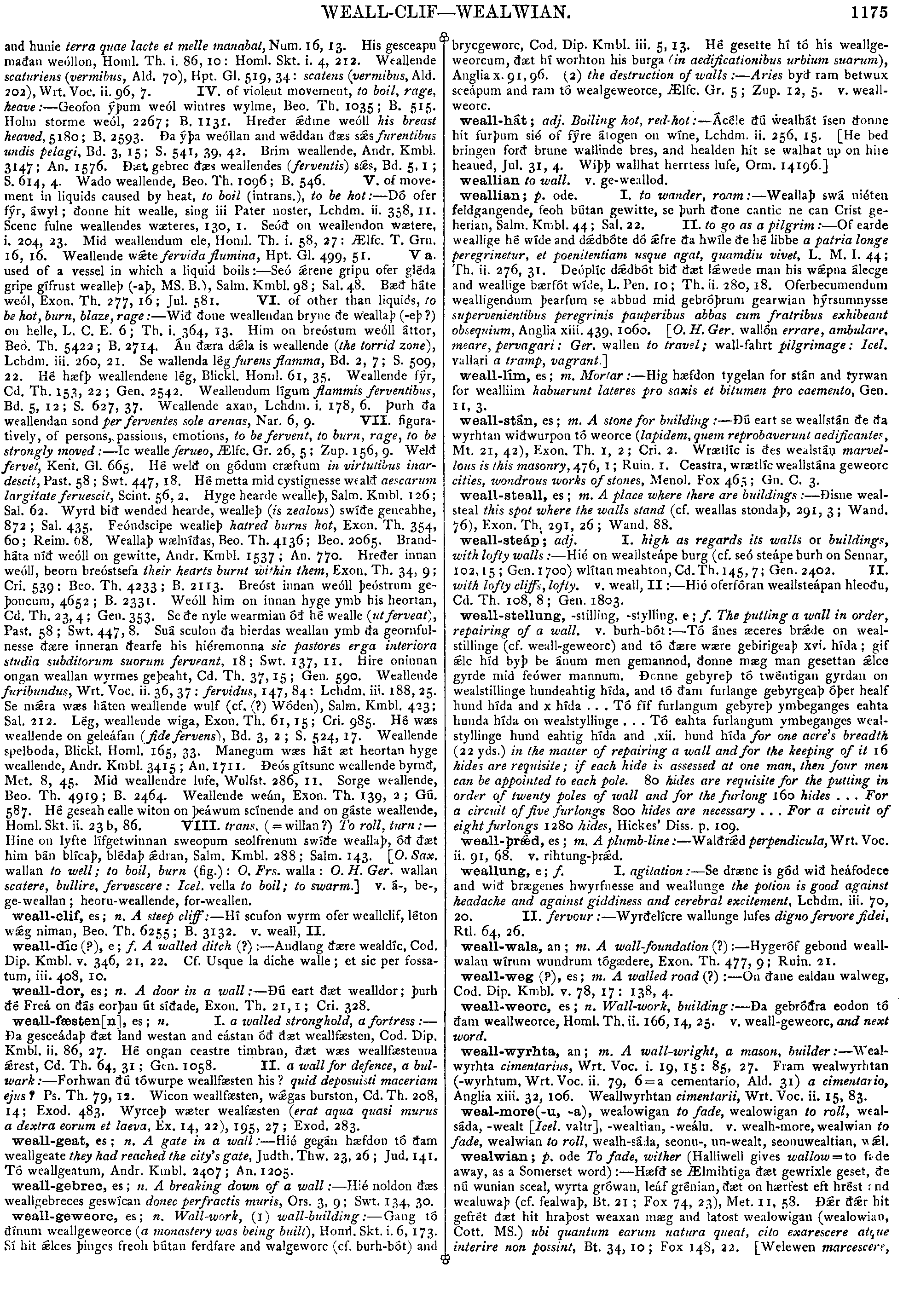
and
hunie
terra
quae
lacte
el
melle
manabat,
Num.
16,
13.
His
gesceapu
maðan
weóllon,
Homl.
Th.
i.
86,
10:
Homl.
Skt.
i.
4,
212.
Weallende
scaturiens
(vermibus,
Ald.
70),
Hpt.
Gl.
519,
34:
scatens
(vermibus,
Ald.
202),
Wrt.
Voc.
ii.
96,
7.
IV.
of
violent
movement,
to
boil,
rage,
heave:--Geofon
ýþum
weól
winlres
wylme,
Beo.
Th.
1035;
B.
515.
Holm
storme
weól,
2267;
B.
1131.
Hreðer
ðme
weóll
his
breast
heaved,
5180;
B.
2593.
Ða
ýþa
weóllan
and
wéddan
ðæs
ss
furentibus
undis
pelagi,
Bd.
3,
15;
S.
541,
39,
42.
Brim
weallende,
Andr.
Kmbl.
3147;
An.
1576.
Ðæt
gebrec
ðæs
weallendes
(ferventis)
ss,
Bd.
5,
1;
S.
614,
4.
Wado
weallende,
Beo.
Th.
1096;
B.
546.
V.
of
movement
in
liquids
caused
by
heat,
to
boil
(intrans.),
to
be
hot:--Dó
ofer
fýr,
áwyl;
ðonne
hit
wealle,
sing
iii
Pater
noster,
Lchdm.
ii.
358,
11.
Scenc
fulne
weallendes
wæteres,
130,
1.
Seóð
on
weallendon
wætere,
i.
204,
23.
Mid
weallendum
ele,
Homl.
Th.
i.
58,
27:
Ælfc.
T.
Grn.
16,
16.
Weallende
wte
fervida
flumina,
Hpt.
Gl.
499,
51.
V
a.
used
of
a
vessel
in
which
a
liquid
boils:--Seó
rene
gripu
ofer
gléda
gripe
gífrust
wealleþ
(-aþ,
MS.
B.),
Salm.
Kmbl.
98;
Sal.
48.
Bæð
háte
weól,
Exon.
Th.
277,
16;
Jul.
581.
VI.
of
other
than
liquids,
to
be
hot,
burn,
blaze,
rage:--Wið
ðone
weallendan
bryne
ðe
weallaþ
(-eþ?)
on
helle,
L.
C.
E.
6;
Th.
i.
364,
13.
Him
on
breóstum
weóll
áttor,
Beo.
Th.
5422;
B.
2714.
Án
ðæra
dla
is
weallende
(the
torrid
zone),
Lchdm.
iii.
260,
21.
Se
wallenda
lég
furens
flamma,
Bd.
2,
7;
S.
509,
22.
Hé
hæfþ
weallendene
lég,
Blickl.
Homl.
61,
35.
Weallende
fýr,
Cd.
Th.
153,
22;
Gen.
2542.
Weallendum
lígum
flammis
ferventibus,
Bd.
5,
12;
S.
627,
37.
Weallende
axan,
Lchdm.
i.
178,
6.
Þurh
ða
weallendan
sond
per
ferventes
sole
arenas,
Nar.
6,
9.
VII.
figuratively,
of
persons,
passions,
emotions,
to
be
fervent,
to
burn,
rage,
to
be
strongly
moved:--Ic
wealle
ferueo,
Ælfc.
Gr.
26,
5;
Zup.
156,
9.
Welð
fervet,
Kent.
Gl.
665.
Hé
welð
on
gódum
cræftum
in
virtutibus
inardescit,
Past.
58;
Swt.
447,
18.
Hé
metta
mid
cystignesse
wealð
aescarum
largitate
feruescit,
Scint.
56,
2.
Hyge
hearde
wealleþ,
Salm.
Kmbl.
126;
Sal.
62.
Wyrd
bið
wended
hearde,
wealleþ
(is
zealous)
swíðe
geneahhe,
872;
Sal.
435.
Feóndscipe
wealleþ
hatred
burns
hot,
Exon.
Th.
354,
60;
Reim.
68.
Weallaþ
wælníðas,
Beo.
Th.
4136;
Beo.
2065.
Brandháta
níð
weóll
on
gewitte,
Andr.
Kmbl.
1537;
An.
770.
Hreðer
innan
weóll,
beorn
breóstsefa
their
hearts
burnt
within
them,
Exon.
Th.
34,
9;
Cri.
539:
Beo.
Th.
4233;
B.
2113.
Breóst
innan
weóll
þeóstrum
geþoncum,
4652;
B.
2331.
Weóll
him
on
innan
hyge
ymb
his
heortan,
Cd.
Th.
23,
4;
Gen.
353.
Se
ðe
nyle
wearmian
óð
hé
wealle
(ut
ferveat),
Past.
58;
Swt.
447,
8.
Suá
sculon
ða
hierdas
weallan
ymb
ða
geornfulnesse
ðære
inneran
ðearfe
his
hiéremonna
sic
pastores
erga
interiora
studia
subditornm
suorum
ferveant,
18;
Swt.
137,
11.
Hire
oninnan
ongan
weallan
wyrmes
geþeaht,
Cd.
Th.
37,
15;
Gen.
590.
Weallende
furibundus,
Wrt.
Voc.
ii.
36,
37:
fervidus,
147,
84:
Lchdm.
iii.
188,
25.
Se
mra
wæs
háten
weallende
wulf
(cf.
(?)
Wóden),
Salm.
Kmbl.
423;
Sal.
212.
Lég,
weallende
wiga,
Exon.
Th.
61,
15;
Cri.
985.
Hé
wæs
weallende
on
geleáfan
(fide
fervens),
Bd.
3,
2;
S.
524,
17.
Weallende
spelboda,
Blickl.
Homl.
165,
33.
Manegum
wæs
hát
æt
heortan
hyge
weallende,
Andr.
Kmbl.
3415;
An.
1711.
Ðeós
gítsunc
weallende
byrnð,
Met.
8,
45.
Mid
weallendre
lufe,
Wulfst.
286,
11.
Sorge
weallende,
Beo.
Th.
4919;
B.
2464.
Weallende
weán,
Exon.
Th.
139,
2;
Gú.
587.
Hé
geseah
ealle
witon
on
þeáwum
scínende
and
on
gáste
weallende,
Homl.
Skt.
ii.
23
b,
86.
VIII.
trans.
(
=
willan?)
To
roll,
turn:--Hine
on
lyfte
lífgetwinnan
sweopum
seolfrenum
swíðe
weallaþ,
óð
ðæt
him
bán
blícaþ,
blédaþ
dran,
Salm.
Kmbl.
288;
Salm.
143.
[O.
Sax.
wallan
to
well;
to
boil,
burn
(fig.):
O.
Frs.
walla:
O.
H.
Ger.
wallan
scatere,
bullire,
fervescere:
Icel.
vella
to
boil;
to
swarm.]
v.
á-,
be-,
ge-weallan;
heoru-weallende,
for-weallen.
|
Source: Bosworth/Toller, page b1178, entry 3 View original page image as: [TIFF] [PNG] [View previous entry] [View next entry] |
[Comment on this entry] [View comments] |
The following entry has been hand-corrected once. |
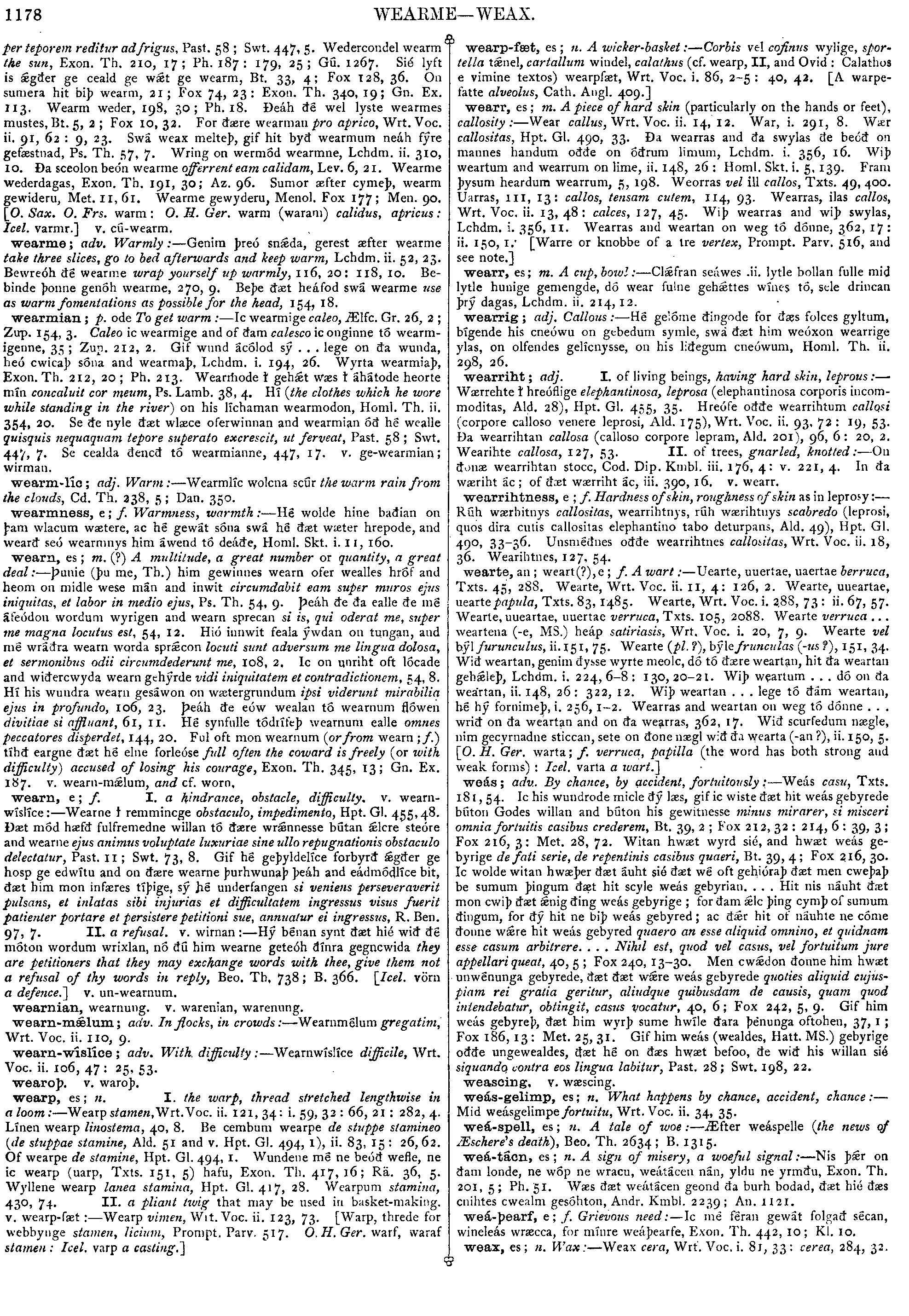
wearmian;
p.
ode
To
get
warm
:--
Ic
wearmige
caleo,
Ælfc.
Gr.
26,
2;
Zup.
154,
3.
Caleo
ic
wearmige
and
of
ðam
calesco
ic
onginne
tó
wearmigenne,
35;
Zup.
212,
2.
Gif
wund
ácólod
sý
...
lege
on
ða
wunda,
heó
cwicaþ
sóna
and
wearmaþ,
Lchdm.
i.
194,
26.
Wyrta
wearmiaþ,
Exon.
Th.
212,
20;
Ph.
213.
Wearmode
geht
Wæs
áhátode
heorte
mín
concaluit
cor
meum,
Ps.
Lamb.
38,
4.
Hí
(the
clothes
which
he
wore
while
standing
in
the
river)
on
his
líchaman
wearmodon,
Homl.
Th.
ii.
354,
20.
Se
ðe
nyle
ðæt
wlæce
oferwinnan
and
wearmian
óð
hé
wealle
quisquis
nequaquam
tepore
superato
excrescit,
ut
ferveat,
Past.
58;
Swt.
447,
7.
Se
cealda
ðencð
tó
wearmianne,
447,
17.
v.
ge-wearmian;
wirman.
|
Source: Bosworth/Toller, page b1181, entry 6 View original page image as: [TIFF] [PNG] [View previous entry] [View next entry] |
[Comment on this entry] [View comments] |
The following entry has been hand-corrected once. |
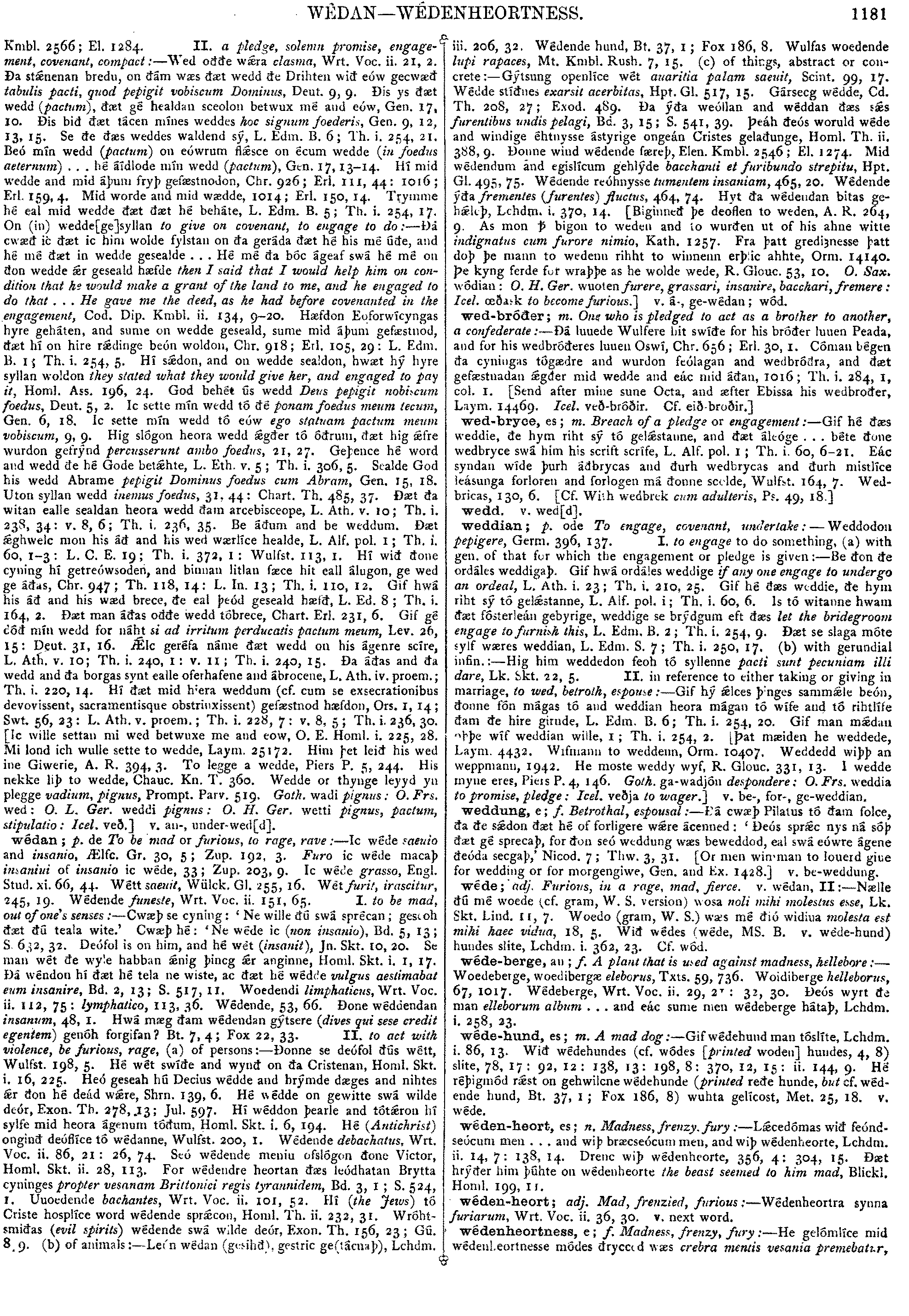
weddian;
p.
ode
To
engage,
covenant,
undertake
:--
Weddodon
pepigere,
Germ.
396,
137.
I.
to
engage
to
do
something,
(a)
with
gen.
of
that
for
which
the
engagement
or
pledge
is
given
:--
Be
ðon
ðe
ordáles
weddigaþ.
Gif
hwá
ordáles
weddige
if
any
one
engage
to
undergo
an
ordeal,
L.
Ath.
i.
23;
Th.
i.
210,
25.
Gif
hé
ðæs
weddie,
ðe
hym
riht
sý
tó
gelstanne,
L.
Alf.
pol.
i;
Th.
i.
60,
6.
Is
tó
witanne
hwam
ðæt
fósterleán
gebyrige,
weddige
se
brýdgum
eft
ðæs
let
the
bridegroom
engage
to
furnish
this,
L.
Edm.
B.
2
;
Th.
i.
254,
9.
Ðæt
se
slaga
móte
sylf
wæres
weddian,
L.
Edm.
S.
7
;
Th.
i.
250,
17.
(b)
with
gerundial
infin.
:--
Hig
him
weddedon
feoh
tó
syllenne
pacti
sunt
pecuniam
illi
dare,
Lk.
Skt.
22,
5.
II.
in
reference
to
either
taking
or
giving
in
marriage,
to
wed,
betroth,
espouse
:--
Gif
hý
lces
þinges
sammle
beón,
ðonne
fón
mágas
tó
and
weddian
heora
mágan
tó
wífe
and
tó
rihtlífe
ðam
ðe
hire
girude,
L.
Edm.
B.
6;
Th.
i.
254,
20.
Gif
man
mdan
oððe
wíf
weddian
wille,
1;
Th.
i.
254,
2.
[Þat
mæiden
he
weddede,
Laym.
4432.
Wifmann
to
weddenn,
Orm.
10407.
Weddedd
wiþþ
an
weppmann,
1942.
He
moste
weddy
wyf,
R.
Glouc.
331,
13.
I
wedde
myne
eres,
ILLEGIBLE
P.
4,
146.
Goth.
ga-wadjón
despondere:
O.
Frs.
weddia
to
promise,
pledge:
Icel.
veðja
to
wnger.]
v.
be-,
for-,
ge-weddian.
|
Source: Bosworth/Toller, page b1182, entry 22 View original page image as: [TIFF] [PNG] [View previous entry] [View next entry] |
[Comment on this entry] [View comments] |
The following entry has been hand-corrected once. |
wefl, e; wefle (-a ; m.?), an; f. I. weft, woof, thread which crosses the warp: -- Weft vel ówef, uuefl cladica, caldica, Txts. 51, 482. Cladica wefl oððe ówef oððe claudica, Wrt. Voc. ii. 14, 4. Wefl vel óweb cladicla, 131, 59. Wefl cladica, 16, 31: i. 66, 13: 281, 76. Uuefl panuculum, ii. 116, 29: titica (cf. O. H. Ger. below), 122, 33. Weflan penniculae (the passage is: Nisi panniculae diversis colorum varietatibus fucatae inter densa filorum stamina ultro citroque decurrant, Ald. 15), Hpt. Gl. 430, 69. Wefla panucla (this is a gloss to the same passage as the preceding), Wrt. Voc. ii. 77, 13. Wundene mé (a coat of mail) ne beóð wefle (ueflæ, Txts. 151, 5), ne ic wearp hafu the threads of the woof are not twisted for me, nor have I a warp, Exon. Th. 417, 15 ; Rä. 36, 5. Wæfla pannicularum (colobium cum sine pompulenta pannicularum varietate ordiretur, Ald. 51), Hpt. Gl. 494, 9. Weflum panniculis (panuclis, Wrt. Voc. ii. 65, 61, in a gloss to the same passage : Lanea filorum stamina ex glomere et panniculis revoluta, Ald. 8), 417, 30. II. an implement for weaving (-l suffix in words denoting implements, cf, scofi), a shuttle (?) :-- Hé sceal habban fela towtóla . . . pihten, wefte,
| Result Page: |  |
Previous | 139 140 141 142 143 144 145 146 147 148 149 150 151 152 153 154 155 156 157 | Next |  |
Germanic Lexicon Project (main page)
This search system was written by
Sean Crist
Please consider
volunteering
to correct the data in these online dictionaries.
No rights reserved. Feel free to use these data in any way you please.