|
|

|
Source: Bosworth/Toller, page b0086, entry 21 View original page image as: [TIFF] [PNG] [View previous entry] [View next entry] |
[Comment on this entry] [View comments] |
The following entry has been hand-corrected once. |
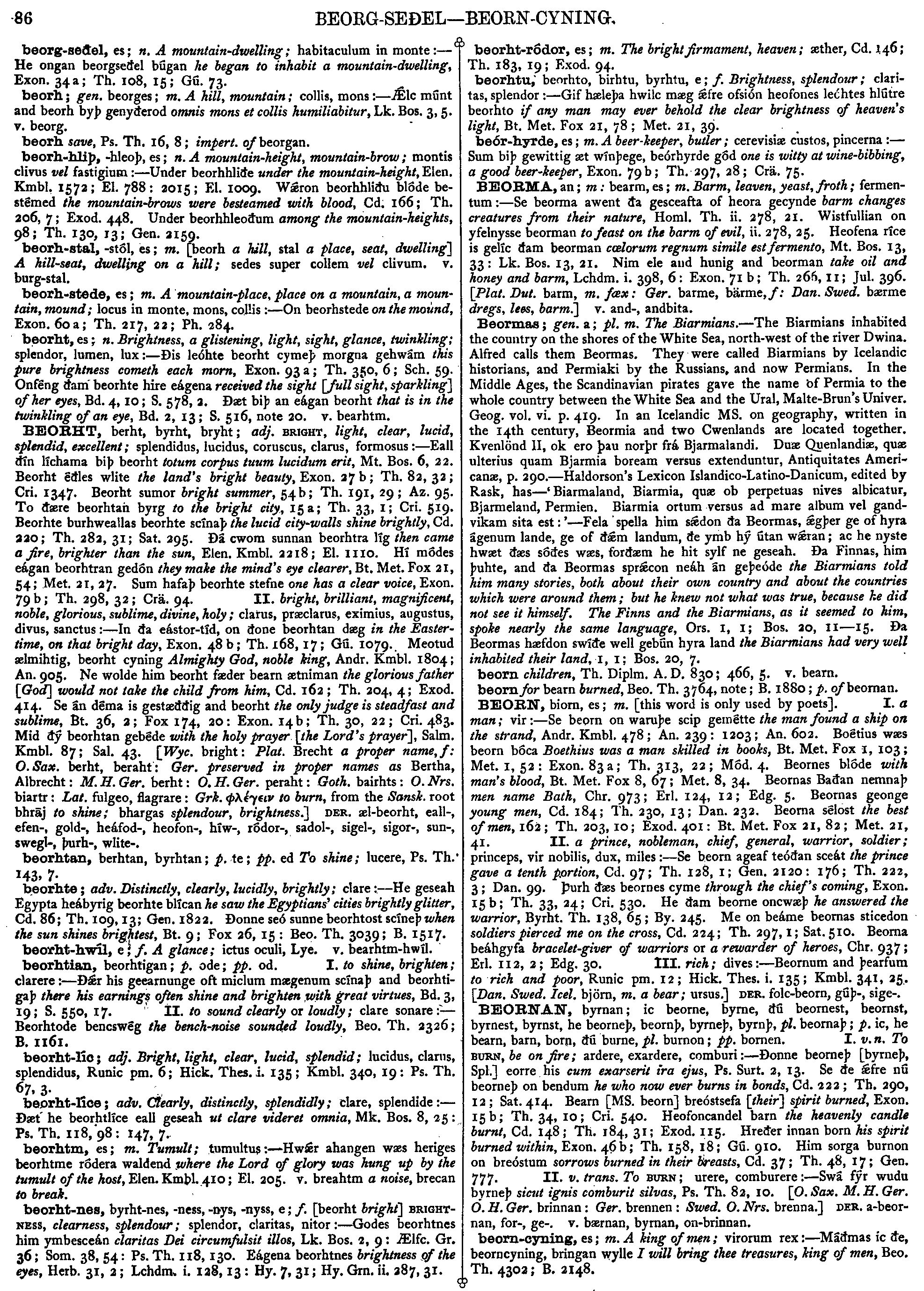
Beormas;
gen.
a;
pl.
m.
The
Biarmians.
-
The
Biarmians
inhabited
the
country
on
the
shores
of
the
White
Sea,
north-west
of
the
river
Dwina.
Alfred
calls
them
Beormas.
They
were
called
Biarmians
by
Icelandic
historians,
and
Permiaki
by
the
Russians,
and
now
Permians.
In
the
Middle
Ages,
the
Scandinavian
pirates
gave
the
name
of
Permia
to
the
whole
country
between
the
White
Sea
and
the
Ural,
Malte-Brun's
Univer.
Geog.
vol.
vi.
p.
419.
In
an
Icelandic
MS.
on
geography,
written
in
the
14th
century,
Beormia
and
two
Cwenlands
are
located
together.
Kvenlönd
II,
ok
ero
þau
norþr
frá
Bjarmalandi.
Duæ
Quenlandiæ,
quæ
ulterius
quam
Bjarmia
boream
versus
extenduntur,
Antiquitates
Americanæ,
p.
290.
-
Haldorson's
Lexicon
Islandico-Latino-Danicum,
edited
by
Rask,
has
-
'Biarmaland,
Biarmia,
quæ
ob
perpetuas
nives
albicatur,
Bjarmeland,
Permien.
Biarmia
ortum
versus
ad
mare
album
vel
gandvikam
sita
est
:'
-
Fela
spella
him
s don
ða
Beormas,
gþer
ge
of
hyra
ágenum
lande,
ge
of
ðm
landum,
ðe
ymb
hý
útan
wran;
ac
he
nyste
hwæt
ðæs
sóðes
wæs,
forðæm
he
hit
sylf
ne
geseah.
Ða
Finnas,
him
þuhte,
and
ða
Beormas
sprcon
neáh
án
geþeóde
the
Biarmians
told
him
many
stories,
both
about
their
own
country
and
about
the
countries
which
were
around
them;
but
he
knew
not
what
was
true,
because
he
did
not
see
it
himself.
The
Finns
and
the
Biarmians,
as
it
seemed
to
him,
spoke
nearly
the
same
language,
Ors.
1,
1;
Bos.
20,
11-15.
Ðá
Beormas
hæfdon
swíðe
well
gebún
hyra
land
the
Biarmians
had
very
well
inhabited
their
land,
1,
1;
Bos.
20,
7.
don
ða
Beormas,
gþer
ge
of
hyra
ágenum
lande,
ge
of
ðm
landum,
ðe
ymb
hý
útan
wran;
ac
he
nyste
hwæt
ðæs
sóðes
wæs,
forðæm
he
hit
sylf
ne
geseah.
Ða
Finnas,
him
þuhte,
and
ða
Beormas
sprcon
neáh
án
geþeóde
the
Biarmians
told
him
many
stories,
both
about
their
own
country
and
about
the
countries
which
were
around
them;
but
he
knew
not
what
was
true,
because
he
did
not
see
it
himself.
The
Finns
and
the
Biarmians,
as
it
seemed
to
him,
spoke
nearly
the
same
language,
Ors.
1,
1;
Bos.
20,
11-15.
Ðá
Beormas
hæfdon
swíðe
well
gebún
hyra
land
the
Biarmians
had
very
well
inhabited
their
land,
1,
1;
Bos.
20,
7.
|
Source: Bosworth/Toller, page b0087, entry 2 View original page image as: [TIFF] [PNG] [View previous entry] [View next entry] |
[Comment on this entry] [View comments] |
The following entry has been hand-corrected once. |
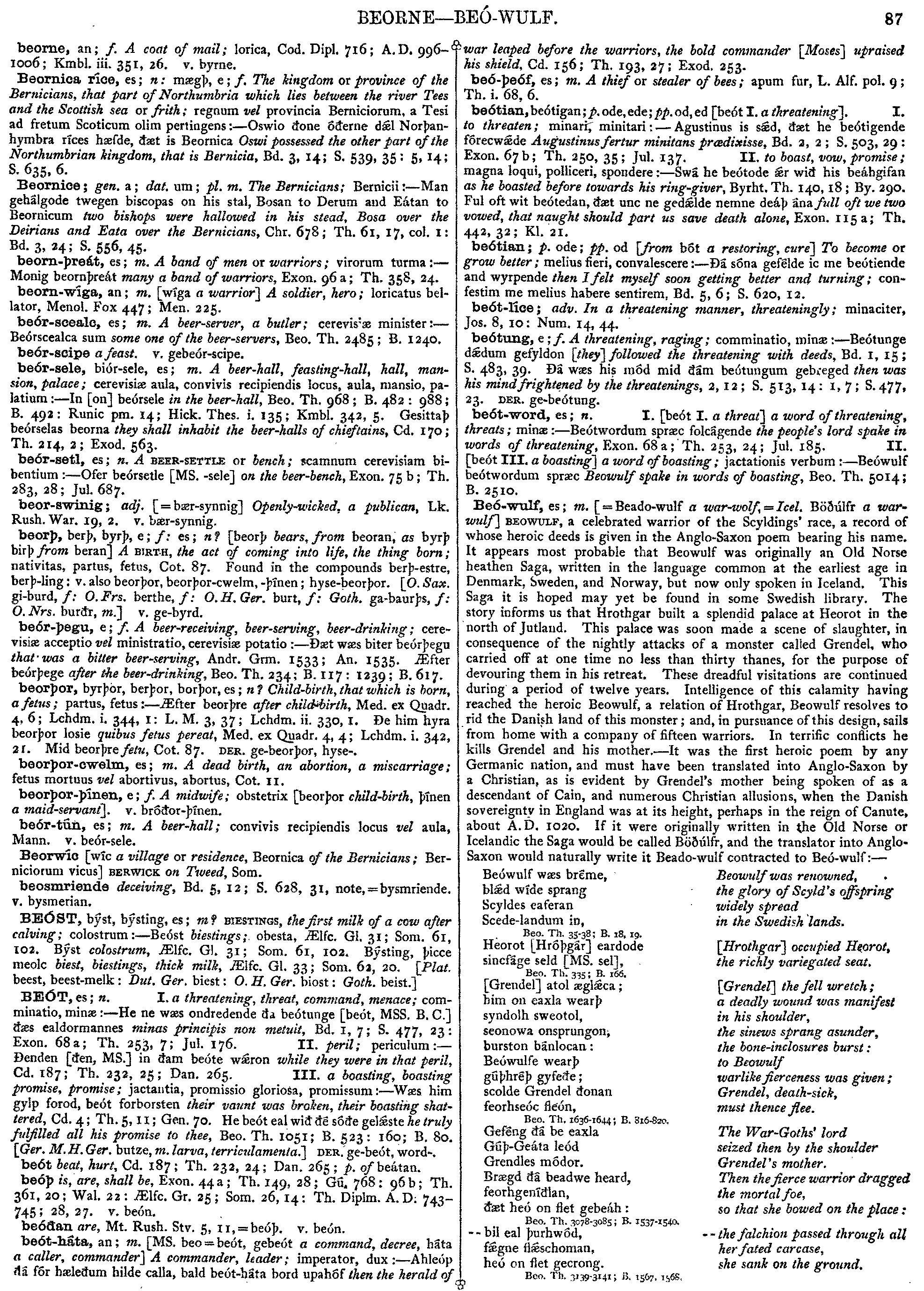
Beornica
ríce,
es;
n
:
mægþ,
e;
f.
The
kingdom
or
province
of
the
Bernicians,
that
part
of
Northumbria
which
lies
between
the
river
Tees
and
the
Scottish
sea
or
frith;
regnum
vel
provincia
Berniciorum,
a
Tesi
ad
fretum
Scoticum
olim
pertingens
:--
Oswio
ðone
óðerne
dl
Norþanhymbra
ríces
hæfde,
ðæt
is
Beornica
Oswi
possessed
the
other
part
of
the
Northumbrian
kingdom,
that
is
Bernicia,
Bd.
3,
14;
S.
539,
35
:
5,
14;
S.
635,
6.
|
Source: Bosworth/Toller, page b0087, entry 13 View original page image as: [TIFF] [PNG] [View previous entry] [View next entry] |
[Comment on this entry] [View comments] |
The following entry has been hand-corrected once. |
beorþor, byrþor, berþor, borþor, es; n? Child-birth, that which is born, a fetus; partus, fetus :-- Æfter beorþre after child-birth, Med. ex Quadr. 4, 6; Lchdm. i. 344, 1 : L. M. 3, 37; Lchdm. ii. 330, 1. Ðe him hyra beorþor losie quibus fetus pereat, Med. ex Quadr. 4, 4; Lchdm. i. 342, 21. Mid beorþre fetu, Cot. 87. DER. ge-beorþor, hyse-.
|
Source: Bosworth/Toller, page b0088, entry 1 View original page image as: [TIFF] [PNG] [View previous entry] [View next entry] |
[Comment on this entry] [View comments] |
The following entry has been hand-corrected once. |
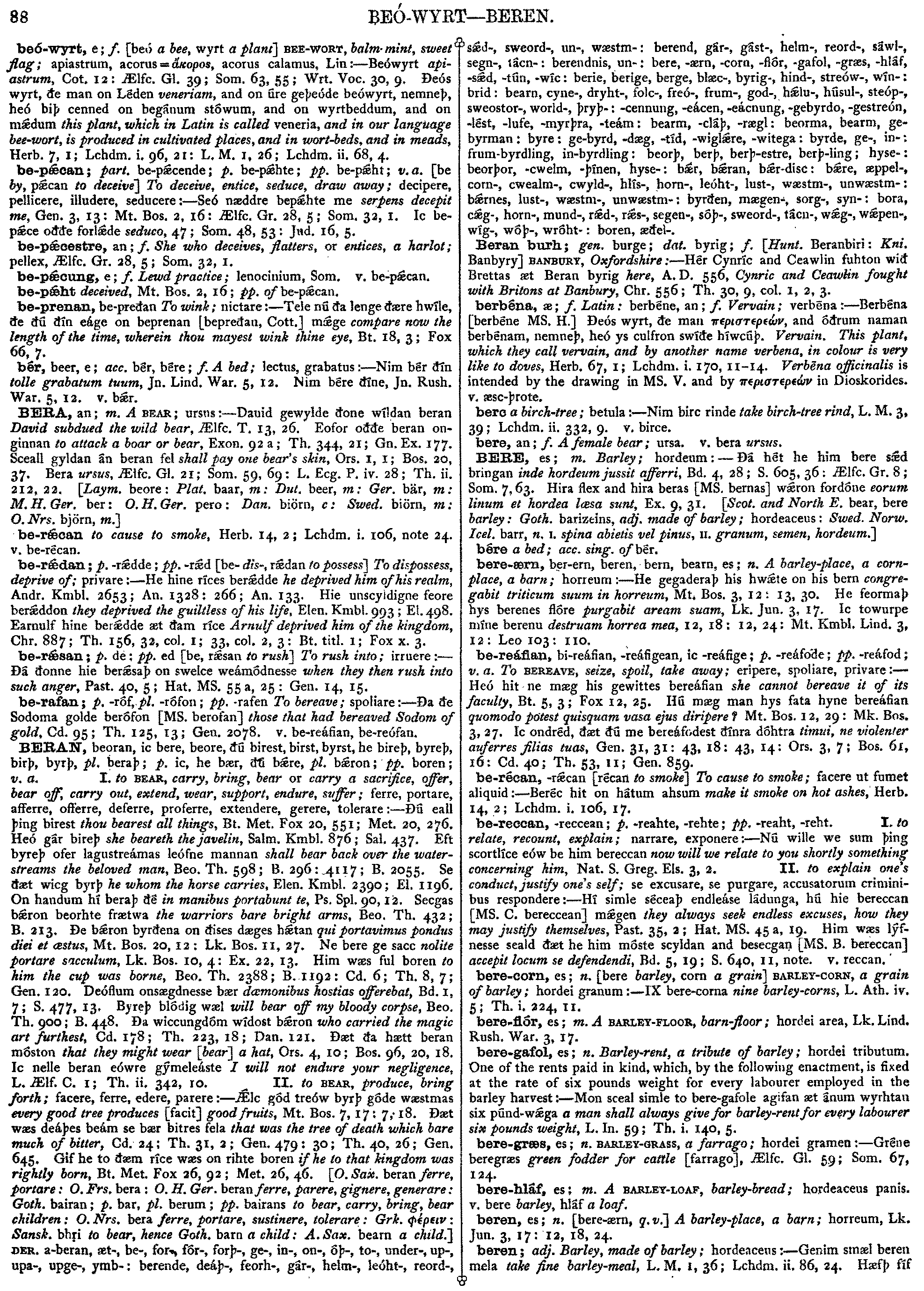
beó-wyrt,
e;
f.
[beó
a
bee,
wyrt
a
plant]
BEE-WORT,
balm
mint,
sweet
flag;
apiastrum,
acorus
=
&alpha-tonos; o
o os,
acorus
calamus,
Lin
:--
Beówyrt
apiastrum,
Cot.
12
:
Ælfc.
Gl.
39;
Som.
63,
55;
Wrt.
Voc.
30,
9.
Ðeós
wyrt,
ðe
man
on
Léden
veneriam,
and
on
úre
geþeóde
beówyrt,
nemneþ,
heó
biþ
cenned
on
begánum
stówum,
and
on
wyrtbeddum,
and
on
mdum
this
plant,
which
in
Latin
is
called
veneria,
and
in
our
language
bee-wort,
is
produced
in
cultivated
places,
and
in
wort-beds,
and
in
meads,
Herb.
7,
1;
Lchdm.
i.
96,
21
:
L.
M.
1,
26;
Lchdm.
ii.
68,
4.
os,
acorus
calamus,
Lin
:--
Beówyrt
apiastrum,
Cot.
12
:
Ælfc.
Gl.
39;
Som.
63,
55;
Wrt.
Voc.
30,
9.
Ðeós
wyrt,
ðe
man
on
Léden
veneriam,
and
on
úre
geþeóde
beówyrt,
nemneþ,
heó
biþ
cenned
on
begánum
stówum,
and
on
wyrtbeddum,
and
on
mdum
this
plant,
which
in
Latin
is
called
veneria,
and
in
our
language
bee-wort,
is
produced
in
cultivated
places,
and
in
wort-beds,
and
in
meads,
Herb.
7,
1;
Lchdm.
i.
96,
21
:
L.
M.
1,
26;
Lchdm.
ii.
68,
4.
|
Source: Bosworth/Toller, page b0088, entry 14 View original page image as: [TIFF] [PNG] [View previous entry] [View next entry] |
[Comment on this entry] [View comments] |
The following entry has been hand-corrected once. |
byreþ
ofer
lagustreámas
leófne
mannan
shall
bear
back
over
the
water-streams
the
beloved
man,
Beo.
Th.
598;
B.
296
:
4117;
B.
2055.
Se
ðæt
wicg
byrþ
he
whom
the
horse
carries,
Elen.
Kmbl.
2390;
El.
1196.
On
handum
hí
beraþ
ðé
in
manibus
portabunt
te,
Ps.
Spl.
90,
12.
Secgas
bron
beorhte
frætwa
the
warriors
bare
bright
arms,
Beo.
Th.
432;
B.
213.
Ðe
bron
byrðena
on
ðises
dæges
htan
qui
portavimus
pondus
diei
et
æstus,
Mt.
Bos.
20,
12
:
Lk.
Bos.
11,
27.
Ne
bere
ge
sacc
nolite
portare
sacculum,
Lk.
Bos.
10,
4
:
Ex.
22,
13.
Him
wæs
ful
boren
to
him
the
cup
was
borne,
Beo.
Th.
2388;
B.
1192
:
Cd.
6;
Th.
8,
7;
Gen.
120.
Deóflum
onsægdnesse
bær
dæmonibus
hostias
offerebat,
Bd.
1,
7;
S.
477,
13.
Byreþ
blódig
wæl
will
bear
off
my
bloody
corpse,
Beo.
Th.
900;
B.
448.
Ða
wiccungdóm
wídest
bron
who
carried
the
magic
art
furthest,
Cd.
178;
Th.
223,
18;
Dan.
121.
Ðæt
ða
hætt
beran
móston
that
they
might
wear
[bear]
a
hat,
Ors.
4,
10;
Bos.
96,
20,
18.
Ic
nelle
beran
eówre
gýmeleáste
I
will
not
endure
your
negligence,
L.
Ælf.
C.
1;
Th.
ii.
342,
10.
II.
to
BEAR,
produce,
bring
forth;
facere,
ferre,
edere,
parere
:--
Æ-acute;lc
gód
treów
byrþ
góde
wæstmas
every
good
tree
produces
[facit]
good
fruits,
Mt.
Bos.
7,
17
:
7;
18.
Ðæt
wæs
deáþes
beám
se
bær
bitres
fela
that
was
the
tree
of
death
which
bare
much
of
bitter,
Cd.
24;
Th.
31,
2;
Gen.
479
:
30;
Th.
40,
26;
Gen.
645.
Gif
he
to
ðæm
ríce
wæs
on
rihte
boren
if
he
to
that
kingdom
was
rightly
born,
Bt.
Met.
Fox
26,
92;
Met.
26,
46.
[O.
Sax.
beran
ferre,
portare
:
O.
Frs.
bera
:
O.
H.
Ger.
beran
ferre,
parere,
gignere,
generare
:
Goth.
bairan;
p.
bar,
pl.
berum;
pp.
bairans
to
bear,
carry,
bring,
bear
children
:
O.
Nrs.
bera
ferre,
portare,
sustinere,
tolerare
:
Grk.
 &epsilon-tonos;

 :
Sansk.
bhri
to
bear,
hence
Goth.
barn
a
child
:
A.
Sax.
bearn
a
child.]
DER.
a-beran,
æt-,
be-,
for-,
fór-,
forþ-,
ge-,
in-,
on-,
óþ-,
to-,
under-,
up-,
upa-,
upge-,
ymb-
:
berende,
deáþ-,
feorh-,
gár-,
helm-,
leóht-,
reord-,
sd-,
sweord-,
un-,
wæstm-
:
berend,
gár-,
gást-,
helm-,
reord-,
sáwl-,
segn-,
tácn-
:
berendnis,
un-
:
bere,
-ærn,
-corn,
-flór,
-gafol,
-græs,
-hláf,
-sd,
-tún,
-wíc
:
berie,
berige,
berge,
blæc-,
byrig-,
hind-,
streów-,
wín-
:
brid
:
bearn,
cyne-,
dryht-,
folc-,
freó-,
frum-,
god-,
hlu-,
húsul-,
steóp-,
sweostor-,
world-,
þryþ-
:
-cennung,
-eácen,
-eácnung,
-gebyrdo,
-gestreón,
-lést,
-lufe,
-myrþra,
-teám
:
bearm,
-cláþ,
-rægl
:
beorma,
bearm,
gebyrman
:
byre
:
ge-byrd,
-dæg,
-tíd,
-wiglre,
-witega
:
byrde,
ge-,
in-
:
frum-byrdling,
in-byrdling
:
beorþ,
berþ,
berþ-estre,
berþ-ling;
hyse-
:
beorþor,
-cwelm,
-þínen,
hyse-
:
br,
bran,
br-disc
:
bre,
æppel-,
corn-,
cwealm-,
cwyld-,
hlís-,
horn-,
leóht-,
lust-,
wæstm-,
unwæstm-
:
brnes,
lust-,
wæstm-,
unwæstm-
:
byrðen,
mægen-,
sorg-,
syn-
:
bora,
cg-,
horn-,
mund-,
rd-,
rs-,
segen-,
sóþ-,
sweord-,
tácn-,
wg-,
wpen-,
wíg-,
wóþ-,
wróht-
:
boren,
æðel-.
:
Sansk.
bhri
to
bear,
hence
Goth.
barn
a
child
:
A.
Sax.
bearn
a
child.]
DER.
a-beran,
æt-,
be-,
for-,
fór-,
forþ-,
ge-,
in-,
on-,
óþ-,
to-,
under-,
up-,
upa-,
upge-,
ymb-
:
berende,
deáþ-,
feorh-,
gár-,
helm-,
leóht-,
reord-,
sd-,
sweord-,
un-,
wæstm-
:
berend,
gár-,
gást-,
helm-,
reord-,
sáwl-,
segn-,
tácn-
:
berendnis,
un-
:
bere,
-ærn,
-corn,
-flór,
-gafol,
-græs,
-hláf,
-sd,
-tún,
-wíc
:
berie,
berige,
berge,
blæc-,
byrig-,
hind-,
streów-,
wín-
:
brid
:
bearn,
cyne-,
dryht-,
folc-,
freó-,
frum-,
god-,
hlu-,
húsul-,
steóp-,
sweostor-,
world-,
þryþ-
:
-cennung,
-eácen,
-eácnung,
-gebyrdo,
-gestreón,
-lést,
-lufe,
-myrþra,
-teám
:
bearm,
-cláþ,
-rægl
:
beorma,
bearm,
gebyrman
:
byre
:
ge-byrd,
-dæg,
-tíd,
-wiglre,
-witega
:
byrde,
ge-,
in-
:
frum-byrdling,
in-byrdling
:
beorþ,
berþ,
berþ-estre,
berþ-ling;
hyse-
:
beorþor,
-cwelm,
-þínen,
hyse-
:
br,
bran,
br-disc
:
bre,
æppel-,
corn-,
cwealm-,
cwyld-,
hlís-,
horn-,
leóht-,
lust-,
wæstm-,
unwæstm-
:
brnes,
lust-,
wæstm-,
unwæstm-
:
byrðen,
mægen-,
sorg-,
syn-
:
bora,
cg-,
horn-,
mund-,
rd-,
rs-,
segen-,
sóþ-,
sweord-,
tácn-,
wg-,
wpen-,
wíg-,
wóþ-,
wróht-
:
boren,
æðel-.
|
Source: Bosworth/Toller, page b0088, entry 16 View original page image as: [TIFF] [PNG] [View previous entry] [View next entry] |
[Comment on this entry] [View comments] |
The following entry has been hand-corrected once. |
berbéna,
æ;
f.
Latin
:
berbéne,
an;
f.
Vervain;
verb na
:--
Berbéna
[berbéne
MS.
H.]
Ðeós
wyrt,
ðe
man
na
:--
Berbéna
[berbéne
MS.
H.]
Ðeós
wyrt,
ðe
man


 &omega-tonos;,
and
óðrum
naman
berbénam,
nemneþ,
heó
ys
culfron
swíðe
híwcúþ.
Vervain.
This
plant,
which
they
call
vervain,
and
by
another
name
verbena,
in
colour
is
very
like
to
doves,
Herb.
67,
1;
Lchdm.
i.
170,
11-14.
Verbna
officinalis
is
intended
by
the
drawing
in
MS.
V.
and
by
&omega-tonos;
in
Dioskorides.
v.
æsc-þrote.
&omega-tonos;,
and
óðrum
naman
berbénam,
nemneþ,
heó
ys
culfron
swíðe
híwcúþ.
Vervain.
This
plant,
which
they
call
vervain,
and
by
another
name
verbena,
in
colour
is
very
like
to
doves,
Herb.
67,
1;
Lchdm.
i.
170,
11-14.
Verbna
officinalis
is
intended
by
the
drawing
in
MS.
V.
and
by
&omega-tonos;
in
Dioskorides.
v.
æsc-þrote.
|
Source: Bosworth/Toller, page b0088, entry 27 View original page image as: [TIFF] [PNG] [View previous entry] [View next entry] |
[Comment on this entry] [View comments] |
The following entry has been hand-corrected once. |
bere-gafol,
es;
n.
Barley-rent,
a
tribute
of
barley;
hordei
tributum.
One
of
the
rents
paid
in
kind,
which,
by
the
following
enactment,
is
fixed
at
the
rate
of
six
pounds
weight
for
every
labourer
employed
in
the
barley
harvest
:--
Mon
sceal
simle
to
bere-gafole
agifan
æt
ánum
wyrhtan
six
púnd-wga
a
man
shall
always
give
for
barley-rent
for
every
labourer
six
pounds
weight,
L.
In.
59;
Th.
i.
140,
5.
|
Source: Bosworth/Toller, page b0089, entry 20 View original page image as: [TIFF] [PNG] [View previous entry] [View next entry] |
[Comment on this entry] [View comments] |
The following entry has been hand-corrected once. |
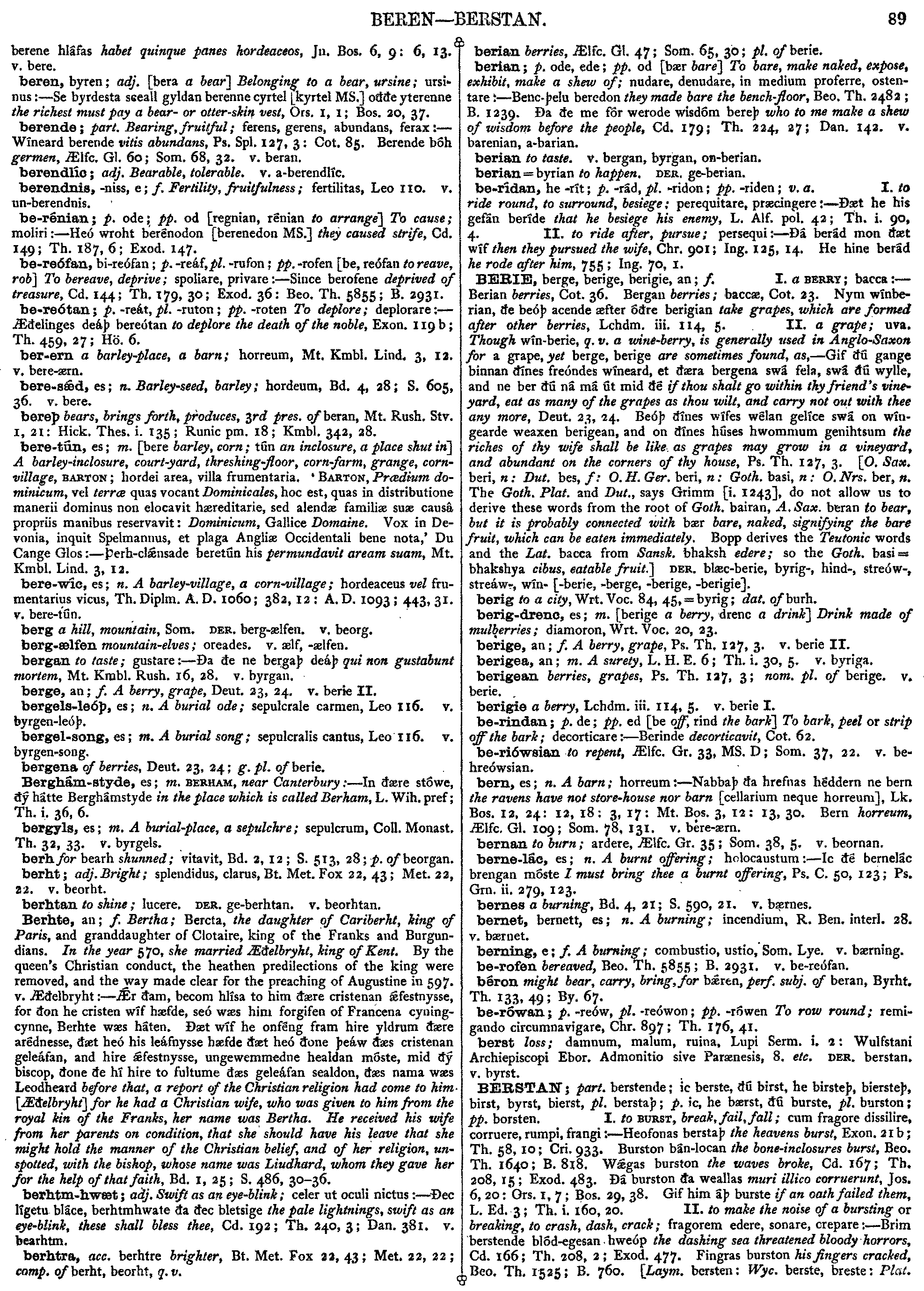
Berghám-styde, es; m. BERHAM, near Canterbury :-- In ðære stówe, ðý hátte Berghámstyde in the place which is called Berham, L. Wih. pref; Th. 1. 36, 6.
|
Source: Bosworth/Toller, page b0089, entry 33 View original page image as: [TIFF] [PNG] [View previous entry] [View next entry] |
[Comment on this entry] [View comments] |
The following entry has been hand-corrected once. |
BERIE, berge, berige, berigie, an; f. I. a BERRY; bacca :-- Berian berries, Cot. 36. Bergan berries; baccæ, Cot. 23. Nym wínberian, ðe beóþ acende after óðre berigian take grapes, which are formed after other berries, Lchdm. iii. 114, 5. II. a grape; uva. Though wín-berie, q. v. a wine-berry, is generally used in Anglo-Saxon for a grape, yet berge, berige are sometimes found, as, - Gif ðú gange binnan ðínes freóndes wíneard, et ðæra bergena swá fela, swá ðú wylle, and ne ber ðú ná má út mid ðé if thou shalt go within thy friend's vine-yard, eat as many of the grapes as thou wilt, and carry not out with thee any more, Deut. 23, 24. Beóþ ðínes wífes wélan gelíce swá on wíngearde weaxen berigean, and on ðínes húses hwommum genihtsum the riches of thy wife shall be like as grapes may grow in a vineyard, and abundant on the corners of thy house, Ps. Th. 127, 3. [O. Sax. beri, n : Dut. bes, f : O. H. Ger. beri, n : Goth. basi, n : O. Nrs. ber, n. The Goth. Plat. and Dut., says Grimm [i. 1243], do not allow us to derive these words from the root of Goth. bairan, A. Sax. beran to bear, but it is probably connected with bær bare, naked, signifying the bare fruit, which can be eaten immediately. Bopp derives the Teutonic words and the Lat. bacca from Sansk. bhaksh edere; so the Goth. basi = bhakshya cibus, eatable fruit.] DER. blæc-berie, byrig-, hind-, streów-, streáw, wín- [-berie, -berge, -berige, -berigie].
|
Source: Bosworth/Toller, page b0092, entry 10 View original page image as: [TIFF] [PNG] [View previous entry] [View next entry] |
[Comment on this entry] [View comments] |
The following entry has been hand-corrected once. |
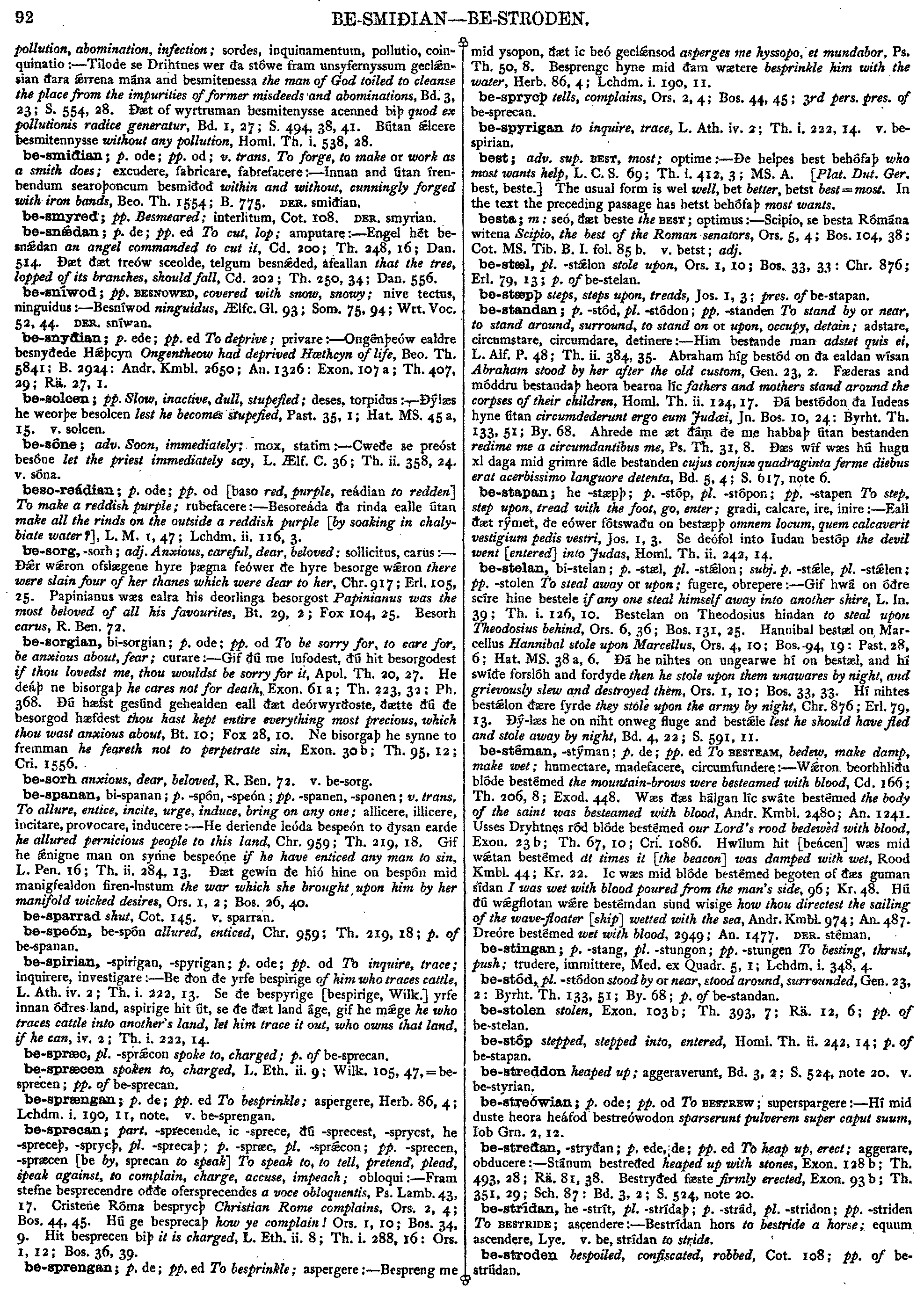
be-sorg,
-sorh;
adj.
Anxious,
careful,
dear,
beloved;
sollicitns,
carus
:
Ðr
wron
ofslægene
hyre
þægna
feówer
ðe
hyre
besorge
wron
there
were
slain
four
of
her
thanes
which
were
dear
to
her,
Chr.
917;
Erl.
105,
25.
Papinianus
wæs
ealra
his
deorlinga
besorgost
Papinianus
was
the
most
beloved
of
all
his
favourites,
Bt.
29,
2;
Fox
104,
25.
Besorh
carus,
R.
Ben.
72.
| Result Page: |  |
Previous | 5 6 7 8 9 10 11 12 13 14 15 16 17 18 19 20 21 22 23 | Next |  |
Germanic Lexicon Project (main page)
This search system was written by
Sean Crist
Please consider
volunteering
to correct the data in these online dictionaries.
No rights reserved. Feel free to use these data in any way you please.