|
|

Tip: In the search results, you can click on any word or abbreviation for more information.
|
Source: Wright's Gothic Grammar, page b0349, entry 12 View original page image as: [TIFF] [PNG] [View previous entry] [View next entry] |
[Comment on this entry] [View comments] |
The following entry has been hand-corrected once. |
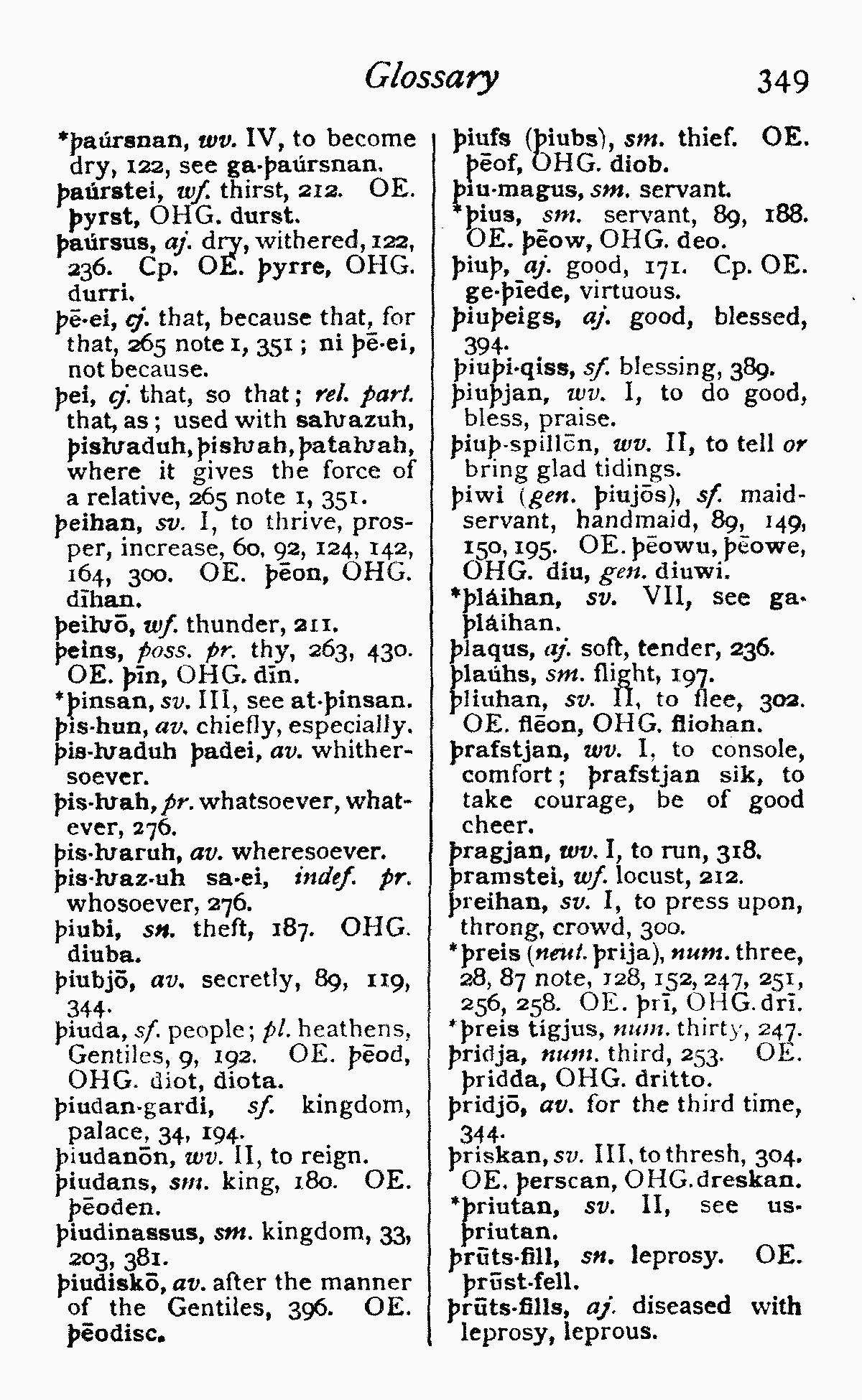
þis- ah,
pr.
whatsoever,
whatever,
276.
ah,
pr.
whatsoever,
whatever,
276.
|
Source: Bosworth/Toller, page b0012, entry 16 View original page image as: [TIFF] [PNG] [View previous entry] [View next entry] |
[Comment on this entry] [View comments] |
The following entry has been hand-corrected once. |
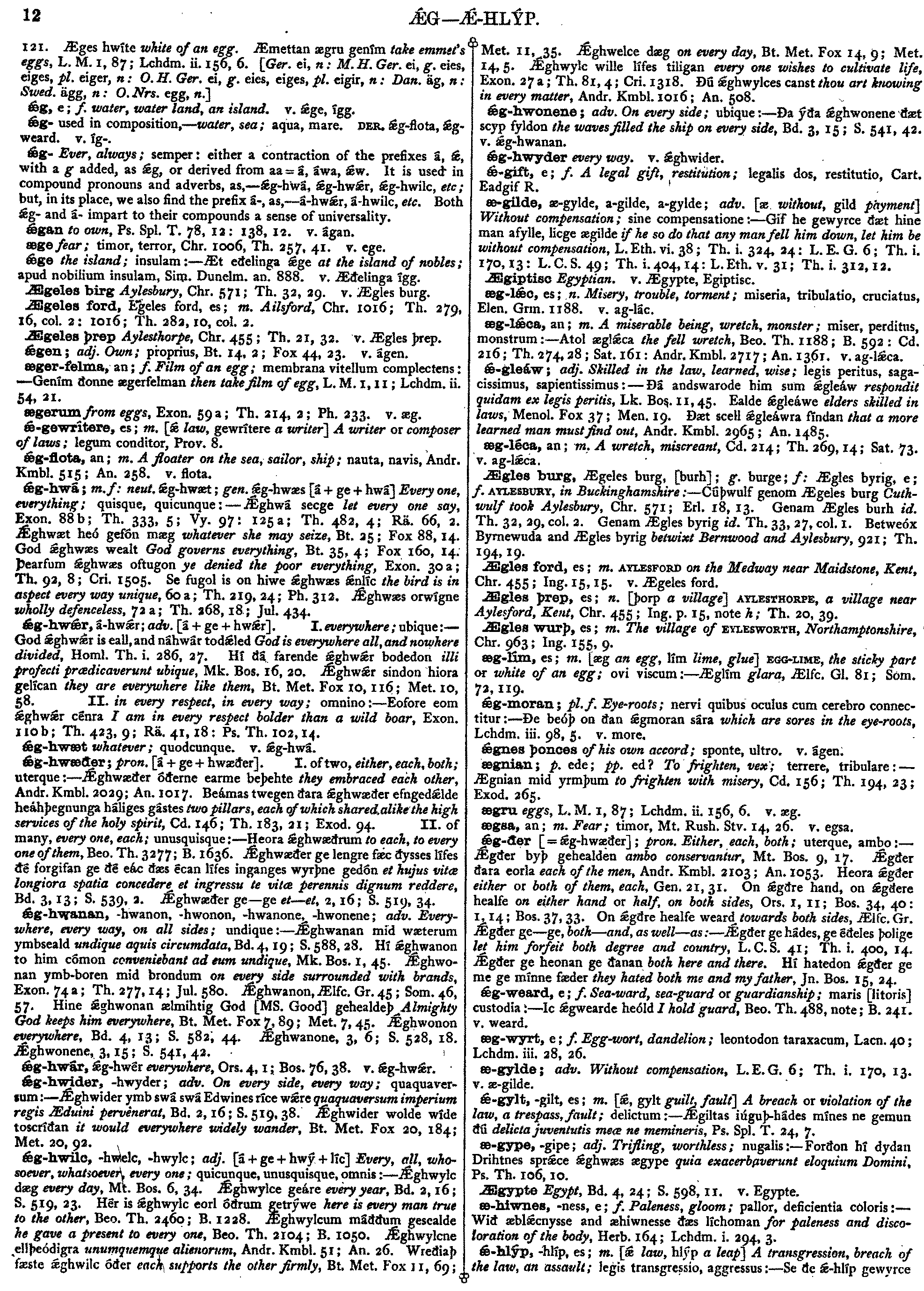
 g-hwá;
m.
f:
neut.
g-hwæt;
gen.
g-hwæs
[á
+
ge
+
hwá]
Every
one,
everything;
quisque,
quicunque:
--
Æ-acute;ghwá
secge
let
every
one
say,
Exon.
88
b;
Th.
333,
5;
Vy.
97:
125a;
Th.
482,
4;
Rä.
66,
2.
Æ-acute;ghwæt
heó
gefón
mæg
whatever
she
may
seize,
Bt.
25;
Fox
88,
14.
God
ghwæs
wealt
God
governs
everything,
Bt.
35,
4;
Fox
160,
14.
þearfum
ghwæs
oftugon
ye
denied
the
poor
everything,
Exon.
30
a;
Th.
92,
8;
Cri.
1505.
Se
fugol
is
on
hiwe
ghwæs
nlíc
the
bird
is
in
aspect
every
way
unique,
60a;
Th.
219,
24;
Ph.
312.
Æ-acute;ghwæs
orwígne
wholly
defenceless,
72
a;
Th.
268,
18;
Jul.
434.
g-hwá;
m.
f:
neut.
g-hwæt;
gen.
g-hwæs
[á
+
ge
+
hwá]
Every
one,
everything;
quisque,
quicunque:
--
Æ-acute;ghwá
secge
let
every
one
say,
Exon.
88
b;
Th.
333,
5;
Vy.
97:
125a;
Th.
482,
4;
Rä.
66,
2.
Æ-acute;ghwæt
heó
gefón
mæg
whatever
she
may
seize,
Bt.
25;
Fox
88,
14.
God
ghwæs
wealt
God
governs
everything,
Bt.
35,
4;
Fox
160,
14.
þearfum
ghwæs
oftugon
ye
denied
the
poor
everything,
Exon.
30
a;
Th.
92,
8;
Cri.
1505.
Se
fugol
is
on
hiwe
ghwæs
nlíc
the
bird
is
in
aspect
every
way
unique,
60a;
Th.
219,
24;
Ph.
312.
Æ-acute;ghwæs
orwígne
wholly
defenceless,
72
a;
Th.
268,
18;
Jul.
434.
|
Source: Bosworth/Toller, page b0012, entry 18 View original page image as: [TIFF] [PNG] [View previous entry] [View next entry] |
[Comment on this entry] [View comments (1)] |
The following entry has been hand-corrected once. |
g-hwæt
whatever;
quodcunque.
v.
g-hw.
|
Source: Bosworth/Toller, page b0023, entry 21 View original page image as: [TIFF] [PNG] [View previous entry] [View next entry] |
[Comment on this entry] [View comments (1)] |
The following entry has been hand-corrected once. |
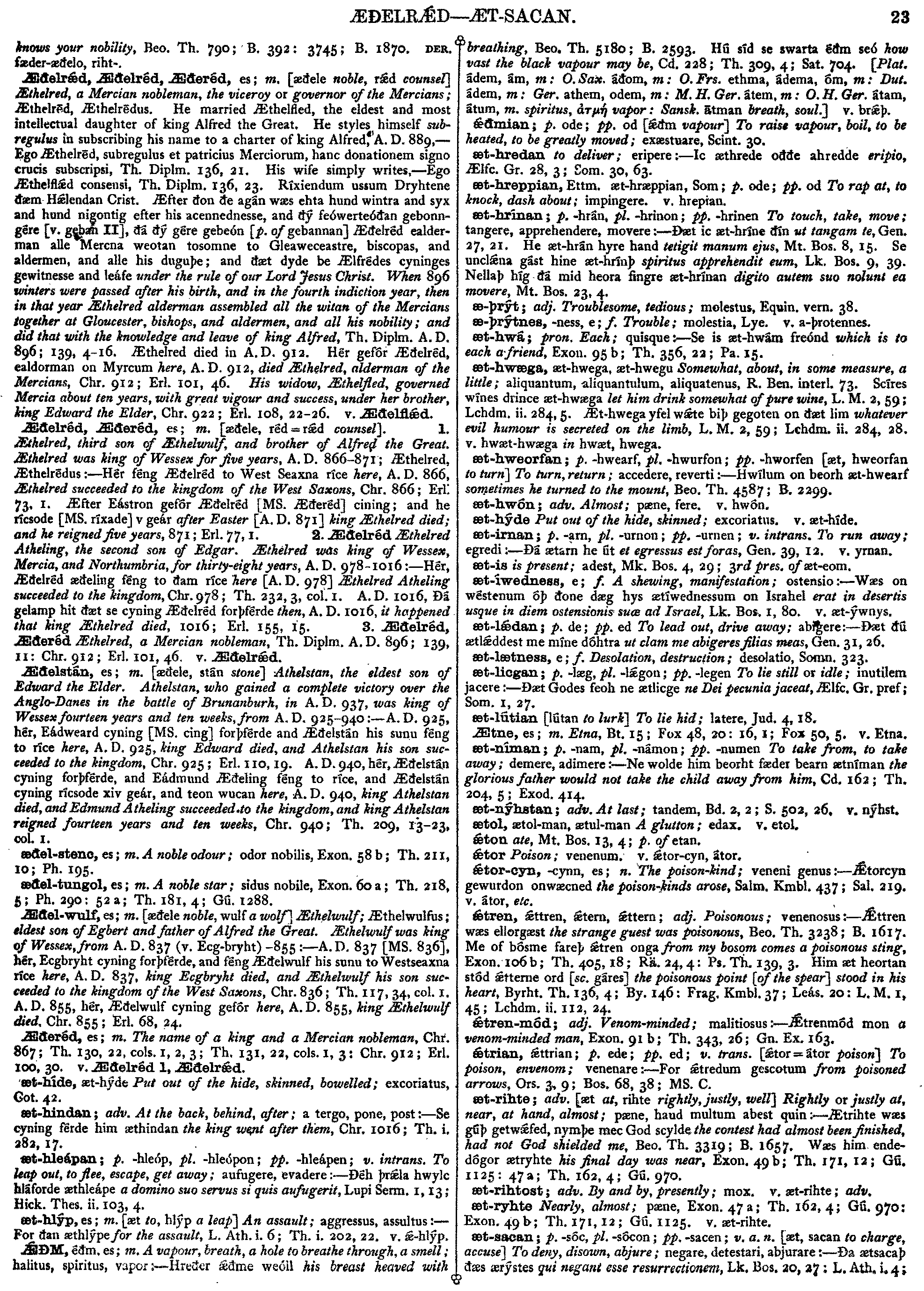
æt-hwæga,
æt-hwega,
æt-hwegu
Somewhat,
about,
in
some
measure,
a
little;
aliquantum,
aliquantulum,
aliquatenus,
R.
Ben.
interl.
73.
Scíres
wínes
drince
æt-hwæga
let
him
drink
somewhat
of
pure
wine,
L.
M.
2,
59;
Lchdm,
ii.
284,5.
Æt-hwega
yfel
wte
biþ
gegoten
on
ðæt
lim
whatever
evil
humour
is
secreted
on
the
limb,
L.
M.
2,
59;
Lchdm,
ii.
284,
28.
v.
hwæt-hwæga
in
hwset,
hwega.
|
Source: Bosworth/Toller, page b0096, entry 26 View original page image as: [TIFF] [PNG] [View previous entry] [View next entry] |
[Comment on this entry] [View comments] |
The following entry has been hand-corrected once. |
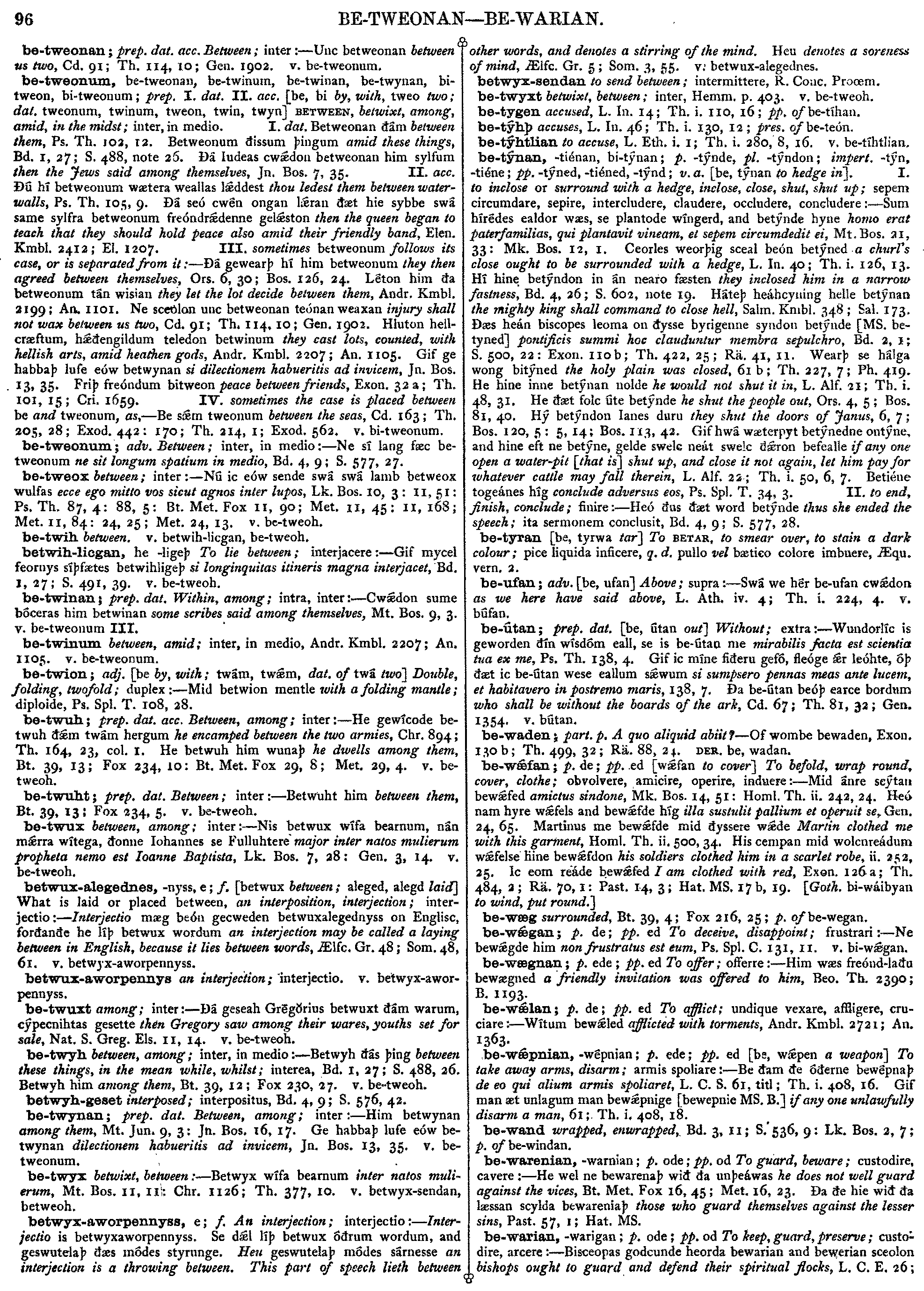
be-týnan,
-tiénan,
bi-týnan;
p.
-týnde,
pl.
-týndon;
impert.
-týn,
-tiéne;
pp.
-týned,
-tiéned,
-týnd;
v.
a.
[be,
týnan
to
hedge
in].
I.
to
inclose
or
surround
with
a
hedge,
inclose,
close,
shut,
shut
up;
sepem
circumdare,
sepire,
intercludere,
claudere,
occludere,
concludere
:--
Sum
hírédes
ealdor
wæs,
se
plantode
wíngerd,
and
betýnde
hyne
homo
erat
paterfamilias,
qui
plantavit
vineam,
et
sepem
circumdedit
ei,
Mt.
Bos.
21,
33
:
Mk.
Bos.
12,
1.
Ceorles
weorþig
sceal
beón
betýned
a
churl's
close
ought
to
be
surrounded
with
a
hedge,
L.
In.
40;
Th.
i.
126,
13.
Hí
hine
betýndon
in
án
nearo
fæsten
they
inclosed
him
in
a
narrow
fastness,
Bd.
4,
26;
S.
602,
note
19.
Háteþ
heáhcyning
helle
betýnan
the
mighty
king
shall
command
to
close
hell,
Salm.
Kmbl.
348;
Sal.
173.
Ðæs
heán
biscopes
leoma
on
ðysse
byrigenne
syndon
betýnde
[MS.
betyned]
pontificis
summi
hoc
clauduntur
membra
sepulchro,
Bd.
2,
1;
S.
500,
22
:
Exon.
110
b;
Th.
422,
25;
Rä.
41,
11.
Wearþ
se
hálga
wong
bitýned
the
holy
plain
was
closed,
61
b;
Th.
227,
7;
Ph.
419.
He
hine
inne
betýnan
nolde
he
would
not
shut
it
in,
L.
Alf.
21;
Th.
i.
48,
31.
He
ðæt
folc
úte
betýnde
he
shut
the
people
out,
Ors.
4,
5;
Bos.
81,
40.
Hý
betýndon
Ianes
duru
they
shut
the
doors
of
Janus,
6,
7;
Bos.
120,
5
:
5,
14;
Bos.
113,
42.
Gif
hwá
wæterpyt
betýnedne
ontýne,
and
hine
eft
ne
betýne,
gelde
swelc
neát
swelc
ðron
befealle
if
any
one
open
a
water-pit
[that
is]
shut
up,
and
close
it
not
again,
let
him
pay
for
whatever
cattle
may
fall
therein,
L.
Alf.
22;
Th.
i.
50,
6,
7.
Betiéne
togeánes
híg
conclude
adversus
eos,
Ps.
Spl.
T.
34,
3.
II.
to
end,
finish,
conclude;
finire
:--
Heó
ðus
ðæt
word
betýnde
thus
she
ended
the
speech;
ita
sermonem
conclusit,
Bd.
4,
9;
S.
577,
28.
|
Source: Bosworth/Toller, page b0101, entry 22 View original page image as: [TIFF] [PNG] [View previous entry] [View next entry] |
[Comment on this entry] [View comments] |
The following entry has been hand-corrected once. |
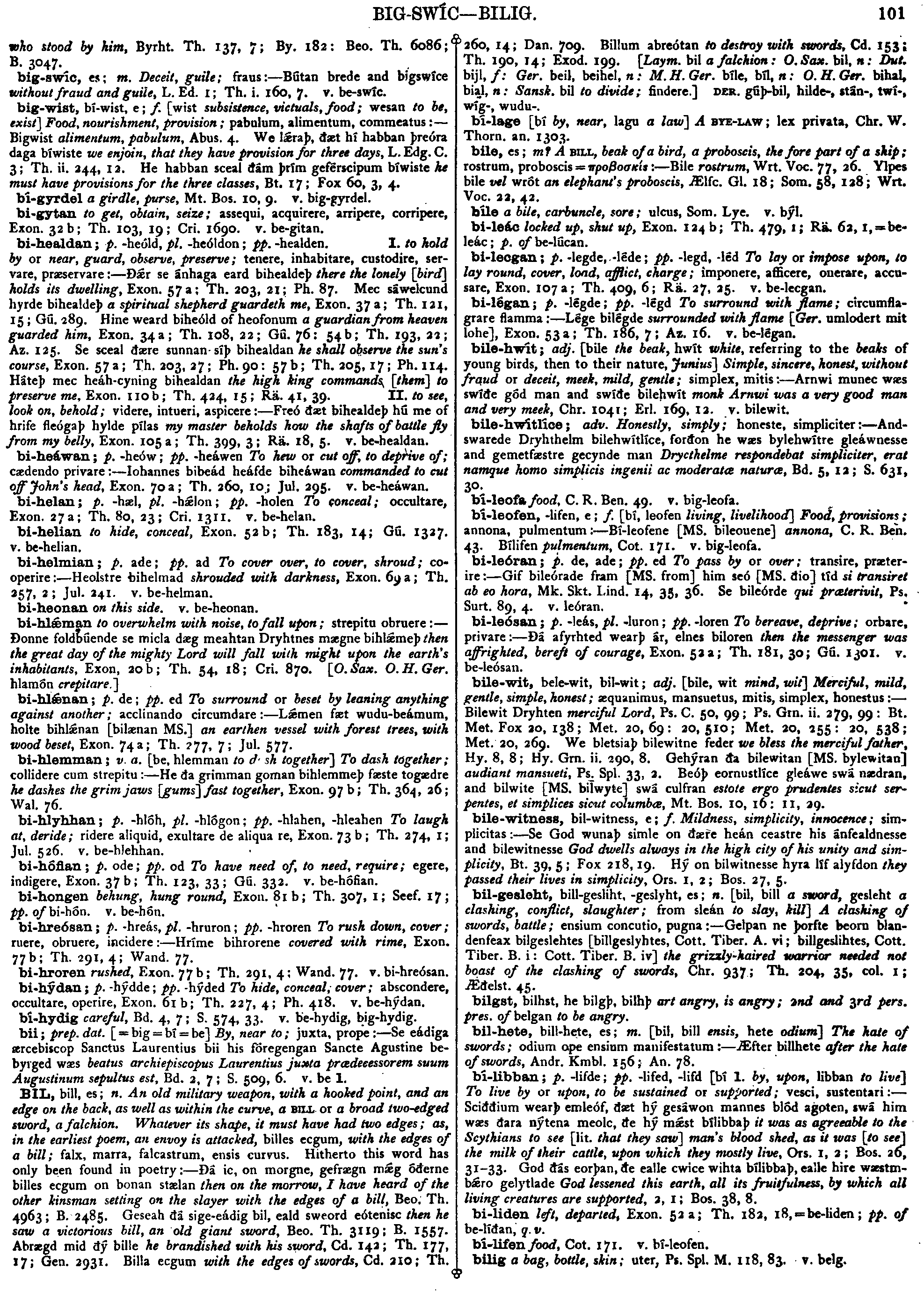
BIL,
bill,
es;
n.
An
old
military
weapon,
with
a
hooked
point,
and
an
edge
on
the
back,
as
well
as
within
the
curve,
a
BILL
or
a
broad
two-edged
sword,
a
falchion.
Whatever
its
shape,
it
must
have
had
two
edges;
as,
in
the
earliest
poem,
an
envoy
is
attacked,
billes
ecgum,
with
the
edges
of
a
bill;
falx,
marra,
falcastrum,
ensis
curvus.
Hitherto
this
word
has
only
been
found
in
poetry
:--
Ðá
ic,
on
morgne,
gefrægn
mg
óðerne
billes
ecgum
on
bonan
stælan
then
on
the
morrow,
I
have
heard
of
the
other
kinsman
setting
on
the
slayer
with
the
edges
of
a
bill,
Beo.
Th.
4963;
B.
2485.
Geseah
ðá
sige-eádig
bil,
eald
sweord
eótenisc
then
he
saw
a
victorious
bill,
an
old
giant
sword,
Beo.
Th.
3119;
B.
1557.
Abrægd
mid
ðý
bille
he
brandished
with
his
sword,
Cd.
142;
Th.
177,
17;
Gen.
2931.
Billa
ecgum
with
the
edges
of
swords,
Cd.
210;
Th.
260,
14;
Dan.
709.
Billum
abreótan
to
destroy
with
swords,
Cd.
153;
Th.
190,
14;
Exod.
199.
[Laym.
bil
a
falchion:
O.
Sax.
bil,
n:
Dut.
bijl,
f:
Ger.
beil,
beihel,
n:
M.
H.
Ger.
bíle,
bíl,
n:
O.
H.
Ger.
bihal,
bial,
n:
Sansk.
bil
to
divide;
findere.]
DER.
gúþ-bil,
hilde-,
stán-,
twí-,
wíg-,
wudu-.
|
Source: Bosworth/Toller, page b0129, entry 1 View original page image as: [TIFF] [PNG] [View previous entry] [View next entry] |
[Comment on this entry] [View comments] |
The following entry has been hand-corrected once. |
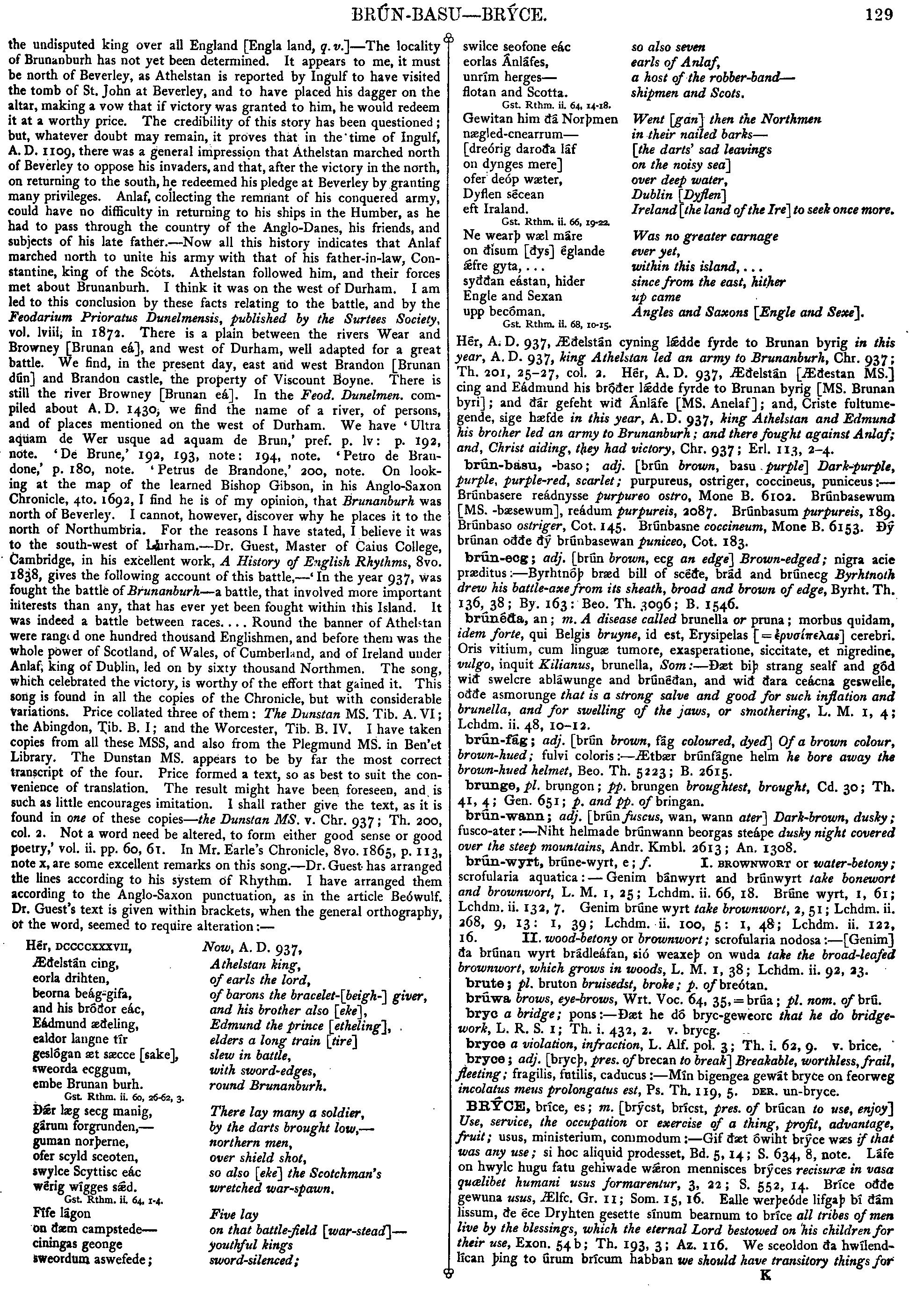
the undisputed king over all England [Engla land, q. v.] -- The locality of Brunanburh has not yet been determined. It appears to me, it must be north of Beverley, as Athelstan is reported by Ingulf to have visited the tomb of St. John at Beverley, and to have placed his dagger on the altar, making a vow that if victory was granted to him, he would redeem it at a worthy price. The credibility of this story has been questioned; but, whatever doubt may remain, it proves that in the time of Ingulf, A. D. 1109, there was a general impression that Athelstan marched north of Beverley to oppose his invaders, and that, after the victory in the north, on returning to the south, he redeemed his pledge at Beverley by granting many privileges. Anlaf, collecting the remnant of his conquered army, could have no difficulty in returning to his ships in the Humber, as he had to pass through the country of the Anglo-Danes, his friends, and subjects of his late father. -- Now all this history indicates that Anlaf marched north to unite his army with that of his father-in-law, Constantine, king of the Scots. Athelstan followed him, and their forces met about Brunanburh. I think it was on the west of Durham. I am led to this conclusion by these facts relating to the battle, and by the Feodarium Prioratus Dunelmensis, published by the Surtees Society, vol. lviii, in 1872. There is a plain between the rivers Wear and Browney [Brunan eá], and west of Durham, well adapted for a great battle. We find, in the present day, east and west Brandon [Brunan dún] and Brandon castle, the property of Viscount Boyne. There is still the river Browney [Brunan eá]. In the Feod. Dunelmen. compiled about A. D. 1430, we find the name of a river, of persons, and of places mentioned on the west of Durham. We have 'Ultra aquam de Wer usque ad aquam de Brun,' pref. p. lv: p. 192, note. 'De Brune,' 192, 193, note: 194, note. 'Petro de Brandone,' p. 180, note. 'Petrus de Brandone,' 200, note. On looking at the map of the learned Bishop Gibson, in his Anglo-Saxon Chronicle, 4to. 1692, I find he is of my opinion, that Brunanburh was north of Beverley. I cannot, however, discover why he places it to the north of Northumbria. For the reasons I have stated, I believe it was to the south-west of Lurham. -- Dr. Guest, Master of Caius College, Cambridge, in his excellent work, A History of English Rhythms, 8vo. 1838, gives the following account of this battle, -- 'In the year 937, was fought the battle of Brunanburh -- a battle, that involved more important interests than any, that has ever yet been fought within this Island. It was indeed a battle between races. . . . Round the banner of Athelstan were ranged one hundred thousand Englishmen, and before them was the whole power of Scotland, of Wales, of Cumberland, and of Ireland under Anlaf, king of Dublin, led on by sixty thousand Northmen. The song, which celebrated the victory, is worthy of the effort that gained it. This song is found in all the copies of the Chronicle, but with considerable variations. Price collated three of them: The Dunstan MS. Tib. A. VI; the Abingdon, Tib. B. I; and the Worcester, Tib. B. IV. I have taken copies from all these MSS, and also from the Plegmund MS. in Ben'et Library. The Dunstan MS. appears to be by far the most correct transcript of the four. Price formed a text, so as best to suit the convenience of translation. The result might have been foreseen, and is such as little encourages imitation. I shall rather give the text, as it is found in one of these copies -- the Dunstan MS. v. Chr. 937; Th. 200, col. 2. Not a word need be altered, to form either good sense or good poetry,' vol. ii. pp. 60, 61. In Mr. Earle's Chronicle, 8vo. 1865, p. 113, note x, are some excellent remarks on this song. -- Dr. Guest has arranged the lines according to his system of Rhythm. I have arranged them according to the Anglo-Saxon punctuation, as in the article Beówulf. Dr. Guest's text is given within brackets, when the general orthography, or the word, seemed to require alteration :--
|
Source: Bosworth/Toller, page b0154, entry 22 View original page image as: [TIFF] [PNG] [View previous entry] [View next entry] |
[Comment on this entry] [View comments] |
The following entry has been hand-corrected once. |
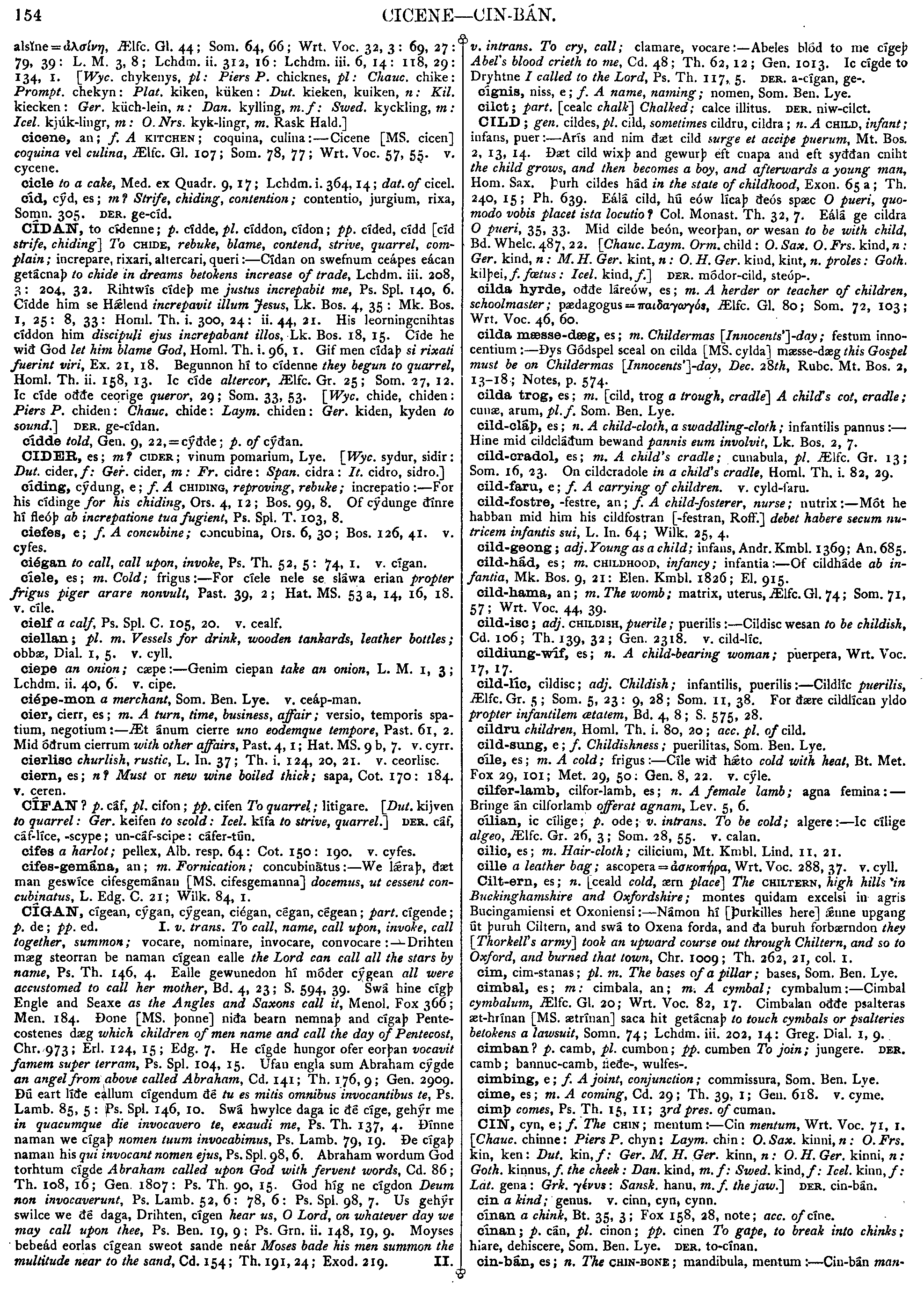
CÍGAN, cígean, cýgan, cýgean, ciégan, cégan, cégean; part. cígende; p. de; pp. ed. I. v. trans. To call, name, call upon, invoke, call together, summon; vocare, nominare, invocare, convocare :-- Drihten mæg steorran be naman cígean ealle the Lord can call all the stars by name, Ps. Th. 146, 4. Ealle gewunedon hí móder cýgean all were accustomed to call her mother, Bd. 4, 23; S. 594, 39. Swá hine cígþ Engle and Seaxe as the Angles and Saxons call it, Menol. Fox 366; Men. 184. Ðone [MS. þonne] niða bearn nemnaþ and cígaþ Pentecostenes dæg which children of men name and call the day of Pentecost, Chr. 973; Erl. 124, 15; Edg. 7. He cígde hunger ofer eorþan vocavit famem super terram, Ps. Spl. 104, 15. Ufan engla sum Abraham cýgde an angel from above called Abraham, Cd. 141; Th. 176, 9; Gen. 2909. Dú UNCERTAIN eart líðe eallum cígendum ðé tu es mitis omnibus invocantibus te, Ps. Lamb. 85, 5: PS. Spl. 146, 10. Swá hwylce daga ic ðé cíge, gehýr me in quacumque die invocavero te, exaudi me, Ps. Th. 137, 4. Ðínne naman we cígaþ nomen tuum invocabimus, Ps. Lamb. 79, 19. Ðe cígaþ naman his qui invocant nomen ejus, Ps. Spl. 98, 6. Abraham wordum God torhtum cígde Abraham called upon God with fervent words, Cd. 86; Th. 108, 16; Gen. 1807: Ps. Th. 90, 15. God híg ne cígdon Deum non invocaverunt, Ps. Lamb. 52, 6: 78, 6: Ps. Spl. 98, 7. Us gehýr swilce we ðé daga, Drihten, cígen hear us, 0 Lord, on whatever day we may call upon thee, Ps. Ben. 19, 9; Ps. Grn. ii. 148, 19, 9. Moyses bebeád eorlas cígean sweot sande neár Moses bade his men summon the multitude near to the sand, Cd. 154; Th. 191, 24; Exod. 219. II. v. intrans. To cry, call; clamare, vocare :-- Abeles blód to me cígeþ Abel's blood crieth to me, Cd. 48; Th. 62, 12; Gen. 1013. Ic cígde to Dryhtne I called to the Lord, Ps. Th. 117, 5. DER. a-cígan, ge-.
|
Source: Bosworth/Toller, page b0188, entry 4 View original page image as: [TIFF] [PNG] [View previous entry] [View next entry] |
[Comment on this entry] [View comments (1)] |
The following entry has been hand-corrected once. |
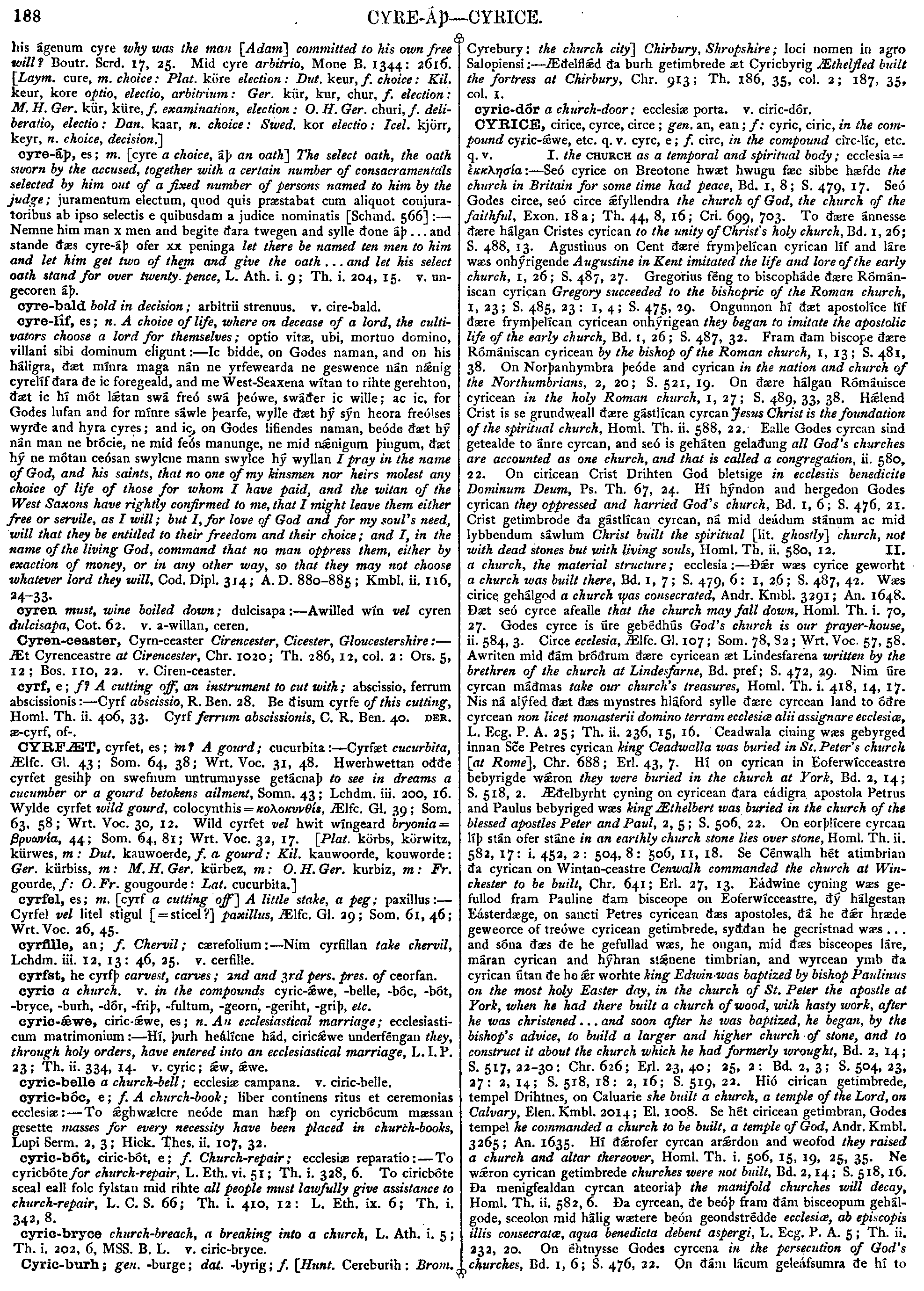
cyre-líf,
es;
n.
A
choice
of
life,
where
on
decease
of
a
lord,
the
cultivators
choose
a
lord
for
themselves;
optio
vitæ,
ubi,
mortuo
domino,
villani
sibi
dominum
eligunt
:--
Ic
bidde,
on
Codes
naman,
and
on
his
háligra,
ðæt
mínra
maga
nán
ne
yrfewearda
ne
geswence
nán
nnig
cyrelíf
ðara
ðe
ic
foregeald,
and
me
West-Seaxena
wítan
to
rihte
gerehton,
ðæt
ic
hí
mót
ltan
swá
freó
swá
þeówe,
swáðer
ic
wille;
ac
ic,
for
Godes
lufan
and
for
mínre
sáwle
þearfe,
wylle
ðæt
hý
sýn
heora
freólses
wyrðe
and
hyra
cyres;
and
ic,
on
Godes
lifiendes
naman,
beóde
ðæt
hý
nán
man
ne
brócie,
ne
mid
feós
manunge,
ne
mid
nnigum
þingum,
ðæt
hý
ne
mótan
ceósan
swylcne
mann
swylce
hý
wyllan
I
pray
in
the
name
of
God,
and
his
saints,
that
no
one
of
my
kinsmen
nor
heirs
molest
any
choice
of
life
of
those
for
whom
I
have
paid,
and
the
witan
of
the
West
Saxons
have
rightly
confirmed
to
me,
that
I
might
leave
them
either
free
or
servile,
as
I
will;
but
I,
for
love
of
God
and
for
my
soul's
need,
will
that
they
be
entitled
to
their
freedom
and
their
choice;
and
I,
in
the
name
of
the
living
God,
command
that
no
man
oppress
them,
either
by
exaction
of
money,
or
in
any
other
way,
so
that
they
may
not
choose
whatever
lord
they
will,
Cod.
Dipl.
314;
A.
D.
880-885;
Kmbl.
ii.
116,
24-33.
|
Source: Bosworth/Toller, page b0268, entry 18 View original page image as: [TIFF] [PNG] [View previous entry] [View next entry] |
[Comment on this entry] [View comments] |
The following entry has been hand-corrected once. |
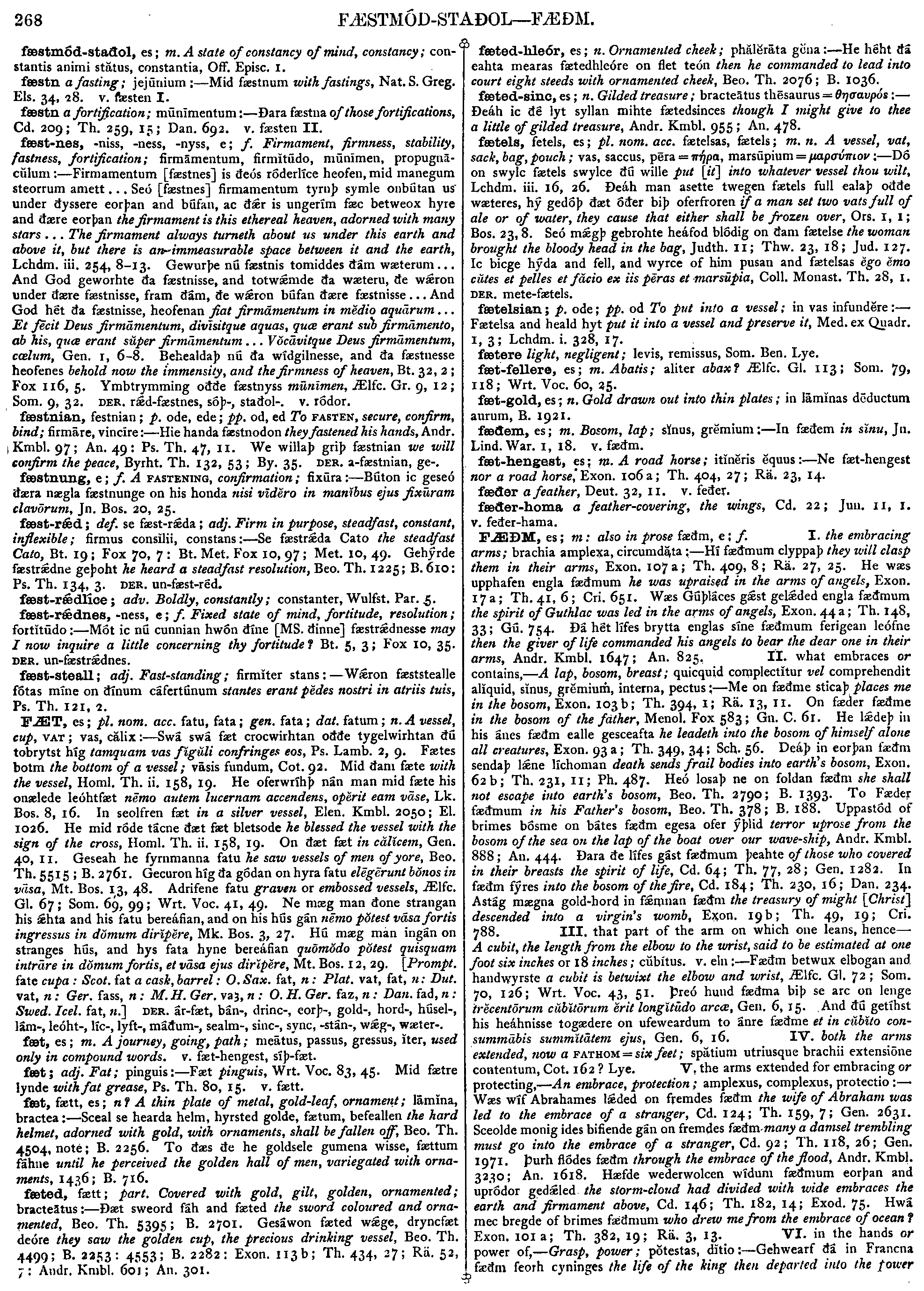
fætels,
fetels,
es;
pl.
nom.
acc.
fætelsas,
fætels;
m.
n.
A
vessel,
vat,
sack,
bag,
pouch;
vas,
saccus,
p ra
=
ra
=
 &eta-tonos;
 ,
mars
,
mars pium
=
pium
=

 &upsilon-tonos;
 o
o :--
Dó
on
swylc
fætels
swylce
ðú
wille
put
[it]
into
whatever
vessel
thou
wilt,
Lchdm.
iii.
16,
26.
Ðeáh
man
asette
twegen
fætels
full
ealaþ
oððe
wæteres,
hý
gedóþ
ðæt
óðer
biþ
oferfroren
if
a
man
set
two
vats
full
of
ale
or
of
water,
they
cause
that
either
shall
be
frozen
over,
Ors.
1,
1;
Bos.
23,
8.
Seó
mgþ
gebrohte
heáfod
blódig
on
ðam
fætelse
the
woman
brought
the
bloody
head
in
the
bag,
Judth.
11;
Thw.
23,
78;
Jud.
127.
Ic
bicge
hýda
and
fell,
and
wyrce
of
him
pusan
and
fætelsas
:--
Dó
on
swylc
fætels
swylce
ðú
wille
put
[it]
into
whatever
vessel
thou
wilt,
Lchdm.
iii.
16,
26.
Ðeáh
man
asette
twegen
fætels
full
ealaþ
oððe
wæteres,
hý
gedóþ
ðæt
óðer
biþ
oferfroren
if
a
man
set
two
vats
full
of
ale
or
of
water,
they
cause
that
either
shall
be
frozen
over,
Ors.
1,
1;
Bos.
23,
8.
Seó
mgþ
gebrohte
heáfod
blódig
on
ðam
fætelse
the
woman
brought
the
bloody
head
in
the
bag,
Judth.
11;
Thw.
23,
78;
Jud.
127.
Ic
bicge
hýda
and
fell,
and
wyrce
of
him
pusan
and
fætelsas
 go
mo
c
go
mo
c tes
et
pelles
et
f
tes
et
pelles
et
f cio
ex
iis
pras
et
marspia,
Coll.
Monast.
Th.
28,
1.
DER.
mete-fætels.
cio
ex
iis
pras
et
marspia,
Coll.
Monast.
Th.
28,
1.
DER.
mete-fætels.
| Result Page: | 1 2 3 4 5 6 7 | Next |  |
Germanic Lexicon Project (main page)
This search system was written by
Sean Crist
Please consider
volunteering
to correct the data in these online dictionaries.
No rights reserved. Feel free to use these data in any way you please.