|
|

Search for were again, using less strict matching (1651 results)
|
Source: Cleasby/Vigfusson, page b0226, entry 14 View original page image as: [TIFF] [PNG] [View previous entry] [View next entry] |
[Comment on this entry] [View comments] |
The following entry has been hand-corrected once. |
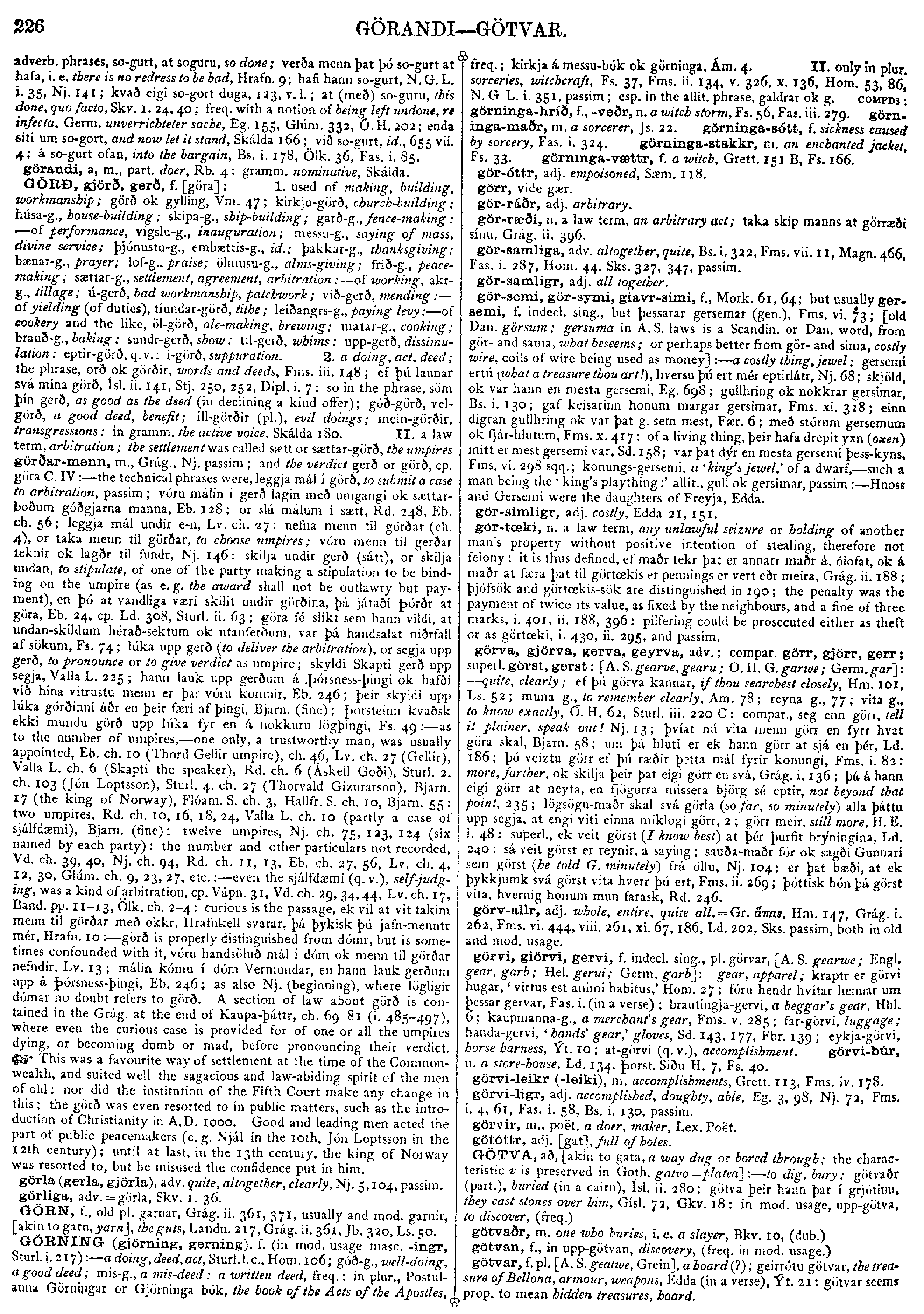
gör-semi, gör-symi, giavr-simi, f., Mork. 61, 64; but usually ger-semi, f. indecl. sing., but þessarar gersemar (gen.), Fms. vi. 73; [old Dan. görsum; gersuma in A. S. laws is a Scandin. or Dan. word, from gör- and sama, what beseems; or perhaps better from gör- and sima, costly wire, coils of wire being used as money] :-- a costly thing, jewel; gersemi ertú (what a treasure thou art!), hversu þú ert mér eptirlátr, Nj. 68; skjöld, ok var hann en mesta gersemi, Eg. 698; gullhring ok nokkrar gersimar, Bs. i. 130; gaf keisarinn honum margar gersimar, Fms. xi. 328; einn digran gullhring ok var þat g. sem mest, Fær. 6; með stórum gersemum ok fjár-hlutum, Fms. x. 417: of a living thing, þeir hafa drepit yxn (oxen) mitt er mest gersemi var, Sd. 158; var þat dýr en mesta gersemi þess-kyns, Fms. vi. 298 sqq.; konungs-gersemi, a 'king's jewel,' of a dwarf, -- such a man being the 'king's plaything:' allit., gull ok gersimar, passim :-- Hnoss and Gersemi were the daughters of Freyja, Edda.
|
Source: Cleasby/Vigfusson, page b0227, entry 3 View original page image as: [TIFF] [PNG] [View previous entry] [View next entry] |
[Comment on this entry] [View comments] |
The following entry has been hand-corrected once. |
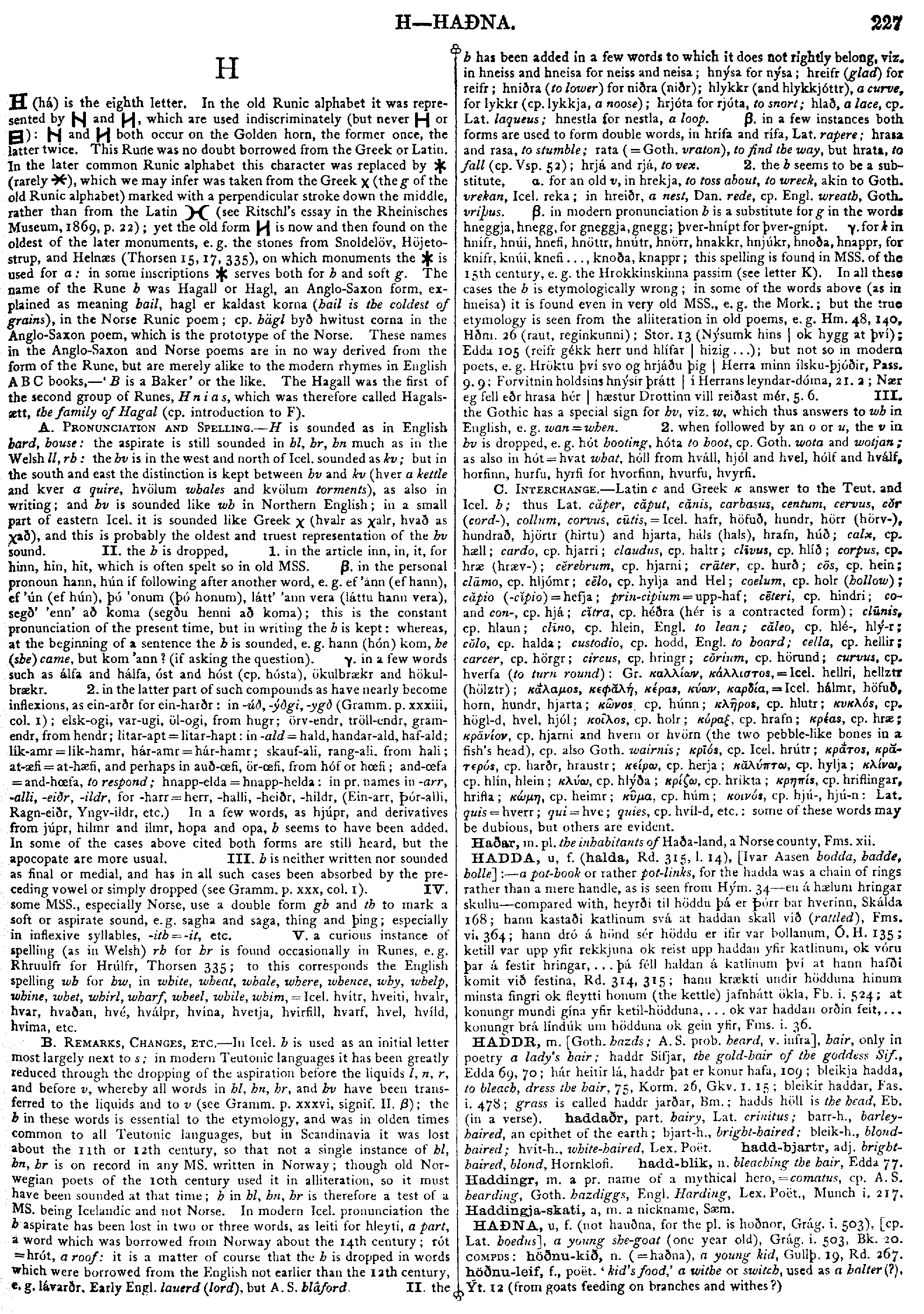
B.
REMARKS,
CHANGES,
ETC.
--
In
Icel.
h
is
used
as
an
initial
letter
most
largely
next
to
s;
in
modern
Teutonic
languages
it
has
been
greatly
reduced
through
the
dropping
of
the
aspiration
before
the
liquids
l,
n,
r,
and
before
v,
whereby
all
words
in
hl,
hn,
hr,
and
hv
have
been
transferred
to
the
liquids
and
to
v
(see
Gramm.
p.
xxxvi,
signif.
II.
 );
the
h
in
these
words
is
essential
to
the
etymology,
and
was
in
olden
times
common
to
all
Teutonic
languages,
but
in
Scandinavia
it
was
lost
about
the
11th
or
12th
century,
so
that
not
a
single
instance
of
hl,
hn,
hr
is
on
record
in
any
MS.
written
in
Norway;
though
old
Norwegian
poets
of
the
10th
century
used
it
in
alliteration,
so
it
must
have
been
sounded
at
that
time;
h
in
hl,
hn,
hr
is
therefore
a
test
of
a
MS.
being
Icelandic
and
not
Norse.
In
modern
Icel.
pronunciation
the
h
aspirate
has
been
lost
in
two
or
three
words,
as
leiti
for
hleyti,
a
part,
a
word
which
was
borrowed
from
Norway
about
the
14th
century;
rót
=
hrót,
a
roof:
it
is
a
matter
of
course
that
the
h
is
dropped
in
words
which
were
borrowed
from
the
English
not
earlier
than
the
12th
century,
e.
g.
lávarðr.
Early
Engl.
lauerd
(lord),
but
A.
S.
hlâford.
II.
the
h
has
been
added
in
a
few
words
to
which
it
does
not
rightly
belong,
viz.
in
hneiss
and
hneisa
for
neiss
and
neisa;
hnýsa
for
nýsa;
hreifr
(glad)
for
reifr;
hniðra
(to
lower)
for
niðra
(niðr);
hlykkr
(and
hlykkjóttr),
a
curve,
for
lykkr
(cp.
lykkja,
a
noose);
hrjóta
for
rjóta,
to
snort;
hlað,
a
lace,
cp.
Lat.
laqueus;
hnestla
for
nestla,
a
loop.
.
in
a
few
instances
both
forms
are
used
to
form
double
words,
in
hrífa
and
rífa,
Lat.
rapere;
hrasa
and
rasa,
to
stumble;
rata
(
=
Goth.
vraton),
to
find
the
way,
but
hrata,
to
fall
(cp.
Vsp.
52);
hrjá
and
rjá,
to
vex.
2.
the
h
seems
to
be
a
substitute,
);
the
h
in
these
words
is
essential
to
the
etymology,
and
was
in
olden
times
common
to
all
Teutonic
languages,
but
in
Scandinavia
it
was
lost
about
the
11th
or
12th
century,
so
that
not
a
single
instance
of
hl,
hn,
hr
is
on
record
in
any
MS.
written
in
Norway;
though
old
Norwegian
poets
of
the
10th
century
used
it
in
alliteration,
so
it
must
have
been
sounded
at
that
time;
h
in
hl,
hn,
hr
is
therefore
a
test
of
a
MS.
being
Icelandic
and
not
Norse.
In
modern
Icel.
pronunciation
the
h
aspirate
has
been
lost
in
two
or
three
words,
as
leiti
for
hleyti,
a
part,
a
word
which
was
borrowed
from
Norway
about
the
14th
century;
rót
=
hrót,
a
roof:
it
is
a
matter
of
course
that
the
h
is
dropped
in
words
which
were
borrowed
from
the
English
not
earlier
than
the
12th
century,
e.
g.
lávarðr.
Early
Engl.
lauerd
(lord),
but
A.
S.
hlâford.
II.
the
h
has
been
added
in
a
few
words
to
which
it
does
not
rightly
belong,
viz.
in
hneiss
and
hneisa
for
neiss
and
neisa;
hnýsa
for
nýsa;
hreifr
(glad)
for
reifr;
hniðra
(to
lower)
for
niðra
(niðr);
hlykkr
(and
hlykkjóttr),
a
curve,
for
lykkr
(cp.
lykkja,
a
noose);
hrjóta
for
rjóta,
to
snort;
hlað,
a
lace,
cp.
Lat.
laqueus;
hnestla
for
nestla,
a
loop.
.
in
a
few
instances
both
forms
are
used
to
form
double
words,
in
hrífa
and
rífa,
Lat.
rapere;
hrasa
and
rasa,
to
stumble;
rata
(
=
Goth.
vraton),
to
find
the
way,
but
hrata,
to
fall
(cp.
Vsp.
52);
hrjá
and
rjá,
to
vex.
2.
the
h
seems
to
be
a
substitute,
 .
for
an
old
v,
in
hrekja,
to
toss
about,
to
wreck,
akin
to
Goth.
vrekan,
Icel.
reka;
in
hreiðr,
a
nest,
Dan.
rede,
cp.
Engl.
wreath,
Goth.
vriþus.
.
in
modern
pronunciation
h
is
a
substitute
for
g
in
the
words
hneggja,
hnegg,
for
gneggja,
gnegg;
þver-hnípt
for
þver-gnipt.
.
for
an
old
v,
in
hrekja,
to
toss
about,
to
wreck,
akin
to
Goth.
vrekan,
Icel.
reka;
in
hreiðr,
a
nest,
Dan.
rede,
cp.
Engl.
wreath,
Goth.
vriþus.
.
in
modern
pronunciation
h
is
a
substitute
for
g
in
the
words
hneggja,
hnegg,
for
gneggja,
gnegg;
þver-hnípt
for
þver-gnipt.
 .
for
k
in
hnífr,
hnúi,
hnefi,
hnöttr,
hnútr,
hnörr,
hnakkr,
hnjúkr,
hnoða,
hnappr,
for
knífr,
knúi,
knefi
...,
knoða,
knappr;
this
spelling
is
found
in
MSS.
of
the
15th
century,
e.g.
the
Hrokkinskinna
passim
(see
letter
K).
In
all
these
cases
the
h
is
etymologically
wrong;
in
some
of
the
words
above
(as
in
hneisa)
it
is
found
even
in
very
old
MSS.,
e.g.
the
Mork.;
but
the
true
etymology
is
seen
from
the
alliteration
in
old
poems,
e.g.
Hm.
48,
140,
Hðm.
26
(raut,
reginkunni);
Stor.
13
(Nýsumk
hins
|
ok
hygg
at
því);
Edda
105
(reifr
gékk
herr
und
hlífar
|
hizig
...);
but
not
so
in
modern
poets,
e.g.
Hröktu
því
svo
og
hrjáðu
þig
|
Herra
minn
ílsku-þjóðir,
Pass.
9.
9;
Forvitnin
holdsins
hnýsir
þrátt
|
í
Herrans
leyndar-dóma,
21.
2;
Nær
eg
fell
eðr
hrasa
hér
|
hæstur
Drottinn
vill
reiðast
mér,
5.
6.
III.
the
Gothic
has
a
special
sign
for
hv,
viz.
w,
which
thus
answers
to
wh
in
English,
e.g.
wan
=
when.
2.
when
followed
by
an
o
or
u,
the
v
in
hv
is
dropped,
e.g.
hót
hooting,
hóta
to
hoot,
cp.
Goth.
wota
and
wotjan;
as
also
in
hót
=
hvat
what,
hóll
from
hváll,
hjól
and
hvel,
hólf
and
hválf,
horfinn,
hurfu,
hyrfi
for
hvorfinn,
hvurfu,
hvyrfi.
.
for
k
in
hnífr,
hnúi,
hnefi,
hnöttr,
hnútr,
hnörr,
hnakkr,
hnjúkr,
hnoða,
hnappr,
for
knífr,
knúi,
knefi
...,
knoða,
knappr;
this
spelling
is
found
in
MSS.
of
the
15th
century,
e.g.
the
Hrokkinskinna
passim
(see
letter
K).
In
all
these
cases
the
h
is
etymologically
wrong;
in
some
of
the
words
above
(as
in
hneisa)
it
is
found
even
in
very
old
MSS.,
e.g.
the
Mork.;
but
the
true
etymology
is
seen
from
the
alliteration
in
old
poems,
e.g.
Hm.
48,
140,
Hðm.
26
(raut,
reginkunni);
Stor.
13
(Nýsumk
hins
|
ok
hygg
at
því);
Edda
105
(reifr
gékk
herr
und
hlífar
|
hizig
...);
but
not
so
in
modern
poets,
e.g.
Hröktu
því
svo
og
hrjáðu
þig
|
Herra
minn
ílsku-þjóðir,
Pass.
9.
9;
Forvitnin
holdsins
hnýsir
þrátt
|
í
Herrans
leyndar-dóma,
21.
2;
Nær
eg
fell
eðr
hrasa
hér
|
hæstur
Drottinn
vill
reiðast
mér,
5.
6.
III.
the
Gothic
has
a
special
sign
for
hv,
viz.
w,
which
thus
answers
to
wh
in
English,
e.g.
wan
=
when.
2.
when
followed
by
an
o
or
u,
the
v
in
hv
is
dropped,
e.g.
hót
hooting,
hóta
to
hoot,
cp.
Goth.
wota
and
wotjan;
as
also
in
hót
=
hvat
what,
hóll
from
hváll,
hjól
and
hvel,
hólf
and
hválf,
horfinn,
hurfu,
hyrfi
for
hvorfinn,
hvurfu,
hvyrfi.
|
Source: Cleasby/Vigfusson, page b0231, entry 32 View original page image as: [TIFF] [PNG] [View previous entry] [View next entry] |
[Comment on this entry] [View comments] |
The following entry has been hand-corrected once. |
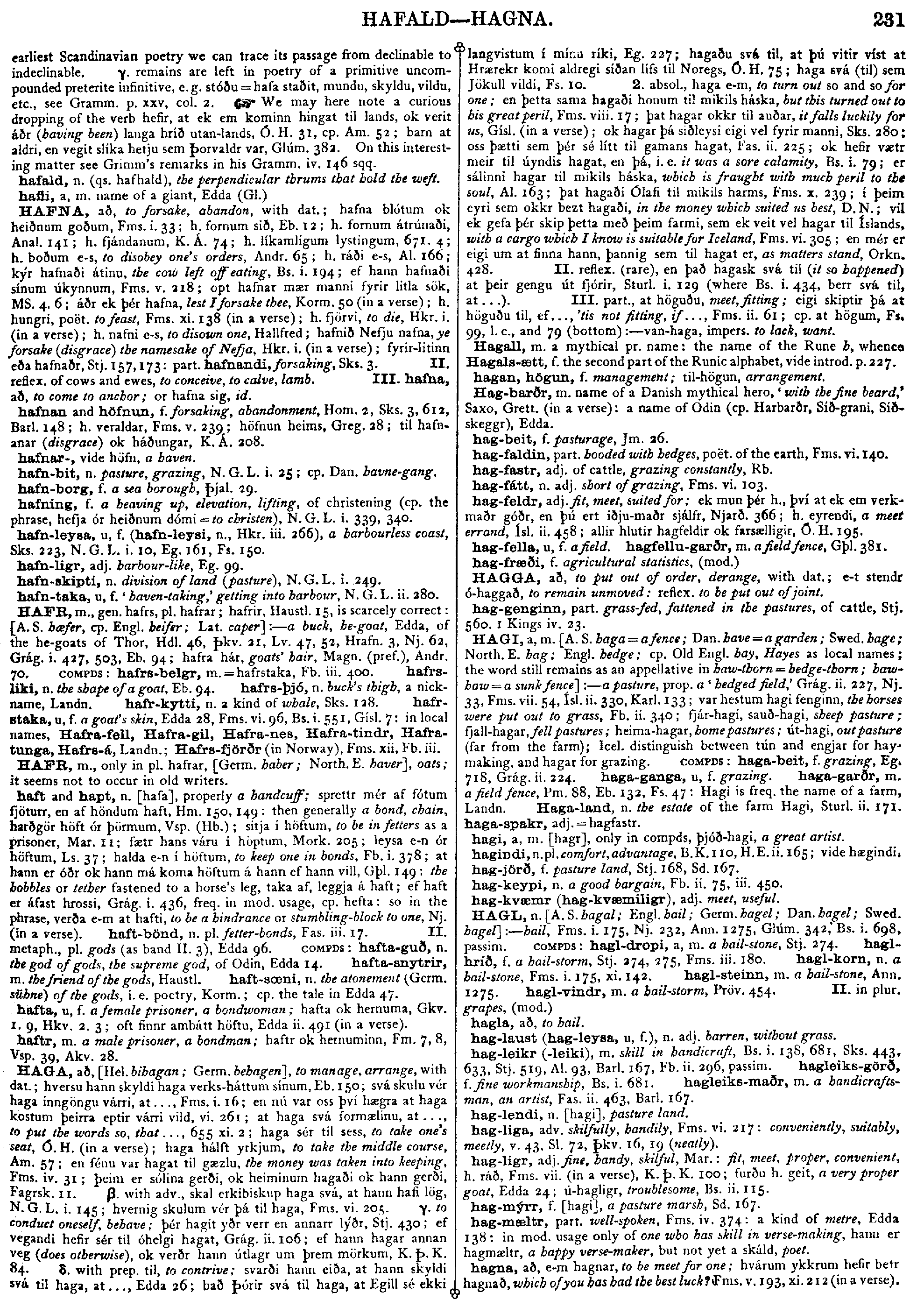
HAGI, a, m. [A. S. haga = a fence; Dan. have = a garden; Swed. hage; North. E. hag; Engl. hedge; cp. Old Engl. hay, Hayes as local names; the word still remains as an appellative in haw-thorn = hedge-thorn; haw-haw = a sunk fence] :-- a pasture, prop. a 'hedged field,' Grág. ii. 227, Nj. 33, Fms. vii. 54, Ísl. ii. 330, Karl. 133; var hestum hagi fenginn, the horses were put out to grass, Fb. ii. 340; fjár-hagi, sauð-hagi, sheep pasture; fjall-hagar, fell pastures; heima-hagar, home pastures; út-hagi, out pasture (far from the farm); Icel. distinguish between tún and engjar for haymaking, and hagar for grazing. COMPDS: haga-beit, f. grazing, Eg. 718, Grág. ii. 224. haga-ganga, u, f. grazing. haga-garðr, m. a field fence, Pm. 88, Eb. 132, Fs. 47: Hagi is freq. the name of a farm, Landn. Haga-land, n. the estate of the farm Hagi, Sturl. ii. 171. haga-spakr, adj. = hagfastr.
|
Source: Cleasby/Vigfusson, page b0233, entry 1 View original page image as: [TIFF] [PNG] [View previous entry] [View next entry] |
[Comment on this entry] [View comments] |
The following entry has been hand-corrected once. |
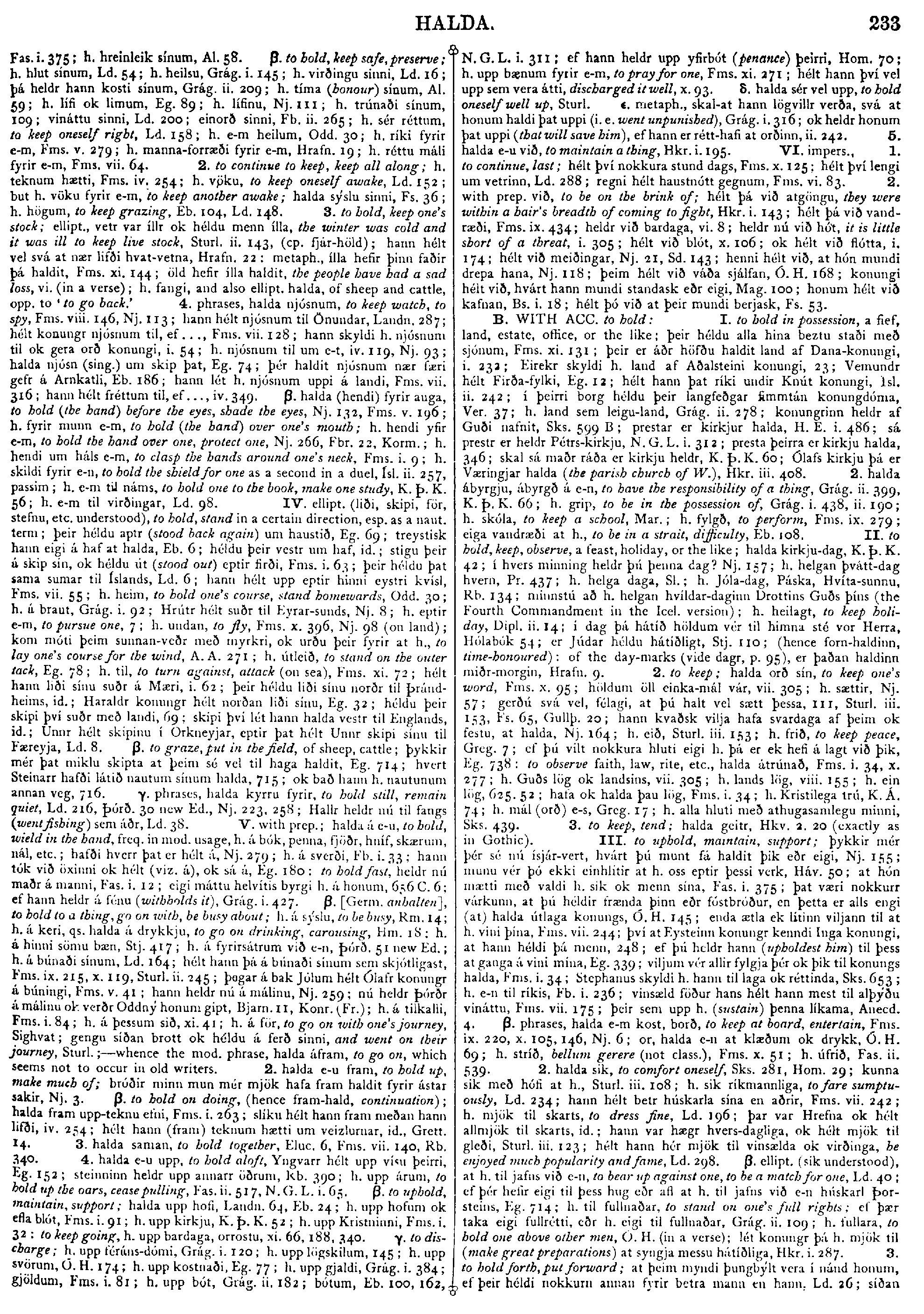
Fas.
i.
375;
h.
hreinleik
sínum,
Al.
58.
.
to
hold,
keep
safe,
preserve;
h.
hlut
sínum,
Ld.
54;
h.
heilsu,
Grág.
i.
145;
h.
virðingu
sinni,
Ld.
16;
þá
heldr
hann
kosti
sínum,
Grág.
ii.
209;
h.
tíma
(honour)
sínum,
Al.
59;
h.
lífi
ok
limum,
Eg.
89;
h.
lífinu,
Nj.
111;
h.
trúnaði
sínum,
109;
vináttu
sinni,
Ld.
200;
einorð
sinni,
Fb.
ii.
265;
h.
sér
réttum,
to
keep
oneself
right,
Ld.
158;
h.
e-m
heilum,
Odd.
30;
h.
ríki
fyrir
e-m,
Fms.
v.
279;
h.
manna-forræði
fyrir
e-m,
Hrafn.
19;
h.
réttu
máli
fyrir
e-m,
Fms.
vii.
64.
2.
to
continue
to
keep,
keep
all
along;
h.
teknum
hætti,
Fms.
iv.
254;
h.
vöku,
to
keep
oneself
awake,
Ld.
152;
but
h.
vöku
fyrir
e-m,
to
keep
another
awake;
halda
sýslu
sinni,
Fs.
36;
h.
högum,
to
keep
grazing,
Eb.
104,
Ld.
148.
3.
to
hold,
keep
one's
stock;
ellipt.,
vetr
var
íllr
ok
héldu
menn
ílla,
the
winter
was
cold
and
it
was
ill
to
keep
live
stock,
Sturl.
ii.
143,
(cp.
fjár-höld);
hann
hélt
vel
svá
at
nær
lifði
hvat-vetna,
Hrafn.
22:
metaph.,
ílla
hefir
þinn
faðir
þá
haldit,
Fms.
xi.
144;
öld
hefir
ílla
haldit,
the
people
have
had
a
sad
loss,
vi.
(in
a
verse);
h.
fangi,
and
also
ellipt.
halda,
of
sheep
and
cattle,
opp.
to
'to
go
back.'
4.
phrases,
halda
njósnum,
to
keep
watch,
to
spy,
Fms.
viii.
146,
Nj.
113;
hann
hélt
njósnum
til
Önundar,
Landn.
287;
hélt
konungr
njósnum
til,
ef
...,
Fms.
vii.
128;
hann
skyldi
h.
njósnum
til
ok
gera
orð
konungi,
i.
54;
h.
njósnum
til
um
e-t,
iv.
119,
Nj.
93;
halda
njósn
(sing.)
um
skip
þat,
Eg.
74;
þér
haldit
njósnum
nær
færi
gefr
á
Arnkatli,
Eb.
186;
hann
lét
h.
njósnum
uppi
á
landi,
Fms.
vii.
316;
hann
hélt
fréttum
til,
ef
...,
iv.
349.
.
halda
(hendi)
fyrir
auga,
to
hold
(the
hand)
before
the
eyes,
shade
the
eyes,
Nj.
132,
Fms.
v.
196;
h.
fyrir
munn
e-m,
to
hold
(the
hand)
over
one's
mouth;
h.
hendi
yfir
e-m,
to
hold
the
hand
over
one,
protect
one,
Nj.
266,
Fbr.
22,
Korm.;
h.
hendi
um
háls
e-m,
to
clasp
the
hands
around
one's
neck,
Fms.
i.
9;
h.
skildi
fyrir
e-n,
to
hold
the
shield
for
one
as
a
second
in
a
duel,
Ísl.
ii.
257,
passim;
h.
e-m
til
náms,
to
hold
one
to
the
book,
make
one
study,
K.
Þ.
K.
56;
h.
e-m
til
virðingar,
Ld.
98.
IV.
ellipt.
(liði,
skipi,
för,
stefnu,
etc.
understood),
to
hold,
stand
in
a
certain
direction,
esp.
as
a
naut.
term;
þeir
héldu
aptr
(stood
back
again)
um
haustið,
Eg.
69;
treystisk
hann
eigi
á
haf
at
halda,
Eb.
6;
héldu
þeir
vestr
um
haf,
id.;
stigu
þeir
á
skip
sín,
ok
héldu
út
(stood
out)
eptir
firði,
Fms.
i.
63;
þeir
héldu
þat
sama
sumar
til
Íslands,
Ld.
6;
hann
hélt
upp
eptir
hinni
eystri
kvísl,
Fms.
vii.
55;
h.
heim,
to
hold
one's
course,
stand
homewards,
Odd.
30;
h.
á
braut,
Grág.
i.
92;
Hrútr
hélt
suðr
til
Eyrar-sunds,
Nj.
8;
h.
eptir
e-m,
to
pursue
one,
7;
h.
undan,
to
fly,
Fms.
x.
396,
Nj.
98
(on
land);
kom
móti
þeim
sunnan-veðr
með
myrkri,
ok
urðu
þeir
fyrir
at
h.,
to
lay
one's
course
for
the
wind,
A.
A.
271;
h.
útleið,
to
stand
on
the
outer
tack,
Eg.
78;
h.
til,
to
turn
against,
attack
(on
sea),
Fms.
xi.
72;
hélt
hann
liði
sínu
suðr
á
Mæri,
i.
62;
þeir
héldu
liði
sínu
norðr
til
Þrándheims,
id.;
Haraldr
konungr
hélt
norðan
liði
sínu,
Eg.
32;
héldu
þeir
skipi
því
suðr
með
landi,
69;
skipi
því
lét
hann
halda
vestr
til
Englands,
id.;
Unnr
hélt
skipinu
í
Orkneyjar,
eptir
þat
hélt
Unnr
skipi
sínu
til
Færeyja,
Ld.
8.
.
to
graze,
put
in
the
field,
of
sheep,
cattle;
þykkir
mér
þat
miklu
skipta
at
þeim
sé
vel
til
haga
haldit,
Eg.
714;
hvert
Steinarr
hafði
látið
nautum
sínum
halda,
715;
ok
bað
hann
h.
nautunum
annan
veg,
716.
.
phrases,
halda
kyrru
fyrir,
to
hold
still,
remain
quiet,
Ld.
216,
Þórð.
30
new
Ed.,
Nj.
223,
258;
Hallr
heldr
nú
til
fangs
(went
fishing)
sem
áðr,
Ld.
38.
V.
with
prep.;
halda
á
e-u,
to
hold,
wield
in
the
hand,
freq.
in
mod.
usage,
h.
á
bók,
penna,
fjöðr,
hníf,
skærum,
nál,
etc.;
hafði
hverr
þat
er
hélt
á,
Nj.
279;
h.
á
sverði,
Fb.
i.
33;
hann
tók
við
öxinni
ok
hélt
(viz.
á),
ok
sá
á,
Eg.
180:
to
hold
fast,
heldr
nú
maðr
á
manni,
Fas.
i.
12;
eigi
máttu
helvítis
byrgi
h.
á
honum,
656
C.
6;
ef
hann
heldr
á
fénu
(withholds
it),
Grág.
i.
427.
.
[Germ.
anhalten],
to
hold
to
a
thing,
go
on
with,
be
busy
about;
h.
á
sýslu,
to
be
busy,
Rm.
14;
h.
á
keri,
qs.
halda
á
drykkju,
to
go
on
drinking,
carousing,
Hm.
18:
h.
á
hinni
sömu
bæn,
Stj.
417;
h.
á
fyrirsátrum
við
e-n,
Þórð.
51
new
Ed.;
h.
á
búnaði
sínum,
Ld.
164;
hélt
hann
þá
á
búnaði
sínum
sem
skjótligast,
Fms.
ix.
215,
x.
119,
Sturl.
ii.
245;
þogar
á
bak
Jólum
hélt
Ólafr
konungr
á
búningi,
Fms.
v.
41;
hann
heldr
nú
á
málinu,
Nj.
259;
nú
heldr
Þórðr
á
málinu
ok
verðr
Oddný
honum
gipt,
Bjarn.
11,
Konr.
(Fr.);
h.
á
tilkalli,
Fms.
i.
84;
h.
á
þessum
sið,
xi.
41;
h.
á
för,
to
go
on
with
one's
journey,
Sighvat;
gengu
síðan
brott
ok
héldu
á
ferð
sinni,
and
went
on
their
journey,
Sturl.;
--
whence
the
mod.
phrase,
halda
áfram,
to
go
on,
which
seems
not
to
occur
in
old
writers.
2.
halda
e-u
fram,
to
hold
up,
make
much
of;
bróðir
minn
mun
mér
mjök
hafa
fram
haldit
fyrir
ástar
sakir,
Nj.
3.
.
to
hold
on
doing,
(hence
fram-hald,
continuation);
halda
fram
upp-teknu
efni,
Fms.
i.
263;
slíku
hélt
hann
fram
meðan
hann
lifði,
iv.
254;
hélt
hann
(fram)
teknum
hætti
um
veizlurnar,
id.,
Grett.
14.
3.
halda
saman,
to
hold
together,
Eluc.
6,
Fms.
vii.
140,
Rb.
340.
4.
halda
e-u
upp,
to
hold
aloft,
Yngvarr
hélt
upp
vísu
þeirri,
Eg.
152;
steinninn
heldr
upp
annarr
öðrum,
Rb.
390;
h.
upp
árum,
to
hold
up
the
oars,
cease
pulling,
Fas.
ii.
517,
N.
G.
L.
i.
65.
.
to
uphold,
maintain,
support;
halda
upp
hofi,
Landn.
64,
Eb.
24;
h.
upp
hofum
ok
efla
blót,
Fms.
i.
91;
h.
upp
kirkju,
K.
Þ.
K.
52;
h.
upp
Kristninni,
Fms.
i.
32:
to
keep
going,
h.
upp
bardaga,
orrostu,
xi.
66,
188,
340.
.
to
discharge;
h.
upp
féráns-dómi,
Grág.
i.
120;
h.
upp
lögskilum,
145;
h.
upp
svörum,
Ó.
H.
174;
h.
upp
kostnaði,
Eg.
77;
h.
upp
gjaldi,
Grág.
i.
384;
gjöldum,
Fms.
i.
81;
h.
upp
bót,
Grág.
ii.
182;
bótum,
Eb.
100,
162,
N.
G.
L.
i.
311;
ef
hann
heldr
upp
yfirbót
(penance)
þeirri,
Hom.
70;
h.
upp
bænum
fyrir
e-m,
to
pray
for
one,
Fms.
xi.
271;
hélt
hann
því
vel
upp
sem
vera
átti,
discharged
it
well,
x.
93.
 .
halda
sér
vel
upp,
to
hold
oneself
well
up,
Sturl.
.
halda
sér
vel
upp,
to
hold
oneself
well
up,
Sturl.
 .
metaph.,
skal-at
hann
lögvillr
verða,
svá
at
honum
haldi
þat
uppi
(i.e.
went
unpunished),
Grág.
i.
316;
ok
heldr
honum
þat
uppi
(that
will
save
him),
ef
hann
er
rétt-hafi
at
orðinn,
ii.
242.
5.
halda
e-u
við,
to
maintain
a
thing,
Hkr.
i.
195.
VI.
impers.,
1.
to
continue,
last;
hélt
því
nokkura
stund
dags,
Fms.
x.
125:
hélt
því
lengi
um
vetrinn,
Ld.
288;
regni
hélt
haustnótt
gegnum,
Fms.
vi.
83.
2.
with
prep.
við,
to
be
on
the
brink
of;
hélt
þá
við
atgöngu,
they
were
within
a
hair's
breadth
of
coming
to
fight,
Hkr.
i.
143;
hélt
þá
við
vandræði,
Fms.
ix.
434;
heldr
við
bardaga,
vi.
8;
heldr
nú
við
hót,
it
is
little
short
of
a
threat,
i.
305;
hélt
við
blót,
x.
106;
ok
hélt
við
flótta,
i.
174;
hélt
við
meiðingar,
Nj.
21,
Sd.
143;
henni
hélt
við,
at
hón
mundi
drepa
hana,
Nj.
118;
þeim
hélt
við
váða
sjálfan,
Ó.
H.
168;
konungi
hélt
við,
hvárt
hann
mundi
standask
eðr
eigi,
Mag.
100;
honum
hélt
við
kafnan,
Bs.
i.
18;
hélt
þó
við
at
þeir
mundi
berjask,
Fs.
53.
.
metaph.,
skal-at
hann
lögvillr
verða,
svá
at
honum
haldi
þat
uppi
(i.e.
went
unpunished),
Grág.
i.
316;
ok
heldr
honum
þat
uppi
(that
will
save
him),
ef
hann
er
rétt-hafi
at
orðinn,
ii.
242.
5.
halda
e-u
við,
to
maintain
a
thing,
Hkr.
i.
195.
VI.
impers.,
1.
to
continue,
last;
hélt
því
nokkura
stund
dags,
Fms.
x.
125:
hélt
því
lengi
um
vetrinn,
Ld.
288;
regni
hélt
haustnótt
gegnum,
Fms.
vi.
83.
2.
with
prep.
við,
to
be
on
the
brink
of;
hélt
þá
við
atgöngu,
they
were
within
a
hair's
breadth
of
coming
to
fight,
Hkr.
i.
143;
hélt
þá
við
vandræði,
Fms.
ix.
434;
heldr
við
bardaga,
vi.
8;
heldr
nú
við
hót,
it
is
little
short
of
a
threat,
i.
305;
hélt
við
blót,
x.
106;
ok
hélt
við
flótta,
i.
174;
hélt
við
meiðingar,
Nj.
21,
Sd.
143;
henni
hélt
við,
at
hón
mundi
drepa
hana,
Nj.
118;
þeim
hélt
við
váða
sjálfan,
Ó.
H.
168;
konungi
hélt
við,
hvárt
hann
mundi
standask
eðr
eigi,
Mag.
100;
honum
hélt
við
kafnan,
Bs.
i.
18;
hélt
þó
við
at
þeir
mundi
berjask,
Fs.
53.
|
Source: Cleasby/Vigfusson, page b0234, entry 3 View original page image as: [TIFF] [PNG] [View previous entry] [View next entry] |
[Comment on this entry] [View comments] |
The following entry has been hand-corrected once. |
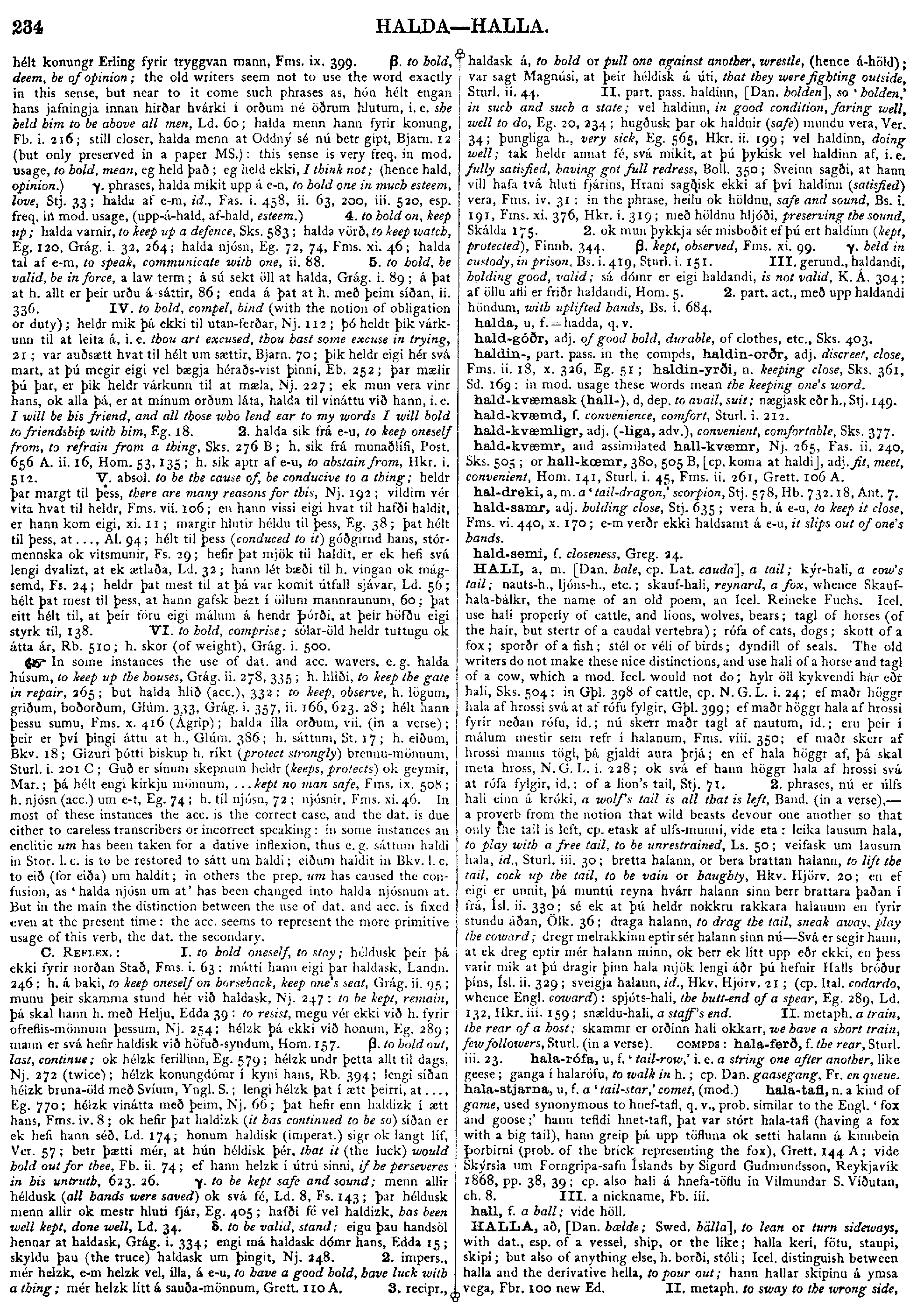
C.
REFLEX.:
I.
to
hold
oneself,
to
stay;
héldusk
þeir
þá
ekki
fyrir
norðan
Stað,
Fms.
i.
63;
mátti
hann
eigi
þar
haldask,
Landn.
246;
h.
á
baki,
to
keep
oneself
on
horseback,
keep
one's
seat,
Grág.
ii.
95;
munu
þeir
skamma
stund
hér
við
haldask,
Nj.
247:
to
be
kept,
remain,
þá
skal
hann
h.
með
Helju,
Edda
39:
to
resist,
megu
vér
ekki
við
h.
fyrir
ofreflis-mönnum
þessum,
Nj.
254;
hélzk
þá
ekki
við
honum,
Eg.
289;
mann
er
svá
hefir
haldisk
við
höfuð-syndum,
Hom.
157.
.
to
hold
out,
last,
continue;
ok
hélzk
ferillinn,
Eg.
579;
hélzk
undr
þetta
allt
til
dags,
Nj.
272
(twice);
hélzk
konungdómr
í
kyni
hans,
Rb.
394;
lengi
síðan
hélzk
bruna-öld
með
Svíum,
Yngl.
S.;
lengi
hélzk
þat
í
ætt
þeirri,
at
...,
Eg.
770;
hélzk
vinátta
með
þeim,
Nj.
66;
þat
hefir
enn
haldizk
í
ætt
hans,
Fms.
iv.
8;
ok
hefir
þat
haldizk
(it
has
continued
to
be
so)
síðan
er
ek
hefi
hann
séð,
Ld.
174;
honum
haldisk
(imperat.)
sigr
ok
langt
líf,
Ver.
57;
betr
þætti
mér,
at
hún
héldisk
þér,
that
it
(the
luck)
would
hold
out
for
thee,
Fb.
ii.
74;
ef
hann
helzk
í
útrú
sinni,
if
he
perseveres
in
his
untruth,
623.
26.
.
to
be
kept
safe
and
sound;
menn
allir
héldusk
(all
bands
were
saved)
ok
svá
fé,
Ld.
8,
Fs.
143;
þar
héldusk
menn
allir
ok
mestr
hluti
fjár,
Eg.
405;
hafði
fé
vel
haldizk,
has
been
well
kept,
done
well,
Ld.
34.
.
to
be
valid,
stand;
eigu
þau
handsöl
hennar
at
haldask,
Grág.
i.
334;
engi
má
haldask
dómr
hans,
Edda
15;
skyldu
þau
(the
truce)
haldask
um
þingit,
Nj.
348.
2.
impers.,
mér
helzk,
e-m
helzk
vel,
ílla,
á
e-u,
to
have
a
good
hold,
have
luck
with
a
thing;
mér
helzk
lítt
á
sauða-mönnum,
Grett.
110
A.
3.
recipr.,
haldask
á,
to
hold
or
pull
one
against
another,
wrestle,
(hence
á-höld);
var
sagt
Magnúsi,
at
þeir
héldisk
á
úti,
that
they
were
fighting
outside,
Sturl.
ii.
44.
II.
part.
pass.
haldinn,
[Dan.
holden],
so
'holden,'
in
such
and
such
a
state;
vel
haldinn,
in
good
condition,
faring
well,
well
to
do,
Eg.
20,
234;
hugðusk
þar
ok
haldnir
(safe)
mundu
vera,
Ver.
34;
þungliga
h.,
very
sick,
Eg.
565,
Hkr.
ii.
199;
vel
haldinn,
doing
well;
tak
heldr
annat
fé,
svá
mikit,
at
þú
þykisk
vel
haldinn
af,
i.e.
fully
satisfied,
having
got
full
redress,
Boll.
350;
Sveinn
sagði,
at
hann
vill
hafa
tvá
hluti
fjárins,
Hrani
sagðisk
ekki
af
því
haldinn
(satisfied)
vera,
Fms.
iv.
31:
in
the
phrase,
heilu
ok
höldnu,
safe
and
sound,
Bs.
i.
191,
Fms.
xi.
376,
Hkr.
i.
319;
með
höldnu
hljóði,
preserving
the
sound,
Skálda
175.
2.
ok
mun
þykkja
sér
misboðit
ef
þú
ert
haldinn
(kept,
protected),
Finnb.
344.
.
kept,
observed,
Fms.
xi.
99.
.
held
in
custody,
in
prison,
Bs.
i.
419,
Sturl.
i.
151.
III.
gerund.,
haldandi,
holding
good,
valid;
sá
dómr
er
eigi
haldandi,
is
not
valid,
K.
Á.
304;
af
öllu
afli
er
friðr
haldandi,
Hom.
5.
2.
part.
act.,
með
upp
haldandi
höndum,
with
uplifted
hands,
Bs.
i.
684.
|
Source: Cleasby/Vigfusson, page b0235, entry 26 View original page image as: [TIFF] [PNG] [View previous entry] [View next entry] |
[Comment on this entry] [View comments] |
The following entry has been hand-corrected once. |
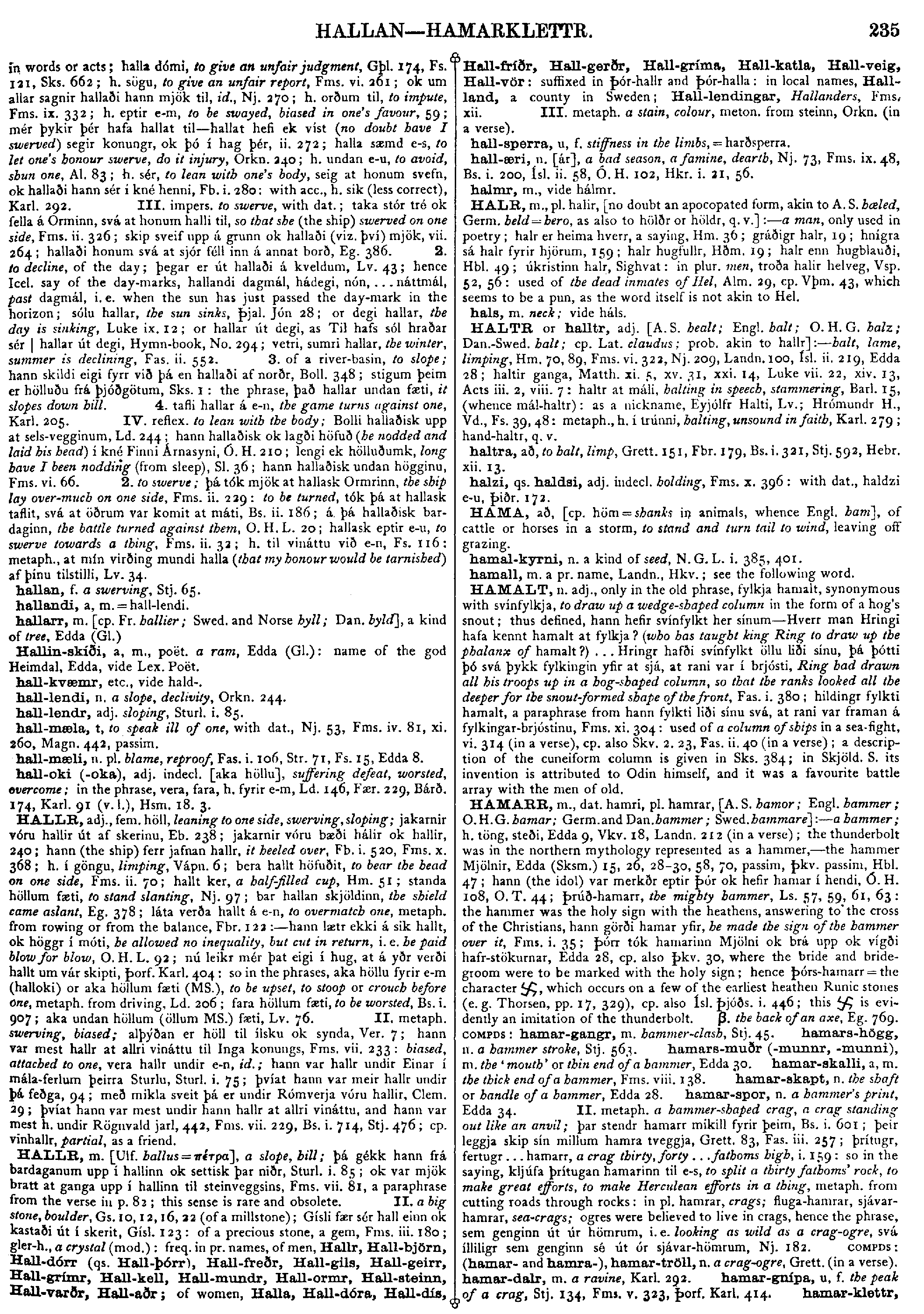
HAMARR,
m.,
dat.
hamri,
pl.
hamrar,
[A.
S.
hamor;
Engl.
hammer;
O.
H.
G.
hamar;
Germ.
and
Dan.
hammer;
Swed.
hammare]
:--
a
hammer;
h.
töng,
steði,
Edda
9,
Vkv.
18,
Landn.
212
(in
a
verse);
the
thunderbolt
was
in
the
northern
mythology
represented
as
a
hammer,
--
the
hammer
Mjölnir,
Edda
(Sksm.)
15,
26,
28-30,
58,
70,
passim,
Þkv.
passim,
Hbl.
47;
hann
(the
idol)
var
merkðr
eptir
Þór
ok
hefir
hamar
í
hendi,
Ó.
H.
108,
O.
T.
44;
Þrúð-hamarr,
the
mighty
hammer,
Ls.
57,
59,
61,
63:
the
hammer
was
the
holy
sign
with
the
heathens,
answering
to
the
cross
of
the
Christians,
hann
görði
hamar
yfir,
he
made
the
sign
of
the
hammer
over
it,
Fms.
i.
35;
Þórr
tók
hamarinn
Mjölni
ok
brá
upp
ok
vígði
hafr-stökurnar,
Edda
28,
cp.
also
Þkv.
30,
where
the
bride
and
bridegroom
were
to
be
marked
with
the
holy
sign;
hence
Þórs-hamarr
=
the
character
RUNE
which
occurs
on
a
few
of
the
earliest
heathen
Runic
stones
(e.g.
Thorsen,
pp.
17,
329),
cp.
also
Ísl.
Þjóðs.
i.
446;
this
RUNE
is
evidently
an
imitation
of
the
thunderbolt.
.
the
back
of
an
axe,
Eg.
769.
COMPDS:
hamar-gangr,
m.
hammer-clash,
Stj.
45.
hamars-högg,
n.
a
hammer
stroke,
Stj.
563.
hamars-muðr
(-munnr,
-munni),
m.
the
'mouth'
or
thin
end
of
a
hammer,
Edda
30.
hamar-skalli,
a,
m.
the
thick
end
of
a
hammer,
Fms.
viii.
138.
hamar-skapt,
n.
the
shaft
or
handle
of
a
hammer,
Edda
28.
hamar-spor,
n.
a
hammer's
print,
Edda
34.
II.
metaph.
a
hammer-shaped
crag,
a
crag
standing
out
like
an
anvil;
þar
stendr
hamarr
mikill
fyrir
þeim,
Bs.
i.
601;
þeir
leggja
skip
sín
millum
hamra
tveggja,
Grett.
83,
Fas.
iii.
257;
þrítugr,
fertugr
...
hamarr,
a
crag
thirty,
forty
...
fathoms
high,
i.
159:
so
in
the
saying,
kljúfa
þrítugan
hamarinn
til
e-s,
to
split
a
thirty
fathoms'
rock,
to
make
great
efforts,
to
make
Herculean
efforts
in
a
thing,
metaph.
from
cutting
roads
through
rocks:
in
pl.
hamrar,
crags;
fluga-hamrar,
sjávar-hamrar,
sea-crags;
ogres
were
believed
to
live
in
crags,
hence
the
phrase,
sem
genginn
út
úr
hömrum,
i.e.
looking
as
wild
as
a
crag-ogre,
svá
ílliligr
sem
genginn
sé
út
ór
sjávar-hömrum,
Nj.
182.
COMPDS:
(hamar-
and
hamra-),
hamar-tröll,
n.
a
crag-ogre,
Grett.
(in
a
verse).
hamar-dalr,
m.
a
ravine,
Karl.
292.
hamar-gnípa,
u,
f.
the
peak
of
a
crag,
Stj.
134,
Fms.
v.
323,
Þorf.
Karl.
414.
hamar-klettr,
|
Source: Cleasby/Vigfusson, page b0236, entry 2 View original page image as: [TIFF] [PNG] [View previous entry] [View next entry] |
[Comment on this entry] [View comments] |
The following entry has been hand-corrected once. |
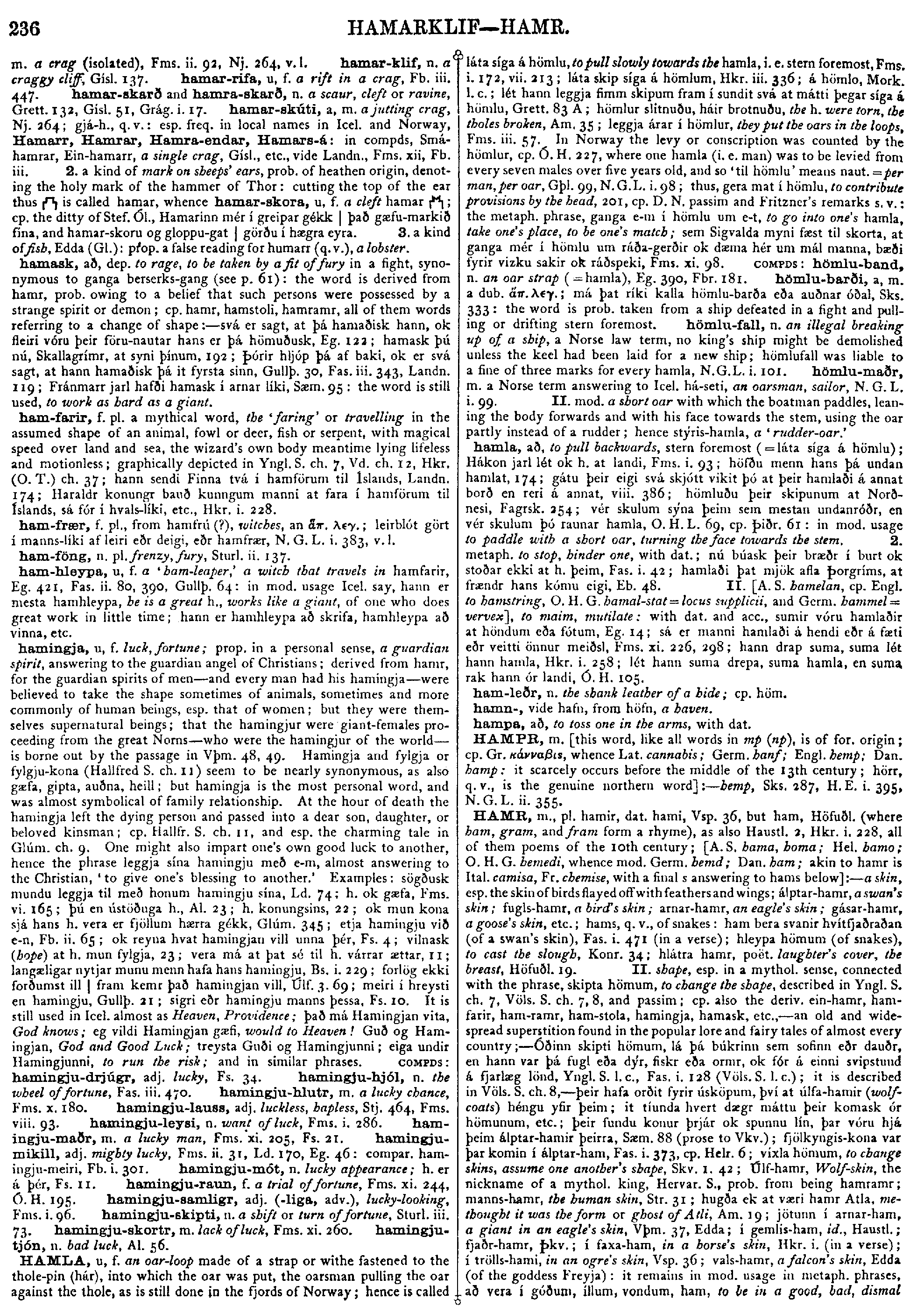
hamask, að, dep. to rage, to be taken by a fit of fury in a fight, synonymous to ganga berserks-gang (see p. 6l): the word is derived from hamr, prob. owing to a belief that such persons were possessed by a strange spirit or demon; cp. hamr, hamstoli, hamramr, all of them words referring to a change of shape :-- svá er sagt, at þá hamaðisk hann, ok fleiri vóru þeir föru-nautar hans er þá hömuðusk, Eg. 122; hamask þú nú, Skallagrímr, at syni þínum, 192; Þórir hljóp þá af baki, ok er svá sagt, at hann hamaðisk þá it fyrsta sinn, Gullþ. 30, Fas. iii. 343, Landn. 119; Fránmarr jarl hafði hamask í arnar líki, Sæm. 95: the word is still used, to work as hard as a giant.
|
Source: Cleasby/Vigfusson, page b0236, entry 7 View original page image as: [TIFF] [PNG] [View previous entry] [View next entry] |
[Comment on this entry] [View comments] |
The following entry has been hand-corrected once. |
hamingja, u, f. luck, fortune; prop. in a personal sense, a guardian spirit, answering to the guardian angel of Christians; derived from hamr, for the guardian spirits of men -- and every man had his hamingja -- were believed to take the shape sometimes of animals, sometimes and more commonly of human beings, esp. that of women; but they were themselves supernatural beings; that the hamingjur were giant-females proceeding from the great Norns -- who were the hamingjur of the world -- is borne out by the passage in Vþm. 48, 49. Hamingja and fylgja or fylgju-kona (Hallfred S. ch. 11) seem to be nearly synonymous, as also gæfa, gipta, auðna, heill; but hamingja is the most personal word, and was almost symbolical of family relationship. At the hour of death the hamingja left the dying person and passed into a dear son, daughter, or beloved kinsman; cp. Hallfr. S. ch. 11, and esp. the charming tale in Glúm. ch. 9. One might also impart one's own good luck to another, hence the phrase leggja sína hamingju með e-m, almost answering to the Christian, 'to give one's blessing to another.' Examples: sögðusk mundu leggja til með honum hamingju sína, Ld. 74; h. ok gæfa, Fms. vi. 165; þú en ústöðuga h., Al. 23; h. konungsins, 22; ok mun kona sjá hans h. vera er fjöllum hærra gékk, Glúm. 345; etja hamingju við e-n, Fb. ii. 65; ok reyna hvat hamingjan vill unna þér, Fs. 4; vilnask (hope) at h. mun fylgja, 23; vera má at þat sé til h. várrar ættar, 11; langæligar nytjar munu menn hafa hans hamingju, Bs. i. 229; forlög ekki forðumst ill | fram kemr það hamingjan vill, Úlf. 3. 69; meiri í hreysti en hamingju, Gullþ. 21; sigri eðr hamingju manns þessa, Fs. 10. It is still used in Icel. almost as Heaven, Providence; það má Hamingjan vita, God knows; eg vildi Hamingjan gæfi, would to Heaven! Guð og Hamingjan, God and Good Luck; treysta Guði og Hamingjunni; eiga undir Hamingjunni, to run the risk; and in similar phrases. COMPDS: hamingju-drjúgr, adj. lucky, Fs. 34. hamingju-hjól, n. the wheel of fortune, Fas. iii. 470. hamingju-hlutr, m. a lucky chance, Fms. x. 180. hamingju-lauss, adj. luckless, hapless, Stj. 464, Fms. viii. 93. hamingju-leysi, n. want of luck, Fms. i. 286. hamingju-maðr, m. a lucky man, Fms. xi. 205, Fs. 21. hamingju-mikill, adj. mighty lucky, Fms. ii. 31, Ld. 170, Eg. 46: compar. hamingju-meiri, Fb. i. 301. hamingju-mót, n. lucky appearance; h. er á pér, Fs. 11. hamingju-raun, f. a trial of fortune, Fms. xi. 244, Ó. H. 195. hamingju-samligr, adj. (-liga, adv.), lucky-looking, Fms. i. 96. hamingju-skipti, n. a shift or turn of fortune, Sturl. iii. 73. hamingju-skortr, m. lack of luck, Fms. xi. 260. hamingju-tjón, n. bad luck, Al. 56.
|
Source: Cleasby/Vigfusson, page b0236, entry 8 View original page image as: [TIFF] [PNG] [View previous entry] [View next entry] |
[Comment on this entry] [View comments] |
The following entry has been hand-corrected once. |
HAMLA, u, f. an oar-loop made of a strap or withe fastened to the thole-pin (hár), into which the oar was put, the oarsman pulling the oar against the thole, as is still done in the fjords of Norway; hence is called láta síga á hömlu, to pull slowly towards the hamla, i.e. stern foremost, Fms. i. 172, vii. 213; láta skip síga á hömlum, Hkr. iii. 336; á hömlo, Mork. l.c.; lét hann leggja fimm skipum fram í sundit svá at mátti þegar síga á hömlu, Grett. 83 A; hömlur slitnuðu, háir brotnuðu, the h. were torn, the tholes broken, Am. 35; leggja árar í hömlur, they put the oars in the loops, Fms. iii. 57. In Norway the levy or conscription was counted by the hömlur, cp. Ó. H. 227, where one hamla (i.e. man) was to be levied from every seven males over five years old, and so 'til hömlu' means naut. = per man, per oar, Gþl. 99, N. G. L. i. 98; thus, gera mat í hömlu, to contribute provisions by the head, 201, cp. D. N. passim and Fritzner's remarks s.v.: the metaph. phrase, ganga e-m í hömlu um e-t, to go into one's hamla, take one's place, to be one's match; sem Sigvalda myni fæst til skorta, at ganga mér í hömlu um ráða-gerðir ok dæma hér um mál manna, bæði fyrir vizku sakir ok ráðspeki, Fms. xi. 98. COMPDS: hömlu-band, n. an oar strap (= hamla), Eg. 390, Fbr. 181. hömlu-barði, a, m. a dub. GREEK; má þat ríki kalla hömlu-barða eða auðnar óðal, Sks. 333: the word is prob. taken from a ship defeated in a fight and pulling or drifting stern foremost. hömlu-fall, n. an illegal breaking up of a ship, a Norse law term, no king's ship might be demolished unless the keel had been laid for a new ship; hömlufall was liable to a fine of three marks for every hamla, N. G. L. i. 101. hömlu-maðr, m. a Norse term answering to Icel. há-seti, an oarsman, sailor, N. G. L. i. 99. II. mod. a short oar with which the boatman paddles, leaning the body forwards and with his face towards the stem, using the oar partly instead of a rudder; hence stýris-hamla, a 'rudder-oar.'
|
Source: Cleasby/Vigfusson, page b0241, entry 21 View original page image as: [TIFF] [PNG] [View previous entry] [View next entry] |
[Comment on this entry] [View comments] |
The following entry has been hand-corrected once. |
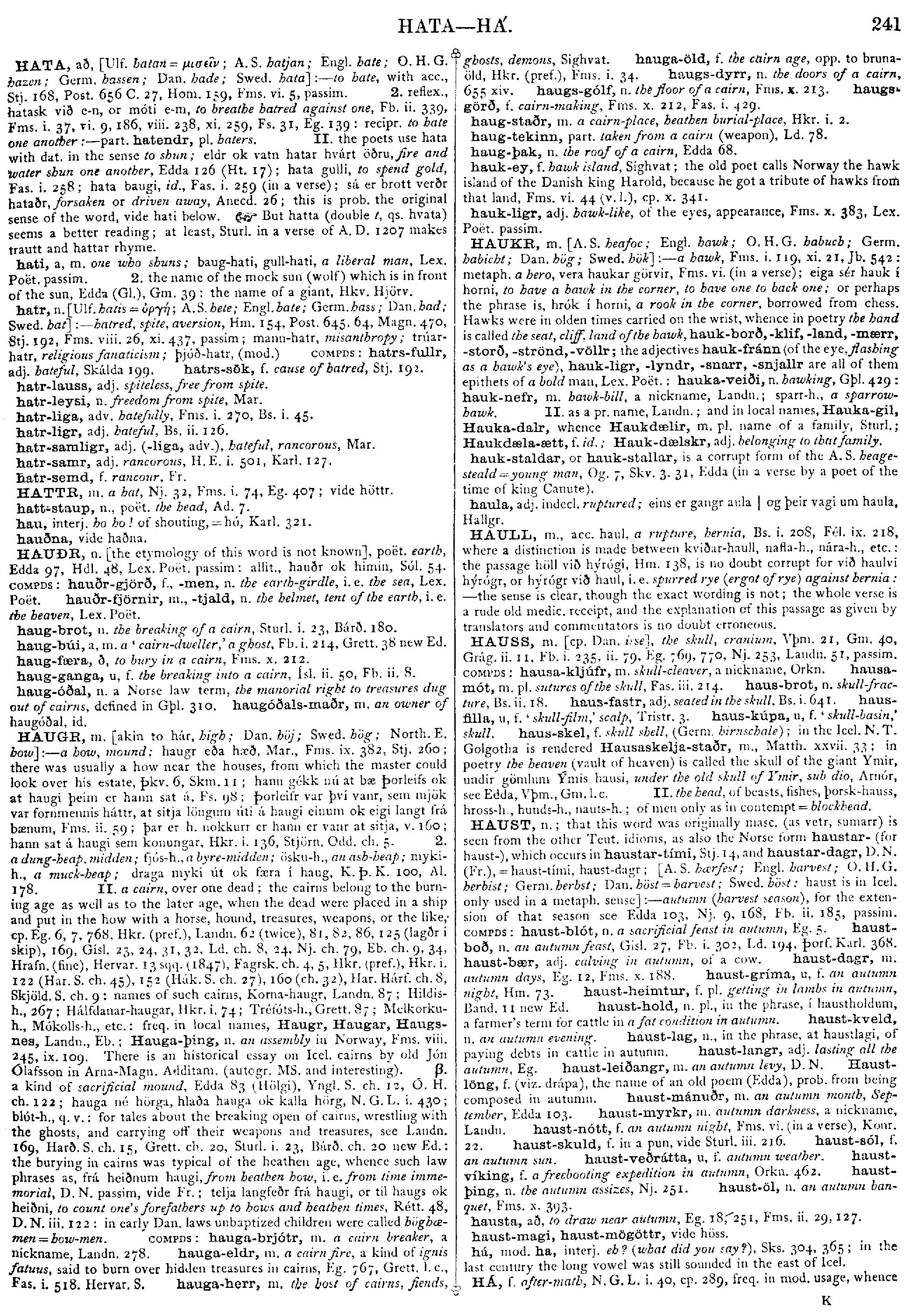
HAUGR,
m.
[akin
to
hár,
high;
Dan.
höj;
Swed.
hog;
North.
E.
how]
:--
a
how,
mound;
haugr
eða
hæð,
Mar.,
Fms.
ix.
382,
Stj.
260;
there
was
usually
a
how
near
the
houses,
from
which
the
master
could
look
over
his
estate,
Þkv.
6,
Skm.
11;
hann
gékk
nú
at
bæ
Þorleifs
ok
at
haugi
þeim
er
hann
sat
a.,
Fs.
98;
Þorleifr
var
því
vanr,
sem
mjök
var
fornmennis
háttr,
at
sitja
löngum
úti
á
haugi
einum
ok
eigi
langt
frá
bænum,
Fms.
ii.
59;
þar
er
h.
nokkurr
er
hann
er
vanr
at
sitja,
v.
160;
hann
sat
á
haugi
sem
konungar,
Hkr.
i.
136,
Stjörn.
Odd.
ch.
5.
2.
a
dung-heap.
midden;
fjós-h.,
a
byre-midden;
ösku-h.,
an
ash-heap;
myki-h.,
a
muck-heap;
draga
myki
út
ok
færa
í
haug,
K.
Þ.
K.
100,
Al.
178.
II.
a
cairn,
over
one
dead;
the
cairns
belong
to
the
burning
age
as
well
as
to
the
later
age,
when
the
dead
were
placed
in
a
ship
and
put
in
the
how
with
a
horse,
hound,
treasures,
weapons,
or
the
like,
cp.
Eg.
6,
7,
768.
Hkr.
(pref.),
Landn.
62
(twice),
81,
82,
86,
125
(lagðr
í
skip),
169,
Gísl.
23,
24,
31,
32,
Ld.
ch.
8,
24,
Nj.
ch.
79,
Eb.
ch.
9,
34,
Hrafn.
(fine),
Hervar.
13
sqq.
(1847),
Fagrsk.
ch.
4,
5,
Hkr.
(pref.),
Hkr.
i.
122
(Har.
S.
ch.
45),
152
(Hák.
S.
ch.
27),
160
(ch.
32),
Har.
Hárf.
ch.
8,
Skjöld.
S.
ch.
9:
names
of
such
cairns,
Korna-haugr,
Landn.
87;
Hildis-h.,
267;
Hálfdanar-haugar,
Hkr.
i.
74;
Tréfóts-h.,
Grett.
87;
Melkorku-h.,
Mókolls-h.,
etc.:
freq.
in
local
names,
Haugr,
Haugar,
Haugs-nes,
Landn.,
Eb.;
Hauga-þing,
n.
an
assembly
in
Norway,
Fms.
viii.
245,
ix.
109.
There
is
an
historical
essay
on
Icel.
cairns
by
old
Jón
Ólafsson
in
Arna-Magn.
Additam.
(autogr.
MS.
and
interesting).
.
a
kind
of
sacrificial
mound,
Edda
83
(Hölgi),
Yngl.
S.
ch.
12,
Ó.
H.
ch.
122;
hauga
né
hörga,
hlaða
hauga
ok
kalla
hörg,
N.
G.
L.
i.
430;
blót-h.,
q.v.:
for
tales
about
the
breaking
open
of
cairns,
wrestling
with
the
ghosts,
and
carrying
off
their
weapons
and
treasures,
see
Landn.
169,
Harð.
S.
ch.
15,
Grett.
ch.
20,
Sturl.
i.
23,
Bárð.
ch.
20
new
Ed.:
the
burying
in
cairns
was
typical
of
the
heathen
age,
whence
such
law
phrases
as,
frá
heiðnum
haugi,
from
heathen
how,
i.e.
from
time
immemorial,
D.
N.
passim,
vide
Fr.;
telja
langfeðr
frá
haugi,
or
til
haugs
ok
heiðni,
to
count
one's
forefathers
up
to
hows
and
heathen
times,
Rétt.
48,
D.
N.
iii.
122:
in
early
Dan.
laws
unbaptized
children
were
called
höghæmen
=
how-men.
COMPDS:
hauga-brjótr,
m.
a
cairn
breaker,
a
nickname,
Landn.
278.
hauga-eldr,
m.
a
cairn
fire,
a
kind
of
ignis
fatuus,
said
to
burn
over
hidden
treasures
in
cairns,
Eg.
767,
Grett.
l.c.,
Fas.
i.
518.
Hervar.
S.
hauga-herr,
m.
the
host
of
cairns,
fiends,
ghosts,
demons,
Sighvat.
hauga-öld,
f.
the
cairn
age,
opp.
to
bruna-öld,
Hkr.
(pref.),
Fms.
i.
34.
haugs-dyrr,
n.
the
doors
of
a
cairn,
655
xiv.
haugs-gólf,
n.
the
floor
of
a
cairn,
Fms.
x.
213.
haugs-görð,
f.
cairn-making,
Fms.
x.
212,
Fas.
i.
429.
| Result Page: |  |
Previous | 118 119 120 121 122 123 124 125 126 127 128 129 130 131 132 133 134 135 136 | Next |  |
Germanic Lexicon Project (main page)
This search system was written by
Sean Crist
Please consider
volunteering
to correct the data in these online dictionaries.
No rights reserved. Feel free to use these data in any way you please.