|
|

|
Source: Bosworth/Toller, page b0682, entry 22 View original page image as: [TIFF] [PNG] [View previous entry] [View next entry] |
[Comment on this entry] [View comments] |
The following entry has been hand-corrected once. |
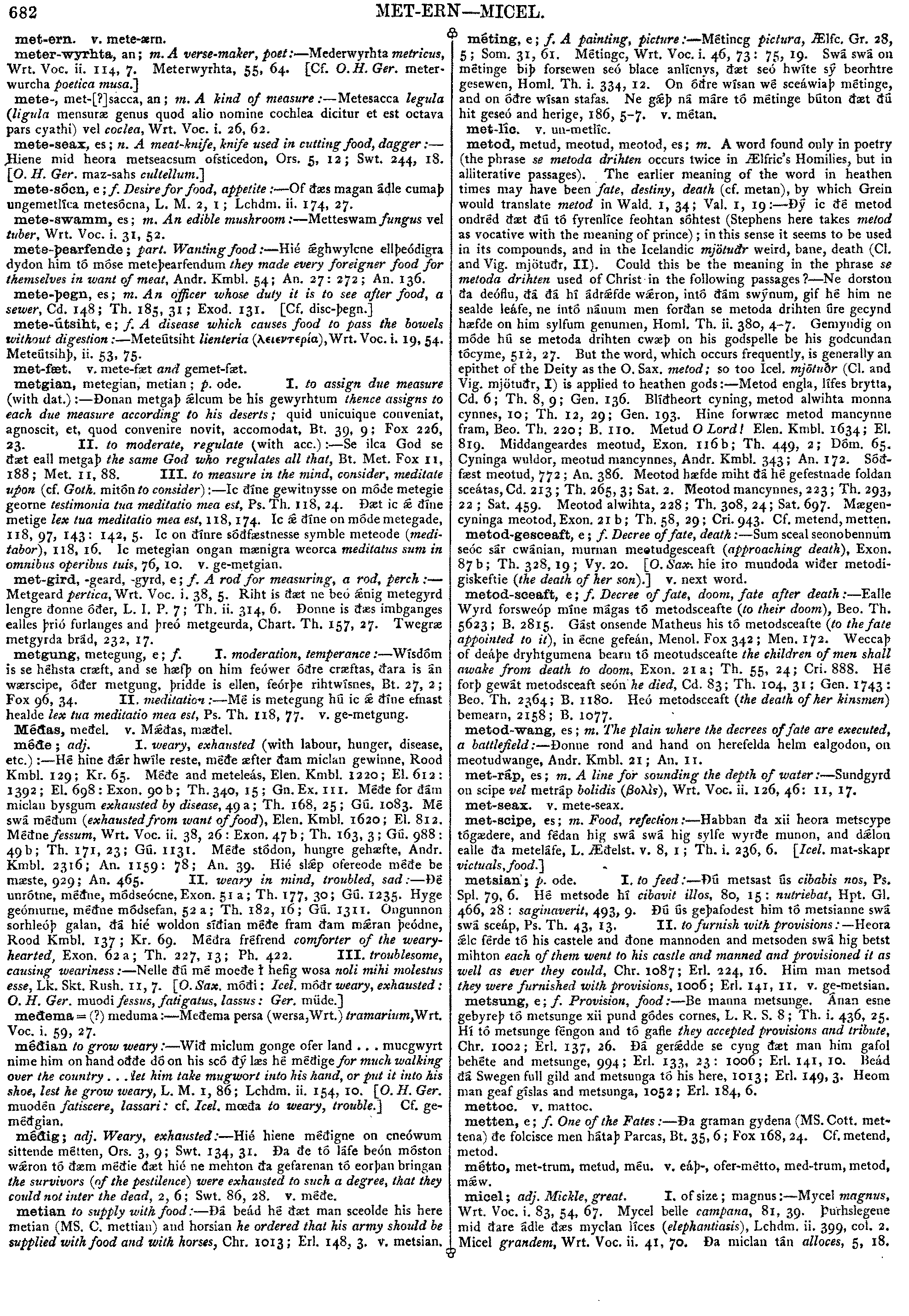
metod,
metud,
meotud,
meotod,
es;
m.
A
word
found
only
in
poetry
(the
phrase
se
metoda
drihten
occurs
twice
in
Ælfric's
Homilies,
but
in
alliterative
passages).
The
earlier
meaning
of
the
word
in
heathen
times
may
have
been
fate,
destiny,
death
(cf.
metan),
by
which
Grein
would
translate
metod
in
Wald.
1,
34;
Val.
1,
19
:--
Ðý
ic
ðé
metod
ondréd
ðæt
ðú
tó
fyrenlíce
feohtan
sóhtest
(Stephens
here
takes
metod
as
vocative
with
the
meaning
of
prince);
in
this
sense
it
seems
to
be
used
in
its
compounds,
and
in
the
Icelandic
mjötuðr
weird,
bane,
death
(Cl.
and
Vig.
mjötuðr,
II).
Could
this
be
the
meaning
in
the
phrase
se
metoda
drihten
used
of
Christ
in
the
following
passages?-Ne
dorston
ða
deóflu,
ðá
ðá
hí
ádr fde
wron,
intó
ðám
swýnum,
gif
hé
him
ne
sealde
leáfe,
ne
intó
nánum
men
forðan
se
metoda
drihten
úre
gecynd
hæfde
on
him
sylfum
genumen,
Homl.
Th.
ii.
380,
4-7.
Gemyndig
on
móde
hú
se
metoda
drihten
cwæþ
on
his
godspelle
be
his
godcundan
tócyme,
512,
27.
But
the
word,
which
occurs
frequently,
is
generally
an
epithet
of
the
Deity
as
the
O.
Sax.
metod;
so
too
Icel.
mjötuðr
(Cl.
and
Vig.
mjötuðr,
I)
is
applied
to
heathen
gods
:--
Metod
engla,
lífes
brytta,
Cd.
6;
Th.
8,
9;
Gen.
136.
Blíðheort
cyning,
metod
alwihta
monna
cynnes,
10;
Th.
12,
29;
Gen.
193.
Hine
forwræc
metod
mancynne
fram,
Beo.
Th.
220;
B.
110.
Metud
O
Lord!
Elen.
Kmbl.
1634;
El.
819.
Middangeardes
meotud,
Exon.
116
b;
Th.
449,
2;
Dóm.
65.
Cyninga
wuldor,
meotud
mancynnes,
Andr.
Kmbl.
343;
An.
172.
Sóðfæst
meotud,
772;
An.
386.
Meotod
hæfde
miht
ðá
hé
gefestnade
foldan
sceátas,
Cd.
213;
Th.
265,
3;
Sat.
2.
Meotod
mancynnes,
223;
Th.
293,
22;
Sat.
459.
Meotod
alwihta,
228;
Th.
308,
24;
Sat.
697.
Mægencyninga
meotod,
Exon.
21
b;
Th.
58,
29;
Cri.
943.
Cf.
metend,
metten.
fde
wron,
intó
ðám
swýnum,
gif
hé
him
ne
sealde
leáfe,
ne
intó
nánum
men
forðan
se
metoda
drihten
úre
gecynd
hæfde
on
him
sylfum
genumen,
Homl.
Th.
ii.
380,
4-7.
Gemyndig
on
móde
hú
se
metoda
drihten
cwæþ
on
his
godspelle
be
his
godcundan
tócyme,
512,
27.
But
the
word,
which
occurs
frequently,
is
generally
an
epithet
of
the
Deity
as
the
O.
Sax.
metod;
so
too
Icel.
mjötuðr
(Cl.
and
Vig.
mjötuðr,
I)
is
applied
to
heathen
gods
:--
Metod
engla,
lífes
brytta,
Cd.
6;
Th.
8,
9;
Gen.
136.
Blíðheort
cyning,
metod
alwihta
monna
cynnes,
10;
Th.
12,
29;
Gen.
193.
Hine
forwræc
metod
mancynne
fram,
Beo.
Th.
220;
B.
110.
Metud
O
Lord!
Elen.
Kmbl.
1634;
El.
819.
Middangeardes
meotud,
Exon.
116
b;
Th.
449,
2;
Dóm.
65.
Cyninga
wuldor,
meotud
mancynnes,
Andr.
Kmbl.
343;
An.
172.
Sóðfæst
meotud,
772;
An.
386.
Meotod
hæfde
miht
ðá
hé
gefestnade
foldan
sceátas,
Cd.
213;
Th.
265,
3;
Sat.
2.
Meotod
mancynnes,
223;
Th.
293,
22;
Sat.
459.
Meotod
alwihta,
228;
Th.
308,
24;
Sat.
697.
Mægencyninga
meotod,
Exon.
21
b;
Th.
58,
29;
Cri.
943.
Cf.
metend,
metten.
|
Source: Bosworth/Toller, page b0765, entry 43 View original page image as: [TIFF] [PNG] [View previous entry] [View next entry] |
[Comment on this entry] [View comments] |
The following entry has been hand-corrected once. |
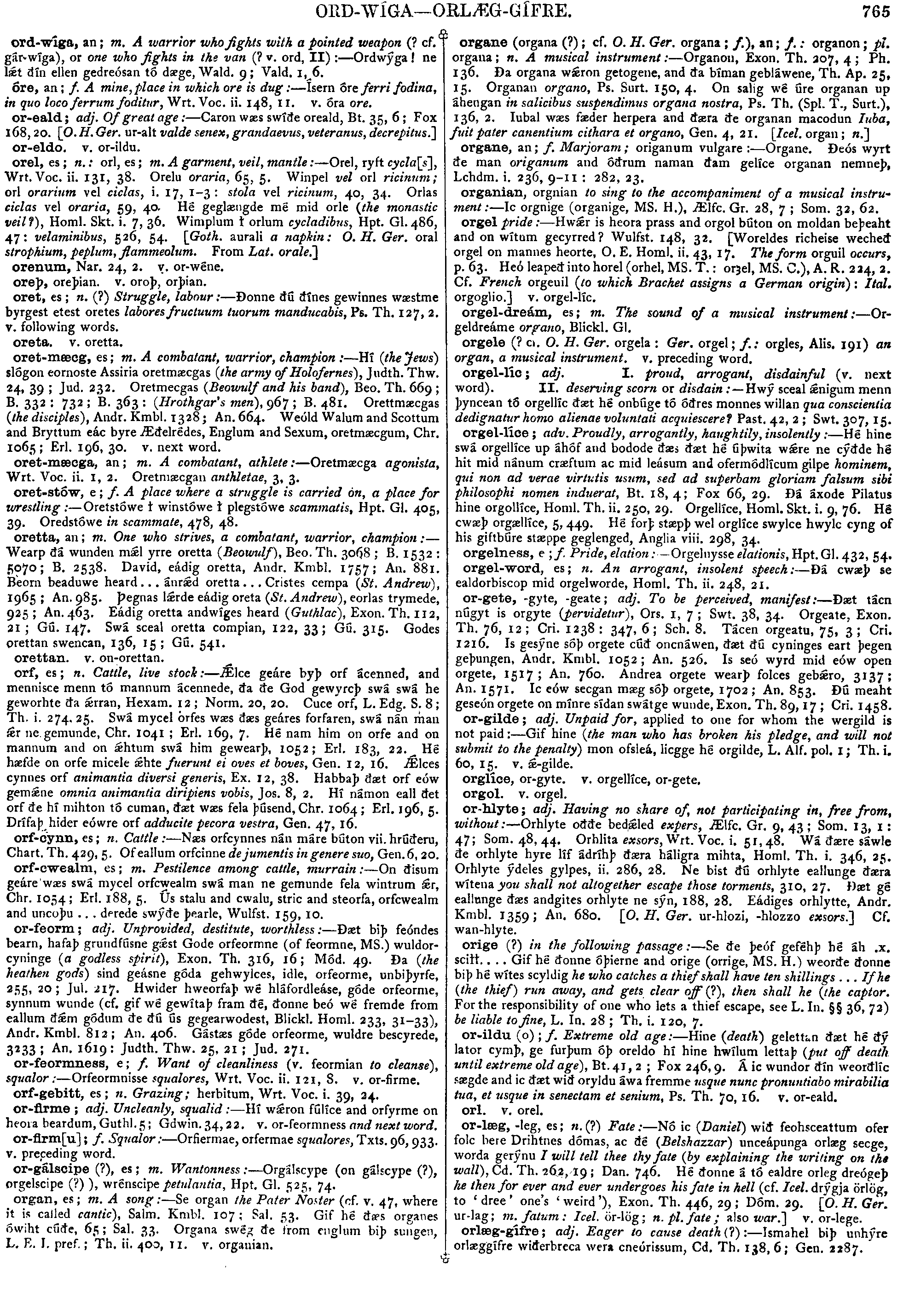
or-læg, -leg, es; n. (?) Fate :-- Nó ic (Daniel) wið feohsceattum ofer folc bere Drihtnes dómas, ac ðé ( Belshazzar) unceápunga orlæg secge, worda gerýnu I will tell thee thy fate (by explaining the writing on the wall), Cd. Th. 262, 19; Dan. 746. Hé ðonne á tô ealdre orleg dreógeþ he then for ever and ever undergoes his fate in hell (cf. Icel. drýgja örlög, to 'dree' one's 'weird'), Exon. Th. 446, 29 ; Dóm. 29. [O. H. Ger. ur-lag; m. fatum: Icel. ör-lög; n. pl. fate; also war.] v. or-lege.
|
Source: Bosworth/Toller, page b1287, entry 7 View original page image as: [TIFF] [PNG] [View previous entry] [View next entry] |
[Comment on this entry] [View comments] |
The following entry has been hand-corrected once. |
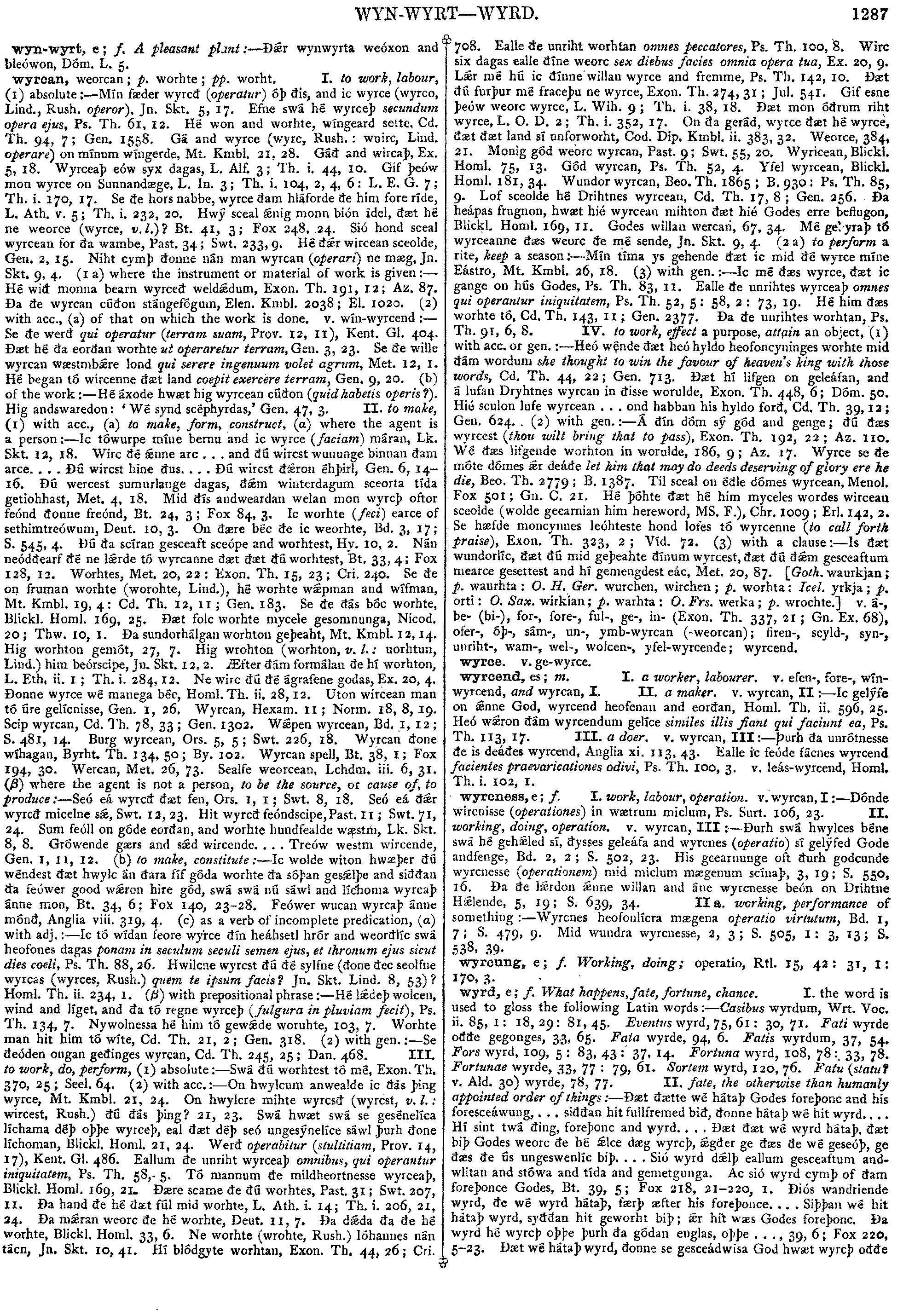
wyrd,
e;
f.
What
happens,
fate,
fortune,
chance.
I.
the
word
is
used
to
gloss
the
following
Latin
words
:--
Casibus
wyrdum,
Wrt.
Voc.
ii.
85,
1
:
18,
29
:
81,
45.
Eventus
wyrd,
75,
61
:
30,
71.
Fati
wyrde
oððe
gegonges,
33,
65.
Fata
wyrde,
94,
6.
Fatis
wyrdum,
37,
54.
Fors
wyrd,
109,
5
:
83,
43:
37,
14.
Fortuna
wyrd,
108,
78
:
33,
78.
Fortunae
wyrde,
33,
77
:
79,
61.
Sortem
wyrd,
120,
76.
Fatu
(statu?
v.
Ald.
30)
wyrde,
78,
77.
II.
fate,
the
otherwise
than
humanly
appointed
order
of
things
:--
Ðæt
ðætte
wé
hátaþ
Godes
foreþonc
and
his
foresceáwung,
.
.
.
siððan
hit
fullfremed
bið,
ðonne
hátaþ
wé
hit
wyrd...
Hí
sint
twá
ðing,
foreþonc
and
wyrd....
Ðæt
ðæt
wé
wyrd
hátaþ,
ðæt
biþ
Godes
weorc
ðe
hé
lce
dæg
wyrcþ,
gðer
ge
ðæs
ðe
wé
geseóþ,
ge
ðæs
ðe
ús
ungeswenlíc
biþ
....
Sió
wyrd
dlþ
eallum
gesceaftum
andwlitan
and
stówa
and
tída
and
gemetgunga.
Ac
sió
wyrd
cymþ
of
ðam
foreþonce
Godes,
Bt.
39,
5;
Fox
218,
21-220,
1.
Ðiós
wandriende
wyrd,
ðe
wé
wyrd
hátaþ,
færþ
æfter
his
foreþonce....
Siþþan
wé
hit
hátaþ
wyrd,
syððan
hit
geworht
biþ;
r
hit
wæs
Godes
foreþonc.
Ða
wyrd
hé
wyrcþ
oþþe
þurh
ða
gódan
englas,
oþþe
.
.
.,
39,
6
;
Fox
220,
5-23.
Ðæt
wé
hátaþ
wyrd,
ðonne
se
gesceádwísa
God
hwæt
wyrcþ
oððe
geþafaþ
ðæs
ðe
wé
ne
wénaþ
fit
illud
fatalis
ordinis
insigne
miraculum,
cum
ab
sciente
geritur,
quod
stupeant
ignorantes,
39,
10;
Fox
226,
24.
Ðé
sceal
on
woruld
bringan
Sarra
sunu,
sóð
forð
gán
wyrd
æfter
ðiosum
wordgemearcum,
Cd.
Th.
142,
1
;
Gen.
2355.
Gð
á
wyrd
swá
hió
sceal,
Beo.
Th.
915;
B.
455.
Ne
wæs
wyrd,
ðæt
hé
má
móste
manna
cynnes
ðicgean,
1473;
B.
734.
Wron
sume
gedwolmen
ðe
cwdon,
ðæt
lc
man
beó
ácenned
be
steorrena
gesetnyssum,
and
þurh
heora
ymbryna
him
wyrd
gelimpe,
Homl.
Th.
i.
110,
8.
Sceal
heó
(Lot's
wife)
wyrde
bídan,
Drihtnes
dómes,
Cd.
Th.
155,
10;
Gen.
2570
:
Exon.
Th.
329,
29;
Vy.
41.
Hí
wyrd
ne
cúþon,
Beo.
Th.
2471
;
B.
1233.
III.
in
a
personal
sense,
one
of
the
Fates
(the
weird
sisters)
:--
Wyrde
Parcae,
Wrt.
Voc.
ii.
116,
9
:
67,
55.
III
a.
as
a
personification,
fate,
fortune
:--
Wyrd
biþ
swíþre,
Meotud
mihtigra,
ðonne
nges
monnes
gehygd,
Exon.
Th.
312,
27;
Seef.
115.
Wyrd
byð
swíþost,
Menol.
Fox
469;
Gn.
C.
5
:
Salm.
Kmbl.
855;
Sal.
427
:
886;
Sal.
442.
Wyrd
bið
ful
árð,
Exon.
Th.
286,
24;
Wand.
5
:
Salm.
Kmbl.
871
;
Sal.
435.
Sume
úþwitan
secgaþ
ðæt
sió
wyrd
wealde
gðer
ge
geslþa
ge
ungeslþa
lces
monnes,
Bt.
39,
8
;
Fox
224,
13.
Weord
(wyrd,
v.
l.),
5,
1
;
Fox
8,
30.
Swá
him
wyrd
ne
gescráf,
Beo.
Th.
5142
;
B.
2574
:
Elen.
Kmbl.
2092;
El.
1047
:
Met.
1,
29.
Behindan
beleác
wyrd
mid
wge,
Cd.
Th.
206,
25;
Exod.
457.
Eorlas
fornóman
wpen
wælgífru,
wyrd
seó
mre,
Exon.
Th.
292,
17
;
Wand.
100:
Beo.
Th.
2415;
B.
1205.
Hié
wyrd
forsweóp,
959;
B.
477
:
5621
;
B.
2814.
Wyrd
ðone
gomelan
grétan
sceolde,
4832;
B.
2420.
Hwý
ðú
fre
woldest
ðæt
seó
wyrd
swá
hwyrfan
sceolde?
Heó
þreáþ
ða
unscildigan,
Bt.
4;
Fox
8,
12
:
Met.
4.
34
:
Andr.
Kmbl.
1226;
An.
613
:
3121
;
An.
1563.
Wyrd
oft
nereþ
unfgne
eorl,
Beó.
Th.
1149;
B.
572
:
Exon.
Th.
165,
18;
Gú.
1030.
Tó
eallum
ðám
geslðum
ðe
seó
wyrd
brengð,
Bt.
16,
3
;
Fox
54,
25
:
14,
1
;
Fox
40,
31.
Ne
wén
ðú
nó
ðæt
ic
tó
ánwillíce
winne
wiþ
ða
wyrd
(fortunam)
...
hit
oft
gebyraþ
ðæt
seó
leáse
wyrd
náuþer
ne
mæg
ðam
men
dón
ne
fultum,
ne
nnne
ðem,
20;
Fox
70,
22.
Wyrde
wiðstondan,
Exón.
Th.
287,
17
;
Wand.
15.
IV.
an
event,
(1)
with
the
special
idea
of
that
which
happens
by
the
determination
of
Providence
or
fate
:--
Ne
wile
Sarran
gelýfan
wordum
mínum;
sceal
seó
wyrd
swá
ðeáh
forð
steallian,
Cd.
Th.
144,
14;
Gen.
2389.
Wyrd
wæs
geworden,
swefen
geséðed,
swá
r
Daniel
cwæð,
257,
5
;
Dan.
653.
God
éce
biþ;
ne
wendaþ
hine
wyrda,
ne
hine
wiht
dreceþ
ádl
ne
yldo,
Exon.
Th.
333,
24;
Gn.
Ex.
9:
Salm.
Kmbl.
666;
Sal.
332.
Wyrda
Waldend,
Cd.
Th.
205,
7;
Exod.
432
:
Andr.
Kmbl.
2113;
An.
1058
:
Elen.
Kmbl.
159
;
El.
80
:
Exon.
Th.
455,
1;
Hy.
4,
43.
Wyrda
gerýnu,
Cd.
Th.
225,
5;
Dan.
149.
Wyrda
geþinga,
250,
14;
Dan.
546.
Wyrda
gesceaft,
224,
6;
Dan.
132.
Onwrigen
is
wyrda
bigang,
Elen.
Kmbl.
2245
;
El.
1124.
Gif
ic
ðé
ðone
[...
age,
the
MS.
is
here
imperfect]
gesecge
ðínes
feores,
ýþelíce
ðú
ða
wyrde
oncyrrest
and
his
hond
beféhst
si
mortis
tue
tibi
insidiatorem
prodidero,
sublato
eo
facile
instantia
fata
mutabis,
mihique
tres
irascentur
sorores,
Clotos,
Lachesis,
Atropos,
Nar.
31,
24.
(2)
in
a
general
sense,
an
event,
occurrence,
circumstance,
incident,
fact
:--
Nnigne
tweógean
ne
þearf,
ðæt
seó
wyrd
on
ðás
ondweardan
tíd
geweorþan
sceal,
ðæt
se
Scyppend
gesittan
wile
on
his
dómsetle,
Blickl.
Howl.
83,
10.
Ðá
gelamp
wundorlíc
wyrd,
ðæt
se
lég
ongan
sleán
ongeán
ðone
wind,
221,
11.
Ðæt
is
mro
wyrd,
Cd.
Th.
84,
18;
Gen.
1399
:
Menol.
Fox
107;
Men.
53.
Egeslíc
wyrd,
Rood
Kmbl.
148;
Kr.
74
:
Exon.
Th.
432,
6
;
Rä.
48,
2.
Seó
wyrd
gewearð
(it
happened)
ðæt
ðæt
wíf
geseah
Ismaél
plegan,
Cd.
Th.
168,
3;
Gen.
2777.
Is
seó
wyrd
mid
eów
open
the
event
is
patent
among
you,
Andr.
Kmbl.
1516;
An.
759
:
Apstls.
Kmbl.
84;
Ap.
42.
Ne
wé
ðære
wyrde
wénan
þurfon
tóweard
in
tíde,
Exon.
Th.
6,
8;
Cri.
81.
Wénan
ðære
wyrde,
ðæt
heó
hire
taman
healde,
Met.
13,
24
:
26,
114
:
Ps.
Th.
119,
5.
Hé
wyrde
bídeþ,
hwonne
God
wille
ðisse
worlde
ende
gewyricean,
Blickl.
Homl.
109,
32.
On
ðæm
dæge
gewíteþ
heofon
and
eorþe....
Swá
eác
for
ðære
ilcan
wyrde
gewíteþ
sunne
and
móna,
91,
22.
Ðá
gesáwon
hié
wundorlíce
wyrd
-
ðone
man
lífgendne,
ðone
ðe
hié
r
deádne
forléton,
217,
36;
Cd.
Th.
61,
112;
Gen.
996
:
245,
30;
Dan.
471.
Hé
ða
wyrd
ne
máð,
fges
forðsíð,
Exon.
Th.
182,
33;
Gú.
1319.
Hé
wyrd
ne
ful
cúþe
freóndrdenne
hú
heó
from
hogde
he
did
not
fully
know
the
circumstance,
how
her
heart
was
turned
from
loving
him,
244,
26;
Jul.
33.
Dígle
wyrd
an
obscure
circumstance,
Elen.
Kmbl.
1077
;
El.
541
:
1163;
El.
583.
Ymb
ða
mran
wyrd,
2126;
El.
1064.
Geopenigean
uncúðe
wyrd,
hwr
hé
ðara
nægla
wénan
þorfte,
2202
;
El.
1102.
Hé
ðé
mæg
onwreón
wyrda
gerýno
he
can
disclose
to
thee
the
secrets
of
events
(can
tell
thee
of
events
which
are
a
secret
to
most
men),
1174;
El.
589
:
1623
;
El.
813.
Hé
ne
leág
fela
wyrda
ne
worda,
Beo.
Th.
6052
;
B.
3030.
V.
what
happens
to
a
person,
fate,
fortune,
lot,
condition
:--
Ic
wille
secgan
ðæt
lc
wyrd
(omnis
fortuna)
bió
gód,
sam
hió
monnum
gód
þince,
sam
hió
him
yfel
þince....
Æ-acute;lc
wyrd,
sam
hió
sié
wynsum,
sam
hió
sié
unwynsum,
for
ðý
cymþ
tó
ðm
gódum
ðæt
hió
...
hine
þreátige
tó
ðon
ðæt
hé
bet
dó,
.
.
.
oððe
him
leánige
ðæt
hé
teala
dyde,
Bt.
40,
1
;
Fox
224,
33-226,
5.
Ða
graman
gydena,
ðe
folcisce
men
hátaþ
Parcas,
ða
hí
secgaþ
ðæt
wealdan
lces
monnes
wyrde,
35,
6
;
Fox
168,
27.
For
hwý
ætwíte
gé
eówerre
wyrde
ðæt
hió
nán
geweald
náh,
39,
1
;
Fox
210,
26.
Him
ne
wæs
nnig
earfoþe
ðæt
líchomlíce
gedál
on
ðære
neówan
wyrde
(in
their
new
condition),
Blickl.
Homl.
135,
31.
Under
wyrd
sub
condicione,
Jn.
Skt.
p.
5,
10.
Ne
meaht
ðú
nó
mid
sóþe
getlan
ðíne
wyrd
and
ðíne
geslþa,
swá
swá
ðú
wénst
quod
tu
falsae
opinionis
supplicium
luis,
id
rebus
jure
imputare
non
possis,
Bt.
10
;
Fox
28,
1.
Wyrd
wánian,
Exon.
Th.
274,
24;
Jul.
538.
Unc
sceal
weorðan
swá
unc
wyrd
geteóð
Metod
manna
gehwæs
to
us
shall
it
befall,
as
the
Lord
of
every
man
decrees
to
us
our
fate,
Beo.
Th.
5046;
B.
2526.
Nýd
bið
wyrda
heardost,
Salm.
Kmbl.
622;
Sal.
310.
Him
mæg
wíssefa
wyrda
gehwylce
gemetigian,
877;
Sal.
438.
Gnornsorga
mst,
wyrda
láðost,
Elen.
Kmbl.
1953;
El.
977
:
Rood
Kmbl.
101
;
Kr.
51.
V
a,
fate,
death.
See
also
III
a
:--
Wille
forgieldan
gsta
Dryhten
willum
æfter
ðære
wyrde,
ðam
ðe
his
synna
nú
sáre
geþenceþ,
Exon.
Th.
450,
3;
Dom.
82.
VI.
chance,
accident
:--
Ðæt
wille
ic
gecýþan,
ðæt
ðu
rícu
of
nánes
monnes
mihtum
swá
gecræftgade
ne
wurdon,
ne
for
nánre
wyrde,
búton
from
Godes
gestihtunge
ut
omnia
haec
profundissimis
Dei
judiciis
disposita,
non
autem
humanis
viribus,
aut
incertis
casibus
accidisse
perdoceam,
Ors.
2,
1
;
Swt.
69,
23.
Sprecan
wiþ
ða
ðe
secgaþ
ðæt
ða
anwaldas
sién
of
wyrda
mægenum
gewordene,
Swt.
62,
10.
[Worþe
hit
wele,
oþer
wo,
as
þe
wyrde
lyke hit
hafe,
Gaw.
2134.
Þe
same
þat
sett
is
be
wirde,
Alex.
(Skt.)
443.
Wyrdis
(wyrde
systres)
Parce,
Cath.
Angl.
420,
and
see
note.
To
dree
his
wyrdes,
Allit.
Pms.
74,
1224.
Heo
biuepeð
hire
wurdes,
H.
M.
33.
24.
Is
þi
werid
(werd,
v.l.)
to
þe
wissid,
Alex.
(Skt.)
689.
Out
of
wo
into
wele
oure
wyrdes
shul
chaunge,
Piers
P.
C.
13,
209.
Þe
sorouful
werdes
of
me
olde
man,
Chauc.
Boet.
4,
10.
O.
Sax.
wurð
fate,
death
:
0.
H.
Ger.
wurt
fatum,
fortuna,
eventus
:
Icel.
urðr
(poet.)
fate;
one
of
the
Norns.
v.
Grmm.
D.
M.
pp.
376
sqq.]
v.
deáþ-,
eft-,
fr-,
for-,
ge-,
tó-,
un-,
wundor-wyrd.
hit
hafe,
Gaw.
2134.
Þe
same
þat
sett
is
be
wirde,
Alex.
(Skt.)
443.
Wyrdis
(wyrde
systres)
Parce,
Cath.
Angl.
420,
and
see
note.
To
dree
his
wyrdes,
Allit.
Pms.
74,
1224.
Heo
biuepeð
hire
wurdes,
H.
M.
33.
24.
Is
þi
werid
(werd,
v.l.)
to
þe
wissid,
Alex.
(Skt.)
689.
Out
of
wo
into
wele
oure
wyrdes
shul
chaunge,
Piers
P.
C.
13,
209.
Þe
sorouful
werdes
of
me
olde
man,
Chauc.
Boet.
4,
10.
O.
Sax.
wurð
fate,
death
:
0.
H.
Ger.
wurt
fatum,
fortuna,
eventus
:
Icel.
urðr
(poet.)
fate;
one
of
the
Norns.
v.
Grmm.
D.
M.
pp.
376
sqq.]
v.
deáþ-,
eft-,
fr-,
for-,
ge-,
tó-,
un-,
wundor-wyrd.
|
Source: Bosworth/Toller, page d0402, entry 1 View original page image as: [TIFF] [PNG] [View previous entry] [View next entry] |
[Comment on this entry] [View comments] |
The following entry has been hand-corrected once. |
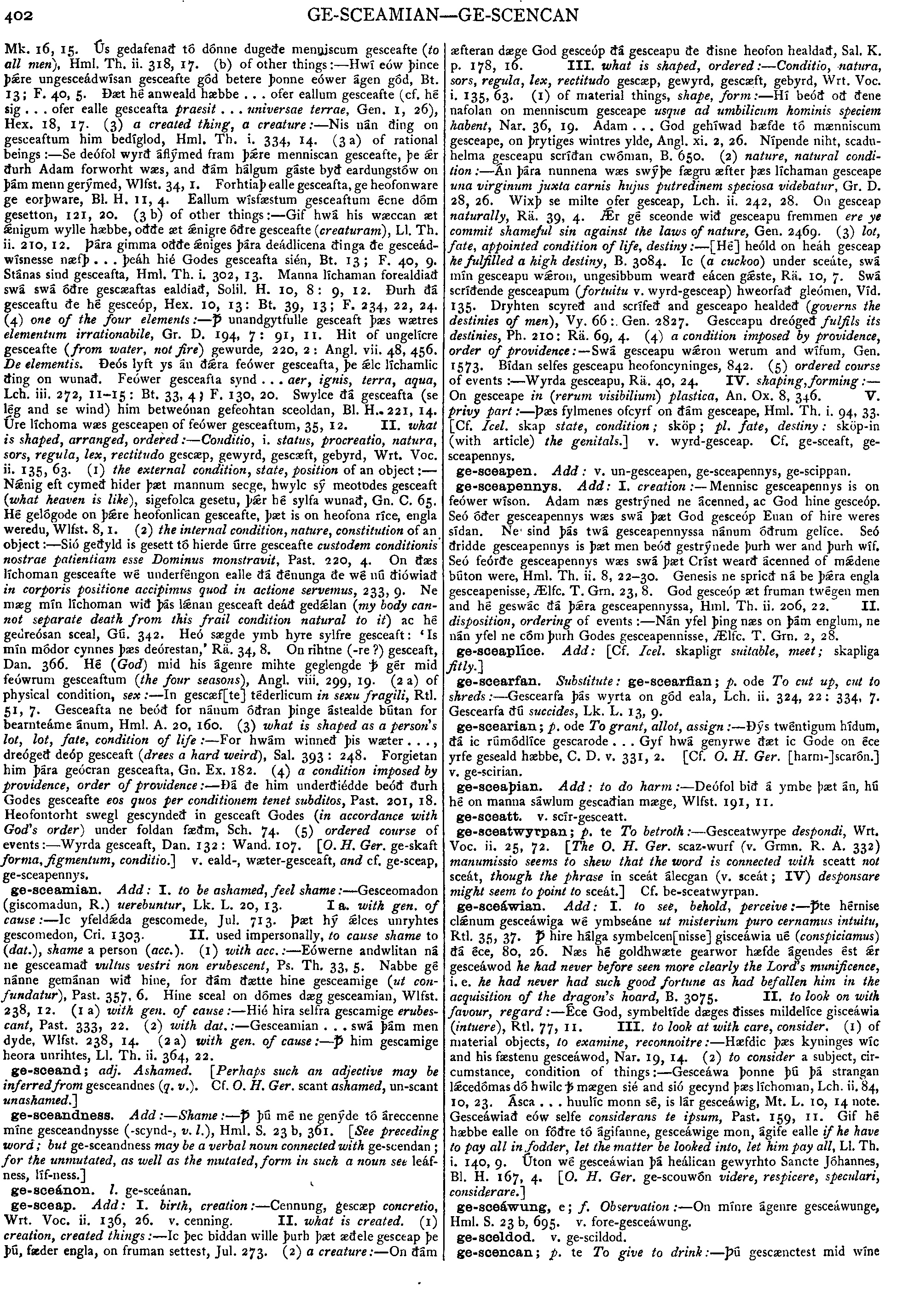
Mk.
16,
15.
Ús
gedafenað
tó
dónne
dugeðe
mennjscum
gesceafte
(to
all
men).
Hml.
Th.
ii.
318,
17.
(b)
of
other
things
:--
Hwí
eów
þince
þre
ungesceadwísan
gesceafte
gód
betere
þonne
eówer
ágen
gód,
Bt.
13;
F.
40,
5.
Ðæt
hé
anweald
hæbbe
.
.
.
ofer
eallum
gesceafte
(cf.
hé
sig
.
.
.
ofer
ealle
gesceafta
praesit
.
.
.
universae
terrae,
Gen.
l,
26),
Hex.
18,
17.
(3)
a
created
thing,
a
creature
:--
Nis
nán
ðing
on
gesceaftum
him
bedíglod,
Hml.
Th.
i.
334,
14.
(3
a)
of
rational
beings
:--
Se
deófol
wyrð
áflýmed
fram
þre
menniscan
gesceafte,
þe
r
ðurh
Adam
forworht
wæs,
and
ðám
hálgum
gáste
byð
eardungstów
on
þám
menn
gerýmed,
Wlfst.
34,
I.
Forhtiaþ
ealle
gesceafta,
ge
heofonware
ge
eorþware,
Bl.
H.
n,
4.
Eallum
wísfæstum
gesceaftum
écne
dóm
gesetton,
121,
20.
(3
b)
of
other
things
:--
Gif
hwá
his
wæccan
æt
ænigum
wylle
hæbbe,
oððe
æt
ænigre
óðre
gesceafte
(creaturam),
Ll.
Th.
ii.
210,
12.
Þára
gimma
oððe
niges
þára
deádlicena
ðinga
ðe
gesceádwísnesse
næfþ
.
.
.
þeáh
hié
Godes
gesceafta
sién,
Bt.
13;
F.
40,
9.
Stánas
sind
gesceafta,
Hml.
Th.
i.
302,
13.
Manna
líchaman
forealdiað
swá
swá
óðre
gescæaftas
ealdiað,
Solil.
H.
10,
8:
9,
12.
Ðurh
ðá
gesceaftu
ðe
hé
gesceóp,
Hex.
10,
13:
Bt.
39,
13;
F.
234,
22,
24.
(4)
one
of
the
four
elements
:--
Þ
UNCERTAIN
unandgytfulle
gesceaft
þæs
wætres
elementum
irratiortabile,
Gr.
D.
194,
7:
91,
II.
Hit
of
ungelícre
gesceafte
(from
water,
not
fire)
gewurde,
220,
2:
Angl.
vii.
48,
456.
De
elementis.
Ðeós
lyft
ys
án
ðra
feówer
gesceafta,
þe
lc
líchamlic
ðing
on
wunað.
Feówer
gesceafta
synd
.
.
.
aer,
ignis,
terra,
aqua,
Lch.
iii.
272,
11-15
:
Bt.
33,
43
F.
130,
20.
Swylce
ðá
gesceafta
(se
lég
and
se
wind)
him
betweónan
gefeohtan
sceoldan,
Bl.
H.
.
221,
14.
Úre
líchoma
wæs
gesceapen
of
feówer
gesceaftum,
35,
12.
II.
what
is
shaped,
arranged,
ordered
:--
Conditio,
i.
status,
procreatio,
natura,
sors,
regtila,
lex,
rectitudo
gescæp,
gewyrd,
gescæft,
gebyrd,
Wrt.
Voc.
ii.
135,
63.
(l)
the
external
condition,
state,
position
of
an
object
:--
Nnig
eft
cymeð
hider
þæt
mannum
secge,
hwylc
sý
meotodes
gesceaft
(what
heaven
is
like),
sigefolca
gesetu,
þr
hé
sylfa
wunað,
Gn.
C.
65.
Hé
gelógode
on
þre
heofonlican
gesceafte,
þæt
is
on
heofona
ríce,
engla
weredu,
Wlfst.
8,
l.
(2)
the
internal
condition,
nature,
constitution
of
an
object
:--
Sió
geðyld
is
gesett
tó
hierde
úrre
gesceafte
custodem
conditionis
nostrae
patientiam
esse
Dominus
monstravit,
Past.
220,
4.
On
ðæs
líchoman
gesceafte
wé
underféngon
ealle
ðá
ðénunga
ðe
wé
nú
ðiówiað
in
corporis
positione
accipimus
quod
in
actione
servemus,
233,
9.
Ne
mæg
mín
líchoman
wið
þás
lnan
gesceaft
deáð
gedlan
(my
body
cannot
separate
death
from
this
frail
condition
natural
to
it)
ac
hé
geureósan
sceal,
Gú.
342.
Heó
sægde
ymb
hyre
sylfre
gesceaft:
Is
mín
módor
cynnes
þæs
deórestan,
Rä.34,
8.
On
rihtne
(-re
?)
gesceaft,
Dan.
366.
Hé
(God)
mid
his
ágenre
mihte
geglengde
 gér
mid
feówrum
gesceaftum
(the
four
seasons),
Angl.
viii.
299,
19.
(2
a)
of
physical
condition,
sex
:--
In
gescæf[te]
téderlicum
in
sexu
fragili,
Rtl.
51,
7.
Gesceafta
ne
beóð
for
nánum
oðran
þinge
ástealde
bútan
for
bearnteáme
ánum,
Hml.
A.
20,
160.
(3)
what
is
shaped
as
a
persons
lot,
lot,
fate,
condition
of
life
:--
For
hwám
winneð
þis
wæter
.
.
.,
dreógeð
deóp
gesceaft
(drees
a
hard
weird),
Sal.
393
:
248.
Forgietan
him
þára
geócran
gesceafta,
Gn.
Ex.
182.
(4)
a
condition
imposed
by
providence,
order
of
providence
:--
Ðá
ðe
him
underðiédde
beóð
ðurh
Godes
gesceafte
eos
quos
per
conditionem
tenet
subditos,
Past.
201,
18.
Heofontorht
swegl
gescyndeð
in
gesceaft
Godes
(in
accordance
with
God's
order]
under
foldan
fæðm,
Sch.
74.
(5)
ordered
course
of
events
:--
Wyrda
gesceaft,
Dan.
132:
Wand.
107.
[O.H.Ger.
ge-skaft
forma,
figmentum,
conditio.
"]
v.
eald-,
wæter-gesceaft,
and
cf.
ge-sceap,
ge-sceapennys.
gér
mid
feówrum
gesceaftum
(the
four
seasons),
Angl.
viii.
299,
19.
(2
a)
of
physical
condition,
sex
:--
In
gescæf[te]
téderlicum
in
sexu
fragili,
Rtl.
51,
7.
Gesceafta
ne
beóð
for
nánum
oðran
þinge
ástealde
bútan
for
bearnteáme
ánum,
Hml.
A.
20,
160.
(3)
what
is
shaped
as
a
persons
lot,
lot,
fate,
condition
of
life
:--
For
hwám
winneð
þis
wæter
.
.
.,
dreógeð
deóp
gesceaft
(drees
a
hard
weird),
Sal.
393
:
248.
Forgietan
him
þára
geócran
gesceafta,
Gn.
Ex.
182.
(4)
a
condition
imposed
by
providence,
order
of
providence
:--
Ðá
ðe
him
underðiédde
beóð
ðurh
Godes
gesceafte
eos
quos
per
conditionem
tenet
subditos,
Past.
201,
18.
Heofontorht
swegl
gescyndeð
in
gesceaft
Godes
(in
accordance
with
God's
order]
under
foldan
fæðm,
Sch.
74.
(5)
ordered
course
of
events
:--
Wyrda
gesceaft,
Dan.
132:
Wand.
107.
[O.H.Ger.
ge-skaft
forma,
figmentum,
conditio.
"]
v.
eald-,
wæter-gesceaft,
and
cf.
ge-sceap,
ge-sceapennys.
|
Source: Bright's OE Grammar, page b0383, entry 18 View original page image as: [TIFF] [PNG] [View previous entry] [View next entry] |
[Comment on this entry] [View comments] |
The following entry has been hand-corrected once. |
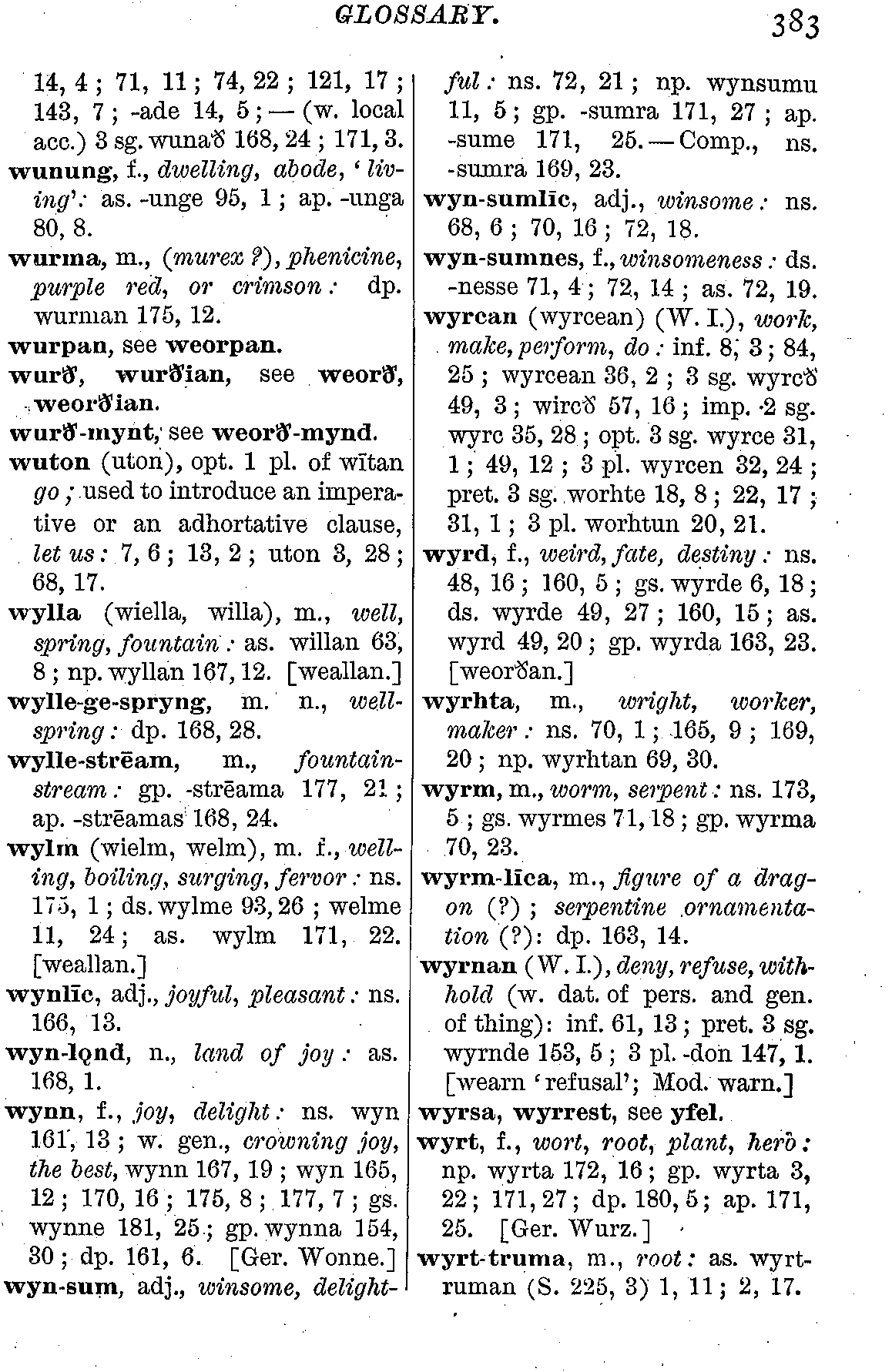
|
Source: Cleasby/Vigfusson, page b0078, entry 3 View original page image as: [TIFF] [PNG] [View previous entry] [View next entry] |
[Comment on this entry] [View comments] |
The following entry has been hand-corrected once. |
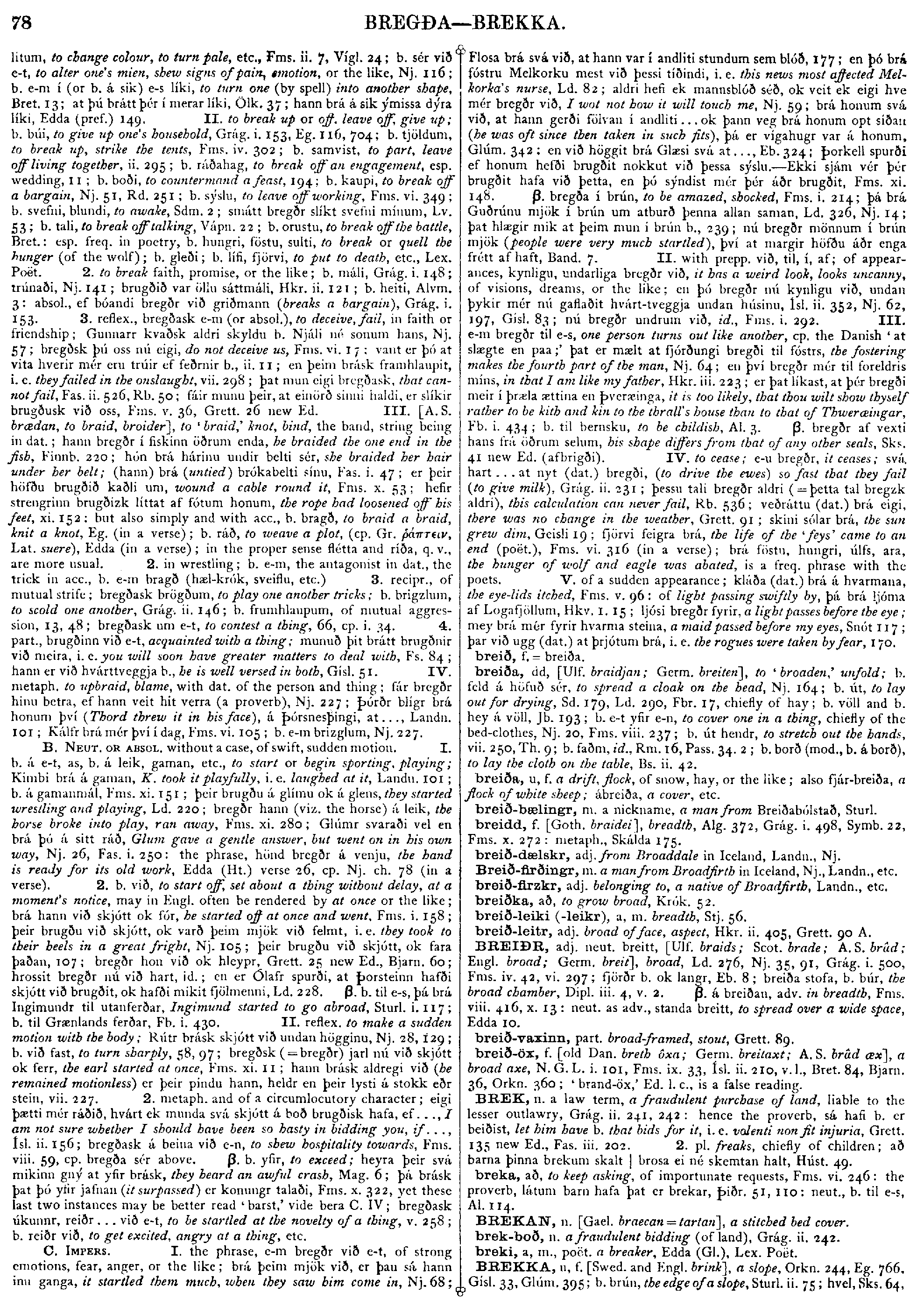
C.
IMPERS.
I.
the
phrase,
e-m
bregðr
við
e-t,
of
strong
emotions,
fear,
anger,
or
the
like;
brá
þeim
mjök
við,
er
þau
sá
hann
inn
ganga,
it
startled
them
much,
when
they
saw
him
come
in,
Nj.
68;
Flosa
brá
svá
við,
at
hann
var
í
andliti
stundum
sem
blóð,
177;
en
þó
brá
fóstru
Melkorku
mest
við
þessi
tíðindi,
i.e.
this
news
most
affected
Melkorka's
nurse,
Ld.
82;
aldri
hefi
ek
mannsblóð
séð,
ok
veit
ek
eigi
hve
mér
bregðr
við,
I
wot
not
how
it
will
touch
me,
Nj.
59;
brá
honum
svá
við,
at
hann
gerði
fölvan
í
andliti
...
ok
þann
veg
brá
honum
opt
síðan
(he
was
oft
since
then
taken
in
such
fits),
þá
er
vígahugr
var
á
honum,
Glúm.
342;
en
við
höggit
brá
Glæsi
svá
at
...,
Eb.
324;
Þorkell
spurði
ef
honum
hefði
brugðit
nokkut
við
þessa
sýslu.--Ekki
sjám
vér
þér
brugðit
hafa
við
þetta,
en
þó
sýndist
mér
þér
áðr
brugðit,
Fms.
xi.
148.
 .
bregða
í
brún,
to
be
amazed,
shocked,
Fms.
i.
214;
þá
brá
Guðrúnu
mjök
í
brún
um
atburð
þenna
allan
saman,
Ld.
326,
Nj.
14;
þat
hlægir
mik
at
þeim
mun
í
brún
b.,
239;
nú
bregðr
mönnum
í
brún
mjök
(people
were
very
much
startled),
því
at
margir
höfðu
áðr
enga
frétt
af
haft,
Band.
7.
II.
with
prepp.
við,
til,
í,
af;
of
appearances,
kynligu,
undarliga
bregðr
við,
it
has
a
weird
look,
looks
uncanny,
of
visions,
dreams,
or
the
like;
en
þó
bregðr
nú
kynligu
við,
undan
þykir
mér
nú
gaflaðit
hvárt-tveggja
undan
húsinu,
Ísl.
ii.
352,
Nj.
62,
197,
Gísl.
83;
nú
bregðr
undrum
við,
id.,
Fms.
i.
292.
III.
e-m
bregðr
til
e-s,
one
person
turns
out
like
another,
cp.
the
Danish
'at
slægte
en
paa;'
þat
er
mælt
at
fjórðungi
bregði
til
fóstrs,
the
fostering
makes
the
fourth
part
of
the
man,
Nj.
64;
en
því
bregðr
mér
til
foreldris
míns,
in
that
I
am
like
my
father,
Hkr.
iii.
223;
er
þat
líkast,
at
þér
bregði
meir
í
þræla
ættina
en
Þveræinga,
it
is
too
likely,
that
thou
wilt
show
thyself
rather
to
be
kith
and
kin
to
the
thrall's
house
than
to
that
of
Thweræingar,
Fb.
i.
434;
b.
til
bernsku,
to
be
childish,
Al.
3.
.
bregðr
af
vexti
hans
frá
öðrum
selum,
his
shape
differs
from
that
of
any
other
seals,
Sks.
41
new
Ed.
(afbrigði).
IV.
to
cease;
e-u
bregðr,
it
ceases;
svá
hart
...
at
nyt
(dat.)
bregði,
(to
drive
the
ewes)
so
fast
that
they
fail
(to
give
milk),
Grág.
ii.
231;
þessu
tali
bregðr
aldri
(=
þetta
tal
bregzk
aldri),
this
calculation
can
never
fail,
Rb.
536;
veðráttu
(dat.)
brá
eigi,
there
was
no
change
in
the
weather,
Grett.
91;
skini
sólar
brá,
the
sun
grew
dim,
Geisü
19;
fjörvi
feigra
brá,
the
life
of
the
'feys'
came
to
an
end
(poët.),
Fms.
vi.
316
(in
a
verse);
brá
föstu,
hungri,
úlfs,
ara,
the
hunger
of
wolf
and
eagle
was
abated,
is
a
freq.
phrase
with
the
poets.
V.
of
a
sudden
appearance;
kláða
(dat.)
brá
á
hvarmana,
the
eye-lids
itched,
Fms.
v.
96:
of
light
passing
swiftly
by,
þá
brá
ljóma
af
Logafjöllum,
Hkv.
1.
15;
ljósi
bregðr
fyrir,
a
light
passes
before
the
eye;
mey
brá
mér
fyrir
hvarma
steina,
a
maid
passed
before
my
eyes,
Snót
117;
þar
við
ugg
(dat.)
at
þrjótum
brá,
i.e.
the
rogues
were
taken
by
fear,
170.
.
bregða
í
brún,
to
be
amazed,
shocked,
Fms.
i.
214;
þá
brá
Guðrúnu
mjök
í
brún
um
atburð
þenna
allan
saman,
Ld.
326,
Nj.
14;
þat
hlægir
mik
at
þeim
mun
í
brún
b.,
239;
nú
bregðr
mönnum
í
brún
mjök
(people
were
very
much
startled),
því
at
margir
höfðu
áðr
enga
frétt
af
haft,
Band.
7.
II.
with
prepp.
við,
til,
í,
af;
of
appearances,
kynligu,
undarliga
bregðr
við,
it
has
a
weird
look,
looks
uncanny,
of
visions,
dreams,
or
the
like;
en
þó
bregðr
nú
kynligu
við,
undan
þykir
mér
nú
gaflaðit
hvárt-tveggja
undan
húsinu,
Ísl.
ii.
352,
Nj.
62,
197,
Gísl.
83;
nú
bregðr
undrum
við,
id.,
Fms.
i.
292.
III.
e-m
bregðr
til
e-s,
one
person
turns
out
like
another,
cp.
the
Danish
'at
slægte
en
paa;'
þat
er
mælt
at
fjórðungi
bregði
til
fóstrs,
the
fostering
makes
the
fourth
part
of
the
man,
Nj.
64;
en
því
bregðr
mér
til
foreldris
míns,
in
that
I
am
like
my
father,
Hkr.
iii.
223;
er
þat
líkast,
at
þér
bregði
meir
í
þræla
ættina
en
Þveræinga,
it
is
too
likely,
that
thou
wilt
show
thyself
rather
to
be
kith
and
kin
to
the
thrall's
house
than
to
that
of
Thweræingar,
Fb.
i.
434;
b.
til
bernsku,
to
be
childish,
Al.
3.
.
bregðr
af
vexti
hans
frá
öðrum
selum,
his
shape
differs
from
that
of
any
other
seals,
Sks.
41
new
Ed.
(afbrigði).
IV.
to
cease;
e-u
bregðr,
it
ceases;
svá
hart
...
at
nyt
(dat.)
bregði,
(to
drive
the
ewes)
so
fast
that
they
fail
(to
give
milk),
Grág.
ii.
231;
þessu
tali
bregðr
aldri
(=
þetta
tal
bregzk
aldri),
this
calculation
can
never
fail,
Rb.
536;
veðráttu
(dat.)
brá
eigi,
there
was
no
change
in
the
weather,
Grett.
91;
skini
sólar
brá,
the
sun
grew
dim,
Geisü
19;
fjörvi
feigra
brá,
the
life
of
the
'feys'
came
to
an
end
(poët.),
Fms.
vi.
316
(in
a
verse);
brá
föstu,
hungri,
úlfs,
ara,
the
hunger
of
wolf
and
eagle
was
abated,
is
a
freq.
phrase
with
the
poets.
V.
of
a
sudden
appearance;
kláða
(dat.)
brá
á
hvarmana,
the
eye-lids
itched,
Fms.
v.
96:
of
light
passing
swiftly
by,
þá
brá
ljóma
af
Logafjöllum,
Hkv.
1.
15;
ljósi
bregðr
fyrir,
a
light
passes
before
the
eye;
mey
brá
mér
fyrir
hvarma
steina,
a
maid
passed
before
my
eyes,
Snót
117;
þar
við
ugg
(dat.)
at
þrjótum
brá,
i.e.
the
rogues
were
taken
by
fear,
170.
|
Source: Cleasby/Vigfusson, page b0097, entry 4 View original page image as: [TIFF] [PNG] [View previous entry] [View next entry] |
[Comment on this entry] [View comments] |
The following entry has not been hand-corrected. However, the page is reserved and someone is correcting it. |
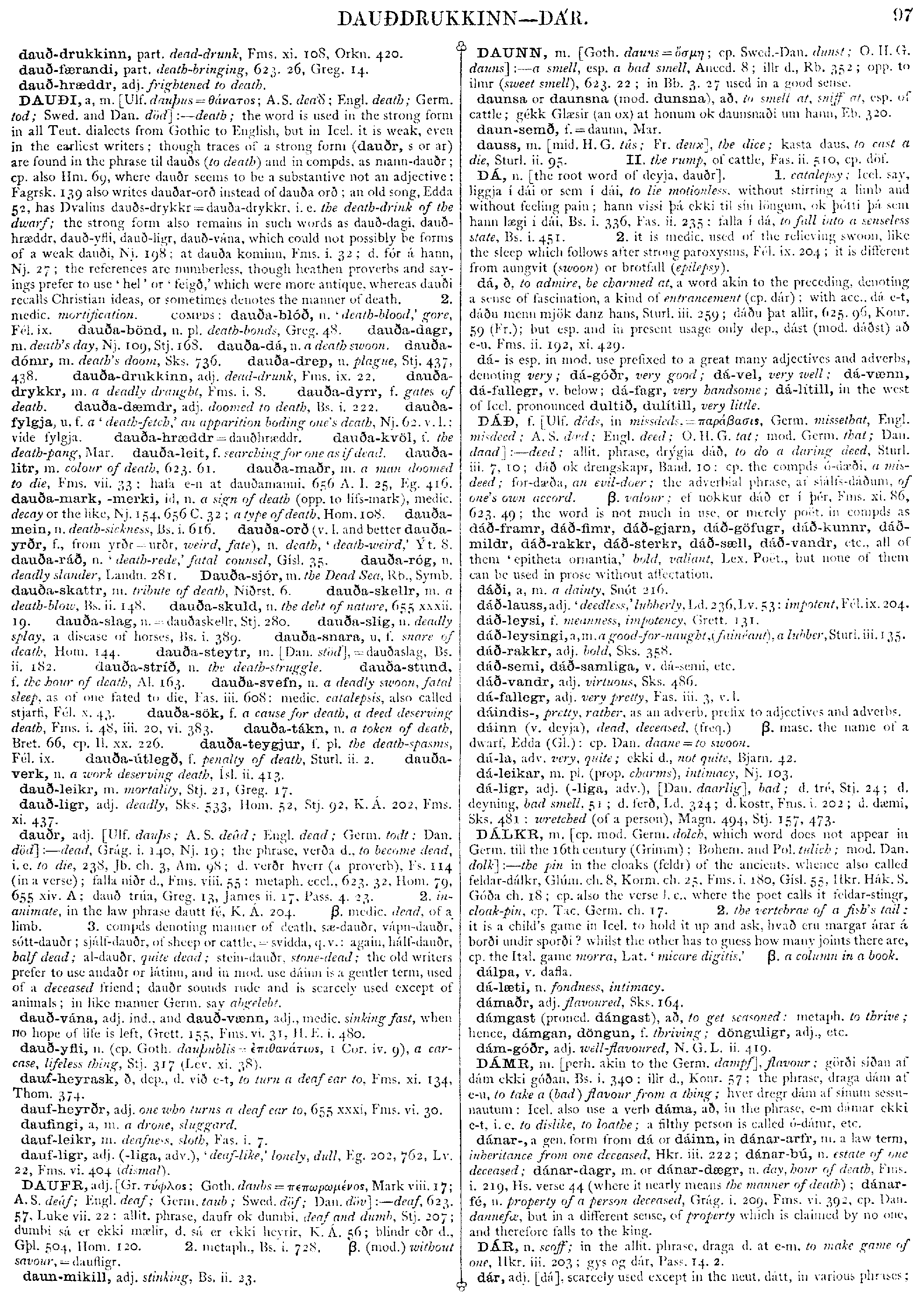
DAUÐI, a, m. [Ulf. dauþits = Oávaros; A. S. d c a'S; Engl. death; Germ. to d; Swed. and Dan. dö d] :-- death; the word is used in the strong form in all Teut. dialects from Gothic to English, but in Icel. it is weak, even in the eaj-licst writers; though traces of a strong form (dauðr, s or ar) are found in the phrase til dauðs (to death) and in compds, as mann-dauðr: cp. also Hm. 69, where dauðr seems to be a substantive not an adjective: Fagrsk. 139 also writes dauðar-orð instead of dauða orð; an old song, Edda 52, has Dvalins dauðs-drykkr = dauða-drykkr, i. e. the death-drink of the dwarf; the strong form also remains in such words as dauð-dagi, danð- hræddr, dauð-yfii, dauð-ligr, dauð-vána, which could not possibly be forms of a weak daudi, Nj. 198; at dauða kominn, Fms. i. 32; d. for a hann, Nj. 27; the references are numberless, though heathen proverbs and say- ings prefer to use ' hel' or ' feigð, ' which were more antique, whereas dauoi recalls Christian ideas, or sometimes denotes the manner of death. 2. medic, mortification. COMVDS: dauða-blóð, n. ' death-blood, ' gore, Fe'L ix. dauða-bönd, n. pl. death-bonds, Greg. 48. dauða-dagr, m. death's day, Nj. 109, Stj. 168. dauða-dá, n. a death swoon, dauða- dónir, m. death's doom, Sks. 736. dauða-drep, \. plagne, Stj. 437, 438. dauða-drukkinn, adj. dead-drunk, Fms. ix. 22. cïaiiða- drykkr, in. a deadly draught, Fms. i. 8. dauða-dyrr, f. gates of death. dauða-dæmdr, adj. doomed to death, Us. i. 222. dauôa- fylgja, u. f. a ' death-fetch' an apparition boding one's death, Ni. 62. v. 1.: vide fylgja. dauða-hrœddr -- dauðhræddr. clauða-kvöl, f. the death-pang, Mar. dauða-leit, f. searching for one as if dead. dauða- litr, m. colour of death. 623. 61. dauða-maðr, in. a man (loomed to die, Fms. vii. 33; hafa e-n at dauðamanni. 656 A. I. 25, Eg. 416. dauða-mark, -merki, id, n. a sign of death (opp. to lifs-mark), medic. de c a y or the like, Nj. 154, 656 C. 32; a type of death, Hom. 108. dauða- mein, n. death- si c k H e ss, Bs. i. 616. dauða-orð (v. 1. and better dauða- yrðr, f., from yrðr- urör, weird, fate), n. death, ' dea/h-weird, ' Ýt. 8. dauða-ráð, n. ' death-rede, ' fatal counsel, Gísl. 35. dauða-róg, n. deadly slander, Laiuln. 281. Dauða-sjór, m. the Dead Sea-. Rb., Symb. dauöa-skattr, m. tribute of death, Niðrst. 6. dauða-skellr, m. a death-blow, 15s. ii. 148. dauða-skuld, n. the debt of nature, 655 xxxii. 19. dauða-slag, n. -- -dauðaskellr, Stj. 280. daxiða-slig, n. deadly splay, a disease of horses, 15s. i. 389. dauða-snara, u, f. swa;v of death, Hom. 144. dauða-steytr, in. [Dan. stö d], = dauðaslag, Bs. ii. 182. dauða-stríð, n. the death-struggle. dauða-stund, f. the hour of death, Al. 163. dauða-svefn, n. a deadly swoon, fatal deep, as of one fated to die, Fas. iii. 608: medic, catalepsis, also called stjarti, Fiji. . x. 43. dauða-sök, f. a cause for death, a deed deserving death, Fms. i. 48, iii. 20, vi. 383. dauða-tákn, n. a token of death, Bret. 66, cp. 11. xx. 226. datiða-teygjur, f. pl. the death-spasms, Fél. ix. dauða-útlegð, f. penalty of death, Sturl. ii. 2. dauða- verk, n. a ivork deserving death, (si. ii. 413.
|
Source: Cleasby/Vigfusson, page b0101, entry 39 View original page image as: [TIFF] [PNG] [View previous entry] [View next entry] |
[Comment on this entry] [View comments] |
The following entry has not been hand-corrected. However, the page is reserved and someone is correcting it. |
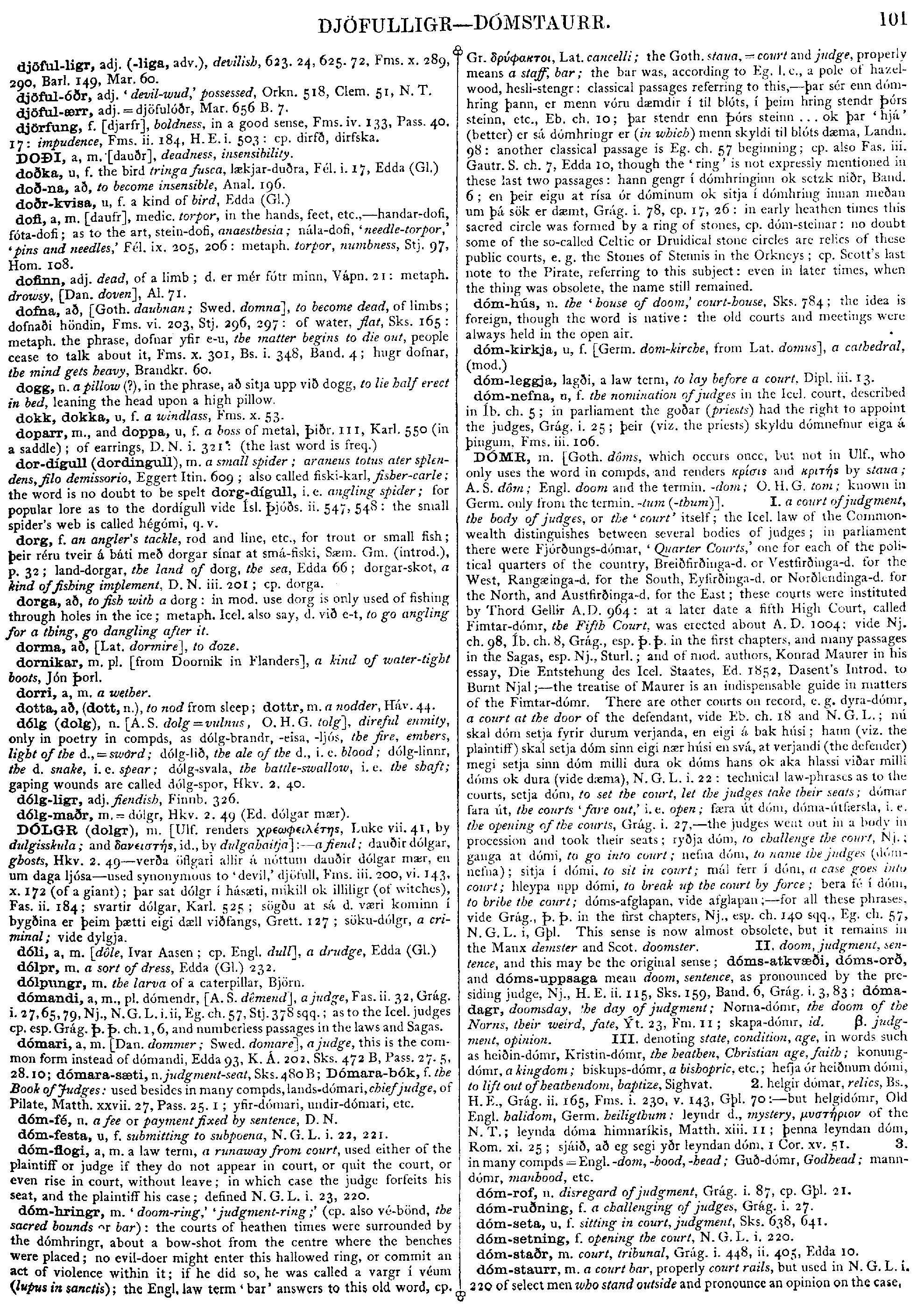
DÓMR, in. [Goth, dams, which occurs once, but not in Ulf., vvho only uses the word in compds, and renders Kpiais and Kptrris by siaua; A. S. dôm; F, ngl. d oow and the termin. -dom; O. H. G. torn; known in Germ, only from the termin. -turn (-thum)'] . I. a court of judgment, the body of judges, or the 'court' itself; the Icel. law of the Common- wealth distinguishes between several bodies of judges; in parliament there were Fjórðungs-dómar, ' Quarter Courts, ' one for each of the poli- tical quarters of the country, Breiðfirðinga-d. or Vesttirðinga-d. for the West, Rangaeinga-d. for the South, Eyiîrðinga-d. or Norðlendinga-d. lor the North, and Austfirðinga-d. for the East; these courts were instituted by Thord Gellir A. D. 964: at a later date a fifth High Court, called Fimtar-domr, the Fifth Court, was erected about A. D. 1004; vide Nj. ch. 98, íb. ch. 8, Grág., esp. f). fx in the first chapters, and many passages in the Sagas, esp. Nj., Sturl.; and of mod. authors, Konrad Maurer in his essay, Die Entstehung des Icel. Staates, Ed. 1852, Dasent's Introd. to Burnt Njal; -- the treatise of Maurer is an indispensable guide in matters of the Fimtar-domr. There are other courts on record, e. g. dyra-dómr, a court at the door of the defendant, vide Eb. ch. 18 and N. G. L.; mi skal dóm setja fyrir durum verjanda, en eigi á. bak hnsi; hann (viz. the plaintiff) skal setja dóm sinn eigi nær húsi en svá, at verjandi (the defender) megi setja sinn dóm milli dura ok dóms hans ok aka hlassi viðar milli dóms ok dura (vide dæma), N. G. L. i. 22: technical law-phrases as to the courts, setja dom, to set the court, let the judges take their seats; durmr fara lit, the courts 'fare out, ' i. e. open; faera lit dom, dúma-iitfærsla, i. e. the opening of the courts, Grug. i. 27, -- the judges went out in a body in procession and took their seats; ryðja dóm, to challenge the court, Nj.; ganga at dúmi, to go info court; nefna dom, to name the judges (iK'. ui- nefna); sitja í dómi, t o s it in court; múl ferr í dom, a case goes into court; hleypa upp dómi, to break up the court by force; bera K i dóm, to bribe the court; dóms-afglapan, vide afglapan; -- for all these phrase?, vide Grág., |x þ. in the first chapters, Nj., esp. ch. 140 sqq., Eg. ch. 57, N. G. L. i, Gþl. This sense is now almost obsolete, but it remains in the Manx demster and Scot, dooinster. II. doom, judgment, sen- tence, and this may be the original sense; dóms-atkvæði, dóms-orð, and dóms-uppsaga mean doom, sentence, as pronounced by the pre- siding judge, Nj., H. E. ii. 115, Sks. 159, Band. 6, Grág. i. 3, 83; dóma- dagr, doomsday, 'he day of judgment; Norna-dómr, the doom of the Norns, their weird, fate, Ýt. 23, Fm. 11; skapa-dómr, id. (3. judg- ment, opinion. III. denoting s t a te, condition, age, in words such as heiðin-dómr, Kristin-dómr, the heathen, Christian age, faith; konung- domr, a kingdom; biskups-dómr, a bishopric, etc.; hefja ór heiðnum dómi, to lift out of heathendom, baptize, Sighvat. 2. helgir dómar, relics, Bs., H. F, ., Grág. ii. 165, Fms. i. 230, v. 143, Gpl. 70 :-- but helgidómr, Old Engl. halidom, Germ, heiligthum: leyndr d., mystery, fjiiaTrjpl. ov of the N. T.; leynda donia hirnnarikis, Matth. xiii. ii; þenna leyndan dom, Rom. xi. 25; sjáið, að eg segi yðr leyndan dom, í Cor. xv. 51. 3. in many compds = Engl. -dom, -hood, -head; Guð-dómr, Godhead; mann- dómr, manhood,
|
Source: Cleasby/Vigfusson, page b0108, entry 16 View original page image as: [TIFF] [PNG] [View previous entry] [View next entry] |
[Comment on this entry] [View comments] |
The following entry has not been hand-corrected. However, the page is reserved and someone is correcting it. |
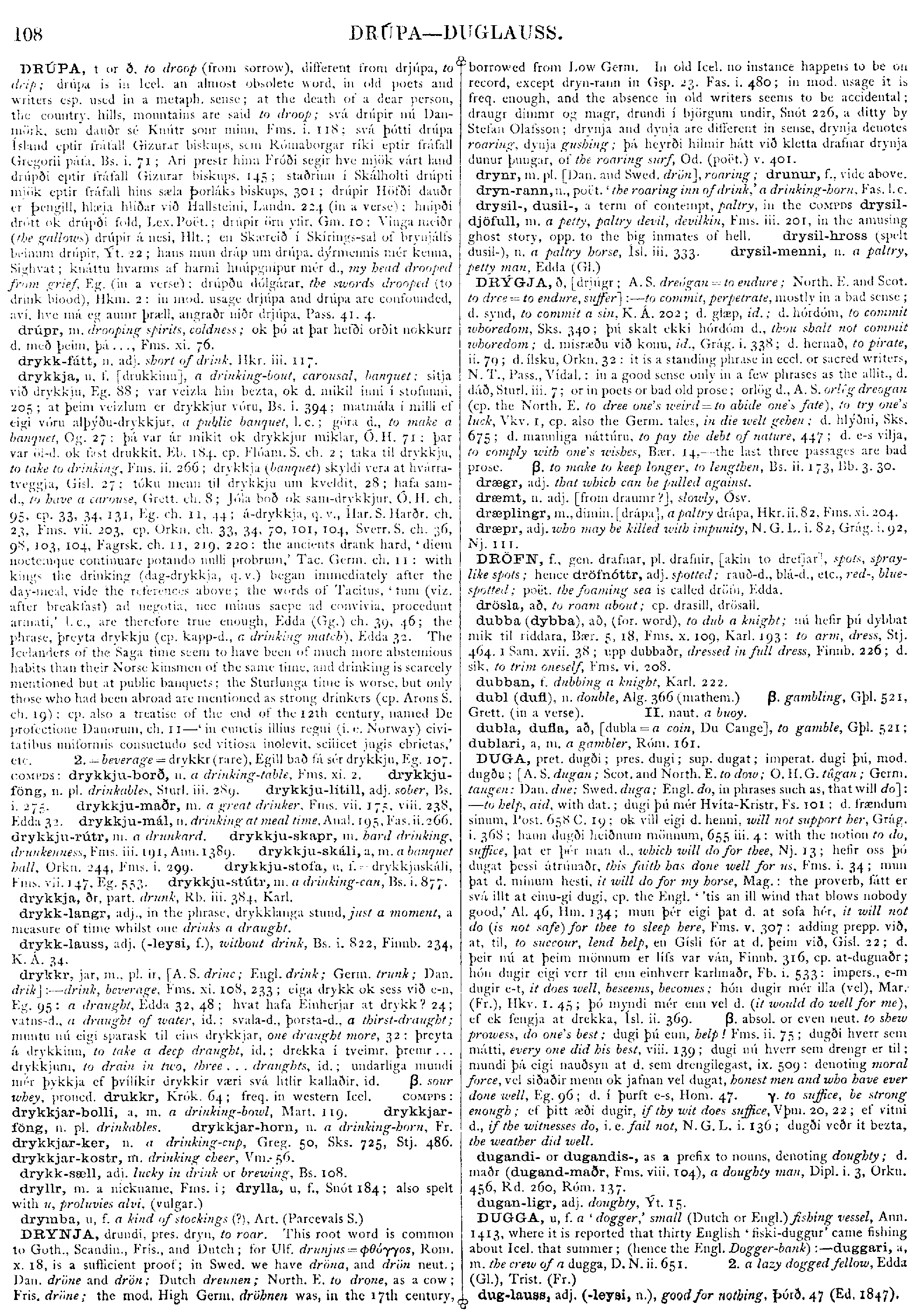
DRÝGJA, ð, j driugr; A. S. dreógan -- -to endure; North. E. and Scot. to dree -- to endure, suffer] :-- to commit, perpetrate, mostly in a bad sense; d. synd, to commit a sin. K. Á. 202; d. giæp, id.; d. hórdóm, to commit whoredom, Sks. 340; þú skalt ekki hórdóin d., thou shall not commit whoredom; d. misræðu við konu, id., Gn'ig. i. 338; d. hernað, to pirate, ii. 70; d. ilsku, Orkn. 32: it is a standing phrase in eccl. or sacred writers, N. T., Pass., Vidal.: in a good sense only in a few phrases as the allit., d. dúð, Sturl. iii. 7; or in poets or bad old prose; orlog d., A. S. orli'g dreogan (cp. the North. E. to dree one's weird -- to abide one's fate), to try one's luck, Vkv. i, cp. also the Germ, tales, in die ivelt gehen; d. hlyðni, Sks. 675; d. mannliga nattiiru, to pay the debt of nature, 447; d. e-s vilja, to comply li-ith one'swi s he s, Bær. 14, -- -the last three passages are bad prose. p. to make to keep longer, to lengthen, Bs. ii. 173, l!b. 3. 30.
|
Source: Cleasby/Vigfusson, page b0147, entry 8 View original page image as: [TIFF] [PNG] [View previous entry] [View next entry] |
[Comment on this entry] [View comments] |
The following entry has been hand-corrected once. |
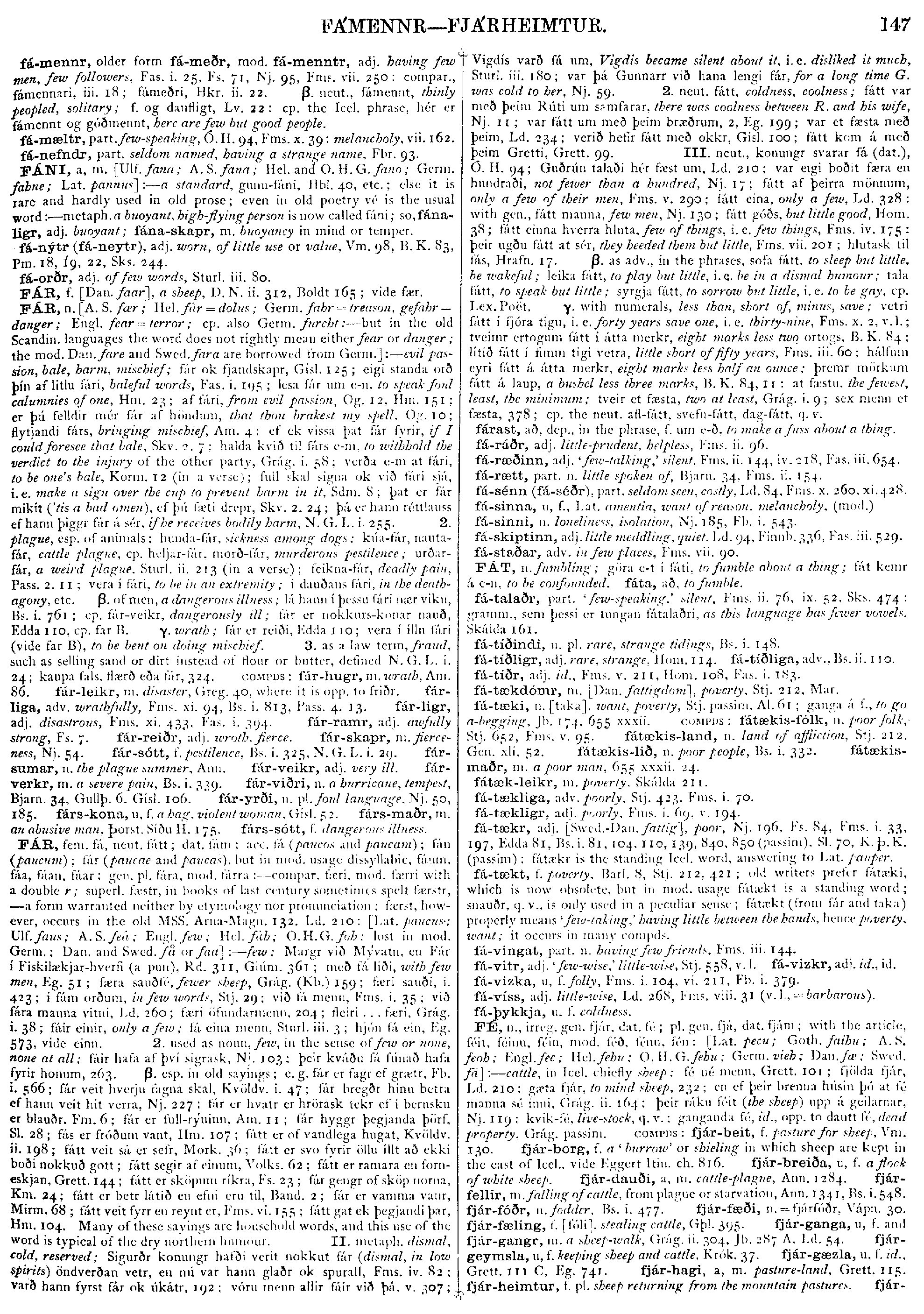
FÁR,
n.
[A.
S.
fær;
Hel.
fâr
=
dolus;
Germ.
fahr
=
treason,
gefahr
=
danger;
Engl.
fear
=
terror;
cp.
also
Germ.
furcht
:--
but
in
the
old
Scandin.
languages
the
word
does
not
rightly
mean
either
fear
or
danger;
the
mod.
Dan.
fare
and
Swed.
fara
are
borrowed
from
Germ.]
:--
evil
passion,
bale,
harm,
mischief;
fár
ok
fjandskapr,
Gísl.
125;
eigi
standa
orð
þín
af
litlu
fári,
baleful
words,
Fas.
i.
195;
lesa
fár
um
e-n,
to
speak
foul
calumnies
of
one,
Hm.
23;
af
fári,
from
evil
passion,
Og.
12.
Hm.
151;
er
þú
felldir
mér
fár
af
höndum,
that
thou
brakest
my
spell,
Og.
10;
flytjandi
fárs,
bringing
mischief,
Am.
4;
ef
ek
vissa
þat
fár
fyrir,
if
I
could
foresee
that
bale,
Skv.
2.
7;
halda
kvið
til
fárs
e-m,
to
withhold
the
verdict
to
the
injury
of
the
other
party,
Grág.
i.
58;
verða
e-m
at
fári,
to
be
one's
bale,
Korm.
12
(in
a
verse);
full
skal
signa
ok
við
fári
sjá,
i.e.
make
a
sign
over
the
cup
to
prevent
harm
in
it,
Sdm.
8;
þat
er
fár
mikit
('tis
a
bad
omen),
ef
þú
fæti
drepr,
Skv.
2.
24;
þá
er
hann
réttlauss
ef
hann
þiggr
fár
á
sér,
if
he
receives
bodily
harm,
N.
G.
L.
i.
255.
2.
plague,
esp.
of
animals;
hunda-fár,
sickness
among
dogs;
kúa-fár,
nauta-fár,
cattle
plague,
cp.
heljar-fár,
morð-fár,
murderous
pestilence;
urðar-fár,
a
weird
plague,
Sturl.
ii.
213
(in
a
verse);
feikna-fár,
deadly
pain,
Pass.
2.
11;
vera
í
fári,
to
be
in
an
extremity;
í
dauðans
fári,
in
the
death-agony,
etc.
.
of
men,
a
dangerous
illness;
lá
hann
í
þessu
fári
nær
viku,
Bs.
i.
761;
cp.
fár-veikr,
dangerously
ill;
fár
er
nokkurs-konar
nauð,
Edda
110,
cp.
far
B.
 .
wrath;
fár
er
reiði,
Edda
110;
vera
í
íllu
fári
(vide
far
B),
to
be
bent
on
doing
mischief.
3.
as
a
law
term,
fraud,
such
as
selling
sand
or
dirt
instead
of
flour
or
butter,
defined
N.
G.
L.
i.
24;
kaupa
fals,
flærð
eða
fár,
324.
COMPDS:
fár-hugr,
m.
wrath,
Am.
86.
fár-leikr,
m.
disaster,
Greg.
40,
where
it
is
opp.
to
friðr.
fár-liga,
adv.
wrathfully,
Fms.
xi.
94,
Bs.
i.
813,
Pass.
4.
13.
fár-ligr,
adj.
disastrous,
Fms.
xi.
433,
Fas.
i.
394.
fár-ramr,
adj.
awfully
strong,
Fs.
7.
fár-reiðr,
adj.
wroth,
fierce.
fár-skapr,
m.
fierceness,
Nj.
54.
fár-sótt,
f.
pestilence,
Bs.
i.
325,
N.
G.
L.
i.
29.
fár-sumar,
n.
the
plague
summer,
Ann.
fár-veikr,
adj.
very
ill.
fár-verkr,
m.
a
severe
pain,
Bs.
i.
339.
fár-viðri,
n.
a
hurricane,
tempest,
Bjarn.
34,
Gullþ.
6,
Gísl.
106.
fár-yrði,
n.
pl.
foul
language,
Nj.
50,
185.
fárs-kona,
u,
f.
a
hag,
violent
woman,
Gísl.
52.
fárs-maðr,
m.
an
abusive
man,
Þorst.
Síðu
H.
175.
fárs-sótt,
f.
dangerous
illness.
.
wrath;
fár
er
reiði,
Edda
110;
vera
í
íllu
fári
(vide
far
B),
to
be
bent
on
doing
mischief.
3.
as
a
law
term,
fraud,
such
as
selling
sand
or
dirt
instead
of
flour
or
butter,
defined
N.
G.
L.
i.
24;
kaupa
fals,
flærð
eða
fár,
324.
COMPDS:
fár-hugr,
m.
wrath,
Am.
86.
fár-leikr,
m.
disaster,
Greg.
40,
where
it
is
opp.
to
friðr.
fár-liga,
adv.
wrathfully,
Fms.
xi.
94,
Bs.
i.
813,
Pass.
4.
13.
fár-ligr,
adj.
disastrous,
Fms.
xi.
433,
Fas.
i.
394.
fár-ramr,
adj.
awfully
strong,
Fs.
7.
fár-reiðr,
adj.
wroth,
fierce.
fár-skapr,
m.
fierceness,
Nj.
54.
fár-sótt,
f.
pestilence,
Bs.
i.
325,
N.
G.
L.
i.
29.
fár-sumar,
n.
the
plague
summer,
Ann.
fár-veikr,
adj.
very
ill.
fár-verkr,
m.
a
severe
pain,
Bs.
i.
339.
fár-viðri,
n.
a
hurricane,
tempest,
Bjarn.
34,
Gullþ.
6,
Gísl.
106.
fár-yrði,
n.
pl.
foul
language,
Nj.
50,
185.
fárs-kona,
u,
f.
a
hag,
violent
woman,
Gísl.
52.
fárs-maðr,
m.
an
abusive
man,
Þorst.
Síðu
H.
175.
fárs-sótt,
f.
dangerous
illness.
| Result Page: | 1 2 3 4 | Next |  |
Germanic Lexicon Project (main page)
This search system was written by
Sean Crist
Please consider
volunteering
to correct the data in these online dictionaries.
No rights reserved. Feel free to use these data in any way you please.