|
|

Search for weard again, using less strict matching (243 results)
|
Source: Bosworth/Toller, page b0853, entry 11 View original page image as: [TIFF] [PNG] [View previous entry] [View next entry] |
[Comment on this entry] [View comments] |
The following entry has been hand-corrected once. |
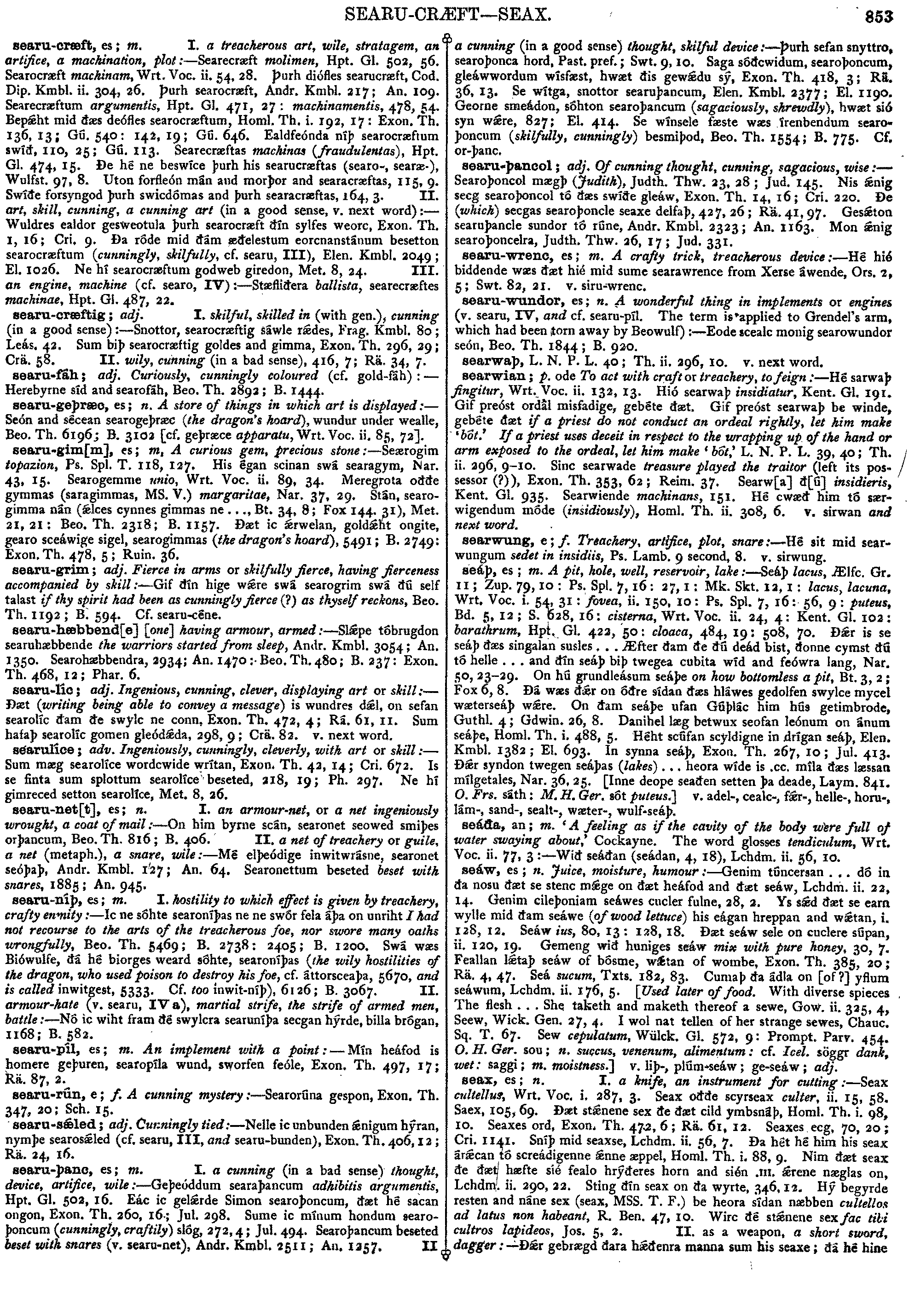
searu-níþ, es; m. I. hostility to which effect is given by treachery, crafty enmity:--Ic ne sóhte searoníþas ne ne swór fela áþa on unriht I had not recourse to the arts of the treacherous foe, nor swore many oaths wrongfully, Beo. Th. 5469; B. 2738: 2405; B. 1200. Swá wæs Biówulfe, ðá hé biorges weard sóhte, searoníþas (the wily hostilities of the dragon, who used poison to destroy his foe, cf. áttorsceaþa, 5670, and is called inwitgest, 5333. Cf. too inwit-níþ), 6126; B. 3067. II. armour-hate (v. searu, IV a), martial strife, the strife of armed men, battle:--Nó ic wiht fram ðé swylcra searuníþa secgan hýrde, billa brógan, 1168; B. 582.
|
Source: Bosworth/Toller, page b0874, entry 11 View original page image as: [TIFF] [PNG] [View previous entry] [View next entry] |
[Comment on this entry] [View comments] |
The following entry has been hand-corrected once. |
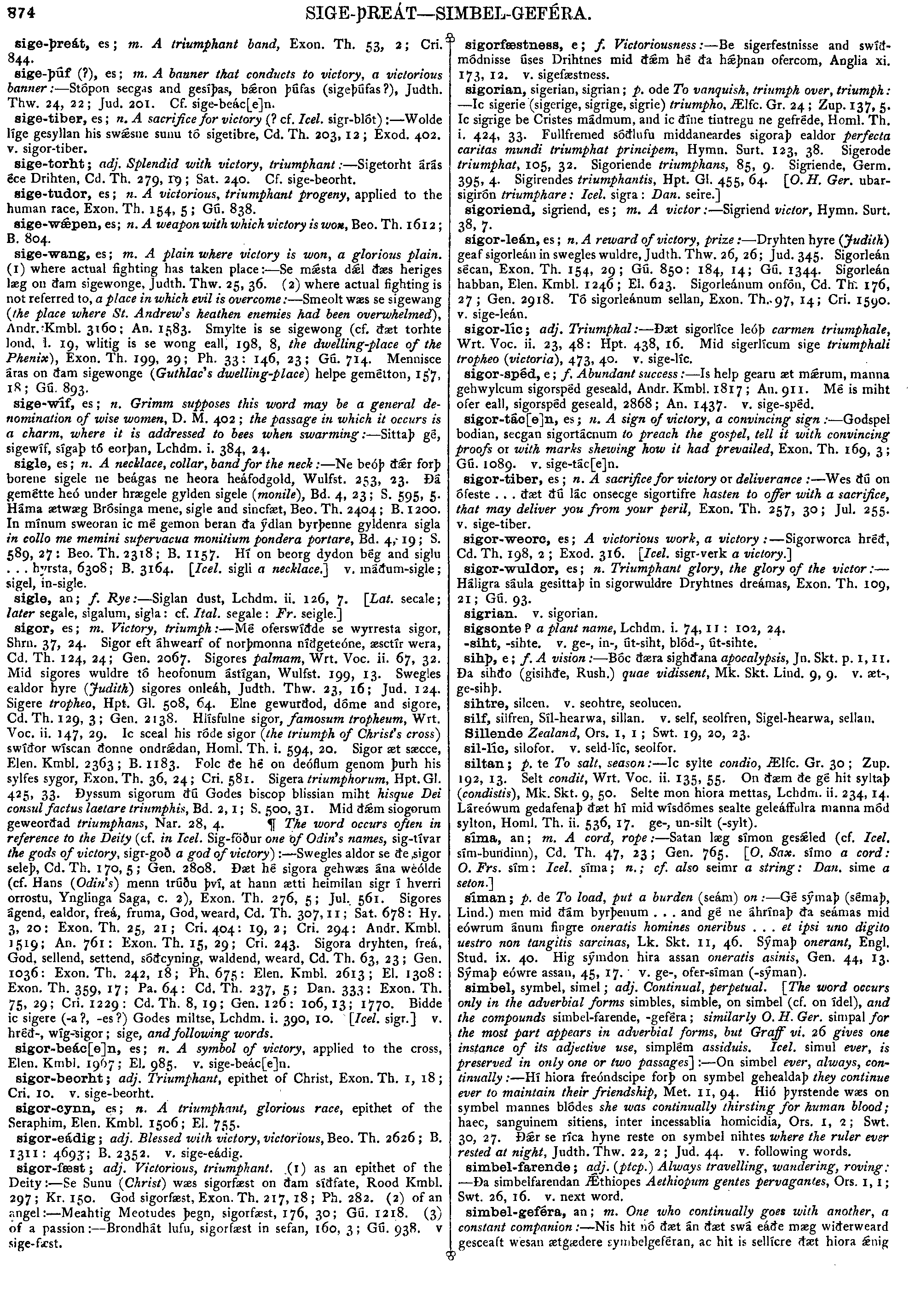
sigor,
es
;
m.
Victory,
triumph
:--Mé
oferswíðde
se
wyrresta
sigor,
Shrn.
37,
24.
Sigor
eft
áhwearf
of
norþmonna
níðgeteóne,
æsctír
wera,
Cd.
Th.
124,
24
;
Gen.
2067.
Sigores
palmam,
Wrt.
Voc.
ii.
67,
32.
Mid
sigores
wuldre
tó
heofonum
ástígan.
Wulfst.
199,
13.
Swegles
ealdor
hyre
(Judith)
sigores
onleáh,
Judth.
Thw.
23,
16
;
Jud.
124.
Sigere
tropheo,
Hpt.
Gl.
508,
64.
Elne
gewurðod,
dóme
and
sigore,
Cd.
Th.
129,
3
;
Gen.
2138.
Hlísfulne
sigor,
famosum
tropheum,
Wrt.
Voc.
ii.
147,
29.
Ic
sceal
his
róde
sigor
(the
triumph
of
Christ's
cross)
swíðor
wíscan
ðonne
ondr dan,
Homl.
Th.
i.
594,
20.
Sigor
æt
sæcce,
Elen.
Kmbl.
2363
;
B.
1183.
Folc
ðe
hé
on
deóflum
genom
þurh
his
sylfes
sygor,
Exon.
Th.
36,
24
;
Cri.
581.
Sigera
triumphorum,
Hpt.
Gl.
425,
33.
Ðyssum
sigorum
ðú
Godes
biscop
blissian
miht
hisque
Dei
consul
factus
laetare
triumphis,
Bd.
2,
1
;
S.
500,
31.
Mid
ðm
siogorum
geweorðad
triumphans,
Nar.
28,
4.
¶The
word
occurs
often
in
reference
to
the
Deity
(cf.
in
Icel.
Sig-föður
one
of
Odin's
names,
sig-tívar
the
gods
of
victory,
sigr-goð
a
god
of
victory)
:--Swegles
aldor
se
ðe
sigor
seleþ,
Cd.
Th.
170,
5
;
Gen.
2808.
Ðæt
hé
sigora
gehwæs
ána
weólde
(cf.
Hans
(Odin's)
menn
trúðu
því,
at
hann
ætti
heimilan
sigr
í
hverri
orrostu,
Ynglinga
Saga,
c.
2),
Exon.
Th.
276,
5
;
Jul.
561.
Sigores
ágend,
ealdor,
freá,
fruma,
God,
weard,
Cd.
Th.
307,
11
;
Sat.
678
:
Hy.
3,
20
:
Exon.
Th.
25,
21
;
Cri.
404
:
19,
2
;
Cri.
294
:
Andr.
Kmbl.
1519
;
An.
761
:
Exon.
Th.
15,
29
;
Cri.
243.
Sigora
dryhten,
freá,
God,
sellend,
settend,
sóðcyning,
waldend,
weard,
Cd.
Th.
63,
23
;
Gen.
1036
:
Exon.
Th.
242,
18
;
Ph.
675
:
Elen.
Kmbl.
2613
;
El.
1308
:
Exon.
Th.
359,
17
;
Pa.
64
:
Cd.
Th.
237,
5
;
Dan.
333
:
Exon.
Th.
75,
29
;
Cri.
1229
:
Cd.
Th.
8,
19
;
Gen.
126
:
106,
13
;
1770.
Bidde
ic
sigere
(-a
?,
-es
?)
Godes
miltse,
Lchdm.
i.
390,
10.
[Icel.
sigr.]
v.
hréð-,
wíg-sigor
;
sige,
and
following
words.
dan,
Homl.
Th.
i.
594,
20.
Sigor
æt
sæcce,
Elen.
Kmbl.
2363
;
B.
1183.
Folc
ðe
hé
on
deóflum
genom
þurh
his
sylfes
sygor,
Exon.
Th.
36,
24
;
Cri.
581.
Sigera
triumphorum,
Hpt.
Gl.
425,
33.
Ðyssum
sigorum
ðú
Godes
biscop
blissian
miht
hisque
Dei
consul
factus
laetare
triumphis,
Bd.
2,
1
;
S.
500,
31.
Mid
ðm
siogorum
geweorðad
triumphans,
Nar.
28,
4.
¶The
word
occurs
often
in
reference
to
the
Deity
(cf.
in
Icel.
Sig-föður
one
of
Odin's
names,
sig-tívar
the
gods
of
victory,
sigr-goð
a
god
of
victory)
:--Swegles
aldor
se
ðe
sigor
seleþ,
Cd.
Th.
170,
5
;
Gen.
2808.
Ðæt
hé
sigora
gehwæs
ána
weólde
(cf.
Hans
(Odin's)
menn
trúðu
því,
at
hann
ætti
heimilan
sigr
í
hverri
orrostu,
Ynglinga
Saga,
c.
2),
Exon.
Th.
276,
5
;
Jul.
561.
Sigores
ágend,
ealdor,
freá,
fruma,
God,
weard,
Cd.
Th.
307,
11
;
Sat.
678
:
Hy.
3,
20
:
Exon.
Th.
25,
21
;
Cri.
404
:
19,
2
;
Cri.
294
:
Andr.
Kmbl.
1519
;
An.
761
:
Exon.
Th.
15,
29
;
Cri.
243.
Sigora
dryhten,
freá,
God,
sellend,
settend,
sóðcyning,
waldend,
weard,
Cd.
Th.
63,
23
;
Gen.
1036
:
Exon.
Th.
242,
18
;
Ph.
675
:
Elen.
Kmbl.
2613
;
El.
1308
:
Exon.
Th.
359,
17
;
Pa.
64
:
Cd.
Th.
237,
5
;
Dan.
333
:
Exon.
Th.
75,
29
;
Cri.
1229
:
Cd.
Th.
8,
19
;
Gen.
126
:
106,
13
;
1770.
Bidde
ic
sigere
(-a
?,
-es
?)
Godes
miltse,
Lchdm.
i.
390,
10.
[Icel.
sigr.]
v.
hréð-,
wíg-sigor
;
sige,
and
following
words.
|
Source: Bosworth/Toller, page b0879, entry 19 View original page image as: [TIFF] [PNG] [View previous entry] [View next entry] |
[Comment on this entry] [View comments] |
The following entry has been hand-corrected once. |
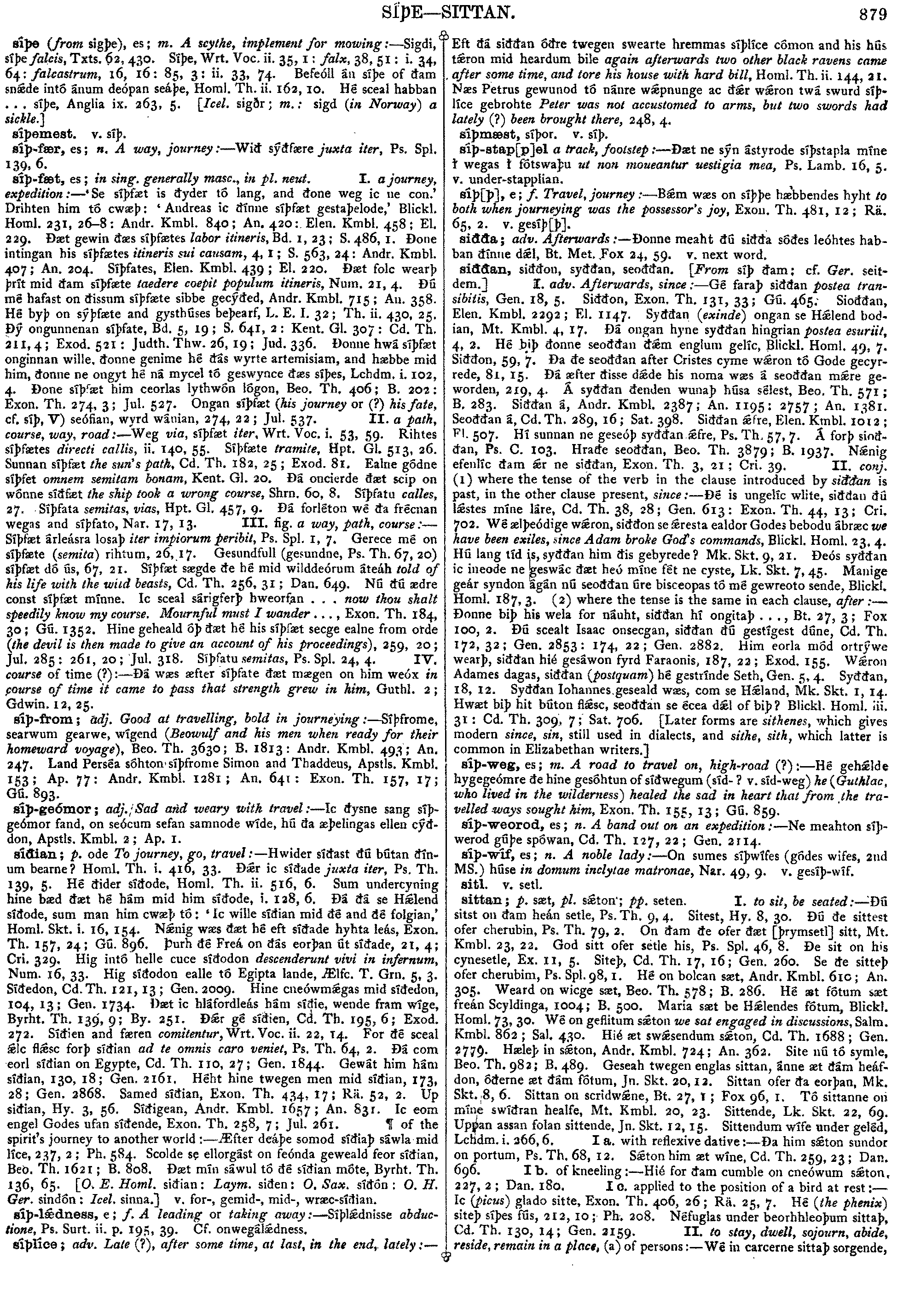
sittan
;
p.
sæt,
pl.
ston
;
pp.
seten.
I.
to
sit,
be
seated
:--Ðú
sitst
on
ðam
heán
setle,
Ps.
Th.
9,
4.
Sitest,
Hy.
8,
30.
Ðú
ðe
sittest
ofer
cherubin,
Ps.
Th.
79,
2.
On
ðam
ðe
ofer
ðæt
[þrymsetl]
sitt.
Mt.
Kmbl.
23,
22.
God
sitt
ofer
setle
his,
Ps.
Spl.
46,
8.
Ðe
sit
on
his
cynesetle,
Ex.
11,
5.
Siteþ,
Cd.
Th.
17,
16
;
Gen.
260.
Se
ðe
sitteþ
ofer
cherubim,
Ps.
Spl.
98,
1.
Hé
on
bolcan
sæt,
Andr.
Kmbl.
610
;
An.
305.
Weard
on
wicge
sæt,
Beo.
Th.
578
;
B.
286.
Hé
æt
fótum
sæt
freán
Scyldinga,
1004
;
B.
500.
Maria
sæt
be
Hlendes
fótum,
Blickl.
Homl.
73,
30.
Wé
on
geflitum
ston
we
sat
engaged
in
discussions,
Salm.
Kmbl.
862
;
Sal.
430.
Hié
æt
swsendum
ston,
Cd.
Th.
1688
;
Gen.
2779.
Hæleþ
in
ston,
Andr.
Kmbl.
724
;
An.
362.
Site
nú
tó
symle,
Beo.
Th.
982
;
B.
489.
Geseah
twegen
englas
sittan,
ánne
æt
ðam
heáf don,
óðerne
æt
ðam
fótum,
Jn.
Skt.
20,
12.
Sittan
ofer
ða
eorþan,
Mk.
Skt.
8,
6.
Sittan
on
scridwne,
Bt.
27,
1
;
Fox
96,
1.
Tó
sittanne
on
míne
swíðran
healfe,
Mt.
Kmbl.
20,
23.
Sittende,
Lk.
Skt.
22,
69.
Uppan
assan
folan
sittende,
Jn.
Skt.
12,
15.
Sittendum
wífe
under
geléd,
Lchdm.
i.
266,
6.
Ia.
with
reflexive
dative
:--Ða
him
ston
sundor
on
portum,
Ps.
Th.
68,
12.
Ston
him
æt
wíne,
Cd.
Th.
259,
23
;
Dan.
696.
Ib.
of
kneeling
:--Hié
for
ðam
cumble
on
cneówum
ston,
227,
2
;
Dan.
180.
Ic.
applied
to
the
position
of
a
bird
at
rest
:--Ic
(picus)
glado
sitte,
Exon.
Th.
406,
26
;
Rä.
25,
7.
Hé
(the
phenix)
siteþ
síþes
fús,
212,
10
;
Ph.
208.
Néfuglas
under
beorhhleoþum
sittaþ,
Cd.
Th.
130,
14
;
Gen.
2159.
II.
to
stay,
dwell,
sojourn,
abide,
reside,
remain
in
a
place,
(a)
of
persons
:--Wé
in
carcerne
sittaþ
sorgende,
don,
óðerne
æt
ðam
fótum,
Jn.
Skt.
20,
12.
Sittan
ofer
ða
eorþan,
Mk.
Skt.
8,
6.
Sittan
on
scridwne,
Bt.
27,
1
;
Fox
96,
1.
Tó
sittanne
on
míne
swíðran
healfe,
Mt.
Kmbl.
20,
23.
Sittende,
Lk.
Skt.
22,
69.
Uppan
assan
folan
sittende,
Jn.
Skt.
12,
15.
Sittendum
wífe
under
geléd,
Lchdm.
i.
266,
6.
Ia.
with
reflexive
dative
:--Ða
him
ston
sundor
on
portum,
Ps.
Th.
68,
12.
Ston
him
æt
wíne,
Cd.
Th.
259,
23
;
Dan.
696.
Ib.
of
kneeling
:--Hié
for
ðam
cumble
on
cneówum
ston,
227,
2
;
Dan.
180.
Ic.
applied
to
the
position
of
a
bird
at
rest
:--Ic
(picus)
glado
sitte,
Exon.
Th.
406,
26
;
Rä.
25,
7.
Hé
(the
phenix)
siteþ
síþes
fús,
212,
10
;
Ph.
208.
Néfuglas
under
beorhhleoþum
sittaþ,
Cd.
Th.
130,
14
;
Gen.
2159.
II.
to
stay,
dwell,
sojourn,
abide,
reside,
remain
in
a
place,
(a)
of
persons
:--Wé
in
carcerne
sittaþ
sorgende,
|
Source: Bosworth/Toller, page b0894, entry 3 View original page image as: [TIFF] [PNG] [View previous entry] [View next entry] |
[Comment on this entry] [View comments] |
The following entry has been hand-corrected once. |
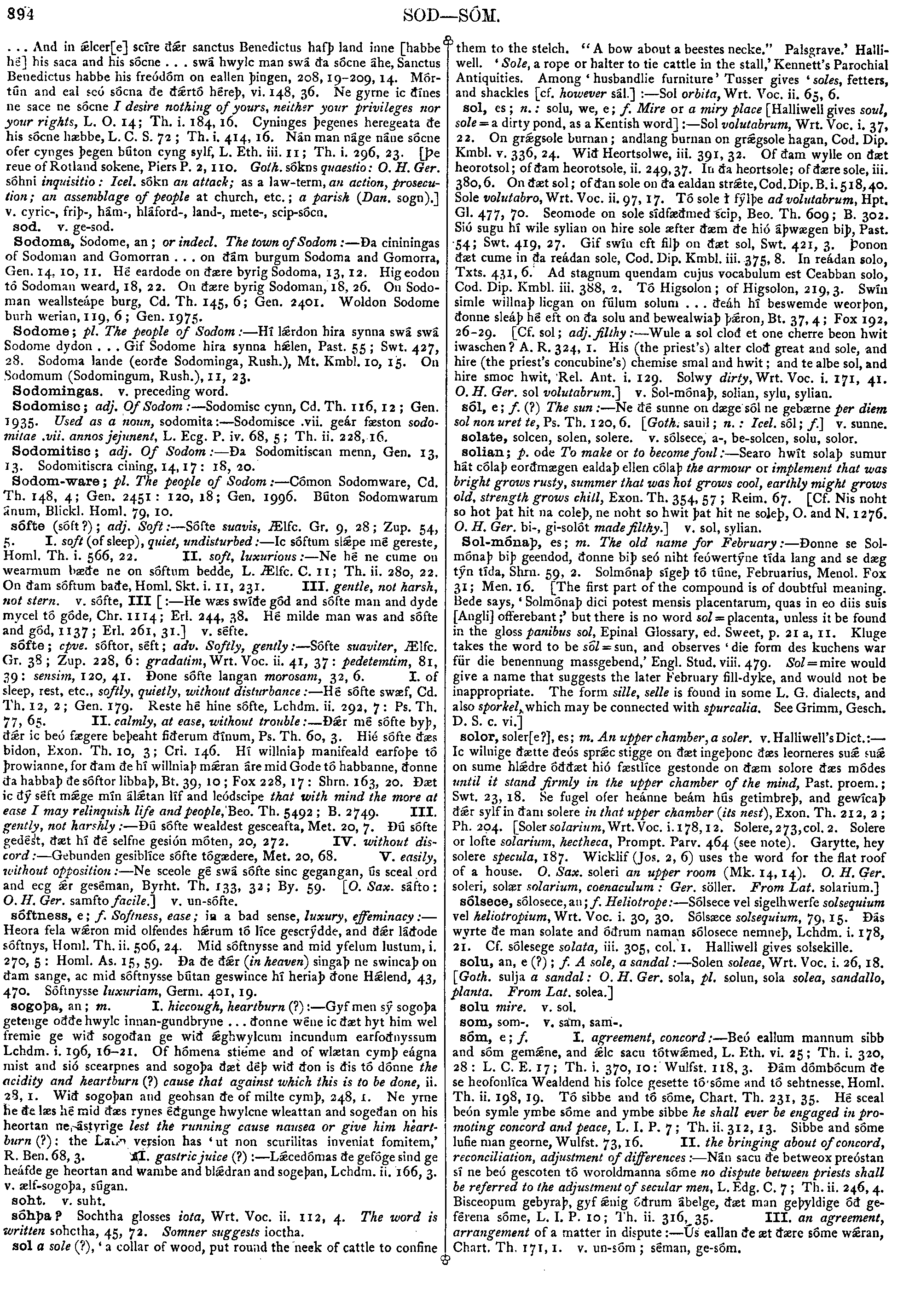
Sodoma, Sodome, an; or indecl. The town of Sodom:--Ða cininingas of Sodoman and Gomorran . . . on ðám burgum Sodoma and Gomorra, Gen. 14, 10, 11. Hé eardode on ðære byrig Sodoma, 13, 12. Hig eodon tó Sodoman weard, 18, 22. On dære byrig Sodoman, 18, 26. On Sodoman weallsteápe burg, Cd. Th. 145, 6; Gen. 2401. Woldon Sodome burh werian, 119, 6; Gen. 1975.
|
Source: Bosworth/Toller, page b0904, entry 19 View original page image as: [TIFF] [PNG] [View previous entry] [View next entry] |
[Comment on this entry] [View comments] |
The following entry has been hand-corrected once. |
spreca,
speca,
an;
m.
A
speaker,
one
who
speaks
in
council
(cf.
sprc,
VIII),
a
councillor:
--
Forht
folces
weard
héht
him
fetigean
sprecan
síne,
Cd.
Th.
161,
18;
Gen.
2667.
[O.
Frs.
for-spreka:
O.
H.
Ger.
sprehho.]
v.
edwít-,
for-,
fore-,
ge-,
mid-,
on-spreca
(-speca).
|
Source: Bosworth/Toller, page b0908, entry 17 View original page image as: [TIFF] [PNG] [View previous entry] [View next entry] |
[Comment on this entry] [View comments] |
The following entry has been hand-corrected once. |
stæpe,
stepe,
es;
pl.
stæpas,
stapas,
stæpe;
m.
I.
a
step,
pace
(lit.
and
fig.)
:--
Stæpe,
stepe
passus,
Ælfc.
Gr.
11;
Zup.
79,
8.
Ne
mágon
becuman
ða
stæpas
ðæs
weorces
ðieder
ðe
hé
wilnaþ,
Past.
11;
Swt.
65,
17.
Ágotene
synt
míne
stapas
(stæpas,
Spl.),
Ps.
Lamb.
72,
2.
Æ-acute;lc
ðæra
stæpa
and
fótlsta
ðe
wé
tó
cyricean
weard
gestæppaþ,
Wulfst.
302,
26.
Mid
heora
þeáwa
stæpum
Drihtne
filiaþ,
Homl.
Th.
i.
120,
28.
Se
ðe
beforan
ðm
stæpum
his
weorca
ne
lócaþ,
Past.
39;
Swt.
287,
18.
His
weg
and
his
stæpas
tó
sceáwianne,
18;
Swt.
131,
21.
Geriht
míne
stæpas
on
ðíne
wegas,,Ps.
Th.
16,
5.
Stapas,
Ps.
Lamb.
84,
14:
118,
133:
Wulfst.
247,
2.
Geld
mé
on
stige
ðr
ic
stæpe
míne
on
ðínum
bebodum
brýce
hæbbe
deduc
me
in
semitam
mandatorum
tuorum,
Ps.
Th.
118,
33.
I
a.
a
step,
pace
as
a
measure
of
distance
:--
Stæpe
passus,
furlang
stadium,
Wrt.
Voc.
i.
38,
8.
Nis
án
stæpe
ðæt
seó
eá
wille
oferyrnan,
Wulfst.
211,
14.
Ne
gang
ðú,
móna,
ánne
stæpe
furðor,
Jos.
10,
12.
Swá
hwá
swá
ðe
genýt
þúsend
stapa,
Mt.
Kmbl.
5,
41.
II.
stepping,
going
:--
Germanus
ðam
healtan
geongan
his
stæpe
geedníwode
and
ðam
Godes
folce
geedníwode
ðone
stæpe
rihtes
geleáfan
Germanus
claudo
juveni
incessum
et
populo
Dei
gressum
recuperarit
fidei,
Bd.
i.
21;
S.
485,
5-9.
Strong
on
stæpe,
Exon.
Th.
498,
23;
Rä.
88,
6.
III.
a
step,
that
on
which
the
foot
may
be
placed
:--
Ðá
ástáh
Isachar
up
on
ðone
ýtemestan
stæpe
the
topmost
of
the
steps
leading
to
the
temple,
Homl.
Ass.
129,
431.
Stapas
vel
stírápas
scansilia,
Wrt.
Voc.
i.
41,
34.
On
ðære
hlddra
is
twá
and
sixti
stapa,
Anglia
xi.
5,
22.
Stæpena,
4,
11.
Ne
gá
ðú
on
stapum
tó
mínum
weofode,
Ex.
20,
26.
Hé
stíhþ
be
ðære
hlddre
stapum,
Homl.
Skt.
i.
1,
22.
III
a.
that
on
which
the
lower
part
of
any
thing
rests,
the
step
of
a
mast,
a
pedestal
:--
Stepe
bassis,
Wrt.
Voc.
ii.
12,
50.
Hig
fæstniaþ
ðone
stepe
þurh
ða
þilinge,
Shrn.
35,
14.
Tredelas
vel
stæpas
bases,
Wrt.
Voc.
i.
21,
48.
Hearpan
stapas
cerimingius
(?
v.
stalu),
Wrt.
Voc.
ii.
130,
40.
IV.
a
degree
:--
Hád
oððe
stæpe
(stepe)
gradus,
Ælfc.
Gr.
11;
Zup.
79,
9.
Positivus
is
se
forma
stæpe
(stepe),
comparativus
is
se
óðer
stæpe
(stepe),
superlativus
is
se
ðridda
stæpe
(stepe),
5;
Zup.
15,
20.
Synd
þrý
stæpas
gecorenra
manna.
Se
nyðemysta
stæpe
...
Se
óðer
stæpe
is
on
wydewan
háde
...
Se
héhsta
stæpe
is
on
mægðhádes
mannum,
Homl.
Th.
ii.
70,
17-23:
94,
15.
Be
ðám
twelf
stæpum
eáðmódnesse.
Ðære
forman
eáðmódnysse
stæpe
is,
R.
Ben.
23,
16.
Seofon
stapas
sindon
háligra
háda
...
Ðone
forman
stæpe
béte
man
mid
áne
punde
...
Æt
ðam
ódrum
stæpe
twá
pund
tó
bóte
...
Æt
ðam
þriddan
stæpe,
etc.,
L.
E.
B.
1-8;
Th.
ii.
240,
242.
[O.
Frs.
stap:
O.
H.
Ger.
stapfo
passus,
gradus,
incessus,
vestigium.]
v.
in-,
on-stæpe;
ord-stapu
(read
-stæpe);
in-stæpe,
-stæpes.
|
Source: Bosworth/Toller, page b0928, entry 2 View original page image as: [TIFF] [PNG] [View previous entry] [View next entry] |
[Comment on this entry] [View comments] |
The following entry has been hand-corrected once. |
strengðu
(o);
indecl.
:
strengð,
e;
f.
Strength
:--
Strengð
acha,
i.
virtus,
Wrt.
Voc.
i.
17,
27.
Seó
strengð
vis,
Gl.
Prud.
71.
I.
referring
to
living
beings,
(l)
strength,
power
ta
do,
fortitude,
power
to
bear,
firmness,
vigour
:--
Strengþu
heáfdes
mínes
fortitudo
capitis
mei,
Ps.
Th.
59,
6
:
117,
14.
Mægnes
strengðu,
Exon.
Th.
239,
23;
Ph.
625.
Módes
strengð
fortitudo,
Wulfst.
51,
7.
Fortitudo,
ðæt
is
strængð
oððe
ánrédnyss,
þurh
ða
sceal
seó
sáwul
forbæran
earfoðnysse
mid
ánrdum
móde,
Homl.
Skt.
i.
1,
165.
Strængþ
vigor,
Hymn.
Surt.
10,
10.
Strengcþ.
mín
fortitudo
mea.
Ps.
Spl.
17,
1.
Strenð
robur,
Kent.
Gl.
795.
Ic
eów
healde
strengðu
staþolfæstre,
Exon.
Th.
31,
3;
Cri.
490.
In
ðære
gstes
strengðu,
40,
14;
Cri.
638.
Beón
wiðmeten
ðinre
strengðe
comparari
fortitudini
tuae,
Deut.
3,
24:
Ps.
Spl.
38,
14.
On
strengðe
horses,
146,
11.
Mid
strencgðe
cum
potentia,
Ps.
Th.
88,
11.
Mid
micelre
strencðe
áfylled
hé
worhte
micele
tácna,
Homl.
Th.
i.
44,
23.
Swá
se
fulfremeda
wæstm
biþ
on
fulre
strencðe
þeónde,
ii.
76,
19.
Se
weard
(the
angel
at
the
gate
of
Eden)
hafaþ
miht
and
strengðo,
Cd.
Th.
58,
22;
Gen.
950.
Ic
ðíne
strengþu
(virtutem)
singe,
Ps.
Th.
58,
16.
Strengðe
fortitudinem,
Ps.
Spl.
58,
18.
Hí
lrdon
ðæt
hí
módes
strengþo
náman,
Bd.
1,
12
;
S.
481,
5.
(1
a)
the
time
when
a
man
is
strong,
mature
years
:--
On
mínum
cildháde
oððe
on
mínre
geógoðe
oððe
on
mínre
strengðe
oððe
on
mínre
ylde,
Anglia
xi.
102,
2.
(2)
violence,
force:--
Hé
ða
ongeánwinnendan
fmnan
mid
micelre
strengðe
earfoðlíce
ofercom,
Ap.
Th.
2,
5.
Strenðe
violentiam,
Kent.
Gl.
842.
Hié
ongunnon
mid
sweordum
and
mid
strengþum
þyder
gán;
þohton
ðæt
hié
woldan
ofsleán
ða
apostolas,
Blickl.
Homl.
151,
1.
II.
referring
to
things,
(1)
strength,
efficacy,
virtue,
beneficial
power
:--
Hæfþ
hit
ða
strængðe
hyne
tó
gewyrmenne
Lchdm.
i.
116,
1.
Ðás
sylfan
strengþe
heó
hafaþ
gewylled
wið
ðæs
migþan
earfoðlícnyssa,
284,
3.
Hæfþ
ðeós
wyrt
ealle
heora
strengða,
244,
1.
(2)
of
that
which
is
hard
to
bear,
strength,
violence,
severity,
force
:--
Ðí
laes
seó
strengð
ðære
wyrte
ða
góman
bærne,
Lchdm.
i.
316,
20.
Wið
áttres
strenðe
(strengðe,
MS.
B.
),
genim
ðás
wyrte
.
.
.
heó
oferswið
ealle
strenðe
ðæs
áttres,
114,
13-15.
Ne
mæg
man
fre
for
his
strengðe
ðysne
wyrttrnman
syllan
þicgean
on
sundrum,
260,
18.
Hé
sceal
upweard
licgean,
ðý
læs
hé
ða
strengþe
ðyssæ
lácnunge
ongite,
300,
21.
v.
mægen-strengðu.
|
Source: Bosworth/Toller, page b0930, entry 21 View original page image as: [TIFF] [PNG] [View previous entry] [View next entry] |
[Comment on this entry] [View comments] |
The following entry has been hand-corrected once. |
stúpian;
p.
ode
To
stoop,
bend
the
back:--Gyf
seó
sunne
hine
(the
moon)
onlþ
ufan
þonne
stúpaþ
hé
(it
has
the
light
part
curving
downwards)
.
.
.
for
ðan
ðe
hé
went
fre
ðone
hricg
tó
ðære
sunnan
weard,
Lchdm.
iii.
266,
20.
Ðæt
hé
swá
oft
sceolde
stúpian
swá
se
cyning
tó
his
horse
wolde
and
ðonne
se
cyning
hæfde
his
hrycg
him
tó
hliépan
ut
ipse
acclinis
humi
regem
superadscensurum
in
equum
dorso
adtolleret,
Ors.
6,
24;
Swt.
274,
24.
[Ha
schulde
stupin
and
strecche
forð
þat
swire,
Jul.
73,
11.
Marie
adun
stupede,
Misc.
53,
559:
Fl.
a.
Bl.
697.
He
nimþ
hede
þet
his
tour
ne
hongi
ne
stoupi,
Ayenb.
151,
6.
To
stoupe
nutare,
Rel.
Ant.
i.
6,
col.
1
(14th
cent.).
Over
þe
table
he
gon
stoupe,
Alis.
1103.
Layamon
uses
the
verb
transitively:
Mon
mæi
mid
strenðe
stupen
(stoupe,
2nd
MS.)
hine
to
grunde,
25950.
[O.
Du.
stuypen
to
bow.
Cf.
Icel.
stúpa
(st.);
steypa
to
cause
to
stoop:
Dan.
stupe
to
fall:
Swed.
stupa
to
fall,
tilt,
lean
forward;
stupande
sloping.]
v.
stíp.
|
Source: Bosworth/Toller, page b0935, entry 37 View original page image as: [TIFF] [PNG] [View previous entry] [View next entry] |
[Comment on this entry] [View comments] |
The following entry has been hand-corrected once. |
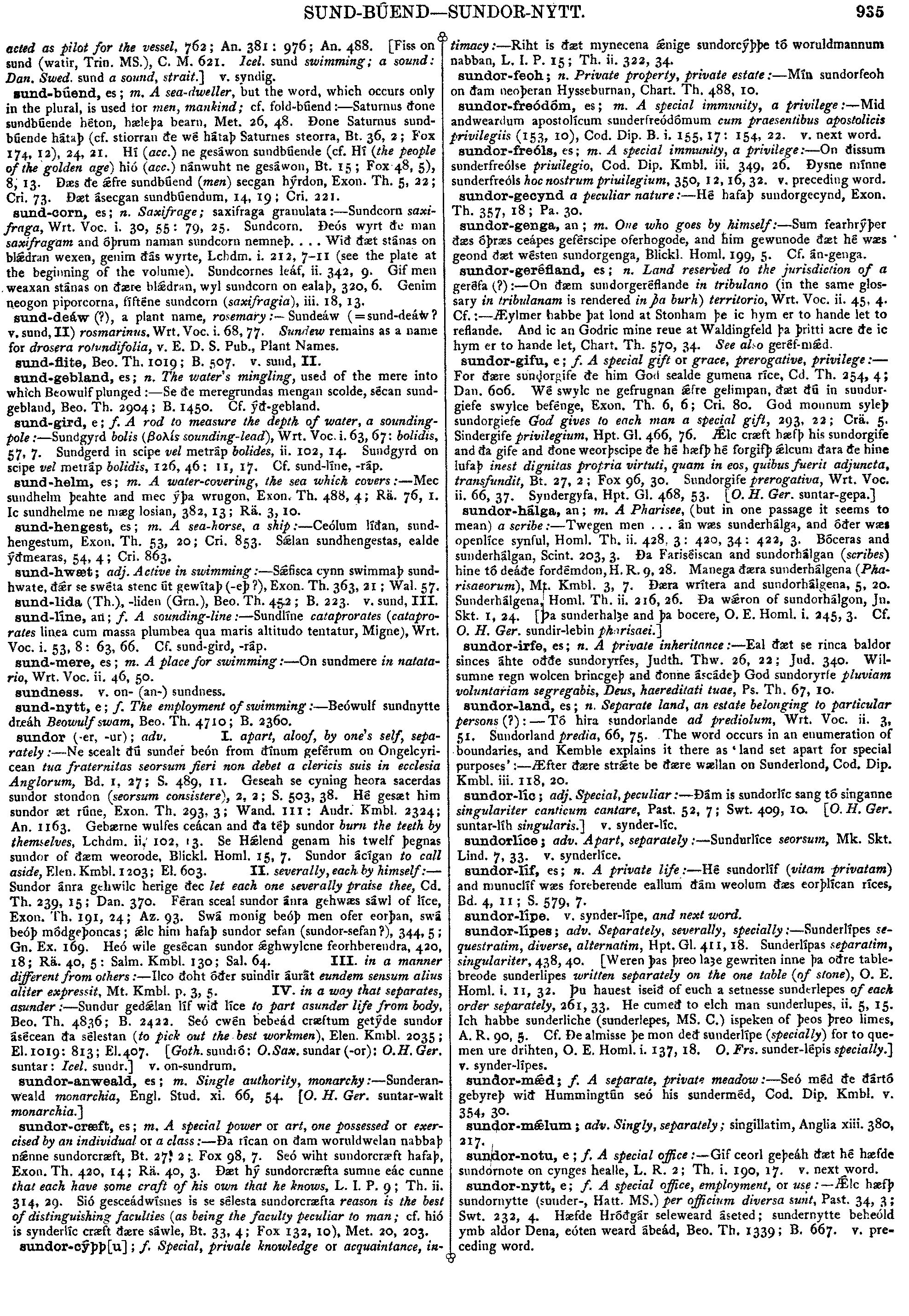
sundor-nytt, e; f. A special office, employment, or use:?-Æ-acute;lc hæfþ sundornytte (sunder-, Hatt. MS.) per officium diversa sunt, Past. 34. 3; Swt. 232, 4. Hæfde Hróðgár seleweard áseted; sundernytte beheóld ymb aldor Dena, eóten weard ábeád, Beo. Th. 1339; B. 667. v. preceding word.
|
Source: Bosworth/Toller, page b0943, entry 2 View original page image as: [TIFF] [PNG] [View previous entry] [View next entry] |
[Comment on this entry] [View comments (1)] |
The following entry has been hand-corrected once. |
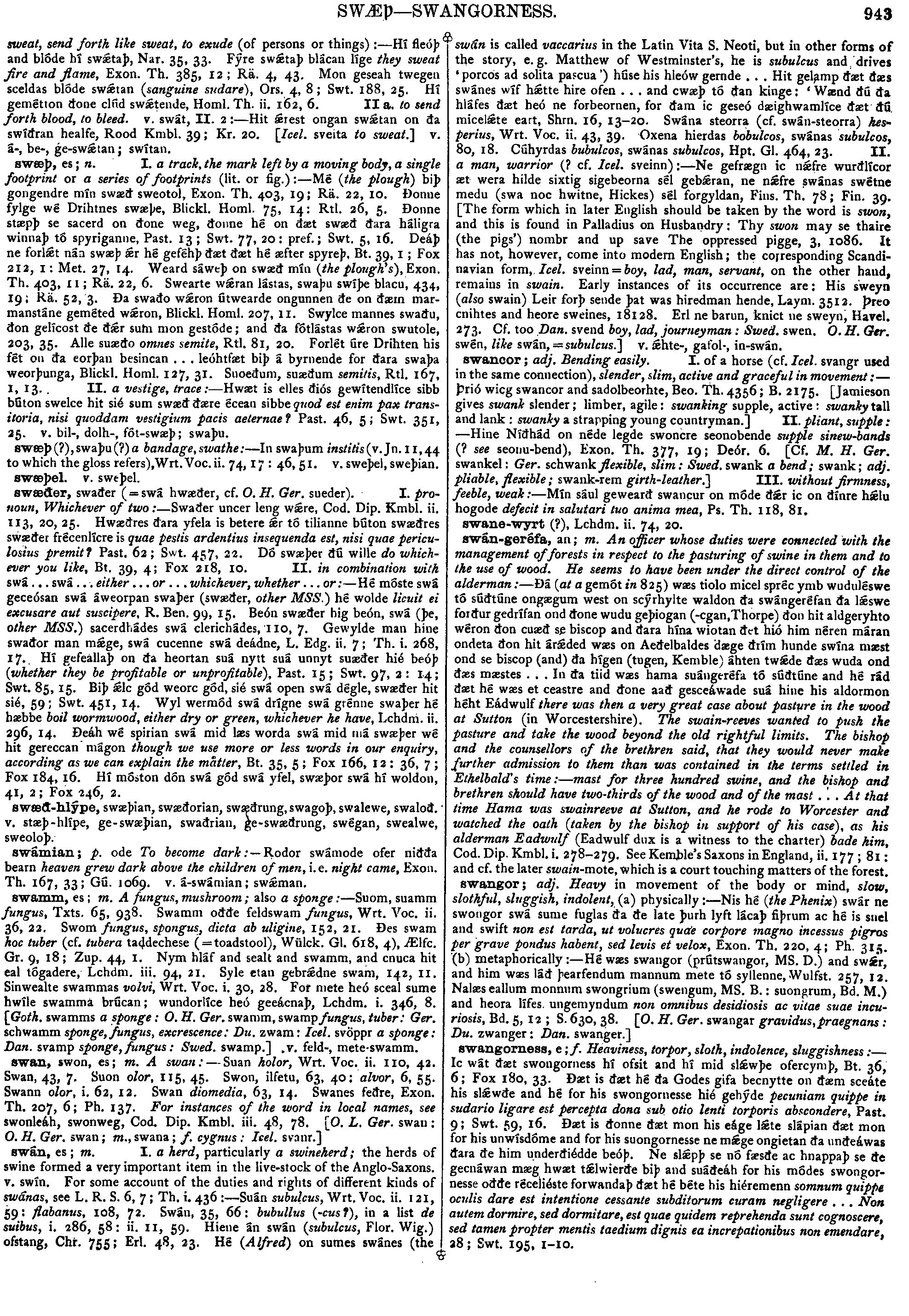
swæþ,
es;
n.
I.
a
track,
the
mark
left
by
a
moving
body,
a
single
footprint
or
a
series
of
footprints
(lit.
or
fig.)
:--
Mé
(the
plough)
biþ
gongendre
mín
swæð
sweotol,
Exon.
Th.
403,
19;
Rä.
22,
10.
Ðonne
fylge
wé
Drihtnes
swæþe.
Blickl.
Homl.
75,
14:
Rtl.
26,
5.
Ðonne
stæpþ
se
sacerd
on
ðone
weg,
ðonne
hé
on
ðæt
swæð
ðara
háligra
winnaþ
tó
spyriganne,
Past.
13;
Swt.
77,
20:
pref.;
Swt.
5,
16.
Deáþ
ne
forlt
nán
swæþ
r
hé
geféhþ
ðæt
ðæt
hé
æfter
spyreþ.
Bt.
39,
1;
Fox
212,
1:
Met.
27,
14.
Weard
sáweþ
on
swæð
mín
(the
plough's),
Exon.
Th.
403,
11;
Rä.
22,
6.
Swearte
wran
lástas,
swaþu
swíþe
blacu,
434,
19;
Rä.
52,
3.
Ða
swaðo
wron
útwearde
ongunnen
ðe
on
ðæm
marmanstáne
geméted
wron,
Blickl.
Homl.
207,
11.
Swylce
mannes
swaðu,
ðon
gelícost
ðe
ðr
sum
mon
gestóde;
and
ða
fótlástas
wron
swutole,
203,
35.
Alle
suæðo
omnes
semite,
Rtl.
81,
20.
Forlét
úre
Drihten
his
fét
on
ða
eorþan
besincan
.
.
.
leóhtfæt
biþ
á
byrnende
for
ðara
swaþa
weorþunga,
Blickl.
Homl.
127,
31.
Suoeðum,
suæðum
semitis.
Rtl.
167,
1,
13.
II.
a
vestige,
trace
:--
Hwæt
is
elles
ðiós
gewítendlíce
sibb
búton
swelce
hit
sié
sum
swæð
ðære
écean
sibbe
quod
est
enim
pax
transitoria,
nisi
quoddam
vestigium
pacis
aelernae?
Past.
46,
5;
Swt.
351,
25.
v.
bil-,
dolh-,
fót-swæþ;
swaþu.
| Result Page: |  |
Previous | 1 2 3 4 5 6 7 8 9 10 11 12 13 14 15 16 17 18 19 | Next |  |
Germanic Lexicon Project (main page)
This search system was written by
Sean Crist
Please consider
volunteering
to correct the data in these online dictionaries.
No rights reserved. Feel free to use these data in any way you please.