|
|

|
Source: Cleasby/Vigfusson, page b0226, entry 27 View original page image as: [TIFF] [PNG] [View previous entry] [View next entry] |
[Comment on this entry] [View comments] |
The following entry has been hand-corrected once. |
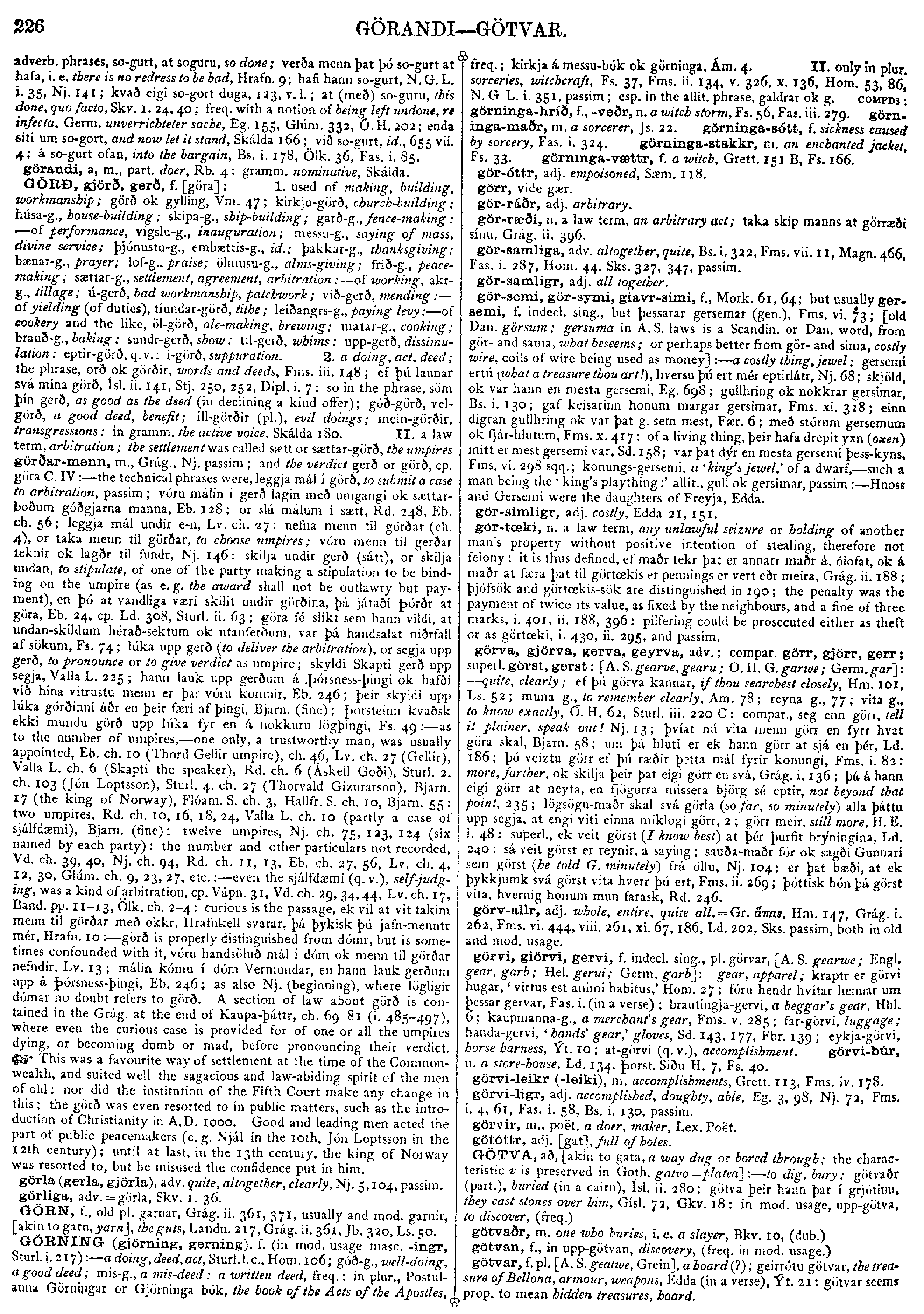
götvar, f. pl. [A. S. gealwe, Grein], a hoard(?); geirrótu götvar, the treasure of Bellona, armour, weapons, Edda (in a verse), Ýt. 21: götvar seems prop. to mean hidden treasures, hoard.
|
Source: Cleasby/Vigfusson, page b0229, entry 2 View original page image as: [TIFF] [PNG] [View previous entry] [View next entry] |
[Comment on this entry] [View comments] |
The following entry has been hand-corrected once. |
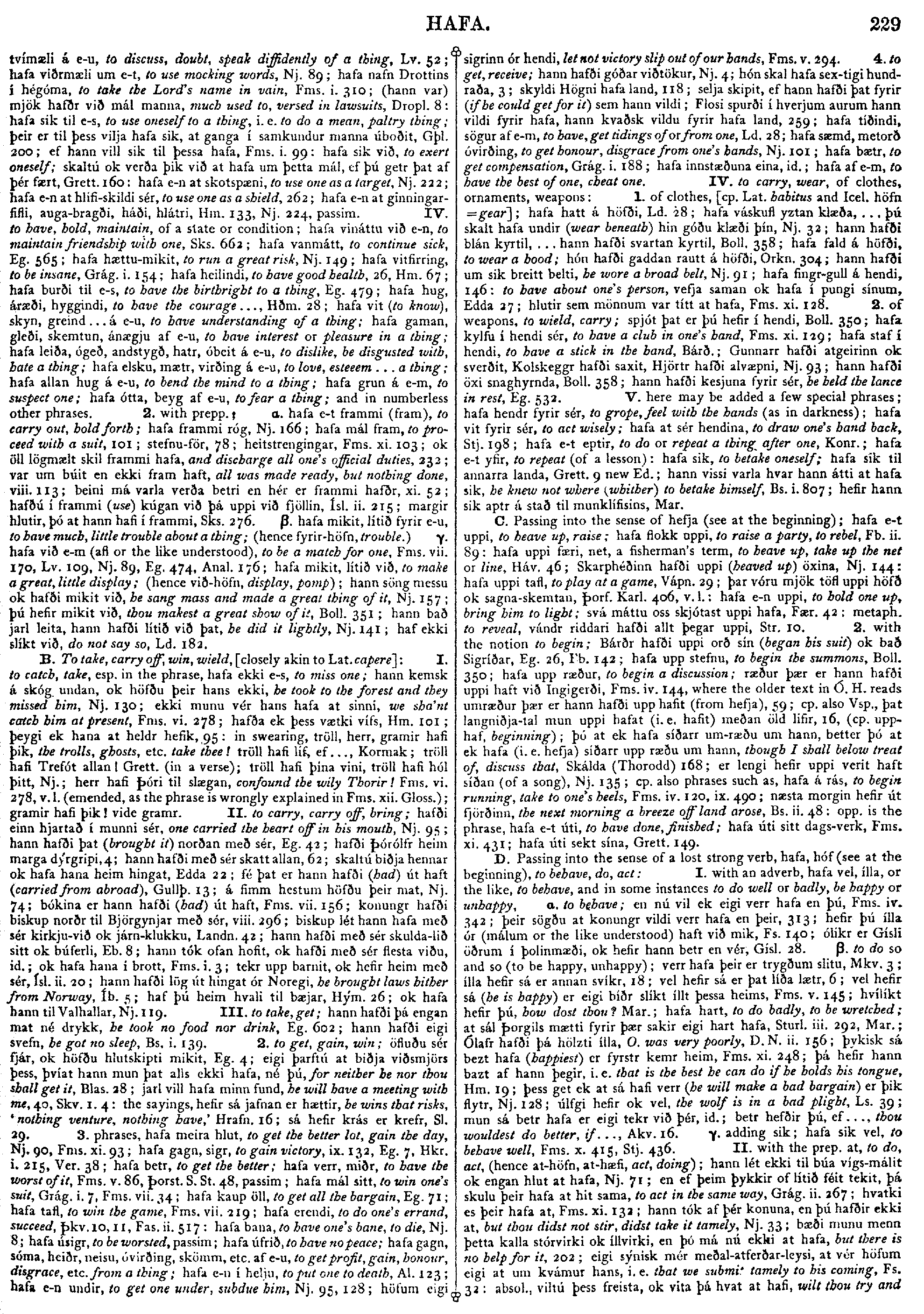
B. To take, carry off, win, wield, [closely akin to Lat. capere]: I. to catch, take, esp. in the phrase, hafa ekki e-s, to miss one; hann kemsk á skóg undan, ok höfðu þeir hans ekki, he took to the forest and they missed him, Nj. 130; ekki munu vér hans hafa at sinni, we sha'nt catch him at present, Fms. vi. 278; hafða ek þess vætki vífs, Hm. 101; þeygi ek hana at heldr hefik, 95: in swearing, tröll, herr, gramir hafi þik, the trolls, ghosts, etc. take thee! tröll hafi líf, ef ..., Kormak; tröll hafi Trefót allan! Grett. (in a verse); tröll hafi þína vini, tröll hafi hól þitt, Nj.; herr hafi Þóri til slægan, confound the wily Thorir! Fms. vi. 278, v.l. (emended, as the phrase is wrongly explained in Fms. xii. Gloss.); gramir hafi þik! vide gramr. II. to carry, carry off, bring; hafði einn hjartað í munni sér, one carried the heart off in his mouth, Nj. 95; hann hafði þat (brought it) norðan með sér, Eg. 42; hafði Þórólfr heim marga dýrgripi, 4; hann hafði með sér skatt allan, 62; skaltú biðja hennar ok hafa hana heim hingat, Edda 22; fé þat er hann hafði (had) út haft (carried from abroad), Gullþ. 13; á fimm hestum höfðu þeir mat, Nj. 74; bókina er hann hafði (had) út haft, Fms. vii. 156; konungr hafði biskup norðr til Björgynjar með sér, viii. 296; biskup lét hann hafa með sér kirkju-við ok járn-klukku, Landn. 42; hann hafði með sér skulda-lið sitt ok búferli, Eb. 8; hann tók ofan hofit, ok hafði með sér flesta viðu, id.; ok hafa hana í brott, Fms. i. 3; tekr upp barnit, ok hefir heim með sér, Ísl. ii. 20; hann hafði lög út hingat ór Noregi, he brought laws hither from Norway, Íb. 5; haf þú heim hvali til bæjar, Hým. 26; ok hafa hann til Valhallar, Nj. 119. III. to take, get; hann hafði þá engan mat né drykk, he took no food nor drink, Eg. 602; hann hafði eigi svefn, he got no sleep, Bs. i. 139. 2. to get, gain, win; öfluðu sér fjár, ok höfðu hlutskipti mikit, Eg. 4; eigi þarftú at biðja viðsmjörs þess, þvíat hann mun þat alls ekki hafa, né þú, for neither he nor thou shall get it, Blas. 28; jarl vill hafa minn fund, he will have a meeting with me, 40, Skv. 1. 4: the sayings, hefir sá jafnan er hættir, he wins that risks, 'nothing venture, nothing have,' Hrafn. 16; sá hefir krás er krefr, Sl. 29. 3. phrases, hafa meira hlut, to get the better lot, gain the day, Nj. 90, Fms. xi. 93; hafa gagn, sigr, to gain victory, ix. 132, Eg. 7, Hkr. i. 215, Ver. 38; hafa betr, to get the better; hafa verr, miðr, to have the worst of it, Fms. v. 86, Þorst. S. St. 48, passim; hafa mál sitt, to win one's suit, Grág. i. 7, Fms. vii. 34; hafa kaup öll, to get all the bargain, Eg. 71; hafa tafl, to win the game, Fms. vii. 219; hafa erendi, to do one's errand, succeed, Þkv. 10, 11, Fas. ii. 517: hafa bana, to have one's bane, to die, Nj. 8; hafa úsigr, to be worsted, passim; hafa úfrið, to have no peace; hafa gagn, sóma, heiðr, neisu, óvirðing, skömm, etc. af e-u, to get profit, gain, honour, disgrace, etc. from a thing; hafa e-n í helju, to put one to death, Al. 123; hafa e-n undir, to get one under, subdue him, Nj. 95, 128; höfum eigi, sigrinn ór hendi, let not victory slip out of our hands, Fms. v. 294. 4. to get, receive; hann hafði góðar viðtökur, Nj. 4; hón skal hafa sex-tigi hundraða, 3; skyldi Högni hafa land, 118; selja skipit, ef hann hafði þat fyrir (if he could get for it) sem hann vildi; Flosi spurði í hverjum aurum hann vildi fyrir hafa, hann kvaðsk vildu fyrir hafa land, 259; hafa tíðindi, sögur af e-m, to have, get tidings of or from one, Ld. 28; hafa sæmd, metorð óvirðing, to get honour, disgrace from one's hands, Nj. 101; hafa bætr, to get compensation, Grág. i. 188; hafa innstæðuna eina, id.; hafa af e-m, to have the best of one, cheat one. IV. to carry, wear, of clothes, ornaments, weapons: 1. of clothes, [cp. Lat. habitus and Icel. höfn = gear]; hafa hatt á höfði, Ld. 28; hafa váskufl yztan klæða, ... þú skalt hafa undir (wear beneath) hin góðu klæði þín, Nj. 32; hann hafði blán kyrtil, ... hann hafði svartan kyrtil, Boll. 358; hafa fald á höfði, to wear a hood; hón hafði gaddan rautt á höfði, Orkn. 304; hann hafði um sik breitt belti, he wore a broad belt, Nj. 91; hafa fingr-gull á hendi, 146: to have about one's person, vefja saman ok hafa í pungi sínum, Edda 27; hlutir sem mönnum var títt at hafa, Fms. xi. 128. 2. of weapons, to wield, carry; spjót þat er þú hefir í hendi, Boll. 350; hafa kylfu í hendi sér, to have a club in one's hand, Fms. xi. 129; hafa staf í hendi, to have a stick in the hand, Bárð.; Gunnarr hafði atgeirinn ok sverðit, Kolskeggr hafði saxit, Hjörtr hafði alvæpni, Nj. 93; hann hafdi öxi snaghyrnda, Boll. 358; hann hafði kesjuna fyrir sér, he held the lance in rest, Eg. 532. V. here may be added a few special phrases; hafa hendr fyrir sér, to grope, feel with the hands (as in darkness); hafa vit fyrir sér, to act wisely; hafa at sér hendina, to draw one's hand back, Stj. 198; hafa e-t eptir, to do or repeat a thing after one, Konr.; hafa e-t yfir, to repeat (of a lesson): hafa sik, to betake oneself; hafa sik til annarra landa, Grett. 9 new Ed.; hann vissi varla hvar hann átti at hafa sik, he knew not where (whither) to betake himself, Bs. i. 807; hefir hann sik aptr á stað til munklífisins, Mar.
|
Source: Cleasby/Vigfusson, page b0241, entry 21 View original page image as: [TIFF] [PNG] [View previous entry] [View next entry] |
[Comment on this entry] [View comments] |
The following entry has been hand-corrected once. |
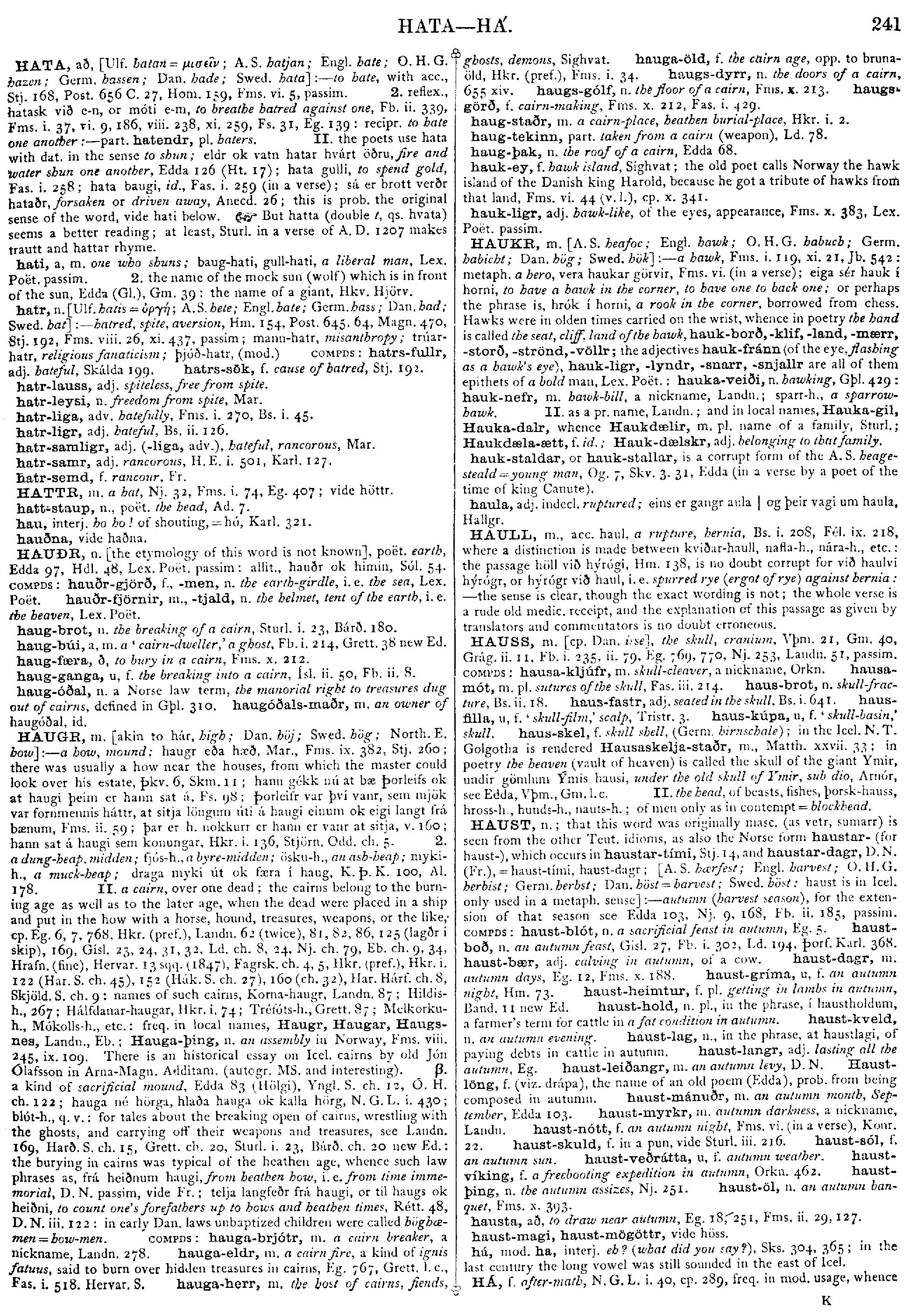
HAUGR,
m.
[akin
to
hár,
high;
Dan.
höj;
Swed.
hog;
North.
E.
how]
:--
a
how,
mound;
haugr
eða
hæð,
Mar.,
Fms.
ix.
382,
Stj.
260;
there
was
usually
a
how
near
the
houses,
from
which
the
master
could
look
over
his
estate,
Þkv.
6,
Skm.
11;
hann
gékk
nú
at
bæ
Þorleifs
ok
at
haugi
þeim
er
hann
sat
a.,
Fs.
98;
Þorleifr
var
því
vanr,
sem
mjök
var
fornmennis
háttr,
at
sitja
löngum
úti
á
haugi
einum
ok
eigi
langt
frá
bænum,
Fms.
ii.
59;
þar
er
h.
nokkurr
er
hann
er
vanr
at
sitja,
v.
160;
hann
sat
á
haugi
sem
konungar,
Hkr.
i.
136,
Stjörn.
Odd.
ch.
5.
2.
a
dung-heap.
midden;
fjós-h.,
a
byre-midden;
ösku-h.,
an
ash-heap;
myki-h.,
a
muck-heap;
draga
myki
út
ok
færa
í
haug,
K.
Þ.
K.
100,
Al.
178.
II.
a
cairn,
over
one
dead;
the
cairns
belong
to
the
burning
age
as
well
as
to
the
later
age,
when
the
dead
were
placed
in
a
ship
and
put
in
the
how
with
a
horse,
hound,
treasures,
weapons,
or
the
like,
cp.
Eg.
6,
7,
768.
Hkr.
(pref.),
Landn.
62
(twice),
81,
82,
86,
125
(lagðr
í
skip),
169,
Gísl.
23,
24,
31,
32,
Ld.
ch.
8,
24,
Nj.
ch.
79,
Eb.
ch.
9,
34,
Hrafn.
(fine),
Hervar.
13
sqq.
(1847),
Fagrsk.
ch.
4,
5,
Hkr.
(pref.),
Hkr.
i.
122
(Har.
S.
ch.
45),
152
(Hák.
S.
ch.
27),
160
(ch.
32),
Har.
Hárf.
ch.
8,
Skjöld.
S.
ch.
9:
names
of
such
cairns,
Korna-haugr,
Landn.
87;
Hildis-h.,
267;
Hálfdanar-haugar,
Hkr.
i.
74;
Tréfóts-h.,
Grett.
87;
Melkorku-h.,
Mókolls-h.,
etc.:
freq.
in
local
names,
Haugr,
Haugar,
Haugs-nes,
Landn.,
Eb.;
Hauga-þing,
n.
an
assembly
in
Norway,
Fms.
viii.
245,
ix.
109.
There
is
an
historical
essay
on
Icel.
cairns
by
old
Jón
Ólafsson
in
Arna-Magn.
Additam.
(autogr.
MS.
and
interesting).
 .
a
kind
of
sacrificial
mound,
Edda
83
(Hölgi),
Yngl.
S.
ch.
12,
Ó.
H.
ch.
122;
hauga
né
hörga,
hlaða
hauga
ok
kalla
hörg,
N.
G.
L.
i.
430;
blót-h.,
q.v.:
for
tales
about
the
breaking
open
of
cairns,
wrestling
with
the
ghosts,
and
carrying
off
their
weapons
and
treasures,
see
Landn.
169,
Harð.
S.
ch.
15,
Grett.
ch.
20,
Sturl.
i.
23,
Bárð.
ch.
20
new
Ed.:
the
burying
in
cairns
was
typical
of
the
heathen
age,
whence
such
law
phrases
as,
frá
heiðnum
haugi,
from
heathen
how,
i.e.
from
time
immemorial,
D.
N.
passim,
vide
Fr.;
telja
langfeðr
frá
haugi,
or
til
haugs
ok
heiðni,
to
count
one's
forefathers
up
to
hows
and
heathen
times,
Rétt.
48,
D.
N.
iii.
122:
in
early
Dan.
laws
unbaptized
children
were
called
höghæmen
=
how-men.
COMPDS:
hauga-brjótr,
m.
a
cairn
breaker,
a
nickname,
Landn.
278.
hauga-eldr,
m.
a
cairn
fire,
a
kind
of
ignis
fatuus,
said
to
burn
over
hidden
treasures
in
cairns,
Eg.
767,
Grett.
l.c.,
Fas.
i.
518.
Hervar.
S.
hauga-herr,
m.
the
host
of
cairns,
fiends,
ghosts,
demons,
Sighvat.
hauga-öld,
f.
the
cairn
age,
opp.
to
bruna-öld,
Hkr.
(pref.),
Fms.
i.
34.
haugs-dyrr,
n.
the
doors
of
a
cairn,
655
xiv.
haugs-gólf,
n.
the
floor
of
a
cairn,
Fms.
x.
213.
haugs-görð,
f.
cairn-making,
Fms.
x.
212,
Fas.
i.
429.
.
a
kind
of
sacrificial
mound,
Edda
83
(Hölgi),
Yngl.
S.
ch.
12,
Ó.
H.
ch.
122;
hauga
né
hörga,
hlaða
hauga
ok
kalla
hörg,
N.
G.
L.
i.
430;
blót-h.,
q.v.:
for
tales
about
the
breaking
open
of
cairns,
wrestling
with
the
ghosts,
and
carrying
off
their
weapons
and
treasures,
see
Landn.
169,
Harð.
S.
ch.
15,
Grett.
ch.
20,
Sturl.
i.
23,
Bárð.
ch.
20
new
Ed.:
the
burying
in
cairns
was
typical
of
the
heathen
age,
whence
such
law
phrases
as,
frá
heiðnum
haugi,
from
heathen
how,
i.e.
from
time
immemorial,
D.
N.
passim,
vide
Fr.;
telja
langfeðr
frá
haugi,
or
til
haugs
ok
heiðni,
to
count
one's
forefathers
up
to
hows
and
heathen
times,
Rétt.
48,
D.
N.
iii.
122:
in
early
Dan.
laws
unbaptized
children
were
called
höghæmen
=
how-men.
COMPDS:
hauga-brjótr,
m.
a
cairn
breaker,
a
nickname,
Landn.
278.
hauga-eldr,
m.
a
cairn
fire,
a
kind
of
ignis
fatuus,
said
to
burn
over
hidden
treasures
in
cairns,
Eg.
767,
Grett.
l.c.,
Fas.
i.
518.
Hervar.
S.
hauga-herr,
m.
the
host
of
cairns,
fiends,
ghosts,
demons,
Sighvat.
hauga-öld,
f.
the
cairn
age,
opp.
to
bruna-öld,
Hkr.
(pref.),
Fms.
i.
34.
haugs-dyrr,
n.
the
doors
of
a
cairn,
655
xiv.
haugs-gólf,
n.
the
floor
of
a
cairn,
Fms.
x.
213.
haugs-görð,
f.
cairn-making,
Fms.
x.
212,
Fas.
i.
429.
|
Source: Cleasby/Vigfusson, page b0244, entry 46 View original page image as: [TIFF] [PNG] [View previous entry] [View next entry] |
[Comment on this entry] [View comments] |
The following entry has been hand-corrected once. |
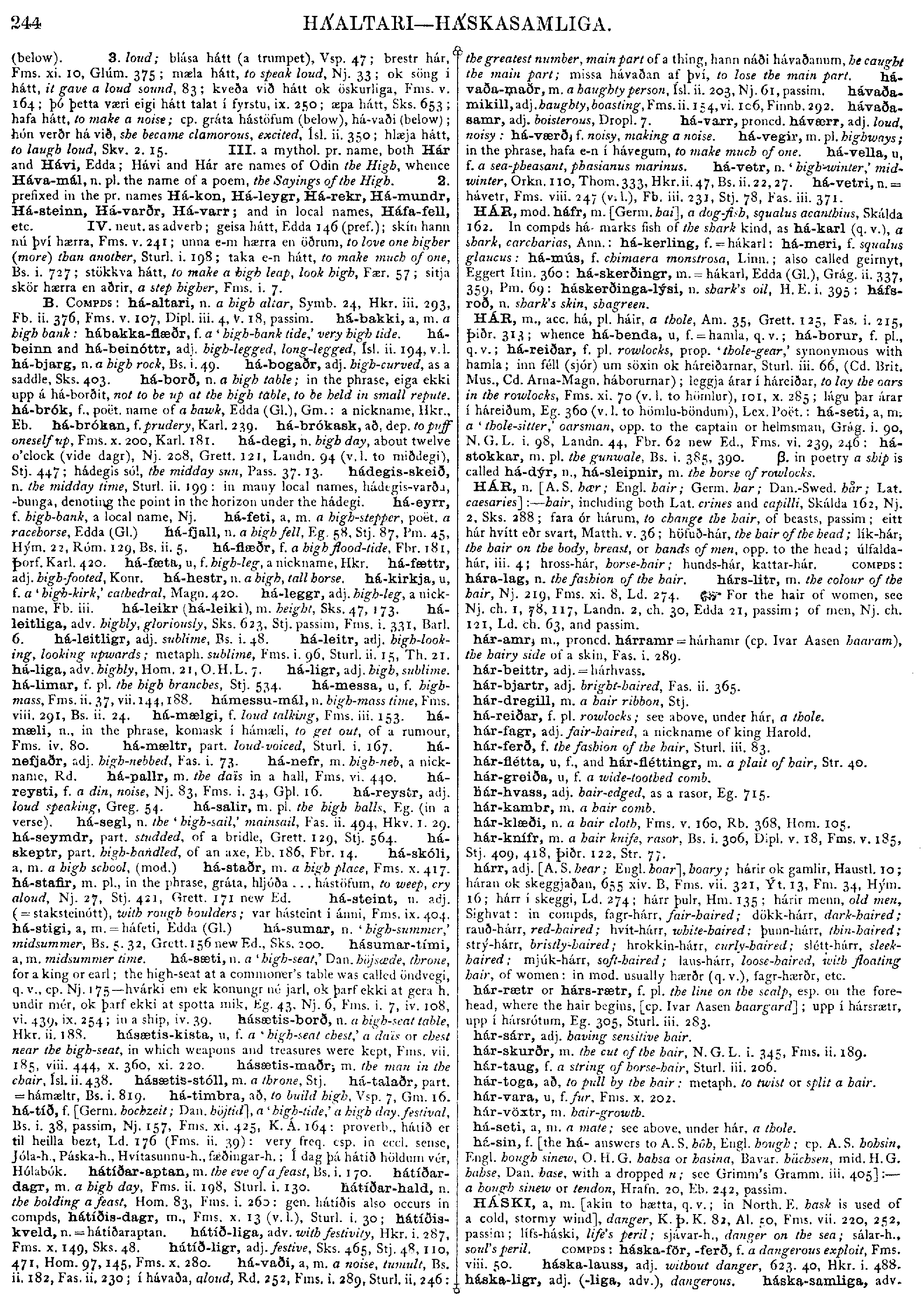
q. v., cp. Nj. 175 — hvárki em ek konungr né jarl, ok þarf ekki at gera h. undir mér, ok þnrf ekki at spotta mik. Eg. 43, Nj. 6, Fms. i. 7, iv. 108, vi. 439, ix. 254; in a ship, iv. 39. hásætis-borð, n. a high-teat table, Hkr. ii. 188. hásætis-kista, u, f. a ' high-seat chest, ' a daïs or chest near the high-seat, in which weapons and treasures were kept, Fms. vii.
|
Source: Cleasby/Vigfusson, page b0259, entry 1 View original page image as: [TIFF] [PNG] [View previous entry] [View next entry] |
[Comment on this entry] [View comments] |
The following entry has been hand-corrected once. |
a march, Fms. v. 74. Her-gautr, m. a name of Odin. her-gjarn, adj. warlike, Bkv. 2. 20. her-glötuðr, m., poët, a destroyer of hosts, Skv. her-gopa, u, f. a bondwoman, Hornklofi, an GREEK. her-grimmr, adj., poët. fierce, Edda. her-hlaup, n. a rushing to arms, Nj. 265, Eg. 10, Fms. i. 55, 210, vii. 270, x. 180. her-horn, n. a trumpet, Al. 35, Stj. 394. her-kastali, a, m. a castle, stronghold, Bs. ii. 113, Mar. her-kerling, f. a monster-hag, Sturl. i. 36. her-klukka, u, f. an alarm bell, Fms. ix. 369, 510, 529. her-klæða, dd; h. sik, to put on armour, Bær. 13: reflex., Fms. i. 43, Eg. 287, Ó. H. 107. her-klæði, n. pl. armour, Eg. 49, Fb. ii. 71, Barl. 98, passim. her-konungr, m. a king of hosts, in old writers almost used = sea-king, warrior-king, Eb. 4 (of king Olave the White), Fms. i. 24, Fb. ii. 282, Edda 105, Magn. 412. her-kumbl, n. a war token, arms (on shields, helmets), Nj. 231, Fms. v. 53. her-land, n. a harried land, invaded and in a state of war, Fms. vi. 38. her-leiða, dd, to lead off into captivity, Stj. 49, 385, 489, Mart. 130, Ver. 30. her-leiðing, f. captivity, Fms. x. 224; esp. of the Babylonian captivity, Al. 166, Rb. 382, 386, Ver. 30, Stj. 26, 49, passim. her-leiðsla, u, f. = herleiðing, Mar. her-lið, n. war-people, troops. Eg. 10, Fms. i. 98, iv. 213. her-liki, n. a monster, N. G. L. i. 376, 395. her-lúðr, m. a trumpet, Stj. 392. her-maðr, m. a man of war, a warrior, Fms. i. 8, xi. 160, 373, Nj. 268, passim. hermann-liga, adv. gallantly, Eg. 383. hermann-ligr, adj. warlike, gallant, Ld. 110, Nj. 39, Fms. viii. 436, xi. 245, Stj. 495. her-margr, adj. like a host for number, Lex. Poët. her-megir, m. pl., poët. warriors, Hkv. 2. 4. Her-móðr, m. a mythol. pr. name, Edda. hernaðr, see the word. her-nam, n. = herfang, Sks. 614. her-numi, adj., 655 x. 2, Greg. 17, and her-numinn, part. captive, Eg. 41, 343. her-næma, d, to capture, Bær. 13. her-óp, n. a war-whoop, war-cry, Eg. 80, Nj. 245, Orkn., Stj. 312, Ó. H. 107, Fb. ii. 125, passim. her-saga, u, f. war-news, Fms. i. 41, N. G. L. i. 102; hersögu-ör, f. = herör, Gþl. 82, v.l. her-skapr, m. warfare, harrying, Fms. v. 344, x. 231, 234, 392, xi. 226, Fas. i. 375, Fs. 4, Stj. 385, Róm. 264, passim. her-skari, a, m. a host. her-skár, adj. (herská, herskátt), a land exposed to raid or in a state of war; landit var þá herskátt, lágu víkingar úti, Eg. 241, Fms. xi. 217, Hkr. i. 44; í þann tíma var mjök herskátt (unruly time), Orkn. 64; þar var herskátt af víkingum, Hkr. i. 106, Bjarn. 15, Ld. 82, Fas. i. 374: of a person, martial, warlike, Fms. i. 198, vii. 16, x. 413, Orkn. 22. her-skip, n. a ship of war, Fms. i. 7, Nj. 8, Ó. H. 16, N. G. L. i. 100, 102. her-skjöldr, m. a war shield, a red shield, opp. to the white shield of peace (friðar-skjöldr), used in phrases as, fara (land) herskildi, to harry (a land), Eg. 246, Fms. i. 62, 116, 131; fara við herskildi, id., Hkr. i. 233, cp. Stj. 542, 619 (2 Kings vi. 14), 641. her-skrúð, n. (her-skrúði, a, m., Fms. x. 234, Stj. 570), harness, Bjarn. 11. her-spori, a, m. a 'war-spur,' caltrop, Fms. vii. 183, Al. 74, Sks. 392. her-stjóri, a, m. a commander, Edda 93. her-stjórn, f. command of troops, Hkr. i. 211. her-sveitir, f. pl. hosts, margfjöldi himneskra hersveita, Luke ii. 13. her-taka, tók, to capture, esp. in part. pass., Fms. i. 28, vii. 129, Eg. 234, 344, Stj. 495. her-taka and her-tekja, u, f. captivity, Stj. 75, Barl. 114. her-tekning, f. captivity, Stj. 52. her-togi, a, m. [A. S. heretoga; Germ. herzog], originally a leader, commander, and often used so in old poets, Lex. Poët.: as a nickname, Guthormr hertogi, Hkr. Har. S. Hárf.: as a title, a duke (e.g. of Normandy); the first Norse duke was the earl Skuli, created duke A.D. 1237, vide Edda 104, Sks. 788, Gþl. 364: eccl. = prince, hertogi myrkranna, Satan, 623. 31. hertoga-dómr, m. a dukedom, Fms. xi. 312, 326. hertoga-dæmi, n. a duchy, Fms. xi. 319, Fas. ii. 475. hertoga-efni, n. a duke to be, N. G. L. ii. 399. hertoga-inna, u, f. a duchess, Ann. 1326. hertoga-nafn, n. the title of a duke, Fms. ix. 46. her-turn, m. a turret on wheels, a war engine, Fms. x. 358. her-tygð, f. = hertýgi (?), an GREEK, Hallfred. her-týgi, n. pl. armour, harness, Germ. heerzeug. her-týgja, að, to put armour on, freq. in mod. usage. her-váðir, f. pl. 'war-weeds,' armour, Hkm., Konr. 39. her-vápn, n. pl. weapons, Hkr. ii. 7, Fms. vii. 147, Jb. 389. her-vegir, m. pl., poët. war-paths, Gh. 2. her-verk or her-verki, n. ravage, plunder, Stj. 598, Hkr. i. 85, Fms. ii. 156, ix. 396. her-vígi, n. battle and ravage, thus defined: it is hervígi when three or more persons are slain or wounded on each side, Grág. ii. 114, 124, Fms. viii. 300: mod. a stronghold. her-víkingr, m. a plunderer, pirate, Fms. i. 225, v. 238, x. 282, Fas. i. 449, Stj. 573. her-væða, dd, to put armour on, Edda 25. her-þing, n. a council of war, Eg. 357, Finnb. 262; but v.l. húsþing is better. her-þurft, f. want of troops, Fagrsk. ch. 32. her-ör, f. a 'war-arrow,' to be sent round as a token of war: the phrase, skera upp h., to summon to arms, Eg. 9, Fms. i. 92, vi. 24, x. 388, Fb. ii. 172, 188, Gþl. 82, cp. 433: for these customs see the remarks s.v. boð, p. 71, as also Scott's Notes to Marmion, Canto III, on the Fiery Cross of the Scottish Clans.
|
Source: Cleasby/Vigfusson, page b0266, entry 48 View original page image as: [TIFF] [PNG] [View previous entry] [View next entry] |
[Comment on this entry] [View comments] |
The following entry has been hand-corrected once. |
HJÁLMR, m. [Goth. hilms; A. S., Engl., Hel., O. H. G., and Germ. helm; Dan.-Swed. hjalm; Ital. elmo; old Fr. heaume; a Teut. word prob. derived from hylja, to hide] :-- a helm, helmet; distinguished from stálhúfa, a steel hood; luktr hjálmr, a closed, shut helm, only occurs in very late writers, e.g. D. N. i. 321; steyptir hjálmar, Gkv. 2. 19, cannot mean cast-iron helmets, but must be helmets coming over the face, as cast-iron was unknown in the Middle Ages, see Aarb. for Nord. Oldk. 1868, p. 9; aringreypir hjálmar, helms shaped like an eagle's beak, Akv. 3; gull-h., a gilt helm; ár-hjálmr, a brazen helmet, Hkm.: the word âr is A. S., since helmets were of English workmanship, as is seen also in Valskir hjálmar, foreign helmets, which are mentioned by Sighvat. 2. in the mythology Odin is called Hjálm-beri, a, m. helm-bearer, Gm.; he and the Valkyrias were represented as wearing helmets, Edda, Hkm. 9, Hkv. 1. 15; whence the poets call the helmet the hood of Odin (Hropts höttr): the vault of heaven is called the 'helm' of the wind, sun, etc., lopt-h., vind-h., sólar-h., Lex. Poët.: the head is called hjálm-stofn, hjálm-staup, hjálm-stallr, hjálm-setr, the stem, knoll, seat of the helm: the weapons,
|
Source: Cleasby/Vigfusson, page b0276, entry 36 View original page image as: [TIFF] [PNG] [View previous entry] [View next entry] |
[Comment on this entry] [View comments] |
The following entry has been hand-corrected once. |
HNÍTA, pres. hnít, pret. hneit, pl. hnitu, a defect. verb: [akin to hnita; A. S. hnîtan = tundere; Dan. nitte] :-- to strike, wound to the death; lér (the scythe) hneit við Hrungnis fóta-stalli (his shield), Kormak; but chiefly used in emphatic phrases, of a heart-wound, hneit þar! við hneit þarna! Gísl. 22, 106; en er hón þreifaði um síðuna þá mælti hón, þar hneit viðna! Fms. iii. 73; hón kvað hvergi stórum við hníta, Korm. 6; hvergi þykki mér við hníta, Ísl. ii. 343; the last three passages refer to a superstition that the touch of a wise woman made one's body 'wound-proof;' in Rd. ch. 5 (at end) the words 'ok þótti henni þar við hníta,' or the like, have been dropped by the transcriber: in poetry the allit. phrase, hjörr hneit við hjarta, the steel touched the heart, Korm. ch. 17 (in a verse); or, egg hneit við fjör seggja, Fms. vii. 71; hneit mér við hjarta hjörr Angantýs, Fas. i. 427; hvast hneit (beit MS.) hjarta ið næsta hættligt járn, Fbr. (fine); þar hneit við, sem ..., it cut him to the quick, that ..., Thom. 397; hnitu reyr saman, the weapons clashed together, Ísl. ii. 353 (in a verse), Fms. ii. 318 (in a verse).
|
Source: Cleasby/Vigfusson, page b0283, entry 5 View original page image as: [TIFF] [PNG] [View previous entry] [View next entry] |
[Comment on this entry] [View comments] |
The following entry has been hand-corrected once. |
HREGG, n. storm and rain, Edda 99, Am. 18, Fs. 129; var bæði hregg ok regn, Eb. 266, Fms. vii. 195; h. ok sjádrif, ii. 177; kastaði þá enn hreggi á móti þeim, Fas. ii. 80; h. eða rota, Bs. i. 339, N. G. L. i. 388; hríð með hreggi, Eb. 206, Lex. Poët.; kulda-h., a chilly, rainy wind; kafalds-h., snow and wind: in poetry the battle is the hregg of weapons, Valkyriur, Odin, etc., see the compds in Lex. Poët. COMPDS: hregg-blásinn, part. blown by the gale, Hallfred. hregg-mímir, m., mythol. name of one of the heavens, Edda (Gl.) hregg-nasi, a, m. a nickname, Eb. hregg-rann, n., hregg-salr, m., poët. 'gale-house,' i.e. the sky, Leiðarv. 17, 25, Geisli 61. hregg-skár, adj. stormy, Merl. 1. 65. hregg-skúr, f. a tempestuous shower, Sks. 227. hregg-tjald, n. 'gale-tent,' i.e. the heaven, Lex. Poët. Hregg-viðr, m. a pr. name, Fas. hregg-viðri, n. a tempest, Fms. ii. 177. hregg-vindr, m. a tempestuous gale, Grett. (in a verse). hregg-þjálmi, a, m. 'wind-trap,' i.e. the heaven, poët., Leiðarv. 4.
|
Source: Cleasby/Vigfusson, page b0289, entry 8 View original page image as: [TIFF] [PNG] [View previous entry] [View next entry] |
[Comment on this entry] [View comments] |
The following entry has been hand-corrected once. |
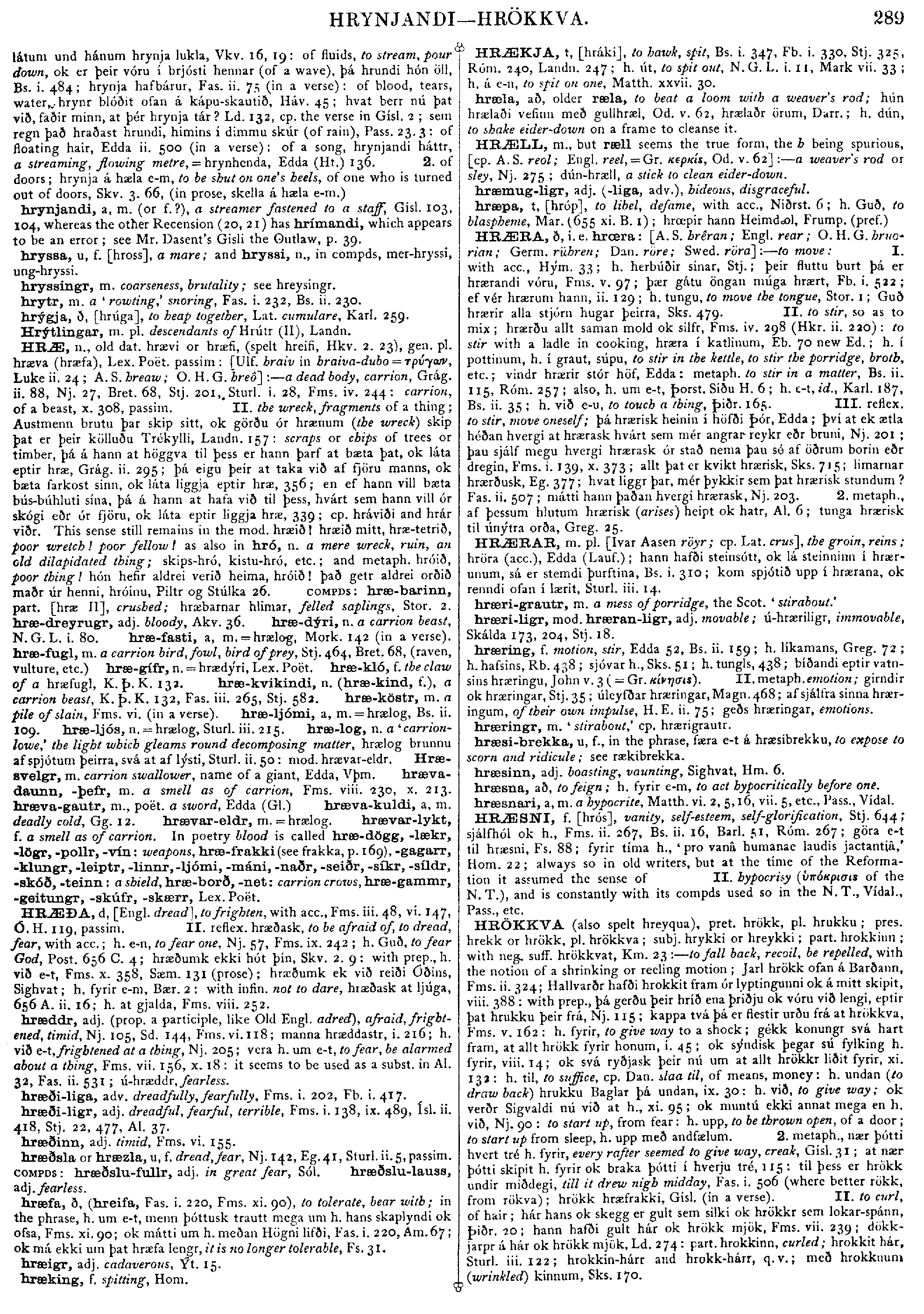
HRÆ, n., old dat. hrævi or hræfi, (spelt hreifi, Hkv. 2. 23), gen. pl. hræva (hræfa), Lex. Poët. passim: [Ulf. hraiv in hraiva-dubo = GREEK, Luke ii. 24; A. S. hreaw; O. H. G. hreô] :-- a dead body, carrion, Grág. ii. 88, Nj. 27, Bret. 68, Stj. 201, Sturl. i. 28, Fms. iv. 244: carrion, of a beast, x. 308, passim. II. the wreck, fragments of a thing; Austmenn brutu þar skip sitt, ok görðu ór hrænum (the wreck) skip þat er þeir kölluðu Trékylli, Landn. 157: scraps or chips of trees or timber, þá á hann at höggva til þess er hann þarf at bæta þat, ok láta eptir hræ, Grág. ii. 295; þá eigu þeir at taka við af fjöru manns, ok bæta farkost sinn, ok láta liggja eptir hræ, 356; en ef hann vill bæta bús-búhluti sína, þá á hann at hafa við til þess, hvárt sem hann vill ór skógi eðr ór fjöru, ok láta eptir liggja hræ, 339; cp. hráviði and hrár viðr. This sense still remains in the mod. hræið! hræið mitt, hræ-tetrið, poor wretch! poor fellow! as also in hró, n. a mere wreck, ruin, an old dilapidated thing; skips-hró, kistu-hró, etc.; and metaph. hróið, poor thing! hón hefir aldrei verið heima, hróið! það getr aldrei orðið maðr úr henni, hróinu, Piltr og Stúlka 26. COMPDS: hræ-barinn, part. [hræ II], crushed; hræbarnar hlimar, felled saplings, Stor. 2. hræ-dreyrugr, adj. bloody, Akv. 36. hræ-dýri, n. a carrion beast, N. G. L. i. 80. hræ-fasti, a, m. = hrælog, Mork. 142 (in a verse). hræ-fugl, m. a carrion bird, fowl, bird of prey, Stj. 464, Bret. 68, (raven, vulture, etc.) hræ-gífr, n. = hrædýri, Lex. Poët. hræ-kló, f. the claw of a hræfugl, K. Þ. K. 132. hræ-kvikindi, n. (hræ-kind, f.), a carrion beast, K. Þ. K. 132, Fas. iii. 265, Stj. 582. hræ-köstr, m. a pile of slain, Fms. vi. (in a verse). hræ-ljómi, a, m. = hrælog, Bs. ii. 109. hræ-ljós, n. = hrælog, Sturl. iii. 215. hræ-log, n. a 'carrion-lowe,' the light which gleams round decomposing matter, hrælog brunnu af spjótum þeirra, svá at af lýsti, Sturl. ii. 50: mod. hrævar-eldr. Hræ-svelgr, m. carrion swallower, name of a giant, Edda, Vþm. hræva-daunn, -þefr, m. a smell as of carrion, Fms. viii. 230, x. 213. hræva-gautr, m., poët. a sword, Edda (Gl.) hræva-kuldi, a, m. deadly cold, Gg. 12. hrævar-eldr, m. = hrælog. hrævar-lykt, f. a smell as of carrion. In poetry blood is called hræ-dögg, -lækr, -lögr, -pollr, -vín: weapons, hræ-frakki (see frakka, p. 169), -gagarr, -klungr, -leiptr, -linnr, -ljómi, -máni, -naðr, -seiðr, -síkr, -síldr, -skóð, -teinn: a shield, hræ-borð, -net: carrion crows, hræ-gammr, -geitungr, -skúfr, -skærr, Lex. Poët.
|
Source: Cleasby/Vigfusson, page b0293, entry 19 View original page image as: [TIFF] [PNG] [View previous entry] [View next entry] |
[Comment on this entry] [View comments] |
The following entry has been hand-corrected once. |
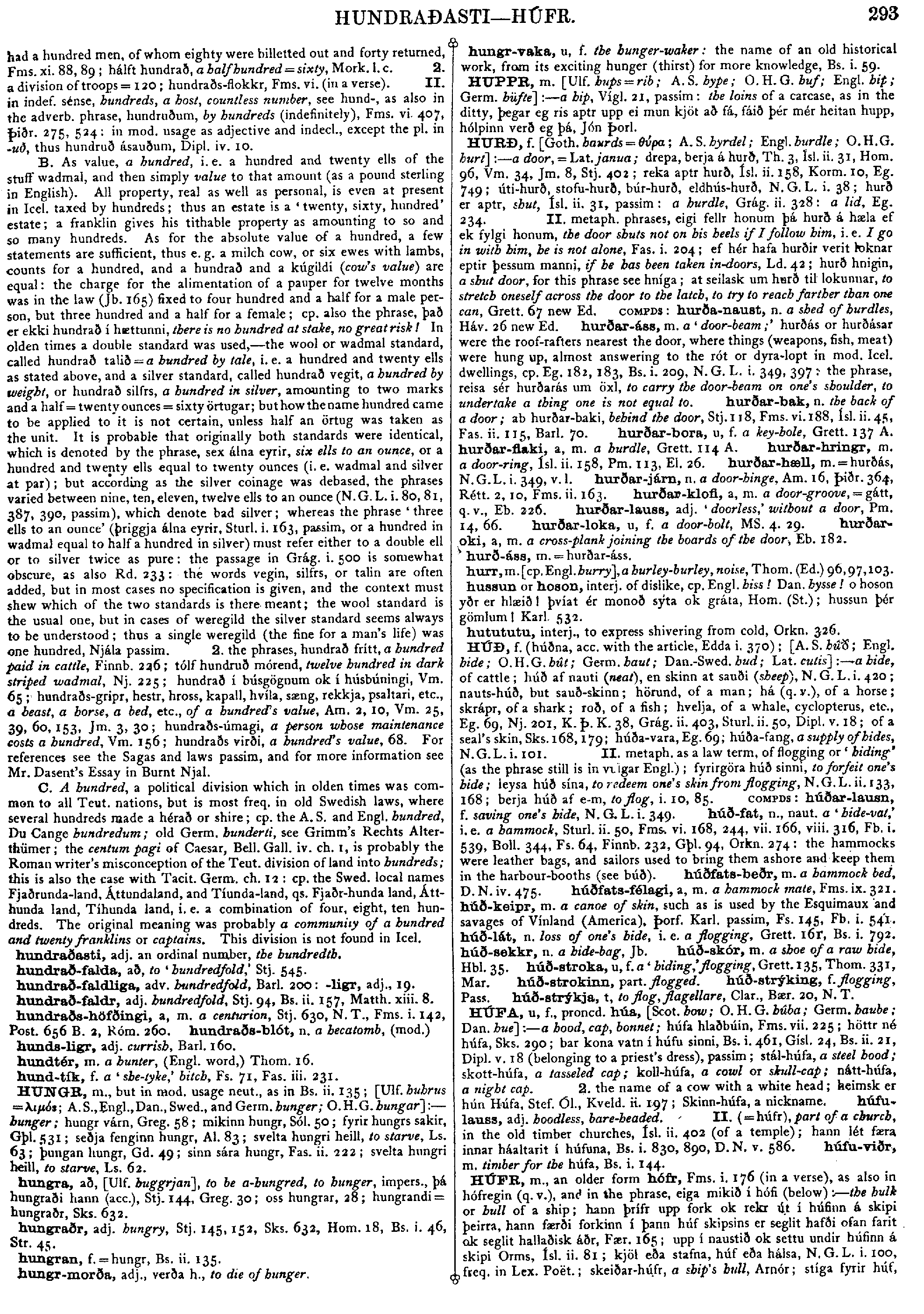
HURÐ, f. [Goth. haurds = GREEK; A. S. hyrdel; Engl. hurdle; O. H. G. hurt] :-- a door, = Lat. janua; drepa, berja á hurð, Th. 3, Ísl. ii. 31, Hom. 96, Vm. 34, Jm. 8, Stj. 402; reka aptr hurð, Ísl. ii. 158, Korm. 10, Eg. 749; úti-hurð, stofu-hurð, búr-hurð, eldhús-hurð, N. G. L. i. 38; hurð er aptr, shut, Ísl. ii. 31, passim: a hurdle, Grág. ii. 328: a lid, Eg. 234. II. metaph. phrases, eigi fellr honum þá hurð á hæla ef ek fylgi honum, the door shuts not on his heels if I follow him, i.e. I go in with him, he is not alone, Fas. i. 204; ef hér hafa hurðir verit loknar eptir þessum manni, if he has been taken in-doors, Ld. 42; hurð hnigin, a shut door, for this phrase see hníga; at seilask um hurð til lokunnar, to stretch oneself across the door to the latch, to try to reach farther than one can, Grett. 67 new Ed. COMPDS: hurða-naust, n. a shed of hurdles, Háv. 26 new Ed. hurðar-áss, m. a 'door-beam;' hurðás or hurðásar were the roof-rafters nearest the door, where things (weapons, fish, meat) were hung up, almost answering to the rót or dyra-lopt in mod. Icel. dwellings, cp. Eg. 182, 183, Bs. i. 209, N. G. L. i. 349, 397: the phrase, reisa sér hurðarás um öxl, to carry the door-beam on one's shoulder, to undertake a thing one is not equal to. hurðar-bak, n. the back of a door; ab hurðar-baki, behind the door, Stj. 118, Fms. vi. 188, Ísl. ii. 45, Fas. ii. 115, Barl. 70. hurðar-bora, u, f. a key-hole, Grett. 137 A. hurðar-flaki, a, m. a hurdle, Grett. 114 A. hurðar-hringr, m. a door-ring, Ísl. ii. 158, Pm. 113, El. 26. hurðar-hæll, m. = hurðás, N. G. L. i. 349, v.l. hurðar-járn, n. a door-hinge, Am. 16, Þiðr. 364, Rétt. 2, 10, Fms. ii. 163. hurðar-klofi, a, m. a door-groove, = gátt, q.v., Eb. 226. hurðar-lauss, adj. 'doorless,' without a door, Pm. 14, 66. hurðar-loka, u, f. a door-bolt, MS. 4. 29. hurðar-oki, a, m. a cross-plank joining the boards of the door, Eb. 182.
| Result Page: |  |
Previous | 1 2 3 4 5 6 7 8 9 10 11 12 | Next |  |
Germanic Lexicon Project (main page)
This search system was written by
Sean Crist
Please consider
volunteering
to correct the data in these online dictionaries.
No rights reserved. Feel free to use these data in any way you please.