|
|

|
Source: Bosworth/Toller, page b0061, entry 6 View original page image as: [TIFF] [PNG] [View previous entry] [View next entry] |
[Comment on this entry] [View comments] |
The following entry has been hand-corrected once. |
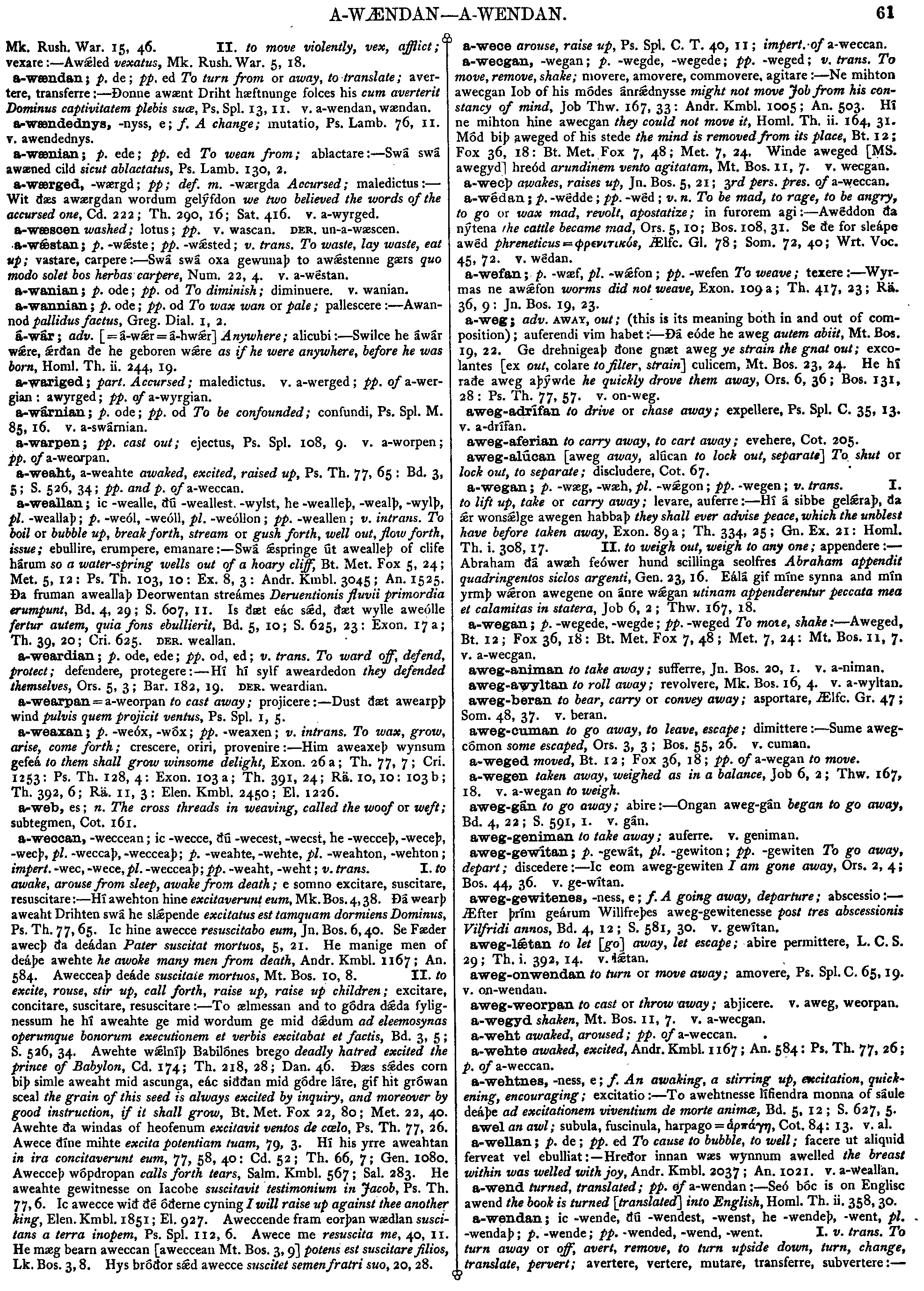
a-w stan;
p.
-wste
;
pp.
-wsted
;
v.
trans.
To
waste,
lay
waste,
eat
up;
vastare,
carpere
:--
Swá
swá
oxa
gewunaþ
to
awstenne
gærs
quo
modo
solet
bos
herbas
carpere,
Num.
22,
4.
v.
a-wéstan.
stan;
p.
-wste
;
pp.
-wsted
;
v.
trans.
To
waste,
lay
waste,
eat
up;
vastare,
carpere
:--
Swá
swá
oxa
gewunaþ
to
awstenne
gærs
quo
modo
solet
bos
herbas
carpere,
Num.
22,
4.
v.
a-wéstan.
|
Source: Bosworth/Toller, page b0062, entry 23 View original page image as: [TIFF] [PNG] [View previous entry] [View next entry] |
[Comment on this entry] [View comments] |
The following entry has been hand-corrected once. |
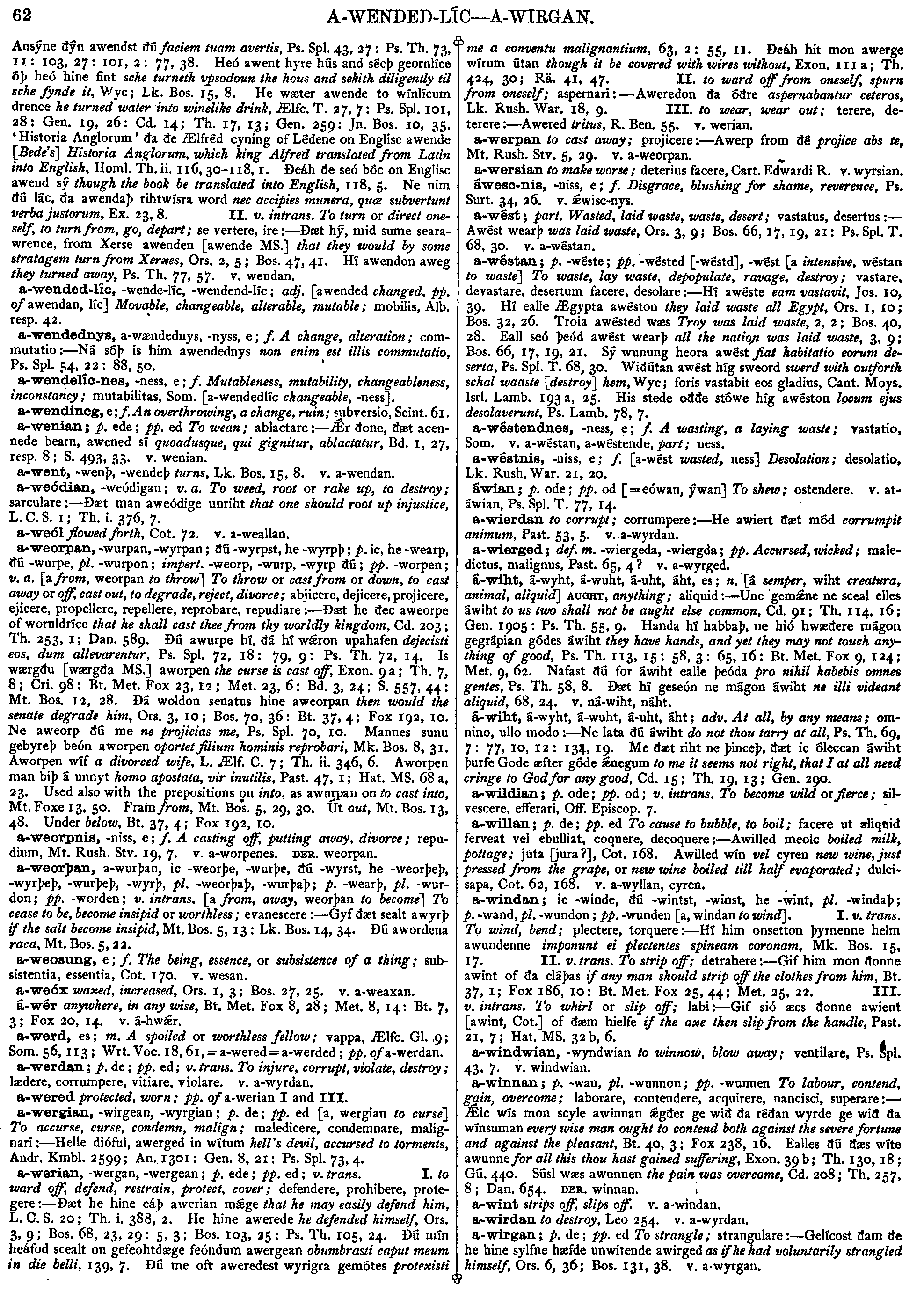
a-wést; part. Wasted, laid waste, waste, desert; vastatus, desertus :-- Awést wearþ was laid waste, Ors. 3, 9 ; Bos. 66, 17, 19, 21: Ps. Spl. T. 68, 30. v. a-wéstan.
|
Source: Bosworth/Toller, page b0062, entry 24 View original page image as: [TIFF] [PNG] [View previous entry] [View next entry] |
[Comment on this entry] [View comments] |
The following entry has been hand-corrected once. |
a-wéstan; p. -wéste; pp. -wésted [-wéstd], -wést [a intensive, wéstan to waste] To waste, lay waste, depopulate, ravage, destroy; vastare, devastare, desertum facere, desolare :-- Hí awéste eam vastavit, Jos. 10, 39. Hí ealle Ægypta awéston they laid waste all Egypt, Ors. 1, 10; Bos. 32, 26. Troia awésted wæs Troy was laid waste, 2, 2 ; Bos. 40, 28. Eall seó þeóð awést wearþ all the nation was laid waste, 3, 9; Bos. 66, 17, 19, 21. Sý wunung heora awést fiat habitatio eorum deserta, Ps. Spl. T. 68, 30. Wiðútan awést híg sweord swerd with outforth schal waaste [destroy] hem, Wyc; foris vastabit eos gladius, Cant. Moys. Isrl. Lamb. 193 a, 25. His stede oððe stówe híg awéston locum ejus desolaverunt, Ps. Lamb. 78, 7.
|
Source: Bosworth/Toller, page b0062, entry 25 View original page image as: [TIFF] [PNG] [View previous entry] [View next entry] |
[Comment on this entry] [View comments] |
The following entry has been hand-corrected once. |
a-wéstendnes, -ness, e; f. A wasting, a laying waste; vastatio, Som. v. a-wéstan, a-wéstende, part; ness.
|
Source: Bosworth/Toller, page b0178, entry 3 View original page image as: [TIFF] [PNG] [View previous entry] [View next entry] |
[Comment on this entry] [View comments] |
The following entry has been hand-corrected once. |
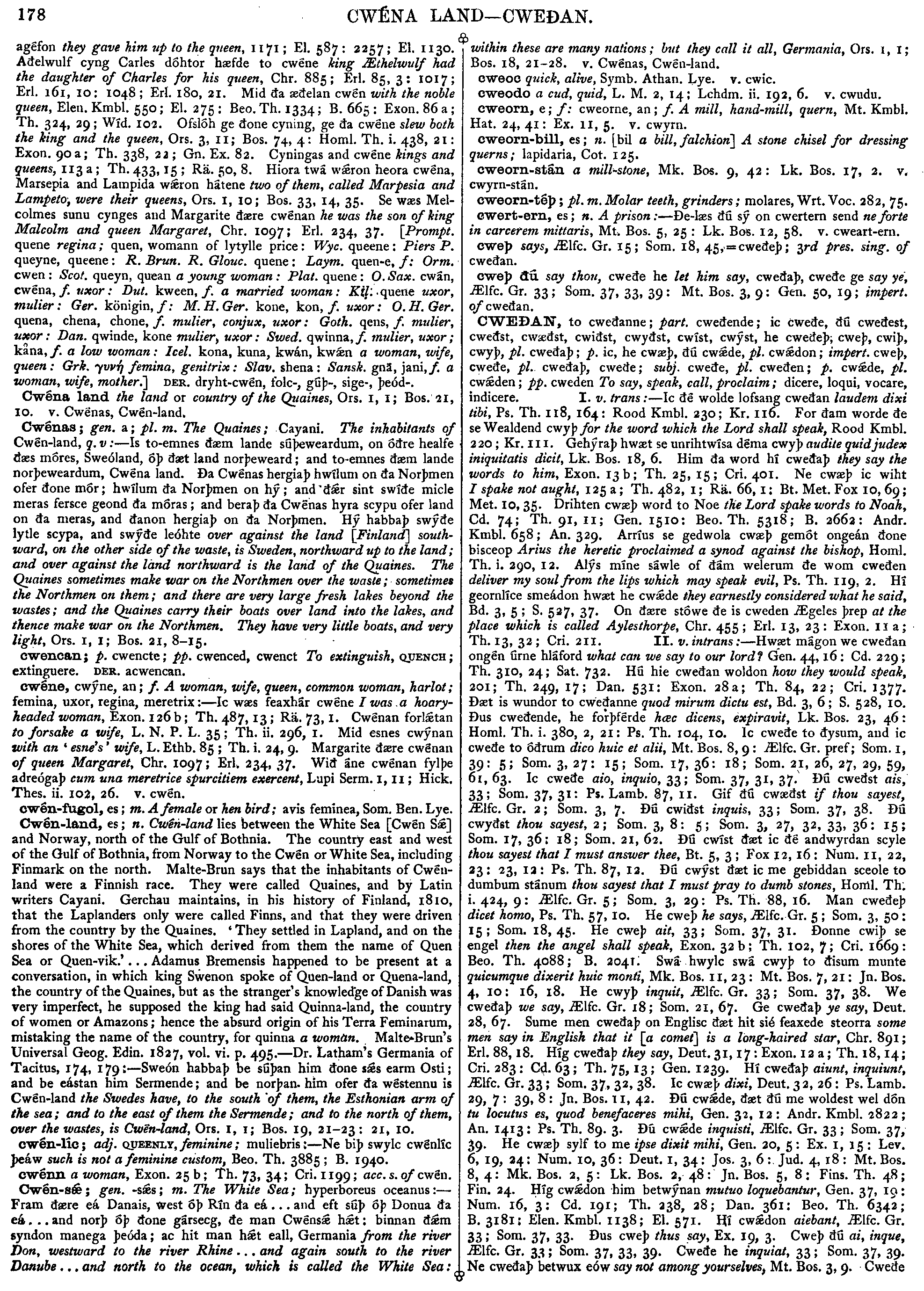
Cwénas;
gen.
a;
pl.
m.
The
Quaines;
Cayani.
The
inhabitants
of
Cwén-land,
q.
v
:--
Is
to-emnes
ðæm
lande
súþeweardum,
on
óðre
healfe
ðæs
móres,
Sweóland,
óþ
ðæt
land
norþeweard;
and
to-emnes
ðæm
lande
norþeweardum,
Cwéna
land.
Ða
Cwénas
hergiaþ
hwílum
on
ða
Norþmen
ofer
ðone
mór;
hwílum
ða
Norþmen
on
hý;
and
ðr
sint
swíðe
micle
meras
fersce
geond
ða
móras;
and
beraþ
ða
Cw nas
hyra
scypu
ofer
land
on
ða
meras,
and
ðanon
hergiaþ
on
ða
Norþmen.
Hý
habbaþ
swýðe
lytle
scypa,
and
swýðe
leóhte
over
against
the
land
[Finland]
southward,
on
the
other
side
of
the
waste,
is
Sweden,
northward
up
to
the
land;
and
over
against
the
land
northward
is
the
land
of
the
Quaines.
The
Quaines
sometimes
make
war
on
the
Northmen
over
the
waste;
sometimes
the
Northmen
on
them;
and
there
are
very
large
fresh
lakes
beyond
the
wastes;
and
the
Quaines
carry
their
boats
over
land
into
the
lakes,
and
thence
make
war
on
the
Northmen.
They
have
very
little
boats,
and
very
light,
Ors.
1,
1;
Bos.
21,
8-15.
nas
hyra
scypu
ofer
land
on
ða
meras,
and
ðanon
hergiaþ
on
ða
Norþmen.
Hý
habbaþ
swýðe
lytle
scypa,
and
swýðe
leóhte
over
against
the
land
[Finland]
southward,
on
the
other
side
of
the
waste,
is
Sweden,
northward
up
to
the
land;
and
over
against
the
land
northward
is
the
land
of
the
Quaines.
The
Quaines
sometimes
make
war
on
the
Northmen
over
the
waste;
sometimes
the
Northmen
on
them;
and
there
are
very
large
fresh
lakes
beyond
the
wastes;
and
the
Quaines
carry
their
boats
over
land
into
the
lakes,
and
thence
make
war
on
the
Northmen.
They
have
very
little
boats,
and
very
light,
Ors.
1,
1;
Bos.
21,
8-15.
|
Source: Bosworth/Toller, page b0180, entry 26 View original page image as: [TIFF] [PNG] [View previous entry] [View next entry] |
[Comment on this entry] [View comments] |
The following entry has been hand-corrected once. |
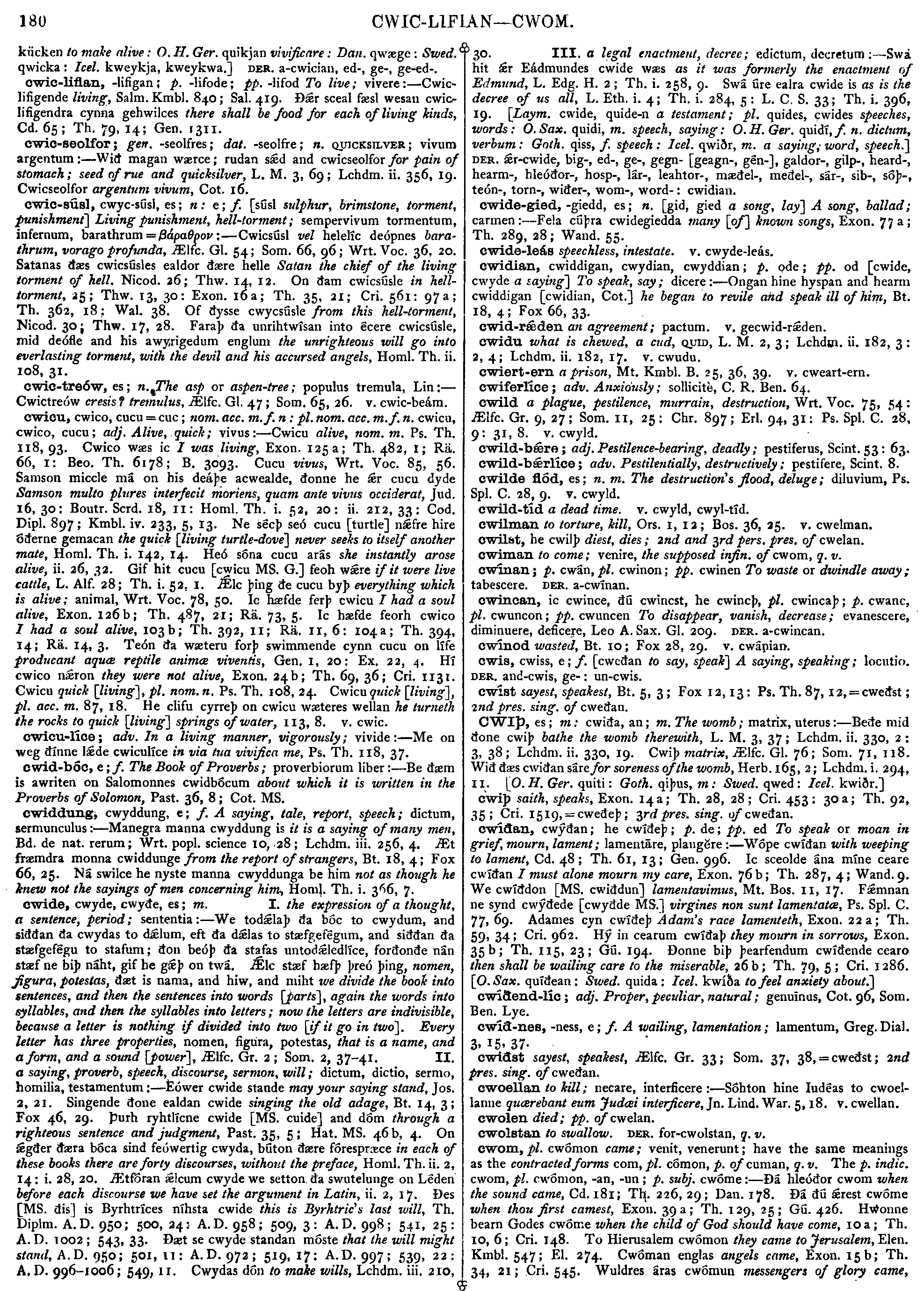
cwínan; p. cwán, pl. cwinon; pp. cwinen To waste or dwindle away; tabescere. DER. a-cwínan.
|
Source: Bosworth/Toller, page b0220, entry 24 View original page image as: [TIFF] [PNG] [View previous entry] [View next entry] |
[Comment on this entry] [View comments] |
The following entry has been hand-corrected once. |
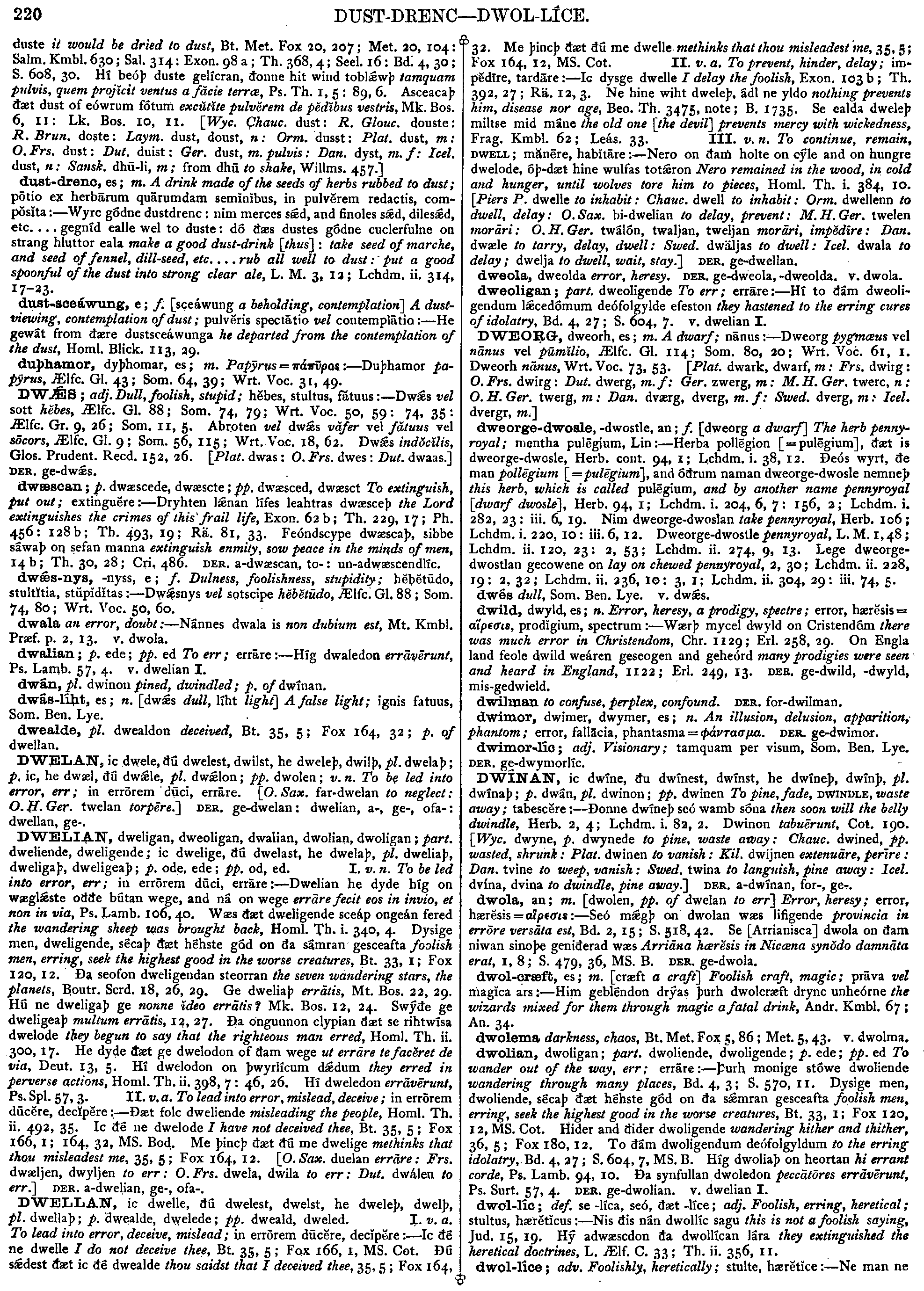
DWÍNAN,
ic
dwíne,
ðu
dwínest,
dwínst,
he
dwíneþ,
dwínþ,
pl.
dwínaþ;
p.
dwán,
pl.
dwinon;
pp.
dwinen
To
pine,
fade,
DWINDLE,
waste
away;
tabesc re
:--
Ðonne
dwíneþ
seó
wamb
sóna
then
soon
will
the
belly
dwindle,
Herb.
2,
4;
Lchdm.
i.
82,
2.
Dwinon
taburunt,
Cot.
190.
[Wyc.
dwyne,
p.
dwynede
to
pine,
waste
away:
Chauc.
dwined,
pp.
wasted,
shrunk:
Plat.
dwinen
to
vanish:
Kil.
dwijnen
extenu
re
:--
Ðonne
dwíneþ
seó
wamb
sóna
then
soon
will
the
belly
dwindle,
Herb.
2,
4;
Lchdm.
i.
82,
2.
Dwinon
taburunt,
Cot.
190.
[Wyc.
dwyne,
p.
dwynede
to
pine,
waste
away:
Chauc.
dwined,
pp.
wasted,
shrunk:
Plat.
dwinen
to
vanish:
Kil.
dwijnen
extenu re,
per
re,
per re:
Dan.
tvine
to
weep,
vanish:
Swed.
twina
to
languish,
pine
away:
Icel.
dvína,
dvina
to
dwindle,
pine
away.]
DER.
a-dwínan,
for-,
ge-.
re:
Dan.
tvine
to
weep,
vanish:
Swed.
twina
to
languish,
pine
away:
Icel.
dvína,
dvina
to
dwindle,
pine
away.]
DER.
a-dwínan,
for-,
ge-.
|
Source: Bosworth/Toller, page b0235, entry 42 View original page image as: [TIFF] [PNG] [View previous entry] [View next entry] |
[Comment on this entry] [View comments] |
The following entry has been hand-corrected once. |
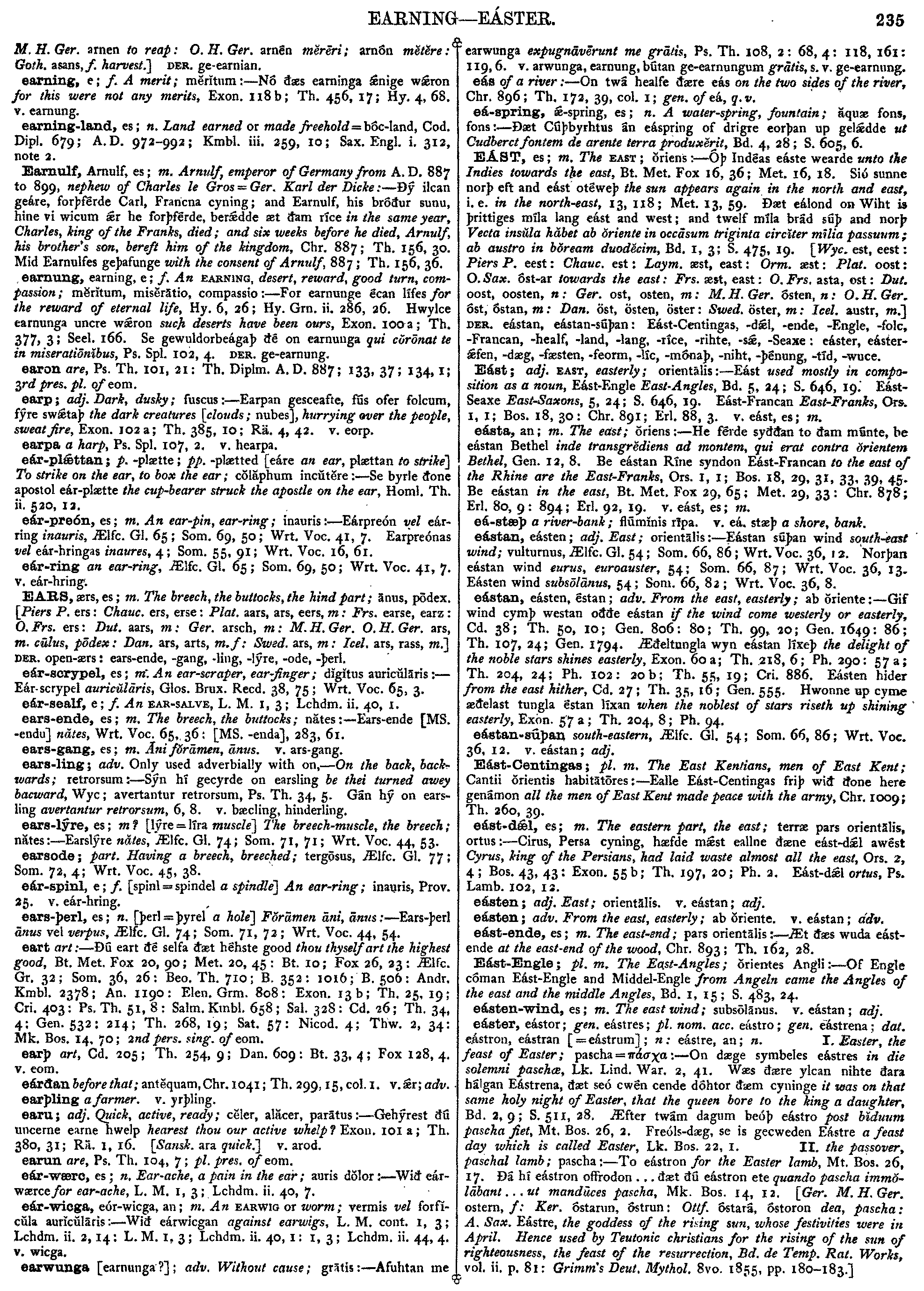
eást-dl,
es;
m.
The
eastern
part,
the
east;
terræ
pars
orientlis,
ortus:--
Cirus,
Persa
cyning,
hæfde
mst
eallne
ðæne
eást-dl
awést
Cyrus,
king
of
the
Persians,
had
laid
waste
almost
all
the
east,
Ors.
2,
4,;
Bos.
43,
43:
Exon.
55b;
Th.
197,
20;
Ph.
2.
Eást-dl
ortus,
Ps.
Lamb.
102,
12.
|
Source: Bosworth/Toller, page b0250, entry 24 View original page image as: [TIFF] [PNG] [View previous entry] [View next entry] |
[Comment on this entry] [View comments (1)] |
The following entry has been hand-corrected once. |
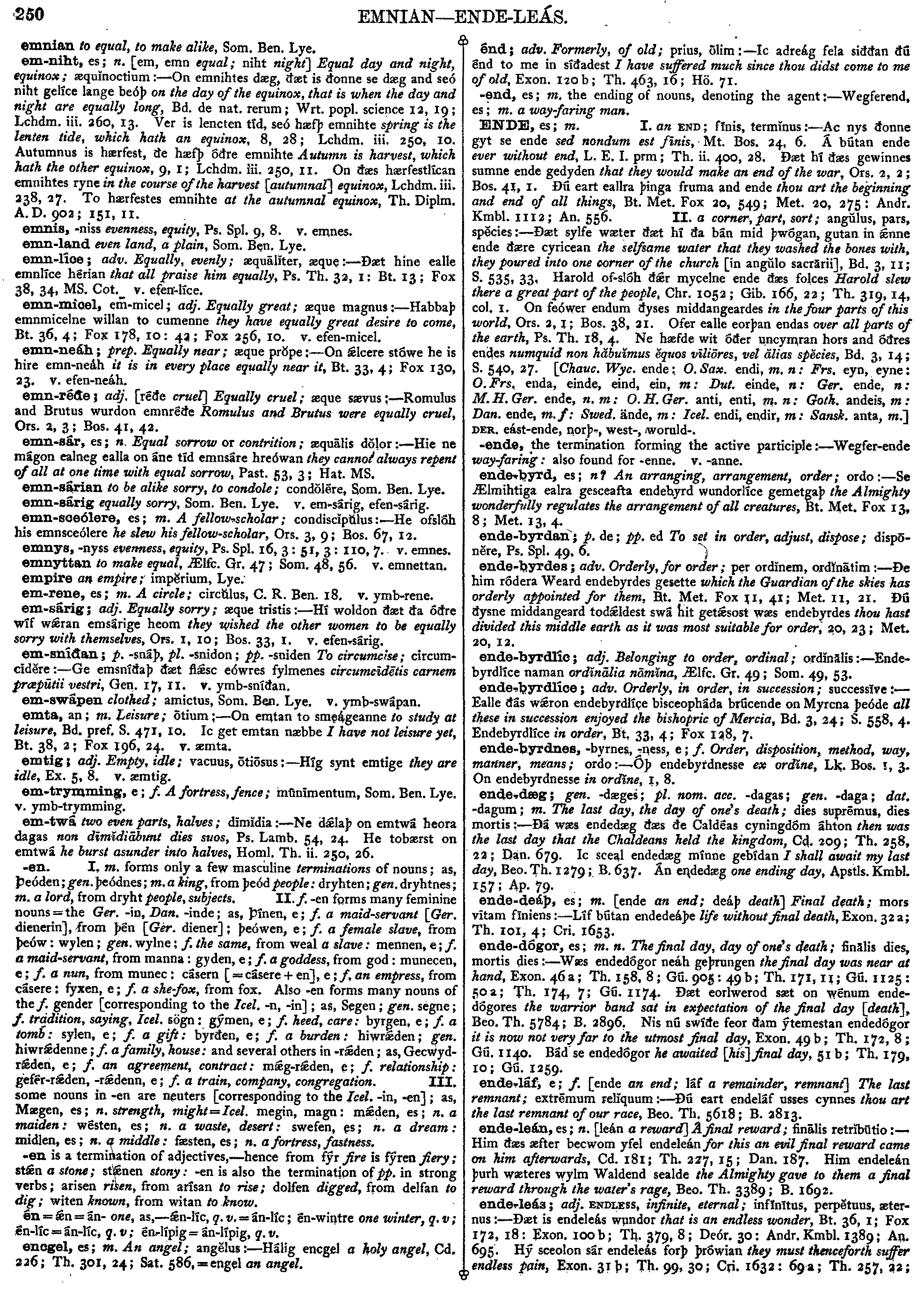
-en.
J,
m.
forms
only
a
few
masculine
terminations
of
nouns;
as,
Þeóden;
gen.
þeódnes;
m.
a
king,
from
þeód
people:
dryhten;
gen.
dryhtnes;
m.
a
lord,
from
dryht
people,
subjects.
II.
f.
-en
forms
many
feminine
nouns
=
the
Ger.
-in,
Dan.
-inde;
as,
Þínen,
e;
f.
a
maid-servant
[Ger.
dienerin],
from
þén
[Ger.
diener];
þeówen,
e;
f.
a
female
slave,
from
þeów:
wylen;
gen.
wylne;
f.
the
same,
from
weal
a
slave:
mennen,
e;
f.
a
maid-servant,
from
manna:
gyden,
e;
f.
a
goddess,
from
god:
munecen,
e;
f.
a
nun,
from
munec:
cásern
[=cásere
+
en],
e;
f,
an
empress,
from
cásere:
fyxen,
e;
f.
a
she-fox,
from
fox.
Also
-en
forms
many
nouns
of
the
f.
gender
[corresponding
to
the
Icel.
-n,
-in]
;
as,
Segen;
gen.
segne;
f.
tradition,
saying,
Icel.
sögn:
gýen,
e;
f.
heed,
care:
byrgen,
e;
f.
a
tomb:
sylen,
e;
f.
a
gift:
byrðen,
e;
f.
a
burden:
hiwrden;
gen.
hiwrdenne;
f.
a
family,
house:
and
several
others
in
-rden;
as,
Gecwyd-rden,
e;
f.
an
agreement,
contract:
mg-rden,
e;
f.
relationship:
gefér-rden,
-rdenn,
e;
f.
a
train,
company,
congregation.
III.
some
nouns
in
-en
are
neuters
[corresponding
to
the
Icel.
-in,
-en];
as,
Mægen,
es;
n.
strength,
might
=
Icel.
megin,
magn:
mden,
es;
n.
a
maiden:
wésten,
es;
n.
a
waste,
desert:
swefen,
es;
n.
a
dream
:
midlen,
es;
n.
a
middle:
fæsten,
es;
n.
a
fortress,
fastness.
|
Source: Bosworth/Toller, page b0259, entry 2 View original page image as: [TIFF] [PNG] [View previous entry] [View next entry] |
[Comment on this entry] [View comments] |
The following entry has been hand-corrected once. |
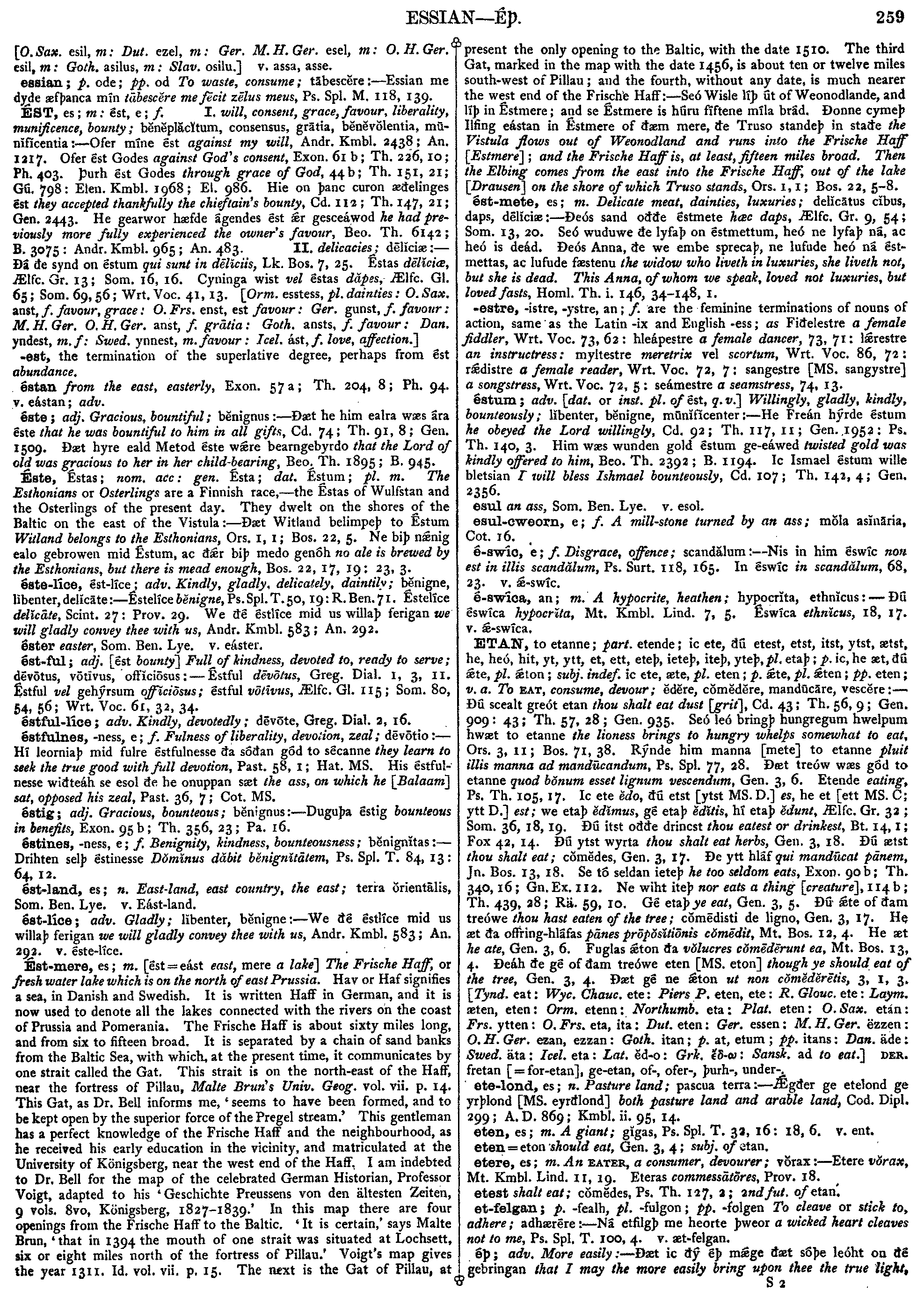
essian;
p.
ode;
pp.
od
To
waste,
consume;
tbescre
:--
Essian
me
dyde
æfþanca
mín
tbescre
me
fcit
zlus
meus.
Ps.
Spl.
M.
118,
139.
| Result Page: |  |
Previous | 1 2 3 4 5 6 7 8 9 10 11 | Next |  |
Germanic Lexicon Project (main page)
This search system was written by
Sean Crist
Please consider
volunteering
to correct the data in these online dictionaries.
No rights reserved. Feel free to use these data in any way you please.