|
|

|
Source: Bosworth/Toller, page d0074, entry 5 View original page image as: [TIFF] [PNG] [View previous entry] [View next entry] |
[Comment on this entry] [View comments] |
The following entry has been hand-corrected once. |
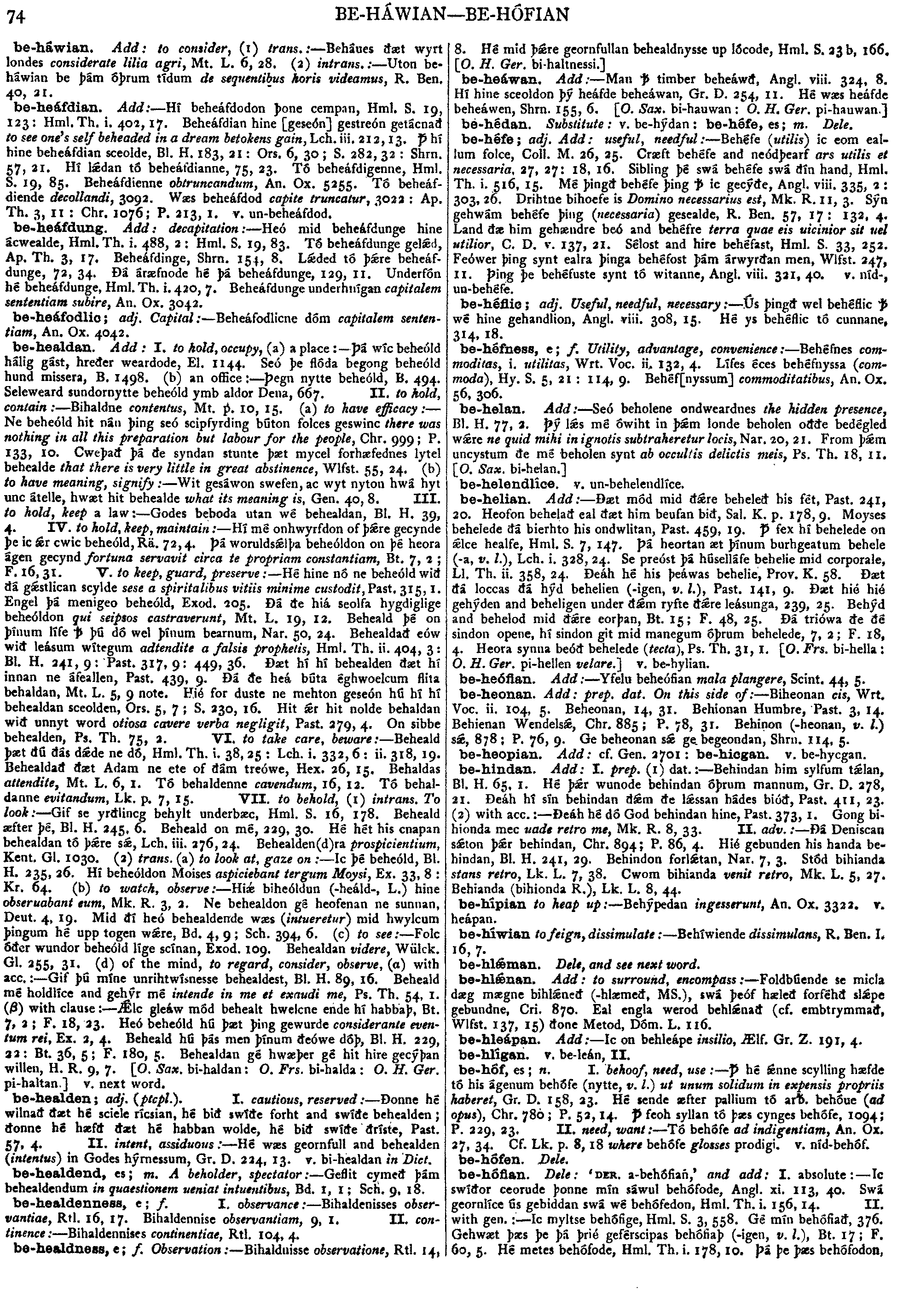
be-healdan.
Add:
I.
to
hold,
occupy,
(a)
a
place:--Þá
wíc
beheóld
hálig
gást,
hreðer
weardode,
El.
1144.
Seó
þe
flóda
begong
beheóld
hund
missera,
B.
1498.
(b)
an
office:--Þegn
nytte
beheóld,
B.
494.
Seleweard
sundornytte
beheóld
ymb
aldor
Dena,
667.
II.
to
hold,
contain:--Bihaldne
contentus,
Mt.
P.
10,
15.
(a)
to
have
efficacy:--Ne
beheóld
hit
nán
þing
seó
scipfyrding
búton
folces
geswinc
there
was
nothing
in
all
this
preparation
but
labour
for
the
people,
Chr.
999;
P.
133,
10.
Cweþað
þá
ðe
syndan
stunte
þæt
mycel
forhæfednes
lytel
behealde
that
there
is
very
little
in
great
abstinence,
Wlfst.
55,
24.
(b)
to
have
meaning,
signify:--Wit
gesáwon
swefen,
ac
wyt
nyton
hwá
hyt
unc
átelle,
hwæt
hit
behealde
what
its
meaning
is.
Gen.
40,
8.
III.
to
hold,
keep
a
law:--Godes
beboda
utan
wé
behealdan,
Bl.
H.
39,
4.
IV.
to
hold,
keep,
maintain:--Hí
mé
onhwyrfdon
of
þ re
gecynde
þe
ic
r
cwic
beheóld,
Rä.
72,
4.
Þá
woruldslþa
beheóldon
on
þé
heora
ágen
gecynd
fortuna
servavit
circa
te
propriam
constantiam,
Bt.
7,
2;
F.
16,
31.
V.
to
keep,
guard,
preserve:--Hé
hine
nó
ne
beheóld
wið
ðá
gstlican
scylde
sese
a
spiritalibus
vitiis
minime
custodit,
Past.
315,
1.
Engel
þá
menigeo
beheóld,
Exod.
205.
Ðá
ðe
hiá
seolfa
hygdiglige
beheóldon
qui
seipsos
castraverunt,
Mt.
L.
19,
12.
Beheald
þé
on
þínum
lífe
re
gecynde
þe
ic
r
cwic
beheóld,
Rä.
72,
4.
Þá
woruldslþa
beheóldon
on
þé
heora
ágen
gecynd
fortuna
servavit
circa
te
propriam
constantiam,
Bt.
7,
2;
F.
16,
31.
V.
to
keep,
guard,
preserve:--Hé
hine
nó
ne
beheóld
wið
ðá
gstlican
scylde
sese
a
spiritalibus
vitiis
minime
custodit,
Past.
315,
1.
Engel
þá
menigeo
beheóld,
Exod.
205.
Ðá
ðe
hiá
seolfa
hygdiglige
beheóldon
qui
seipsos
castraverunt,
Mt.
L.
19,
12.
Beheald
þé
on
þínum
lífe
 þú
dó
wel
þínum
bearnum,
Nar.
50,
24.
Behealdað
eów
wið
leásum
wítegum
adtendite
a
falsis
prophetis,
Hml.
Th.
ii.
404,
3:
Bl.
H.
241,
9:
Past.
317,
9:
449,
36.
Ðæt
hí
hí
behealden
ðæt
hí
innan
ne
áfeallen,
Past.
439,
9.
Ðá
ðe
heá
búta
éghwoelcum
flita
behaldan,
Mt.
L.
5,
9
note.
Hié
for
duste
ne
mehton
geseón
hú
hí
hí
behealdan
sceolden,
Ors.
5,
7;
S.
230,
16.
Hit
r
hit
nolde
behaldan
wið
unnyt
word
otiosa
covere
verba
negligit,
Past.
279,
4.
On
sibbe
behealden,
Ps.
Th.
75,
2.
VI.
to
take
care,
beware:--Beheald
þæt
ðú
ðás
dde
ne
dó,
Hml.
Th.
i.
38,
25:
Lch.
i.
332,
6:
ii.
318,
19.
Behealdað
ðæt
Adam
ne
ete
of
ðám
treówe,
Hex.
26,
15.
Behaldas
attendite,
Mt.
L.
6,
I.
Tó
behaldenne
cavendum,
16,
12.
Tó
behal-danne
evitandum,
Lk.
p.
7,
15.
VII.
to
behold,
(I)
intrans.
To
look:--Gif
se
yrðlincg
behylt
underbæc,
Hml.
S.
16,
178.
Beheald
æfter
þé,
Bl.
H.
245,
6.
Beheald
on
mé,
229,
30.
Hé
hét
his
cnapan
behealdan
tó
þre
s,
Lch.
iii.
.
276,
24.
Behealden(d)ra
prospicientium,
Kent.
Gl.
1030.
(2)
trans,
(a)
to
look
at,
gaze
on:--Ic
þé
beheóld,
Bl.
H.
235,
26.
Hí
beheóldon
Moises
aspiciebant
tergum
Moysi,
Ex.
33,
8:
Kr.
64.
(b)
to
watch,
observe:--Hi
biheóldun
(-heáld-.
L.)
hine
obseruabant
eum.
Mk.
R.
3,
2.
Ne
behealdon
gé
heofenan
ne
sunnan,
Deut.
4,
19.
Mid
ðí
heó
behealdende
wæs
(intueretur)
mid
hwylcum
þingum
hé
upp
togen
wre,
Bd.
4,
9;
Sch.
394,
6.
(c)
to
see:--Folc
óðer
wundor
beheóld
líge
scínan,
Exod.
109.
Behealdan
videre,
Wülck.
Gl.
255,
31.
(d)
of
the
mind,
to
regard,
consider,
observe,
(a)
with
acc.:--
Gif
þú
míne
unrihtwísnesse
behealdest,
Bl.
H.
89,
16.
Beheald
mé
holdlíce
and
gehýr
mé
intende
in
me
et
exaudi
me,
Ps.
Th.
54,
l.
(
þú
dó
wel
þínum
bearnum,
Nar.
50,
24.
Behealdað
eów
wið
leásum
wítegum
adtendite
a
falsis
prophetis,
Hml.
Th.
ii.
404,
3:
Bl.
H.
241,
9:
Past.
317,
9:
449,
36.
Ðæt
hí
hí
behealden
ðæt
hí
innan
ne
áfeallen,
Past.
439,
9.
Ðá
ðe
heá
búta
éghwoelcum
flita
behaldan,
Mt.
L.
5,
9
note.
Hié
for
duste
ne
mehton
geseón
hú
hí
hí
behealdan
sceolden,
Ors.
5,
7;
S.
230,
16.
Hit
r
hit
nolde
behaldan
wið
unnyt
word
otiosa
covere
verba
negligit,
Past.
279,
4.
On
sibbe
behealden,
Ps.
Th.
75,
2.
VI.
to
take
care,
beware:--Beheald
þæt
ðú
ðás
dde
ne
dó,
Hml.
Th.
i.
38,
25:
Lch.
i.
332,
6:
ii.
318,
19.
Behealdað
ðæt
Adam
ne
ete
of
ðám
treówe,
Hex.
26,
15.
Behaldas
attendite,
Mt.
L.
6,
I.
Tó
behaldenne
cavendum,
16,
12.
Tó
behal-danne
evitandum,
Lk.
p.
7,
15.
VII.
to
behold,
(I)
intrans.
To
look:--Gif
se
yrðlincg
behylt
underbæc,
Hml.
S.
16,
178.
Beheald
æfter
þé,
Bl.
H.
245,
6.
Beheald
on
mé,
229,
30.
Hé
hét
his
cnapan
behealdan
tó
þre
s,
Lch.
iii.
.
276,
24.
Behealden(d)ra
prospicientium,
Kent.
Gl.
1030.
(2)
trans,
(a)
to
look
at,
gaze
on:--Ic
þé
beheóld,
Bl.
H.
235,
26.
Hí
beheóldon
Moises
aspiciebant
tergum
Moysi,
Ex.
33,
8:
Kr.
64.
(b)
to
watch,
observe:--Hi
biheóldun
(-heáld-.
L.)
hine
obseruabant
eum.
Mk.
R.
3,
2.
Ne
behealdon
gé
heofenan
ne
sunnan,
Deut.
4,
19.
Mid
ðí
heó
behealdende
wæs
(intueretur)
mid
hwylcum
þingum
hé
upp
togen
wre,
Bd.
4,
9;
Sch.
394,
6.
(c)
to
see:--Folc
óðer
wundor
beheóld
líge
scínan,
Exod.
109.
Behealdan
videre,
Wülck.
Gl.
255,
31.
(d)
of
the
mind,
to
regard,
consider,
observe,
(a)
with
acc.:--
Gif
þú
míne
unrihtwísnesse
behealdest,
Bl.
H.
89,
16.
Beheald
mé
holdlíce
and
gehýr
mé
intende
in
me
et
exaudi
me,
Ps.
Th.
54,
l.
( )
with
clause:--Æ-acute;lc
gleáw
mód
behealt
hwelcne
ende
hí
habbaþ,
Bt.
7,
2;
F.
18,
23.
Heó
beheóld
hú
þæt
þing
gewurde
considerante
even-tum
rei,
Ex.
2,
4.
Beheald
hú
þás
men
þínum
ðeówe
dóþ,
Bl.
H.
229,
22:
Bt.
36,
5;
F.
180,
5.
Behealdan
gé
hwæþer
gé
hit
hire
gecýþan
willen,
H.
R.
9,
7.
[O.
Sax,
bi-haldan:
O.
Frs.
bi-halda:
O.
H.
Ger.
pi-haltan.]
v.
next
word.
)
with
clause:--Æ-acute;lc
gleáw
mód
behealt
hwelcne
ende
hí
habbaþ,
Bt.
7,
2;
F.
18,
23.
Heó
beheóld
hú
þæt
þing
gewurde
considerante
even-tum
rei,
Ex.
2,
4.
Beheald
hú
þás
men
þínum
ðeówe
dóþ,
Bl.
H.
229,
22:
Bt.
36,
5;
F.
180,
5.
Behealdan
gé
hwæþer
gé
hit
hire
gecýþan
willen,
H.
R.
9,
7.
[O.
Sax,
bi-haldan:
O.
Frs.
bi-halda:
O.
H.
Ger.
pi-haltan.]
v.
next
word.
|
Source: Bosworth/Toller, page d0075, entry 12 View original page image as: [TIFF] [PNG] [View previous entry] [View next entry] |
[Comment on this entry] [View comments] |
The following entry has been hand-corrected once. |
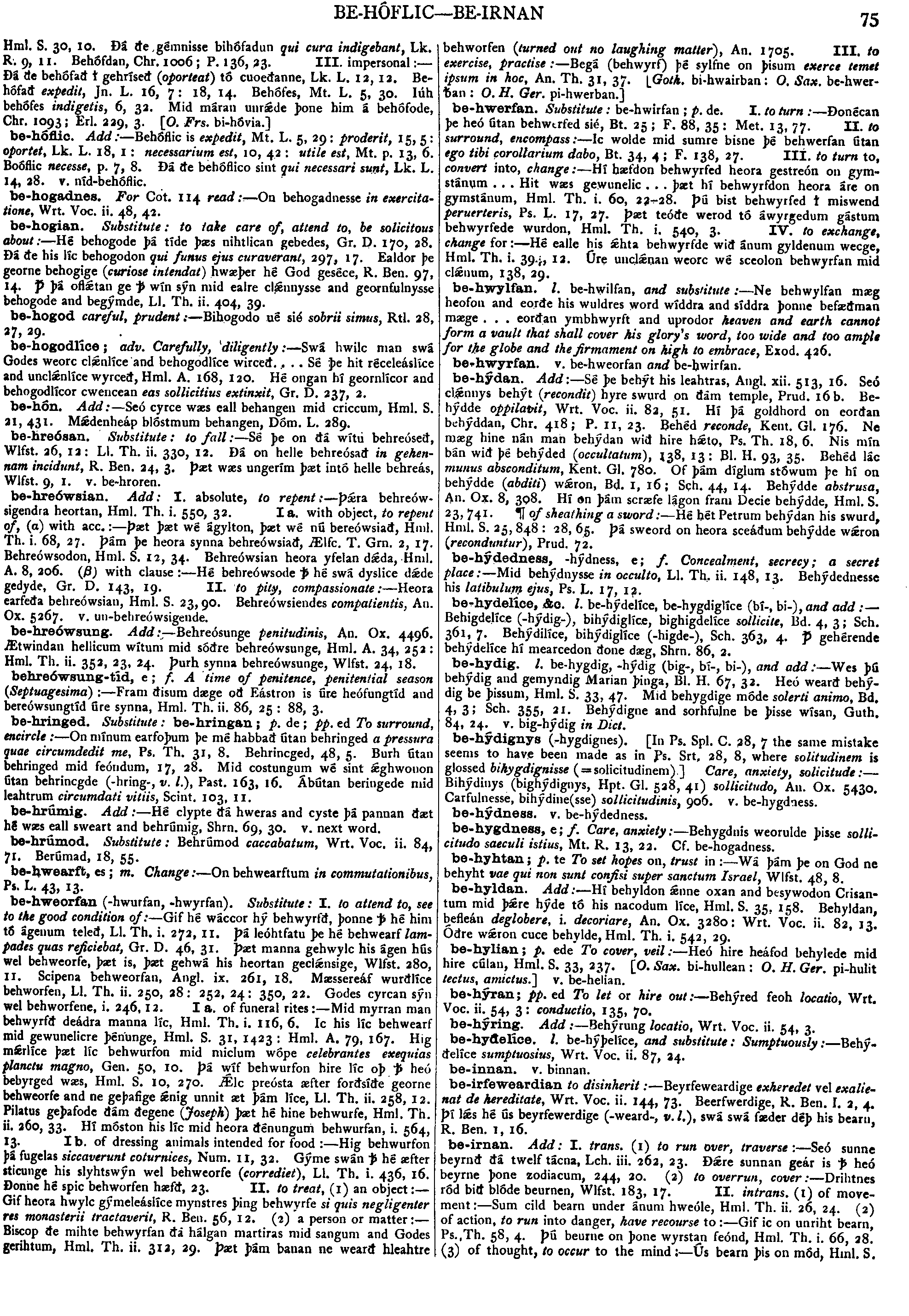
be-hringed.
Substitute:
be-hringan;
p.
de;
pp.
ed
To
surround,
encircle:--On
mínum
earfoþum
þe
mé
habbað
útan
behringed
a
pressura
quae
circumdedit
me,
Ps.
Th.
31,
8.
Behrincged,
48,
5.
Burh
útan
behringed
mid
feóndum,
17,
28.
Mid
costungum
wé
sint
ghwonon
útan
behrincgde
(-hring-,
v.
l.).
Past.
163,
16.
Ábútan
beringede
mid
leahtrum
circumdati
vitiis,
Scint.
103,
II.
|
Source: Bosworth/Toller, page d0152, entry 10 View original page image as: [TIFF] [PNG] [View previous entry] [View next entry] |
[Comment on this entry] [View comments] |
The following entry has been hand-corrected once. |
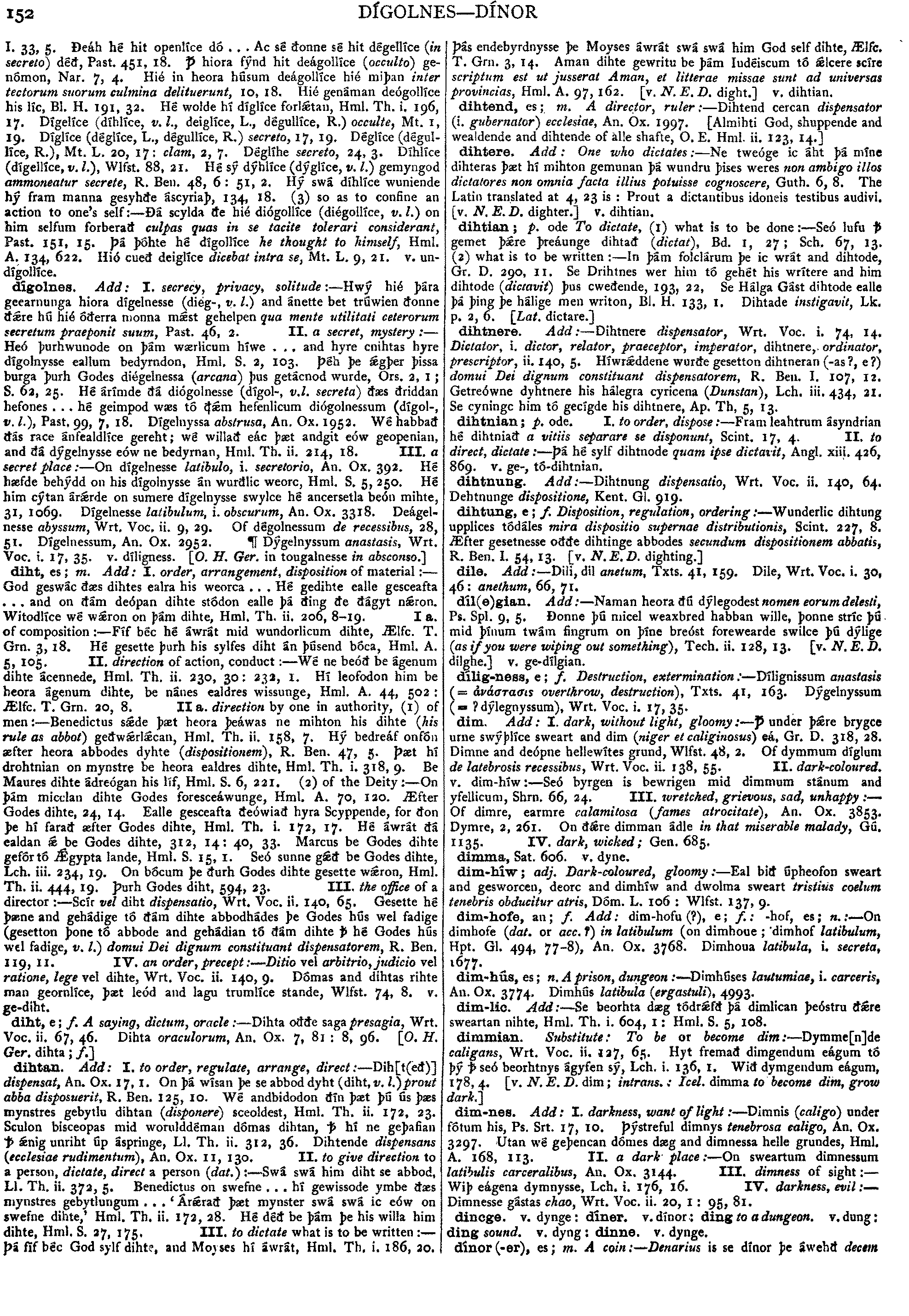
dihtnian; p. ode. I. to order, dispose:--Fram leahtrum ásyndrian hé dihtniað a vitiis separare se disponunt, Scint. 17, 4. II. to direct, dictate:--Þá hé sylf dihtnode quant ipse dictavit, Angl. xiii. 426, 869. v. ge-, tó-dihtnian.
|
Source: Bosworth/Toller, page d0243, entry 1 View original page image as: [TIFF] [PNG] [View previous entry] [View next entry] |
[Comment on this entry] [View comments] |
The following entry has been hand-corrected once. |
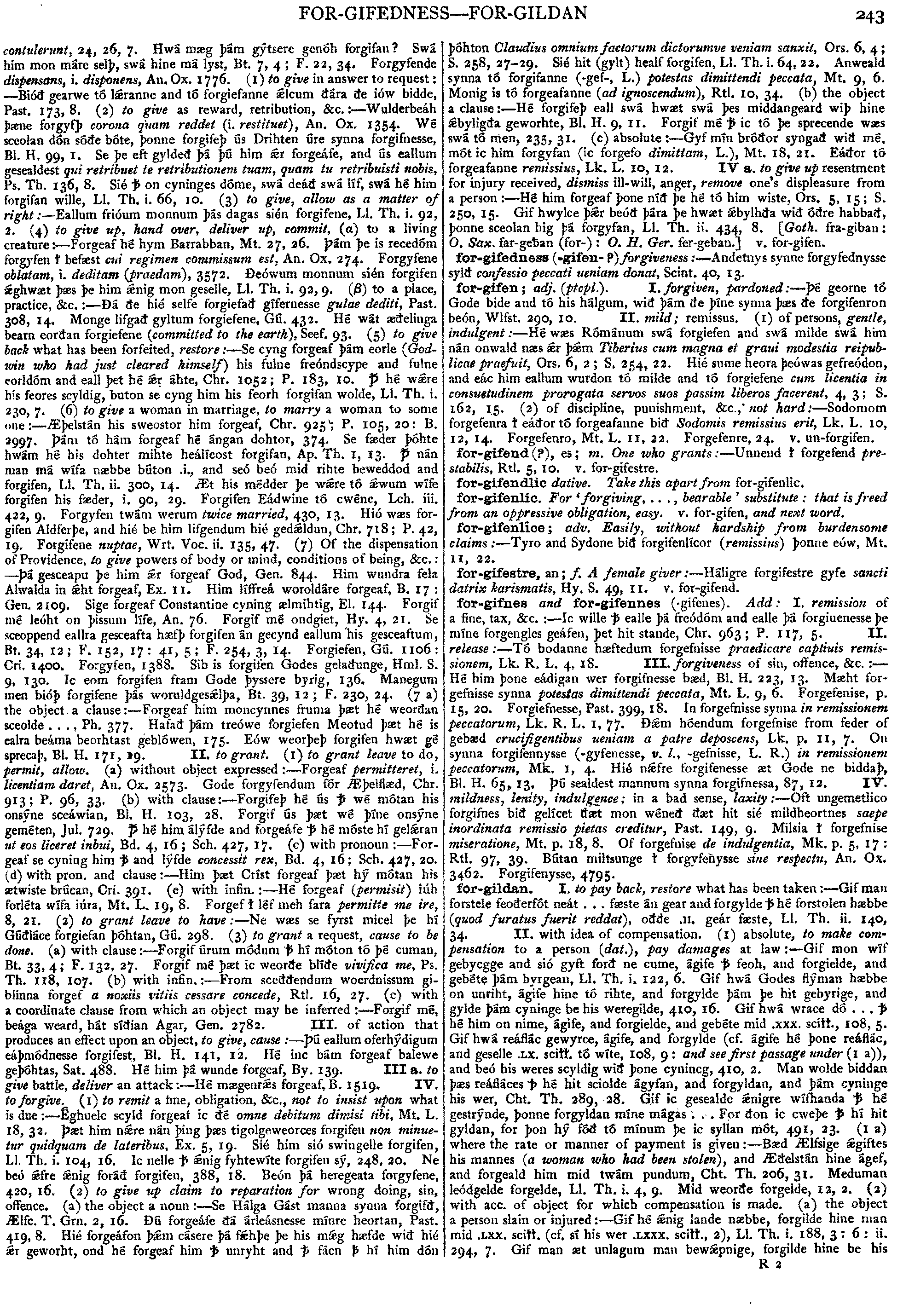
contulerunt,
24,
26,
7.
Hwá
mæg
þám
gýtsere
genóh
forgifan?
Swá
him
mon
máre
selþ,
swá
hine
má
lyst,
Bt.
7,
4;
F.
22,
34.
Forgyfende
dispensans,
i.
disponens,
An.
Ox.
1776.
(1)
to
give
in
answer
to
request:--Bióð
gearwe
tó
lranne
and
tó
forgiefanne
lcum
ðára
ðe
iów
bidde,
Past.
173,
8.
(2)
to
give
as
reward,
retribution,
&c.:--Wulderbeáh
þæne
forgyfþ
corona
quam
reddet
(i.
restituet),
An.
Ox.
1354.
Wé
sceolan
dón
sóðe
bóte,
þonne
forgifeþ
ús
Drihten
úre
synna
forgifnesse,
Bl.
H.
99,
1.
Se
þe
eft
gyldeð
þá
þú
him
r
forgeáfe,
and
ús
eallum
gesealdest
qui
retribuet
te
retributionem
tuam,
quam
tu
retribuisti
nobis,
Ps.
Th.
136,
8.
Sié
on
cyninges
dóme,
swá
deáð
swá
líf,
swá
hé
him
forgifan
wille,
Ll.
Th.
i.
66,
10.
(3)
to
give,
allow
as
a
matter
of
right:--Eallum
frióum
monnum
þás
dagas
sién
forgifene,
Ll.
Th.
i.
92,
2.
(4)
to
give
up,
hand
over,
deliver
up,
commit,
( )
to
a
living
creature:--Forgeaf
hé
hym
Barrabban,
Mt.
27,
26.
Þám
þe
is
recedóm
forgyfen
)
to
a
living
creature:--Forgeaf
hé
hym
Barrabban,
Mt.
27,
26.
Þám
þe
is
recedóm
forgyfen
 befæst
cui
regimen
commissum
est,
An.
Ox.
274.
Forgyfene
oblatam,
i.
deditam
(praedam),
3572.
Ðeówum
monnum
sién
forgifen
ghwæt
þæs
þe
him
nig
mon
geselle,
Ll.
Th.
i.
92,
9.
()
to
a
place,
practice,
&c.:--Ðá
ðe
hié
selfe
forgiefað
gífernesse
gulae
dediti,
Past.
308,
14.
Monge
lifgað
gyltum
forgiefene,
Gú.
432.
Hé
wát
æðelinga
beam
eorðan
forgiefene
(committed
to
the
earth),
Seef.
93.
(5)
to
give
back
what
has
been
forfeited,
restore:--Se
cyng
forgeaf
þám
eorle
(Godwin
who
had
just
cleared
himself)
his
fulne
freóndscype
and
fulne
eorldóm
and
eall
þet
hé
r
áhte,
Chr.
1052;
P.
183,
10.
Þ-bar;
hé
wre
his
feores
scyldig,
buton
se
cyng
him
his
feorh
forgifan
wolde,
Ll.
Th.
i.
230,
7.
(6)
to
give
a
woman
in
marriage,
to
marry
a
woman
to
some
one:--Æþelstán
his
sweostor
him
forgeaf,
Chr.
925;
P.
105,
20:
B.
2997.
Þám
tó
hám
forgeaf
hé
ángan
dohtor,
374.
Se
fæder
þóhte
hwám
hé
his
dohter
mihte
heálícost
forgifan,
Ap.
Th.
1,
13.
Þ-bar;
nán
man
má
wífa
næbbe
búton
.i.,
and
seó
beó
mid
rihte
beweddod
and
forgifen,
Ll.
Th.
ii.
300,
14.
Æt
his
médder
þe
wre
tó
wum
wífe
forgifen
his
fæder,
i.
90,
29.
Forgifen
Eádwine
tó
cwéne,
Lch.
iii.
422,
9.
Forgyfen
twám
werum
twice
married,
430,
13.
Hió
wæs
forgifen
Aldferþe,
and
hié
be
him
lifgendum
hié
gedldun,
Chr.
718;
P.
42,
19.
Forgifene
nuptae,
Wrt.
Voc.
ii.
135,
47.
(7)
Of
the
dispensation
of
Providence,
to
give
powers
of
body
or
mind,
conditions
of
being,
&c.:--Þá
gesceapu
þe
him
r
forgeaf
God,
Gen.
844.
Him
wundra
fela
Alwalda
in
ht
forgeaf,
Ex.
11.
Him
líffreá
woroldáre
forgeaf,
B.
17:
Gen.
2109.
Sige
forgeaf
Constantine
cyning
ælmihtig,
El.
144.
Forgif
mé
leóht
on
þissum
lífe,
An.
76.
Forgif
mé
ondgiet,
Hy.
4,
21.
Se
sceoppend
eallra
gesceafta
hæfþ
forgifen
án
gecynd
eallum
his
gesceaftum,
Bt.
34,
12;
F.
152,
17:
41,
5;
F.
254,
3,
14.
Forgiefen,
Gú.
1106:
Cri.
1400.
Forgyfen,
1388.
Sib
is
forgifen
Godes
gelaðunge,
Hml.
S.
9,
130.
Ic
eom
forgifen
fram
Gode
þyssere
byrig,
136.
Manegum
men
bióþ
forgifene
þás
woruldgeslþa,
Bt.
39,
12;
F.
230,
24.
(7
a)
the
object
a
clause:--Forgeaf
him
moncynnes
fruma
þæt
hé
weorðan
sceolde
.
.
.,
Ph.
377.
Hafað
þám
treówe
forgiefen
Meotud
þæt
hé
is
ealra
beáma
beorhtast
geblówen,
175.
Eów
weorþeþ
forgifen
hwæt
gé
sprecaþ,
Bl.
H.
171,
29.
II.
to
grant.
(1)
to
grant
leave
to
do,
permit,
allow.
(a)
without
object
expressed:--Forgeaf
permitteret,
i.
licentiam
daret,
An.
Ox.
2573.
Gode
forgyfendum
fór
Æþelflæd,
Chr.
913;
P.
96,
33.
(b)
with
clause:--Forgifeþ
hé
ús
wé
mótan
his
onsýne
sceáwian,
Bl.
H.
103,
28.
Forgif
ús
þæt
wé
þíne
onsýne
geméten,
Jul.
729.
Þ-bar;
hé
him
álýfde
and
forgeáfe
hé
móste
hí
gelran
ut
eos
liceret
inbui,
Bd.
4,
16;
Sch.
427,
17.
(c)
with
pronoun:--Forgeaf
se
cyning
him
and
lýfde
concessit
rex,
Bd.
4,
16;
Sch.
427,
20.
(d)
with
pron.
and
clause:--Him
þæt
Críst
forgeaf
þæt
hý
mótan
his
ætwiste
brúcan,
Cri.
391.
(e)
with
infin.:--Hé
forgeaf
(permisit)
iúh
forléta
wífa
iúra,
Mt.
L.
19,
8.
Forgef
léf
meh
fara
permitte
me
ire,
8,
21.
(2)
to
grant
leave
to
have:--Ne
wæs
se
fyrst
micel
þe
hí
Gúðláce
forgiefan
þóhtan,
Gú.
298.
(3)
to
grant
a
request,
cause
to
be
done.
(a)
with
clause:--Forgif
úrum
módum
hí
móton
tó
þé
cuman,
Bt.
33,
4;
F.
132,
27.
Forgif
mé
þæt
ic
weorðe
blíðe
vivifica
me,
Ps.
Th.
118,
107.
(b)
with
infin.:--From
sceððendum
woerdnissum
giblinna
forgef
a
noxiis
vitiis
cessare
concede,
Rtl.
16,
27.
(c)
with
a
coordinate
clause
from
which
an
object
may
be
inferred:--Forgif
mé,
beága
weard,
hát
síðian
Agar,
Gen.
2782.
III.
of
action
that
produces
an
effect
upon
an
object,
to
give,
cause:--Þú
eallum
oferhýdigum
eáþmódnesse
forgifest,
Bl.
H.
141,
12.
Hé
inc
bám
forgeaf
balewe
geþóhtas,
Sat.
488.
Hé
him
þá
wunde
forgeaf,
By.
139.
III
a.
to
give
battle,
deliver
an
attack:--Hé
mægenrs
forgeaf,
B.
1519.
IV.
to
forgive.
(1)
to
remit
a
fine,
obligation,
&c.,
not
to
insist
upon
what
is
due:--Éghuelc
scyld
forgeaf
ic
ðé
omne
debitum
dimisi
tibi,
Mt.
L.
18,
32.
Þæt
him
nre
nán
þing
þæs
tigolgeweorces
forgifen
non
minuetur
quidquam
de
lateribus,
Ex.
5,
19.
Sié
him
sió
swingelle
forgifen,
Ll.
Th.
i.
104,
16.
Ic
nelle
nig
fyhtewíte
forgifen
sý,
248,
20.
Ne
beó
fre
nig
foráð
forgifen,
388,
18.
Beón
þá
heregeata
forgyfene,
420,
16.
(2)
to
give
up
claim
to
reparation
for
wrong
doing,
sin,
offence.
(a)
the
object
a
noun:--Se
Hálga
Gást
manna
synna
forgifð,
Ælfc.
T.
Grn.
2,
16.
Ðú
forgeáfe
ðá
árleásnesse
mínre
heortan,
Past.
419,
8.
Hié
forgeáfon
þm
cásere
þá
fhþe
þe
his
mg
hæfde
wið
hié
r
geworht,
ond
hé
forgeaf
him
unryht
and
fácn
hí
him
dón
þóhton
Claudius
omnium
factorum
dictorumve
veniam
sanxit,
Ors.
6,
4;
S.
258,
27-29.
Sié
hit
(gylt)
healf
forgifen,
Ll.
Th.
i.
64,
22.
Anweald
synna
tó
forgifanne
(-gef-,
L.)
potestas
dimittendi
peccata,
Mt.
9,
6.
Monig
is
tó
forgeafanne
(ad
ignoscendum),
Rtl.
10,
34.
(b)
the
object
a
clause:--Hé
forgifeþ
eall
swá
hwæt
swá
þes
middangeard
wiþ
hine
byligða
geworhte,
Bl.
H.
9,
11.
Forgif
mé
ic
tó
þe
sprecende
wæs
swá
tó
men,
235,
31.
(c)
absolute:--Gyf
mín
bróðor
syngað
wið
mé,
mót
ic
him
forgyfan
(ic
forgefo
dimittam,
L.),
Mt.
18,
21.
Eáðor
tó
forgeafanne
remissius,
Lk.
L.
10,
12.
IV
a.
to
give
up
resentment
for
injury
received,
dismiss
ill-will,
anger,
remove
one's
displeasure
from
a
person:--Hé
him
forgeaf
þone
níð
þe
hé
tó
him
wiste,
Ors.
5,
15;
S.
250,
15.
Gif
hwylce
þr
beóð
þára
þe
hwæt
bylhða
wið
óðre
habbað,
þonne
sceolan
hig
þá
forgyfan,
Ll.
Th.
ii.
434,
8.
[Goth.
fra-giban:
O.
Sax.
far-ge
befæst
cui
regimen
commissum
est,
An.
Ox.
274.
Forgyfene
oblatam,
i.
deditam
(praedam),
3572.
Ðeówum
monnum
sién
forgifen
ghwæt
þæs
þe
him
nig
mon
geselle,
Ll.
Th.
i.
92,
9.
()
to
a
place,
practice,
&c.:--Ðá
ðe
hié
selfe
forgiefað
gífernesse
gulae
dediti,
Past.
308,
14.
Monge
lifgað
gyltum
forgiefene,
Gú.
432.
Hé
wát
æðelinga
beam
eorðan
forgiefene
(committed
to
the
earth),
Seef.
93.
(5)
to
give
back
what
has
been
forfeited,
restore:--Se
cyng
forgeaf
þám
eorle
(Godwin
who
had
just
cleared
himself)
his
fulne
freóndscype
and
fulne
eorldóm
and
eall
þet
hé
r
áhte,
Chr.
1052;
P.
183,
10.
Þ-bar;
hé
wre
his
feores
scyldig,
buton
se
cyng
him
his
feorh
forgifan
wolde,
Ll.
Th.
i.
230,
7.
(6)
to
give
a
woman
in
marriage,
to
marry
a
woman
to
some
one:--Æþelstán
his
sweostor
him
forgeaf,
Chr.
925;
P.
105,
20:
B.
2997.
Þám
tó
hám
forgeaf
hé
ángan
dohtor,
374.
Se
fæder
þóhte
hwám
hé
his
dohter
mihte
heálícost
forgifan,
Ap.
Th.
1,
13.
Þ-bar;
nán
man
má
wífa
næbbe
búton
.i.,
and
seó
beó
mid
rihte
beweddod
and
forgifen,
Ll.
Th.
ii.
300,
14.
Æt
his
médder
þe
wre
tó
wum
wífe
forgifen
his
fæder,
i.
90,
29.
Forgifen
Eádwine
tó
cwéne,
Lch.
iii.
422,
9.
Forgyfen
twám
werum
twice
married,
430,
13.
Hió
wæs
forgifen
Aldferþe,
and
hié
be
him
lifgendum
hié
gedldun,
Chr.
718;
P.
42,
19.
Forgifene
nuptae,
Wrt.
Voc.
ii.
135,
47.
(7)
Of
the
dispensation
of
Providence,
to
give
powers
of
body
or
mind,
conditions
of
being,
&c.:--Þá
gesceapu
þe
him
r
forgeaf
God,
Gen.
844.
Him
wundra
fela
Alwalda
in
ht
forgeaf,
Ex.
11.
Him
líffreá
woroldáre
forgeaf,
B.
17:
Gen.
2109.
Sige
forgeaf
Constantine
cyning
ælmihtig,
El.
144.
Forgif
mé
leóht
on
þissum
lífe,
An.
76.
Forgif
mé
ondgiet,
Hy.
4,
21.
Se
sceoppend
eallra
gesceafta
hæfþ
forgifen
án
gecynd
eallum
his
gesceaftum,
Bt.
34,
12;
F.
152,
17:
41,
5;
F.
254,
3,
14.
Forgiefen,
Gú.
1106:
Cri.
1400.
Forgyfen,
1388.
Sib
is
forgifen
Godes
gelaðunge,
Hml.
S.
9,
130.
Ic
eom
forgifen
fram
Gode
þyssere
byrig,
136.
Manegum
men
bióþ
forgifene
þás
woruldgeslþa,
Bt.
39,
12;
F.
230,
24.
(7
a)
the
object
a
clause:--Forgeaf
him
moncynnes
fruma
þæt
hé
weorðan
sceolde
.
.
.,
Ph.
377.
Hafað
þám
treówe
forgiefen
Meotud
þæt
hé
is
ealra
beáma
beorhtast
geblówen,
175.
Eów
weorþeþ
forgifen
hwæt
gé
sprecaþ,
Bl.
H.
171,
29.
II.
to
grant.
(1)
to
grant
leave
to
do,
permit,
allow.
(a)
without
object
expressed:--Forgeaf
permitteret,
i.
licentiam
daret,
An.
Ox.
2573.
Gode
forgyfendum
fór
Æþelflæd,
Chr.
913;
P.
96,
33.
(b)
with
clause:--Forgifeþ
hé
ús
wé
mótan
his
onsýne
sceáwian,
Bl.
H.
103,
28.
Forgif
ús
þæt
wé
þíne
onsýne
geméten,
Jul.
729.
Þ-bar;
hé
him
álýfde
and
forgeáfe
hé
móste
hí
gelran
ut
eos
liceret
inbui,
Bd.
4,
16;
Sch.
427,
17.
(c)
with
pronoun:--Forgeaf
se
cyning
him
and
lýfde
concessit
rex,
Bd.
4,
16;
Sch.
427,
20.
(d)
with
pron.
and
clause:--Him
þæt
Críst
forgeaf
þæt
hý
mótan
his
ætwiste
brúcan,
Cri.
391.
(e)
with
infin.:--Hé
forgeaf
(permisit)
iúh
forléta
wífa
iúra,
Mt.
L.
19,
8.
Forgef
léf
meh
fara
permitte
me
ire,
8,
21.
(2)
to
grant
leave
to
have:--Ne
wæs
se
fyrst
micel
þe
hí
Gúðláce
forgiefan
þóhtan,
Gú.
298.
(3)
to
grant
a
request,
cause
to
be
done.
(a)
with
clause:--Forgif
úrum
módum
hí
móton
tó
þé
cuman,
Bt.
33,
4;
F.
132,
27.
Forgif
mé
þæt
ic
weorðe
blíðe
vivifica
me,
Ps.
Th.
118,
107.
(b)
with
infin.:--From
sceððendum
woerdnissum
giblinna
forgef
a
noxiis
vitiis
cessare
concede,
Rtl.
16,
27.
(c)
with
a
coordinate
clause
from
which
an
object
may
be
inferred:--Forgif
mé,
beága
weard,
hát
síðian
Agar,
Gen.
2782.
III.
of
action
that
produces
an
effect
upon
an
object,
to
give,
cause:--Þú
eallum
oferhýdigum
eáþmódnesse
forgifest,
Bl.
H.
141,
12.
Hé
inc
bám
forgeaf
balewe
geþóhtas,
Sat.
488.
Hé
him
þá
wunde
forgeaf,
By.
139.
III
a.
to
give
battle,
deliver
an
attack:--Hé
mægenrs
forgeaf,
B.
1519.
IV.
to
forgive.
(1)
to
remit
a
fine,
obligation,
&c.,
not
to
insist
upon
what
is
due:--Éghuelc
scyld
forgeaf
ic
ðé
omne
debitum
dimisi
tibi,
Mt.
L.
18,
32.
Þæt
him
nre
nán
þing
þæs
tigolgeweorces
forgifen
non
minuetur
quidquam
de
lateribus,
Ex.
5,
19.
Sié
him
sió
swingelle
forgifen,
Ll.
Th.
i.
104,
16.
Ic
nelle
nig
fyhtewíte
forgifen
sý,
248,
20.
Ne
beó
fre
nig
foráð
forgifen,
388,
18.
Beón
þá
heregeata
forgyfene,
420,
16.
(2)
to
give
up
claim
to
reparation
for
wrong
doing,
sin,
offence.
(a)
the
object
a
noun:--Se
Hálga
Gást
manna
synna
forgifð,
Ælfc.
T.
Grn.
2,
16.
Ðú
forgeáfe
ðá
árleásnesse
mínre
heortan,
Past.
419,
8.
Hié
forgeáfon
þm
cásere
þá
fhþe
þe
his
mg
hæfde
wið
hié
r
geworht,
ond
hé
forgeaf
him
unryht
and
fácn
hí
him
dón
þóhton
Claudius
omnium
factorum
dictorumve
veniam
sanxit,
Ors.
6,
4;
S.
258,
27-29.
Sié
hit
(gylt)
healf
forgifen,
Ll.
Th.
i.
64,
22.
Anweald
synna
tó
forgifanne
(-gef-,
L.)
potestas
dimittendi
peccata,
Mt.
9,
6.
Monig
is
tó
forgeafanne
(ad
ignoscendum),
Rtl.
10,
34.
(b)
the
object
a
clause:--Hé
forgifeþ
eall
swá
hwæt
swá
þes
middangeard
wiþ
hine
byligða
geworhte,
Bl.
H.
9,
11.
Forgif
mé
ic
tó
þe
sprecende
wæs
swá
tó
men,
235,
31.
(c)
absolute:--Gyf
mín
bróðor
syngað
wið
mé,
mót
ic
him
forgyfan
(ic
forgefo
dimittam,
L.),
Mt.
18,
21.
Eáðor
tó
forgeafanne
remissius,
Lk.
L.
10,
12.
IV
a.
to
give
up
resentment
for
injury
received,
dismiss
ill-will,
anger,
remove
one's
displeasure
from
a
person:--Hé
him
forgeaf
þone
níð
þe
hé
tó
him
wiste,
Ors.
5,
15;
S.
250,
15.
Gif
hwylce
þr
beóð
þára
þe
hwæt
bylhða
wið
óðre
habbað,
þonne
sceolan
hig
þá
forgyfan,
Ll.
Th.
ii.
434,
8.
[Goth.
fra-giban:
O.
Sax.
far-ge an
(for-):
O.
H.
Ger.
fer-geban.]
v.
for-gifen.
an
(for-):
O.
H.
Ger.
fer-geban.]
v.
for-gifen.
|
Source: Bosworth/Toller, page d0392, entry 1 View original page image as: [TIFF] [PNG] [View previous entry] [View next entry] |
[Comment on this entry] [View comments (1)] |
The following entry has been hand-corrected once. |
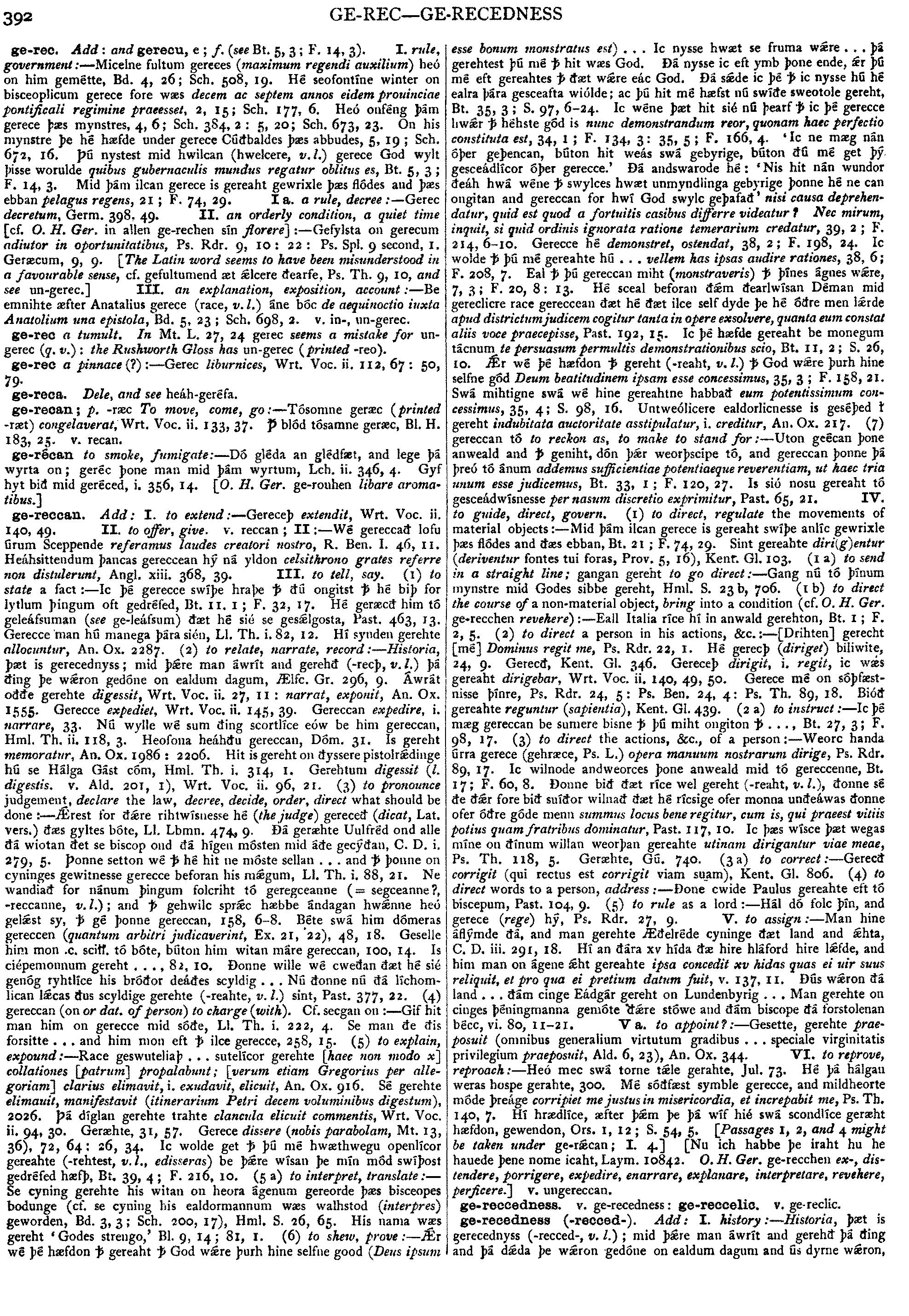
ge-rec.
Add:
and
gerecu,
e
;
f.
(
see
Bt.
5,
3;
F.
14,
3).
I.
rule,
government
:--
Micelne
fultum
gereces
(maximum
regendi
auxilium)
néo
on
him
gemétte,
Bd.
4,
26;
Sch.
508,
19.
He
seofontine
winter
on
bisceoplicum
gerece
fore
wæs
decem
ac
septem
annos
eidem
prouinciae
pontificali
regimine
praeesset,
2,
15;
Sch.
177,
6.
Heó
onféng
Þam
gerece
þæs
mynstres,
4,
6;
Sch.
384,
2
:
5,
20;
Sch.
673,
23.
On
his
mynstre
þe
hé
hæfde
under
gerece
cúðbaldes
þæs
abbudes,
5,
19
;
Sch.
672,
16.
Þú
nystest
mid
hwilcan
(hwelcere,
v.
l.)
gerece
God
wylt
þisse
worulde
quibus
gubernactulis
mundus
regatur
oblitus
es,
Bt.
5,
3
;
F.
14,
3.
Mid
þám
ilcan
gerece
is
gereaht
gewrixle
þæs
flódes
and
þæs
ebban
pelagus
regens,
21
;
F.
74,
29,
Ia.
a
rule,
decree
:--
Gerec
decretum,
Germ.
398,
49.
II.
an
orderly
condition,
a
quiet
time
[cf.
O.
H.
Ger.
in
allen
ge-rechen
sin
florere]
:--
Gefylsta
on
gerecum
ndiutor
in
oportunitatibus,
Ps.
Rdr.
9,
10
:
22
:
Ps.
Spl.
9
second,
l.
Geræcum,
9,
9.
[The
Latin
word
seems
to
have
been
misunderstood
in
a
favourable
sense,
cf.
gefultumend
æt
lcere
ðearfe.
Ps.
Th.
9,
10,
and
see
un-gerec.]
III.
an
explanation,
exposition,
account
:--
Be
emnihte
æfter
Anatalius
gerece
(race,
v.
l.)
áne
bóc
de
aequinoctio
iuxta
Anatolium
una
epislola,
Bd.
5,
23
;
Sch.
698,
2.
v.
in-,un-gerec.
ge-rec
a
tumult.
In
Mt.
L.
27,
24
gerec
seems
a
mistake
for
un-gerec
(q.
v.)
:
the
Rushworth
Gloss
has
un-gerec
(printed
-reo).ge-rec
a
pinnace
(?)
:--
Gerec
liburnices,
Wrt.
Voc.
ii.
112,
67:
50,
79
.ge-reca.
Dele,
and
see
heáh-geréfa.ge-recan;
ILLEGIBLE
-ræc
To
move,
come,
g
o
:--
Tósomne
geræc
(printed
-ræt)
congelaverat.
Wrt.
Voc.
ii.
133,
37.
ILLEGIBLE
blód
tósamne
geræc,
Bl.
H.
183,
25.
v.
recan.ge-récan
to
smoke,
fumigate
:--
Dó
gléda
an
glédfæt,
and
lege
þá
wyrta
on;
geréc
þone
man
mid
þám
wyrtum,
Lch.
ii.
346,
4.
Gyf
hyt
bið
mid
gereced,
i.
356,
14.
[O.
H.
Ger.
ge-rouhen
libare
aromatibus
.]ge-reccan.
Add:
I.
to
extend
:--
Gereceþ
extendit,
Wrt.
Voc.
ii.
140,
49.
II.
to
offer,
give.
v.
reccan
;
II
:--
Wé
gereccað
lofu
Úrum
Sceppende
referamus
laudes
creatori
nostro,
R.
Ben.
I.
46,
ii.
Heahsittendum
þancas
gereccean
hý
ná
yldon
celsithrono
grates
referre
non
distulerunt,
Angl.
xiii.
368,
39.
III.
to
tell,
say.
(1)
to
state
a
fact
:--
Ic
þé
gerecce
swíþe
hraþe
ILLEGIBLE
ðú
ongitst
ILLEGIBLE
hé
biþ
for
lytlum
þingum
oft
gedréfed,
Bt.
II.
I
;
F.
32,
17.
Hé
geræcð
him
tó
geleáfsuman
(see
ge-leáfsum)
ðæt
hé
sié
se
geslgosta,
Past.
463,
13.
Gerecce
man
hú
manega
þára
sién,
Ll.
Th.
i.
82,
12.
Hí
synden
gerehte
allocuntur,
An.
Ox.
2287.
(2)
to
relate,
narrate,
record
:--
Historia,
þæt
is
gerecednyss;
mid
þre
man
áwrít
and
gerehð
(-recþ,
v.
l.)
þá
ðing
þe
wron
gedóne
on
ealdum
dagum,
Ælfc.
Gr.
296,
9.
Áwrát
oððe
gerehte
digessit,
Wrt.
Voc.
ii.
27,
ii
:
narrat,
exponit,
An.
Ox.
1555.
Gerecce
expediet,
Wrt.
Voc.
ii.
145,
39.
Gereccan
expedire,
i.
narrare,
33.
Nú
wylle
wé
sum
ðing
scortlíce
eów
be
him
gereccan,
Hml.
Th.
ii.
118,
3.
Heofona
heáhðu
gereccan,
Dóm.
31.
Is
gereht
memoratur,
An.
Ox.
1986
:
2206.
Hit
is
gereht
on
ðyssere
pistolrdinge
hú
se
Hálga
Gást
óm,
Hml.
Th.
i.
314,
l.
Ge-ehtum
digessit
(l.
digestis.
v.
Aid.
201,
l),
Wrt.
Voc.
ii.
96,
21.
(3)
to
pronounce
judgement,
declare
the
law,
decree,
decide,
order,
direct
what
should
be
done
:--
Æ-acute;rest
for
ðre
rihtwísnesse
hé
(the
judge]
gereceð
(dicat,
Lat.
vers.
)
ðæs
gyltes
bote,
Ll.
Lbmn.
474,
9.
Ðá
geræhte
Uulfréd
ond
alle
ðá
wiotan
ðet
se
biscop
ond
ðá
hígen
mósten
mid
áðe
gecýðan,
C.
D.
i.
279
5.
þonne
setton
wé
hé
hit
ne
móste
sellan
.
.
.
and
ILLEGIBLE
þonne
on
cyninges
gewitnesse
gerecce
beforan
his
mgum,
Ll.
Th.
i.
88,
21.
Ne
wandiað
for
nánum
þingum
folcriht
tó
geregceanne
(=segclanne
?
,
-reccanne,
v.
l.
)
;
and
Þ
gehwilc
sprc
hæbbe
ándagan
hwnne
heó
gelst
sy,
ILLEGIBLE
gé
þonne
gereccan,
158,
6-8.
Béte
swá
him
dómeras
gereccen
(quantum
arbitri
judicaverint,
Ex.
21,
22),
48,
18.
Geselle
him
mon
.
c.
scitf.
tó
bóte,
búton
him
witan
máre
gereccan,
100,
14.
Is
ciépemonnum
gereht
.
.
.
,
82,
10,
Ðonne
wille
wé
cweðan
ðæt
hé
sié
genóg
ryhtlíce
his
bróðor
deáðes
scyldig
.
.
.
Nú
ðonne
nú
ðá
líchomlican
lcas
ðus
scyldige
gerehte
(-reahte,
v.
l.)
sint,
Past.
377,
22.
(4)
gereccan
(on
or
dat.
of
person)
to
charge
(with).
Cf.
secgan
on
:--
Gif
hit
man
him
on
gerecce
mid
sóðe,
Ll.
Th.
i.
222,
4.
Se
man
ðe
ðis
forsitte
.
.
.
and
him
mon
eft
þilce
gerecce,
258,
15.
(5)
to
explain,
expound
:--
Race
geswuteliaþ
.
.
.
sutelícor
gerehte
[haee
non
modo
x]
collationes
[patrum]
propalabnnt;
[verum
etiam
Gregorius
per
allegoriam]
clarius
elimavit,
i.
exudavit,
elicuit,
An.
Ox.
916.
Sé
gerehte
elimauit,
manifestavit
(itinerarium
Petri
decem
voluminibus
digestum),
2026.
Þá
diglan
gerehte
trahte
clancula
elicuit
commentis,
Wrt.
Voc.
ii.
94,
30.
Geræhte,
31,
57.
Gerece
dissere
(nobis
parabolam,
Mt.
13,
36),
72,
64:
26,
34.
Ic
wolde
get
þú
me
hwæthwegu
openlícor
gereahte
(-rehtest,
v.
l.
,
edisseras)
be
þre
wísan
þe
mín
mód
swíþost
gedréfed
hæfþ,
Bt.
39,
4
;
F.
216,
10.
(5
a)
to
interpret,
translate
:--
Se
cyning
gerehte
his
witan
on
heora
ágenum
gereorde
þæs
bisceopes
bodunge
(cf.
se
cyning
his
ealdormannum
wæs
walhstod
interpres
geworden,
Bd.
3,
3;
Sch.
200,
17,
Hml.
S.
26,
65.
His
nama
wæs
gereht
'Godes
strengo,
'
Bl.
9,
14;
81,
I.
(6)
to
shew,
prove
:--
Æ-acute;r
wé
þé
hæfdon
ILLEGIBLE
gereaht
ILLEGIBLE
God
wre
þurh
hine
selfne
good
(Deus
ipsum
esse
bonum
monsíratus
est)
.
.
.
Ic
nysse
hwæt
se
fruma
wre
.
.
.
þá
gerehtest
þú
mé
ILLEGIBLE
hit
wæs
God.
Ðá
nysse
ic
eft
ymb
þone
ende,
r
þú
mé
eft
gereahtes
ILLEGIBLE
ðæt
wre
eác
God.
Ðá
sde
ic
þé
ILLEGIBLE
ic
nysse
Hé
hé
ealra
þára
gesceafta
wiólde;
ac
þú
hit
me
hæfst
nú
swíðe
sweotole
gereht,
Bt.
35,
3
;
S.
97.
6-24.
Ic
wéne
þæt
hit
sié
nú
þearf
ILLEGIBLE
ic
þé
gerecce
liwr
ILLEGIBLE
héhste
gód
is
nunc
demonstrandum
reor,
quonam
haec
perfectio
constituta
est,
34,
l
;
F.
134,
3:
35,
5
;
F.
166,
4.
'Ic
ne
mæg
nán
óþer
geþencan,
búton
hit
weás
swá
gebyrige,
buton
ðú
mé
get
þý.
gesceádlícor
óþer
gerecce.
Ðá
andswarode
hé
:
'
Nis
hit
nán
wundor
ðeáh
hwá
wéne
ILLEGIBLE
swylces
hwæt
unmyndlinga
gebyrige
þonne
hé
ne
can
ongitan
and
gereccan
for
hwí
God
swylc
geþafað'
nisi
causa
deprehendatur,
quid
est
quod
a
fortuitis
casibus
differre
videatur
ILLEGIBLE
.(
Nec
mirum,
inquit,
si
quid
ordinis
ignorata
ratione
temerarium
credatur,
39,
2
;
F.
214,
6-10.
Gerecce
hé
demonstret,
ostendat,
38,
2;
F.
198,
24.
Ic
wolde
ILLEGIBLE
þú
mé
gereahte
hú
.
.
.
vellem
has
ipsas
audire
rationes,
38,
6;
F.
208,
7.
Eal
ILLEGIBLE
þú
gereccan
miht
monstraveris
ILLEGIBLE
þínes
ágnes
wre,
7,
3;
F.
20,
8:13.
Hé
sceal
beforan
ðm
ðearlwísan
Déman
mid
gereclicre
race
gereccean
ðæt
hé
ðæt
ilce
self
dyde
þe
hé
óðre
men
lrde
apud
districtum
judicem
cogitur
tanta
in
opere
exsolvere,
quanta
eum
constat
aliis
voce
praecepisse,
Past.
192,
15.
Ic
þé
hæfde
gereaht
be
monegum
tácnum
te
persuasum
permullis
demonstrationibus
scio,
Bt.
ll,
2;
S.
26,
10.
Æ-acute;r
wé
þé
hæfdon
gereht
(-reaht,
v.l.
)
God
wre
þurh
hine
selfne
gód
Deum
beatitudinem
ipsam
esse
concessimus,
35,
3
;
F.
158,
21.
Swá
mihtigne
swá
wé
hine
gereahtne
habbað
eum
potentissimum
concessimus,
35,
4;
S.
98,
16.
Untweólicere
ealdorlicnesse
is
geséþed
ILLEGIBLE
gereht
indubitata
auctoritate
asstipulatur,
i.
creditur,
An.
Ox.
217.
(7)
gereccan
tó
to
reckon
as,
to
make
to
stand
for
:--
Uton
geécan
þone
anweald
and
ILLEGIBLE
geniht,
dón
þr
weorþscipe
tó,
and
gereccan
þonne
þá
þreó
tó
ánum
addemus
sufficienliae
poten/iaeque
reverentiam,
ut
haec
tria
unum
esse
judicemus,
Bt.
33,
I;
F.
120,
27.
Is
sió
nosu
gereaht
tó
gesceádwísnesse
per
nasum
discretio
exprimitur,
Past.
65,
21.
IV.
to
guide,
direct,
govern.
(1)
to
direct,
regulate
the
movements
of
material
objects
:--
Mid
þám
ilcan
gerece
is
gereaht
swíþe
anlic
gewrixle
þæs
flódes
and
ðæs
ebban.
Bt.
21
;
F.
74,
29.
Sint
gereahte
diri(g)entur
(deriventur
fantes
tui
foras,
Prov.
5,
16),
Kent.
Gl.
103.
(l
a)
to
send
in
a
straight
line;
gangan
gereht
to
go
direct
:--
Gang
nú
tó
þínum
mynstre
mid
Godes
sibbe
gereht,
Hml.
S.
23
b,
706.
(l
b)
to
direct
the
course
of
a
non-material
object,
bring
into
a
condition
(cf.
O.
H.
Ger.
ge-recchen
revehere)
:--
Eall
Italia
ríce
hí
in
anwald
gerehton,
Bt.
I;
F.
2,
5.
(2)
to
direct
a
person
in
his
actions,
&
c.
:--
[Drihten]
gerecht
[mé]
Dominus
regit
me,
Ps.
Rdr.
22,
l.
Hé
gerecþ
(diriget)
biliwite,
24,
9.
Gerecð,
Kent.
Gl.
346.
Gereceþ
dirigit,
i.
regit,
ic
wæs
gereaht
dirigebar,
Wrt.
Voc.
ii.
140,
49,
50.
Gerece
me
on
sðþfæstnisse
þínre,
Ps.
Rdr.
24,
5:
Ps.
Ben.
24,
4:
Ps.
Th.
89,
18.
Bióð
gereahte
reguntur
(sapientia),
Kent.
Gl.
439.
(2
a)
to
instruct
:--
Ic
þé
mæg
gereccan
be
sumere
bisne
ILLEGIBLE
þú
miht
ongiton
ILLEGIBLE
.
.
.
,
Bt.
27,
3;
F.
98,
17.
(3)
to
direct
the
actions,
&
c.
,
of
a
person
:--
Weorc
handa
úrra
gerece
(gehræce,
Ps.
L.
)
opera
manuum
nostrarum
dirige,
Ps.
Rdr.
89,
17.
Ic
wilnode
andweorces
þone
anweald
mid
to
gereccenne,
Bt.
17;
F.
60,
8.
Ðonne
bið
ðæt
rice
wel
gereht
(-reaht,
v.
l.),
ðonne
sé
ðe
ðr
fore
bið
suíðor
wilnað
ðæt
hé
rícsige
ofer
monna
unðeáwas
ðonne
ofer
óðre
góde
menn
summus
locus
bene
regitur,
cum
is,
qui
praeest
vitiis
potius
quam
fratribus
dominatur,
Past.
117,
10.
Ic
þæs
wísce
þæt
wegas
mine
on
ðínum
willan
weorþan
gereahte
utinam
dirigantur
viae
meae,
Ps.
Th.
118,
5.
Geræhte
,
Gú.
740.
(33)
to
correct
:--
Gerecð
corrigit
(qui
rectus
est
corrigit
viam
suam),
Kent.
Gl.
806.
(4)
to
direct
words
to
a
person,
address
:--
Ðone
cwide
Paulus
gereahte
eft
to
biscepum,
Past.
104,
9.
(5)
to
rule
as
a
lord
:--
Hal
dó
folc
bin,
and
gerece
(rege)
hy.
Ps.
Rdr.
27,
9.
V.
to
assign
:--
Man
hine
áflýmde
ðá,
and
man
gerehte
Æðelréde
cyninge
ðæt
land
and
hta,
C.
D.
iii.
291,
18.
Hí
an
ðára
xv
hída
ðæ
hire
hlaford
hire
lfde,
and
him
man
on
ágene
ht
gereahte
ipsa
concedit
xv
hidas
quas
ei
uir
suus
reliquit,
el
pro
qua
ei
pretium
datum
fuit,
v.
137,
ii.
Ðús
wron
ðá
land
.
.
.
ðám
cinge
Eádgár
gereht
on
Lundenbyrig
.
.
.
Man
gerehte
on
cinges
þéningmanna
gemóte
ðre
stówe
and
ðám
biscope
ðá
forstolenan
bécc,
vi.
80,
11,21.
Va.
to
appoint?
:--
Gesette,
gerehte
prae-posuit
(omnibus
generalium
virtutum
gradibus
...
speciale
virginitatis
privilegium
praeposuit,
Aid.
6,
23),
An.
Ox.
344.
VI.
to
reprove,
reproach
:--
Heó
mec
swá
torne
tle
gerahte.
Jul.
73.
Hé
þá
hálgan
weras
hospe
gerahte,
300.
Mé
sóðfæst
symble
gerecce,
and
mildheorte
mode
þreáge
corripiet
me
Justus
in
misericordia,
et
increpabit
me,
Ps.
Th.
140,
7.
Hi
hrædlíce,
æfter
þm
þe
þá
wíf
hié
swá
scondlíce
geræht
hæfdon,
gewendon,
Ors.
1,
12;
S.
54,
5.
[Passages
I.
2,
and
4
might
be
taken
under
ge-rcan;
I.
4.]
[Nu
ich
habbe
þe
iraht
hu
he
hauede
þene
nome
icaht,
Laym.
10842.
O.
H.
Ger.
ge-recchen
ex-,
dis-tendere,
porrigere,
expedire,
enarrare,
explanare,
interpretare,
revehere,
perftcere.
]
v.
ungereccan.ge-reccedness.
v.
ge-recedness:
ge-reccelic.
v.
ge-reclic.ge-recedness
(-recced-).
Add:
I.
history
:--
Historia,
þæt
is
gerecednyss
(-recced-,
v.
l.)
;
mid
þre
man
áwrít
and
gerehð
þá
ðing
and
þá
dda
þe
wron
gedóne
on
ealdum
dagum
and
ús
dyrne
wron.
|
Source: Bosworth/Toller, page d0428, entry 17 View original page image as: [TIFF] [PNG] [View previous entry] [View next entry] |
[Comment on this entry] [View comments] |
The following entry has been hand-corrected once. |
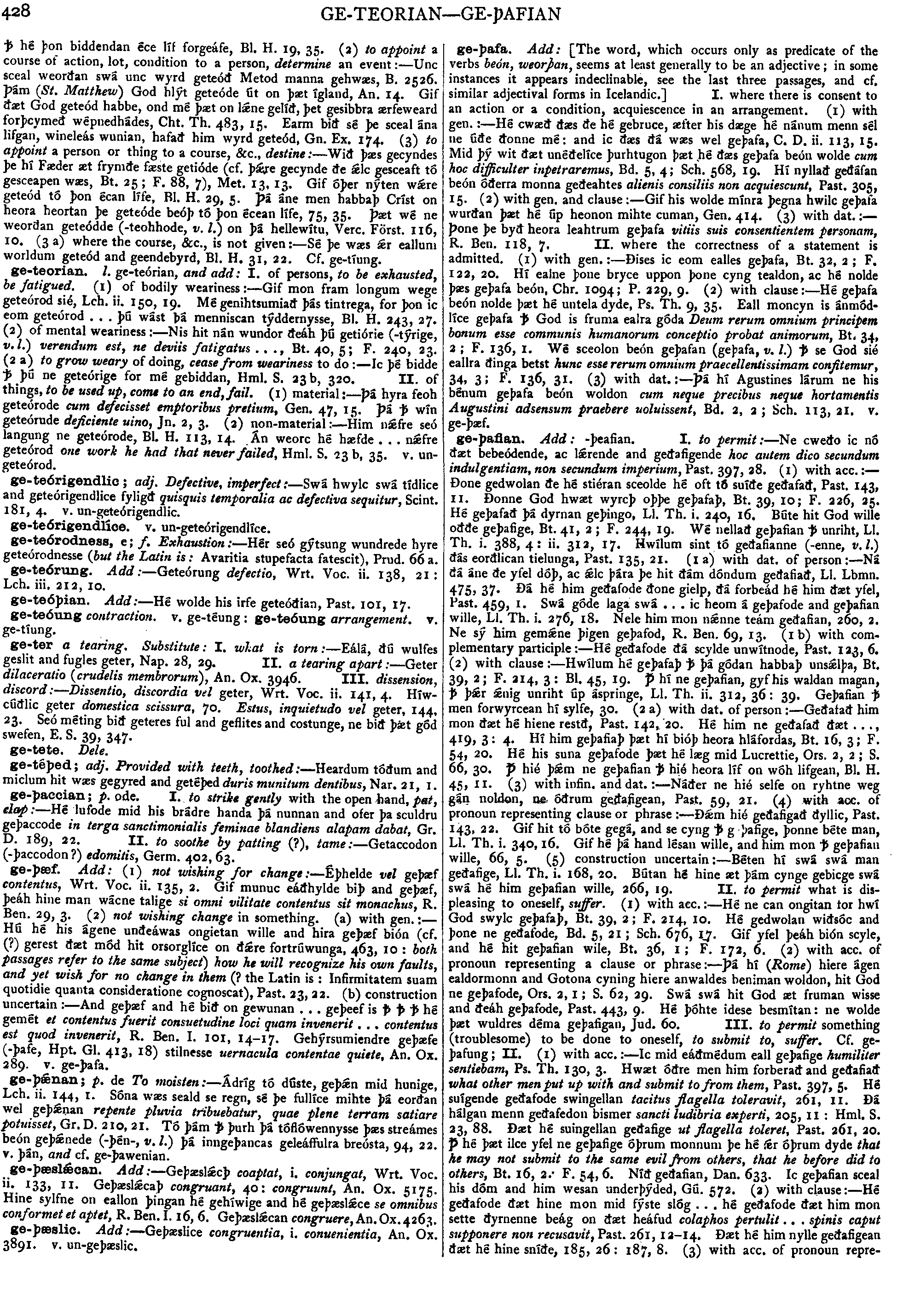
ge-þafa.
Add:
[The
word,
which
occurs
only
as
predicate
of
the
verbs
beón,
weorþan,
seems
at
least
generally
to
be
an
adjective;
in
some
instances
it
appears
indeclinable,
see
the
last
three
passages,
and
cf.
similar
adjectival
forms
in
Icelandic.]
I.
where
there
is
consent
to
an
action
or
a
condition,
acquiescence
in
an
arrangement.
(1)
with
gen.
:--
Hé
cwæð
ðæs
ðe
hé
gebruce,
æfter
his
dæge
hé
nánum
menn
sél
ne
úðe
ðonne
mé:
and
ic
ð
æs
ðá
wæs
wel
geþafa,
C.
D.
ii.
113,
15.
Mid
þý
wit
ðæt
unéðelíce
þurhtugon
þæt
hé
ðæs
geþafa
beón
wolde
cum
hoc
difficulter
inpetraremus,
Bd.
5,
4;
Sch.
568,
19.
Hí
nyllað
geðáfan
beón
óðerra
monna
geðeahtes
alienis
consiliis
non
acquiescunt,
Past.
305,
15.
(2)
with
gen.
and
clause
:--
Gif
his
wolde
mínra
þegna
hwilc
geþafa
wurðan
þæt
hé
úp
heonon
mihte
cuman,
Gen.
414.
(3)
with
dat.
:--
þone
þe
byð
heora
leahtrum
geþafa
vitiis
suis
consentientem
personam,
R.
Ben.
118,
7.
II.
where
the
correctness
of
a
statement
is
admitted.
(1)
with
gen.
:--
Ðises
ic
eom
ealles
geþafa,
Bt.
32,
2
;
F.
122,
20.
Hí
ealne
þone
bryce
uppon
þone
cyng
tealdon,
ac
hé
nolde
þæs
geþafa
beón,
Chr.
1094;
P.
229,
9.
(2)
with
clause
:--
Hé
geþafa
beón
nolde
þæt
hé
untela
dyde.
Ps.
Th.
9,
35.
Ball
moncyn
is
ánmód-líce
geþafa
God
is
fruma
ealra
góda
Deum
rerun
omnium
principem
bonum
esse
communis
humanorum
conceptio
probat
animorum,
Bt.
34,
2
;
F.
136,
1.
Wé
sceolon
beón
geþafan
(geþafa,
v.
l.)
se
God
sié
eallra
ðinga
betst
hunc
esse
rerum
omnium
praecellentissimam
confitemur,
34,
3;
F.
136,
31.
(3)
with
dat.
:--
Þ
á
hí
Agustines
larum
ne
his
bénum
geþafa
beón
woldon
cum
neque
precibus
neque
hortamentis
Augustini
adsensum
praebere
uoluissent,
Bd.
2,
2
;
Sch.
113,
21.
v.
ge-þæf.
|
Source: Bosworth/Toller, page d0429, entry 1 View original page image as: [TIFF] [PNG] [View previous entry] [View next entry] |
[Comment on this entry] [View comments] |
The following entry has been hand-corrected once. |
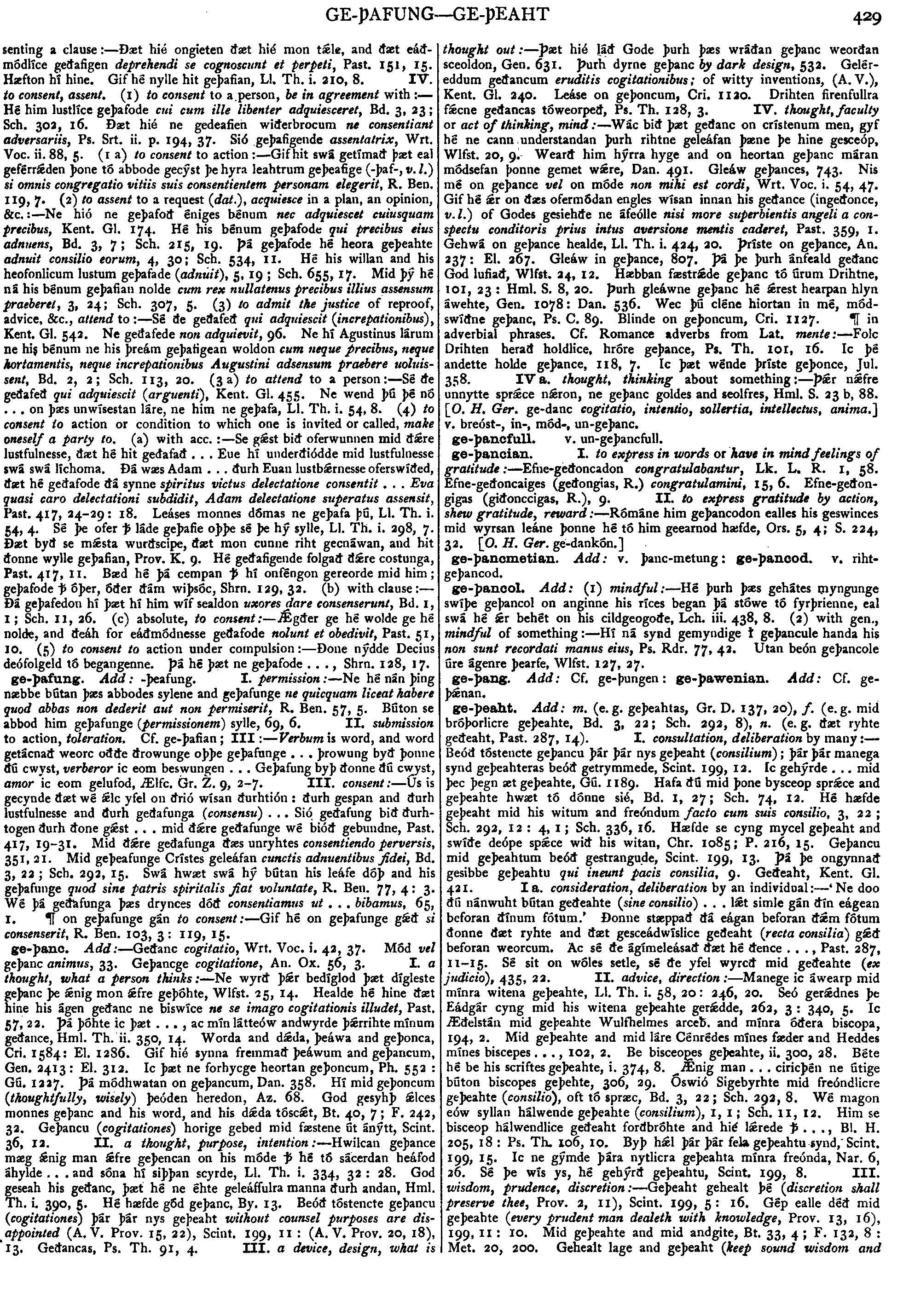
senting
a
clause
:--
Ðæt
hié
ongieten
ðæt
hié
mon
tle,
and
ðæt
eáð-módlíce
geðafigen
deprehendi
se
cognoscunt
et
perpeti,
Past.
151,
15.
Hæfton
hí
hine.
Gif
hé
nylle
hit
geþafian,
Ll.
Th.
i.
210,
8.
IV.
to
consent,
assent.
(1)
to
consent
to
a
person,
be
in
agreement
with
:--
Hé
him
lustlíce
geþafode
cui
cum
ille
libenter
adquiesceret,
Bd.
3,
23;
Sch.
302,
16.
Ðæt
hié
né
gedeafien
wiðerbrocum
ne
consentiant
adversariis,
Ps.
Srt.
ii.
p.
194,
37.
Sió
geþafigende
assentatrix,
Wrt.
Voc.
ii.
88,
5.
(I
a)
to
consent
to
action
:--
Gif
hit
swá
getímað
þæt
eal
geférrden
þone
tó
abbode
gecýst
þe
hyra
leahtrum
geþeafige
(-þaf-,
v.
l.
)
si
omnis
congregatio
vitiis
suis
consentientem
personam
elegerit,
R.
Ben.
119,
7.
(2)
to
assent
to
a
request
(dat.),
acquiesce
in
a
plan,
an
opinion,
&c.
:--
Ne
hió
ne
geþafoð
éniges
benum
nec
adquiescet
cuiusquam
precibus,
Kent.
Gl.
174.
Hé
his
bénum
geþafode
qui
precibus
eius
adnuens,
Bd.
3,
7;
Sch.
215,
19.
þ
á
geþafode
hé
heora
geþeahte
adnuit
consilio
eorum,
4,
30;
Sch.
534,
11.
Hé
his
willan
and
his
heofonlicum
lustum
geþafade
(adnuit),
5,
19
;
Sch.
655,
17.
Mid
þý
he
ná
his
bénum
geþafian
nolde
cum
rex
nullatenus
precibus
illius
assensum
praeberet,
3,
24;
Sch.
307,
5.
(3)
to
admit
the
justice
of
reproof,
advice,
&c.
,
attend
to
:--
Sé
ðe
geðafeð
qui
adquiescit
(increpationibus),
Kent,
Gl.
542.
Ne
geðafede
non
adquievit,
96.
Ne
hí
Agustinus
lárum
ne
his
bénum
ne
his
þreám
geþatígean
woldon
cum
neque
precibus,
neque
kortamentis,
neque
increpationibus
Augustini
adsensum
praebere
uoluis-sent.
Bd.
2,
2;
Sch.
113,
20.
(3
a)
to
attend
to
a
person
:--
Sé
(te
geðafeð
qui
adquiescit
(arguenti).
Kent.
Gl.
455.
Ne
wend
þú
þé
nó
.
.
.
on
þæs
unwísestan
láre,
ne
him
ne
geþafa,
Ll.
Th.
i.
54,
8.
(4)
to
consent
to
action
or
condition
to
which
one
is
invited
or
called,
make
oneself
a
party
to.
(a)
with
acc.
:--
Se
gst
bið
oferwunnen
mid
ðre
lustfulnesse,
ðæt
hé
hit
gedafað
.
.
.
Eue
hí
underðiódde
mid
lustfulnesse
swá
swá
líchoma.
Ðá
wæs
Adam
.
.
.
ðurh
Euan
lustbrnesse
oferswíðed,
ðæt
hé
geðafode
(ðá
synne
spiritus
victus
delectatione
consentit.
.
.
Eva
quasi
caro
delectationi
subdidit,
Adam
delectatione
superatus
assensit,
Past.
417,
24-29:
18.
Leáses
monnes
dómas
ne
geþafa
þú,
Ll.
Th.
i.
54,
4.
Sé
þe
ofer
láde
geþafie
oþþe
sé
þe
hý
sylle,
Ll.
Th.
i.
298,
7.
Ðæt
byð
se
msta
wurðscipe,
ðæt
mon
cunne
riht
gecnáwan,
and
hit
ðonne
wylle
geþafian,
Prov.
K.
9.
Hé
geðafigende
folgað
ðre
costunga,
Past.
417,
11.
Bæd
hé
þá
cempan
hí
onféngon
gereorde
mid
him
;
geþafode
óþer,
óðer
ðára
wiþsóc,
Shrn.
129,
32.
(b)
with
clause
:--
Ðá
geþafedon
hí
þæt
hí
him
wíf
sealdon
uxores
dare
consenserunt,
Bd.
1,
1;
Sch.
11,
26.
(c)
absolute,
to
consent
:--
Æ-acute;gðer
ge
hé
wolde
ge
hé
nolde,
and
ðeáh
for
eáðmódnesse
geðafode
nolunt
et
obedivit,
Past.
51,
10.
(5)
to
consent
to
action
under
compulsion
:--
Ðone
nýdde
Decius
deófolgeld
tó
begangenne.
Þá
hé
þæt
ne
geþafode
.
.
.
,
Shrn.
128,
17.
|
Source: Bosworth/Toller, page d0686, entry 45 View original page image as: [TIFF] [PNG] [View previous entry] [View next entry] |
[Comment on this entry] [View comments] |
The following entry has been hand-corrected once. |
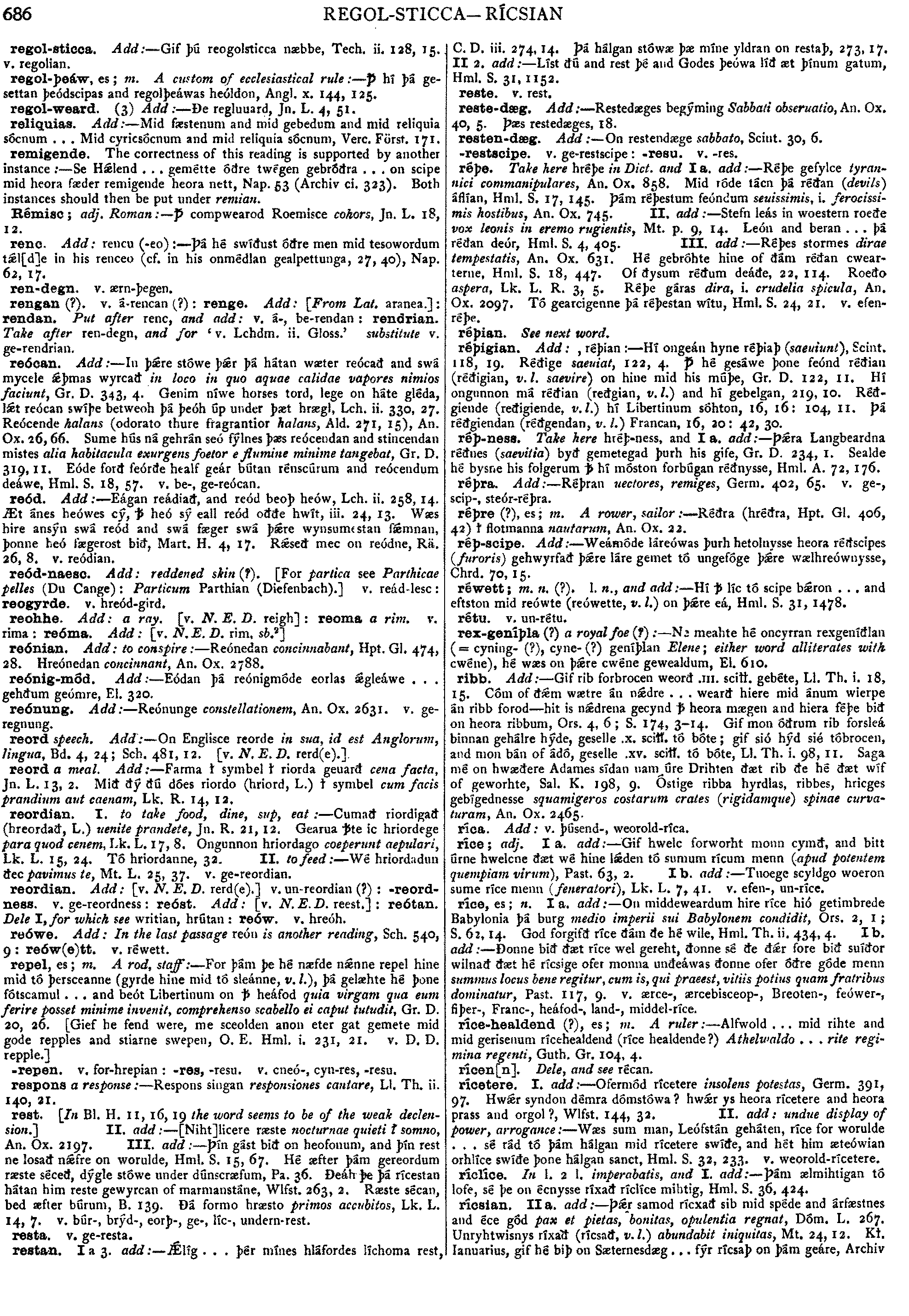
ríce.
es;
n.
I
a.
add
:--
On
middeweardum
hire
ríce
hió
getimbrede
Babylonia
þá
burg
medio
imperii
sui
Babylonem
condidit,
Ors.
2,
1;
8.
62,
14.
God
forgifð
ríce
ðám
ðe
hé
wile,
Hml.
Th.
ii.
434,
4.
I
b.
add
:--
Ðonne
bið
ðæt
ríce
wel
gereht,
ðonne
sé
ðe
ðr
fore
bið
suíðor
wilnað
ðæt
hé
rícsige
ofer
monna
unðeáwas
ðonne
ofer
óðre
góde
menn
summus
locus
bene
regitur,
cum
is,
qui
praeest,
vitiis
potius
quam
fratribus
dominatur,
Past.
117,
9.
v.
ærce-,
ærcebisceop-,
Breoten-,
feówer-,
fiþer-,
Franc-,
heáfod-,
land-,
middel-ríce.
| Result Page: |  |
Previous | 1 2 |
Germanic Lexicon Project (main page)
This search system was written by
Sean Crist
Please consider
volunteering
to correct the data in these online dictionaries.
No rights reserved. Feel free to use these data in any way you please.