|
|

Tip: In the search results, you can click on any word or abbreviation for more information.
|
Source: Bosworth/Toller, page d0626, entry 15 View original page image as: [TIFF] [PNG] [View previous entry] [View next entry] |
[Comment on this entry] [View comments] |
The following entry has been hand-corrected once. |
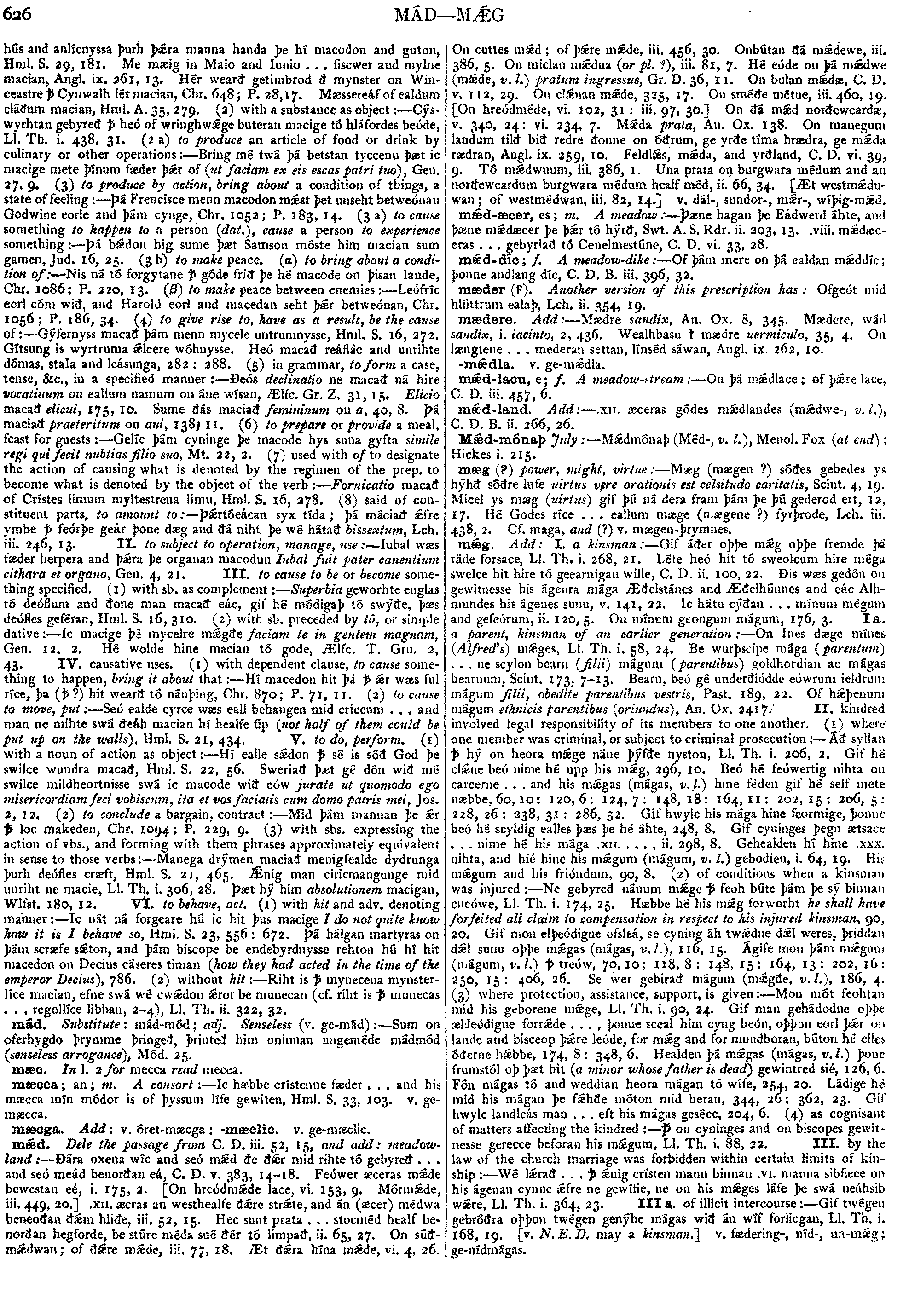
mæg (?) power, might, virtue :-- Mæg (mægen ?) sóðes gebedes ys hýhð sóðre lufe uirtus vere orationis est celsitudo caritatis, Scint. 4, 19. Micel ys mæg (uirtus) gif þú ná dera fram þám þe þú gederod ert, 12, 17. Hé Godes ríce . . . eallum mæge (mægene ?) fyrþrode, Lch. iii. 438, 2. Cf. maga, and (?) v. mægen-þrymnes.
|
Source: Bosworth/Toller, page d0632, entry 4 View original page image as: [TIFF] [PNG] [View previous entry] [View next entry] |
[Comment on this entry] [View comments] |
The following entry has been hand-corrected once. |
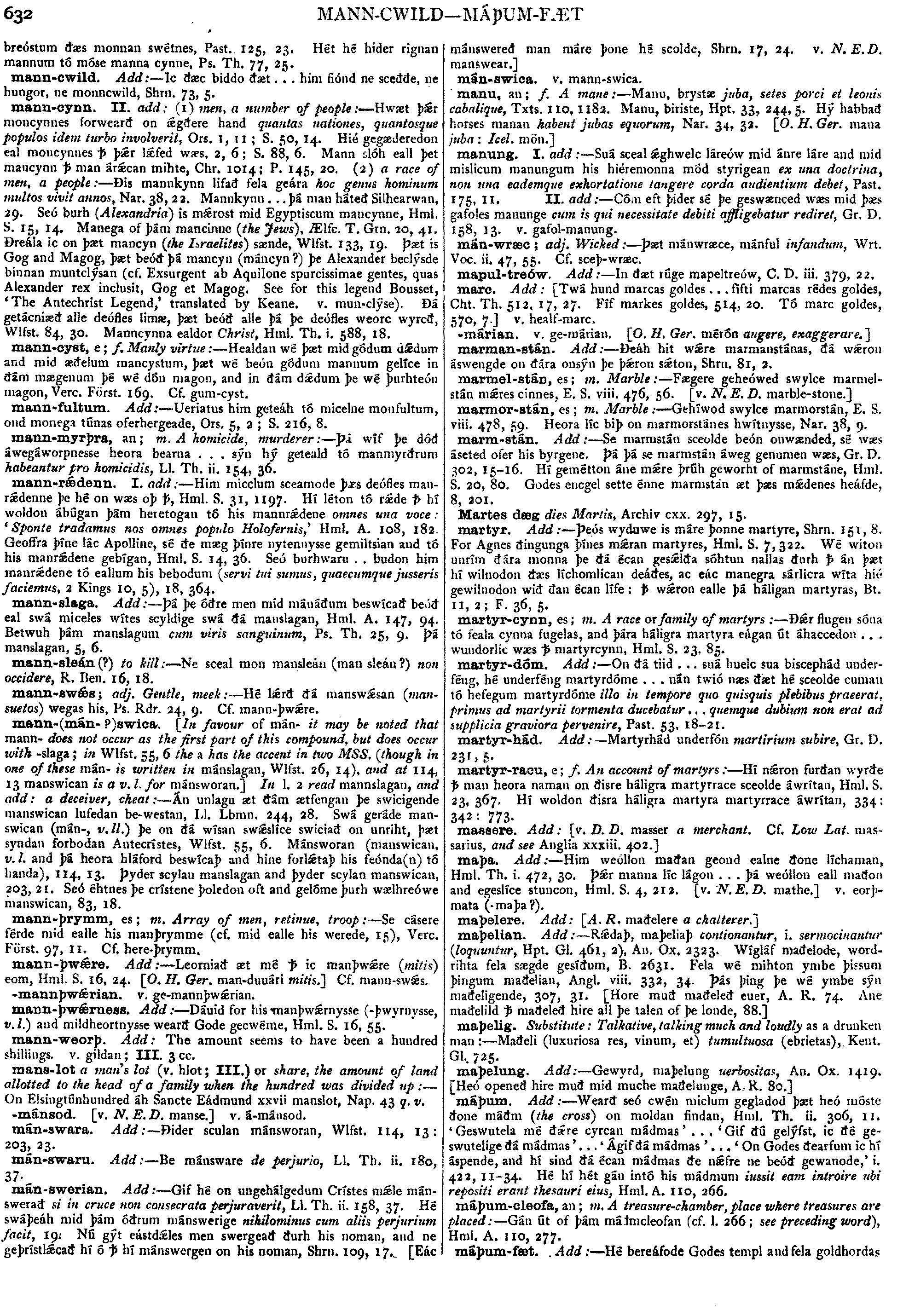
mann-cyst,
e;
f.
Manly
virtue
:--
Healdan
wé
þæt
mid
gódum
d dum
and
mid
æðelum
mancystum,
þæt
wé
beón
gódum
mannum
gelíce
in
ðám
mægenum
þé
wé
dón
magon,
and
in
ðám
ddum
þe
wé
þurhteón
magon,
Verc.
Först.
169.
Cf.
gum-cyst.
dum
and
mid
æðelum
mancystum,
þæt
wé
beón
gódum
mannum
gelíce
in
ðám
mægenum
þé
wé
dón
magon,
and
in
ðám
ddum
þe
wé
þurhteón
magon,
Verc.
Först.
169.
Cf.
gum-cyst.
|
Source: Bosworth/Toller, page d0633, entry 9 View original page image as: [TIFF] [PNG] [View previous entry] [View next entry] |
[Comment on this entry] [View comments] |
The following entry has been hand-corrected once. |
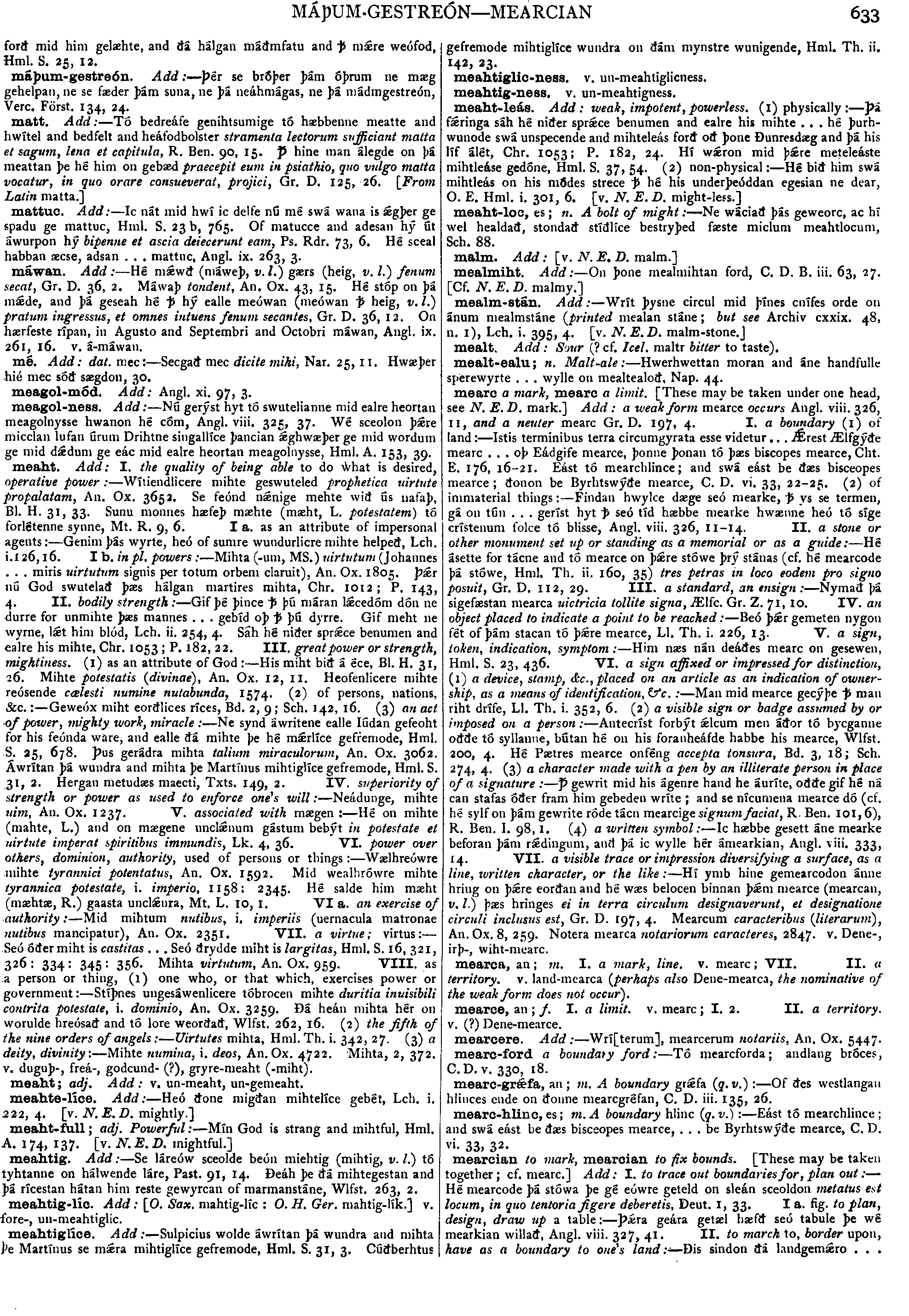
meaht.
Add:
I.
the
quality
of
being
able
to
do
what
is
desired,
operative
power
:--
Wítiendlicere
mihte
geswuteled
prophetica
uirtute
propalatam,
An.
Ox.
3652.
Se
feónd
nnige
mehte
wið
ús
nafaþ,
Bl.
H.
31,
33.
Sunu
monnes
hæfeþ
mæhte
(mæht,
L.
potestatem)
tó
forlétenne
synne,
Mt.
R.
9,
6.
I
a.
as
an
attribute
of
impersonal
agents
:--
Genim
þás
wyrte,
heó
of
sumre
wundurlicre
mihte
helpeð,
Lch.
i.
126,
16.
I
b.
in
pl.
powers
:--
Mihta
(-um,
MS.)
uirtutum
(Johannes
.
.
.
miris
uirtutum
signis
per
totum
orbem
claruit),
An.
Ox.
1805.
Þr
nú
God
swutelað
þæs
hálgan
martires
mihta,
Chr.
1012
;
P.
143,
4.
II.
bodily
strength
:--
Gif
þé
þince
 þú
máran
lcedóm
dón
ne
durre
for
unmihte
þæs
mannes.
.
.
gebíd
oþ
þú
dyrre.
Gif
meht
ne
wyrne,
lt
him
blód,
Lch.
ii.
254,
4.
Sáh
hé
niðer
sprce
benumen
and
ealre
his
mihte,
Chr.
1053;
P.
182,
22.
III.
great
power
or
strength,
mightiness.
(1)
as
an
attribute
of
God
:--
His
miht
bið
á
éce,
Bl.
H.
31,
26.
Mihte
potestatis
(
divinae).
An.
Ox.
12,
11.
Heofenlicere
mihte
reósende
cælesti
numine
nutabunda,
1574.
(2)
of
persons,
nations,
&c.:--
Geweóx
miht
eorðlices
ríces,
Bd.
2,
9;
Sch.
142,
16.
(3)
an
act
of
power,
mighty
work,
miracle
:--
Ne
synd
áwritene
ealle
Iúdan
gefeoht
for
his
feónda
ware,
and
ealle
ðá
mihte
þe
hé
mrlíce
gefremode,
Hml.
S.
25,
678.
Þus
gerádra
mihta
talium
miraculorum,
An.
Ox.
3062.
Áwrítan
þá
wundra
and
mihta
þe
Martínus
mihtiglíce
gefremode,
Hml.
S.
31,
2.
Hergan
metudæs
maecti,
Txts.
149,
2.
IV.
superiority
of
strength
or
power
as
used
to
enforce
one's
will
:--
Neádunge,
mihte
uim,
An.
Ox.
1237.
V.
associated
with
mægen
:--
Hé
on
mihte
(mahte.
L.
)
and
on
mægene
unclnun.
gástum
bebýt
in
potestate
et
uirtute
imperat
spiritibus
immundis,
Lk.
4,
36.
VI.
power
over
others,
dominion,
authority,
used
of
persons
or
things
:--
Wælhreówre
mihte
tyrannici
potentates,
An.
Ox.
1592.
Mid
wealhrówre
mihte
tyrannica
potestate,
i.
imperio,
1158:
2345.
Hé
salde
him
mæht
(mæhtæ,
R.
)
gaasta
unclnra,
Mt.
L.
10,
1.
VI
a.
an
exercise
of
authority
:--
Mid
mihtum
nutibus,
i.
imperiis
(uernacula
matronae
nutibus
mancipatur),
An.
Ox.
2351.
VII.
a
virtue;
virtus
:--
Seó
óðer
miht
is
castitas
.
.
.
Seó
ðrydde
miht
is
largitas,
Hml.
S.
16,
321,
326:
334:
345:
356.
Mihta
virtutum.
An.
Ox.
959.
VIII.
as
a
person
or
thing,
(l)
one
who,
or
that
which,
exercises
power
or
government
:--
Stíþnes
ungesáwenlicere
tóbrocen
mihte
duritia
inuisibili
contrita
potestate,
i.
dominio,
An.
Ox.
3259.
Ðá
heán
mihta
hér
on
worulde
hreósað
and
tó
lore
weorðað.
Wlfst.
262,
16.
(2)
the
fifth
of
the
nine
orders
of
angels
:--
Uirtutes
mihta,
Hml.
Th.
i.
342,
27.
(3)
a
deity,
divinity
:--
Mihte
numina,
i.
deos,
An.
Ox.
4722.
Mihta,
2,
372.
v.
duguþ-,
freá-,
godcund-
(?),
gryre-meaht
(-miht).
þú
máran
lcedóm
dón
ne
durre
for
unmihte
þæs
mannes.
.
.
gebíd
oþ
þú
dyrre.
Gif
meht
ne
wyrne,
lt
him
blód,
Lch.
ii.
254,
4.
Sáh
hé
niðer
sprce
benumen
and
ealre
his
mihte,
Chr.
1053;
P.
182,
22.
III.
great
power
or
strength,
mightiness.
(1)
as
an
attribute
of
God
:--
His
miht
bið
á
éce,
Bl.
H.
31,
26.
Mihte
potestatis
(
divinae).
An.
Ox.
12,
11.
Heofenlicere
mihte
reósende
cælesti
numine
nutabunda,
1574.
(2)
of
persons,
nations,
&c.:--
Geweóx
miht
eorðlices
ríces,
Bd.
2,
9;
Sch.
142,
16.
(3)
an
act
of
power,
mighty
work,
miracle
:--
Ne
synd
áwritene
ealle
Iúdan
gefeoht
for
his
feónda
ware,
and
ealle
ðá
mihte
þe
hé
mrlíce
gefremode,
Hml.
S.
25,
678.
Þus
gerádra
mihta
talium
miraculorum,
An.
Ox.
3062.
Áwrítan
þá
wundra
and
mihta
þe
Martínus
mihtiglíce
gefremode,
Hml.
S.
31,
2.
Hergan
metudæs
maecti,
Txts.
149,
2.
IV.
superiority
of
strength
or
power
as
used
to
enforce
one's
will
:--
Neádunge,
mihte
uim,
An.
Ox.
1237.
V.
associated
with
mægen
:--
Hé
on
mihte
(mahte.
L.
)
and
on
mægene
unclnun.
gástum
bebýt
in
potestate
et
uirtute
imperat
spiritibus
immundis,
Lk.
4,
36.
VI.
power
over
others,
dominion,
authority,
used
of
persons
or
things
:--
Wælhreówre
mihte
tyrannici
potentates,
An.
Ox.
1592.
Mid
wealhrówre
mihte
tyrannica
potestate,
i.
imperio,
1158:
2345.
Hé
salde
him
mæht
(mæhtæ,
R.
)
gaasta
unclnra,
Mt.
L.
10,
1.
VI
a.
an
exercise
of
authority
:--
Mid
mihtum
nutibus,
i.
imperiis
(uernacula
matronae
nutibus
mancipatur),
An.
Ox.
2351.
VII.
a
virtue;
virtus
:--
Seó
óðer
miht
is
castitas
.
.
.
Seó
ðrydde
miht
is
largitas,
Hml.
S.
16,
321,
326:
334:
345:
356.
Mihta
virtutum.
An.
Ox.
959.
VIII.
as
a
person
or
thing,
(l)
one
who,
or
that
which,
exercises
power
or
government
:--
Stíþnes
ungesáwenlicere
tóbrocen
mihte
duritia
inuisibili
contrita
potestate,
i.
dominio,
An.
Ox.
3259.
Ðá
heán
mihta
hér
on
worulde
hreósað
and
tó
lore
weorðað.
Wlfst.
262,
16.
(2)
the
fifth
of
the
nine
orders
of
angels
:--
Uirtutes
mihta,
Hml.
Th.
i.
342,
27.
(3)
a
deity,
divinity
:--
Mihte
numina,
i.
deos,
An.
Ox.
4722.
Mihta,
2,
372.
v.
duguþ-,
freá-,
godcund-
(?),
gryre-meaht
(-miht).
|
Source: Bright's OE Grammar, page b0248, entry 3 View original page image as: [TIFF] [PNG] [View previous entry] [View next entry] |
[Comment on this entry] [View comments] |
The following entry has been hand-corrected once. |
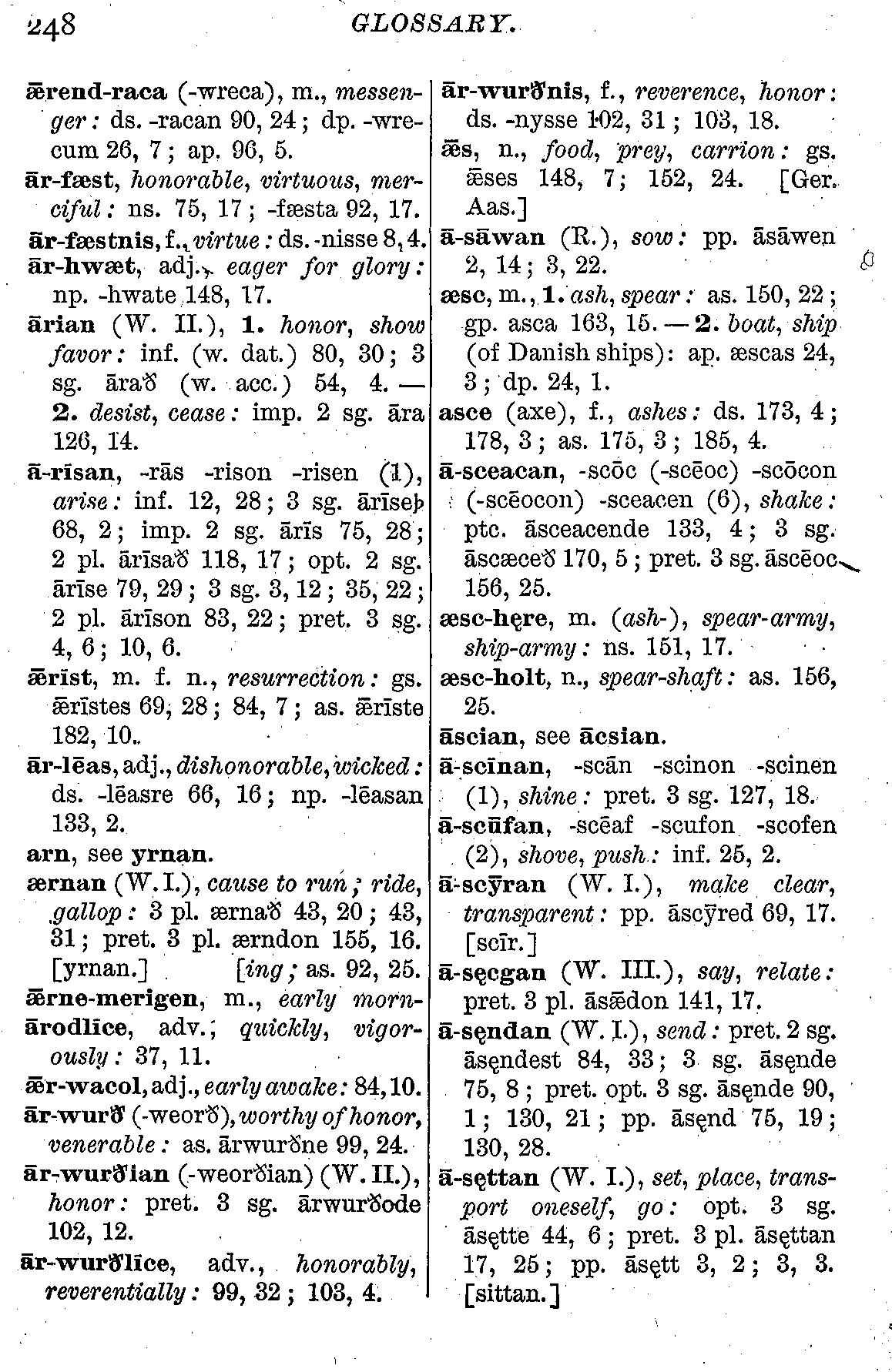
 r-fæastnis
f
virtue
r-fæastnis
f
virtue
|
Source: Bright's OE Grammar, page b0263, entry 34 View original page image as: [TIFF] [PNG] [View previous entry] [View next entry] |
[Comment on this entry] [View comments] |
The following entry has been hand-corrected once. |
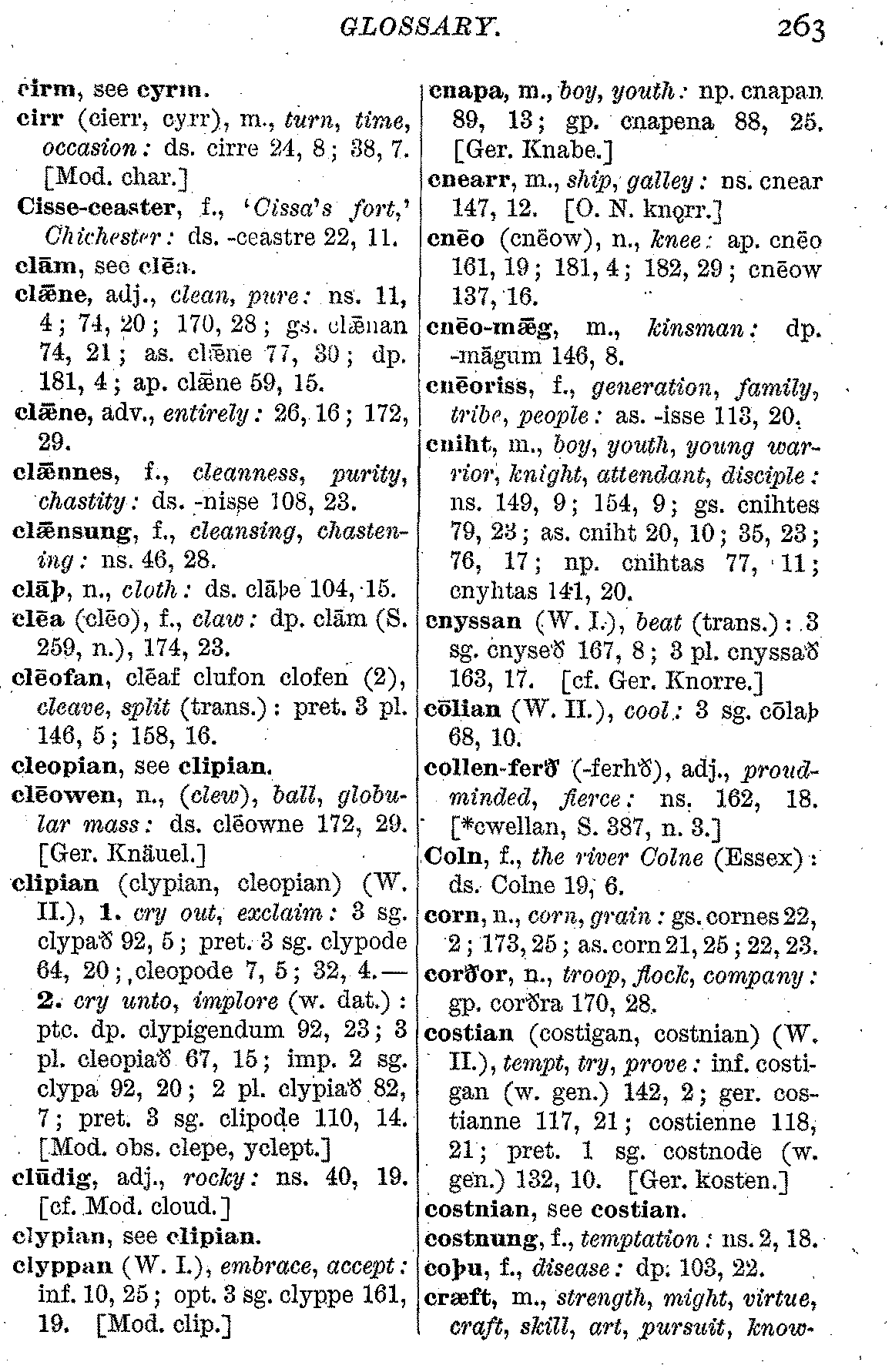
cræft m strength, might, virtue, craft, skill, art, pursuit, knowledge
|
Source: Bright's OE Grammar, page b0327, entry 7 View original page image as: [TIFF] [PNG] [View previous entry] [View next entry] |
[Comment on this entry] [View comments] |
The following entry has been hand-corrected once. |
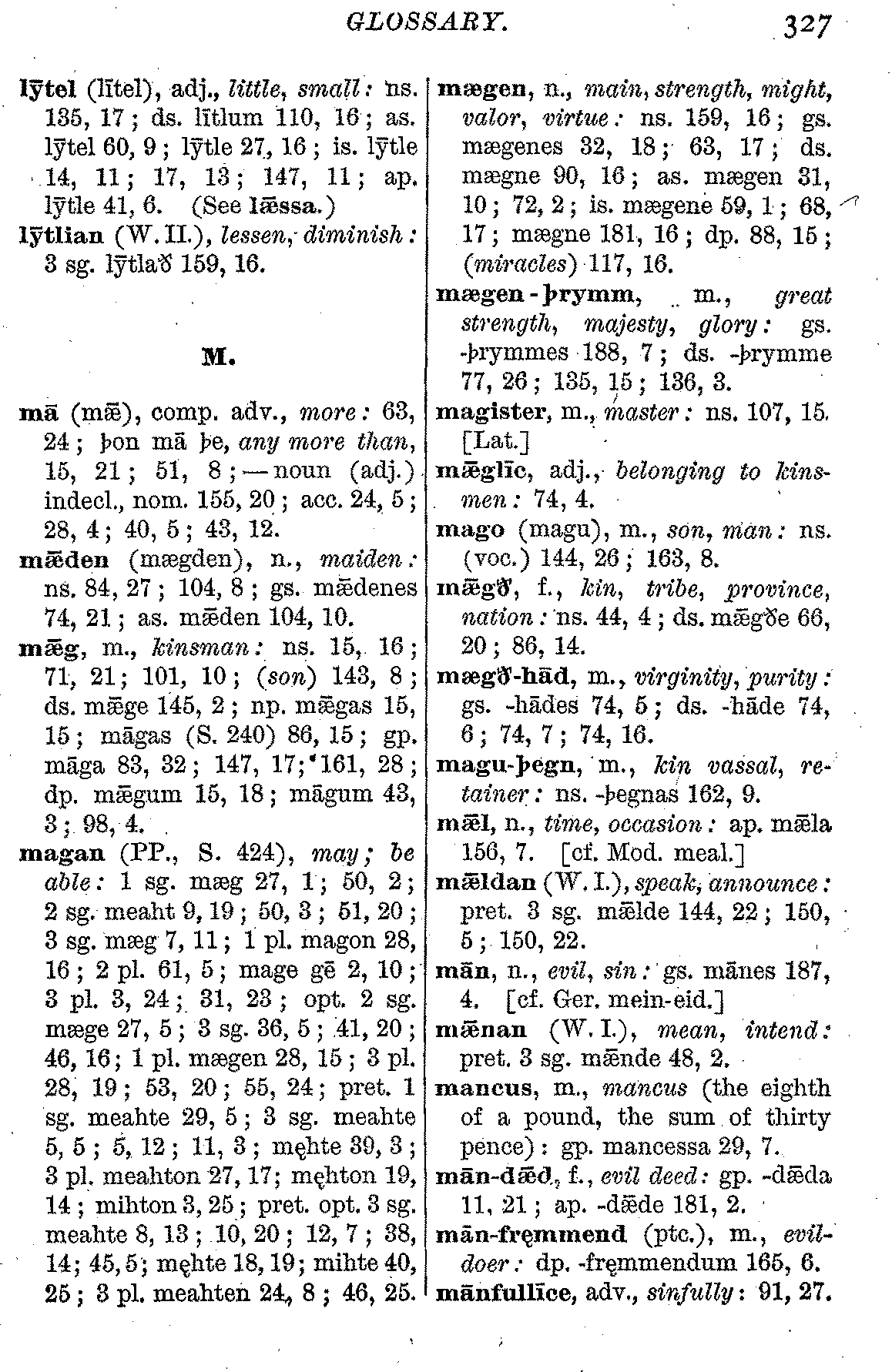
mægen n main, strength, might, valor, virtue
|
Source: Cleasby/Vigfusson, page b0007, entry 22 View original page image as: [TIFF] [PNG] [View previous entry] [View next entry] |
[Comment on this entry] [View comments] |
The following entry has been hand-corrected once. |
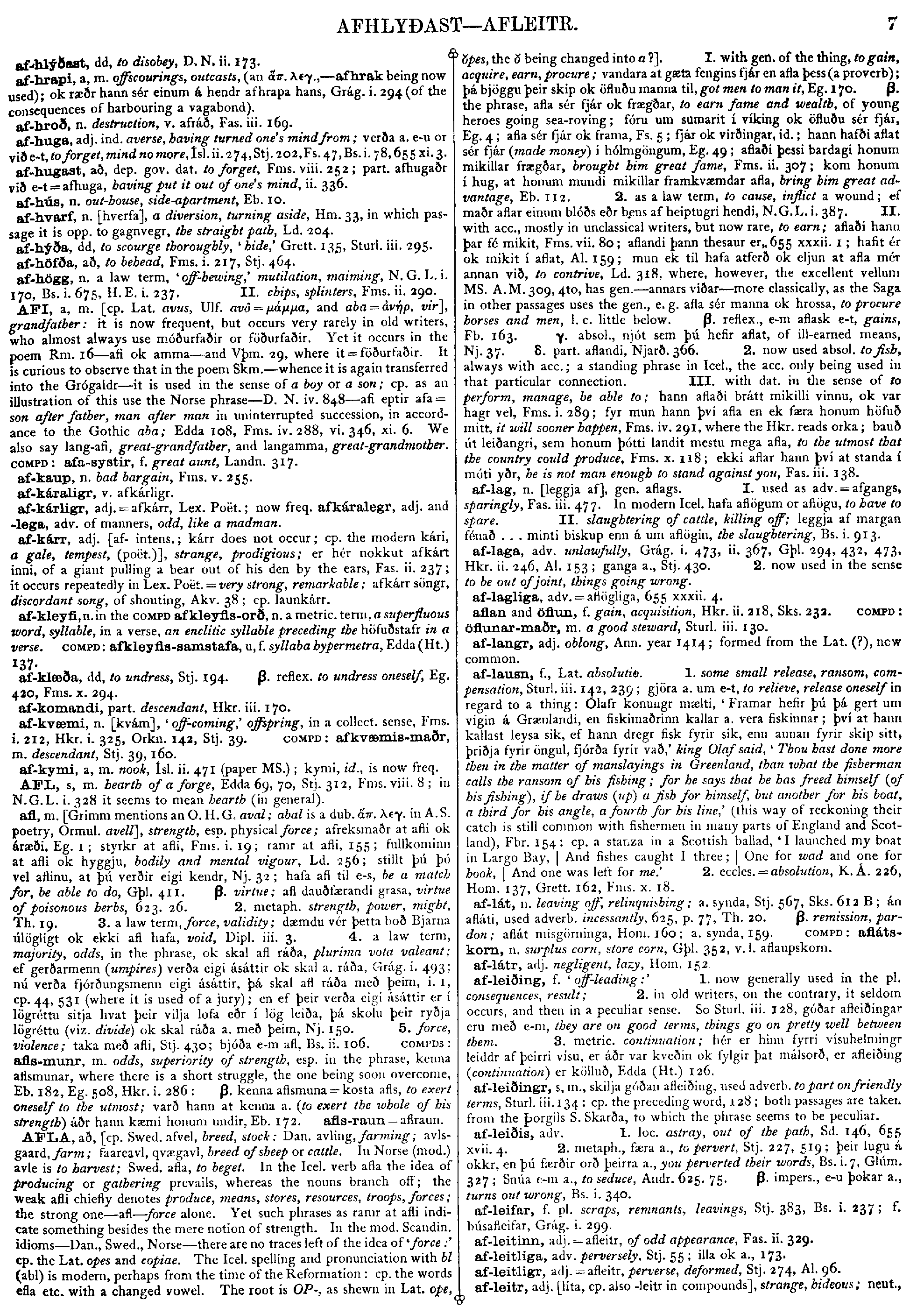
afl,
m.
[Grimm
mentions
an
O.
H.
G.
aval;
abal
is
a
dub.
GREEK
in
A.
S.
poetry,
Ormul.
avell]
,
strength,
esp.
physical
force;
afreksmaðr
at
afli
ok
áræði,
Eg.
1;
styrkr
at
afli,
Fms.
i.
19;
ramr
at
afli,
155;
fullkominn
at
afli
ok
hyggju,
bodily
and
mental
vigour,
Ld.
256;
stillt
þú
þó
vel
aflinu,
at
þú
verðir
eigi
kendr,
Nj.
32;
hafa
afl
til
e-s,
be
a
match
for,
be
able
to
do,
Gþl.
411.
 .
virtue;
afl
dauðfærandi
grasa,
virtue
of
poisonous
herbs,
623.
26.
2.
metaph.
strength,
power,
might,
Th.
19.
3.
a
law
term,
force,
validity;
dæmdu
vér
þetta
boð
Bjarna
úlögligt
ok
ekki
afl
hafa,
void,
Dipl.
iii.
3.
4.
a
law
term,
majority,
odds,
in
the
phrase,
ok
skal
afl
ráða,
plurima
vota
valeant;
ef
gerðarmenn
(umpires)
verða
eigi
ásáttir
ok
skal
a
ráða,
Grág.
i.
493;
nú
verða
fjórðungsmenn
eigi
ásáttir,
þá
skal
afl
ráða
með
þeim,
i.
l,
cp.
44,
531
(where
it
is
used
of
a
jury);
en
ef
þeir
verða
eigi
ásáttir
er
í
lögréttu
sitja
hvat
þeir
vilja
lofa
eðr
í
lög
leiða,
þá
skolu
þeir
ryðja
lögréttu
(viz.
divide)
ok
skal
ráða
a.
með
þeim,
Nj.
150.
5.
force,
violence;
taka
með
afli,
Stj.
4.
30;
bjóða
e-m
afl,
Bs.
ii.
106.
COMPDS:
afls-munr,
m.
odds,
superiority
of
strength,
esp.
in
the
phrase,
kenna
aflsmunar,
where
there
is
a
short
struggle,
the
one
being
soon
overcome,
Eb.
182,
Eg.
508,
Hkr.
i.
286:
.
kenna
aflsmuna
=
kosta
afis,
to
exert
oneself
to
the
utmost;
varð
hann
at
kenna
a.
(to
exert
the
whole
of
his
strength)
áðr
hann
kæmi
honum
undir,
Eb.
172.
afl.
s-raun
=
aflraun.
.
virtue;
afl
dauðfærandi
grasa,
virtue
of
poisonous
herbs,
623.
26.
2.
metaph.
strength,
power,
might,
Th.
19.
3.
a
law
term,
force,
validity;
dæmdu
vér
þetta
boð
Bjarna
úlögligt
ok
ekki
afl
hafa,
void,
Dipl.
iii.
3.
4.
a
law
term,
majority,
odds,
in
the
phrase,
ok
skal
afl
ráða,
plurima
vota
valeant;
ef
gerðarmenn
(umpires)
verða
eigi
ásáttir
ok
skal
a
ráða,
Grág.
i.
493;
nú
verða
fjórðungsmenn
eigi
ásáttir,
þá
skal
afl
ráða
með
þeim,
i.
l,
cp.
44,
531
(where
it
is
used
of
a
jury);
en
ef
þeir
verða
eigi
ásáttir
er
í
lögréttu
sitja
hvat
þeir
vilja
lofa
eðr
í
lög
leiða,
þá
skolu
þeir
ryðja
lögréttu
(viz.
divide)
ok
skal
ráða
a.
með
þeim,
Nj.
150.
5.
force,
violence;
taka
með
afli,
Stj.
4.
30;
bjóða
e-m
afl,
Bs.
ii.
106.
COMPDS:
afls-munr,
m.
odds,
superiority
of
strength,
esp.
in
the
phrase,
kenna
aflsmunar,
where
there
is
a
short
struggle,
the
one
being
soon
overcome,
Eb.
182,
Eg.
508,
Hkr.
i.
286:
.
kenna
aflsmuna
=
kosta
afis,
to
exert
oneself
to
the
utmost;
varð
hann
at
kenna
a.
(to
exert
the
whole
of
his
strength)
áðr
hann
kæmi
honum
undir,
Eb.
172.
afl.
s-raun
=
aflraun.
|
Source: Cleasby/Vigfusson, page b0064, entry 25 View original page image as: [TIFF] [PNG] [View previous entry] [View next entry] |
[Comment on this entry] [View comments] |
The following entry has been hand-corrected once. |
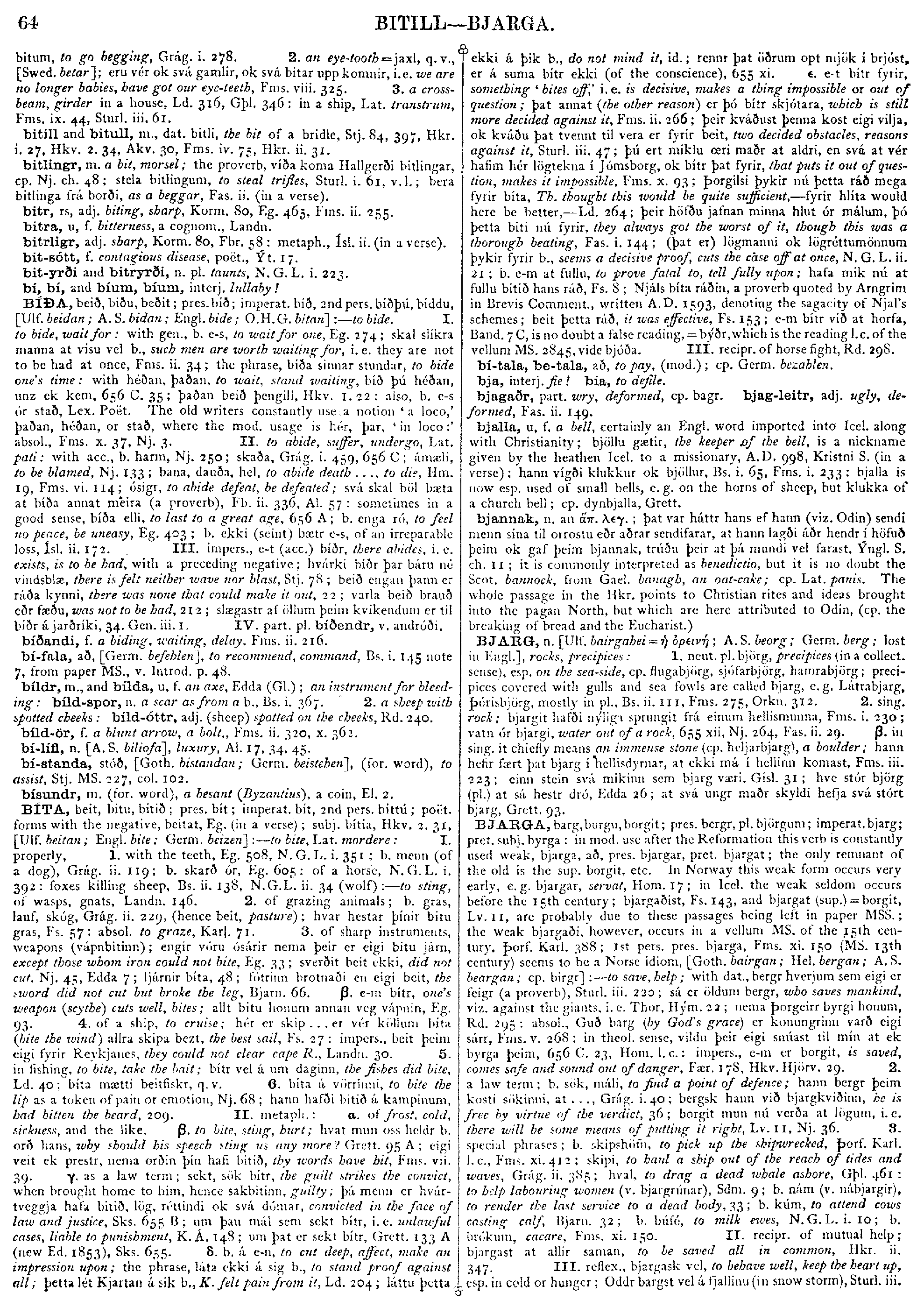
BJARGA, barg, burgu, borgit; pres. bergr, pl. björgum; imperat. bjarg; pret. subj. byrga: in mod. use after the Reformation this verb is constantly used weak, bjarga, að, pres. bjargar, pret. bjargat; the only remnant of the old is the sup. borgit, etc. In Norway this weak form occurs very early, e.g. bjargar, servat, Hom. 17; in Icel. the weak seldom occurs before the 15th century; bjargaðist, Fs. 143, and bjargat (sup.) = borgit, Lv. 11, are probably due to these passages being left in paper MSS.; the weak bjargaði, however, occurs in a vellum MS. of the 15th century, Þorf. Karl. 388; 1st pers. pres. bjarga, Fms. xi. 150 (MS. 13th century) seems to be a Norse idiom, [Goth. bairgan; Hel. bergan; A. S. beargan; cp. birgr] :-- to save, help; with dat., bergr hverjum sem eigi er feigr (a proverb), Sturl. iii. 220; sá er öldum bergr, who saves mankind, viz. against the giants, i.e. Thor, Hým. 22; nema Þorgeirr byrgi honum, Rd. 295: absol., Guð barg (by God's grace) er konungrinn varð eigi sárr, Fms. v. 268: in theol. sense, vildu þeir eigi snúast til mín at ek byrga þeim, 656 C. 23, Hom. l.c.: impers., e-m er borgit, is saved, comes safe and sound out of danger, Fær. 178, Hkv. Hjörv. 29. 2. a law term; b. sök, máli, to find a point of defence; hann bergr þeim kosti sökinni, at ..., Grág. i. 40; bergsk hann við bjargkviðinn, he is free by virtue of the verdict, 36; borgit mun nú verða at lögum, i.e. there will be some means of putting it right, Lv. 11, Nj. 36. 3. special phrases; b. skipshöfn, to pick up the shipwrecked, Þorf. Karl. l.c., Fms. xi. 412; skipi, to haul a ship out of the reach of tides and waves, Grág. ii. 385; hval, to drag a dead whale ashore, Gþl. 461: to help labouring women (v. bjargrúnar), Sdm. 9; b. nám (v. nábjargir), to render the last service to a dead body, 33; b. kúm, to attend cows casting calf, Bjarn. 32; b. búfé, to milk ewes, N. G. L. i. 10; b. brókum, cacare, Fms. xi. 150. II. recipr. of mutual help; bjargast at allir saman, to be saved all in common, Hkr. ii. 347. III. reflex., bjargask vel, to behave well, keep the heart up, esp. in cold or hunger; Oddr bargst vel á fjallinu (in snow storm), Sturl. iii.
|
Source: Cleasby/Vigfusson, page b0109, entry 1 View original page image as: [TIFF] [PNG] [View previous entry] [View next entry] |
[Comment on this entry] [View comments] |
The following entry has not been hand-corrected. However, the page is reserved and someone is correcting it. |
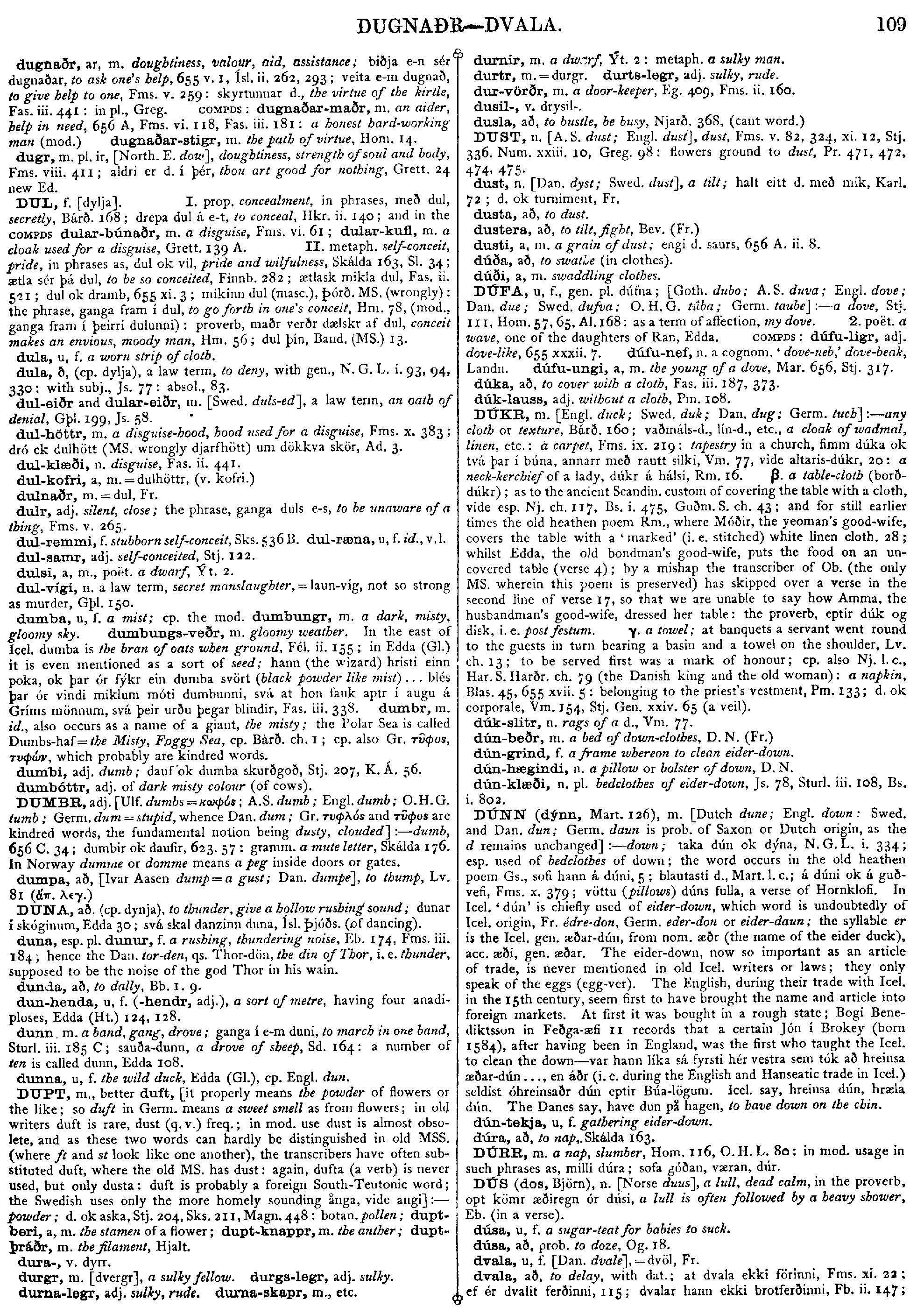
dugnaðr, ar, m. doughtiness, valour, aid, assistance; biðja e-n sér dugnaðar, to a s kone's help, 655 v. I, Ísl. ii. 262, 293; veita e-m dugnað, to give help t o o ne, Fms. v. 259: skyrtunnar d., the virtue of the kirtle, Fas. iii. 441: in pl., Greg. COMPDS: dugnaðar-maðr, m. an aider, "help in need, 656 A, Fms. vi. 118, Fas. iii. 181: a honest hard-working man (mod.) dugnaðar-stigr, m. the path of virtue, Hom. 14.
|
Source: Cleasby/Vigfusson, page b0110, entry 8 View original page image as: [TIFF] [PNG] [View previous entry] [View next entry] |
[Comment on this entry] [View comments (1)] |
The following entry has been hand-corrected once. |
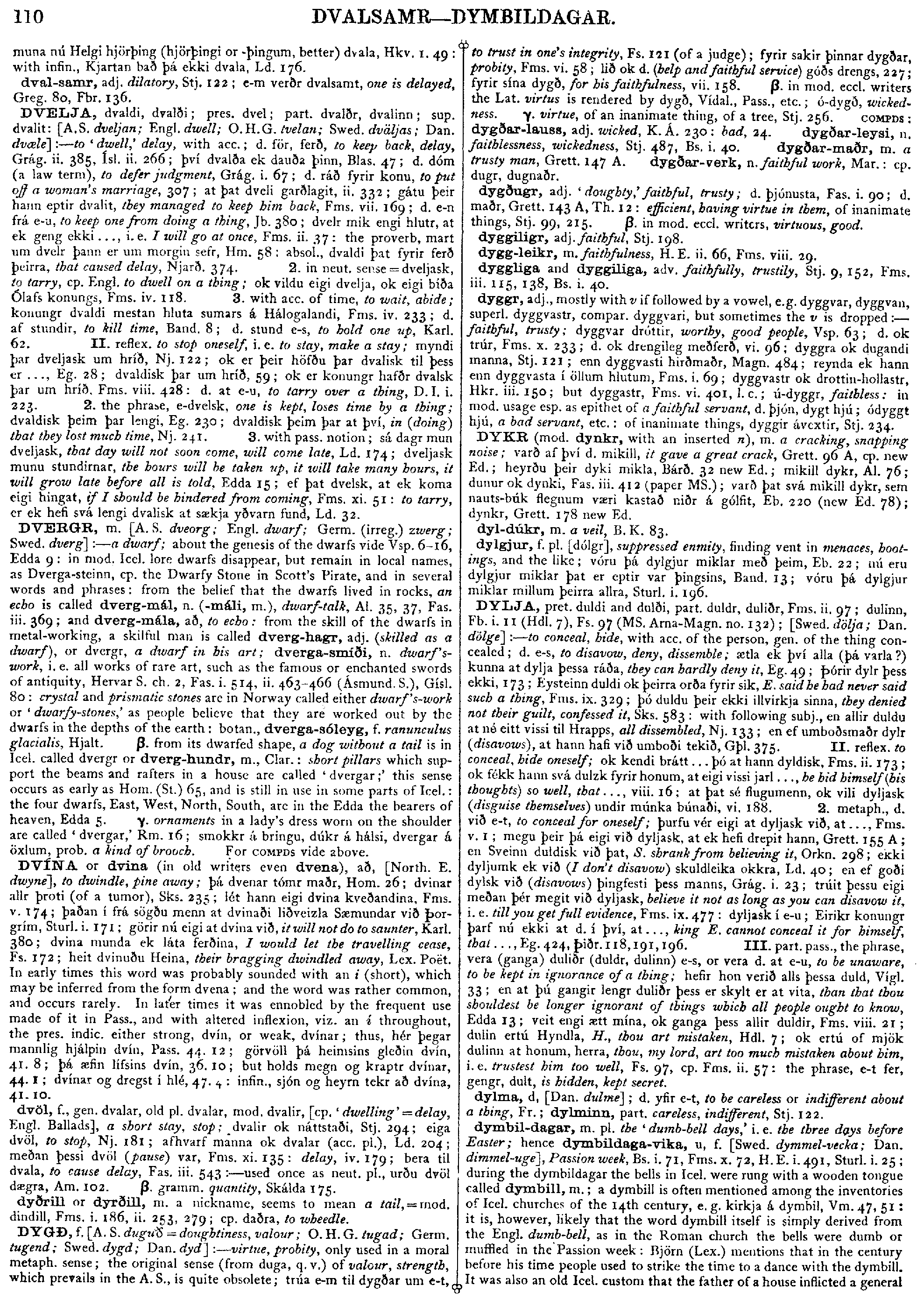
DYGÐ,
f.
[A.
S.
duguð
=
doughtiness,
valour;
O.
H.
G.
tugad;
Germ.
tugend;
Swed.
dygd;
Dan.
dyd]
:--
virtue,
probity,
only
used
in
a
moral
metaph.
sense;
the
original
sense
(from
duga,
q.v.)
of
valour,
strength,
which
prevails
in
the
A.
S.,
is
quite
obsolete;
trúa
e-m
til
dygðar
um
e-t,
to
trwst
in
one's
integrity,
Fs.
121
(of
a
judge);
fyrir
sakir
þinnar
dygðar,
probity,
Fms.
vi.
58;
lið
ok
d.
(help
and
faithful
service)
góðs
drengs,
227;
fyrir
sína
dygð,
for
his
faithfulness,
vii.
158.
.
in
mod.
eccl.
writers
the
Lat.
virtus
is
rendered
by
dygð,
Vídal.,
Pass.,
etc.;
ó-dygð,
wickedness,
 .
virtue,
of
an
inanimate
thing,
of
a
tree,
Stj.
256.
COMPDS:
dygðar-lauss,
adj.
wicked,
K.
Á.
230:
bad,
24.
dygðar-leysi,
n.
faithlessness,
wickedness,
Stj.
487,
Bs.
i.
40.
dygðar-maðr,
m.
a
trusty
man,
Grett.
147
A.
dygðar-verk,
n.
faithful
work,
Mar.:
cp.
dugr,
dugnaðr.
.
virtue,
of
an
inanimate
thing,
of
a
tree,
Stj.
256.
COMPDS:
dygðar-lauss,
adj.
wicked,
K.
Á.
230:
bad,
24.
dygðar-leysi,
n.
faithlessness,
wickedness,
Stj.
487,
Bs.
i.
40.
dygðar-maðr,
m.
a
trusty
man,
Grett.
147
A.
dygðar-verk,
n.
faithful
work,
Mar.:
cp.
dugr,
dugnaðr.
| Result Page: |  |
Previous | 1 2 3 4 5 6 | Next |  |
Germanic Lexicon Project (main page)
This search system was written by
Sean Crist
Please consider
volunteering
to correct the data in these online dictionaries.
No rights reserved. Feel free to use these data in any way you please.