|
|

Tip: In the search results, you can click on any word or abbreviation for more information.
|
Source: Cleasby/Vigfusson, page b0700, entry 33 View original page image as: [TIFF] [PNG] [View previous entry] [View next entry] |
[Comment on this entry] [View comments] |
The following entry has been hand-corrected once. |
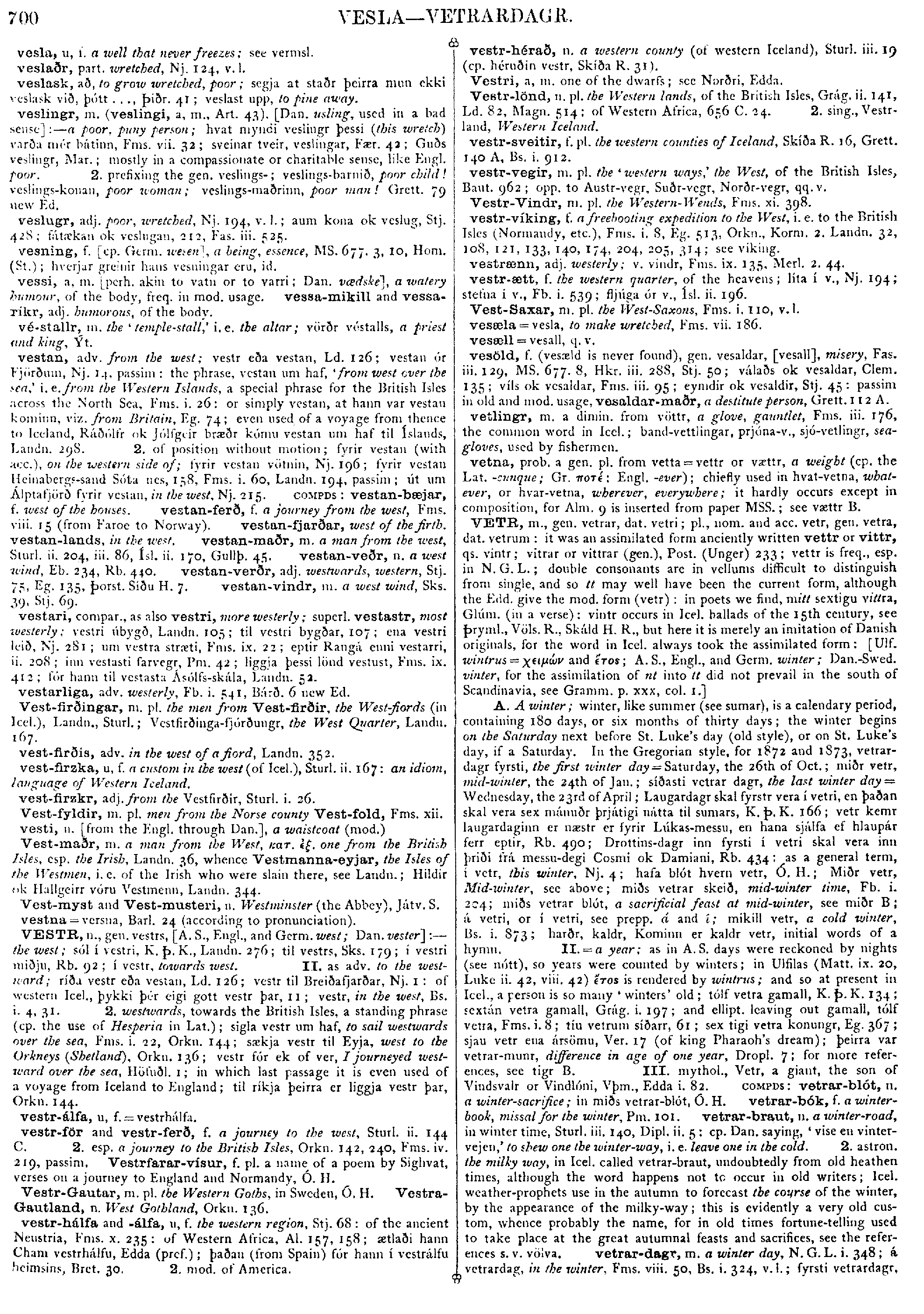
vestrænn, adj. westerly; v. vindr, Fms. ix. 135, Merl. 2. 44.
|
Source: Cleasby/Vigfusson, page b0707, entry 29 View original page image as: [TIFF] [PNG] [View previous entry] [View next entry] |
[Comment on this entry] [View comments] |
The following entry has been hand-corrected once. |
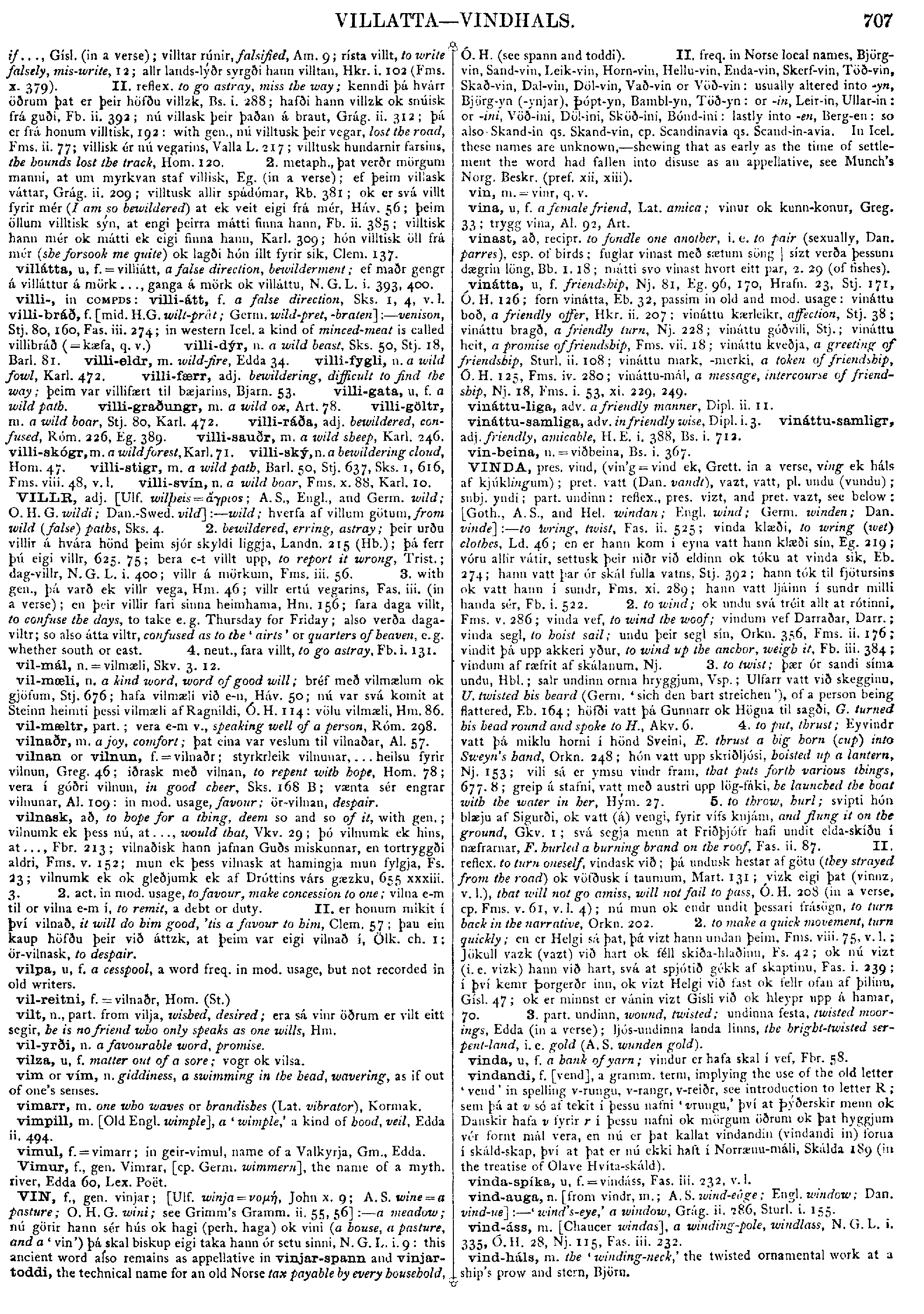
VINDA, pres. vind, (vin'g = vind ek, Grett. in a verse, ving ek háls af kjúklingum); pret. vatt (Dan. vandt), vazt, vatt, pl. undu (vundu); subj. yndi; part. undinn: reflex., pres. vizt, and pret. vazt, see below: [Goth., A.S., and Hel. windan; Engl. wind; Germ. winden; Dan. vinde] :-- to wring, twist, Fas. ii. 525; vinda klæði, to wring (wet) clothes, Ld. 46; en er hann kom í eyna vatt hann klæði sín, Eg. 219; vóru allir vátir, settusk þeir niðr við eldinn ok tóku at vinda sik, Eb. 274; hann vatt þar ór skál fulla vatns, Stj. 392; hann tók til fjötursins ok vatt hann í sundr, Fms. xi. 289; hann vatt ljáinn í sundr milli handa sér, Fb. i. 522. 2. to wind; ok undu svá tréit allt at rótinni, Fms. v. 286; vinda vef, to wind the woof; vindum vef Darraðar, Darr.; vinda segl, to hoist sail; undu þeir segl sín, Orkn. 356, Fms. ii. 176; vindit þá upp akkeri yður, to wind up the anchor, weigh it, Fb. iii. 384; vindum af ræfrit af skálanum, Nj. 3. to twist; þær ór sandi síma undu, Hbl.; salr undinn orma hryggjum, Vsp.; Ulfarr vatt við skegginu, U. twisted his beard (Germ. 'sich den bart streichen'), of a person being flattered, Eb. 164; höfði vatt þá Gunnarr ok Högna til sagði, G. turned his head round and spoke to H., Akv. 6. 4. to put, thrust; Eyvindr vatt þá miklu horni í hönd Sveini, E. thrust a big horn (cup) into Sweyn's hand, Orkn. 248; hón vatt upp skriðljósi, hoisted up a lantern, Nj. 153; vili sá er ymsu vindr fram, that puts forth various things, 677. 8; greip á stafni, vatt með austri upp lög-fáki, he launched the boat with the water in her, Hým. 27. 5. to throw, hurl; svipti hón blæju af Sigurði, ok vatt (á) vengi, fyrir vífs knjám, and flung it on the ground, Gkv. 1; svá segja menn at Friðþjófr hafi undit elda-skíðu í næfrarnar, F. hurled a burning brand on the roof, Fas. ii. 87. II. reflex. to turn oneself, vindask við; þá undusk hestar af götu (they strayed from the road) ok vöfðusk í taumum, Mart. 131; vizk eigi þat (vinnz, v.l.), that will not go amiss, will not fail to pass, Ó.H. 208 (in a verse, cp. Fms. v. 6l, v.l. 4); nú mun ok endr undit þessari frásögn, to turn back in the narrative, Orkn. 202. 2. to make a quick movement, turn quickly; en er Helgi sá þat, þá vizt hann undan þeim, Fms. viii. 75, v.l.; Jökull vazk (vazt) við hart ok féll skíða-hlaðinn, Fs. 42; ok nú vizt (i.e. vizk) hann við hart, svá at spjótið gékk af skaptinu, Fas. i. 239; í því kemr Þorgerðr inn, ok vizt Helgi við fast ok fellr ofan af þilinu, Gísl. 47; ok er minnst er vánin vizt Gísli við ok hleypr upp á hamar, 70. 3. part. undinn, wound, twisted; undinna festa, twisted moorings, Edda (in a verse); ljós-undinna landa linns, the bright-twisted serpent-land, i.e. gold (A.S. wunden gold).
|
Source: Cleasby/Vigfusson, page b0707, entry 33 View original page image as: [TIFF] [PNG] [View previous entry] [View next entry] |
[Comment on this entry] [View comments] |
The following entry has been hand-corrected once. |
vind-auga, n. [from vindr, m.; A.S. wind-eâge; Engl. window; Dan. vind-ue] :-- 'wind's-eye,' a window, Grág. ii. 286, Sturl. i. 155.
|
Source: Cleasby/Vigfusson, page b0708, entry 4 View original page image as: [TIFF] [PNG] [View previous entry] [View next entry] |
[Comment on this entry] [View comments (1)] |
The following entry has been hand-corrected once. |
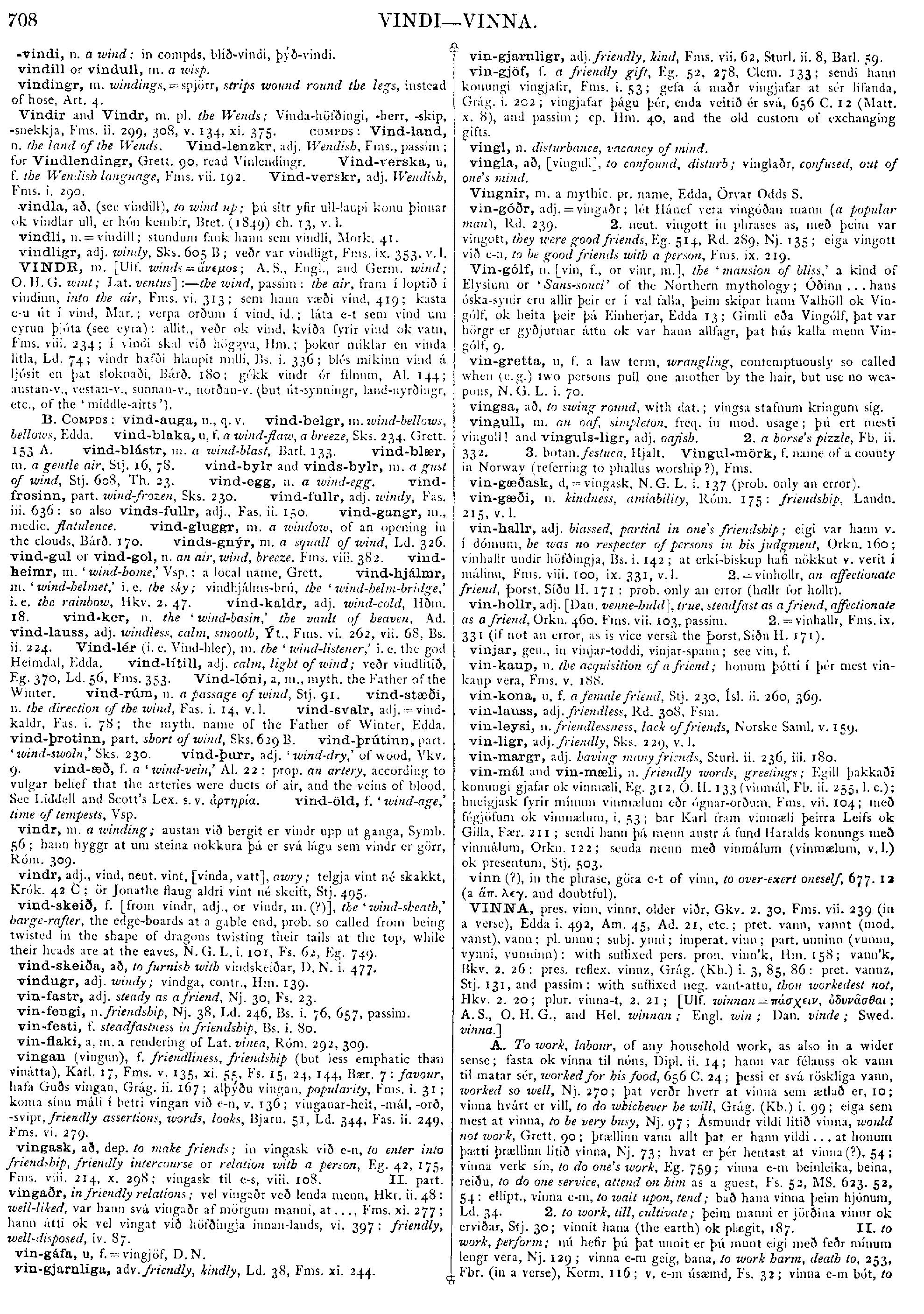
Vindir and Vindr, m. pl. the Wends; Vinda-höfðingi, -herr, -skip, -snekkja, Fms. ii. 299, 308, v. 134, xi. 375. COMPDS: Vind-land, n. /be land of the Wends. Vind-lenzkr, adj. Wendish, Fms., passim; for Vindlendingr, Grett. 90, read Vínlendingr. Vind-verska, n, f. the Wendish language, Fms. vii. 192. Vind-verskr, adj. Wendish, Fms. i. 290.
|
Source: Cleasby/Vigfusson, page b0708, entry 11 View original page image as: [TIFF] [PNG] [View previous entry] [View next entry] |
[Comment on this entry] [View comments] |
The following entry has been hand-corrected once. |
vind-skeið, f. [from vindr, adj., or vindr, m.(?)], the 'wind-sheath,' barge-rafter, the edge-boards at a gable end, prob. so called from being twisted in the shape of dragons twisting their tails at the top, while their heads are at the eaves, N.G.L. i. 101, Fs. 62, Eg. 749.
|
Source: Cleasby/Vigfusson, page b0710, entry 12 View original page image as: [TIFF] [PNG] [View previous entry] [View next entry] |
[Comment on this entry] [View comments] |
The following entry has been hand-corrected once. |
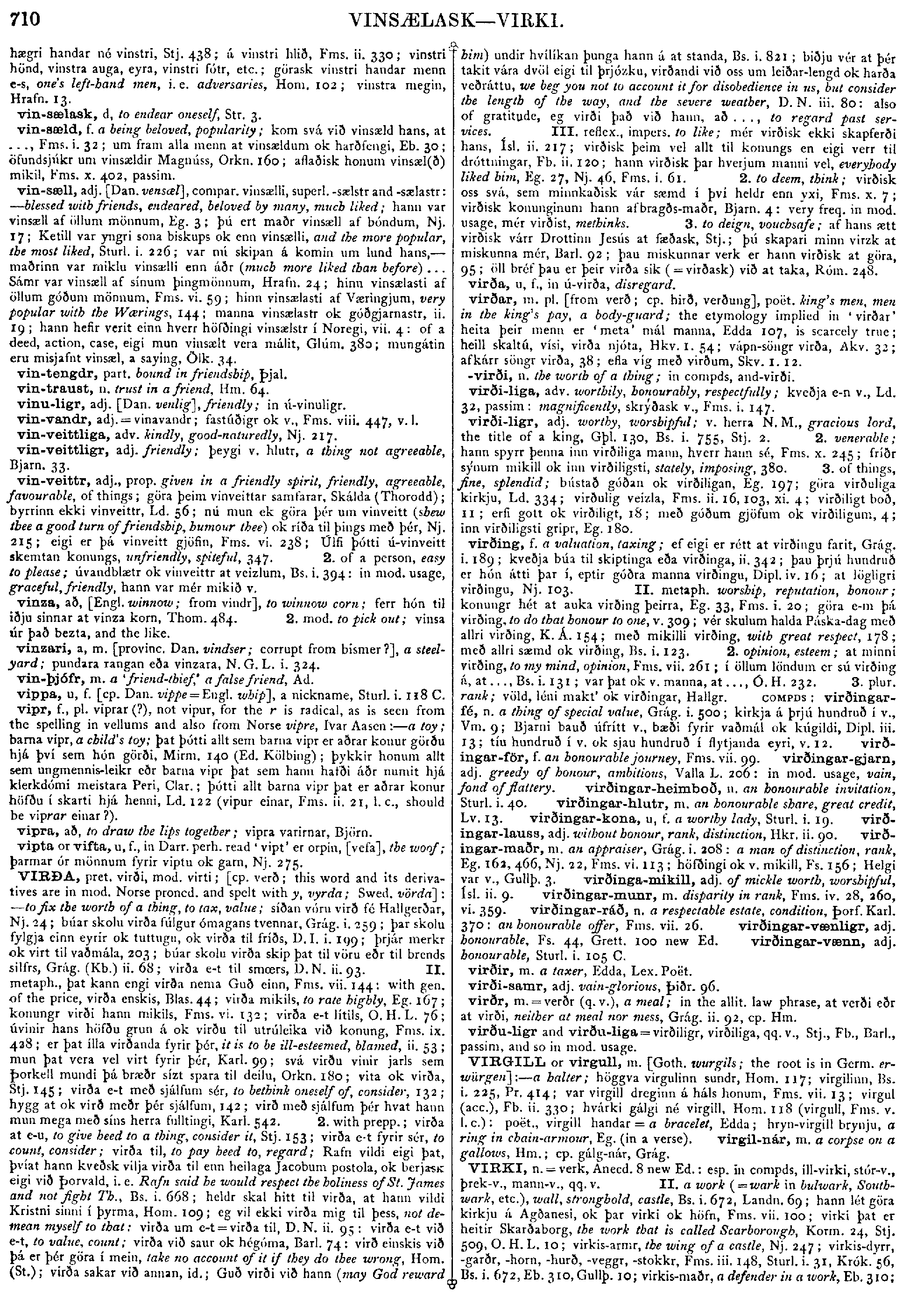
vinza, að, [Engl. winnow; from vindr], to winnow corn; ferr hón til iðju sinnar at vinza korn, Thom. 484. 2. mod. to pick out; vinsa úr það bezta, and the like.
|
Source: Cleasby/Vigfusson, page b0736, entry 3 View original page image as: [TIFF] [PNG] [View previous entry] [View next entry] |
[Comment on this entry] [View comments] |
The following entry has been hand-corrected once. |
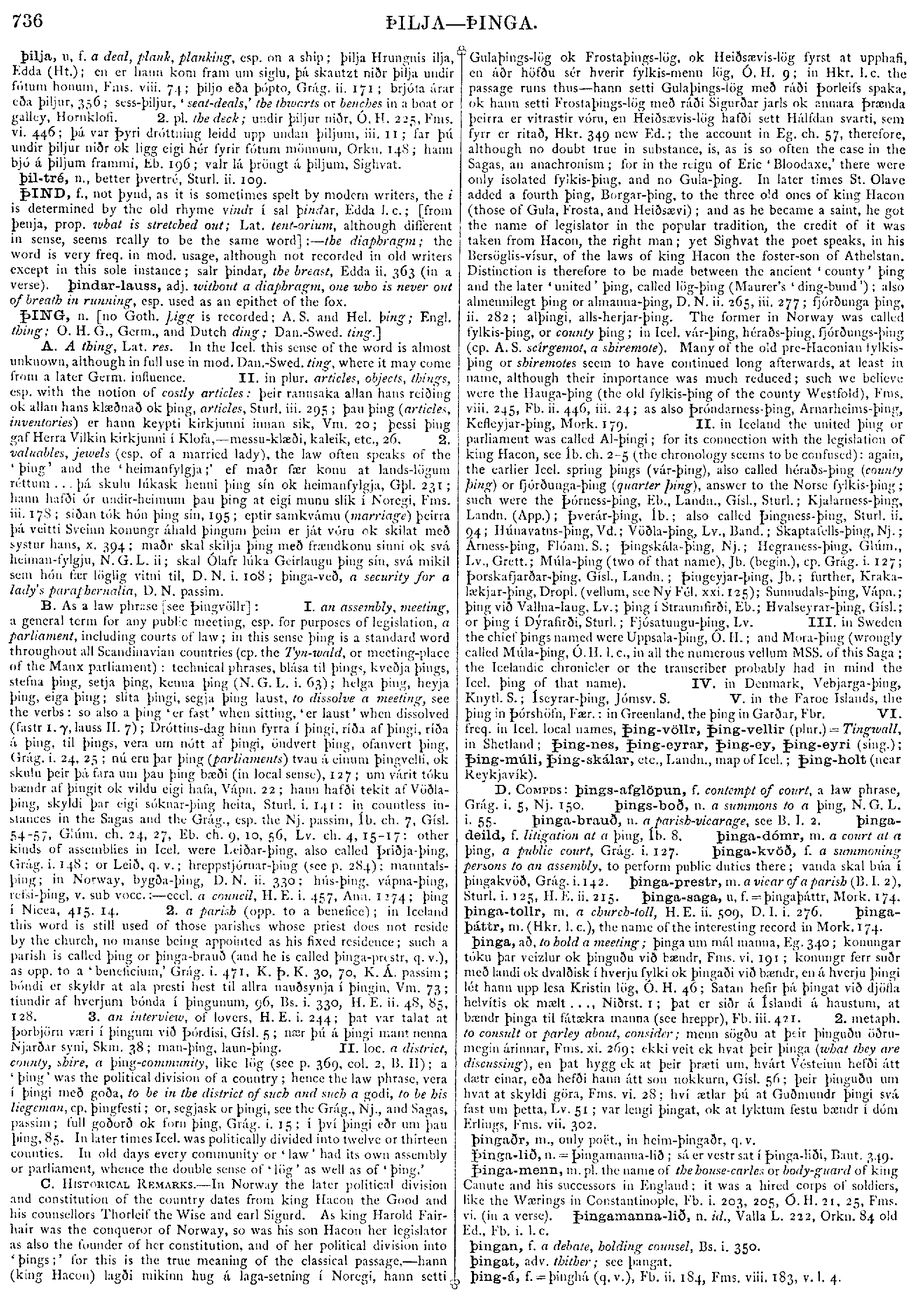
ÞIND, f., not þynd, as it is sometimes spelt by modern writers, the i is determined by the old rhyme vindr í sal þindar, Edda l.c.; [from þenja, prop. what is stretched out; Lat. tent-orium, although different in sense, seems really to be the same word] :-- the diaphragm; the word is very freq. in mod. usage, although not recorded in old writers except in this sole instance; salr þindar, the breast, Edda ii. 363 (in a verse), þindar-lauss, adj. without a diaphragm, one who is never out of breath in running, esp. used as an epithet of the fox.
|
Source: Cleasby/Vigfusson, page b0740, entry 25 View original page image as: [TIFF] [PNG] [View previous entry] [View next entry] |
[Comment on this entry] [View comments] |
The following entry has been hand-corrected once. |
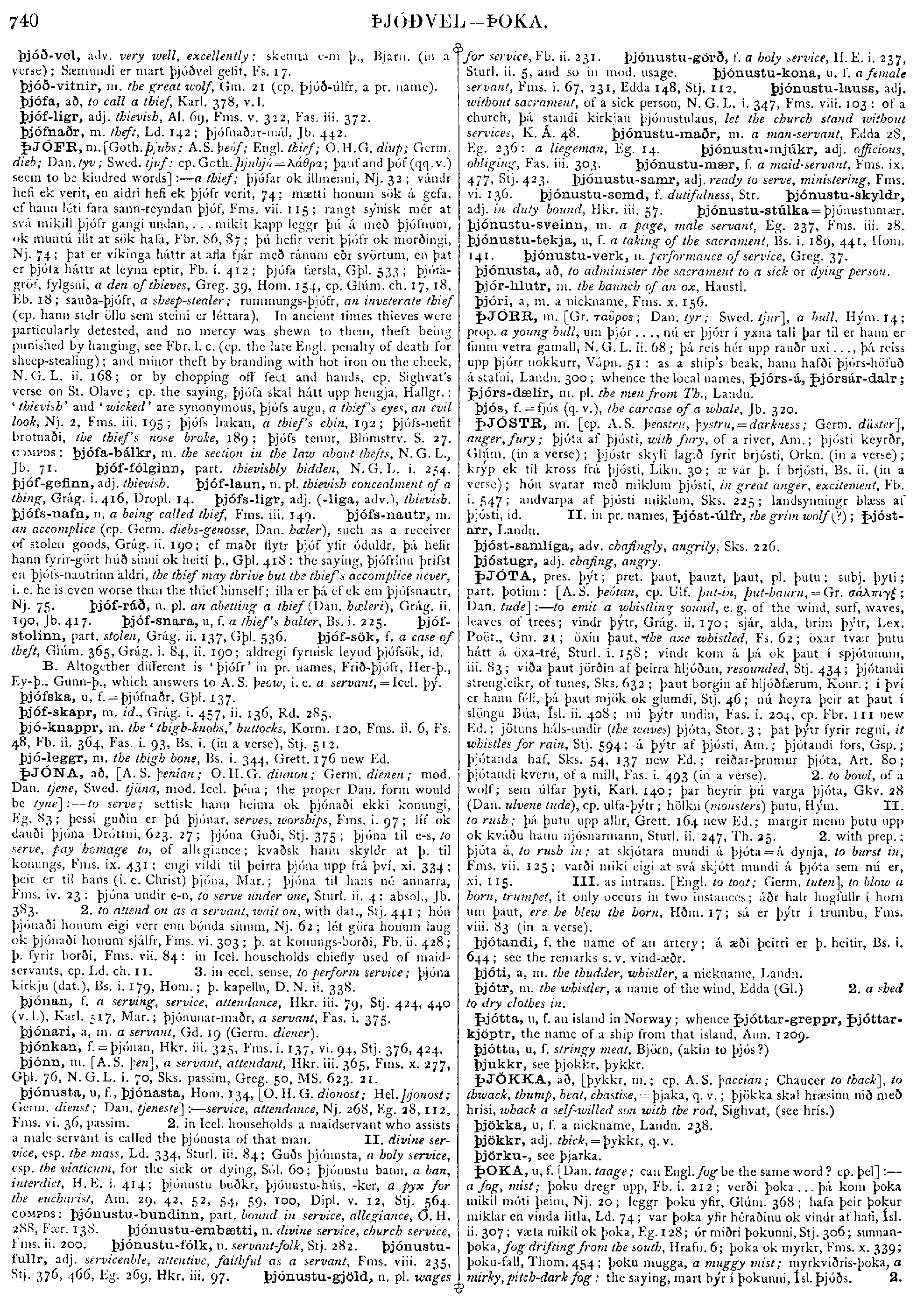
ÞJÓTA, pres. þýt; pret. þaut, þauzt, þaut, pl. þutu; subj. þyti; part. þotinn: [A.S. þeótan, cp. Ulf. þut-in, þut-haurn, = Gr. GREEK; Dan. tude] :-- to emit a whistling sound, e.g. of the wind, surf, waves, leaves of trees; vindr þýtr, Grág. ii. 170; sjár, alda, brim þýtr, Lex. Poët., Gm. 21; öxin þaut, the axe whistled, Fs. 62; öxar tvær þutu hátt á öxa-tré, Sturl. 1. 158; vindr kom á þá ok þaut í spjótunum, iii. 83; víða þaut jörðin af þeirra hljóðan, resounded, Stj. 434; þjótandi strengleikr, of tunes, Sks. 632; þaut borgin af hljóðfærum, Konr.; í því er hann féll, þá þaut mjök ok glumdi, Stj. 46; nú heyra þeir at þaut í slöngu Búa, Ísl. ii. 408; nú þýtr undin, Fas. i. 204, cp. Fbr. 111 new Ed.; jötuns háls-undir (the waves) þjóta, Stor. 3; þat þýtr fyrir regni, it whistles for rain, Stj. 594; á þýtr af þjósti, Am.; þjótandi fors, Gsp.; þjótanda haf, Sks. 54, 137 new Ed.; reiðar-þrumur þjóta, Art. 80; þjótandi kvern, of a mill, Fas. i. 493 (in a verse). 2. to howl, of a wolf; sem úlfar þyti, Karl. 140; þar heyrir þú varga þjóta, Gkv. 28 (Dan. ulvene tude), cp. ulfa-þýtr; hölkn (monsters) þutu, Hým. II. to rush; þá þutu upp allir, Grett. 164 new Ed.; margir menn þutu upp ok kváðu hann njósnarmann, Sturl. ii. 247, Th. 25. 2. with prep.; þjóta ú, to rush in; at skjótara mundi á þjóta = á dynja, to burst in, Fms. vii. 125; varði miki eigi at svá skjótt mundi á þjóta sem nú er, xi. 115. III. as intrans. [Engl. to toot; Germ. tuten], to blow a horn, trumpet, it only occurs in two instances; áðr halr hugfullr í horn um þaut, ere he blew the horn, Hðm. 17; sá er þýtr í trumbu, Fms. viii. 83 (in a verse).
|
Source: Cleasby/Vigfusson, page b0740, entry 36 View original page image as: [TIFF] [PNG] [View previous entry] [View next entry] |
[Comment on this entry] [View comments] |
The following entry has been hand-corrected once. |
ÞOKA, u, f. [Dan. taage; can Engl. fog be the same word? cp. þel] :-- a fog, mist; þoku dregr upp, Fb. i. 212; verði þoka ... þá kom þoka mikil móti þeim, Nj. 20; leggr þoku yfir, Glúm. 368; hafa þeir þokur miklar en vinda litla, Ld. 74; var þoka yfir héraðinu ok vindr af hafi, Ísl. ii. 307; væta mikil ok þoka, Eg. 128; ór miðri þokunni, Stj. 306; sunnan-þoka, fog drifting from the south, Hrafn. 6; þoka ok myrkr, Fms. x. 339; þoku-fall, Thom. 454; þoku mugga, a muggy mist; myrkviðris-þoka, a mirky, pitch-dark fog: the saying, mart býr í þokunui, Ísl. Þjóðs. 2.
|
Source: Cleasby/Vigfusson, page b0755, entry 5 View original page image as: [TIFF] [PNG] [View previous entry] [View next entry] |
[Comment on this entry] [View comments] |
The following entry has been hand-corrected once. |
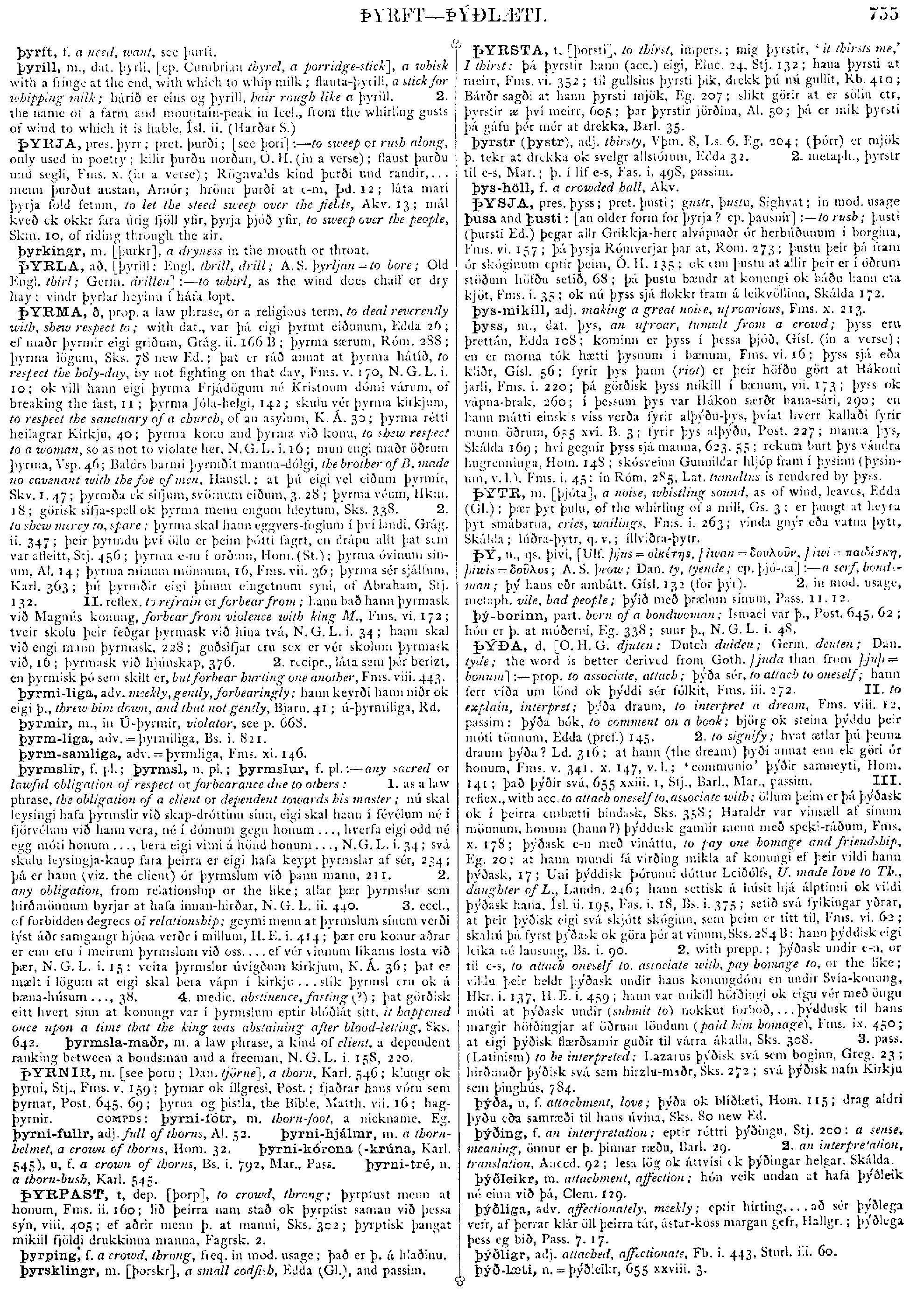
ÞYRLA, að, [þyrill: Engl. thrill, drill; A.S. þyrljan = to bore; Old Engl. thirl; Germ. drillen] :-- to whirl, as the wind does chaff or dry hay: vindr þyrlar heyinn í háfa lopt.
| Result Page: |  |
Previous | 1 2 3 4 5 | Next |  |
Germanic Lexicon Project (main page)
This search system was written by
Sean Crist
Please consider
volunteering
to correct the data in these online dictionaries.
No rights reserved. Feel free to use these data in any way you please.