|
|

|
Source: Cleasby/Vigfusson, page b0705, entry 9 View original page image as: [TIFF] [PNG] [View previous entry] [View next entry] |
[Comment on this entry] [View comments] |
The following entry has been hand-corrected once. |
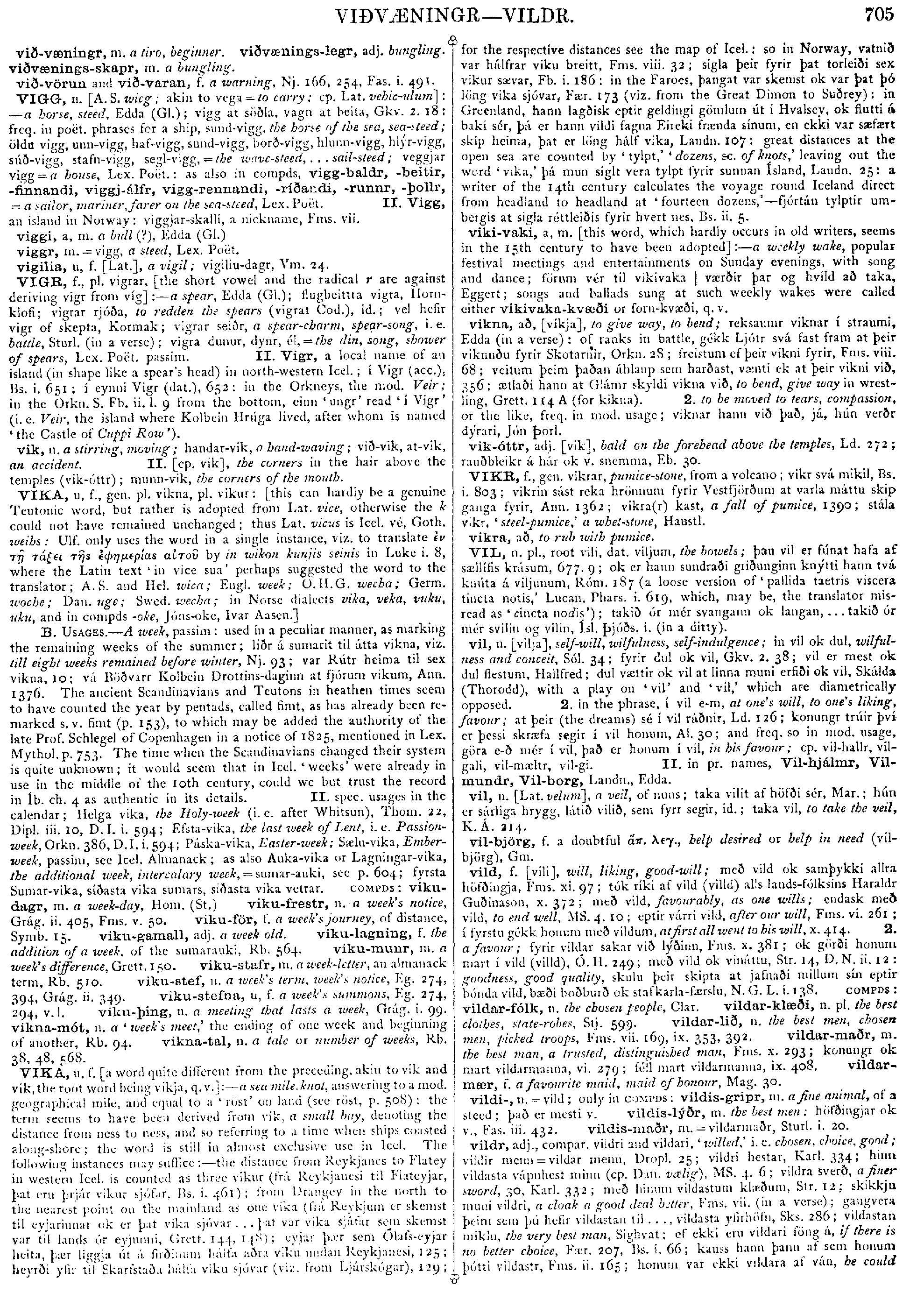
VIKA, u, f., gen. pl. vikna, pl. vikur: [this can hardly be a genuine Teutonic word, but rather is adopted from Lat. vice, otherwise the k could not have remained unchanged; thus Lat. vicus is Icel. vé, Goth. weihs: Ulf. only uses the word in a single instance, viz. to translate GREEK by in wikon kunjis seinis in Luke i. 8, where the Latin text 'in vice sua' perhaps suggested the word to the translator; A.S. and Hel. wica; Engl. week; O.H.G. wecha; Germ. woche; Dan. uge; Swed. wecha; in Norse dialects vika, veka, vuku, uku, and in compds -oke, Jóns-oke, Ivar Aasen.] B. USAGES. -- A week, passim: used in a peculiar manner, as marking the remaining weeks of the summer; líðr á sumarit til átta vikna, viz. till eight weeks remained before winter, Nj. 93; var Rútr heima til sex vikna, 10; vá Böðvarr Kolbein Drottins-daginn at fjórum vikum, Ann. 1376. The ancient Scandinavians and Teutons in heathen times seem to have counted the year by pentads, called fimt, as has already been remarked s.v. fimt (p. 153), to which may be added the authority of the late Prof. Schlegel of Copenhagen in a notice of 1825, mentioned in Lex. Mythol. p. 753. The time when the Scandinavians changed their system is quite unknown; it would seem that in Icel. 'weeks' were already in use in the middle of the 10th century, could we but trust the record in Íb. ch. 4 as authentic in its details. II. spec. usages in the calendar; Helga vika, the Holy-week (i.e. after Whitsun), Thom. 22, Dipl. iii. 10, D.I. i. 594; Efsta-vika, the last week of Lent, i.e. Passion-week, Orkn. 386, D.I. i. 594; Páska-vika, Easter-week; Sælu-vika, Ember-week, passim, see Icel. Almanack; as also Auka-vika or Lagningar-vika, the additional week, intercalary week, = sumar-auki, see p. 604; fyrsta Sumar-vika, síðasta vika sumars, síðasta vika vetrar. COMPDS: viku-dagr, m. a week-day, Hom. (St.) viku-frestr, n. a week's notice, Grág. ii. 405, Fms. v. 50. viku-för, f. a week's journey, of distance, Symb. 15. viku-gamall, adj. a week old. viku-lagning, f. the addition of a week, of the sumarauki, Rb. 564. viku-munr, m. a week's difference, Grett. 150. viku-stafr, m. a week-letter, an almanack term, Rb. 510. viku-stef, n. a week's term, week's notice, Eg. 274. 394, Grág. ii. 349. viku-stefna, u, f. a week's summons. Eg. 274, 294, v.l. viku-þing, n. a meeting that lasts a week, Grág. i. 99. vikna-mót, n. a 'week's meet,' the ending of one week and beginning of another, Rb. 94. vikna-tal, n. a tale or number of weeks, Rb. 38, 48, 568.
|
Source: Cleasby/Vigfusson, page b0705, entry 10 View original page image as: [TIFF] [PNG] [View previous entry] [View next entry] |
[Comment on this entry] [View comments] |
The following entry has been hand-corrected once. |
VIKA, u, f. [a word quite different from the preceding, akin to vik and vík, the root word being víkja, q.v.] :-- a sea mile, knot, answering to a mod. geographical mile, and equal to a 'röst' on land (see röst, p. 508): the term seems to have been derived from vík, a small bay, denoting the distance from ness to ness, and so referring to a time when ships coasted along-shore; the word is still in almost exclusive use in Icel. The following instances may suffice :-- the distance from Reykjanes to Flatey in western Icel. is counted as three viknr (frá Reykjanesi til Flateyjar, þat eru þrjár vikur sjófar, Bs. i. 461); from Drangey in the north to the nearest point on the mainland as one vika (frá Revkjum er skemst til eyjarinnar ok er þat vika sjóvar ... þat var vika sjáfar sem skemst var til lands ór eyjunni, Grett. 144, 148); eyjar þær sem Ólafs-eyjar heita, þær liggja út á firðinum hálfa aðra viku undan Reykjanesi, 125; heyrði yfir til Skarfstaða hálfa viku sjóvar (viz. from Ljárskógar), 129; for the respective distances see the map of Icel.: so in Norway, vatnið var hálfrar viku breitt, Fms. viii. 32; sigla þeir fyrir þat torleiði sex vikur sævar, Fb. i. 186: in the Faroes, þangat var skemst ok var þat þó löng vika sjóvar, Fær. 173 (viz. from the Great Dimon to Suðrey): in Greenland, hann lagðisk eptir geldingi gömlum út í Hvalsey, ok flutti á baki sér, þá er hann vildi fagna Eireki frænda sínum, en ekki var sæfært skip heima, þat er löng hálf vika, Landn. 107: great distances at the open sea are counted by 'tylpt,' 'dozens, sc. of knots,' leaving out the word 'vika,' þá mun siglt vera tylpt fyrir sunnan Ísland, Landn. 25: a writer of the 14th century calculates the voyage round Iceland direct from headland to headland at 'fourteen dozens,' -- fjórtan tylptir umbergis at sigla réttleiðis fyrir hvert nes, Bs. ii. 5.
|
Source: Torp, page b0407, entry 5 View original page image as: [TIFF] [PNG] [View previous entry] [View next entry] |
[Comment on this entry] [View comments] |
The following entry has been hand-corrected once. |
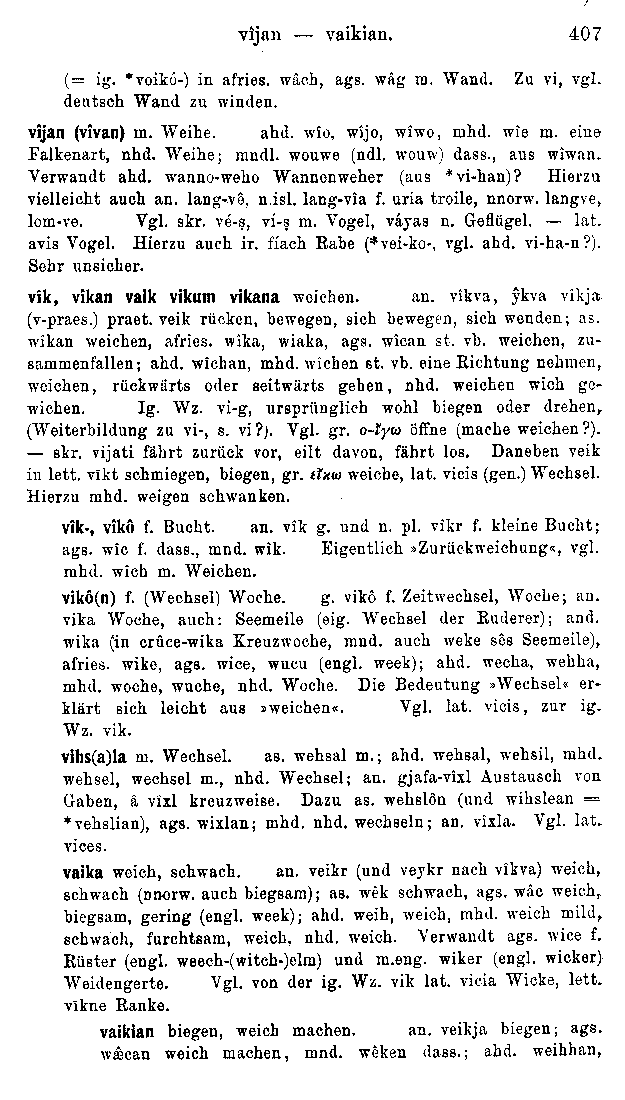
vikô(n) f. (Wechsel) Woche. g. vikô f. Zeitwechsel, Woche; an. vika Woche, auch: Seemeile (eig. Wechsel der Ruderer); and. wika (in crûce-wika Kreuzwoche, mnd. auch weke sês Seemeile), afries. wike, ags. wice, wucu (engl. week); ahd. wecha, wehha, mhd. woche, wuche, nhd. Woche. Die Bedeutung »Wechsel« erklärt sich leicht aus »weichen«. Vgl. lat. vicis, zur ig. Wz. vik.
[Translate the German words]
|
Source: Wright's Gothic Grammar, page b0356, entry 46 View original page image as: [TIFF] [PNG] [View previous entry] [View next entry] |
[Comment on this entry] [View comments] |
The following entry has been hand-corrected once. |
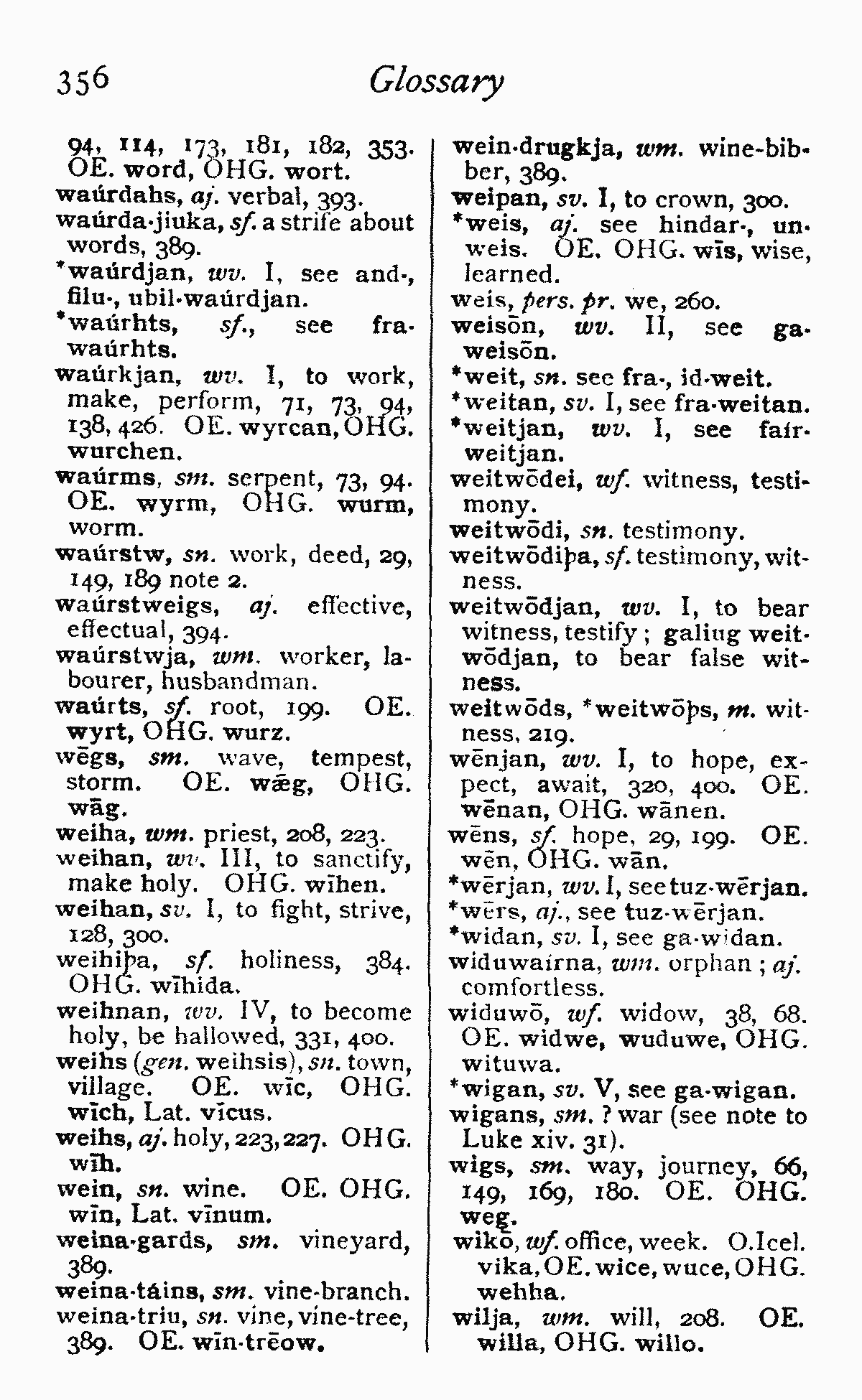
wik ,
wf.
week.
O.Icel.
vika,
OE.
wice,
wuce,
OHG.
wehha.
,
wf.
week.
O.Icel.
vika,
OE.
wice,
wuce,
OHG.
wehha.
|
Source: Bosworth/Toller, page b1215, entry 6 View original page image as: [TIFF] [PNG] [View previous entry] [View next entry] |
[Comment on this entry] [View comments (1)] |
The following entry has been hand-corrected once. |
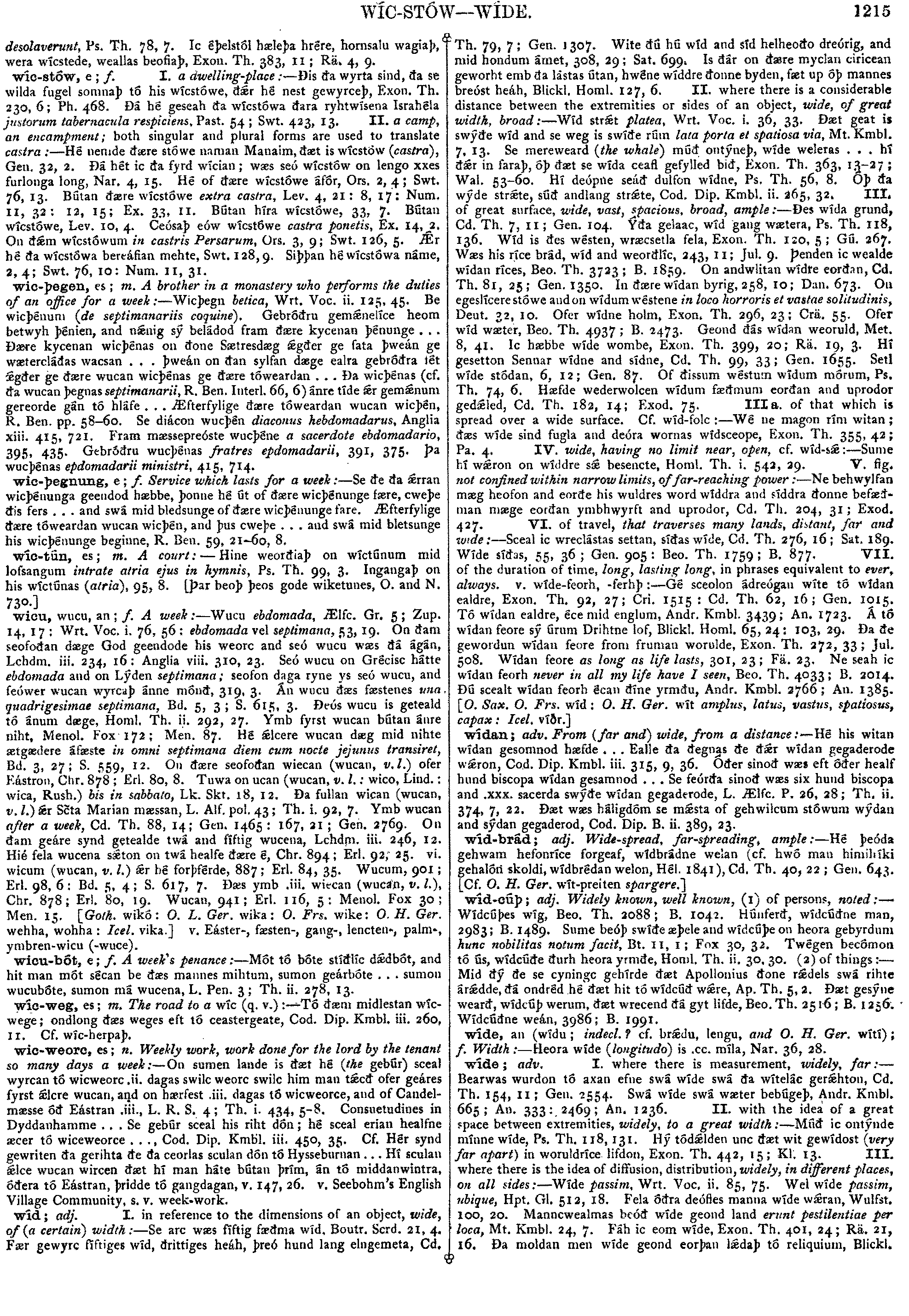
wicu,
wucu,
an
;
f.
A
week
:--
Wucu
ebdomada,
Ælfc.
Gr.
5
;
Zup.
14,
17
:
Wrt.
Voc.
i.
76,
56
:
ebdomada
vel
septimana,
53,
19.
On
ðam
seofoðan
dæge
God
geendode
his
weorc
and
seó
wucu
wæs
ðá
ágán,
Lchdm.
iii.
234,
16
:
Anglia
viii.
310,
23.
Seó
wucu
on
Grécisc
hátte
ebdomada
and
on
Lýden
septimana;
seofon
daga
ryne
ys
seó
wucu,
and
feówer
wucan
wyrcaþ
ánne
mónð,
319,
3.
Án
wucu
ðæs
fæstenes
una
quadrigesimae
seplimana,
Bd.
5,
3
;
S.
615,
3.
Ðeós
wucu
is
geteald
tó
ánum
dæge,
Homl.
Th.
ii.
292,
27.
Ymb
fyrst
wucan
bútan
ánre
niht,
Menol.
Fox
172;
Men.
87.
Hé
 lcere
wucan
dæg
mid
nihte
ætgædere
áfæste
in
omni
septimana
diem
cum
nocte
jejunus
transiret,
Bd.
3,
27;
S.
559,
12.
On
ðære
seofoðan
wiecan
(wucan,
v.l.)
ofer
Eástron,
Chr.
878
;
Erl.
80,
8.
Tuwa
on
ucan
(wucan,
v.l.:
wico,
Lind.:
wica,
Rush.)
bis
in
sabbalo,
Lk.
Skt.
18,
12.
Ða
fullan
wican
(wucan,
v.l.)
ir
UNCERTAIN
Marian
mæssan,
L.
Alf.
pol.
43;
Th.
i.
92,
7.
Ymb
wucan
after
a
week,
Cd.
Th.
88,
14;
Gen.
1465
:
167,
31
;
Gen.
2769.
On
ðam
geáre
synd
getealde
twá
and
fíftig
wucena,
Lchdm.
iii.
246,
12.
Hié
fela
wucena
ston
on
twá
healfe
ðære
é,
Chr.
894;
Erl.
92,
25.
vi.
wicum
(wucan,
v.l.)
r
hé
forþférde,
887;
Erl.
84,
35.
Wucum,
901;
Erl.
98,
6:
Bd.
5,
4
;
S.
617,
7.
Ðæs
ymb
.iii.
wiecan
(wucan,
v.l.),
Chr.
878;
Erl.
80,
19.
Wucan,
941;
Erl.
116,
5:
Menol.
Fox
30;
Men.
15.
[Goth.
wikó:
O.
L.
Ger.
wika:
O.
Frs.
wike:
O.
H.
Ger.
wehha,
wohha
:
Icel.
vika.]
v.
Eásier-,
fæsten-,
gang-,
lencten-,
palm-,
ymbren-wicu
(-wuce).
lcere
wucan
dæg
mid
nihte
ætgædere
áfæste
in
omni
septimana
diem
cum
nocte
jejunus
transiret,
Bd.
3,
27;
S.
559,
12.
On
ðære
seofoðan
wiecan
(wucan,
v.l.)
ofer
Eástron,
Chr.
878
;
Erl.
80,
8.
Tuwa
on
ucan
(wucan,
v.l.:
wico,
Lind.:
wica,
Rush.)
bis
in
sabbalo,
Lk.
Skt.
18,
12.
Ða
fullan
wican
(wucan,
v.l.)
ir
UNCERTAIN
Marian
mæssan,
L.
Alf.
pol.
43;
Th.
i.
92,
7.
Ymb
wucan
after
a
week,
Cd.
Th.
88,
14;
Gen.
1465
:
167,
31
;
Gen.
2769.
On
ðam
geáre
synd
getealde
twá
and
fíftig
wucena,
Lchdm.
iii.
246,
12.
Hié
fela
wucena
ston
on
twá
healfe
ðære
é,
Chr.
894;
Erl.
92,
25.
vi.
wicum
(wucan,
v.l.)
r
hé
forþférde,
887;
Erl.
84,
35.
Wucum,
901;
Erl.
98,
6:
Bd.
5,
4
;
S.
617,
7.
Ðæs
ymb
.iii.
wiecan
(wucan,
v.l.),
Chr.
878;
Erl.
80,
19.
Wucan,
941;
Erl.
116,
5:
Menol.
Fox
30;
Men.
15.
[Goth.
wikó:
O.
L.
Ger.
wika:
O.
Frs.
wike:
O.
H.
Ger.
wehha,
wohha
:
Icel.
vika.]
v.
Eásier-,
fæsten-,
gang-,
lencten-,
palm-,
ymbren-wicu
(-wuce).
|
Source: Cleasby/Vigfusson, page b0002, entry 1 View original page image as: [TIFF] [PNG] [View previous entry] [View next entry] |
[Comment on this entry] [View comments] |
The following entry has been hand-corrected once. |
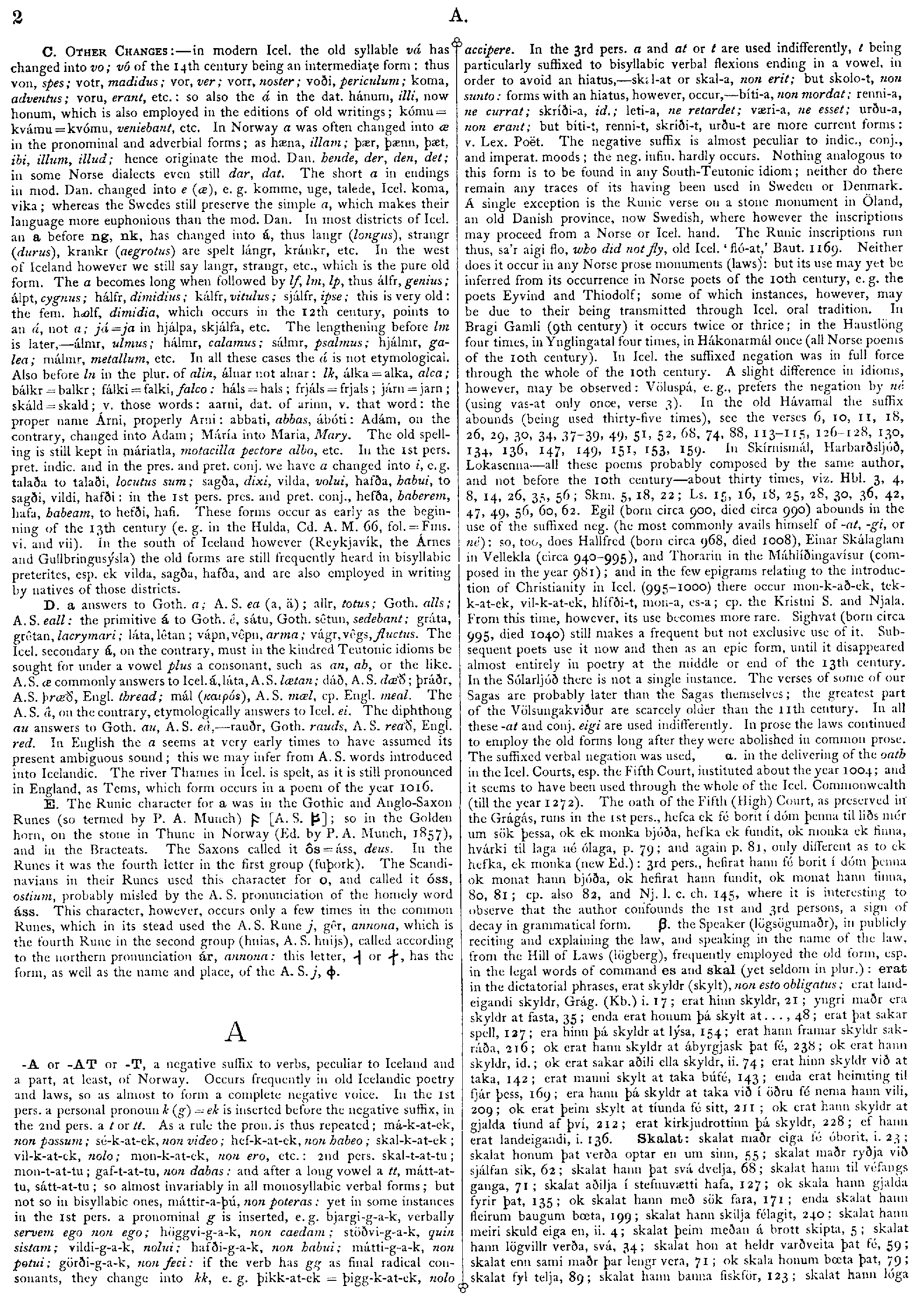
C.
OTHER
CHANGES
:--
in
modern
Icel.
the
old
syllable
va
has
changed
into
vo;
vó
of
the
14th
century
being
an
intermediate
form:
thus
von,
spes;
votr,
madidus;
vor,
ver;
vorr,
noster;
voði,
periculum;
koma,
adventus;
voru,
erant,
etc.:
so
also
the
á
in
the
dat.
hánum,
illi,
now
honum,
which
is
also
employed
in
the
editions
of
old
writings;
kómu
=
kvámu
=
kvómu,
veniebant,
etc.
In
Norway
a
was
often
changed
into
æ
in
the
pronominal
and
adverbial
forms;
as
hæna,
illam;
þær,
þænn,
þæt,
ibi,
ilium,
illud;
hence
originate
the
mod.
Dan.
hende,
der,
den,
det;
in
some
Norse
dialects
even
still
dar,
dat.
The
short
a
in
endings
in
mod.
Dan.
changed
into
e
(æ),
e.
g.
komme,
uge,
talede,
Icel.
koma,
vika;
whereas
the
Swedes
still
preserve
the
simple
a,
which
makes
their
language
more
euphonious
than
the
mod.
Dan.
In
most
districts
of
Icel.
an
a
before
ng,
nk,
has
changed
into
á,
thus
langr
(longus),
strangr
(durus),
krankr
(aegrotus)
are
spelt
lángr,
kránkr,
etc.
In
the
west
of
Iceland
however
we
still
say
langr,
strangr,
etc.,
which
is
the
pure
old
form.
The
a
becomes
long
when
followed
by
lf,
lm,
lp,
thus
álfr,
genius;
álpt,
cygnus;
hálfr,
dimidius;
kálfr,
vitulus;
sjálfr,
ipse;
this
is
very
old:
the
fem.
h lf,
dimidia,
which
occurs
in
the
12th
century,
points
to
an
á,
not
a;
já
=
ja
in
hjálpa,
skjálfa,
etc.
The
lengthening
before
lm
is
later,
--
álmr,
ulmus;
hálmr,
calamus;
sálmr,
psalmus;
hjálmr,
ga-
lea;
málmr,
metallum,
etc.
In
all
these
cases
the
á
is
not
etymological.
Also
before
ln
in
the
plur.
of
alin,
álnar
not
alnar:
lk,
alka
=
alka,
alca;
bálkr
=
balkr;
fálki
=
falki,
falco:
háls
=
hals;
frjáls
=
frjals;
járn
=
jarn;
skáld
=
skald;
v.
those
words:
aarni,
dat.
of
arinn,
v.
that
word:
the
proper
name
Árni,
properly
Arni:
abbati,
abbas,
ábóti:
Adám,
on
the
contrary,
changed
into
Adam;
Máría
into
Maria,
Mary.
The
old
spell-
ing
is
still
kept
in
máriatla,
motacilla
pectore
albo,
etc.
In
the
1st
pers.
pret.
indic.,
and
in
the
pres.
and
pret.
conj.
we
have
a
changed
into
i,
e.
g.
talaða
to
talaði,
locutus
sum;
sagða,
dixi,
vilda,
volui,
hafða,
habui,
to
sagði,
vildi,
hafði:
in
the
1st
pers.
pres.
and
pret.
conj.,
hefða,
haberem,
hafa,
habeam,
to
hefði,
hafi.
These
forms
occur
as
early
as
the
begin-
ning
of
the
13th
century
(e.
g.
in
the
Hulda,
Cd.
A.
M.
66,
fol.
=
Fms.
vi.
and
vii).
In
the
south
of
Iceland
however
(Reykjavik,
the
Árnes
and
Gullbringusýsla)
the
old
forms
are
still
frequently
heard
in
bisyllabic
preterites,
esp.
ek
vilda,
sagða,
hafða,
and
are
also
employed
in
writing
by
natives
of
those
districts.
D.
a
answers
to
Goth,
a;
A.
S.
ea
(a,
ä);
allr,
totus;
Goth,
alls;
A.
S.
eall:
the
primitive
á
to
Goth,
ê,
sátu,
Goth,
sêtun,
sedebant;
gráta,
grétun,
lacrymari;
láta,
lêtan;
vápn,
vêpn,
arma;
vagr,
vêgs,
fluctus.
The
Icel.
secondary
á,
on
the
contrary,
must
in
the
kindred
Teutonic
idioms
be
sought
for
under
a
vowel
plus
a
consonant,
such
as
an,
ah,
or
the
like.
A.
S.
æ
commonly
answers
to
Icel.
á,
láta,
A.
S.
lætan;
dáð,
A.
S.
dæð;
þráðr,
A.
S.
þræð,
Engl.
thread;
mál
(GREEK),
A.
S.
mœl,
cp.
Engl.
meal.
The
A.
S.
(1,
on
the
contrary,
etyrnologically
answers
to
Icel.
ei.
The
diphthong
au
answers
to
Goth.
au,
A.
S.
eá,
--
rauðr,
Goth.
rauds,
A.
S.
reað,
Engl.
red.
In
English
the
a
seems
at
very
early
times
to
have
assumed
its
present
ambiguous
sound;
this
we
may
infer
from
A.
S.
words
introduced
into
Icelandic.
The
river
Thames
in
Icel.
is
spelt,
as
it
is
still
pronounced
in
England,
as
Tems,
which
form
occurs
in
a
poem
of
the
year
1016.
E.
The
Runic
character
for
a
was
in
the
Gothic
and
Anglo-Saxon
Runes
(so
termed
by
P.
A.
Munch)
RUNE
[A.
S.
RUNE];
so
in
the
Golden
horn,
on
the
stone
in
Thune
in
Norway
(Ed.
by
P.
A.
Munch,
1857),
and
in
the
Bracteats.
The
Saxons
called
it
os
=
áss,
deus.
In
the
Runes
it
was
the
fourth
letter
in
the
first
group
(fuþork).
The
Scandi-
navians
in
their
Runes
used
this
character
for
o,
and
called
it
óss,
ostium,
probably
misled
by
the
A.
S.
pronunciation
of
the
homely
word
áss.
This
character,
however,
occurs
only
a
few
times
in
the
common
Runes,
which
in
its
stead
used
the
A.
S.
Rune
RUNE,
gér,
annona,
which
is
the
fourth
Rune
in
the
second
group
(hnias,
A.
S.
hnijs),
called
according
to
the
northern
pronunciation
ár,
annona:
this
letter,
RUNE
or
RUNE
has
the
form,
as
well
as
the
name
and
place,
of
the
A.
S.
RUNE,
RUNE.
lf,
dimidia,
which
occurs
in
the
12th
century,
points
to
an
á,
not
a;
já
=
ja
in
hjálpa,
skjálfa,
etc.
The
lengthening
before
lm
is
later,
--
álmr,
ulmus;
hálmr,
calamus;
sálmr,
psalmus;
hjálmr,
ga-
lea;
málmr,
metallum,
etc.
In
all
these
cases
the
á
is
not
etymological.
Also
before
ln
in
the
plur.
of
alin,
álnar
not
alnar:
lk,
alka
=
alka,
alca;
bálkr
=
balkr;
fálki
=
falki,
falco:
háls
=
hals;
frjáls
=
frjals;
járn
=
jarn;
skáld
=
skald;
v.
those
words:
aarni,
dat.
of
arinn,
v.
that
word:
the
proper
name
Árni,
properly
Arni:
abbati,
abbas,
ábóti:
Adám,
on
the
contrary,
changed
into
Adam;
Máría
into
Maria,
Mary.
The
old
spell-
ing
is
still
kept
in
máriatla,
motacilla
pectore
albo,
etc.
In
the
1st
pers.
pret.
indic.,
and
in
the
pres.
and
pret.
conj.
we
have
a
changed
into
i,
e.
g.
talaða
to
talaði,
locutus
sum;
sagða,
dixi,
vilda,
volui,
hafða,
habui,
to
sagði,
vildi,
hafði:
in
the
1st
pers.
pres.
and
pret.
conj.,
hefða,
haberem,
hafa,
habeam,
to
hefði,
hafi.
These
forms
occur
as
early
as
the
begin-
ning
of
the
13th
century
(e.
g.
in
the
Hulda,
Cd.
A.
M.
66,
fol.
=
Fms.
vi.
and
vii).
In
the
south
of
Iceland
however
(Reykjavik,
the
Árnes
and
Gullbringusýsla)
the
old
forms
are
still
frequently
heard
in
bisyllabic
preterites,
esp.
ek
vilda,
sagða,
hafða,
and
are
also
employed
in
writing
by
natives
of
those
districts.
D.
a
answers
to
Goth,
a;
A.
S.
ea
(a,
ä);
allr,
totus;
Goth,
alls;
A.
S.
eall:
the
primitive
á
to
Goth,
ê,
sátu,
Goth,
sêtun,
sedebant;
gráta,
grétun,
lacrymari;
láta,
lêtan;
vápn,
vêpn,
arma;
vagr,
vêgs,
fluctus.
The
Icel.
secondary
á,
on
the
contrary,
must
in
the
kindred
Teutonic
idioms
be
sought
for
under
a
vowel
plus
a
consonant,
such
as
an,
ah,
or
the
like.
A.
S.
æ
commonly
answers
to
Icel.
á,
láta,
A.
S.
lætan;
dáð,
A.
S.
dæð;
þráðr,
A.
S.
þræð,
Engl.
thread;
mál
(GREEK),
A.
S.
mœl,
cp.
Engl.
meal.
The
A.
S.
(1,
on
the
contrary,
etyrnologically
answers
to
Icel.
ei.
The
diphthong
au
answers
to
Goth.
au,
A.
S.
eá,
--
rauðr,
Goth.
rauds,
A.
S.
reað,
Engl.
red.
In
English
the
a
seems
at
very
early
times
to
have
assumed
its
present
ambiguous
sound;
this
we
may
infer
from
A.
S.
words
introduced
into
Icelandic.
The
river
Thames
in
Icel.
is
spelt,
as
it
is
still
pronounced
in
England,
as
Tems,
which
form
occurs
in
a
poem
of
the
year
1016.
E.
The
Runic
character
for
a
was
in
the
Gothic
and
Anglo-Saxon
Runes
(so
termed
by
P.
A.
Munch)
RUNE
[A.
S.
RUNE];
so
in
the
Golden
horn,
on
the
stone
in
Thune
in
Norway
(Ed.
by
P.
A.
Munch,
1857),
and
in
the
Bracteats.
The
Saxons
called
it
os
=
áss,
deus.
In
the
Runes
it
was
the
fourth
letter
in
the
first
group
(fuþork).
The
Scandi-
navians
in
their
Runes
used
this
character
for
o,
and
called
it
óss,
ostium,
probably
misled
by
the
A.
S.
pronunciation
of
the
homely
word
áss.
This
character,
however,
occurs
only
a
few
times
in
the
common
Runes,
which
in
its
stead
used
the
A.
S.
Rune
RUNE,
gér,
annona,
which
is
the
fourth
Rune
in
the
second
group
(hnias,
A.
S.
hnijs),
called
according
to
the
northern
pronunciation
ár,
annona:
this
letter,
RUNE
or
RUNE
has
the
form,
as
well
as
the
name
and
place,
of
the
A.
S.
RUNE,
RUNE.
|
Source: Cleasby/Vigfusson, page b0041, entry 131 View original page image as: [TIFF] [PNG] [View previous entry] [View next entry] |
[Comment on this entry] [View comments] |
The following entry has been hand-corrected once. |
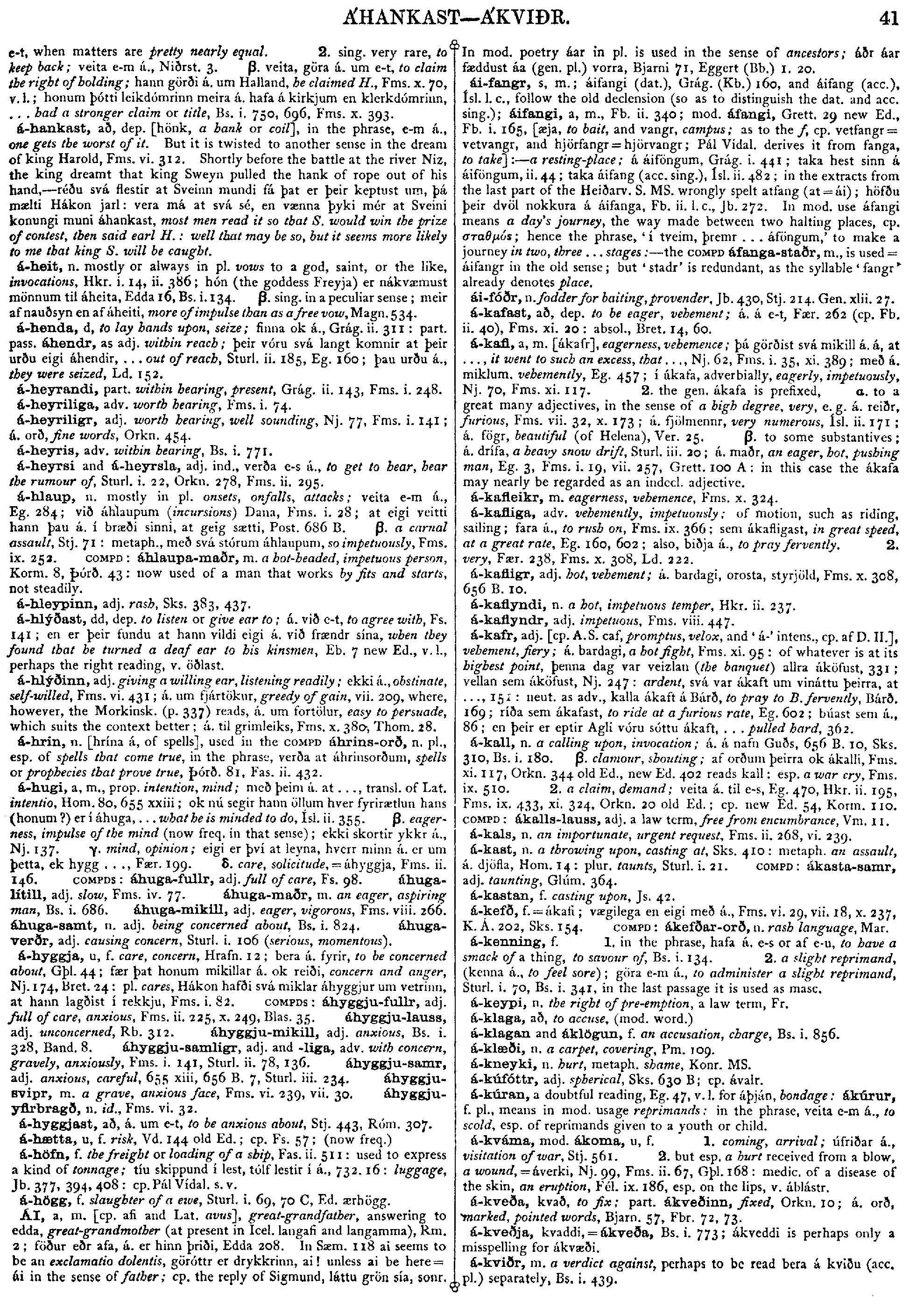
ÁR, n. [Goth. jêr; A. S. gear; Engl. year; Germ. jabr; the Scandin. idioms all drop the j, as in ungr, young; cp. also the Gr. GREEK; Lat. hora; Ulf. renders not only GREEK but also sometimes GREEK and GREEK by jêr]. I. a year, = Lat. annus, divided into twelve lunar months, each of 30 days, with four intercalary days, thus making 364 days; as the year was reckoned about the middle of the 10th century (the original calculation probably only reckoned 360 days, and made up the difference by irregular intercalary months). About the year 960 Thorstein Surt introduced the sumarauki (intercalary week), to be inserted every seventh year, thus bringing the year up to 365 days. After the introduction of Christianity (A. D. 1000) the sumarauki was made to harmonize with the Julian calendar; but from A. D. 1700 with the Gregorian calendar; v. the words sumarauki, hlaupár, mánuðr, vika, etc., Íb. ch. 4, Rb. 6, Fms. i. 67; telja árum, to count the time by years, Vsp. 6; í ári, used adverb., at present, as yet, Ó. H. 41, 42 (in a verse). II. = Lat. annona, plenty, abundance, fruitfulness; the phrase, friðr ok ár, Fms. vii. 174, Hkr. Yngl. ch. 8-12; ár ok fésæla, Hkr. l. c.; þá var ár urn öll lönd, id.; létu hlaða skip mörg af korni ok annarri gæzku, ok flytja svá ár í Dan- mörku, Fms. xi. 8, Sks. 323, Fas. i. 526, Hom. 68; gott ár, Eg. 39; blota til árs, Fms. i. 34. III. the name of the Rune RUNE (a), Skálda 176; in the A. S. and Goth. Runes the j has the name jêr, gêr, according to the Germ. and Engl. pronunciation of this word; vide p. 2, col. 1. COMPDS: ára-tal, n. and ára-tala, u, f. number of years; fimtugr at áratali, Stj. 110, Rb. 484, Mar. 656 A. i. 29; hann (Ari Frodi) hafði áratal fyrst til þess er Kristni kom á Ísland, en síðan allt til sinna daga, Hkr. (pref.), seems to mean that Ari in respect of chronology divided his Íslendingabók into two periods, that before and that after the introduction of Christianity; Stj. 112 (periode). árs-bót, f. = árbót, Bs. i. 343, q. v.
|
Source: Cleasby/Vigfusson, page b0095, entry 1 View original page image as: [TIFF] [PNG] [View previous entry] [View next entry] |
[Comment on this entry] [View comments] |
The following entry has been hand-corrected once. |
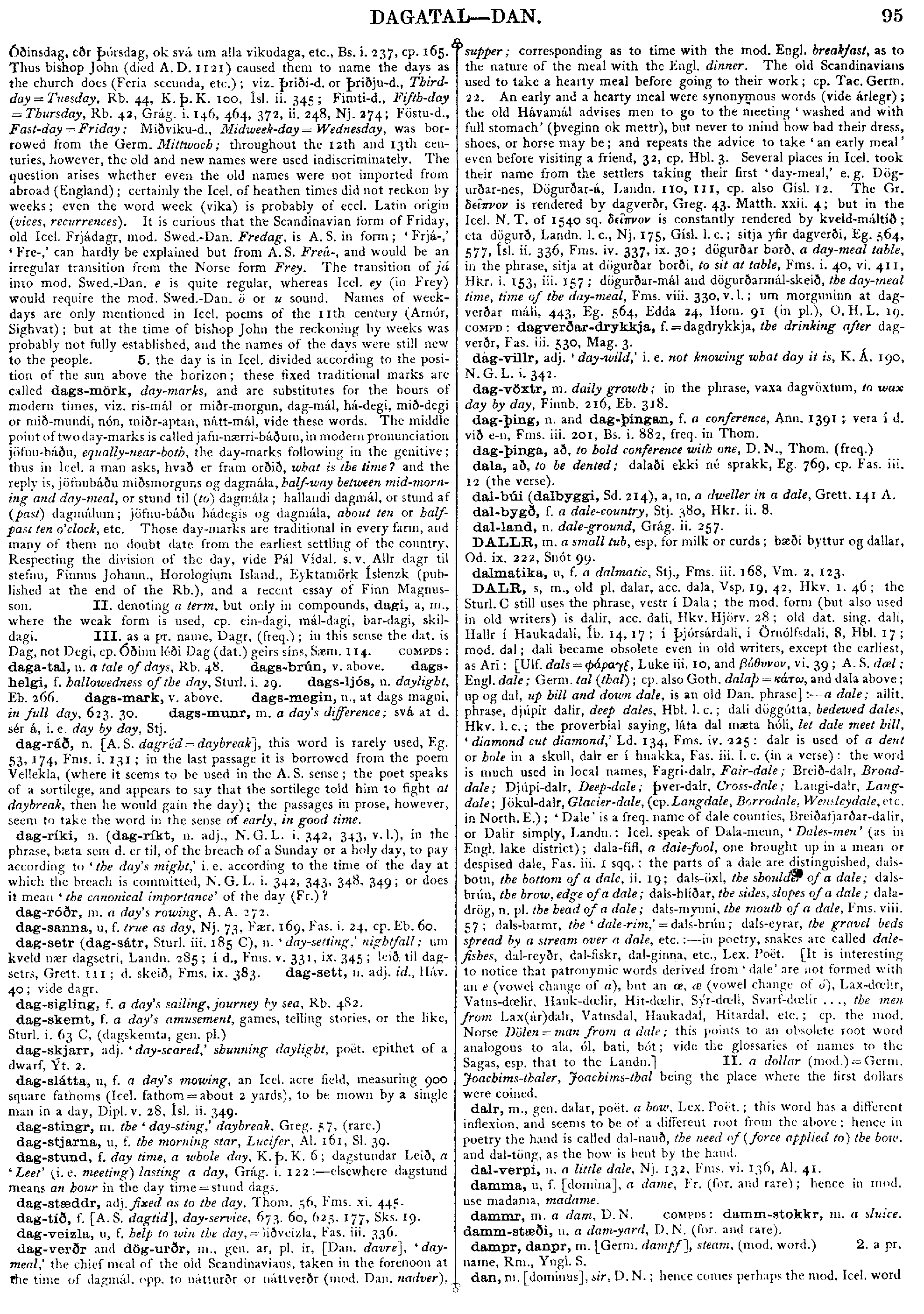
Óðinsdag, eðr Þórsdag, ok svá um alla vikudaga, etc., Bs. i. 237, cp. 165. Thus bishop John (died A.D. 1121) caused them to name the days as the church does (Feria sccunda, etc.); viz. Þriði-d. or Þriðju-d., Third-day = Tuesday, Rb. 44, K.Þ.K. 100, Ísl. ii. 345; Fimti-d., Fifth-day -- Thursday, Rb. 42, Grág. i. 146, 464, 372, ii. 248, Nj. 274; Föstu-d., Fast-day = Friday; Miðviku-d., Midweek-day = Wednesday, was borrowed from the Germ. Mittwoch; throughout the 12th and 13th centuries, however, the old and new names were used indiscriminately. The question arises whether even the old names were not imported from abroad (England); certainly the Icel. of heathen times did not reckon by weeks; even the word week (vika) is probably of eccl. Latin origin (vices, recurrences). It is curious that the Scandinavian form of Friday, old Icel. Frjádagr, mod. Swed.-Dan. Fredag, is A.S. in form; 'Frjá-,' 'Fre-,' can hardly be explained but from A.S. Freâ-, and would be an irregular transition from the Norse form Frey. The transition of ja into mod. Swed.-Dan. e is quite regular, whereas Icel. ey (in Frey) would require the mod. Swed.-Dan. ö or u sound. Names of weekdays are only mentioned in Icel. poems of the 11th century (Arnór, Sighvat); but at the time of bishop John the reckoning by weeks was probably not fully established, and the names of the days were still new to the people. 5. the day is in Icel. divided according to the posi- tion of the sun above the horizon; these fixed traditional marks are called dags-mörk, day-marks, and are substitutes for the hours of modern times, viz. ris-mál or miðr-morgun, dag-mál, há-degi, mið-degi or mið-mundi, nón, miðr-aptan, nátt-mál, vide these words. The middle point of two day-marks is called jafn-nærri-báðum, in modern pronunciation jöfnu-báðu, equally-near-both, the day-marks following in the genitive; thus in Icel. a man asks, hvað er fram orðið, what is the time? and the reply is, jöfnubáðu miðsmorguns og dagmála, half-way between mid-morn- ing and day-meal, or stund til (to) dagmála; hallandi dagmál, or stund af (past) dagmálum; jöfnu-báðu hádegis og dagmúla, about ten or half- past ten o'clock, etc. Those day-marks are traditional in every farm, and many of them no doubt date from the earliest settling of the country. Respecting the division of the day, vide Pál Vídal. s.v. Allr dagr til stefnu, Finnus Johann., Horologium Island., Eyktamörk Íslenzk (published at the end of the Rb.), and a recent essay of Finn Magnusson. II. denoting a term, but only in compounds, dagi, a, m., where the weak form is used, cp. ein-dagi, mál-dagi, bar-dagi, skil- dagi. III. jis a pr. name, Dagr, (freq.); in this sense the dat. is Dag, not Degi, cp. Óðinn léði Dag (dat.) geirs síns, Sæm. 114. COMPDS: daga-tal, n. a tale of days, Rb. 48. dags-brun, v. above. dags- helgi, f. hallowedness of the day, Sturl. i. 29. dags-ljós, n. daylight, Eb. 266. dags-mark, v. above. dags-megin, n., at dags magni, in full day, 623. 30. dags-munr, m. a day's difference; svá at d. sér á, i.e. day by day, Stj.
|
Source: Cleasby/Vigfusson, page b0116, entry 13 View original page image as: [TIFF] [PNG] [View previous entry] [View next entry] |
[Comment on this entry] [View comments] |
The following entry has been hand-corrected once. |
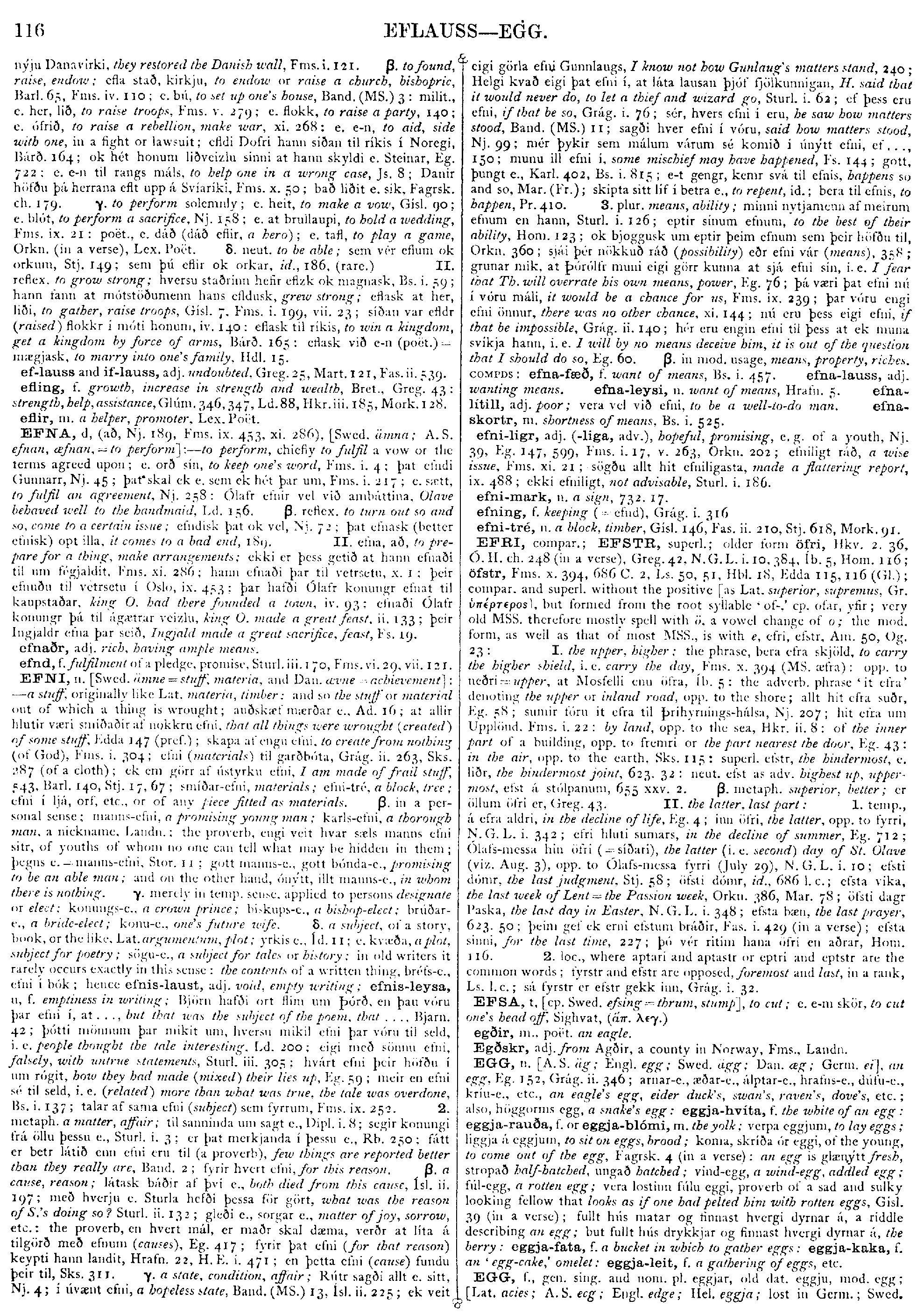
EFRI,
compar.;
EFSTR,
superl.;
older
form
öfri,
Hkv.
2.
36,
Ó.
H.
ch.
248
(in
a
verse),
Greg.
42,
N.
G.
L.
i.
10,
384,
Íb.
5,
Hom.
116;
öfstr,
Fms.
x.
394,
686
C.
2,
Ls.
50,
51,
Hbl.
18,
Edda
115,
116
(Gl.);
compar.
and
superl.
without
the
positive
[as
Lat.
superior,
supremus.
Gr.
GREEK,
but
formed
from
the
root
syllable
'of-,'
cp.
ofar,
yfir;
very
old
MSS.
therefore
mostly
spell
with
ö,
a
vowel
change
of
o;
the
mod.
form,
as
well
as
that
of
most
MSS.,
is
with
e,
efri,
efstr,
Am.
50,
Og.
23:
I.
the
upper,
higher;
the
phrase,
bera
efra
skjöld,
to
carry
the
higher
shield,
i.e.
carry
the
day,
Fms.
x.
394
(MS.
æfra):
opp.
to
neðri
=
upper,
at
Mosfelli
enu
öfra,
Íb.
5:
the
adverb,
phrase
'it
efra'
denoting
the
upper
or
inland
road,
opp.
to
the
shore;
allt
hit
efra
suðr,
Eg.
58;
sumir
fóru
it
efra
til
Þríhyrnings-hálsa,
Nj.
207;
hit
efra
um
Upplönd,
Fms.
i.
22:
by
land,
opp.
to
the
sea,
Hkr.
ii.
8:
of
the
inner
part
of
a
building,
opp.
to
fremri
or
the
part
nearest
the
door,
Eg.
43:
in
the
air,
opp.
to
the
earth,
Sks.
115:
superl.
efstr,
the
hindermost,
e.
liðr,
the
hindermost
joint,
623.
32:
neut.
efst
as
adv.
highest
up,
uppermost,
efst
á
stólpanum,
655
xxv.
2.
 .
metaph.
superior,
better;
er
öllum
öfri
er,
Greg.
43.
II.
the
latter,
last
part:
1.
temp.,
á
efra
aldri,
in
the
decline
of
life,
Eg.
4;
inn
öfri,
the
latter,
opp.
to
fyrri,
N.
G.
L.
i.
342;
efri
hluti
sumars,
in
the
decline
of
summer,
Eg.
712;
Ólafs-messa
hin
öfri
(
=
síðari),
the
latter
(i.e.
second)
day
of
St.
Olave
(viz.
Aug.
3),
opp.
to
Ólafs-messa
fyrri
(July
29),
N.
G.
L.
i.
10;
efsti
dómr,
the
last
judgment,
Stj.
58;
öfsti
dómr,
id.,
686
l.c.;
efsta
vika,
the
last
week
of
Lent
=
the
Passion
week,
Orkn.
386,
Mar.
78;
öfsti
dagr
Paska,
the
last
day
in
Easter,
N.
G.
L.
i.
348;
efsta
bæn,
the
last
prayer,
623.
50;
þeim
gef
ek
erni
efstum
bráðir,
Fas.
i.
429
(in
a
verse);
efsta
sinni,
for
the
last
time,
227;
þó
vér
ritim
hana
öfri
en
aðrar,
Hom.
116.
2.
loc.,
where
aptari
and
aptastr
or
eptri
and
eptstr
are
the
common
words;
fyrstr
and
efstr
are
opposed,
foremost
and
last,
in
a
rank,
Ls.
l.c.;
sá
fyrstr
er
efstr
gekk
inn,
Grág.
i.
32.
.
metaph.
superior,
better;
er
öllum
öfri
er,
Greg.
43.
II.
the
latter,
last
part:
1.
temp.,
á
efra
aldri,
in
the
decline
of
life,
Eg.
4;
inn
öfri,
the
latter,
opp.
to
fyrri,
N.
G.
L.
i.
342;
efri
hluti
sumars,
in
the
decline
of
summer,
Eg.
712;
Ólafs-messa
hin
öfri
(
=
síðari),
the
latter
(i.e.
second)
day
of
St.
Olave
(viz.
Aug.
3),
opp.
to
Ólafs-messa
fyrri
(July
29),
N.
G.
L.
i.
10;
efsti
dómr,
the
last
judgment,
Stj.
58;
öfsti
dómr,
id.,
686
l.c.;
efsta
vika,
the
last
week
of
Lent
=
the
Passion
week,
Orkn.
386,
Mar.
78;
öfsti
dagr
Paska,
the
last
day
in
Easter,
N.
G.
L.
i.
348;
efsta
bæn,
the
last
prayer,
623.
50;
þeim
gef
ek
erni
efstum
bráðir,
Fas.
i.
429
(in
a
verse);
efsta
sinni,
for
the
last
time,
227;
þó
vér
ritim
hana
öfri
en
aðrar,
Hom.
116.
2.
loc.,
where
aptari
and
aptastr
or
eptri
and
eptstr
are
the
common
words;
fyrstr
and
efstr
are
opposed,
foremost
and
last,
in
a
rank,
Ls.
l.c.;
sá
fyrstr
er
efstr
gekk
inn,
Grág.
i.
32.
|
Source: Cleasby/Vigfusson, page b0248, entry 17 View original page image as: [TIFF] [PNG] [View previous entry] [View next entry] |
[Comment on this entry] [View comments] |
The following entry has not been hand-corrected. However, the page is reserved and someone is correcting it. |
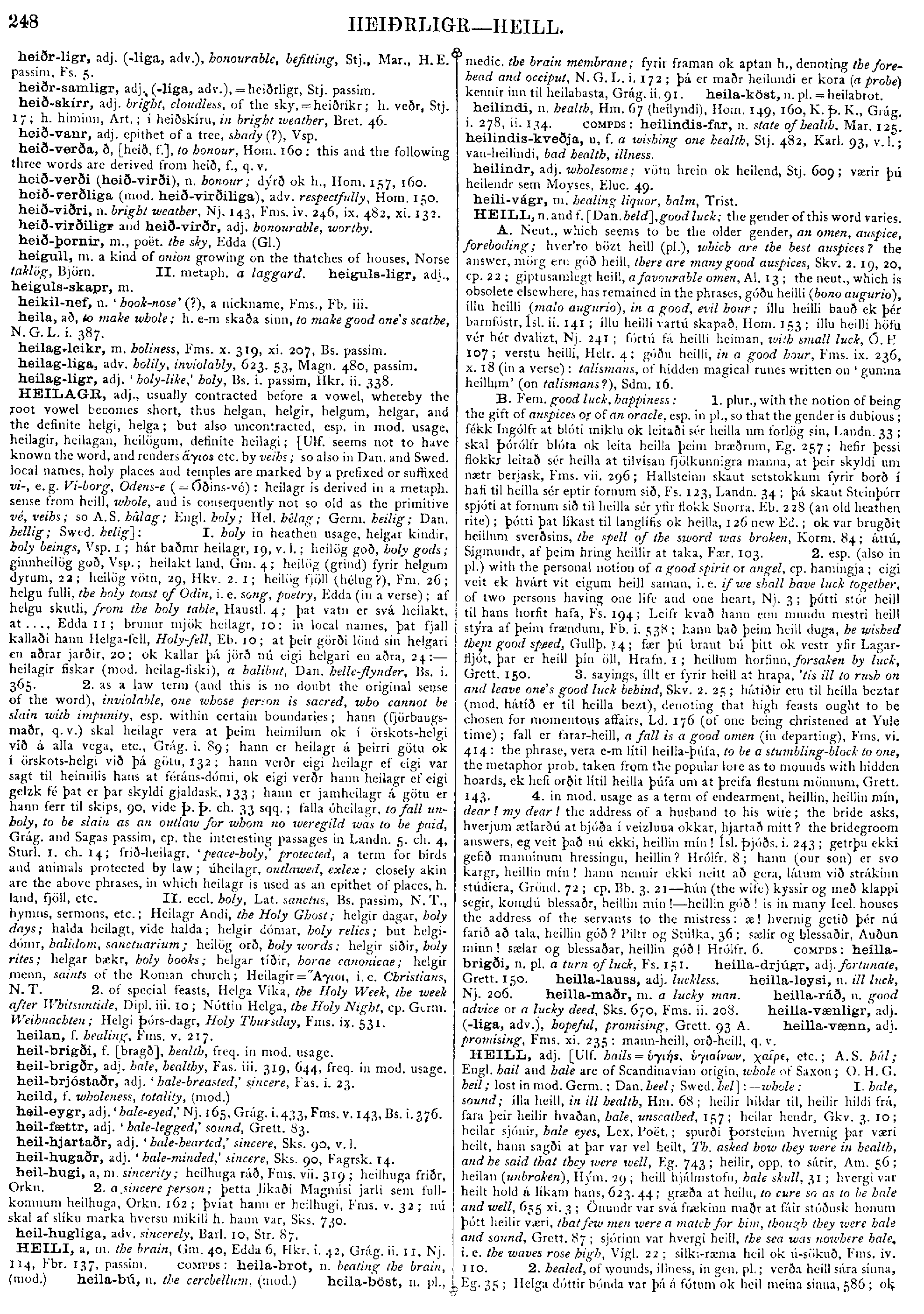
HEILAGR, adj., usually contracted before a vowel, whereby the root vowel becomes short, thus helgan, helgir, helgum, helgar, and the definite helgi, helga; but also uncontractcd, esp. in mod. usage, heilagir, heilagan, heilögum, definite heilagi; [Ulf. seems not to have known the word, and renders ayios etc. by veihs; so also in Dan. and Swed. local names, holy places and temples are marked by a prefixed or suffixed vi-, e. g. Vi-borg, Odens-e ( -- Öðins-vé): heilagr is derived in a metaph. sense from heill, whole, and is consequently not so old as the primitive ve, veihs; soA. S. hâlag; Engl. holy; Hel. belag; Germ, heilig; Dan. hellig; Swed. helig] : I. holy in heathen usage, helgar kindir, holy beings, Vsp. I; liar baðmr heilagr, 19, v. 1.; heilög goð, holy gods; ginnheilög goð, Vsp.; heilakt land, Gm. 4; heilög (grind) fyrir helgum dyrum, 22; heilög vötn, 29, Hkv. 2. i; heilög fjöll (hélugV), Fm. 26; helgu fulli, the holy toast of Odin, i. e. son^, poetry, Edda (in a verse); af helgu skutli, from the holy table, Haustl. 4; þat vatn er svá heilakt, at..., Edda II; brunnr mjök heilagr, 10: in local names, þat fjall kallaði hann Helga-fell, Holy-fell, Eb. 10; at þeir görði loud sin helgari en aðrar jarðir, 20; ok kallar þá jörð nú eigi helgari en aðra, 24 :-- heilagir fiskar (mod. heilag-fiski), a halibut, Dan. helle-jlynder, Bs. i. 365. 2. as a law term (and this is no doubt the original sense of the word), inviolable, onewhose person is sacred, who cannot be slain with impunity, esp. within certain boundaries; hann (fjorbaugs- maðr, q. v.) skal heilagr vera at þeirn heimilum ok í öiskots-helgi við á alla vega, etc., Grág. i. 89; hann er heilagr á þeirri götu ok í örskots-helgi við þá götu, 132; hann verðr eigi heilagr ef eigi var sagt til heiniilis hans at féráns-dómi, ok eigi verðr hann heilagr ef eigi gelzk fé þat er þar skyldi gjaldask, 133; hann er jamheilagr a götu er hann ferr til skips, 90, vide b. f). ch. 33 sqq.; falla óheilagr, to fall un- holy, to be slain as an outlaw for whom no weregild was to be paid, Grág. and Sagas passim, cp. the interesting passages in Landn. 5. ch. 4, Sturl. i. ch. 14; frið-heilagr, 'peace-holy, ' protected, a term for birds and animals protected by law; úheilagr, outlawed, exlex: closely akin are the above phrases, in which heilagr is used as an epithet of places, h. land, fjöll, etc. II. eccl. holy, Lat. sanctus, Bs. passim, N. T., hymns, sermons, etc.; Heilagr Audi, the Holy Ghost; helgir dagar, holy days; lialda lieilagt, vide halda; helgir domar, holy relics; but helgi- doinr, halidotn, sanctuarium; heilog orð, holy words; helgir siðir, holy rites; helgar bækr, holy books; helgar tíðir, h or ae canonicae; helgir menu, saints of the Roman church; Heilagir ="A7ioi, i. e. Christians, N. T. 2. of special feasts, Helga Vika, the Holy Week, the week after Whitsuntide, Dipl. iii. to; Nóttin Helga, the Holy Night, cp. Germ. Weihnachten; Helgi bórs-dagr, Holy Thursday, Fms. ix.
| Result Page: | 1 2 | Next |  |
Germanic Lexicon Project (main page)
This search system was written by
Sean Crist
Please consider
volunteering
to correct the data in these online dictionaries.
No rights reserved. Feel free to use these data in any way you please.