|
|

Tip: In the search results, you can click on any word or abbreviation for more information.
|
Source: Cleasby/Vigfusson, page b0082, entry 13 View original page image as: [TIFF] [PNG] [View previous entry] [View next entry] |
[Comment on this entry] [View comments] |
The following entry has been hand-corrected once. |
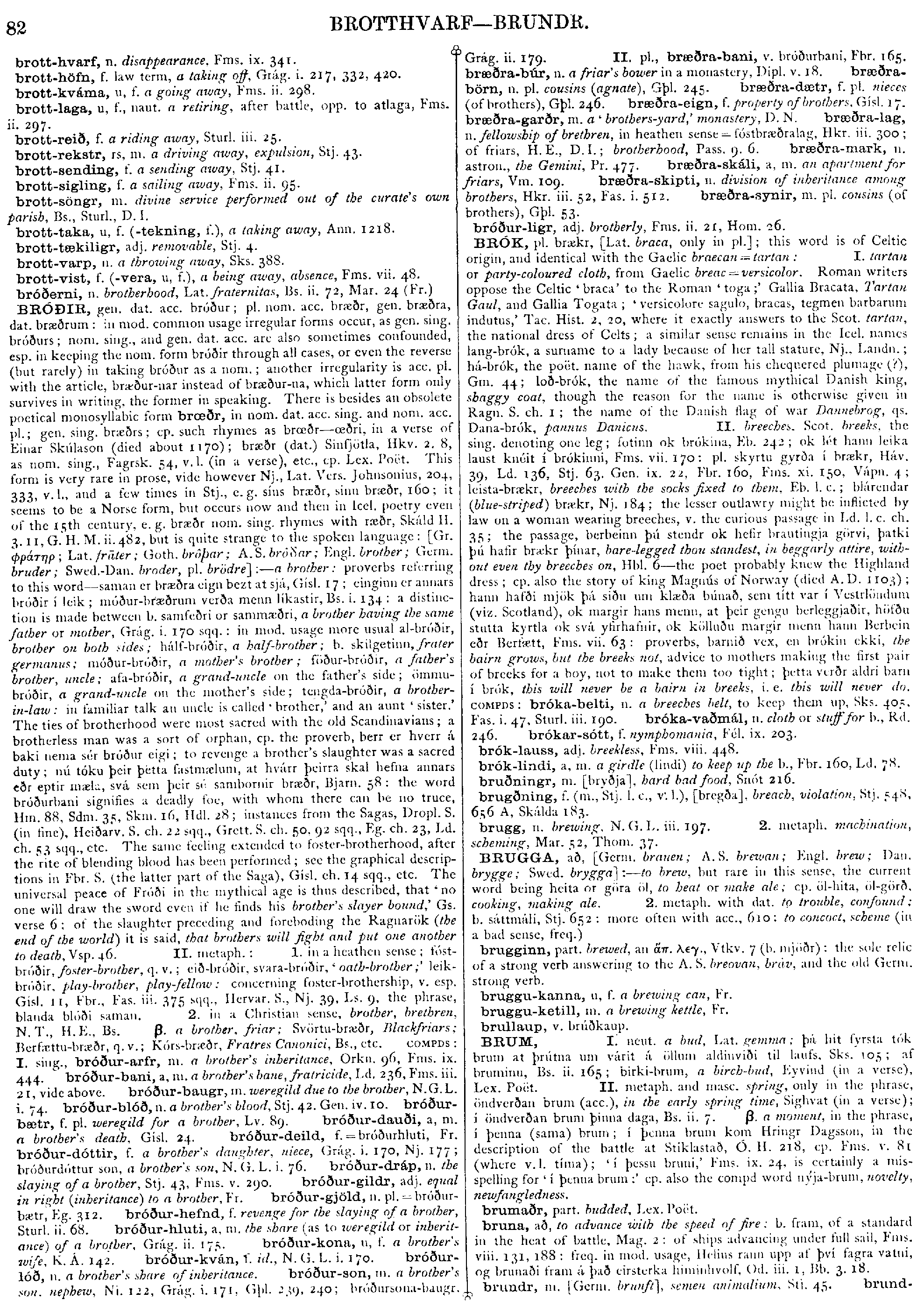
brott-vist, f. (-vera, u, f.), a being away, absence, Fms. vii. 48.
|
Source: Cleasby/Vigfusson, page b0082, entry 17 View original page image as: [TIFF] [PNG] [View previous entry] [View next entry] |
[Comment on this entry] [View comments] |
The following entry has been hand-corrected once. |
BRÓK, pl. brækr, [Lat. braca, only in pl.]; this word is of Celtic origin, and identical with the Gaelic braecan = tartan: I. tartan or party-coloured cloth, from Gaelic breac = versicolor. Roman writers oppose the Celtic 'braca' to the Roman 'toga;' Gallia Bracata, Tartan Gaul, and Gallia Togata; 'versicolore sagulo, bracas, tegmen barbarum indutus,' Tac. Hist. 2, 20, where it exactly answers to the Scot, tartan, the national dress of Celts; a similar sense remains in the Icel. names lang-brók, a surname to a lady because of her tall stature, Nj., Landn.; há-brók, the poët. name of the hawk, from his chequered plumage (?), Gm. 44; loð-brók, the name of the famous mythical Danish king, shaggy coat, though the reason for the name is otherwise given in Ragn. S. ch. I; the name of the Danish flag of war Dannebrog, qs. Dana-brók, pannus Danicus. II. breeches. Scot, breeks, the sing, denoting one leg; fótinn ok brókina, Eb. 242; ok let hann leika laust knæt í brókinni, Fms. vii. 170: pl. skyrtu gyrða í brækr, Háv. 39, Ld. 136, Stj. 63. Gen. ix. 22, Fbr. 160, Fms. xi. 150, Vápn. 4; leista-brækr, breeches with the socks fixed to them. Eb. 1. c.; blárendar (blue-striped) brækr, Nj. 184; the lesser outlawry might be inflicted by law on a woman wearing breeches, v. the curious passage in Ld. 1. c. ch. 35; the passage, berbeinn þú stendr ok hefir brautingja görvi, þatkiþú hafir brækr þínar, bare-legged thou standest, in beggarly attire, without even thy breeches on, Hbl. 6 -- the poet probably knew the Highland dress; cp. also the story of king Magnús of Norway (died A. D. 1103); hann hafði mjök þá siðu um klæða búnað, sem títt var í Vestrlöndum (viz. Scotland), ok margir hans menn, at þeir gengu berleggjaðir, höfðu stutta kyrtla ok svá yfirhafnir, ok kölluðu margir menn hann Berbein eðr Berfætt, Fms. vii. 63: proverbs, barnið vex, en brókin ekki, the bairn grows, but the breeks not, advice to mothers making the first pair of breeks for a boy, not to make them too tight; þetta verðr aldri barn í brók, this will never be a bairn in breeks, i. e. this will never do. COMPDS: bróka-belti, n. a breeches belt, to keep them up, Sks. 405. Fas. i. 47, Sturl. iii. 190. bróka-vaðmál, n. cloth or stuff for b., Rd. 246. brókar-sótt, f. nymphomania, Fél. ix.
|
Source: Cleasby/Vigfusson, page b0082, entry 35 View original page image as: [TIFF] [PNG] [View previous entry] [View next entry] |
[Comment on this entry] [View comments] |
The following entry has been hand-corrected once. |
brunn-migi, a, m. 'mingens in puteum,' a kind of hobgoblin who polluted the wells, Hálfs S. ch. 5. Fas. ii. 29, mentioned only here, and unknown to the present Icel. legends :-- name of the fox, Edda (Gl.); cp. the proverb, skömm hundum, skitu refar í brunn karls, shame on the hounds, the foxes defiled the carl's burn, Fms. vii. 21.
|
Source: Cleasby/Vigfusson, page b0084, entry 1 View original page image as: [TIFF] [PNG] [View previous entry] [View next entry] |
[Comment on this entry] [View comments] |
The following entry has been hand-corrected once. |
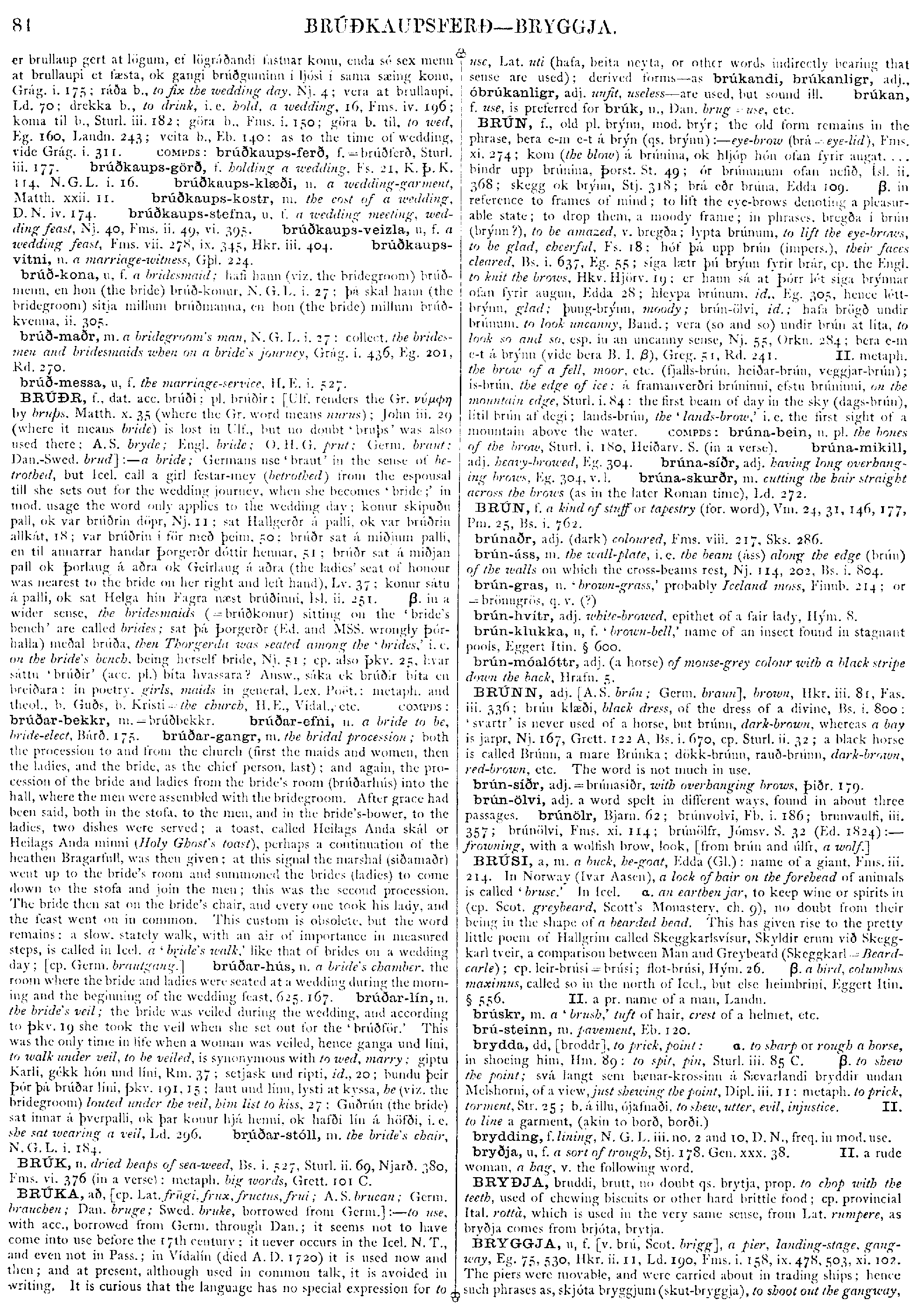
er brullaup gert at lögum, ef lögráðandi fastnar konu, enda sé sex menn at brullaupi et fæsta, ok gangi brúðguminn i ljósi í sama sæing konu, Grág. i. 175; ráða b., to fix the wedding day. Nj. 4; vera at brullaupi, Ld. 70; drekka b., to drink, i. e. hold, a wedding, 16, Fms. iv. 196; koma til b., Sturl. iii. 182; göra b., Fms. i. 150; göra b. til, to wed, Eg. 160, Landn. 243; veita b., Eb. 140: as to the time of wedding, vide Grág. i. 311. COMPDS: brúðkaups-ferð, f. = brúðferð, Sturl. iii. 177. brúðkaups-görð, f. holding a wedding, Fs. 21, K. Þ. K. 114, N. G. L. i. 16. brúðkaups-klæði, n. a wedding-garment, Matth. xxii. ii. brúðkaups-kostr, m. the cost of a wedding, D. N. iv. 174. brúðkaups-stefna, u, f. a wedding meeting, wedding feast, Nj. 40, Fms. ii. 49, vi. 395. brúðkaups-veizla, u, f. a wedding feast, Fms. vii. 278, ix. 345, Hkr. iii. 404. brúðkaups-vitni, n. a marriage-witness, Gþl. 224.
|
Source: Cleasby/Vigfusson, page b0084, entry 32 View original page image as: [TIFF] [PNG] [View previous entry] [View next entry] |
[Comment on this entry] [View comments] |
The following entry has been hand-corrected once. |
BRYNJA, u, f. [Ulf. brynio; A. S. burn; Hel. bry-nio; O. H. G. brunja; Swed. brynja; Dan. brynie] :-- a coat of mail, in olden times woven of rings (hringa-brynja, ring-mail), hence in poetry called hring-skyrta, a chain-mail sark or shirt, with epithets such as 'iron sewed, knit, woven,' and the like, Lex. Poët.: the breast-plate, spanga-brynja (Fms. vii. 264, viii. 95, 388), is of later date, viz. of the time of the Crusades and the following ages, vide Fms. i. 43, ii. 309, iv. 65, vi. 410, 411, vii. 45, 46, viii. 403, xi. 137, v. 1. etc. etc., Bs. i. 526, 528, 624. COMPDS: brynju-bítr, m. mail-biter, name of a sword, Sturl. brynju-bönd, n. pl. cords to fasten the b., Karl. brynju-hattr and -hetta = brynhattr. brynju-hálsbjörg, f. a hauberk, brynju-hringr, m. the ring of a coat of mail, Fas. i. 197. brynju-lauss, adj. without a coat of mail, uncovered, Sturl. ii. 146, Fms. vi. 416 (in a verse). brynju-meistari, a, m. a smith of a b., N. G. L. ii. 246. brynju-rokkr, m. a coat [Germ. rock] of mail, Karl.
|
Source: Cleasby/Vigfusson, page b0084, entry 43 View original page image as: [TIFF] [PNG] [View previous entry] [View next entry] |
[Comment on this entry] [View comments] |
The following entry has been hand-corrected once. |
brytja, að, [brjóta-brotinn; A. S. bryttjan = to deal out], to chop, esp. of butcher's meat, Ísl. ii. 337; svá brytju vér grísina, Sd. 163; b. búfé, Al. 80, Stj. 411. Judg. xiv. 6 (as he would have 'rent' a kid); b. niðr, to cut down, as a carcase, Fms. vii. 123; b. mat, to chop meat, viii. 221.
|
Source: Cleasby/Vigfusson, page b0084, entry 54 View original page image as: [TIFF] [PNG] [View previous entry] [View next entry] |
[Comment on this entry] [View comments] |
The following entry has been hand-corrected once. |
bræði, f. [bráðr], anger, ire, temper, Eluc. 41; í bræði, in a passion, Fms. vii. 130, Pass. 8. 14; með bræði, with ire, Stj. 153. brœði-mæli, n. pl. angry language, Sks. 25.
|
Source: Cleasby/Vigfusson, page b0084, entry 55 View original page image as: [TIFF] [PNG] [View previous entry] [View next entry] |
[Comment on this entry] [View comments] |
The following entry has been hand-corrected once. |
bræðrunga, u, f. [bróðir], a female first cousin, Grág. i. 346, Fms. vii. 274, Post. 656 A. ii. 15.
|
Source: Cleasby/Vigfusson, page b0084, entry 75 View original page image as: [TIFF] [PNG] [View previous entry] [View next entry] |
[Comment on this entry] [View comments] |
The following entry has been hand-corrected once. |
BUGR,
m.
pl.
ir,
a
bowing,
winding;
so
Icel.
call
the
bight
or
bend
of
a
river,
brook,
creek,
or
the
like;
renna
í
bugum,
to
fiow
in
bights,
hence
ár-bugr,
lækjar-bugr:
the
bight
(inside)
of
a
ring,
finger,
bow-string,
etc.;
í
bug
hringinum,
Eg.
306;
b.
fingranna,
Sturl.
i.
189;
grípa
í
bug
snærum,
poët,
to
grip
the
bight
of
the
bow-string,
Jd.
27:
the
scythe
has
þjó-bugr,
q.
v.:
the
concave
side
of
the
sails,
sá
af
landi
í
bug
allra
seglanna,
Fms.
vii.
94:
a
curve,
disorder,
of
a
line
of
men
or
ships
(in
battle),
rétta
þann
bug,
er
á
var
orðinn
flotanum,
i.
174;
hence
the
phrase,
aka
e-m
á
bug,
vide
aka;
vinda
(göra)
bráða-bug
að
e-u,
to
make
haste,
Grett.
98
A:
á
bug,
Scot.
abeigh
(aloof),
Úlf.
3.
27;
mein-bugir,
impediments.
 .
convexity;
b.
jarðar,
Rb.
468,
unusual
in
this
sense.
.
convexity;
b.
jarðar,
Rb.
468,
unusual
in
this
sense.
|
Source: Cleasby/Vigfusson, page b0084, entry 92 View original page image as: [TIFF] [PNG] [View previous entry] [View next entry] |
[Comment on this entry] [View comments] |
The following entry has been hand-corrected once. |
BURÐR,
ar,
m.
pl.
ir,
[Engl.
birth;
Hel.
giburd;
Germ.
geburt;
cp.
bera
A.
II]
:--
birth,
esp.
of
the
birth
of
Christ;
frá
Guðs,
Drottins,
Krists
burði,
Bs.
i.
112,
145,
158,
173;
frá
hingað-burði
Christi,
id.,
64,
75,
79,
85;
til
burðar
Christi,
Rb.
84:
of
men,
sótt
burðar
=
jóðsótt,
labours,
K.
Á.
104.
2.
of
domestic
animals,
calving,
lambing,
hence
sauð-burðr,
the
lambing-time;
þeim
kúm
er
bezt
búast
til
burðar,
Bs.
i.
194.
3.
birth,
the
thing
born,
an
embryo;
Fíllinn
gengr
tvö
ár
með
burðinum,
Stj.
70;
at
þær
(viz.
the
ewes)
skyldi
sinn
burð
geta,
178;
fæða
sinn
burð,
97;
með
konum
leysisk
burðr
(abort),
Bs.
i.
798.
4.
in
pl.
birth,
extraction;
heiðinn
at
burðum
(MS.
sing.),
heathen
by
birth,
Ver.
40;
burðir
ok
ætt,
kith
and
kin,
Fms.
i.
83;
er
ekki
er
til
Noregs
kominn
fyrir
burða
sakir,
ix.
389;
Hákon
jarl
hafði
burði
til
þess,
at
halda
foðurleifð
sinni,
ok
hafa
jarlsnafn,
i.
223;
þykkjumk
ek
hafa
til
þess
burði
ok
frænda
styrk,
Eg.
474;
hence
in
mod.
usage
burðir
means
one's
'physique,'
strength;
burðamaðr
mikill,
a
mighty
strong
man;
hafa
litla
burði,
to
have
little
strength;
yfir-burðir,
superior
strength
(cp.
bera
yfir),
and
afburðir,
q.v.
II.
the
bearing
of
limbs,
body;
lima-burðr,
fóta-burðr,
höfuð-burðr.
III.
[bera
C],
the
compds
at-burðr,
við-burðr,
til-burðr,
hop,
accident;
fyrir-burðr,
vision.
IV.
answering
to
bera
A.
I,
vide
byrðr,
and
compds
like
á-burðr.
.
saman-burðr,
comparison.
COMPDS:
burða-munr,
m.
distance
of
birth,
Fs.
125.
burðar-dagr,
m.
a
birthday,
Hom.
106;
b.
Maríu,
the
nativity
of
the
Virgin
Mary,
Rb.
8.
burðar-maðr,
m.
a
bearer,
Fms.
i.
271.
burðar-sveinn,
m.
an
errand-boy,
Fms.
vii.
222.
burðar-tími,
a,
m.
birth-time,
Stj.
97;
natal
hour,
101.
| Result Page: |  |
Previous | 65 66 67 68 69 70 71 72 73 74 75 76 77 78 79 80 81 82 83 | Next |  |
Germanic Lexicon Project (main page)
This search system was written by
Sean Crist
Please consider
volunteering
to correct the data in these online dictionaries.
No rights reserved. Feel free to use these data in any way you please.