|
|

|
Source: Cleasby/Vigfusson, page b0699, entry 19 View original page image as: [TIFF] [PNG] [View previous entry] [View next entry] |
[Comment on this entry] [View comments] |
The following entry has been hand-corrected once. |
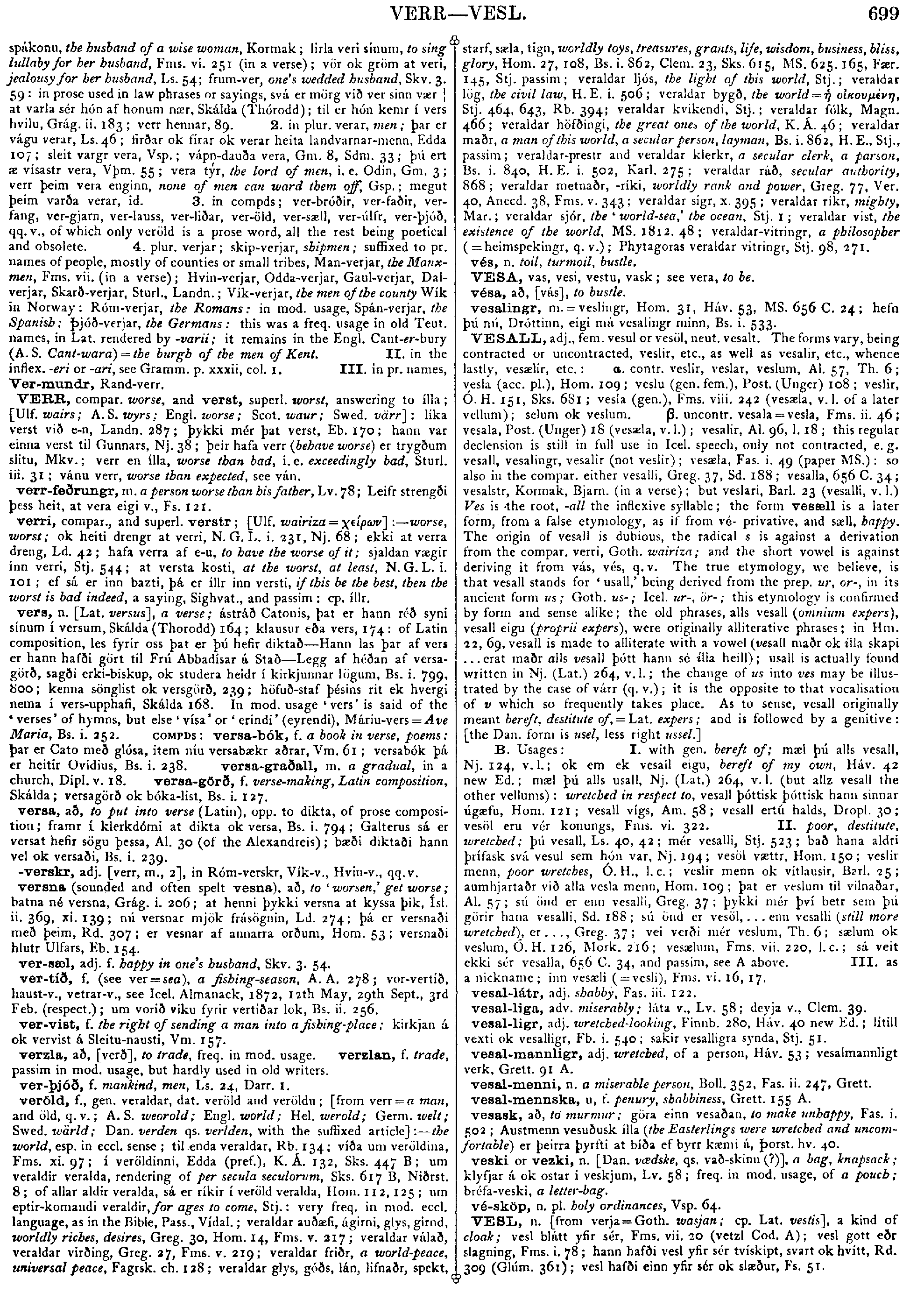
VESALL,
adj.,
fem.
vesul
or
vesöl,
neut.
vesalt.
The
forms
vary,
being
contracted
or
uncontracted,
veslir,
etc.,
as
well
as
vesalir,
etc.,
whence
lastly,
vesælir,
etc.:
 .
contr.
veslir,
veslar,
veslum,
Al.
57,
Th.
6;
vesla
(acc.
pl.),
Hom.
109;
veslu
(gen.
fem.),
Post.
(Unger)
108;
veslir,
Ó.H.
151,
Sks.
681;
vesla
(gen.),
Fms.
viii.
242
(vesæla,
v.l.
of
a
later
vellum);
selum
ok
veslum.
.
contr.
veslir,
veslar,
veslum,
Al.
57,
Th.
6;
vesla
(acc.
pl.),
Hom.
109;
veslu
(gen.
fem.),
Post.
(Unger)
108;
veslir,
Ó.H.
151,
Sks.
681;
vesla
(gen.),
Fms.
viii.
242
(vesæla,
v.l.
of
a
later
vellum);
selum
ok
veslum.
 .
uncontr.
vesala
=
vesla,
Fms.
ii.
46;
vesala,
Post.
(Unger)
18
(vesæla,
v.l.);
vesalir,
Al.
96,
l.
18;
this
regular
declension
is
still
in
full
use
in
Icel.
speech,
only
not
contracted,
e.g.
vesall,
vesalingr,
vesalir
(not
veslir);
vesæla,
Fas.
i.
49
(paper
MS.):
so
also
in
the
compar.
either
vesalli,
Greg.
37,
Sd.
188;
vesalla,
656
C.
34;
vesalstr,
Kormak,
Bjarn.
(in
a
verse);
but
veslari,
Barl.
23
(vesalli,
v.l.)
Ves
is
the
root,
-all
the
inflexive
syllable;
the
form
vesæll
is
a
later
form,
from
a
false
etymology,
as
if
from
vé-
privative,
and
sæll,
happy.
The
origin
of
vesall
is
dubious,
the
radical
s
is
against
a
derivation
from
the
compar.
verri,
Goth.
wairiza;
and
the
short
vowel
is
against
deriving
it
from
vás,
vés,
q.v.
The
true
etymology,
we
believe,
is
that
vesall
stands
for
'usall,'
being
derived
from
the
prep.
ur,
or-,
in
its
ancient
form
us;
Goth.
us-;
Icel.
ur-,
ör-;
this
etymology
is
confirmed
by
form
and
sense
alike;
the
old
phrases,
alls
vesall
(omnium
expers),
vesall
eigu
(proprii
expers),
were
originally
alliterative
phrases;
in
Hm.
22,
69,
vesall
is
made
to
alliterate
with
a
vowel
(vesall
maðr
ok
ílla
skapi
...
erat
maðr
alls
vesall
þótt
hann
sé
ílla
heill);
usall
is
actually
found
written
in
Nj.
(Lat.)
264,
v.l.;
the
change
of
us
into
ves
may
be
illustrated
by
the
case
of
várr
(q.v.);
it
is
the
opposite
to
that
vocalisation
of
v
which
so
frequently
takes
place.
As
to
sense,
vesall
originally
meant
bereft,
destitute
of,
=
Lat.
expers;
and
is
followed
by
a
genitive:
[the
Dan.
form
is
usel,
less
right
ussel.]
B.
Usages:
I.
with
gen.
bereft
of;
mæl
þú
alls
vesall,
Nj.
124,
v.l.;
ok
em
ek
vesall
eigu,
bereft
of
my
own,
Háv.
42
new
Ed.;
mæl
þú
alls
usall,
Nj.
(Lat.)
264,
v.l.
(but
allz
vesall
the
other
vellums):
wretched
in
respect
to,
vesall
þóttisk
þóttisk
hann
sinnar
úgæfu,
Hom.
121;
vesall
vígs,
Am.
58;
vesall
ertú
halds,
Dropl.
30;
vesöl
eru
vér
konungs,
Fms.
vi.
322.
II.
poor,
destitute,
wretched;
þú
vesall,
Ls.
40,
42;
mér
vesalli,
Stj.
523;
bað
hana
aldri
þrífask
svá
vesul
sem
hón
var,
Nj.
194;
vesöl
vættr,
Hom.
150;
veslir
menn,
poor
wretches,
Ó.H.,
l.c.;
veslir
menn
ok
vitlausir,
Barl.
25;
aumhjartaðr
við
alla
vesla
menn,
Hom.
109;
þat
er
veslum
til
vilnaðar,
Al.
57;
sú
önd
er
enn
vesalli,
Greg.
37;
þykki
mér
því
betr
sem
þú
görir
hana
vesalli,
Sd.
188;
sú
önd
er
vesöl,
...
enn
vesalli
(still
more
wretched),
er
...,
Greg.
37;
vei
verði
mér
veslum,
Th.
6;
sælum
ok
veslum,
Ó.H.
126,
Mork.
216;
vesælum,
Fms.
vii.
220,
l.c.;
sá
veit
ekki
sér
vesalla,
656
C.
34,
and
passim,
see
A
above.
III.
as
a
nickname;
inn
vesæli
(=
vesli),
Fms.
vi.
16,
17.
.
uncontr.
vesala
=
vesla,
Fms.
ii.
46;
vesala,
Post.
(Unger)
18
(vesæla,
v.l.);
vesalir,
Al.
96,
l.
18;
this
regular
declension
is
still
in
full
use
in
Icel.
speech,
only
not
contracted,
e.g.
vesall,
vesalingr,
vesalir
(not
veslir);
vesæla,
Fas.
i.
49
(paper
MS.):
so
also
in
the
compar.
either
vesalli,
Greg.
37,
Sd.
188;
vesalla,
656
C.
34;
vesalstr,
Kormak,
Bjarn.
(in
a
verse);
but
veslari,
Barl.
23
(vesalli,
v.l.)
Ves
is
the
root,
-all
the
inflexive
syllable;
the
form
vesæll
is
a
later
form,
from
a
false
etymology,
as
if
from
vé-
privative,
and
sæll,
happy.
The
origin
of
vesall
is
dubious,
the
radical
s
is
against
a
derivation
from
the
compar.
verri,
Goth.
wairiza;
and
the
short
vowel
is
against
deriving
it
from
vás,
vés,
q.v.
The
true
etymology,
we
believe,
is
that
vesall
stands
for
'usall,'
being
derived
from
the
prep.
ur,
or-,
in
its
ancient
form
us;
Goth.
us-;
Icel.
ur-,
ör-;
this
etymology
is
confirmed
by
form
and
sense
alike;
the
old
phrases,
alls
vesall
(omnium
expers),
vesall
eigu
(proprii
expers),
were
originally
alliterative
phrases;
in
Hm.
22,
69,
vesall
is
made
to
alliterate
with
a
vowel
(vesall
maðr
ok
ílla
skapi
...
erat
maðr
alls
vesall
þótt
hann
sé
ílla
heill);
usall
is
actually
found
written
in
Nj.
(Lat.)
264,
v.l.;
the
change
of
us
into
ves
may
be
illustrated
by
the
case
of
várr
(q.v.);
it
is
the
opposite
to
that
vocalisation
of
v
which
so
frequently
takes
place.
As
to
sense,
vesall
originally
meant
bereft,
destitute
of,
=
Lat.
expers;
and
is
followed
by
a
genitive:
[the
Dan.
form
is
usel,
less
right
ussel.]
B.
Usages:
I.
with
gen.
bereft
of;
mæl
þú
alls
vesall,
Nj.
124,
v.l.;
ok
em
ek
vesall
eigu,
bereft
of
my
own,
Háv.
42
new
Ed.;
mæl
þú
alls
usall,
Nj.
(Lat.)
264,
v.l.
(but
allz
vesall
the
other
vellums):
wretched
in
respect
to,
vesall
þóttisk
þóttisk
hann
sinnar
úgæfu,
Hom.
121;
vesall
vígs,
Am.
58;
vesall
ertú
halds,
Dropl.
30;
vesöl
eru
vér
konungs,
Fms.
vi.
322.
II.
poor,
destitute,
wretched;
þú
vesall,
Ls.
40,
42;
mér
vesalli,
Stj.
523;
bað
hana
aldri
þrífask
svá
vesul
sem
hón
var,
Nj.
194;
vesöl
vættr,
Hom.
150;
veslir
menn,
poor
wretches,
Ó.H.,
l.c.;
veslir
menn
ok
vitlausir,
Barl.
25;
aumhjartaðr
við
alla
vesla
menn,
Hom.
109;
þat
er
veslum
til
vilnaðar,
Al.
57;
sú
önd
er
enn
vesalli,
Greg.
37;
þykki
mér
því
betr
sem
þú
görir
hana
vesalli,
Sd.
188;
sú
önd
er
vesöl,
...
enn
vesalli
(still
more
wretched),
er
...,
Greg.
37;
vei
verði
mér
veslum,
Th.
6;
sælum
ok
veslum,
Ó.H.
126,
Mork.
216;
vesælum,
Fms.
vii.
220,
l.c.;
sá
veit
ekki
sér
vesalla,
656
C.
34,
and
passim,
see
A
above.
III.
as
a
nickname;
inn
vesæli
(=
vesli),
Fms.
vi.
16,
17.
Germanic Lexicon Project (main page)
This search system was written by
Sean Crist
Please consider
volunteering
to correct the data in these online dictionaries.
No rights reserved. Feel free to use these data in any way you please.