|
|

I noticed that your search contained the search word verb. You might be looking for materials on a specific language. If you can't find what you're looking for using this search system, I recommend that you click on the "Texts" link above and scroll down to the language you are looking for.
|
Source: Cleasby/Vigfusson, page b0082, entry 24 View original page image as: [TIFF] [PNG] [View previous entry] [View next entry] |
[Comment on this entry] [View comments] |
The following entry has been hand-corrected once. |
brugginn, part, brewed, an GREEK Vtkv. 7 (b. mjöðr): the sole relic of a strong verb answering to the A. S. breovan, bráv, and the old Germ. strong verb.
|
Source: Cleasby/Vigfusson, page b0084, entry 73 View original page image as: [TIFF] [PNG] [View previous entry] [View next entry] |
[Comment on this entry] [View comments] |
The following entry has been hand-corrected once. |
buga, að, to bow; in fishing for trout with nets people in Icel. say, buga fyrir, to draw the net round; but mostly used metaph. and in compds, vfir-buga, to bow down, subdue; 3rd pers. pret. reflex. bugusk, from an obsolete strong verb bjúga, baug, occurs in Eyvind, bugusk álmar, bows were bent, Fms. i. 49.
|
Source: Cleasby/Vigfusson, page b0084, entry 110 View original page image as: [TIFF] [PNG] [View previous entry] [View next entry] |
[Comment on this entry] [View comments] |
The following entry has been hand-corrected once. |
BÚA,
pret.
sing.
bjó,
2nd
pers.
bjótt,
mod.
bjóst;
plur.
bjoggu,
bjöggu,
and
mod.
bjuggu,
or
even
buggu;
sup.
búit,
búið,
and
(rarely)
contr.
búð;
part.
búinn;
pret.
subj.
bjöggi,
mod.
byggi
or
bjyggi;
pres.
sing,
indic.
bý;
pl.
búm,
mod.
búum:
reflex.
forms
býsk
or
býst,
bjósk
or
bjóst,
bjöggusk,
búisk,
etc.:
poët,
forms
with
suffixed
negative
bjó-at,
Skv.
3.
39:
an
obsolete
pret.
bjoggi
=
bjó,
Fms.
ix.
440
(in
a
verse);
bjöggisk
=
bjósk,
Hom.
118.
[Búa
is
originally
a
reduplicated
and
contracted
verb
answering
to
Goth.
búan,
of
which
the
pret.
may
have
been
baibau:
by
bûan
Ulf.
renders
Gr.
GREEK,
GREEK;
Hel.
bûan
=
habitare;
Germ.
bauen;
Swed.
and
Dan.
bo.
The
Icel.
distinguishes
between
the
strong
neut.
and
originally
redupl.
verb
búa,
and
the
transit.
and
weak
byggja,
q.v.:
búa
seems
to
be
kindred
to
Gr.
GREEK,
GREEK
(cp.
Sansk.
bhû,
bhavâmi,
Lat.
fui);
byggja
to
Lat.
f cio,
cp.
Swed.
-Dan.
bygga,
Scot,
and
North.
E.
to
'big,'
i.e.
to
build;
cp.
Lat.
aedificare,
nidificare:
again,
the
coincidence
in
sense
with
the
Gr.
GREEK,
GREEK,
Lat.
vicus,
is
no
less
striking,
cp.
the
references
s.v.
bú
above.
Búa,
as
a
root
word,
is
one
of
the
most
interesting
words
in
the
Scandin.
tongues;
bú,
bær,
bygg,
bygð,
byggja,
etc.,
all
belong
to
this
family:
it
survives
in
the
North.
E.
word
to
'big,'
in
the
Germ,
bauen
(to
till),
and
possibly
(v.
above)
in
the
auxiliary
verb
'to
be.']
cio,
cp.
Swed.
-Dan.
bygga,
Scot,
and
North.
E.
to
'big,'
i.e.
to
build;
cp.
Lat.
aedificare,
nidificare:
again,
the
coincidence
in
sense
with
the
Gr.
GREEK,
GREEK,
Lat.
vicus,
is
no
less
striking,
cp.
the
references
s.v.
bú
above.
Búa,
as
a
root
word,
is
one
of
the
most
interesting
words
in
the
Scandin.
tongues;
bú,
bær,
bygg,
bygð,
byggja,
etc.,
all
belong
to
this
family:
it
survives
in
the
North.
E.
word
to
'big,'
in
the
Germ,
bauen
(to
till),
and
possibly
(v.
above)
in
the
auxiliary
verb
'to
be.']
|
Source: Cleasby/Vigfusson, page b0087, entry 2 View original page image as: [TIFF] [PNG] [View previous entry] [View next entry] |
[Comment on this entry] [View comments] |
The following entry has been hand-corrected once. |
B.
ACTIVE,
to
make
ready:
the
sense
and
form
here
reminds
one
of
the
Gr.
GREEK:
[this
sense
is
much
used
in
Old
Engl.,
esp.
the
part.
bone,
boon,
or
boun,
ready,
('boun
to
go,'
Chaucer,
etc.);
in
later
Engl.
'boun'
was
corrupted
into
'bound,'
in
such
naut.
phrases
as
bound
for
a
port,
etc.:
from
this
part,
the
ballad
writers
formed
a
fresh
verb,
to
boun,
'busk
ye,
boun
ye;'
'busk'
is
a
remnant
of
the
old
reflex,
búask,
see
Dasent,
Burnt
Njal,
pref.
xvi.
note,
and
cp.
below
III.]
I.
to
make
ready,
'boun,'
for
a
journey;
b.
ferð,
för
sína;
and
as
a
naut.
term,
b.
skip,
to
make
ready
for
sea;
bjoggu
þeir
ferð
sína,
Fms.
ix.
453;
en
er
þeir
vóru
búnir,
Nj.
122;
ok
vóru
þá
mjök
brott
búnir,
they
were
'boun'
for
sea,
Fms.
vii.
101;
bjó
hann
skip
sitt,
Nj.
128;
en
skip
er
brotið,
svá
at
eigi
er
í
för
búanda
á
því
sumri,
i.e.
ship
unfit
to
go
to
sea,
Grág.
i.
92;
b.
sik
til
göngu,
to
be
'boun'
for
a
walk,
Ld.
46;
b.
sik
at
keyra,
to
make
one
ready
for
...,
Nj.
91.
 .
as
a
law
term,
b.
sök,
mál,
or
adding
til,
b.
til
sök,
mál
á
hendr
e-m,
to
take
out
a
summons
against
one,
begin
a
lawsuit;
b.
mál
í
dóm,
of
the
preliminaries
to
a
lawsuit,
hence
málatilbúningr,
in
numberless
cases
in
the
Grágás
and
Sagas.
.
as
a
law
term,
b.
sök,
mál,
or
adding
til,
b.
til
sök,
mál
á
hendr
e-m,
to
take
out
a
summons
against
one,
begin
a
lawsuit;
b.
mál
í
dóm,
of
the
preliminaries
to
a
lawsuit,
hence
málatilbúningr,
in
numberless
cases
in
the
Grágás
and
Sagas.
 .
generally
to
prepare,
make;
b.
smyrsl,
to
make
ointments,
Rb.
82.
2.
=
Old
Engl.
to
boun,
i.e.
to
dress,
equip;
b.
sik,
to
dress;
svá
búinn,
so
dressed,
Fms.
xi.
272;
hence
búningr,
dress
(freq.);
vel
búinn,
well-dressed,
Nj.
3,
Ísl.
ii.
434;
spari-búinn,
in
holiday
dress;
illa
búinn,
ill-dressed;
síðan
bjó
hon
hana
sem
hon
kunni,
she
dressed
her
as
well
as
she
could,
Finnb.
258;
b.
beð,
rekkjur,
to
make
a
bed,
Eg.
236;
b.
upp
hvílur,
id.,
Nj.
168;
b.
öndvegi,
hús,
to
make
a
high
seat,
dress
a
house
for
a
feast,
175,
(hús-búnaðr,
hús-búningr,
tapestry);
búa
borð,
to
dress
the
table,
(borð
búnaðr,
table-service);
b.
stofu,
Fms.
iv.
75.
.
búa
til
veizlu,
to
make
'boun'
(prepare)
for
a
feast,
Eg.
38,
Fms.
vii.
307;
b.
til
seyðis,
to
make
the
fire
'boun'
for
cooking,
Nj.
199;
b.
til
vetrsetu,
to
make
'boun'
for
a
winter
abode,
Fms.
x.
42;
til-búa,
and
fyrir-b.,
to
prepare;
eg
fer
héðan
að
til-b.
yðr
stað,
John
xiv.
3;
eignizt
það
ríki
sem
yðr
var
til-búið
frá
upphafi
veraldar,
Matth.
xxv.
34.
.
b.
um
e-t,
in
mod.
use
with
the
notion
of
packing
up,
to
make
into
a
bundle,
of
parcels,
letters,
etc.;
hence
um-búningr
and
um-búðir,
a
packing,
packing-cover;
b.
um
rúm,
hvílu,
to
make
a
bed;
búa
um
e-n,
to
make
one's
bed;
var
búið
um
þá
Þórodd
í
seti,
ok
lögðusk
þeir
til
svefns,
Th.'s
bed
was
made
on
the
benches,
and
they
went
to
sleep,
Ó.
H.
153;
skaltú
nú
sjá
hvar
vit
leggumk
niðr,
ok
hversu
ek
bý
um
okkr
(of
the
dying
Njal),
Nj.
701;
er
mér
sagt
at
hann
hafi
illa
um
búit,
of
a
dead
body,
51;
þeir
höfðu
(svá)
um
sik
búit
(they
had
covered
themselves
so)
at
þá
mátti
eigi
sjá,
261;
kváðu
nú
Guðrúnu
eiga
at
búa
um
rauða
skör
Bolla,
said
that
G.
would
have
to
comb
B.'s
(her
husband's)
bloody
head,
Ld.
244;
búa
svá
um
at
aldri
mátti
vökna,
pack
it
up
so
that
it
cannot
get
wet,
Fms.
vii.
225;
Þórólfr
lét
setja
upp
skip
ok
um
búa,
he
had
the
ship
laid
up
and
fenced
it
round
(for
the
winter),
Eg.
199;
b.
um
andvirki,
to
fence
and
thatch
bay-ricks,
Grág.
ii.
335:
metaph.
to
manage,
preserve
a
thing,
Fms.
ix.
52;
aumlega
búinn,
in
a
piteous
state,
Hom.
115.
3.
to
ornament,
esp.
with
metals
or
artificial
work
of
any
kind,
of
clothes
laced
with
gold;
kyrtill
hlaðbúinn,
Ísl.
ii.
434,
Nj.
48,
Vm.
129:
of
gloves,
B.
K.
84:
of
a
belt
with
stones
or
artificial
work,
Fms.
xi.
271:
of
a
drinking-horn,
D.
N.
(Fr.);
but
esp.
of
a
weapon,
sword,
or
the
like,
enamelled
with
gold
or
silver
(gull-búinn,
silfr-búinn);
búin
gulli
ok
silfri,
Fms.
i.
15;
búinn
knífr,
xi.
271;
vápn
búit
mjök,
much
ornamented,
ii.
255,
iv.
77,
130,
Eb.
226,
228.
.
part.,
búinn
at
e-u,
or
vel
búinn,
metaph.
endowed
with,
well
endowed;
at
flestum
í
þróttum
vel
búinn,
Nj.
61,
Fms.
x.
295;
at
auð
vel
búinn,
wealthy,
410;
vel
búinn
at
hreysti
ok
allri
atgörvi,
Eg.
82;
bezt
at
viti
búinn,
Fms.
xi.
51.
II.
particular
use
of
the
part.
pass,
'boun,'
ready,
willing;
margir
munu
búnir
at
kaupa,
ready,
willing
to
buy,
Fms.
vi.
218;
hann
kvaðsk
þess
fyrir
löngu
búinn,
Ld.
66,
Fms.
iii.
123;
nefna
vátta
at
þeir
eru
búnir
(ready)
at
leysa
kvið
þann
af
hendi,
Grág.
i.
54;
vóru
allir
til
þess
búnir,
Fms.
xi.
360:
compar.,
engir
menn
sýna
sik
búnari
(more
willing)
til
liðveizlu,
Sturl.
i.
103:
the
allit.
phrase,
vera
boðinn
og
búinn
til
e-s,
vide
bjóða
VI:
denoting
fitted,
adapted,
ek
em
gamall,
ok
lítt
b.
at
(little
fit
to)
hefna
sona
minna,
Nj.
200;
þótt
ek
sé
verr
til
b.
en
hann
fyrir
vanheilsu
sakir,
Fms.
vii.
275;
eiga
við
búið
(mod.
vera
við
búinn),
to
keep
oneself
ready,
to
be
on
one's
guard,
Bs.
i.
537.
2.
on
the
point
of
doing,
about
to
do
so
and
so;
hann
var
búinn
til
falls,
he
was
just
about
to
tumble,
Fms.
x.
314;
en
áðr
þeir
kómu
var
búið
til
hins
mesta
váða,
ix.
444,
v.l.
.
neut.
búið
is
used
almost
adverbially,
on
the
point
of,
just
about
to;
ok
búið
við
skipbroti,
Ísl.
ii.
245;
búið
við
váða
miklum,
Fms.
ix.
310;
sagði
at
þá
var
búit
við
geig
mikinn
með
þeim
feðgum,
Eg.
158:
this
is
rare
and
obsolete
in
mod.
usage;
and
the
Icel.
now
say,
liggja
við
mér
lá
við
að
detta,
where
an
old
writer
would
have
said,
ek
var
búinn
at
detta;
the
sense
would
else
be
ambiguous,
as
búinn,
vera
búinn,
in
mod.
usage
means
to
have
done;
ég
er
búinn
að
eta,
I
have
done
eating;
vera
búinn
að
e-u
(a
work,
business
of
any
kind),
to
have
done
with
it;
also
absol.,
eg
er
búinn,
I
have
done;
thus
e.g.
vera
b.
að
kaupa,
fyrir
löngu
b.,
b.
at
græða,
leysa,
etc.,
in
mod.
sense
means
to
have
done,
done
long
ago;
only
by
adding
prepp.
við,
til
(vera
við
búinn,
til
búinn)
the
part.
resumes
its
old
sense:
on
the
other
hand,
búinn
in
the
sense
of
having
done
hardly
ever
occurs
in
old
writers.
.
búð
(búið)
is
even
used
adverbially
=
may
be,
may
happen;
with
subj.
with
or
without
'at,'
búð,
svá
sé
til
ætlað,
may
be,
it
will
come
so
to
happen,
Nj.
114;
búð,
dragi
til
þess
sem
vera
vill,
185;
búð,
eigi
fari
fjarri
því
sem
þú
gazt
til,
id.,
Ed.
Johns.
508,
note
c;
búð,
svá
þykki
sem
ek
grípa
gulli
við
þá,
9,
note
3;
búð,
eigi
hendi
hann
slík
úgipta
annat
sinn,
42;
búð,
ek
láta
annars
víti
at
varnaði
verða,
106;
búð,
vér
þurfim
enn
hlífanna,
Sturl.
ii.
137
(vellum
MSS.;
um
ríð,
Ed.,
quite
without
sense),
cp.
also
Eb.
27
new
Ed.:
in
mod.
usage
it
is
freq.
to
say,
það
er
búið,
vel
búið,
albúið,
etc.,
it
is
likely,
most
likely
that
...
.
generally
to
prepare,
make;
b.
smyrsl,
to
make
ointments,
Rb.
82.
2.
=
Old
Engl.
to
boun,
i.e.
to
dress,
equip;
b.
sik,
to
dress;
svá
búinn,
so
dressed,
Fms.
xi.
272;
hence
búningr,
dress
(freq.);
vel
búinn,
well-dressed,
Nj.
3,
Ísl.
ii.
434;
spari-búinn,
in
holiday
dress;
illa
búinn,
ill-dressed;
síðan
bjó
hon
hana
sem
hon
kunni,
she
dressed
her
as
well
as
she
could,
Finnb.
258;
b.
beð,
rekkjur,
to
make
a
bed,
Eg.
236;
b.
upp
hvílur,
id.,
Nj.
168;
b.
öndvegi,
hús,
to
make
a
high
seat,
dress
a
house
for
a
feast,
175,
(hús-búnaðr,
hús-búningr,
tapestry);
búa
borð,
to
dress
the
table,
(borð
búnaðr,
table-service);
b.
stofu,
Fms.
iv.
75.
.
búa
til
veizlu,
to
make
'boun'
(prepare)
for
a
feast,
Eg.
38,
Fms.
vii.
307;
b.
til
seyðis,
to
make
the
fire
'boun'
for
cooking,
Nj.
199;
b.
til
vetrsetu,
to
make
'boun'
for
a
winter
abode,
Fms.
x.
42;
til-búa,
and
fyrir-b.,
to
prepare;
eg
fer
héðan
að
til-b.
yðr
stað,
John
xiv.
3;
eignizt
það
ríki
sem
yðr
var
til-búið
frá
upphafi
veraldar,
Matth.
xxv.
34.
.
b.
um
e-t,
in
mod.
use
with
the
notion
of
packing
up,
to
make
into
a
bundle,
of
parcels,
letters,
etc.;
hence
um-búningr
and
um-búðir,
a
packing,
packing-cover;
b.
um
rúm,
hvílu,
to
make
a
bed;
búa
um
e-n,
to
make
one's
bed;
var
búið
um
þá
Þórodd
í
seti,
ok
lögðusk
þeir
til
svefns,
Th.'s
bed
was
made
on
the
benches,
and
they
went
to
sleep,
Ó.
H.
153;
skaltú
nú
sjá
hvar
vit
leggumk
niðr,
ok
hversu
ek
bý
um
okkr
(of
the
dying
Njal),
Nj.
701;
er
mér
sagt
at
hann
hafi
illa
um
búit,
of
a
dead
body,
51;
þeir
höfðu
(svá)
um
sik
búit
(they
had
covered
themselves
so)
at
þá
mátti
eigi
sjá,
261;
kváðu
nú
Guðrúnu
eiga
at
búa
um
rauða
skör
Bolla,
said
that
G.
would
have
to
comb
B.'s
(her
husband's)
bloody
head,
Ld.
244;
búa
svá
um
at
aldri
mátti
vökna,
pack
it
up
so
that
it
cannot
get
wet,
Fms.
vii.
225;
Þórólfr
lét
setja
upp
skip
ok
um
búa,
he
had
the
ship
laid
up
and
fenced
it
round
(for
the
winter),
Eg.
199;
b.
um
andvirki,
to
fence
and
thatch
bay-ricks,
Grág.
ii.
335:
metaph.
to
manage,
preserve
a
thing,
Fms.
ix.
52;
aumlega
búinn,
in
a
piteous
state,
Hom.
115.
3.
to
ornament,
esp.
with
metals
or
artificial
work
of
any
kind,
of
clothes
laced
with
gold;
kyrtill
hlaðbúinn,
Ísl.
ii.
434,
Nj.
48,
Vm.
129:
of
gloves,
B.
K.
84:
of
a
belt
with
stones
or
artificial
work,
Fms.
xi.
271:
of
a
drinking-horn,
D.
N.
(Fr.);
but
esp.
of
a
weapon,
sword,
or
the
like,
enamelled
with
gold
or
silver
(gull-búinn,
silfr-búinn);
búin
gulli
ok
silfri,
Fms.
i.
15;
búinn
knífr,
xi.
271;
vápn
búit
mjök,
much
ornamented,
ii.
255,
iv.
77,
130,
Eb.
226,
228.
.
part.,
búinn
at
e-u,
or
vel
búinn,
metaph.
endowed
with,
well
endowed;
at
flestum
í
þróttum
vel
búinn,
Nj.
61,
Fms.
x.
295;
at
auð
vel
búinn,
wealthy,
410;
vel
búinn
at
hreysti
ok
allri
atgörvi,
Eg.
82;
bezt
at
viti
búinn,
Fms.
xi.
51.
II.
particular
use
of
the
part.
pass,
'boun,'
ready,
willing;
margir
munu
búnir
at
kaupa,
ready,
willing
to
buy,
Fms.
vi.
218;
hann
kvaðsk
þess
fyrir
löngu
búinn,
Ld.
66,
Fms.
iii.
123;
nefna
vátta
at
þeir
eru
búnir
(ready)
at
leysa
kvið
þann
af
hendi,
Grág.
i.
54;
vóru
allir
til
þess
búnir,
Fms.
xi.
360:
compar.,
engir
menn
sýna
sik
búnari
(more
willing)
til
liðveizlu,
Sturl.
i.
103:
the
allit.
phrase,
vera
boðinn
og
búinn
til
e-s,
vide
bjóða
VI:
denoting
fitted,
adapted,
ek
em
gamall,
ok
lítt
b.
at
(little
fit
to)
hefna
sona
minna,
Nj.
200;
þótt
ek
sé
verr
til
b.
en
hann
fyrir
vanheilsu
sakir,
Fms.
vii.
275;
eiga
við
búið
(mod.
vera
við
búinn),
to
keep
oneself
ready,
to
be
on
one's
guard,
Bs.
i.
537.
2.
on
the
point
of
doing,
about
to
do
so
and
so;
hann
var
búinn
til
falls,
he
was
just
about
to
tumble,
Fms.
x.
314;
en
áðr
þeir
kómu
var
búið
til
hins
mesta
váða,
ix.
444,
v.l.
.
neut.
búið
is
used
almost
adverbially,
on
the
point
of,
just
about
to;
ok
búið
við
skipbroti,
Ísl.
ii.
245;
búið
við
váða
miklum,
Fms.
ix.
310;
sagði
at
þá
var
búit
við
geig
mikinn
með
þeim
feðgum,
Eg.
158:
this
is
rare
and
obsolete
in
mod.
usage;
and
the
Icel.
now
say,
liggja
við
mér
lá
við
að
detta,
where
an
old
writer
would
have
said,
ek
var
búinn
at
detta;
the
sense
would
else
be
ambiguous,
as
búinn,
vera
búinn,
in
mod.
usage
means
to
have
done;
ég
er
búinn
að
eta,
I
have
done
eating;
vera
búinn
að
e-u
(a
work,
business
of
any
kind),
to
have
done
with
it;
also
absol.,
eg
er
búinn,
I
have
done;
thus
e.g.
vera
b.
að
kaupa,
fyrir
löngu
b.,
b.
at
græða,
leysa,
etc.,
in
mod.
sense
means
to
have
done,
done
long
ago;
only
by
adding
prepp.
við,
til
(vera
við
búinn,
til
búinn)
the
part.
resumes
its
old
sense:
on
the
other
hand,
búinn
in
the
sense
of
having
done
hardly
ever
occurs
in
old
writers.
.
búð
(búið)
is
even
used
adverbially
=
may
be,
may
happen;
with
subj.
with
or
without
'at,'
búð,
svá
sé
til
ætlað,
may
be,
it
will
come
so
to
happen,
Nj.
114;
búð,
dragi
til
þess
sem
vera
vill,
185;
búð,
eigi
fari
fjarri
því
sem
þú
gazt
til,
id.,
Ed.
Johns.
508,
note
c;
búð,
svá
þykki
sem
ek
grípa
gulli
við
þá,
9,
note
3;
búð,
eigi
hendi
hann
slík
úgipta
annat
sinn,
42;
búð,
ek
láta
annars
víti
at
varnaði
verða,
106;
búð,
vér
þurfim
enn
hlífanna,
Sturl.
ii.
137
(vellum
MSS.;
um
ríð,
Ed.,
quite
without
sense),
cp.
also
Eb.
27
new
Ed.:
in
mod.
usage
it
is
freq.
to
say,
það
er
búið,
vel
búið,
albúið,
etc.,
it
is
likely,
most
likely
that
...
 .
svá
búit,
adverbially,
and
proncd.
as
if
one
word,
as
matters
stand,
or
even
temp.
at
present,
as
yet;
eigi
mun
hlýða
svá
búit,
i.e.
it
will
not
do
'so
done,'
i.e.
something
else
must
be
done,
Eg.
507;
eigi
munu
þér
fá
at
unnit
svá
búið,
i.e.
not
as
yet,
Fms.
vii.
270;
stendr
þar
nú
svá
búit
(i.e.
unchanged),
um
hríð,
xi.
81;
en
berjask
eigi
svo
búit,
not
fight
as
yet,
Nj.
229;
segja
Eyjólfi
til
svá
búins,
they
tell
Eyolf
the
state
of
things,
viz.
that
nothing
had
been
done,
Gísl.
41;
þeir
skildu
við
svá
búit;
þeir
lögðu
frá
við
svá
búið,
implying
'vain
effort,'
Germ.
'unverrichteter
Sache,'
.
svá
búit,
adverbially,
and
proncd.
as
if
one
word,
as
matters
stand,
or
even
temp.
at
present,
as
yet;
eigi
mun
hlýða
svá
búit,
i.e.
it
will
not
do
'so
done,'
i.e.
something
else
must
be
done,
Eg.
507;
eigi
munu
þér
fá
at
unnit
svá
búið,
i.e.
not
as
yet,
Fms.
vii.
270;
stendr
þar
nú
svá
búit
(i.e.
unchanged),
um
hríð,
xi.
81;
en
berjask
eigi
svo
búit,
not
fight
as
yet,
Nj.
229;
segja
Eyjólfi
til
svá
búins,
they
tell
Eyolf
the
state
of
things,
viz.
that
nothing
had
been
done,
Gísl.
41;
þeir
skildu
við
svá
búit;
þeir
lögðu
frá
við
svá
búið,
implying
'vain
effort,'
Germ.
'unverrichteter
Sache,'
|
Source: Cleasby/Vigfusson, page b0088, entry 1 View original page image as: [TIFF] [PNG] [View previous entry] [View next entry] |
[Comment on this entry] [View comments] |
The following entry has been hand-corrected once. |
Ísl.
ii,
Hkr.
i.
340:
at
svá
búnu,
adverbially,
as
yet,
at
present;
hann
kvaðsk
eigi
fýsask
til
Íslands
at
svá
búnu,
Nj.
123,
Fms.
xi.
131;
þenna
draum
segjum
vér
engum
manni
at
svá
búnu,
this
dream
we
will
not
tell
to
anybody
as
yet,
Nj.
212;
en
at
svá
búnu
tjár
ekki,
Fas.
i.
364.
III.
reflex.
to
'boun'
or
'busk'
oneself,
make
oneself
ready,
equip
oneself;
gengu
menu
þá
á
skip
sín,
ok
bjoggusk
sem
hvatligast,
Fms.
v.
15:
adding
the
infinitive
of
a
verb
as
predicate,
bjósk
hann
at
fara
norðr
til
Þrandheims,
Eg.
18;
or
ellipt.,
where
búask
thus
denotes
the
act
itself,
nú
býsk
hann
út
til
Íslands,
i.e.
he
'busked'
him
to
go
...,
Nj.
10;
bjoggusk
þeir
fóstbræðr
í
hernað,
they
went
on
a
free-booting
trip,
Landn.
31;
seg
Agli
at
þeir
búisk
þaðan
fimmtán,
94:
or
adding
another
verb
denoting
the
act,
in
the
same
tense,
bjósk
Haraldr
konungr
úr
Þrándheimi
með
skipaliði,
ok
fór
suðr
á
Mæri,
he
'busked'
him
...
and
went
south,
Eg.
7;
the
journey
added
in
gen.,
búask
ferðar
sinnar,
Fms.
i.
3;
búask
menu
ferða
sinna,
Ld.
177.
.
denoting
intention,
hidden
or
not
put
into
action;
fór
sá
kurr,
at
Skúli
byggisk
á
land
upp,
Fms.
ix.
483.
2.
to
prepare
for
a
thing;
búask
við
boði,
veizlu,
etc.,
Nj.
10,
Korm.
10;
b.
(vel,
kristilega)
við
dauða
sínum,
andláti
sínu,
(eccl.)
to
prepare
for
one's
death,
Fs.
80,
Bs.
i.
74;
búask
við
vetri,
to
provide
for
the
winter,
get
store
in,
Fms.
xi.
415;
b.
við
úfriði,
vii.
23.
.
to
be
on
one's
guard,
take
steps
to
prevent
a
thing;
nú
ríða
hér
úvinir
þínir
at
þér;
skaltu
svá
við
búask,
i.e.
be
sure
of
that,
make
up
thy
mind,
Nj.
264;
bústu
svá
við,
skal
hann
kveða,
at
...,
Grág.
ii.
244.
.
such
phrases
as,
búask
um
=
búa
um
sik,
to
make
one's
own
bed,
encamp,
make
oneself
comfortable,
Nj.
259;
tjölduðu
búðir
ok
bjöggusk
vel
um,
219;
var
hörð
veðrátta,
svá
at
ekki
mátti
úti
um
búask,
Fms.
x.
13.
Ld.
348;
in
the
last
passage
the
verb
is
deponent.
3.
metaph.,
b.
við
e-u,
to
expect,
freq.
in
mod.
usage;
in
phrases,
það
er
ekki
við
að
búast,
it
cannot
be
expected;
búast
við
e-m,
to
expect
a
guest,
or
the
like.
.
to
intend,
think
about;
eg
býst
við
að
koma,
I
hope
to
come;
eg
bjóst
aldrei
við
því,
I
never
hoped
for
that,
it
never
entered
my
mind,
and
in
numberless
cases.
4.
passive
(very
rare
and
not
classical);
um
kveldit
er
matr
bjósk
=
er
m.
var
búinn,
Fms.
ix.
364.
|
Source: Cleasby/Vigfusson, page b0091, entry 15 View original page image as: [TIFF] [PNG] [View previous entry] [View next entry] |
[Comment on this entry] [View comments] |
The following entry has been hand-corrected once. |
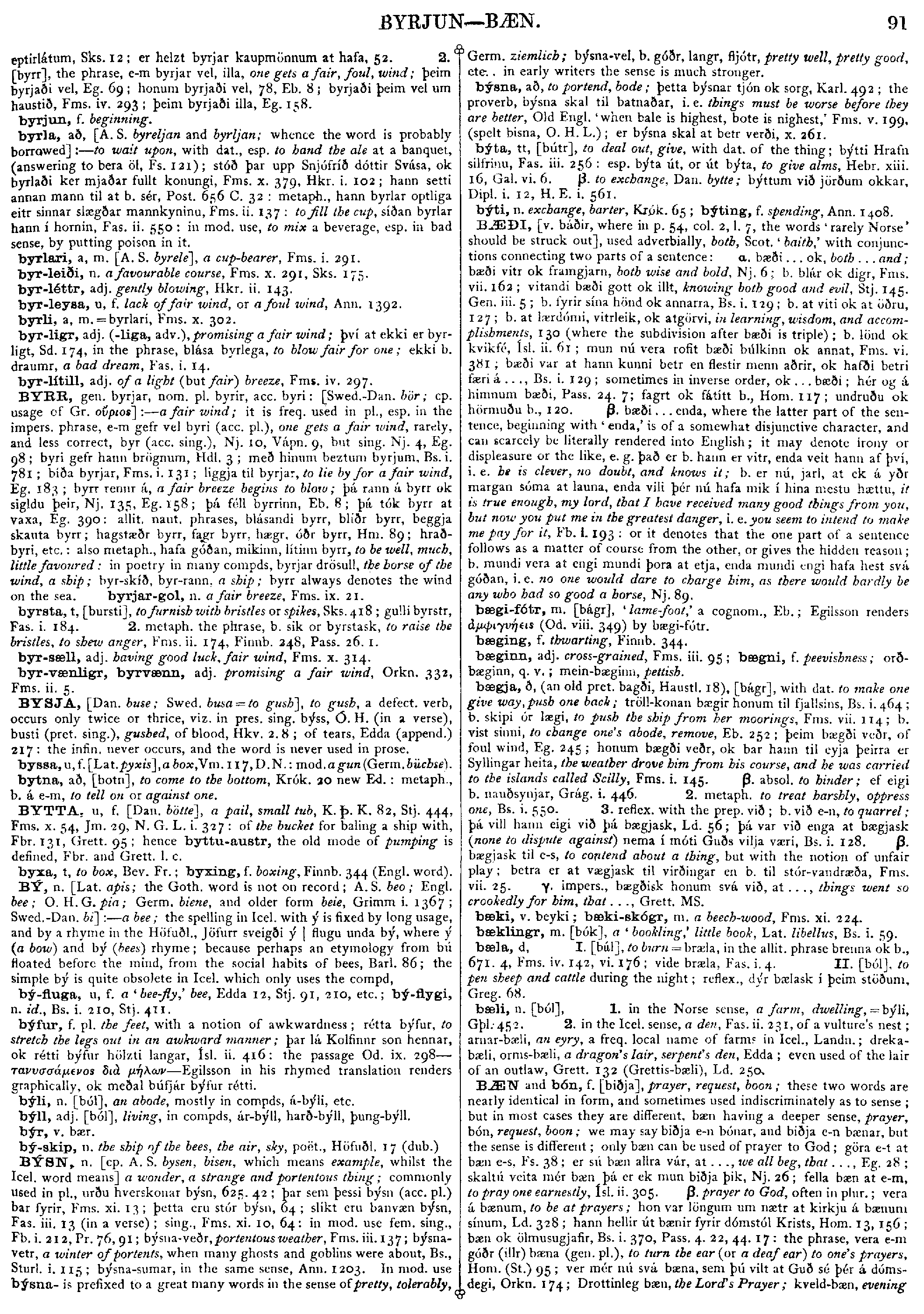
BYSJA, [Dan. buse; Swed. busa = to gush], to gush, a defect, verb, occurs only twice or thrice, viz. in pres. sing, býss, Ó. H. (in a verse), busti (pret. sing.), gushed, of blood, Hkv. 2.8; of tears, Edda (append.) 217: the infin. never occurs, and the word is never used in prose.
|
Source: Cleasby/Vigfusson, page b0093, entry 6 View original page image as: [TIFF] [PNG] [View previous entry] [View next entry] |
[Comment on this entry] [View comments (1)] |
The following entry has been hand-corrected once. |
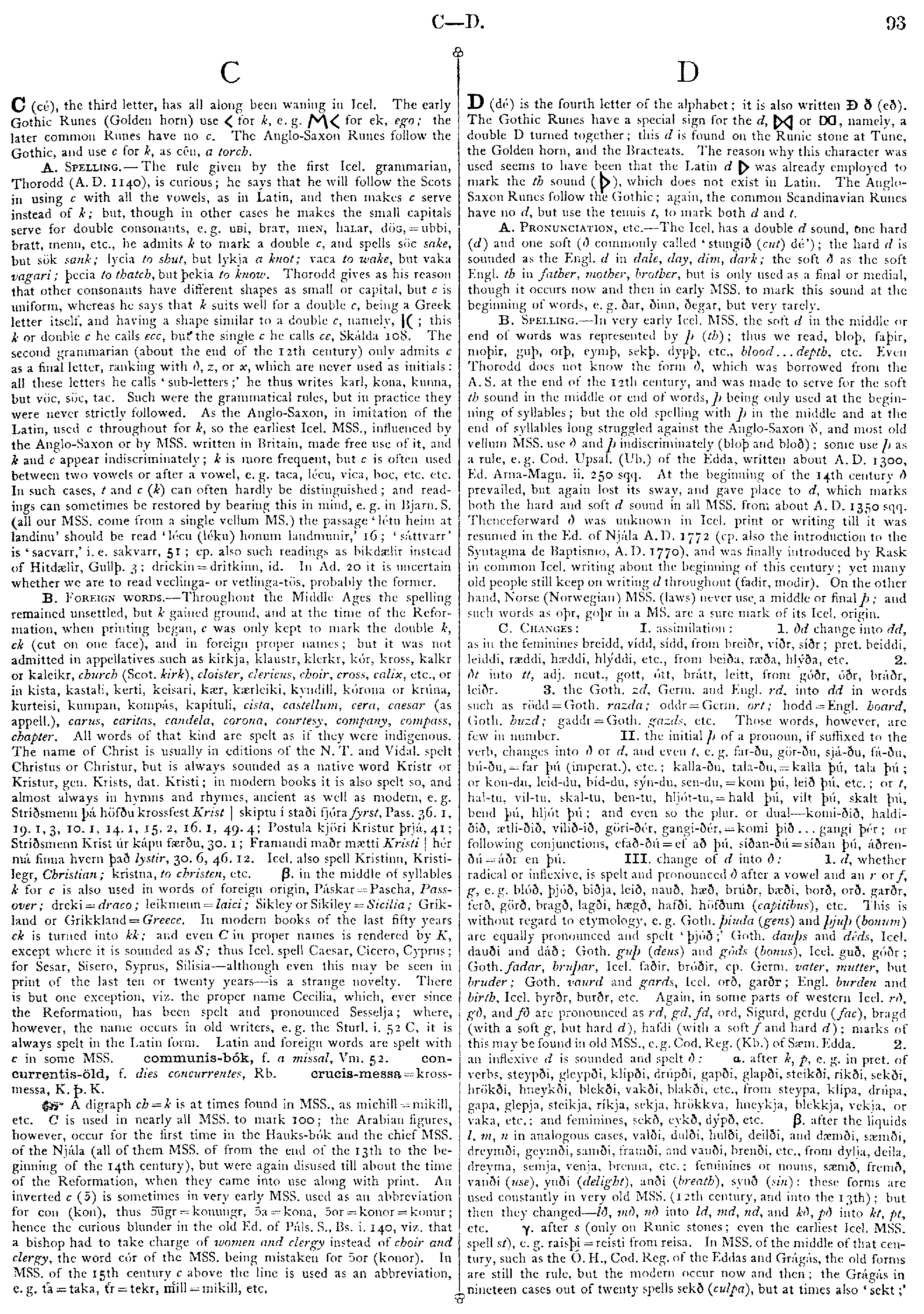
C.
CHANGES:
I.
assimilation:
1.
ðd
change
into
dd,
as
in
the
feminines
breidd,
vídd,
sídd,
from
breiðr,
víðr,
síðr;
pret.
beiddi,
leiddi,
ræddi,
hæddi,
hlýddi,
etc.,
from
beiða,
ræða,
hlýða,
etc.
2.
ðt
into
tt,
adj.
neut.,
gott,
ótt,
brátt,
leitt,
from
góðr,
óðr,
bráðr,
leiðr.
3.
the
Goth,
zd,
Germ,
and
Engl.
rd
into
dd
in
words
such
as
rödd
=
Goth.
razda;
oddr
=
Germ,
ort;
hodd
=
Engl.
hoard,
Goth.
huzd;
gaddr
=
Goth.
gazds,
etc.
Those
words,
however,
are
few
in
number.
II.
the
initial
þ
of
a
pronoun,
if
suffixed
to
the
verb,
changes
into
ð
or
d,
and
even
t,
e.g.
far-ðu,
gör-ðu,
sjá-ðu,
fá-ðu,
bú-ðu,
=
far
þú
(imperat.),
etc.;
kalla-ðu,
tala-ðu,
=
kalla
þú,
tala
þú;
or
kon-du,
leid-du,
bíd-du,
sýn-du,
sen-du,
=
kom
þú,
leið
þú,
etc.;
or
t,
hal-tu,
vil-tu,
skal-tu,
ben-tu,
hljót-tu,
=
hald
þú,
vilt
þú,
skalt
þú,
bend
þú,
hljót
þu;
and
even
so
the
plur.
or
dual
--
komi-ðið,
haldi-ðið,
ætli-ðið,
vilið-ið,
göri-ðér,
gangi-ðér,
=
komi
þið
...
gangi
þér;
or
following
conjunctions,
efað-ðú
=
ef
að
þú,
síðan-ðú
=
síðan
þú,
áðren-ððí
=
áðr
en
þú.
III.
change
of
d
into
ð:
1.
d,
whether
radical
or
inflexive,
is
spelt
and
pronounced
ð
after
a
vowel
and
an
r
or
f,
g,
e.g.
blóð,
þjóð,
biðja,
leið,
nauð,
hæð,
brúðr,
bæði,
borð,
orð,
garðr,
ferð,
görð,
bragð,
lagði,
hægð,
hafði,
höfðum
(capitibus),
etc.
This
is
without
regard
to
etymology,
e.g.
Goth,
þiuda
(gens)
and
þjuþ
(bonum)
are
equally
pronounced
and
spelt
'þjóð;'
Goth.
dauþs
and
dêds,
Icel.
dauði
and
dáð;
Goth,
guþ
(deus)
and
gôds
(bonus),
Icel.
guð,
góðr;
Goth.
fadar,
bruþar,
Icel.
faðir,
bróðir,
cp.
Germ,
vater,
mutter,
but
bruder;
Goth,
vaurd
and
gards,
Icel.
orð,
garðr;
Engl.
burden
and
birth,
Icel.
byrðr,
burðr,
etc.
Again,
in
some
parts
of
western
Icel.
rð,
gð,
and
fd
are
pronounced
as
rd,
gd,
fd,
ord,
Sigurd,
gerdu
(fac),
bragd
(with
a
soft
g,
but
hard
d),
hafdi
(with
a
soft
f
and
hard
d);
marks
of
this
may
be
found
in
old
MSS.,
e.g.
Cod.
Reg.
(Kb.)
of
Stem.
Edda.
2.
an
inflexive
d
is
sounded
and
spelt
ð:
 .
after
k,
p,
e.g.
in
pret.
of
verbs,
steypði,
gleypði,
klípði,
drúpði,
gapði,
glapði,
steikði,
ríkði,
sekði,
hrökði,
hneykði,
blekði,
vakði,
blakði,
etc.,
from
steypa,
klípa,
drúpa,
gapa,
glepja,
steikja,
ríkja,
sekja,
hrökkva,
hneykja,
blekkja,
vekja,
or
vaka,
etc.;
and
feminines,
sekð,
eykð,
dýpð,
etc.
.
after
the
liquids
l,
m,
n
in
analogous
cases,
valði,
dulði,
hulði,
deilði,
and
dæmði,
sæmði,
dreymði,
geymði,
samði,
framði,
and
vanði,
brenði,
etc.,
from
dylja,
deila,
dreyma,
semja,
venja,
brenna,
etc.;
feminines
or
nouns,
sæmð,
fremð,
vanði
(use),
ynði
(delight),
anði
(breath),
synð
(sin):
these
forms
are
used
constantly
in
very
old
MSS.
(12th
century,
and
into
the
13th);
but
then
they
changed
--
lð,
mð,
nð
into
ld,
md,
nd,
and
kð,
pð
into
kt,
pt,
etc.
.
after
s
(only
on
Runic
stones;
even
the
earliest
Icel.
MSS.
spell
st),
e.g.
raisþi
=
reisti
from
reisa.
In
MSS.
of
the
middle
of
that
century,
such
as
the
Ó.H.,
Cod.
Reg.
of
the
Eddas
and
Grágás,
the
old
forms
are
still
the
rule,
but
the
modern
occur
now
and
then;
the
Grágás
in
nineteen
cases
out
of
twenty
spells
sekð
(culpa),
but
at
times
also
'sekt;'
.
after
k,
p,
e.g.
in
pret.
of
verbs,
steypði,
gleypði,
klípði,
drúpði,
gapði,
glapði,
steikði,
ríkði,
sekði,
hrökði,
hneykði,
blekði,
vakði,
blakði,
etc.,
from
steypa,
klípa,
drúpa,
gapa,
glepja,
steikja,
ríkja,
sekja,
hrökkva,
hneykja,
blekkja,
vekja,
or
vaka,
etc.;
and
feminines,
sekð,
eykð,
dýpð,
etc.
.
after
the
liquids
l,
m,
n
in
analogous
cases,
valði,
dulði,
hulði,
deilði,
and
dæmði,
sæmði,
dreymði,
geymði,
samði,
framði,
and
vanði,
brenði,
etc.,
from
dylja,
deila,
dreyma,
semja,
venja,
brenna,
etc.;
feminines
or
nouns,
sæmð,
fremð,
vanði
(use),
ynði
(delight),
anði
(breath),
synð
(sin):
these
forms
are
used
constantly
in
very
old
MSS.
(12th
century,
and
into
the
13th);
but
then
they
changed
--
lð,
mð,
nð
into
ld,
md,
nd,
and
kð,
pð
into
kt,
pt,
etc.
.
after
s
(only
on
Runic
stones;
even
the
earliest
Icel.
MSS.
spell
st),
e.g.
raisþi
=
reisti
from
reisa.
In
MSS.
of
the
middle
of
that
century,
such
as
the
Ó.H.,
Cod.
Reg.
of
the
Eddas
and
Grágás,
the
old
forms
are
still
the
rule,
but
the
modern
occur
now
and
then;
the
Grágás
in
nineteen
cases
out
of
twenty
spells
sekð
(culpa),
but
at
times
also
'sekt;'
|
Source: Cleasby/Vigfusson, page b0093, entry 30 View original page image as: [TIFF] [PNG] [View previous entry] [View next entry] |
[Comment on this entry] [View comments] |
The following entry has been hand-corrected once. |
DAGR,
m.,
irreg.
dat.
degi,
pl.
dagar:
[the
kindred
word
dœgr
with
a
vowel
change
from
ó
(dóg)
indicates
a
lost
root
verb
analogous
to
ala,
ól,
cp.
dalr
and
dælir;
this
word
is
common
to
all
Teutonic
dialects;
Goth.
dags;
A.S.
dag;
Engl.
day;
Swed.-Dan.
dag;
Germ,
tag;
the
Lat.
dies
seems
to
be
identical,
although
no
interchange
has
taken
place]
:--
a
day;
in
different
senses:
1.
the
natural
day
:--
sayings
referring
to
the
day,
at
kveldi
skal
dag
leyfa,
at
eventide
shall
the
day
be
praised,
Hm.
80
;
allir
dagar
eiga
kveld
um
síðir;
mörg
eru
dags
augu,
vide
auga;
enginn
dagr
til
enda
tryggr,
no
day
can
be
trusted
till
its
end;
allr
dagr
til
stefnu,
Grág.
i.
395,
443,
is
a
law
phrase,
--
for
summoning
was
lawful
only
if
performed
during
the
day;
this
phrase
is
also
used
metaph.
=
'plenty
of
time'
or
the
like:
popular
phrases
as
to
the
daylight
are
many
--
dagr
rennr,
or
rennr
upp,
and
kemr
upp,
the
day
rises,
Bm.
1;
dagr
í
austri,
day
in
the
east,
where
the
daylight
first
appears;
dagsbrún,
'day's
brow,'
is
the
first
streak
of
daylight,
the
metaphor
taken
from
the
human
face;
lysir
af
degi,
it
brightens
from
the
day,
i.e.
daylight
is
appearing;
dagr
ljómar,
the
day
gleams;
fyrir
dag,
before
day;
móti
degi,
undir
dag,
about
daybreak;
komið
at
degi,
id.,
Fms.
viii.
398;
dagr
á
lopti,
day
in
the
sky;
árla,
snemma
dags,
early
in
the
morning,
Pass.
15.
17;
dagr
um
allt
lopt,
etc.;
albjartr
dagr,
hábjartr
d.,
full
day,
broad
daylight;
hæstr
dagr,
high
day;
önd-verðr
d.,
the
early
day
=
forenoon,
Am.
50;
miðr
dagr,
midday,
Grág.
i.
413,
446,
Sks.
217,
219;
áliðinn
dagr,
late
in
the
day,
Fas.
i.
313;
hallandi
dagr,
declining
day;
at
kveldi
dags,
síð
dags,
late
in
the
day,
Fms.
i.
69.
In
the
evening
the
day
is
said
to
set,
hence
dag-sett,
dag-setr,
and
dagr
setzt;
in
tales,
ghosts
and
spirits
come
out
with
nightfall,
but
dare
not
face
the
day;
singing
merry
songs
after
nightfall
is
not
safe,
það
kallast
ekki
Kristnum
leyft
að
kveða
þegar
dagsett
er,
a
ditty;
Syrpuvers
er
mestr
galdr
er
í
fólginn,
ok
eigi
er
lofat
at
kveða
eptir
dagsetr,
Fas.
iii.
206,
Ísl.
Þjóðs.
ii.
7,
8:
the
daylight
is
symbolical
of
what
is
true
or
clear
as
day,
hence
the
word
dagsanna,
or
satt
sem
dagr,
q.v.
2.
of
different
days;
í
dag,
to-day,
Grág.
i.
16,
18,
Nj.
36,
Ld.
76,
Fms.
vi.
151;
í
gær-dag,
yesterday;
í
fyrra
dag,
the
day
before
yesterday,
Háv.
50;
í
hinni-fyrra
dag,
the
third
day;
annars
dags,
Vígl.
23,
Pass.
50.
I;
hindra
dags,
the
hinder
day,
the
day
after
to-mor-
row,
Hm.
109;
dag
eptir
dag,
day
after
day,
Hkr.
ii.
313;
dag
frá
degi,
from
day
to
day,
Fms.
ii.
230;
hvern
dag
frá
öðrum,
id.,
Fms.
viii.
182;
annan
dag
frá
öðrum.
id.,
Eg.
277;
um
daginn,
during
the
day;
á
dögunum.
the
other
day;
nótt
ok
dag,
night
and
day;
liðlangan
dag,
the
'life-long'
day;
dögunum
optar,
more
times
than
there
are
days,
i.e.
over
and
over
again,
Fms.
x.
433;
á
deyjanda
degi,
on
one's
day
of
death,
Grág.
i.
402.
.
regu-dagr,
a
rainy
day:
sólskins-dagr,
a
sunny
day;
sumar-
dagr,
a
summer
day;
vetrar-dagr,
a
winter
day;
hátíðis-dagr,
a
feast
day;
fegins-dagr,
a
day
of
joy;
dóms-dagr,
the
day
of
doom,
judgment
day,
Gl.
82,
Fms.
viii.
98;
hamingju-dagr,
heilla-dagr,
a
day
of
happiness;
gleði-
dagr,
id.;
brúðkaups-dagr,
bridal-day;
burðar-dagr,
a
birthday.
3.
in
pl.
days
in
the
sense
of
times;
aðrir
dagar,
Fms.
i.
216;
ek
ætlaða
ekki
at
þessir
dagar
mundu
verða,
sem
nú
eru
orðnir,
Nj.
171;
góðir
dagar,
happy
days,
Fms.
xi.
286,
270;
sjá
aldrei
glaðan
dag
(sing.),
never
to
see
glad
days.
.
á
e-s
dögum,
um
e-s
daga
eptir
e-s
daga,
esp.
of
the
lifetime
or
reign
of
kings,
Fms.;
but
in
Icel.
also
used
of
the
lög-
sögumaðr,
Jb.
repeatedly;
vera
á
dögum,
to
be
alive;
eptir
minn
dag,
'after
my
day,'
i.e.
when
I
am
dead.
.
calendar
days,
e.g.
Hvita-
dagar,
the
White
days,
i.e.
Whitsuntide;
Hunda-dagar,
the
Dog
days;
Banda-dagr,
Vincula
Petri;
Höfuð-dagr,
Decap.
Johannis;
Geisla-dagr,
Epiphany;
Imbru-dagar,
Ember
days;
Gang-dagar,
'Ganging
days,'
Ro-
gation
days;
Dýri-dagr,
Corpus
Christi;
etc.
4.
of
the
week-
days;
the
old
names
being
Sunnu-d.
or
Drottins-d.,
Mána-d.,
Týs-d.,
Öðins-d.,
Þórs-d.,
Frjá-d.,
Laugar-d.
or
Þvátt-d.
It
is
hard
to
understand
how
the
Icel.
should
be
the
one
Teut.
people
that
have
disused
the
old
names
of
the
week-days;
but
so
it
was,
vide
Jóns
S.
ch.
24;
fyrir
bauð
hann
at
eigna
daga
vitrum
mönnum
heiðnum,
svá
sem
at
kalla
Týrsdag
|
Source: Cleasby/Vigfusson, page b0096, entry 4 View original page image as: [TIFF] [PNG] [View previous entry] [View next entry] |
[Comment on this entry] [View comments] |
The following entry has been hand-corrected once. |
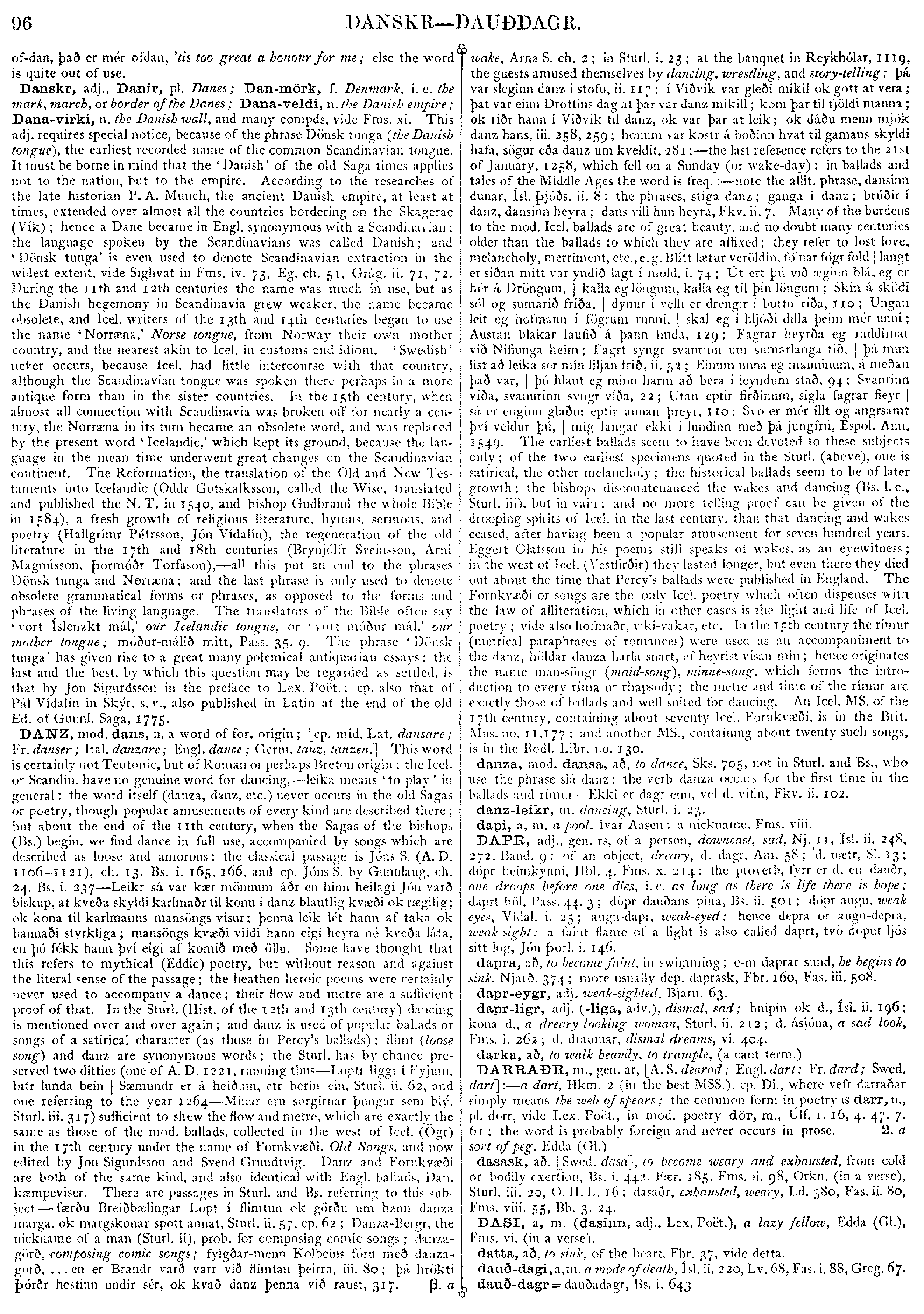
danza, mod. dansa, að, to dance, Sks. 705, not in Sturl. and Bs., who use the phrase slá danz; the verb danza occurs for the first time in the ballads and rímur -- Ekki er dagr enn, vel d. vifin, Fkv. ii. 102.
|
Source: Cleasby/Vigfusson, page b0097, entry 44 View original page image as: [TIFF] [PNG] [View previous entry] [View next entry] |
[Comment on this entry] [View comments] |
The following entry has not been hand-corrected. However, the page is reserved and someone is correcting it. |
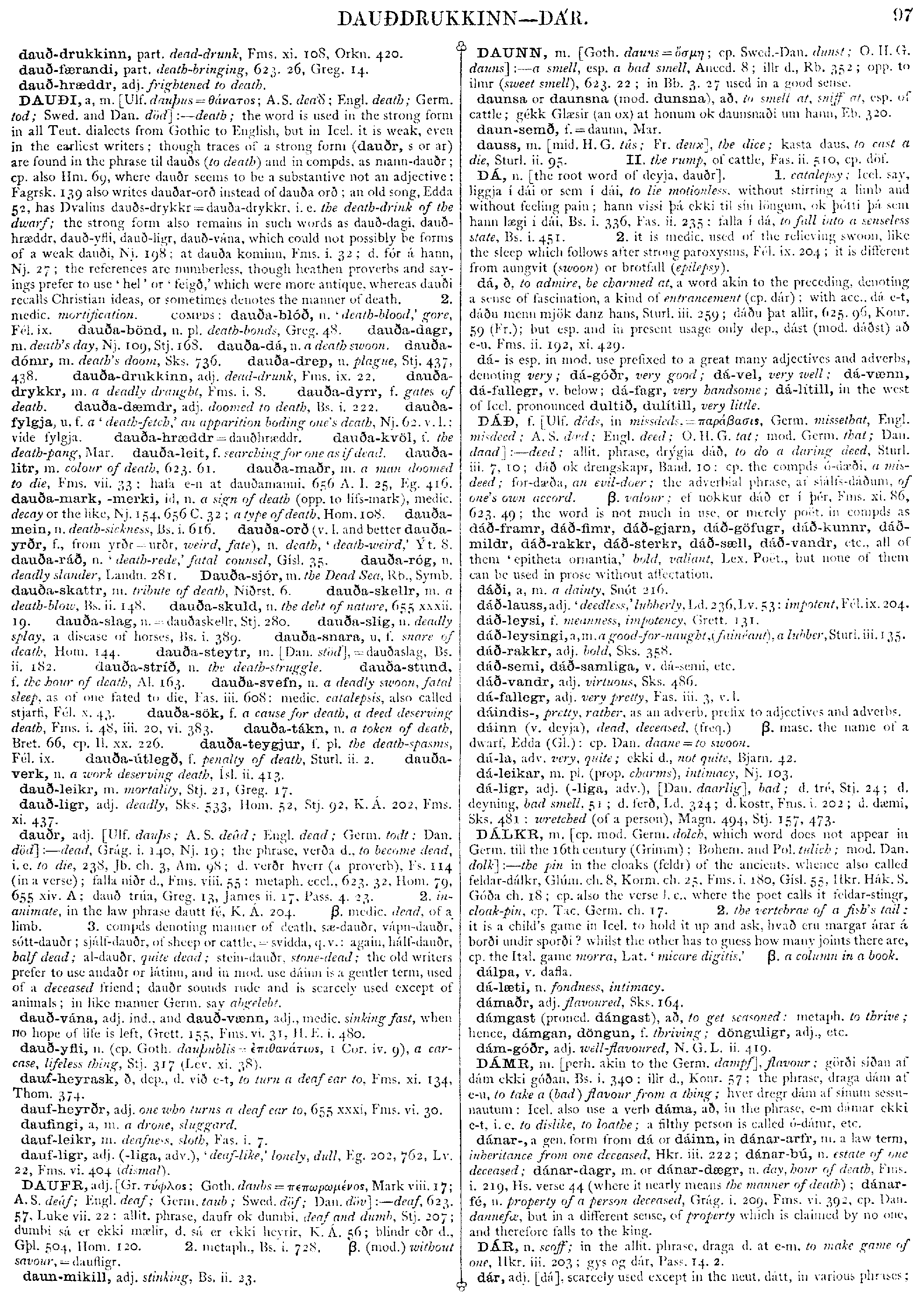
DÁMR, m. [peril, akin to the Germ. dampf, flavour; görði síðan af dám ekki góðan, Bs. i. 340; il'tr d., Konr. 57; the phrase, draga dam af e-u, to take a (bad) flavour from a thing; hver dregr dam af sinuin sessu- nautum: Icel. also use a verb dáma, að, in the phrase, e-m dumar ekki e-t, i. e. to dislike, to loathe; a filthy person is called ó-dánir, etc.
| Result Page: |  |
Previous | 19 20 21 22 23 24 25 26 27 28 29 30 31 32 33 34 35 36 37 | Next |  |
Germanic Lexicon Project (main page)
This search system was written by
Sean Crist
Please consider
volunteering
to correct the data in these online dictionaries.
No rights reserved. Feel free to use these data in any way you please.