|
|

Search for vala again, using less strict matching (16 results)
|
Source: Torp, page b0400, entry 3 View original page image as: [TIFF] [PNG] [View previous entry] [View next entry] |
[Comment on this entry] [View comments] |
The following entry has been hand-corrected once. |
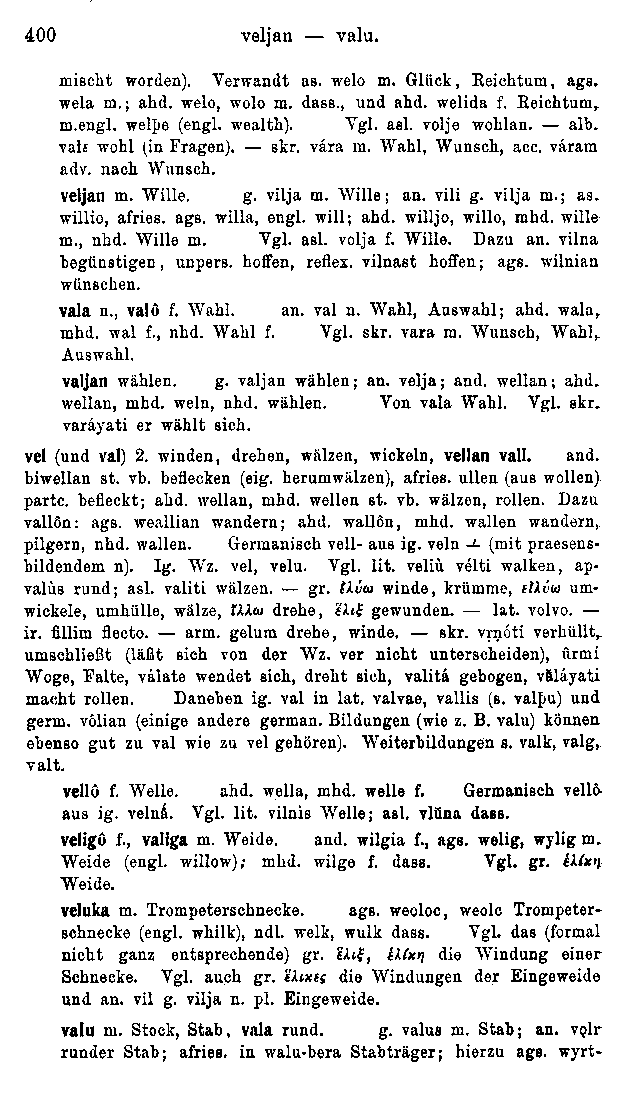
vala n., valô f. Wahl. an. val n. Wahl, Auswahl; ahd. wala, mhd. wal f., nhd. Wahl f. Vgl. skr. vara m. Wunsch, Wahl, Auswahl.
[Translate the German words]
|
Source: Torp, page b0402, entry 3 View original page image as: [TIFF] [PNG] [View previous entry] [View next entry] |
[Comment on this entry] [View comments] |
The following entry has been hand-corrected once. |
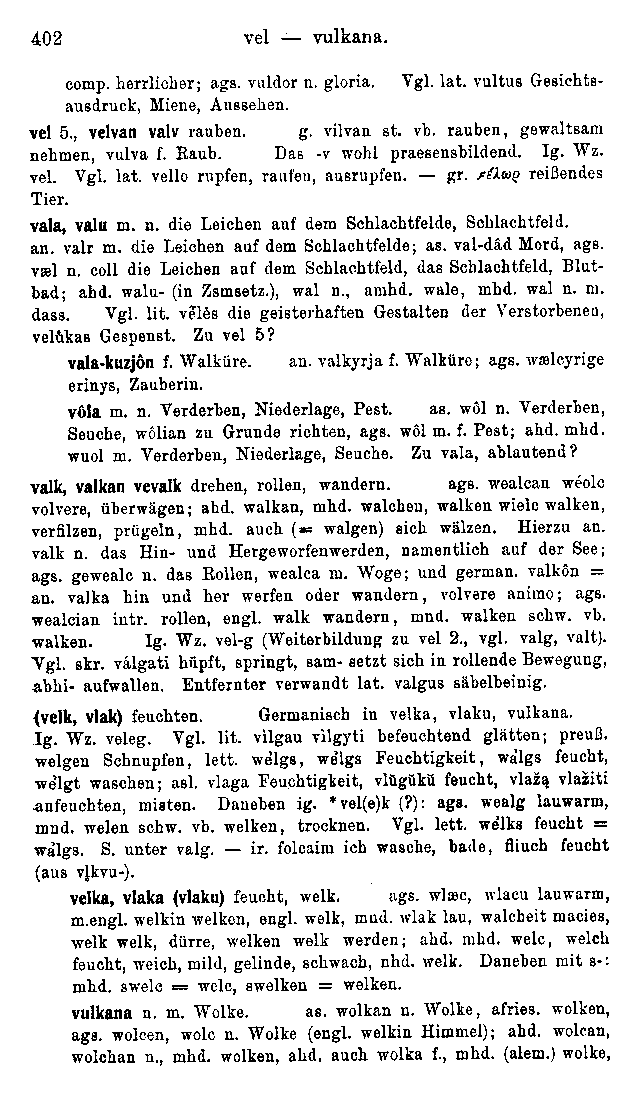
vala,
valu
m.
n.
die
Leichen
auf
dem
Schlachtfelde,
Schlachtfeld.
an.
valr
m.
die
Leichen
auf
dem
Schlachtfelde;
as.
val-dâd
Mord,
ags.
væl
n.
coll
die
Leichen
auf
dem
Schlachtfeld,
das
Schlachtfeld,
Blutbad;
ahd.
walu-
(in
Zsmsetz.),
wal
n.,
amhd.
wale,
mhd.
wal
n.
m.
dass.
Vgl.
lit.
v l
l s
die
geisterhaften
Gestalten
der
Verstorbenen,
vel
s
die
geisterhaften
Gestalten
der
Verstorbenen,
vel kas
Gespenst.
Zu
vel
5?
kas
Gespenst.
Zu
vel
5?
[Translate the German words]
|
Source: Cleasby/Vigfusson, page b0675, entry 1 View original page image as: [TIFF] [PNG] [View previous entry] [View next entry] |
[Comment on this entry] [View comments] |
The following entry has been hand-corrected once. |
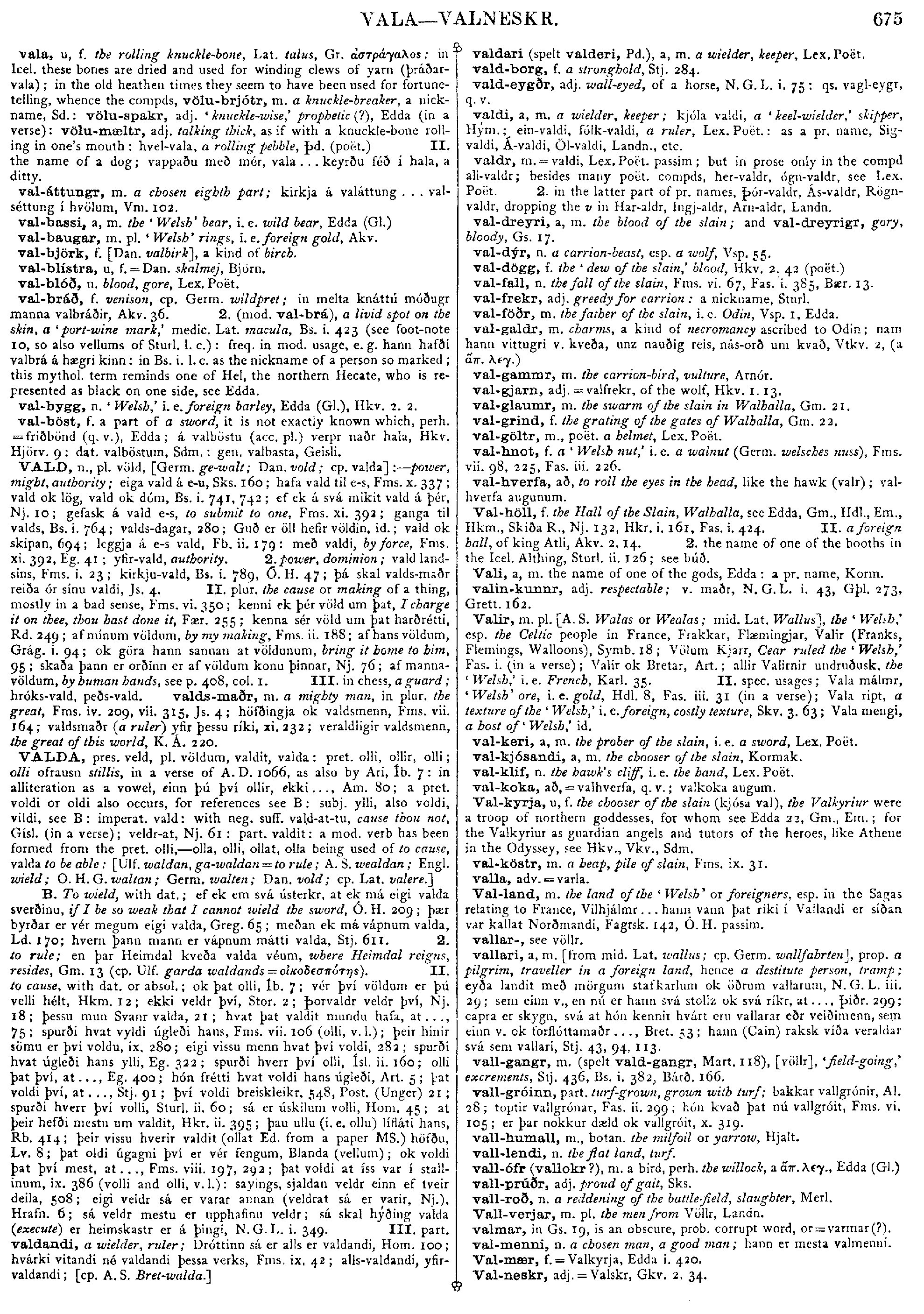
vala, u, f. the rolling knuckle-bone, Lat. talus, Gr. GREEK; in Icel. these bones are dried and used for winding clews of yarn (þráðar-vala); in the old heathen times they seem to have been used for fortune-telling, whence the compds, völu-brjótr, m. a knuckle-breaker, a nickname, Sd.: völu-spakr, adj. 'knuckle-wise' prophetic(?), Edda (in a verse): völu-mæltr, adj. talking thick, as if with a knuckle-bone rolling in one's mouth: hvel-vala, a rolling pebble, Þd. (poët.) II. the name of a dog; vappaðu með mér, vala ... keyrðu féð í hala, a ditty.
|
Source: Torp, page b0399, entry 7 View original page image as: [TIFF] [PNG] [View previous entry] [View next entry] |
[Comment on this entry] [View comments] |
The following entry has been hand-corrected once. |
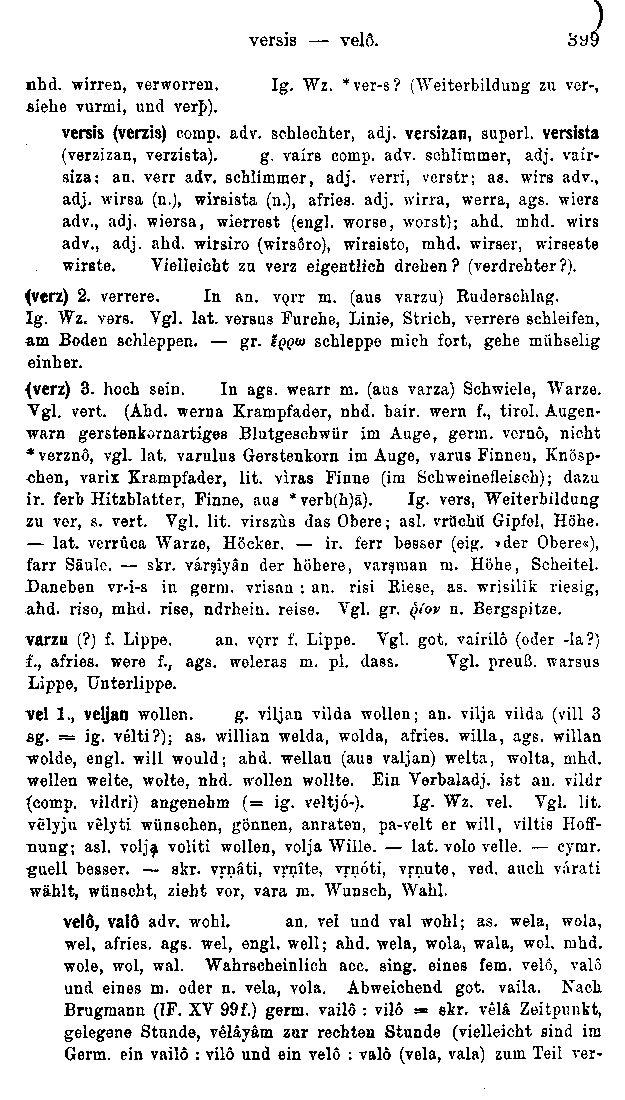
velô,
valô
adv.
wohl.
an.
vel
und
val
wohl;
as.
wela,
wola,
wel,
afries.
ags.
wel,
engl.
well;
ahd.
wela,
wola,
wala,
wol,
mhd.
wole,
wol,
wal.
Wahrscheinlich
acc.
sing.
eines
fem.
velô,
valô
und
eines
m.
oder
n.
vela,
vola.
Abweichend
got.
vaila.
Nach
Brugmann
(IF.
XV
99f.)
germ.
vailô
:
vilô
=
skr.
vêlâ
Zeitpunkt,
gelegene
Stunde,
vêlâyâm
zur
rechten
Stunde
(vielleicht
sind
im
Germ.
ein
vailô
:
vilô
und
ein
velô
:
valô
(vela,
vala)
zum
Teil
vermischt

 wohl
(in
Fragen).
-
skr.
vára
m.
Wahl,
Wunsch,
acc.
váram,
adv.
nach
Wunsch.
wohl
(in
Fragen).
-
skr.
vára
m.
Wahl,
Wunsch,
acc.
váram,
adv.
nach
Wunsch.
[Translate the German words]
|
Source: Torp, page b0400, entry 4 View original page image as: [TIFF] [PNG] [View previous entry] [View next entry] |
[Comment on this entry] [View comments] |
The following entry has been hand-corrected once. |
valjan wählen. g. valjan wählen; an. velja; and. wellan; ahd. wellan, mhd. weln, nhd. wählen. Von vala Wahl. Vgl. Skr. varáyati er wählt sich.
[Translate the German words]
|
Source: Torp, page b0400, entry 9 View original page image as: [TIFF] [PNG] [View previous entry] [View next entry] |
[Comment on this entry] [View comments] |
The following entry has been hand-corrected once. |
valu
m.
Stock,
Stab,
vala
rund.
g.
valus
m.
Stab;
an.
v lr
runder
Stab;
afries.
in
walu-bera
Stabträger;
hierzu
ags.
wyrt
lr
runder
Stab;
afries.
in
walu-bera
Stabträger;
hierzu
ags.
wyrt wala
wala
[Translate the German words]
|
Source: Torp, page b0402, entry 5 View original page image as: [TIFF] [PNG] [View previous entry] [View next entry] |
[Comment on this entry] [View comments] |
The following entry has been hand-corrected once. |
vôla m. n. Verderben, Niederlage, Pest. as. wôl n. Verderben, Seuche, wôlian zu Grunde richten, ags. wôl m. f. Pest; ahd. mhd. wuol m. Verderben, Niederlage, Seuche. Zu vala, ablautend?
[Translate the German words]
|
Source: Cleasby/Vigfusson, page b0149, entry 1 View original page image as: [TIFF] [PNG] [View previous entry] [View next entry] |
[Comment on this entry] [View comments] |
The following entry has been hand-corrected once. |
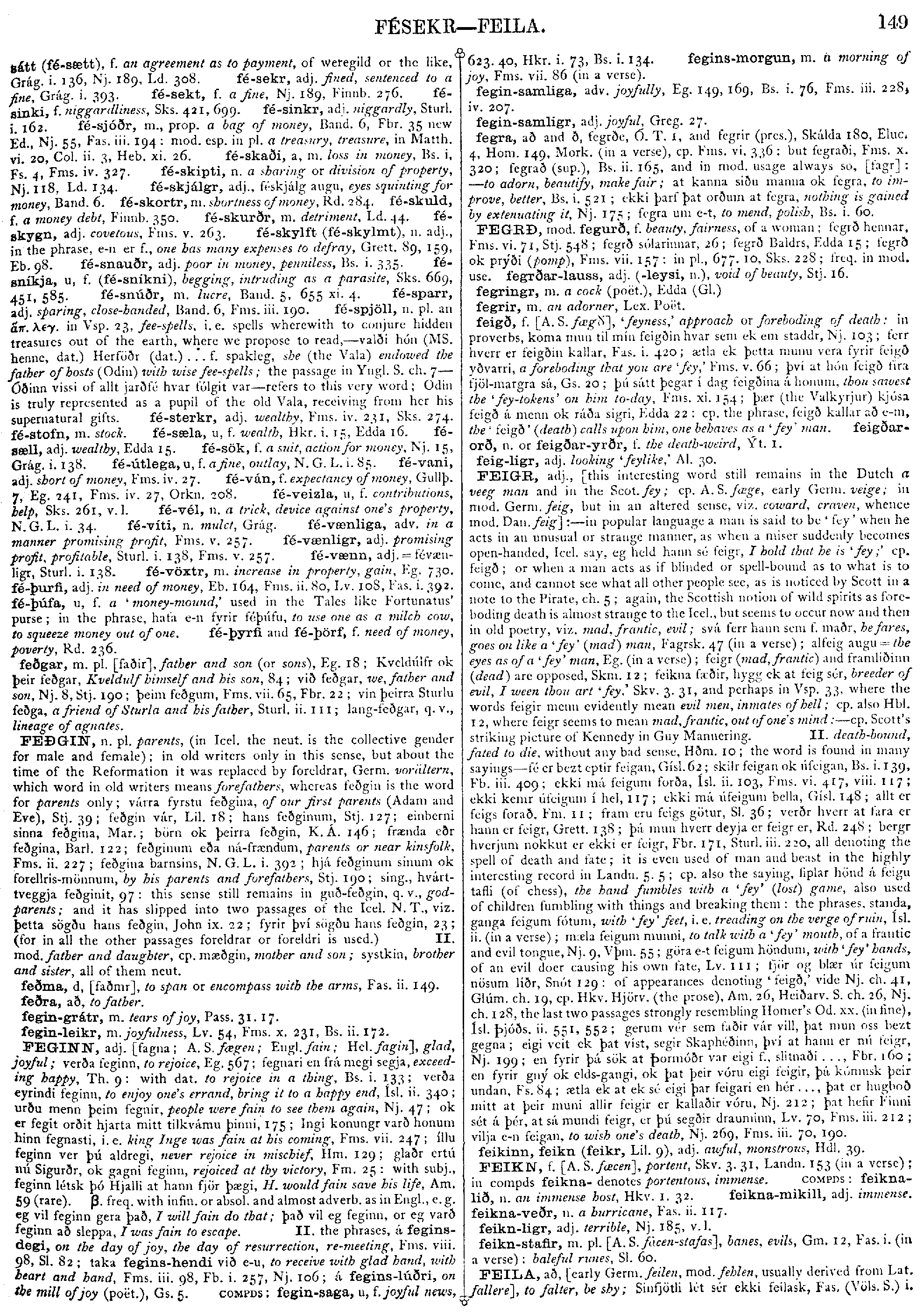
sátt (fé-sætt), f. an agreement as to payment, of weregild or the like, Grág. i. 136, Nj. 189, Ld. 308. fé-sekr, adj. fined, sentenced to a fine, Grág. i. 393. fé-sekt, f. a fine, Nj. 189, Finnb. 276. fé-sinki, f. niggardliness, Sks. 421, 699. fé-sinkr, adj. niggardly, Sturl. i. 162. fé-sjóðr, m., prop. a bag of money, Band. 6, Fbr. 35 new Ed., Nj. 55, Fas. iii. 194: mod. esp. in pl. a treasury, treasure, in Matth. vi. 20, Col. ii. 3, Heb. xi. 26. fé-skaði, a, m. loss in money, Bs. i, Fs. 4, Fms. iv. 327. fé-skipti, n. a sharing or division of property, Nj. 118, Ld. 134. fé-skjálgr, adj., féskjálg augu, eyes squinting for money, Band. 6. fé-skortr, m. shortness of money, Rd. 284. fé-skuld, f. a money debt, Finnb. 350. fé-skurðr, m. detriment, Ld. 44. fé-skygn, adj. covetous, Fms. v. 263. fé-skylft (fé-skylmt), n. adj., in the phrase, e-n er f., one has many expenses to defray, Grett. 89, 159, Eb. 98. fé-snauðr, adj. poor in money, penniless, Bs. i. 335. fé-sníkja, u, f. (fé-sníkni), begging, intruding as a parasite, Sks. 669, 451, 585. fé-snúðr, m. lucre, Band. 5, 655 xi. 4. fé-sparr, adj. sparing, close-handed, Band. 6, Fms. iii. 190. fé-spjöll, n. pl. an GREEK in Vsp. 23, fee-spells, i.e. spells wherewith to conjure hidden treasures out of the earth, where we propose to read, -- valði hón (MS. henne, dat.) Herföðr (dat.) ... f. spakleg, she (the Vala) endowed the father of hosts (Odin) with wise fee-spells; the passage in Yngl. S. ch. 7 -- Óðinn vissi of allt jarðfé hvar fólgit var -- refers to this very word; Odin is truly represented as a pupil of the old Vala, receiving from her his supernatural gifts. fé-sterkr, adj. wealthy, Fms. iv. 231, Sks. 274. fé-stofn, m. stock. fé-sæla, u, f. wealth, Hkr. i. 15, Edda 16. fé-sæll, adj. wealthy, Edda 15. fé-sök, f. a suit, action for money, Nj. 15, Grág. i. 138. fé-útlega, u, f. a fine, outlay, N. G. L. i. 85. fé-vani, adj. short of money, Fms. iv. 27. fé-ván, f. expectancy of money, Gullþ. 7, Eg. 241, Fms. iv. 27, Orkn. 208. fé-veizla, u, f. contributions, help, Sks. 261, v.l. fé-vél, n. a trick, device against one's property, N. G. L. i. 34. fé-víti, n. mulct, Grág. fé-vænliga, adv. in a manner promising profit, Fms. v. 257. fé-vænligr, adj. promising profit, profitable, Sturl. i. 138, Fms. v. 257. fé-vænn, adj. = févænligr, Sturl. i. 138. fé-vöxtr, m. increase in property, gain, Eg. 730. fé-þurfi, adj. in need of money, Eb. 164, Fms. ii. 80, Lv. 108, Fas. i. 392. fé-þúfa, u, f. a 'money-mound,' used in the Tales like Fortunatus' purse; in the phrase, hafa e-n fyrir féþúfu, to use one as a milch cow, to squeeze money out of one. fé-þyrfi and fé-þörf, f. need of money, poverty, Rd. 236.
|
Source: Cleasby/Vigfusson, page b0459, entry 9 View original page image as: [TIFF] [PNG] [View previous entry] [View next entry] |
[Comment on this entry] [View comments] |
The following entry has been hand-corrected once. |
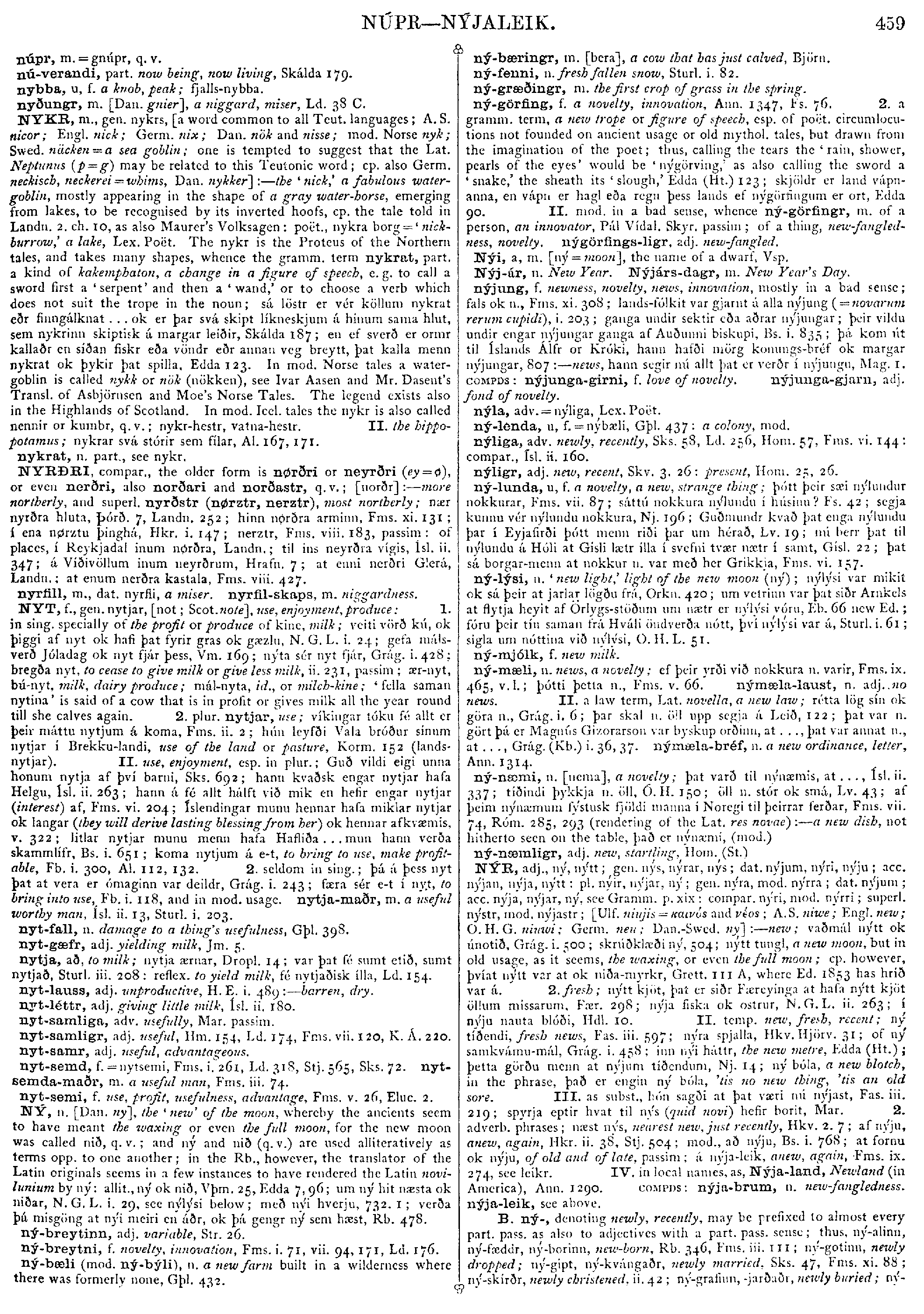
NYT, f., gen. nytjar, [not; Scot. note], use, enjoyment, produce: 1. in sing, specially of the profit or produce of kine, milk; veiti vörð kú, ok þiggi af nyt ok hafi þat fyrir gras ok gæzlu, N. G. L. i. 24; gefa málsverð Jóladag ok nyt fjár þess, Vm. 169; nýta sér nyt fjár, Grág. i. 428: bregða nyt, to cease to give milk or give less milk, ii. 231, passim; ær-nyt, bú-nyt, milk, dairy produce; mál-nyta, id., or milch-kine; 'fella saman nytina' is said of a cow that is in profit or gives milk all the year round till she calves again. 2. plur. nytjar, use; víkingar tóku fé allt er þeir máttu nytjum á koma, Fms. ii. 2; hún leyfði Vala bróður sínum nytjar í Brekku-landi, use of the land or pasture, Korm. 152 (lands-nytjar). II. use, enjoyment, esp. in plur.; Guð vildi eigi unna honum nytja af þvi barni, Sks. 692; hann kvaðsk engar nytjar hafa Helgu, Ísl. ii. 263; hann á fé allt hálft við mik en hefir engar nytjar (interest) af, Fms. vi. 204; Íslendingar munu hennar hafa miklar nytjar ok langar (they will derive lasting blessing from her) ok hennar afkvæmis, v. 322; litlar nytjar munu menn hafa Hafliða . . . mun hann verða skammlífr, Bs. i. 651; koma nytjum á e-t, to bring to use, make profitable, Fb. i. 300, Al. 112, 132. 2. seldom in sing.; þá á þess nyt þat at vera er ómaginn var deildr, Grág. i. 243; færa sér e-t í nyt, to bring into use, Fb. i. 118, and in mod. usage. nytja-maðr, m. a useful worthy man, Ísl. ii. 13, Sturl. i. 203.
|
Source: Cleasby/Vigfusson, page b0581, entry 39 View original page image as: [TIFF] [PNG] [View previous entry] [View next entry] |
[Comment on this entry] [View comments] |
The following entry has been hand-corrected once. |
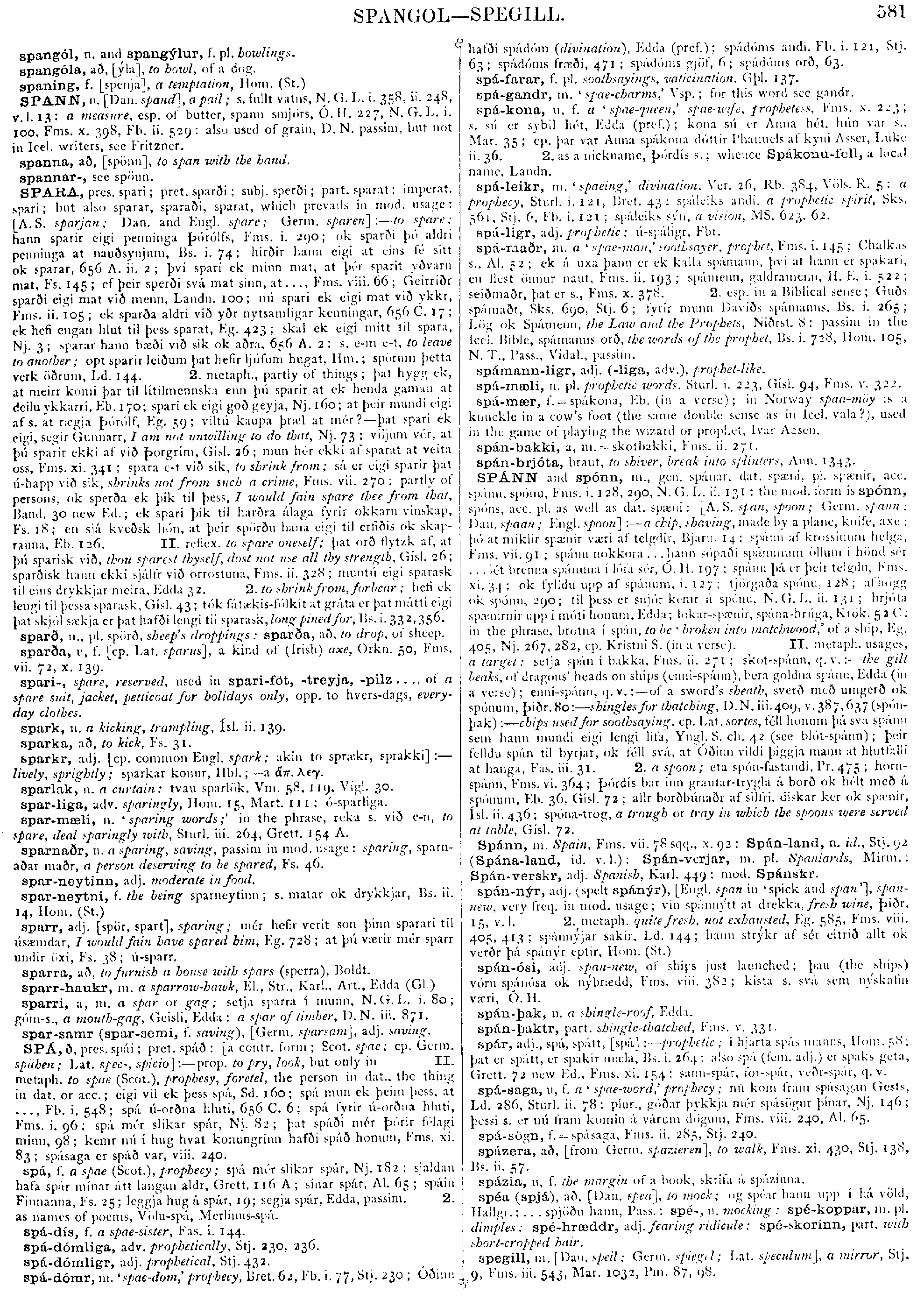
spá-mær, f. = spákona, Eb. (in a verse); in Norway spaa-möy is a knuckle in a cow's foot (the same double sense as in Icel. vala?), used in the game of playing the wizard or prophet, Ivar Aasen.
| Result Page: | 1 2 | Next |  |
Germanic Lexicon Project (main page)
This search system was written by
Sean Crist
Please consider
volunteering
to correct the data in these online dictionaries.
No rights reserved. Feel free to use these data in any way you please.