|
|

|
Source: Cleasby/Vigfusson, page b0054, entry 11 View original page image as: [TIFF] [PNG] [View previous entry] [View next entry] |
[Comment on this entry] [View comments] |
The following entry has not been hand-corrected. However, the page is reserved and someone is correcting it. |
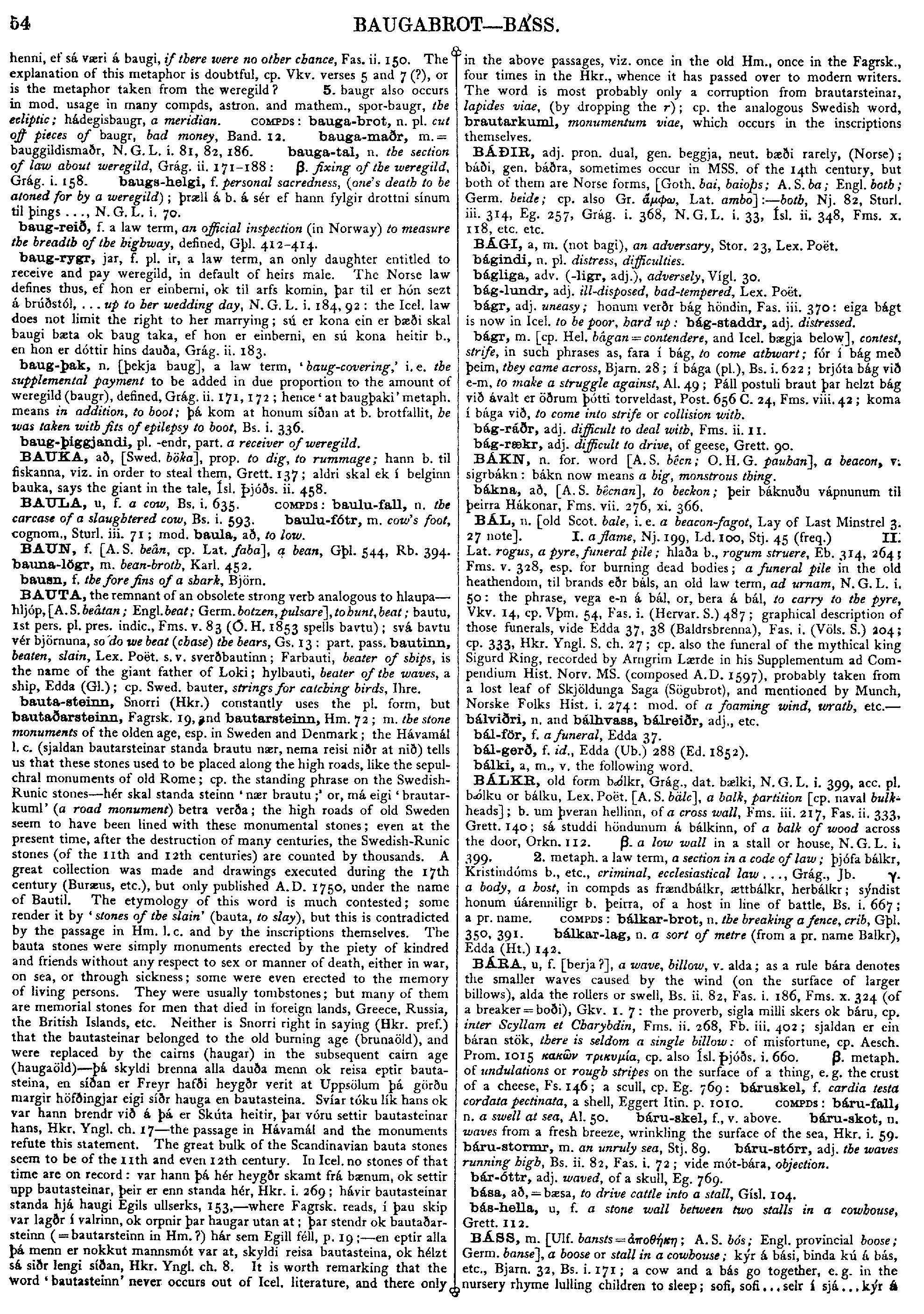
bauta-steinn, Snorri (Hkr.) constantly uses the pl. form, but bautaðarsteinn, Fagrsk. 19, ^nd bautarsteinn, Hm. 72; m. the stone monuments of the olden age, esp. in Sweden and Denmark; the Hávamál 1. c. (sjaldan bautarsteinar standa brautu nær, nema reisi niðr at nið) tells us that these stones used to be placed along the high roads, like the sepul- chral monuments of old Rome; cp. the standing phrase on the Swedish- Runic stones -- her skal standa steinn ' naer brautu;' or, má eigi' brautar- kuml' (a roa d monument) betra verða; the high roads of old Sweden seem to have been lined with these monumental stones; even at the present time, after the destruction of many centuries, the Swedish-Runic stones (of the nth and I2th centuries) are counted by thousands. A great collection was made and drawings executed during the I7*h century (Buræus, etc.), but only published A. D. 1750, under the name of Bautil. The etymology of this word is much contested; some render it by ' s t on e s of the slain' (bauta, to slay), but this is contradicted by the passage in Hm. 1. c. and by the inscriptions themselves. The bauta stones were simply monuments erected by the piety of kindred and friends without any respect to sex or manner of death, either in war, on sea, or through sickness; some were even erected to the memory of living persons. They were usually tombstones; but many of them are memorial stones for men that died in foreign lands, Greece, Russia, the British Islands, etc. Neither is Snorri right in saying (Hkr. pref.) that the bautasteinar belonged to the old burning age (brunaöld), and were replaced by the cairns (haugar) in the subsequent cairn age (haugaöld) -- þá skyldi brenna alla dauða menn ok reisa eptir bauta- steina, en síðan er Freyr hafði heygðr verit at Uppsölum þá görðu margir höfðingjar eigi síðr hauga en bautasteina. Svíar tóku lík hans ok var hann brendr við á þá er Skúta heitir, þar vóru settir bautasteinar hans, Hkr. Yngl. ch. 17 -- the passage in Hávamál and the monuments refute this statement. The great bulk of the Scandinavian bauta stones seem to be of the nth and even 12th century. In Icel. no stones of that time are on record: var hann þá her heygðr skamt frá bsenum, ok settir upp bautasteinar, þeir er enn standa her, Hkr. i. 269; hávir bautasteinar standa hjá haugi Egils ullserks, 153, -- where Fagrsk. reads, í þau skip var lagðr í valrinn, ok orpnir þar haugar utan at; þar stendr ok bautaðar- steinn (= bautarsteinn in Hm. ?) hár sem Egill fell, p. 19; -- en eptir alia þá menn er nokkut mannsmót var at, skyldi reisa bautasteina, ok hélzt sa siðr lengi síðan, Hkr. Yngl. ch. 8. It is worth remarking that the Word ' bautasteinn' never occurs out of Icel. literature, and there only in the above passages, viz. once in the old Hm., once in the Fagrsk., four times in the Hkr., whence it has passed over to modern writers. The word is most probably only a corruption from brautarsteinar, lapides viae, (by dropping the r); cp. the analogous Swedish word, brautarkuml, monumentum viae, which occurs in the inscriptions themselves.
|
Source: Cleasby/Vigfusson, page b0057, entry 1 View original page image as: [TIFF] [PNG] [View previous entry] [View next entry] |
[Comment on this entry] [View comments] |
The following entry has been hand-corrected once. |
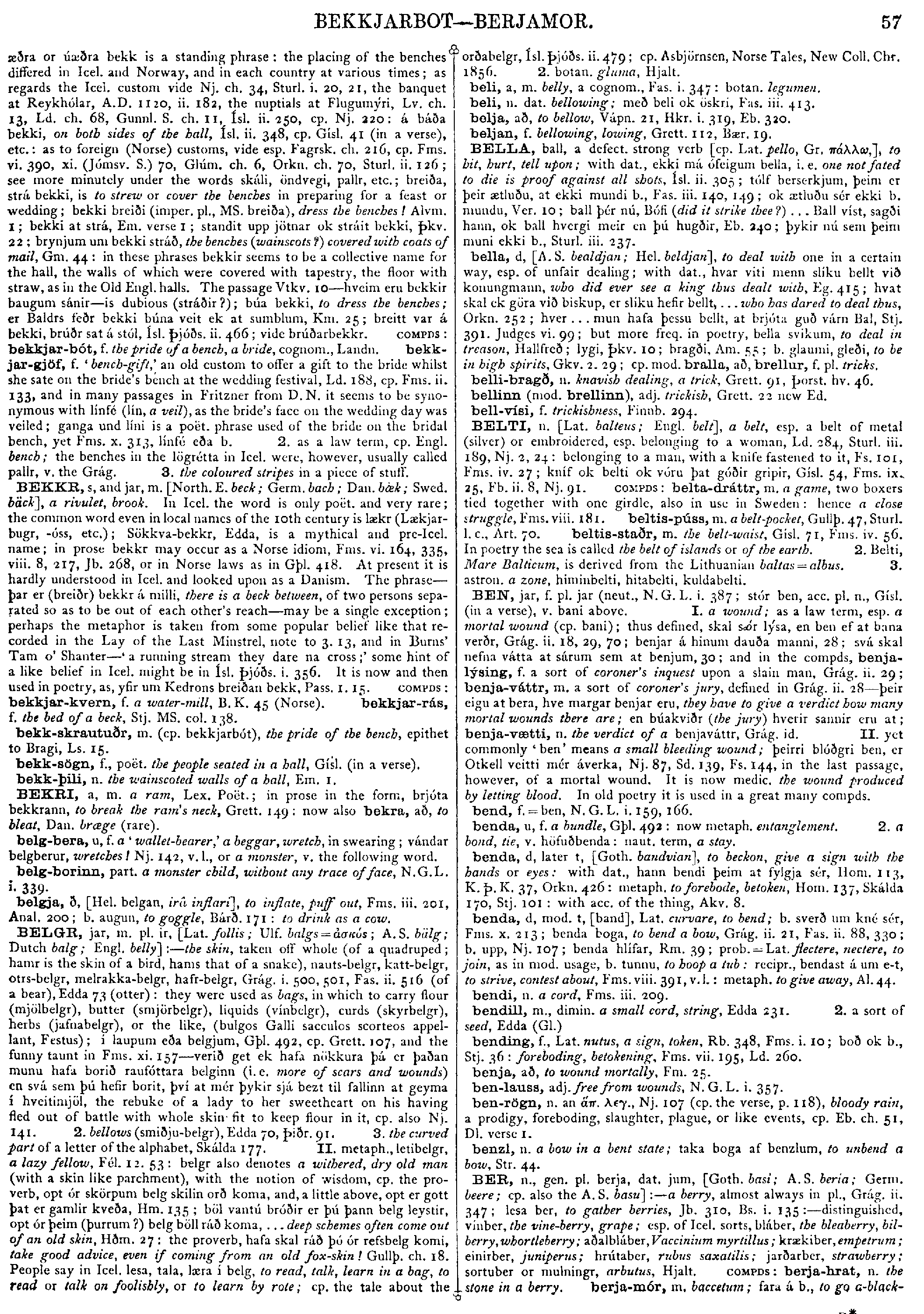
æðra or úæðra bekk is a standing phrase: the placing of the benches differed in Icel. and Norway, and in each country at various times; as regards the Icel. custom vide Nj. ch. 34, Sturl. i. 20, 21, the banquet at Reykhólar, A. D. 1120, ii. 182, the nuptials at Flugumýri, Lv. ch. 13, Ld. ch. 68, Gunnl. S. ch. 11, Ísl. ii. 250, cp. Nj. 220: á báða bekki, on both sides of the ball, Ísl. ii. 348, cp. Gísl. 41 (in a verse), etc.: as to foreign (Norse) customs, vide esp. Fagrsk. ch. 216, cp. Fms. vi. 390, xi. (Jómsv. S.) 70, Glúm. ch. 6, Orkn. ch. 70, Sturl. ii. 126; see more minutely under the words skáli, öndvegi, pallr, etc.; breiða, strá bekki, is to strew or cover the benches in preparing for a feast or wedding; bekki breiði (imper. pl., MS. breiða), dress the benches! Alvm. 1; bekki at strá, Em. verse 1; standit upp jötnar ok stráit bekki, Þkv. 22; brynjum um bekki stráð, the benches (wainscots?) covered with coats of mail, Gm. 44: in these phrases bekkir seems to be a collective name for the hall, the walls of which were covered with tapestry, the floor with straw, as in the Old Engl. halls. The passage Vtkv. 10 -- hveim eru bekkir baugum sánir -- is dubious (stráðir?); búa bekki, to dress the benches; er Baldrs feðr bekki búna veit ek at sumblum, Km. 25; breitt var á bekki, brúðr sat á stól, Ísl. Þjóðs. ii. 466; vide brúðarbekkr. COMPDS: bekkjar-bót, f. the pride of a bench, a bride, cognom., Landn. bekk-jar-gjöf, f. 'bench-gift,' an old custom to offer a gift to the bride whilst she sate on the bride's bench at the wedding festival, Ld. 188, cp. Fms. ii. 133, and in many passages in Fritzner from D. N. it seems to be synonymous with línfé (lín, a veil), as the bride's face on the wedding day was veiled; ganga und líni is a poët. phrase used of the bride on the bridal bench, yet Fms. x. 313, línfé eða b. 2. as a law term, cp. Engl. bench; the benches in the lögrétta in Icel. were, however, usually called pallr, v. the Grág. 3. the coloured stripes in a piece of stuff.
|
Source: Cleasby/Vigfusson, page b0063, entry 16 View original page image as: [TIFF] [PNG] [View previous entry] [View next entry] |
[Comment on this entry] [View comments] |
The following entry has been hand-corrected once. |
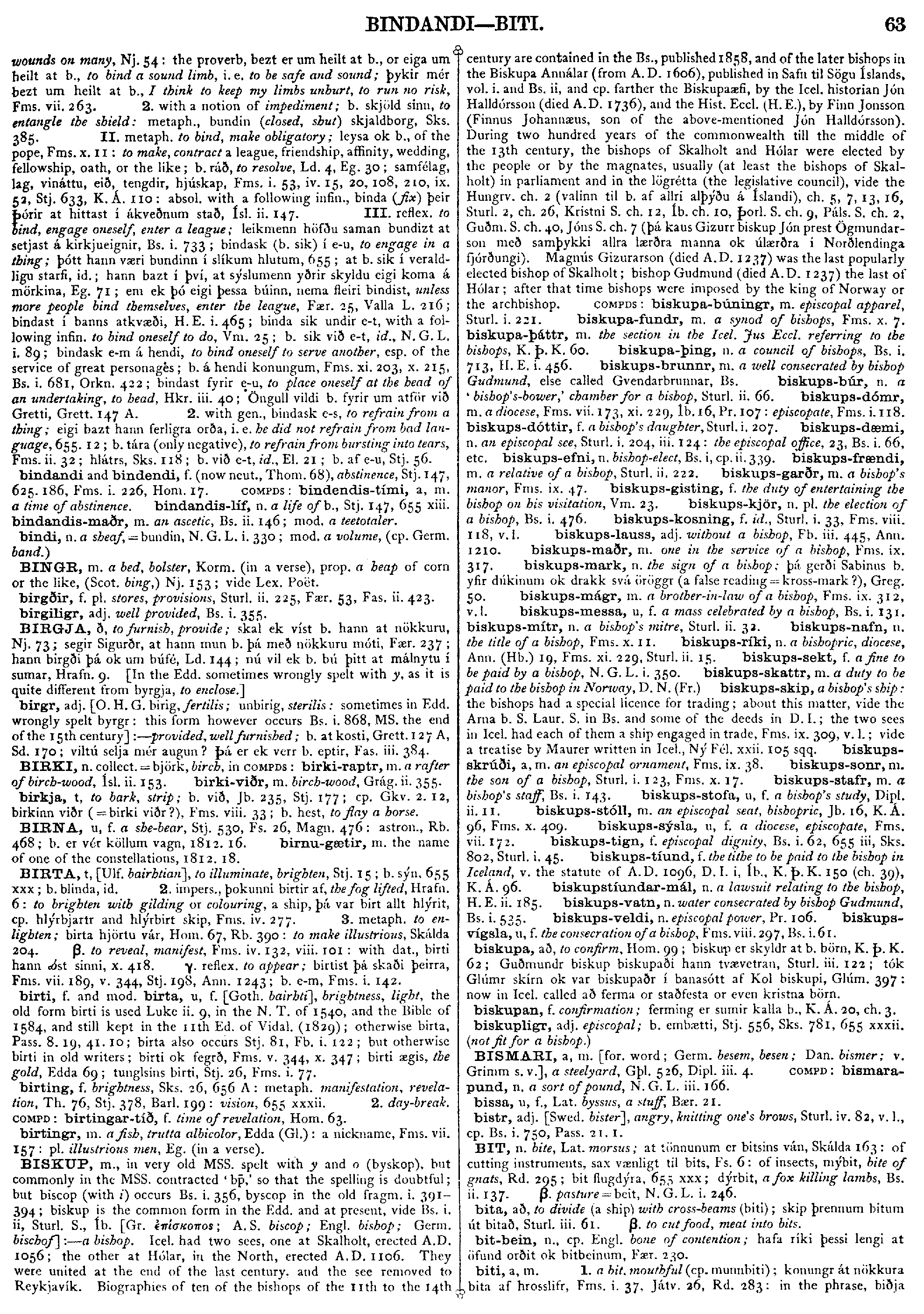
BISKUP, m., in very old MSS. spelt with y and o (byskop), but commonly in the MSS. contracted 'bUNCERTAIN,' so that the spelling is doubtful; but biscop (with i) occurs Bs. i. 356, byscop in the old fragm. i. 391-394; biskup is the common form in the Edd. and at present, vide Bs. i. ii, Sturl. S., Íb. [Gr. GREEK; A. S. biscop; Engl. bishop; Germ. bischof] :-- a bishop. Icel. had two sees, one at Skalholt, erected A.D. 1056; the other at Hólar, in the North, erected A.D. 1106. They were united at the end of the last century, and the see removed to Reykjavik. Biographies of ten of the bishops of the 11th to the 14th century are contained in the Bs., published 1858, and of the later bishops in the Biskupa Annálar (from A.D. 1606), published in Safn til Sögu Íslands, vol. i. and Bs. ii, and cp. farther the Biskupaæfi, by the Icel. historian Jón Halldórsson (died A.D. 1736), and the Hist. Eccl. (H. E.). by Finn Jonsson (Finnus Johannæus, son of the above-mentioned Jón Halldórsson). During two hundred years of the commonwealth till the middle of the 13th century, the bishops of Skalholt and Hólar were elected by the people or by the magnates, usually (at least the bishops of Skalholt) in parliament and in the lögrétta (the legislative council), vide the Hungrv. ch. 2 (valinn til b. af allri alþýðu á Íslandi), ch. 5, 7, 13, 16, Sturl. 2, ch. 26, Kristni S. ch. 12, Íb. ch. 10, Þorl. S. ch. 9, Páls. S. ch. 2, Guðm. S. ch. 40, Jóns S. ch. 7 (þá kaus Gizurr biskup Jón prest Ögmundarson með samþykki allra lærðra manna ok úlærðra í Norðlendinga fjórðungi). Magnús Gizurarson (died A.D. 1237) was the last popularly elected bishop of Skalholt; bishop Gudmund (died A.D. 1237) the last of Hólar; after that time bishops were imposed by the king of Norway or the archbishop. COMPDS: biskupa-búningr, m. episcopal apparel, Sturl. i. 221. biskupa-fundr, m. a synod of bishops, Fms. x. 7. biskupa-þáttr, m. the section in the Icel. Jus Eccl. referring to the bishops, K. Þ. K. 60. biskupa-þing, n. a council of bishops, Bs. i. 713, H. E. i. 456. biskups-brunnr, m. a well consecrated by bishop Gudmund, else called Gvendarbrunnar, Bs. biskups-búr, n. a 'bishop's-bower,' chamber for a bishop, Sturl. ii. 66. biskups-dómr, m. a diocese, Fms. vii. 173, xi. 229, Íb. 16, Pr. 107: episcopate, Fms. i. 118. biskups-dóttir, f. a bishop's daughter, Sturl. i. 207. biskups-dæmi, n. an episcopal see, Sturl. i. 204, iii. 124: the episcopal office, 23, Bs. i. 66, etc. biskups-efni, n. bishop-elect, Bs. i, cp. ii. 339. biskups-frændi, m. a relative of a bishop, Sturl. ii. 222. biskups-garðr, m. a bishop's manor, Fms. ix. 47. biskups-gisting, f. the duty of entertaining the bishop on his visitation, Vm. 23. biskups-kjör, n. pl. the election of a bishop, Bs. i. 476. biskups-kosning, f. id., Sturl. i. 33, Fms. viii. 118, v.l. biskups-lauss, adj. without a bishop, Fb. iii. 445, Ann. 1210. biskups-maðr, m. one in the service of a bishop, Fms. ix. 317. biskups-mark, n. the sign of a bishop; þá gerði Sabinus b. yfir dúkinum ok drakk svá öröggr (a false reading = kross-mark?), Greg. 50. biskups-mágr, m. a brother-in-law of a bishop, Fms. ix. 312, v.l. biskups-messa, u, f. a mass celebrated by a bishop, Bs. i. 131. biskups-mítr, n. a bishop's mitre, Sturl. ii. 32. biskups-nafn, n. the title of a bishop, Fms. x. 11. biskups-ríki, n. a bishopric, diocese, Ann. (Hb.) 19, Fms. xi. 229, Sturl. ii. 15. biskups-sekt, f. a fine to be paid by a bishop, N. G. L. i. 350. biskups-skattr, m. a duty to be paid to the bishop in Norway, D. N. (Fr.) biskups-skip, a bishop's ship: the bishops had a special licence for trading; about this matter, vide the Arna b. S. Laur. S. in Bs. and some of the deeds in D. I.; the two sees in Icel. had each of them a ship engaged in trade, Fms. ix. 309, v.l.; vide a treatise by Maurer written in Icel., Ný Fél. xxii. 105 sqq. biskups-skrúði, a, m. an episcopal ornament, Fms. ix. 38. biskups-sonr, m. the son of a bishop, Sturl. i. 123, Fms. x. 17. biskups-stafr, m. a bishop's staff, Bs. i. 143. biskups-stofa, u, f. a bishop's study, Dipl. ii. 11. biskups-stóll, m. an episcopal seat, bishopric, Jb. 16, K. Á. 96, Fms. x. 409. biskups-sýsla, u, f. a diocese, episcopate, Fms. vii. 172. biskups-tign, f. episcopal dignity, Bs. i. 62, 655 iii, Sks. 802, Sturl. i. 45. biskups-tíund, f. the tithe to be paid to the bishop in Iceland, v. the statute of A.D. 1096, D. I. i, Íb., K. Þ. K. 150 (ch. 39), K. Á. 96. biskupstíundar-mál, n. a lawsuit relating to the bishop, H. E. ii. 185. biskups-vatn, n. water consecrated by bishop Gudmund, Bs. i. 535. biskups-veldi, n. episcopal power, Pr. 106. biskups-vígsla, u, f. the consecration of a bishop, Fms. viii. 297, Bs. i. 61.
|
Source: Cleasby/Vigfusson, page b0073, entry 14 View original page image as: [TIFF] [PNG] [View previous entry] [View next entry] |
[Comment on this entry] [View comments] |
The following entry has been hand-corrected once. |
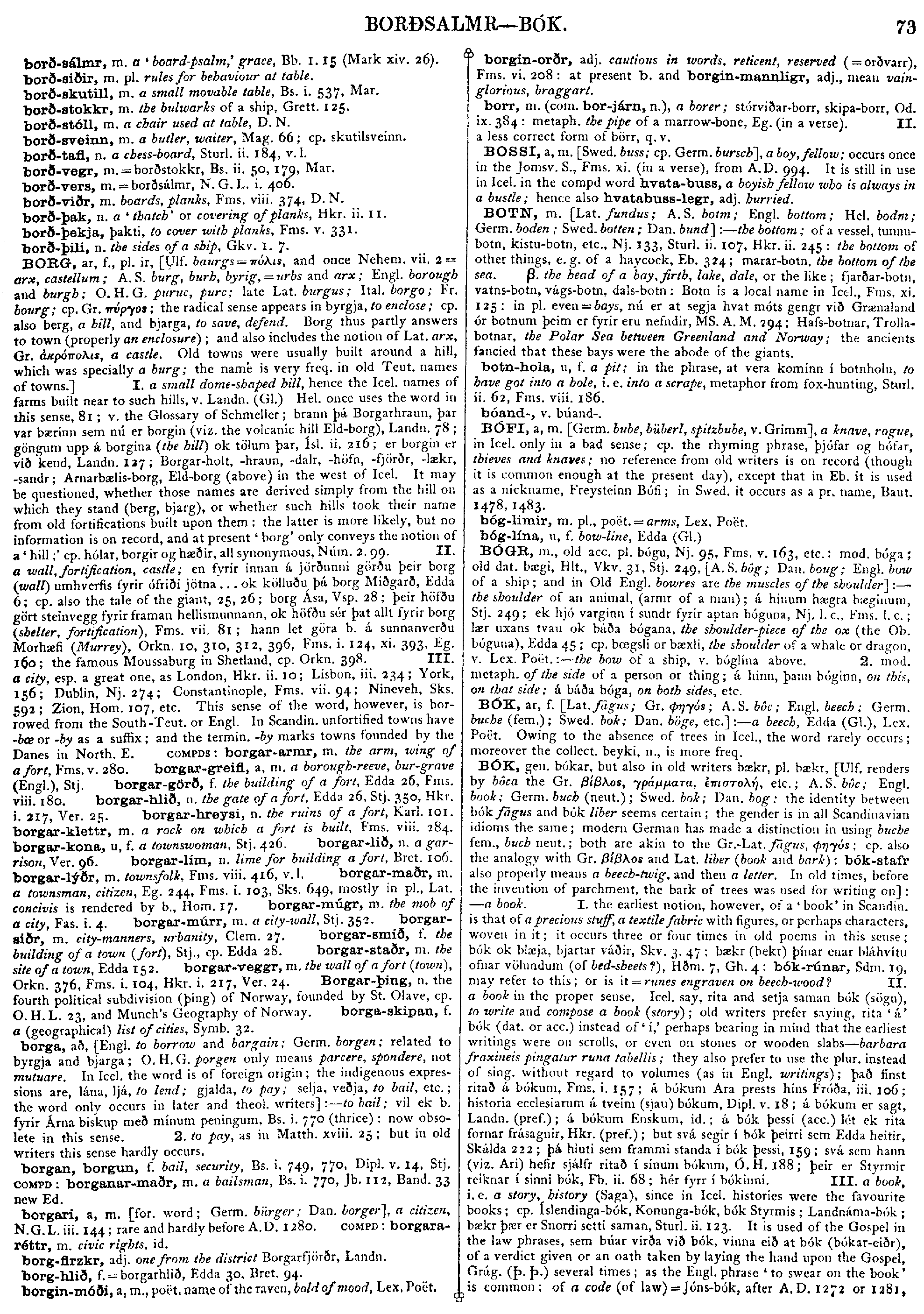
BORG, ar, f., pl. ir, [Ulf. baurgs = GREEK, and once Nehem. vii. 2 = arx, castellum; A. S. burg, burh, byrig, = urbs and arx; Engl. borough and burgh; O. H. G. puruc, purc; late Lat. burgus; Ital. borgo; Fr. bourg; cp. Gr. GREEK; the radical sense appears in byrgja, to enclose; cp. also berg, a hill, and bjarga, to save, defend. Borg thus partly answers to town (properly an enclosure); and also includes the notion of Lat. arx, Gr. GREEK, a castle. Old towns were usually built around a hill, which was specially a burg; the name is very freq. in old Teut. names of towns.] I. a small dome-shaped hill, hence the Icel. names of farms built near to such hills, v. Landn. (Gl.) Hel. once uses the word in this sense, 81; v. the Glossary of Schmeller; brann þá Borgarhraun, þar var bærinn sem nú er borgin (viz. the volcanic hill Eld-borg), Landn. 78; göngum upp á borgina (the hill) ok tölum þar, Ísl. ii. 216; er borgin er við kend, Landn. 127; Borgar-holt, -hraun, -dalr, -höfn, -fjörðr, -lækr, -sandr; Arnarbælis-borg, Eld-borg (above) in the west of Icel. It may be questioned, whether those names are derived simply from the hill on which they stand (berg, bjarg), or whether such hills took their name from old fortifications built upon them: the latter is more likely, but no information is on record, and at present 'borg' only conveys the notion of a 'hill;' cp. hólar, borgir og hæðir, all synonymous, Núm. 2. 99. II. a wall, fortification, castle; en fyrir innan á jörðunni görðu þeir borg (wall) umhverfis fyrir ófriði jötna ... ok kölluðu þá borg Miðgarð, Edda 6; cp. also the tale of the giant, 25, 26; borg Ása, Vsp. 28; þeir höfðu gört steinvegg fyrir framan hellismunnann, ok höfðu sér þat allt fyrir borg (shelter, fortification), Fms. vii. 81; hann let göra b. á sunnanverðu Morhæfi (Murrey), Orkn. 10, 310, 312, 396, Fms. i. 124, xi. 393, Eg. 160; the famous Moussaburg in Shetland, cp. Orkn. 398. III. a city, esp. a great one, as London, Hkr. ii. 10; Lisbon, iii. 234; York, 156; Dublin, Nj. 274; Constantinople, Fms. vii. 94; Nineveh, Sks. 592; Zion, Hom. 107, etc. This sense of the word, however, is borrowed from the South-Teut. or Engl. In Scandin. unfortified towns have -bæ or -by as a suffix; and the termin. -by marks towns founded by the Danes in North. E. COMPDS: borgar-armr, m. the arm, wing of a fort, Fms. v. 280. borgar-greifi, a, m. a borough-reeve, bur-grave (Engl.), Stj. borgar-görð, f. the building of a fort, Edda 26, Fms. viii. 180. borgar-hlið, n. the gate of a fort, Edda 26, Stj. 350, Hkr. i. 217, Ver. 25. borgar-hreysi, n. the ruins of a fort, Karl. 101. borgar-klettr, m. a rock on which a fort is built, Fms. viii. 284. borgar-kona, u, f. a townswoman, Stj. 426. borgar-lið, n. a garrison, Ver. 96. borgar-lím, n. lime for building a fort, Bret. 106. borgar-lýðr, m. townsfolk, Fms. viii. 416, v.l. borgar-maðr, m. a townsman, citizen, Eg. 244, Fms. i. 103, Sks. 649, mostly in pl., Lat. concivis is rendered by b., Hom. 17. borgar-múgr, m. the mob of a city, Fas. i. 4. borgar-múrr, m. a city-wall, Stj. 352. borgar-siðr, m. city-manners, urbanity, Clem. 27. borgar-smíð, f. the building of a town (fort), Stj., cp. Edda 28. borgar-staðr, m. the site of a town, Edda 152. borgar-veggr, m. the wall of a fort (town), Orkn. 376, Fms. i. 104, Hkr. i. 217, Ver. 24. Borgar-þing, n. the fourth political subdivision (þing) of Norway, founded by St. Olave, cp. O. H. L. 23, and Munch's Geography of Norway. borga-skipan, f. a (geographical) list of cities, Symb. 32.
|
Source: Cleasby/Vigfusson, page b0082, entry 32 View original page image as: [TIFF] [PNG] [View previous entry] [View next entry] |
[Comment on this entry] [View comments] |
The following entry has been hand-corrected once. |
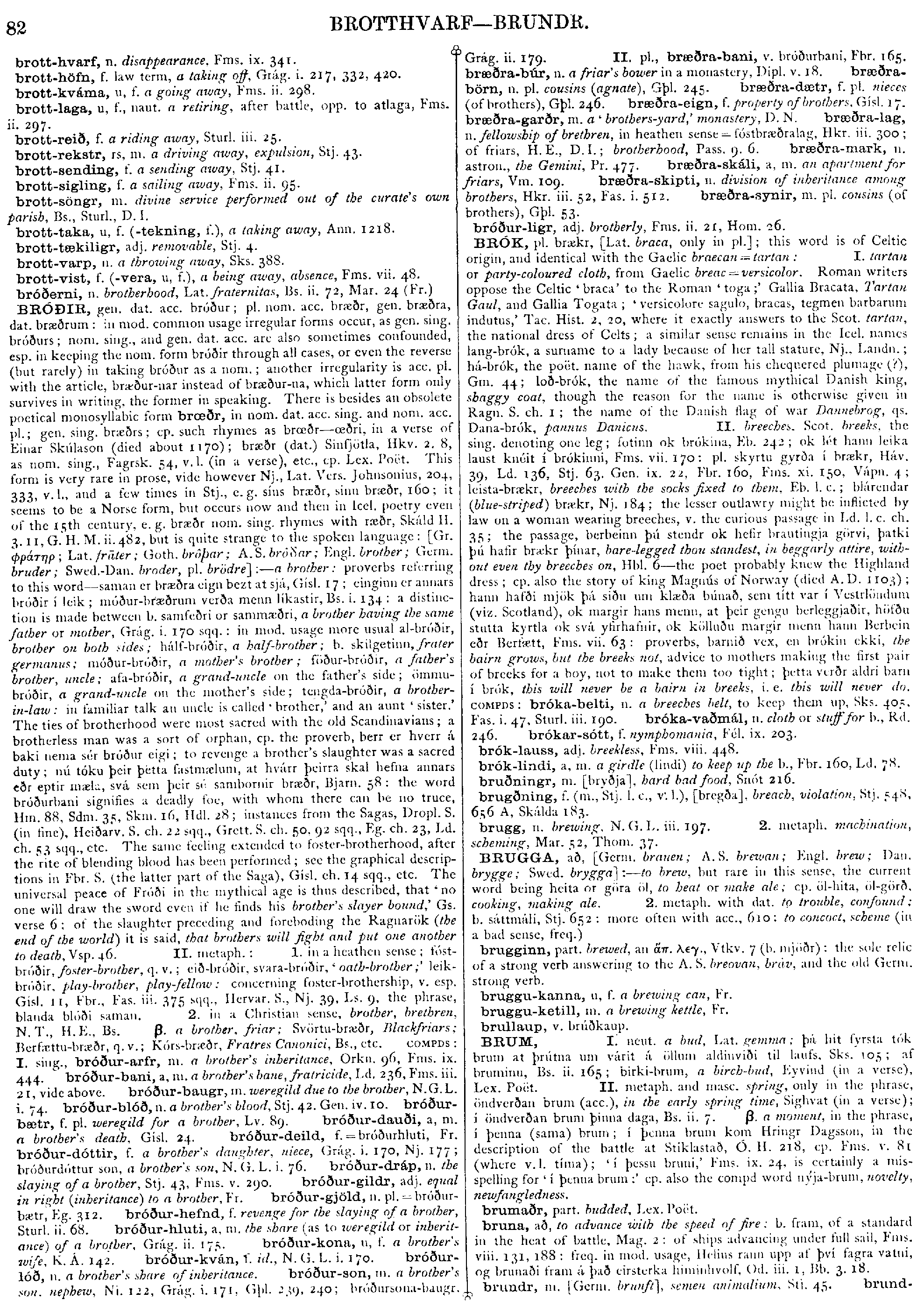
tíð, f. the time when the ewes are blæsma (in Icel. usually the month of December), Bs. i. 873, Vm. 80.
|
Source: Cleasby/Vigfusson, page b0088, entry 27 View original page image as: [TIFF] [PNG] [View previous entry] [View next entry] |
[Comment on this entry] [View comments] |
The following entry has been hand-corrected once. |
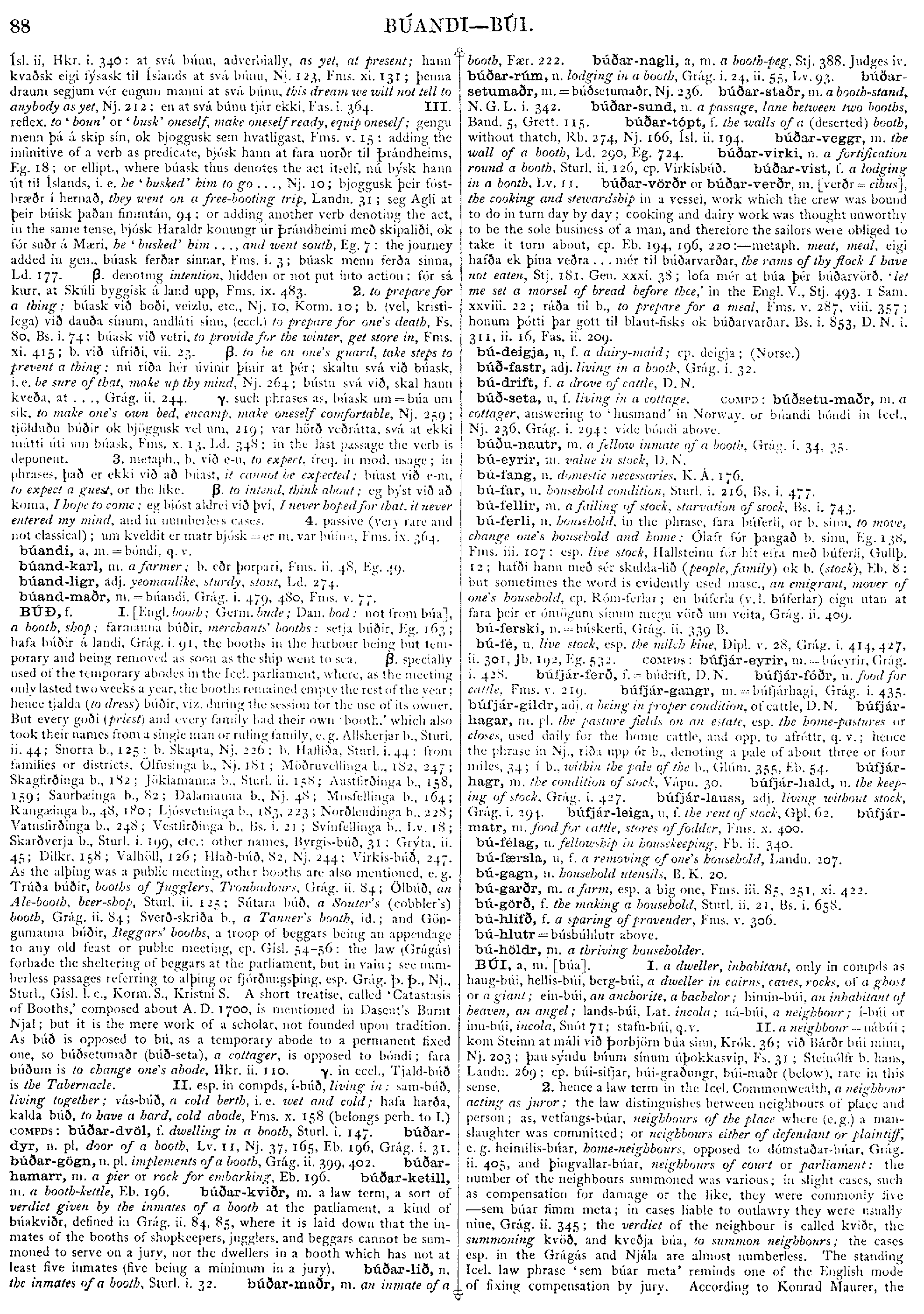
BÚI, a, m. [búa]. I. a dweller, inhabitant, only in compds as haug-búi, hellis-búi, berg-búi, a dweller in cairns, caves, rocks, of a ghost or a giant; ein-búi, an anchorite, a bachelor; himin-búi, an inhabitant of heaven, an angel; lands-búi, Lat. incola; ná-búi, a neighbour; í-búi or inn-búi, incola, Snót 71; stafn-búi, q.v. II. a neighbour = nábúi; kom Steinn at máli við Þorbjörn búa sinn, Krók. 36; við Bárðr búi minn, Nj. 203; þau sýndu búum sínum úþokkasvip, Fs. 31; Steinólfr b. hans, Landn. 269; cp. búi-sifjar, búi-graðungr, búi-maðr (below), rare in this sense. 2. hence a law term in the Icel. Commonwealth, a neighbour acting as juror; the law distinguishes between neighbours of place and person; as, vetfangs-búar, neighbours of the place where (e.g.) a manslaughter was committed; or neighbours either of defendant or plaintiff, e.g. heimilis-búar, home-neighbours, opposed to dómstaðar-búar, Grág. ii. 405, and þingvallar-búar, neighbours of court or parliament: the number of the neighbours summoned was various; in slight cases, such as compensation for damage or the like, they were commonly five--sem búar fimm meta; in cases liable to outlawry they were usually nine, Grág. ii. 345; the verdict of the neighbour is called kviðr, the summoning kvöð, and kveðja búa, to summon neighbours; the cases esp. in the Grágás and Njála are almost numberless. The standing Icel. law phrase 'sem búar meta' reminds one of the English mode of fixing compensation by jury. According to Konrad Maurer,
|
Source: Cleasby/Vigfusson, page b0089, entry 19 View original page image as: [TIFF] [PNG] [View previous entry] [View next entry] |
[Comment on this entry] [View comments] |
The following entry has been hand-corrected once. |
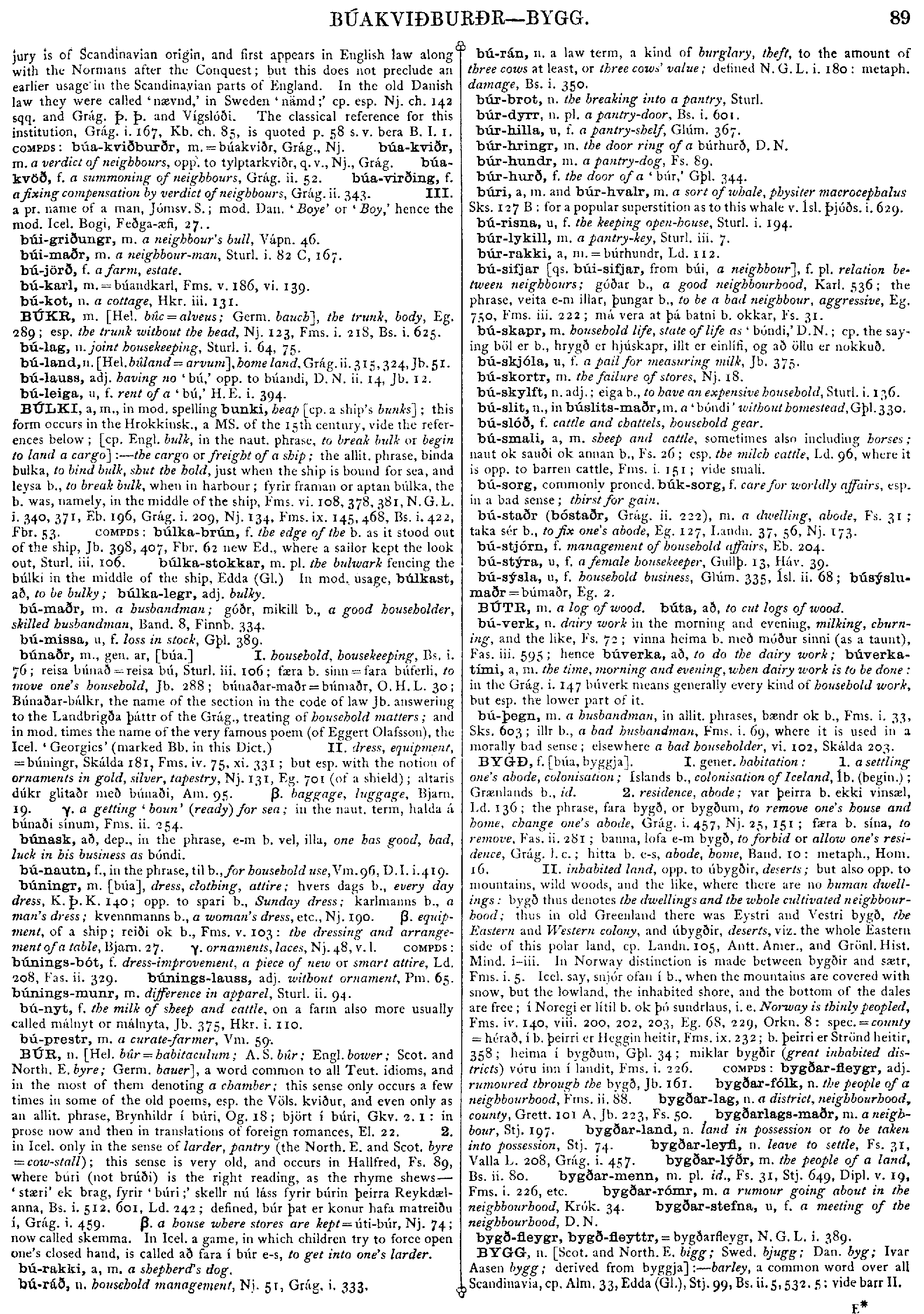
bú-nyt, f. the milk of sheep and cattle, on a farm also more usually called málnyt or málnyta, Jb. 375, Hkr. i. 110.
|
Source: Cleasby/Vigfusson, page b0093, entry 1 View original page image as: [TIFF] [PNG] [View previous entry] [View next entry] |
[Comment on this entry] [View comments] |
The following entry has been hand-corrected once. |
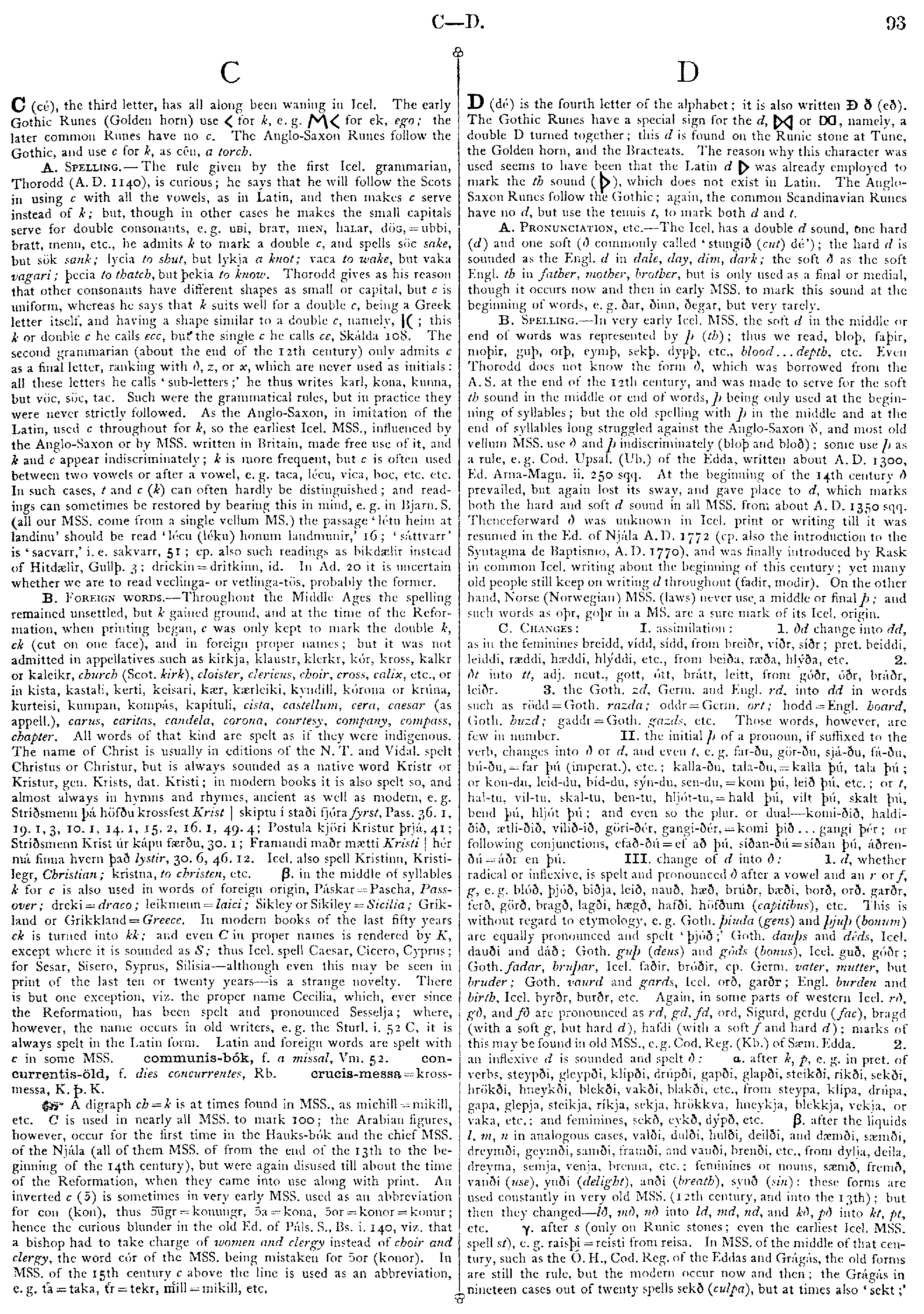
C
(cé),
the
third
letter,
has
all
along
been
waning
in
Icel.
The
early
Gothic
Runes
(Golden
horn)
use
RUNE
for
k,
e.g.
RUNE
for
ek,
ego;
the
later
common
Runes
have
no
c.
The
Anglo-Saxon
Runes
follow
the
Gothic,
and
use
c
tor
k,
as
cén,
a
torch.
A.
SPELLING.
--
The
rule
given
by
the
first
Icel.
grammarian,
Thorodd
(A.D.
1140),
is
curious;
he
says
that
he
will
follow
the
Scots
in
using
c
with
all
the
vowels,
as
in
Latin,
and
then
makes
c
serve
instead
of
k;
but,
though
in
other
cases
he
makes
the
small
capitals
serve
for
double
consonants,
e.
g.
uBi,
braT,
meN,
haLar,
döG,
=
ubbi,
bratt,
menn,
etc.,
he
admits
k
to
mark
a
double
c,
and
spells
söc
sake,
but
sök
sank;
lycia
to
shut,
but
lykja
a
knot;
vaca
to
wake,
but
vaka
vagari;
þecia
to
thatch,
but
þekia
to
know.
Thorodd
gives
as
his
reason
that
other
consonants
have
different
shapes
as
small
or
capital,
but
c
is
uniform,
whereas
he
says
that
k
suits
well
for
a
double
c,
being
a
Greek
letter
itself,
and
having
a
shape
similar
to
a
double
c,
namely,
RUNE;
this
k
or
double
c
he
calls
ecc,
but
the
single
c
he
calls
ce,
Skálda
108.
The
second
grammarian
(about
the
end
of
the
12th
century)
only
admits
c
as
a
final
letter,
ranking
with
ð,
z,
or
x,
which
are
never
used
as
initials:
all
these
letters
he
calls
'sub-letters;'
he
thus
writes
karl,
kona,
kunna,
but
vöc,
söc,
tac.
Such
were
the
grammatical
rules,
but
in
practice
they
were
never
strictly
followed.
As
the
Anglo-Saxon,
in
imitation
of
the
Latin,
used
c
throughout
for
k,
so
the
earliest
Icel.
MSS.,
influenced
by
the
Anglo-Saxon
or
by
MSS.
written
in
Britain,
made
free
use
of
it,
and
k
and
c
appear
indiscriminately;
k
is
more
frequent,
but
c
is
often
used
between
two
vowels
or
after
a
vowel,
e.g.
taca,
lécu,
vica,
hoc,
etc.
etc.
In
such
cases,
t
and
c
(k)
can
often
hardly
be
distinguished;
and
readings
can
sometimes
be
restored
by
bearing
this
in
mind,
e.g.
in
Bjarn.
S.
(all
our
MSS.
come
from
a
single
vellum
MS.)
the
passage
'létu
heim
at
landinu'
should
be
read
'lécu
(léku)
honum
landmunir,'
16;
'
sáttvarr'
is
'sacvarr,'
i.e.
sakvarr,
51;
cp.
also
such
readings
as
bikdælir
instead
of
Hitdælir,
Gullþ.
3;
drickin
=
dritkinn,
id.
In
Ad.
20
it
is
uncertain
whether
we
are
to
read
veclinga-
or
vetlinga-tös,
probably
the
former.
B.
FOREIGN
WORDS.
--
Throughout
the
Middle
Ages
the
spelling
remained
unsettled,
but
k
gained
ground,
and
at
the
time
of
the
Reformation,
when
printing
began,
c
was
only
kept
to
mark
the
double
k,
ek
(cut
on
one
face),
and
in
foreign
proper
names;
but
it
was
not
admitted
in
appellatives
such
as
kirkja,
klaustr,
klerkr,
kór,
kross,
kalkr
or
kaleikr,
church
(Scot,
kirk),
cloister,
clericus,
choir,
cross,
calix,
etc.,
or
in
kista,
kastali,
kerti,
keisari,
kær,
kærleiki,
kyndill,
kórona
or
krúna,
kurteisi,
kumpan,
kompás,
kapítuli,
cista,
castellum,
cern,
caesar
(as
appell.),
carus,
caritas,
candela,
corona,
courtesy,
company,
compass,
chapter.
All
words
of
that
kind
are
spelt
as
if
they
were
indigenous.
The
name
of
Christ
is
usually
in
editions
of
the
N.T.
and
Vidal.
spelt
Christus
or
Christur,
but
is
always
sounded
as
a
native
word
Kristr
or
Kristur,
gen.
Krists,
dat.
Kristi;
in
modern
books
it
is
also
spelt
so,
and
almost
always
in
hymns
and
rhymes,
ancient
as
well
as
modern,
e.g.
Stríðsmenn
þá
höfðu
krossfest
Krist
|
skiptu
í
staði
fjóra
fyrst,
Pass.
36.
I,
19.1,
3,
10.1,
14.1,
15.2,
16.1,
49.4;
Postula
kjöri
Kristur
þrjá,
41;
Stríðsmenn
Krist
úr
kúpu
færðu,
30.1;
Framandi
maðr
mætti
Kristi
|
hér
má
fínna
hvern
það
lystir,
30.6,
46.12.
Icel.
also
spell
Kristinn,
Kristilegr,
Christian;
kristna,
to
christen,
etc.
 .
in
the
middle
of
syllables
k
for
c
is
also
used
in
words
of
foreign
origin,
Páskar
=
Pascha,
Passover;
dreki
=
draco;
leikmenn
=
laici;
Sikley
or
Sikiley
=
Sicilia;
Grikland
or
Grikkland
=
Greece.
In
modern
books
of
the
last
fifty
years
ck
is
turned
into
kk;
and
even
C
in
proper
names
is
rendered
by
K,
except
where
it
is
sounded
as
S;
thus
Icel.
spell
Caesar,
Cicero,
Cyprus;
for
Sesar,
Sisero,
Syprus,
Silisia
--
although
even
this
may
be
seen
in
print
of
the
last
ten
or
twenty
years
--
is
a
strange
novelty.
There
is
but
one
exception,
viz.
the
proper
name
Cecilia,
which,
ever
since
the
Reformation,
has
been
spelt
and
pronounced
Sesselja;
where,
however,
the
name
occurs
in
old
writers,
e.g.
the
Sturl.
i.
52
C,
it
is
always
spelt
in
the
Latin
form.
Latin
and
foreign
words
are
spelt
with
c
in
some
MSS.
communis-bók,
f.
a
missal,
Vm.
52.
concurrentis-öld,
f.
dies
concurrentes,
Rb.
crucis-messa
=
kross-messa,
K.Þ.K.
&hand;
A
digraph
ch
=
k
is
at
times
found
in
MSS.,
as
michill
=
mikill,
etc.
C
is
used
in
nearly
all
MSS.
to
mark
100;
the
Arabian
figures,
however,
occur
for
the
first
time
in
the
Hauks-bók
and
the
chief
MSS.
of
the
Njála
(all
of
them
MSS.
of
from
the
end
of
the
13th
to
the
beginning
of
the
14th
century),
but
were
again
disused
till
about
the
time
of
the
Reformation,
when
they
came
into
use
along
with
print.
An
inverted
c
(&c-reversed-long;)
is
sometimes
in
very
early
MSS.
used
as
an
abbreviation
for
con
(kon),
thus
&c-reversed-long;ugr
=
konungr,
&c-reversed-long;a
=
kona,
&c-reversed-long;or
=
konor
=
konur;
hence
the
curious
blunder
in
the
old
Kd.
of
Páls.
S.,
Bs.
i.
140,
viz.
that
a
bishop
had
to
take
charge
of
women
and
clergy
instead
of
choir
and
clergy,
the
word
cór
of
the
MSS.
being
mistaken
for
&c-reversed-long;or
(konor).
In
MSS.
of
the
15th
century
c
above
the
line
is
used
as
an
abbreviation,
e.g.
t&c-super;a
=
taka,
t&c-super;r
=
tekr,
m&c-super;ill
=
mikill,
etc.
.
in
the
middle
of
syllables
k
for
c
is
also
used
in
words
of
foreign
origin,
Páskar
=
Pascha,
Passover;
dreki
=
draco;
leikmenn
=
laici;
Sikley
or
Sikiley
=
Sicilia;
Grikland
or
Grikkland
=
Greece.
In
modern
books
of
the
last
fifty
years
ck
is
turned
into
kk;
and
even
C
in
proper
names
is
rendered
by
K,
except
where
it
is
sounded
as
S;
thus
Icel.
spell
Caesar,
Cicero,
Cyprus;
for
Sesar,
Sisero,
Syprus,
Silisia
--
although
even
this
may
be
seen
in
print
of
the
last
ten
or
twenty
years
--
is
a
strange
novelty.
There
is
but
one
exception,
viz.
the
proper
name
Cecilia,
which,
ever
since
the
Reformation,
has
been
spelt
and
pronounced
Sesselja;
where,
however,
the
name
occurs
in
old
writers,
e.g.
the
Sturl.
i.
52
C,
it
is
always
spelt
in
the
Latin
form.
Latin
and
foreign
words
are
spelt
with
c
in
some
MSS.
communis-bók,
f.
a
missal,
Vm.
52.
concurrentis-öld,
f.
dies
concurrentes,
Rb.
crucis-messa
=
kross-messa,
K.Þ.K.
&hand;
A
digraph
ch
=
k
is
at
times
found
in
MSS.,
as
michill
=
mikill,
etc.
C
is
used
in
nearly
all
MSS.
to
mark
100;
the
Arabian
figures,
however,
occur
for
the
first
time
in
the
Hauks-bók
and
the
chief
MSS.
of
the
Njála
(all
of
them
MSS.
of
from
the
end
of
the
13th
to
the
beginning
of
the
14th
century),
but
were
again
disused
till
about
the
time
of
the
Reformation,
when
they
came
into
use
along
with
print.
An
inverted
c
(&c-reversed-long;)
is
sometimes
in
very
early
MSS.
used
as
an
abbreviation
for
con
(kon),
thus
&c-reversed-long;ugr
=
konungr,
&c-reversed-long;a
=
kona,
&c-reversed-long;or
=
konor
=
konur;
hence
the
curious
blunder
in
the
old
Kd.
of
Páls.
S.,
Bs.
i.
140,
viz.
that
a
bishop
had
to
take
charge
of
women
and
clergy
instead
of
choir
and
clergy,
the
word
cór
of
the
MSS.
being
mistaken
for
&c-reversed-long;or
(konor).
In
MSS.
of
the
15th
century
c
above
the
line
is
used
as
an
abbreviation,
e.g.
t&c-super;a
=
taka,
t&c-super;r
=
tekr,
m&c-super;ill
=
mikill,
etc.
|
Source: Cleasby/Vigfusson, page b0093, entry 28 View original page image as: [TIFF] [PNG] [View previous entry] [View next entry] |
[Comment on this entry] [View comments] |
The following entry has been hand-corrected once. |
dag-mál, n. (vide dagr), prop. 'day-meal,' one of the divisions of the day, usually about 8 or 9 o'clock A. M.; the Lat. hora tertia is rendered by 'er vér köllum dagmál, 'which we call d., Hom. 142; cnn er ekki liðit af dagmálum, Hom. (St.) 10. Acts ii. 15; in Glúm. 342 we are told that the young Glum was very lazy, and lay in bed till day-meal every morning, cp. also 343; Hrafn. 28 and O.H.L. 18 -- á einum morni milli rismála ok dagmála -- where distinction is made between rismál (rising time) and dagmál, so as to make a separate dagsmark (q.v.) of each of them; and again, a distinction is made between 'midday' and dagmal, Ísl. ii. 334. The dagmal is thus midway between 'rising' and 'midday,' which accords well with the present use. The word is synonymous with dagverðarmál, breakfast-time, and denotes the hour when the ancient Icel. used to take their chief meal, opposed to náttmál, night-meal or supper-time, Fms. viii. 330; even the MSS. use dagmál and dagverðarmál indiscriminately; cp. also Sturl. iii. 4 C; Rb. 452 says that at full moon the ebb takes place 'at dagmálum.' To put the dagmál at 7.30 A.M., as Pál Vídalin does, seems neither to acccord with the present use nor the passage in Glum or the eccl. hora tertia, which was the nearest hour answering to the Icel, calculation of the day. In Fb. i. 539 it is said that the sun set at 'eykð' (i.e. half-past three o'clock), but rose at 'dagmál' which puts the dagmal at 8.30 A.M. COMPDS: dagmála- staðr, m. the place of d. in the horizon, Fb. I. dagmala-tið, f. morning terce, 625. 176.
|
Source: Cleasby/Vigfusson, page b0096, entry 8 View original page image as: [TIFF] [PNG] [View previous entry] [View next entry] |
[Comment on this entry] [View comments] |
The following entry has been hand-corrected once. |
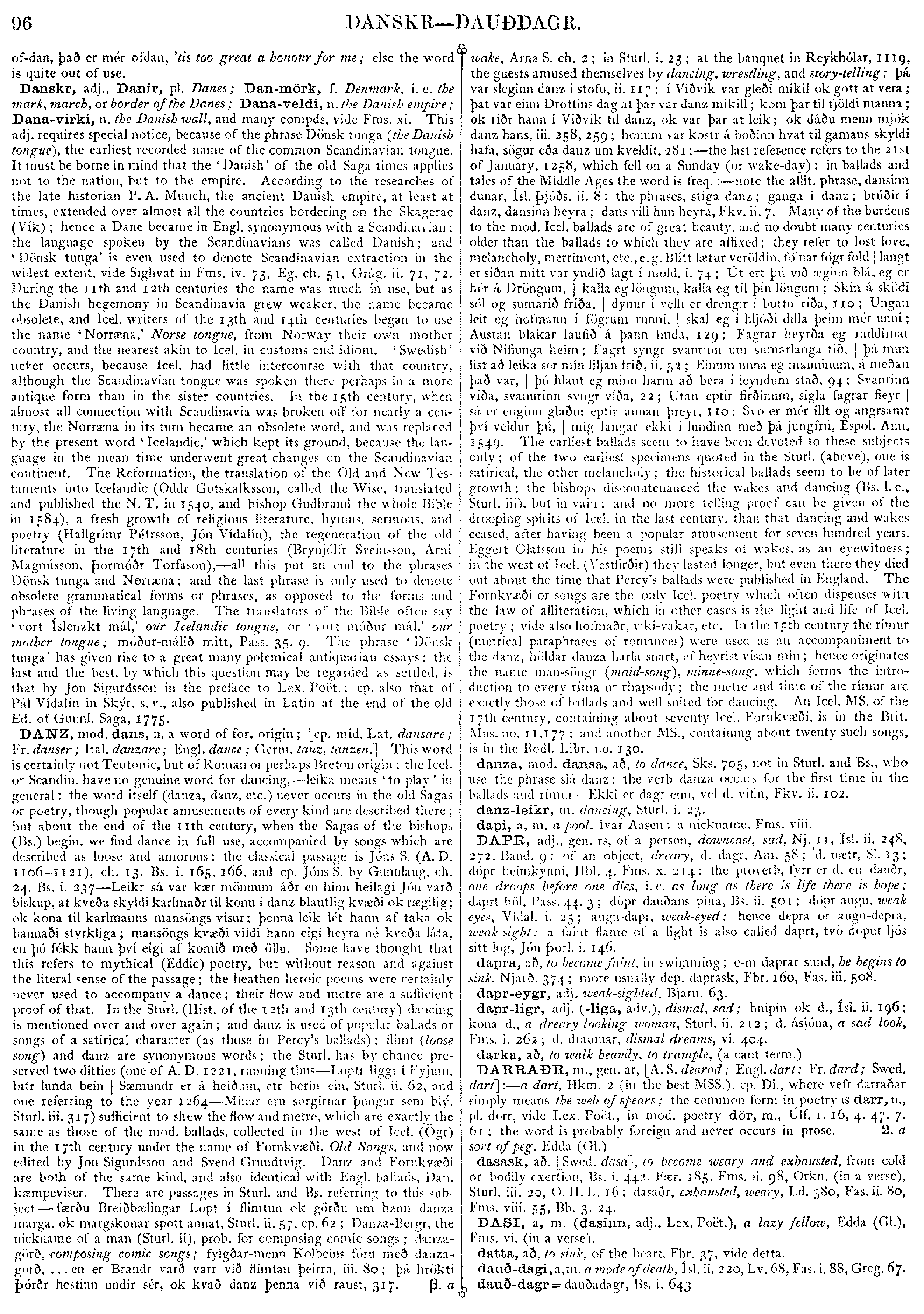
dapra, að, to become faint, in swimming; e-m daprar sund, he begins to sink, Njarð. 374; more usually dep. daprask, Fbr. 160, Fas. iii. 508.
| Result Page: |  |
Previous | 1 2 3 4 5 6 7 8 9 10 11 12 | Next |  |
Germanic Lexicon Project (main page)
This search system was written by
Sean Crist
Please consider
volunteering
to correct the data in these online dictionaries.
No rights reserved. Feel free to use these data in any way you please.