|
|

|
Source: Cleasby/Vigfusson, page b0438, entry 10 View original page image as: [TIFF] [PNG] [View previous entry] [View next entry] |
[Comment on this entry] [View comments] |
The following entry has been hand-corrected once. |
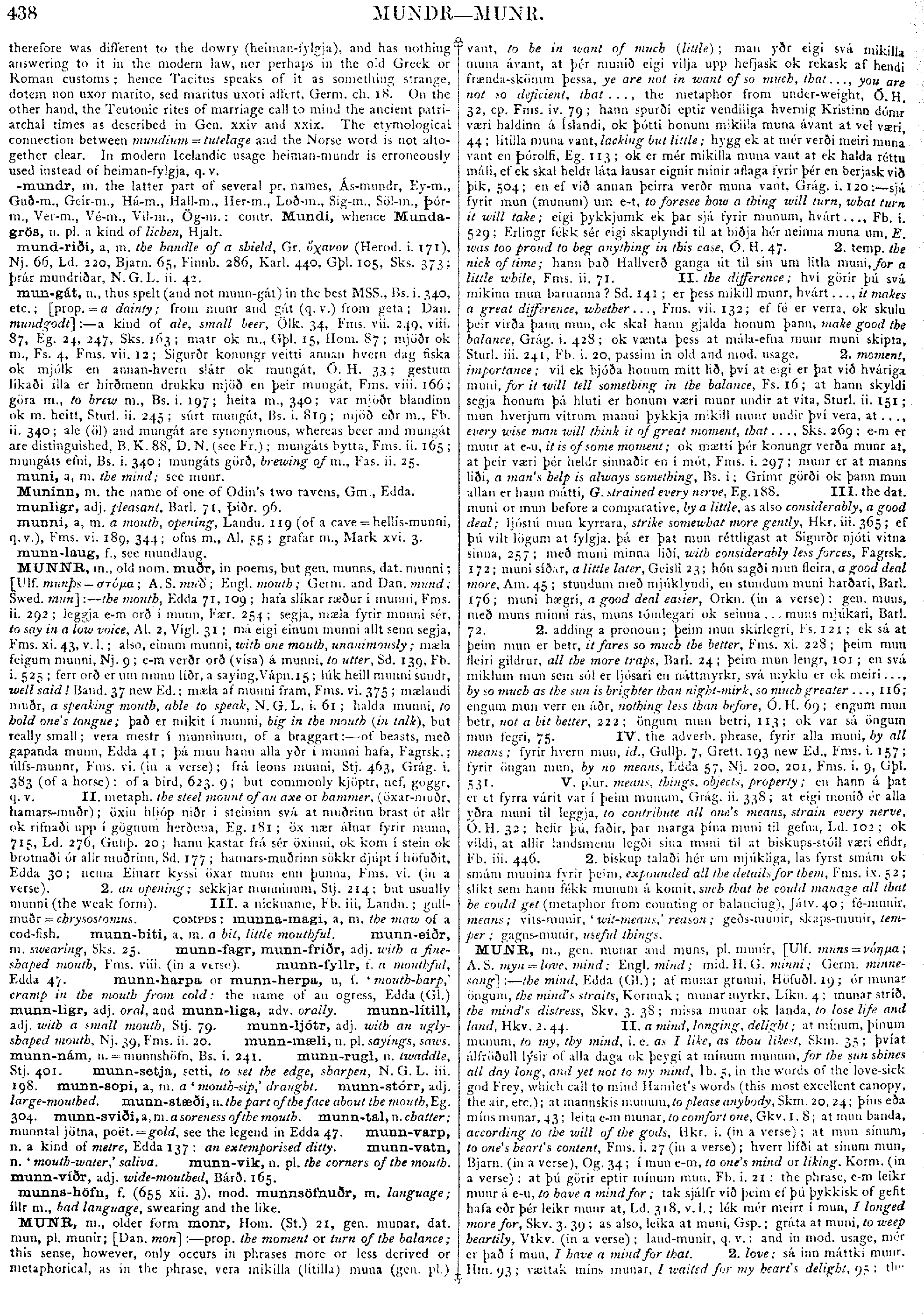
MUNNR, m., old nom. muðr, in poems, but gen. munns, dat. munni; [Ulf. munþs = GREEK; A.S. muð Engl. mouth; Germ. and Dan. mund; Swed. mun] :-- the mouth, Edda 71, 109; hafa slíkar ræður í munni, Fms. ii. 292; leggya e-m orð í munn, Fær. 254; segja, mæla fyrir munni sér, to say in a low voice, Al. 2, Vígl. 31; má eigi einum munni allt senn segja, Fms. xi. 43, v.l.; also, einum munni, with one mouth, unanimously; mæla feigum munni, Nj. 9; e-m verðr orð (vísa) á munni, to utter, Sd. 139, Fb. i. 525; ferr orð er um munn líðr, a saying, Vápn. 15; lúk heill munni sundr, well said! Band. 37 new Ed.; mæla af munni fram, Fms. vi. 375; mælandi muðr, a speaking mouth, able to speak, N.G.L. i. 61; halda munni, to hold one's tongue; það er mikit í munni, big in the mouth (in talk), but really small; vera mestr í munninum, of a braggart :-- of beasts, með gapanda munn, Edda 41; þá mun hann alla yðr í munni hafa, Fagrsk.; úlfs-munnr, Fms. vi. (in a verse); frá leons munni, Stj. 463, Grág. i. 383 (of a horse): of a bird, 623. 9; but commonly kjöptr, nef, goggr, q.v. II. metaph. the steel mount of an axe or hammer, (öxar-muðr, hamars-muðr); öxin hljóp niðr í steininn svá at muðrinn brast ór allr ok rifnaði upp í gögnum herðuna, Eg. 181; öx nær álnar fyrir munn, 715, Ld. 276, Gullþ. 20; hann kastar frá sér öxinni, ok kom í stein ok brotnaði ór allr muðrinn, Sd. 177; hamars-muðrinn sökkr djúpt í höfuðit, Edda 30; nema Einarr kyssi öxar munn enn þunna, Fms. vi. (in a verse). 2. an opening; sekkjar munninum, Stj. 214; but usually munni (the weak form). III. a nickname, Fb. iii, Landn.; gull-muðr = chrysostomus. COMPDS: munna-magi, a, m. the maw of a cod-fish. munn-biti, a, m. a bit, little mouthful. munn-eiðr, m. swearing, Sks. 25. munn-fagr, munn-fríðr, adj. with a fine-shaped mouth, Fms. viii, (in a verse). munn-fyllr, f. a mouthful, Edda 47. munn-harpa or munn-herpa, u, f. 'mouth-harp,' cramp in the mouth from cold: the name of an ogress, Edda (Gl.) munn-ligr, adj. oral, and munn-liga, adv. orally. munn-lítill, adj. with a small mouth, Stj. 79. munn-ljótr, adj. with an ugly-shaped mouth, Nj. 39, Fms. ii. 20. munn-mæli, n. pl. sayings, saws. munn-nám, n. = munnshöfn, Bs. i. 241. munn-rugl, n. twaddle, Stj. 401. munn-setja, setti, to set the edge, sharpen, N.G.L. iii. 198. muunn-sopi, a, m. a 'mouth-sip,' draught. munn-stórr, adj. large-mouthed. munn-stæði, n. the part of the face about the mouth, Eg. 304. munn-sviði, a, m. a soreness of the mouth, munn-tal, n. chatter; munntal jötna, poët. = gold, see the legend in Edda 47. munn-varp, n. a kind of metre, Edda 137: an extemporised ditty. munn-vatn, n. 'mouth-water,' saliva. munn-vik, n. pl. the corners of the mouth. munn-víðr, adj. wide-mouthed, Bárð. 165.
|
Source: Cleasby/Vigfusson, page b0444, entry 24 View original page image as: [TIFF] [PNG] [View previous entry] [View next entry] |
[Comment on this entry] [View comments] |
The following entry has been hand-corrected once. |
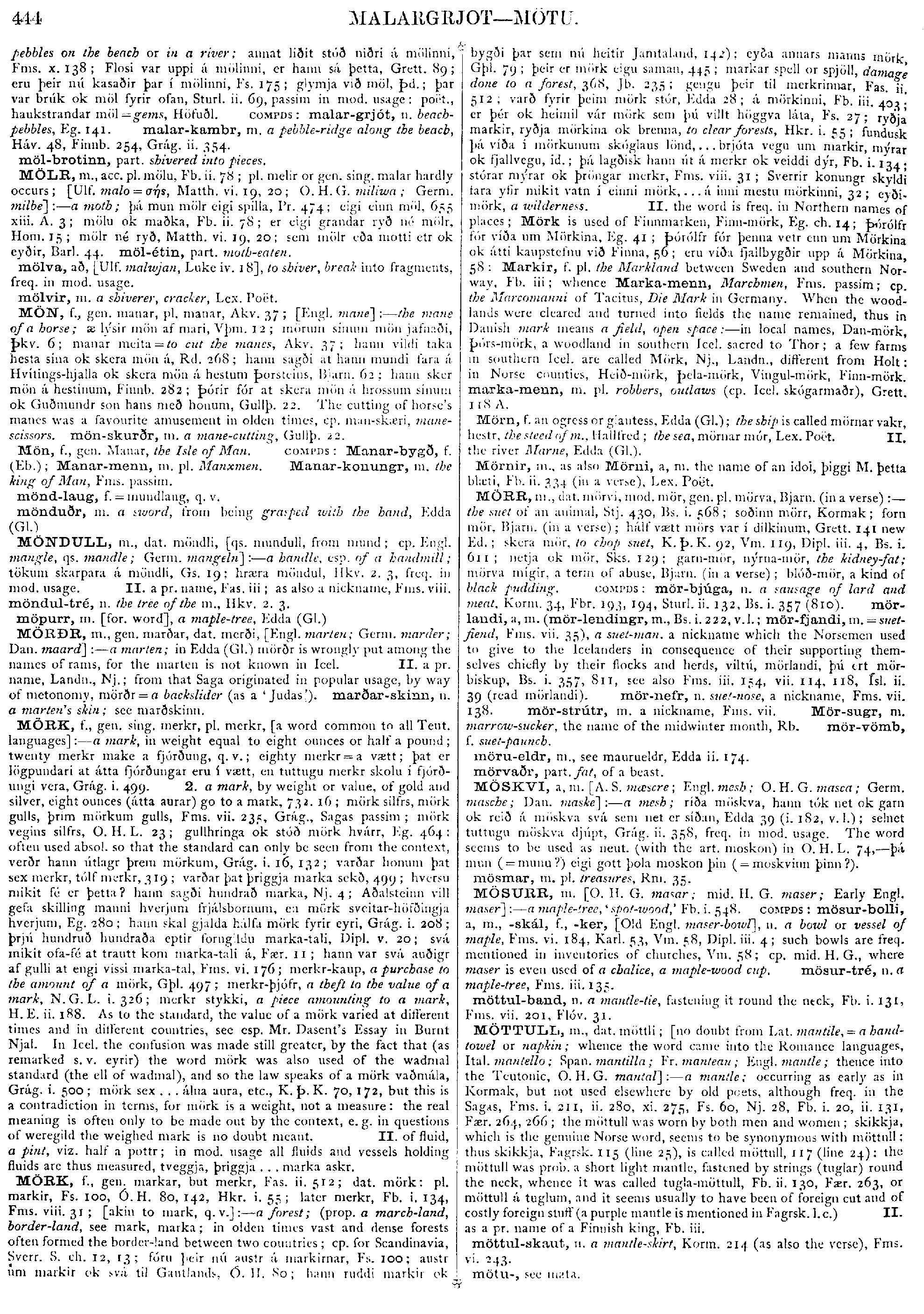
MÖTTULL, m., dat. möttli; [no doubt from Lat. mantile, = a hand-towel or napkin; whence the word came into the Romance languages, Ital. mantello; Span. mantilla; Fr. manteau; Engl. mantle; thence into the Teutonic, O.H.G. mantal] :-- a mantle; occurring as early as in Kormak, but not used elsewhere by old poets, although freq. in the Sagas, Fms. i. 211, ii. 280, xi. 275, Fs. 60, Nj. 28, Fb. i. 20, ii. 131, Fær. 264, 266; the möttull was worn by both men and women; skikkja, which is the genuine Norse word, seems to be synonymous with möttull; thus skikkja, Fagrsk. 115 (line 25), is called möttull, 117 (line 24): the möttull was prob. a short light mantle, fastened by strings (tuglar) round the neck, whence it was called tugla-möttull, Fb. ii. 130, Fær. 263, or möttull á tuglum, and it seems usually to have been of foreign cut and of costly foreign stuff (a purple mantle is mentioned in Fagrsk. l.c.) II. as a pr. name of a Finnish king, Fb. iii.
|
Source: Cleasby/Vigfusson, page b0457, entry 36 View original page image as: [TIFF] [PNG] [View previous entry] [View next entry] |
[Comment on this entry] [View comments] |
The following entry has been hand-corrected once. |
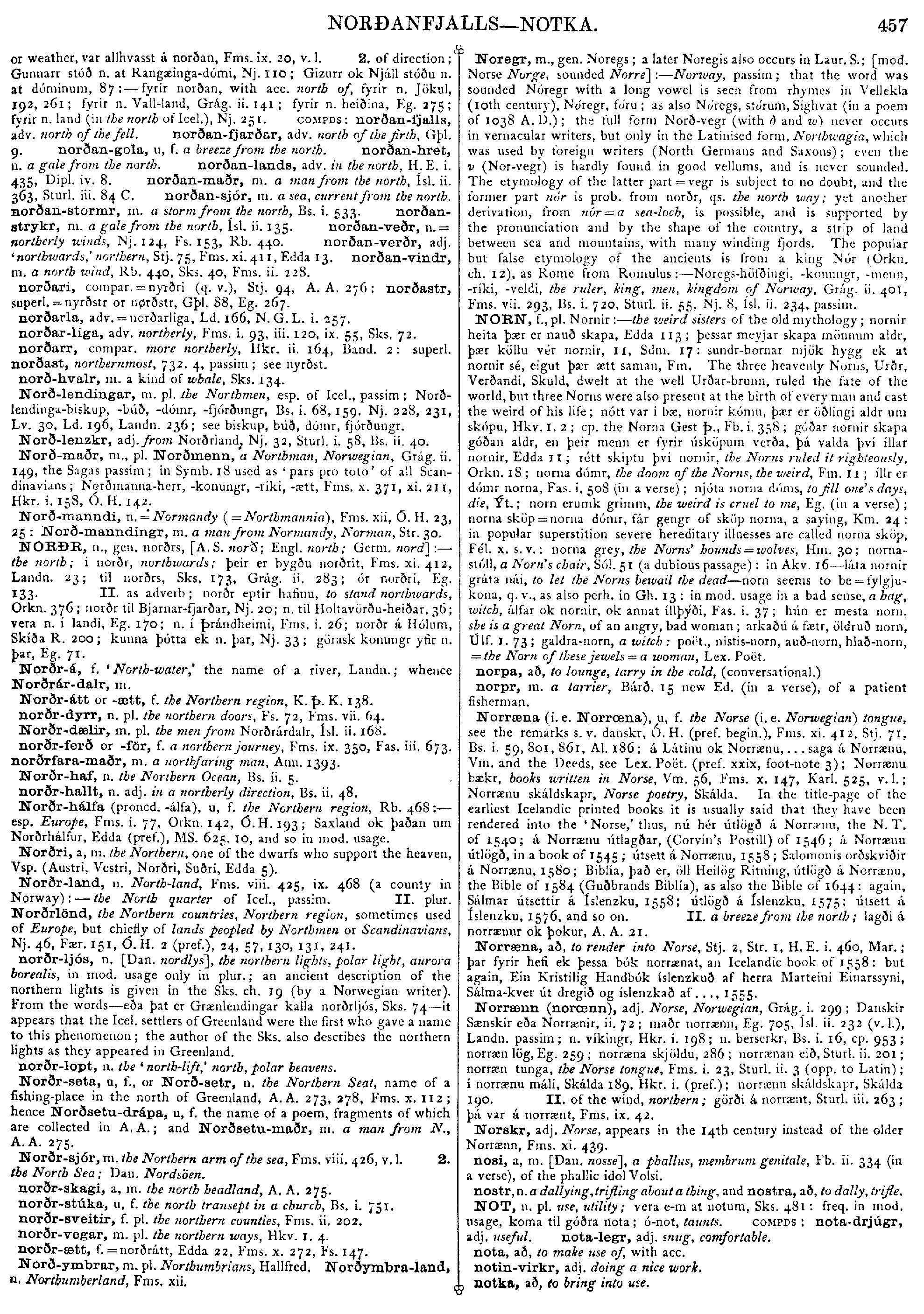
Norræna (i. e. Norrœna), u, f. the Norse (i. e. Norwegian) tongue, see the remarks s. v. danskr, Ó. H. (pref. begin.), Fms. xi. 412, Stj. 71, Bs. i. 59, 801, 861, Al. 186; á Látinu ok Norrænu, . . . saga á Norrænu, Vm. and the Deeds, see Lex. Poët. (pref. xxix, foot-note 3); Norrænu bækr, books written in Norse, Vm. 56, Fms. x. 147, Karl. 525, v. l.; Norrænu skáldskapr, Norse poetry, Skálda. In the title-page of the earliest Icelandic printed books it is usually said that they have been rendered into the 'Norse,' thus, nú hér útlögð á Norrænu, the N. T. of 1540; á Norrænu útlagðar, (Corvin's Postill) of 1546; á Norrænu útlögð, in a book of 1545; útsett á Norrænu, 1558; Salomonis orðskviðir á Norrænu, 1580; Biblía, það er, öll Heilög Ritning, útlögð á Norrænu, the Bible of 1584 (Guðbrands Biblía), as also the Bible of 1644: again, Sálmar útsettir á Íslenzku, 1558; útlögð á Íslenzku, 1575; útsett á Íslenzku, 1576, and so on. II. a breeze from the north; lagði á norrænur ok þokur, A. A. 21.
|
Source: Cleasby/Vigfusson, page b0465, entry 50 View original page image as: [TIFF] [PNG] [View previous entry] [View next entry] |
[Comment on this entry] [View comments] |
The following entry has been hand-corrected once. |
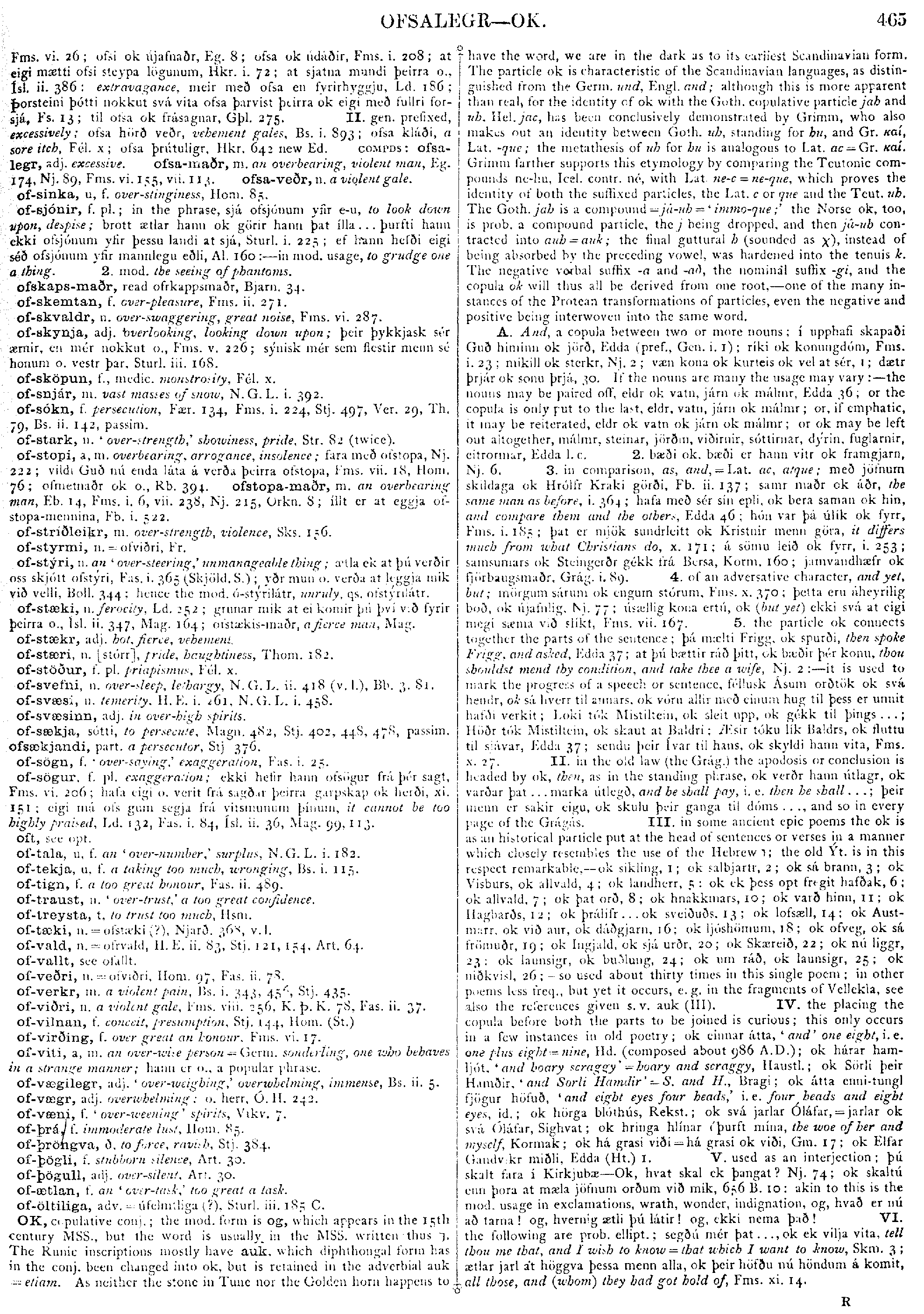
OK, copulative conj.; the mod. form is og, which appears in the 15th century MSS., but the word is usually in the MSS. written thus RUNE. The Runic inscriptions mostly have auk, which diphthongal form has in the conj. been changed into ok, but is retained in the adverbial auk = etiam. As neither the stone in Tune nor the Golden horn happens to have the word, we are in the dark as to its earliest Scandinavian form. The particle ok is characteristic of the Scandinavian languages, as distinguished from the Germ. und, Engl. and; although this is more apparent than real, for the identity of ok with the Goth. copulative particle jah and uh. Hel. jac, has been conclusively demonstrated by Grimm, who also makes out an identity between Goth. uh, standing for hu, and Gr. GREEK, Lat. -que; the metathesis of uh for hu is analogous to Lat. ac = Gr. GREEK. Grimm farther supports this etymology by comparing the Teutonic compounds ne-hu, Icel. contr. né, with Lat. ne-c = ne-que, which proves the identity of both the suffixed particles, the Lat. c or que and the Teut. uh. The Goth. jah is a compound = jâ-uh = 'immo-que;' the Norse ok, too, is prob. a compound particle, the j being dropped, and then jâ-uh contracted into auh = auk; the final guttural h (sounded as RUNE), instead of being absorbed by the preceding vowel, was hardened into the tenuis k. The negative verbal suffix -a and -að, the nominal suffix -gi, and the copula ok will thus all be derived from one root, -- one of the many instances of the Protean transformations of particles, even the negative and positive being interwoven into the same word. A. And, a copula between two or more nouns; í upphafi skapaði Guð himinn ok jörð, Edda (pref., Gen. i. 1); ríki ok konungdóm, Fms. i. 23; mikill ok sterkr, Nj. 2; væn kona ok kurteis ok vel at sér, 1; dætr þrjár ok sonu þrá, 30. If the nouns are many the usage may vary :-- the nouns may be paired off, eldr ok vatn, járn ok málmr, Edda 36; or the copula is only put to the last, eldr, vatn, járn ok málmr; or, if emphatic, it may be reiterated, eldr ok vatn ok járn ok málmr; or ok may be left out altogether, málmr. steinar, jörðin, viðirnir, sóttirnar, dýrin, fuglarnir, eitrormar, Edda l.c. 2. bæði ok, bæði er hann vitr ok framgjarn, Nj. 6. 3. in comparison, as, and, = Lat. ac, atque; með jöfnum skildaga ok Hrólfr Kraki görði, Fb. ii. 137; samr maðr ek áðr, the same man as before, i. 364; hafa með sér sín epli, ok bera saman ok hin, and compare them and the others, Edda 46; hón var þá úlík ok fyrr, Fms. i. 185; þat er mjök sundrleitt ok Kristnir menn göra, it differs much from what Christians do, x. 171; á sömu leið ok fyrr, i. 253; samsumars ok Steingerðr gékk frá Bersa, Korm. 160; jamvandhæfr ok flörbaugsmaðr, Grág. i. 89. 4. of an adversative character, and yet, but; mörgum sárum ok engum stórum, Fms. x. 370; þetta eru áheyrilig boð, ok újafnlig. Nj. 77; úsællig kona ertú, ok (but yet) ekki svá at eigi megi sæma við slíkt, Fms. vii. 167. 5. the particle ok connects together the parts of the sentence; þá mælti Frigg, ok spurði, then spoke Frigg, and asked, Edda 37; at þú bættir ráð þitt, ok bæðir þér konu, thou shouldst mend thy condition, and take thee a wife, Nj. 2 :-- it is used to mark the progress of a speech or sentence, féllusk Ásum orðtök ok svá hendr, ok sá hverr til annars, ok vóru allir með einum hug til þess er unnit hafði verkit; Loki tók. Mistiltein, ok sleit upp, ok gékk til þings ...; Höðr tók Mistiltein, ok skaut at Baldri; Æsir tóku lík Baldrs, ok fluttu til sjávar, Edda 37; sendu þeir Ívar til hans, ok skyldi hann vita, Fms. x. 27. II. in the old law (the Grág.) the apodosis or conclusion is headed by ok, then, as in the standing phrase, ok verðr hann útlagr, ok varðar þat ... marka útlegð, and he shall pay, i.e. then he shall ...; þeir menn er sakir eigu, ok skulu þeir ganga til dóms ..., and so in every page of the Grágás. III. in some ancient epic poems the ok is as an historical particle put at the head of sentences or verses in a manner which closely resembles the use of the Hebrew HEBREW; the old Ýt. is in this respect remarkable, -- ok sikling, I; ok salbjartr, 2; ok sá brann, 3; ok Visburs, ok allvald, 4; ok landherr, 5: ok ek þess opt fregit hafðak, 6; ok allvald, 7; ok þat orð, 8; ok hnakkmars, 10; ok varð hinn, 11; ok Hagbarðs, 12; ok þrálífr ... ok sveiðuðs. 13; ok lofsæll, 14; ok Austmarr, ok við aur, ok dáðgjarn, 16; ok ljóshömum, 18; ok ofveg, ok sá frömuðr, 19; ok Ingjald, ok sjá urðr, 20; ok Skæreið, 22; ok nú liggr, 23: ok launsigr, ok buðlung, 24; ok um ráð, ok launsigr, 25; ok niðkvisl, 26; - so used about thirty times in this single poem; in other poems less freq., but yet it occurs, e.g. in the fragments of Vellekla, see also the references given s.v. auk (III). IV. the placing the copula before both the parts to be joined is curious; this only occurs in a few instances in old poetry; ok einnar átta, 'and' one eight, i.e. one plus eight = nine, Hd. (composed about 986 A.D.); ok hárar hamljót, 'and hoary scraggy' = hoary and scraggy, Haustl.; ok Sörli þeir Hamðir, 'and Sorli Hamdir' = S. and H., Bragi; ok átta enni-tungl fjögur höfuð, 'and eight eyes four heads' i.e. four heads and eight eyes, id.; ok hörga blóthús, Rekst.; ok svá jarlar Óláfar, = jarlar ok svá Óláfar, Sighvat; ok hringa hlínar óþurft mína, the woe of her and myself, Kormak; ok há grasi viði = há grasi ok viði, Gm. 17; ok Elfar Gandvikr miðli, Edda (Ht.) 1. V. used as an interjection; þú skalt fara í Kirkjubæ -- Ok, hvat skal ek þangat? Nj. 74; ok skaltú enn þora at mæla jöfnum orðum við mik, 656 B. 10: akin to this is the mod. usage in exclamations, wrath, wonder, indignation, og, hvað er nú að tarna! og, hvernig ætli þú látir! og, ekki nema það! VI. the following are prob. ellipt.; segðú mér þat ..., ok ek vilja vita, tell thou me that, and I wish to know = that which I want to know, Skm. 3; ætlar jarl at höggva þessa menn alla, ok þeir hofðu nú höndum á komit, all those, and (whom) they had got hold of, Fms. xi. 14.
|
Source: Cleasby/Vigfusson, page b0466, entry 37 View original page image as: [TIFF] [PNG] [View previous entry] [View next entry] |
[Comment on this entry] [View comments] |
The following entry has been hand-corrected once. |
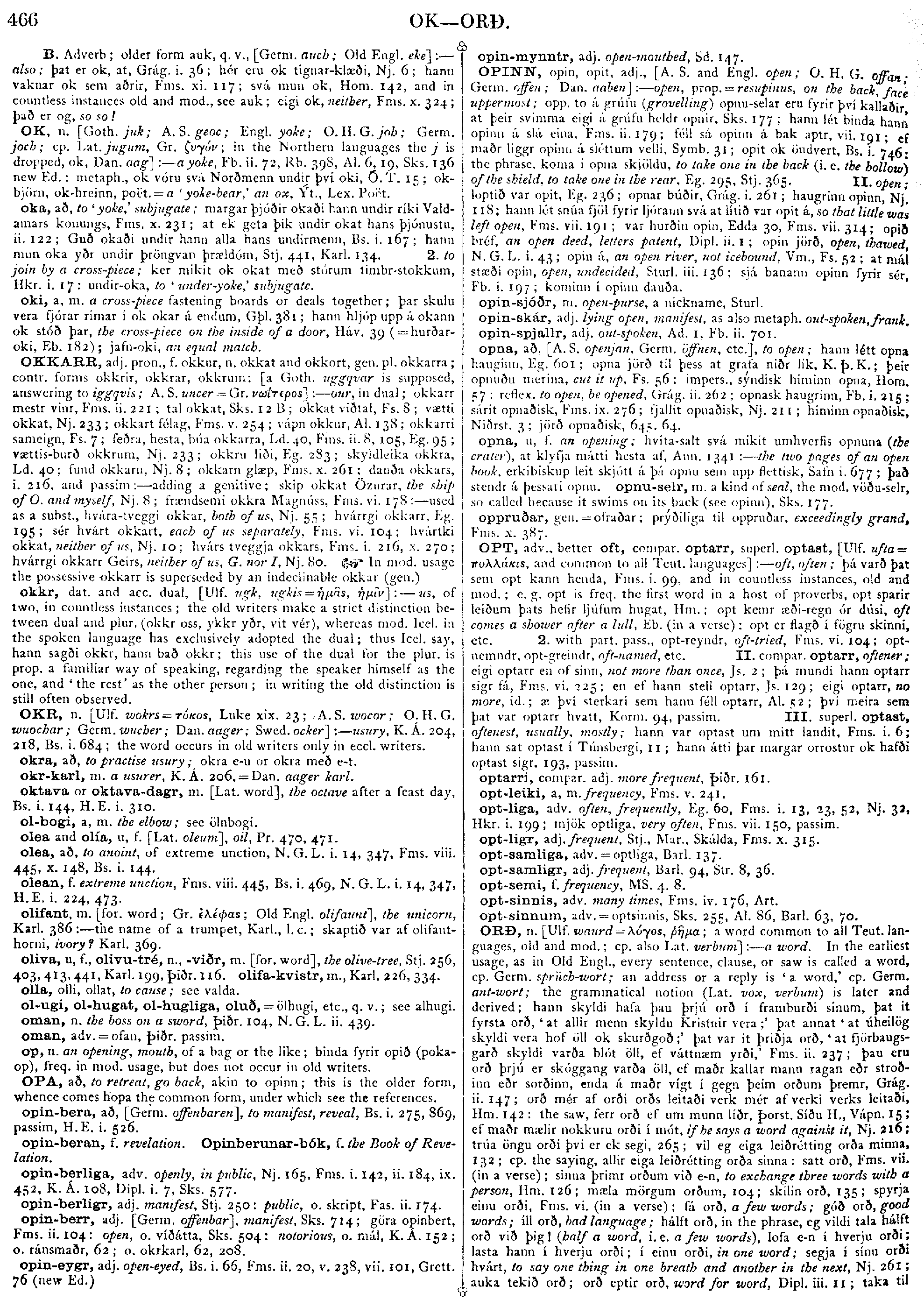
OPT, adv., better oft, compar. optarr, superl. optast, [Ulf. ufta = GREEK, and common to all Teut. languages] :-- oft, often; þá varð þat sem opt kann henda, Fms. i. 99, and in countless instances, old and mod.; e.g. opt is freq. the first word in a host of proverbs, opt sparir leiðum þats hefir ljúfum hugat, Hm.; opt kemr æði-regn ór dúsi, oft comes a shower after a lull, Eb. (in a verse): opt er flagð í fögru skinni, etc. 2. with part. pass., opt-reyndr, oft-tried, Fms. vi. 104; opt-nemndr, opt-greindr, oft-named, etc. II. compar. optarr, oftener; eigi optarr en of sinn, not more than once, Js. 2; þá mundi hann optarr sigr fá, Fms. vi. 225; en ef hann stell optarr, Js. 129; eigi optarr, no more, id.; æ því sterkari sem hann féll optarr, Al. 52; því meira sem þat var optarr hvatt, Korm. 94, passim. III. superl. optast, oftenest, usually, mostly; hann var optast um mitt landit, Fms. i. 6; hann sat optast í Túnsbergi, 11; hann átti þar margar orrostur ok hafði optast sigr, 193, passim.
|
Source: Cleasby/Vigfusson, page b0470, entry 3 View original page image as: [TIFF] [PNG] [View previous entry] [View next entry] |
[Comment on this entry] [View comments] |
The following entry has been hand-corrected once. |
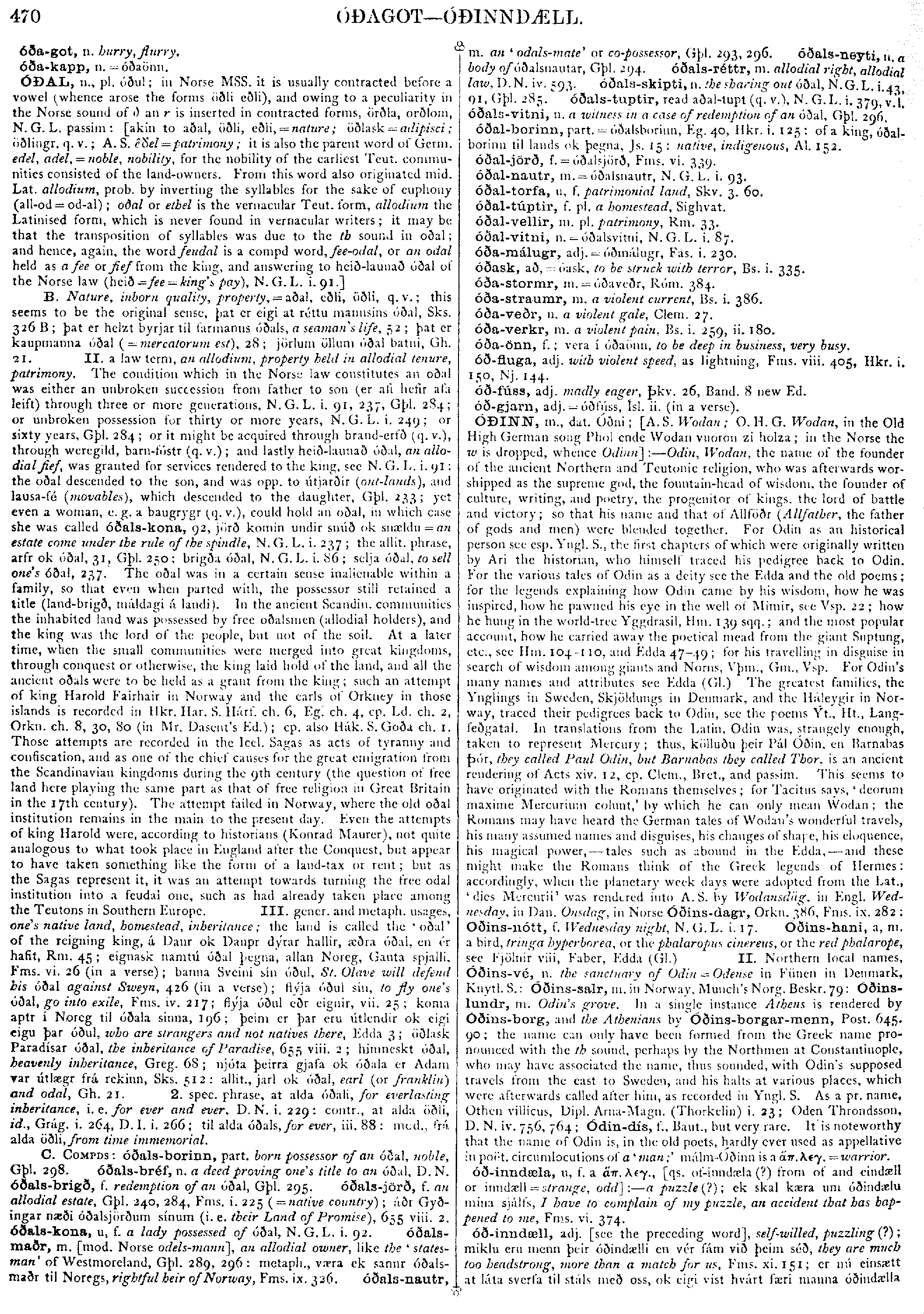
ÓÐAL, n., pl. óðul; in Norse MSS. it is usually contracted before a vowel (whence arose the forms öðli eðli), and owing to a peculiarity in the Norse sound of ð an r is inserted in contracted forms, örðla, orðlom, N.G.L. passim: [akin to aðal, öðli, eðli, = nature; öðlask = adipisci; oðlingr, q.v.; A.S. êðel = patrimony; it is also the parent word of Germ. edel, adel, = noble, nobility, for the nobility of the earliest Teut. communities consisted of the land-owners. From this word also originated mid. Lat. allodium, prob. by inverting the syllables for the sake of euphony (all-od = od-al); oðal or ethel is the vernacular Teut. form, allodium the Latinised form, which is never found in vernacular writers; it may be that the transposition of syllables was due to the th sound in oðal; and hence, again, the word feudal is a compd word, fee-odal, or an odal held as a fee or feif from the king, and answering to heið-launað óðal of the Norse law (heið = fee = king's pay), N.G.L. i. 91.] B. Nature, inborn quality, property, = aðal, eðli, öðli, q.v.; this seems to be the original sense, þat er eigi at réttu mannsins óðal, Sks. 326 B; þat er helzt byrjar til farmanns óðals, a seaman's life, 52; þat er kaupmanna óðal ( = mercatorum est), 28; jörlum öllum óðal batni, Gh. 21. II. a law term, an allodium, property held in allodial tenure, patrimony. The condition which in the Norse law constitutes an oðal was either an unbroken succession from father to son (er afi hefir afa leift) through three or more generations, N.G.L. i. 91, 237, Gþl. 284; or unbroken possession for thirty or more years, N.G.L. i. 249; or sixty years, Gþl. 284; or it might be acquired through brand-erfð (q.v.), through weregild, barn-fóstr (q.v.); and lastly heið-launað óðal, an allodial fief, was granted for services rendered to the king, see N.G.L. i. 91: the oðal descended to the son, and was opp. to útjarðir (out-lands), and lausa-fé (movables), which descended to the daughter, Gþl. 233; yet even a woman, e.g. a baugrygr (q.v.), could hold an oðal, in which case she was called óðals-kona, 92, jörð komin undir snúð ok snældu = an estate come under the rule of the spindle, N.G.L. i. 237; the allit. phrase, arfr ok óðal, 31, Gþl. 250: brigða óðal, N.G.L. i. 86; selja óðal, to sell one's óðal, 237. The oðal was in a certain sense inalienable within a family, so that even when parted with, the possessor still retained a title (land-brigð, máldagi á landi). In the ancient Scandin. communities the inhabited land was possessed by free oðalsmen (allodial holders), and the king was the lord of the people, but not of the soil. At a later time, when the small communities were merged into great kingdoms, through conquest or otherwise, the king laid hold of the land, and all the ancient oðals were to be held as a grant from the king; such an attempt of king Harold Fairhair in Norway and the earls of Orkney in those islands is recorded in Hkr. Har. S. Hárf. ch. 6, Eg. ch. 4, cp. Ld. ch. 2, Orkn. ch. 8, 30, 80 (in Mr. Dasent's Ed.); cp. also Hák. S. Goða ch. 1. Those attempts are recorded in the Icel. Sagas as acts of tyranny and confiscation, and as one of the chief causes for the great emigration from the Scandinavian kingdoms during the 9th century (the question of free land here playing the same part as that of free religion in Great Britain in the 17th century). The attempt failed in Norway, where the old oðal institution remains in the main to the present day. Even the attempts of king Harold were, according to historians (Konrad Maurer), not quite analogous to what took place in England after the Conquest, but appear to have taken something like the form of a land-tax or rent; but as the Sagas represent it, it was an attempt towards turning the free odal institution into a feudal one, such as had already taken place among the Teutons in Southern Europe. III. gener. and metaph. usages, one's native land, homestead, inheritance; the land is called the 'oðal' of the reigning king, á Danr ok Danpr dýrar hallir, æðra óðal, en ér hafit, Rm. 45; eignask namtú óðal þegna, allan Noreg, Gauta spjalli, Fms. vi. 26 (in a verse); banna Sveini sín óðul, St. Olave will defend his óðal against Sweyn, 426 (in a verse); flýja óðul sín, to fly one's óðal, go into exile, Fms. iv. 217; flýja óðul eðr eignir, vii. 25; koma aptr í Noreg til óðala sinna, 196; þeim er þar eru útlendir ok eigi eigu þar óðul, who are strangers and not natives there, Edda 3; öðlask Paradísar óðal, the inheritance of Paradise, 655 viii. 2; himneskt óðal, heavenly inheritance, Greg. 68; njóta þeirra gjafa ok óðala er Adam var útlægr frá rekinn, Sks. 512: allit., jarl ok óðal, earl (or franklin) and odal, Gh. 21. 2. spec. phrase, at alda óðali, for everlasting inheritance, i.e. for ever and ever, D.N. i. 229: contr., at alda öðli, id., Grág. i. 264, D.I. i. 266; til alda óðals, for ever, iii. 88: mod., frá, alda öðli, from time immemorial. C. COMPDS: óðals-borinn, part. born possessor of an óðal, noble, Gþl. 298. óðals-bréf, n. a deed proving one's title to an óðal, D.N. óðals-brigð, f. redemption of an óðal, Gþl. 295. óðals-jörð, f. an allodial estate, Gþl. 240, 284, Fms. i. 225 (= native country); áðr Gyðingar næði óðalsjörðum sínum (i.e. their Land of Promise), 655 viii. 2. óðals-kona, u, f. a lady possessed of óðal, N.G.L. i. 92. óðals-maðr, m. [mod. Norse odels-mann], an allodial owner, like the 'statesman' of Westmorland, Gþl. 289, 296: metaph., væra ek sannr óðalsmaðr til Noregs, rightful heir of Norway, Fms. ix. 326. óðals-nautr, m. an 'odals-mate' or co-possessor, Gþl. 293, 296. óðals-neyti, u. a body of óðalsnautar, Gþl. 294. óðals-réttr, m. allodial right, allodial law, D.N. iv. 593. óðals-skipti, n. the sharing out óðal, N.G.L. i. 43, 91, Gþl. 285. óðals-tuptir, read aðal-tupt (q.v.), N.G.L. i. 379, v.l. óðals-vitni, n. a witness in a case of redemption of an óðal, Gþl. 296.
|
Source: Cleasby/Vigfusson, page b0485, entry 14 View original page image as: [TIFF] [PNG] [View previous entry] [View next entry] |
[Comment on this entry] [View comments (1)] |
The following entry has been hand-corrected once. |
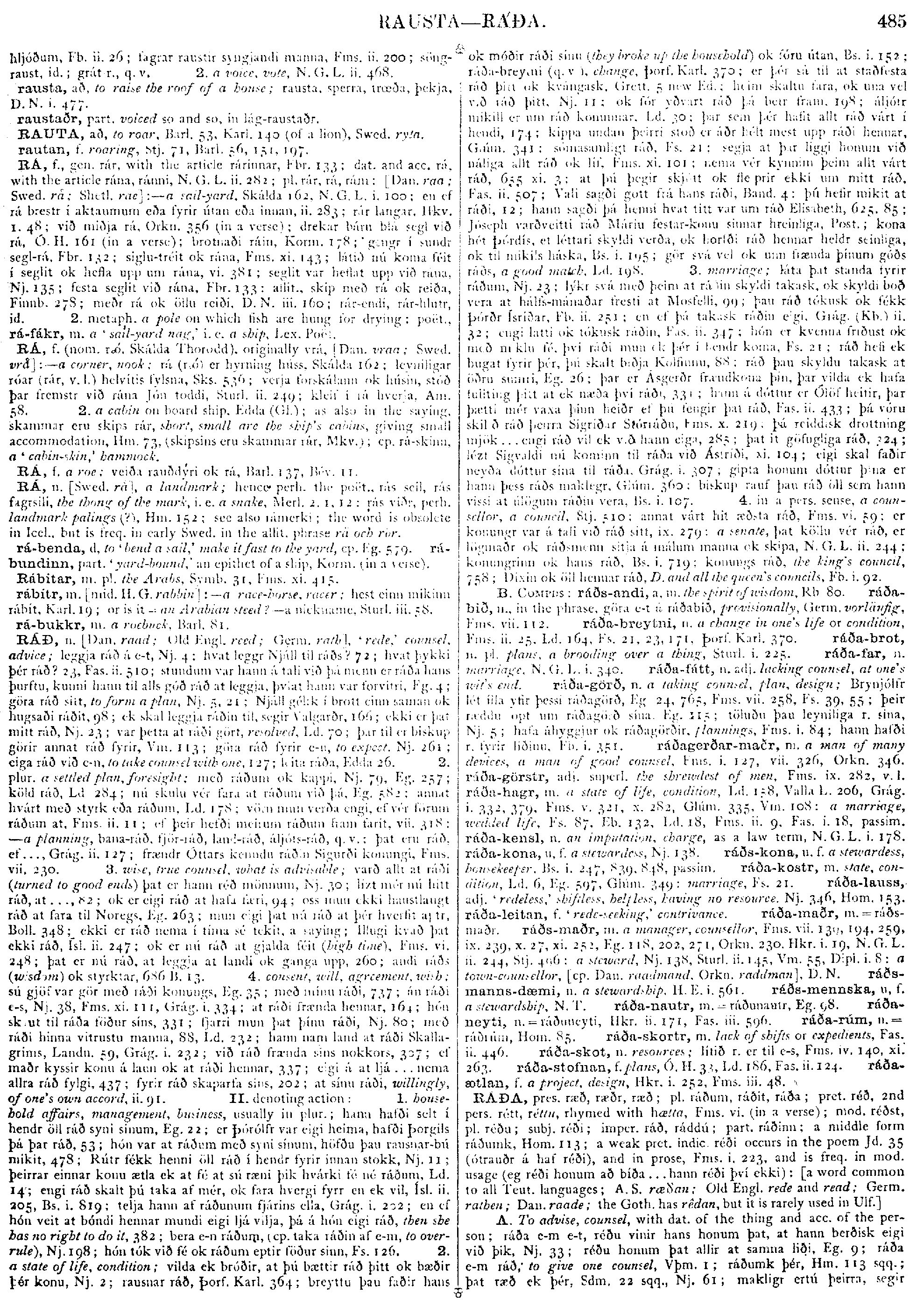
RÁÐ, n. [Dan. raad; Old Engl. reed; Germ. rath], 'rede' counsel, advice; leggja ráð á, e-t, Nj. 4; hvat leggr Njáll til ráðs? 72; hvat þykki þér ráð? 23, Fas. ii. 510; stundum var hann á tali við þá menn er ráða hans þurftu, kunni hann til alls góð ráð at leggja, þvíat hann var forvitri, Eg. 4; göra ráð sitt, to form a plan, Nj. 5, 21; Njáll gékk í brott einn saman ok hugsaði ráðit, 98; ek skal leggja ráðin til, segir Valgarðr, 166; ekki er þat mitt ráð, Nj. 23; var þetta at ráði gört, resolved, Ld. 70; þar til er biskup görir annat ráð fyrir, Vm. 113; göra ráð fyrir e-u, to expect, Nj. 261; eiga ráð við e-n, to take counsel with one, 127; leita ráða, Edda 26. 2. plur. a settled plan, foresight; með ráðum ok kappi, Nj. 79, Eg. 257; köld ráð, Ld. 284; nú skulu vér fara at ráðum við þá, Eg. 582; annat hvárt með styrk eða ráðum, Ld. 178; vörn mun verða engi, ef vér förum ráðum at, Fms. ii. 11; ef þeir hefði meirum ráðum fram farit, vii. 318 :-- a planning, bana-ráð, fjör-ráð, land-ráð, áljóts-ráð, q.v.; þat eru ráð, ef ..., Grág. ii. 127; frændr Óttars kenndu ráðin Sigurði konungi, Fms. vii. 230. 3. wise, true councel, what is advisable; varð allt at ráði (turned to good ends) þat er hann ráð mönnum, Nj. 30; lizt mér nú hitt ráð, at ..., 82; ok er eigi ráð at hafa færi, 94; oss mun ekki haustlaugt ráð at fara til Noregs, Eg. 263; mun eigi þat ná ráð at þér hverfit aptr, Boll. 348; ekki er ráð nema í tíma, sé tekit, a saying; Illugi kvað þat ekki ráð, Ísl. ii. 247; ok er nú ráð at gjalda féit (high time), Fms. vi. 248; þat er nú ráð, at leggja at landi ok ganga upp, 260; andi ráðs (wisdom) ok styrktar, 686 B. 13. 4. consent, will, agreement, wish: sú gjöf var gör með ráði konungs, Eg. 35; með mínu ráði, 737; án ráði e-s, Nj. 38, Fms. xi. 111, Grág. i. 334; at ráði frænda hennar, 164; hón skaut til ráða föður síns, 331; fjarri mun þat þínn ráði, Nj. 80; með ráði hinna vitrustu manna, 88, Ld. 232; hann nam land at ráði Skallagríms, Landn. 59, Grág. i. 232; við ráð frænda síns nokkors, 307; ef maðr kyssir konu á laun ok at ráði hennar, 337; eigi á at ljá ... nema allra ráð fylgi, 437; fyrir ráð skaparfa síns, 202; at sínn ráði, willingly, of one's own accord, ii. 91. II. denoting action: 1. household affairs, management, business, usually in plur.; hann hafði selt í hendr öll ráð syni sínum, Eg. 22; er Þórólfr var eigi heima, hafði Þorgils þá þar ráð, 53; hón var at ráðum með syni sínum, höfðu þau rausnar-bú mikit, 478; Rútr fékk henni öll ráð í hendr fyrir innan stokk, Nj. 11; þeirrar einnar konu ætla ek at fé at sú ræni þik hvárki fé né ráðum, Ld. 14; engi ráð skalt þú taka af mér, ok fara hvergi fyrr en ek vil, Ísl. ii. 205, Bs. i. 819; telja hann af ráðunum fjárins ella, Grág. i. 202; en ef hón veit at bóndi hennar mundi eigi ljá vilja, þá á hón eigi ráð, then she has no right to do it, 382; bera e-n ráðum, (cp. taka ráðin af e-m, to overrule), Nj. 198; hón tók við fé ok ráðum eptir föður sinn, Fs. 126. 2. a state of life, condition; vilda ek bróðir, at þú bættir ráð þitt ok bæðir þér konu, Nj. 2; rausnar ráð, Þorf. Karl. 364; breyttu þau faðir hans ok móðir ráði sínu (they broke up the household) ok fóru útan, Bs. i. 152; ráða-breytni (q.v), change, Þorf. Karl. 370; er þér sá til at staðfesta ráð þitt ok kvangask, Grett. 5 new Ed.; heim skaltu fara, ok una vel við ráð þitt, Nj. 11; ok fór yðvart ráð þá betr fram, 198; áljótr mikill er um ráð konunnar, Ld. 30; þar sem þér hafit allt ráð várt í hendi, 174; kippa undan þeirri stóð er áðr hélt mest upp ráði hennar, Glúm. 341: sómasamligt ráð, Fs. 21; segja at þar liggi honum við náliga allt ráð ok líf, Fms. xi. 101; nema vér kynnim þeim allt várt ráð, 655 xi. 3; at þú þegir skjótt ok fle prir ekki um mitt ráð, Fas. ii. 507; Vali sagði gott frá hans ráði, Band. 4: þú hefir mikit at ráði, 12; hann sagði þá henni hvat títt var um ráð Elisabeth, 625. 85; Jóseph varðveitti ráð Máriu festar-konu sinnar hreinliga, Post.; kona hét Þórdís, et léttari skyldi verða, ok horfði ráð hennar heldr seinliga, ok til mikils háska, Bs. i. 195; gör svá vel ok unn frænda þínum góðs ráðs, a good match, Ld. 198. 3. marriage; láta þat standa fyrir ráðum, Nj. 23; lýkr svá með þeim at ráðin skyldi takask, ok skyldi boð vera at hálfs-mánaðar fresti at Mosfelli, 99; þau ráð tókusk ok fékk Þórðr Ísríðar, Fb. ii. 251; en ef þá takask ráðin eigi. Grág. (Kb.) ii. 32; engi latti ok tókusk ráðin. Fas. ii. 347; hón er kvenna friðust ok með miklu fé, þvi ráði mun ok þér í hendr koma, Fs. 21; ráð hefi ek hugat fyrir þér, þú skalt biðja Kolfinnu, 88; ráð þau skyldu takask at öðru sunni, Eg. 26; þar er Ásgerðr frændkona þin, þar vilda ek hafa fullting þitt at ek næða því ráði 331; hann á dóttur er Ólöf heitir, þar þætti mér vaxa þinn heiðr ef þú fengir þat ráð, Fas. ii. 433; þá vóru skil ð ráð þeirra Sigriðar Stórráðu, Fms. x. 219; þá, reiddisk drottning mjök ... engi ráð vil ek við hann eiga, 285; þat it göfugliga ráð, 324; lézt Sigvaldi nú kominn til ráða við Ástríði, xi. 104; eigi skal faðir neyða dóttur sina til ráða, Grág. i. 307; gipta honum dóttur þina er hann þess ráðs maklegr, Glúm. 360: biskup rauf þau ráð öll sem hann vissi at úlögum ráðin vera, Bs. i. 107. 4. in a pers. sense, a counsellor, a council, Stj. 510; annat várt hit æðsta ráð, Fms. vi. 59; er konungr var á tali við ráð sitt, ix. 279: a senate, þat köllu vér ráð, er lögmaðr ok ráðsmenn sitja á málum manna ok skipa, N.G.L. ii. 244; konungrinn ok hans ráð, Bs. i. 719; konungs ráð, the king's council, 758; Dixin ok öll hennar ráð, D. and all the queen's councils, Fb. i. 92. B. COMPDS: ráðs-andi, a, m. the spirit, of wisdom, Rb 80. ráða-bið, n., in the phrase, göra e-t á ráðabið, provisionally, Germ. vorläufig, Fms. vii. 112. ráða-breytni, n. a change in one's life or condition, Fms. ii. 25, Ld. 164, Fs. 21, 23, 171, Þorf. Karl. 370. ráða-brot, n. pl. plans, a brooding over a thing, Sturl. i. 225. ráða-far, n. marriage, N.G.L. i. 340. ráða-fátt, n. adj. lacking counsel, at one's wit's end. ráða-görð, n. a taking councel, plan, design; Brynjólfr lét ílla yfir þessi ráðagörð, Eg; 24, 765, Fms. vii. 258, Fs. 39, 55; þeir ræddu opt inn ráðagörð sína. Eg. 115; töluðu þau leyniliga r. sína, Nj. 5; hafa áhyggjur ok ráðagörðir, plannings, Fms. i. 84; hann hafði r. fyrir liðinu, Fb. i. 351. ráðagerðar-maðr, m. a man of many devices, a man of good counsel, Fms. i. 127, vii. 326, Orkn. 346. ráða-görstr, adj. superl. the shrewdest of men, Fms. ix. 282, v.l. ráða-hagr, m. a state of life, condition, Ld. 158, Valla L. 206, Grág. i. 332, 379, Fms. v. 321, x. 282, Glúm. 335, Vm. 108: a marriage, wedded life, Fs. 87, Eb. 132, Ld. 18, Fms. ii. 9, Fas. i. 18, passim, ráða-kensl, n. an imputation, charge, as a law term, N.G.L. i. 178. ráða-kona, u, f. a stewardess, Nj. 138. ráðs-kona, u, f. a stewardess, housekeeper, Bs. i. 247, 839, 848, passim. ráða-kostr, m. state, condition, Ld. 6, Eg. 597, Glúm. 349: marriage, Fs. 21. ráða-lauss, adj. 'redeless,' shiftless, helpless, having no resource. Nj. 346, Hom. 153. ráða-leitan, f. 'rede-seeking,' contrivance. ráða-maðr, m. = ráðs-maðr. ráðs-maðr, m. a manager, counsellor, Fms. vii. 139, 194, 259, ix. 239, x. 27, xi. 252, Eg. 118, 202, 271, Orkn. 230. Hkr. i. 19, N.G.L. ii. 244, Stj. 496: a steward, Nj. 138, Sturl. ii. 145, Vm. 55, Dipl. i. 8: a town-counsellor, [cp. Dan. raadmand, Orkn. raddman], D.N. ráðsmanns-dæmi, n. a stewardship. H.E. i. 561. ráðs-mennska, u, f. a stewardship, N.T. ráða-nautr, m. = ráðunautr, Eg. 98. raða-neyti, n. = ráðuneyti, Hkr. ii. 171, Fas. iii. 596. ráða-rúm, n. = ráðrúm, Hom. 85. ráða-skortr, m. lack of shifts or expedients, Fas. ii. 446. ráða-skot, n. resources; lítið r. er til e-s, Fms. iv. 140, xi. 263. ráða-stofnan, f. plans, Ó.H. 33, Ld. 186, Fas. ii. 124. ráða-ætlan, f. a project, design, Hkr. i. 252, Fms. iii. 48.
|
Source: Cleasby/Vigfusson, page b0491, entry 37 View original page image as: [TIFF] [PNG] [View previous entry] [View next entry] |
[Comment on this entry] [View comments] |
The following entry has been hand-corrected once. |
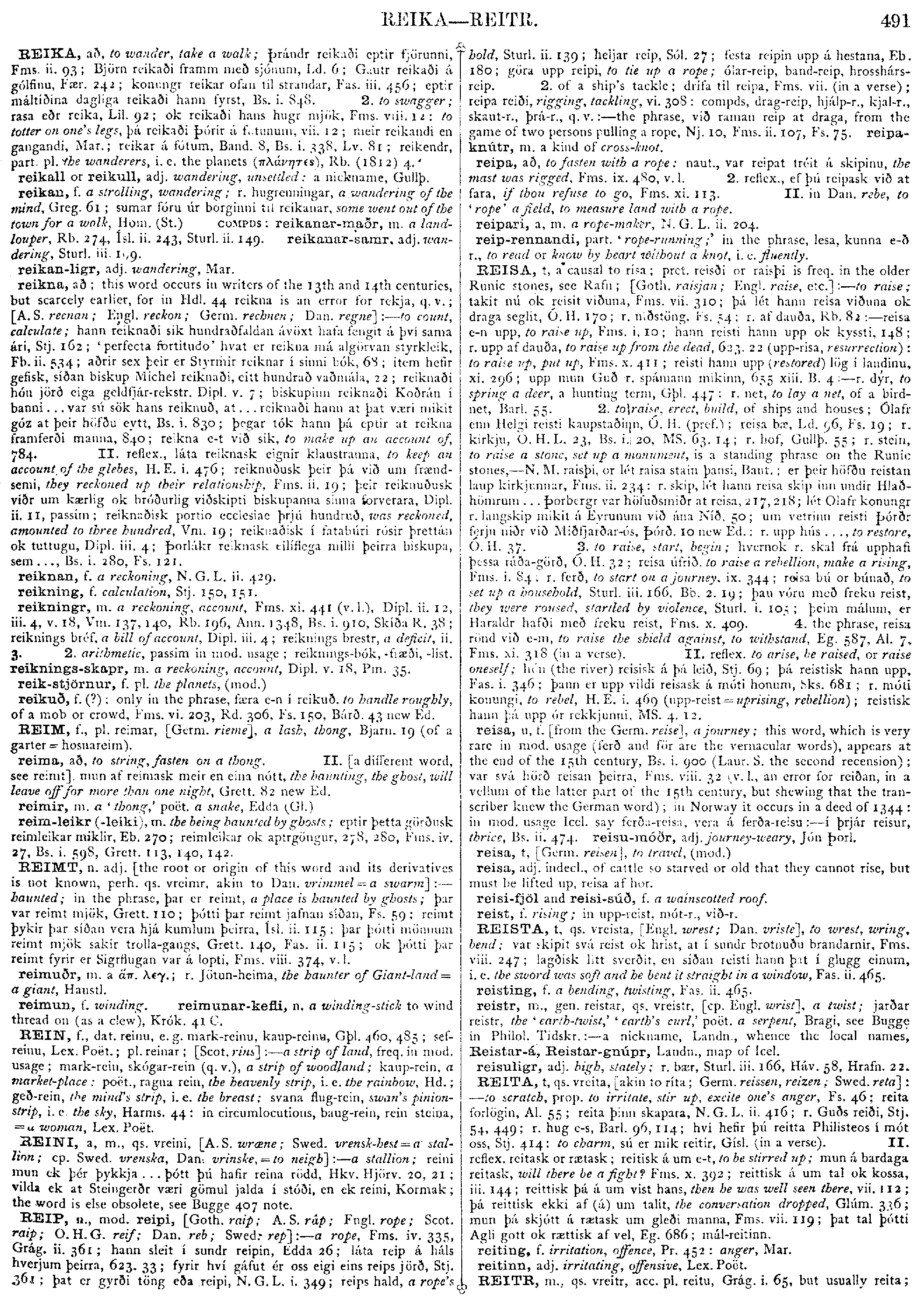
REITR, m., qs. vreitr, acc. pl. reitu, Grág. i. 65, but usually reita;
|
Source: Cleasby/Vigfusson, page b0496, entry 7 View original page image as: [TIFF] [PNG] [View previous entry] [View next entry] |
[Comment on this entry] [View comments] |
The following entry has been hand-corrected once. |
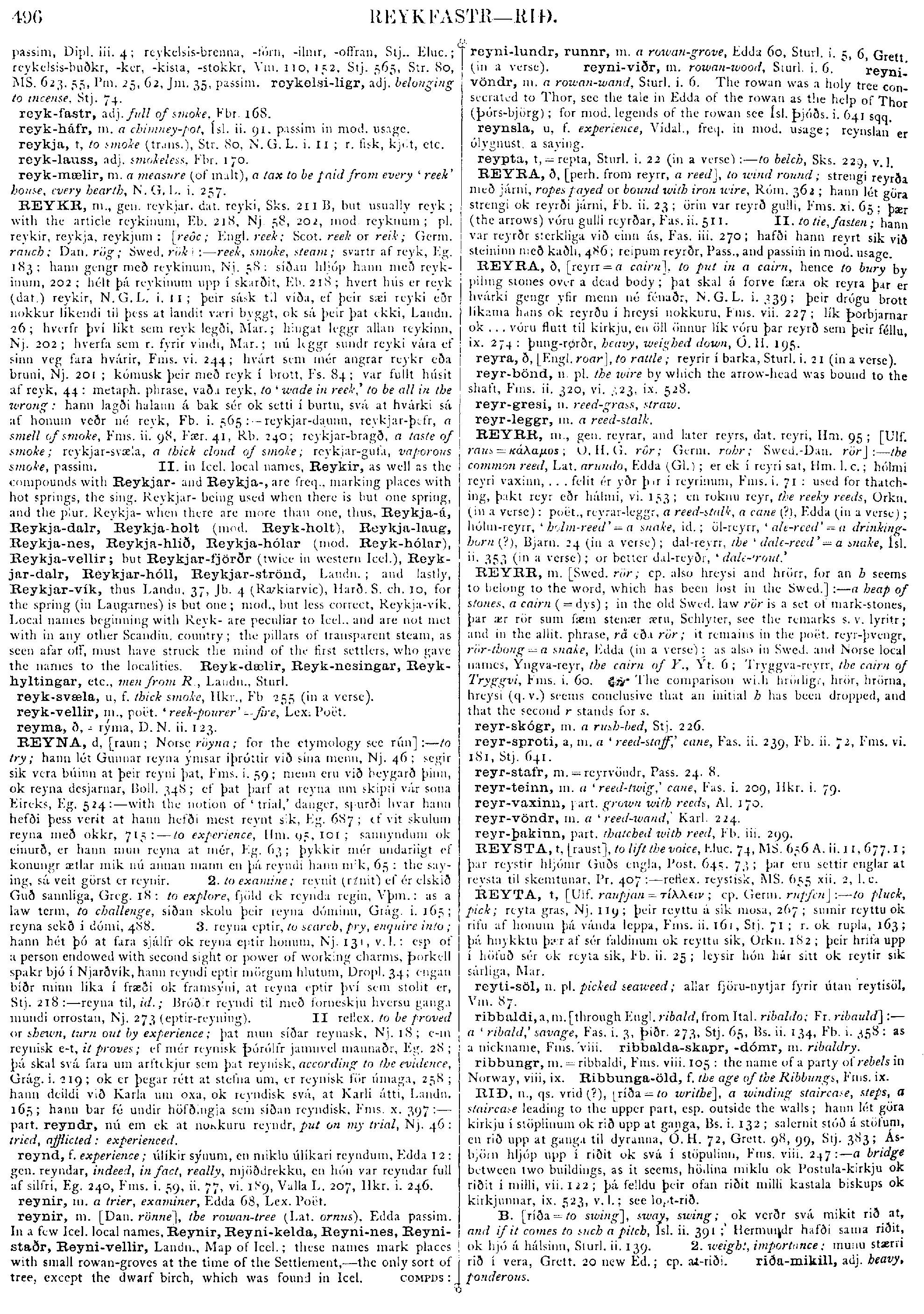
REYKR, m., gen. reykjar. dat. reyki, Sks. 211 B, but usually reyk; with the article reykinum, Eb. 218, Nj 58, 202, mod. reyknum; pl. reykir, reykja, reykjum: [A.S. reôc; Engl. reek; Scot. reek or reik; Germ. rauch; Dan. rög; Swed. rök] :-- reek, smoke, steam; svartr af reyk, Eg. 183; hann gengr með reykinum, Nj. 58: síðan hljóp hann með reykinum, 202; hélt þá reykinum upp í skarðit, Eb. 218; hvert hús er reyk (dat.) reykir, N.G.L. i. 11; þeir sásk til víða, ef þeir sæi reyki eðr nokkur líkendi til þess at landit væri byggt, ok sá þeir þat ekki, Landn. 26; hverfr því likt sem reyk legði, Mar.; hingat leggr allan reykinn, Nj. 202; hverfa sem r. fyrir vindi, Mar.; nú leggr sundr reyki vára ef sinn veg fara hvárir, Fms. vi. 244; hvárt sem mér angrar reykr eða bruni, Nj. 201; kómusk þeir með reyk í brott, Fs. 84; var fullt húsit af reyk, 44: metaph. phrase, vaða reyk, to 'wade in reek' to be all in the wrong; hann lagði halann á bak sér ok setti í burtu, svá at hvárki sá af honum veðr né reyk, Fb. i. 565 :-- reykjar-daunn, reykjar-þefr, a smell of smoke, Fms. ii. 98, Fær. 41, Rb. 240; reykjar-bragð, a taste of smoke; reykjar-svæla, a thick cloud of smoke; reykjar-gufa, vaporous smoke, passim. II. in Icel. local names, Reykir, as well as the compounds with Reykjar- and Reykja-, are freq., marking places with hot springs, the sing. Reykjar- being used when there is but one spring, and the plur. Reykja- when there are more than one, thus, Reykja-á, Reykja-dalr, Reykja-holt (mod. Reyk-holt), Reykja-laug, Reykja-nes, Reykja-hlíð, Reykja-hólar (mod. Reyk-hólar), Reykja-vellir; but Reykjar-fjörðr (twice in western Icel.), Reykjar-dalr, Reykjar-hóll, Reykjar-strönd, Landn.; and lastly, Reykjar-vík, thus Landn. 37, Jb. 4 (Ra/kiarvic), UNCERTAIN Harð. S. ch. 10, for the spring (in Laugarnes) is but one; mod., but less correct, Reykja-vík. Local names beginning with Reyk- are peculiar to Icel., and are not met with in any other Scandin. country; the pillars of transparent steam, as seen afar off, must have struck the mind of the first settlers, who gave the names to the localities. Reyk-dælir, Reyk-nesingar, Reyk-hyltingar, etc., men from R, Landn., Sturl.
|
Source: Cleasby/Vigfusson, page b0499, entry 3 View original page image as: [TIFF] [PNG] [View previous entry] [View next entry] |
[Comment on this entry] [View comments] |
The following entry has been hand-corrected once. |
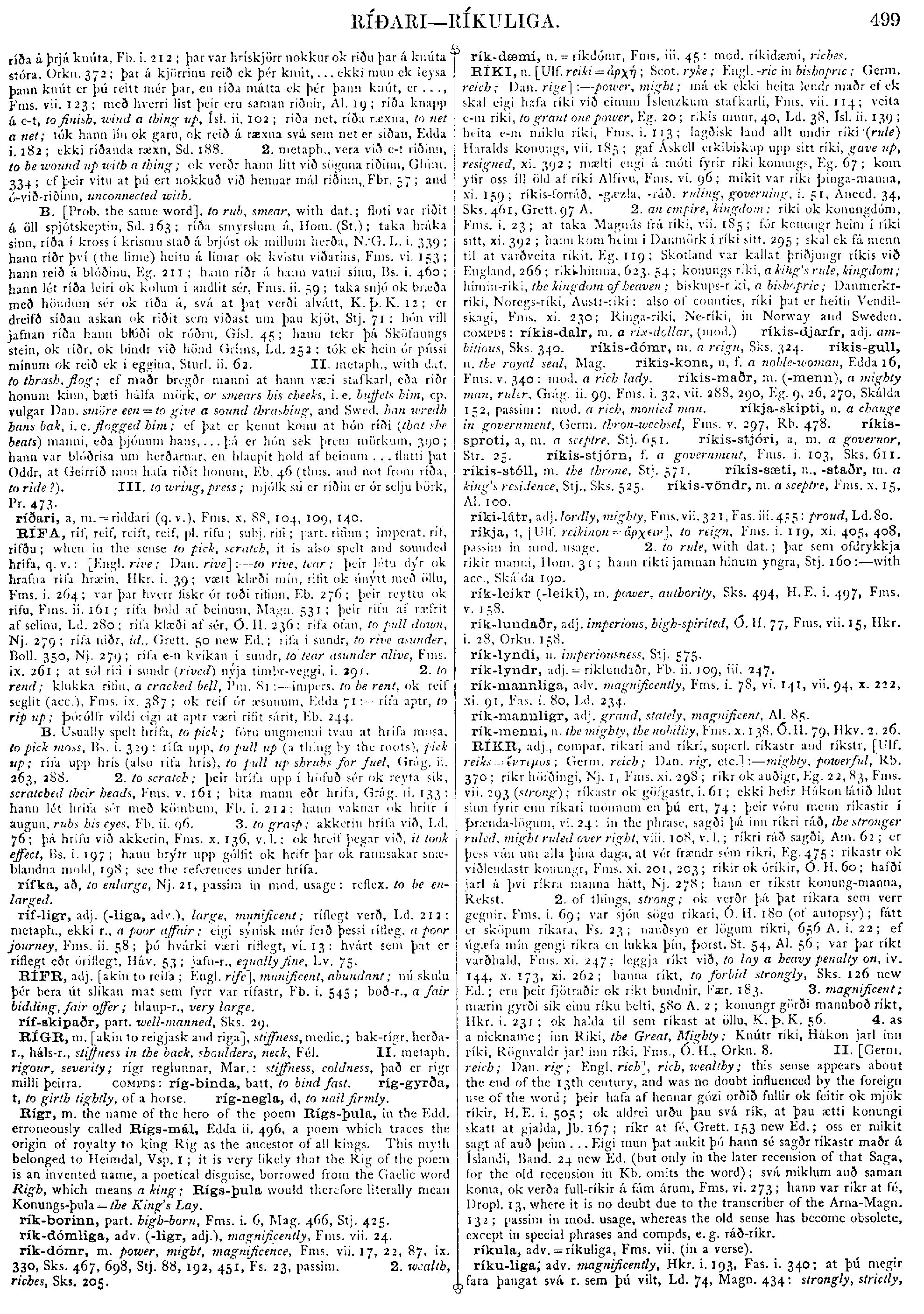
RÍFA, ríf, reif, reift, reif, pl. rifu; subj. rifi; part. rifinn; imperat. ríf, rífðu; when in the sense to pick, scratch, it is also spelt and sounded hrífa, q.v.: [Engl. rive; Dan. rive] :-- to rive, tear; þeir létu dýr ok hrafna rífa hræin, Hkr. i. 39; vætt klæði mín, rifit ok únýtt með öllu, Fms. i. 264; var þar hverr fiskr ór roði rifinn, Eb. 276; þeir reyttu ok rifu, Fms. ii. 161; rífa hold af beinum, Magn. 531; þeir rifu af ræfrit af selinu, Ld. 280; rífa klæði af sér, Ó.H. 236: rífa ofan, to pull down, Nj. 279; rífa niðr, id., Grett. 50 new Ed.; rífa í sundr, to rive asunder, Boll. 350, Nj. 279; rífa e-n kvikan í sundr, to tear asunder alive, Fms. ix. 261; at sól rifi í sundr (rived) nýja timbr-veggi, i. 291. 2. to rend; klukka rifin, a cracked bell, Pm. 81 :-- impers. to be rent, ok reif seglit (acc.), Fms. ix. 387; ok reif ór æsunum, Edda 71 :-- rífa aptr, to rip up; Þórólfr vildi eigi at aptr væri rifit sárit, Eb. 244. B. usually spelt hrífa, to pick; fóru ungmenni tvau at hrífa mosa, to pick moss, Bs. i. 329: rífa upp, to pull up (a thing by the roots), pick up; rífa upp hrís (also rífa hrís), to pull up shrubs for fuel, Grág. ii. 263, 288. 2. to scratch; þeir hrífa upp í höfuð sér ok reyta sik, scratched their heads, Fms. v. 161; bíta mann eðr hrífa, Grág. ii. 133: hann lét hrífa sér með kömbum, Fb. i. 212; hann vaknar ok hrífr í augun, rubs his eyes, Fb. ii. 96. 3. to grasp; akkerin hrífa við, Ld. 76; þá hrífu við akkerin, Fms. x. 136, v.l.; ok hreif þegar við, it took effect, Bs. i. 197; hann brýtr upp gólfit ok hrífr þar ok rannsakar snæblandna mold, 198; see the references under hrífa.
| Result Page: |  |
Previous | 5 6 7 8 9 10 11 12 13 14 15 16 17 18 | Next |  |
Germanic Lexicon Project (main page)
This search system was written by
Sean Crist
Please consider
volunteering
to correct the data in these online dictionaries.
No rights reserved. Feel free to use these data in any way you please.