|
|

|
Source: Cleasby/Vigfusson, page b0681, entry 37 View original page image as: [TIFF] [PNG] [View previous entry] [View next entry] |
[Comment on this entry] [View comments] |
The following entry has been hand-corrected once. |
vasi, a, m. a nickname, Dipl. v. 5. 2. a pocket, freq. in mod. usage, but prob. from some foreign root; vestis-vasi, buxna-vasi, treyju-vasi; vasa-klútr, a pocket-kerchief; vasa-knifr, a pocket-knife, etc.
|
Source: Cleasby/Vigfusson, page b0683, entry 13 View original page image as: [TIFF] [PNG] [View previous entry] [View next entry] |
[Comment on this entry] [View comments] |
The following entry has been hand-corrected once. |
VÁÐ, vóð, voð, f.; [A.S. wæd; remains in Engl. widow's weeds] :-- a piece of stuff, cloth, as it leaves the loom; sat þar kona sveigði rokk, breiddi faðm bjó til váðar, Rm. 16; segl hvítt sem snjór af Háleyskum váðum, Fagrsk. ch. 102; ef segl er eigi fengit, skal gjalda sex aura ... en ef einnar váðar missir (i.e. one breadth of the sail is missing, if it be short by one váð), þá er maðr sekr sex aurum, N.G.L. i. 199; cp. hafnar-váð, a common cloth; álna hafnar-váðar, Vm. 103; þetta á kirkja í lausa gózi, kýr sex ok sex hundruð í hafnar-váðum, Pm. 57; þrjá-tigi hundruð vöru ok hafnar-váða, Dipl. ii. 6, iii. 8; gefa úmaganum tólf álnir hafnar váðar á hverjum misserum til klæða sér, Vm. 117, D.N. ii. 225, iii. 451, Munk. 66; also called hafnar vaðmál, D.N. i. 134, Grág.; vöru-váð and sölu-váð, a common cloth in trade, see vara, sala. II. metaph. a fishing-net is called váð; veiða, draga váð at hváru landi, Grág. ii. 349 (Jb. 305); as also in mod. usage; this may be the 'wad' in the Scottish ballad cited s.v. aflausn; in the Icel. reference, Fbr. 154, 'vað' may be = váð: in poets also of the sail, greiða náir glygg váð ... hríð féll í bug váða ... váð blés, Lex. Poët.; cp. váð-hæfr. III. a 'weed,' cloth, cut and sewn; váðir mínar gaf ek tveimr trémönnum, Hm. 48; kven-váðir, a woman's weeds, Þkv.; matar ok váða er manni þörf, Hm. 3: allit., vápn eða váðir, Grág. ii. 8; vápnum ok váðum skolu vinir gleðjask, Hm. 40: poët., Högna váð, Héðins váð, váðir Váfaðar, the weed of H., etc., i.e. armour, the coat of mail, Lex. Poët.; her-váðir, id.; heiðingja váðir, 'wolf's weed,' i.e. wolf's hair, Akv. 8; hvíta-váðir, see hvítr. B. COMPDS: váð-áss, m. a pole to hang clothes on, Hrafn. 20. váð-beðr, m. a case of cloth; skinnbeðir, hægindi váðbeðr, Dipl. iii. 4. váð-feldr, part. soft, of raiment. váða-gangr, m. the casting a net, D.N. iii. 1108. váð-hæfr, adj. fit for sail; váðhæft-veðr, a favourable wind; hvessti svá at varla var váðhæft á konungs skipi, Fms. ix. 387. váð-ker, n. a tub in which clothes are stamped or trodden, Fas. ii. 34. váð-mál, see vaðmál. váð-meiðr, m. = váðáss, Glúm. 390, Rd. 296. váðar-varp, n. the casting a net, D.N. v. 971. váð-verk, n. cloth-making, Eb. 258. váð-virkja, t, to wind up, end, finish, metaph. from the loom, Krók. 63.
|
Source: Cleasby/Vigfusson, page b0683, entry 16 View original page image as: [TIFF] [PNG] [View previous entry] [View next entry] |
[Comment on this entry] [View comments] |
The following entry has been hand-corrected once. |
váfa, u, f. a ghost, spectre, shade, Grett. 112 A; very freq. in mod. usage, but sounded vofa, Ísl. Þjóðs.
|
Source: Cleasby/Vigfusson, page b0684, entry 5 View original page image as: [TIFF] [PNG] [View previous entry] [View next entry] |
[Comment on this entry] [View comments] |
The following entry has been hand-corrected once. |
vága, að, spelt vóga or voga; [Germ. wagen; Dan. vove] :-- to dare, venture; þann þótti mikit voga, Bs. i. 868 (Laur. S.); þó skal nú nokkut til voga, Grett. 157 new Ed.; þó skal nú þar til voga, 143 A; menn hafa opt vogat við slíkan liðsmun, 72; at þú vogir at berjast við þá, Fas. i. 450 (paper MS.); the word is freq. in mod. usage, but hardly older than the 15th century.
|
Source: Cleasby/Vigfusson, page b0684, entry 22 View original page image as: [TIFF] [PNG] [View previous entry] [View next entry] |
[Comment on this entry] [View comments] |
The following entry has been hand-corrected once. |
válgna, að, i.e. volgna, to become warm, Fas. i. 84, passim in mod. usage.
|
Source: Cleasby/Vigfusson, page b0684, entry 23 View original page image as: [TIFF] [PNG] [View previous entry] [View next entry] |
[Comment on this entry] [View comments] |
The following entry has been hand-corrected once. |
VÁLGR, adj., or better valgr, sounded volgr; [this word, so freq. in mod. usage, is not found in old writers (Fas. i. 84 is a paper MS.); they always use fjálgr (q.v.), identical in sense, but unknown in mod. Icel.; the mod. form, glóð-volgr, ember-hot, exactly answers to glóð-fjálgr' of the Ýt.; in-fjálgr, Hkv., must be a false reading for ú-fjálgr = ofjelg, a word frequent in the mod. Norwegian dialects, meaning 'un-warm,' i.e. cold, chilly, dismal, see Ivar Aasen; in A.S. wealg occurs in a single instance, viz. in Gregory's Pastorale of King Alfred, edited by Mr. Sweet] :-- warm, luke-warm; en með því þú ert volgr, og hvorki kaldr né heitr, mun ek út-skirpa þér af mínum munni, Rev. iii. 16; it is in rendering this very passage that king Alfred (l.c.) uses wealgh, so there can be no doubt as to the identity of the A.S. and Icel. word: passim in mod. usage, volg mjólk, volgt blóð, glóð-volgr, spen-volgr; spenvolg mjólk, milk warm from the cow.
|
Source: Cleasby/Vigfusson, page b0685, entry 5 View original page image as: [TIFF] [PNG] [View previous entry] [View next entry] |
[Comment on this entry] [View comments] |
The following entry has been hand-corrected once. |
vándska or vánzka, mod. vonzka, u, f. wickedness, Rétt. 18, D.N. iv. 66: in mod. usage, esp. of fury, ire, anger, hann réði sér ekki fyrir vonzku; vonzku-veðr, a furious, bad gale.
|
Source: Cleasby/Vigfusson, page b0685, entry 17 View original page image as: [TIFF] [PNG] [View previous entry] [View next entry] |
[Comment on this entry] [View comments] |
The following entry has been hand-corrected once. |
VÁR,
n.,
mod.
vor;
[Lat.
v r;
Dan.-Swed.
vaar,
vår:
in
mod.
Danish
this
old
word
has
been
displaced
by
for-aar
Germ.
früh-jahr;
although
vaar
is
still
used
in
special
and
poetical
phrases]
:--
the
spring;
vetr,
sumar,
vár
ok
haust,
Edda;
hit
næsta
vár,
...
um
várit,
Fms.
vi.
90;
allt
til
várs,
Nj.
11;
í
vár,
last
spring,
Eg.
235;
í
vári,
Eb.
(in
a
verse),
passim
in
old
and
mod.
usage.
B.
COMPDS:
vár-bók,
f.
a
mass-book
for
the
spring,
Ám.
5.
vár-dagar,
m.
pl.
spring
days,
Boll.
354,
Fms.
iii.
91.
vár-ferli,
r;
Dan.-Swed.
vaar,
vår:
in
mod.
Danish
this
old
word
has
been
displaced
by
for-aar
Germ.
früh-jahr;
although
vaar
is
still
used
in
special
and
poetical
phrases]
:--
the
spring;
vetr,
sumar,
vár
ok
haust,
Edda;
hit
næsta
vár,
...
um
várit,
Fms.
vi.
90;
allt
til
várs,
Nj.
11;
í
vár,
last
spring,
Eg.
235;
í
vári,
Eb.
(in
a
verse),
passim
in
old
and
mod.
usage.
B.
COMPDS:
vár-bók,
f.
a
mass-book
for
the
spring,
Ám.
5.
vár-dagar,
m.
pl.
spring
days,
Boll.
354,
Fms.
iii.
91.
vár-ferli,
|
Source: Cleasby/Vigfusson, page b0687, entry 6 View original page image as: [TIFF] [PNG] [View previous entry] [View next entry] |
[Comment on this entry] [View comments] |
The following entry has been hand-corrected once. |
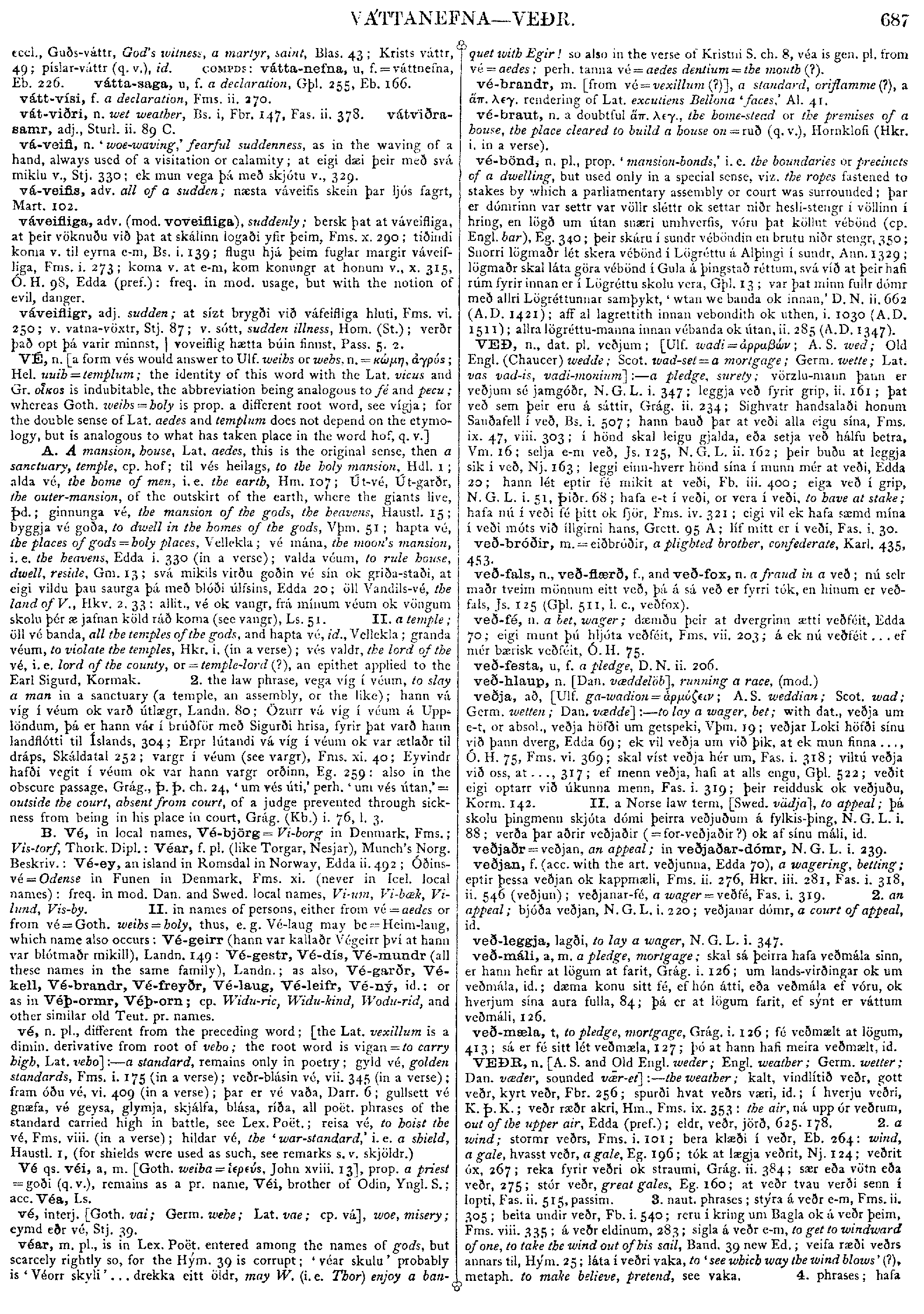
váveifliga, adv. (mod. voveifliga), suddenly; bersk þat at váveifliga, at þeir vöknuðu við þat at skálinn logaði yfir þeim, Fms. x. 290; tíðindi koma v. til eyrna e-m, Bs. i. 139; flugu hjá þeim fuglar margir váveifliga, Fms. i. 273; koma v. at e-m, kom konungr at honum v., x. 315, Ó.H. 98, Edda (pref.): freq. in mod. usage, but with the notion of evil, danger.
|
Source: Cleasby/Vigfusson, page b0688, entry 10 View original page image as: [TIFF] [PNG] [View previous entry] [View next entry] |
[Comment on this entry] [View comments] |
The following entry has been hand-corrected once. |
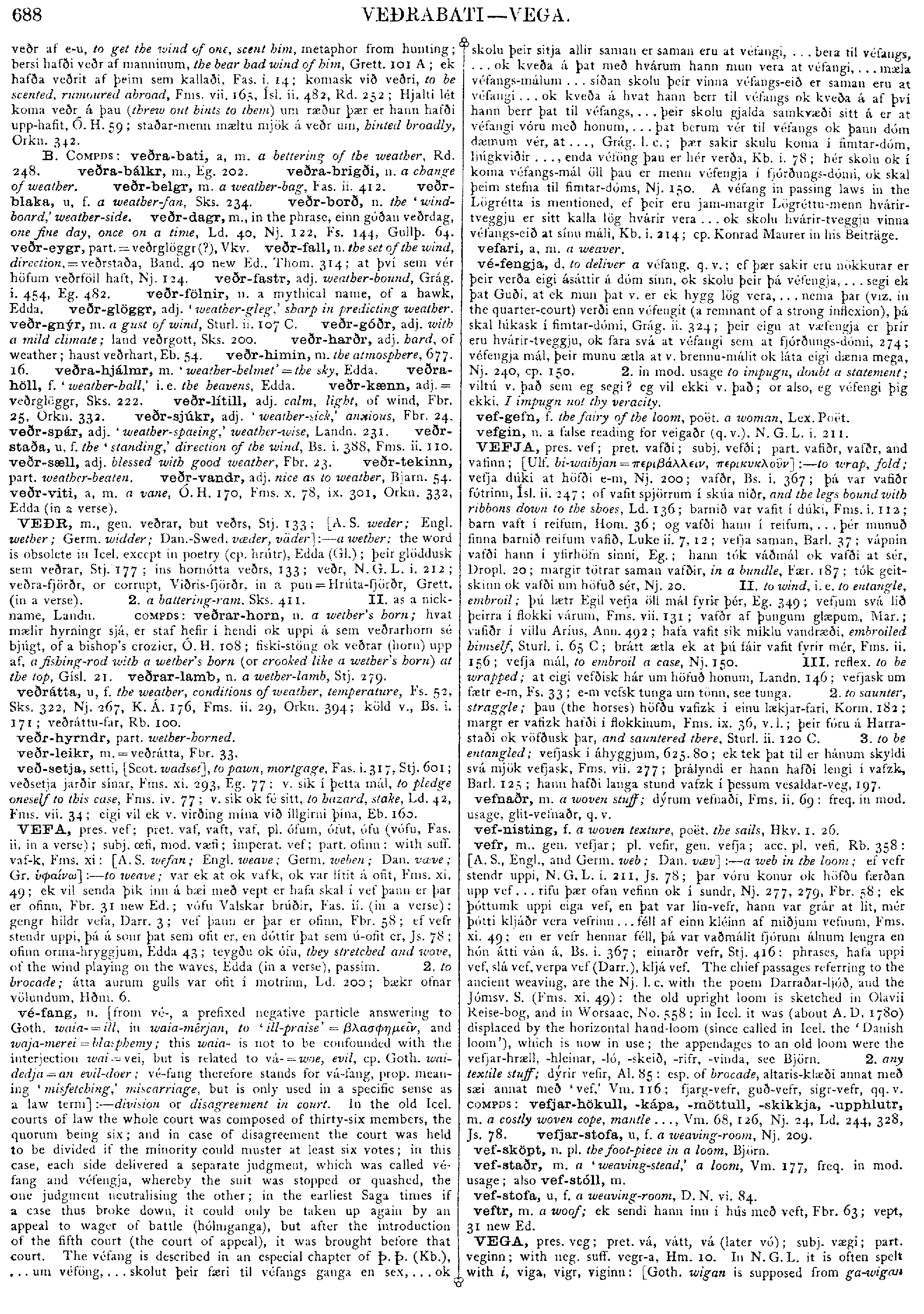
vé-fengja, d, to deliver a véfang, q.v.; ef þær sakir eru nökkurar er þeir verða eigi ásáttir á dóm sinn, ok skolu þeir þá véfengja, ... segi ek þat Guði, at ek mun þat v. er ek hygg lög vera, ... nema þar (viz. in the quarter-court) verði enn véfengit (a remnant of a strong inflexion), þá skal lúkask í fimtar-dómi, Grág. ii. 324; þeir eigu at væfengja er þrír eru hvárir-tveggju, ok fara svá at véfangi sem at fjórðungs-dómi, 274; véfengja mál, þeir munu ætla at v. brennu-málit ok láta eigi dæma mega, Nj. 240, cp. 150. 2. in mod. usage to impugn, doubt a statement; viltú v. það sem eg segi? eg vil ekki v. það; or also, eg véfengi þig ekki, I impugn not thy veracity.
| Result Page: |  |
Previous | 126 127 128 129 130 131 132 133 134 135 136 137 138 139 140 141 142 143 144 | Next |  |
Germanic Lexicon Project (main page)
This search system was written by
Sean Crist
Please consider
volunteering
to correct the data in these online dictionaries.
No rights reserved. Feel free to use these data in any way you please.