|
|

|
Source: Bosworth/Toller, page b0080, entry 30 View original page image as: [TIFF] [PNG] [View previous entry] [View next entry] |
[Comment on this entry] [View comments] |
The following entry has been hand-corrected once. |
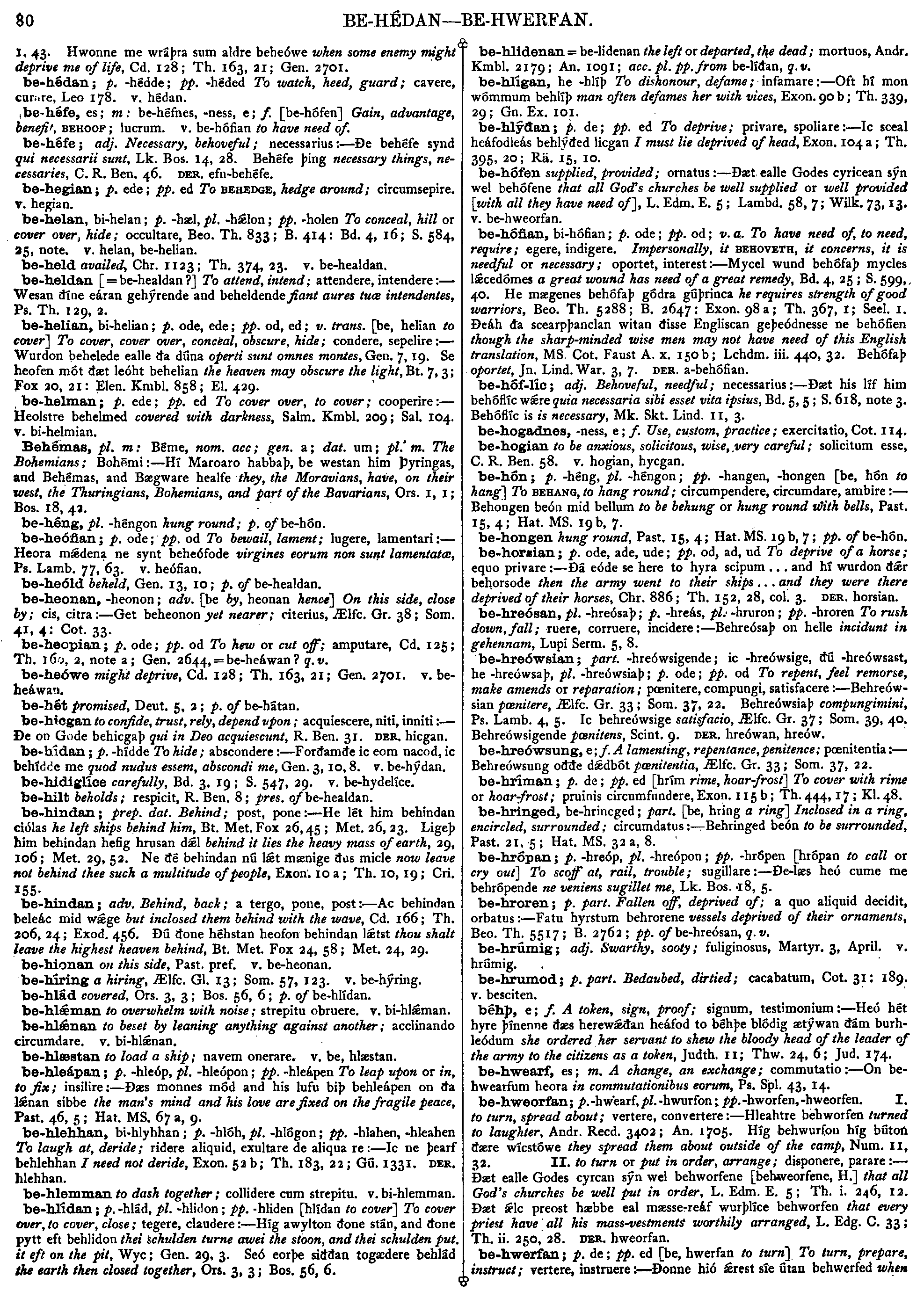
be-hleápan;
p.
-hleóp,
pl.
-hleópon;
pp.
-hleápen
To
leap
upon
or
in,
to
fix;
insilire
:--
Ðæs
monnes
mód
and
his
lufu
biþ
behleápen
on
ða
l nan
sibbe
the
man's
mind
and
his
love
are
fixed
on
the
fragile
peace,
Past.
46,
5;
Hat.
MS.
67
a,
9.
nan
sibbe
the
man's
mind
and
his
love
are
fixed
on
the
fragile
peace,
Past.
46,
5;
Hat.
MS.
67
a,
9.
|
Source: Bosworth/Toller, page b0081, entry 41 View original page image as: [TIFF] [PNG] [View previous entry] [View next entry] |
[Comment on this entry] [View comments] |
The following entry has been hand-corrected once. |
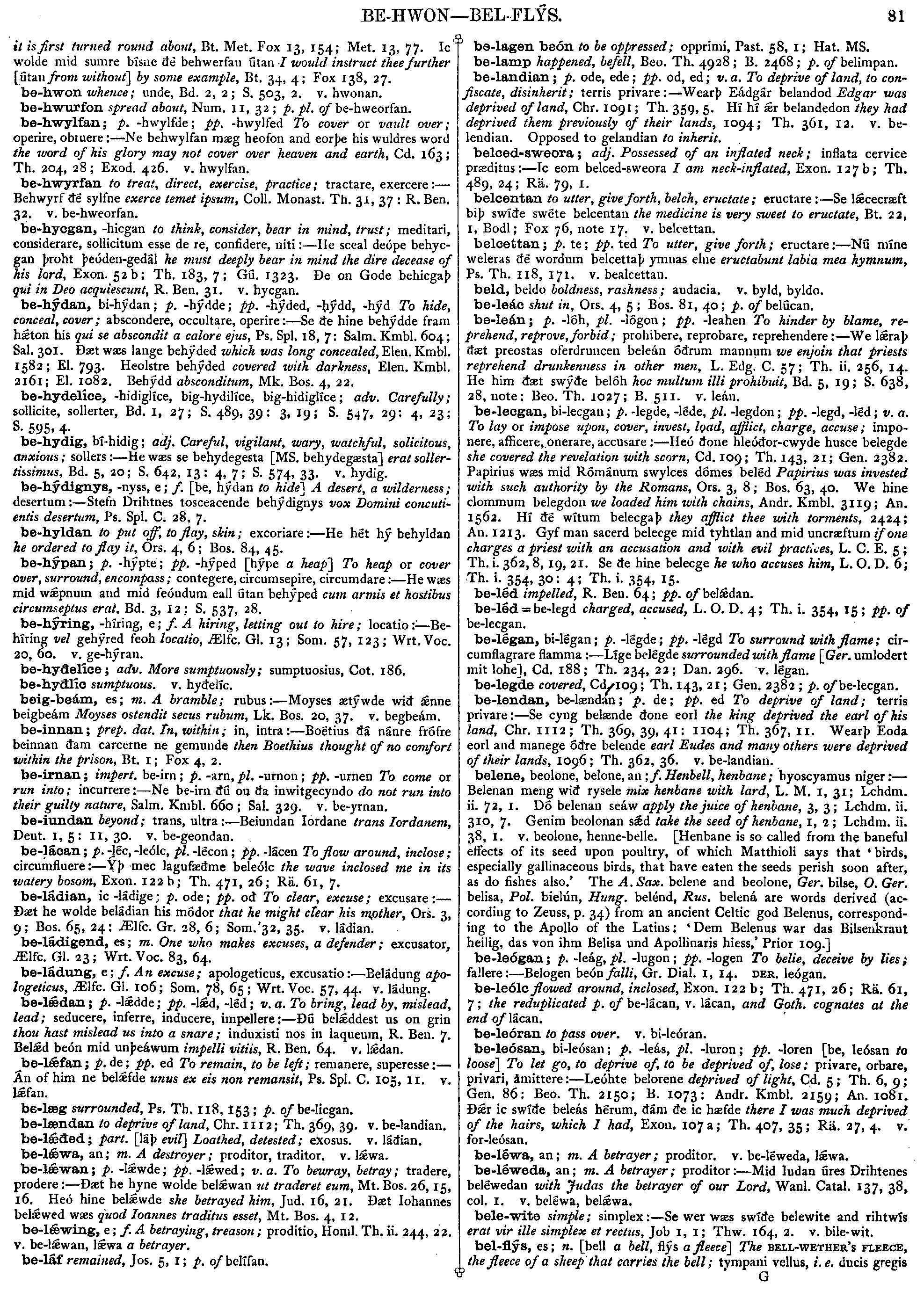
be-lecgan, bi-lecgan; p. -legde, -léde, pl. -legdon; pp. -legd, -léd; v. a. To lay or impose upon, cover, invest, load, afflict, charge, accuse; imponere, afficere, onerare, accusare :-- Heó ðone hleóðor-cwyde husce belegde she covered the revelation with scorn, Cd. 109; Th. 143, 21; Gen. 2382. Papirius wæs mid Rómánum swylces dómes beléd Papirius was invested with such authority by the Romans, Ors. 3, 8; Bos. 63, 40. We hine clommum belegdon we loaded him with chains, Andr. Kmbl. 3119; An. 1562. Hí ðé wítum belecgaþ they afflict thee with torments, 2424; An. 1213. Gyf man sacerd belecge mid tyhtlan and mid uncræftum if one charges a priest with an accusation and with evil practices, L. C. E. 5; Th. i. 362, 8, 19, 21. Se ðe hine belecge he who accuses him, L. O. D. 6; Th. i. 354, 30 : 4; Th. i. 354, 15.
|
Source: Bosworth/Toller, page b0081, entry 47 View original page image as: [TIFF] [PNG] [View previous entry] [View next entry] |
[Comment on this entry] [View comments] |
The following entry has been hand-corrected once. |
belene,
beolone,
belone,
an;
f.
Henbell,
henbane;
hyoscyamus
niger
:--
Belenan
meng
wið
rysele
mix
henbane
with
lard,
L.
M.
1,
31;
Lchdm.
ii.
72,
1.
Dó
belenan
seáw
apply
the
juice
of
henbane,
3,
3;
Lchdm.
ii.
310,
7.
Genim
beolonan
sd
take
the
seed
of
henbane,
1,
2;
Lchdm.
ii.
38,
1.
v.
beolone,
henne-belle.
[Henbane
is
so
called
from
the
baneful
effects
of
its
seed
upon
poultry,
of
which
Matthioli
says
that
'birds,
especially
gallinaceous
birds,
that
have
eaten
the
seeds
perish
soon
after,
as
do
fishes
also.'
The
A.
Sax.
belene
and
beolone,
Ger.
bilse,
O.
Ger.
belisa,
Pol.
bielún,
Hung.
belénd,
Rus.
belená
are
words
derived
(according
to
Zeuss,
p.
34)
from
an
ancient
Celtic
god
Belenus,
corresponding
to
the
Apollo
of
the
Latins
:
'Dem
Belenus
war
das
Bilsenkraut
heilig,
das
von
ihm
Belisa
and
Apollinaris
hiess,'
Prior
109.]
|
Source: Bosworth/Toller, page b0084, entry 7 View original page image as: [TIFF] [PNG] [View previous entry] [View next entry] |
[Comment on this entry] [View comments] |
The following entry has been hand-corrected once. |
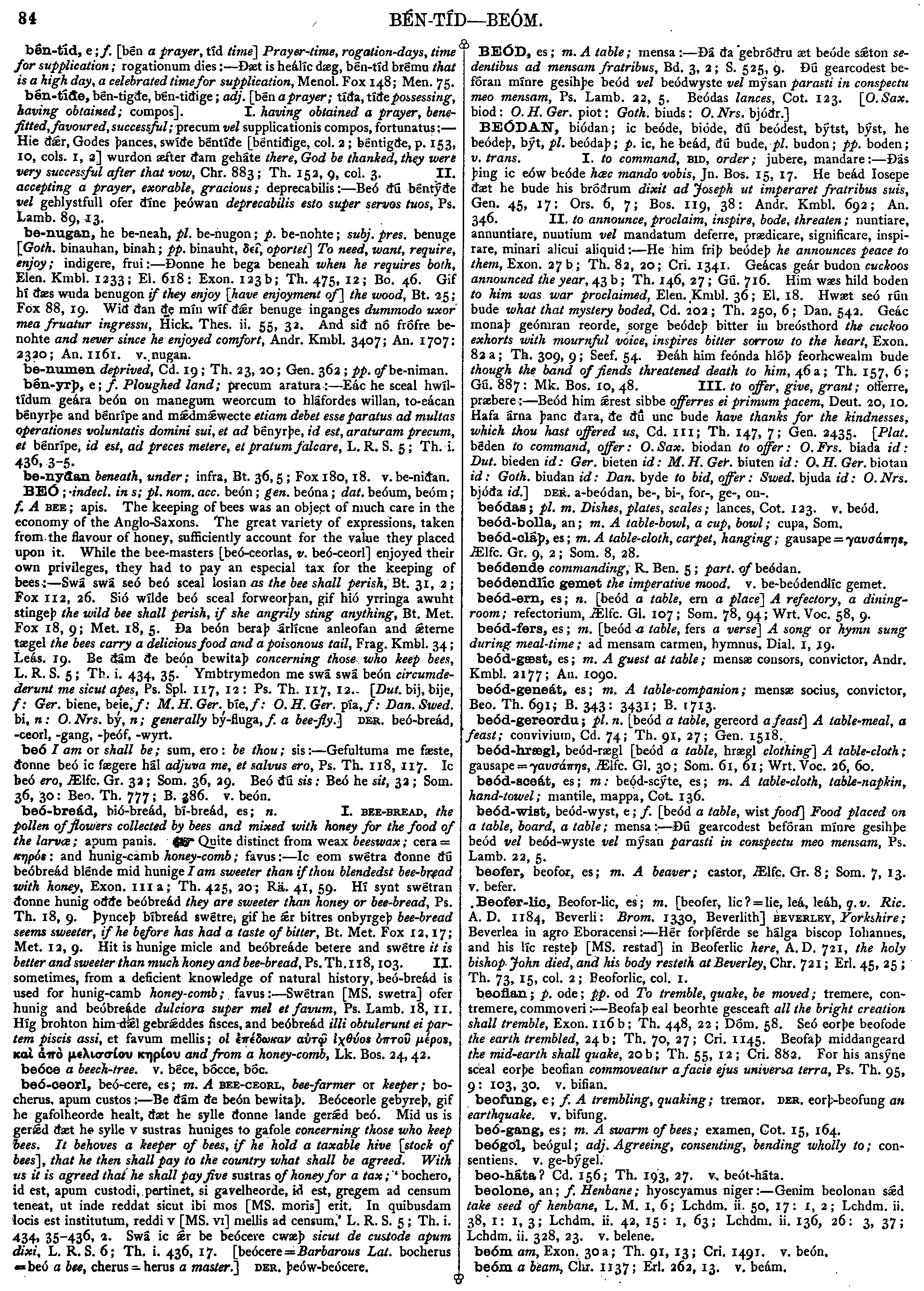
BEÓ;
indecl.
in
s;
pl.
nom.
acc.
beón;
gen.
beóna;
dat.
beóum,
beóm;
f.
A
BEE;
apis.
The
keeping
of
bees
was
an
object
of
much
care
in
the
economy
of
the
Anglo-Saxons.
The
great
variety
of
expressions,
taken
from
the
flavour
of
honey,
sufficiently
account
for
the
value
they
placed
upon
it.
While
the
bee-masters
[beó-ceorlas,
v.
beó-ceorl]
enjoyed
their
own
privileges,
they
had
to
pay
an
especial
tax
for
the
keeping
of
bees
:--
Swá
swá
seó
beó
sceal
losian
as
the
bee
shall
perish,
Bt.
31,
2;
Fox
112,
26.
Sió
wílde
beó
sceal
forweorþan,
gif
hió
yrringa
awuht
stingeþ
the
wild
bee
shall
perish,
if
she
angrily
sting
anything,
Bt.
Met.
Fox
18,
9;
Met.
18,
5.
Ða
beón
beraþ
árlícne
anleofan
and
terne
tægel
the
bees
carry
a
delicious
food
and
a
poisonous
tail,
Frag.
Kmbl.
34;
Leás.
19.
Be
ðám
ðe
beón
bewitaþ
concerning
those,
who
keep
bees,
L.
R.
S.
5;
Th.
i.
434,
35.
Ymbtrymedon
me
swá
swá
beón
circumdederunt
me
sicut
apes,
Ps.
Spl.
117,
12
:
Ps.
Th.
117,
12.
[Dut.
bij,
bije,
f
:
Ger.
biene,
beie,
f
:
M.
H.
Ger.
bíe,
f
:
O.
H.
Ger.
pía,
f
:
Dan.
Swed.
bi,
n
:
O.
Nrs.
bý,
n;
generally
bý-fluga,
f.
a
bee
fly.]
DER.
beó-breád,
-ceorl,
-gang,
-þeóf,
-wyrt.
|
Source: Bosworth/Toller, page b0090, entry 27 View original page image as: [TIFF] [PNG] [View previous entry] [View next entry] |
[Comment on this entry] [View comments] |
The following entry has been hand-corrected once. |
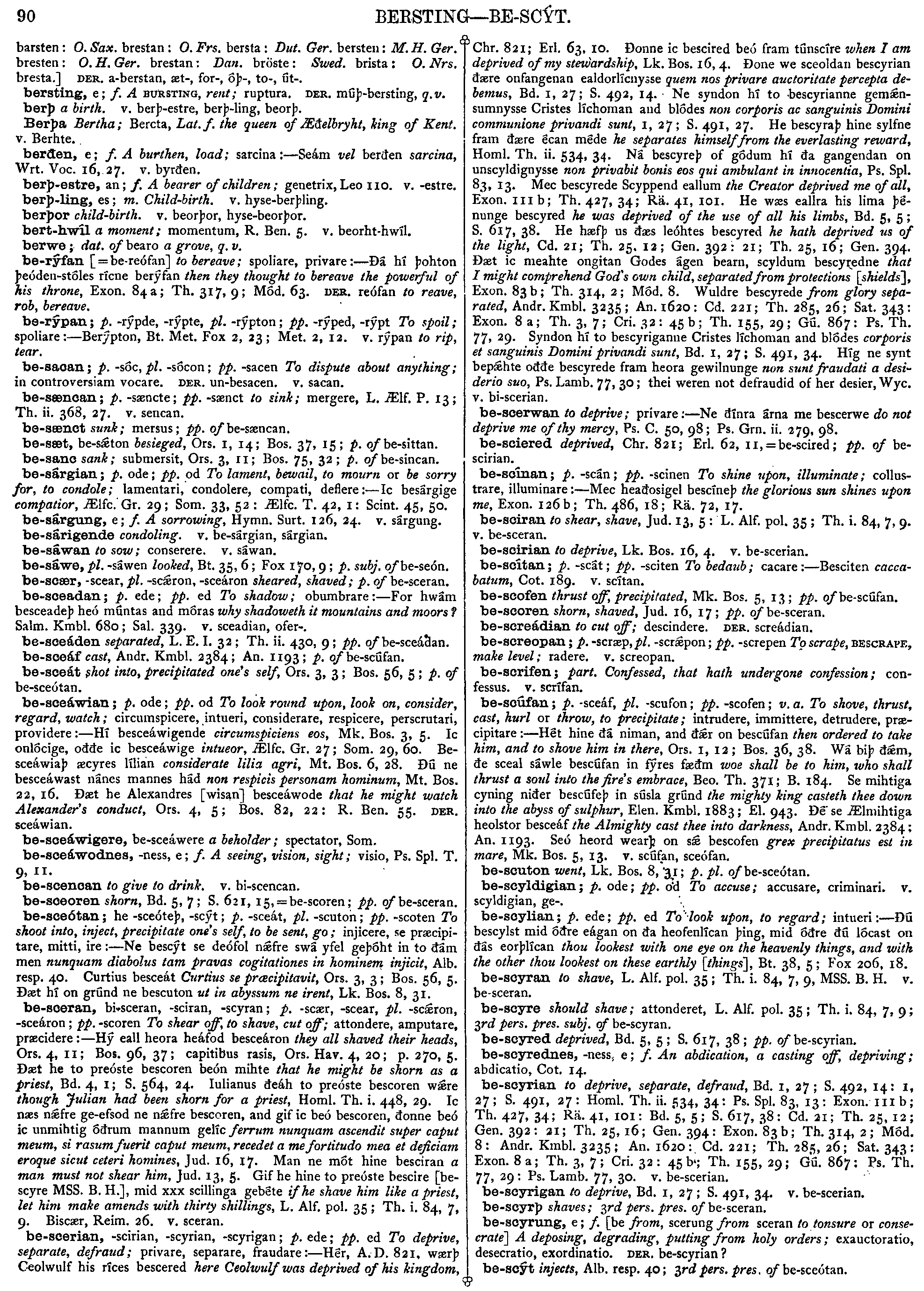
be-sceáwian; p. ode; pp. od To look round upon, look on, consider, regard, watch; circumspicere, intueri, considerare, respicere, perscrutari, providere :-- Hí besceáwigende circumspiciens eos, Mk. Bos. 3, 5. Ic onlócige, oððe ic besceáwige intueor, Ælfc. Gr. 27; Som. 29, 60. Besceáwiaþ æcyres lílian considerate lilia agri, Mt. Bos. 6, 28. Ðú ne besceáwast nánes mannes hád non respicis personam hominum, Mt. Bos. 22, 16. Ðæt he Alexandres [wisan] besceáwode that he might watch Alexander's conduct, Ors. 4, 5; Bos. 82, 22 : R. Ben. 55. DER. sceáwian.
|
Source: Bosworth/Toller, page b0090, entry 38 View original page image as: [TIFF] [PNG] [View previous entry] [View next entry] |
[Comment on this entry] [View comments] |
The following entry has been hand-corrected once. |
be-scínan; p. -scán; pp. -scinen To shine upon, illuminate; collustrare, illuminare :-- Mec heaðosigel bescíneþ the glorious sun shines upon me, Exon. 126 b; Th. 486, 18; Rä. 72, 17.
|
Source: Bosworth/Toller, page b0090, entry 50 View original page image as: [TIFF] [PNG] [View previous entry] [View next entry] |
[Comment on this entry] [View comments] |
The following entry has been hand-corrected once. |
be-scylian; p. ede; pp. ed To look upon, to regard; intueri :-- Ðú bescylst mid óðre eágan on ða heofenlícan þing, mid óðre ðú lócast on ðás eorþlícan thou lookest with one eye on the heavenly things, and with the other thou lookest on these earthly [things], Bt. 38, 5; Fox 206, 18.
|
Source: Bosworth/Toller, page b0091, entry 25 View original page image as: [TIFF] [PNG] [View previous entry] [View next entry] |
[Comment on this entry] [View comments] |
The following entry has been hand-corrected once. |
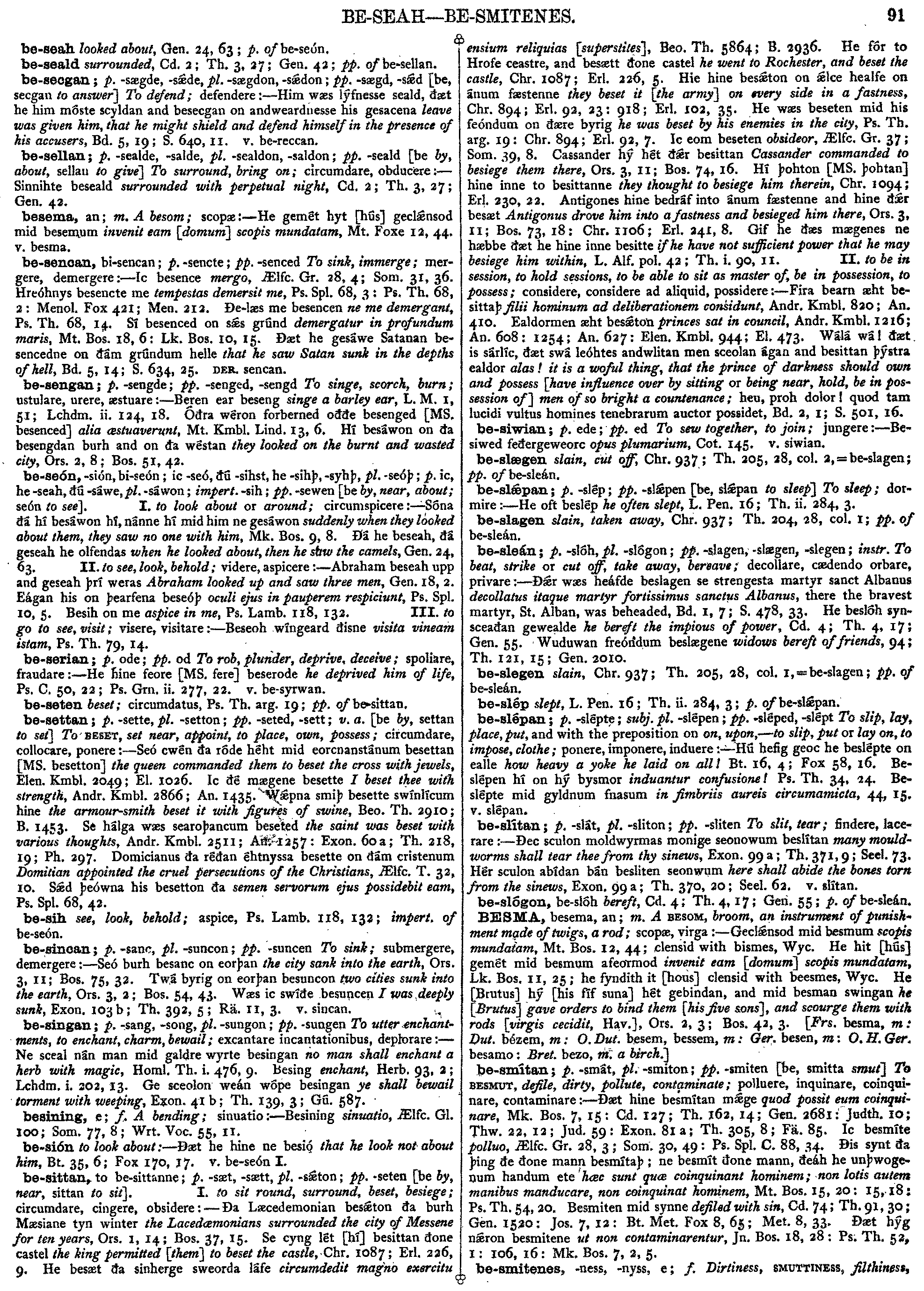
be-slépan; p. -slépte; subj. pl. -slépen; pp. -sléped, -slépt To slip, lay, place, put, and with the preposition on on, upon, - to slip, put or lay on, to impose, clothe; ponere, imponere, induere :-- Hú hefig geoc he beslépte on ealle how heavy a yoke he laid on all! Bt. 16, 4; Fox 58, 16. Beslépen hí on hý bysmor induantur confusione! Ps. Th. 34, 24. Beslépte mid gyldnum fnasum in fimbriis aureis circumamicta, 44, 15. v. slépan.
|
Source: Bosworth/Toller, page b0092, entry 14 View original page image as: [TIFF] [PNG] [View previous entry] [View next entry] |
[Comment on this entry] [View comments (1)] |
The following entry has been hand-corrected once. |
be-spanan,
bi-spanan;
p.
-spón,
-speón;
pp.
-spanen,
-sponen;
v.
trans.
To
allure,
entice,
incite,
urge,
induce,
bring
on
any
one;
allicere,
illicere,
incitare,
provocare,
inducere
:--
He
deriende
leóda
bespeón
to
ðysan
earde
he
allured
pernicious
people
to
this
land,
Chr.
959;
Th.
219,
18.
Gif
he
nigne
man
on
synne
bespeón
if
he
have
enticed
any
man
to
sin,
L.
Pen.
16;
Th.
ii.
284,
13.
Ðæt
gewin
ðe
hió
hint
on
bespón
mid
manigfealdon
firen-lustum
the
war
which
she
brought
upon
him
by
her
manifold
wicked
desires,
Ors.
1,
2;
Bos.
26,
40.
|
Source: Bosworth/Toller, page b0092, entry 27 View original page image as: [TIFF] [PNG] [View previous entry] [View next entry] |
[Comment on this entry] [View comments] |
The following entry has been hand-corrected once. |
be-stæl,
pl.
-stlon
stole
upon,
Ors.
1,
10;
Bos.
33,
33
:
Chr.
876;
Erl.
79,
13;
p.
of
be-stelan.
| Result Page: |  |
Previous | 1 2 3 4 5 6 7 8 9 10 11 12 13 14 | Next |  |
Germanic Lexicon Project (main page)
This search system was written by
Sean Crist
Please consider
volunteering
to correct the data in these online dictionaries.
No rights reserved. Feel free to use these data in any way you please.