|
|

Search for uir again, using less strict matching (18 results)
|
Source: Bosworth/Toller, page b1066, entry 3 View original page image as: [TIFF] [PNG] [View previous entry] [View next entry] |
[Comment on this entry] [View comments] |
The following entry has been hand-corrected once. |
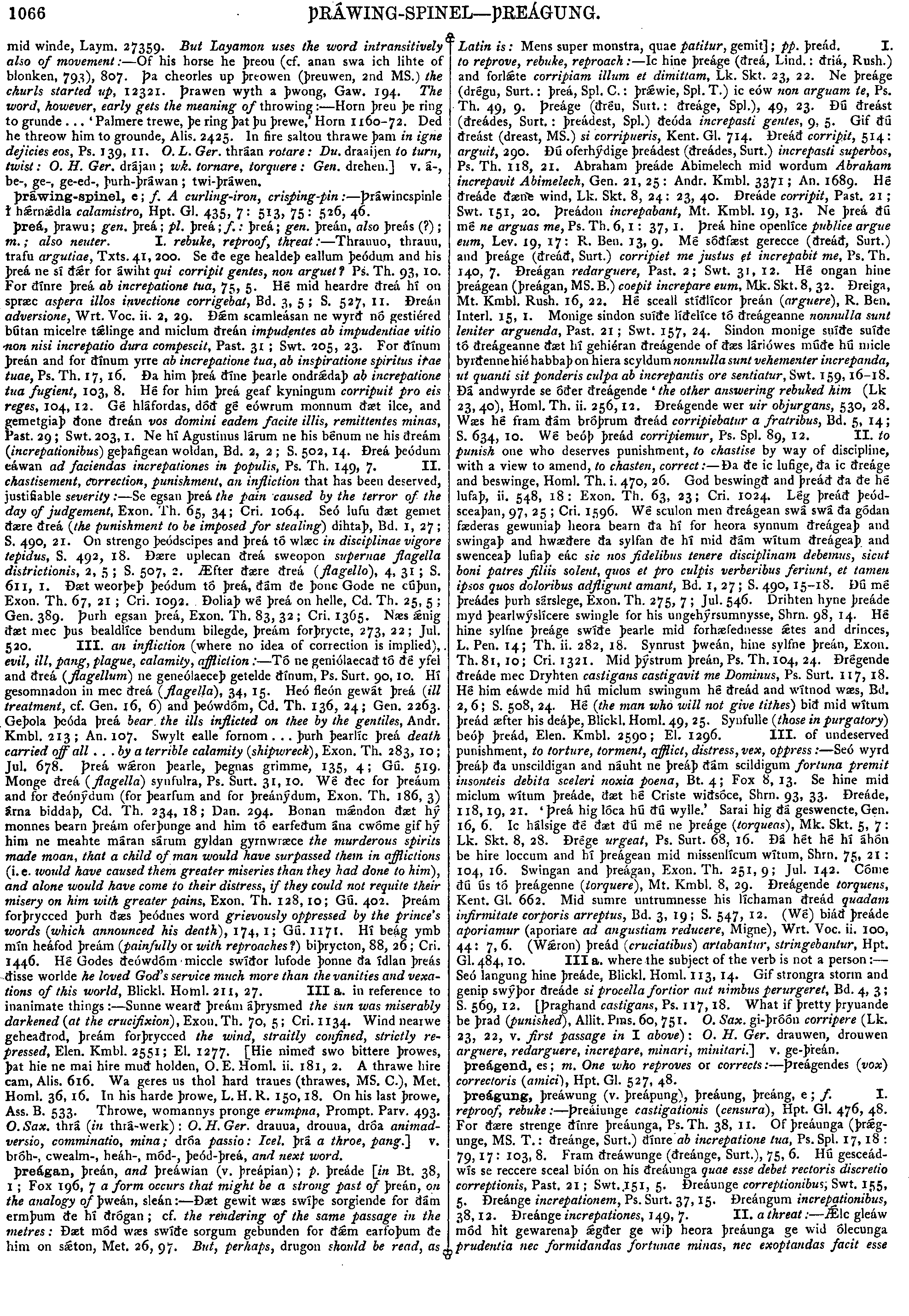
þreágan,
þreán,
and
þreáwian
(v.
þreápian);
p.
þreáde
[in
Bt.
38,
1;
Fox
196,
7
a
form
occurs
that
might
be
a
strong
past
of
þreán,
on
the
analogy
of
þweán,
sleán
:--
Ðæt
gewit
wæs
swíþe
sorgiende
for
ðám
ermþum
ðe
hí
ðrógan;
cf.
the
rendering
of
the
same
passage
in
the
metres:
Ðæt
mód
wæs
swíðe
sorgum
gebunden
for
ð m
earfoþum
ðe
him
on
ston,
Met.
26,
97.
But,
perhaps,
drugon
should
be
read,
as,
Latin
is:
Mens
super
monstra,
quae
patitur,
gemit];
pp.
þreád.
I.
to
reprove,
rebuke,
reproach
:--
Ic
hine
þreáge
(ðreá,
Lind.:
ðriá,
Rush.)
and
forlte
corripiam
illum
et
dimittam,
Lk.
Skt.
23,
22.
Ne
þreáge
(drégu,
Surt.:
þreá,
Spl.
C.:
þrwie,
Spl.
T.)
ic
eów
non
arguam
te,
Ps.
Th.
49,
9.
Þreáge
(ðréu,
Surt.:
ðreáge,
Spl.),
49,
23.
Ðú
ðreást
(ðreádes,
Surt.:
þreádest,
Spl.)
ðeóda
increpasti
gentes,
9,
5.
Gif
ðú
ðreást
(dreast,
MS.)
si
corripueris,
Kent.
Gl.
714.
Ðreáð
corripit,
514:
arguit,
290.
Ðú
oferhýdige
þreádest
(ðreádes,
Surt.)
increpasti
superbos,
Ps.
Th.
118,
21.
Abraham
þreáde
Abimelech
mid
wordum
Abraham
increpavit
Abimelech,
Gen.
21,
25:
Andr.
Kmbl.
3371;
An.
1689.
Hé
ðreáde
ðæne
wind,
Lk.
Skt.
8,
24:
23,
40.
Ðreáde
corripit,
Past.
21;
Swt.
151,
20.
Þreádon
increpabant,
Mt.
Kmbl.
19,
13.
Ne
þreá
ðú
mé
ne
arguas
me,
Ps.
Th.
6,
1:
37,
1.
Þreá
hine
openlíce
publice
argue
eum,
Lev.
19,
17:
R.
Ben.
13,
9.
Mé
sóðfæst
gerecce
(ðreáð,
Surt.)
and
þreáge
(ðreáð,
Surt.)
corripiet
me
justus
et
increpabit
me,
Ps.
Th.
140,
7.
Ðreágan
redarguere,
Past.
2;
Swt.
31,
12.
Hé
ongan
hine
þreágean
(þreágan,
MS.
B.)
coepit
increpare
eum,
Mk.
Skt.
8,
32.
Ðreiga,
Mt.
Kmbl.
Rush.
16,
22.
Hé
sceall
stíðlícor
þreán
(arguere),
R.
Ben.
Interl.
15,
1.
Monige
sindon
suíðe
líðelíce
tó
ðreágeanne
nonnulla
sunt
leniter
arguenda,
Past.
21;
Swt.
157,
24.
Sindon
monige
sníðe
sníðe
tó
ðreágeanne
ðæt
hí
gehiéran
ðreágende
of
ðæs
láriówes
múðe
hú
micle
byrðenne
hié
habbaþ
on
hiera
scyldum
nonnulla
sunt
vehementer
increpanda,
ut
quanti
sit
ponderis
culpa
ab
increpantis
ore
sentiatur,
Swt.
159,
16-18.
Ðá
andwyrde
se
óðer
ðreágende
'the
other
answering
rebuked
him
(Lk
23,
40),
Homl.
Th.
ii.
256,
12.
Ðreágende
wer
uir
objurgans,
530,
28.
Wæs
hé
fram
ðám
bróþrum
ðreád
corripiebatur
a
fratribus,
Bd.
5,
14;
S.
634,
10.
Wé
beóþ
þreád
corripiemur,
Ps.
Spl.
89,
12.
II.
to
punish
one
who
deserves
punishment,
to
chastise
by
way
of
discipline,
with
a
view
to
amend,
to
chasten,
correct
:--
Ða
ðe
ic
lufige,
ða
ic
ðreáge
and
beswinge,
Homl.
Th.
i.
470,
26.
God
beswingð
and
þreáð
ða
ðe
hé
lufaþ,
ii.
548,
18:
Exon.
Th.
63,
23;
Cri.
1024.
Lég
þreáð
þeódsceaþan,
97,
25;
Cri.
1596.
Wé
sculon
men
ðreágean
swá
swá
ða
gódan
fæderas
gewuniaþ
heora
bearn
ða
hí
for
heora
synnum
ðreágeaþ
and
swingaþ
and
hwæðere
ða
sylfan
ðe
hí
mid
ðám
wítum
ðreágeaþ
and
swenceaþ
lufiaþ
eác
sic
nos
fidelibus
tenere
disciplinam
debemus,
sicut
boni
patres
filiis
solent,
quos
et
pro
culpis
verberibus
feriunt,
et
tamen
ipsos
quos
doloribus
adfligunt
amant,
Bd.
1,
27;
S.
490,
15-18.
Ðú
mé
þreádes
þurh
sárslege,
Exon.
Th.
275,
7;
Jul.
546.
Drihten
hyne
þreáde
myd
þearlwýslícere
swingle
for
his
ungehýrsumnysse,
Shrn.
98,
14.
Hé
hine
sylfne
þreáge
swíðe
þearle
mid
forhæfednesse
tes
and
drinces,
L.
Pen.
14;
Th.
ii.
282,
18.
Synrust
þweán,
hine
sylfne
þreán,
Exon.
Th.
81,
10;
Cri.
1321.
Mid
þýstrum
þreán,
Ps.
Th.
104,
24.
Ðrégende
ðreáde
mec
Dryhten
castigans
castigavit
me
Dominus,
Ps.
Surt.
117,
18.
Hé
him
eáwde
mid
hú
miclum
swingum
hé
ðread
and
wítnod
wæs,
Bd.
2,
6;
S.
508,
24.
Hé
(the
man
who
will
not
give
tithes)
bið
mid
wítum
þreád
æfter
his
deáþe,
Blickl.
Homl.
49,
25.
Synfulle
(those
in
purgatory)
beóþ
þreád,
Elen.
Kmbl.
2590;
El.
1296.
III.
of
undeserved
punishment,
to
torture,
torment,
afflict,
distress,
vex,
oppress
:--
Seó
wyrd
þreáþ
ða
unscildigan
and
náuht
ne
þreáþ
ðám
scildigum
fortuna
premit
insonteis
debita
sceleri
noxia
poena,
Bt.
4;
Fox
8,
13.
Se
hine
mid
miclum
wítum
þreáde,
ðæt
hé
Criste
wiðsóce,
Shrn.
93,
33.
Ðreáde,
118,
19,
21.
'Þreá
hig
lóca
hú
ðú
wylle.'
Sarai
hig
ðá
geswencte,
Gen.
16,
6.
Ic
hálsige
ðé
ðæt
ðú
mé
ne
þreáge
(torqueas),
Mk.
Skt.
5,
7:
Lk.
Skt.
8,
28.
Ðrége
urgeat,
Ps.
Surt.
68,
16.
Ðá
hét
hé
hí
áhón
be
hire
loccum
and
hí
þreágean
mid
missenlícum
wítum,
Shrn.
75,
21:
104,
16.
Swingan
and
þreágan,
Exon.
Th.
251,
9;
Jul.
142.
Cóme
ðú
ús
tó
þreágenne
(torquere),
Mt.
Kmbl.
8,
29.
Ðreágende
torquens,
Kent.
Gl.
662.
Mid
sumre
untrumnesse
his
líchaman
ðreád
quadam
infirmitate
corporis
arreptus,
Bd.
3,
19;
S.
547,
12.
(Wé)
biáð
þreáde
aporiamur
(aporiare
ad
angustiam
reducere,
Migne),
Wrt.
Voc.
ii.
100,
44:
7,
6.
(Wron)
þreád
(cruciatibus)
artabantur,
stringebantur,
Hpt.
Gl.
484,
10.
III
a.
where
the
subject
of
the
verb
is
not
a
person
:--
Seó
langung
hine
þreáde,
Blickl.
Homl.
713,
14.
Gif
strongra
storm
and
genip
swýþor
ðreáde
si
procella
fortior
aut
nimbus
perurgeret,
Bd.
4,
3;
S.
569,
12.
[Þraghand
castigans,
Ps.
117,
18.
What
if
þretty
þryuande
be
þrad
(punished),
Allit.
Pms.
60,
751.
O.
Sax.
gi-þróón
corripere
(Lk.
23,
22,
v.
first
passage
in
I
above):
O.
H.
Ger.
drauwen,
drouwen
arguere,
redarguere,
increpare,
minari,
minitari.]
v.
ge-þreán.
m
earfoþum
ðe
him
on
ston,
Met.
26,
97.
But,
perhaps,
drugon
should
be
read,
as,
Latin
is:
Mens
super
monstra,
quae
patitur,
gemit];
pp.
þreád.
I.
to
reprove,
rebuke,
reproach
:--
Ic
hine
þreáge
(ðreá,
Lind.:
ðriá,
Rush.)
and
forlte
corripiam
illum
et
dimittam,
Lk.
Skt.
23,
22.
Ne
þreáge
(drégu,
Surt.:
þreá,
Spl.
C.:
þrwie,
Spl.
T.)
ic
eów
non
arguam
te,
Ps.
Th.
49,
9.
Þreáge
(ðréu,
Surt.:
ðreáge,
Spl.),
49,
23.
Ðú
ðreást
(ðreádes,
Surt.:
þreádest,
Spl.)
ðeóda
increpasti
gentes,
9,
5.
Gif
ðú
ðreást
(dreast,
MS.)
si
corripueris,
Kent.
Gl.
714.
Ðreáð
corripit,
514:
arguit,
290.
Ðú
oferhýdige
þreádest
(ðreádes,
Surt.)
increpasti
superbos,
Ps.
Th.
118,
21.
Abraham
þreáde
Abimelech
mid
wordum
Abraham
increpavit
Abimelech,
Gen.
21,
25:
Andr.
Kmbl.
3371;
An.
1689.
Hé
ðreáde
ðæne
wind,
Lk.
Skt.
8,
24:
23,
40.
Ðreáde
corripit,
Past.
21;
Swt.
151,
20.
Þreádon
increpabant,
Mt.
Kmbl.
19,
13.
Ne
þreá
ðú
mé
ne
arguas
me,
Ps.
Th.
6,
1:
37,
1.
Þreá
hine
openlíce
publice
argue
eum,
Lev.
19,
17:
R.
Ben.
13,
9.
Mé
sóðfæst
gerecce
(ðreáð,
Surt.)
and
þreáge
(ðreáð,
Surt.)
corripiet
me
justus
et
increpabit
me,
Ps.
Th.
140,
7.
Ðreágan
redarguere,
Past.
2;
Swt.
31,
12.
Hé
ongan
hine
þreágean
(þreágan,
MS.
B.)
coepit
increpare
eum,
Mk.
Skt.
8,
32.
Ðreiga,
Mt.
Kmbl.
Rush.
16,
22.
Hé
sceall
stíðlícor
þreán
(arguere),
R.
Ben.
Interl.
15,
1.
Monige
sindon
suíðe
líðelíce
tó
ðreágeanne
nonnulla
sunt
leniter
arguenda,
Past.
21;
Swt.
157,
24.
Sindon
monige
sníðe
sníðe
tó
ðreágeanne
ðæt
hí
gehiéran
ðreágende
of
ðæs
láriówes
múðe
hú
micle
byrðenne
hié
habbaþ
on
hiera
scyldum
nonnulla
sunt
vehementer
increpanda,
ut
quanti
sit
ponderis
culpa
ab
increpantis
ore
sentiatur,
Swt.
159,
16-18.
Ðá
andwyrde
se
óðer
ðreágende
'the
other
answering
rebuked
him
(Lk
23,
40),
Homl.
Th.
ii.
256,
12.
Ðreágende
wer
uir
objurgans,
530,
28.
Wæs
hé
fram
ðám
bróþrum
ðreád
corripiebatur
a
fratribus,
Bd.
5,
14;
S.
634,
10.
Wé
beóþ
þreád
corripiemur,
Ps.
Spl.
89,
12.
II.
to
punish
one
who
deserves
punishment,
to
chastise
by
way
of
discipline,
with
a
view
to
amend,
to
chasten,
correct
:--
Ða
ðe
ic
lufige,
ða
ic
ðreáge
and
beswinge,
Homl.
Th.
i.
470,
26.
God
beswingð
and
þreáð
ða
ðe
hé
lufaþ,
ii.
548,
18:
Exon.
Th.
63,
23;
Cri.
1024.
Lég
þreáð
þeódsceaþan,
97,
25;
Cri.
1596.
Wé
sculon
men
ðreágean
swá
swá
ða
gódan
fæderas
gewuniaþ
heora
bearn
ða
hí
for
heora
synnum
ðreágeaþ
and
swingaþ
and
hwæðere
ða
sylfan
ðe
hí
mid
ðám
wítum
ðreágeaþ
and
swenceaþ
lufiaþ
eác
sic
nos
fidelibus
tenere
disciplinam
debemus,
sicut
boni
patres
filiis
solent,
quos
et
pro
culpis
verberibus
feriunt,
et
tamen
ipsos
quos
doloribus
adfligunt
amant,
Bd.
1,
27;
S.
490,
15-18.
Ðú
mé
þreádes
þurh
sárslege,
Exon.
Th.
275,
7;
Jul.
546.
Drihten
hyne
þreáde
myd
þearlwýslícere
swingle
for
his
ungehýrsumnysse,
Shrn.
98,
14.
Hé
hine
sylfne
þreáge
swíðe
þearle
mid
forhæfednesse
tes
and
drinces,
L.
Pen.
14;
Th.
ii.
282,
18.
Synrust
þweán,
hine
sylfne
þreán,
Exon.
Th.
81,
10;
Cri.
1321.
Mid
þýstrum
þreán,
Ps.
Th.
104,
24.
Ðrégende
ðreáde
mec
Dryhten
castigans
castigavit
me
Dominus,
Ps.
Surt.
117,
18.
Hé
him
eáwde
mid
hú
miclum
swingum
hé
ðread
and
wítnod
wæs,
Bd.
2,
6;
S.
508,
24.
Hé
(the
man
who
will
not
give
tithes)
bið
mid
wítum
þreád
æfter
his
deáþe,
Blickl.
Homl.
49,
25.
Synfulle
(those
in
purgatory)
beóþ
þreád,
Elen.
Kmbl.
2590;
El.
1296.
III.
of
undeserved
punishment,
to
torture,
torment,
afflict,
distress,
vex,
oppress
:--
Seó
wyrd
þreáþ
ða
unscildigan
and
náuht
ne
þreáþ
ðám
scildigum
fortuna
premit
insonteis
debita
sceleri
noxia
poena,
Bt.
4;
Fox
8,
13.
Se
hine
mid
miclum
wítum
þreáde,
ðæt
hé
Criste
wiðsóce,
Shrn.
93,
33.
Ðreáde,
118,
19,
21.
'Þreá
hig
lóca
hú
ðú
wylle.'
Sarai
hig
ðá
geswencte,
Gen.
16,
6.
Ic
hálsige
ðé
ðæt
ðú
mé
ne
þreáge
(torqueas),
Mk.
Skt.
5,
7:
Lk.
Skt.
8,
28.
Ðrége
urgeat,
Ps.
Surt.
68,
16.
Ðá
hét
hé
hí
áhón
be
hire
loccum
and
hí
þreágean
mid
missenlícum
wítum,
Shrn.
75,
21:
104,
16.
Swingan
and
þreágan,
Exon.
Th.
251,
9;
Jul.
142.
Cóme
ðú
ús
tó
þreágenne
(torquere),
Mt.
Kmbl.
8,
29.
Ðreágende
torquens,
Kent.
Gl.
662.
Mid
sumre
untrumnesse
his
líchaman
ðreád
quadam
infirmitate
corporis
arreptus,
Bd.
3,
19;
S.
547,
12.
(Wé)
biáð
þreáde
aporiamur
(aporiare
ad
angustiam
reducere,
Migne),
Wrt.
Voc.
ii.
100,
44:
7,
6.
(Wron)
þreád
(cruciatibus)
artabantur,
stringebantur,
Hpt.
Gl.
484,
10.
III
a.
where
the
subject
of
the
verb
is
not
a
person
:--
Seó
langung
hine
þreáde,
Blickl.
Homl.
713,
14.
Gif
strongra
storm
and
genip
swýþor
ðreáde
si
procella
fortior
aut
nimbus
perurgeret,
Bd.
4,
3;
S.
569,
12.
[Þraghand
castigans,
Ps.
117,
18.
What
if
þretty
þryuande
be
þrad
(punished),
Allit.
Pms.
60,
751.
O.
Sax.
gi-þróón
corripere
(Lk.
23,
22,
v.
first
passage
in
I
above):
O.
H.
Ger.
drauwen,
drouwen
arguere,
redarguere,
increpare,
minari,
minitari.]
v.
ge-þreán.
|
Source: Bosworth/Toller, page b1205, entry 4 View original page image as: [TIFF] [PNG] [View previous entry] [View next entry] |
[Comment on this entry] [View comments] |
The following entry has been hand-corrected once. |
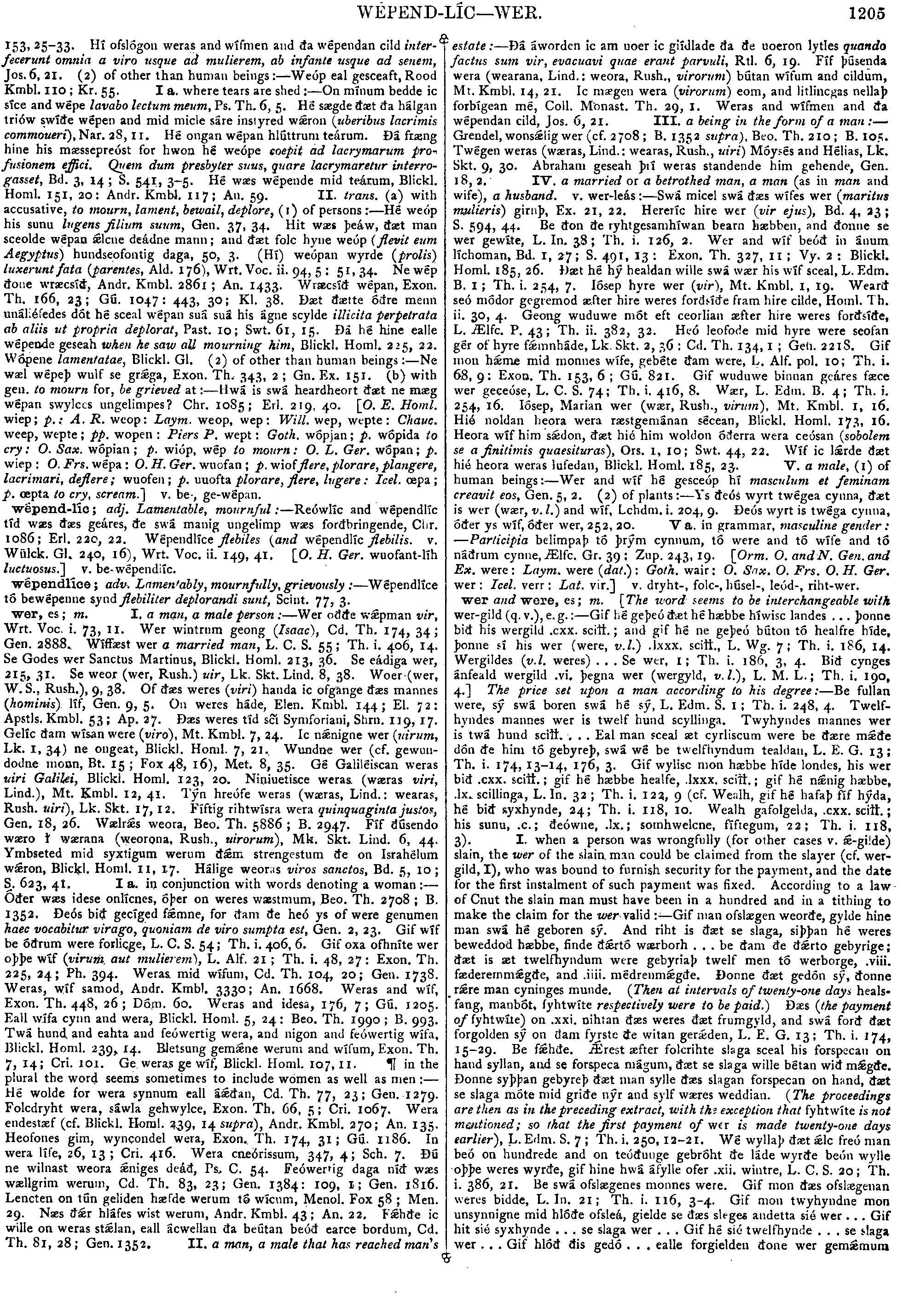
wer,
es;
m.
I.
a
man,
a
male
person:--Wer
oððe
wpman
vir,
Wrt.
Voc.
i.
73,
11.
Wer
wintrum
geong
(Isaac),
Cd.
Th.
174,
34;
Gen.
2888.
Wíffæst
wer
a
married
man,
L.
C.
S.
55;
Th.
i.
406,
14.
Se
Godes
wer
Sanctus
Martinus,
Blickl.
Homl.
213,
36.
Se
eádiga
wer,
215,
31.
Se
weor
(wer,
Rush.)
uir,
Lk.
Skt.
Lind.
8,
38.
Woer
(wer,
W.
S.,
Rush.),
9,
38.
Of
ðæs
weres
(viri)
handa
ic
ofgange
ðæs
mannes
(hominis)
líf,
Gen.
9,
5.
On
weres
háde,
Elen.
Kmbl.
144;
El.
72:
Apstls.
Kmbl.
53;
Ap.
27.
Ðæs
weres
tíd
s i
Symforiani,
Shrn.
119,
17.
Gelíc
ðam
wísan
were
(viro),
Mt.
Kmbl.
7,
24.
Ic
nnigne
wer
(uirum,
Lk.
1,
34)
ne
ongeat,
Blickl.
Homl.
7,
21.
Wundne
wer
(cf.
gewundodne
monn,
Bt.
15;
Fox
48,
16),
Met.
8,
35.
Gé
Galiléiscan
weras
uiri
Galilei,
Blickl.
Homl.
123,
20.
Niniuetisce
weras
(wæras
viri,
Lind.),
Mt.
Kmbl.
12,
41.
Týn
hreófe
weras
(wæras,
Lind.:
wearas,
Rush.
uiri),
Lk.
Skt.
17,
12.
Fíftig
rihtwísra
wera
quinquaginta
justos,
Gen.
18,
26.
Wælrs
weora,
Beo.
Th.
5886;
B.
2947.
Fíf
ðúsendo
wæro
i
Symforiani,
Shrn.
119,
17.
Gelíc
ðam
wísan
were
(viro),
Mt.
Kmbl.
7,
24.
Ic
nnigne
wer
(uirum,
Lk.
1,
34)
ne
ongeat,
Blickl.
Homl.
7,
21.
Wundne
wer
(cf.
gewundodne
monn,
Bt.
15;
Fox
48,
16),
Met.
8,
35.
Gé
Galiléiscan
weras
uiri
Galilei,
Blickl.
Homl.
123,
20.
Niniuetisce
weras
(wæras
viri,
Lind.),
Mt.
Kmbl.
12,
41.
Týn
hreófe
weras
(wæras,
Lind.:
wearas,
Rush.
uiri),
Lk.
Skt.
17,
12.
Fíftig
rihtwísra
wera
quinquaginta
justos,
Gen.
18,
26.
Wælrs
weora,
Beo.
Th.
5886;
B.
2947.
Fíf
ðúsendo
wæro
 wærana
(weorona,
Rush.,
uirorum),
Mk.
Skt.
Lind.
6,
44.
Ymbseted
mid
syxtigum
werum
ðm
strengestum
ðe
on
Israhélum
wron,
Blickl.
Homl.
11,
17.
Hálige
weoras
viros
sanctos,
Bd.
5,
10;
S.
623,
41.
I
a.
in
conjunction
with
words
denoting
a
woman:--Óðer
wæs
idese
onlícines,
óþer
on
weres
wæstmum,
Beo.
Th.
2708;
B.
1352.
Ðeós
bið
gecíged
fmne,
for
ðam
ðe
heó
ys
of
were
genumen
haec
vocabitur
virago,
quoniam
de
viro
sumpta
est,
Gen.
2,
23.
Gif
wíf
be
óðrum
were
forlicge,
L.
C.
S.
54;
Th.
i.
406,
6.
Gif
oxa
ofhníte
wer
oþþe
wíf
(virum
aut
mulierem),
L.
Alf.
21;
Th.
i.
48,
27:
Exon.
Th.
225,
24;
Ph.
394.
Weras
mid
wífum,
Cd.
Th.
104,
20;
Gen.
1738.
Weras,
wíf
samod,
Andr.
Kmbl.
3330;
An.
1668.
Weras
and
wíf,
Exon.
Th.
448,
26;
Dóm.
60.
Weras
and
idesa,
176,
7;
Gú.
1205.
Eall
wífa
cynn
and
wera,
Blickl.
Homl.
5,
24:
Beo.
Th.
1990;
B.
993.
Twá
hund
and
eahta
and
feówertig
wera,
and
nigon
and
feówertig
wífa,
Blickl.
Homl.
239,
14.
Bletsung
gemne
werum
and
wífum,
Exon.
Th.
7,
14;
Cri.
101.
Ge
weras
ge
wíf,
Blickl.
Homl.
107,
11.

in
the
plural
the
word
seems
sometimes
to
include
women
as
well
as
men:--Hé
wolde
for
wera
synnum
eall
áðan,
Cd.
Th.
77,
23;
Gen.
1279.
Folcdryht
wera,
sáwla
gehwylce,
Exon.
Th.
66,
5;
Cri.
1067.
Wera
endestæf
(cf.
Blickl.
Homl.
239,
14
supra),
Andr.
Kmbl.
270;
An.
135.
Heofones
gim,
wyncondel
wera,
Exon.
Th.
174,
31;
Gú.
1186.
In
wera
lífe,
26,
13;
Cri.
416.
Wera
cneórissum,
347,
4;
Sch.
7.
Ðú
ne
wilnast
weora
niges
deáð,
Ps.
C.
54.
Feówertig
daga
níð
wæs
wællgrim
werum,
Cd.
Th.
83,
23;
Gen.
1384:
109,
1;
Gen.
1816.
Lencten
on
tún
geliden
hæfde
werum
tó
wícum,
Menol.
Fox
58;
Men.
29.
Næs
ðr
hláfes
wist
werum,
Andr.
Kmbl.
43;
An.
22.
Fhðe
ic
wille
on
weras
stlan,
eall
ácwellan
ða
beútan
beóð
earce
bordum,
Cd.
Th.
81,
28;
Gen.
1352.
II.
a
man,
a
male
that
has
reached
man's
estate:--Ðá
áworden
ic
am
uoer
ic
giídlade
ða
ðe
uoeron
lytles
quando
factus
sum
vir,
evacuavi
quae
erant
parvuli,
Rtl.
6,
19.
Fíf
þúsenda
wera
(wearana,
Lind.:
weora,
Rush.,
virorum)
bútan
wífum
and
cildum,
Mt.
Kmbl.
14,
21.
Ic
mægen
wera
(virorum)
eom,
and
litlincgas
nellaþ
forbígean
mé,
Coll.
Monast.
Th.
29,
1.
Weras
and
wífmen
and
ða
wépendan
cild,
Jos.
6,
21.
III.
a
being
in
the
form
of
a
man:--Grendel,
wonslig
wer
(cf.
2708;
B.
1352
supra),
Beo.
Th.
210;
B.
105.
Twégen
weras
(wæras,
Lind.:
wearas,
Rush.,
uiri)
Móysés
and
Hélias,
Lk.
Skt.
9,
30.
Abraham
geseah
þrí
weras
standende
him
gehende,
Gen.
18,
2.
IV.
a
married
or
a
betrothed
man,
a
man
(as
in
man
and
wife),
a
husband,
v.
wer-leás:--Swá
micel
swá
ðæs
wífes
wer
(maritus
mulieris)
girnþ,
Ex.
21,
22.
Hereríc
hire
wer
(vir
ejus),
Bd.
4,
23;
S.
594,
44.
Be
ðon
ðe
ryhtgesamhíwan
bearn
hæbben,
and
ðonne
se
wer
gewíte,
L.
In.
38;
Th.
i.
126,
2.
Wer
and
wíf
beóð
in
ánum
líchoman,
Bd.
1,
27;
S.
491,
13:
Exon.
Th.
327,
11;
Vy.
2:
Blickl.
Homl.
185,
26.
Ðæt
hé
hý
healdan
wille
swá
wær
his
wíf
sceal,
L.
Edm.
B.
1;
Th.
i.
254,
7.
Iósep
hyre
wer
(vir),
Mt.
Kmbl.
1,
19.
Wearð
seó
módor
gegremod
æfter
hire
weres
forðsíðe
fram
hire
cilde,
Homl.
Th.
ii.
30,
4.
Geong
wuduwe
mót
eft
ceorlian
æfter
hire
weres
forðsíðe,
L.
Ælfc.
P.
43;
Th.
ii.
382,
32.
Heó
leofode
mid
hyre
were
seofan
gér
of
hyre
fmnháde,
Lk.
Skt.
2,
36:
Cd.
Th.
134,
1;
Gen.
2218.
Gif
mon
hme
mid
monnes
wífe,
gebéte
ðam
were,
L.
Alf.
pol.
10;
Th.
i.
68,
9:
Exon.
Th.
153,
6;
Gú.
821.
Gif
wuduwe
binnan
geáres
fæce
wer
geceóse,
L.
C.
S.
74;
Th.
i.
416,
8.
Wær,
L.
Edm.
B.
4;
Th.
i.
254,
16.
Iósep,
Marian
wer
(wær,
Rush.,
virum),
Mt.
Kmbl.
1,
16.
Hié
noldan
heora
wera
ræstgemánan
sécean,
Blickl.
Homl.
173,
16.
Heora
wíf
him
sdon,
ðæt
hié
him
woldon
óðerra
wera
ceósan
(sobolem
se
a
finitimis
quaesituras),
Ors.
1,
10;
Swt.
44,
22.
Wíf
ic
lrde
ðæt
hié
heora
weras
lufedan,
Blickl.
Homl.
185,
23.
V.
a
male,
(1)
of
human
beings:--Wer
and
wíf
hé
gesceóp
hí
masculum
et
feminam
creavit
eos,
Gen.
5,
2.
(2)
of
plants:--Ys
ðeós
wyrt
twégea
cynna,
ðæt
is
wer
(wær,
v.
l.)
and
wíf,
Lchdm.
i.
204,
9.
Ðeós
wyrt
is
twéga
cynna,
óðer
ys
wíf,
óðer
wer,
252,
20.
V
a.
in
grammar,
masculine
gender:--Participia
belimpaþ
tó
þrým
cynnum,
tó
were
and
tó
wífe
and
tó
náðrum
cynne,
Ælfc.
Gr.
39;
Zup.
243,
19.
[Orm.
O.
and
N.
Gen.
and
Ex.
were:
Laym.
were
(dat.):
Goth.
wair:
O.
Sax.
O.
Frs.
O.
H.
Ger.
wer:
Icel.
verr:
Lat.
vir.]
v.
dryht-,
folc-,
húsel-,
leód-,
riht-wer.
wærana
(weorona,
Rush.,
uirorum),
Mk.
Skt.
Lind.
6,
44.
Ymbseted
mid
syxtigum
werum
ðm
strengestum
ðe
on
Israhélum
wron,
Blickl.
Homl.
11,
17.
Hálige
weoras
viros
sanctos,
Bd.
5,
10;
S.
623,
41.
I
a.
in
conjunction
with
words
denoting
a
woman:--Óðer
wæs
idese
onlícines,
óþer
on
weres
wæstmum,
Beo.
Th.
2708;
B.
1352.
Ðeós
bið
gecíged
fmne,
for
ðam
ðe
heó
ys
of
were
genumen
haec
vocabitur
virago,
quoniam
de
viro
sumpta
est,
Gen.
2,
23.
Gif
wíf
be
óðrum
were
forlicge,
L.
C.
S.
54;
Th.
i.
406,
6.
Gif
oxa
ofhníte
wer
oþþe
wíf
(virum
aut
mulierem),
L.
Alf.
21;
Th.
i.
48,
27:
Exon.
Th.
225,
24;
Ph.
394.
Weras
mid
wífum,
Cd.
Th.
104,
20;
Gen.
1738.
Weras,
wíf
samod,
Andr.
Kmbl.
3330;
An.
1668.
Weras
and
wíf,
Exon.
Th.
448,
26;
Dóm.
60.
Weras
and
idesa,
176,
7;
Gú.
1205.
Eall
wífa
cynn
and
wera,
Blickl.
Homl.
5,
24:
Beo.
Th.
1990;
B.
993.
Twá
hund
and
eahta
and
feówertig
wera,
and
nigon
and
feówertig
wífa,
Blickl.
Homl.
239,
14.
Bletsung
gemne
werum
and
wífum,
Exon.
Th.
7,
14;
Cri.
101.
Ge
weras
ge
wíf,
Blickl.
Homl.
107,
11.

in
the
plural
the
word
seems
sometimes
to
include
women
as
well
as
men:--Hé
wolde
for
wera
synnum
eall
áðan,
Cd.
Th.
77,
23;
Gen.
1279.
Folcdryht
wera,
sáwla
gehwylce,
Exon.
Th.
66,
5;
Cri.
1067.
Wera
endestæf
(cf.
Blickl.
Homl.
239,
14
supra),
Andr.
Kmbl.
270;
An.
135.
Heofones
gim,
wyncondel
wera,
Exon.
Th.
174,
31;
Gú.
1186.
In
wera
lífe,
26,
13;
Cri.
416.
Wera
cneórissum,
347,
4;
Sch.
7.
Ðú
ne
wilnast
weora
niges
deáð,
Ps.
C.
54.
Feówertig
daga
níð
wæs
wællgrim
werum,
Cd.
Th.
83,
23;
Gen.
1384:
109,
1;
Gen.
1816.
Lencten
on
tún
geliden
hæfde
werum
tó
wícum,
Menol.
Fox
58;
Men.
29.
Næs
ðr
hláfes
wist
werum,
Andr.
Kmbl.
43;
An.
22.
Fhðe
ic
wille
on
weras
stlan,
eall
ácwellan
ða
beútan
beóð
earce
bordum,
Cd.
Th.
81,
28;
Gen.
1352.
II.
a
man,
a
male
that
has
reached
man's
estate:--Ðá
áworden
ic
am
uoer
ic
giídlade
ða
ðe
uoeron
lytles
quando
factus
sum
vir,
evacuavi
quae
erant
parvuli,
Rtl.
6,
19.
Fíf
þúsenda
wera
(wearana,
Lind.:
weora,
Rush.,
virorum)
bútan
wífum
and
cildum,
Mt.
Kmbl.
14,
21.
Ic
mægen
wera
(virorum)
eom,
and
litlincgas
nellaþ
forbígean
mé,
Coll.
Monast.
Th.
29,
1.
Weras
and
wífmen
and
ða
wépendan
cild,
Jos.
6,
21.
III.
a
being
in
the
form
of
a
man:--Grendel,
wonslig
wer
(cf.
2708;
B.
1352
supra),
Beo.
Th.
210;
B.
105.
Twégen
weras
(wæras,
Lind.:
wearas,
Rush.,
uiri)
Móysés
and
Hélias,
Lk.
Skt.
9,
30.
Abraham
geseah
þrí
weras
standende
him
gehende,
Gen.
18,
2.
IV.
a
married
or
a
betrothed
man,
a
man
(as
in
man
and
wife),
a
husband,
v.
wer-leás:--Swá
micel
swá
ðæs
wífes
wer
(maritus
mulieris)
girnþ,
Ex.
21,
22.
Hereríc
hire
wer
(vir
ejus),
Bd.
4,
23;
S.
594,
44.
Be
ðon
ðe
ryhtgesamhíwan
bearn
hæbben,
and
ðonne
se
wer
gewíte,
L.
In.
38;
Th.
i.
126,
2.
Wer
and
wíf
beóð
in
ánum
líchoman,
Bd.
1,
27;
S.
491,
13:
Exon.
Th.
327,
11;
Vy.
2:
Blickl.
Homl.
185,
26.
Ðæt
hé
hý
healdan
wille
swá
wær
his
wíf
sceal,
L.
Edm.
B.
1;
Th.
i.
254,
7.
Iósep
hyre
wer
(vir),
Mt.
Kmbl.
1,
19.
Wearð
seó
módor
gegremod
æfter
hire
weres
forðsíðe
fram
hire
cilde,
Homl.
Th.
ii.
30,
4.
Geong
wuduwe
mót
eft
ceorlian
æfter
hire
weres
forðsíðe,
L.
Ælfc.
P.
43;
Th.
ii.
382,
32.
Heó
leofode
mid
hyre
were
seofan
gér
of
hyre
fmnháde,
Lk.
Skt.
2,
36:
Cd.
Th.
134,
1;
Gen.
2218.
Gif
mon
hme
mid
monnes
wífe,
gebéte
ðam
were,
L.
Alf.
pol.
10;
Th.
i.
68,
9:
Exon.
Th.
153,
6;
Gú.
821.
Gif
wuduwe
binnan
geáres
fæce
wer
geceóse,
L.
C.
S.
74;
Th.
i.
416,
8.
Wær,
L.
Edm.
B.
4;
Th.
i.
254,
16.
Iósep,
Marian
wer
(wær,
Rush.,
virum),
Mt.
Kmbl.
1,
16.
Hié
noldan
heora
wera
ræstgemánan
sécean,
Blickl.
Homl.
173,
16.
Heora
wíf
him
sdon,
ðæt
hié
him
woldon
óðerra
wera
ceósan
(sobolem
se
a
finitimis
quaesituras),
Ors.
1,
10;
Swt.
44,
22.
Wíf
ic
lrde
ðæt
hié
heora
weras
lufedan,
Blickl.
Homl.
185,
23.
V.
a
male,
(1)
of
human
beings:--Wer
and
wíf
hé
gesceóp
hí
masculum
et
feminam
creavit
eos,
Gen.
5,
2.
(2)
of
plants:--Ys
ðeós
wyrt
twégea
cynna,
ðæt
is
wer
(wær,
v.
l.)
and
wíf,
Lchdm.
i.
204,
9.
Ðeós
wyrt
is
twéga
cynna,
óðer
ys
wíf,
óðer
wer,
252,
20.
V
a.
in
grammar,
masculine
gender:--Participia
belimpaþ
tó
þrým
cynnum,
tó
were
and
tó
wífe
and
tó
náðrum
cynne,
Ælfc.
Gr.
39;
Zup.
243,
19.
[Orm.
O.
and
N.
Gen.
and
Ex.
were:
Laym.
were
(dat.):
Goth.
wair:
O.
Sax.
O.
Frs.
O.
H.
Ger.
wer:
Icel.
verr:
Lat.
vir.]
v.
dryht-,
folc-,
húsel-,
leód-,
riht-wer.
|
Source: Bosworth/Toller, page b1208, entry 16 View original page image as: [TIFF] [PNG] [View previous entry] [View next entry] |
[Comment on this entry] [View comments] |
The following entry has been hand-corrected once. |
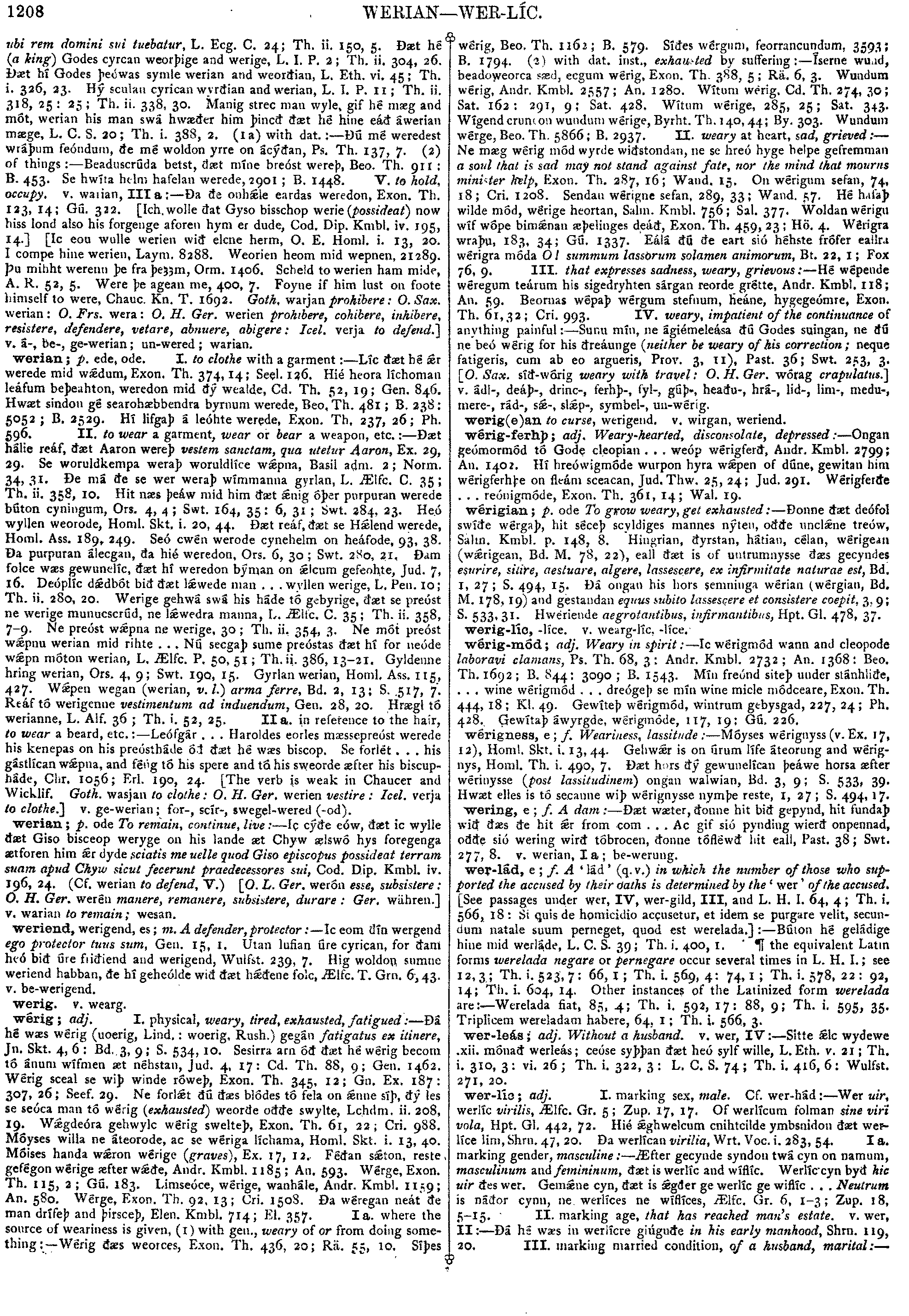
wer-líc;
adj.
I.
marking
sex,
male.
Cf.
wer-hád:--Wer
uir,
werlíc
virilis,
Ælfc.
Gr.
5;
Zup.
17,
17.
Of
werlícum
folman
sine
viri
vola,
Hpt.
Gl.
442,
72.
Hié
ghwelcum
cnihtcilde
ymbsnidon
ðæt
werlíce
lim,
Shrn.
47,
20.
Ða
werlícan
virilia,
Wrt.
Voc.
i.
283,
54.
I
a.
marking
gender,
masculine:--Æfter
gecynde
syndon
twá
cyn
on
namum,
masculinum
and
femininum,
ðæt
is
werlíc
and
wíflíc.
Werlíc
cyn
byð
hic
uir
ðes
wer.
Gemne
cyn,
ðæt
is
gðer
ge
werlíc
ge
wiflíc
.
.
.
Neutrum
is
náðor
cynn,
ne
werlíces
ne
wíflíces,
Ælfc.
Gr.
6,
1-3;
Zup.
18,
5-15.
II.
marking
age,
that
has
reached
man's
estate.
v.
wer,
II:--Ðá
hé
wæs
in
werlícre
giúguðe
in
his
early
manhood,
Shrn.
119,
20.
III.
marking
married
condition,
of
a
husband,
marital:--
|
Source: Bosworth/Toller, page b1209, entry 2 View original page image as: [TIFF] [PNG] [View previous entry] [View next entry] |
[Comment on this entry] [View comments] |
The following entry has been hand-corrected once. |
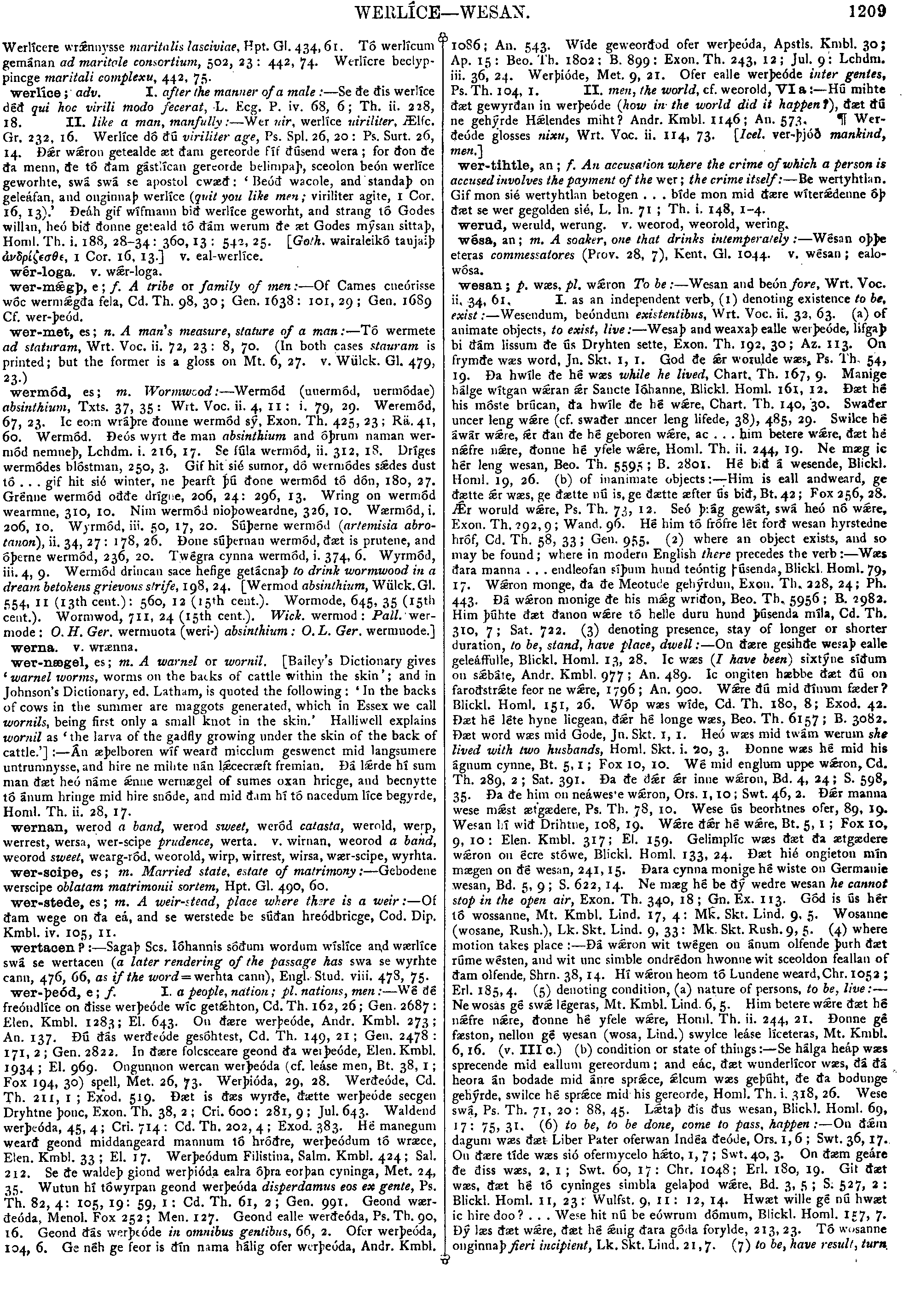
werlíce;
adv.
I.
after
the
manner
of
a
male:--Se
ðe
ðis
werlíce
déð
qui
hoc
virili
modo
fecerat,
L.
Ecg.
P.
iv.
68,
6;
Th.
ii.
228,
18.
II.
like
a
man,
manfully:--Wer
uir,
werlíce
uiriliter,
Ælfc.
Gr.
232,
16.
Werlíce
dó
ðú
viriliter
age,
Ps.
Spl.
26,
20:
Ps.
Surt.
26,
14.
Ðr
wron
getealde
æt
ðam
gereorde
fíf
ðúsend
wera;
for
ðon
ðe
ða
menn,
ðe
tó
ðam
gástlícan
gereorde
belimpaþ,
sceolon
beón
werlíce
geworhte,
swá
swá
se
apostol
cwæð:
'Beóð
wacole,
and
standaþ
on
geleáfan,
and
onginnaþ
werlíce
(quit
you
like
men;
viriliter
agite,
1
Cor.
16,
13).'
Ðeáh
gif
wífmann
bið
werlíce
geworht,
and
strang
tó
Godes
willan,
heó
bið
ðonne
geteald
tó
ðám
werum
ðe
æt
Godes
mýsan
sittaþ,
Homl.
Th.
i.
188,
28-34:
360,
13:
542,
25.
[Goth.
wairaleikó
taujaiþ
GREEK,
1
Cor.
16,
13.]
v.
eal-werlíce.
|
Source: Bosworth/Toller, page d0253, entry 9 View original page image as: [TIFF] [PNG] [View previous entry] [View next entry] |
[Comment on this entry] [View comments] |
The following entry has been hand-corrected once. |
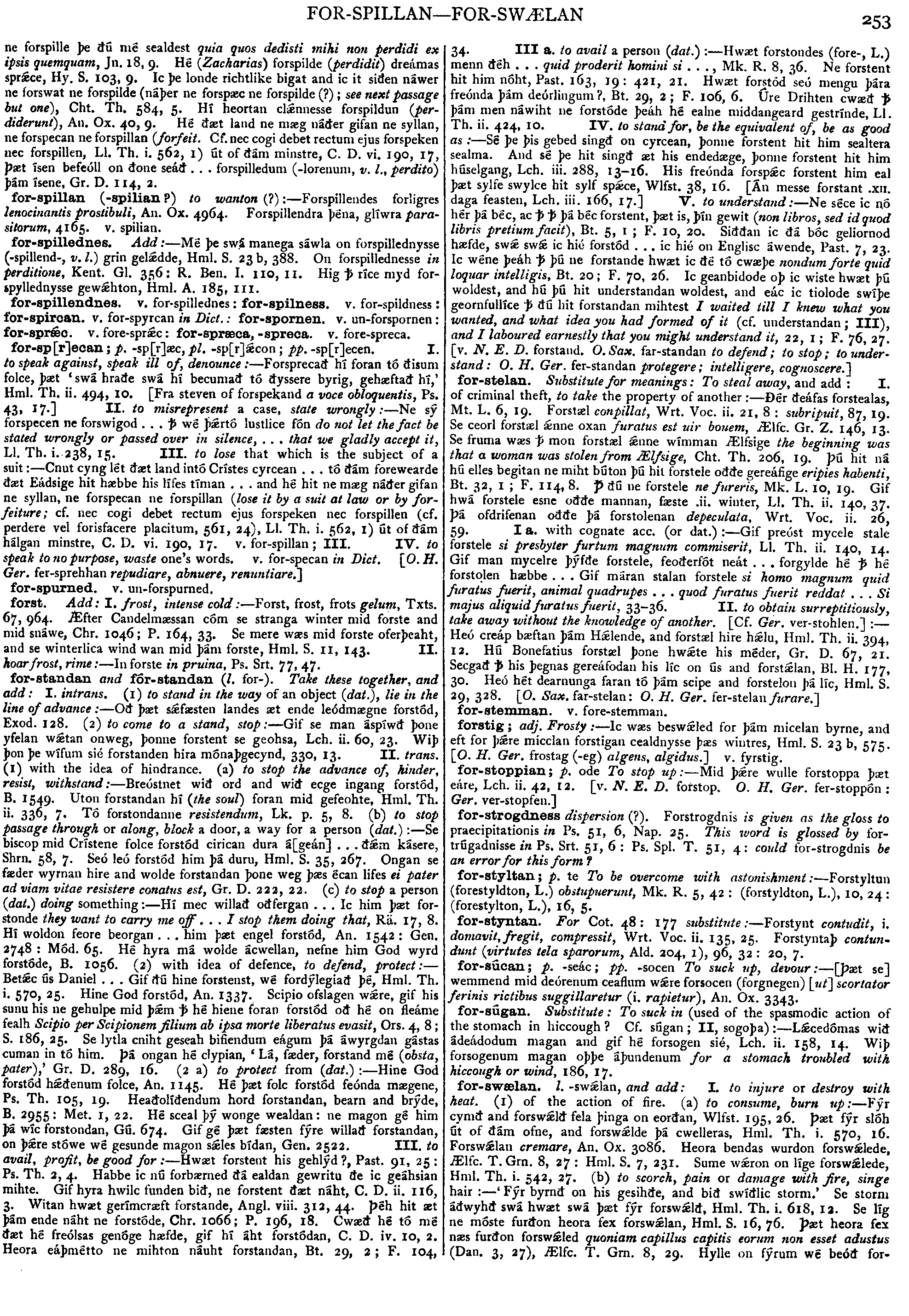
for-stelan.
Substitute
for
meanings:
To
steal
away,
and
add:
I.
of
criminal
theft,
to
take
the
property
of
another
:--
Ðér
ðeáfas
forstealas,
Mt.
L.
6,
19.
Forstæl
conpillat,
Wrt.
Voc.
ii.
21,
8:
subripuit,
87,
19.
Se
ceorl
forstæl
nne
oxan
furatus
est
uir
bouem,
Ælfc.
Gr.
Z.
146,
13.
Se
fruma
wæs
 mon
forstæl
nne
wímman
Ælfsige
the
beginning
was
that
a
woman
was
stolen
from
Ælfsige,
Cht.
Th.
206,
19.
Þú
hit
ná
hú
elles
begitan
ne
miht
búton
þú
hit
forstele
oððe
gereáfige
eripies
habenti,
Bt.
32,
1;
F.
114,
8.
ðú
ne
forstele
ne
fureris,
Mk.
L.
10,
19.
Gif
hwá
forstele
esne
oððe
mannan,
fæste
.ii.
winter,
Ll.
Th.
ii.
140,
37.
Þa
ofdrifenan
oððe
þá
forstolenan
depeculata,
Wrt.
Voc.
ii.
26,
59.
I
a.
with
cognate
acc.
(or
dat.)
:--
Gif
preóst
mycele
stale
forstele
si
presbyter
furtum
magnum
commiserit,
Ll.
Th.
ii.
140,
14.
Gif
man
mycelre
þýfðe
forstele,
feoðerfót
neát
...
forgylde
hé
hé
forstolen
hæbbe
...
Gif
máran
stalan
forstele
si
homo
magnum
quid
furatus
fuerit,
animal
quadrupes
...
quod
furatus
fuerit
reddat
...
Si
majus
aliquid
furatus
fuerit,
33-36.
II.
to
obtain
surreptitiously,
take
away
without
the
knowledge
of
another.
[Cf.
Ger.
ver-stohlen.]
:--
Heó
creáp
bæftan
þám
Hlende,
and
forstæl
hire
hlu,
Hml.
Th.
ii.
394,
12.
Hú
Bonefatius
forstæl
þone
hwte
his
méder,
Gr.
D.
67,
21.
Secgað
his
þegnas
gereáfodan
his
líc
on
ús
and
forstlan,
Bl.
H.
177,
30.
Heó
hét
dearnunga
faran
tó
þám
scipe
and
forstelon
þá
líc,
Hml.
S.
29,
328.
[O.
Sax.
far-stelan:
O.
H.
Ger.
fer-stelan
furare.]
mon
forstæl
nne
wímman
Ælfsige
the
beginning
was
that
a
woman
was
stolen
from
Ælfsige,
Cht.
Th.
206,
19.
Þú
hit
ná
hú
elles
begitan
ne
miht
búton
þú
hit
forstele
oððe
gereáfige
eripies
habenti,
Bt.
32,
1;
F.
114,
8.
ðú
ne
forstele
ne
fureris,
Mk.
L.
10,
19.
Gif
hwá
forstele
esne
oððe
mannan,
fæste
.ii.
winter,
Ll.
Th.
ii.
140,
37.
Þa
ofdrifenan
oððe
þá
forstolenan
depeculata,
Wrt.
Voc.
ii.
26,
59.
I
a.
with
cognate
acc.
(or
dat.)
:--
Gif
preóst
mycele
stale
forstele
si
presbyter
furtum
magnum
commiserit,
Ll.
Th.
ii.
140,
14.
Gif
man
mycelre
þýfðe
forstele,
feoðerfót
neát
...
forgylde
hé
hé
forstolen
hæbbe
...
Gif
máran
stalan
forstele
si
homo
magnum
quid
furatus
fuerit,
animal
quadrupes
...
quod
furatus
fuerit
reddat
...
Si
majus
aliquid
furatus
fuerit,
33-36.
II.
to
obtain
surreptitiously,
take
away
without
the
knowledge
of
another.
[Cf.
Ger.
ver-stohlen.]
:--
Heó
creáp
bæftan
þám
Hlende,
and
forstæl
hire
hlu,
Hml.
Th.
ii.
394,
12.
Hú
Bonefatius
forstæl
þone
hwte
his
méder,
Gr.
D.
67,
21.
Secgað
his
þegnas
gereáfodan
his
líc
on
ús
and
forstlan,
Bl.
H.
177,
30.
Heó
hét
dearnunga
faran
tó
þám
scipe
and
forstelon
þá
líc,
Hml.
S.
29,
328.
[O.
Sax.
far-stelan:
O.
H.
Ger.
fer-stelan
furare.]
|
Source: Bosworth/Toller, page d0262, entry 2 View original page image as: [TIFF] [PNG] [View previous entry] [View next entry] |
[Comment on this entry] [View comments] |
The following entry has been hand-corrected once. |
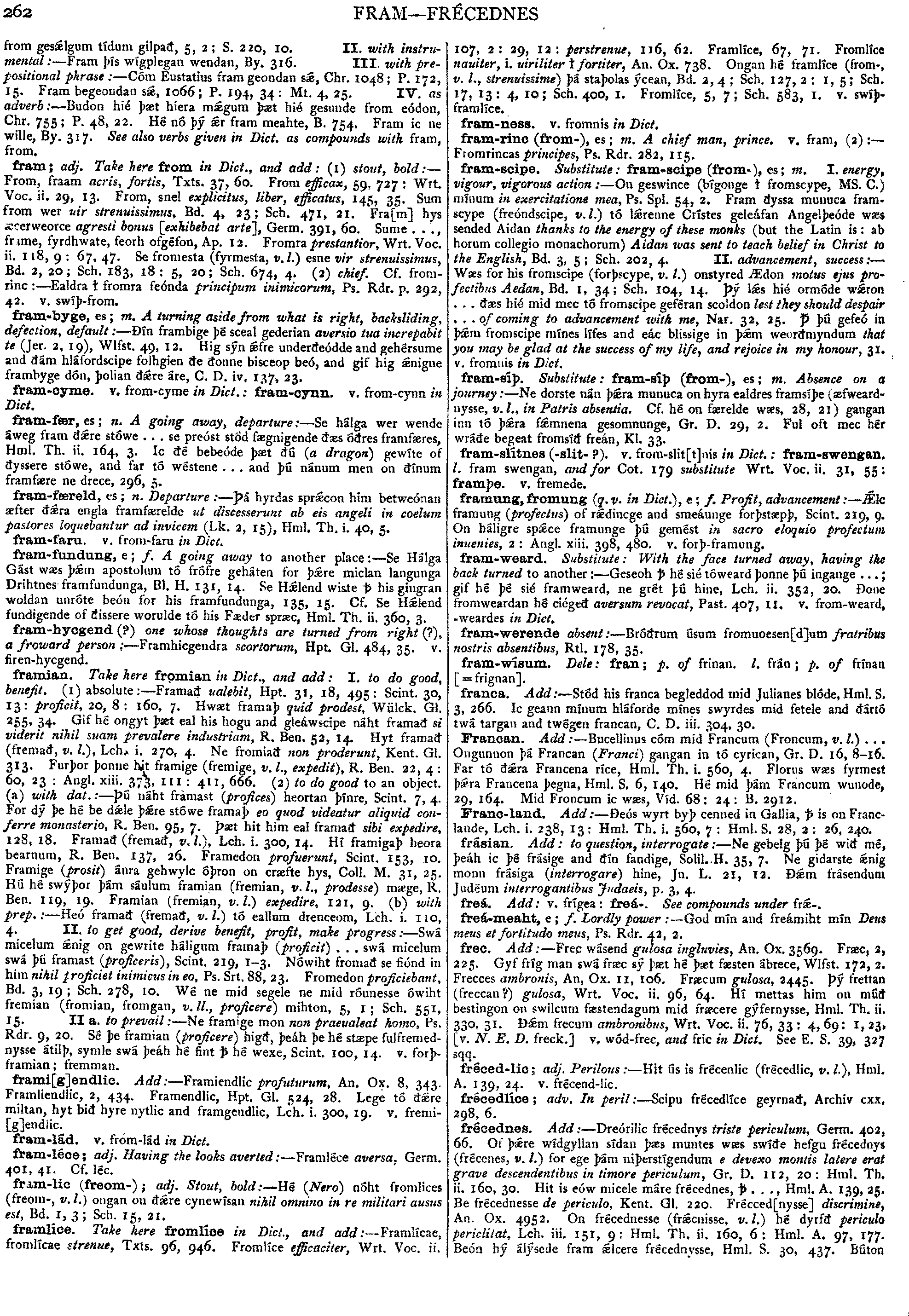
fram;
adj.
Take
here
from
in
Dict.,
and
add:
(1)
stout,
bold
:--
From,
fraam
acris,
fortis,
Txts.
37,
60.
From
efficatus,
59,
727:
Wrt.
Voc.
ii.
29,
13.
From,
snel
explicitus,
liber,
efficatus,
145,
35.
Sum
from
wer
uir
strenuissimus,
Bd.
4,
23;
Sch.
471,
21.
Fra[m]
hys
æcerweorce
agresti
bonus
[exhibebat
arte]
Germ.
391,
60.
Sume
...,
frame,
fyrdhwate,
feorh
ofgéfon,
Ap.
12.
Fromra
prestantior,
Wrt.
Voc.
ii.
118,
9:
67,
47.
Se
fromesta
(fyrmesta,
v.l.)
esne
vir
strenuissimus,
Bd.
2,
20;
Sch.
183,
18:
5,
20;
Sch.
674,
4.
(2)
chief.
Cf.
fromrinc
:--
Ealdra
fromra
feónda
principum
inimicorum,
Ps.
Rdr.
p.
292,
42.
v.
swiþ-from.
|
Source: Bosworth/Toller, page d0323, entry 1 View original page image as: [TIFF] [PNG] [View previous entry] [View next entry] |
[Comment on this entry] [View comments] |
The following entry has been hand-corrected once. |
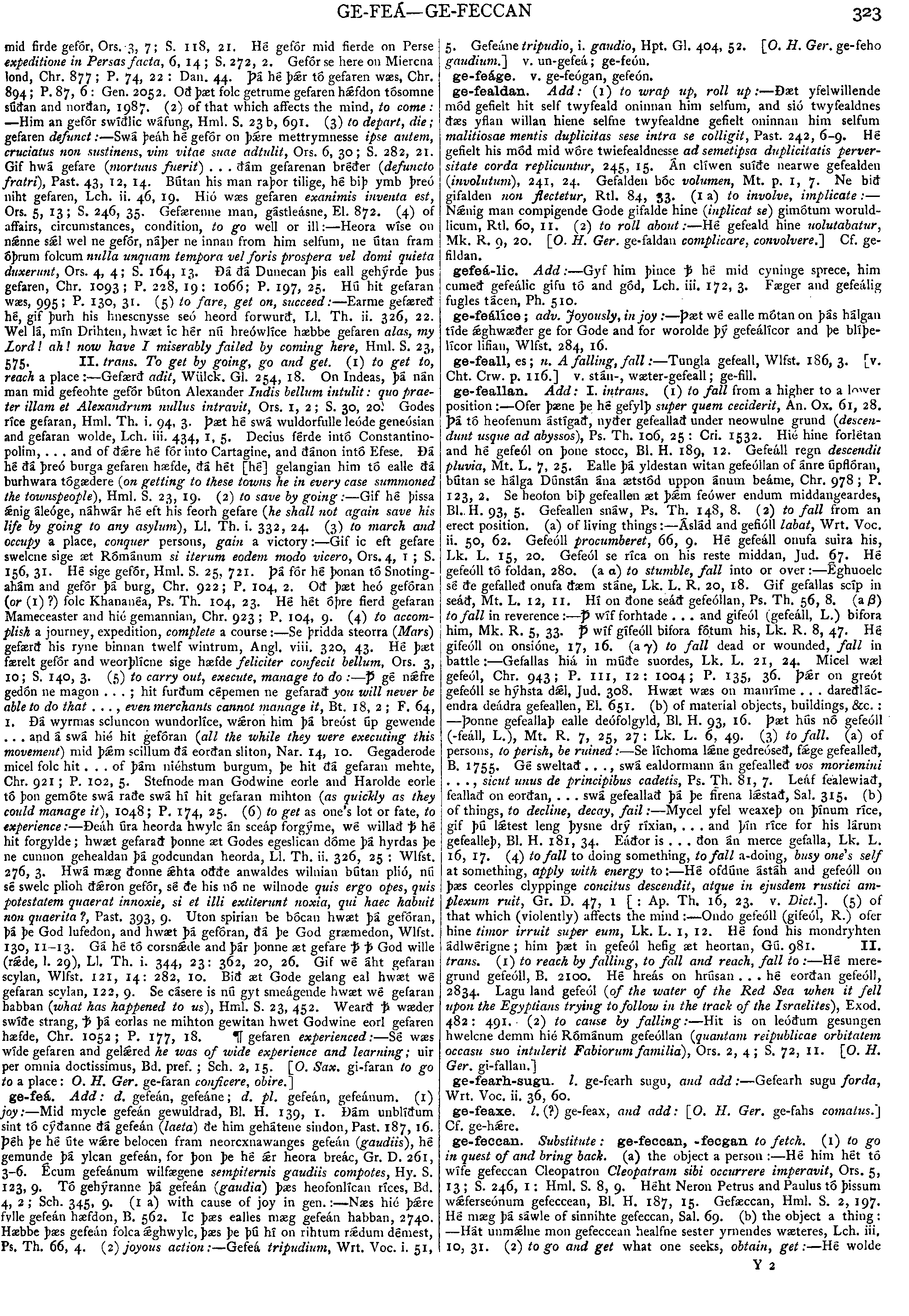
mid
firde
gefór,
Ors.
3,
7;
S.
118,
21.
Hé
gefór
mid
fierde
on
Perse
expeditione
in
Persas
facta,
6,
14;
S.
272,
2.
Gefór
se
here
on
Miercna
lond,
Chr.
877;
P.
74,
22:
Dan.
44.
Þá
hé
þr
tó
gefaren
wæs,
Chr.
894;
P.
87,
6:
Gen.
2052.
Oð
þæt
folc
getrume
gefaren
hfdon
tósomne
súðan
and
norðan,
1987.
(2)
of
that
which
affects
the
mind,
to
come
:--
Him
an
gefór
swíðlic
wáfung,
Hml.
S.
23
b,
691.
(3)
to
depart,
die;
gefaren
defunct
:--
Swá
þeáh
hé
gefór
on
þre
mettrymnesse
ipse
autem,
cruciatus
non
sustinens,
vim
vitae
suae
adtulit,
Ors.
6,
30;
S.
282,
21.
Gif
hwá
gefare
(mortuus
fuerit)
...
ðám
gefarenan
bréðer
(defuncto
fratri),
Past.
43,
12,
14.
Bútan
his
man
raþor
tilige,
hé
biþ
ymb
þreó
niht
gefaren,
Lch.
ii.
46,
19.
Hió
wæs
gefaren
exanimis
inventa
est,
Ors.
5,
13;
S.
246,
35.
Gefærenne
man,
gástleásne,
El.
872.
(4)
of
affairs,
circumstances,
condition,
to
go
well
or
ill
:--
Heora
wíse
on
nnne
sl
wel
ne
gefór,
náþer
ne
innan
from
him
selfum,
ne
útan
fram
óþrum
folcum
nulla
unquam
tempora
vel
foris
prospera
vel
domi
quieta
duxerunt,
Ors.
4,
4;
S.
164,
13.
Ðá
ðá
Dunecan
þis
eall
gehýrde
þus
gefaren,
Chr.
1093;
P.
228,
19:
1066;
P.
197,
25.
Hú
hit
gefaran
wæs,
995;
P.
130,
31.
(5)
to
fare,
get
on,
succeed
:--
Earme
gefæreð
hé,
gif
þurh
his
hnescnysse
seó
heord
forwurð,
Ll.
Th.
ii.
326,
22.
Wel
lá,
mín
Drihten,
hwæt
ic
hér
nú
hreówlíce
hæbbe
gefaren
alas,
my
Lord!
ah!
now
have
I
miserably
failed
by
coming
here,
Hml.
S.
23,
575.
II.
trans.
To
get
by
going,
go
and
get.
(1)
to
get
to,
reach
a
place
:--
Gefærð
adit,
Wülck.
Gl.
254,
18.
On
Indeas,
þá
nán
man
mid
gefeohte
gefór
búton
Alexander
Indis
bellum
intulit:
quo
praeter
illam
et
Alexandrum
nullus
intravit,
Ors.
1,
2;
S.
30,
20.
Godes
ríce
gefaran,
Hml.
Th.
i.
94,
3.
Þæt
hé
swá
wuldorfulle
leóde
geneósian
and
gefaran
wolde,
Lch.
iii.
434,
1,
5.
Decius
férde
intó
Constantinopolim,
...
and
of
ðre
hé
fór
into
Cartagine,
and
ðánon
intó
Efese.
Ðá
hé
ðá
þreó
burga
gefaren
hæfde,
ðá
hét
[hé]
gelangian
him
tó
ealle
ðá
burhwara
tógædere
(on
getting
to
these
towns
he
in
every
case
summoned
the
townspeople),
Hml.
S.
23,
19.
(2)
to
save
by
going
:--
Gif
hé
þissa
nig
áleóge,
náhwár
hé
eft
his
feorh
gefare
(he
shall
not
again
save
his
life
by
going
to
any
asylum),
Ll.
Th.
i.
332,
24.
(3)
to
march
and
occupy
a
place,
conquer
persons,
gain
a
victory
:--
Gif
ic
eft
gefare
swelcne
sige
æt
Rómánum
si
iterum
eodem
modo
vicero,
Ors.
4,
1;
S.
156,
31.
Hé
sige
gefór,
Hml.
S.
25,
721.
Þá
fór
hé
þonan
tó
Snotingahám
and
gefór
þá
burg,
Chr.
922;
P.
104,
2.
Oð
þæt
heó
gefóran
(or
(1)
?)
folc
Khananéa,
Ps.
Th.
104,
23.
Hé
hét
óþre
fierd
gefaran
Mameceaster
and
hié
gemannian,
Chr.
923;
P.
104,
9.
(4)
to
accomplish
a
journey,
expedition,
complete
a
course
:--
Se
þridda
steorra
(Mars)
gefærð
his
ryne
binnan
twelf
wintrnm,
Angl.
viii.
320,
43.
Hé
þæt
færelt
gefór
and
weorþlícne
sige
hæfde
feliciter
confecit
bellum,
Ors.
3,
10;
S.
140,
3.
(5)
to
carry
out,
execute,
manage
to
do
:--
Þ-bar;
gé
nfre
gedón
ne
magon
...;
hit
furðum
cépemen
ne
gefarað
you
will
never
be
able
to
do
that
...,
even
merchants
cannot
manage
it,
Bt.
18,
2;
F.
64,
1.
Ðá
wyrmas
scluncon
wundorlíce,
wron
him
þá
breóst
úp
gewende
...
and
á
swá
hié
hit
gefóran
(all
the
while
they
were
executing
this
movement)
mid
þm
scillum
ðá
eorðan
sliton,
Nar.
14,
10.
Gegaderode
micel
folc
hit
...
of
þám
niéhstum
burgum,
þe
hit
ðá
gefaran
mehte,
Chr.
921;
P.
102,
5.
Stefnode
man
Godwine
eorle
and
Harolde
eorle
tó
þon
gemóte
swá
raðe
swá
hí
hit
gefaran
mihton
(as
quickly
as
they
could
manage
it),
1048;
P.
174,
25.
(6)
to
get
as
one's
lot
or
fate,
to
experience
:--
Ðeáh
úra
heorda
hwylc
án
sceáp
forgýme,
wé
willað
hé
hit
forgylde;
hwæt
gefarað
þonne
æt
Godes
egeslican
dóme
þá
hyrdas
þe
ne
cunnon
gehealdan
þá
godcundan
heorda,
Ll.
Th.
ii.
326,
25:
Wlfst.
276,
3.
Hwá
mæg
ðonne
hta
oððe
anwaldes
wilnian
bútan
plió,
nú
sé
swelc
plioh
ðron
gefór,
sé
ðe
his
nó
ne
wilnode
quis
ergo
opes,
quis
potestatem
quaerat
innoxie,
si
et
illi
extiterunt
noxia,
qui
haec
habuit
non
quaerita?,
Past.
393,
9.
Uton
spirian
be
bócan
hwæt
þá
gefóran,
þá
þe
God
lufedon,
and
hwæt
þá
gefóran,
ðá
þe
God
græmedon,
Wlfst.
130,
11-13.
Gá
hé
tó
corsnde
and
þár
þonne
æt
gefare
God
wille
(rde,
l.
29),
Ll.
Th.
i.
344,
23:
362,
20,
26.
Gif
wé
áht
gefaran
scylan,
Wlfst.
121,
14:
282,
10.
Bið
æt
Gode
gelang
eal
hwæt
wé
gefaran
scylan,
122,
9.
Se
cásere
is
nú
gyt
smeágende
hwæt
wé
gefaran
habban
(what
has
happened
to
us),
Hml.
S.
23,
452.
Wearð
wæder
swíðe
strang,
þá
eorlas
ne
mihton
gewitan
hwet
Godwine
eorl
gefaren
hæfde,
Chr.
1052;
P.
177,
18.

gefaren
experienced
:--
Sé
wæs
wíde
gefaren
and
gelred
he
was
of
wide
experience
and
learning;
uir
per
omnia
doctissimus,
Bd.
pref.;
Sch.
2,
15.
[O.
Sax.
gi-faran
to
go
to
a
place:
O.
H.
Ger.
ge-faran
conficere,
obire.]
|
Source: Bosworth/Toller, page d0348, entry 4 View original page image as: [TIFF] [PNG] [View previous entry] [View next entry] |
[Comment on this entry] [View comments] |
The following entry has been hand-corrected once. |
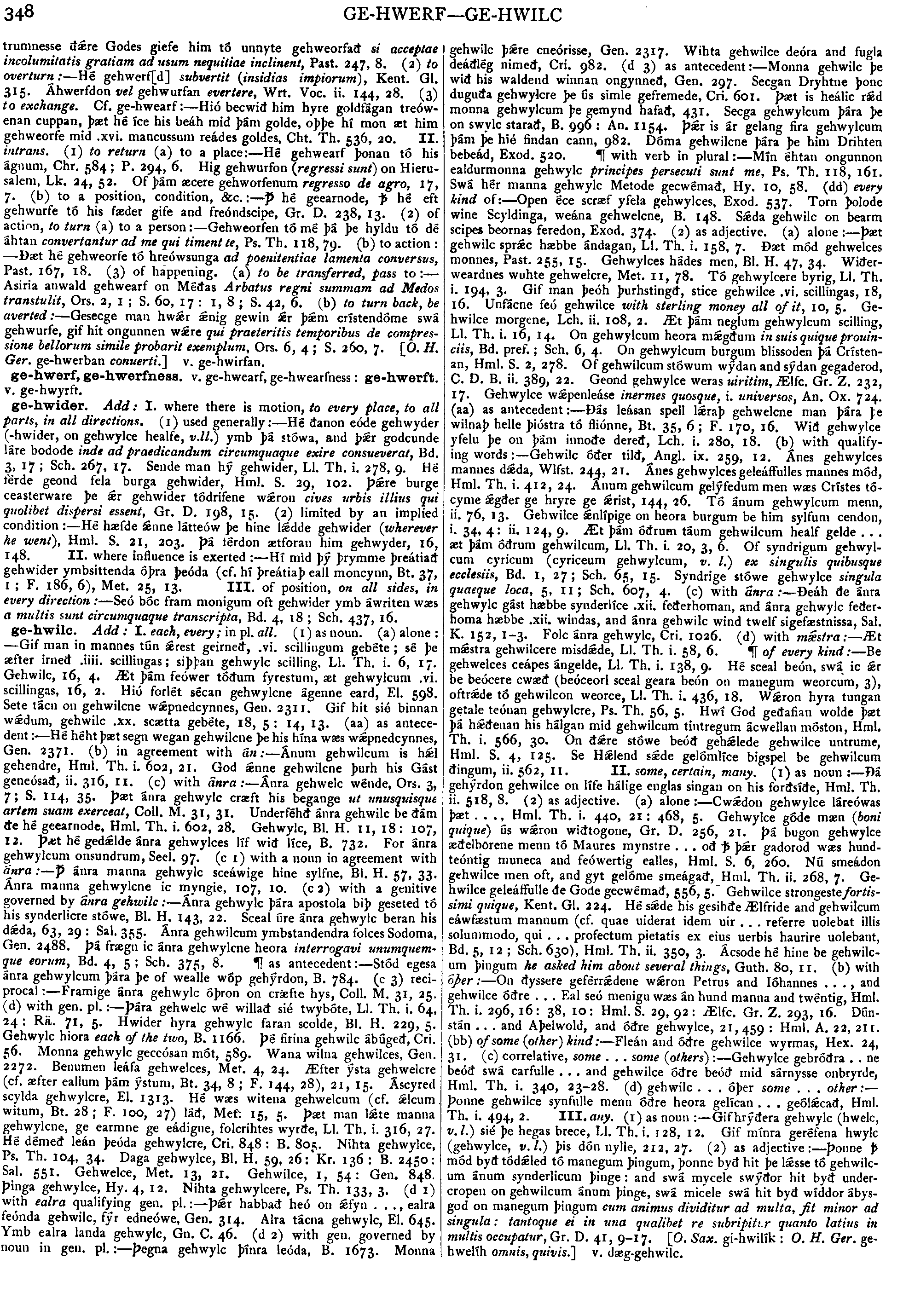
ge-hwilc.
Add:
I.
each,
every;
in
pl.
all.
(I)
as
noun,
(a)
alone
:
--
Gif
man
in
mannes
t n
n
 rest
geirne
rest
geirne ,
.vi.
scillingum
geb
,
.vi.
scillingum
geb te
;
s
þe
æfter
irne
.iiii.
scillingas;
sibban
gehwylc
scilling.
Ll.
Th.
i.
6,
17.
Gehwilc,
16,
4.
Æt
þ
te
;
s
þe
æfter
irne
.iiii.
scillingas;
sibban
gehwylc
scilling.
Ll.
Th.
i.
6,
17.
Gehwilc,
16,
4.
Æt
þ m
feówer
t
m
feówer
t um
fyrestum,
æt
gehwylcum
.vi.
scillingas,
16,
2.
Hió
forlt
scan
gehwylcne
genne
eard,
El.
598.
Sete
tcn
on
gehwilcne
wpnedcynnes,
Gen.
2311.
Gif
hit
sié
binnan
wdum,
gehwilc
.xx.
scætta
gebte,
18,
5
:
14,
13.
(aa)
as
antecedent
:--
H
hht
þæt
segn
wegan
gehwilcne
þe
his
h
um
fyrestum,
æt
gehwylcum
.vi.
scillingas,
16,
2.
Hió
forlt
scan
gehwylcne
genne
eard,
El.
598.
Sete
tcn
on
gehwilcne
wpnedcynnes,
Gen.
2311.
Gif
hit
sié
binnan
wdum,
gehwilc
.xx.
scætta
gebte,
18,
5
:
14,
13.
(aa)
as
antecedent
:--
H
hht
þæt
segn
wegan
gehwilcne
þe
his
h na
wæs
wpnedcynnes,
Gen.
2371.
(b)
in
agreement
with
n
:--
&A-long;num
gehwilcum
is
hl
gehendre,
Hml.
Th.
i.
602,
21.
God
nne
gehwilcne
þurh
his
Gst
geneósa,
ii.
316,
II.
(c)
with
nra
:--
&A-long;nra
gehwelc
wnde,
Ors.
3,
7;
S.
114,
35.
Þæt
nra
gehwylc
cræft
his
begange
ut
unusquisque
artem
suam
exerceat,
Coll.
M.
31,
31.
Underf
nra
gehwilc
be
m
e
h
geearnode.
Hml.
Th.
i.
602,
28.
Gehwylc,
Bl.
H.
II,
18
:
107,
12.
Þæt
h
gedlde
nra
gehwylces
lf
wi
lce,
B.
732.
For
nra
gehwylcum
onsundrum,
Seel.
97.
(c
I)
with
a
noun
in
agreement
with
nra
:--
nra
manna
gehwylc
sceáwige
hine
sylfne,
Bl.
H.
57,
33
Ánra
manna
gehwylcne
ic
myngie,
107,
10.
(c
2)
with
a
genitive
governed
by
anra
gehwilc
:--
&A-long;nra
gehwylc
þra
apostola
biþ
geseted
t
his
synderlicre
stwe,
Bl.
H.
143,
22.
Sceal
re
nra
gehwylc
beran
his
dda,
63,
29
:
Sal.
355.
&A-long;nra
gehwilcum
ymbstandendra
folces
Sodoma,
Gen.
2488.
Þ
frægn
ic
nra
gehwylcne
heora
interrogavi
unumquem-que
eorum,
Bd.
4,
5
;
Sch.
375,
8.

as
antecedent
:--
Std
egesa
nra
gehwylcum
þra
þe
of
wealle
wp
geh
na
wæs
wpnedcynnes,
Gen.
2371.
(b)
in
agreement
with
n
:--
&A-long;num
gehwilcum
is
hl
gehendre,
Hml.
Th.
i.
602,
21.
God
nne
gehwilcne
þurh
his
Gst
geneósa,
ii.
316,
II.
(c)
with
nra
:--
&A-long;nra
gehwelc
wnde,
Ors.
3,
7;
S.
114,
35.
Þæt
nra
gehwylc
cræft
his
begange
ut
unusquisque
artem
suam
exerceat,
Coll.
M.
31,
31.
Underf
nra
gehwilc
be
m
e
h
geearnode.
Hml.
Th.
i.
602,
28.
Gehwylc,
Bl.
H.
II,
18
:
107,
12.
Þæt
h
gedlde
nra
gehwylces
lf
wi
lce,
B.
732.
For
nra
gehwylcum
onsundrum,
Seel.
97.
(c
I)
with
a
noun
in
agreement
with
nra
:--
nra
manna
gehwylc
sceáwige
hine
sylfne,
Bl.
H.
57,
33
Ánra
manna
gehwylcne
ic
myngie,
107,
10.
(c
2)
with
a
genitive
governed
by
anra
gehwilc
:--
&A-long;nra
gehwylc
þra
apostola
biþ
geseted
t
his
synderlicre
stwe,
Bl.
H.
143,
22.
Sceal
re
nra
gehwylc
beran
his
dda,
63,
29
:
Sal.
355.
&A-long;nra
gehwilcum
ymbstandendra
folces
Sodoma,
Gen.
2488.
Þ
frægn
ic
nra
gehwylcne
heora
interrogavi
unumquem-que
eorum,
Bd.
4,
5
;
Sch.
375,
8.

as
antecedent
:--
Std
egesa
nra
gehwylcum
þra
þe
of
wealle
wp
geh rdon,
B.
784.
(c
3)
reci-procal
:--
Framige
nra
gehwylc
þron
on
crfte
hys,
Coll.
M.
31,
25.
(d)
with
gen.
pl.
:--
Þra
gehwelc
w
willa
sié
twybte,
Ll.
Th.
i.
64,
24
:
Rä.
71,
5.
Hwider
hyra
gehwylc
faran
scolde,
Bl.
H.
229,
5.
Gehwylc
hiora
each
of
the
two,
B.
1166.
Þe
firina
gehwilc
bge,
Cri.
56.
Monna
gehwylc
geceósan
mt,
589.
Wana
wilna
gehwilces,
Gen.
2272.
Benumen
leáfa
gehwelces,
Met.
4,
24.
Æfter
sta
gehwelcre
(cf.
æfter
eallum
þm
stum,
Bt.
34,
8
;
F.
144,
28),
21,
15.
&A-long;scyred
scylda
gehwylcre,
El.
1313.
H
wæs
witena
gehwelcum
(cf.
lcum
witum,
Bt.
28;
F.
100,
27)
l,
Met.
15,
5.
Þæt
man
lte
manna
gehwylcne,
ge
earmne
ge
eádigue,
folcrihtes
wyre,
Ll.
Th.
i.
316,
27.
H
dme
leán
þeóda
gehwylcre,
Cri.
848
:
B.
805.
Nihta
gehwylce,
Ps.
Th.
104,
34.
Daga
gehwylce,
Bl.
H.
59,
26
:
Kr.
136
:
B.
2450:
Sal.
551.
Gehwelce,
Met.
13,
21.
Gehwilce,
l,
54:
Gen.
848.
Þinga
gehwylce.
Hy.
4,
12.
Nihta
gehwylcere,
Ps.
Th.
133,
3.
(d
l)
with
ealra
qualifying
gen.
pl.
:--
Þr
habba
heó
on
fyn
.
.
.
,
ealra
feónda
gehwilc,
fr
edneówe.
Gen.
314.
Alra
tcna
gehwylc,
El.
645.
Ymb
ealra
landa
gehwylc,
Gn.
C.
46.
(d
2)
with
gen.
governed
by
noun
in
gen.
pl.
:--
Þegna
gehwylc
þnra
leóda,
B.
1673.
Monna
gehwilc
þre
cneórisse,
Gen.
2317.
Wihta
gehwilce
deóra
and
fugla
deálg
nime,
Cri.
982.
(d
3)
as
antecedent
:--
Monna
gehwilc
þe
wi
his
waldend
winnan
ongynne,
Gen.
297.
Secgan
Dryhtne
þonc
dugua
gehwylcre
þe
s
simle
gefremede,
Cri.
601.
Þæt
is
heálic
rd
monna
gehwylcum
þe
gemynd
hafa,
431.
Secga
gehwylcum
þra
þe
on
swylc
stara,
B.
996
:
An.
1154.
Þr
is
r
gelang
fira
gehwylcum
þm
þe
hié
findan
cann,
982.
Dma
gehwilcne
þra
þe
him
Drihten
bebeád,
Exod.
520.

with
verb
in
plural
:--
Mn
htan
ongunnon
ealdurmonna
gehwylc
principes
persecuti
sunt
me,
Ps.
Th.
118,
161.
Sw
hr
manna
gehwylc
Metode
gecwma,
Hy.
10,
58.
(dd)
every
kind
of
:--
Open
ce
scræf
yfela
gehwylces,
Exod.
537.
Torn
þolode
wine
Scyldinga,
weána
gehwelcne,
B.
148.
Sda
gehwilc
on
bearm
scipes
beornas
feredon,
Exod.
374.
(2)
as
adjective,
(a)
alone
:--
Þæt
gehwilc
sprc
hæbbe
ndagan,
Ll.
Th.
i.
158,
7.
Ðæt
md
gehwelces
monnes,
Past.
255,
15.
Gehwylces
hdes
men,
Bl.
H.
47,
34.
Wier-weardnes
wuhte
gehwelcre,
Met.
ii.
78.
T
gehwylcere
byrig,
Ll.
Th.
i.
194,
3.
Gif
man
þeóh
þurhsting,
stice
gehwilce
.vi.
scillingas,
18,
16.
Unfcne
feó
gehwilce
with
sterling
money
all
of
it,
10,
5.
Ge-hwilce
morgene.
Lch.
ii.
108,
2.
Æt
þm
neglum
gehwylcum
scilling,
Ll.
Th.
i.
16,
14.
On
gehwylcum
heora
mgum
in
suis
quique
prouin-ciis,
Bd.
pref.
;
Sch.
6,
4.
On
gehwylcum
burgum
blissoden
þ
Crsten-an,
Hml.
S.
2,
278.
Of
gehwilcum
stwum
wdan
and
sdan
gegaderod,
C.
D.
B.
ii.
389,
22.
Geond
gehwylce
weras
uiritim,
Ælfc.
Gr.
Z.
232,
17.
Gehwylce
wpenleáse
inermes
quosque,
i.
universos,
An.
Ox.
724.
(aa)
as
antecedent
:--
Ðs
leásan
spell
lraþ
gehwelcne
man
þra
þe
wilnaþ
helle
þióstra
t
fliónne,
Bt.
35,
6;
F.
170,
16.
Wi
gehwylce
yfelu
þe
on
þm
innoe
dere,
Lch.
i.
280,
18.
(b)
with
quasi-fying
words
:--
Gehwilc
er
til,
Angl.
ix.
259,
12.
&A-long;nes
gehwylces
mannes
dda,
Wlfst.
244,
21.
&A-long;nes
gehwylces
geleáffulles
mannes
md,
Hml.
Th.
i.
412,
24.
&A-long;num
gehwilcum
gelfedum
men
wæs
Crstes
t-cyme
ger
ge
hryre
ge
rist,
144,
26.
T
num
gehwylcum
menn,
ii.
76,
13.
Gehwilce
nlpige
on
heora
burgum
be
him
sylfum
cendon,
i.
34,
4:
ii.
124,
9.
Æt
þm
rum
tum
gehwilcum
healf
gelde
.
.
.
æt
þm
rum
gehwilcum,
Ll.
Th.
i.
20,
3,
6.
Of
syndrigum
gehwyl-cum
cyricum
(cyriceum
gehwylcum,
v.
l.)
ex
singulis
quibusque
ecclesiis,
Bd.
l,
27;
Sch.
65,
15.
Syndrige
stwe
gehwylce
singula
quaeque
loca,
5,
II;
Sch.
607,
4.
(c)
with
nra
:--
Ðeáh
e
nra
gehwylc
gst
hæbbe
synderlce
.xii.
feerhoman,
and
nra
gehwylc
feer-homa
hæbbe
.xii.
windas,
and
nra
gehwilc
wind
twelf
sigefæstnissa,
Sal.
K.
152,
1-3.
Folc
nra
gehwylc,
Cri.
1026.
(d)
with
mstra
:--
Æt
mstra
gehwilcere
misdde,
Ll.
Th.
i.
58,
6.

of
every
kind
:--
Be
gehwelces
ceápes
ngelde.
Ll.
Th.
i.
138,
9.
H
sceal
beón,
sw
ic
r
be
beócere
cwæ
(beóceorl
sceal
geara
beón
on
manegum
weorcum,
3),
oftrde
t
gehwilcon
weorce,
Ll.
Th.
i.
436,
18.
Wron
hyra
tungan
getale
teónan
gehwylcre,
Ps.
Th.
56,
5.
Hw
God
geafian
wolde
þæt
þ
henan
his
hlgan
mid
gehwilcum
tintregum
cwellan
mston,
Hml.
Th.
i.
566,
30.
On
re
stwe
beó
gehlede
gehwilce
untrume,
Hml.
S.
4,
125.
Se
Hlend
sde
gelmlce
bigspel
be
gehwilcum
ingum.
ii.
562,
II.
II.
some,
certain,
many,
(I)
as
noun
:--
Ð
gehrdon
gehwilce
on
lfe
hlige
englas
singan
on
his
forse,
Hml,
Th.
ii.
518,
8.
(2)
as
adjective,
(a)
alone
:--
Cwdon
gehwylce
lreówas
þæt
.
.
.
,
Hml.
Th.
i.
440,
21:
468,
5.
Gehwylce
gde
mæn
(boni
quique),
s
wron
witogone,
Gr.
D.
256,
21.
Þ
hugon
gehwylce
æelborene
menn
t
Maures
mynstre
.
.
.
o
þr
gadorod
wæs
hund-teóntig
muneca
and
feówertig
ealles,
Hml.
S.
6,
260.
N
smeádon
gehwilce
men
oft,
and
gyt
gelme
smeága,
Hml.
Th.
ii.
268,
7.
Ge-hwilce
geleáffulle
e
Gode
gecwma,
556,
5.
Gehwilce
strongeste
fortis-simi
quique,
Kent.
Gl.
224.
H
sde
his
gesihe
Ælfride
and
gehwilcum
eáwfæstum
mannum
(cf.
quae
uiderat
idem
uir
.
.
.
referre
uolebat
illis
solunmiodo,
qui
.
.
.
profectum
pietatis
ex
eius
uerbis
haurire
uolebant,
Bd.
5,
12
;
Sch.
630),
Hml.
Th.
ii.
350,
3.
&A-long;csode
h
hine
be
gehwilc-um
þingum
he
asked
him
about
several
things,
Guth.
80,
II.
(b)
with
þer
:--
On
yssere
gefrrdene
wron
Petrus
and
Ihannes
.
.
.
,
and
;
ehwilce
re
.
.
.
Eal
seó
menigu
wæs
n
hund
manna
and
twntig,
Hml.
Th.
i.
296,
16:
38,
10:
Hml.
S.
29,
92
:
Ælfc.
Gr.
Z.
293,
16.
Dn-stn
.
.
.
and
Aþelwold,
and
re
gehwylce,
21,
459
:
Hml.
A.
22,
211.
(bb)
of
some
(other)
kind
:--
Fleán
and
re
gehwilce
wyrrnas,
Hex.
24,
31.
(c)
correlative,
some
.
.
.
some
(others)
:--
Gehwylce
gebrra
.
.
ne
beó
sw
carfulle
.
.
.
and
gehwilce
re
beó
mid
srnysse
onbryrde,
Hml.
Th.
i.
340,
23-28.
(d)
gehwilc
.
.
.
þer
some
.
.
.
other
:--
Þonne
gehwilce
synfulle
menn
re
heora
gelcan
.
.
.
gelca,
Hml.
Th.
i.
494,
2.
III.
any.
(1)
as
noun
:--
Gifhrera
gehwylc
(hwelc,
v.
l.)
sié
þe
hegas
brece,
Ll.
Th.
i.
128,
12.
Gif
mnra
gerfena
hwylc
(gehwylce,
v.
l.
)
þis
dn
nylle,
212,
27.
(2)
as
adjective
:--
Þonne
md
by
tdled
t
manegum
þingum,
þonne
by
hit
þe
lsse
t
gehwilc-um
num
synderlicum
þinge:
and
sw
mycele
swor
hit
by
under-cropen
on
gehwilcum
num
þinge,
sw
micele
sw
hit
by
wddor
bys-god
on
manegum
þingum
cum
animus
dividitur
ad
multa,
fit
minor
ad
singula:
tantoque
ei
in
una
qualibet
re
subripitur
quanto
latius
in
multis
occupatur,
Gr.
D.
41,
9-17.
[O.
Sax.
gi-hwilk
:
O.
H.
Ger.
ge-hwelh
omnis,
quivis.]
v.
dæg-gehwilc.
rdon,
B.
784.
(c
3)
reci-procal
:--
Framige
nra
gehwylc
þron
on
crfte
hys,
Coll.
M.
31,
25.
(d)
with
gen.
pl.
:--
Þra
gehwelc
w
willa
sié
twybte,
Ll.
Th.
i.
64,
24
:
Rä.
71,
5.
Hwider
hyra
gehwylc
faran
scolde,
Bl.
H.
229,
5.
Gehwylc
hiora
each
of
the
two,
B.
1166.
Þe
firina
gehwilc
bge,
Cri.
56.
Monna
gehwylc
geceósan
mt,
589.
Wana
wilna
gehwilces,
Gen.
2272.
Benumen
leáfa
gehwelces,
Met.
4,
24.
Æfter
sta
gehwelcre
(cf.
æfter
eallum
þm
stum,
Bt.
34,
8
;
F.
144,
28),
21,
15.
&A-long;scyred
scylda
gehwylcre,
El.
1313.
H
wæs
witena
gehwelcum
(cf.
lcum
witum,
Bt.
28;
F.
100,
27)
l,
Met.
15,
5.
Þæt
man
lte
manna
gehwylcne,
ge
earmne
ge
eádigue,
folcrihtes
wyre,
Ll.
Th.
i.
316,
27.
H
dme
leán
þeóda
gehwylcre,
Cri.
848
:
B.
805.
Nihta
gehwylce,
Ps.
Th.
104,
34.
Daga
gehwylce,
Bl.
H.
59,
26
:
Kr.
136
:
B.
2450:
Sal.
551.
Gehwelce,
Met.
13,
21.
Gehwilce,
l,
54:
Gen.
848.
Þinga
gehwylce.
Hy.
4,
12.
Nihta
gehwylcere,
Ps.
Th.
133,
3.
(d
l)
with
ealra
qualifying
gen.
pl.
:--
Þr
habba
heó
on
fyn
.
.
.
,
ealra
feónda
gehwilc,
fr
edneówe.
Gen.
314.
Alra
tcna
gehwylc,
El.
645.
Ymb
ealra
landa
gehwylc,
Gn.
C.
46.
(d
2)
with
gen.
governed
by
noun
in
gen.
pl.
:--
Þegna
gehwylc
þnra
leóda,
B.
1673.
Monna
gehwilc
þre
cneórisse,
Gen.
2317.
Wihta
gehwilce
deóra
and
fugla
deálg
nime,
Cri.
982.
(d
3)
as
antecedent
:--
Monna
gehwilc
þe
wi
his
waldend
winnan
ongynne,
Gen.
297.
Secgan
Dryhtne
þonc
dugua
gehwylcre
þe
s
simle
gefremede,
Cri.
601.
Þæt
is
heálic
rd
monna
gehwylcum
þe
gemynd
hafa,
431.
Secga
gehwylcum
þra
þe
on
swylc
stara,
B.
996
:
An.
1154.
Þr
is
r
gelang
fira
gehwylcum
þm
þe
hié
findan
cann,
982.
Dma
gehwilcne
þra
þe
him
Drihten
bebeád,
Exod.
520.

with
verb
in
plural
:--
Mn
htan
ongunnon
ealdurmonna
gehwylc
principes
persecuti
sunt
me,
Ps.
Th.
118,
161.
Sw
hr
manna
gehwylc
Metode
gecwma,
Hy.
10,
58.
(dd)
every
kind
of
:--
Open
ce
scræf
yfela
gehwylces,
Exod.
537.
Torn
þolode
wine
Scyldinga,
weána
gehwelcne,
B.
148.
Sda
gehwilc
on
bearm
scipes
beornas
feredon,
Exod.
374.
(2)
as
adjective,
(a)
alone
:--
Þæt
gehwilc
sprc
hæbbe
ndagan,
Ll.
Th.
i.
158,
7.
Ðæt
md
gehwelces
monnes,
Past.
255,
15.
Gehwylces
hdes
men,
Bl.
H.
47,
34.
Wier-weardnes
wuhte
gehwelcre,
Met.
ii.
78.
T
gehwylcere
byrig,
Ll.
Th.
i.
194,
3.
Gif
man
þeóh
þurhsting,
stice
gehwilce
.vi.
scillingas,
18,
16.
Unfcne
feó
gehwilce
with
sterling
money
all
of
it,
10,
5.
Ge-hwilce
morgene.
Lch.
ii.
108,
2.
Æt
þm
neglum
gehwylcum
scilling,
Ll.
Th.
i.
16,
14.
On
gehwylcum
heora
mgum
in
suis
quique
prouin-ciis,
Bd.
pref.
;
Sch.
6,
4.
On
gehwylcum
burgum
blissoden
þ
Crsten-an,
Hml.
S.
2,
278.
Of
gehwilcum
stwum
wdan
and
sdan
gegaderod,
C.
D.
B.
ii.
389,
22.
Geond
gehwylce
weras
uiritim,
Ælfc.
Gr.
Z.
232,
17.
Gehwylce
wpenleáse
inermes
quosque,
i.
universos,
An.
Ox.
724.
(aa)
as
antecedent
:--
Ðs
leásan
spell
lraþ
gehwelcne
man
þra
þe
wilnaþ
helle
þióstra
t
fliónne,
Bt.
35,
6;
F.
170,
16.
Wi
gehwylce
yfelu
þe
on
þm
innoe
dere,
Lch.
i.
280,
18.
(b)
with
quasi-fying
words
:--
Gehwilc
er
til,
Angl.
ix.
259,
12.
&A-long;nes
gehwylces
mannes
dda,
Wlfst.
244,
21.
&A-long;nes
gehwylces
geleáffulles
mannes
md,
Hml.
Th.
i.
412,
24.
&A-long;num
gehwilcum
gelfedum
men
wæs
Crstes
t-cyme
ger
ge
hryre
ge
rist,
144,
26.
T
num
gehwylcum
menn,
ii.
76,
13.
Gehwilce
nlpige
on
heora
burgum
be
him
sylfum
cendon,
i.
34,
4:
ii.
124,
9.
Æt
þm
rum
tum
gehwilcum
healf
gelde
.
.
.
æt
þm
rum
gehwilcum,
Ll.
Th.
i.
20,
3,
6.
Of
syndrigum
gehwyl-cum
cyricum
(cyriceum
gehwylcum,
v.
l.)
ex
singulis
quibusque
ecclesiis,
Bd.
l,
27;
Sch.
65,
15.
Syndrige
stwe
gehwylce
singula
quaeque
loca,
5,
II;
Sch.
607,
4.
(c)
with
nra
:--
Ðeáh
e
nra
gehwylc
gst
hæbbe
synderlce
.xii.
feerhoman,
and
nra
gehwylc
feer-homa
hæbbe
.xii.
windas,
and
nra
gehwilc
wind
twelf
sigefæstnissa,
Sal.
K.
152,
1-3.
Folc
nra
gehwylc,
Cri.
1026.
(d)
with
mstra
:--
Æt
mstra
gehwilcere
misdde,
Ll.
Th.
i.
58,
6.

of
every
kind
:--
Be
gehwelces
ceápes
ngelde.
Ll.
Th.
i.
138,
9.
H
sceal
beón,
sw
ic
r
be
beócere
cwæ
(beóceorl
sceal
geara
beón
on
manegum
weorcum,
3),
oftrde
t
gehwilcon
weorce,
Ll.
Th.
i.
436,
18.
Wron
hyra
tungan
getale
teónan
gehwylcre,
Ps.
Th.
56,
5.
Hw
God
geafian
wolde
þæt
þ
henan
his
hlgan
mid
gehwilcum
tintregum
cwellan
mston,
Hml.
Th.
i.
566,
30.
On
re
stwe
beó
gehlede
gehwilce
untrume,
Hml.
S.
4,
125.
Se
Hlend
sde
gelmlce
bigspel
be
gehwilcum
ingum.
ii.
562,
II.
II.
some,
certain,
many,
(I)
as
noun
:--
Ð
gehrdon
gehwilce
on
lfe
hlige
englas
singan
on
his
forse,
Hml,
Th.
ii.
518,
8.
(2)
as
adjective,
(a)
alone
:--
Cwdon
gehwylce
lreówas
þæt
.
.
.
,
Hml.
Th.
i.
440,
21:
468,
5.
Gehwylce
gde
mæn
(boni
quique),
s
wron
witogone,
Gr.
D.
256,
21.
Þ
hugon
gehwylce
æelborene
menn
t
Maures
mynstre
.
.
.
o
þr
gadorod
wæs
hund-teóntig
muneca
and
feówertig
ealles,
Hml.
S.
6,
260.
N
smeádon
gehwilce
men
oft,
and
gyt
gelme
smeága,
Hml.
Th.
ii.
268,
7.
Ge-hwilce
geleáffulle
e
Gode
gecwma,
556,
5.
Gehwilce
strongeste
fortis-simi
quique,
Kent.
Gl.
224.
H
sde
his
gesihe
Ælfride
and
gehwilcum
eáwfæstum
mannum
(cf.
quae
uiderat
idem
uir
.
.
.
referre
uolebat
illis
solunmiodo,
qui
.
.
.
profectum
pietatis
ex
eius
uerbis
haurire
uolebant,
Bd.
5,
12
;
Sch.
630),
Hml.
Th.
ii.
350,
3.
&A-long;csode
h
hine
be
gehwilc-um
þingum
he
asked
him
about
several
things,
Guth.
80,
II.
(b)
with
þer
:--
On
yssere
gefrrdene
wron
Petrus
and
Ihannes
.
.
.
,
and
;
ehwilce
re
.
.
.
Eal
seó
menigu
wæs
n
hund
manna
and
twntig,
Hml.
Th.
i.
296,
16:
38,
10:
Hml.
S.
29,
92
:
Ælfc.
Gr.
Z.
293,
16.
Dn-stn
.
.
.
and
Aþelwold,
and
re
gehwylce,
21,
459
:
Hml.
A.
22,
211.
(bb)
of
some
(other)
kind
:--
Fleán
and
re
gehwilce
wyrrnas,
Hex.
24,
31.
(c)
correlative,
some
.
.
.
some
(others)
:--
Gehwylce
gebrra
.
.
ne
beó
sw
carfulle
.
.
.
and
gehwilce
re
beó
mid
srnysse
onbryrde,
Hml.
Th.
i.
340,
23-28.
(d)
gehwilc
.
.
.
þer
some
.
.
.
other
:--
Þonne
gehwilce
synfulle
menn
re
heora
gelcan
.
.
.
gelca,
Hml.
Th.
i.
494,
2.
III.
any.
(1)
as
noun
:--
Gifhrera
gehwylc
(hwelc,
v.
l.)
sié
þe
hegas
brece,
Ll.
Th.
i.
128,
12.
Gif
mnra
gerfena
hwylc
(gehwylce,
v.
l.
)
þis
dn
nylle,
212,
27.
(2)
as
adjective
:--
Þonne
md
by
tdled
t
manegum
þingum,
þonne
by
hit
þe
lsse
t
gehwilc-um
num
synderlicum
þinge:
and
sw
mycele
swor
hit
by
under-cropen
on
gehwilcum
num
þinge,
sw
micele
sw
hit
by
wddor
bys-god
on
manegum
þingum
cum
animus
dividitur
ad
multa,
fit
minor
ad
singula:
tantoque
ei
in
una
qualibet
re
subripitur
quanto
latius
in
multis
occupatur,
Gr.
D.
41,
9-17.
[O.
Sax.
gi-hwilk
:
O.
H.
Ger.
ge-hwelh
omnis,
quivis.]
v.
dæg-gehwilc.
|
Source: Bosworth/Toller, page d0392, entry 1 View original page image as: [TIFF] [PNG] [View previous entry] [View next entry] |
[Comment on this entry] [View comments (1)] |
The following entry has been hand-corrected once. |
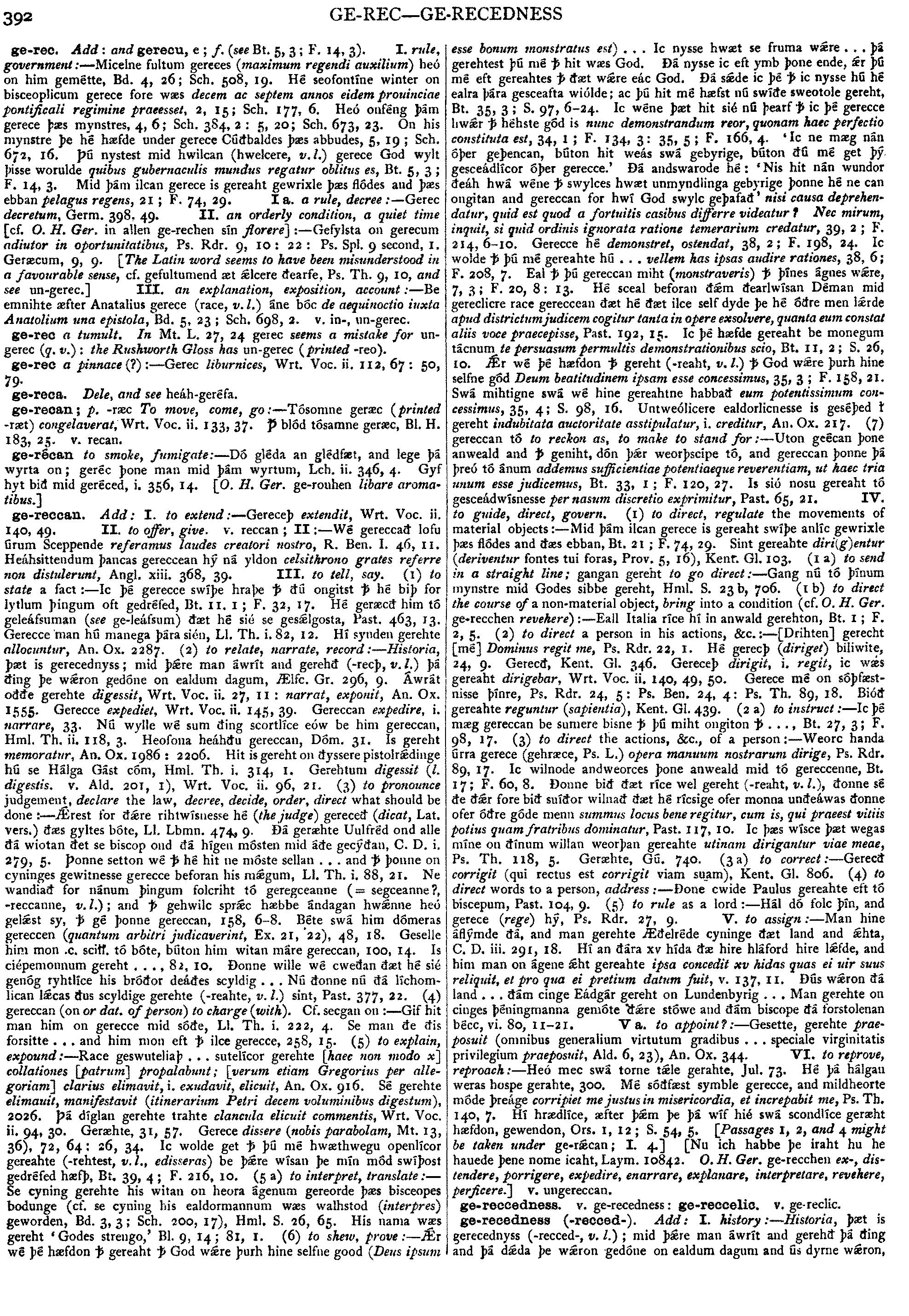
ge-rec.
Add:
and
gerecu,
e
;
f.
(
see
Bt.
5,
3;
F.
14,
3).
I.
rule,
government
:--
Micelne
fultum
gereces
(maximum
regendi
auxilium)
néo
on
him
gemétte,
Bd.
4,
26;
Sch.
508,
19.
He
seofontine
winter
on
bisceoplicum
gerece
fore
wæs
decem
ac
septem
annos
eidem
prouinciae
pontificali
regimine
praeesset,
2,
15;
Sch.
177,
6.
Heó
onféng
Þam
gerece
þæs
mynstres,
4,
6;
Sch.
384,
2
:
5,
20;
Sch.
673,
23.
On
his
mynstre
þe
hé
hæfde
under
gerece
cúðbaldes
þæs
abbudes,
5,
19
;
Sch.
672,
16.
Þú
nystest
mid
hwilcan
(hwelcere,
v.
l.)
gerece
God
wylt
þisse
worulde
quibus
gubernactulis
mundus
regatur
oblitus
es,
Bt.
5,
3
;
F.
14,
3.
Mid
þám
ilcan
gerece
is
gereaht
gewrixle
þæs
flódes
and
þæs
ebban
pelagus
regens,
21
;
F.
74,
29,
Ia.
a
rule,
decree
:--
Gerec
decretum,
Germ.
398,
49.
II.
an
orderly
condition,
a
quiet
time
[cf.
O.
H.
Ger.
in
allen
ge-rechen
sin
florere]
:--
Gefylsta
on
gerecum
ndiutor
in
oportunitatibus,
Ps.
Rdr.
9,
10
:
22
:
Ps.
Spl.
9
second,
l.
Geræcum,
9,
9.
[The
Latin
word
seems
to
have
been
misunderstood
in
a
favourable
sense,
cf.
gefultumend
æt
lcere
ðearfe.
Ps.
Th.
9,
10,
and
see
un-gerec.]
III.
an
explanation,
exposition,
account
:--
Be
emnihte
æfter
Anatalius
gerece
(race,
v.
l.)
áne
bóc
de
aequinoctio
iuxta
Anatolium
una
epislola,
Bd.
5,
23
;
Sch.
698,
2.
v.
in-,un-gerec.
ge-rec
a
tumult.
In
Mt.
L.
27,
24
gerec
seems
a
mistake
for
un-gerec
(q.
v.)
:
the
Rushworth
Gloss
has
un-gerec
(printed
-reo).ge-rec
a
pinnace
(?)
:--
Gerec
liburnices,
Wrt.
Voc.
ii.
112,
67:
50,
79
.ge-reca.
Dele,
and
see
heáh-geréfa.ge-recan;
ILLEGIBLE
-ræc
To
move,
come,
g
o
:--
Tósomne
geræc
(printed
-ræt)
congelaverat.
Wrt.
Voc.
ii.
133,
37.
ILLEGIBLE
blód
tósamne
geræc,
Bl.
H.
183,
25.
v.
recan.ge-récan
to
smoke,
fumigate
:--
Dó
gléda
an
glédfæt,
and
lege
þá
wyrta
on;
geréc
þone
man
mid
þám
wyrtum,
Lch.
ii.
346,
4.
Gyf
hyt
bið
mid
gereced,
i.
356,
14.
[O.
H.
Ger.
ge-rouhen
libare
aromatibus
.]ge-reccan.
Add:
I.
to
extend
:--
Gereceþ
extendit,
Wrt.
Voc.
ii.
140,
49.
II.
to
offer,
give.
v.
reccan
;
II
:--
Wé
gereccað
lofu
Úrum
Sceppende
referamus
laudes
creatori
nostro,
R.
Ben.
I.
46,
ii.
Heahsittendum
þancas
gereccean
hý
ná
yldon
celsithrono
grates
referre
non
distulerunt,
Angl.
xiii.
368,
39.
III.
to
tell,
say.
(1)
to
state
a
fact
:--
Ic
þé
gerecce
swíþe
hraþe
ILLEGIBLE
ðú
ongitst
ILLEGIBLE
hé
biþ
for
lytlum
þingum
oft
gedréfed,
Bt.
II.
I
;
F.
32,
17.
Hé
geræcð
him
tó
geleáfsuman
(see
ge-leáfsum)
ðæt
hé
sié
se
geslgosta,
Past.
463,
13.
Gerecce
man
hú
manega
þára
sién,
Ll.
Th.
i.
82,
12.
Hí
synden
gerehte
allocuntur,
An.
Ox.
2287.
(2)
to
relate,
narrate,
record
:--
Historia,
þæt
is
gerecednyss;
mid
þre
man
áwrít
and
gerehð
(-recþ,
v.
l.)
þá
ðing
þe
wron
gedóne
on
ealdum
dagum,
Ælfc.
Gr.
296,
9.
Áwrát
oððe
gerehte
digessit,
Wrt.
Voc.
ii.
27,
ii
:
narrat,
exponit,
An.
Ox.
1555.
Gerecce
expediet,
Wrt.
Voc.
ii.
145,
39.
Gereccan
expedire,
i.
narrare,
33.
Nú
wylle
wé
sum
ðing
scortlíce
eów
be
him
gereccan,
Hml.
Th.
ii.
118,
3.
Heofona
heáhðu
gereccan,
Dóm.
31.
Is
gereht
memoratur,
An.
Ox.
1986
:
2206.
Hit
is
gereht
on
ðyssere
pistolrdinge
hú
se
Hálga
Gást
óm,
Hml.
Th.
i.
314,
l.
Ge-ehtum
digessit
(l.
digestis.
v.
Aid.
201,
l),
Wrt.
Voc.
ii.
96,
21.
(3)
to
pronounce
judgement,
declare
the
law,
decree,
decide,
order,
direct
what
should
be
done
:--
Æ-acute;rest
for
ðre
rihtwísnesse
hé
(the
judge]
gereceð
(dicat,
Lat.
vers.
)
ðæs
gyltes
bote,
Ll.
Lbmn.
474,
9.
Ðá
geræhte
Uulfréd
ond
alle
ðá
wiotan
ðet
se
biscop
ond
ðá
hígen
mósten
mid
áðe
gecýðan,
C.
D.
i.
279
5.
þonne
setton
wé
hé
hit
ne
móste
sellan
.
.
.
and
ILLEGIBLE
þonne
on
cyninges
gewitnesse
gerecce
beforan
his
mgum,
Ll.
Th.
i.
88,
21.
Ne
wandiað
for
nánum
þingum
folcriht
tó
geregceanne
(=segclanne
?
,
-reccanne,
v.
l.
)
;
and
Þ
gehwilc
sprc
hæbbe
ándagan
hwnne
heó
gelst
sy,
ILLEGIBLE
gé
þonne
gereccan,
158,
6-8.
Béte
swá
him
dómeras
gereccen
(quantum
arbitri
judicaverint,
Ex.
21,
22),
48,
18.
Geselle
him
mon
.
c.
scitf.
tó
bóte,
búton
him
witan
máre
gereccan,
100,
14.
Is
ciépemonnum
gereht
.
.
.
,
82,
10,
Ðonne
wille
wé
cweðan
ðæt
hé
sié
genóg
ryhtlíce
his
bróðor
deáðes
scyldig
.
.
.
Nú
ðonne
nú
ðá
líchomlican
lcas
ðus
scyldige
gerehte
(-reahte,
v.
l.)
sint,
Past.
377,
22.
(4)
gereccan
(on
or
dat.
of
person)
to
charge
(with).
Cf.
secgan
on
:--
Gif
hit
man
him
on
gerecce
mid
sóðe,
Ll.
Th.
i.
222,
4.
Se
man
ðe
ðis
forsitte
.
.
.
and
him
mon
eft
þilce
gerecce,
258,
15.
(5)
to
explain,
expound
:--
Race
geswuteliaþ
.
.
.
sutelícor
gerehte
[haee
non
modo
x]
collationes
[patrum]
propalabnnt;
[verum
etiam
Gregorius
per
allegoriam]
clarius
elimavit,
i.
exudavit,
elicuit,
An.
Ox.
916.
Sé
gerehte
elimauit,
manifestavit
(itinerarium
Petri
decem
voluminibus
digestum),
2026.
Þá
diglan
gerehte
trahte
clancula
elicuit
commentis,
Wrt.
Voc.
ii.
94,
30.
Geræhte,
31,
57.
Gerece
dissere
(nobis
parabolam,
Mt.
13,
36),
72,
64:
26,
34.
Ic
wolde
get
þú
me
hwæthwegu
openlícor
gereahte
(-rehtest,
v.
l.
,
edisseras)
be
þre
wísan
þe
mín
mód
swíþost
gedréfed
hæfþ,
Bt.
39,
4
;
F.
216,
10.
(5
a)
to
interpret,
translate
:--
Se
cyning
gerehte
his
witan
on
heora
ágenum
gereorde
þæs
bisceopes
bodunge
(cf.
se
cyning
his
ealdormannum
wæs
walhstod
interpres
geworden,
Bd.
3,
3;
Sch.
200,
17,
Hml.
S.
26,
65.
His
nama
wæs
gereht
'Godes
strengo,
'
Bl.
9,
14;
81,
I.
(6)
to
shew,
prove
:--
Æ-acute;r
wé
þé
hæfdon
ILLEGIBLE
gereaht
ILLEGIBLE
God
wre
þurh
hine
selfne
good
(Deus
ipsum
esse
bonum
monsíratus
est)
.
.
.
Ic
nysse
hwæt
se
fruma
wre
.
.
.
þá
gerehtest
þú
mé
ILLEGIBLE
hit
wæs
God.
Ðá
nysse
ic
eft
ymb
þone
ende,
r
þú
mé
eft
gereahtes
ILLEGIBLE
ðæt
wre
eác
God.
Ðá
sde
ic
þé
ILLEGIBLE
ic
nysse
Hé
hé
ealra
þára
gesceafta
wiólde;
ac
þú
hit
me
hæfst
nú
swíðe
sweotole
gereht,
Bt.
35,
3
;
S.
97.
6-24.
Ic
wéne
þæt
hit
sié
nú
þearf
ILLEGIBLE
ic
þé
gerecce
liwr
ILLEGIBLE
héhste
gód
is
nunc
demonstrandum
reor,
quonam
haec
perfectio
constituta
est,
34,
l
;
F.
134,
3:
35,
5
;
F.
166,
4.
'Ic
ne
mæg
nán
óþer
geþencan,
búton
hit
weás
swá
gebyrige,
buton
ðú
mé
get
þý.
gesceádlícor
óþer
gerecce.
Ðá
andswarode
hé
:
'
Nis
hit
nán
wundor
ðeáh
hwá
wéne
ILLEGIBLE
swylces
hwæt
unmyndlinga
gebyrige
þonne
hé
ne
can
ongitan
and
gereccan
for
hwí
God
swylc
geþafað'
nisi
causa
deprehendatur,
quid
est
quod
a
fortuitis
casibus
differre
videatur
ILLEGIBLE
.(
Nec
mirum,
inquit,
si
quid
ordinis
ignorata
ratione
temerarium
credatur,
39,
2
;
F.
214,
6-10.
Gerecce
hé
demonstret,
ostendat,
38,
2;
F.
198,
24.
Ic
wolde
ILLEGIBLE
þú
mé
gereahte
hú
.
.
.
vellem
has
ipsas
audire
rationes,
38,
6;
F.
208,
7.
Eal
ILLEGIBLE
þú
gereccan
miht
monstraveris
ILLEGIBLE
þínes
ágnes
wre,
7,
3;
F.
20,
8:13.
Hé
sceal
beforan
ðm
ðearlwísan
Déman
mid
gereclicre
race
gereccean
ðæt
hé
ðæt
ilce
self
dyde
þe
hé
óðre
men
lrde
apud
districtum
judicem
cogitur
tanta
in
opere
exsolvere,
quanta
eum
constat
aliis
voce
praecepisse,
Past.
192,
15.
Ic
þé
hæfde
gereaht
be
monegum
tácnum
te
persuasum
permullis
demonstrationibus
scio,
Bt.
ll,
2;
S.
26,
10.
Æ-acute;r
wé
þé
hæfdon
gereht
(-reaht,
v.l.
)
God
wre
þurh
hine
selfne
gód
Deum
beatitudinem
ipsam
esse
concessimus,
35,
3
;
F.
158,
21.
Swá
mihtigne
swá
wé
hine
gereahtne
habbað
eum
potentissimum
concessimus,
35,
4;
S.
98,
16.
Untweólicere
ealdorlicnesse
is
geséþed
ILLEGIBLE
gereht
indubitata
auctoritate
asstipulatur,
i.
creditur,
An.
Ox.
217.
(7)
gereccan
tó
to
reckon
as,
to
make
to
stand
for
:--
Uton
geécan
þone
anweald
and
ILLEGIBLE
geniht,
dón
þr
weorþscipe
tó,
and
gereccan
þonne
þá
þreó
tó
ánum
addemus
sufficienliae
poten/iaeque
reverentiam,
ut
haec
tria
unum
esse
judicemus,
Bt.
33,
I;
F.
120,
27.
Is
sió
nosu
gereaht
tó
gesceádwísnesse
per
nasum
discretio
exprimitur,
Past.
65,
21.
IV.
to
guide,
direct,
govern.
(1)
to
direct,
regulate
the
movements
of
material
objects
:--
Mid
þám
ilcan
gerece
is
gereaht
swíþe
anlic
gewrixle
þæs
flódes
and
ðæs
ebban.
Bt.
21
;
F.
74,
29.
Sint
gereahte
diri(g)entur
(deriventur
fantes
tui
foras,
Prov.
5,
16),
Kent.
Gl.
103.
(l
a)
to
send
in
a
straight
line;
gangan
gereht
to
go
direct
:--
Gang
nú
tó
þínum
mynstre
mid
Godes
sibbe
gereht,
Hml.
S.
23
b,
706.
(l
b)
to
direct
the
course
of
a
non-material
object,
bring
into
a
condition
(cf.
O.
H.
Ger.
ge-recchen
revehere)
:--
Eall
Italia
ríce
hí
in
anwald
gerehton,
Bt.
I;
F.
2,
5.
(2)
to
direct
a
person
in
his
actions,
&
c.
:--
[Drihten]
gerecht
[mé]
Dominus
regit
me,
Ps.
Rdr.
22,
l.
Hé
gerecþ
(diriget)
biliwite,
24,
9.
Gerecð,
Kent.
Gl.
346.
Gereceþ
dirigit,
i.
regit,
ic
wæs
gereaht
dirigebar,
Wrt.
Voc.
ii.
140,
49,
50.
Gerece
me
on
sðþfæstnisse
þínre,
Ps.
Rdr.
24,
5:
Ps.
Ben.
24,
4:
Ps.
Th.
89,
18.
Bióð
gereahte
reguntur
(sapientia),
Kent.
Gl.
439.
(2
a)
to
instruct
:--
Ic
þé
mæg
gereccan
be
sumere
bisne
ILLEGIBLE
þú
miht
ongiton
ILLEGIBLE
.
.
.
,
Bt.
27,
3;
F.
98,
17.
(3)
to
direct
the
actions,
&
c.
,
of
a
person
:--
Weorc
handa
úrra
gerece
(gehræce,
Ps.
L.
)
opera
manuum
nostrarum
dirige,
Ps.
Rdr.
89,
17.
Ic
wilnode
andweorces
þone
anweald
mid
to
gereccenne,
Bt.
17;
F.
60,
8.
Ðonne
bið
ðæt
rice
wel
gereht
(-reaht,
v.
l.),
ðonne
sé
ðe
ðr
fore
bið
suíðor
wilnað
ðæt
hé
rícsige
ofer
monna
unðeáwas
ðonne
ofer
óðre
góde
menn
summus
locus
bene
regitur,
cum
is,
qui
praeest
vitiis
potius
quam
fratribus
dominatur,
Past.
117,
10.
Ic
þæs
wísce
þæt
wegas
mine
on
ðínum
willan
weorþan
gereahte
utinam
dirigantur
viae
meae,
Ps.
Th.
118,
5.
Geræhte
,
Gú.
740.
(33)
to
correct
:--
Gerecð
corrigit
(qui
rectus
est
corrigit
viam
suam),
Kent.
Gl.
806.
(4)
to
direct
words
to
a
person,
address
:--
Ðone
cwide
Paulus
gereahte
eft
to
biscepum,
Past.
104,
9.
(5)
to
rule
as
a
lord
:--
Hal
dó
folc
bin,
and
gerece
(rege)
hy.
Ps.
Rdr.
27,
9.
V.
to
assign
:--
Man
hine
áflýmde
ðá,
and
man
gerehte
Æðelréde
cyninge
ðæt
land
and
hta,
C.
D.
iii.
291,
18.
Hí
an
ðára
xv
hída
ðæ
hire
hlaford
hire
lfde,
and
him
man
on
ágene
ht
gereahte
ipsa
concedit
xv
hidas
quas
ei
uir
suus
reliquit,
el
pro
qua
ei
pretium
datum
fuit,
v.
137,
ii.
Ðús
wron
ðá
land
.
.
.
ðám
cinge
Eádgár
gereht
on
Lundenbyrig
.
.
.
Man
gerehte
on
cinges
þéningmanna
gemóte
ðre
stówe
and
ðám
biscope
ðá
forstolenan
bécc,
vi.
80,
11,21.
Va.
to
appoint?
:--
Gesette,
gerehte
prae-posuit
(omnibus
generalium
virtutum
gradibus
...
speciale
virginitatis
privilegium
praeposuit,
Aid.
6,
23),
An.
Ox.
344.
VI.
to
reprove,
reproach
:--
Heó
mec
swá
torne
tle
gerahte.
Jul.
73.
Hé
þá
hálgan
weras
hospe
gerahte,
300.
Mé
sóðfæst
symble
gerecce,
and
mildheorte
mode
þreáge
corripiet
me
Justus
in
misericordia,
et
increpabit
me,
Ps.
Th.
140,
7.
Hi
hrædlíce,
æfter
þm
þe
þá
wíf
hié
swá
scondlíce
geræht
hæfdon,
gewendon,
Ors.
1,
12;
S.
54,
5.
[Passages
I.
2,
and
4
might
be
taken
under
ge-rcan;
I.
4.]
[Nu
ich
habbe
þe
iraht
hu
he
hauede
þene
nome
icaht,
Laym.
10842.
O.
H.
Ger.
ge-recchen
ex-,
dis-tendere,
porrigere,
expedire,
enarrare,
explanare,
interpretare,
revehere,
perftcere.
]
v.
ungereccan.ge-reccedness.
v.
ge-recedness:
ge-reccelic.
v.
ge-reclic.ge-recedness
(-recced-).
Add:
I.
history
:--
Historia,
þæt
is
gerecednyss
(-recced-,
v.
l.)
;
mid
þre
man
áwrít
and
gerehð
þá
ðing
and
þá
dda
þe
wron
gedóne
on
ealdum
dagum
and
ús
dyrne
wron.
|
Source: Bosworth/Toller, page d0492, entry 1 View original page image as: [TIFF] [PNG] [View previous entry] [View next entry] |
[Comment on this entry] [View comments] |
The following entry has been hand-corrected once. |
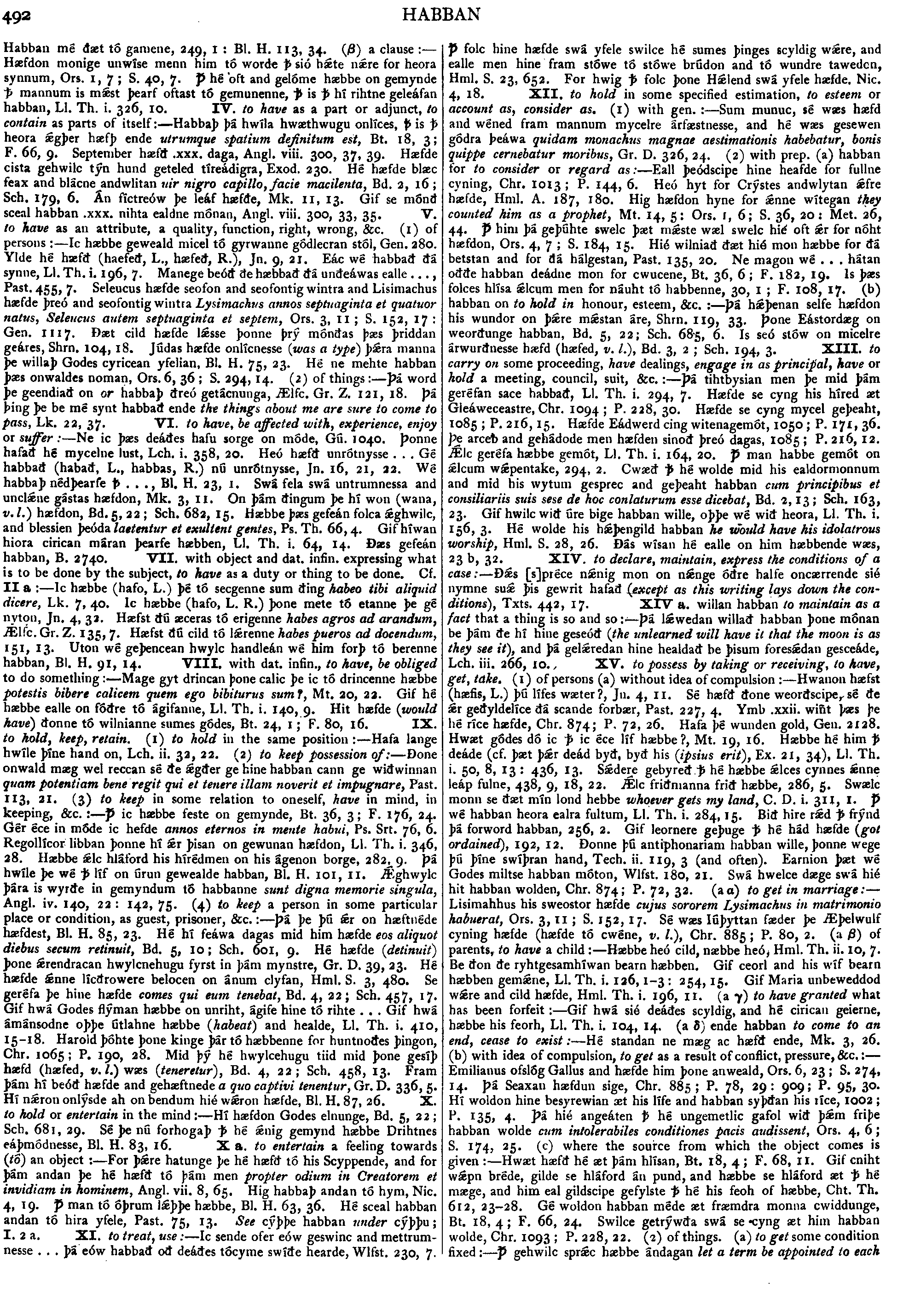
Habban
mé
dæt
tó
gamene,
249,
l
:
Bl.
H.
113,
34.
( )
a
clause
:--
Hæfdon
monige
unwíse
menn
him
tó
worde
sió
hate
nre
for
heora
synnum,
Ors.
1,
7;
S.
40,
7.
Þ-bar;
he
oft
and
gelóme
hæbbe
on
gemynde
mannum
is
mst
þearf
oftast
tó
gemunenne,
is
hí
rihtne
geleáfan
habban,
Ll.
Th.
i.
326,
10.
IV.
to
have
as
a
part
or
adjunct,
to
contain
as
parts
of
itself
:--
Habbaþ
þá
hwíla
hwæthwugu
onlíces,
is
heora
gþer
hæfþ
ende
utrumque
spatium
definitum
est,
Bt.
18,
3;
F.
66,
9.
September
hæfð
.xxx.
daga,
Angl.
viii.
300,
37,
39.
Hæfde
cista
gehwilc
týn
hund
geteled
tíreádigra,
Exod.
230.
Hé
hæfde
blæc
feax
and
blácne
andwlitan
uir
nigro
capillo,
facie
macilenta,
Bd.
2,
16
;
Sch.
179,
6.
Án
fíctreów
þe
leáf
hæfde,
Mk.
ii.
13.
Gif
se
mónð
sceal
habban
.xxx.
nihta
ealdne
mónan,
Angl.
viii.
300,
33,
35,
V.
to
have
as
an
attribute,
a
quality,
function,
right,
wrong,
&c.
(l)
of
persons
:--
Ic
hæbbe
geweald
micel
tó
gyrwanne
gódlecran
stól.
Gen.
280.
Ylde
hé
hæfð
(haefeð,
L.
,
hæfeð,
R.
),
Jn.
9,
21.
Eác
wé
habbað
ðá
synne,
Ll.
Th.
i.
196,
7.
Manege
beóððe
hæbbað
ðá
unðeáwas
ealle.
.
.
,
Past.
455,
7.
Seleucus
hæfde
seofon
and
seofontig
wintra
and
Lisimachus
hæfde
þreó
and
seofontig
wintra
Lysimachus
annos
septuaginta
et
quatuor
natus,
Seleucus
autem
septuaginta
et
septem,
Ors.
3,
11;
S.
152,
17
:
Gen.
1117.
Ðæt
cild
hæfde
lsse
þonne
brý
mónðas
þæs
þriddan
geáres,
Shrn.
104,
18.
Júdas
hæfde
onlícnesse
(was
a
type)
þra
manna
be
willaþ
Godes
cyricean
yfelian.
Bl.
H.
75,
23.
Hé
ne
mehte
habban
þæs
onwaldes
noman,
Ors.
6,
36;
S.
294,
14.
(2)
of
things
:--
Þá
word
þe
geendiað
on
or
habbaþ
ðreó
getácnunga,
Ælfc.
Gr.
Z.
121,
18.
Þá
þing
þe
be
mé
synt
habbað
ende
the
things
about
me
are
sure
to
come
to
pass,
Lk.
22,
37.
VI.
to
have,
be
affected
with,
experience,
enjoy
or
suffer
:--
Ne
ic
þæs
deáðes
hafu
sorge
on
móde,
Gú.
1040.
Þonne
hafað
hé
mycelne
lust,
Lch.
i.
358,
20.
Heó
hæfð
unrótnysse
.
.
.
Gé
habbað
(habað.
L.
,
habbas,
R.
)
nú
unrótnysse,
Jn.
16,
21,
12.
Wé
habbaþ
nédbearfe
.
.
.
,
Bl.
H.
23,
1.
Swá
fela
swá
untrumnessa
and
unclne
gástas
hæfdon,
Mk.
3,
11.
On
þám
ðingum
þe
hí
won
(wana,
v.
l.)
hæfdon,
Bd.
5,
22
;
Sch.
682,
15.
Hæbbe
þæs
gefeán
folca
ghwilc,
and
blessien
þeóda
laetentur
et
exutient
gentes,
Ps.
Th.
66,
4.
Gif
híwan
hiora
cirican
máran
þearfe
hæbben,
Ll.
Th.
i.
64,
14.
Ðæs
gefeán
habban,
B.
2740.
VII.
with
object
and
dat.
infin.
expressing
what
is
to
be
done
by
the
subject,
to
have
as
a
duty
or
thing
to
be
done.
Cf.
II
a
:--
Ic
hæbbe
(hafo.
L.
)
þé
tó
secgenne
sum
ðing
habeo
tibi
aliquid
dicere,
Lk.
7,
40.
Ic
hæbbe
(hafo,
L.
R.
)
þone
mete
tó
etanne
þe
gé
nyton,
Jn.
4,
32.
Hæfst
ðú
æceras
tó
erigenne
habes
agros
ad
arandum,
Æ-acute;lfc.
Gr.
Z.
135,
7.
Hæfst
ðú
cild
tó
lrenne
habes
pueros
ad
docendum,
151,
13.
Uton
wé
geþencean
hwylc
handleán
wé
him
forþ
tó
berenne
habban,
Bl.
H.
91,
14.
VIII.
with
dat.
infin.
to
have,
be
obliged
to
do
something
:--
Mage
gyt
drincan
þone
calic
þe
ic
tó
drincenne
hæbbe
potestis
bibere
calicem
quem
ego
bibiturus
sum
?
Mt.
20,
22.
Gif
hé
hæbbe
ealle
on
fððre
tó
ágifanne,
Ll.
Th.
i.
140,
9.
Hit
hæfde
(would
have)
ðonne
tó
wilnianne
sumes
gódes,
Bt.
24,
i;
F.
80,
16.
IX.
to
hold,
keep,
retain.
(l)
to
hold
in
the
same
position
:--
Hafa
lange
hwlle
þíne
hand
on.
Lch.
ii.
32,
22.
(2)
to
keep
possession
of
:--
Ðone
onwald
mæg
wel
reccan
sé
ðe
gðer
ge
bine
habban
cann
ge
wiðwinnan
quam
potentiam
bene
regit
qui
et
tenere
illam
noverit
et
impugnare,
Past.
113,
21.
(3)
to
keep
in
some
relation
to
oneself
,
have
in
mind,
in
keeping,
&c.
:--
p
ic
hæbbe
feste
on
gemynde,
Bt.
36,
3;
F.
176,
24.
Gér
éce
in
móde
ic
hefde
annos
eternos
in
meute
habui.
Ps.
Srt.
76,
6.
Regolllcór
libban
þonne
hí
r
þisan
on
gewunan
hæfdon,
Ll.
Th.
i.
346,
28.
Hæbbe
lc
hláford
his
hírédmen
on
his
ágenon
borge,
282,
9.
Þá
hwíle
be
we
líf
on
úrun
gewealde
habban,
Bl.
H.
101,
11.
Æ-acute;ghwylc
þára
is
wyrlte
in
gemyndum
tó
habbanne
sunt
digna
memorie
singula,
Angl.
iv.
140,
22
:
142,
75.
(4)
to
keep
a
person
in
some
particular
place
or
condition,
as
guest,
prisoner,
&c.
:--
Þá
þe
þú
r
on
hæftnéde
hæfdest,
Bl.
H.
85,
23.
Hé
hí
feáwa
dagas
mid
him
hæfde
eos
aliquot
diebus
secum
retinuit,
Bd.
5,
10;
Sch.
601,
9.
Hé
hæfde
(detinuit)
þone
rendracan
hwylcnehugu
fyrst
in
þám
mynstre,
Gr.
D.
39,
23.
Hé
hæfde
nne
lícðrowere
belocen
on
ánum
clyfan,
Hml.
S.
3,
480.
Se
geréfa
þe
hine
hæfde
comes
qui
eum
tenebat,
Bd.
4,
22;
Sch.
457,
17.
Gif
hwá
Godes
flýman
hæbbe
on
unriht,
ágife
hine
tó
rihte
.
.
.
Gif
hwá
ámánsodne
oþþe
útlahne
hæbbe
(habeat)
and
healde,
Ll.
Th.
i.
410,
15-18.
Harold
þóhte
þone
kinge
þár
tó
hæbbenne
for
huntnoðes
þingon,
Chr.
1065;
P.
190,
28.
Mid
þý
hé
hwylcehugu
tiid
mid
þone
gesíþ
hæfd
(haefed,
v.
l.)
wæs
(tenerelur),
Bd.
4,
22;
Sch.
458,
13.
Fram
þám
hí
beóð
hæfde
and
gehæftnede
a
quo
captivi
tenentur,
Gr.
D.
336,
5.
Hí
nron
onlýsde
ah
on
bendum
hié
wiéron
hæfde,
Bl.
H.
87,
26.
X.
to
hold
or
entertain
in
the
mind
:--
Hí
hæfdon
Godes
elnunge,
Bd.
5,
22
;
Sch.
681,
29.
Sé
þe
nú
forhogaþ
þ
hé
nig
gemynd
hæbbe
Drihtnes
eáþmódnesse,
Bl.
H.
83,
16.
X
a.
to
entertain
a
feeling
towards
(tó)
an
object
:--
For
þre
hatunge
þe
hé
hæfð
tó
his
Scyppende,
and
for
þám
andan
þe
hé
hæfð
tó
þám
men
propter
odium
in
Creatorem
et
invidiam
in
hominem,
Angl.
vii.
8,
65.
Hig
habbaþ
andan
tó
hym,
Nic.
4,
19.
man
tó
óþrum
lþþe
hæbbe,
Bl.
H.
63,
36.
Hé
sceal
habban
andan
tó
hira
yfele,
Past.
75,
13.
See
cýþþe
habban
unáer
cýþþu;
1.
2
a.
XI.
to
treat,
use
:--
Ic
sende
ofer
eów
geswinc
and
mettrumnesse
.
.
.
þá
eów
habbað
oð
deáðes
tócyme
swíðe
hearde,
Wlfst.
230,
7.
Þ-bar;
folc
hine
hæfde
swá
yfele
swilce
hé
sumes
þinges
scyldig
wre,
and
ealle
men
hine
fram
stówe
tó
stówe
brúdon
and
tó
wundre
tawedcn,
Hml.
S.
23,
652.
For
hwig
;
folc
þone
Hlend
swá
yfele
hæfde.
Nic.
4,
18.
XII.
to
hold
in
some
specified
estimation,
to
esteem
or
account
as,
consider
as.
(l)
with
gen.
:--
Sum
munuc,
sé
wæs
hæfd
and
wéned
fram
mannum
mycelre
árfæstnesse,
and
hé
wæs
gesewen
gódra
þeáwa
quidam
monachtis
magnae
aestimationis
habebatur,
bonis
quippe
cernebatur
moribus,
Gr.
D.
326,
24.
(2)
with
prep,
(a)
habban
for
to
consider
or
regard
as
:--
Eall
þeódscipe
hine
heafde
for
fullne
cyning,
Chr.
1013
;
P.
144,
6.
Heó
hyt
for
Crýstes
andwlytan
fre
hæfde,
Hml.
A.
187,
180.
Hig
hæfdon
hyne
for
nne
wítegan
they
counted
him
as
a
prophet,
Mt.
14,
5:
Ors.
l,
6;
S.
36,
20:
Met.
26,
44.
Þ-bar;
him
þá
geþflhte
swelc
þæt
mste
wæl
swelc
hié
oft
r
for
nóht
hæfdon.
Ors.
4,
7
;
S.
184,
15.
Hié
wilniað
ðæt
hié
mon
hæbbe
for
ðá
betstan
and
for
dá
hálgestan,
Past.
135,
20.
Ne
magon
wé
.
.
.
hátan
oððe
habban
deádne
mon
for
cwucene,
Bt.
36,
6
;
F.
182,
19.
Is
þæs
folces
hlísa
lcum
men
for
náuht
tó
habbenne,
30,
l
;
F.
108,
17.
(b)
habban
on
to
hold
in
honour,
esteem,
&c.
:--
Þá
hþenan
selfe
hæfdon
his
wundor
on
þre
mstan
áre,
Shrn.
119,
33.
Þone
Eástordæg
on
weorðunge
habban,
Bd.
5,
22;
Sch.
685,
6.
Is
seó
stów
on
micelre
árwurðnesse
hæfd
(hæfed,
v.
l.),
Bd.
3,
2
;
Sch.
194,
3.
XIII.
to
carry
on
some
proceeding,
have
dealings,
engage
in
as
principal,
have
or
hold
a
meeting,
council,
suit,
&c.
:--
Þá
tihtbysian
men
þe
mid
þám
geréfan
sace
habbað,
Ll.
Th.
i.
294,
7.
Hæfde
se
cyng
his
hired
set
Gieáweceastre,
Chr.
1094
;
P.
228,
30.
Hæfde
se
cyng
mycel
geþeaht,
1085
;
P.
216,
15.
Hæfde
Eádwerd
cing
witenagemót,
1050;
P.
171,
36.
Þe
arceb
and
gehádode
men
hæfden
sinoit
þreó
dagas,
1085;
P.
216,
12.
Æ-acute;lc
geréfa
hæbbe
gemót,
Ll.
Th.
i.
164,
20.
Þ-bar;
man
habbe
gemót
on
lcum
wpentake,
294,
2.
Cwæð
hé
wolde
mid
his
ealdormonnum
and
mid
his
wytum
gesprec
and
geþeaht
habban
cum
principibus
et
consiliariis
suis
sese
de
hoc
conlaturum
esse
dicebat,
Bd.
2,
13;
Sch.
163,
23.
Gif
hwilc
wið
úre
bige
habban
wille,
oþþe
wé
wið
heora,
Ll.
Th.
i.
156,
3.
Hé
wolde
his
hbengild
habban
he
would
have
his
idolatrous
worship,
Hml.
S.
28,
26.
Ðás
wísan
hé
ealle
on
him
hæbbende
wæs,
23
b,
32.
XIV.
to
declare,
maintain,
express
the
conditions
of
a
case
:--
Ðs
[s]préce
nnig
mon
on
nnge
óðre
halfe
oncærrende
sié
nymne
su
þis
gewrit
hafað
(except
as
this
writing
lays
down
the
conditions),
Txts.
442,
17.
XIV
a.
willan
habban
to
maintain
as
a
fact
that
a
thing
is
so
and
so:--
Þá
lwedan
willað
habban
þone
mónan
be
þám
ðe
hí
hine
geseóð
(the
unlearned
will
have
it
that
the
moon
is
as
they
see
if),
and
þá
gelredan
hine
healdað
be
þisum
foresdan
gesceáde,
Lch.
iii.
266,
10.
,
XV.
to
possess
by
taking
or
receiving,
to
have,
get,
take.
(l)
of
persons
(a)
without
idea
of
compulsion
:--
Hwanon
hæfst
(hæfis,
L.
)
þú
lífes
wæter?,
Jn.
4,
11.
Sé
hæfð
ðone
weorðscipe.
sé
ðe
r
geðyldelíce
ðá
scande
forbær,
Past.
227,
4.
Ymb
.xxii.
wiñt
þæs
þe
hé
ríce
hæfde,
Chr.
874;
P.
72,
26.
Hafa
þé
wunden
gold,
Gen.
2128.
Hwæt
gódes
dó
ic
ic
éce
líf
hæbbe?,
Mt.
19,
16.
Hæbbe
hé
him
deáde
(cf.
þæt
þr
deád
byð,
byð
his
(ipsius
erif),
Ex.
21,
34),
Ll.
Th.
i.
50,
8,
13
:
436,
13.
Sdere
gebyreð
hé
hæbbe
lces
cynnes
nne
leáp
fulne,
438,
9,
18,
22.
Æ-acute;lc
friðmanna
frið
hæbbe,
286,
5.
Swælc
monn
se
ðæt
mín
lond
hebbe
whoever
gets
my
land,
C.
D.
i.
311,
I.
Þ-bar;
wé
habban
heora
ealra
fultum,
Ll.
Th.
i.
284,
15.
Bið
hire
rd
frýnd
þá
forword
habban,
256,
2.
Gif
leornere
geþuge
hé
had
hsefde
(got
ordained),
192,
12,
Ðonne
þú
antiphonariam
habban
wille,
þonne
wege
þú
þíne
swíþran
hand,
Tech.
ii.
119,
3
(and
often).
Earmon
þæt
wé
Godes
miltse
habban
móton,
Wlfst.
180,
21.
Swá
hwelce
dæge
swá
hié
hit
habban
wolden,
Chr.
874;
P.
72,
32.
(a
)
a
clause
:--
Hæfdon
monige
unwíse
menn
him
tó
worde
sió
hate
nre
for
heora
synnum,
Ors.
1,
7;
S.
40,
7.
Þ-bar;
he
oft
and
gelóme
hæbbe
on
gemynde
mannum
is
mst
þearf
oftast
tó
gemunenne,
is
hí
rihtne
geleáfan
habban,
Ll.
Th.
i.
326,
10.
IV.
to
have
as
a
part
or
adjunct,
to
contain
as
parts
of
itself
:--
Habbaþ
þá
hwíla
hwæthwugu
onlíces,
is
heora
gþer
hæfþ
ende
utrumque
spatium
definitum
est,
Bt.
18,
3;
F.
66,
9.
September
hæfð
.xxx.
daga,
Angl.
viii.
300,
37,
39.
Hæfde
cista
gehwilc
týn
hund
geteled
tíreádigra,
Exod.
230.
Hé
hæfde
blæc
feax
and
blácne
andwlitan
uir
nigro
capillo,
facie
macilenta,
Bd.
2,
16
;
Sch.
179,
6.
Án
fíctreów
þe
leáf
hæfde,
Mk.
ii.
13.
Gif
se
mónð
sceal
habban
.xxx.
nihta
ealdne
mónan,
Angl.
viii.
300,
33,
35,
V.
to
have
as
an
attribute,
a
quality,
function,
right,
wrong,
&c.
(l)
of
persons
:--
Ic
hæbbe
geweald
micel
tó
gyrwanne
gódlecran
stól.
Gen.
280.
Ylde
hé
hæfð
(haefeð,
L.
,
hæfeð,
R.
),
Jn.
9,
21.
Eác
wé
habbað
ðá
synne,
Ll.
Th.
i.
196,
7.
Manege
beóððe
hæbbað
ðá
unðeáwas
ealle.
.
.
,
Past.
455,
7.
Seleucus
hæfde
seofon
and
seofontig
wintra
and
Lisimachus
hæfde
þreó
and
seofontig
wintra
Lysimachus
annos
septuaginta
et
quatuor
natus,
Seleucus
autem
septuaginta
et
septem,
Ors.
3,
11;
S.
152,
17
:
Gen.
1117.
Ðæt
cild
hæfde
lsse
þonne
brý
mónðas
þæs
þriddan
geáres,
Shrn.
104,
18.
Júdas
hæfde
onlícnesse
(was
a
type)
þra
manna
be
willaþ
Godes
cyricean
yfelian.
Bl.
H.
75,
23.
Hé
ne
mehte
habban
þæs
onwaldes
noman,
Ors.
6,
36;
S.
294,
14.
(2)
of
things
:--
Þá
word
þe
geendiað
on
or
habbaþ
ðreó
getácnunga,
Ælfc.
Gr.
Z.
121,
18.
Þá
þing
þe
be
mé
synt
habbað
ende
the
things
about
me
are
sure
to
come
to
pass,
Lk.
22,
37.
VI.
to
have,
be
affected
with,
experience,
enjoy
or
suffer
:--
Ne
ic
þæs
deáðes
hafu
sorge
on
móde,
Gú.
1040.
Þonne
hafað
hé
mycelne
lust,
Lch.
i.
358,
20.
Heó
hæfð
unrótnysse
.
.
.
Gé
habbað
(habað.
L.
,
habbas,
R.
)
nú
unrótnysse,
Jn.
16,
21,
12.
Wé
habbaþ
nédbearfe
.
.
.
,
Bl.
H.
23,
1.
Swá
fela
swá
untrumnessa
and
unclne
gástas
hæfdon,
Mk.
3,
11.
On
þám
ðingum
þe
hí
won
(wana,
v.
l.)
hæfdon,
Bd.
5,
22
;
Sch.
682,
15.
Hæbbe
þæs
gefeán
folca
ghwilc,
and
blessien
þeóda
laetentur
et
exutient
gentes,
Ps.
Th.
66,
4.
Gif
híwan
hiora
cirican
máran
þearfe
hæbben,
Ll.
Th.
i.
64,
14.
Ðæs
gefeán
habban,
B.
2740.
VII.
with
object
and
dat.
infin.
expressing
what
is
to
be
done
by
the
subject,
to
have
as
a
duty
or
thing
to
be
done.
Cf.
II
a
:--
Ic
hæbbe
(hafo.
L.
)
þé
tó
secgenne
sum
ðing
habeo
tibi
aliquid
dicere,
Lk.
7,
40.
Ic
hæbbe
(hafo,
L.
R.
)
þone
mete
tó
etanne
þe
gé
nyton,
Jn.
4,
32.
Hæfst
ðú
æceras
tó
erigenne
habes
agros
ad
arandum,
Æ-acute;lfc.
Gr.
Z.
135,
7.
Hæfst
ðú
cild
tó
lrenne
habes
pueros
ad
docendum,
151,
13.
Uton
wé
geþencean
hwylc
handleán
wé
him
forþ
tó
berenne
habban,
Bl.
H.
91,
14.
VIII.
with
dat.
infin.
to
have,
be
obliged
to
do
something
:--
Mage
gyt
drincan
þone
calic
þe
ic
tó
drincenne
hæbbe
potestis
bibere
calicem
quem
ego
bibiturus
sum
?
Mt.
20,
22.
Gif
hé
hæbbe
ealle
on
fððre
tó
ágifanne,
Ll.
Th.
i.
140,
9.
Hit
hæfde
(would
have)
ðonne
tó
wilnianne
sumes
gódes,
Bt.
24,
i;
F.
80,
16.
IX.
to
hold,
keep,
retain.
(l)
to
hold
in
the
same
position
:--
Hafa
lange
hwlle
þíne
hand
on.
Lch.
ii.
32,
22.
(2)
to
keep
possession
of
:--
Ðone
onwald
mæg
wel
reccan
sé
ðe
gðer
ge
bine
habban
cann
ge
wiðwinnan
quam
potentiam
bene
regit
qui
et
tenere
illam
noverit
et
impugnare,
Past.
113,
21.
(3)
to
keep
in
some
relation
to
oneself
,
have
in
mind,
in
keeping,
&c.
:--
p
ic
hæbbe
feste
on
gemynde,
Bt.
36,
3;
F.
176,
24.
Gér
éce
in
móde
ic
hefde
annos
eternos
in
meute
habui.
Ps.
Srt.
76,
6.
Regolllcór
libban
þonne
hí
r
þisan
on
gewunan
hæfdon,
Ll.
Th.
i.
346,
28.
Hæbbe
lc
hláford
his
hírédmen
on
his
ágenon
borge,
282,
9.
Þá
hwíle
be
we
líf
on
úrun
gewealde
habban,
Bl.
H.
101,
11.
Æ-acute;ghwylc
þára
is
wyrlte
in
gemyndum
tó
habbanne
sunt
digna
memorie
singula,
Angl.
iv.
140,
22
:
142,
75.
(4)
to
keep
a
person
in
some
particular
place
or
condition,
as
guest,
prisoner,
&c.
:--
Þá
þe
þú
r
on
hæftnéde
hæfdest,
Bl.
H.
85,
23.
Hé
hí
feáwa
dagas
mid
him
hæfde
eos
aliquot
diebus
secum
retinuit,
Bd.
5,
10;
Sch.
601,
9.
Hé
hæfde
(detinuit)
þone
rendracan
hwylcnehugu
fyrst
in
þám
mynstre,
Gr.
D.
39,
23.
Hé
hæfde
nne
lícðrowere
belocen
on
ánum
clyfan,
Hml.
S.
3,
480.
Se
geréfa
þe
hine
hæfde
comes
qui
eum
tenebat,
Bd.
4,
22;
Sch.
457,
17.
Gif
hwá
Godes
flýman
hæbbe
on
unriht,
ágife
hine
tó
rihte
.
.
.
Gif
hwá
ámánsodne
oþþe
útlahne
hæbbe
(habeat)
and
healde,
Ll.
Th.
i.
410,
15-18.
Harold
þóhte
þone
kinge
þár
tó
hæbbenne
for
huntnoðes
þingon,
Chr.
1065;
P.
190,
28.
Mid
þý
hé
hwylcehugu
tiid
mid
þone
gesíþ
hæfd
(haefed,
v.
l.)
wæs
(tenerelur),
Bd.
4,
22;
Sch.
458,
13.
Fram
þám
hí
beóð
hæfde
and
gehæftnede
a
quo
captivi
tenentur,
Gr.
D.
336,
5.
Hí
nron
onlýsde
ah
on
bendum
hié
wiéron
hæfde,
Bl.
H.
87,
26.
X.
to
hold
or
entertain
in
the
mind
:--
Hí
hæfdon
Godes
elnunge,
Bd.
5,
22
;
Sch.
681,
29.
Sé
þe
nú
forhogaþ
þ
hé
nig
gemynd
hæbbe
Drihtnes
eáþmódnesse,
Bl.
H.
83,
16.
X
a.
to
entertain
a
feeling
towards
(tó)
an
object
:--
For
þre
hatunge
þe
hé
hæfð
tó
his
Scyppende,
and
for
þám
andan
þe
hé
hæfð
tó
þám
men
propter
odium
in
Creatorem
et
invidiam
in
hominem,
Angl.
vii.
8,
65.
Hig
habbaþ
andan
tó
hym,
Nic.
4,
19.
man
tó
óþrum
lþþe
hæbbe,
Bl.
H.
63,
36.
Hé
sceal
habban
andan
tó
hira
yfele,
Past.
75,
13.
See
cýþþe
habban
unáer
cýþþu;
1.
2
a.
XI.
to
treat,
use
:--
Ic
sende
ofer
eów
geswinc
and
mettrumnesse
.
.
.
þá
eów
habbað
oð
deáðes
tócyme
swíðe
hearde,
Wlfst.
230,
7.
Þ-bar;
folc
hine
hæfde
swá
yfele
swilce
hé
sumes
þinges
scyldig
wre,
and
ealle
men
hine
fram
stówe
tó
stówe
brúdon
and
tó
wundre
tawedcn,
Hml.
S.
23,
652.
For
hwig
;
folc
þone
Hlend
swá
yfele
hæfde.
Nic.
4,
18.
XII.
to
hold
in
some
specified
estimation,
to
esteem
or
account
as,
consider
as.
(l)
with
gen.
:--
Sum
munuc,
sé
wæs
hæfd
and
wéned
fram
mannum
mycelre
árfæstnesse,
and
hé
wæs
gesewen
gódra
þeáwa
quidam
monachtis
magnae
aestimationis
habebatur,
bonis
quippe
cernebatur
moribus,
Gr.
D.
326,
24.
(2)
with
prep,
(a)
habban
for
to
consider
or
regard
as
:--
Eall
þeódscipe
hine
heafde
for
fullne
cyning,
Chr.
1013
;
P.
144,
6.
Heó
hyt
for
Crýstes
andwlytan
fre
hæfde,
Hml.
A.
187,
180.
Hig
hæfdon
hyne
for
nne
wítegan
they
counted
him
as
a
prophet,
Mt.
14,
5:
Ors.
l,
6;
S.
36,
20:
Met.
26,
44.
Þ-bar;
him
þá
geþflhte
swelc
þæt
mste
wæl
swelc
hié
oft
r
for
nóht
hæfdon.
Ors.
4,
7
;
S.
184,
15.
Hié
wilniað
ðæt
hié
mon
hæbbe
for
ðá
betstan
and
for
dá
hálgestan,
Past.
135,
20.
Ne
magon
wé
.
.
.
hátan
oððe
habban
deádne
mon
for
cwucene,
Bt.
36,
6
;
F.
182,
19.
Is
þæs
folces
hlísa
lcum
men
for
náuht
tó
habbenne,
30,
l
;
F.
108,
17.
(b)
habban
on
to
hold
in
honour,
esteem,
&c.
:--
Þá
hþenan
selfe
hæfdon
his
wundor
on
þre
mstan
áre,
Shrn.
119,
33.
Þone
Eástordæg
on
weorðunge
habban,
Bd.
5,
22;
Sch.
685,
6.
Is
seó
stów
on
micelre
árwurðnesse
hæfd
(hæfed,
v.
l.),
Bd.
3,
2
;
Sch.
194,
3.
XIII.
to
carry
on
some
proceeding,
have
dealings,
engage
in
as
principal,
have
or
hold
a
meeting,
council,
suit,
&c.
:--
Þá
tihtbysian
men
þe
mid
þám
geréfan
sace
habbað,
Ll.
Th.
i.
294,
7.
Hæfde
se
cyng
his
hired
set
Gieáweceastre,
Chr.
1094
;
P.
228,
30.
Hæfde
se
cyng
mycel
geþeaht,
1085
;
P.
216,
15.
Hæfde
Eádwerd
cing
witenagemót,
1050;
P.
171,
36.
Þe
arceb
and
gehádode
men
hæfden
sinoit
þreó
dagas,
1085;
P.
216,
12.
Æ-acute;lc
geréfa
hæbbe
gemót,
Ll.
Th.
i.
164,
20.
Þ-bar;
man
habbe
gemót
on
lcum
wpentake,
294,
2.
Cwæð
hé
wolde
mid
his
ealdormonnum
and
mid
his
wytum
gesprec
and
geþeaht
habban
cum
principibus
et
consiliariis
suis
sese
de
hoc
conlaturum
esse
dicebat,
Bd.
2,
13;
Sch.
163,
23.
Gif
hwilc
wið
úre
bige
habban
wille,
oþþe
wé
wið
heora,
Ll.
Th.
i.
156,
3.
Hé
wolde
his
hbengild
habban
he
would
have
his
idolatrous
worship,
Hml.
S.
28,
26.
Ðás
wísan
hé
ealle
on
him
hæbbende
wæs,
23
b,
32.
XIV.
to
declare,
maintain,
express
the
conditions
of
a
case
:--
Ðs
[s]préce
nnig
mon
on
nnge
óðre
halfe
oncærrende
sié
nymne
su
þis
gewrit
hafað
(except
as
this
writing
lays
down
the
conditions),
Txts.
442,
17.
XIV
a.
willan
habban
to
maintain
as
a
fact
that
a
thing
is
so
and
so:--
Þá
lwedan
willað
habban
þone
mónan
be
þám
ðe
hí
hine
geseóð
(the
unlearned
will
have
it
that
the
moon
is
as
they
see
if),
and
þá
gelredan
hine
healdað
be
þisum
foresdan
gesceáde,
Lch.
iii.
266,
10.
,
XV.
to
possess
by
taking
or
receiving,
to
have,
get,
take.
(l)
of
persons
(a)
without
idea
of
compulsion
:--
Hwanon
hæfst
(hæfis,
L.
)
þú
lífes
wæter?,
Jn.
4,
11.
Sé
hæfð
ðone
weorðscipe.
sé
ðe
r
geðyldelíce
ðá
scande
forbær,
Past.
227,
4.
Ymb
.xxii.
wiñt
þæs
þe
hé
ríce
hæfde,
Chr.
874;
P.
72,
26.
Hafa
þé
wunden
gold,
Gen.
2128.
Hwæt
gódes
dó
ic
ic
éce
líf
hæbbe?,
Mt.
19,
16.
Hæbbe
hé
him
deáde
(cf.
þæt
þr
deád
byð,
byð
his
(ipsius
erif),
Ex.
21,
34),
Ll.
Th.
i.
50,
8,
13
:
436,
13.
Sdere
gebyreð
hé
hæbbe
lces
cynnes
nne
leáp
fulne,
438,
9,
18,
22.
Æ-acute;lc
friðmanna
frið
hæbbe,
286,
5.
Swælc
monn
se
ðæt
mín
lond
hebbe
whoever
gets
my
land,
C.
D.
i.
311,
I.
Þ-bar;
wé
habban
heora
ealra
fultum,
Ll.
Th.
i.
284,
15.
Bið
hire
rd
frýnd
þá
forword
habban,
256,
2.
Gif
leornere
geþuge
hé
had
hsefde
(got
ordained),
192,
12,
Ðonne
þú
antiphonariam
habban
wille,
þonne
wege
þú
þíne
swíþran
hand,
Tech.
ii.
119,
3
(and
often).
Earmon
þæt
wé
Godes
miltse
habban
móton,
Wlfst.
180,
21.
Swá
hwelce
dæge
swá
hié
hit
habban
wolden,
Chr.
874;
P.
72,
32.
(a
 )
to
get
in
marriage
:--
Lisimahhus
his
sweostor
hæfde
cujus
sororem
Lysimachus
in
matrimonio
habuerat,
Ors.
3,
11;
S.
152,
17.
Sé
wæs
lúþyttan
fæder
þe
Æþelwulf
cyning
hæfde
(hæfde
tó
cwéne,
v.
l.),
Chr.
885;
P.
80,
2.
(a
)
of
parents,
to
have
a
child
:--
Hæbbe
heó
cild,
næbbe
heó,
Hml.
Th.
ii.
10,
7-Be
ðon
ðe
ryhtgesamhíwan
beam
hæbben.
Gif
ceorl
and
his
wíf
bearn
hæbben
gemne,
Ll.
Th.
i.
126,
1-3:
254,
15.
Gif
Maria
unbeweddod
wre
and
cild
hæfde.
Hml.
Th.
i.
196,
11.
(a
)
to
get
in
marriage
:--
Lisimahhus
his
sweostor
hæfde
cujus
sororem
Lysimachus
in
matrimonio
habuerat,
Ors.
3,
11;
S.
152,
17.
Sé
wæs
lúþyttan
fæder
þe
Æþelwulf
cyning
hæfde
(hæfde
tó
cwéne,
v.
l.),
Chr.
885;
P.
80,
2.
(a
)
of
parents,
to
have
a
child
:--
Hæbbe
heó
cild,
næbbe
heó,
Hml.
Th.
ii.
10,
7-Be
ðon
ðe
ryhtgesamhíwan
beam
hæbben.
Gif
ceorl
and
his
wíf
bearn
hæbben
gemne,
Ll.
Th.
i.
126,
1-3:
254,
15.
Gif
Maria
unbeweddod
wre
and
cild
hæfde.
Hml.
Th.
i.
196,
11.
(a
 )
to
have
granted
what
has
been
forfeit
:--
Gif
hwá
sié
deáðes
scyldig,
and
hé
cirican
geierne,
hæbbe
his
feorh,
Ll.
Th.
i.
104,
14.
(a
)
to
have
granted
what
has
been
forfeit
:--
Gif
hwá
sié
deáðes
scyldig,
and
hé
cirican
geierne,
hæbbe
his
feorh,
Ll.
Th.
i.
104,
14.
(a
 )
ende
habban
to
come
to
an
end,
cease
to
exist
:--
Hé
standan
ne
mæg
ac
hæfð
ende,
Mk.
3,
26.
(b)
with
idea
of
compulsion,
to
get
as
a
result
of
conflict,
pressure,
&c.
:--
Emilianus
ofslóg
Gallus
and
hæfde
him
þone
anweald,
Ors.
6,
23
;
S.
274a
14.
Þá
Seaxan
hæfdun
sige,
Chr.
885
;
P.
78,
29
:
909;
P.
95,
30.
Hí
woldon
hine
besyrewian
æt
his
lífe
and
habban
syþðan
his
ríce,
1002;
P.
13S.
4.
Pá
hié
angeáten
hé
ungemetlic
gafol
wid
þm
friþe
habban
wolde
cum
intolerabiles
conditiones
pacis
audissent,
Ors.
4,
6;
S.
174,
25.
(c)
where
the
source
from
which
the
object
comes
is
given
:--
Hwæt
hæfð
hé
æt
þám
hlísan.
Bt.
18,
4;
F.
68,
11.
Gif
cniht
wpn
bréde,
gilde
se
hláford
án
pund,
and
hæbbe
se
hláford
æt
hé
mæge,
and
him
eal
gildscipe
gefylste
hé
his
feoh
of
hæbbe,
Cht.
Th.
612,
23-28.
Gé
woldon
habban
méde
æt
fræmdra
monna
cwiddunge,
Bt.
18,
4;
F.
66,
24.
Swilce
getrýwða
swá
se
cyng
æt
him
habban
wolde,
Chr.
1093
;
P.
228,
22.
(2)
of
things,
(a)
to
get
some
condition
fixed
:--
Þ-bar;
gehwilc
sprc
hæbbe
ándagan
let
a
term
be
appointed
to
each
)
ende
habban
to
come
to
an
end,
cease
to
exist
:--
Hé
standan
ne
mæg
ac
hæfð
ende,
Mk.
3,
26.
(b)
with
idea
of
compulsion,
to
get
as
a
result
of
conflict,
pressure,
&c.
:--
Emilianus
ofslóg
Gallus
and
hæfde
him
þone
anweald,
Ors.
6,
23
;
S.
274a
14.
Þá
Seaxan
hæfdun
sige,
Chr.
885
;
P.
78,
29
:
909;
P.
95,
30.
Hí
woldon
hine
besyrewian
æt
his
lífe
and
habban
syþðan
his
ríce,
1002;
P.
13S.
4.
Pá
hié
angeáten
hé
ungemetlic
gafol
wid
þm
friþe
habban
wolde
cum
intolerabiles
conditiones
pacis
audissent,
Ors.
4,
6;
S.
174,
25.
(c)
where
the
source
from
which
the
object
comes
is
given
:--
Hwæt
hæfð
hé
æt
þám
hlísan.
Bt.
18,
4;
F.
68,
11.
Gif
cniht
wpn
bréde,
gilde
se
hláford
án
pund,
and
hæbbe
se
hláford
æt
hé
mæge,
and
him
eal
gildscipe
gefylste
hé
his
feoh
of
hæbbe,
Cht.
Th.
612,
23-28.
Gé
woldon
habban
méde
æt
fræmdra
monna
cwiddunge,
Bt.
18,
4;
F.
66,
24.
Swilce
getrýwða
swá
se
cyng
æt
him
habban
wolde,
Chr.
1093
;
P.
228,
22.
(2)
of
things,
(a)
to
get
some
condition
fixed
:--
Þ-bar;
gehwilc
sprc
hæbbe
ándagan
let
a
term
be
appointed
to
each
| Result Page: | 1 2 | Next |  |
Germanic Lexicon Project (main page)
This search system was written by
Sean Crist
Please consider
volunteering
to correct the data in these online dictionaries.
No rights reserved. Feel free to use these data in any way you please.