|
|

Search for ude again, using less strict matching (29 results)
|
Source: Bosworth/Toller, page b0450, entry 8 View original page image as: [TIFF] [PNG] [View previous entry] [View next entry] |
[Comment on this entry] [View comments] |
The following entry has been hand-corrected once. |
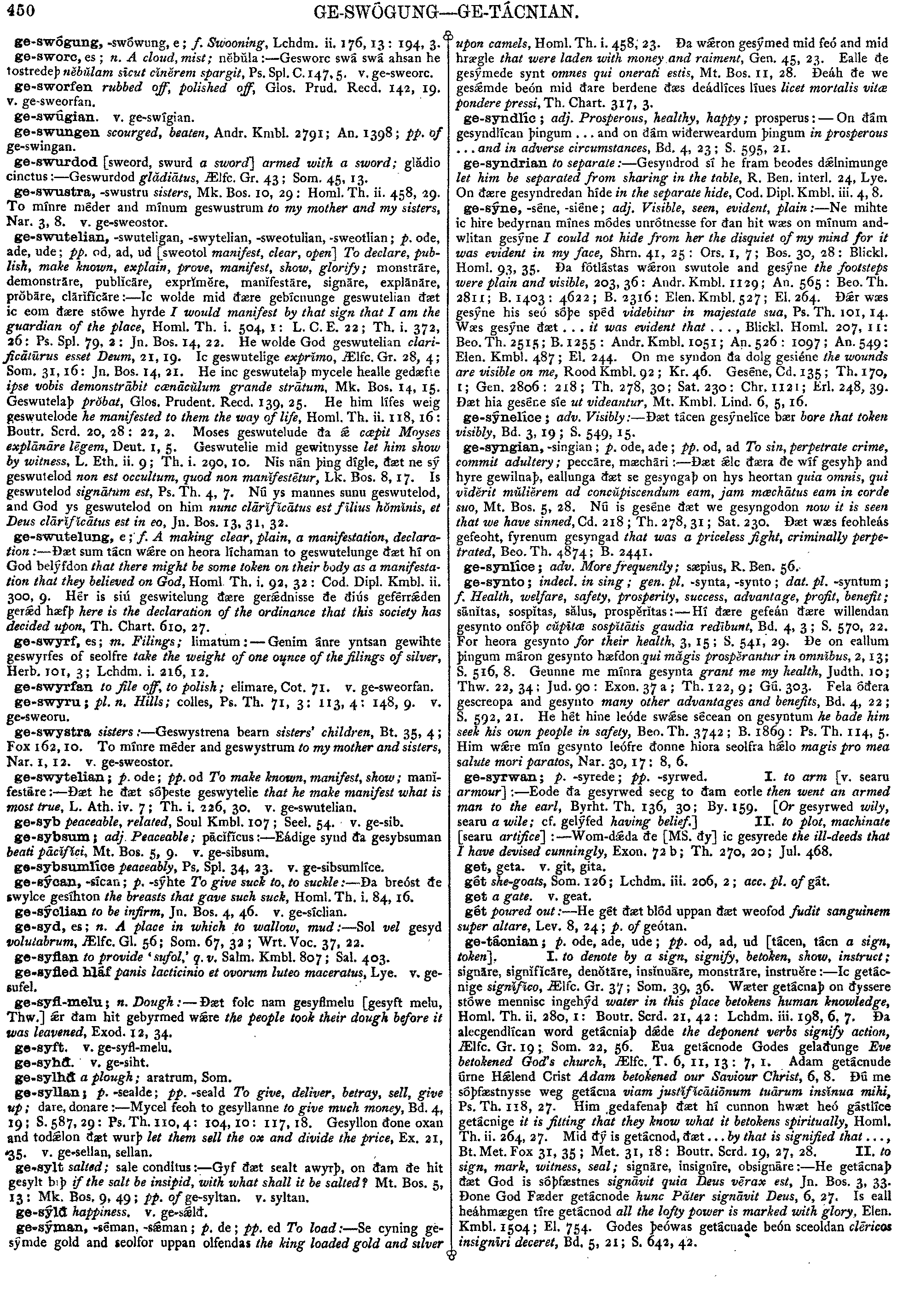
ge-swutelian,
-swuteligan,
-swytelian,
-sweotulian,
-sweotlian;
p.
ode,
ade,
ude;
pp.
od,
ad,
ud
[sweotol
manifest,
clear,
open]
To
declare,
publish,
make
known,
explain,
prove,
manifest,
show,
glorify;
monstr re,
demonstrre,
publ
re,
demonstrre,
publ cre,
exprm
cre,
exprm re,
manfestre,
signre,
explnre,
pr
re,
manfestre,
signre,
explnre,
pr bre,
clrfcre
:--
Ic
wolde
mid
ðære
gebícnunge
geswutelian
ðæt
ic
eom
ðære
stówe
hyrde
I
would
manifest
by
that
sign
that
I
am
the
guardian
of
the
place,
Homl.
Th.
i.
504,
1:
L.
C.
E.
22;
Th.
i.
372,
26:
Ps.
Spl.
79,
2:
Jn.
Bos.
14,
22.
He
wolde
God
geswutelian
clarifict
bre,
clrfcre
:--
Ic
wolde
mid
ðære
gebícnunge
geswutelian
ðæt
ic
eom
ðære
stówe
hyrde
I
would
manifest
by
that
sign
that
I
am
the
guardian
of
the
place,
Homl.
Th.
i.
504,
1:
L.
C.
E.
22;
Th.
i.
372,
26:
Ps.
Spl.
79,
2:
Jn.
Bos.
14,
22.
He
wolde
God
geswutelian
clarifict rus
esset
Deum,
21,
19.
Ic
geswutelige
exprmo,
Ælfc.
Gr.
28,
4;
Som.
31,
16:
Jn.
Bos.
14,
21.
He
inc
geswutelaþ
mycele
healle
gedæfte
ipse
vobis
demonstrbit
cænc
rus
esset
Deum,
21,
19.
Ic
geswutelige
exprmo,
Ælfc.
Gr.
28,
4;
Som.
31,
16:
Jn.
Bos.
14,
21.
He
inc
geswutelaþ
mycele
healle
gedæfte
ipse
vobis
demonstrbit
cænc lum
grande
strtum,
Mk.
Bos.
14,
15.
Geswutelaþ
prbat,
Glos.
Prudent.
Recd.
139,
25.
He
him
lífes
weig
geswutelode
he
manifested
to
them
the
way
of
life,
Homl.
Th.
ii.
118,
16:
Boutr.
Scrd.
20,
28:
22,
2.
Moses
geswutelude
ða
lum
grande
strtum,
Mk.
Bos.
14,
15.
Geswutelaþ
prbat,
Glos.
Prudent.
Recd.
139,
25.
He
him
lífes
weig
geswutelode
he
manifested
to
them
the
way
of
life,
Homl.
Th.
ii.
118,
16:
Boutr.
Scrd.
20,
28:
22,
2.
Moses
geswutelude
ða
 cæpit
Moyses
explnre
l
cæpit
Moyses
explnre
l gem,
Deut.
1,
5.
Geswutelie
mid
gewitnysse
let
him
show
by
witness,
L.
Eth.
ii.
9;
Th.
i.
290,
l0.
Nis
nán
þing
dígle,
ðæt
ne
sý
geswutelod
non
est
occultum,
quod
non
manfesttur,
Lk.
Bos.
8,
17.
Is
geswutelod
signtum
est,
Ps.
Th.
4,
7.
Nú
ys
mannes
sunu
geswutelod,
and
God
ys
geswutelod
on
him
nunc
clrfctus
est
f
gem,
Deut.
1,
5.
Geswutelie
mid
gewitnysse
let
him
show
by
witness,
L.
Eth.
ii.
9;
Th.
i.
290,
l0.
Nis
nán
þing
dígle,
ðæt
ne
sý
geswutelod
non
est
occultum,
quod
non
manfesttur,
Lk.
Bos.
8,
17.
Is
geswutelod
signtum
est,
Ps.
Th.
4,
7.
Nú
ys
mannes
sunu
geswutelod,
and
God
ys
geswutelod
on
him
nunc
clrfctus
est
f lius
hmnis,
et
Deus
clrfctus
est
in
eo,
Jn.
Bos.
13,
31,
32.
lius
hmnis,
et
Deus
clrfctus
est
in
eo,
Jn.
Bos.
13,
31,
32.
|
Source: Bosworth/Toller, page b0450, entry 43 View original page image as: [TIFF] [PNG] [View previous entry] [View next entry] |
[Comment on this entry] [View comments] |
The following entry has been hand-corrected once. |
ge-tácnian;
p.
ode,
ade,
ude;
pp.
od,
ad,
ud
[tácen,
tácn
a
sign,
token].
I.
to
denote
by
a
sign,
signify,
betoken,
show,
instruct;
signre,
signfcre,
dentre,
insnure,
monstrre,
instrure
:--
Ic
getácnige
signfco,
Ælfc.
Gr.
37;
Som.
39,
36.
Wæter
getácnaþ
on
ðyssere
stówe
mennisc
ingehýd
water
in
this
place
betokens
human
knowledge,
Homl.
Th.
ii.
280,
1:
Boutr.
Scrd.
21,
42:
Lchdm.
iii.
198,
6,
7.
Ða
alecgendlícan
word
getácnaþ
dde
the
deponent
verbs
signify
action,
Ælfc.
Gr.
19;
Som.
22,
56.
Eua
getácnode
Godes
gelaðunge
Eve
betokened
God's
church,
Ælfc.
T.
6,
11,
13:
7,
I.
Adam
getácnude
úrne
Hlend
Crist
Adam
betokened
our
Saviour
Christ,
6,
8.
Ðú
me
sóþfæstnysse
weg
getácna
viam
justfcti num
turum
insnua
mihi,
Ps.
Th.
118,
27.
Him
gedafenaþ
ðæt
hí
cunnon
hwæt
heó
gástlíce
getácnige
it
is
fitting
that
they
know
what
it
betokens
spiritually,
Homl.
Th.
ii.
264,
27.
Mid
ðý
is
getácnod,
ðæt
...
by
that
is
signed
that
...,
Bt.
Met.
Fox
31,
35;
Met.
31,
18:
Boutr.
Scrd.
19,
27,
28.
II.
to
sign,
mark,
witness,
seal;
signre,
insignre,
obsignre
:--
He
getácnaþ
ðæt
God
is
sóþfæstnes
signvit
quia
Deus
vrax
est,
Jn.
Bos.
3,
33.
Ðone
God
Fæder
getácnode
hunc
P
num
turum
insnua
mihi,
Ps.
Th.
118,
27.
Him
gedafenaþ
ðæt
hí
cunnon
hwæt
heó
gástlíce
getácnige
it
is
fitting
that
they
know
what
it
betokens
spiritually,
Homl.
Th.
ii.
264,
27.
Mid
ðý
is
getácnod,
ðæt
...
by
that
is
signed
that
...,
Bt.
Met.
Fox
31,
35;
Met.
31,
18:
Boutr.
Scrd.
19,
27,
28.
II.
to
sign,
mark,
witness,
seal;
signre,
insignre,
obsignre
:--
He
getácnaþ
ðæt
God
is
sóþfæstnes
signvit
quia
Deus
vrax
est,
Jn.
Bos.
3,
33.
Ðone
God
Fæder
getácnode
hunc
P ter
signvit
Deus,
6,
27.
Is
eall
heáhmægen
tíre
getácnod
all
the
lofty
power
is
marked
with
glory,
Elen.
Kmbl.
1504;
El.
754.
Godes
þeówas
getácnode
beón
sceoldan
clricos
insignri
deceret,
Bd.
5,
21;
S.
642,
42.
ter
signvit
Deus,
6,
27.
Is
eall
heáhmægen
tíre
getácnod
all
the
lofty
power
is
marked
with
glory,
Elen.
Kmbl.
1504;
El.
754.
Godes
þeówas
getácnode
beón
sceoldan
clricos
insignri
deceret,
Bd.
5,
21;
S.
642,
42.
|
Source: Bosworth/Toller, page b0453, entry 1 View original page image as: [TIFF] [PNG] [View previous entry] [View next entry] |
[Comment on this entry] [View comments] |
The following entry has been hand-corrected once. |
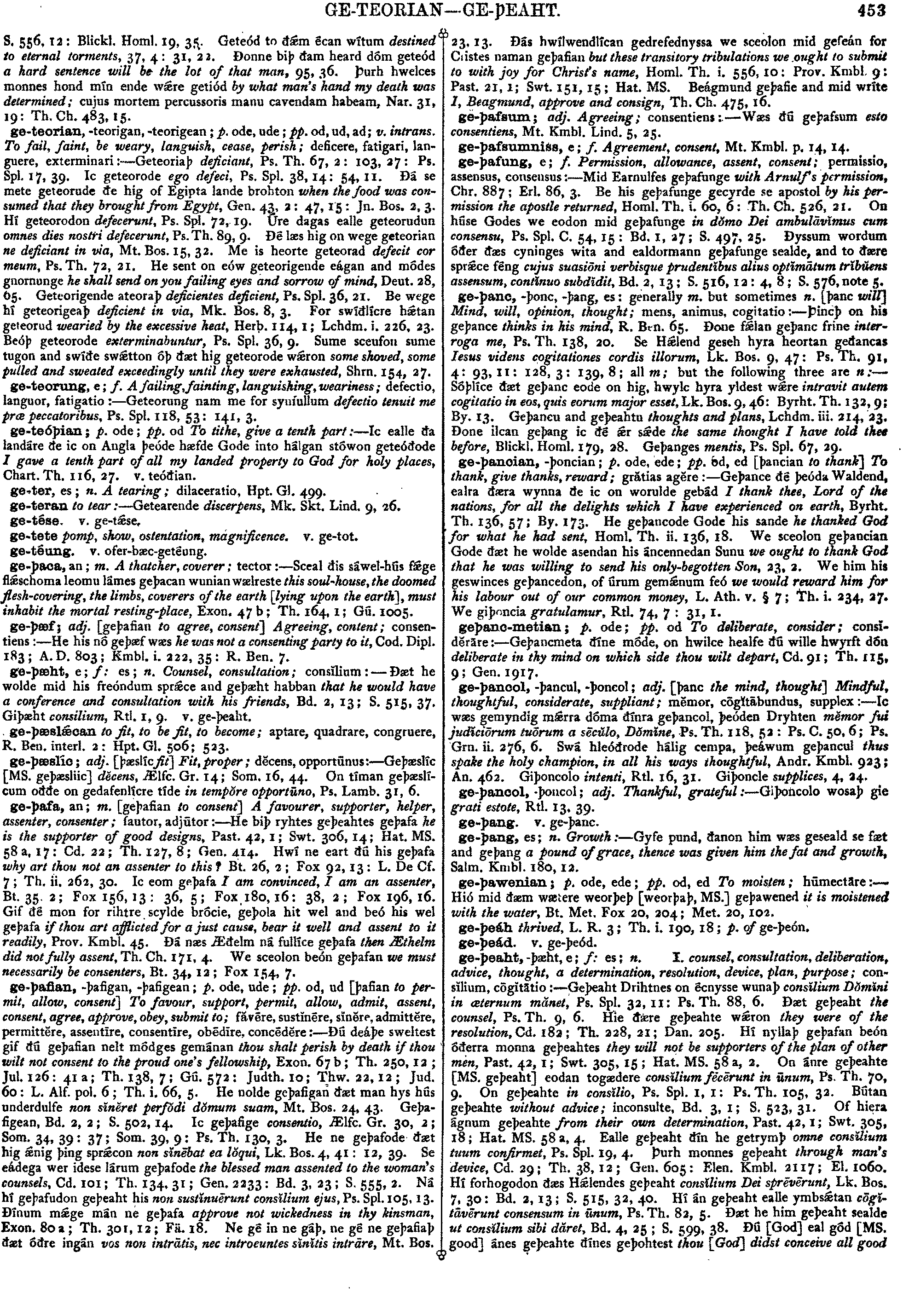
ge-teorian,
-teorigan,
-teorigean;
p.
ode,
ude;
pp.
od,
ud,
ad;
v.
intrans.
To
fail,
faint,
be
weary,
languish,
cease,
perish;
deficere,
fatigari,
languere,
exterminari
:--
Geteoriaþ
deficiant,
Ps.
Th.
67,
2:
103,
27:
Ps.
Spl.
17,
39.
Ic
geteorode
ego
defeci,
Ps.
Spl.
38,
14:
54,
11.
Ðá
se
mete
geteorude
ðe
hig
of
Egipta
lande
brohton
when
the
food
was
consumed
that
they
brought
from
Egypt,
Gen.
43,
2:
47,
15:
Jn.
Bos.
2,
3.
Hí
geteorodon
defecerunt,
Ps.
Spl.
72,
19.
Úre
dagas
ealle
geteorudun
omnes
dies
nostri
defecerunt,
Ps.
Th.
89,
9.
Ðé
læs
hig
on
wege
geteorian
ne
deficiant
in
via,
Mt.
Bos.
15,
32.
Me
is
heorte
geteorad
defecit
cor
meum,
Ps.
Th.
72,
21.
He
sent
on
eów
geteorigende
eágan
and
módes
gnornunge
he
shall
send
on
you
failing
eyes
and
sorrow
of
mind,
Deut.
28,
65.
Geteorigende
ateoraþ
deficientes
deficient,
Ps.
Spl.
36,
21.
Be
wege
hí
geteorigeaþ
deficient
in
via,
Mk.
Bos.
8,
3.
For
swíðlícre
htan
geteorud
wearied
by
the
excessive
heat,
Herb.
114,
1;
Lchdm.
i.
226,
23.
Beóþ
geteorode
exterminabuntur,
Ps.
Spl.
36,
9.
Sume
sceufon
sume
tugon
and
swíðe
swtton
óþ
ðæt
hig
geteorode
wron
some
shoved,
some
pulled
and
sweated
exceedingly
until
they
were
exhausted,
Shrn.
154,
27.
|
Source: Bosworth/Toller, page b0453, entry 15 View original page image as: [TIFF] [PNG] [View previous entry] [View next entry] |
[Comment on this entry] [View comments] |
The following entry has been hand-corrected once. |
ge-þafian,
-þafigan,
-þafigean;
p.
ode,
ude;
pp.
od,
ud
[þafian
to
permit,
allow,
consent]
To
favour,
support,
permit,
allow,
admit,
assent,
consent,
agree,
approve,
obey,
submit
to;
fvre,
sustnre,
snre,
admittre,
permittre,
assentre,
consentre,
obdre,
concdre
:--
Ðú
deáþe
sweltest
gif
ðú
geþafian
nelt
módges
gemánan
thou
shalt
perish
by
death
if
thou
wilt
not
consent
to
the
proud
one's
fellowship,
Exon.
67
b;
Th.
250,
12;
Jul.
126:
41
a;
Th.
138,
7;
Gú.
572:
Judth.
10;
Thw.
22,
12;
Jud.
60:
L.
Alf.
pol.
6;
Th.
i.
66,
5.
He
nolde
geþafigan
ðæt
man
hys
hús
underdulfe
non
snret
perfdi
dmum
suam,
Mt.
Bos.
24,
43.
Geþafigean,
Bd.
2,
2;
S.
502,
14.
Ic
geþafige
consentio,
Ælfc.
Gr.
30,
2;
Som.
34,
39:
37;
Som.
39,
9:
Ps.
Th.
130,
3.
He
ne
geþafode
ðæt
hig
nig
þing
sprcon
non
snbat
ea
lqui,
Lk.
Bos.
4,
41:
12,
39.
Se
eádega
wer
idese
lárum
geþafode
the
blessed
man
assented
to
the
woman's
counsels,
Cd.
101;
Th.
134,
31;
Gen.
2233:
Bd.
3,
23;
S.
555,
2.
Ná
hí
geþafudon
geþeaht
his
non
sustnurunt
conslium
ejus,
Ps.
Spl.
105,
13.
Ðínum
mge
mán
ne
geþafa
approve
not
wickedness
in
thy
kinsman,
Exon.
80
a;
Th.
301,
12;
Fä.
18.
Ne
gé
in
ne
gáþ,
ne
gé
ne
geþafiaþ
ðæt
óðre
ingán
vos
non
intrtis,
nec
introeuntes
sntis
intrre,
Mt.
Bos.
23,
13.
Ðás
hwílwendlícan
gedrefednyssa
we
sceolon
mid
gefeán
for
Cristes
naman
geþafian
but
these
transitory
tribulations
we
ought
to
submit
to
with
joy
for
Christ's
name,
Homl.
Th.
i.
556,
10:
Prov.
Kmbl.
9:
Past.
21,
1;
Swt.
151,
15;
Hat.
MS.
Beágmund
geþafie
and
mid
wríte
I,
Beagmund,
approve
and
consign,
Th.
Ch.
475,
16.
|
Source: Bosworth/Toller, page b0466, entry 7 View original page image as: [TIFF] [PNG] [View previous entry] [View next entry] |
[Comment on this entry] [View comments] |
The following entry has been hand-corrected once. |
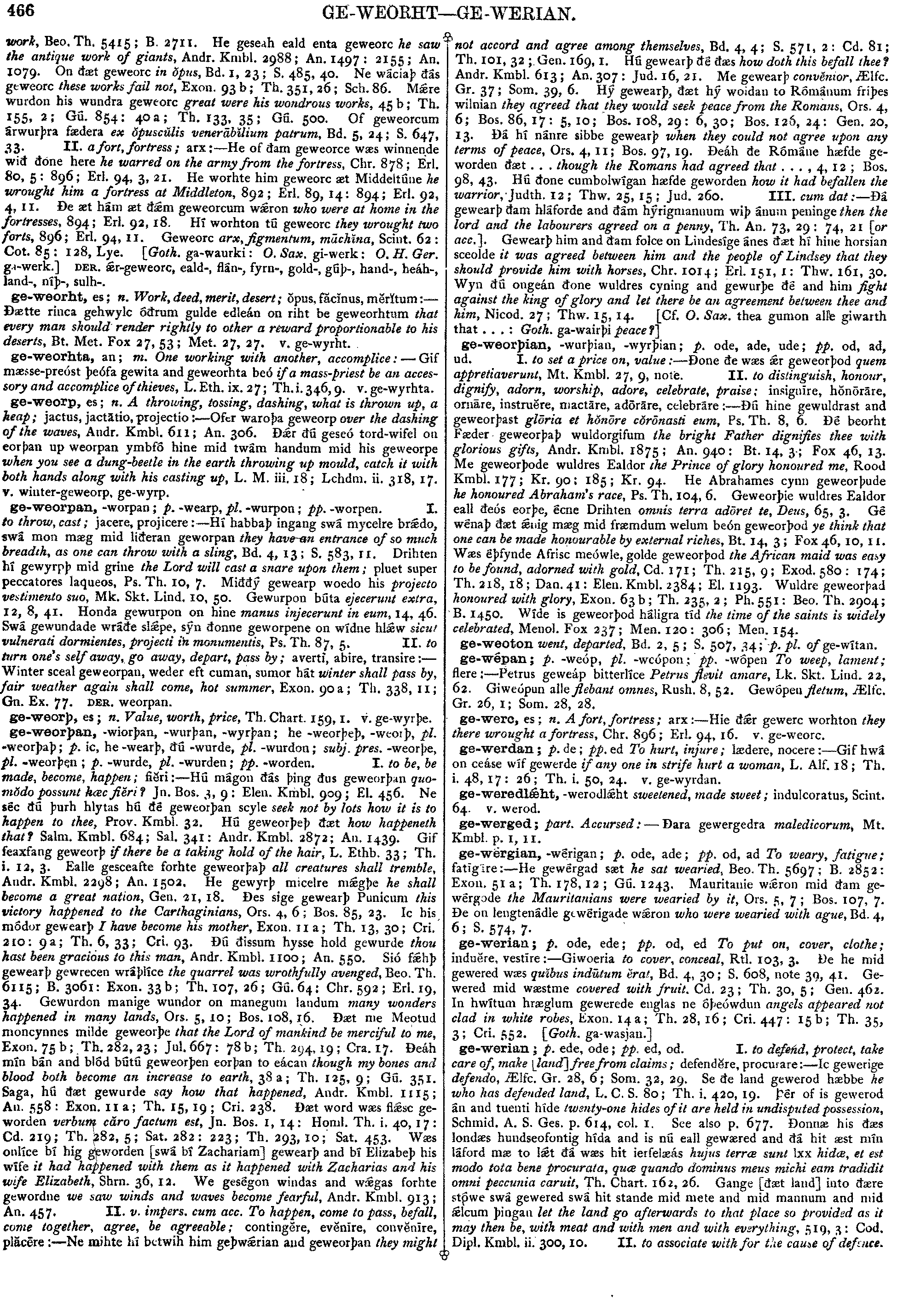
ge-weorþian,
-wurþian,
-wyrþian;
p.
ode,
ade,
ude;
pp.
od,
ad,
ud.
I.
to
set
a
price
on,
value
:--
Ðone
ðe
wæs
r
geweorþod
quem
appretiaverunt,
Mt.
Kmbl.
27,
9,
note.
II.
to
distinguish,
honour,
dignify,
adorn,
worship,
adore,
celebrate,
praise;
insignre,
hnrre,
ornre,
instrure,
mactre,
adrre,
celebrre
:--
Ðú
hine
gewuldrast
and
geweorþast
glria
et
hnre
crnasti
eum,
Ps.
Th.
8,
6.
Ðé
beorht
Fæder
geweorþaþ
wuldorgifum
the
bright
Father
dignifies
thee
with
glorious
gifts,
Andr.
Kmbl.
1875;
An.
940:
Bt.
14,
3;
Fox
46,
13.
Me
geweorþode
wuldres
Ealdor
the
Prince
of
glory
honoured
me,
Rood
Kmbl.
177;
Kr.
90;
185;
Kr.
94.
He
Abrahames
cynn
geweorþude
he
honoured
Abraham's
race,
Ps.
Th.
104,
6.
Geweorþie
wuldres
Ealdor
eall
ðeós
eorþe,
écne
Drihten
omnis
terra
adret
te,
Deus,
65,
3.
Gé
wénaþ
ðæt
nig
mæg
mid
fræmdum
welum
beón
geweorþod
ye
think
that
one
can
be
made
honourable
by
external
riches,
Bt.
14,
3;
Fox
46,
10,
11.
Wæs
éþfynde
Afrisc
meówle,
golde
geweorþod
the
African
maid
was
easy
to
be
found,
adorned
with
gold,
Cd.
171;
Th.
215,
9;
Exod.
580:
174;
Th.
218,
18;
Dan.
41:
Elen.
Kmbl.
2384;
El.
1193.
Wuldre
geweorþad
honoured
with
glory,
Exon.
63
b;
Th.
235,
2;
Ph.
551:
Beo.
Th.
2904;
B.
1450.
Wíde
is
geweorþod
háligra
tíd
the
time
of
the
saints
is
widely
celebrated,
Menol.
Fox
237;
Men.
120:
306;
Men.
154.
|
Source: Bosworth/Toller, page b0839, entry 1 View original page image as: [TIFF] [PNG] [View previous entry] [View next entry] |
[Comment on this entry] [View comments] |
The following entry has been hand-corrected once. |
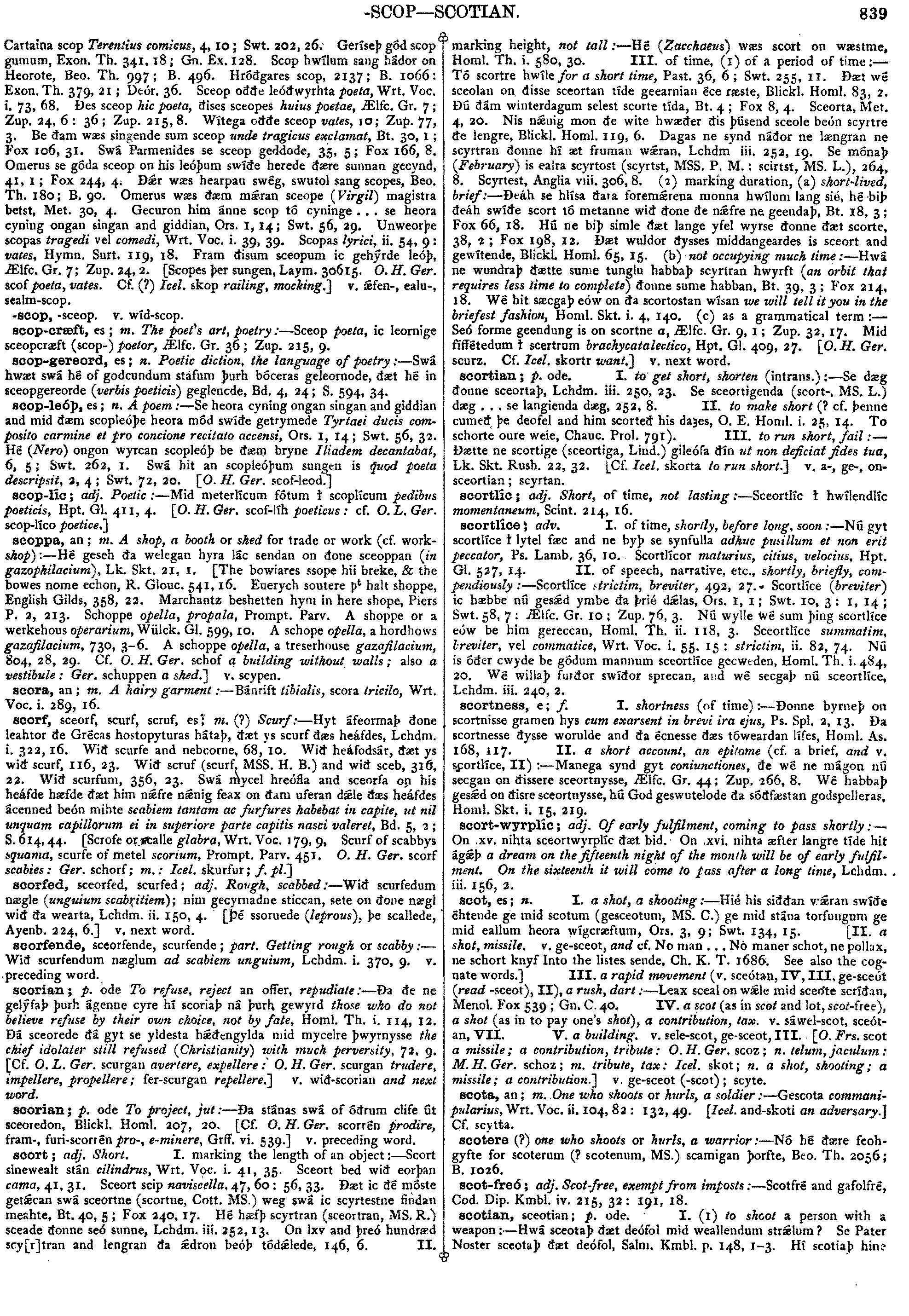
Cartaina
scop
Terentius
comicus,
4,
10
;
Swt.
202,
26.
Geríseþ
gód
scop
gumum.
Exon.
Th.
341,
18
;
Gn.
Ex.
128.
Scop
hwílum
sang
hádor
on
Heorote,
Beo.
Th.
997
;
B.
496.
Hróðgares
scop,
2137
;
B.
1066
:
Exon.
Th.
379,
21
;
Deór.
36.
Sceop
oððe
leóðwyrhta
poeta,
Wrt.
Voc.
I.
73,
68.
Ðes
sceop
hic
poeta,
ðises
sceopes
huius
poetae,
Ælfc.
Gr.
7
;
Zup.
24,
6
:
36
;
Zup.
215,
8.
Wítega
oððe
sceop
vates,
10
;
Zup.
77,
3.
Be
ðam
wæs
singende
sum
sceop
ude
tragicus
exclamat,
Bt.
30,
l
Fox
106,
31.
Swá
Parmenides
se
sceop
geddode,
35,
5
;
Fox
166,
8.
Omerus
se
góda
sceop
on
his
leóþum
swíðe
herede
ðære
sunnan
gecynd,
41,
1
;
Fox
244,
4.
Ðr
wæs
hearpan
swég,
swutol
sang
scopes,
Beo.
Th.
180
;
B.
90.
Omerus
wæs
ðæm
mran
sceope
(Virgil)
magistra
betst.
Met.
30,
4.
Gecuron
him
ánne
scop
tó
cyninge
...
se
heora
cyning
ongan
singan
and
giddian,
Ors.
1,
14
;
Swt.
56,
29.
Unweorþe
scopas
tragedi
vel
comedi,
Wrt.
Voc.
i.
39,
39.
Scopas
lyrici,
ii.
54,
9
:
vates.
Hymn.
Surt.
119,
18.
Fram
ðisum
sceopum
ic
gehýrde
leóþ,
Ælfc.
Gr.
7
;
Zup.
24,
2.
[Scopes
þer
sungen,
Laym.
30615.
O.
H.
Ger.
scof
poeta,
vates.
Cf.
(?)
Icel.
skop
railing,
mocking.]
v.
fen-,
ealu-,
sealm-scop.
|
Source: Cleasby/Vigfusson, page b0671, entry 16 View original page image as: [TIFF] [PNG] [View previous entry] [View next entry] |
[Comment on this entry] [View comments] |
The following entry has been hand-corrected once. |
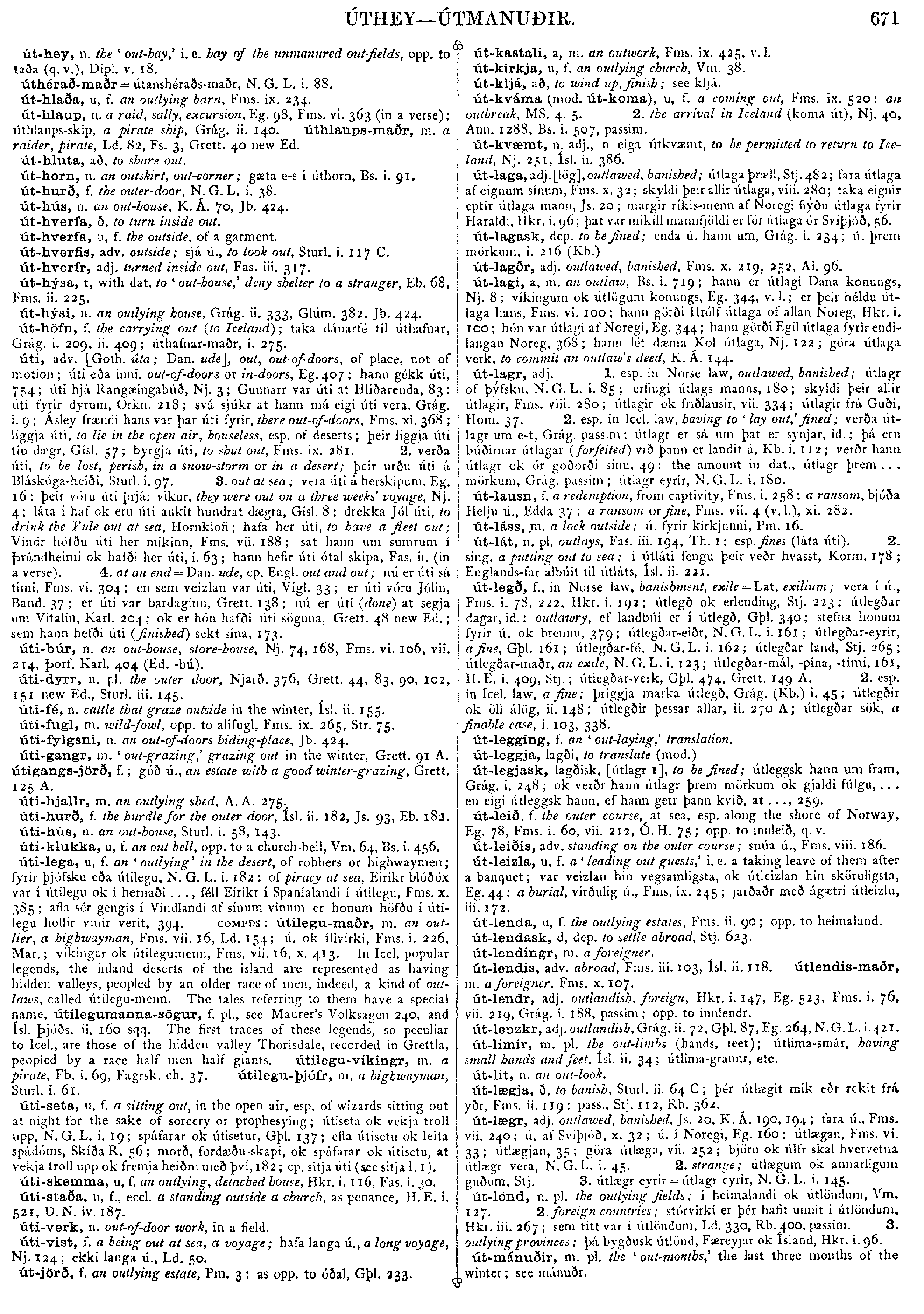
úti, adv. [Goth. ûta; Dan. ude], out, out-of-doors, of place, not of motion; úti eða inni, out-of-doors or in-doors, Eg. 407; hann gékk úti, 754; úti hjá Rangæingabúð, Nj. 3; Gunnarr var úti at Hlíðarenda, 83: úti fyrir dyrum, Orkn. 218; svá sjúkr at hann má eigi úti vera, Grág. i. 9; Ásley frændi hans var þar úti fyrir, there out-of-doors, Fms. xi. 368; liggja úti, to lie in the open air, houseless, esp. of deserts; þeir liggja úti tíu dægr, Gísl. 57; byrgja úti, to shut out, Fms. ix. 281. 2. verða úti, to be lost, perish, in a snow-storm or in a desert; þeir urðu úti á Bláskóga-heiði, Sturl. i. 97. 3. out at sea; vera úti á herskipum, Eg. 16: þeir vóru úti þrjár vikur, they were out on a three weeks' voyage, Nj. 4; láta í haf ok eru úti aukit hundrat dægra, Gísl. 8; drekka Jól úti, to drink the Yule out at sea, Hornklofi; hafa her úti, to have a fleet out; Vindr höfðu úti her mikinn, Fms. vii. 188; sat hann um sumrum í Þrándheimi ok hafði her úti, i. 63; hann hefir úti ótal skipa, Fas. ii. (in a verse). 4. at an end = Dan. ude, cp. Engl. out and out; nú er úti sá tími, Fms. vi. 304; en sem veizlan var úti, Vígl. 33; er úti vóru Jólin, Band. 37; er úti var bardaginn, Grett. 138; nú er úti (done) at segja um Vitalin, Karl. 204; ok er hón hafði úti söguna, Grett. 48 new Ed.; sem hann hefði úti (finished) sekt sína, 173.
| Result Page: |  |
Previous | 1 2 3 |
Germanic Lexicon Project (main page)
This search system was written by
Sean Crist
Please consider
volunteering
to correct the data in these online dictionaries.
No rights reserved. Feel free to use these data in any way you please.