|
|

|
Source: Bosworth/Toller, page b0966, entry 23 View original page image as: [TIFF] [PNG] [View previous entry] [View next entry] |
[Comment on this entry] [View comments] |
The following entry has been hand-corrected once. |
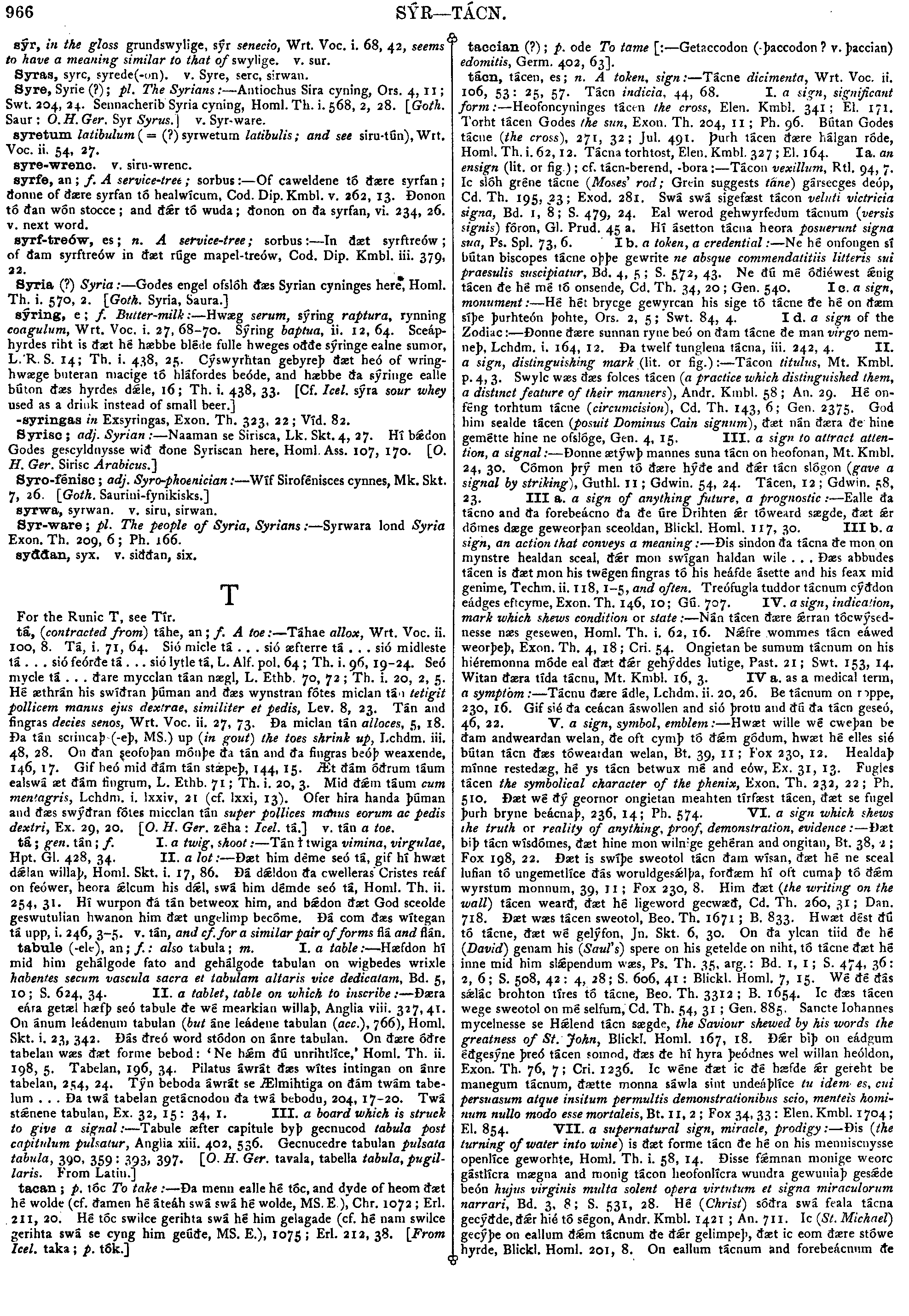
tácn,
tácen,
es;
n.
A
token,
sign
:--
Tácne
dicimenta,
Wrt.
Voc.
ii.
106,
53:
25,
57.
Tácn
indicia,
44,
68.
I.
a
sign,
significant
form
:--
Heofoncyninges
tácen
the
cross,
Elen.
Kmbl.
341;
El.
171.
Torht
tácen
Godes
the
sun,
Exon.
Th.
204,
11;
Ph.
96.
Bútan
Godes
tácne
(the
cross),
271,
32;
Jul.
491.
Þurh
tácen
ðære
hálgan
róde,
Homl.
Th.
i.
62,
12.
Tácna
torhtost,
Elen.
Kmbl.
327;
El.
164.
I
a.
an
ensign
(lit.
or
fig.);
cf.
tácn-berend,
-bora
:--
Tácon
vexillum,
Rtl.
94,
7.
Ic
slóh
gréne
tácne
(Moses'
rod;
Grein
suggests
táne)
gársecges
deóp,
Cd.
Th.
195,
23;
Exod.
281.
Swá
swá
sigefæst
tácon
veluti
victricia
signa,
Bd.
1,
8;
S.
479,
24.
Eal
werod
gehwyrfedum
tácnum
(versis
signis)
fóron,
Gl.
Prud.
45
a.
Hí
ásetton
tácna
heora
posuerunt
signa
sua,
Ps.
Spl.
73,
6.
I
b.
a
token,
a
credential
:--
Ne
hé
onfongen
si
bútan
biscopes
tácne
oþþe
gewrite
ne
absque
commendatitiis
litteris
sui
praesulis
suscipiatur,
Bd.
4,
5;
S.
572,
43.
Ne
ðú
mé
óðiéwest
 nig
tácen
ðe
hé
mé
tó
onsende,
Cd.
Th.
14,
20;
Gen.
540.
I
c.
a
sign,
monument
:--
Hé
hét
brycge
gewyrcan
his
sige
tó
tácne
ðe
he
on
ðæm
síþe
þurhteón
þohte,
Ors.
2,
5;
Swt.
84,
4.
I
d.
a
sign
of
the
Zodiac
:--
Ðonne
ðære
sunnan
ryne
beó
on
ðam
tácne
ðe
man
virgo
nemneþ,
Lchdm.
i.
164,
12.
Ða
twelf
tunglena
tácna,
iii.
242,
4.
II.
a
sign,
distinguishing
mark
(lit.
or
fig.)
:--
Tácon
titulus,
Mt.
Kmbl.
p.
4,
3.
Swylc
wæs
ðæs
folces
tácen
(a
practice
which
distinguished
them,
a
distinct
feature
of
their
manners),
Andr.
Kmbl.
58;
An.
29.
Hé
onféng
torhtum
tácne
(circumcision),
Cd.
Th.
143,
6;
Gen.
2375.
God
him
sealde
tácen
(posuit
Dominus
Cain
signum),
ðæt
nán
ðæra
ðe
hine
gemétte
hine
ne
ofslóge,
Gen.
4,
15.
III.
a
sign
to
attract
attention,
a
signal
:--
Ðonne
ætýwþ
mannes
suna
tácn
on
heofonan,
Mt.
Kmbl.
24,
30.
Cómon
þrý
men
tó
ðære
hýðe
and
ðær
tácn
slógon
(gave
a
signal
by
striking),
Guthl.
11;
Gdwin.
54,
24.
Tácen,
12;
Gdwin.
58,
23.
III
a.
a
sign
of
anything
future,
a
prognostic
:--
Ealle
ða
tácno
and
ða
forebeácno
ða
ðe
úre
Drihten
r
tóweard
sægde,
ðæt
r
dómes
dæge
geweorþan
sceoldan,
Blickl.
Homl.
117,
30.
III
b.
a
sign,
an
action
that
conveys
a
meaning
:--
Ðis
sindon
ða
tácna
ðe
mon
on
mynstre
healdan
sceal,
ðr
mon
swígan
haldan
wile
...
Ðæs
abbudes
tácen
is
ðæt
mon
his
twégen
fingras
tó
his
heáfde
ásette
and
his
feax
mid
genime,
Techm.
ii.
118,
1-5,
and
often.
Treófugla
tuddor
tácnum
cýðdon
eádges
eftcyme,
Exon.
Th.
146,
10;
Gú.
707.
IV.
a
sign,
indication,
mark
which
shews
condition
or
state
:--
Nán
tácen
ðære
rran
tócwýsednesse
næs
gesewen,
Homl.
Th.
i.
62,
16.
Nfre
wommes
tácn
eáwed
weorþeþ,
Exon.
Th.
4,
18;
Cri.
54.
Ongietan
be
sumum
tácnum
on
his
hiéremonna
móde
eal
ðæt
ðr
gehýddes
lutige,
Past.
21;
Swt.
153,
14.
Witan
ðæra
tída
tácnu,
Mt.
Kmbl.
16,
3.
IV
a.
as
a
medical
term,
a
symptom
:--
Tácna
ðære
ádle,
Lchdm.
ii.
20,
26.
Be
tácnum
on
roppe,
230,
16.
Gif
sié
ða
ceácan
áswollen
and
sió
þrotu
and
ðú
ða
tácn
geseó,
46,
22.
V.
a
sign,
symbol,
emblem
:--
Hwæt
wille
wé
cweþan
be
ðam
andweardan
welan,
ðe
oft
cymþ
tó
ðm
gódum,
hwæt
hé
elles
sié
bútan
tácn
ðæs
tóweardan
welan,
Bt.
39,
11;
Fox
230,
12.
Healdaþ
mínne
restedæg,
hé
ys
tácn
betwux
mé
and
eów,
Ex.
31,
13.
Fugles
tácen
the
symbolical
character
of
the
phenix,
Exon.
Th.
232,
22;
Ph.
510.
Ðæt
wé
ðý
geornor
ongietan
meahten
tírfæst
tácen,
ðæt
se
fugel
þurh
bryne
beácnaþ,
236,
14;
Ph.
574.
VI.
a
sign
which
shews
the
truth
or
reality
of
anything,
proof,
demonstration,
evidence
:--
Ðæt
biþ
tácn
wísdómes,
ðæt
hine
mon
wilnige
gehéran
and
ongitan,
Bt.
38,
2;
Fox
198,
22.
Ðæt
is
swíþe
sweotol
tácn
ðam
wísan,
ðæt
hé
ne
sceal
lufian
tó
ungemetlíce
ðás
woruldgeslþa,
forðæm
hí
oft
cumaþ
tó
ðm
wyrstum
monnum,
39,
11;
Fox
230,
8.
Him
ðæt
(the
writing
on
the
wall)
tácen
wearð,
ðæt
hé
ligeword
gecwæð,
Cd.
Th.
260,
31;
Dan.
718.
Ðæt
wæs
tácen
sweotol,
Beo.
Th.
1671;
B.
833.
Hwæt
dést
ðú
tó
tácne,
ðæt
wé
gelýfon,
Jn.
Skt.
6,
30.
On
ða
ylcan
tiid
ðe
hé
(David)
genam
his
(Saul's)
spere
on
his
getelde
on
niht,
tó
tácne
ðæt
hé
inne
mid
him
slpendum
wæs,
Ps.
Th.
35,
arg.:
Bd.
1,
1;
S.
474,
36:
2,
6;
S.
508,
42;
4,
28;
S.
606,
41:
Blickl.
Homl.
7,
15.
Wé
ðé
ðás
slíc
brohton
tíres
tó
tácne,
Beo.
Th.
3312;
B.
1654.
Ic
ðæs
tácen
wege
sweotol
on
mé
selfum;
Cd.
Th.
54,
31;
Gen.
885.
Sancte
Iohannes
mycelnesse
se
Hlend
tácn
sægde,
the
Saviour
shewed
by
his
words
the
greatness
of
St.
John,
Blickl.
Homl.
167,
18.
Ðr
biþ
on
eádgum
édgesýne
þreó
tácen
somod,
ðæs
ðe
hí
hyra
þeódnes
wel
willan
heóldon,
Exon.
Th.
76,
7;
Cri.
1236.
Ic
wéne
ðæt
ic
ðé
hæfde
r
gereht
be
manegum
tácnum,
ðætte
monna
sáwla
sint
undeáþlíce
tu
idem
es,
cui
persuasum
atque
insitum
permultis
demonstrationibus
scio,
menteis
hominum
nullo
modo
ease
mortaleis,
Bt.
11,
2;
Fox
34,
33:
Elen.
Kmbl.
1704;
El.
854.
VII.
a
supernatural
sign,
miracle,
prodigy
:--
Ðis
(the
turning
of
water
into
wine)
is
ðæt
forme
tácn
ðe
hé
on
his
menniscnysse
openlíce
geworhte,
Homl.
Th.
i.
58,
14.
Ðisse
fmnan
monige
weorc
gástlícra
mægna
and
monig
tácon
heofonlícra
wundra
gewuniaþ
gesde
beón
hujus
virginis
multa
solent
opera
virtutum
et
signa
miraculorum
narrari,
Bd.
3,
8;
S.
531,
28.
Hé
(Christ)
sóðra
swá
feala
tácna
gecýðde,
ðr
hié
tó
ségon,
Andr.
Kmbl.
1421;
An.
711.
Ic
(St.
Michael)
gecýþe
on
eallum
ðm
tácnum
ðe
ðr
gelimpeþ,
ðæt
ic
eom
ðære
stówe
hyrde,
Blickl.
Homl.
201,
8.
On
eallum
tácnum
and
forebeácnum
ðe
God
sende
þurh
hine,
Deut.
34,
11.
Gif
nig
wítega
secge
tácnu
and
forebeácnu,
13,
1.
Tácna,
Homl.
Th.
i.
44,
24.
Noldan
hí
ða
torhtan
tácen
oncnáwan
ðe
him
beforan
fremede
freóbearn
Godes,
Exon.
Th.
40,
22;
Cri.
642.
Gesiáþ
werc
Dryhtnes
ða
set[t]e
tácen
ofer
eórðan
videte
opera
Domini
quae
posuit
prodigia
super
terram,
Ps.
Surt.
45,
9.
VII
a.
a
signal
event,
remarkable
circumstance
:--
Andsware
cýðan
tácna
gehwylces
ðe
ic
him
tó
séce
to
give
me
an
answer
in
reference
to
every
remarkable
circumstance
about
which
I
enquire
of
them
(cf.
mé
þinga
gehwylc
gecýðan,
ðe
ic
him
tó
séce,
817;
El.
409),
Elen.
Kmbl.
637;
El.
319.
Wé
on
gemynd
witon
álra
tácna
gehwylc
swá
Tróiána
þurh
gefeoht
fremedon,
1286;
El.
645.
[Goth.
taikns;
f.:
O.
Sax.
tékan;
n.:
O.
Frs.
téken:
O.
H.
Ger.
zeihhan
signum,
signaculum,
nota,
titulus,
miraculum:
Icel.
teikn,
tákn
a
token,
sign,
wonder.]
v.
andgit-,
bell-,
fácen-,
fore-,
friðo-,
luf-,
sige-,
sigor-,
sóþ-,
weá-,
weder-,
wer-,
wundor-tácn.
nig
tácen
ðe
hé
mé
tó
onsende,
Cd.
Th.
14,
20;
Gen.
540.
I
c.
a
sign,
monument
:--
Hé
hét
brycge
gewyrcan
his
sige
tó
tácne
ðe
he
on
ðæm
síþe
þurhteón
þohte,
Ors.
2,
5;
Swt.
84,
4.
I
d.
a
sign
of
the
Zodiac
:--
Ðonne
ðære
sunnan
ryne
beó
on
ðam
tácne
ðe
man
virgo
nemneþ,
Lchdm.
i.
164,
12.
Ða
twelf
tunglena
tácna,
iii.
242,
4.
II.
a
sign,
distinguishing
mark
(lit.
or
fig.)
:--
Tácon
titulus,
Mt.
Kmbl.
p.
4,
3.
Swylc
wæs
ðæs
folces
tácen
(a
practice
which
distinguished
them,
a
distinct
feature
of
their
manners),
Andr.
Kmbl.
58;
An.
29.
Hé
onféng
torhtum
tácne
(circumcision),
Cd.
Th.
143,
6;
Gen.
2375.
God
him
sealde
tácen
(posuit
Dominus
Cain
signum),
ðæt
nán
ðæra
ðe
hine
gemétte
hine
ne
ofslóge,
Gen.
4,
15.
III.
a
sign
to
attract
attention,
a
signal
:--
Ðonne
ætýwþ
mannes
suna
tácn
on
heofonan,
Mt.
Kmbl.
24,
30.
Cómon
þrý
men
tó
ðære
hýðe
and
ðær
tácn
slógon
(gave
a
signal
by
striking),
Guthl.
11;
Gdwin.
54,
24.
Tácen,
12;
Gdwin.
58,
23.
III
a.
a
sign
of
anything
future,
a
prognostic
:--
Ealle
ða
tácno
and
ða
forebeácno
ða
ðe
úre
Drihten
r
tóweard
sægde,
ðæt
r
dómes
dæge
geweorþan
sceoldan,
Blickl.
Homl.
117,
30.
III
b.
a
sign,
an
action
that
conveys
a
meaning
:--
Ðis
sindon
ða
tácna
ðe
mon
on
mynstre
healdan
sceal,
ðr
mon
swígan
haldan
wile
...
Ðæs
abbudes
tácen
is
ðæt
mon
his
twégen
fingras
tó
his
heáfde
ásette
and
his
feax
mid
genime,
Techm.
ii.
118,
1-5,
and
often.
Treófugla
tuddor
tácnum
cýðdon
eádges
eftcyme,
Exon.
Th.
146,
10;
Gú.
707.
IV.
a
sign,
indication,
mark
which
shews
condition
or
state
:--
Nán
tácen
ðære
rran
tócwýsednesse
næs
gesewen,
Homl.
Th.
i.
62,
16.
Nfre
wommes
tácn
eáwed
weorþeþ,
Exon.
Th.
4,
18;
Cri.
54.
Ongietan
be
sumum
tácnum
on
his
hiéremonna
móde
eal
ðæt
ðr
gehýddes
lutige,
Past.
21;
Swt.
153,
14.
Witan
ðæra
tída
tácnu,
Mt.
Kmbl.
16,
3.
IV
a.
as
a
medical
term,
a
symptom
:--
Tácna
ðære
ádle,
Lchdm.
ii.
20,
26.
Be
tácnum
on
roppe,
230,
16.
Gif
sié
ða
ceácan
áswollen
and
sió
þrotu
and
ðú
ða
tácn
geseó,
46,
22.
V.
a
sign,
symbol,
emblem
:--
Hwæt
wille
wé
cweþan
be
ðam
andweardan
welan,
ðe
oft
cymþ
tó
ðm
gódum,
hwæt
hé
elles
sié
bútan
tácn
ðæs
tóweardan
welan,
Bt.
39,
11;
Fox
230,
12.
Healdaþ
mínne
restedæg,
hé
ys
tácn
betwux
mé
and
eów,
Ex.
31,
13.
Fugles
tácen
the
symbolical
character
of
the
phenix,
Exon.
Th.
232,
22;
Ph.
510.
Ðæt
wé
ðý
geornor
ongietan
meahten
tírfæst
tácen,
ðæt
se
fugel
þurh
bryne
beácnaþ,
236,
14;
Ph.
574.
VI.
a
sign
which
shews
the
truth
or
reality
of
anything,
proof,
demonstration,
evidence
:--
Ðæt
biþ
tácn
wísdómes,
ðæt
hine
mon
wilnige
gehéran
and
ongitan,
Bt.
38,
2;
Fox
198,
22.
Ðæt
is
swíþe
sweotol
tácn
ðam
wísan,
ðæt
hé
ne
sceal
lufian
tó
ungemetlíce
ðás
woruldgeslþa,
forðæm
hí
oft
cumaþ
tó
ðm
wyrstum
monnum,
39,
11;
Fox
230,
8.
Him
ðæt
(the
writing
on
the
wall)
tácen
wearð,
ðæt
hé
ligeword
gecwæð,
Cd.
Th.
260,
31;
Dan.
718.
Ðæt
wæs
tácen
sweotol,
Beo.
Th.
1671;
B.
833.
Hwæt
dést
ðú
tó
tácne,
ðæt
wé
gelýfon,
Jn.
Skt.
6,
30.
On
ða
ylcan
tiid
ðe
hé
(David)
genam
his
(Saul's)
spere
on
his
getelde
on
niht,
tó
tácne
ðæt
hé
inne
mid
him
slpendum
wæs,
Ps.
Th.
35,
arg.:
Bd.
1,
1;
S.
474,
36:
2,
6;
S.
508,
42;
4,
28;
S.
606,
41:
Blickl.
Homl.
7,
15.
Wé
ðé
ðás
slíc
brohton
tíres
tó
tácne,
Beo.
Th.
3312;
B.
1654.
Ic
ðæs
tácen
wege
sweotol
on
mé
selfum;
Cd.
Th.
54,
31;
Gen.
885.
Sancte
Iohannes
mycelnesse
se
Hlend
tácn
sægde,
the
Saviour
shewed
by
his
words
the
greatness
of
St.
John,
Blickl.
Homl.
167,
18.
Ðr
biþ
on
eádgum
édgesýne
þreó
tácen
somod,
ðæs
ðe
hí
hyra
þeódnes
wel
willan
heóldon,
Exon.
Th.
76,
7;
Cri.
1236.
Ic
wéne
ðæt
ic
ðé
hæfde
r
gereht
be
manegum
tácnum,
ðætte
monna
sáwla
sint
undeáþlíce
tu
idem
es,
cui
persuasum
atque
insitum
permultis
demonstrationibus
scio,
menteis
hominum
nullo
modo
ease
mortaleis,
Bt.
11,
2;
Fox
34,
33:
Elen.
Kmbl.
1704;
El.
854.
VII.
a
supernatural
sign,
miracle,
prodigy
:--
Ðis
(the
turning
of
water
into
wine)
is
ðæt
forme
tácn
ðe
hé
on
his
menniscnysse
openlíce
geworhte,
Homl.
Th.
i.
58,
14.
Ðisse
fmnan
monige
weorc
gástlícra
mægna
and
monig
tácon
heofonlícra
wundra
gewuniaþ
gesde
beón
hujus
virginis
multa
solent
opera
virtutum
et
signa
miraculorum
narrari,
Bd.
3,
8;
S.
531,
28.
Hé
(Christ)
sóðra
swá
feala
tácna
gecýðde,
ðr
hié
tó
ségon,
Andr.
Kmbl.
1421;
An.
711.
Ic
(St.
Michael)
gecýþe
on
eallum
ðm
tácnum
ðe
ðr
gelimpeþ,
ðæt
ic
eom
ðære
stówe
hyrde,
Blickl.
Homl.
201,
8.
On
eallum
tácnum
and
forebeácnum
ðe
God
sende
þurh
hine,
Deut.
34,
11.
Gif
nig
wítega
secge
tácnu
and
forebeácnu,
13,
1.
Tácna,
Homl.
Th.
i.
44,
24.
Noldan
hí
ða
torhtan
tácen
oncnáwan
ðe
him
beforan
fremede
freóbearn
Godes,
Exon.
Th.
40,
22;
Cri.
642.
Gesiáþ
werc
Dryhtnes
ða
set[t]e
tácen
ofer
eórðan
videte
opera
Domini
quae
posuit
prodigia
super
terram,
Ps.
Surt.
45,
9.
VII
a.
a
signal
event,
remarkable
circumstance
:--
Andsware
cýðan
tácna
gehwylces
ðe
ic
him
tó
séce
to
give
me
an
answer
in
reference
to
every
remarkable
circumstance
about
which
I
enquire
of
them
(cf.
mé
þinga
gehwylc
gecýðan,
ðe
ic
him
tó
séce,
817;
El.
409),
Elen.
Kmbl.
637;
El.
319.
Wé
on
gemynd
witon
álra
tácna
gehwylc
swá
Tróiána
þurh
gefeoht
fremedon,
1286;
El.
645.
[Goth.
taikns;
f.:
O.
Sax.
tékan;
n.:
O.
Frs.
téken:
O.
H.
Ger.
zeihhan
signum,
signaculum,
nota,
titulus,
miraculum:
Icel.
teikn,
tákn
a
token,
sign,
wonder.]
v.
andgit-,
bell-,
fácen-,
fore-,
friðo-,
luf-,
sige-,
sigor-,
sóþ-,
weá-,
weder-,
wer-,
wundor-tácn.
|
Source: Bosworth/Toller, page b1021, entry 13 View original page image as: [TIFF] [PNG] [View previous entry] [View next entry] |
[Comment on this entry] [View comments] |
The following entry has been hand-corrected once. |
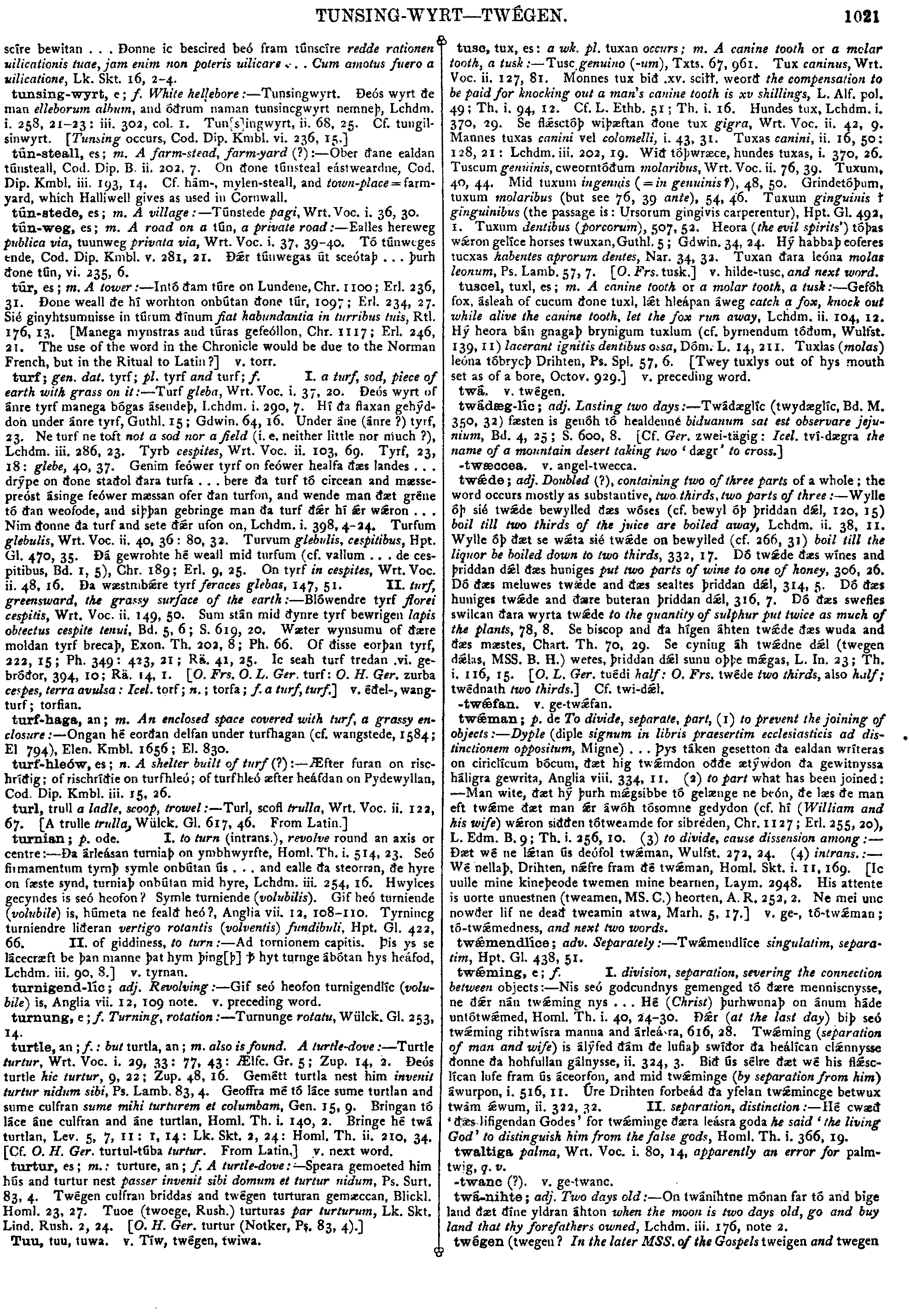
turnung, e; f. Turning, rotation:--Turnunge rotatu, Wülck. Gl. 253, 14.
|
Source: Bosworth/Toller, page b1030, entry 2 View original page image as: [TIFF] [PNG] [View previous entry] [View next entry] |
[Comment on this entry] [View comments] |
The following entry has been hand-corrected once. |
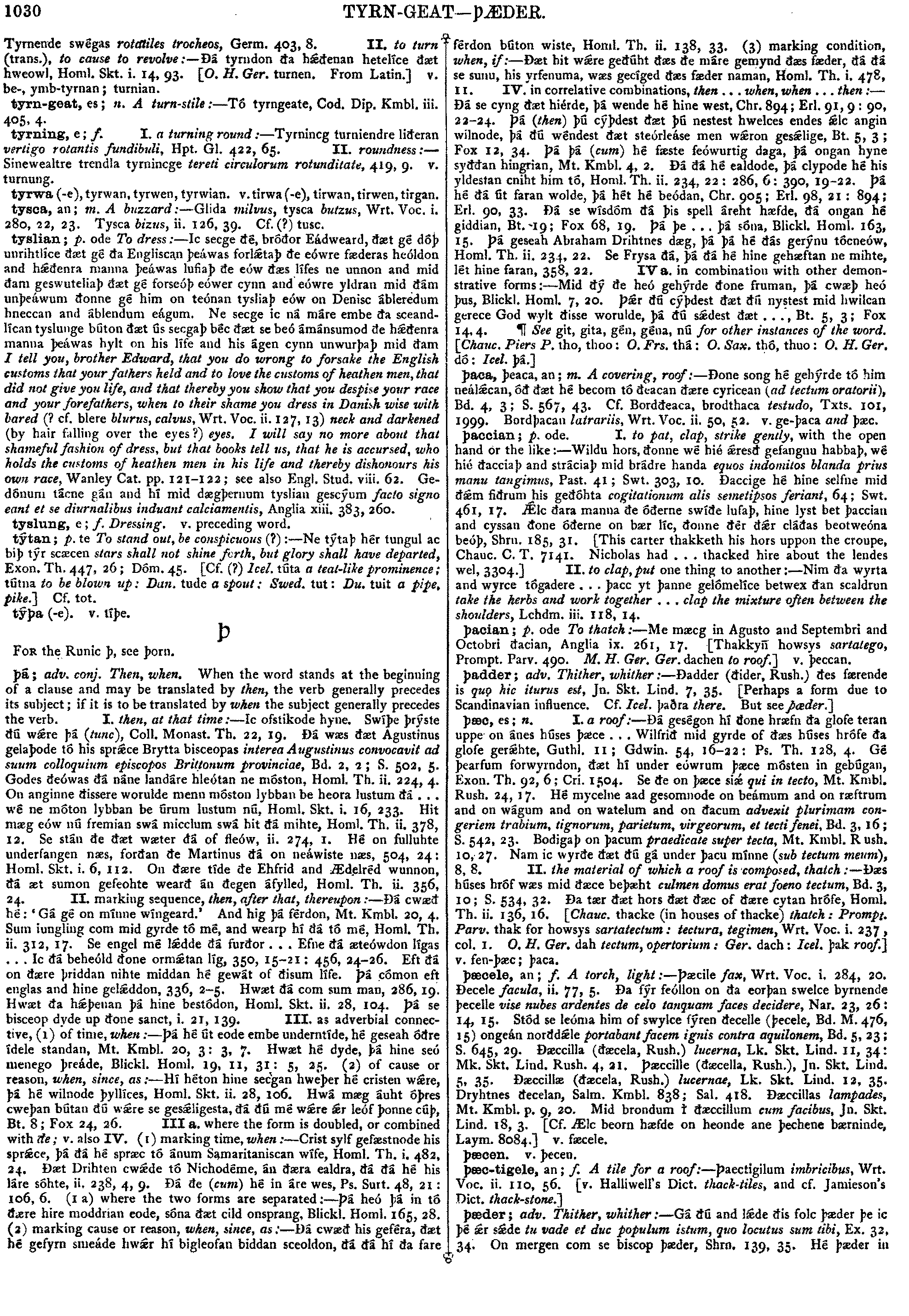
tyrning, e; f. I. a turning round :-- Tyrnincg turniendre liðeran vertigo rotantis fundibuli, Hpt. Gl. 422, 65. II. roundness :-- Sinewealtre trendla tyrnincge tereti circulorum rotunditate, 419, 9. v. turnung.
|
Source: Bosworth/Toller, page b1103, entry 22 View original page image as: [TIFF] [PNG] [View previous entry] [View next entry] |
[Comment on this entry] [View comments] |
The following entry has been hand-corrected once. |
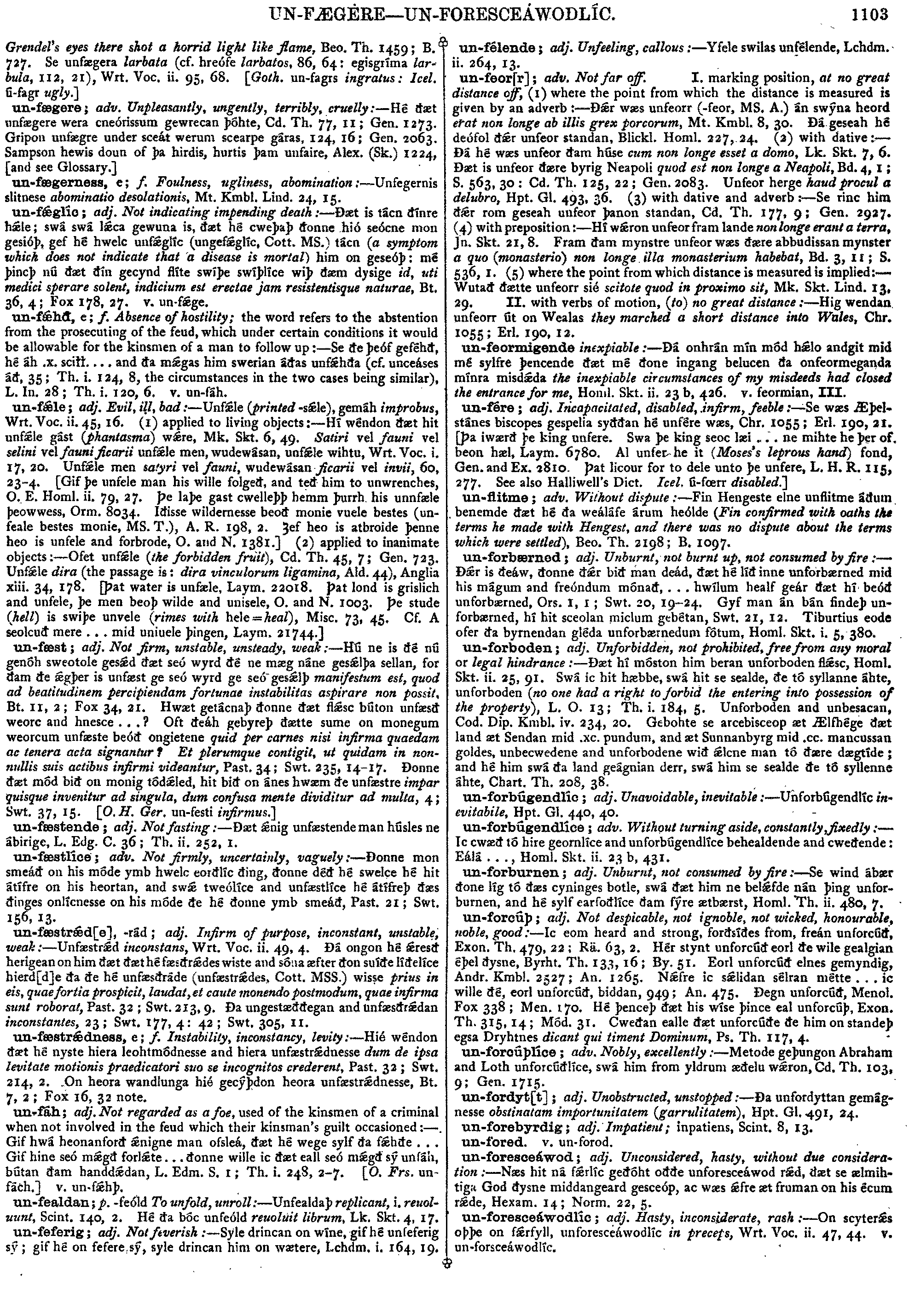
un-forbúgendlíce; adv. Without turning aside, constantly, fixedly :-- Ic cwæð tó hire geornlíce and unforbúgendlíce behealdende and cweðende: Eálá..., Homl. Skt. ii. 23 b, 431.
|
Source: Bosworth/Toller, page b1165, entry 9 View original page image as: [TIFF] [PNG] [View previous entry] [View next entry] |
[Comment on this entry] [View comments] |
The following entry has been hand-corrected once. |
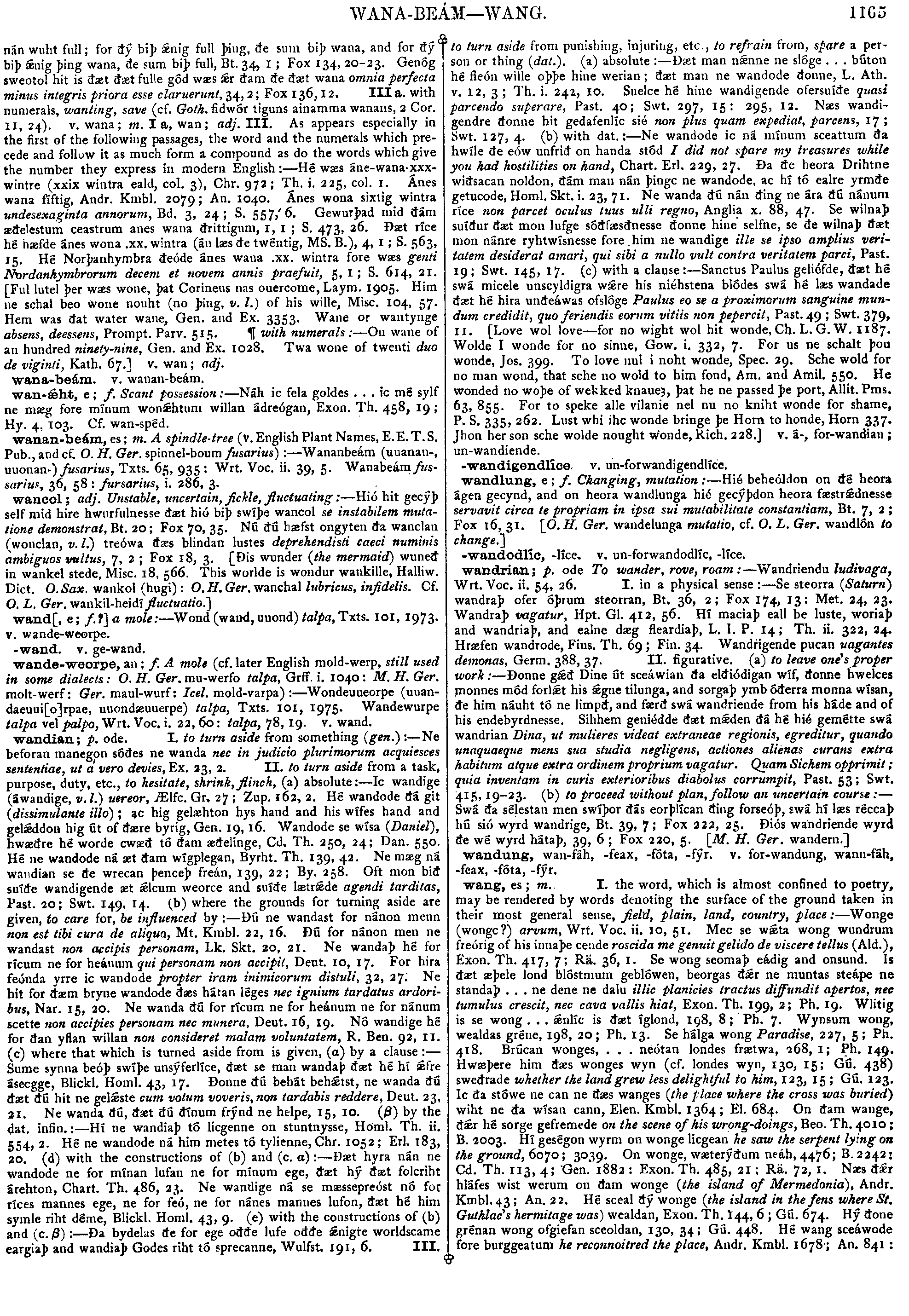
wandian;
p.ode.
I.
to
turn
aside
from
something
(gen.)
:--
Ne
beforan
manegon
sóðes
ne
wanda
nec
in
judicio
plurimorum
acquiesces
sententiae,
ut
a
vero
devies,
Ex.
23,
2.
II.
to
turn
aside
from
a
task,
purpose,
duty,
etc.,
to
hesitate,
shrink,
flinch,
(a)
absolute
:--
Ic
wandige
(áwandige,
v.
l.)
uereor,
Ælfc.
Gr.
27
;
Zup.
162,
2.
Hé
wandode
ðá
git
(dissimulante
illo);
ac
nig
gelæhton
hys
hand
and
his
wífes
hand
and
gelddon
hig
út
of
ðære
byrig,
Gen.
19,
16.
Wandode
se
wísa
(Daniel),
hwæðre
hé
worde
cwæð
tó
ðam
æðelinge,
Cd.
Th.
250,
24;
Dan.
550.
Hé
ne
wandode
ná
æt
ðam
wígplegan,
Byrht.
Th.
139,
42.
Ne
mæg
ná
wandian
se
ðe
wrecan
þenceþ
freán,
139,
22;
By.
258.
Oft
mon
bið
suíðe
wandigende
æt
lcum
weorce
and
suíðe
lætrde
agendi
tarditas,
Past.
20;
Swt.
149,
14.
(b)
where
the
grounds
for
turning
aside
are
given,
to
care
for,
be
influenced
by
:--
Ðú
ne
wandast
for
nánon
menn
non
est
tibi
cura
de
aliquo,
Mt.
Kmbl.
22,
16.
Ðú
for
nánon
men
ne
wandast
non
accipis
personam,
Lk.
Skt.
20,
21.
Ne
wandaþ
hé
for
rícum
ne
for
heánum
qui
personam
non
accipit,
Deut.
10,
17.
For
hira
feónda
yrre
ic
wandode
propter
iram
inimicorum
distuli,
32,
27.
Ne
hit
for
ðæm
bryne
wandode
ðæs
hátan
léges
nec
ignium
tardatus
ardori bus,
Nar.
15,
20.
Ne
wanda
ðú
for
rícum
ne
for
heánum
ne
for
nánum
scette
non
accipies
personam
nec
munera,
Deut.
16,
19.
Nó
wandige
hé
for
ðan
yflan
willan
non
consideret
malam
voluntatem,
R.
Ben.
92,
11(c)
where
that
which
is
turned
aside
from
is
given,
(
bus,
Nar.
15,
20.
Ne
wanda
ðú
for
rícum
ne
for
heánum
ne
for
nánum
scette
non
accipies
personam
nec
munera,
Deut.
16,
19.
Nó
wandige
hé
for
ðan
yflan
willan
non
consideret
malam
voluntatem,
R.
Ben.
92,
11(c)
where
that
which
is
turned
aside
from
is
given,
( )
by
a
clause
:--
Sume
synna
beóþ
swíþe
unsýferlíce,
ðæt
se
man
wandaþ
ðæt
hé
hí
fre
ásecgge,
Blickl.
Homl.
43,
17.
Ðonne
ðú
behát
behtst,
ne
wanda
ðú
ðæt
ðú
hit
ne
gelste
cum
votum
voveris,
non
tardabis
reddere,
Deut.
23,
21.
Ne
wanda
ðú,
ðæt
ðú
ðínum
frýnd
ne
helpe,
15,
10.
(
)
by
a
clause
:--
Sume
synna
beóþ
swíþe
unsýferlíce,
ðæt
se
man
wandaþ
ðæt
hé
hí
fre
ásecgge,
Blickl.
Homl.
43,
17.
Ðonne
ðú
behát
behtst,
ne
wanda
ðú
ðæt
ðú
hit
ne
gelste
cum
votum
voveris,
non
tardabis
reddere,
Deut.
23,
21.
Ne
wanda
ðú,
ðæt
ðú
ðínum
frýnd
ne
helpe,
15,
10.
( )
by
the
dat.
infin.
:--
Hí
ne
wandiaþ
tó
licgenne
on
stuntnysse,
Homl.
Th.
ii.
554,
2.
Hé
ne
wandode
ná
him
metes
tó
tylienne,
Chr.
1052;
Erl.
183,
20.
(d)
with
the
constructions
of
(b)
and
(c.)
:--
Ðæt
hyra
nán
ne
wandode
ne
for
mínan
lufan
ne
for
mínum
ege,
ðæt
hý
ðæt
folcriht
árehton,
Chart.
Th.
486,
23.
Ne
wandige
ná
se
mæssepreóst
nó
for
ríces
mannes
ege,
ne
for
feó,
ne
for
nánes
mannes
lufon,
ðæt
hé
him
symle
riht
déme,
Blickl.
Homl.
43,
9.
(e)
with
the
constructions
of
(b)
and
(c.)
:--
Da
bydelas
ðe
for
ege
oððe
lufe
oððe
nigre
worldscame
eargiaþ
and
wandiaþ
Godes
riht
tó
sprecanne,
Wulfst.
191,
6.
III.
to
turn
aside
from
punishing,
injuring,
etc.,
to
refrain
from,
spare
a
per-son
or
thing
(dat.).
(a)
absolute
:--
Ðæt
man
nnne
ne
slóge
.
.
.
búton
hé
fleón
wille
oþþe
hine
werian;
ðæt
man
ne
wandode
ðonne,
L.
Ath.
v.
12,
3
;
Th.
i.
242,
10.
Suelce
hé
hine
wandigende
ofersuíðe
quasi
parcendo
superare,
Past.
40;
Swt.
297,
15:
295,
12.
Næs
wandigendre
ðonne
hit
gedafenlíc
sié
non
plus
quam
expediat,
parcens,
17
;
Swt.
127,
4.
(b)
with
dat.
:--
Ne
wandode
ic
ná
mínum
sceattum
ða
hwíle
ðe
eów
unfrið
on
handa
stód
I
did
not
spore
my
treasures
while
you
had
hostilities
on
hand,
Chart.
Erl.
229,
27.
Ða
ðe
heora
Drihtne
wiðsacan
noldon,
ðám
man
nán
þingc
ne
wandode,
ac
hí
tó
ealre
yrmðe
getucode,
Homl.
Skt.
i.
23,
71.
Ne
wanda
ðú
nán
ðing
ne
ára
ðú
nánum
ríce
non
parcet
oculus
tuus
ulli
regno,
Anglia
x.
88,
47.
Se
wilnaþ
suíður
ðæt
mon
lufge
sóðfæsðnesse
ðonne
hine
selfne,
se
ðe
wilnaþ
ðæt
mon
nánre
ryhtwísnesse
fore
him
ne
wandige
ille
se
ipso
amplius
veritatem
desiderat
amari,
qui
sibi
a
nullo
vult
contra
veritatem
parci,
Past.
19;
Swt.
145,
17.
(c)
with
a
clause
:--
Sanctus
Paulus
geliéfde,
ðæt
hé
swá
micele
unscyldigra
wre
his
niéhstena
blódes
swá
hé
læs
wandade
ðæt
hé
hira
unðeáwas
ofslóge
Paulus
eo
se
a
proximorum
sanguine
mundum
credidit,
quo
feriendis
eorum
vitiis
non
pepercit,
Past.
49
;
Swt.
379,
11.
[Love
wol
love
--
for
no
wight
wol
hit
wonde,
Ch.
L.
G.
W.
1187.
Wolde
I
wonde
for
no
sinne,
Gow.
i.
332,
7.
For
us
ne
schalt
þou
wonde,
Jos.
399.
To
love
nul
i
noht
wonde,
Spec.
29.
Sche
wold
for
no
man
wond,
that
sche
no
wold
to
him
fond,
Am.
and
Amil.
550.
He
wonded
no
woþe
of
wekked
knaue
)
by
the
dat.
infin.
:--
Hí
ne
wandiaþ
tó
licgenne
on
stuntnysse,
Homl.
Th.
ii.
554,
2.
Hé
ne
wandode
ná
him
metes
tó
tylienne,
Chr.
1052;
Erl.
183,
20.
(d)
with
the
constructions
of
(b)
and
(c.)
:--
Ðæt
hyra
nán
ne
wandode
ne
for
mínan
lufan
ne
for
mínum
ege,
ðæt
hý
ðæt
folcriht
árehton,
Chart.
Th.
486,
23.
Ne
wandige
ná
se
mæssepreóst
nó
for
ríces
mannes
ege,
ne
for
feó,
ne
for
nánes
mannes
lufon,
ðæt
hé
him
symle
riht
déme,
Blickl.
Homl.
43,
9.
(e)
with
the
constructions
of
(b)
and
(c.)
:--
Da
bydelas
ðe
for
ege
oððe
lufe
oððe
nigre
worldscame
eargiaþ
and
wandiaþ
Godes
riht
tó
sprecanne,
Wulfst.
191,
6.
III.
to
turn
aside
from
punishing,
injuring,
etc.,
to
refrain
from,
spare
a
per-son
or
thing
(dat.).
(a)
absolute
:--
Ðæt
man
nnne
ne
slóge
.
.
.
búton
hé
fleón
wille
oþþe
hine
werian;
ðæt
man
ne
wandode
ðonne,
L.
Ath.
v.
12,
3
;
Th.
i.
242,
10.
Suelce
hé
hine
wandigende
ofersuíðe
quasi
parcendo
superare,
Past.
40;
Swt.
297,
15:
295,
12.
Næs
wandigendre
ðonne
hit
gedafenlíc
sié
non
plus
quam
expediat,
parcens,
17
;
Swt.
127,
4.
(b)
with
dat.
:--
Ne
wandode
ic
ná
mínum
sceattum
ða
hwíle
ðe
eów
unfrið
on
handa
stód
I
did
not
spore
my
treasures
while
you
had
hostilities
on
hand,
Chart.
Erl.
229,
27.
Ða
ðe
heora
Drihtne
wiðsacan
noldon,
ðám
man
nán
þingc
ne
wandode,
ac
hí
tó
ealre
yrmðe
getucode,
Homl.
Skt.
i.
23,
71.
Ne
wanda
ðú
nán
ðing
ne
ára
ðú
nánum
ríce
non
parcet
oculus
tuus
ulli
regno,
Anglia
x.
88,
47.
Se
wilnaþ
suíður
ðæt
mon
lufge
sóðfæsðnesse
ðonne
hine
selfne,
se
ðe
wilnaþ
ðæt
mon
nánre
ryhtwísnesse
fore
him
ne
wandige
ille
se
ipso
amplius
veritatem
desiderat
amari,
qui
sibi
a
nullo
vult
contra
veritatem
parci,
Past.
19;
Swt.
145,
17.
(c)
with
a
clause
:--
Sanctus
Paulus
geliéfde,
ðæt
hé
swá
micele
unscyldigra
wre
his
niéhstena
blódes
swá
hé
læs
wandade
ðæt
hé
hira
unðeáwas
ofslóge
Paulus
eo
se
a
proximorum
sanguine
mundum
credidit,
quo
feriendis
eorum
vitiis
non
pepercit,
Past.
49
;
Swt.
379,
11.
[Love
wol
love
--
for
no
wight
wol
hit
wonde,
Ch.
L.
G.
W.
1187.
Wolde
I
wonde
for
no
sinne,
Gow.
i.
332,
7.
For
us
ne
schalt
þou
wonde,
Jos.
399.
To
love
nul
i
noht
wonde,
Spec.
29.
Sche
wold
for
no
man
wond,
that
sche
no
wold
to
him
fond,
Am.
and
Amil.
550.
He
wonded
no
woþe
of
wekked
knaue ,
þat
he
ne
passed
be
port,
Allit.
Pms.
63.
855.
For
to
speke
alle
vilanie
nel
nu
no
kniht
wonde
for
shame,
P.
S.
335,
262.
Lust
whi
ihc
wonde
bringe
þe
Horn
to
honde,
Horn
337.
Jhon
her
son
sche
wolde
nought
wonde,
Rich.
228.]
v.
á-,
for-wandian
;
un-wandiende.
,
þat
he
ne
passed
be
port,
Allit.
Pms.
63.
855.
For
to
speke
alle
vilanie
nel
nu
no
kniht
wonde
for
shame,
P.
S.
335,
262.
Lust
whi
ihc
wonde
bringe
þe
Horn
to
honde,
Horn
337.
Jhon
her
son
sche
wolde
nought
wonde,
Rich.
228.]
v.
á-,
for-wandian
;
un-wandiende.
|
Source: Bosworth/Toller, page b1189, entry 11 View original page image as: [TIFF] [PNG] [View previous entry] [View next entry] |
[Comment on this entry] [View comments] |
The following entry has been hand-corrected once. |
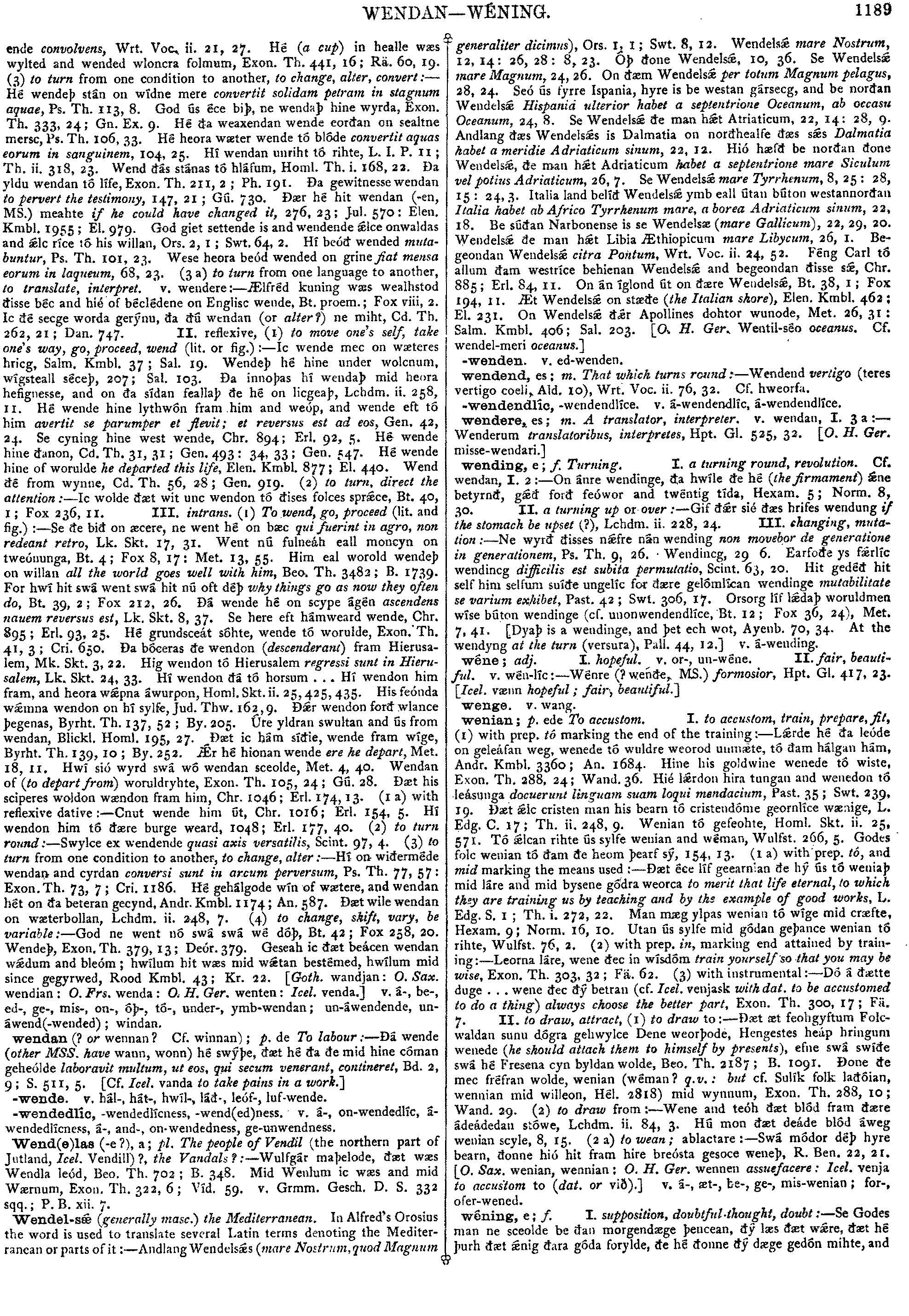
wending,
e;
f
Turning.
I.
a
turning
round,
revolution.
Cf.
wendan,
I.
2:--On
ánre
wendinge,
ða
hwíle
ðe
hé
(the
firmament)
ne
betyrnð,
gð
forð
feówor
and
twéntig
tída,
Hexam.
5;
Norm.
8,
30.
II.
a
turning
up
or
over:--Gif
ðr
sié
ðæs
hrifes
wendung
if
the
stomach
be
upset
(?),
Lchdm.
ii.
228,
24.
III.
changing,
mutation:--Ne
wyrð
ðisses
nfre
nán
wending
non
movebor
de
generations
in
generationem,
Ps.
Th.
9,
26.
Wendincg,
29
6.
Earfoðe
ys
frlíc
wendincg
difficilis
est
subita
permutatio,
Scint.
63,
20.
Hit
gedéð
hit
self
him
selfum
suíðe
ungelíc
for
ðære
gelómlícan
wendinge
mutabilitate
se
varium
exhibet,
Past.
42;
Swt.
306,
17.
Orsorg
líf
ldaþ
woruldmen
wíse
búton
wendinge
(cf.
unonwendendlíce,
Bt.
12;
Fox
36,
24),
Met.
7,
41.
[Dyaþ
is
a
wendinge,
and
þet
ech
wot,
Ayenb.
70,
34.
At
the
wendyng
at
the
turn
(versura),
Pall.
44,
12.]
v.
á-wending.
|
Source: Bosworth/Toller, page b1281, entry 32 View original page image as: [TIFF] [PNG] [View previous entry] [View next entry] |
[Comment on this entry] [View comments] |
The following entry has been hand-corrected once. |
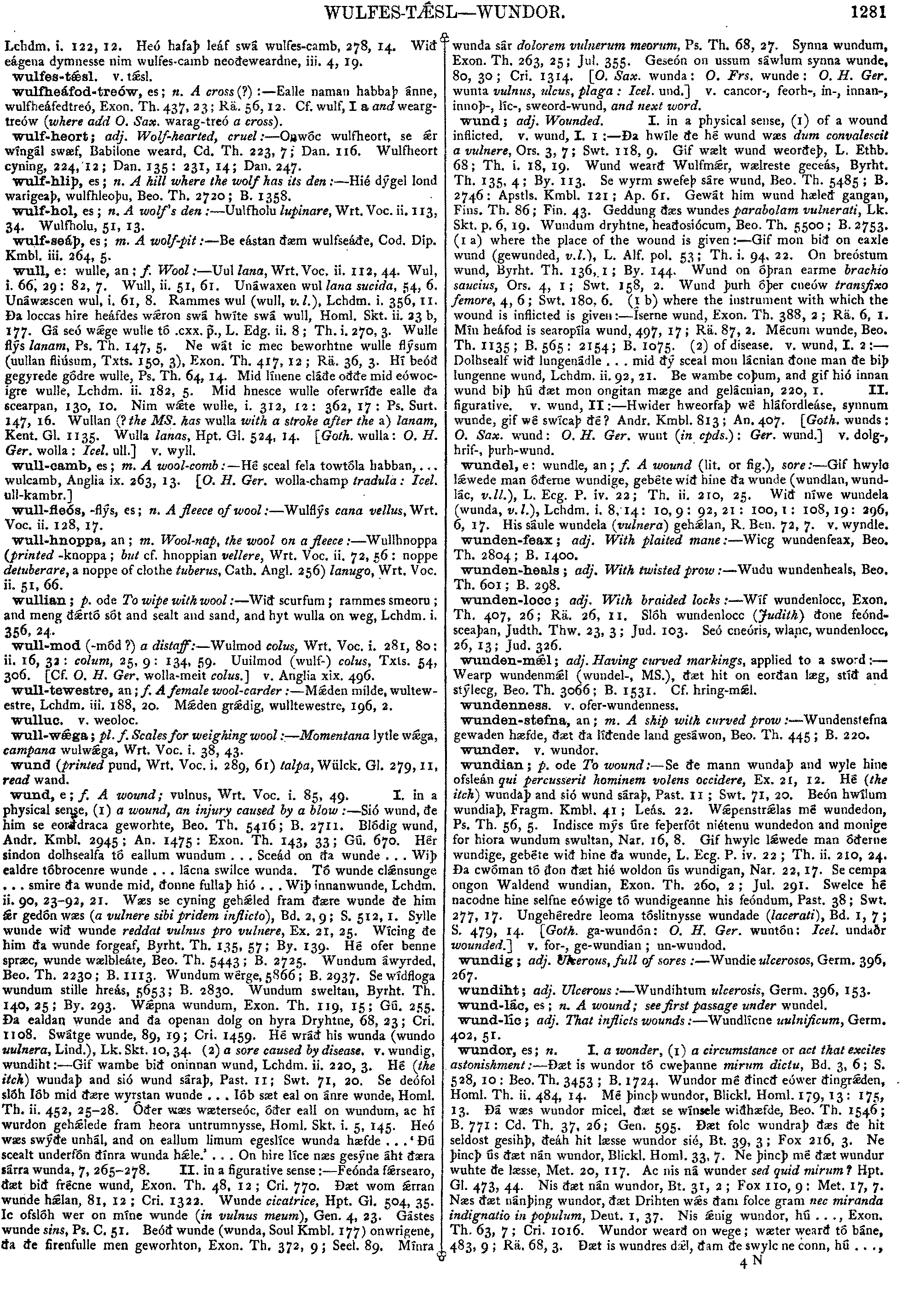
wundor,
es;
n.
I.
a
wonder,
(1)
a
circumstance
or
act
that
excites
astonishment
:--
Ðæt
is
wundor
tó
cweþanne
mirum
dictu,
Bd.
3,
6;
S.
528,
10:
Beo.
Th.
3453;
B.
1724.
Wundor
mé
ðincð
eówer
ðingrden,
Homl.
Th.
ii.
484,
14.
Mé
þincþ
wundor,
Blickl.
Homl.
179,
13:
175,
13.
Ðá
wæs
wundor
micel,
ðæt
se
wínsele
wiðhæfde,
Beo.
Th.
1546;
B.
771:
Cd.
Th.
37,
26;
Gen.
595.
Ðæt
folc
wusidraþ
ðæs
ðe
hit
seldost
gesihþ,
ðeáh
hit
læsse
wundor
sié,
Bt.
39,
3;
Fox
216,
3.
Ne
þincþ
ús
ðæt
nán
wundor,
Blickl.
Homl.
33,
7.
Ne
þincþ
mé
ðæt
wundur
wuhte
ðe
læsse,
Met.
20,
117.
Ac
nis
ná
wunder
sed
quid
mirum?
Hpt.
Gl.
473,
44.
Nis
ðæt
nán
wundor,
Bt.
31,
2;
Fox
110,
9:
Met.
17,
7.
Næs
ðæt
nánþing
wundor,
ðæt
Drihten
ws
ðam
folce
gram
nec
miranda
indignatio
in
populum,
Deut.
1,
37.
Nis
nig
wundor,
hú...,
Exon.
Th.
63,
7;
Cri.
1016.
Wundor
wearð
on
wege;
wæter
wearð
tó
báne,
483,
9;
Rä.
68,
3.
Ðæt
is
wundres
dl,
ðam
ðe
swylc
ne
conn,
hú...,
472,
3;
Rä.
61,
10.
Ic
ðæt
wundor
gefrægn,
ðæt
se
wyrm
forswealg
wera
gied
sumes,
432,
7;
Rä.
48,
2.
Ne
ic
on
mægene
miclum
gange,
ne
wundor
ofer
mé
wuniaþ
nig
neque
ambulavi
in
magnis,
neque
in
mirabilibus
super
me,
Ps.
Th.
130,
2.
Ðr
bið
wundra
má,
ðonne
hit
nig
mæge
áþencan,
Exon.
Th.
61,
24;
Cri.
989.
Ðæt
wæs
wundra
sum,
ðæt
ðæt
sweord
gemealt
íse
gelícost,
Beo.
Th.
3219;
B.
1607.
(2)
a
circumstance
that
excites
astonishment
as
being
out
of
the
usual
course
of
nature,
a
prodigy,
portent
:--
Gewurdon
on
Róme
ða
yfelan
wundor
obscoena
et
dira
prodigia
vel
visa
Romae
vel
nunciata
sunt,
Ors.
4,
2;
Swt.
160,
17.
Wundra
 forebeácna
prodigia,
Hpt.
Gl.
488,
34.
(3)
of
the
works
of
Divine
power,
a
wonder,
miracle
:--
For
fyrwetgeornnesse
ðæs
wundres
(the
raising
of
Lazarus),
Blickl.
Homl.
69,
22.
Á
mæg
God
wyrcan
wundor
æfter
wundre,
Beo.
Th.
1866;
B.
931.
Eal
ðæt
folc
ðe
ðis
wundor
(the
giving
sight
to
the
blind
man)
geseah,
Blickl.
Homl.
15,
29.
Ic
bebeóde
wundor
geweorðan,
Andr.
Kmbl.
1459;
An.
730:
Cd.
Th.
245,
31;
Dan.
471:
Elen.
Kmbl.
2241;
El.
1122.
Gemunaþ
hú
hé
mænig
wundor
geworhte
mementote
mirabilia
ejus,
quae
fecit,
Ps.
Th.
104,
5.
Mre
synd
his
wundur
ofer
manna
bearn
mirabilia
ejus
filiis
hominum,
106,
30.
Swá
fela
wundra,
swá
wé
gehýrdon
gedóne
on
Cafarnaum,
Lk.
Skt.
4,
23.
Ðis
worhte
fruma
ðara
wundra
(uundra,
Lind.)
ðe
Hlend
hoc
fecit
initium
signorum
Jesus,
Jn.
Skt.
Rush.
2,
11:
Blickl.
Homl.
105,
25:
Andr.
Kmbl.
1138;
An.
569.
Ðæt
(the
turning
of
Lot's
wife
into
a
pillar
of
salt)
is
wundra
sum,
ðara
ðe
geworhte
wuldres
Aldor,
Cd.
Th.
155,
14;
Gen.
2572.
On
eallum
mínum
wundrum
in
cunctis
mirabilibus
meis,
Ex.
3,
20.
For
ðínum
wundrum
a
signis
tuis,
Ps.
Th.
64,
8.
Mænigu
wundur
hé
geworhte,
77,
5.
Wundor,
Cd.
Th.
246,
4;
Dan.
474:
Blickl.
Homl.
17,
10.
Wundru,
Past.
16;
Swt.
103,
13:
Ps.
Th.
87,
12:
Ex.
12,
12.
Wundro,
Blickl.
Homl.
81,
10.
Uundra,
Jn.
Skt.
Lind.
11,
47.
(3
a)
of
supernatural
power
working
through
a
human
being,
a
miracle
:--
Eft
gelamp
óþer
wundor
ðissum
onlíc,
Blickl.
Homl.
219,
6.
His
(Oswald's)
wundor
wron
miclo,
Shrn.
114,
5:
Elen.
Kmbl.
1650;
El.
827.
Synd
ðás
wundru
(virtutes)
gefremede
on
him,
Mt.
Kmbl.
14,
2.
Wæs
ðis
ðara
wundra
rest
ðe
ðes
eádiga
wer
geworhte,
Blickl.
Homl.
219,
2.
Þurh
ða
wundor
ðe
heó
geseah
æt
ðam
bisceope,
Shrn.
115,
6.
Héhbiscopes
micla
wundra
pontificis
magnolia,
Rtl.
77,
19.
(4)
a
wonderful
object,
wondrous
thing
:--
Wén
is
ðæt
hwilc
wundor
ineode
on
ðæt
carcern
and
ða
hyrdas
ácwælde,
Blickl.
Homl.
239,
30.
Heofonbeácen
...
óðer
wundor
syllíc
...
byrnende
beám,
Cd.
Th.
184,
17;
Exod.
108.
Hwæt
is
ðæt
wundor,
ðæt
geond
ðás
woruld
fareþ?
...
Yldo,
Salm.
Kmbl.
563;
Sal.
281.
Férdon
folctogan
wunder
sceáwian,
láþes
lástas,
Beo.
Th.
1685;
B.
840.
Wundur,
6057;
B.
3032:
6197;
B.
3103.
Hine
wundra
fela
swencte
on
sunde,
3023;
B.
1509.
II.
wonderful,
miraculous
power
:--
Ðæs
engles
mægen
and
his
wundor
weorðod
bið,
Blickl.
Homl.
209,
20.
Heofenas
andettaþ
hú
wundor
ðín
standeþ,
Ps.
Th.
88,
4.
Mycel
ys
his
wundur
ofer
manna
bearn,
106,
20.
Eal
ðis
wæs
geworden
tó
ðon
ðæt
wé
sceoldan
úres
Drihtnes
wundor
oncnáwan,
Blickl.
Homl.
71,
23.
III.
wonder,
admiration
:--
Þeóda
wlítaþ,
wundrum
wafiaþ,
hú
seó
wilgedryht
wildne
weorþiaþ,
Exon.
Th.
222,
1;
Ph.
342.
Ðysne
wíg
ðe
ðú
ðé
tó
wundrum
(as
the
object
of
thy
adoration?
cf.
Ðam
gyldnan
gylde
ðe
hé
him
tó
gode
geteóde,
l.
19)
teódest,
Cd.
Th.
228,
25;
Den.
208.

cases,
with
or
without
prepositions,
used
adverbially
or
adjectivally
:--
Ðæt
of
ðé
ácenned
bið,
ðæt
bið
on
wundra
(shall
be
a
source
of
wonder)
eallum
folcum,
Homl.
Ass.
121,
138.
Gé
mec
tó
wundre
(so
as
to
excite
wonder,
wonderfully),
wgan
mótun,
Exon.
Th.
124,
21;
Gú.
341:
Homl.
Skt.
i.
23,
652.
Wundrum
monigo
very
many,
Mk.
Skt.
Lind.
Rush.
7,
8.
Wundrum
lytel
wonderfully
little,
Bt.
11,
1;
Fox
32,
21.
Swýþe
wundrum
well,
Lchdm.
i.
80,
21.
Wundrum
fæger,
Exon.
Th.
214,
1;
Ph.
232:
202,
1;
Ph.
63.
Wundrum
gegierwed,
483,
8;
Rä.
68,
2.
Eallum
wundrum
ðrymlíc
girwan
up
swsendo,
Judth.
Thw.
21,
7;
Jud.
8.
Hú
woruld
wre
wundrum
geteód,
Cd.
Th.
222,
28;
Dan.
111.
[O.
Sax.
wundar:
O.
H.
Ger.
wuntar
mirum,
prodigium,
portentum,
mirabile,
miraculum,
magnale,
stupor:
Icel.
undr.]
v.
eall-,
fr-,
hand-,
lyft-,
mægen-,
niþ-,
searo-,
sundor-,
swegel-,
þeód-wundor.
forebeácna
prodigia,
Hpt.
Gl.
488,
34.
(3)
of
the
works
of
Divine
power,
a
wonder,
miracle
:--
For
fyrwetgeornnesse
ðæs
wundres
(the
raising
of
Lazarus),
Blickl.
Homl.
69,
22.
Á
mæg
God
wyrcan
wundor
æfter
wundre,
Beo.
Th.
1866;
B.
931.
Eal
ðæt
folc
ðe
ðis
wundor
(the
giving
sight
to
the
blind
man)
geseah,
Blickl.
Homl.
15,
29.
Ic
bebeóde
wundor
geweorðan,
Andr.
Kmbl.
1459;
An.
730:
Cd.
Th.
245,
31;
Dan.
471:
Elen.
Kmbl.
2241;
El.
1122.
Gemunaþ
hú
hé
mænig
wundor
geworhte
mementote
mirabilia
ejus,
quae
fecit,
Ps.
Th.
104,
5.
Mre
synd
his
wundur
ofer
manna
bearn
mirabilia
ejus
filiis
hominum,
106,
30.
Swá
fela
wundra,
swá
wé
gehýrdon
gedóne
on
Cafarnaum,
Lk.
Skt.
4,
23.
Ðis
worhte
fruma
ðara
wundra
(uundra,
Lind.)
ðe
Hlend
hoc
fecit
initium
signorum
Jesus,
Jn.
Skt.
Rush.
2,
11:
Blickl.
Homl.
105,
25:
Andr.
Kmbl.
1138;
An.
569.
Ðæt
(the
turning
of
Lot's
wife
into
a
pillar
of
salt)
is
wundra
sum,
ðara
ðe
geworhte
wuldres
Aldor,
Cd.
Th.
155,
14;
Gen.
2572.
On
eallum
mínum
wundrum
in
cunctis
mirabilibus
meis,
Ex.
3,
20.
For
ðínum
wundrum
a
signis
tuis,
Ps.
Th.
64,
8.
Mænigu
wundur
hé
geworhte,
77,
5.
Wundor,
Cd.
Th.
246,
4;
Dan.
474:
Blickl.
Homl.
17,
10.
Wundru,
Past.
16;
Swt.
103,
13:
Ps.
Th.
87,
12:
Ex.
12,
12.
Wundro,
Blickl.
Homl.
81,
10.
Uundra,
Jn.
Skt.
Lind.
11,
47.
(3
a)
of
supernatural
power
working
through
a
human
being,
a
miracle
:--
Eft
gelamp
óþer
wundor
ðissum
onlíc,
Blickl.
Homl.
219,
6.
His
(Oswald's)
wundor
wron
miclo,
Shrn.
114,
5:
Elen.
Kmbl.
1650;
El.
827.
Synd
ðás
wundru
(virtutes)
gefremede
on
him,
Mt.
Kmbl.
14,
2.
Wæs
ðis
ðara
wundra
rest
ðe
ðes
eádiga
wer
geworhte,
Blickl.
Homl.
219,
2.
Þurh
ða
wundor
ðe
heó
geseah
æt
ðam
bisceope,
Shrn.
115,
6.
Héhbiscopes
micla
wundra
pontificis
magnolia,
Rtl.
77,
19.
(4)
a
wonderful
object,
wondrous
thing
:--
Wén
is
ðæt
hwilc
wundor
ineode
on
ðæt
carcern
and
ða
hyrdas
ácwælde,
Blickl.
Homl.
239,
30.
Heofonbeácen
...
óðer
wundor
syllíc
...
byrnende
beám,
Cd.
Th.
184,
17;
Exod.
108.
Hwæt
is
ðæt
wundor,
ðæt
geond
ðás
woruld
fareþ?
...
Yldo,
Salm.
Kmbl.
563;
Sal.
281.
Férdon
folctogan
wunder
sceáwian,
láþes
lástas,
Beo.
Th.
1685;
B.
840.
Wundur,
6057;
B.
3032:
6197;
B.
3103.
Hine
wundra
fela
swencte
on
sunde,
3023;
B.
1509.
II.
wonderful,
miraculous
power
:--
Ðæs
engles
mægen
and
his
wundor
weorðod
bið,
Blickl.
Homl.
209,
20.
Heofenas
andettaþ
hú
wundor
ðín
standeþ,
Ps.
Th.
88,
4.
Mycel
ys
his
wundur
ofer
manna
bearn,
106,
20.
Eal
ðis
wæs
geworden
tó
ðon
ðæt
wé
sceoldan
úres
Drihtnes
wundor
oncnáwan,
Blickl.
Homl.
71,
23.
III.
wonder,
admiration
:--
Þeóda
wlítaþ,
wundrum
wafiaþ,
hú
seó
wilgedryht
wildne
weorþiaþ,
Exon.
Th.
222,
1;
Ph.
342.
Ðysne
wíg
ðe
ðú
ðé
tó
wundrum
(as
the
object
of
thy
adoration?
cf.
Ðam
gyldnan
gylde
ðe
hé
him
tó
gode
geteóde,
l.
19)
teódest,
Cd.
Th.
228,
25;
Den.
208.

cases,
with
or
without
prepositions,
used
adverbially
or
adjectivally
:--
Ðæt
of
ðé
ácenned
bið,
ðæt
bið
on
wundra
(shall
be
a
source
of
wonder)
eallum
folcum,
Homl.
Ass.
121,
138.
Gé
mec
tó
wundre
(so
as
to
excite
wonder,
wonderfully),
wgan
mótun,
Exon.
Th.
124,
21;
Gú.
341:
Homl.
Skt.
i.
23,
652.
Wundrum
monigo
very
many,
Mk.
Skt.
Lind.
Rush.
7,
8.
Wundrum
lytel
wonderfully
little,
Bt.
11,
1;
Fox
32,
21.
Swýþe
wundrum
well,
Lchdm.
i.
80,
21.
Wundrum
fæger,
Exon.
Th.
214,
1;
Ph.
232:
202,
1;
Ph.
63.
Wundrum
gegierwed,
483,
8;
Rä.
68,
2.
Eallum
wundrum
ðrymlíc
girwan
up
swsendo,
Judth.
Thw.
21,
7;
Jud.
8.
Hú
woruld
wre
wundrum
geteód,
Cd.
Th.
222,
28;
Dan.
111.
[O.
Sax.
wundar:
O.
H.
Ger.
wuntar
mirum,
prodigium,
portentum,
mirabile,
miraculum,
magnale,
stupor:
Icel.
undr.]
v.
eall-,
fr-,
hand-,
lyft-,
mægen-,
niþ-,
searo-,
sundor-,
swegel-,
þeód-wundor.
|
Source: Bosworth/Toller, page b1295, entry 5 View original page image as: [TIFF] [PNG] [View previous entry] [View next entry] |
[Comment on this entry] [View comments] |
The following entry has been hand-corrected once. |
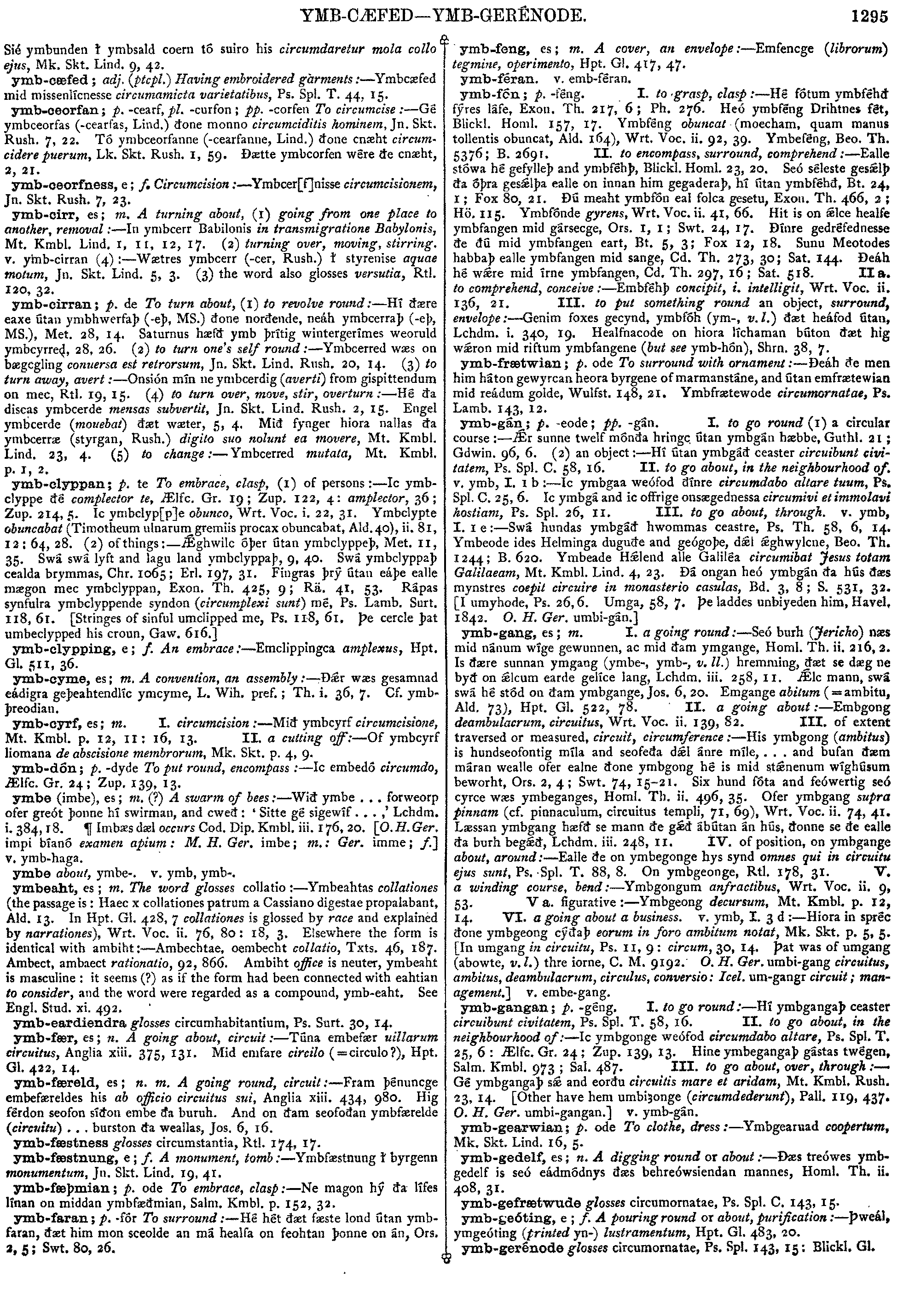
ymb-cirr,
es;
m.
A
turning
about,
(1)
going
from
one
place
to
another,
removal
:--
In
ymbcerr
Babilonis
in
transmigratione
Babylonis,
Mt.
Kmbl.
Lind.
1.
11,
12,
17.
(2)
turning
over,
moving,
stirring.
v.
ymb-cirran
(4)
:--
Wætres
ymbcerr
(-cer,
Rush.)
styrenise
aquae
motum,
Jn.
Skt.
Lind.
5,
3.
(3)
the
word
also
glosses
versutia,
Rtl.
120,
32.
|
Source: Bosworth/Toller, page d0235, entry 11 View original page image as: [TIFF] [PNG] [View previous entry] [View next entry] |
[Comment on this entry] [View comments] |
The following entry has been hand-corrected once. |
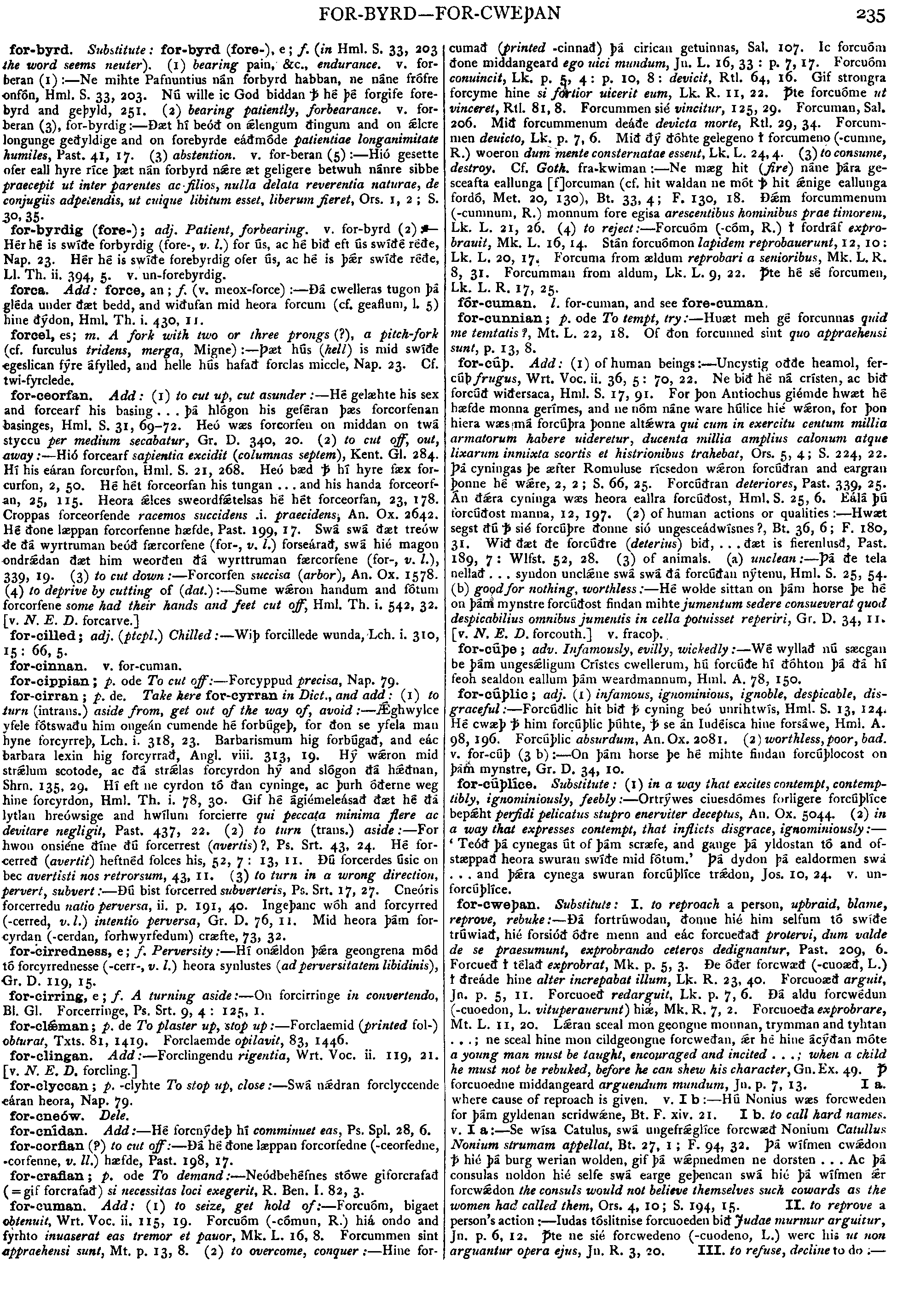
for-cirring, e; f. A turning aside :-- On forcirringe in convertendo, Bl. Gl. Forcerringe, Ps. Srt. 9, 4: 125, 1.
|
Source: Bosworth/Toller, page d0262, entry 3 View original page image as: [TIFF] [PNG] [View previous entry] [View next entry] |
[Comment on this entry] [View comments] |
The following entry has been hand-corrected once. |
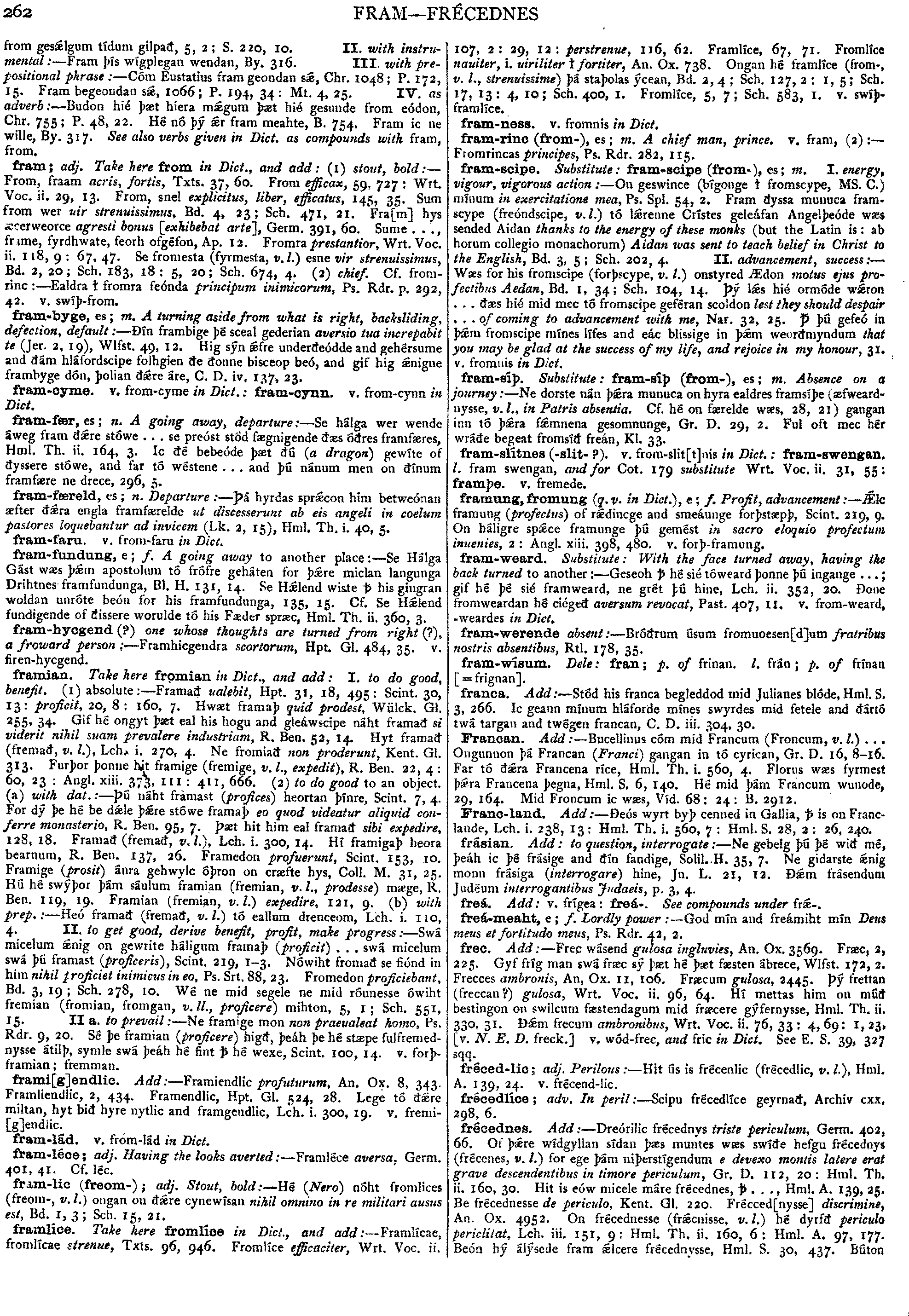
fram-byge,
es;
m.
A
turning
aside
from
what
is
right,
backsliding,
defection,
default
:--
Ðín
frambige
þé
sceal
gederian
aversio
tua
increpabit
te
(Jer.
2,
19),
Wlfst.
49,
12.
Hig
sýn
fre
underðeódde
and
gehérsume
and
ðám
hláfordscipe
folhgien
ðe
ðonne
bisceop
beó,
and
gif
hig
nigne
frambyge
dón,
þolian
ðre
áre,
C.D.
iv.
137,
23.
| Result Page: |  |
Previous | 1 2 3 4 5 6 7 | Next |  |
Germanic Lexicon Project (main page)
This search system was written by
Sean Crist
Please consider
volunteering
to correct the data in these online dictionaries.
No rights reserved. Feel free to use these data in any way you please.