|
|

|
Source: Torp, page b0092, entry 7 View original page image as: [TIFF] [PNG] [View previous entry] [View next entry] |
[Comment on this entry] [View comments] |
The following entry has been hand-corrected once. |
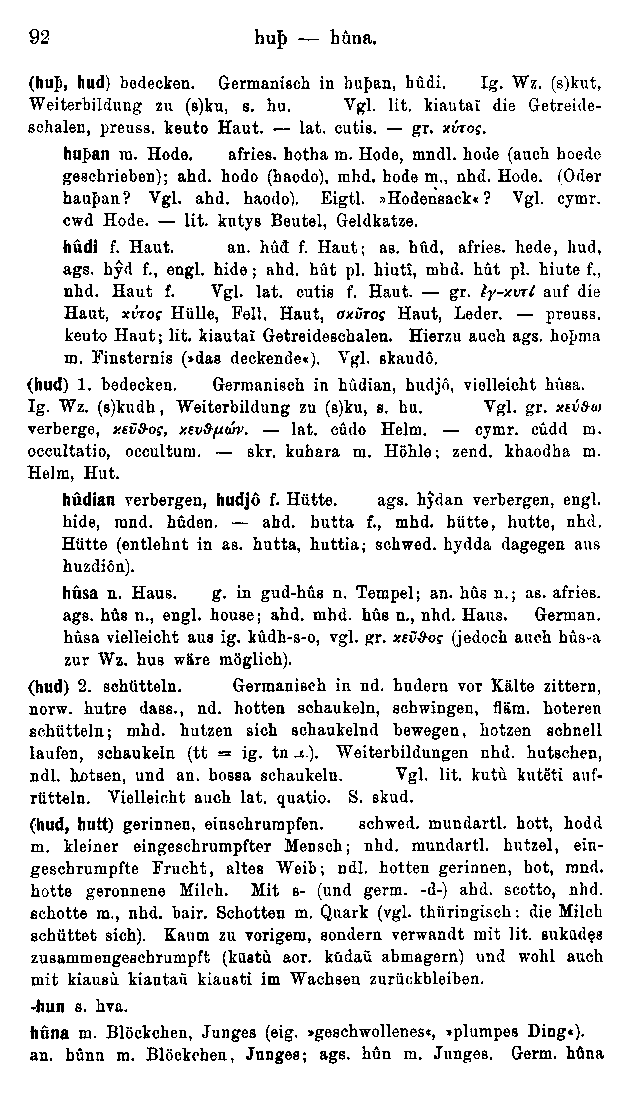
(hud)
2.
schütteln.
Germanisch
in
nd.
hudern
vor
Kälte
zittern,
norw.
hutre
dass.,
nd.
hotten
schaukeln,
schwingen,
fläm.
hoteren
schütteln;
mhd.
hutzen
sich
schaukelnd
bewegen,
hetzen.
schnell
laufen,
schaukeln
(tt
=
ig.
tn .).
Weiterbildungen
nhd.
hutschen,
ndl.
hotsen,
und
an.
hossa
schaukeln.
Vgl.
lit.
kutù
kut
.).
Weiterbildungen
nhd.
hutschen,
ndl.
hotsen,
und
an.
hossa
schaukeln.
Vgl.
lit.
kutù
kut ti
auf
rütteln.
Vielleicht
auch
lat.
quatio.
S.
skud.
ti
auf
rütteln.
Vielleicht
auch
lat.
quatio.
S.
skud.
[Translate the German words]
|
Source: Torp, page b0118, entry 5 View original page image as: [TIFF] [PNG] [View previous entry] [View next entry] |
[Comment on this entry] [View comments] |
The following entry has been hand-corrected once. |

hvîta,
hvitta
weiß,
hellfarbig.
g.
hveits
weiß;
an.
hvîtr
weiß,
hellfarbig;
as.
afries.
ags.
hwit,
engl.
white;
ahd.
(h)wî&z-hook;,
mhd.
wî&z-hook;,
nhd.
weiß.
Daneben
afries.
as.
hwitt.
In
germ.
hv tta
kann
tt
aus
ig.
-dn
oder
aus
tn
entstanden
sein.
tta
kann
tt
aus
ig.
-dn
oder
aus
tn
entstanden
sein.
[Translate the German words]
|
Source: Torp, page b0136, entry 4 View original page image as: [TIFF] [PNG] [View previous entry] [View next entry] |
[Comment on this entry] [View comments] |
The following entry has been hand-corrected once. |
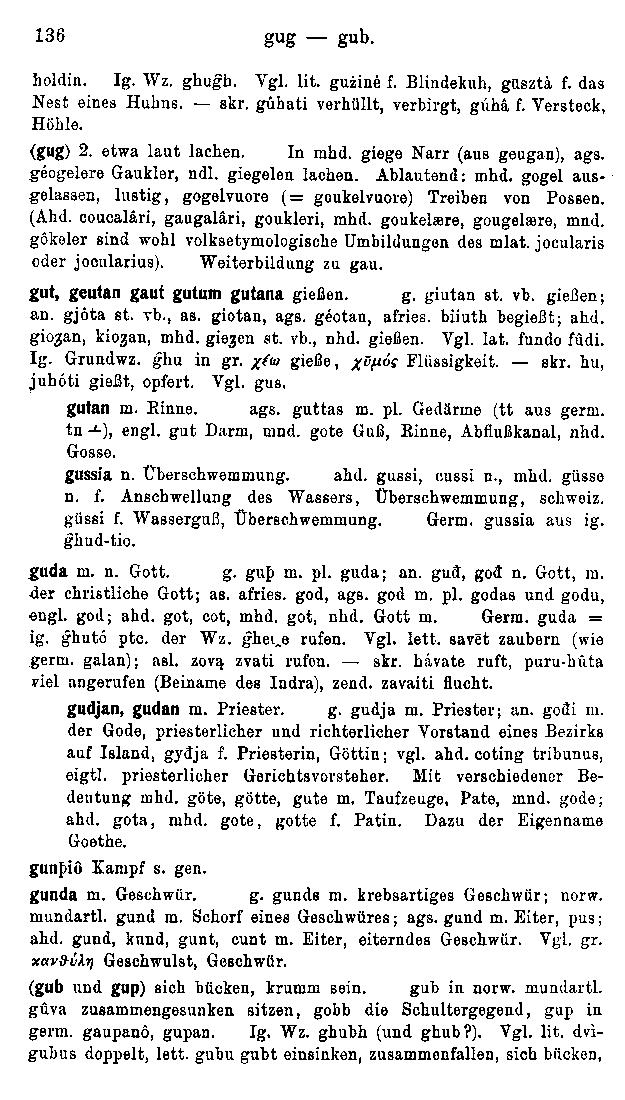
gutan
m.
Rinne.
ags.
guttas
m.
pl.
Gedärme
(tt
aus
germ.
tn
),
engl.
gut
Darm,
mnd.
gote
Guß,
Rinne,
Abflußkanal,
nhd.
Gosse.
[Translate the German words]
|
Source: Torp, page b0137, entry 9 View original page image as: [TIFF] [PNG] [View previous entry] [View next entry] |
[Comment on this entry] [View comments] |
The following entry has been hand-corrected once. |
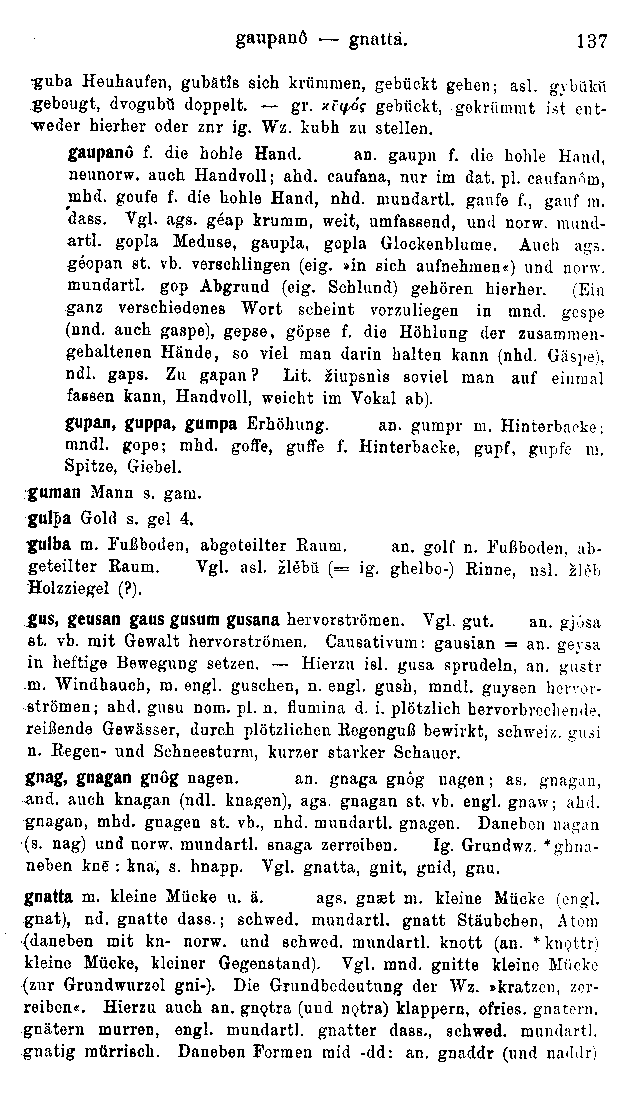
gnatta
m.
kleine
Mücke
u.
ä.
ags.
gnæt
m.
kleine
Mücke
(engl.
gnat),
nd.
gnatte
dass.;
schwed.
mundartl.
gnatt
Stäubchen,
Atom
(daneben
mit
kn-
norw.
und
schwed.
mundartl.
knott
(an.
*kn ttr)
kleine
Mücke,
kleiner
Gegenstand).
Vgl.
mnd.
gnitte
kleine
Mücke
(zur
Grundwurzel
gni-).
Die
Grundbedeutung
der
Wz.
»kratzen,
zerreiben«.
Hierzu
auch
an.
gntra
(und
ntra)
klappern,
offies.
gnatern.
gnätern
murren,
engl.
mundartl.
gnatter
dass.,
schwed.
mundartl.
gnatig
mürrisch.
Daneben
Formen
mid
).
Vgl.
gnag.
ttr)
kleine
Mücke,
kleiner
Gegenstand).
Vgl.
mnd.
gnitte
kleine
Mücke
(zur
Grundwurzel
gni-).
Die
Grundbedeutung
der
Wz.
»kratzen,
zerreiben«.
Hierzu
auch
an.
gntra
(und
ntra)
klappern,
offies.
gnatern.
gnätern
murren,
engl.
mundartl.
gnatter
dass.,
schwed.
mundartl.
gnatig
mürrisch.
Daneben
Formen
mid
).
Vgl.
gnag.
[Translate the German words]
|
Source: Torp, page b0150, entry 2 View original page image as: [TIFF] [PNG] [View previous entry] [View next entry] |
[Comment on this entry] [View comments] |
The following entry has been hand-corrected once. |
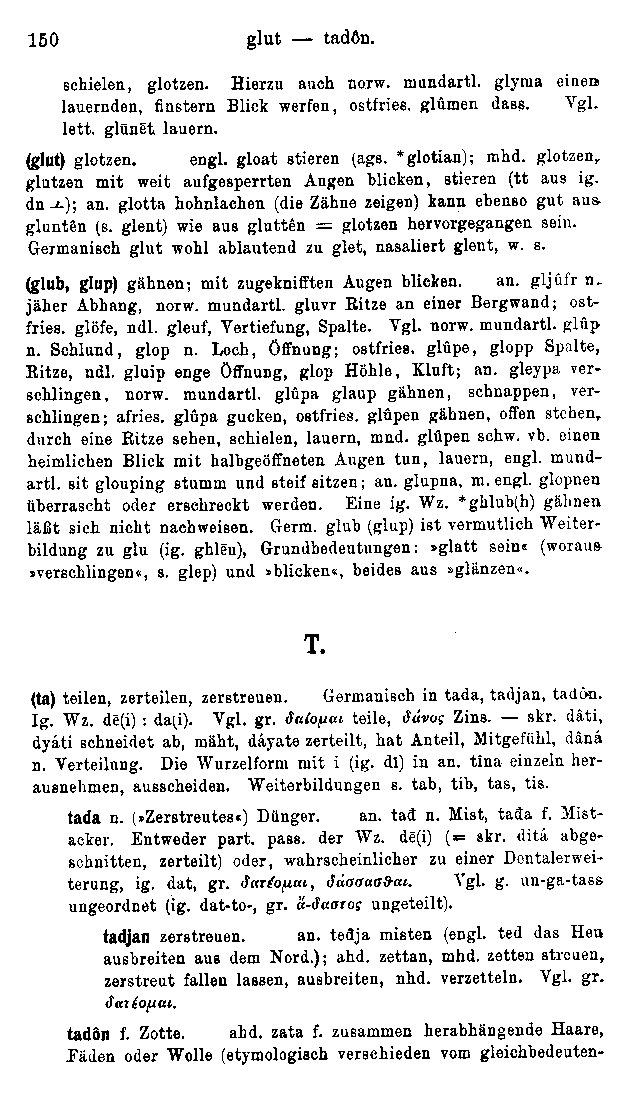
(glut)
glotzen.
engl.
gloat
stieren
(ags.
*glotian);
mhd.
glotzen,
glutzen
mit
weit
aufgesperrten
Augen
blicken,
stieren
(tt
aus
ig.
dn
);
an.
glotta
hohnlachen
(die
Zähne
zeigen)
kann
ebenso
gut
aus
gluntên
(s.
glent)
wie
aus
gluttên
=
glotzen
hervorgegangen
sein.
Germanisch
glut
wohl
ablautend
zu
glet,
nasaliert
glent,
w.
s.
[Translate the German words]
|
Source: Torp, page b0150, entry 8 View original page image as: [TIFF] [PNG] [View previous entry] [View next entry] |
[Comment on this entry] [View comments] |
The following entry has been hand-corrected once. |
tadôn
f.
Zotte.
ahd.
zata
f.
zusammen
herabhängende
Haare,
Fäden
oder
Wolle
(etymologisch
verschieden
vom
gleichbedeutenden
)
und
an.
tturr
(statt
ttturr?)
Fetzen.
[Translate the German words]
|
Source: Torp, page b0208, entry 3 View original page image as: [TIFF] [PNG] [View previous entry] [View next entry] |
[Comment on this entry] [View comments] |
The following entry has been hand-corrected once. |

dudran
m.
Dotterkraut.
schwed.
dodra,
mhd.
toter
m.
Dotterkraut;
m.
engl.
doder,
n.
engl.
dodder
Flachsseide,
ndl.
(vlas)dodder.
Wahrscheinlich
eig.
»verwirrte
Masse«
(?).
Ein
verwandtes
Wort
ist
engl.
dodder
briza
media
(»rattle-grass«,
»shaky-grass«).
Vgl.
engl.
mundartl.
dodder
zittern,
dudder
verwirren,
ags.
dyderian
täuschen,
norw.
dudra
zittern,
mndl.
dotten,
dutten
verrückt
sein,
mnd.
vordutten
verwirren,
mhd.
vertutzen
betäubt
werden,
nfries.
dutten
schlafen,
träumen,
wackeln
(tt
aus
dn
).
[Translate the German words]
|
Source: Bosworth/Toller, page b0008, entry 7 View original page image as: [TIFF] [PNG] [View previous entry] [View next entry] |
[Comment on this entry] [View comments] |
The following entry has been hand-corrected once. |
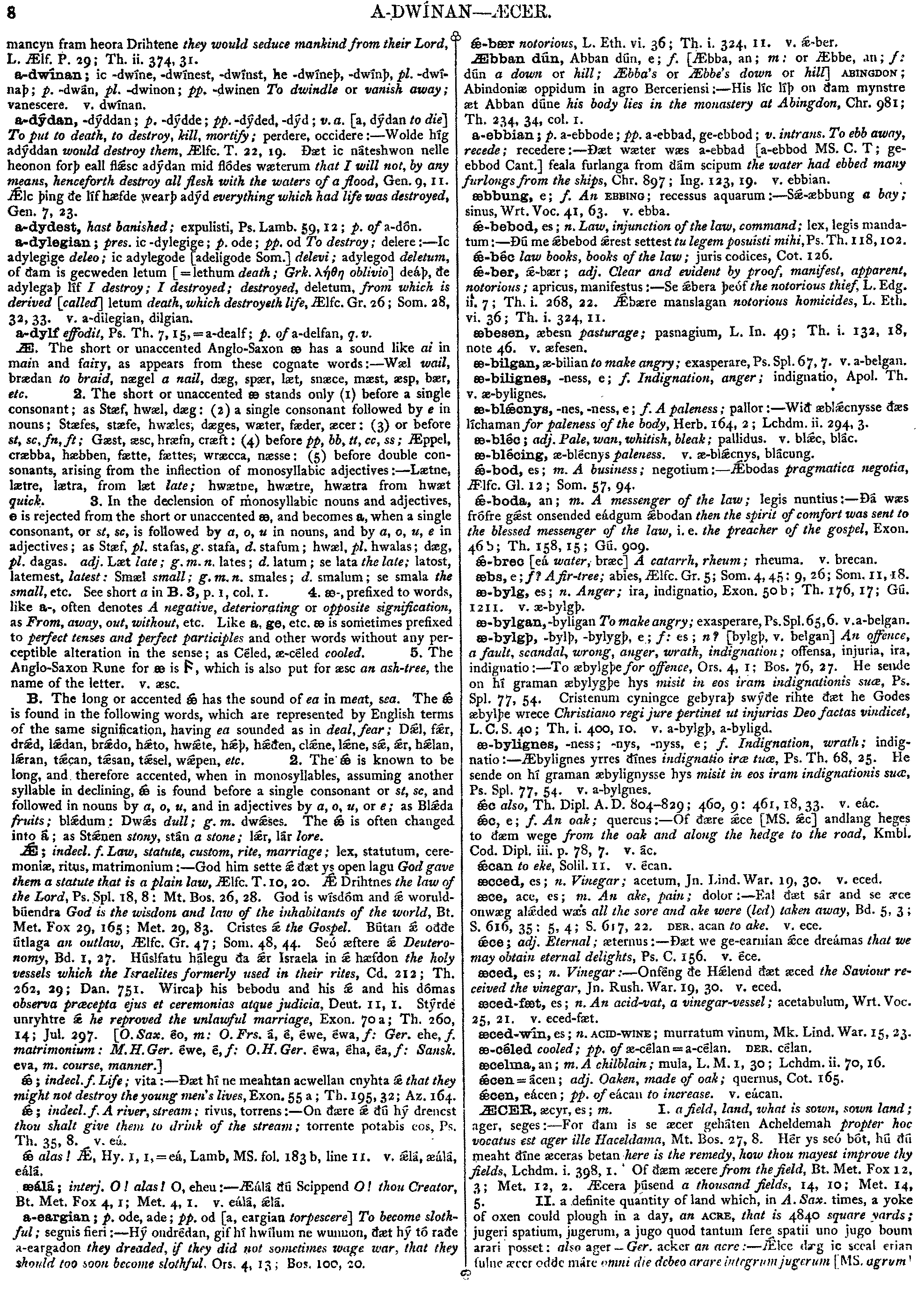
Æ. The short or unaccented Anglo-Saxon æ has a sound like ai in main and fairy, as appears from these cognate words :-- Wæl wail, brædan to braid, nægel a nail, dæg, spær, læt, snæce, mæst, æsp, bær, etc. 2. The short or unaccented æ stands only (1) before a single consonant; as Stæf, hwæl, dæg: (2) a single consonant followed by e in nouns; Stæfes, stæfe, hwæles, dæges, wæter, fæder, æcer: (3) or before st, sc, fn, ft; Gæst, æsc, hræfn, cræft: (4) before pp, bb, tt, cc, ss; Æppel, cræbba, hæbben, fætte, fættes, wræcca, næsse: (5) before double consonants, arising from the inflection of monosyllabic adjectives :-- Lætne, lætre, lætra, from læt late; hwætne, hwætre, hwætra from hwæt quick. 3. In the declension of monosyllabic nouns and adjectives, e is rejected from the short or unaccented æ, and becomes a, when a single consonant, or st, sc, is followed by a, o, u in nouns, and by a, o, u, e in adjectives; as Stæf, pl. stafas, g. stafa, d. stafum; hwæl, pl. hwalas; dæg, pl. dagas. adj. Læt late; g. m. n. lates; d. latum; se lata the late; latost, latemest, latest: Smæl small; g. m. n. smales; d. smalum; se smala the small, etc. See short a in B. 3, p. 1, col. 1. 4. æ-, prefixed to words, like a-, often denotes A negative, deteriorating or opposite signification, as From, away, out, without, etc. Like a, ge, etc. æ is sometimes prefixed to perfect tenses and perfect participles and other words without any perceptible alteration in the sense; as Céled, æ-céled cooled. 5. The Anglo-Saxon Rune for æ is RUNE, which is also put for æsc an ash-tree, the name of the letter. v. æsc.
|
Source: Cleasby/Vigfusson, page b0002, entry 3 View original page image as: [TIFF] [PNG] [View previous entry] [View next entry] |
[Comment on this entry] [View comments] |
The following entry has been hand-corrected once. |
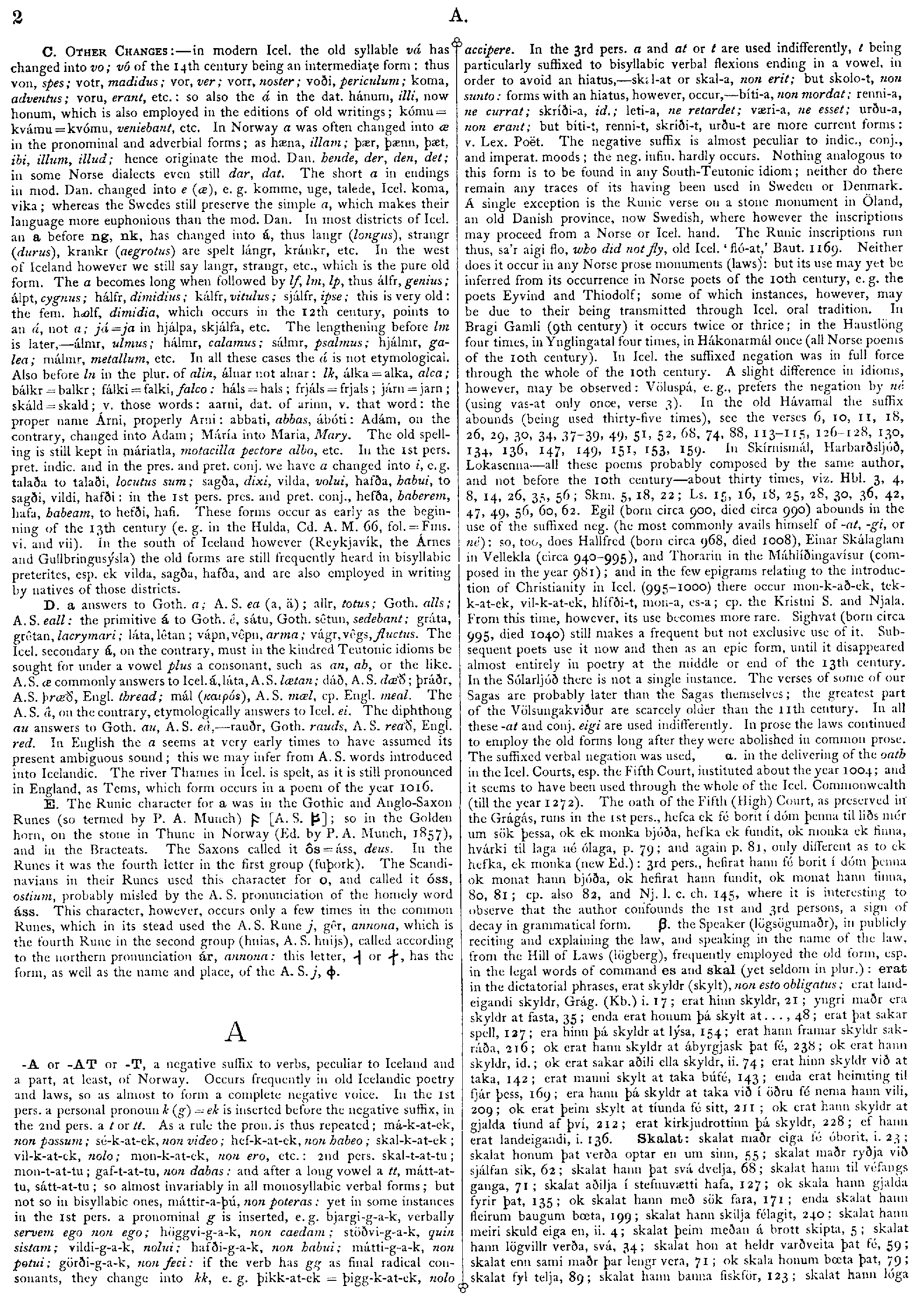
-A
or
-AT
or
-T,
a
negative
suffix
to
verbs,
peculiar
to
Iceland
and
a
part,
at
least,
of
Norway.
Occurs
frequently
in
old
Icelandic
poetry
and
laws,
so
as
almost
to
form
a
complete
negative
voice.
In
the
1st
pers.
a
personal
pronoun
k
(g)
=
ek
is
inserted
before
the
negative
suffix,
in
the
2nd
pers.
a
t
or
tt.
As
a
rule
the
pron.
as
thus
repeated;
má-k-at-ek,
non
possum;
sé-k-at-ek,
non
video;
hef-k-at-ek,
non
habeo;
skal-k-at-ek;
vil-k-at-ek,
nolo;
mon-k-at-ek,
non
ero,
etc.:
2nd
pers.
skal-t-at-tu;
mon-t-at-tu;
gaf-t-at-tu,
non
dabas:
and
after
a
long
vowel
a
tt,
mátt-at-
tu,
sátt-at-tu;
so
almost
invariably
in
all
monosyllabic
verbal
forms;
but
not
so
in
bisyllabic
ones,
máttir-a-þú,
non
poteras:
yet
in
some
instances
in
the
1st
pers.
a
pronominal
g
is
inserted,
e.
g.
bjargi-g-a-k,
verbally
servem
ego
non
ego;
höggvi-g-a-k,
non
cædam;
stöðvi-g-a-k,
quin
sistam;
vildi-g-a-k,
nolui;
hafði-g-a-k,
non
babui;
mátti-g-a-k,
non
potui;
görði-g-a-k,
non
feci:
if
the
verb
has
gg
as
final
radical
con-
sonants,
they
change
into
kk,
e.
g.
þikk-at-ek
=
þigg-k-at-ek,
nolo
accipere.
In
the
3rd
pers.
a
and
at
or
t
are
used
indifferently,
t
being
particularly
suffixed
to
bisyllabic
verbal
flexions
ending
in
a
vowel,
in
order
to
avoid
an
hiatus,
--
skal-at
or
skal-a,
non
erit;
but
skolo-t,
non
sunto:
forms
with
an
hiatus,
however,
occur,
--
bítí-a,
non
mordat;
renni-a,
ne
currat;
skríði-a,
id.;
leti-a,
ne
retardet;
vaeri-a,
ne
esset;
urðu-a,
non
erant;
but
bíti-t,
renni-t,
skríði-t,
urðu-t
are
more
current
forms:
v.
Lex.
Poët.
The
negative
suffix
is
almost
peculiar
to
indic.,
conj.,
and
imperat.
moods;
the
neg.
infin.
hardly
occurs.
Nothing
analogous
to
this
form
is
to
be
found
in
any
South-Teutonic
idiom;
neither
do
there
remain
any
traces
of
its
having
been
used
in
Sweden
or
Denmark.
A
single
exception
is
the
Runic
verse
on
a
stone
monument
in
Öland,
an
old
Danish
province,
now
Swedish,
where
however
the
inscriptions
may
proceed
from
a
Norse
or
Icel.
hand.
The
Runic
inscriptions
run
thus,
sár
aigi
flo,
who
did
not
fly,
old
Icel.
'flo-at,'
Baut.
1169.
Neither
does
it
occur
in
any
Norse
prose
monuments
(laws):
but
its
use
may
yet
be
inferred
from
its
occurrence
in
Norse
poets
of
the
10th
century,
e.
g.
the
poets
Eyvind
and
Thiodolf;
some
of
which
instances,
however,
may
be
due
to
their
being
transmitted
through
Icel.
oral
tradition.
In
Bragi
Gamli
(9th
century)
it
occurs
twice
or
thrice;
in
the
Haustlöng
four
times,
in
Ynglingatal
four
times,
in
Hákonarmál
once
(all
Norse
poems
of
the
10th
century).
In
Icel.
the
suffixed
negation
was
in
full
force
through
the
whole
of
the
10th
century.
A
slight
difference
in
idioms,
however,
may
be
observed:
Völuspá,
e.
g.,
prefers
the
negation
by
né
(using
vas-at
only
once,
verse
3).
In
the
old
Hávamal
the
suffix
abounds
(being
used
thirty-five
times),
see
the
verses
6,
10,
11,
18,
26,
29,
30,
34,
37-39,
49,
51,
52,
68,
74,
88,
113-115,
126-128,
130,
134,
136,
147,
149,
151,
153,
159.
In
Skírnismál,
Harbarðsljóð,
Lokasenna
--
all
these
poems
probably
composed
by
the
same
author,
and
not
before
the
loth
century
--
about
thirty
times,
viz.
Hbl.
3,
4,
8,
14,
26,
35,
56;
Skm.
5,
18,
22;
Ls.
15,
16,
18,
25,
28,
30,
36,
42,
47,
49,
56,
60,
62.
Egil
(born
circa
900,
died
circa
990)
abounds
in
the
use
of
the
suffixed
neg.
(he
most
commonly
avails
himself
of
-at,
-gi,
or
né;
so,
too,
does
Hallfred
(born
circa
968,
died
1008),
Einar
Skálaglam
in
Vellekla
(circa
940-995),
and
Thorarin
in
the
Máhlíðingavísur
(com-
posed
in
the
year
981);
and
in
the
few
epigrams
relating
to
the
introduc-
tion
of
Christianity
in
Icel.
(995-1000)
there
occur
mon-k-að-ek,
tek-
k-at-ek,
vil-k-at-ek,
hlífði-t,
mon-a,
es-a;
cp.
the
Kristni
S.
and
Njala.
From
this
time,
however,
its
use
becomes
more
rare.
Sighvat
(born
circa
995,
died
1040)
still
makes
a
frequent
but
not
exclusive
use
of
it.
Sub-
sequent
poets
use
it
now
and
then
as
an
epic
form,
until
it
disappeared
almost
entirely
in
poetry
at
the
middle
or
end
of
the
13th
century.
In
the
Sólarljóð
there
is
not
a
single
instance.
The
verses
of
some
of
our
Sagas
are
probably
later
than
the
Sagas
themselves;
the
greatest
part
of
the
Völsungakviður
are
scarcely
older
than
the
11th
century.
In
all
these
-at
and
conj.
eigi
are
used
indifferently.
In
prose
the
laws
continued
to
employ
the
old
forms
long
after
they
were
abolished
in
common
prose.
The
suffixed
verbal
negation
was
used,
a.
in
the
delivering
of
the
oath
in
the
Icel.
Courts,
esp.
the
Fifth
Court,
instituted
about
the
year
1004;
and
it
seems
to
have
been
used
through
the
whole
of
the
Icel.
Commonwealth
(till
the
year
1272).
The
oath
of
the
Fifth
(High)
Court,
as
preserved
in
the
Grágás,
runs
in
the
1st
pers.,
hefka
ek
fé
borit
í
dóm
þenna
til
liðs
mér
um
sök
þessa,
ok
ek
monka
bjóða,
hefka
ek
fundit,
ok
monka
ek
finna,
hvárki
til
laga
né
ólaga,
p.
79;
and
again
p.
81,
only
different
as
to
ek
hefka,
ek
monka
(new
Ed.):
3rd
pers.,
hefirat
hann
fé;
borit
í
dóm
þenna
ok
monat
hann
bjóða,
ok
hefirat
hann
fundit,
ok
monat
hann
tinna,
80,
81;
cp.
also
82,
and
Nj.
l.
c.
ch.
145,
where
it
is
interesting
to
observe
that
the
author
confounds
the
ist
and
3rd
persons,
a
sign
of
decay
in
grammatical
form.
 .
the
Speaker
(lögsögumaðr),
in
publicly
reciting
and
explaining
the
law,
and
speaking
in
the
name
of
the
law,
from
the
Hill
of
Laws
(lögberg),
frequently
employed
the
old
form,
esp.
in
the
legal
words
of
command
es
and
skal
(yet
seldom
in
plur.):
erat
in
the
dictatorial
phrases,
erat
skyldr
(skylt),
non
esto
obligatus;
erat
land-
eigandi
skyldr,
Grág.
(Kb.)
i.
17;
erat
hinn
skyldr,
21;
yngri
maðr
era
skyldr
at
fasta,
35;
enda
erat
honum
þá
skylt
at
...,
48;
erat
þat
sakar
spell,
127;
era
hinn
þá
skyldr
at
lýsa,
154;
erat
hann
framar
skyldr
sak-
ráða,
216;
ok
erat
hann
skyldr
at
ábyrgjask
þat
fé,
238;
ok
erat
hann
skyldr,
id.;
ok
erat
sakar
aðili
ella
skyldr,
ii.
74;
erat
hinn
skyldr
við
at
taka,
142;
erat
manni
skylt
at
taka
búfé,
143;
enda
erat
heimting
til
fjár
þess,
169;
era
hann
þá
skyldr
at
taka
við
í
öðru
fé
nema
hann
vili,
209;
ok
erat
þeim
skylt
at
tíunda
fé
sitt,
211;
ok
erat
hann
skyldr
at
gjalda
tíund
af
því,
212;
erat
kirkjudrottinn
þá
skyldr,
228;
ef
hann
erat
landeigaadi,
i.
136.
Skalat:
skalat
maðr
eiga
fó
óborit,
i.
23;
skalat
homum
þat
verða
optar
en
um
siun,
55;
skalat
maðr
ryðja
við
sjálfan
sik,
62;
skalat
hann
þat
svá
dvelja,
68;
skalat
hann
til
véfangs
ganga,
71;
skalat
aðilja
í
stefnuvætti
hafa,
127;
ok
skala
hann
gjalda
fyrir
þat,
135;
ok
skalat
hann
með
sök
fara,
171;
enda
skalat
hann
fleirum
baugum
bœta,
199;
skalat
hann
skilja
félagit,
240;
skalat
hann
meiri
skuld
eiga
en,
ii.
4;
skalat
þeim
meðan
á
brott
skipta,
5;
skalat
hann
lögvillr
verða,
svá,
34;
skalat
hon
at
heldr
varðveita
þat
fé,
59;
í
skalat
enn
sami
maðr
þar
lengr
vera,
71;
ok
skala
honum
bæta
þat,
79;
skalat
fyl
telja,
89;
skalat
hann
banna
fiskför,
123;
skalat
hann
lóga
.
the
Speaker
(lögsögumaðr),
in
publicly
reciting
and
explaining
the
law,
and
speaking
in
the
name
of
the
law,
from
the
Hill
of
Laws
(lögberg),
frequently
employed
the
old
form,
esp.
in
the
legal
words
of
command
es
and
skal
(yet
seldom
in
plur.):
erat
in
the
dictatorial
phrases,
erat
skyldr
(skylt),
non
esto
obligatus;
erat
land-
eigandi
skyldr,
Grág.
(Kb.)
i.
17;
erat
hinn
skyldr,
21;
yngri
maðr
era
skyldr
at
fasta,
35;
enda
erat
honum
þá
skylt
at
...,
48;
erat
þat
sakar
spell,
127;
era
hinn
þá
skyldr
at
lýsa,
154;
erat
hann
framar
skyldr
sak-
ráða,
216;
ok
erat
hann
skyldr
at
ábyrgjask
þat
fé,
238;
ok
erat
hann
skyldr,
id.;
ok
erat
sakar
aðili
ella
skyldr,
ii.
74;
erat
hinn
skyldr
við
at
taka,
142;
erat
manni
skylt
at
taka
búfé,
143;
enda
erat
heimting
til
fjár
þess,
169;
era
hann
þá
skyldr
at
taka
við
í
öðru
fé
nema
hann
vili,
209;
ok
erat
þeim
skylt
at
tíunda
fé
sitt,
211;
ok
erat
hann
skyldr
at
gjalda
tíund
af
því,
212;
erat
kirkjudrottinn
þá
skyldr,
228;
ef
hann
erat
landeigaadi,
i.
136.
Skalat:
skalat
maðr
eiga
fó
óborit,
i.
23;
skalat
homum
þat
verða
optar
en
um
siun,
55;
skalat
maðr
ryðja
við
sjálfan
sik,
62;
skalat
hann
þat
svá
dvelja,
68;
skalat
hann
til
véfangs
ganga,
71;
skalat
aðilja
í
stefnuvætti
hafa,
127;
ok
skala
hann
gjalda
fyrir
þat,
135;
ok
skalat
hann
með
sök
fara,
171;
enda
skalat
hann
fleirum
baugum
bœta,
199;
skalat
hann
skilja
félagit,
240;
skalat
hann
meiri
skuld
eiga
en,
ii.
4;
skalat
þeim
meðan
á
brott
skipta,
5;
skalat
hann
lögvillr
verða,
svá,
34;
skalat
hon
at
heldr
varðveita
þat
fé,
59;
í
skalat
enn
sami
maðr
þar
lengr
vera,
71;
ok
skala
honum
bæta
þat,
79;
skalat
fyl
telja,
89;
skalat
hann
banna
fiskför,
123;
skalat
hann
lóga
|
Source: Cleasby/Vigfusson, page b0008, entry 5 View original page image as: [TIFF] [PNG] [View previous entry] [View next entry] |
[Comment on this entry] [View comments] |
The following entry has been hand-corrected once. |
| Result Page: | 1 2 3 4 5 6 7 | Next |  |
Germanic Lexicon Project (main page)
This search system was written by
Sean Crist
Please consider
volunteering
to correct the data in these online dictionaries.
No rights reserved. Feel free to use these data in any way you please.