|
|

Tip: In the search results, you can click on any word or abbreviation for more information.
|
Source: Bosworth/Toller, page b0998, entry 4 View original page image as: [TIFF] [PNG] [View previous entry] [View next entry] |
[Comment on this entry] [View comments] |
The following entry has been hand-corrected once. |
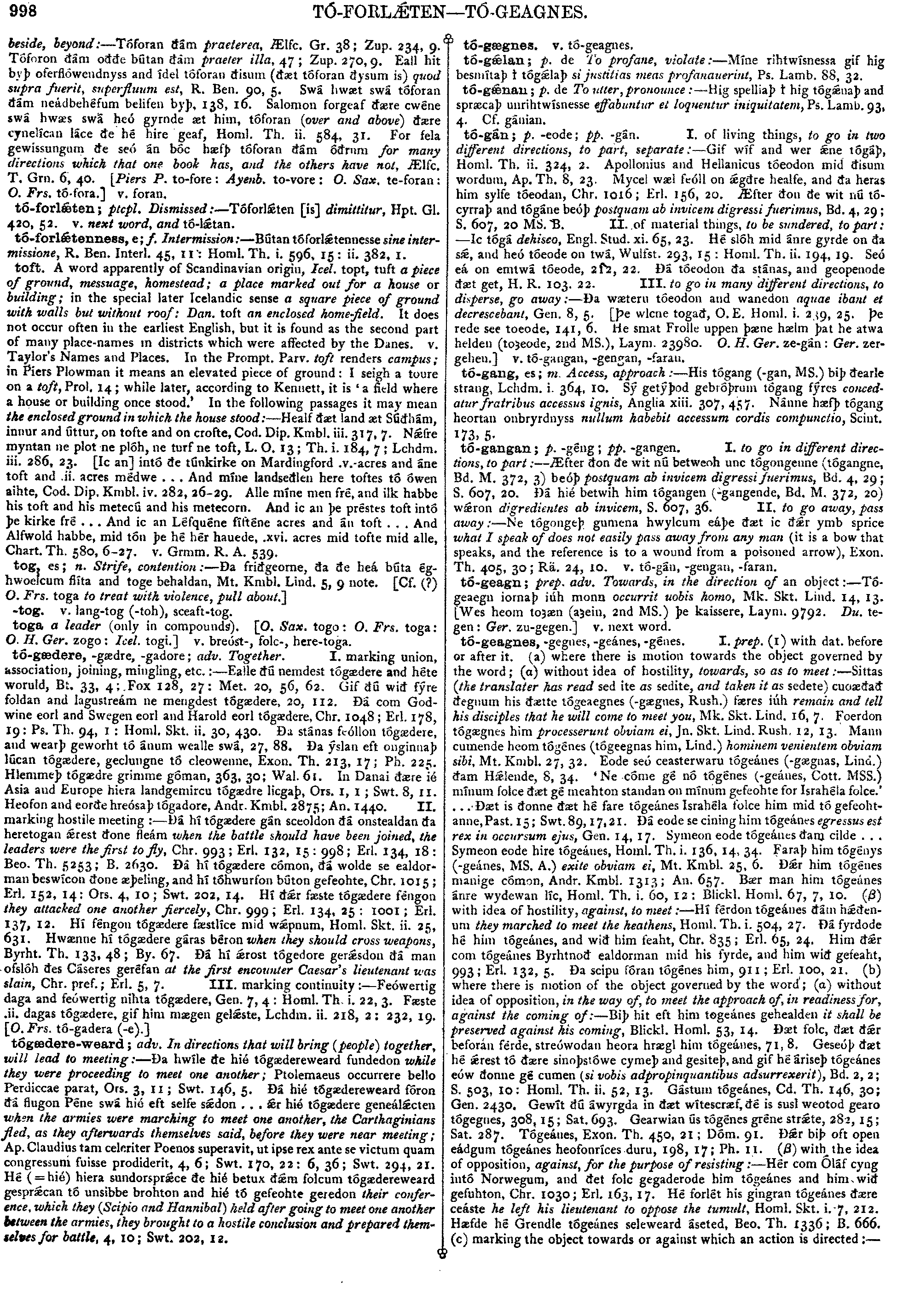
toft.
A
word
apparently
of
Scandinavian
origin,
Icel.
topt,
tuft
a
piece
of
ground,
messuage,
homestead;
a
place
marked
out
for
a
house
or
building;
in
the
special
later
Icelandic
sense
a
square
piece
of
ground
with
walls
but
without
roof:
Dan.
toft
an
enclosed
home-field.
It
does
not
occur
often
in
the
earliest
English,
but
it
is
found
as
the
second
part
of
many
place-names
m
districts
which
were
affected
by
the
Danes,
v.
Taylor's
Names
and
Places.
In
the
Prompt.
Parv,
toft
renders
campus;
in
Piers
Plowman
it
means
an
elevated
piece
of
ground
:
I
seign
a
toure
on
a
toft,
Prol.
14;
while
later,
according
to
Kenuett,
it
is'
a
field
where
a
house
or
building
once
stood.'
In
the
following
passages
it
may
mean
the
enclosed
ground
in
which
the
house
stood
:--
Healf
ðæt
land
æt
Súðhám,
innur
and
úttur,
on
tofte
and
on
crofte,
Cod.
Dip.
Kmbl.
iii.
317,
7.
N fre
myntan
ne
plot
ne
plóh,
ne
turf
ne
toft,
L.
O.
13;
Th.
i.
184,
7
;
Lchdm.
iii.
286,
23.
[Ic
an]
intó
ðe
túnkirke
on
Mardingford
.
v.
-acres
and
áne
toft
and
.ii.
acres
médwe
.
.
.
And
míne
landseðlen
here
toftes
tó
ówen
aihte,
Cod.
Dip.
Kmbl.
iv.
282,
26-29.
Alle
míne
men
fré,
and
ilk
habbe
his
toft
and
his
metecfi
and
his
metecú.
And
ic
an
þe
préstes
toft
into
þe
kirke
fre
.
.
.
And
ic
an
Léfquéne
fítténe
acres
and
an
toft
.
.
.
And
Alfwold
habbe,
mid
tón
þe
hé
hér
hauede,
.xvi.
acres
mid
tofte
mid
alle.
Chart.
Th.
580,
6-27.
v.
Grmm.
R.
A.
539.
fre
myntan
ne
plot
ne
plóh,
ne
turf
ne
toft,
L.
O.
13;
Th.
i.
184,
7
;
Lchdm.
iii.
286,
23.
[Ic
an]
intó
ðe
túnkirke
on
Mardingford
.
v.
-acres
and
áne
toft
and
.ii.
acres
médwe
.
.
.
And
míne
landseðlen
here
toftes
tó
ówen
aihte,
Cod.
Dip.
Kmbl.
iv.
282,
26-29.
Alle
míne
men
fré,
and
ilk
habbe
his
toft
and
his
metecfi
and
his
metecú.
And
ic
an
þe
préstes
toft
into
þe
kirke
fre
.
.
.
And
ic
an
Léfquéne
fítténe
acres
and
an
toft
.
.
.
And
Alfwold
habbe,
mid
tón
þe
hé
hér
hauede,
.xvi.
acres
mid
tofte
mid
alle.
Chart.
Th.
580,
6-27.
v.
Grmm.
R.
A.
539.
|
Source: Cleasby/Vigfusson, page b0636, entry 28 View original page image as: [TIFF] [PNG] [View previous entry] [View next entry] |
[Comment on this entry] [View comments] |
The following entry has been hand-corrected once. |
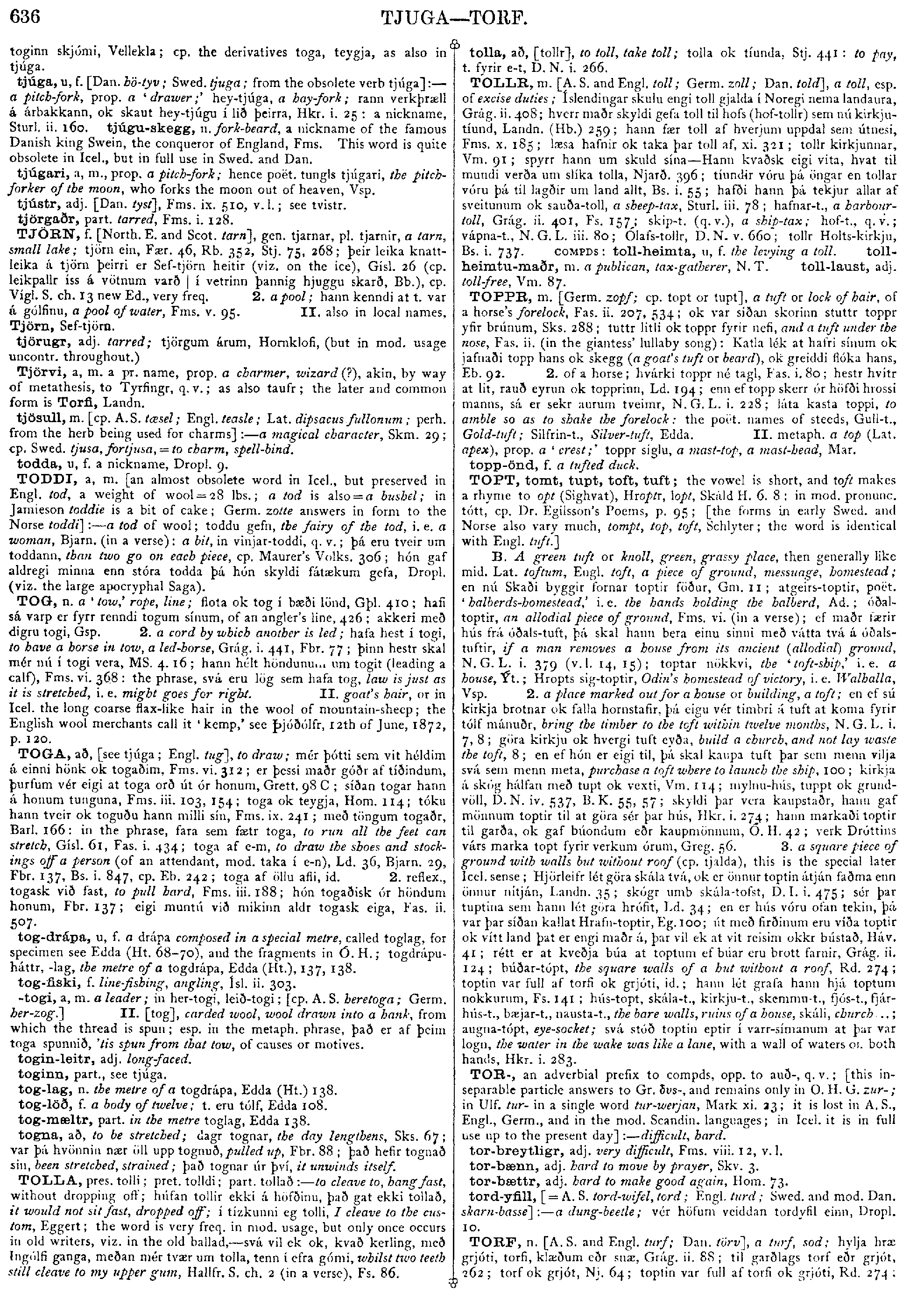
TOPT, tomt, tupt, toft, tuft; the vowel is short, and toft makes a rhyme to opt (Sighvat), Hroptr, lopt, Skáld H. 6. 8: in mod. pronunc. tótt, cp. Dr. Egilsson's Poems, p. 95; [the forms in early Swed. and Norse also vary much, tompt, top, toft, Schlyter; the word is identical with Engl. tuft.] B. A green tuft or knoll, green, grassy place, then generally like mid. Lat. toftum, Engl. toft, a piece of ground, messuage, homestead; en nú Skaði byggir fornar toptir föður, Gm. 11; atgeirs-toptir, poët. 'halberds-homestead,' i.e. the hands holding the halberd, Ad.; óðal-toptir, an allodial piece of ground, Fms. vi. (in a verse); ef maðr færir hús frá óðals-tuft, þá skal hann bera einu sinni með vátta tvá á óðals-tuftir, if a man removes a house from its ancient (allodial) ground, N.G.L. i. 379 (v.l. 14, 15); toptar nökkvi, the 'toft-ship,' i.e. a house, Ýt.; Hropts sig-toptir, Odin's homestead of victory, i.e. Walhalla, Vsp. 2. a place marked out for a house or building, a toft; en ef sú kirkja brotnar ok falla hornstafir, þá eigu vér timbri á tuft at koma fyrir tólf mánuðr, bring the timber to the toft within twelve months, N.G.L. i. 7, 8; göra kirkju ok hvergi tuft eyða, build a church, and not lay waste the toft, 8; en ef hón er eigi til, þá skal kaupa tuft þar sem menn vilja svá sem menn meta, purchase a toft where to launch the ship, 100; kirkja á skóg hálfan með tupt ok vexti, Vm. 114; mylnu-hús, tuppt ok grundvöll, D.N. iv. 537, B.K. 55, 57; skyldi þar vera kaupstaðr, hann gaf mönnum toptir til at göra sér þar hús, Hkr. i. 274; hann markaði toptir til garða, ok gaf búondum eðr kaupmönnum, Ó.H. 42; verk Dróttins várs marka topt fyrir verkum órum, Greg. 56. 3. a square piece of ground with walls but without roof (cp. tjalda), this is the special later Icel. sense; Hjörleifr lét göra skála tvá, ok er önnur toptin átján faðma enn önnur nítján, Landn. 35; skógr umb skála-tofst, D.I. i. 475; sér þar tuptina sem hann lét göra hrófit, Ld. 34; en er hús vóru ofan tekin, þá var þar síðan kallat Hrafn-toptir, Eg. 100; út með firðinum eru víða toptir ok vítt land þat er engi maðr á, þar vil ek at vit reisim okkr bústað, Háv. 41; rétt er at kveðja búa at toptum ef búar eru brott farnir, Grág. ii. 124; búðar-tópt, the square walls of a hut without a roof, Rd. 274; toptin var full af torfi ok grjóti, id.; hann lét grafa hann hjá toptum nokkurum, Fs. 141; hús-topt, skála-t., kirkju-t., skemmu-t., fjós-t., fjárhús-t., bæjar-t., nausta-t., the bare walls, ruins of a house, skáli, church ...; augna-tópt, eye-socket; svá stóð toptin eptir í varr-símanum at þar var logn, the water in the wake was like a lane, with a wall of waters on both hands, Hkr. i. 283.
|
Source: Bosworth/Toller, page b0776, entry 12 View original page image as: [TIFF] [PNG] [View previous entry] [View next entry] |
[Comment on this entry] [View comments] |
The following entry has been hand-corrected once. |
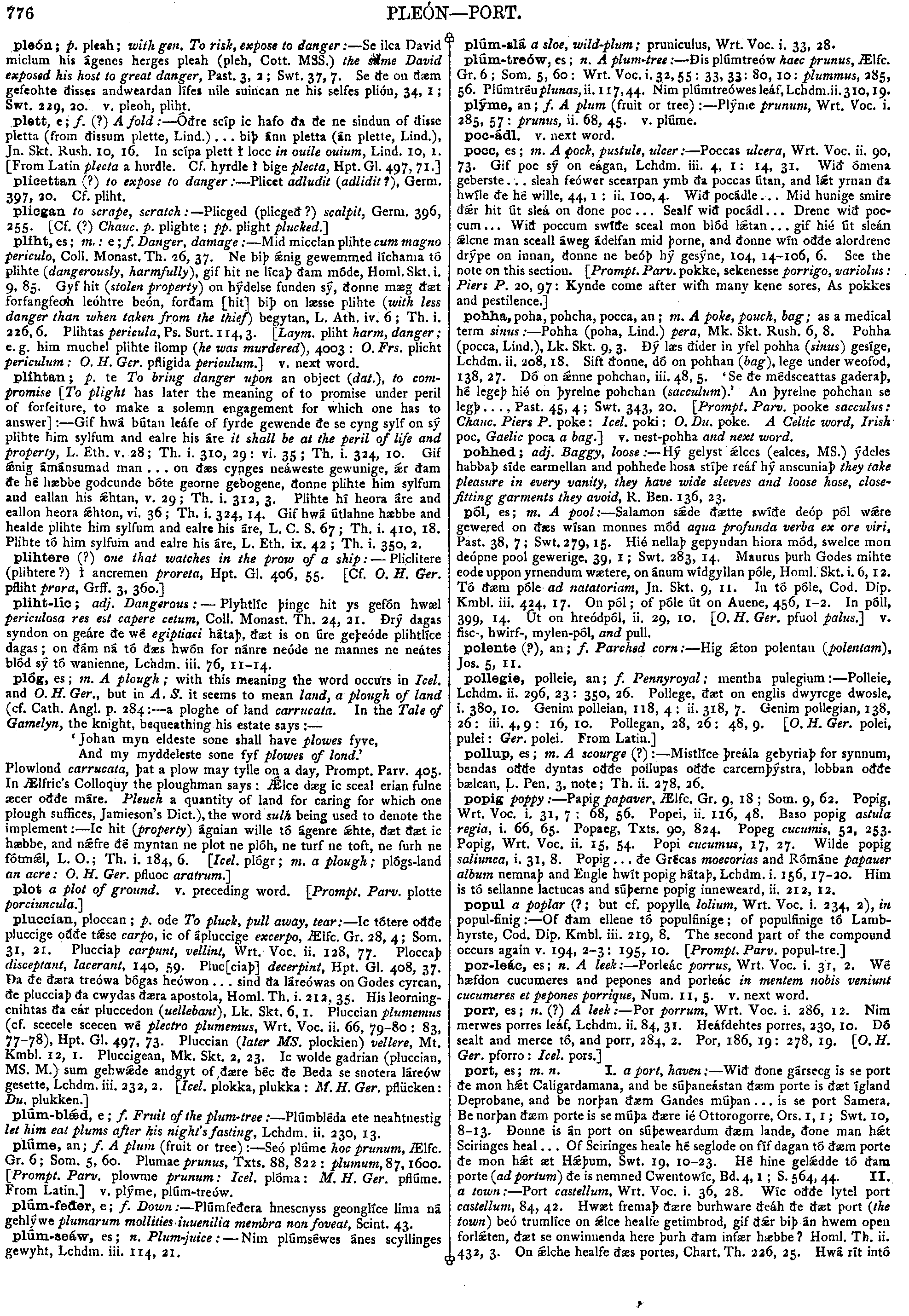
Plowlond
carrucata,
þat
a
plow
may
tylle
on
a
day,
Prompt.
Parv.
405.
In
Ælfric's
Colloquy
the
ploughman
says
:
Æ-acute;lce
dæg
ic
sceal
erian
fulne
æcer
oððe
máre.
Pleuch
a
quantity
of
land
for
caring
for
which
one
plough
suffices,
Jamieson's
Dict.),
the
word
sulh
being
used
to
denote
the
implement
:--
Ic
hit
(property)
ágnian
wille
tó
ágenre
hte,
ðæt
ðæt
ic
hæbbe,
and
nfre
ðé
myntan
ne
plot
ne
plóh,
ne
turf
ne
toft,
ne
furh
ne
fótml,
L.
O.;
Th.
i.
184,
6.
[Icel.
plógr;
m.
a
plough;
plógs-land
an
acre:
O.
H.
Ger.
pfluoc
aratrum.]
|
Source: Bosworth/Toller, page b0803, entry 18 View original page image as: [TIFF] [PNG] [View previous entry] [View next entry] |
[Comment on this entry] [View comments] |
The following entry has been hand-corrected once. |
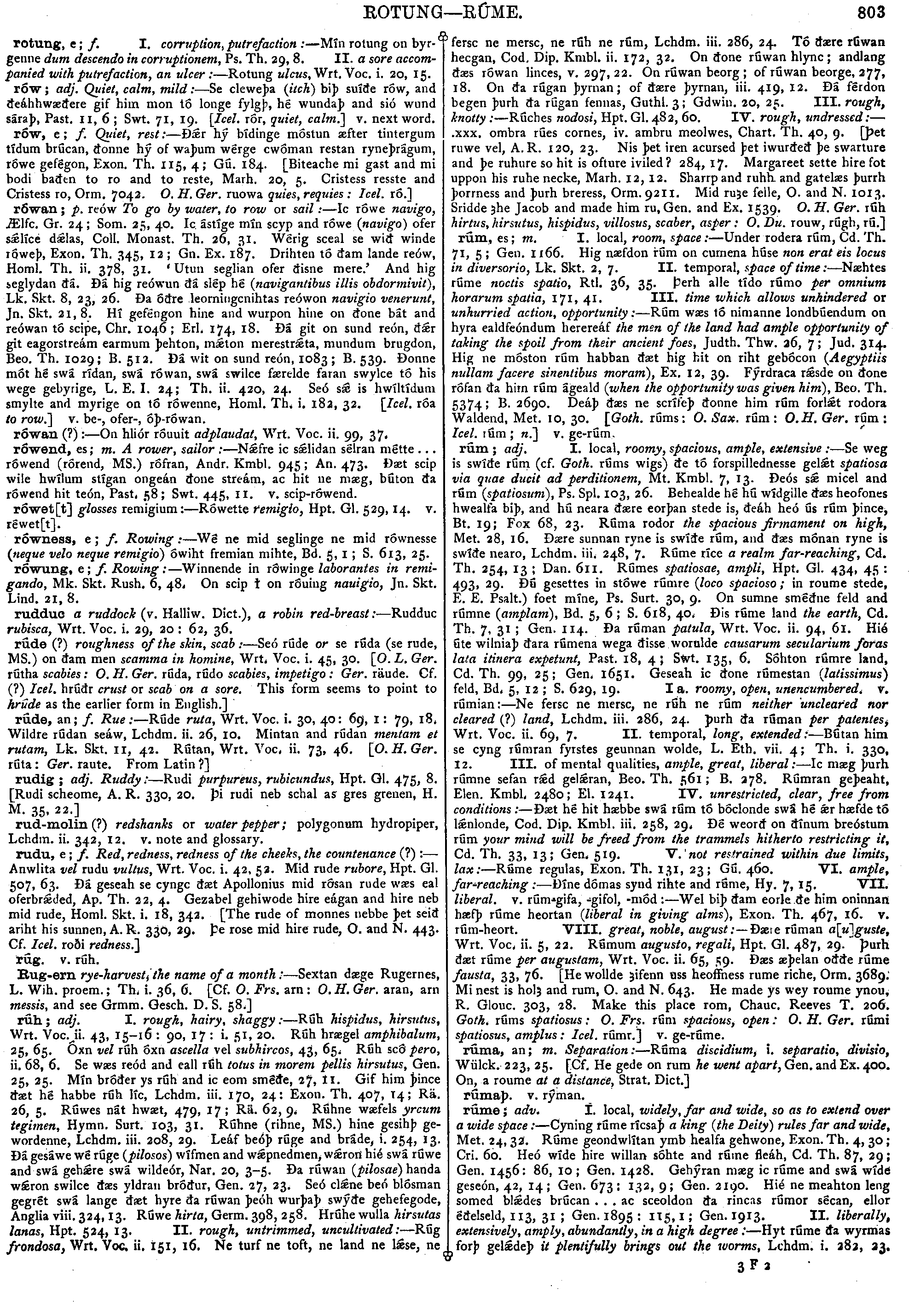
rúh;
adj.
I.
rough,
hairy,
shaggy
:--
Rúh
hispidus,
hirsutus,
Wrt.
Voc.
ii.
43,
15-16
:
90,
17
:
i.
51,
20.
Rúh
hrægel
amphibalum,
25,
65.
Óxn
vel
rúh
óxn
ascella
vel
subhircos,
43,
65.
Rúh
scó
pero,
ii.
68,
6.
Se
wæs
reód
and
eall
rúh
totus
in
morem
pellis
hirsutus,
Gen.
25,
25.
Min
bróðer
ys
rúh
and
ic
eom
sméðe,
27,
11.
Gif
him
þince
ðæt
hé
habbe
rúh
líc,
Lchdm.
iii.
170,
24
:
Exon.
Th.
407,
14;
Rä.
26,
5.
Rúwes
nát
hwæt,
479,
17;
Rä.
62,
9.
Rúhne
wæfels
yrcum
tegimen,
Hymn.
Surt.
103,
31.
Rúhne
(rihne,
MS.)
hine
gesihþ
gewordenne,
Lchdm.
iii.
208,
29.
Leáf
beóþ
rúge
and
bráde,
i.
254,
13.
Ðá
gesáwe
wé
rúge
(pilosos)
wífmen
and
wpnedmen,
wron
hié
swá
rúwe
and
swá
gehre
swá
wildeór,
Nar.
20,
3-5.
Ða
rúwan
(pilosae)
handa
wron
swilce
ðæs
yldran
bróður,
Gen.
27,
23.
Seó
clne
beó
blósman
gegrét
swá
lange
ðæt
hyre
ða
rúwan
þeóh
wurþaþ
swýðe
gehefegode,
Anglia
viii.
324,13.
Rúwe
hirta,
Germ.
398,
258.
Hrúhe
wulla
hirsutas
lanas,
Hpt.
524,
13.
II.
rough,
untrimmed,
uncultivated
:--
Rúg
frondosa,
Wrt.
Voc,
ii.
151,
16.
Ne
turf
ne
toft,
ne
land
ne
lse,
ne
fersc
ne
mersc,
ne
rúh
ne
rúm,
Lchdm.
iii.
286,
24.
Tó
ðære
rúwan
hecgan,
Cod.
Dip.
Kmbl.
ii.
172,
32.
On
ðone
rúwan
hlync;
andlang
ðæs
rówan
linces,
v.
297,
22.
On
rúwan
beorg;
of
rúwan
beorge,
277,
18.
On
ða
rúgan
þyrnan;
of
ðære
þyrnan,
iii.
419,
12.
Ðá
férdon
begen
þurh
ða
rúgan
fennas,
Guthl.
3;
Gdwin.
20,
25.
III.
rough,
knotty
:--
Rúches
nodosi,
Hpt.
G1.
482,
60.
IV.
rough,
undressed
:--
.xxx.
ombra
rúes
cornes,
iv.
ambru
meolwes,
Chart.
Th.
40,
9.
[Þet
ruwe
vel,
A.
R.
120,
23.
Nis
þet
iren
acursed
þet
iwurðeð
þe
swarture
and
þe
ruhure
so
hit
is
ofture
iviled?
284,
17.
Margareet
sette
hire
fot
uppon
his
ruhe
necke,
Marh.
12,
12.
Sharrp
and
ruhh
and
gatelæs
þurrh
þorrness
and
þurh
breress,
Orm.
9211.
Mid
ru e
felle,
O.
and
N.
1013.
Sridde
he
Jacob
and
made
him
ru,
Gen.
and
Ex.
1539.
O.
H.
Ger.
rúh
hirtus,
hirsutus,
hispidus,
villosus,
scaber,
asper
:
O.
Du.
rouw,
rúgh,
rú.]
e
felle,
O.
and
N.
1013.
Sridde
he
Jacob
and
made
him
ru,
Gen.
and
Ex.
1539.
O.
H.
Ger.
rúh
hirtus,
hirsutus,
hispidus,
villosus,
scaber,
asper
:
O.
Du.
rouw,
rúgh,
rú.]
|
Source: Bosworth/Toller, page b1021, entry 7 View original page image as: [TIFF] [PNG] [View previous entry] [View next entry] |
[Comment on this entry] [View comments] |
The following entry has been hand-corrected once. |
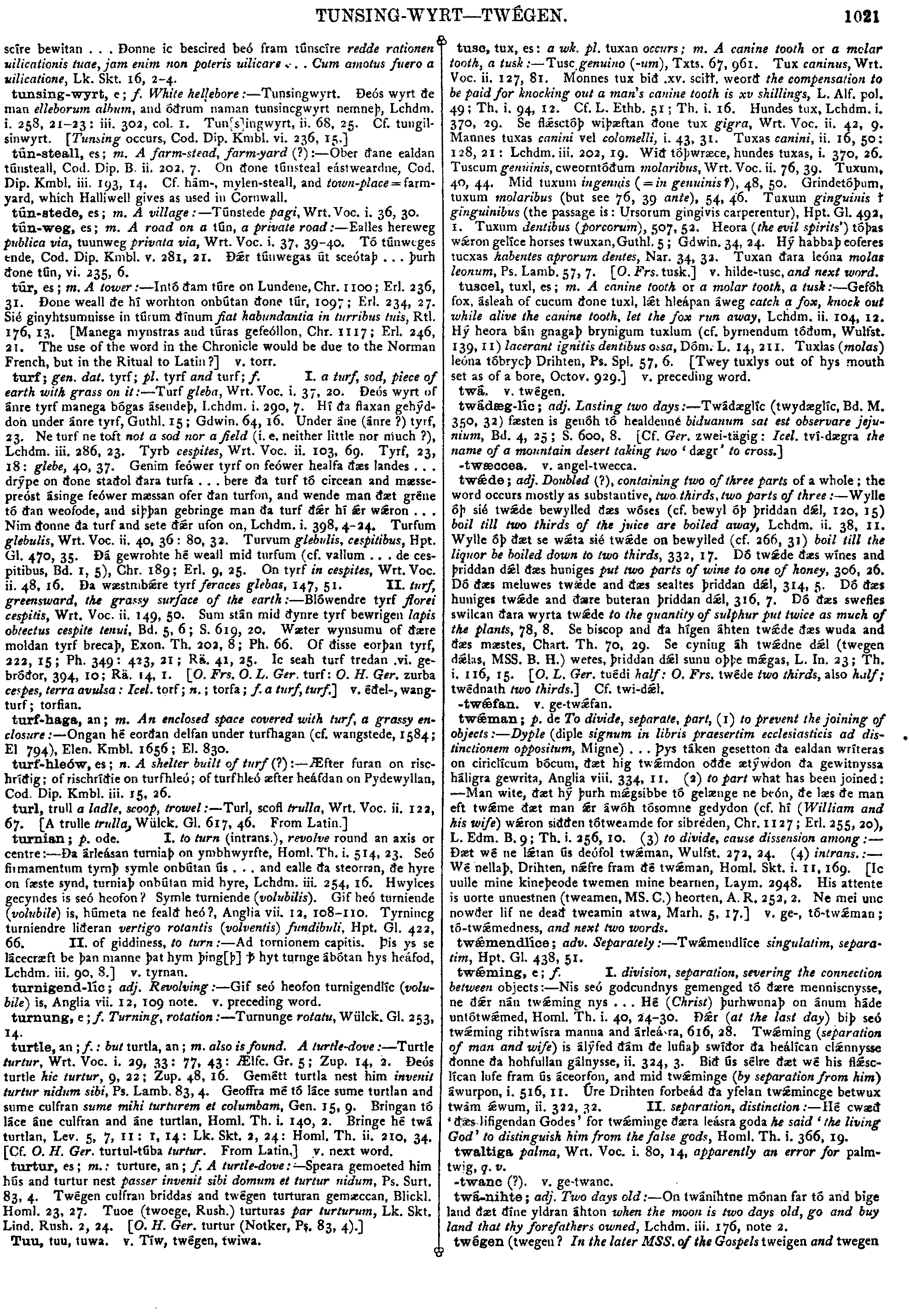
turf;
gen.
dat.
tyrf;
pl.
tyrf
and
turf;
f.
I.
a
turf,
sod,
piece
of
earth
with
grass
on
it:--Turf
gleba,
Wrt.
Voc.
i.
37,
20.
Ðeós
wyrt
of
ánre
tyrf
manega
bógas
ásendeþ,
Lchdm.
i.
290,
7.
Hí
ða
flaxan
gehýddon
under
ánre
tyrf,
Guthl.
15;
Gdwin.
64,
16.
Under
áne
(ánre?)
tyrf,
23.
Ne
turf
ne
toft
not
a
sod
nor
a
field
(i.
e.
neither
little
nor
much?),
Lchdm.
iii.
286,
23.
Tyrb
cespites,
Wrt.
Voc.
ii.
103,
69.
Tyrf,
23,
18:
glebe,
40,
37.
Genim
feówer
tyrf
on
feówer
healfa
ðæs
landes
.
.
.
drýpe
on
ðone
staðol
ðara
turfa
.
.
.
bere
ða
turf
tó
circean
and
maesse preóst
ásinge
feówer
mæssan
ofer
ðan
turfon,
and
wende
man
ðæt
gréne
tó
ðan
weofode,
and
siþþan
gebringe
man
ða
turf
ðr
hí
r
wron
.
.
.
Nim
ðonne
ða
turf
and
sete
ðr
ufon
on,
Lchdm.
i.
398,
4-24.
Turfum
glebulis,
Wrt.
Voc.
ii.
40,
36:
80,
32.
Turvum
glebulis,
cespitibus,
Hpt.
Gl.
470,
35.
Ðá
gewrohte
hé
weall
mid
turfum
(cf.
vallum
.
.
.
de
cespitibus,
Bd.
1,
5),
Chr.
189;
Erl.
9,
25.
On
tyrf
in
cespites,
Wrt.
Voc.
ii.
48,
16.
Ða
wæstmbre
tyrf
feraces
glebas,
147,
51.
II.
turf,
greensward,
the
grassy
surface
of
the
earth:--Blówendre
tyrf
florei
cespitis,
Wrt.
Voc.
ii.
149,
50.
Sum
stán
mid
ðynre
tyrf
bewrigen
lapis
obtectus
cespite
tenui,
Bd.
5,
6;
S.
619,
20.
Wæter
wynsumu
of
ðære
moldan
tyrf
brecaþ,
Exon.
Th.
202,
8;
Ph.
66.
Of
ðisse
eorþan
tyrf,
222,
15;
Ph.
349:
423,
21;
Rä.
41,
25.
Ic
seah
turf
tredan
.vi.
gebróðor,
394,
10;
Rä.
14,
1.
[O.
Frs.
O.
L.
Ger.
turf:
O.
H.
Ger.
zurba
cespes,
terra
avulsa:
Icel.
torf;
n.;
torfa;
f.
a
turf,
turf.]
v.
éðel-,
wang-turf;
torfian.
preóst
ásinge
feówer
mæssan
ofer
ðan
turfon,
and
wende
man
ðæt
gréne
tó
ðan
weofode,
and
siþþan
gebringe
man
ða
turf
ðr
hí
r
wron
.
.
.
Nim
ðonne
ða
turf
and
sete
ðr
ufon
on,
Lchdm.
i.
398,
4-24.
Turfum
glebulis,
Wrt.
Voc.
ii.
40,
36:
80,
32.
Turvum
glebulis,
cespitibus,
Hpt.
Gl.
470,
35.
Ðá
gewrohte
hé
weall
mid
turfum
(cf.
vallum
.
.
.
de
cespitibus,
Bd.
1,
5),
Chr.
189;
Erl.
9,
25.
On
tyrf
in
cespites,
Wrt.
Voc.
ii.
48,
16.
Ða
wæstmbre
tyrf
feraces
glebas,
147,
51.
II.
turf,
greensward,
the
grassy
surface
of
the
earth:--Blówendre
tyrf
florei
cespitis,
Wrt.
Voc.
ii.
149,
50.
Sum
stán
mid
ðynre
tyrf
bewrigen
lapis
obtectus
cespite
tenui,
Bd.
5,
6;
S.
619,
20.
Wæter
wynsumu
of
ðære
moldan
tyrf
brecaþ,
Exon.
Th.
202,
8;
Ph.
66.
Of
ðisse
eorþan
tyrf,
222,
15;
Ph.
349:
423,
21;
Rä.
41,
25.
Ic
seah
turf
tredan
.vi.
gebróðor,
394,
10;
Rä.
14,
1.
[O.
Frs.
O.
L.
Ger.
turf:
O.
H.
Ger.
zurba
cespes,
terra
avulsa:
Icel.
torf;
n.;
torfa;
f.
a
turf,
turf.]
v.
éðel-,
wang-turf;
torfian.
|
Source: Bosworth/Toller, page d0645, entry 4 View original page image as: [TIFF] [PNG] [View previous entry] [View next entry] |
[Comment on this entry] [View comments] |
The following entry has been hand-corrected once. |
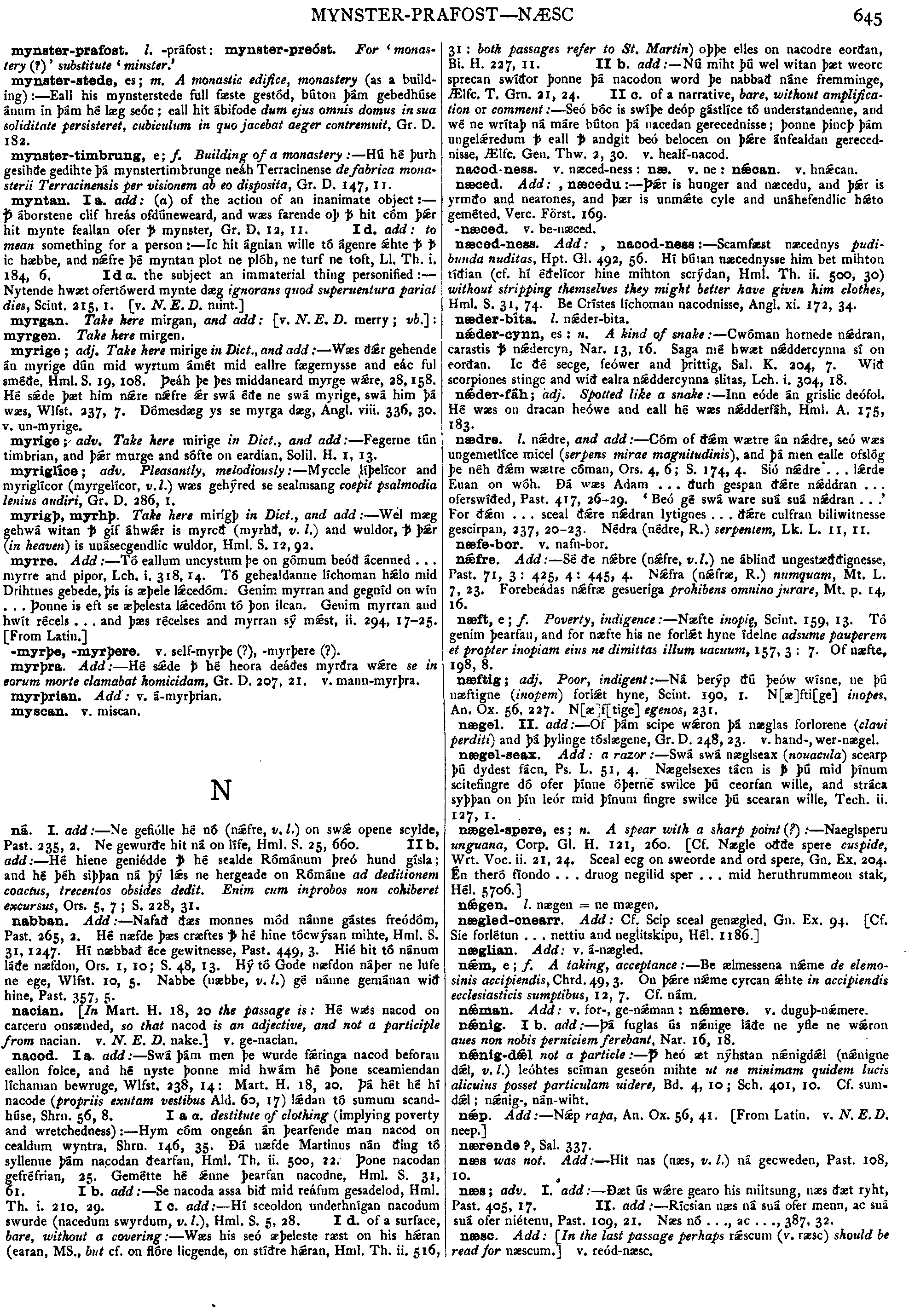
myntan.
I
a.
add:
(a)
of
the
action
of
an
inanimate
object
:--
 áborstene
clif
hreás
ofdúmeweard,
and
wæs
farende
oþ
hit
cóm
þr
hit
mynte
feallan
ofer
mynster,
Gr.
D.
12,
II.
I
d.
add:
to
mean
something
for
a
person
:--
Ic
hit
ágnian
wille
tó
ágenre
hte
ic
hæbbe,
and
nfre
þé
myntan
plot
ne
plóh,
ne
turf
ne
toft,
Ll.
Th.
i.
184,
6.
I
d
a.
the
subject
an
immaterial
thing
personified
:--
Nytende
hwæt
ofertó;werd
mynte
dæg
ignorans
quod
superuentura
pariat
dies,
Scint.
215,
I.
[v.
N.
E.
D.
mint.]
áborstene
clif
hreás
ofdúmeweard,
and
wæs
farende
oþ
hit
cóm
þr
hit
mynte
feallan
ofer
mynster,
Gr.
D.
12,
II.
I
d.
add:
to
mean
something
for
a
person
:--
Ic
hit
ágnian
wille
tó
ágenre
hte
ic
hæbbe,
and
nfre
þé
myntan
plot
ne
plóh,
ne
turf
ne
toft,
Ll.
Th.
i.
184,
6.
I
d
a.
the
subject
an
immaterial
thing
personified
:--
Nytende
hwæt
ofertó;werd
mynte
dæg
ignorans
quod
superuentura
pariat
dies,
Scint.
215,
I.
[v.
N.
E.
D.
mint.]
|
Source: Cleasby/Vigfusson, page b0003, entry 7 View original page image as: [TIFF] [PNG] [View previous entry] [View next entry] |
[Comment on this entry] [View comments] |
The following entry has been hand-corrected once. |
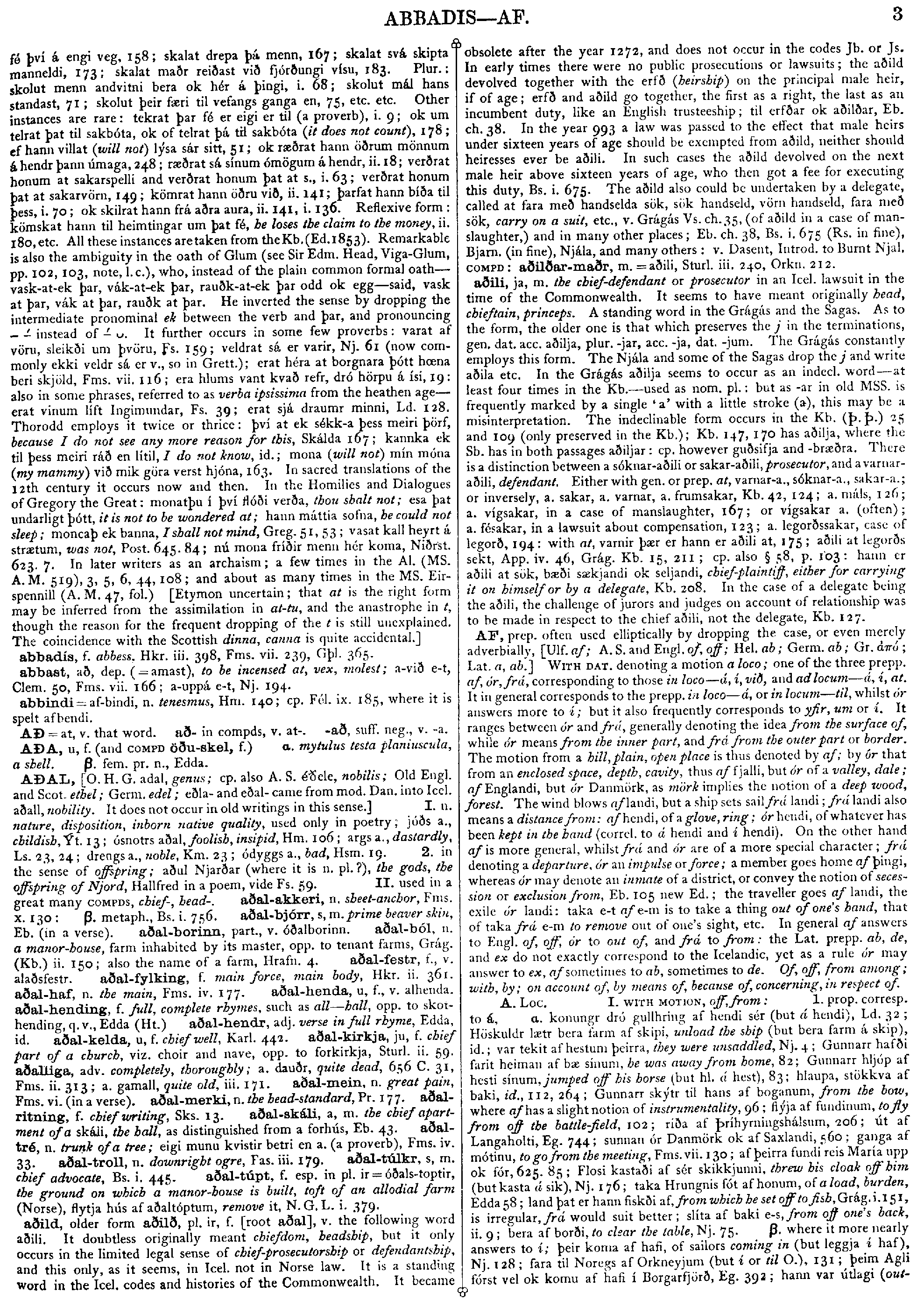
AÐAL,
[O.
H.
G.
adal,
genus;
cp.
also
A.
S.
éðele,
nobilis;
Old
Engl.
and
Scot,
ethel;
Germ,
edel;
eðla-
and
eðal-
came
from
mod.
Dan.
into
Icel.
aðall,
nobility.
It
does
not
occur
in
old
writings
in
this
sense.]
I.
n.
nature,
disposition,
inborn
native
quality,
used
only
in
poetry;
jóðs
a.,
childish,
Ýt.
13;
ósnotrs
aðal,
foolish,
insipid,
Hm.
106;
args
a.,
dastardly,
Ls.
23,
24;
drengs
a.,
noble,
Km.
23;
ódyggs
a.,
bad,
Hsm.
19.
2.
in
the
sense
of
offspring;
aðul
Njarðar
(where
it
is
n.
pl.?),
the
gods,
the
offspring
of
Njord,
Hallfred
in
a
poem,
vide
Fs.
59.
II.
used
in
a
great
many
COMPDS,
chief-,
head-.
aðal-akkeri,
n.
sheet-anchor,
Fms.
x.
130:
 .
metaph.,
Bs.
i.
756.
aðal-bjórr,
s,
m.
prime
beaver
skin,
Eb.
(in
a
verse).
aðal-borinn,
part.,
v.
óðalborinn.
aðal-ból,
n.
a
manor-house,
farm
inhabited
by
its
master,
opp.
to
tenant
farms,
Grág.
(Kb.)
ii.
150;
also
the
name
of
a
farm,
Hrafn.
4.
aðal-festr,
f.,
v.
alaðsfestr.
aðal-fylking,
f.
main
force,
main
body,
Hkr.
ii.
361.
aðal-haf,
n.
the
main,
Fms.
iv.
177.
aðal-henda,
u,
f.,
v.
alhenda.
aðal-hending,
f.
full,
complete
rhymes,
such
as
all
--
hall,
opp.
to
skot-
hending,
q.
v.,
Edda
(Ht.)
aðal-hendr,
adj.
verse
in
full
rhyme,
Edda,
id.
aðal-kelda,
u,
f.
chief
well,
Karl.
442.
aðal-kirkja,
ju,
f.
chief
part
of
a
church,
viz.
choir
and
nave,
opp.
to
forkirkja,
Sturl.
ii.
59.
aðalliga,
adv.
completely,
thoroughly;
a.
dauðr,
quite
dead,
656
C.
31,
Fms.
ii.
313;
a.
gamall,
quite
old,
iii.
171.
aðal-mein,
n.
great
pain,
Fms.
vi.
(in
a
verse),
aðal-merki,
n.
the
head-standard,
Pr.
177.
aðal-
ritning,
f.
chief
writing,
Sks.
13.
aðal-skáli,
a,
m.
the
chief
apart-
ment
of
a
skáli,
the
hall,
as
distinguished
from
a
forhús,
Eb.
43.
aðal-
tré,
n.
trunk
of
a
tree;
eigi
munu
kvistir
betri
en
a.
(a
proverb),
Fms.
iv.
33.
aðal-troll,
n.
downright
ogre,
Fas.
iii.
179.
aðal-túlkr,
s,
m.
chief
advocate,
Bs.
i.
445.
aðal-túpt,
f.
esp.
in
pl.
ir
=
óðals-toptir,
the
ground
on
which
a
manor-bouse
is
built,
toft
of
an
allodial
farm
(Norse),
flytja
hús
af
aðaltóptum,
remove
it,
N.
G.
L.
i.
.
metaph.,
Bs.
i.
756.
aðal-bjórr,
s,
m.
prime
beaver
skin,
Eb.
(in
a
verse).
aðal-borinn,
part.,
v.
óðalborinn.
aðal-ból,
n.
a
manor-house,
farm
inhabited
by
its
master,
opp.
to
tenant
farms,
Grág.
(Kb.)
ii.
150;
also
the
name
of
a
farm,
Hrafn.
4.
aðal-festr,
f.,
v.
alaðsfestr.
aðal-fylking,
f.
main
force,
main
body,
Hkr.
ii.
361.
aðal-haf,
n.
the
main,
Fms.
iv.
177.
aðal-henda,
u,
f.,
v.
alhenda.
aðal-hending,
f.
full,
complete
rhymes,
such
as
all
--
hall,
opp.
to
skot-
hending,
q.
v.,
Edda
(Ht.)
aðal-hendr,
adj.
verse
in
full
rhyme,
Edda,
id.
aðal-kelda,
u,
f.
chief
well,
Karl.
442.
aðal-kirkja,
ju,
f.
chief
part
of
a
church,
viz.
choir
and
nave,
opp.
to
forkirkja,
Sturl.
ii.
59.
aðalliga,
adv.
completely,
thoroughly;
a.
dauðr,
quite
dead,
656
C.
31,
Fms.
ii.
313;
a.
gamall,
quite
old,
iii.
171.
aðal-mein,
n.
great
pain,
Fms.
vi.
(in
a
verse),
aðal-merki,
n.
the
head-standard,
Pr.
177.
aðal-
ritning,
f.
chief
writing,
Sks.
13.
aðal-skáli,
a,
m.
the
chief
apart-
ment
of
a
skáli,
the
hall,
as
distinguished
from
a
forhús,
Eb.
43.
aðal-
tré,
n.
trunk
of
a
tree;
eigi
munu
kvistir
betri
en
a.
(a
proverb),
Fms.
iv.
33.
aðal-troll,
n.
downright
ogre,
Fas.
iii.
179.
aðal-túlkr,
s,
m.
chief
advocate,
Bs.
i.
445.
aðal-túpt,
f.
esp.
in
pl.
ir
=
óðals-toptir,
the
ground
on
which
a
manor-bouse
is
built,
toft
of
an
allodial
farm
(Norse),
flytja
hús
af
aðaltóptum,
remove
it,
N.
G.
L.
i.
|
Source: Cleasby/Vigfusson, page b0137, entry 2 View original page image as: [TIFF] [PNG] [View previous entry] [View next entry] |
[Comment on this entry] [View comments (3)] |
The following entry has been hand-corrected once. |
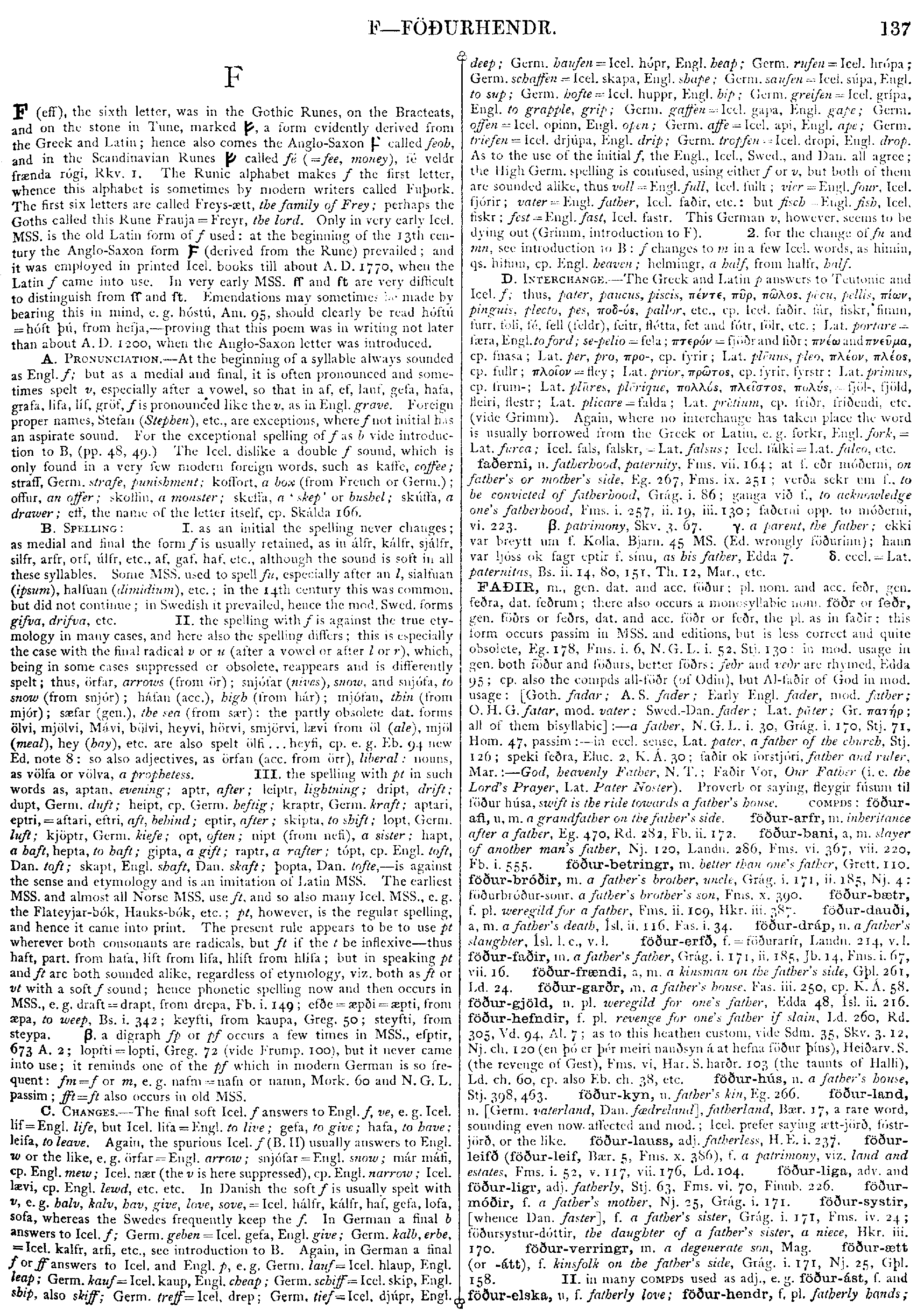
F
(eff),
the
sixth
letter,
was
in
the
Gothic
Runes,
on
the
Bracteats,
and
on
the
stone
in
Tune,
marked
RUNE,
a
form
evidently
derived
from
the
Greek
and
Latin;
hence
also
comes
the
Anglo-Saxon
RUNE
called
feoh,
and
in
the
Scandinavian
Runes
RUNE
called
fé
(=fee,
money),
fé
veldr
frænda
rógi,
Rkv.
I.
The
Runic
alphabet
makes
f
the
first
letter,
whence
this
alphabet
is
sometimes
by
modern
writers
called
Fuþork.
The
first
six
letters
are
called
Freys-ætt,
the
family
of
Frey;
perhaps
the
Goths
called
this
Rune
Frauja
=
Freyr,
the
lord.
Only
in
very
early
Icel.
MSS.
is
the
old
Latin
form
of
f
used:
at
the
beginning
of
the
13th
century
the
Anglo-Saxon
form
RUNE
(derived
from
the
Rune)
prevailed;
and
it
was
employed
in
printed
Icel.
books
till
about
A.
D.
1770,
when
the
Latin
f
came
into
use.
In
very
early
MSS.
ff
and
ft
are
very
difficult
to
distinguish
from
ff
and
ft.
Emendations
may
sometimes
be
made
by
bearing
this
in
mind,
e.
g.
hóstú,
Am.
95,
should
clearly
be
read
hóftú
=
hóft
þú,
from
hefja,
--
proving
that
this
poem
was
in
writing
not
later
than
about
A.
D.
1200,
when
the
Anglo-Saxon
letter
was
introduced.
A.
PRONUNCIATION.
--
At
the
beginning
of
a
syllable
always
sounded
as
Engl.
f;
but
as
a
medial
and
final,
it
is
often
pronounced
and
sometimes
spelt
v,
especially
after
a
vowel,
so
that
in
af,
ef,
lauf,
gefa,
hafa,
grafa,
lifa,
líf,
gröf,
f
is
pronounced
like
the
v,
as
in
Engl.
grave.
Foreign
proper
names,
Stefan
(Stephen),
etc.,
are
exceptions,
where
f
not
initial
has
an
aspirate
sound.
For
the
exceptional
spelling
of
f
as
b
vide
introduction
to
B,
(pp.
48,
49.)
The
Icel.
dislike
a
double
f
sound,
which
is
only
found
in
a
verv
few
modern
foreign
words,
such
as
kaffe,
coffee;
straff,
Germ,
strafe,
punishment;
koffort,
a
box
(from
French
or
Germ.);
offur,
an
offer;
skoffin,
a
monster;
skeffa,
a
'skep'
or
bushel;
skúffa,
a
drawer;
eff,
the
name
of
the
letter
itself,
cp.
Skálda
166.
B.
SPELLING:
I.
as
an
initial
the
spelling
never
changes;
as
medial
and
final
the
form
f
is
usually
retained,
as
in
álfr,
kálfr,
sjálfr,
silfr,
arfr,
orf,
úlfr,
etc.,
af,
gaf,
haf,
etc.,
although
the
sound
is
soft
in
all
these
syllables.
Some
MSS.
used
to
spell
fu,
especially
after
an
l,
sialfuan
(ipsum),
halfuan
(dimidium),
etc.;
in
the
14th
century
this
was
common,
but
did
not
continue;
in
Swedish
it
prevailed,
hence
the
mod.
Swed.
forms
gifva,
drifva,
etc.
II.
the
spelling
with
f
is
against
the
true
etymology
in
many
cases,
and
here
also
the
spelling
differs;
this
is
especially
the
case
with
the
final
radical
v
or
u
(after
a
vowel
or
after
l
or
r),
which,
being
in
some
cases
suppressed
or
obsolete,
reappears
and
is
differently
spelt;
thus,
örfar,
arrows
(from
ör);
snjófar
(nives),
snow,
and
snjófa,
to
snow
(from
snjór);
háfan
(acc.),
high
(from
hár);
mjófan,
thin
(from
mjór);
sæfar
(gen.),
the
sea
(from
sær):
the
partly
obsolete
dat.
forms
ölvi,
mjölvi,
Mávi,
bölvi,
heyvi,
hörvi,
smjörvi,
lævi
from
öl
(ale),
mjöl
(meal),
hey
(hay),
etc.
are
also
spelt
ölfi
...
heyfi,
cp.
e.
g.
Eb.
94
new
Ed.
note
8:
so
also
adjectives,
as
örfan
(acc.
from
örr),
liberal:
nouns,
as
völfa
or
völva,
a
prophetess.
III.
the
spelling
with
pt
in
such
words
as,
aptan,
evening;
aptr,
after;
leiptr,
lightning;
dript,
drift;
dupt,
Germ.
duft;
heipt,
cp.
Germ.
heftig;
kraptr,
Germ.
kraft;;
aptari,
eptri,
=
aftari,
eftri,
aft,
behind;
eptir,
after;
skipta,
to
shift;
lopt,
Germ.
luft;
kjöptr,
Germ.
UNCERTAIN;
opt,
often;
nipt
(from
nefi),
a
sister;
hapt,
a
haft,
hepta,
to
haft;
gipta,
a
gift;
raptr,
a
rafter;
tópt,
cp.
Engl.
toft,
Dan.
toft;
skapt,
Engl.
shaft,
Dan.
skaft;
þopta,
Dan.
tofte,
--
is
against
the
sense
and
etymology
and
is
an
imitation
of
Latin
MSS.
The
earliest
MSS.
and
almost
all
Norse
MSS.
use
ft,
and
so
also
many
Icel.
MSS.,
e.
g.
the
Flateyjar-bók,
Hauks-bók,
etc.;
pt,
however,
is
the
regular
spelling,
and
hence
it
came
into
print.
The
present
rule
appears
to
be
to
use
pt
wherever
both
consonants
are
radicals,
but
ft
if
the
t
be
inflexive
--
thus
haft,
part.
from
hafa,
líft
from
lifa,
hlíft
from
hlífa;
but
in
speaking
pt
and
ft
are
both
sounded
alike,
regardless
of
etymology,
viz.
both
as
ft
or
vt
with
a
soft
f
sound;
hence
phonetic
spelling
now
and
then
occurs
in
MSS.,
e.
g.
draft
--
drapt,
from
drepa,
Fb.
i.
149;
efðe
=
æpði
=
æpti,
from
æpa,
to
weep,
Bs.
i.
342;
keyfti,
from
kaupa,
Greg.
50;
steyfti,
from
steypa.
.
a
digraph
fp
or
pf
occurs
a
few
times
in
MSS.,
efptir,
673
A.
2;
lopfti
=
lopti,
Greg.
72
(vide
Frump.
100),
but
it
never
came
into
use;
it
reminds
one
of
the
pf
which
in
modern
German
is
so
frequent:
fm
--
f
or
m,
e.
g.
nafm
--
nafn
or
namn,
Mork.
60
and
N.
G.
L.
passim;
fft=ft
also
occurs
in
old
MSS.
C.
CHANGES.
--
The
final
soft
Icel.
f
answers
to
Engl.
f,
ve,
e.
g.
Icel.
líf
=
Engl.
life,
but
Icel.
lifa
=
Engl.
to
live;
gefa,
to
give;
hafa,
to
have;
leifa,
to
leave.
Again,
the
spurious
Icel.
f
(B.
II)
usually
answers
to
Engl.
w
or
the
like,
e.
g.
örfar
=
Engl.
arrow;
snjófar
=
Engl.
snow;
már
náfi,
cp.
Engl.
mew;
Icel.
nær
(the
v
is
here
suppressed),
cp.
Engl.
narrow;
Icel.
lævi,
cp.
Engl.
lewd,
etc.
etc.
In
Danish
the
soft
f
is
usually
spelt
with
v,
e.
g.
halv,
kalv,
hav,
give,
love,
sove,
--
Icel.
hálfr,
kálfr,
haf,
gefa,
lofa,
sofa,
whereas
the
Swedes
frequently
keep
the
f.
In
German
a
final
b
answers
to
Icel.
f;
Germ.
geben
=
Icel.
gefa,
Engl.
give;
Germ.
kalb,
erbe,
=
Icel.
kalfr,
arfi,
etc.,
see
introduction
to
B.
Again,
in
German
a
final
f
or
ff
answers
to
Icel.
and
Engl.
p,
e.
g.
Germ.
lauf
=Icel.
hlaup,
Engl.
leap;
Germ.
kauf
=
Icel.
kaup,
Engl.
cheap;
Germ.
schiff
=
Icel.
skip,
Engl.
ship,
also
skiff;
Germ.
treff
=
Icel.
drep;
Germ.
tief
=
Icel.
djúpr,
Engl.
deep;
Germ.
haufen
=
Icel.
hópr,
Engl.
heap;
Germ.
rufen
=
Icel.hrópa;
Germ.
schaffen
=
Icel.
skapa,
Engl.
shape;
Germ.
saufen
=
Icel.
súpa,
Engl.
to
sup;
Germ.
UNCERTAIN
=
Icel.
huppr,
Engl.
hip;
Germ.
greifen
=
Icel.
grípa,
Engl.
to
grapple,
grip;
Germ.
gaffen
=
Icel.
gapa,
Engl.
gape;
Germ.
offen
=
Icel.
opinn,
Engl.
open;
Germ.
affe
=
Icel.
api,
Engl.
ape;
Germ.
triefen
=
Icel.
drjúpa,
Engl.
drip;
Germ.
tropfen
=
Icel.
dropi,
Engl.
drop.
As
to
the
use
of
the
initial
f,
the
Engl.,
Icel.,
Swed.,
and
Dan.
all
agree;
the
High
Germ.
spelling
is
confused,
using
either
f
or
v,
but
both
of
them
are
sounded
alike,
thus
voll
=
Engl.
full,
Icel.
fullr;
vier
=
Engl.
four,
Icel.
fjórir;
vater
=
Engl.
father,
Icel.
faðir,
etc.:
but
fisch
=
Engl.
fish,
Icel.
fiskr;
fest
=
Engl.
fast,
Icel.
fastr.
This
German
v,
however,
seems
to
be
dying
out
(Grimm,
introduction
to
F).
2.
for
the
change
of
fn
and
mn,
see
introduction
to
B:
f
changes
to
m
in
a
few
Icel.
words,
as
himin,
qs.
hiffin,
cp.
Engl.
heaven;
helmingr,
a
half,
from
halfr,
half.
D.
INTERCHANGE.
--
The
Greek
and
Latin
p
answers
to
Teutonic
and
Icel.
f;
thus,
pater,
paucus,
piscis,
GREEK,
GREEK,
GREEK,
pecu,
pellis,
GREEK,
pinguis,
plecto,
pes,
GREEK,
pallor,
etc.,
cp.
Icel.
faðir,
fár,
fiskr,
fimm,
furr,
foli,
fé,
fell
(feldr),
feitr,
flétta,
fet
and
fótr,
fólr,
etc.;
Lat.
portare
=
færa,
Engl.
to
ford;
se-pelio
=
fela;
GREEK
=
fjóðr
and
fiðr;
GREEK
and
GREEK,
cp.
fnasa;
Lat.
per,
pro,
GREEK
cp.
fyrir;
Lat.
pl nus,
pleo,
GREEK,
GREEK,
cp.
fullr;
GREEK
=
fley;
Lat.
prior,
GREEK,
cp.
fyrir,
fyrstr:
Lat.
primus,
cp.
frum-;
Lat.
pl
nus,
pleo,
GREEK,
GREEK,
cp.
fullr;
GREEK
=
fley;
Lat.
prior,
GREEK,
cp.
fyrir,
fyrstr:
Lat.
primus,
cp.
frum-;
Lat.
pl res,
plrique,
GREEK,
GREEK,
GREEK
=
fjöl-,
fjöd,
fleiri,
flestr;
Lat.
plicare
=
falda;
Lat.
prtium,
cp.
friðr,
fríðendi,
etc.
(vide
Grimm).
Again,
where
no
interchange
has
taken
place
the
word
is
usually
borrowed
from
the
Greek
or
Latin,
e.
g.
forkr,
Engl.
fork
=
Lat.
furca;
Icel.
fals,
falskr
=
Lat.
falsus;
Icel.
fálki
=
Lat.
falco,
etc.
faðerni,
n.
fatherhood,
paternity,
Fms.
vii.
164;
at
f.
eðr
móðerni,
on
father's
or
mother's
side,
Eg.
267,
Fms.
ix.
251;
verða
sekr
um
f.,
to
be
convicted
of
fatherhood,
Grág.
i.
86;
ganga
við
f.,
to
acknowledge
one's
fatherhood,
Fms.
i.
257,
ii.
19,
iii.
130;
faðerni
opp.
to
móðerni,
vi.
223.
.
patrimony,
Skv.
3.
67.
res,
plrique,
GREEK,
GREEK,
GREEK
=
fjöl-,
fjöd,
fleiri,
flestr;
Lat.
plicare
=
falda;
Lat.
prtium,
cp.
friðr,
fríðendi,
etc.
(vide
Grimm).
Again,
where
no
interchange
has
taken
place
the
word
is
usually
borrowed
from
the
Greek
or
Latin,
e.
g.
forkr,
Engl.
fork
=
Lat.
furca;
Icel.
fals,
falskr
=
Lat.
falsus;
Icel.
fálki
=
Lat.
falco,
etc.
faðerni,
n.
fatherhood,
paternity,
Fms.
vii.
164;
at
f.
eðr
móðerni,
on
father's
or
mother's
side,
Eg.
267,
Fms.
ix.
251;
verða
sekr
um
f.,
to
be
convicted
of
fatherhood,
Grág.
i.
86;
ganga
við
f.,
to
acknowledge
one's
fatherhood,
Fms.
i.
257,
ii.
19,
iii.
130;
faðerni
opp.
to
móðerni,
vi.
223.
.
patrimony,
Skv.
3.
67.
 .
a
parent,
the
father;
ekki
var
breytt
um
f.
Kolla,
Bjarn.
45
MS.
(Ed.
wrongly
föðurinn);
hann
var
ljóss
ok
fagr
eptir
f.
sínu,
as
his
father,
Edda
7.
.
a
parent,
the
father;
ekki
var
breytt
um
f.
Kolla,
Bjarn.
45
MS.
(Ed.
wrongly
föðurinn);
hann
var
ljóss
ok
fagr
eptir
f.
sínu,
as
his
father,
Edda
7.
 .
eccl.
=
Lat.
paternitas,
Bs.
ii.
14,
80,
151,
Th.
12,
Mar.,
etc.
FAÐIR,
m.,
gen.
dat.
and
acc.
föður:
pl.
nom.
and
acc.
feðr,
gen.
feðra,
dat.
feðrum;
there
also
occurs
a
monosyllabic
nom.
föðr
or
feðr,
gen.
föðrs
or
feðrs,
dat.
and
acc.
föðr
or
feðr,
the
pl.
as
in
faðir;
this
form
occurs
passim
in
MSS.
and
editions,
but
is
less
correct
and
quite
obsolete,
Eg.
178,
Fms.
i.
6,
N.
G.
L.
i.
52,
Stj.
130:
in
mod.
usage
in
gen.
both
föður
and
föðurs,
better
föðrs:
feðr
nd
veðr
are
rhymed,
Edda
95;
cp.
also
the
compds
all-föðr
(of
Odin),
but
Al-faðir
of
God
in
mod.
usage:
[Goth,
fadar;
A.
S.
fader;
Early
Engl.
fader,
mod.
father;
O.
H.
G.
fatar,
mod.
vater;
Swed.-Dan.
fader;
Lat.
p
.
eccl.
=
Lat.
paternitas,
Bs.
ii.
14,
80,
151,
Th.
12,
Mar.,
etc.
FAÐIR,
m.,
gen.
dat.
and
acc.
föður:
pl.
nom.
and
acc.
feðr,
gen.
feðra,
dat.
feðrum;
there
also
occurs
a
monosyllabic
nom.
föðr
or
feðr,
gen.
föðrs
or
feðrs,
dat.
and
acc.
föðr
or
feðr,
the
pl.
as
in
faðir;
this
form
occurs
passim
in
MSS.
and
editions,
but
is
less
correct
and
quite
obsolete,
Eg.
178,
Fms.
i.
6,
N.
G.
L.
i.
52,
Stj.
130:
in
mod.
usage
in
gen.
both
föður
and
föðurs,
better
föðrs:
feðr
nd
veðr
are
rhymed,
Edda
95;
cp.
also
the
compds
all-föðr
(of
Odin),
but
Al-faðir
of
God
in
mod.
usage:
[Goth,
fadar;
A.
S.
fader;
Early
Engl.
fader,
mod.
father;
O.
H.
G.
fatar,
mod.
vater;
Swed.-Dan.
fader;
Lat.
p ter;
Gr.
GREEK
all
of
them
bisyllabic]
:--
a
father,
N.
G.
L.
i.
30,
Grág.
i.
170,
Stj.
71,
Hom.
47,
passim
:--
in
eccl.
sense,
Lat.
pater,
a
father
of
the
church,
Stj.
126;
speki
feðra,
Eluc.
2,
K.
Á.
30;
faðir
ok
forstjóri,
father
and
ruler,
Mar.
:--
God,
heavenly
Father,
N.
T.;
Foðir
Vor,
Our
Father
(i.
e.
the
Lord's
Prayer,
Lat.
Pater
Noster).
Proverb
or
saying,
fleygir
fúsum
til
föður
húsa,
swift
is
the
ride
towards
a
father's
house.
COMPDS:
föður-afi,
u,
m.
a
grandfather
on
the
father's
side.
föður-arfr,
m.
inheritance
after
a
father,
Eg.
470,
Rd.
282,
Fb.
ii.
172.
föður-bani,
a,
m.
slayer
of
another
man's
father,
Nj.
120,
Landn.
286,
Fms.
vi.
367,
vii.
220,
Fb.
i.
555.
Föður-betringr,
m.
better
than
one's
father,
Grett.
110.
föður-bróðir,
m.
a
father's
brother,
uncle,
Grág;.
i.
171,
ii.
185,
Nj.
4:
föðurbróður-sonr,
a
father's
brother's
son,
Fms.
x.
390.
föður-bætr,
f.
pl.
weregild
for
a
father,
Fms.
ii.
109,
Hkr.
iii.
387.
föður-dauði,
a,
m.
a
father's
death,
Ísl.
ii.
116,
Fas.
i.
34.
föður-dráp,
n.
a
father's
slaughter,
Ísl.
l.
c.,
v.
l.
föður-erfð,
f.
=
föðurarfr,
Landn.
214,
v.
l.
föður-faðir,
m.
a
father's
father,
Grág.
i.
171,
ii.
185,
Jb.
14,
Fms.
i.
67,
vii.
16.
föður-frændi,
a,
m.
a
kinsman
on
the
father's
side,
Gþl.
261,
Ld.
24.
föður-garðr,
m.
a
father's
house,
Fas.
iii.
250,
cp.
K.
Á.
58.
föður-gjöld,
n.
pl.
weregild
for
one's
father,
Edda
48,
Ísl.
ii.
216.
föður-hefndir,
f.
pl.
revenge
for
one's
father
if
slain,
Ld.
260,
Rd.
305,
Vd.
94,
Al.
7;
as
to
this
heathen
custom,
vide
Sdm.
35,
Skv.
3.
12,
Nj.
ch.
120
(en
þó
er
þér
meiri
nauðsyná
at
hefna
föður
þíns),
Heiðarv.
S.
(the
revenge
of
Gest),
Fms.
vi,
Har.
S.
harðr.
103
(the
taunts
of
Halli),
Ld.
ch.
60,
cp.
also
Eb.
ch.
38,
etc.
föður-hús,
n.
a
father's
house,
Stj.
398,
463.
föður-kyn,
n.
father's
kin,
Eg.
266.
föður-land,
n.
[Germ.
vaterland,
Dan.
fædreland],
fatherland,
Bær.
17,
a
rare
word,
sounding
even
now
affected
and
mod.;
Icel.
prefer
saying
ætt-jörð,
fóstr-jörð,
or
the
like.
föður-lauss,
adj.
fatherless,
H.
E.
i.
237.
föður-leifð
(föður-leif,
Bær.
5,
Fms.
x.
386),
f.
a
patrimony,
viz.
land
and
estates,
Fms.
i.
52,
v.
117,
vii.
176,
Ld.
104.
föður-liga,
adv.
and
föður-ligr,
adj.
fatherly,
Stj.
63,
Fms.
vi.
70,
Finnb.
226.
föður-móðir,
f.
a
father's
mother,
Nj.
25,
Grág.
i.
171.
föður-systir,
[whence
Dan.
faster],
f.
a
father's
sister,
Grág.
i.
171,
Fms.
iv.
24;
füðursystur-dóttir,
the
daughter
of
a
father's
sister,
a
niece,
Hkr.
iii.
170.
föður-verringr,
m.
a
degenerate
son,
Mag.
föður-ætt
(or
-átt),
f.
kinsfolk
on
the
father's
side,
Grág.
i.
171,
Nj.
25,
Gþl.
158.
II.
in
many
COMPDS
used
as
adj.,
e.
g.
föður-ást,
f.
and
föður-elska,
u,
f.
fatherly
love;
föður-hendr,
f,
pl.
fatherly
ter;
Gr.
GREEK
all
of
them
bisyllabic]
:--
a
father,
N.
G.
L.
i.
30,
Grág.
i.
170,
Stj.
71,
Hom.
47,
passim
:--
in
eccl.
sense,
Lat.
pater,
a
father
of
the
church,
Stj.
126;
speki
feðra,
Eluc.
2,
K.
Á.
30;
faðir
ok
forstjóri,
father
and
ruler,
Mar.
:--
God,
heavenly
Father,
N.
T.;
Foðir
Vor,
Our
Father
(i.
e.
the
Lord's
Prayer,
Lat.
Pater
Noster).
Proverb
or
saying,
fleygir
fúsum
til
föður
húsa,
swift
is
the
ride
towards
a
father's
house.
COMPDS:
föður-afi,
u,
m.
a
grandfather
on
the
father's
side.
föður-arfr,
m.
inheritance
after
a
father,
Eg.
470,
Rd.
282,
Fb.
ii.
172.
föður-bani,
a,
m.
slayer
of
another
man's
father,
Nj.
120,
Landn.
286,
Fms.
vi.
367,
vii.
220,
Fb.
i.
555.
Föður-betringr,
m.
better
than
one's
father,
Grett.
110.
föður-bróðir,
m.
a
father's
brother,
uncle,
Grág;.
i.
171,
ii.
185,
Nj.
4:
föðurbróður-sonr,
a
father's
brother's
son,
Fms.
x.
390.
föður-bætr,
f.
pl.
weregild
for
a
father,
Fms.
ii.
109,
Hkr.
iii.
387.
föður-dauði,
a,
m.
a
father's
death,
Ísl.
ii.
116,
Fas.
i.
34.
föður-dráp,
n.
a
father's
slaughter,
Ísl.
l.
c.,
v.
l.
föður-erfð,
f.
=
föðurarfr,
Landn.
214,
v.
l.
föður-faðir,
m.
a
father's
father,
Grág.
i.
171,
ii.
185,
Jb.
14,
Fms.
i.
67,
vii.
16.
föður-frændi,
a,
m.
a
kinsman
on
the
father's
side,
Gþl.
261,
Ld.
24.
föður-garðr,
m.
a
father's
house,
Fas.
iii.
250,
cp.
K.
Á.
58.
föður-gjöld,
n.
pl.
weregild
for
one's
father,
Edda
48,
Ísl.
ii.
216.
föður-hefndir,
f.
pl.
revenge
for
one's
father
if
slain,
Ld.
260,
Rd.
305,
Vd.
94,
Al.
7;
as
to
this
heathen
custom,
vide
Sdm.
35,
Skv.
3.
12,
Nj.
ch.
120
(en
þó
er
þér
meiri
nauðsyná
at
hefna
föður
þíns),
Heiðarv.
S.
(the
revenge
of
Gest),
Fms.
vi,
Har.
S.
harðr.
103
(the
taunts
of
Halli),
Ld.
ch.
60,
cp.
also
Eb.
ch.
38,
etc.
föður-hús,
n.
a
father's
house,
Stj.
398,
463.
föður-kyn,
n.
father's
kin,
Eg.
266.
föður-land,
n.
[Germ.
vaterland,
Dan.
fædreland],
fatherland,
Bær.
17,
a
rare
word,
sounding
even
now
affected
and
mod.;
Icel.
prefer
saying
ætt-jörð,
fóstr-jörð,
or
the
like.
föður-lauss,
adj.
fatherless,
H.
E.
i.
237.
föður-leifð
(föður-leif,
Bær.
5,
Fms.
x.
386),
f.
a
patrimony,
viz.
land
and
estates,
Fms.
i.
52,
v.
117,
vii.
176,
Ld.
104.
föður-liga,
adv.
and
föður-ligr,
adj.
fatherly,
Stj.
63,
Fms.
vi.
70,
Finnb.
226.
föður-móðir,
f.
a
father's
mother,
Nj.
25,
Grág.
i.
171.
föður-systir,
[whence
Dan.
faster],
f.
a
father's
sister,
Grág.
i.
171,
Fms.
iv.
24;
füðursystur-dóttir,
the
daughter
of
a
father's
sister,
a
niece,
Hkr.
iii.
170.
föður-verringr,
m.
a
degenerate
son,
Mag.
föður-ætt
(or
-átt),
f.
kinsfolk
on
the
father's
side,
Grág.
i.
171,
Nj.
25,
Gþl.
158.
II.
in
many
COMPDS
used
as
adj.,
e.
g.
föður-ást,
f.
and
föður-elska,
u,
f.
fatherly
love;
föður-hendr,
f,
pl.
fatherly
Germanic Lexicon Project (main page)
This search system was written by
Sean Crist
Please consider
volunteering
to correct the data in these online dictionaries.
No rights reserved. Feel free to use these data in any way you please.