|
|

Tip: In the search results, you can click on any word or abbreviation for more information.
|
Source: Cleasby/Vigfusson, page b0420, entry 1 View original page image as: [TIFF] [PNG] [View previous entry] [View next entry] |
[Comment on this entry] [View comments] |
The following entry has been hand-corrected once. |
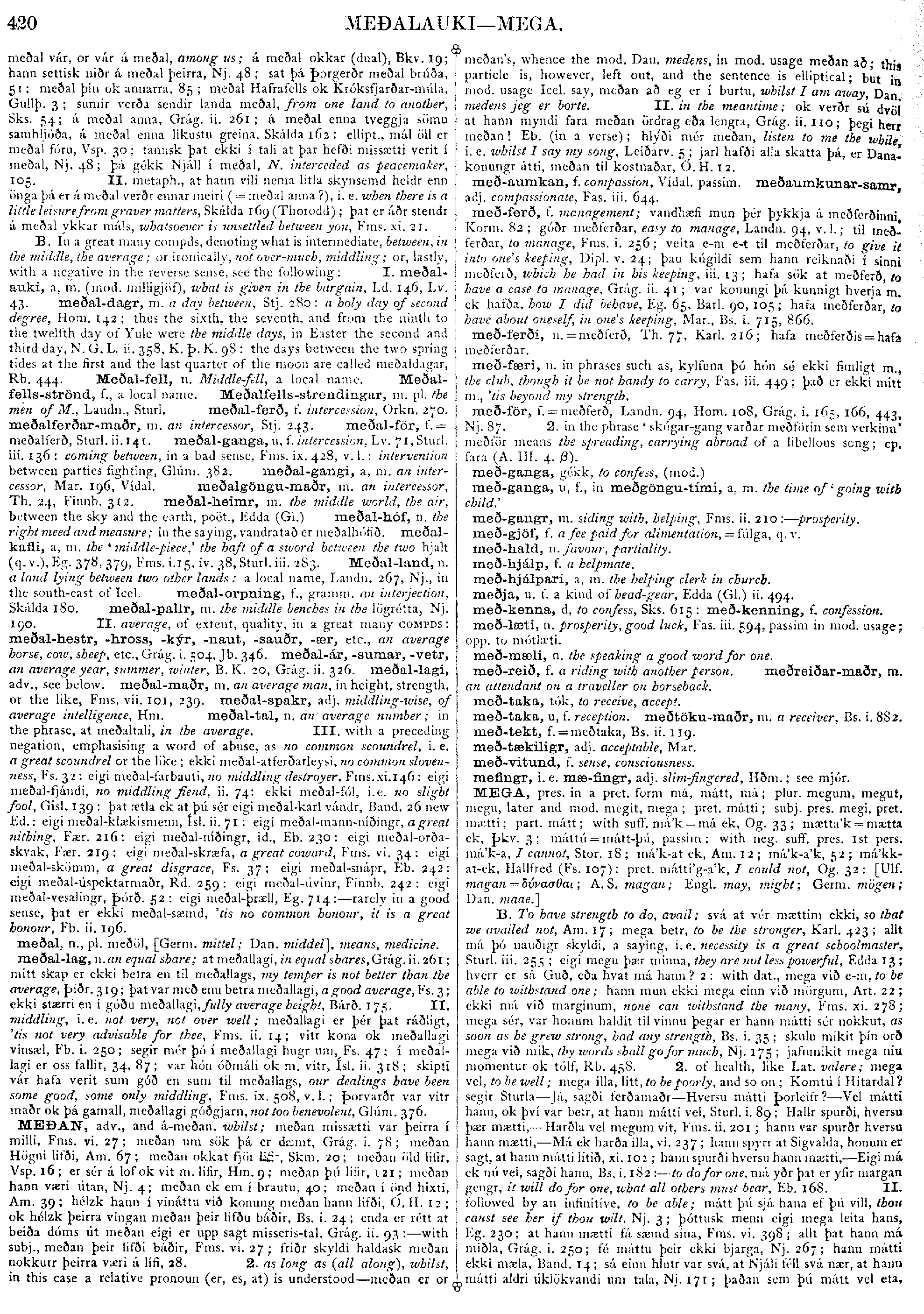
meðal vár, or vár á meðal, among us; á meðal okkar (dual), Bkv. 19; hann settisk niðr á meðal þeirra, Nj. 48; sat þá Þorgerðr meðal brúða, 51; meðal þín ok annarra, 85; meðal Hafrafells ok Króksfjarðar-múla, Gullþ. 3; sumir verða sendir landa meðal, from one land to another, Sks. 54; á meðal anna, Grág. ii. 261; á meðal enna tveggja sömu samhljóða, á meðal enna líkustu greina, Skálda 162: ellipt., mál öll er meðal fóru, Vsp. 30; fannsk þat ekki í tali at þar hefði missætti verit í meðal, Nj. 48; þá gékk Njáll í meðal, N. interceded as peacemaker, 105. II. metaph., at hann vili nema litla skynsemd heldr enn önga þá er á meðal verðr ennar meiri (= meðal anna?), i.e. when there is a little leisure from graver matters, Skálda 169 (Thorodd); þat er áðr stendr á meðal ykkar má!s, whatsoever is unsettled between you, Fms. xi. 21. B. In a great many compds, denoting what is intermediate, between, in the middle, the average; or ironically, not over-much, middling; or, lastly, with a negative in the reverse sense, see the following: I. meðal-auki, a, m. (mod. milligjöf), what is given in the bargain, Ld. 146, Lv. 43. meðal-dagr, m. a day between, Stj. 280: a holy day of second degree, Hom. 142; thus the sixth, the seventh, and from the ninth to the twelfth day of Yule were the middle days, in Easter the second and third day, N.G.L. ii, 358, K.Þ.K. 98: the days between the two spring tides at the first and the last quarter of the moon are called meðaldagar, Rb. 444. Meðal-fell, n. Middle-fell, a local name. Meðal-fells-strönd, f., a local name. Meðalfells-strendingar, m. pl. the men of M., Landn., Sturl. meðal-ferð, f. intercession, Orkn. 270. meðalferðar-maðr, m. an intercessor, Stj. 243. meðal-för, f. = meðalferð, Sturl. ii. 141. meðal-ganga, u, f. intercession, Lv. 71, Sturl. iii. 136: coming between, in a bad sense. Fms. ix. 428, v.l.: intervention between parties fighting, Glúm. 382. meðal-gangi, a, m. an intercessor, Mar. 196, Vídal. meðalgöngu-maðr, m. an intercessor, Th. 24, Finnb. 312. meðal-heimr, m. the middle world, the air, between the sky and the earth, poët., Edda (Gl.) meðal-hóf, n. the right meed and measure; in the saying, vandratað er meðalhófið. meðal-kafli, a, m. the 'middle-piece, ' the haft of a sword between the two hjalt (q.v.), Eg. 378, 379, Fms. i. 15, iv. 38, Sturl. iii. 283. Meðal-land, n. a land lying between two other lands: a local name, Landn. 267, Nj., in the south-east of Icel. meðal-orpning, f., gramm. an interjection, Skálda 180. meðal-pallr, m. the middle benches in the lögrétta, Nj. 190. II. average, of extent, quality, in a great many COMPDS: meðal-hestr, -hross, -kýr, -naut, -sauðr, -ær, etc., an average horse, cow, sheep, etc., Grág. i. 504, Jb. 346. meðal-ár, -sumar, -vetr, an average year, summer, winter, B.K. 20, Grág. ii. 326. meðal-lagi, adv., see below, meðal-maðr, m. an average man, in height, strength, or the like, Fms. vii. 101, 239. meðal-spakr, adj. middling-wise, of average intelligence, Hm. meðal-tal, n. an average number; in the phrase, at meðaltali, in the average. III. with a preceding negation, emphasising a word of abuse, as no common scoundrel, i.e. a great scoundrel or the like; ekki meðal-atferðarleysi, no common slovenness, Fs. 32: eigi meðal-farbauti, no middling destroyer, Fms. xi. 146: eigi meðal-fjándi, no middling fiend, ii. 74: ekki meðal-fól, i.e. no slight fool, Gísl. 139: þat ætla ek at þú sér eigi meðal-karl vándr, Band. 26 new Ed.: eigi meðal-klækismenn, Ísl. ii. 71: eigi meðal-mann-níðingr, a great nithing, Fær. 216: eigi meðal-níðingr, id., Eb. 230: eigi meðal-orðaskvak, Fæ 219: eigi meðal-skræfa, a great coward, Fms. vi. 34: eigi meðal-skömm, a great disgrace, Fs. 37: eigi meðal-snápr, Eb. 242: eigi meðal-úspektarmaðr, Rd. 259: eigi meðal-úvinr, Finnb. 242: eigi meðal-vesalingr, Þórð. 52: eigi meðal-þræli, Eg. 714 :-- rarely in a good sense, þat er ekki meðal-sæmd, 'tis no common honour, it is a great honour, Fb. ii. 196.
|
Source: Cleasby/Vigfusson, page b0434, entry 30 View original page image as: [TIFF] [PNG] [View previous entry] [View next entry] |
[Comment on this entry] [View comments] |
The following entry has been hand-corrected once. |
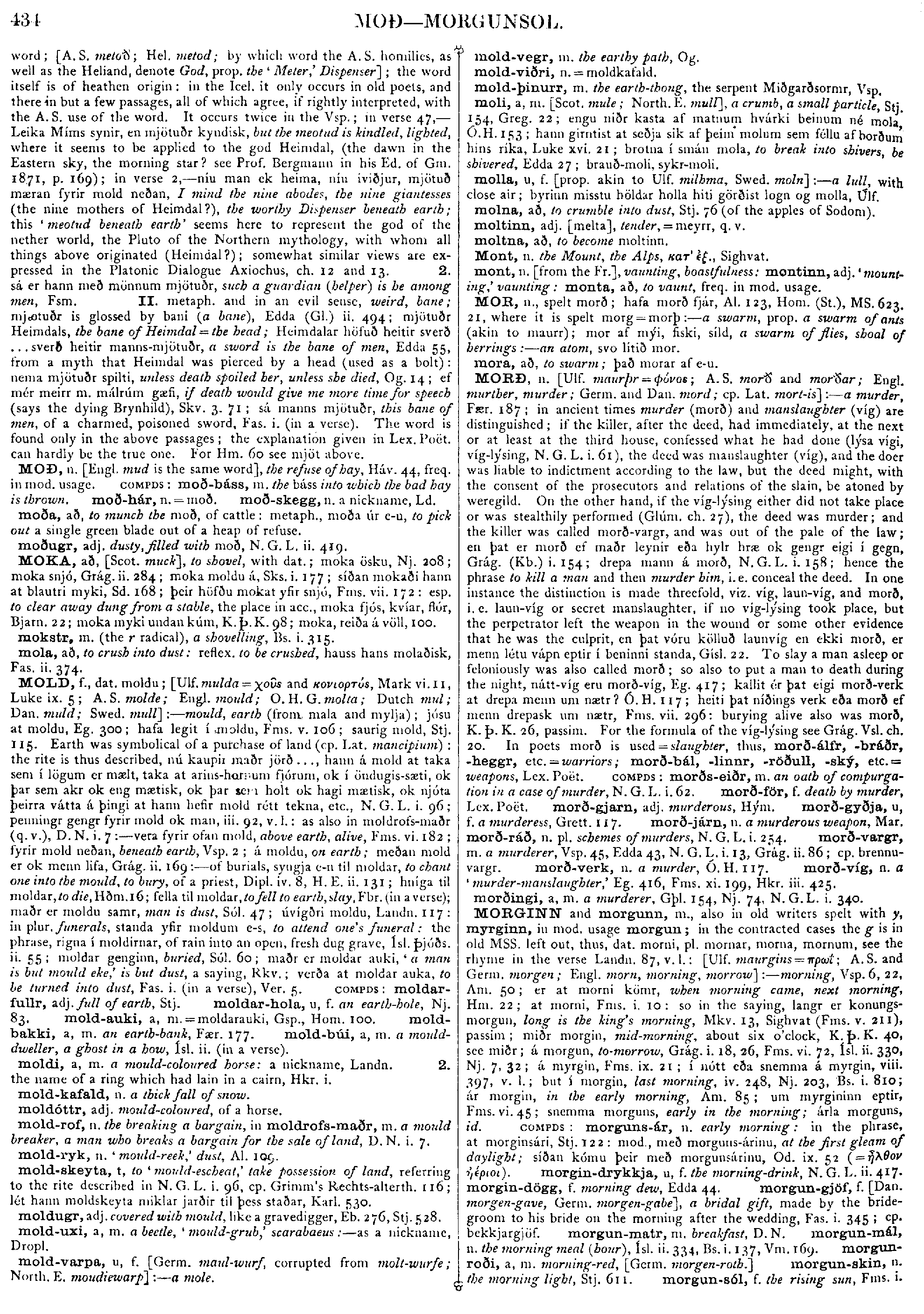
MORÐ, n. [Ulf. maurþr = GREEK; A.S. morð and morðar; Engl. murther, murder; Germ. and Dan. mord; cp. Lat. mort-is] :-- a murder, Fær. 187; in ancient times murder (morð) and manslaughter (víg) are distinguished; if the killer, after the deed, had immediately, at the next or at least at the third house, confessed what he had done (lýsa vígi, víg-lýsing, N.G.L. i. 6l), the deed was manslaughter (víg), and the doer was liable to indictment according to the law, but the deed might, with the consent of the prosecutors and relations of the slain, be atoned by weregild. On the other hand, if the víg-lýsing either did not take place or was stealthily performed (Glúm. ch. 27), the deed was murder; and the killer was called morð-vargr, and was out of the pale of the law; en þat er morð ef maðr leynir eða hylr hræ ok gengr eigi í gegn, Grág. (Kb.) i. 154; drepa mann á morð, N.G.L. i. 158; hence the phrase to kill a man and then murder him, i.e. conceal the deed. In one instance the distinction is made threefold, viz. víg, laun-víg, and morð, i.e. laun-víg or secret manslaughter, if no víg-lýsing took place, but the perpetrator left the weapon in the wound or some other evidence that he was the culprit, en þat vóru kölluð launvíg en ekki morð, er menn létu vápn eptir í beninni standa, Gísl. 22. To slay a man asleep or feloniously was also called morð; so also to put a man to death during the night, nátt-víg eru morð-víg, Eg. 417; kallit ér þat eigi morð-verk at drepa menn um nætr? Ó.H. 117; heiti þat níðings verk eða morð ef menn drepask um nætr, Fms. vii. 296: burying alive also was morð, K.Þ.K. 26, passim. For the formula of the víg-lýsing see Grág. Vsl. ch. 20. In poets morð is used = slaughter, thus, morð-álfr, -bráðr, -heggr, etc. = warriors; morð-bál, -linnr, -röðull, -ský, etc. = weapons, Lex. Poët. COMPDS: morðs-eiðr, m. an oath of compurgation in a case of murder, N.G.L. i. 62. morð-för, f. death by murder, Lex. Poët. morð-gjarn, adj. murderous, Hým. morð-gyðja, u, f. a murderess, Grett. 117. morð-járn, n. a murderous weapon, Mar. morð-ráð, n. pl. schemes of murders, N.G.L. i. 254. morð-vargr, m. a murderer, Vsp. 45, Edda 43, N.G.L. i. 13, Grág. ii. 86; cp. brennu-vargr. morð-verk, n. a murder, Ó.H. 117. morð-víg, n. a 'murder-manslaughter,' Eg. 416, Fms. xi. 199, Hkr. iii. 425.
|
Source: Cleasby/Vigfusson, page b0439, entry 2 View original page image as: [TIFF] [PNG] [View previous entry] [View next entry] |
[Comment on this entry] [View comments] |
The following entry has been hand-corrected once. |
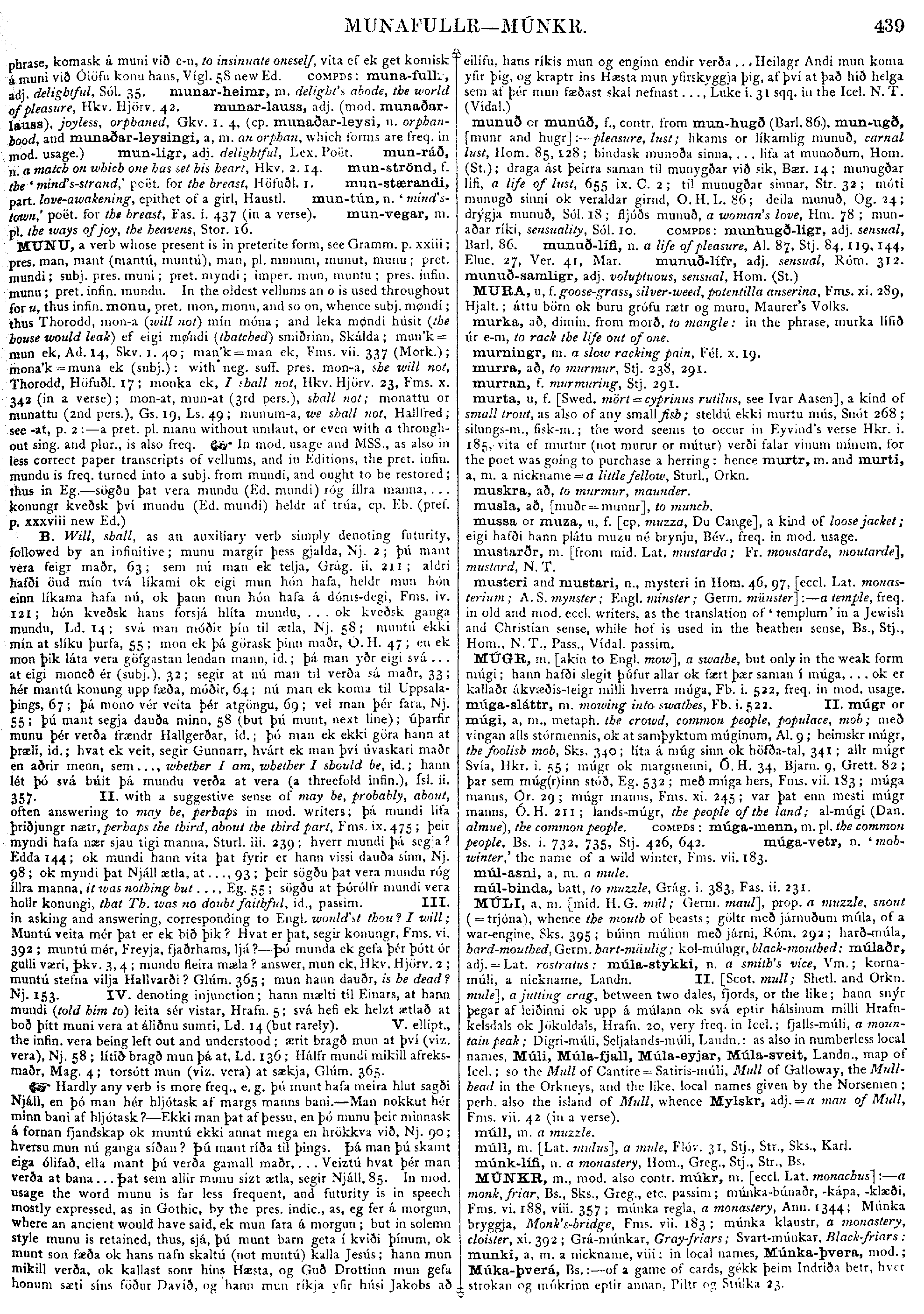
MUNU, a verb whose present is in preterite form, see Gramm. p. xxiii; pres. man, mant (mantú, muntú), man, pl. munum, munut, munu; pret. mundi; subj. pres. muni; pret. myndi; imper. mun, muntu; pres. infin. munu; pret. infin. mundu. In the oldest vellums an o is used throughout for u, thus infin. monu, pret. mon, monu, and so on, whence subj. møndi; thus Thorodd, mon-a (will not) mín móna; and leka møndi húsit (the house would leak) ef eigi møndi (thatched) smiðrinn, Skálda; mun'k = mun ek, Ad. 14, Skv. 1. 40; man'k = man ek, Fms. vii. 337 (Mork.); mona'k = muna ek (subj.): with neg. suff. pres. mon-a, she will not, Thorodd, Höfuðl. 17; monka ek, I shall not, Hkv. Hjörv. 23, Fms. x. 342 (in a verse); mon-at, mun-at (3rd pers.), shall not; monattu or munattu (2nd pers.), Gs. 19, Ls. 49; munum-a, we shall not, Hallfred; see -at, p. 2 :-- a pret. pl. manu without umlaut, or even with a throughout sing. and plur., is also freq. &FINGER; In mod. usage and MSS., as also in less correct paper transcripts of vellums, and in Editions, the pret. infin. mundu is freq. turned into a subj. from mundi, and ought to be restored; thus in Eg. -- sögðu þat vera mundu (Ed. mundi) róg íllra manna, ... konungr kveðsk því mundu (Ed. mundi) heldr af trúa, cp. Eb. (pref. p. xxxviii new Ed.) B. Will, shall, as an auxiliary verb simply denoting futurity, followed by an infinitive; munu margir þess gjalda, Nj. 2; þú mant vera feigr maðr, 63; sem nú man ek telja, Grág. ii. 211; aldri hafði önd mín tvá líkami ok eigi mun hón hafa, heldr mun hón einn líkama hafa nú, ok þann mun hón hafa á dóms-degi, Fms. iv. 121; hón kveðsk hans forsjá hlíta mundu, ... ok kveðsk ganga mundu, Ld. 14; svá man móðir þín til ætla, Nj. 58; muntú ekki mín at slíku þurfa, 55; mon ek þá görask þinn maðr, Ó.H. 47; en ek mon þik láta vera göfgastan lendan mann, id.; þá man yðr eigi svá ... at eigi moneð ér (subj.), 32; segir at nú man til verða sá maðr, 33; hér mantú konung upp fæða, móðir, 64; nú man ek koma til Uppsala-þings, 67; þá mono vér veita þér atgöngu, 69; vel man þér fara, Nj. 55; þú mant segja dauða minn, 58 (but þú munt, next line); úþarfir munu þér verða frændr Hallgerðar, id.; þó man ek ekki göra hann at þræli, id.; hvat ek veit, segir Gunnarr, hvárt ek man því úvaskari maðr en aðrir menn, sem ..., whether I am, whether I should be, id.; hann lét þó svá búit þá mundu verða at vera (a threefold infin.), Ísl. ii. 357. II. with a suggestive sense of may be, probably, about, often answering to may be, perhaps in mod. writers; þá mundi lífa þriðjungr nætr, perhaps the third, about the third part, Fms. ix. 475; þeir myndi hafa nær sjau tigi manna, Sturl. iii. 239; hverr mundi þá segja? Edda 144; ok mundi hann vita þat fyrir er hann vissi dauða sinn, Nj. 98; ok myndi þat Njáll ætla, at ..., 93; þeir sögðu þat vera mundu róg íllra manna, it was nothing but ..., Eg. 55; sögðu at Þórólfr mundi vera hollr konungi, that Th. was no doubt faithful, id., passim. III. in asking and answering, corresponding to Engl. would'st thou? I will; Muntú veita mér þat er ek bið þik? Hvat er þat, segir konungr, Fms. vi. 392; muntú mér, Freyja, fjaðrhams, ljá? -- Þó munda ek gefa þér þótt ór gulli væri, Þkv. 3, 4; mundu fleira mæla? answer, mun ek, Hkv. Hjörv. 2; muntú stefna vilja Hallvarði? Glúm. 365; mun hann dauðr, is he dead? Nj. 135. IV. denoting injunction; hann mælti til Einars, at hann mundi (told him to) leita sér vistar, Hrafn. 5; svá hefi ek helzt ætlað at boð þitt muni vera at áliðnu sumri, Ld. 14 (but rarely). V. ellipt., the infin. vera being left out and understood; ærit bragð mun at því (viz. vera), Nj. 58; lítið bragð mun þá at, Ld. 136; Hálfr mundi mikill afreksmaðr, Mag. 4; torsótt mun (viz. vera) at sækja, Glúm. 365. &FINGER; Hardly any verb is more freq., e.g. þú munt hafa meira hlut sagði Njáll, en þó man hér hljótask af margs manns bani. -- Man nokkut hér minn bani af hljótask? -- Ekki man þat af þessu, en þó munu þeir minnask á fornan fjandskap ok muntú ekki annat mega en hrökkva við, Nj. 90; hversu mun nú ganga síðan? Þú mant ríða til þings. Þá man þú skamt eiga ólifað, ella mant þú verða gamall maðr, ... Veiztú hvat þér man verða at bana ... Þat sem allir munu sízt ætla, segir Njáll, 85. In mod. usage the word munu is far less frequent, and futurity is in speech mostly expressed, as in Gothic, by the pres. indic., as, eg fer á morgun, where an ancient would have said, ek mun fara á morgun; but in solemn style munu is retained, thus, sjá, þú munt barn geta í kviði þínum, ok munt son fæða ok hans nafn skaltú (not muntú) kalla Jesús; hann mun mikill verða, ok kallast sonr hins Hæsta, og Guð Drottinn mun gefa honum sæti síns föður Davíð, og hann mun ríkja yfir húsi Jakobs að eilifu, hans ríkis mun og enginn endir verða ... Heilagr Audi mun koma yfir þig, og kraptr ins Hæsta mun yfirskyggja þig, af því at það hið helga sem af þér mun fæðast skal nefnast ..., Luke i. 31 sqq. in the Icel. N.T. (Vídal.)
|
Source: Cleasby/Vigfusson, page b0440, entry 6 View original page image as: [TIFF] [PNG] [View previous entry] [View next entry] |
[Comment on this entry] [View comments] |
The following entry has been hand-corrected once. |
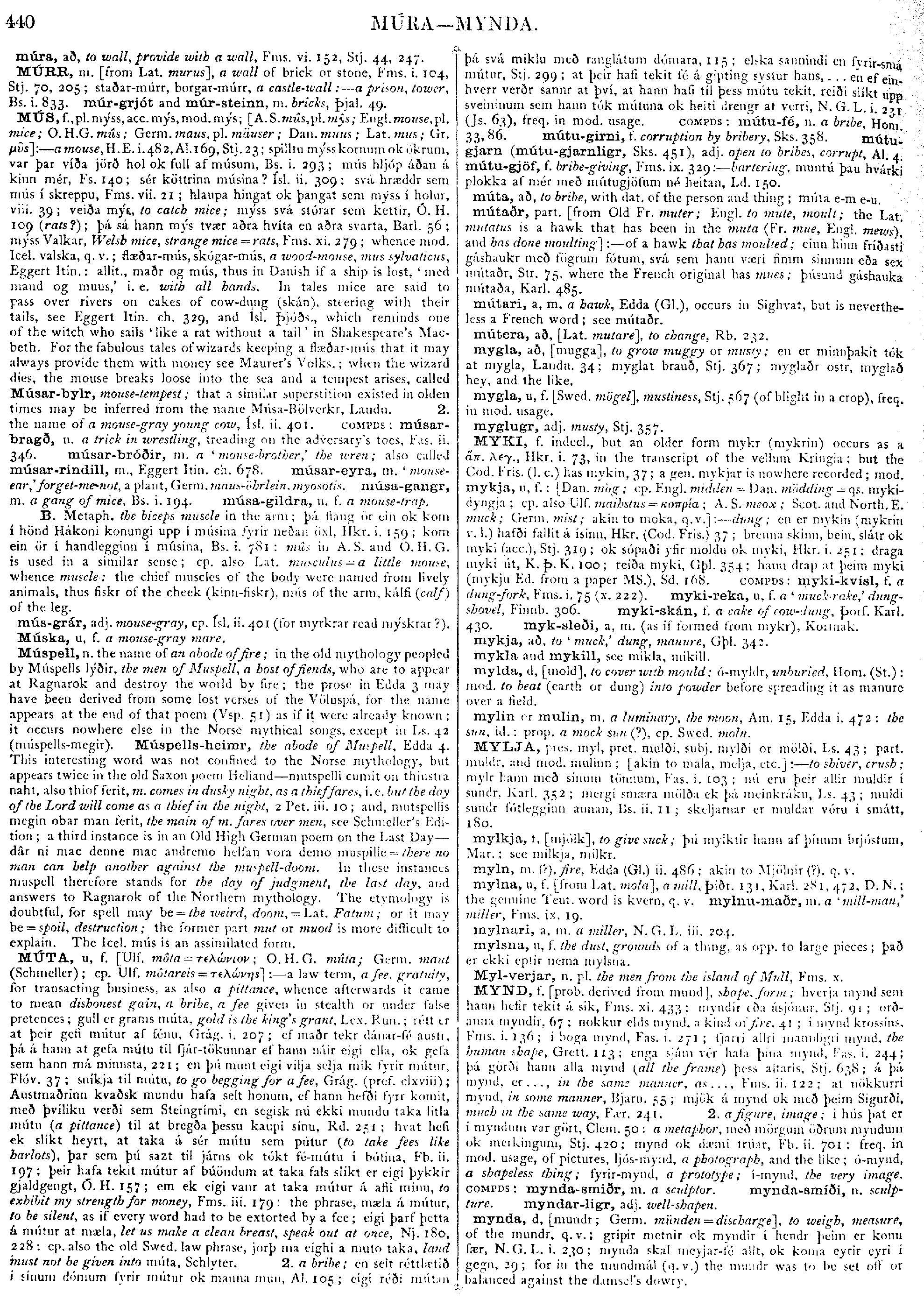
Múspell, n. the name of an abode of fire; in the old mythology peopled by Múspells lýðir, the men of Muspell, a host of fiends, who are to appear at Ragnarok and destroy the world by fire; the prose in Edda 3 may have been derived from some lost verses of the Völuspá, for the name appears at the end of that poem (Vsp. 51) as if it were already known; it occurs nowhere else in the Norse mythical songs, except in Ls. 42 (múspells-megir). Múspells-heimr, the abode of Muspell, Edda 4. This interesting word was not confined to the Norse mythology, but appears twice in the old Saxon poem Heliand -- mutspelli cumit on thiustra naht, also thiof ferit, m. comes in dusky night, as a thief fares, i.e. but the day of the Lord will come as a thief in the night, 2 Pet. iii. 10; and, mutspellis megin obar man ferit, the main of m. fares over men, see Schmeller's Edition; a third instance is in an Old High German poem on the Last Day -- dâr ni mac denne mac andremo helfan vora demo muspille = there no man can help another against the muspell-doom. In these instances muspell therefore stands for the day of judgment, the last day, and answers to Ragnarok of the Northern mythology. The etymology is doubtful, for spell may be = the weird, doom, = Lat. Fatum; or it may be = spoil, destruction; the former part mut or muod is more difficult to explain. The Icel. mús is an assimilated form.
|
Source: Cleasby/Vigfusson, page b0462, entry 9 View original page image as: [TIFF] [PNG] [View previous entry] [View next entry] |
[Comment on this entry] [View comments] |
The following entry has been hand-corrected once. |
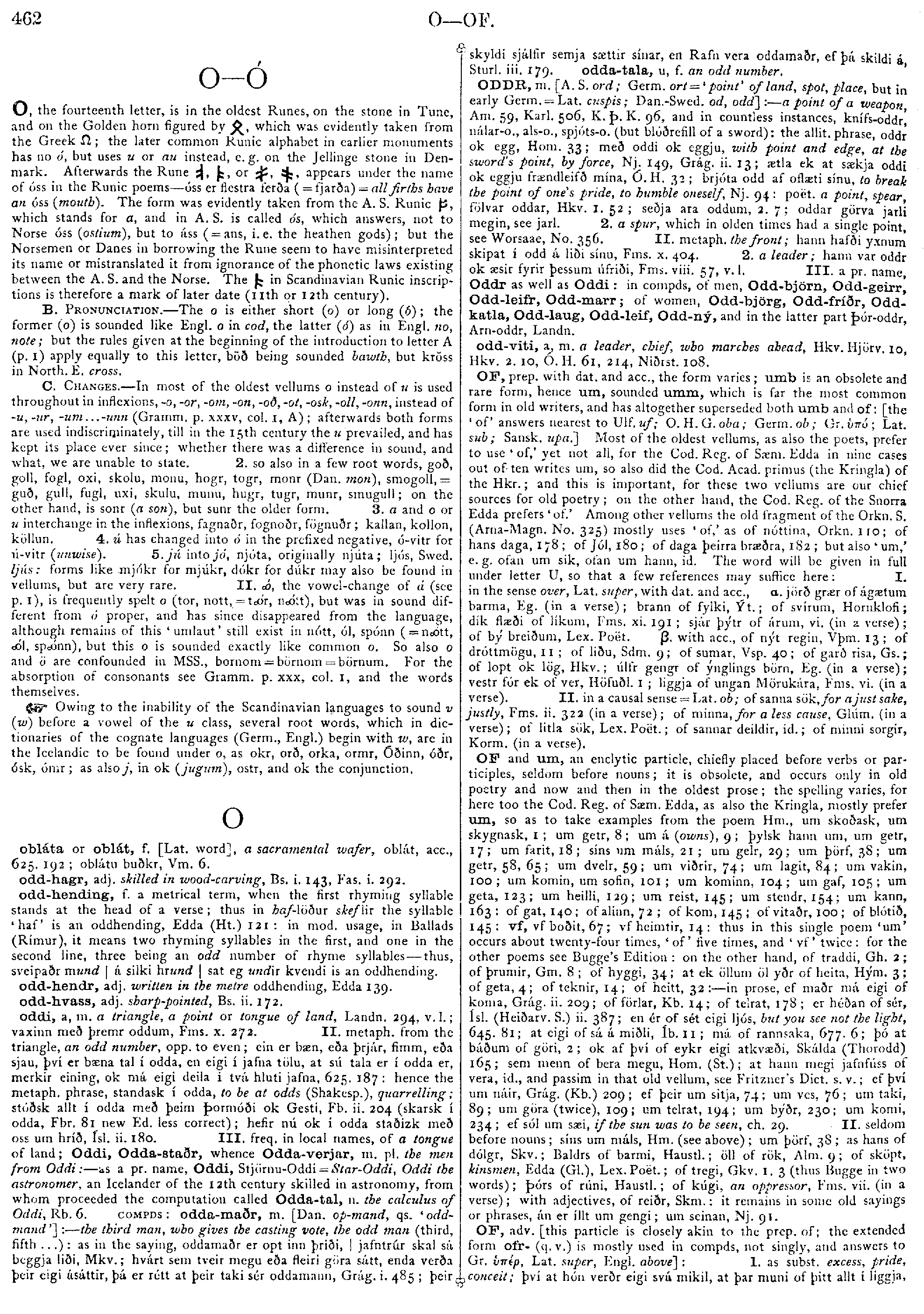
oddi, a, m. a triangle, a point or tongue of land, Landn. 294, v.l.; vaxinn með þremr oddum, Fms. x. 272. II. metaph. from the triangle, an odd number, opp. to even; ein er bæn, eða þrjár, fimm, eða sjau, því er bæna tal í odda, en eigi í jafna tölu, at sú tala er í odda er, merkir eining, ok má eigi deila í tvá hluti jafna, 625. 187: hence the metaph. phrase, standask í odda, to be at odds (Shakesp.), quarrelling; stóðsk allt í odda með þeim Þormóði ok Gesti, Fb. ii. 204 (skarsk í odda, Fbr. 81 new Ed. less correct); hefir nú ok í odda staðizk með oss um hríð, Ísl. ii. 180. III. freq. in local names, of a tongue of land; Oddi, Odda-staðr, whence Odda-verjar, m. pl. the men from Oddi :-- as a pr. name, Oddi, Stjörnu-Oddi = star-Oddi, Oddi the astronomer, an Icelander of the 12th century skilled in astronomy, from whom proceeded the computation called Odda-tal, n. the calculus of Oddi, Rb. 6. COMPDS: odda-maðr, m. [Dan. op-mand, qs. 'odd-mand'] :-- the third man, who gives the casting vote, the odd man (third, fifth ...): as in the saying, oddamaðr er opt inn þriði, | jafntrúr skal sá beggja liði, Mkv.; hvart sem tveir megu eða fleiri göra sátt, enda verða þeir eigi ásáttir, þá er rétt at þeir taki sér oddamann, Grág. i. 485; þeir skyldi sjálfir semja sættir sínar, en Rafn vera oddamaðr, ef þá skildi á Sturl. iii. 179. odda-tala, u, f. an odd number.
|
Source: Cleasby/Vigfusson, page b0493, entry 6 View original page image as: [TIFF] [PNG] [View previous entry] [View next entry] |
[Comment on this entry] [View comments] |
The following entry has been hand-corrected once. |
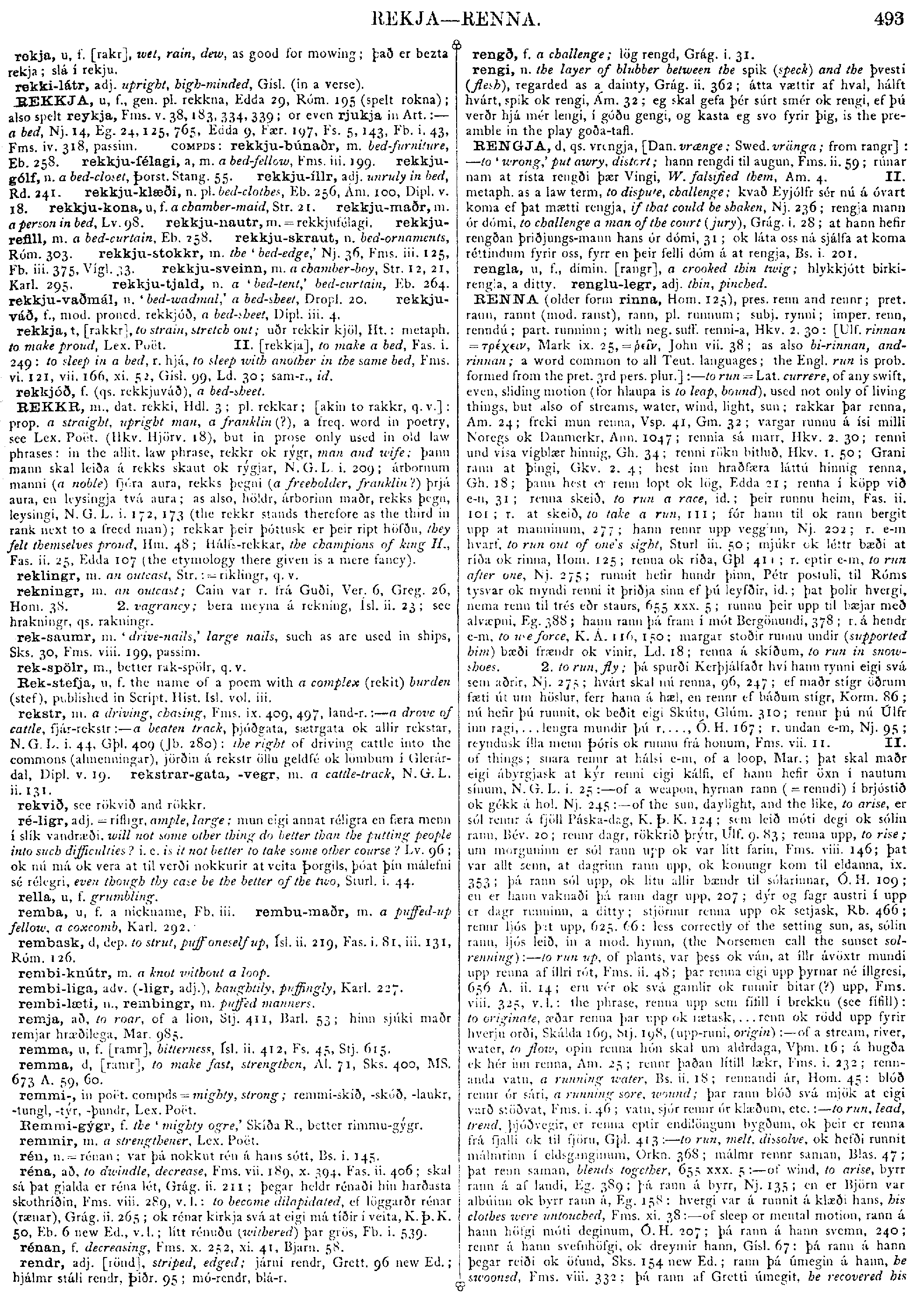
REKKR, m., dat. rekki, Hdl. 3; pl. rekkar; [akin to rakkr, q.v.]: prop. a straight, upright man, a franklin(?), a freq. word in poetry, see Lex. Poët. (Hkv. Hjörv. 18), but in prose only used in old law phrases: in the allit. law phrase, rekkr ok rýgr, man and wife; þann mann skal leiða á rekks skaut ok rýgjar, N.G.L. i. 209; árbornum manni (a noble) fjóra aura, rekks þegni (a freeholder, franklin)? þrjá aura, en leysingja tvá aura; as also, höldr, árborinn maðr, rekks þegn, leysingi, N.G.L. i. 172, 173 (the rekkr stands therefore as the third in rank next to a freed man); rekkar þeir þóttusk er þeir ript höfðu, they felt themselves proud, Hm. 48; Hálfs-rekkar, the champions of king H., Fas. ii. 25, Edda 107 (the etymology there given is a mere fancy).
|
Source: Cleasby/Vigfusson, page b0511, entry 72 View original page image as: [TIFF] [PNG] [View previous entry] [View next entry] |
[Comment on this entry] [View comments] |
The following entry has been hand-corrected once. |
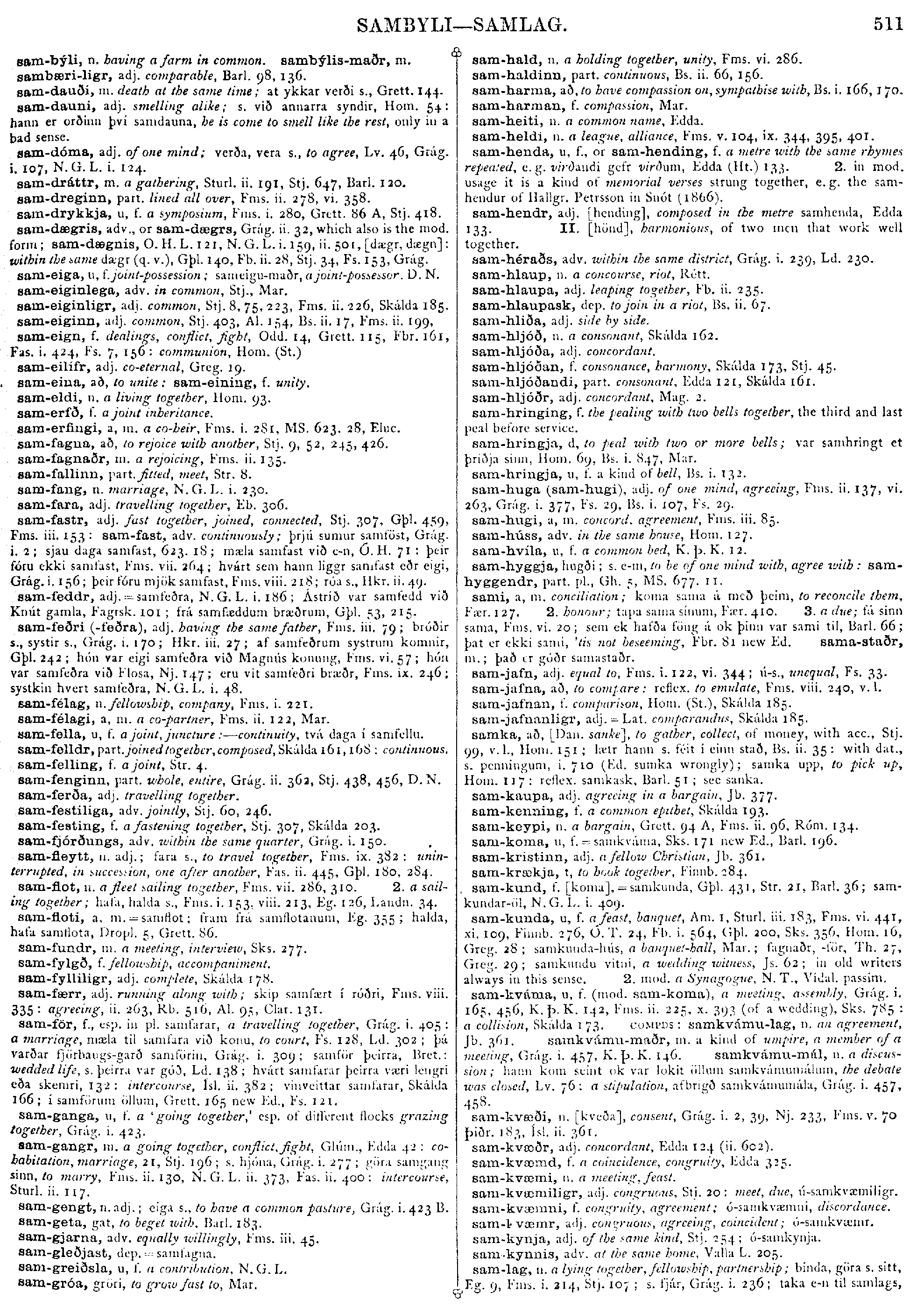
sam-hringing, f. the pealing with two bells together, the third and last peal before service.
|
Source: Cleasby/Vigfusson, page b0516, entry 11 View original page image as: [TIFF] [PNG] [View previous entry] [View next entry] |
[Comment on this entry] [View comments] |
The following entry has been hand-corrected once. |
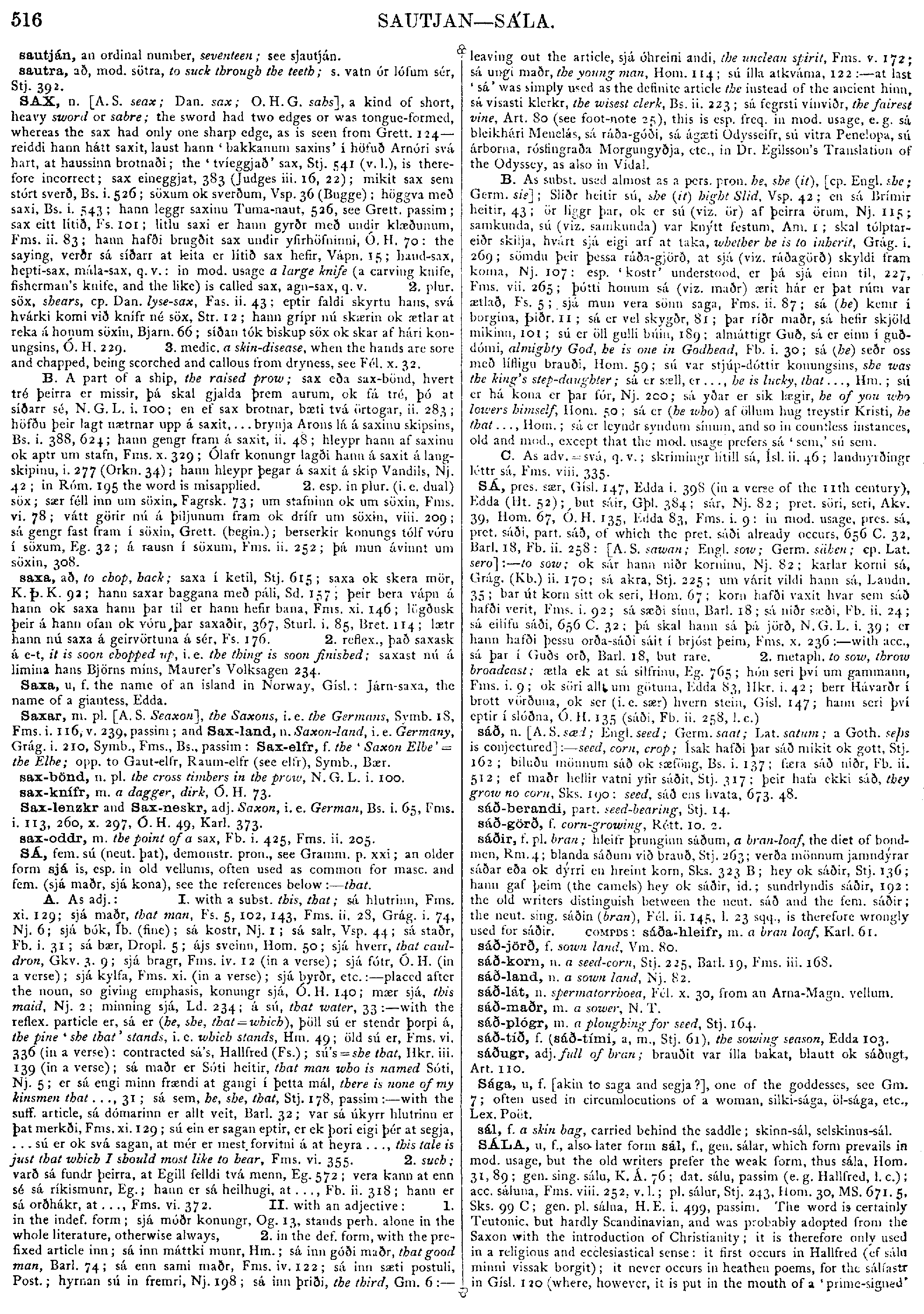
SÁ, fem, sú (neut. þat), demonstr. pron., see Gramm. p. xxi; an older form sjá is, esp. in old vellums, often used as common for masc. and fem. (sjá maðr, sjá kona), see the references below :-- that. A. As adj.: I. with a subst. this, that; sá hlutrinn, Fins, xi. 129; sjá maðr, that man, Fs. 5, 102, 143, Fms. ii. 28, Grág. i. 74, Nj. 6; sjá bók, Íb. (fine); sá kostr, Nj. 1; sá salr, Vsp. 44; sá staðr, Fb. i. 31; sá bær, Dropl. 5; ájs sveinn, Hom. 50; sjá hverr, that cauldron, Gkv. 3. 9; sjá bragr, Fms. iv. 12 (in a verse); sjá fótr, Ó.H. (in a verse); sjá kylfa, Fms. xi. (in a verse); sjá byrðr, etc. :-- placed after the noun, so giving emphasis, konungr sjá, Ó.H. 140; mær sjá, this maid, Nj. 2; minning sjá, Ld. 234; á sú, that water, 33 :-- with the reflex. particle er, sá er (he, she, that = which), þöll sú er stendr þorpi á, the pine 'she that' stands, i.e. which stands, Hm. 49; öld sú er, Fms. vi. 336 (in a verse): contracted sá's, Hallfred (Fs.); sú's = she that, Hkr. iii. 139 (in a verse); sá maðr er Sóti heitir, that man who is named Sóti, Nj. 5; er sá engi minn frændi at gangi í þetta mál, there is none of my kinsmen that ..., 31; sá sem, he, she, that, Stj. 178, passim :-- with the suff. article, sá dómarinn er allt veit, Barl. 32; var sá úkyrr hlutrinn er þat merkði, Fms. xi. 129; sú ein er sagan eptir, er ek þori eigi þér at segja, ... sú er ok svá sagan, at mér er mest forvitni á at heyra ..., this tale is just that which I should most like to hear, Fms. vi. 355. 2. such; varð sá fundr þeirra, at Egill felldi tvá menn, Eg. 572; vera kann at enn sé sá ríkismunr, Eg.; hann er sá heilhugi, at ..., Fb. ii. 318; hann er sá orðhákr, at ..., Fms. vi. 372. II. with an adjective: 1. in the indef. form; sjá móðr konungr, Og. 13, stands perh. alone in the whole literature, otherwise always, 2. in the def. form, with the prefixed article inn; sá inn máttki munr, Hm.; sá inn góði maðr, that good man, Barl. 74; sá enn sami maðr, Fms. iv. 122; sá inn sæti postuli, Post.; hyrnan sú in fremri, Nj. 198; sá inn þriði, the third, Gm. 6 :-- leaving out the article, sjá óhreini andi, the unclean spirit, Fms. v. 172; sá ungi maðr, the young man, Hom. 114; sú ílla atkváma, 122 :-- at last 'sá' was simply used as the definite article the instead of the ancient hinn, sá vísasti klerkr, the wisest clerk, Bs. ii. 223; sá fegrsti vínviðr, the fairest vine, Art. 80 (see foot-note 25), this is esp. freq. in mod. usage, e.g. sá bleikhári Menelás, sá ráða-góði, sá ágæti Odysseifr, sú vitra Penelopa, sú árborna, rósfingraða Morgungyðja, etc., in Dr. Egilsson's Translation of the Odyssey, as also in Vídal. B. As subst. used almost as a pers. pron. he, she (it), [cp. Engl. she; Germ, sie]; Slíðr heitir sú, she (it) hight Slid, Vsp. 42; en sá Brímir heitir, 43; ör liggr par, ok er sú (viz. ör) af þeirra örum, Nj. 115; samkunda, sú (viz. samkunda) var knýtt festum, Am. 1; skal tólptar-eiðr skilja, hvárt sjá eigi arf at taka, whether he is to inherit, Grág. i. 269; sömdu þeir þessa ráða-gjörð, at sjá (viz. ráðagörð) skyldi fram koma, Nj. 107: esp. 'kostr' understood, er þá sjá einn til, 227, Fms. vii. 265; þótti honum sá (viz. maðr) ærit hár er þat rúm var ætlað, Fs. 5; sjá mun vera sönn saga, Fms. ii. 87; sá (he) kemr í borgina, Þiðr. 11; sá er vel skygðr, 81; þar ríðr maðr, sá hefir skjöld mikinn, 101; sú er öll gulli búin, 189; almáttigr Guð, sá er einn í guðdómi, almighty God, he is one in Godhead, Fb. i. 30; sá (he) seðr oss með lífligu brauði, Hom. 59; sú var stjúp-dóttir konungsins, she was the king's step-daughter; sá er sæll, er ..., he is lucky, that ..., Hm.; sú er há kona er þar fór, Nj. 200; sá yðar er sik lægir, he of you who lowers himself, Hom. 50; sá er (he who) af öllum hug treystir Kristi, he that ..., Hom.; sá er leyndr syndum sínum, and so in countless instances, old and mod., except that the mod. usage prefers sá 'sem,' sú sem. C. As adv. = svá, q.v.; skrímingr lítill sá, Ísl. ii. 46; landnyrðingr léttr sá, Fms. viii. 335.
|
Source: Cleasby/Vigfusson, page b0528, entry 17 View original page image as: [TIFF] [PNG] [View previous entry] [View next entry] |
[Comment on this entry] [View comments] |
The following entry has been hand-corrected once. |
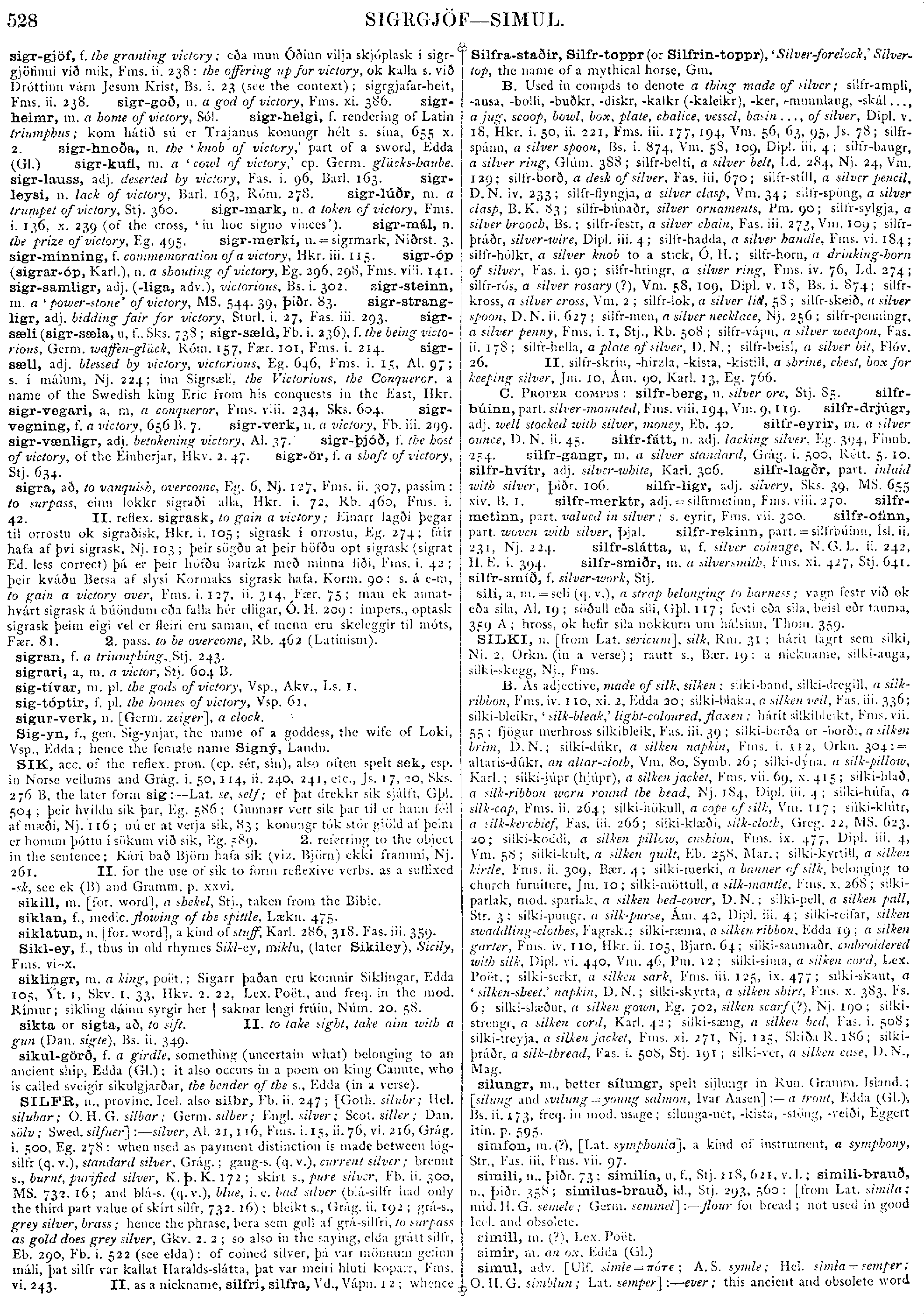
SILFR, n., provinc. Icel. also silbr, Fb. ii. 247; [Goth. silubr; Hel. silubar; O.H.G. silbar; Germ. silber; Engl. silver; Scot. siller; Dan. sölv; Swed. silfuer] :-- silver, Al. 21, 116, Fms. i. 15, ii. 76, vi. 216, Grág. i. 500, Eg. 278: when used as payment distinction is made between lög-silfr (q.v.), standard silver, Grág.; gang-s. (q.v.), current silver; brennt s., burnt, purified silver, K.Þ.K. 172; skírt s., pure silver, Fb. ii. 300, MS. 732. 16; and blá-s. (q.v.), blue, i.e. bad silver (blá-silfr had only the third part value of skírt silfr, 732. 16); bleikt s., Grág. ii. 192; grá-s., grey silver, brass; hence the phrase, bera sem gull af grá-silfri, to surpass as gold does grey silver, Gkv. 2. 2; so also in the saying, elda grátt silfr, Eb. 290, Fb. i. 522 (see elda): of coined silver, þá var mönnum gefinn máli, þat silfr var kallat Haralds-slátta, þat var meiri hluti koparr, Fms. vi. 243. II. as a nickname, silfri, silfra, Vd., Vápn. 12; whence Silfra-staðir, Silfr-toppr (or Silfrin-toppr), 'Silver-forelock,' Silver-top, the name of a mythical horse, Gm. B. Used in compds to denote a thing made of silver; silfr-ampli, -ausa, -bolli, -buðkr, -diskr, -kalkr (-kaleikr), -ker, -munnlaug, -skál ..., a jug, scoop, bowl, box, plate, chalice, vessel, basin ..., of silver, Dipl. v. 18, Hkr. i. 50, ii. 221, Fms. iii. 177, 194, Vm. 56, 63, 95, Js. 78; silfr-spánn, a silver spoon, Bs. i. 874, Vm. 58, 109, Dipl, iii. 4; silfr-baugr, a silver ring, Glúm. 388; silfr-belti, a silver belt, Ld. 284, Nj. 24, Vm. 129; silfr-borð, a desk of silver, Fas. iii. 670; silfr-stíll, a silver pencil, D.N. iv. 233; silfr-flyngja, a silver clasp, Vm. 34; silfr-spöng, a silver clasp, B.K. 83; silfr-búnaðr, silver ornaments, Pm. 90; silfr-sylgja, a silver brooch, Bs.; silfr-festr, a silver chain. Fas. iii. 273, Vm. 109; silfr-þráðr, silver-wire, Dipl. iii. 4; silfr-hadda, a silver handle, Fms. vi. 184; silfr-hólkr, a silver knob to a stick, Ó.H.; silfr-horn, a drinking-horn of silver, Fas. i. 90; silfr-hringr, a silver ring, Fms. iv. 76, Ld. 274; silfr-rós, a silver rosary(?), Vm. 58, 109, Dipl. v. 18, Bs. i. 874; silfr-kross, a silver cross, Vm. 2; silfr-lok, a silver lid, 58; silfr-skeið, a silver spoon, D.N. ii. 627; silfr-men, a silver necklace, Nj. 256; silfr-penningr, a silver penny, Fms. i. 1, Stj., Rb. 508; silfr-vápn, a silver weapon, Fas. ii. 178; silfr-hella, a plate of silver, D.N.; silfr-beisl, a silver bit, Flóv. 26. II. silfr-skrín, -hirzla, -kista, -kistill, a shrine, chest, box for keeping silver, Jm. 10, Am. 90, Karl. 13, Eg. 766. C. PROPER COMPDS: silfr-berg, n. silver ore, Stj. 85. silfr-búinn, part. silver-mounted, Fms. viii. 194, Vm. 9, 119. silfr-drjúgr, adj. well stocked with silver, money, Eb. 40. silfr-eyrir, m. a silver ounce, D.N. ii. 45. silfr-fátt, n. adj. lacking silver, Eg. 394. Finnb. 254. silfr-gangr, m. a silver standard, Grág. i. 500, Rétt. 5. 10. silfr-hvítr, adj. silver-white, Karl. 306. silfr-lagðr, part. inlaid with silver, Þiðr. 106. silfr-ligr, adj. silvery, Sks. 39, MS. 655 xiv. B. 1. silfr-merktr, adj. = silfrmetinn, Fms. viii. 270. silfr-metinn, part. valued in silver; s. eyrir, Fms. vii. 300. silfr-ofinn, part. woven with silver, Þjal. silfr-rekinn, part. = silfrbúinn, Ísl. ii. 231, Nj. 224. silfr-slátta, u, f. silver coinage, N.G.L. ii. 242, H.E. i. 394. silfr-smiðr, m. a silversmith, Fms. xi. 427, Stj. 641. silfr-smíð, f. silver-work, Stj.
|
Source: Cleasby/Vigfusson, page b0530, entry 1 View original page image as: [TIFF] [PNG] [View previous entry] [View next entry] |
[Comment on this entry] [View comments] |
The following entry has been hand-corrected once. |
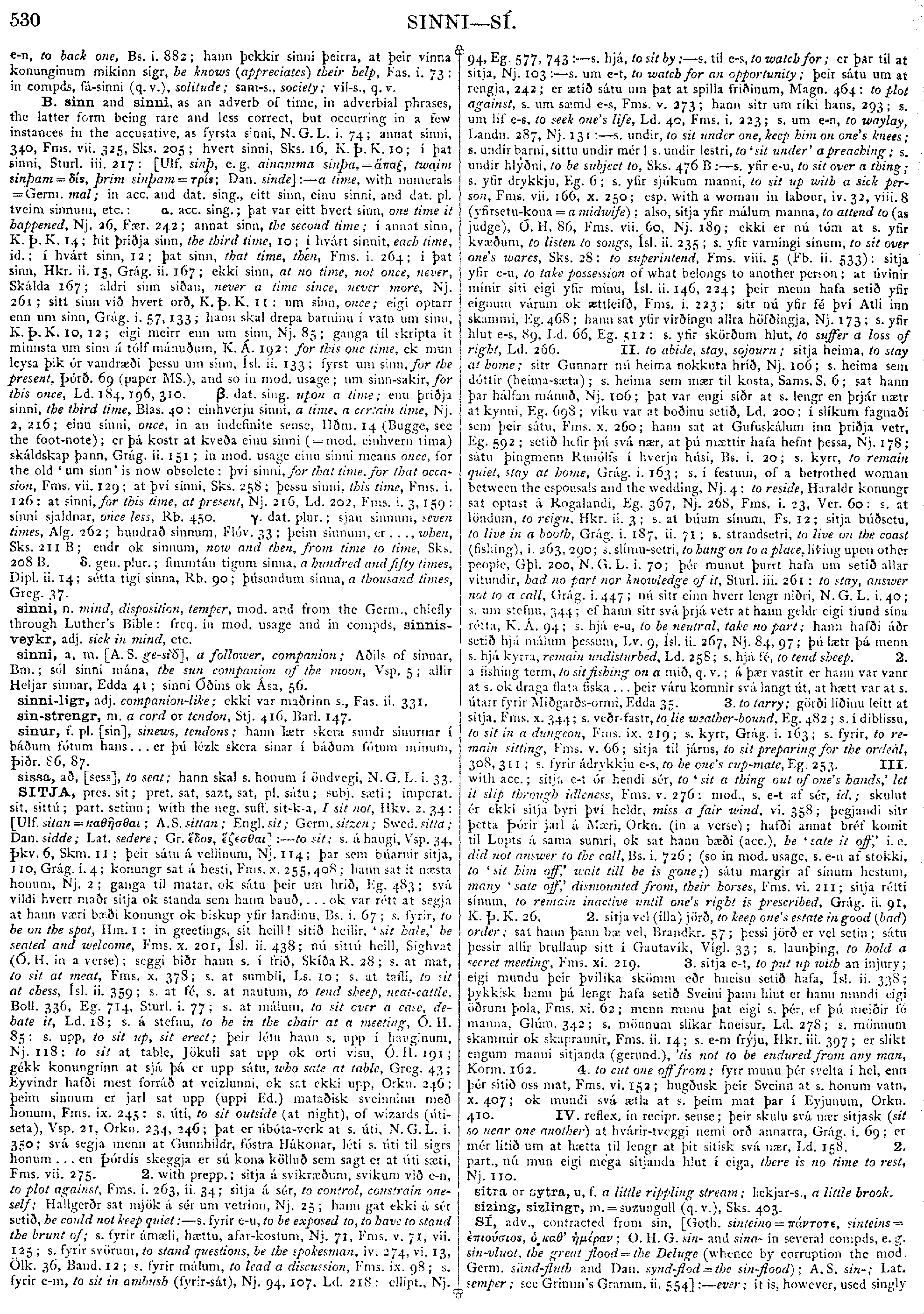
e-n,
to
back
one,
Bs.
i.
882;
hann
þekkir
sinni
þeirra,
at
þeir
vinna
konunginum
mikinn
sigr,
he
knows
(appreciates)
their
help,
Fas.
i.
73:
in
compds,
fá-sinni
(q.v.),
solitude;
sam-s.,
society;
víl-s.,
q.v.
B.
sinn
and
sinni,
as
an
adverb
of
time,
in
adverbial
phrases,
the
latter
form
being
rare
and
less
correct,
but
occurring
in
a
few
instances
in
the
accusative,
as
fyrsta
sinni,
N.G.L.
i.
74;
annat
sinni,
340,
Fms.
vii.
325,
Sks.
205;
hvert
sinni,
Sks.
16,
K.Þ.K.
10;
í
þat
sinni,
Sturl.
iii.
217:
[Ulf.
sinþ,
e.g.
ainamma
sinþa,
=
GREEK,
twaim
sinþam
=
GREEK,
þrim
sinþam
=
GREEK;
Dan.
sinde]
:--
a
time,
with
numerals
=
Germ.
mal;
in
acc,
and
dat.
sing.,
eitt
sinn,
einu
sinni,
and
dat.
pl.
tveim
sinnum,
etc.:
 .
acc.
sing.;
þat
var
eitt
hvert
sinn,
one
time
it
happened,
Nj.
26,
Fær.
242;
annat
sinn,
the
second
time;
í
annat
sinn,
K.Þ.K,
14;
hit
þriðja
sinn,
the
third
time,
10;
í
hvárt
sinnit,
each
time,
id.;
í
hvárt
sinn,
12;
þat
sinn,
that
time,
then,
Fms.
i.
264;
í
þat
sinn,
Hkr.
ii.
15,
Grág.
ii.
167;
ekki
sinn,
at
no
time,
not
once,
never,
Skálda
167;
aldri
sinn
síðan,
never
a
time
since,
never
more,
Nj.
261;
sitt
sinn
við
hvert
orð,
K.Þ.K.
11:
um
sinn,
once;
eigi
optarr
enn
um
sinn,
Grág.
i.
57,
133;
hann
skal
drepa
barninu
í
vatn
um
sinn,
K.Þ.K.
10,
12;
eigi
meirr
enn
um
sinn,
Nj.
85;
ganga
til
skripta
it
minnsta
um
sinn
á
tólf
mánuðum,
K.Á.
192:
for
this
one
time,
ek
mun
leysa
þik
ór
vandræði
þessu
um
sinn,
Ísl.
ii.
133;
fyrst
um
sinn,
for
the
present,
Þórð.
69
(paper
MS.),
and
so
in
mod.
usage;
um
sinn-sakir,
for
this
once,
Ld.
184,
196,
310.
.
acc.
sing.;
þat
var
eitt
hvert
sinn,
one
time
it
happened,
Nj.
26,
Fær.
242;
annat
sinn,
the
second
time;
í
annat
sinn,
K.Þ.K,
14;
hit
þriðja
sinn,
the
third
time,
10;
í
hvárt
sinnit,
each
time,
id.;
í
hvárt
sinn,
12;
þat
sinn,
that
time,
then,
Fms.
i.
264;
í
þat
sinn,
Hkr.
ii.
15,
Grág.
ii.
167;
ekki
sinn,
at
no
time,
not
once,
never,
Skálda
167;
aldri
sinn
síðan,
never
a
time
since,
never
more,
Nj.
261;
sitt
sinn
við
hvert
orð,
K.Þ.K.
11:
um
sinn,
once;
eigi
optarr
enn
um
sinn,
Grág.
i.
57,
133;
hann
skal
drepa
barninu
í
vatn
um
sinn,
K.Þ.K.
10,
12;
eigi
meirr
enn
um
sinn,
Nj.
85;
ganga
til
skripta
it
minnsta
um
sinn
á
tólf
mánuðum,
K.Á.
192:
for
this
one
time,
ek
mun
leysa
þik
ór
vandræði
þessu
um
sinn,
Ísl.
ii.
133;
fyrst
um
sinn,
for
the
present,
Þórð.
69
(paper
MS.),
and
so
in
mod.
usage;
um
sinn-sakir,
for
this
once,
Ld.
184,
196,
310.
 .
dat.
sing,
upon
a
time;
enu
þriðja
sinni,
the
third
time,
Blas.
40:
eiuhverju
sinni,
a
time,
a
certain
time,
Nj.
2,
216;
einu
sinni,
once,
in
an
indefinite
sense,
Hðm.
14
(Bugge,
see
the
foot-note);
er
þá
kostr
at
kveða
einu
sinni
(=
mod.
einhvern
tíma)
skáldskap
þann,
Grág.
ii.
151;
in
mod.
usage
einu
sinni
means
once,
for
the
old
'um
sinn'
is
now
obsolete:
því
sinni,
for
that
time,
for
that
occasion,
Fms.
vii.
129;
at
því
sinni,
Sks.
258;
þessu
sinni,
this
time,
Fms.
i.
126:
at
sinni,
for
this
time,
at
present,
Nj.
216,
Ld.
202,
Fms.
i.
3,
159:
sinni
sjaldnar,
once
less,
Rb.
450.
.
dat.
sing,
upon
a
time;
enu
þriðja
sinni,
the
third
time,
Blas.
40:
eiuhverju
sinni,
a
time,
a
certain
time,
Nj.
2,
216;
einu
sinni,
once,
in
an
indefinite
sense,
Hðm.
14
(Bugge,
see
the
foot-note);
er
þá
kostr
at
kveða
einu
sinni
(=
mod.
einhvern
tíma)
skáldskap
þann,
Grág.
ii.
151;
in
mod.
usage
einu
sinni
means
once,
for
the
old
'um
sinn'
is
now
obsolete:
því
sinni,
for
that
time,
for
that
occasion,
Fms.
vii.
129;
at
því
sinni,
Sks.
258;
þessu
sinni,
this
time,
Fms.
i.
126:
at
sinni,
for
this
time,
at
present,
Nj.
216,
Ld.
202,
Fms.
i.
3,
159:
sinni
sjaldnar,
once
less,
Rb.
450.
 .
dat.
plur.;
sjau
sinnum,
seven
times,
Alg.
262;
hundrað
sinnum,
Flóv.
33;
þeim
sinnum,
er
...,
when,
Sks.
211
B;
endr
ok
sinnum,
now
and
then,
from
time
to
time,
Sks.
208
B.
.
dat.
plur.;
sjau
sinnum,
seven
times,
Alg.
262;
hundrað
sinnum,
Flóv.
33;
þeim
sinnum,
er
...,
when,
Sks.
211
B;
endr
ok
sinnum,
now
and
then,
from
time
to
time,
Sks.
208
B.
 .
gen.
p!ur.;
fimmtán
tigum
sinna,
a
hundred
and
fifty
times,
Dipl.
ii.
14;
sétta
tigi
sinna,
Rb.
90;
þúsundum
sinna,
a
thousand
times,
Greg.
37.
.
gen.
p!ur.;
fimmtán
tigum
sinna,
a
hundred
and
fifty
times,
Dipl.
ii.
14;
sétta
tigi
sinna,
Rb.
90;
þúsundum
sinna,
a
thousand
times,
Greg.
37.
| Result Page: |  |
Previous | 3 4 5 6 7 8 9 10 11 12 13 14 | Next |  |
Germanic Lexicon Project (main page)
This search system was written by
Sean Crist
Please consider
volunteering
to correct the data in these online dictionaries.
No rights reserved. Feel free to use these data in any way you please.