|
|

þey (4 results)
Search for they again, using less strict matching (2727 results)
|
Source: Bosworth/Toller, page d0399, entry 2 View original page image as: [TIFF] [PNG] [View previous entry] [View next entry] |
[Comment on this entry] [View comments (2)] |
The following entry has been hand-corrected once. |
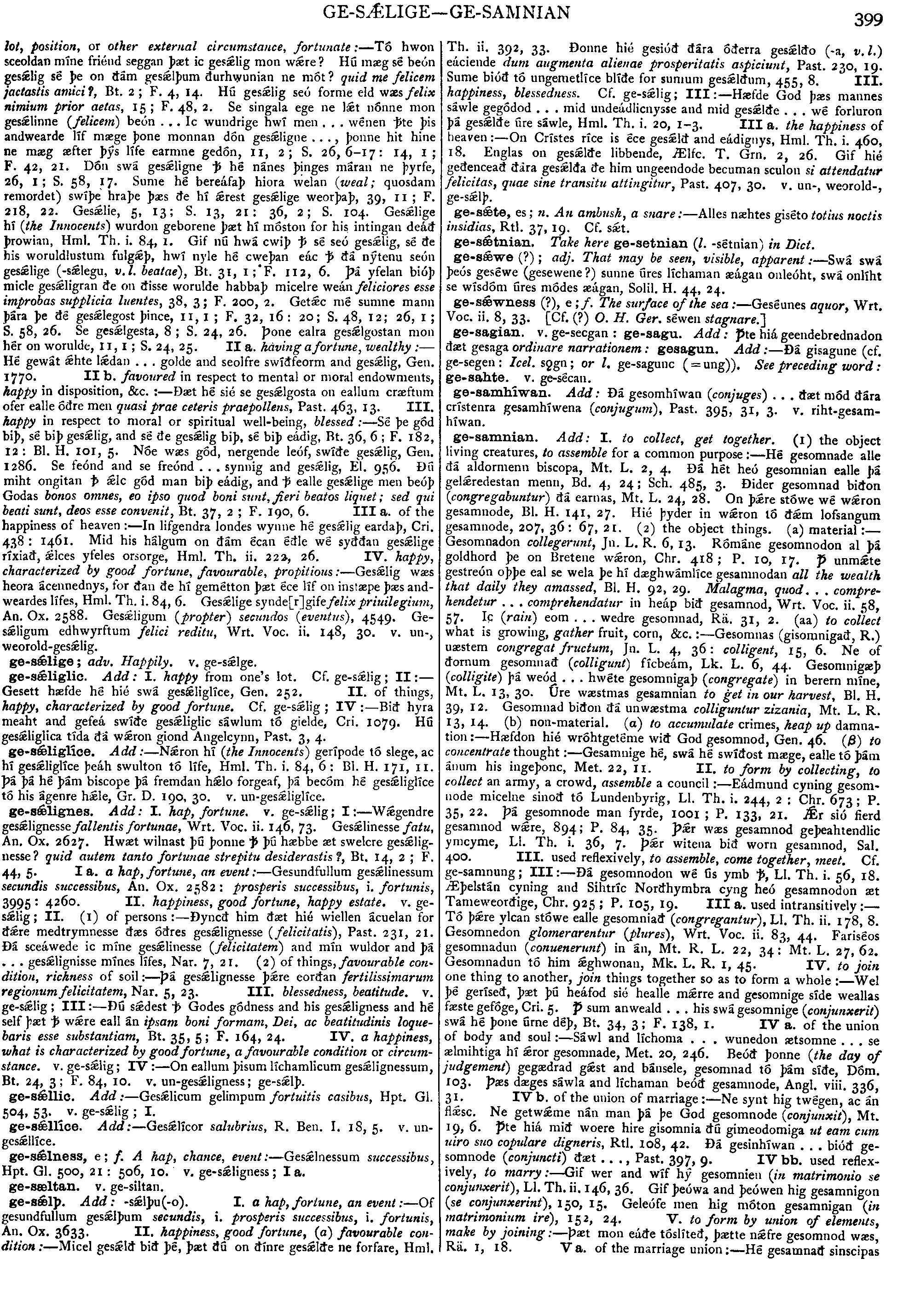
ge-s lignes.
Add;
I.
hap,
fortune,
v.
ge-slig;
I
:--
Wgendre
geslignesse
fallentis
fortunae,
Wrt.
Voc.
ii.
146,
73.
Geslinesse
fatu,
An.
Ox.
2627.
Hwæt
wilnast
þú
þonne
ILLEGIBLE
þú
hæbbe
æt
swelcre
geslignesse?
guid
autem
tanto
fortunae
strepitu
desiderastis
?
Bt.
14,
2
;
F.
44,
5.
I
a.
a
hap,
fortune,
an
event
:--
Gesundfullum
geslinessum
secundis
successibus,
An.
Ox.
2582
:
prosperis
successibus,
i.
fortunis,
3995
:
4260.
II.
happiness,
good
fortune,
happy
estate,
v.
geslig;
II.
(1)
of
persons
:--
Ðyncð
him
ðæt
hié
wiellen
ácuelan
for
ðre
medtrymnesse
ðæs
óðres
geslignesse
(felicitatis),
Past.
231,
21.
Ðá
sceáwede
ic
míne
geslinesse
(felicitatem)
and
mín
wuldor
and
þá
.
.
.
geslignisse
mínes
lífes,
Nar.
7,
21.
(2)
of
things,
favourable
condition,
richness
of
soil
:--
Þá
geslignesse
þre
eorðan
fertilissimarum
regionum
felicitatem,
Nar.
5,
23.
III.
blessedness,
beatitude,
v.
ge-slig
;
III
:--
Ðú
sdest
ILLEGIBLE
Godes
gódness
and
his
gesligness
and
hé
self
þæt
;
ILLEGIBLE
wre
eall
án
ipsam
boni
formam,
Dei,
ac
beatitudinis
loquebaris
esse
substantiam,
Bt.
35,
5;
F.
164,
24.
IV.
a
happiness,
what
is
characterized
by
good
fortune,
a
favourable
condition
or
circumstance.
V.
ge-slig;
IV
:--
On
eallum
þisum
líchamlicum
geslignessum,
Bt.
24,
3;
F.
84,
10.
v.
un-gesligness;
ge-s;þ.ge-sllic.
Add
:--
Geslicum
gelimpum
fortuitis
casibus,
Hpt.
Gl.
504,
53.
v.
ge-slig
;
I.ge-sllíce.
Add
:--
Geslícor
salubrius,
R.
Ben.
I.
18,
5.
v.
un-gcsllíce.ge-slness,
e;
f.
A
hap,
chance,
event
:--
Geslnessum
successibus,
Hpt.
Gl.
500,
21:
506,
10.
v.
ge-sligness;
I
a.
ge-sæltan.
v.
ge-siltan.
ge-slþ.
Add:
-slþu(-o).
I.
a
hap,
fortune,
an
event
:--
Of
gesundfullum
geslþum
secundis,
i.
prosperis
successibus,
i.
fortunis,
An.
Ox.
3633.
II.
happiness,
good
fortune,
(a)
favourable
condition
:--
Micel
geslð
bið
þé,
þæt
ðú
on
ðínre
geslðe
ne
forfare,
Th.
ii.
392,
33.
Ðonne
hié
gesióð
ðára
óðerra
geslðo
(-a,
v.
l.)
eáciende
dum
augmenta
auenae
prosperitatis
aspiciunt,
Past.
230,
19.
Sume
bióð
tó
ungemetlíce
blíðe
for
sumum
geslðum,
455,
8.
III.
happiness,
blessedness.
Cf.
ge-slig;
III
:--
Hæfde
God
þæs
mannes
sáwle
gegódod.
.
.mid
undeádlicnysse
and
mid
geslðe...
wé
forluron
þá
geslðe
úre
sáwle,
Hml.
Th.
i.
20,
1-3.
III
a.
the
happiness
of
heaven
:--
On
Crístes
ríce
is
éce
geslð
and
eádignys,
Hml.
Th.
i.
460,
18.
Englas
on
geslðe
libbende,
Ælfc.
T.
Grn.
2,
26.
Gif
hié
geðenceað
ðára
geslða
ðe
him
ungeendode
becuman
sculon
si
attendatur
felicitas,
quae
sine
transitu
attingitur,
Past.
407,
30.
v.
un-,
weorold-,
ge-slþ.ge-ste,
es;
n.
An
ambush,
a
snare
:--
Alles
næhtes
giséto
tatius
noctis
insidias.
Rtl.
37,
19.
Cf.
st.ge-stnian.
Take
here
ge-setnian
(l.
-sétnian)
in
Dict,ge-swe
(?);
adj.
That
may
be
seen,
visible,
apparent
:--
Swá
swá
þeós
geséwe
(gesewene
?)
sunne
úres
líchaman
æúgan
onleóht,
swá
onlíht
se
wisdóm
úres
módes
æúgan,
Solil.
H.
44,
24.ge-swness
(?),
e
;
f.
The
surface
of
the
sea
:--
Gessunes
aquor,
Wrt.
Voc.
ii.
8,
33.
[Cf.
(?)
O.
H.
Ger.
séwen
stagnare.
]ge-sagian.
v.
ge-secgan
:
ge-sagu.
Add:
ILLEGIBLE
hiá
geendebrednadon
ðæt
gesaga
ordinare
narrationem:
gesagun.
Add
:--
Ðá
gisagune
(cf.
ge-segen
:
Icel.
sggn;
or
l.
ge-sagunc
(-ung).
See
preceding
word:
ge-sahte.
v.
ge-sécan.
ge-samhíwan.
Add:
Ðá
gesomhíwan
(conjuges)
.
.
.
ðæt
mód
ðára
crístenra
gesamhíwena
(conjugum),
Past.
395,
31,
3.
v.
riht-gesam-híwan.
ge-samnian.
Add:
I.
to
collect,
get
together.
(1)
the
object
living
creatures,
to
assemble
for
a
common
purpose
:--
Hé
gesomnade
alle
ðá
aldormenn
biscopa,
Mt.
L.
2,
4.
Ðá
hét
heó
gesomnian
ealle
þá
gelredestan
menn,
Bd.
4,
24
;
Sch.
485,
3.
Ðider
gesomnad
biðon
(congregabuntur)
ðá
earnas.
Mt.
L.
24,
28.
On
þre
stówe
wé
wron
gesamnode,
Bl.
H.
141,
27.
Hié
þyder
in
wron
tó
ðm
lofsangum
gesamnode,
207,
36;
67,
21.
(2)
the
object
things,
(a)
material
:--
Gesomnadon
collegerunt,
Jn.
L.
R.
6,
13.
Rómáne
gesomnodon
al
þá
goldhord
þe
on
Bretene
wron,
Chr.
418
;
P.
10,
17.
ILLEGIBLE
unmte
gestreón
oþþe
eal
se
wela
þe
hí
dæghwámlíce
gesamnodan
all
the
wealth
that
daily
they
amassed,
Bl.
H.
92,
29.
Malagma,
quod.
.
.
comprehendetur
.
.
.
comprehendatur
in
heáp
bið
gesamnod,
Wrt.
Voc.
ii.
58,
57.
Ic
(rain)
eom
.
.
.
wedre
gesomnad,
Rá.
31,
2.
(aa)
to
collect
what
is
growing,
gather
fruit,
corn,
&
c.
:--
Gesomnas
(gisoronigað,
R.
)
uæstem
congregat
fructum,
jn.
L.
4,
36:
colligent,
15,
6.
Ne
of
ðornum
gesomnað
(colligunt)
fícbeám.
Lk.
L.
6,
44.
Gesomnigæþ
(colligile)
þá
weód
.
.
.
hwéte
gesomnigaþ
(congregate)
in
berern
mine,
Mt.
L.
13,
30.
Úre
wæstmas
gesamnian
to
get
in
our
harvest.
Bl.
H.
39,
12.
Gesomnad
biðon
ðá
unwæstma
colliguntur
zizania,
Mt.
L.
R.
13,
14.
(b)
non-material,
(a)
to
accumulate
crimes,
heap
up
damnation
:--
Hæfdon
hié
wróhtgetéme
wið
God
gesomnod,
Gen.
46.
ILLEGIBLE
to
concentrate
thought
:--
Gesamnige
hé,
swá
hé
swíðost
mæge,
ealle
tó
þám
ánum
his
ingeþonc.
Met.
22,
ii.
II.
to
form
by
collecting,
to
collect
an
army,
a
crowd,
assemble
a
council
:--
Eádmund
cyning
gesomnode
micelne
sinoð
tó
Lundenbyrig,
Ll.
Th.
i.
244,
2
:
Chr.
673
;
P.
35,
22.
þá
gesomnode
man
fyrde,
1001
;
P.
133,
21.
Æ-acute;r
sió
fierd
gesamnod
wre,
894;
P.
84,
35.
Þr
wæs
gesamnod
geþeahtendlic
ymcyme,
Ll.
Th.
i.
36,
7.
þr
witena
bið
worn
gesamnod.
Sal.
400.
III.
used
reflexively
,
to
assemble,
come
together,
meet.
Cf.
ge-samnung;
III
:--
Ðá
gesomnodon
wé
ús
ymb
ILLEGIBLE
,
Ll.
Th.
i.
56,
18.
Æþelstán
cyning
and
Sihtric
Norðhymbra
cyng
heó
gesamnodon
æt
Tameweorðige,
Chr.
925
;
P.
105,
19.
III
a,
used
intransitively
:--
Tó
þre
ylcan
stowe
ealle
gesomniað
(congregantur),
LI.
Th.
ii.
178,
8.
Gesomnedon
glomerarentur
(plures),
Wrt.
Voc.
ii.
83,
44.
Fariséos
gesomnadun
(conuenerunt)
in
án,
Mt.
R.
L.
22,
34:
Mt.
L.
27,
62.
Gesomnadun
tó
him
ghwonan,
Mk.
L.
R.
I.
45.
IV.
to
join
one
thing
to
another,
join
things
together
so
as
to
form
a
whole
:--
Wel
þé
geríseð,
þæt
þú
heáfod
sió
healle
mrre
and
gesomnige
síde
weallas
fæste
gefóge,
Cri.
5.
ILLEGIBLE
sum
anweald
.
.
.
his
swá
gesomnige
(canjunxerif)
swá
hé
þone
úrne
déþ,
Bt.
34,
3;
F.
138,
l.
IV
a.
of
the
union
of
body
and
soul
:--
Sáwl
and
líchoma
.
.
.
wunedon
ætsomne
.
.
.
se
ælmihtiga
hí
ror
gesomnade,
Met.
20,
246.
Beóð
þonne
(the
day
of
judgement)
gegædrad
gst
and
bánsele,
gesomnad
tó
þám
síðe,
Dóm.
103.
Þæs
dæges
sáwla
and
líchaman
beóð
gesamnode,
Angl.
viii.
336,
31.
IV
b.
of
the
union
of
marriage
:--
Ne
synt
hig
twégen,
ac
an
flsc.
Ne
getwme
nán
man
þá
þe
God
gesomnode
(conjunxit),
Mt.
19,
6.
ILLEGIBLE
hiá
mið
woere
hire
gisomnia
ðú
gimeodomiga
ut
eam
cum
uiro
suo
cofutare
digneris,
Rtl.
108,
42.
Ðá
gesinhíwan
.
.
.
bióð
gesomnode
(conjuncti)
ðæt
.
.
.
,
Past.
397,
9.
IV
bb.
used
reflexively,
to
marry:
--
-Gif
wer
and
wíf
hý
gesomnien
(in
matrimonio
se
conjunxerit),
Ll.
Th.
ii.
146,
36.
Gif
þeówa
and
þeówen
hig
gesamnigon
(se
conjunxerint),
150,
15.
Geleófe
men
hig
móton
gesamnigan
(in
matrimonium
ire),
152,
24.
V.
to
form
by
union
of
elements,
make
by
joining
:--
Þæt
mon
cúðe
tóslíteð,
þætte
nfre
gesomnod
wæs,
Ru.
I.
18,
V
a.
of
the
marriage
union
:--
Hé
gesamnað
sinscipas.
lignes.
Add;
I.
hap,
fortune,
v.
ge-slig;
I
:--
Wgendre
geslignesse
fallentis
fortunae,
Wrt.
Voc.
ii.
146,
73.
Geslinesse
fatu,
An.
Ox.
2627.
Hwæt
wilnast
þú
þonne
ILLEGIBLE
þú
hæbbe
æt
swelcre
geslignesse?
guid
autem
tanto
fortunae
strepitu
desiderastis
?
Bt.
14,
2
;
F.
44,
5.
I
a.
a
hap,
fortune,
an
event
:--
Gesundfullum
geslinessum
secundis
successibus,
An.
Ox.
2582
:
prosperis
successibus,
i.
fortunis,
3995
:
4260.
II.
happiness,
good
fortune,
happy
estate,
v.
geslig;
II.
(1)
of
persons
:--
Ðyncð
him
ðæt
hié
wiellen
ácuelan
for
ðre
medtrymnesse
ðæs
óðres
geslignesse
(felicitatis),
Past.
231,
21.
Ðá
sceáwede
ic
míne
geslinesse
(felicitatem)
and
mín
wuldor
and
þá
.
.
.
geslignisse
mínes
lífes,
Nar.
7,
21.
(2)
of
things,
favourable
condition,
richness
of
soil
:--
Þá
geslignesse
þre
eorðan
fertilissimarum
regionum
felicitatem,
Nar.
5,
23.
III.
blessedness,
beatitude,
v.
ge-slig
;
III
:--
Ðú
sdest
ILLEGIBLE
Godes
gódness
and
his
gesligness
and
hé
self
þæt
;
ILLEGIBLE
wre
eall
án
ipsam
boni
formam,
Dei,
ac
beatitudinis
loquebaris
esse
substantiam,
Bt.
35,
5;
F.
164,
24.
IV.
a
happiness,
what
is
characterized
by
good
fortune,
a
favourable
condition
or
circumstance.
V.
ge-slig;
IV
:--
On
eallum
þisum
líchamlicum
geslignessum,
Bt.
24,
3;
F.
84,
10.
v.
un-gesligness;
ge-s;þ.ge-sllic.
Add
:--
Geslicum
gelimpum
fortuitis
casibus,
Hpt.
Gl.
504,
53.
v.
ge-slig
;
I.ge-sllíce.
Add
:--
Geslícor
salubrius,
R.
Ben.
I.
18,
5.
v.
un-gcsllíce.ge-slness,
e;
f.
A
hap,
chance,
event
:--
Geslnessum
successibus,
Hpt.
Gl.
500,
21:
506,
10.
v.
ge-sligness;
I
a.
ge-sæltan.
v.
ge-siltan.
ge-slþ.
Add:
-slþu(-o).
I.
a
hap,
fortune,
an
event
:--
Of
gesundfullum
geslþum
secundis,
i.
prosperis
successibus,
i.
fortunis,
An.
Ox.
3633.
II.
happiness,
good
fortune,
(a)
favourable
condition
:--
Micel
geslð
bið
þé,
þæt
ðú
on
ðínre
geslðe
ne
forfare,
Th.
ii.
392,
33.
Ðonne
hié
gesióð
ðára
óðerra
geslðo
(-a,
v.
l.)
eáciende
dum
augmenta
auenae
prosperitatis
aspiciunt,
Past.
230,
19.
Sume
bióð
tó
ungemetlíce
blíðe
for
sumum
geslðum,
455,
8.
III.
happiness,
blessedness.
Cf.
ge-slig;
III
:--
Hæfde
God
þæs
mannes
sáwle
gegódod.
.
.mid
undeádlicnysse
and
mid
geslðe...
wé
forluron
þá
geslðe
úre
sáwle,
Hml.
Th.
i.
20,
1-3.
III
a.
the
happiness
of
heaven
:--
On
Crístes
ríce
is
éce
geslð
and
eádignys,
Hml.
Th.
i.
460,
18.
Englas
on
geslðe
libbende,
Ælfc.
T.
Grn.
2,
26.
Gif
hié
geðenceað
ðára
geslða
ðe
him
ungeendode
becuman
sculon
si
attendatur
felicitas,
quae
sine
transitu
attingitur,
Past.
407,
30.
v.
un-,
weorold-,
ge-slþ.ge-ste,
es;
n.
An
ambush,
a
snare
:--
Alles
næhtes
giséto
tatius
noctis
insidias.
Rtl.
37,
19.
Cf.
st.ge-stnian.
Take
here
ge-setnian
(l.
-sétnian)
in
Dict,ge-swe
(?);
adj.
That
may
be
seen,
visible,
apparent
:--
Swá
swá
þeós
geséwe
(gesewene
?)
sunne
úres
líchaman
æúgan
onleóht,
swá
onlíht
se
wisdóm
úres
módes
æúgan,
Solil.
H.
44,
24.ge-swness
(?),
e
;
f.
The
surface
of
the
sea
:--
Gessunes
aquor,
Wrt.
Voc.
ii.
8,
33.
[Cf.
(?)
O.
H.
Ger.
séwen
stagnare.
]ge-sagian.
v.
ge-secgan
:
ge-sagu.
Add:
ILLEGIBLE
hiá
geendebrednadon
ðæt
gesaga
ordinare
narrationem:
gesagun.
Add
:--
Ðá
gisagune
(cf.
ge-segen
:
Icel.
sggn;
or
l.
ge-sagunc
(-ung).
See
preceding
word:
ge-sahte.
v.
ge-sécan.
ge-samhíwan.
Add:
Ðá
gesomhíwan
(conjuges)
.
.
.
ðæt
mód
ðára
crístenra
gesamhíwena
(conjugum),
Past.
395,
31,
3.
v.
riht-gesam-híwan.
ge-samnian.
Add:
I.
to
collect,
get
together.
(1)
the
object
living
creatures,
to
assemble
for
a
common
purpose
:--
Hé
gesomnade
alle
ðá
aldormenn
biscopa,
Mt.
L.
2,
4.
Ðá
hét
heó
gesomnian
ealle
þá
gelredestan
menn,
Bd.
4,
24
;
Sch.
485,
3.
Ðider
gesomnad
biðon
(congregabuntur)
ðá
earnas.
Mt.
L.
24,
28.
On
þre
stówe
wé
wron
gesamnode,
Bl.
H.
141,
27.
Hié
þyder
in
wron
tó
ðm
lofsangum
gesamnode,
207,
36;
67,
21.
(2)
the
object
things,
(a)
material
:--
Gesomnadon
collegerunt,
Jn.
L.
R.
6,
13.
Rómáne
gesomnodon
al
þá
goldhord
þe
on
Bretene
wron,
Chr.
418
;
P.
10,
17.
ILLEGIBLE
unmte
gestreón
oþþe
eal
se
wela
þe
hí
dæghwámlíce
gesamnodan
all
the
wealth
that
daily
they
amassed,
Bl.
H.
92,
29.
Malagma,
quod.
.
.
comprehendetur
.
.
.
comprehendatur
in
heáp
bið
gesamnod,
Wrt.
Voc.
ii.
58,
57.
Ic
(rain)
eom
.
.
.
wedre
gesomnad,
Rá.
31,
2.
(aa)
to
collect
what
is
growing,
gather
fruit,
corn,
&
c.
:--
Gesomnas
(gisoronigað,
R.
)
uæstem
congregat
fructum,
jn.
L.
4,
36:
colligent,
15,
6.
Ne
of
ðornum
gesomnað
(colligunt)
fícbeám.
Lk.
L.
6,
44.
Gesomnigæþ
(colligile)
þá
weód
.
.
.
hwéte
gesomnigaþ
(congregate)
in
berern
mine,
Mt.
L.
13,
30.
Úre
wæstmas
gesamnian
to
get
in
our
harvest.
Bl.
H.
39,
12.
Gesomnad
biðon
ðá
unwæstma
colliguntur
zizania,
Mt.
L.
R.
13,
14.
(b)
non-material,
(a)
to
accumulate
crimes,
heap
up
damnation
:--
Hæfdon
hié
wróhtgetéme
wið
God
gesomnod,
Gen.
46.
ILLEGIBLE
to
concentrate
thought
:--
Gesamnige
hé,
swá
hé
swíðost
mæge,
ealle
tó
þám
ánum
his
ingeþonc.
Met.
22,
ii.
II.
to
form
by
collecting,
to
collect
an
army,
a
crowd,
assemble
a
council
:--
Eádmund
cyning
gesomnode
micelne
sinoð
tó
Lundenbyrig,
Ll.
Th.
i.
244,
2
:
Chr.
673
;
P.
35,
22.
þá
gesomnode
man
fyrde,
1001
;
P.
133,
21.
Æ-acute;r
sió
fierd
gesamnod
wre,
894;
P.
84,
35.
Þr
wæs
gesamnod
geþeahtendlic
ymcyme,
Ll.
Th.
i.
36,
7.
þr
witena
bið
worn
gesamnod.
Sal.
400.
III.
used
reflexively
,
to
assemble,
come
together,
meet.
Cf.
ge-samnung;
III
:--
Ðá
gesomnodon
wé
ús
ymb
ILLEGIBLE
,
Ll.
Th.
i.
56,
18.
Æþelstán
cyning
and
Sihtric
Norðhymbra
cyng
heó
gesamnodon
æt
Tameweorðige,
Chr.
925
;
P.
105,
19.
III
a,
used
intransitively
:--
Tó
þre
ylcan
stowe
ealle
gesomniað
(congregantur),
LI.
Th.
ii.
178,
8.
Gesomnedon
glomerarentur
(plures),
Wrt.
Voc.
ii.
83,
44.
Fariséos
gesomnadun
(conuenerunt)
in
án,
Mt.
R.
L.
22,
34:
Mt.
L.
27,
62.
Gesomnadun
tó
him
ghwonan,
Mk.
L.
R.
I.
45.
IV.
to
join
one
thing
to
another,
join
things
together
so
as
to
form
a
whole
:--
Wel
þé
geríseð,
þæt
þú
heáfod
sió
healle
mrre
and
gesomnige
síde
weallas
fæste
gefóge,
Cri.
5.
ILLEGIBLE
sum
anweald
.
.
.
his
swá
gesomnige
(canjunxerif)
swá
hé
þone
úrne
déþ,
Bt.
34,
3;
F.
138,
l.
IV
a.
of
the
union
of
body
and
soul
:--
Sáwl
and
líchoma
.
.
.
wunedon
ætsomne
.
.
.
se
ælmihtiga
hí
ror
gesomnade,
Met.
20,
246.
Beóð
þonne
(the
day
of
judgement)
gegædrad
gst
and
bánsele,
gesomnad
tó
þám
síðe,
Dóm.
103.
Þæs
dæges
sáwla
and
líchaman
beóð
gesamnode,
Angl.
viii.
336,
31.
IV
b.
of
the
union
of
marriage
:--
Ne
synt
hig
twégen,
ac
an
flsc.
Ne
getwme
nán
man
þá
þe
God
gesomnode
(conjunxit),
Mt.
19,
6.
ILLEGIBLE
hiá
mið
woere
hire
gisomnia
ðú
gimeodomiga
ut
eam
cum
uiro
suo
cofutare
digneris,
Rtl.
108,
42.
Ðá
gesinhíwan
.
.
.
bióð
gesomnode
(conjuncti)
ðæt
.
.
.
,
Past.
397,
9.
IV
bb.
used
reflexively,
to
marry:
--
-Gif
wer
and
wíf
hý
gesomnien
(in
matrimonio
se
conjunxerit),
Ll.
Th.
ii.
146,
36.
Gif
þeówa
and
þeówen
hig
gesamnigon
(se
conjunxerint),
150,
15.
Geleófe
men
hig
móton
gesamnigan
(in
matrimonium
ire),
152,
24.
V.
to
form
by
union
of
elements,
make
by
joining
:--
Þæt
mon
cúðe
tóslíteð,
þætte
nfre
gesomnod
wæs,
Ru.
I.
18,
V
a.
of
the
marriage
union
:--
Hé
gesamnað
sinscipas.
|
Source: Bosworth/Toller, page d0400, entry 1 View original page image as: [TIFF] [PNG] [View previous entry] [View next entry] |
[Comment on this entry] [View comments] |
The following entry has been hand-corrected once. |
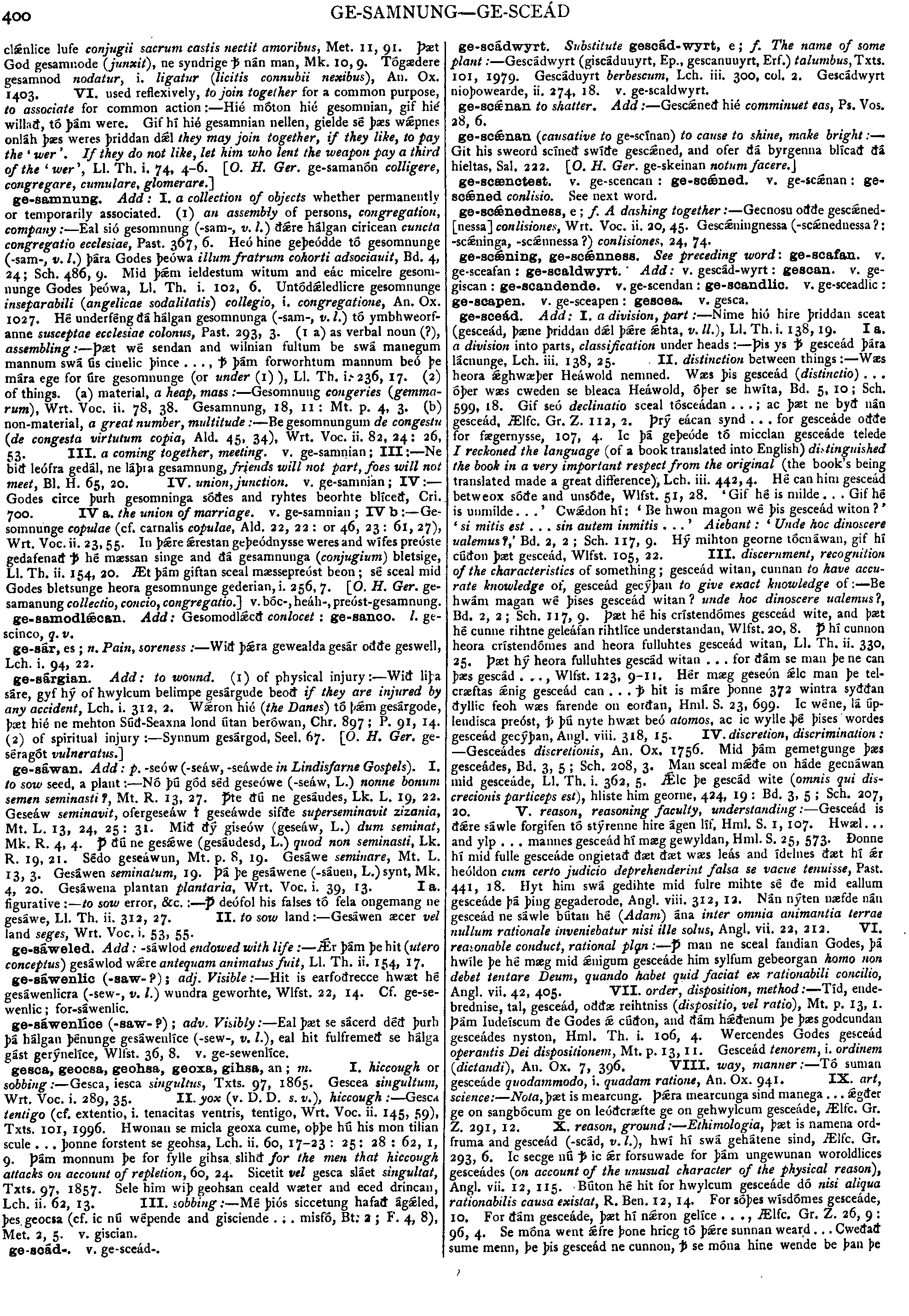
clnlice
lufe
conjugii
sacrum
castis
nectit
amoribus,
Met.
II.
91.
Þæt
God
gesamnode
(junxit),
ne
syndrige
 nán
man,
Mk.
lo,
9.
Tógædere
gesamnod
nodatur,
i.
ligatur
(licitis
connubii
nexibus),
An.
Ox
1403.
VI.
used
reflexively,
to
join
together
for
a
common
purpose
to
associate
for
common
action
:--
Hié
móton
hié
gesomnian,
gif
hié
willað,
tó
þám
were.
Gif
hí
hié
gesamnian
nellen,
gielde
sé
þæs
wpnes
onláh
þæs
weres
þriddan
dl
they
may
join
together,
if
they
like,
to
pay
the
'wer'.
If
they
do
not
like,
let
him
who
lent
the
weapon
pay
a
third
of
the
'wer',
Ll.
Th.
i.
74,
4-6.
[O.H.Ger.
ge-samanón
colligere
congregare,
cumulare,
glomerare.]
nán
man,
Mk.
lo,
9.
Tógædere
gesamnod
nodatur,
i.
ligatur
(licitis
connubii
nexibus),
An.
Ox
1403.
VI.
used
reflexively,
to
join
together
for
a
common
purpose
to
associate
for
common
action
:--
Hié
móton
hié
gesomnian,
gif
hié
willað,
tó
þám
were.
Gif
hí
hié
gesamnian
nellen,
gielde
sé
þæs
wpnes
onláh
þæs
weres
þriddan
dl
they
may
join
together,
if
they
like,
to
pay
the
'wer'.
If
they
do
not
like,
let
him
who
lent
the
weapon
pay
a
third
of
the
'wer',
Ll.
Th.
i.
74,
4-6.
[O.H.Ger.
ge-samanón
colligere
congregare,
cumulare,
glomerare.]
|
Source: Bosworth/Toller, page d0400, entry 5 View original page image as: [TIFF] [PNG] [View previous entry] [View next entry] |
[Comment on this entry] [View comments] |
The following entry has been hand-corrected once. |
ge-sárgian.
Add:
to
wound,
(l)
of
physical
injury
:--
Wið
liþa
sáre,
gyf
hý
of
hwylcum
belimpe
gesárgude
beoð
if
they
are
injured
by
any
accident,
Lch.
i.
312,
2.
Wron
hié
(the
Danes)
tó
þm
gesárgode,
þæt
hié
ne
mehton
Súð-Seaxna
lond
útan
berówan,
Chr.
897;
P.
91,
14.
(2)
of
spiritual
injury
:--
Synnum
gesárgod.
Seel.
67.
[O.H.Ger.
ge-séragót
vulneratus.]
|
Source: Bosworth/Toller, page d0406, entry 1 View original page image as: [TIFF] [PNG] [View previous entry] [View next entry] |
[Comment on this entry] [View comments] |
The following entry has been hand-corrected once. |
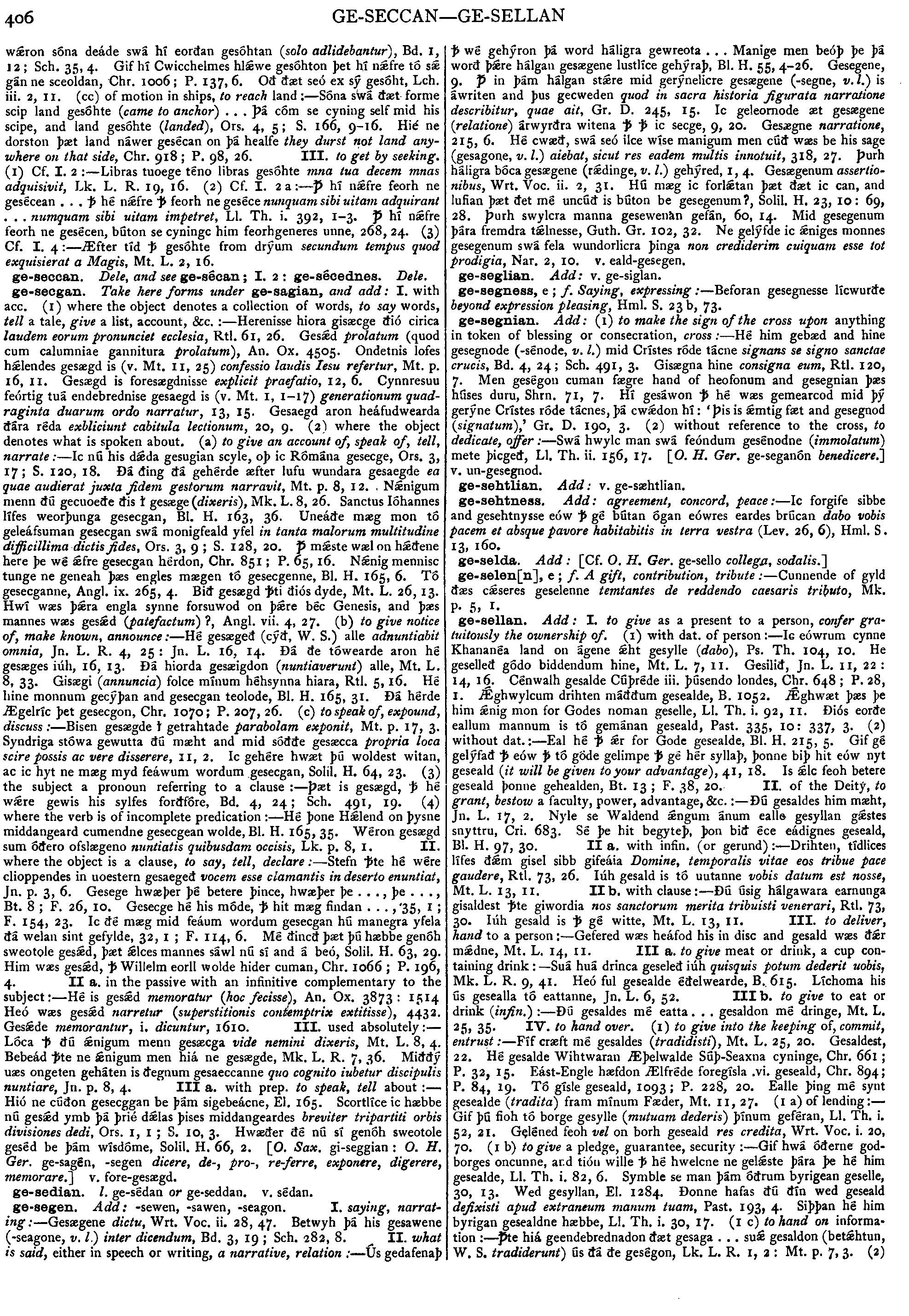
wron
sóna
deáde
swá
hí
eorðan
gesóhtan
(solo
adlidebantur),
Bd.
I.
12;
Sch.
35,
4.
Gif
hí
Cwicchelmes
hlwe
gesóhton
þet
hí
nfre
tó
s
gán
ne
sceoldan,
Chr.
1006;
P.
137,
6.
Oð
ðæt
seó
ex
sý
gesóht,
Lch.
iii.
2,
ll.
(cc)
of
motion
in
ships,
to
reach
land
:--
Sóna
swá
ðæt
forme
scip
land
gesóhte
(came
to
anchor)
.
.
.
Þá
cóm
se
cyning
self
mid
his
scipe,
and
land
gesóhte
(landed),
Ors.
4,
5;
S.
166,
9-16.
Hié
ne
dorston
þæt
land
náwer
gesécan
on
þá
healfe
they
durst
not
land
anywhere
on
that
side,
Chr.
918
;
P.
98,
26.
III.
to
get
by
seeking.
(l)
Cf.
I.
2
:--
Libras
tuoege
téno
libras
gesóhte
mna
tua
decent
mnas
adquisivit,
Lk.
L.
R.
19,
16.
(2)
Cf.
I.
2
a
:--
Þ
UNCERTAIN
hí
nfre
feorh
ne
gesécean
.
.
.
hé
nfre
feorh
ne
geséce
nunquam
sibi
uitam
adquirant
.
.
.
numquam
sibi
uitam
impetret,
Ll.
Th.
i.
392,
1-3.
Þ
UNCERTAIN
hí
nfre
feorh
ne
gesécen,
búton
se
cyningc
him
feorhgeneres
unne,
268,
24.
(3)
Cf.
I.
4
:--
Æfter
tíd
gesóhte
from
drýum
secundum
tempus
quod
exquisierat
a
Magis,
Mt.
L.
2,
16.
|
Source: Bosworth/Toller, page d0408, entry 1 View original page image as: [TIFF] [PNG] [View previous entry] [View next entry] |
[Comment on this entry] [View comments] |
The following entry has been hand-corrected once. |
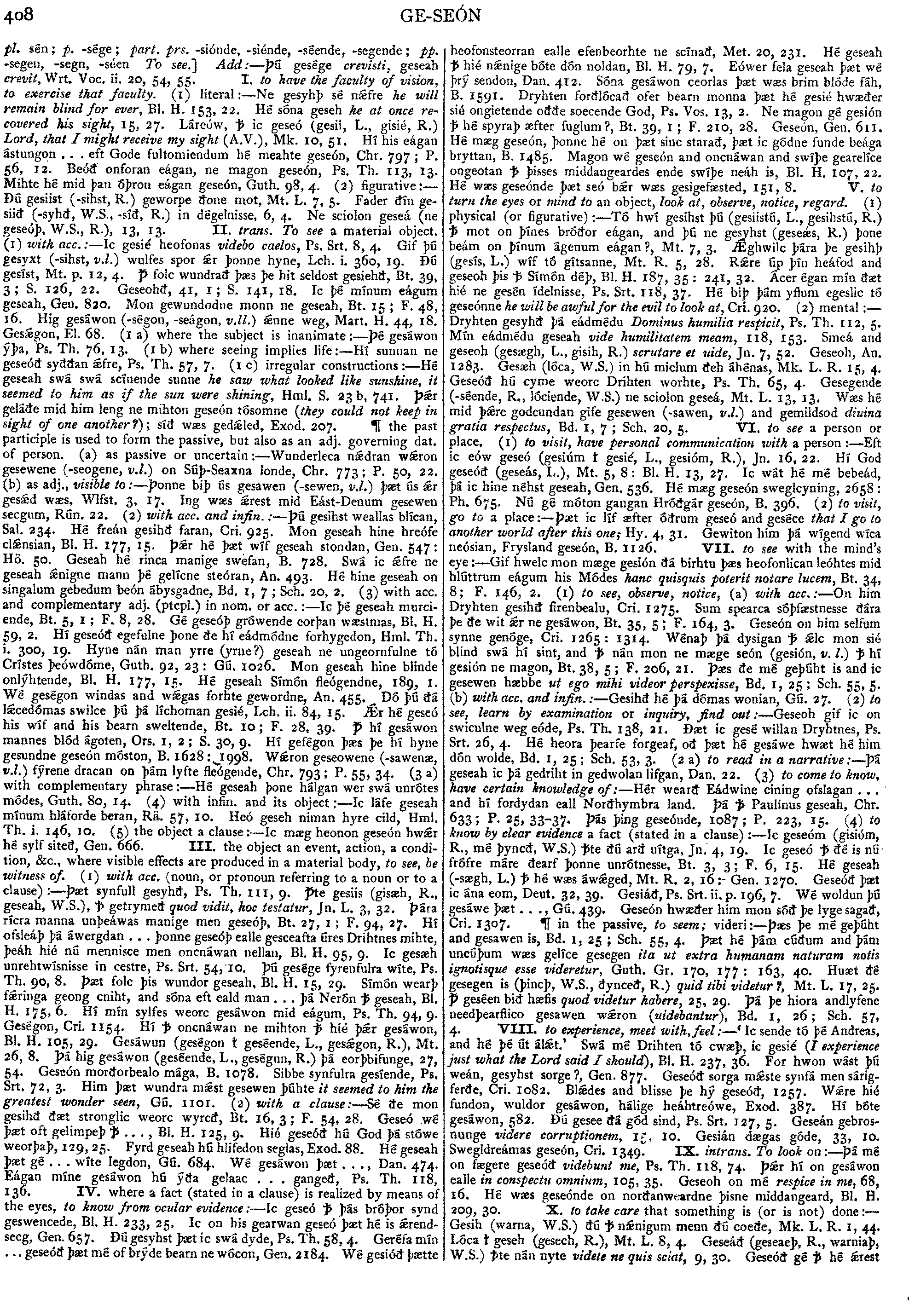
pl.
sén;
p.
-sége
;
part.
prs.
-siónde,
-siénde,
-séende,
-segende
;
pp.
-segen,
-segn,
-séen
To
see.]
Add
:--
Þú
gesége
crevisti,
geseah
crevit,
Wrt.
Voc.
ii.
20,
54,
55.
I.
to
have
the
faculty
of
vision,
to
exercise
that
faculty.
(l)
literal
:--
Ne
gesyhþ
sé
nfre
he
will
remain
blind
for
ever.
Bl.
H.
153,
22.
Hé
sóna
geseh
he
at
once
recovered
his
sight,
15,
27.
Láreów,
ic
geseó
(gesii,
L.,
gisié,
R.
)
Lord,
that
I
might
receive
my
sight
(A.
V.),
Mk.
10,
51.
Hí
his
eágan
ástungon
.
.
.
eft
Gode
fultomiendum
hé
meahte
geseón.
Chr.
797
;
P.
56,
12.
Beóð
onforan
eágan,
ne
magon
geseón,
Ps.
Th.
113,
13.
Mihte
he
mid
þan
óþron
eágan
geseón.
Guth.
98,
4.
(2)
figurative
:--
Ðú
gesiist
(-sihst,
R.)
geworpe
ðone
mot,
Mt.
L.
7,
5.
Fader
ðín
gesiið
(-syhð,
W.S.,
-síð,
R.)
in
dégelnisse,
6,
4.
Ne
sciolon
geseá
(ne
geseóþ,
W.S.,
R.),
13,
13.
II.
trans.
To
see
a
material
object,
(l)
with
acc.
:--
Ic
gesié
heofonas
videbo
caelos,
Ps.
Srt.
8,
4.
Gif
þú
gesyxt
(-sihst,
v.l.)
wulfes
spor
r
þonne
hyne,
Lch.
i.
360,
19.
Ðú
gesíst,
Mt.
p.
12,
4.
Þ
UNCERTAIN
folc
wundrað
þæs
þe
hit
seldost
gesiehð,
Bt.
39,
3;
S.
126,
22.
Geseohð,
41,
1;
S.
141,
18.
Ic
þé
mínum
eágum
geseah,
Gen.
820.
Mon
gewundodne
monn
ne
geseah.
Bt.
15
;
F.
48,
16.
Hig
gesáwon
(-ségon,
-seágon,
v.ll.)
nne
weg,
Mart.
H.
44,
18.
Gesgon,
El.
68.
(l
a)
where
the
subject
is
inanimate
:--
Þé
gesáwon
ýþa.
Ps.
Th.
76,
13.
(l
b)
where
seeing
implies
life
:--
Hí
sunnan
ne
geseóð
syððan
fre,
Ps.
Th.
57,
7.
(l
c)
irregular
constructions
:--
Hé
geseah
swá
swá
scínende
sunne
he
saw
what
looked
like
sunshine,
it
seemed
to
him
as
if
the
sun
were
shining.
Hml.
S.
23
b,
741.
Þr
geláðe
mid
him
leng
ne
mihton
geseón
tósomne
(they
could
not
keep
in
sight
of
one
another
?);
síð
wæs
gedled,
Exod.
207.

the
past
participle
is
used
to
form
the
passive,
but
also
as
an
adj.
governing
dat.
of
person,
(a)
as
passive
or
uncertain
:--
Wunderleca
ndran
wron
gesewene
(-seogene,
v.l.)
on
Súþ-Seaxna
londe,
Chr.
773;
P.
50,
22.
(b)
as
adj.
,
visible
to
:--
Þonne
biþ
ús
gesawen
(-sewen,
v.l.)
þæt
ús
r
gesd
wæs.
Wlfst.
3,
17.
Ing
wæs
rest
mid
Eást-Denum
gesewen
secgum,
Rún.
22.
(2)
with
acc.
and
infin.
:--
Þú
gesihst
weallas
blícan,
Sal.
234.
Hé
freán
gesihð
faran,
Cri.
925.
Mon
geseah
hine
hreófe
clnsian,
Bl.
H.
177,
15.
Þr
hé
þæt
wíf
geseah
stondan,
Gen.
547:
Ho.
50.
Geseah
hé
rinca
manige
swefan,
B.
728.
Swá
ic
fre
ne
geseah
nigne
mann
þé
gelícne
steóran,
An.
493.
Hé
hine
geseah
on
singalum
gebedum
beón
ábysgadne,
Bd.
l,
7;
Sch.
20,
2.
(3)
with
acc.
and
complementary
adj.
(ptcpl.)
in
nom.
or
acc.
:--
Ic
þé
geseah
murciende,
Bt.
5,
I
;
F.
8,
28.
Gé
geseóþ
grówende
eorþan
wæstmas.
Bl.
H.
59,
2.
Hí
geseóð
egefulne
þone
ðe
hí
eádmódne
forhygedon,
Hml.
Th.
i.
300,
19.
Hyne
nán
man
yrre
(yrne?)
geseah
ne
ungeornfulne
tó
Crístes
þeówdóme,
Guth.
92,
23
:
Gú.
1026.
Mon
geseah
hine
blinde
onlýhtende,
Bl.
H.
177,
15.
Hé
geseah
Símón
fleógendne,
189,
i.
Wé
geségon
windas
and
wgas
forhte
gewordne,
An.
455.
Dó
þú
ðá
lcedómas
swilce
þú
þá
líchoman
gesié,
Lch.
ii.
84,
15.
Æ-acute;r
hé
geseó
his
wíf
and
his
bearn
sweltende,
Bt.
10;
F.
28,
39.
Þ
UNCERTAIN
hí
gesáwon
mannes
blód
ágoten,
Ors.
l,
2
;
S.
30,
9.
Hí
gefégon
þæs
þe
hí
hyne
gesundne
geseón
móston,
B.
1628:
1998.
Wron
geseowene
(-sawenæ,
v.l.)
fýrene
dracan
on
þám
lyfte
fleógende,
Chr.
793;
P.
55,
34.
(3
a)
with
complementary
phrase
:--
Hé
geseah
þone
hálgan
wer
swá
unrótes
módes.
Guth.
80,
14.
(4)
with
infin.
and
its
object
:--
Ic
láfe
geseah
mínum
hláforde
beran,
Rä.
57,
10.
Heó
geseh
niman
hyre
cild,
Hml.
Th.
i.
146,
10.
(5)
the
object
a
clause
:--
Ic
mæg
heonon
geseón
hwr
hé
sylf
siteð,
Gen.
666.
III.
the
object
an
event,
action,
a
condition,
&c.
,
where
visible
effects
are
produced
in
a
material
body,
to
see,
be
witness
of.
(l)
with
acc.
(noun,
or
pronoun
referring
to
a
noun
or
to
a
clause)
:--
Þæt
synfull
gesyhð,
Ps.
Th.
111,
9.
Þ
UNCERTAINte
gesiis
(gisæh,
R.,
geseah,
W.S.),
þ
getrymeð
quod
vidit,
hoc
testatur,
Jn.
L.
3,
32.
Þára
rícra
manna
unþeáwas
manige
men
geseóþ,
Bt.
27,
I
;
F.
94,
27.
Hí
ofsleáþ
þá
áwergdan
.
.
.
þonne
geseóþ
ealle
gesceafta
úres
Drihtnes
mihte,
þeáh
hié
nú
mennisce
men
oncnáwan
nellan,
Bl.
H.
95,
9.
Ic
gesæh
unrehtwísnisse
in
cestre,
Ps.
Srt.
54,
10.
Þú
gesége
fyrenfulra
wíte,
Ps.
Th.
90,
8.
Þæt
folc
þis
wundor
geseah,
Bl.
H.
15,
29.
Símón
wearþ
fringa
geong
cniht,
and
sóna
eft
eald
man
.
.
.
þá
Nerón
geseah,
Bl.
H.
175,
6.
Hí
mín
sylfes
weorc
gesáwon
mid
eágum,
Ps.
Th.
94,
9.
Geségon,
Cri.
1154.
Hí
oncnáwan
ne
mihton
hié
þr
gesáwon,
Bl.
H.
105,
29.
Gesáwun
(geségon
 geséende,
L.,
gességon,
R.
),
Mt.
26,
8.
Þá
hig
gesáwon
(geséende,
L.,
geségnn,
R.
)
þá
eorþbifunge,
27,
54.
Geseón
morðorbealo
mága,
B.
1078.
Sibbe
synfulra
gesiende,
Ps.
Srt.
72,
3.
Him
þæt
wundra
mst
gesewen
þúhte
it
seemed
to
him
the
greatest
wonder
seen,
Go.
1101.
(2)
with
a
clause
:--
Sé
ðe
mon
gesihð
ðæt
stronglic
weorc
wyrcð,
Bt.
16,
3;
F.
54,
28.
Geseó
wé
þæt
oft
gelimpeþ
.
.
.
,
Bl.
H.
125,
9.
Hié
geseóð
hú
God
þá
stówe
weorþaþ,
129,
25.
Fyrd
geseah
hú
hlifedon
seglas,
Exod.
88.
Hé
geseah
þæt
gé
.
.
.
wíte
legdon,
Gú.
684.
Wé
gesáwon
þæt
.
.
.
,
Dan.
474.
Eágan
míne
gesáwon
hú
ýða
gelaac
.
.
.
gangeð,
Ps.
Th.
118,
136.
IV.
where
a
fact
(stated
in
a
clause)
is
realized
by
means
of
the
eyes,
to
know
from
ocular
evidence
:--
Ic
geseó
þás
bróþor
synd
geswencede,
Bl.
H.
233,
25.
Ic
on
his
gearwan
geseó
þæt
hé
is
rend-secg,
Gen.
657.
Ðú
gesyhst
þæt
ic
swá
dyde,
Ps.
Th.
58,
4.
Geréfa
mín
.
.
.
geseóð
þæt
mé
of
brýde
bearn
ne
wócon,
Gen.
2184.
Wé
gesióð
þætte
heofonsteorran
ealle
efenbeorhte
ne
scínað,
Met.
20,
231.
Hé
geseah
hié
nnige
bóte
dón
noldan,
Bl.
H.
79,
7.
Eówer
fela
geseah
þæt
wé
þrý
sendon,
Dan.
412.
Sóna
gesáwon
ceorlas
þæt
wæs
brim
blóde
fáh,
3.
1591.
Dryhten
forðlócað
ofer
bearn
monna
þæt
hé
gesié
hwæðer
sié
ongietende
oððe
soecende
God,
Ps.
Vos.
13,
2.
Ne
magon
gé
gesión
hé
spyraþ
æfter
fuglum?,
Bt.
39,
l;
F.
210,
28.
Geseón,
Gen.
611.
Hé
mæg
geseón,
þonne
hé
on
þæt
sinc
starað,
þæt
ic
gódne
funde
beága
bryttan,
B.
1485.
Magon
wé
geseón
and
oncnáwan
and
swíþe
gearelíce
ongeotan
þisses
middangeardes
ende
swíþe
neáh
is,
Bl.
H.
107,
22.
Hé
wæs
geseónde
þæt
seó
br
wæs
gesigefæsted,
151,
8.
V.
to
turn
the
eyes
or
mind
to
an
object,
look
at,
observe,
notice,
regard.
(l)
physical
(or
figurative)
:--
Tó
hwí
gesihst
þú
(gesiistú,
L.,
gesihstú,
R.)
mot
on
þínes
broðor
eágan,
and
þú
ne
gesyhst
(geses,
R.)
þone
beám
on
þinum
ágenum
eágan
?,
Mt.
7,
3.
Æghwilc
þára
þe
gesihþ
(gesís,
L.)
wíf
tó
gítsanne,
Mt.
R.
5,
28.
Rre
úp
þín
heáfod
and
geseoh
þis
Simón
déþ,
Bl.
H.
187,
35
:
241,
32.
Ácer
égan
mín
ðæt
hié
ne
gesén
ídelnisse,
Ps.
Srt.
118,
37.
Hé
biþ
þám
yflum
egeslic
tó
geseónne
he
will
be
awful
f
or
the
evil
to
look
at,
Crl.
920.
(2)
mental
:--
Dryhten
gesyhð
þá
eádmédu
Dominus
humilia
respicit,
Ps.
Th.
112,
5.
Mín
eádmédu
geseah
vide
humilitatem
meam,
118,
153.
Smeá
and
geseoh
(gesægh,
L.,
gisih,
R.)
scrutare
et
uide,
Jn.
7,
52.
Geseoh,
An.
1283.
Gesæh
(lóca,
W.S.)
in
hú
miclum
ðeh
áhénas,
Mk.
L.
R.
15,
4.
Geseóð
hú
cyme
weorc
Drihten
worhte,
Ps.
Th.
65,
4.
Gesegende
(séende,
R.,
lóciende,
W.S.)
ne
sciolon
geseá,
Mt.
L.
13,
13.
Wæs
hé
mid
þre
godcundan
gife
gesewen
(-sawen,
v.l.)
and
gemildsod
diuina
gratia
respectus,
Bd.
I.
7
;
Sch.
20,
5.
VI.
to
see
a
person
or
place.
(l)
to
visit,
have
personal
communication
with
a
person
:--
Eft
ic
eów
geseó
(gesiúm
gesié,
L.,
gesióm,
R.),
Jn.
16,
22.
Hí
God
geseóð
(geseás,
L.),
Mt.
5,
8:
Bl.
H.
13,
27.
Ic
wát
hé
mé
bebeád,
þá
ic
hine
néhst
geseah,
Gen.
536.
Hé
mæg
geseón
sweglcyning,
2658
:
Ph.
675.
Nú
gé
móton
gangan
Hróðgár
geseón,
B.
396.
(2)
to
visit,
go
to
a
place
:--
Þæt
ic
líf
æfter
óðrum
geseó
and
geséce
that
I
go
to
another
world
after
this
one;
Hy.
4,
31.
Gewiton
him
þá
wígend
wíca
neósian,
Frysland
geseón,
B.
1126.
VII.
to
see
with
the
mind's
eye
:--
Gif
hwelc
mon
mæge
gesión
ðá
birhtu
þæs
heofonlican
leóhtes
mid
hlúttrum
eágum
his
Módes
hanc
quisquis
poterit
notare
lucem,
Bt.
34,
8;
F.
146,
2.
(l)
to
see,
observe,
notice,
(a)
with
acc.
:--
On
him
Dryhten
gesihð
firenbealu,
Cri.
1275.
Sum
spearca
sóþfæstnesse
ðára
þe
ðe
wit
r
ne
gesáwon,
Bt.
35,
5
;
F.
164,
3.
Geseón
on
him
selfum
synne
genóge,
Cri.
1265:
1314.
Wénaþ
þá
dysigan
lc
mon
sié
blind
swá
hí
sint,
and
nán
mon
ne
mæge
seón
(gesión,
v.l.)
hí
gesión
ne
magon,
Bt.
38,
5
;
F.
206,
21.
Þæs
ðe
mé
geþúht
is
and
ic
gesewen
hæbbe
ut
ego
mihi
videor
perspexisse,
Bd.
I.
25
;
Sch.
55,
5.
(b)
with
acc.
and
infin.
:--
Gesihð
hé
þá
dómas
wonian,
Gú.
27.
(2)
to
see,
learn
by
examination
or
inquiry,
find
out
:--
Geseoh
gif
ic
on
swiculne
weg
eóde,
Ps.
Th.
138,
21.
Ðæt
ic
gesé
willan
Dryhtnes,
Ps.
Srt.
26,
4.
Hé
heora
þearfe
forgeaf,
oð
þæt
hé
gesáwe
hwæt
hé
him
dón
wolde,
Bd.
I.
25
;
Sch.
53,
3.
(2
a)
to
read
in
a
narrative
:--
Þá
geseah
ic
þá
gedriht
in
gedwolan
lifgan,
Dan.
22.
(3)
to
come
to
know,
have
certain
knowledge
of
:--
Hér
wearð
Eádwine
cining
ofslagan
.
.
.
and
hí
fordydan
eall
Norðhymbra
land.
Þá
Paulinus
geseah,
Chr.
633;
P-
25.
33-37.
Þás
þing
geseónde,
1087;
P.
223,
15.
(4)
to
know
by
clear
evidence
a
fact
(stated
in
a
clause)
:--
Ic
geseóm
(gisióm,
R.,
mé
þyncð,
W.S.)
te
ðú
arð
uítga,
Jn.
4,
19.
Ic
geseó
ðé
is
nú
frófre
máre
ðearf
þonne
unrótnesse,
Bt.
3,
3;
F.
6,
15.
Hé
geseah
(-sægh,
L.)
hé
wæs
áwged,
Mt.
R.
2,
16:
Gen.
1270.
Geseóð
þæt
ic
ána
eom,
Deut.
32,
39.
Gesiáð,
Ps.
Srt.
ii.
p.
196,
7.
Wé
woldun
þú
gesáwe
þæt.
.
.
,
Gú.
439.
Geseón
hwæðer
him
mon
sóð
þe
lyge
sagað,
Cri.
1307.

in
the
passive,
to
seem;
videri
:--
Þæs
þe
mé
geþúht
and
gesawen
is,
Bd.
l,
25
;
Sch.
55,
4.
Þæt
hé
þám
cúðum
and
þám
uncúþum
wæs
gelíce
gesegen
ita
ut
extra
humanam
naturam
notis
ignotisque
esse
videretur,
Guth.
Gr.
170,
177
:
163,
40.
Huæt
ðé
gesegen
is
(þincþ,
W.S.,
ðynceð,
R.)
quid
tibi
videtur?,
Mt.
L.
17,
25.
Þ
UNCERTAIN
geséen
bið
hæfis
quod
videtur
habere,
25,
29.
Þá
þe
hiora
andlyfene
needþearfiico
gesawen
wron
(uidebantur),
Bd.
l,
26;
Sch.
57,
4.
VIII.
to
experience,
meet
with,
feel
:--
'Ic
sende
tó
þé
Andreas,
and
hé
þé
út
ált.'
Swá
mé
Drihten
tó
cwæþ,
ic
gesié
(I
experience
just
what
the
Lord
said
I
should],
Bl.
H.
237,
36.
For
hwon
wást
þú
weán,
gesyhst
sorge
?,
Gen.
877.
Geseóð
sorga
mste
synfá
men
sárig-ferðe,
Cri.
1082.
Bldes
and
blisse
þe
hý
geseóð,
1257.
Wre
hié
fundon,
wuldor
gesáwon,
hálige
heáhtreówe,
Exod.
387.
Hí
bóte
gesáwon,
582.
Ðú
gesee
ðá
gód
sind,
Ps.
Srt.
127,
5.
Geseán
gebrosnunge
videre
corruptionem,
15,
10.
Gesián
dægas
góde,
33,
10.
Swegldreámas
geseón,
Cri.
1349.
IX.
intrans.
To
look
on
:--
Þá
mé
on
fægere
geseóð
videbunt
me,
Ps.
Th.
118,
74.
Þr
hí
on
gesáwon
ealle
in
conspectu
omnium,
105,
35.
Geseoh
on
mé
respice
in
me,
68,
16.
Hé
wæs
geseónde
on
norðanweardne
þisne
middangeard,
Bl.
H.
209,
30.
X.
to
take
care
that
something
is
(or
is
not)
done
:--
Gesih
(warna,
W.S.)
ðú
nnigum
menn
ðú
coeðe,
Mk.
L.
R.
l,
44.
Lóca
geseh
(gesech,
R.
),
Mt.
L.
8,
4.
Geseáð
(geseaeþ,
R.,
warniaþ,
W.S.)
te
nán
nyte
videte
ne
quis
sciat,
9,
30.
Geseóð
gé
hé
rest
geséende,
L.,
gességon,
R.
),
Mt.
26,
8.
Þá
hig
gesáwon
(geséende,
L.,
geségnn,
R.
)
þá
eorþbifunge,
27,
54.
Geseón
morðorbealo
mága,
B.
1078.
Sibbe
synfulra
gesiende,
Ps.
Srt.
72,
3.
Him
þæt
wundra
mst
gesewen
þúhte
it
seemed
to
him
the
greatest
wonder
seen,
Go.
1101.
(2)
with
a
clause
:--
Sé
ðe
mon
gesihð
ðæt
stronglic
weorc
wyrcð,
Bt.
16,
3;
F.
54,
28.
Geseó
wé
þæt
oft
gelimpeþ
.
.
.
,
Bl.
H.
125,
9.
Hié
geseóð
hú
God
þá
stówe
weorþaþ,
129,
25.
Fyrd
geseah
hú
hlifedon
seglas,
Exod.
88.
Hé
geseah
þæt
gé
.
.
.
wíte
legdon,
Gú.
684.
Wé
gesáwon
þæt
.
.
.
,
Dan.
474.
Eágan
míne
gesáwon
hú
ýða
gelaac
.
.
.
gangeð,
Ps.
Th.
118,
136.
IV.
where
a
fact
(stated
in
a
clause)
is
realized
by
means
of
the
eyes,
to
know
from
ocular
evidence
:--
Ic
geseó
þás
bróþor
synd
geswencede,
Bl.
H.
233,
25.
Ic
on
his
gearwan
geseó
þæt
hé
is
rend-secg,
Gen.
657.
Ðú
gesyhst
þæt
ic
swá
dyde,
Ps.
Th.
58,
4.
Geréfa
mín
.
.
.
geseóð
þæt
mé
of
brýde
bearn
ne
wócon,
Gen.
2184.
Wé
gesióð
þætte
heofonsteorran
ealle
efenbeorhte
ne
scínað,
Met.
20,
231.
Hé
geseah
hié
nnige
bóte
dón
noldan,
Bl.
H.
79,
7.
Eówer
fela
geseah
þæt
wé
þrý
sendon,
Dan.
412.
Sóna
gesáwon
ceorlas
þæt
wæs
brim
blóde
fáh,
3.
1591.
Dryhten
forðlócað
ofer
bearn
monna
þæt
hé
gesié
hwæðer
sié
ongietende
oððe
soecende
God,
Ps.
Vos.
13,
2.
Ne
magon
gé
gesión
hé
spyraþ
æfter
fuglum?,
Bt.
39,
l;
F.
210,
28.
Geseón,
Gen.
611.
Hé
mæg
geseón,
þonne
hé
on
þæt
sinc
starað,
þæt
ic
gódne
funde
beága
bryttan,
B.
1485.
Magon
wé
geseón
and
oncnáwan
and
swíþe
gearelíce
ongeotan
þisses
middangeardes
ende
swíþe
neáh
is,
Bl.
H.
107,
22.
Hé
wæs
geseónde
þæt
seó
br
wæs
gesigefæsted,
151,
8.
V.
to
turn
the
eyes
or
mind
to
an
object,
look
at,
observe,
notice,
regard.
(l)
physical
(or
figurative)
:--
Tó
hwí
gesihst
þú
(gesiistú,
L.,
gesihstú,
R.)
mot
on
þínes
broðor
eágan,
and
þú
ne
gesyhst
(geses,
R.)
þone
beám
on
þinum
ágenum
eágan
?,
Mt.
7,
3.
Æghwilc
þára
þe
gesihþ
(gesís,
L.)
wíf
tó
gítsanne,
Mt.
R.
5,
28.
Rre
úp
þín
heáfod
and
geseoh
þis
Simón
déþ,
Bl.
H.
187,
35
:
241,
32.
Ácer
égan
mín
ðæt
hié
ne
gesén
ídelnisse,
Ps.
Srt.
118,
37.
Hé
biþ
þám
yflum
egeslic
tó
geseónne
he
will
be
awful
f
or
the
evil
to
look
at,
Crl.
920.
(2)
mental
:--
Dryhten
gesyhð
þá
eádmédu
Dominus
humilia
respicit,
Ps.
Th.
112,
5.
Mín
eádmédu
geseah
vide
humilitatem
meam,
118,
153.
Smeá
and
geseoh
(gesægh,
L.,
gisih,
R.)
scrutare
et
uide,
Jn.
7,
52.
Geseoh,
An.
1283.
Gesæh
(lóca,
W.S.)
in
hú
miclum
ðeh
áhénas,
Mk.
L.
R.
15,
4.
Geseóð
hú
cyme
weorc
Drihten
worhte,
Ps.
Th.
65,
4.
Gesegende
(séende,
R.,
lóciende,
W.S.)
ne
sciolon
geseá,
Mt.
L.
13,
13.
Wæs
hé
mid
þre
godcundan
gife
gesewen
(-sawen,
v.l.)
and
gemildsod
diuina
gratia
respectus,
Bd.
I.
7
;
Sch.
20,
5.
VI.
to
see
a
person
or
place.
(l)
to
visit,
have
personal
communication
with
a
person
:--
Eft
ic
eów
geseó
(gesiúm
gesié,
L.,
gesióm,
R.),
Jn.
16,
22.
Hí
God
geseóð
(geseás,
L.),
Mt.
5,
8:
Bl.
H.
13,
27.
Ic
wát
hé
mé
bebeád,
þá
ic
hine
néhst
geseah,
Gen.
536.
Hé
mæg
geseón
sweglcyning,
2658
:
Ph.
675.
Nú
gé
móton
gangan
Hróðgár
geseón,
B.
396.
(2)
to
visit,
go
to
a
place
:--
Þæt
ic
líf
æfter
óðrum
geseó
and
geséce
that
I
go
to
another
world
after
this
one;
Hy.
4,
31.
Gewiton
him
þá
wígend
wíca
neósian,
Frysland
geseón,
B.
1126.
VII.
to
see
with
the
mind's
eye
:--
Gif
hwelc
mon
mæge
gesión
ðá
birhtu
þæs
heofonlican
leóhtes
mid
hlúttrum
eágum
his
Módes
hanc
quisquis
poterit
notare
lucem,
Bt.
34,
8;
F.
146,
2.
(l)
to
see,
observe,
notice,
(a)
with
acc.
:--
On
him
Dryhten
gesihð
firenbealu,
Cri.
1275.
Sum
spearca
sóþfæstnesse
ðára
þe
ðe
wit
r
ne
gesáwon,
Bt.
35,
5
;
F.
164,
3.
Geseón
on
him
selfum
synne
genóge,
Cri.
1265:
1314.
Wénaþ
þá
dysigan
lc
mon
sié
blind
swá
hí
sint,
and
nán
mon
ne
mæge
seón
(gesión,
v.l.)
hí
gesión
ne
magon,
Bt.
38,
5
;
F.
206,
21.
Þæs
ðe
mé
geþúht
is
and
ic
gesewen
hæbbe
ut
ego
mihi
videor
perspexisse,
Bd.
I.
25
;
Sch.
55,
5.
(b)
with
acc.
and
infin.
:--
Gesihð
hé
þá
dómas
wonian,
Gú.
27.
(2)
to
see,
learn
by
examination
or
inquiry,
find
out
:--
Geseoh
gif
ic
on
swiculne
weg
eóde,
Ps.
Th.
138,
21.
Ðæt
ic
gesé
willan
Dryhtnes,
Ps.
Srt.
26,
4.
Hé
heora
þearfe
forgeaf,
oð
þæt
hé
gesáwe
hwæt
hé
him
dón
wolde,
Bd.
I.
25
;
Sch.
53,
3.
(2
a)
to
read
in
a
narrative
:--
Þá
geseah
ic
þá
gedriht
in
gedwolan
lifgan,
Dan.
22.
(3)
to
come
to
know,
have
certain
knowledge
of
:--
Hér
wearð
Eádwine
cining
ofslagan
.
.
.
and
hí
fordydan
eall
Norðhymbra
land.
Þá
Paulinus
geseah,
Chr.
633;
P-
25.
33-37.
Þás
þing
geseónde,
1087;
P.
223,
15.
(4)
to
know
by
clear
evidence
a
fact
(stated
in
a
clause)
:--
Ic
geseóm
(gisióm,
R.,
mé
þyncð,
W.S.)
te
ðú
arð
uítga,
Jn.
4,
19.
Ic
geseó
ðé
is
nú
frófre
máre
ðearf
þonne
unrótnesse,
Bt.
3,
3;
F.
6,
15.
Hé
geseah
(-sægh,
L.)
hé
wæs
áwged,
Mt.
R.
2,
16:
Gen.
1270.
Geseóð
þæt
ic
ána
eom,
Deut.
32,
39.
Gesiáð,
Ps.
Srt.
ii.
p.
196,
7.
Wé
woldun
þú
gesáwe
þæt.
.
.
,
Gú.
439.
Geseón
hwæðer
him
mon
sóð
þe
lyge
sagað,
Cri.
1307.

in
the
passive,
to
seem;
videri
:--
Þæs
þe
mé
geþúht
and
gesawen
is,
Bd.
l,
25
;
Sch.
55,
4.
Þæt
hé
þám
cúðum
and
þám
uncúþum
wæs
gelíce
gesegen
ita
ut
extra
humanam
naturam
notis
ignotisque
esse
videretur,
Guth.
Gr.
170,
177
:
163,
40.
Huæt
ðé
gesegen
is
(þincþ,
W.S.,
ðynceð,
R.)
quid
tibi
videtur?,
Mt.
L.
17,
25.
Þ
UNCERTAIN
geséen
bið
hæfis
quod
videtur
habere,
25,
29.
Þá
þe
hiora
andlyfene
needþearfiico
gesawen
wron
(uidebantur),
Bd.
l,
26;
Sch.
57,
4.
VIII.
to
experience,
meet
with,
feel
:--
'Ic
sende
tó
þé
Andreas,
and
hé
þé
út
ált.'
Swá
mé
Drihten
tó
cwæþ,
ic
gesié
(I
experience
just
what
the
Lord
said
I
should],
Bl.
H.
237,
36.
For
hwon
wást
þú
weán,
gesyhst
sorge
?,
Gen.
877.
Geseóð
sorga
mste
synfá
men
sárig-ferðe,
Cri.
1082.
Bldes
and
blisse
þe
hý
geseóð,
1257.
Wre
hié
fundon,
wuldor
gesáwon,
hálige
heáhtreówe,
Exod.
387.
Hí
bóte
gesáwon,
582.
Ðú
gesee
ðá
gód
sind,
Ps.
Srt.
127,
5.
Geseán
gebrosnunge
videre
corruptionem,
15,
10.
Gesián
dægas
góde,
33,
10.
Swegldreámas
geseón,
Cri.
1349.
IX.
intrans.
To
look
on
:--
Þá
mé
on
fægere
geseóð
videbunt
me,
Ps.
Th.
118,
74.
Þr
hí
on
gesáwon
ealle
in
conspectu
omnium,
105,
35.
Geseoh
on
mé
respice
in
me,
68,
16.
Hé
wæs
geseónde
on
norðanweardne
þisne
middangeard,
Bl.
H.
209,
30.
X.
to
take
care
that
something
is
(or
is
not)
done
:--
Gesih
(warna,
W.S.)
ðú
nnigum
menn
ðú
coeðe,
Mk.
L.
R.
l,
44.
Lóca
geseh
(gesech,
R.
),
Mt.
L.
8,
4.
Geseáð
(geseaeþ,
R.,
warniaþ,
W.S.)
te
nán
nyte
videte
ne
quis
sciat,
9,
30.
Geseóð
gé
hé
rest
|
Source: Bosworth/Toller, page d0410, entry 3 View original page image as: [TIFF] [PNG] [View previous entry] [View next entry] |
[Comment on this entry] [View comments] |
The following entry has been hand-corrected once. |
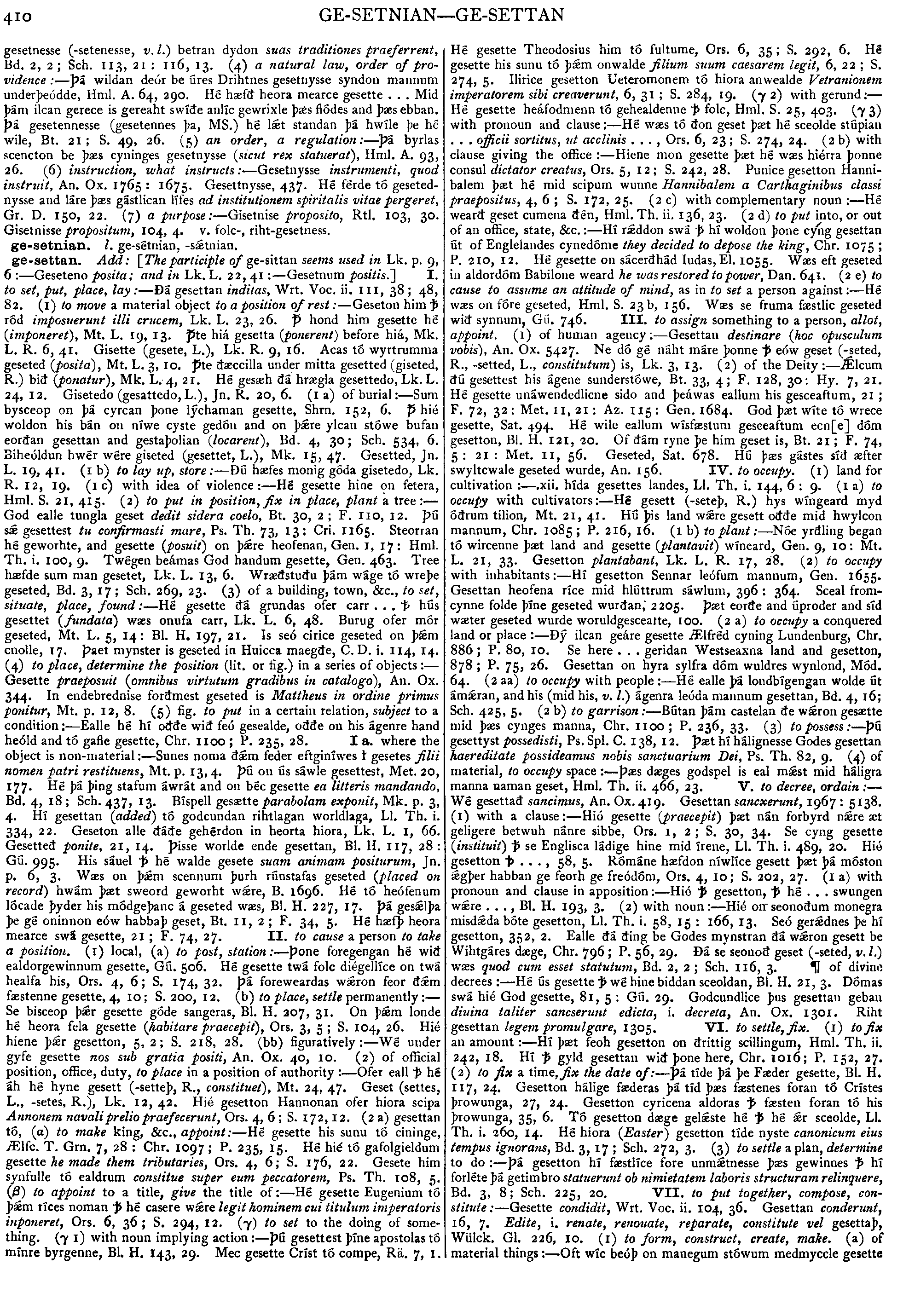
ge-settan.
Add:
[The
participle
of
ge-sittan
seems
used
in
Lk.
p.
9,
6
:--
Geseteno
posita;
and
in
Lk.
L.
22,
41
:--
Gesetnum
positis.]
I.
to
set,
put,
place,
lay
:--
Ðá
gesettan
inditas,
Wrt.
Voc.
ii.
111,
38
;
48,
82.
(l)
to
move
a
material
object
to
a
position
of
rest
:--
Geseton
him
ród
imposuerunt
illi
crucem,
Lk.
L.
23,
26.
Þ
UNCERTAIN
hond
him
gesette
hé
(imponeret),
Mt.
L.
19,
13.
Þ
UNCERTAINte
hiá
gesetta
(ponerent)
before
hiá,
Mk.
L.
R.
6,
41.
Gisette
(gesete,
L.
),
Lk.
R.
9,
16.
Acas
tó
wyrtrumma
geseted
(posita),
Mt.
L.
3,
10.
Þ
UNCERTAIN;te
ðæccilla
under
mitta
gesetted
(giseted,
R.)
bið
(ponatur),
Mk.
L.
4,
21.
Hé
gesæh
ðá
hrægla
gesettedo.
Lk.
L.
24,
12.
Gisetedo
(gesattedo,
L.),
Jn.
R.
20,
6.
(Ia)
of
burial
:--
Sum
bysceop
on
þá
cyrcan
þone
lýchaman
gesette.
Shrn.
152,
6.
Þ
UNCERTAIN
hié
woldon
his
bán
on
níwe
cyste
gedón
and
on
þre
ylcan
stówe
bufan
eorðan
gesettan
and
gestaþolian
(locarent),
Bd.
4,
30;
Sch.
534,
6.
Biheóldun
hwér
wére
giseted
(gesettet,
L.),
Mk.
15,
47.
Gesetted,
Jn.
L.
19,
41.
(i
b)
to
lay
up,
store
:--
Ðú
hæfes
monig
góda
gisetedo,
Lk.
R.
12,
19.
(i
c)
with
idea
of
violence
:--
Hé
gesette
hine
on
fetera,
Hml.
S.
21,
415.
(2)
to
put
in
position,
fix
in
place,
plant
a
tree
:--
God
ealle
tungla
geset
dedit
sidera
coelo,
Bt.
30,
2;
F.
110,
12.
Þú
sgesettest
tu
confirmasti
mare,
Ps.
Th.
73,
13:
Cri.
1165.
Steorran
hé
geworhte,
and
gesette
(posuit)
on
þre
heofenan,
Gen.
I.
17
:
Hml.
Th.
i.
100,
9.
Twégen
beámas
God
handum
gesette,
Gen.
463.
Tree
hæfde
sum
man
gesetet,
Lk.
L.
13,
6.
Wræðstuðu
þám
wáge
tó
wreþe
geseted,
Bd.
3,
17
;
Sch.
269,
23.
(3)
of
a
building,
town,
&c.,
to
set,
situate,
place,
found
:--
Hé
gesette
ðá
grundas
ofer
carr
.
.
.
hús
gesettet
(fundata)
wæs
onufa
carr,
Lk.
L.
6,
48.
Burug
ofer
mór
geseted.
Mt.
L.
5,
14:
Bl.
H.
197,
21.
Is
seó
cirice
geseted
on
þm
cnolle,
17.
Þaet
mynster
is
geseted
in
Huicca
maegðe,
C.
D.
i.
114,
14.
(4)
to
place,
determine
the
position
(lit.
or
fig.)
in
a
series
of
objects
:--
Gesette
praeposuit
(omnibus
virtutum
gradibus
in
catalogo),
An.
Ox.
344.
In
endebrednise
forðmest
geseted
is
Mattheus
in
ordine
primus
ponitur,
Mt.
p.
12,
8.
(5)
fig.
to
put
in
a
certain
relation,
subject
to
a
condition
:--
Ealle
heé
hí
oððe
wið
feó
gesealde,
oððe
on
his
ágenre
hand
heóld
and
tó
gafle
gesette,
Chr.
noo
;
P.
235,
28.
I
a.
where
the
object
is
non-material
:--
Sunes
noma
ðm
feder
eftginíwes
gesetes
filii
nomen
patri
restituens,
Mt.
p.
13,
4.
Þú
on
ús
sáwle
gesettest.
Met.
20,
177.
Hé
þá
þing
stafum
áwrát
and
on
béc
gesette
ea
litteris
mandando,
Bd.
4,
18
;
Sch.
437,
13.
Bíspell
gesætte
parabolam
exponit,
Mk.
p.
3,
4.
Hí
gesettan
(added)
to
godcundan
rihtlagan
worldlaga,
Ll.
Th.
i.
334,
22.
Geseton
alle
ðáðe
gehérdon
in
heorta
hiora,
Lk.
L.
l,
66.
Gesetteð
ponite,
21,
14.
Þisse
worlde
ende
gesettan,
Bl.
H.
117,
28:
Gü.
995.
His
sáuel
hé
walde
gesete
suam
animam
positurum,
Jn.
p.
6,
3.
Wæs
on
þm
scennum
þurh
rúnstafas
geseted
(placed
on
record)
hwám
þæt
sweord
geworht
wre,
B.
1696.
Hé
tó
heofenum
lócade
þyder
his
módgeþanc
á
geseted
wæs,
Bl.
H.
227,
17.
Þá
geslþa
þe
gé
oninnon
eów
habbaþ
geset,
Bt.
11,
2;
F.
34,
5.
Hé
hæfþ
heora
mearce
swá
gesette,
21;
F.
74,
27.
II.
to
cause
a
person
to
take
a
position,
(l)
local,
(a)
to
post,
station
:--
Þone
foregengan
hé
wið
ealdorgewinnum
gesette,
Gü.
506.
Hé
gesette
twá
folc
diégellíce
on
twá
healfa
his,
Ors.
4,
6
;
S.
174,
32.
Þá
foreweardas
wron
feor
ðm
fæstenne
gesette,
4,
10;
S.
200,
12.
(b)
to
place,
settle
permanently
:--
Se
bisceop
þr
gesette
góde
sangeras,
Bl.
H.
207,
31.
On
þm
londe
hé
heora
fela
gesette
(habitare
praecepit),
Ors.
3,
5
;
S.
104,
26.
Hié
hiene
þr
gesetton,
5,
2;
S.
218,
28.
(bb)
figuratively
:--
Wé
under
gyfe
gesette
nos
sub
gratia
positi,
An.
Ox.
40,
10.
(2)
of
official
position,
office,
duty,
to
place
in
a
position
of
authority
:--
Ofer
eall
hé
áh
hé
hyne
gesett
(-setteþ,
R.,
constituet],
Mt.
24,
47.
Geset
(settes,
L.,
-setes,
R.),
Lk.
12,
42.
Hié
gesetton
Hannonan
ofer
hiora
scipa
Annonem
navali
prelio
praefecerunt,
Ors.
4,
6
;
S.
172,
12.
(2
a)
gesettan
tó,
( )
to
make
king,
&c.,
appoint
:--
Hé
gesette
his
sunu
tó
cininge,
Ælfc.
T.
Grn.
7,
28
:
Chr.
1097
;
P.
235,
15.
Hé
hié
tó
gafolgieldum
gesette
he
made
them
tributaries,
Ors.
4,
6;
S.
176,
22.
Gesete
him
synfulle
tó
ealdrum
constitue
super
eum
peccatorem,
Ps.
Th.
108,
5.
(
)
to
make
king,
&c.,
appoint
:--
Hé
gesette
his
sunu
tó
cininge,
Ælfc.
T.
Grn.
7,
28
:
Chr.
1097
;
P.
235,
15.
Hé
hié
tó
gafolgieldum
gesette
he
made
them
tributaries,
Ors.
4,
6;
S.
176,
22.
Gesete
him
synfulle
tó
ealdrum
constitue
super
eum
peccatorem,
Ps.
Th.
108,
5.
( )
to
appoint
to
a
title,
give
the
title
of
:--
Hé
gesette
Eugenium
tó
þm
ríces
noman
hé
casere
wre
legit
hominem
cui
titulum
imperatoris
inponeret,
Ors.
6,
36;
S.
294,
12.
(
)
to
appoint
to
a
title,
give
the
title
of
:--
Hé
gesette
Eugenium
tó
þm
ríces
noman
hé
casere
wre
legit
hominem
cui
titulum
imperatoris
inponeret,
Ors.
6,
36;
S.
294,
12.
( )
to
set
to
the
doing
of
something.
(
I)
with
noun
implying
action
:--
Þú
gesettest
þíne
apostolas
tó
mínre
byrgenne,
Bl.
H.
143,
29.
Mec
gesette
Críst
tó
compe,
Rä.
7,
Hé
gesette
Theodosius
him
tó
fultume,
Ors.
6,
35
;
S.
292,
6.
Hé
gesette
his
sunu
tó
þm
onwalde
filium
suum
caesarem
legit,
6,
22
;
S.
274,
5.
Ilirice
gesetton
Ueteromonem
tó
hiora
anwealde
Vetranionem
imperatorem
sibi
creaverunt,
6,
31
;
S.
284,
19.
(
2)
with
gerund
:--
Hé
gesette
heáfodmenn
tó
gehealdenne
folc,
Hml.
S.
25,
403.
(
3)
with
pronoun
and
clause
:--
Hé
wæs
tó
ðon
geset
þæt
hé
sceolde
stúpian
.
.
.
officii
sortitus,
ut
acclinis
.
.
.
,
Ors.
6,
23;
S.
274,
24.
(2
b)
with
clause
giving
the
office
:--
Hiene
mon
gesette
þæt
hé
wæs
hiérra
þonne
consul
dictator
creatus,
Ors.
5,
12
;
S.
242,
28.
Punice
gesetton
Hannibalem
þæt
hé
mid
scipum
wunne
Hannibalem
a
Carthaginibus
classi
praepositus,
4,
6
;
S.
172,
25.
(2
c)
with
complementary
noun
:--
Hé
wearð
geset
cumena
ðén,
Hml.
Th.
ii.
136,
23.
(2
d)
to
put
into,
or
out
of
an
office,
state,
&c.
:--
Hî
rddon
swá
hî
woldon
þone
cyíig
gesettan
út
of
Englelandes
cynedóme
they
decided
to
depose
the
king,
Chr.
1075
;
P.
210,
12.
Hé
gesette
on
sácerðhád
Iudas,
El.
1055.
Wæs
eft
geseted
in
aldordóm
Babilone
weard
he
was
restored
to
power,
Dan.
641.
(2
e)
to
cause
to
assume
an
attitude
of
mind,
as
in
to
set
a
person
against
:--
Hé
wæs
on
fóre
geseted.
Hml.
S.
23
b,
156.
Wæs
se
fruma
fæstlic
geseted
wið
synnum,
Gú.
746.
III.
to
assign
something
to
a
person,
allot,
appoint.
(l)
of
human
agency
:--
Gesettan
destinare
(hoc
opuscidum
vobis],
An.
Ox.
5427.
Ne
dó
gé
náht
máre
þonne
eów
geset
(-seted,
R.,
-setted,
L.,
constitutum)
is,
Lk.
3,
13.
(2)
of
the
Deity
:--
Æ-acute;lcum
ðú
gesettest
his
ágene
sunderstówe,
Bt.
33,
4;
F.
128,
30:
Hy.
7,
21.
Hé
gesette
unáwendedlicne
sido
and
þeáwas
eallum
his
gesceaftum,
21
;
F.
72,
32:
Met.
ii.
21:
Az.
115:
Gen.
1684.
God
þæt
wíte
tó
wrece
gesette.
Sat.
494.
Hé
wile
eallum
wísfæstum
gesceaftum
ecn[e]
dóm
gesetton.
Bl.
H.
121,
20.
Of
ðám
ryne
þe
him
geset
is,
Bt.
21;
F.
74,
5
:
21
:
Met.
II,
56.
Geseted,
Sae.
678.
Hú
þæs
gástes
síd
æfter
swyltcwale
geseted
wurde,
An.
156.
IV.
to
occupy,
(l)
land
for
cultivation
:--
.xii.
hîda
gesettes
landes,
Ll.
Th.
i.
144,
6:9.
(l
a)
to
occupy
with
cultivators
:--
Hé
gesett
(-seteþ.
R.)
hys
wíngeard
myd
óðrum
tilion,
Mt.
21,
41.
Hú
þis
land
wre
gesett
oððe
mid
hwylcon
mannum,
Chr.
1085
;
P.
216,
16.
(l
b)
to
plant
;
--
Nóe
yrðling
began
tó
wircenne
þæt
land
and
gesette
(plantavit)
wíneard,
Gen.
9,
10:
Mt.
L.
21,
33.
Gesetton
plantabant,
Lk.
L.
R.
17,
28.
(2)
to
occupy
with
inhabitants
:--
Hí
gesetton
Sennar
leófum
mannum,
Gen.
1655.
Gesettan
heofena
ríce
mid
hlúttrum
sáwlum,
396
:
364.
Sceal
fromcynne
folde
þíne
geseted
wurðan,
2205.
Þæt
eorðe
and
úproder
and
síd
wæter
geseted
wurde
woruldgesceatte,
100.
(2
a)
to
occupy
a
conquered
land
or
place
:--
Ðý
ilcan
geáre
gesette
Ælfréd
cyning
Lundenburg,
Chr.
886
;
P.
80,
10.
Se
here
.
.
.
geridan
Westseaxna
land
and
gesetton,
878
;
P.
75,
26.
Gesettan
on
hyra
sylfra
dóm
wuldres
wynlond,
Mod.
64.
(2
aa)
to
occupy
with
people
:--
Hé
ealle
þá
londbígengan
wolde
út
ámran,
and
his
(mid
his,
v.l.)
ágenra
leóda
mannum
gesettan,
Bd.
4,
16;
Sch.
425,
5.
(2
b)
to
garrison
:--
Bútan
þám
castelan
ðe
wron
gesætte
mid
þæs
cynges
manna,
Chr.
iioo
;
P.
236,
33.
(3)
to
possess
:--
Þú
gesettyst
possedisti,
Ps.
Spl.
C.
138,
12.
Þæt
hí
hálignesse
Godes
gesettan
haereditaie
possideamus
nobis
sanctuarium
Dei,
Ps.
Th.
82,
9.
(4)
of
material,
to
occupy
space
:--
þæs
dæges
godspel
is
eal
mst
mid
háligra
manna
naman
geset,
Hml.
Th.
ii.
466,
23.
V.
to
decree,
ordain
:--
Wé
gesettað
sancimus,
An.
Ox.
419.
Gesettan
sancxerunt,
1967
:
5138.
(l)
with
a
clause
:--
Hió
gesette
(praecepit)
þæt
nán
forbyrd
nre
æt
geligere
betwuh
nánre
sibbe,
Ors.
l,
2
;
S.
30,
34.
Se
cyng
gesette
(instituit)
se
Englisca
ládige
hine
mid
írene,
Ll.
Th.
i.
489,
20.
Hié
gesetton
.
.
.
,
58,
5.
Rómáne
hæfdon
níwlíce
gesett
þæt
þá
móston
gþer
habban
ge
feorh
ge
freódóm,
Ors.
4,
10;
S.
202,
27.
(l
a)
with
pronoun
and
clause
in
apposition
:--
Hié
gesetton,
hé
.
.
.
swungen
wre
.
.
.
,
Bl.
H.
193,
3.
(2)
with
noun
:--
Hié
on
seonoðum
monegra
misdda
bóte
gesetton,
Ll.
Th.
i.
58,
15
:
166,
13.
Seó
gerdnes
þe
hí
gesetton,
352,
2.
Ealle
ðá
ðing
be
Godes
mynstran
ðá
wron
gesett
be
Wihtgáres
dæge,
Chr.
796;
P.
56,
29.
Ðá
se
seonoð
geset
(-seted,
v.l.)
wæs
quod
cum
esset
statutum,
Bd.
2,
2
;
Sch.
116,
3.

of
divine
decrees
:--
Hé
ús
gesette
;
wé
hine
biddan
sceoldan,
Bl.
H.
21,
3.
Dómas
swá
hié
God
gesette,
81,
5
:
Gú.
29.
Godcundlice
þus
gesettan
geban
diuina
taliter
sancserunt
edicta,
i.
decreta,
An.
Ox.
1301.
Riht
gesettan
legem
promulgare,
1305.
VI.
to
settle,
fix.
(l)
to
fix
an
amount
:--
Hí
þæt
feoh
gesetton
on
ðrittig
scillingum,
Hml.
Th.
ii.
242,
18.
Hí
gyld
gesettan
wið
þone
here,
Chr.
1016;
P.
152,
27.
(2)
to
fix
a
time,
fix
the
date
of
:--
Þá
tíde
þá
þe
Fæder
gesette,
Bl.
H.
117,
24.
Gesetton
hálige
fæderas
þá
tíd
þæs
fæstenes
foran
tó
Crístes
þrowunga,
27,
24.
Gesetton
cyricena
aldoras
fæsten
foran
tó
his
þrowunga,
35,
6.
Tó
gesetton
dæge
gelste
hé
hé
r
sceolde,
Ll.
Th.
i.
260,
14.
Hé
hiora
(Easter)
gesetton
tíde
nyste
canonicum
eius
tempus
ignorans,
Bd.
3,
17
;
Sch.
272,
3.
(3)
to
settle
a
plan,
determine
to
do
:--
Þá
gesetton
hí
fæstlíce
fore
unmtnesse
þæs
gewinnes
hí
forléte
þá
getimbro
statuerunt
ob
nimietatem
laboris
structuram
relinquere,
Bd.
3,
8;
Sch.
225,
20.
VII.
to
put
together,
compose,
constitute
:--
Gesette
condidit,
Wrt.
Voc.
ii.
104,
36.
Gesettan
conderunt,
16,
7.
Edite,
i.
renate,
renouate,
reparate,
constitute
vel
gesettaþ,
Wülck.
Gl.
226,
JO.
(l)
to
form,
construct,
create,
make,
(a)
of
material
things
:--
Oft
wíc
beóþ
on
manegum
stówum
medmyccle
gesette
)
to
set
to
the
doing
of
something.
(
I)
with
noun
implying
action
:--
Þú
gesettest
þíne
apostolas
tó
mínre
byrgenne,
Bl.
H.
143,
29.
Mec
gesette
Críst
tó
compe,
Rä.
7,
Hé
gesette
Theodosius
him
tó
fultume,
Ors.
6,
35
;
S.
292,
6.
Hé
gesette
his
sunu
tó
þm
onwalde
filium
suum
caesarem
legit,
6,
22
;
S.
274,
5.
Ilirice
gesetton
Ueteromonem
tó
hiora
anwealde
Vetranionem
imperatorem
sibi
creaverunt,
6,
31
;
S.
284,
19.
(
2)
with
gerund
:--
Hé
gesette
heáfodmenn
tó
gehealdenne
folc,
Hml.
S.
25,
403.
(
3)
with
pronoun
and
clause
:--
Hé
wæs
tó
ðon
geset
þæt
hé
sceolde
stúpian
.
.
.
officii
sortitus,
ut
acclinis
.
.
.
,
Ors.
6,
23;
S.
274,
24.
(2
b)
with
clause
giving
the
office
:--
Hiene
mon
gesette
þæt
hé
wæs
hiérra
þonne
consul
dictator
creatus,
Ors.
5,
12
;
S.
242,
28.
Punice
gesetton
Hannibalem
þæt
hé
mid
scipum
wunne
Hannibalem
a
Carthaginibus
classi
praepositus,
4,
6
;
S.
172,
25.
(2
c)
with
complementary
noun
:--
Hé
wearð
geset
cumena
ðén,
Hml.
Th.
ii.
136,
23.
(2
d)
to
put
into,
or
out
of
an
office,
state,
&c.
:--
Hî
rddon
swá
hî
woldon
þone
cyíig
gesettan
út
of
Englelandes
cynedóme
they
decided
to
depose
the
king,
Chr.
1075
;
P.
210,
12.
Hé
gesette
on
sácerðhád
Iudas,
El.
1055.
Wæs
eft
geseted
in
aldordóm
Babilone
weard
he
was
restored
to
power,
Dan.
641.
(2
e)
to
cause
to
assume
an
attitude
of
mind,
as
in
to
set
a
person
against
:--
Hé
wæs
on
fóre
geseted.
Hml.
S.
23
b,
156.
Wæs
se
fruma
fæstlic
geseted
wið
synnum,
Gú.
746.
III.
to
assign
something
to
a
person,
allot,
appoint.
(l)
of
human
agency
:--
Gesettan
destinare
(hoc
opuscidum
vobis],
An.
Ox.
5427.
Ne
dó
gé
náht
máre
þonne
eów
geset
(-seted,
R.,
-setted,
L.,
constitutum)
is,
Lk.
3,
13.
(2)
of
the
Deity
:--
Æ-acute;lcum
ðú
gesettest
his
ágene
sunderstówe,
Bt.
33,
4;
F.
128,
30:
Hy.
7,
21.
Hé
gesette
unáwendedlicne
sido
and
þeáwas
eallum
his
gesceaftum,
21
;
F.
72,
32:
Met.
ii.
21:
Az.
115:
Gen.
1684.
God
þæt
wíte
tó
wrece
gesette.
Sat.
494.
Hé
wile
eallum
wísfæstum
gesceaftum
ecn[e]
dóm
gesetton.
Bl.
H.
121,
20.
Of
ðám
ryne
þe
him
geset
is,
Bt.
21;
F.
74,
5
:
21
:
Met.
II,
56.
Geseted,
Sae.
678.
Hú
þæs
gástes
síd
æfter
swyltcwale
geseted
wurde,
An.
156.
IV.
to
occupy,
(l)
land
for
cultivation
:--
.xii.
hîda
gesettes
landes,
Ll.
Th.
i.
144,
6:9.
(l
a)
to
occupy
with
cultivators
:--
Hé
gesett
(-seteþ.
R.)
hys
wíngeard
myd
óðrum
tilion,
Mt.
21,
41.
Hú
þis
land
wre
gesett
oððe
mid
hwylcon
mannum,
Chr.
1085
;
P.
216,
16.
(l
b)
to
plant
;
--
Nóe
yrðling
began
tó
wircenne
þæt
land
and
gesette
(plantavit)
wíneard,
Gen.
9,
10:
Mt.
L.
21,
33.
Gesetton
plantabant,
Lk.
L.
R.
17,
28.
(2)
to
occupy
with
inhabitants
:--
Hí
gesetton
Sennar
leófum
mannum,
Gen.
1655.
Gesettan
heofena
ríce
mid
hlúttrum
sáwlum,
396
:
364.
Sceal
fromcynne
folde
þíne
geseted
wurðan,
2205.
Þæt
eorðe
and
úproder
and
síd
wæter
geseted
wurde
woruldgesceatte,
100.
(2
a)
to
occupy
a
conquered
land
or
place
:--
Ðý
ilcan
geáre
gesette
Ælfréd
cyning
Lundenburg,
Chr.
886
;
P.
80,
10.
Se
here
.
.
.
geridan
Westseaxna
land
and
gesetton,
878
;
P.
75,
26.
Gesettan
on
hyra
sylfra
dóm
wuldres
wynlond,
Mod.
64.
(2
aa)
to
occupy
with
people
:--
Hé
ealle
þá
londbígengan
wolde
út
ámran,
and
his
(mid
his,
v.l.)
ágenra
leóda
mannum
gesettan,
Bd.
4,
16;
Sch.
425,
5.
(2
b)
to
garrison
:--
Bútan
þám
castelan
ðe
wron
gesætte
mid
þæs
cynges
manna,
Chr.
iioo
;
P.
236,
33.
(3)
to
possess
:--
Þú
gesettyst
possedisti,
Ps.
Spl.
C.
138,
12.
Þæt
hí
hálignesse
Godes
gesettan
haereditaie
possideamus
nobis
sanctuarium
Dei,
Ps.
Th.
82,
9.
(4)
of
material,
to
occupy
space
:--
þæs
dæges
godspel
is
eal
mst
mid
háligra
manna
naman
geset,
Hml.
Th.
ii.
466,
23.
V.
to
decree,
ordain
:--
Wé
gesettað
sancimus,
An.
Ox.
419.
Gesettan
sancxerunt,
1967
:
5138.
(l)
with
a
clause
:--
Hió
gesette
(praecepit)
þæt
nán
forbyrd
nre
æt
geligere
betwuh
nánre
sibbe,
Ors.
l,
2
;
S.
30,
34.
Se
cyng
gesette
(instituit)
se
Englisca
ládige
hine
mid
írene,
Ll.
Th.
i.
489,
20.
Hié
gesetton
.
.
.
,
58,
5.
Rómáne
hæfdon
níwlíce
gesett
þæt
þá
móston
gþer
habban
ge
feorh
ge
freódóm,
Ors.
4,
10;
S.
202,
27.
(l
a)
with
pronoun
and
clause
in
apposition
:--
Hié
gesetton,
hé
.
.
.
swungen
wre
.
.
.
,
Bl.
H.
193,
3.
(2)
with
noun
:--
Hié
on
seonoðum
monegra
misdda
bóte
gesetton,
Ll.
Th.
i.
58,
15
:
166,
13.
Seó
gerdnes
þe
hí
gesetton,
352,
2.
Ealle
ðá
ðing
be
Godes
mynstran
ðá
wron
gesett
be
Wihtgáres
dæge,
Chr.
796;
P.
56,
29.
Ðá
se
seonoð
geset
(-seted,
v.l.)
wæs
quod
cum
esset
statutum,
Bd.
2,
2
;
Sch.
116,
3.

of
divine
decrees
:--
Hé
ús
gesette
;
wé
hine
biddan
sceoldan,
Bl.
H.
21,
3.
Dómas
swá
hié
God
gesette,
81,
5
:
Gú.
29.
Godcundlice
þus
gesettan
geban
diuina
taliter
sancserunt
edicta,
i.
decreta,
An.
Ox.
1301.
Riht
gesettan
legem
promulgare,
1305.
VI.
to
settle,
fix.
(l)
to
fix
an
amount
:--
Hí
þæt
feoh
gesetton
on
ðrittig
scillingum,
Hml.
Th.
ii.
242,
18.
Hí
gyld
gesettan
wið
þone
here,
Chr.
1016;
P.
152,
27.
(2)
to
fix
a
time,
fix
the
date
of
:--
Þá
tíde
þá
þe
Fæder
gesette,
Bl.
H.
117,
24.
Gesetton
hálige
fæderas
þá
tíd
þæs
fæstenes
foran
tó
Crístes
þrowunga,
27,
24.
Gesetton
cyricena
aldoras
fæsten
foran
tó
his
þrowunga,
35,
6.
Tó
gesetton
dæge
gelste
hé
hé
r
sceolde,
Ll.
Th.
i.
260,
14.
Hé
hiora
(Easter)
gesetton
tíde
nyste
canonicum
eius
tempus
ignorans,
Bd.
3,
17
;
Sch.
272,
3.
(3)
to
settle
a
plan,
determine
to
do
:--
Þá
gesetton
hí
fæstlíce
fore
unmtnesse
þæs
gewinnes
hí
forléte
þá
getimbro
statuerunt
ob
nimietatem
laboris
structuram
relinquere,
Bd.
3,
8;
Sch.
225,
20.
VII.
to
put
together,
compose,
constitute
:--
Gesette
condidit,
Wrt.
Voc.
ii.
104,
36.
Gesettan
conderunt,
16,
7.
Edite,
i.
renate,
renouate,
reparate,
constitute
vel
gesettaþ,
Wülck.
Gl.
226,
JO.
(l)
to
form,
construct,
create,
make,
(a)
of
material
things
:--
Oft
wíc
beóþ
on
manegum
stówum
medmyccle
gesette
|
Source: Bosworth/Toller, page d0414, entry 34 View original page image as: [TIFF] [PNG] [View previous entry] [View next entry] |
[Comment on this entry] [View comments] |
The following entry has been hand-corrected once. |
ge-sprc.
Add;
[ge-spræc,
ge-sprce
(v.
god-gesprce),
ge-sprec,
ge-spræc
(?
cf.
ge-spræcan
=
ge-sprecan,
and
cf.
gebrec
and
ge-bræc).
These
forms
are
taken
together
as
they
cannot
always
be
distinguished
with
certainty
either
by
form
or
by
meaning;
where
the
quantity
of
the
vowel
is
uncertain
it
is
left
unmarked.]
I.
speech,
talking
:--
Gearowyrde
on
gespræce
(-sprece,
v.l.)
loquella
promtus,
Bd.
5,
2;
Sch.
561,
3.
Ðæt
is
best
.
.
.
man
.
.
.
gemetigian
cunne
ge
his
spréce
ge
his
swígan,
and
wite
hwonne
hé
gespréce
hæbbe
(when
he
have
occasion
for
speaking),
and
hwanne
him
geanswaræd
si,
Prov.
K.
2.
II.
a
speech,
language
:--
Hé
andwyrde
þám
ælreordan
gesprece
(-spræce,
v.l.)
in
eadem
barbara
(Bulgarica)
locutione
respondit,
Gr.D.
300,
24.
Ne
sind
gespreocu
(loquellae),
Ps.
Srt.
18,
4.
III.
what
is
said,
a
speech,
saying,
an
oracle,
words
:--
Gesprec
Dryhtnes
eloquium
Domini,
Ps.
Srt.
Vos.
104,
19
:
118,
50:
eloquia,
ll,
7.
Gecýþed
mid
ealdorlicnesse
þæs
hálgan
gespreces
(þre
hálgan
spræce,
v.l.)
auctoritate
sacri
eloquii,
Gr.
D.
323,
13.
Efter
gesprece
ðínum
secundum
eloquium
tuum,
Ps.
Srt.
118,
41.
Gesprec
ðín
(ðíne
gesprecu,
Ps.
Vos.)
ne
heóldun
eloquia
tua
non
custodierunt,
158
:
162.
Gespreocu
(gesprec,
Ps.
Vos.)
Dryhtnes
eloquia
Domini,
Ps.
Srt.
17,
31.
Gespreocu
(gesprecu,
Ps.
Vos.),
118,
103.
Gespreco
oracula,
Wrt.
Voc.
ii.
62,
43.
Þæs
þe
ús
cýþað
þá
hálgan
gespræcu
(-sprecu,
v.l.)
quod
sacra
testantur
eloquia,
Gr.
D.
294,
21
:
Hml.
S.
23
b,
92.
Gespræca
uerborum,
i.
sermonum,
An.
Ox.
2,
169.
On
þæs
hálgan
gewrites
gesprecum
(eloquiis),
Gr.
D.
138.
35.
In
mínre
heortan
ic
gehýdde
þíne
gespræcu
(gesprecu.
Ps.
Vos.
,
gespreocu,
Ps.
Srt.,
spca.
Ps.
L.
118,
II),
Ll.
Th.
ii.
402,
38.
IV.
a
speaking
to
or
with,
colloquy,
dialogue,
conversation
:--
Mé
simle
is
swýþe
leóf
ealldra
manna
gespræc
(sprc,
gespræca,
v.
ll.)
mihi
senum
|
Source: Bosworth/Toller, page d0415, entry 4 View original page image as: [TIFF] [PNG] [View previous entry] [View next entry] |
[Comment on this entry] [View comments] |
The following entry has been hand-corrected once. |
ge-sprecan.
Add:
I.
absolute,
to
speak,
(i)
to
have
the
faculty
of
speech,
not
to
be
dumb
:--
Dumbo
dyde
te
hiá
gesprecas
mutos
fecit
loqui,
Mk.
L.
7,
37.
Gebróht
wæs
him
dumb,
and
geleicnade
hine
su
hé
gespræc,
Mt.
L.
12,
22.
Ðreátas
geségon
monigo
gesprécon,
15,
31.
(l
a)
to
exercise
the
faculty
of
speech,
not
to
be
silent
:--
Ne
geléfde
ðá
gesprecca
non
sinebat
ea
loqui,
Lk.
L.
4,
41.
(2)
to
talk,
converse
:--
Mið
ðý
gespræce
(wé
gisprécun,
R.)
in
woege
dum
loqueretur
in
via,
Lk.
L.
24,
32.
(2
a)
to
talk
with,
converse
together
:--
Gesprécon
betuién
him
conloquebantur
ad
inuicem,
Jn.
L.
R.
II,
56.
Efne
gesprécon,
Lk.
L.
4,
36.
Ðá
hiordas
gisprecun
(loquebantur)
bitwih
him,
Lk.
R.
L.
2,
15.
Mið
him
gesprécon,
Mt.
L.
17,
3:
Lk.
L.
9,
30.
(2
b)
to
speak
about
:--
Nnig
eáuunge
gespræc
of
him,
Jn.
L.
R.
7,
13.
Þá
þá
hí
umbe
óþer
þing
gesprecon
hæfdon,
Chr.
1070;
P.
206,
9.
(2
c)
to
speak
to
or
with
some
one
about
something
:--
Tó
faeder
of
brehtnise
his
gespræc,
Jn.
p.
7,
18.
Ðá
ilco
gesprécon
him
bituih
of
ðm
allum,
Lk.
L.
R.
24,
14.
(3)
of
public
speaking
:--
Mið
ðý
gespræc,
Lk.
L.
11,
37.
Hé
lrde
ðá
menigo,
te
geblann
gespreaca,
5,
4.
II.
with
cognate
object.
(l)
a
noun
denoting
speech
or
a
pronoun
referring
to
a
statement,
to
speak
words,
&c.say
:--
Word
Godes
gispreces
(loquitur],
Jn.
R.
L.
3,
34.
Word
hé
gespræce,
Mk.
L.
8,
32.
Gespræc
Beówulf
gylpworda
sum,
B.
675.
Hiera
sundorsprce
þe
hié
gesprcan
the
colloquy
they
were
to
have,
Ors.
4,
10
;
S.
202,
13.
Ðá
ðe
gespreccenda
woeron
ðá
wítgo,
Lk.
L.
24,
25.
Siððan
he
hit
gesprecen
hæfð,
Past.
81,
7:
Ors.
2,
8;
S.
92,
8.
Ðá
ðis
gesprecen
wæs,
Bt.
18,
I
;
F.
60,
18.
(l
a)
to
speak
to
a
person
:--
Fela
Daniel
tó
his
drihtne
gespræc
sóðra
worda,
Dan.
594.
Huæt
gespræce
him,
Jn.
L.
10,
6.
(l
b)
to
speak
of
:--
Monigo
of
his
micelnise
gespræc,
Lk.
p.
5,
12.
(2)
where
the
object
denotes
the
matter
expressed
in
the
words
spoken
:--
Þ
UNCERTAIN
ué
uuton
ué
gesprecas
(-spreocas,
R.),
Jn.
L.
3,
(3)
where
the
object
is
that
which
is
spoken
about,
to
speak
about
:--
Þá
wre
and
þá
winetreówe
þe
git
on
rdagum
oft
gesprcon,
Bo.
52.
(4)
the
object
a
clause
:--
Wæs
gesprecen
ðurh
Salomonn
bi
ðm
Wísdóme
ðæt
se
Wísdóm
wille
sóna
fleón
ðone
ðe
hine
fliéhð,
Past.
247,
16.
Þá
hé
hæfde
gespecen
þat
hé
wolde,
Chr.
1048;
P.
173,
note
I.
III.
with
a
personal
object.
(l)
to
speak
to
a
person,
accost
:--
Ic
gesprece
sumne
mann
adorior,
Ælfc.
Gr.
Z.
219,
l.
Tó
þám
burnan
þe
wytt
unc
rest
gesprcon,
Hml.
S.
23
b,
707.
(2)
of
more
or
less
formal
speech,
to
address
:--
Hé
árás
and
þá
gebróðru
gespræc
(cf.
him
tó
spræc
fratres
allocutus
est.
Gr.
D.
105,
16)
:
'Gebróðru,
miltsige
eów
God
.
.
.,'
Hml.
Th.
ii.
158,
24:
474,
26.
Heó
gespæc
deór
alloquitur
bestiam,
An.
Ox,
4899.
Hé
cwæð
hí
Críst
gespræce
þysum
godspellicum
wordum:
'Ne
háte
ic
eów
ná
þeówan
.
.
.,'
Hml.
S.
2,
86.
Gesprecendum
contionante,
An.
Ox.
3459.
(3)
to
speak
in
reproof,
exhortation,
&c.
:--
Þá
lufode
hé
hine,
and
gelóme
hine
gespræc
tihtende
tó
geleáfan,
Hml.
S.
3,
573.
Se
hálga
wer
hine
eft
gespræc
and
git
þryddan
síðe,
and
swýðe
hine
þreáde,
21,
59.
Þá
englas
þá
hwíle
Heliodorum
gesprcon,
sdon
hé
sceolde
Onian
mycclum
þancian,
25,
789.
(4)
to
speak
with,
have
an
interview
with
:--
Hí
áxodon
hwæðer
Petrus
þr
wununge
hæfde,
woldon
hine
gespræcan,
Hml.
S.
10,
112.
Hé
hét
him
to
gelangian
þá
deófolgildan
.
.
.
wolde
hí
gesprecan,
18,
370.
Ðeós
tíd
cymð
ymbe
twelf
mónað,
lc
man
sceal
his
scrift
gesprecan
(confessarium
suum
alloqui),
Ll.
Th.
ii.
224,
33.
IV.
to
agree,
settle
:--
Þá
gesprcon
hié
him
betweónum
þæt
hié
wolden
anwendan
ealle
þá
gesetnessa,
Ors.
6,
10
;
S.
264,
19.
Hí
tó
fullan
friðe
gesprcon
hig
ealle
mid
him
súð
faran
woldon,
Chr.
1066;
P.
197,
31.
Tostig
eorl
him
cðm
tó
mid
eallum
þám
þe
hé
begiten
hæfde,
eall
swá
hý
r
gesprecen
hæfdon,
P.
196,
26.
(O.Sax.
gi-sprekan
:
O.H.Ger.
ge-sprehhan
loqui,
dicere,
alloqui,
compellare,
convenire,
constituere.)
|
Source: Bosworth/Toller, page d0417, entry 10 View original page image as: [TIFF] [PNG] [View previous entry] [View next entry] |
[Comment on this entry] [View comments] |
The following entry has been hand-corrected once. |
ge-stefnian
to
summon,
call
on
a
person
to
act
:--
Hié
gestefniað
him
betweónum
wið
ðám
unclnum
gástum
they
(the
angels)
eall
on
one
another
to
fight
against
the
unclean
spirits,
Verc.
Först.
125,
7.
|
Source: Bosworth/Toller, page d0430, entry 1 View original page image as: [TIFF] [PNG] [View previous entry] [View next entry] |
[Comment on this entry] [View comments] |
The following entry has been hand-corrected once. |
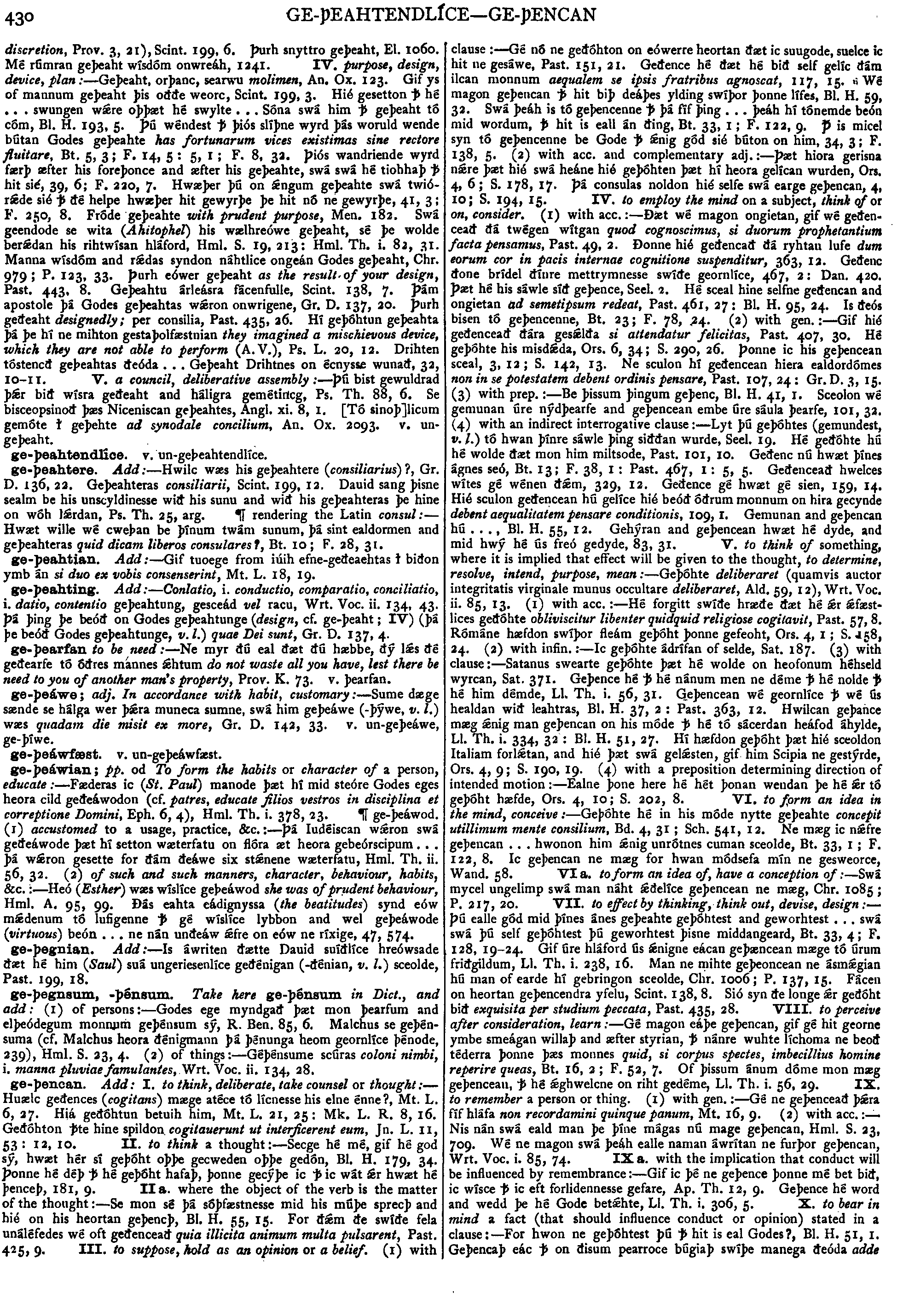
discretion,
Prov.
3,
21),
Scint.
199,
6.
Þ-bar;urh
snyttro
geþeaht,
El.
1060.
Mé
rúmran
geþeaht
wísdóm
onwreáh,
1241.
IV.
purpose,
design,
device,
plan
:--
Geþeaht,
orþanc,
searwu
molimen,
An.
Ox.
123.
Gif
ys
of
mannum
geþeaht
þis
oððe
weorc,
Scint.
199,
3.
Hié
gesetton
hé
...
swungen
wre
oþþæt
hé
swylte
...
Sóna
swá
him
geþeaht
tó
cóm,
Bl.
H.
193,
5.
Þú
wéndest
þiós
slíþne
wyrd
þás
woruld
wende
bútan
Godes
geþeahte
has
fortunarum
vices
existimas
sine
rectore
fluitare,
Bt.
5,
3;
F.
14,
5:
5,
1;
F.
8,
32.
Þiós
wandriende
wyrd
færþ
æfter
his
foreþonce
and
æfter
his
geþeahte,
swá
swá
hé
tiohhaþ
hit
sié,
39,
6;
F.
220,
7.
Hwæþer
þú
on
ngum
geþeahte
swá
twiórde
sié
ðé
helpe
hwæþer
hit
gewyrþe
þe
hit
nó
ne
gewyrþe,
41,
3;
F.
250,
8.
Fróde
geþeahte
with
prudent
purpose,
Men.
182.
Swá
geendode
se
wita
(Ahitophel)
his
wælhreówe
geþeaht,
sé
þe
wolde
berdan
his
rihtwísan
hláford,
Hml.
S.
19,
213:
Hml.
Th.
i.
82,
31.
Manna
wísdóm
and
rdas
syndon
náhtlice
ongeán
Godes
geþeaht,
Chr.
979;
P.
123,
33.
Þurh
eówer
geþeaht
as
the
result
of
your
design,
Past.
443,
8.
Geþeahtu
árleásra
fácenralle,
Scint.
138,
7.
Þám
apostole
þá
Godes
geþeahtas
wron
onwrigene,
Gr.
D.
137,
20.
Þurh
geðeaht
designedly;
per
consilia,
Past.
435,
26.
Hí
geþóhtun
geþeahta
þá
þe
hí
ne
mihton
gestaþolfæstnian
they
imagined
a
mischievous
device,
which
they
are
not
able
to
perform
(A.
V.),
Ps.
L.
20,
12.
Drihten
tóstencð
geþeahtas
ðeóda
...
Geþeaht
Drihtnes
on
écnysse
wunað,
32,
10-11.
V.
a
council,
deliberative
assembly
:--
Þú
bist
gewuldrad
þr
bið
wísra
geðeaht
and
háligra
gemétincg,
Ps.
Th.
88,
6.
Se
bisceopsinoð
þæs
Niceniscan
geþeahtes,
Angl.
xi.
8,
1.
[Tó
sinoþ]licum
gemóte
geþehte
ad
synodale
concilium.
An.
Ox.
2093.
v.
un-geþeaht.
| Result Page: |  |
Previous | 207 208 209 210 211 212 213 214 215 216 217 218 219 220 221 222 223 224 225 | Next |  |
Germanic Lexicon Project (main page)
This search system was written by
Sean Crist
Please consider
volunteering
to correct the data in these online dictionaries.
No rights reserved. Feel free to use these data in any way you please.