|
|

þey (4 results)
Search for they again, using less strict matching (2727 results)
|
Source: Bosworth/Toller, page b0619, entry 23 View original page image as: [TIFF] [PNG] [View previous entry] [View next entry] |
[Comment on this entry] [View comments] |
The following entry has been hand-corrected once. |
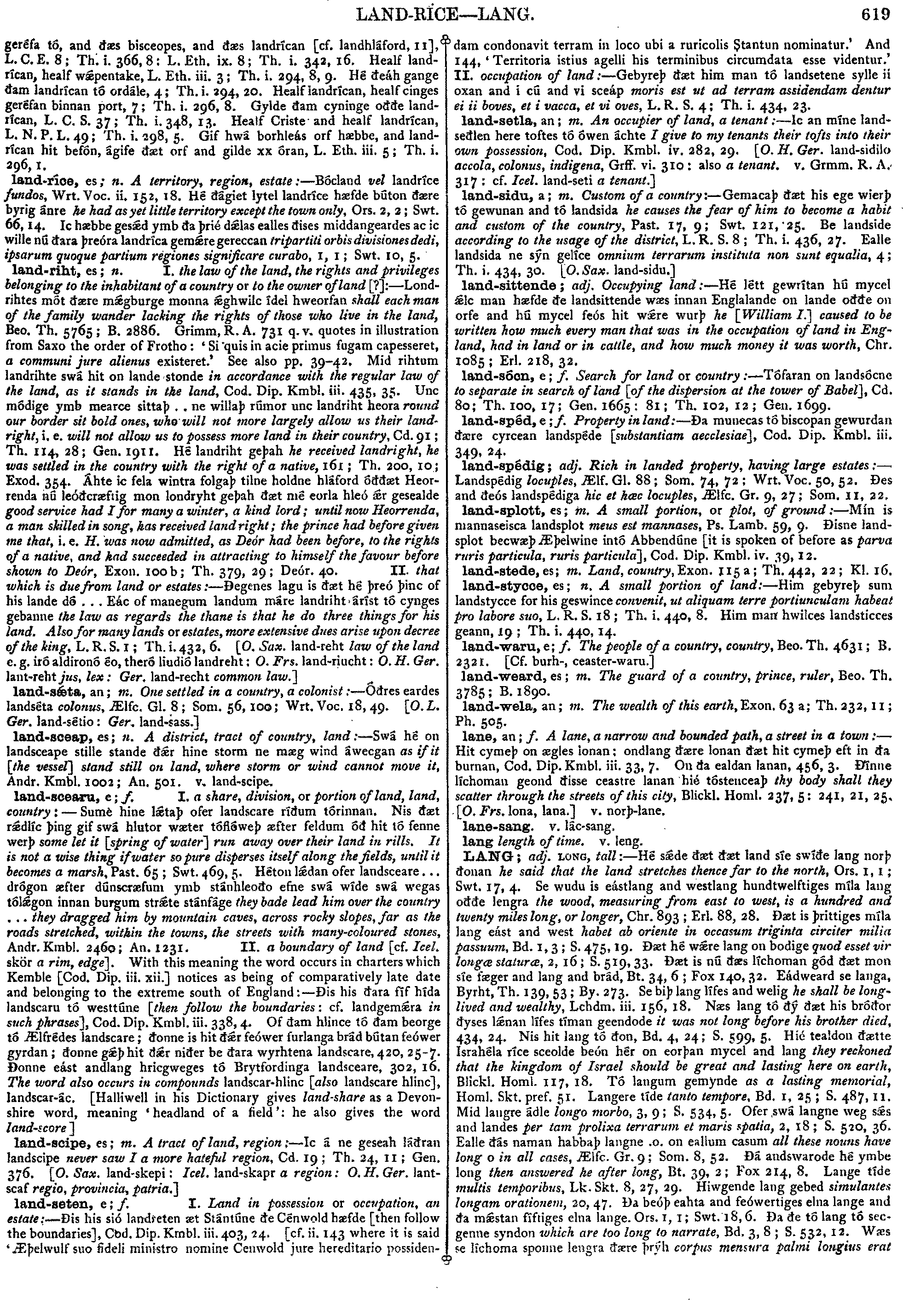
LANG;
adj.
LONG,
tall
:--
Hé
s de
ðæt
ðæt
land
síe
swíðe
lang
norþ
ðonan
he
said
that
the
land
stretches
thence
far
to
the
north,
Ors.
1,
1;
Swt.
17,
4.
Se
wudu
is
eástlang
and
westlang
hundtwelftiges
míla
lang
oððe
lengra
the
wood,
measuring
from
east
to
west,
is
a
hundred
and
twenty
miles
long,
or
longer,
Chr.
893;
Erl.
88,
28.
Ðæt
is
þrittiges
míla
lang
eást
and
west
habet
ab
oriente
in
occasum
triginta
circiter
milia
passuum,
Bd.
1,
3;
S.
475,
19.
Ðæt
hé
wre
lang
on
bodige
quod
esset
vir
longæ
staturæ,
2,
16;
S.
519,
33.
Ðæt
is
nú
ðæs
líchoman
gód
ðæt
man
síe
fæger
and
lang
and
brád,
Bt.
34,
6;
Fox
140,
32.
Eádweard
se
langa,
Byrht,
Th.
139,
53;
By
273.
Se
biþ
lang
lífes
and
welig
he
shall
be
longlived
and
wealthy,
Lchdm.
iii.
156,
18.
Næs
lang
tó
ðý
ðæt
his
bróðor
ðyses
lnan
lífes
tíman
geendode
it
was
not
long
before
his
brother
died,
434,
24.
Nis
hit
lang
tó
ðon,
Bd.
4,
24;
S.
599,
5.
Hié
tealdon
ðætte
Israhéla
ríce
sceolde
beón
hér
on
eorþan
mycel
and
lang
they
reckoned
that
the
kingdom
of
Israel
should
be
great
and
lasting
here
on
earth,
Blickl.
Homl.
117,
18.
Tó
langum
gemynde
as
a
lasting
memorial,
Homl.
Skt.
pref.
51.
Langere
tíde
tanto
tempore,
Bd.
1,
25;
S.
487,
11.
Mid
langre
ádle
longo
morbo,
3,
9;
S.
534,
5.
Ofer
swá
langne
weg
ss
and
landes
per
tam
prolixa
terrarum
et
maris
spatia,
2,
18;
S.
520,
36.
Ealle
ðás
naman
habbaþ
langne
.o.
on
eallum
casum
all
these
nouns
have
long
o
in
all
cases,
Ælfc.
Gr.
9;
Som.
8,
52.
Ðá
andswarode
hé
ymbe
long
then
answered
he
after
long,
Bt.
39,
2;
Fox
214,
8.
Lange
tíde
multis
temporibus,
Lk.
Skt.
8,
27,
29.
Hiwgende
lang
gebed
simulantes
longam
orationem,
20,
47.
Ða
beóþ
eahta
and
feówertiges
elna
lange
and
ða
mstan
fíftiges
elna
lange.
Ors.
1,
1;
Swt.18,
6.
Ða
ðe
tó
lang
tó
secgenne
syndon
which
are
too
long
to
narrate,
Bd.
3,
8;
S.
532,
12.
Wæs
se
líchoma
sponne
lengra
ðære
þrýh
corpus
mensura
palmi
longius
erat
sarcofago,
4,
11;
S.
580,
5.
sarcofago,
4,
11;
S.
580,
5.
Ne
bip
hé
lengra
ðonne
syfan
elna
lang,
Ors.
1,
1;
Swt.
18,
4.
Ðis
eálond
hafaþ
mycele
lengran
dagas
on
sumera
ðonne
ða
súþdlas
middangeardes,
Bd.
1,
1;
S.
473,
32.
Ðá
bebeád
hé
ðæt
him
mon
lengran
cwidas
beforan
cwde
præcepit
eum
sententias
longiores
dicere,
5,
2;
S.
615;
14.
Ða
onfóþ
lengestne
dóm
hi
accipient
prolixius
judicium,
Mk.
12,
40.
[The
word
occurs
in
all
the
Teutonic
dialects.]
DER.
and-,
dæg-,
ealdor-,
ge-,
morgen-,
niht-,
sumor-
lang;
it
also
is
found
in
combination
with
the
words
denoting
the
points
of
the
compass,
eást-lang,
&c.
de
ðæt
ðæt
land
síe
swíðe
lang
norþ
ðonan
he
said
that
the
land
stretches
thence
far
to
the
north,
Ors.
1,
1;
Swt.
17,
4.
Se
wudu
is
eástlang
and
westlang
hundtwelftiges
míla
lang
oððe
lengra
the
wood,
measuring
from
east
to
west,
is
a
hundred
and
twenty
miles
long,
or
longer,
Chr.
893;
Erl.
88,
28.
Ðæt
is
þrittiges
míla
lang
eást
and
west
habet
ab
oriente
in
occasum
triginta
circiter
milia
passuum,
Bd.
1,
3;
S.
475,
19.
Ðæt
hé
wre
lang
on
bodige
quod
esset
vir
longæ
staturæ,
2,
16;
S.
519,
33.
Ðæt
is
nú
ðæs
líchoman
gód
ðæt
man
síe
fæger
and
lang
and
brád,
Bt.
34,
6;
Fox
140,
32.
Eádweard
se
langa,
Byrht,
Th.
139,
53;
By
273.
Se
biþ
lang
lífes
and
welig
he
shall
be
longlived
and
wealthy,
Lchdm.
iii.
156,
18.
Næs
lang
tó
ðý
ðæt
his
bróðor
ðyses
lnan
lífes
tíman
geendode
it
was
not
long
before
his
brother
died,
434,
24.
Nis
hit
lang
tó
ðon,
Bd.
4,
24;
S.
599,
5.
Hié
tealdon
ðætte
Israhéla
ríce
sceolde
beón
hér
on
eorþan
mycel
and
lang
they
reckoned
that
the
kingdom
of
Israel
should
be
great
and
lasting
here
on
earth,
Blickl.
Homl.
117,
18.
Tó
langum
gemynde
as
a
lasting
memorial,
Homl.
Skt.
pref.
51.
Langere
tíde
tanto
tempore,
Bd.
1,
25;
S.
487,
11.
Mid
langre
ádle
longo
morbo,
3,
9;
S.
534,
5.
Ofer
swá
langne
weg
ss
and
landes
per
tam
prolixa
terrarum
et
maris
spatia,
2,
18;
S.
520,
36.
Ealle
ðás
naman
habbaþ
langne
.o.
on
eallum
casum
all
these
nouns
have
long
o
in
all
cases,
Ælfc.
Gr.
9;
Som.
8,
52.
Ðá
andswarode
hé
ymbe
long
then
answered
he
after
long,
Bt.
39,
2;
Fox
214,
8.
Lange
tíde
multis
temporibus,
Lk.
Skt.
8,
27,
29.
Hiwgende
lang
gebed
simulantes
longam
orationem,
20,
47.
Ða
beóþ
eahta
and
feówertiges
elna
lange
and
ða
mstan
fíftiges
elna
lange.
Ors.
1,
1;
Swt.18,
6.
Ða
ðe
tó
lang
tó
secgenne
syndon
which
are
too
long
to
narrate,
Bd.
3,
8;
S.
532,
12.
Wæs
se
líchoma
sponne
lengra
ðære
þrýh
corpus
mensura
palmi
longius
erat
sarcofago,
4,
11;
S.
580,
5.
sarcofago,
4,
11;
S.
580,
5.
Ne
bip
hé
lengra
ðonne
syfan
elna
lang,
Ors.
1,
1;
Swt.
18,
4.
Ðis
eálond
hafaþ
mycele
lengran
dagas
on
sumera
ðonne
ða
súþdlas
middangeardes,
Bd.
1,
1;
S.
473,
32.
Ðá
bebeád
hé
ðæt
him
mon
lengran
cwidas
beforan
cwde
præcepit
eum
sententias
longiores
dicere,
5,
2;
S.
615;
14.
Ða
onfóþ
lengestne
dóm
hi
accipient
prolixius
judicium,
Mk.
12,
40.
[The
word
occurs
in
all
the
Teutonic
dialects.]
DER.
and-,
dæg-,
ealdor-,
ge-,
morgen-,
niht-,
sumor-
lang;
it
also
is
found
in
combination
with
the
words
denoting
the
points
of
the
compass,
eást-lang,
&c.
|
Source: Bosworth/Toller, page b0620, entry 6 View original page image as: [TIFF] [PNG] [View previous entry] [View next entry] |
[Comment on this entry] [View comments] |
The following entry has been hand-corrected once. |
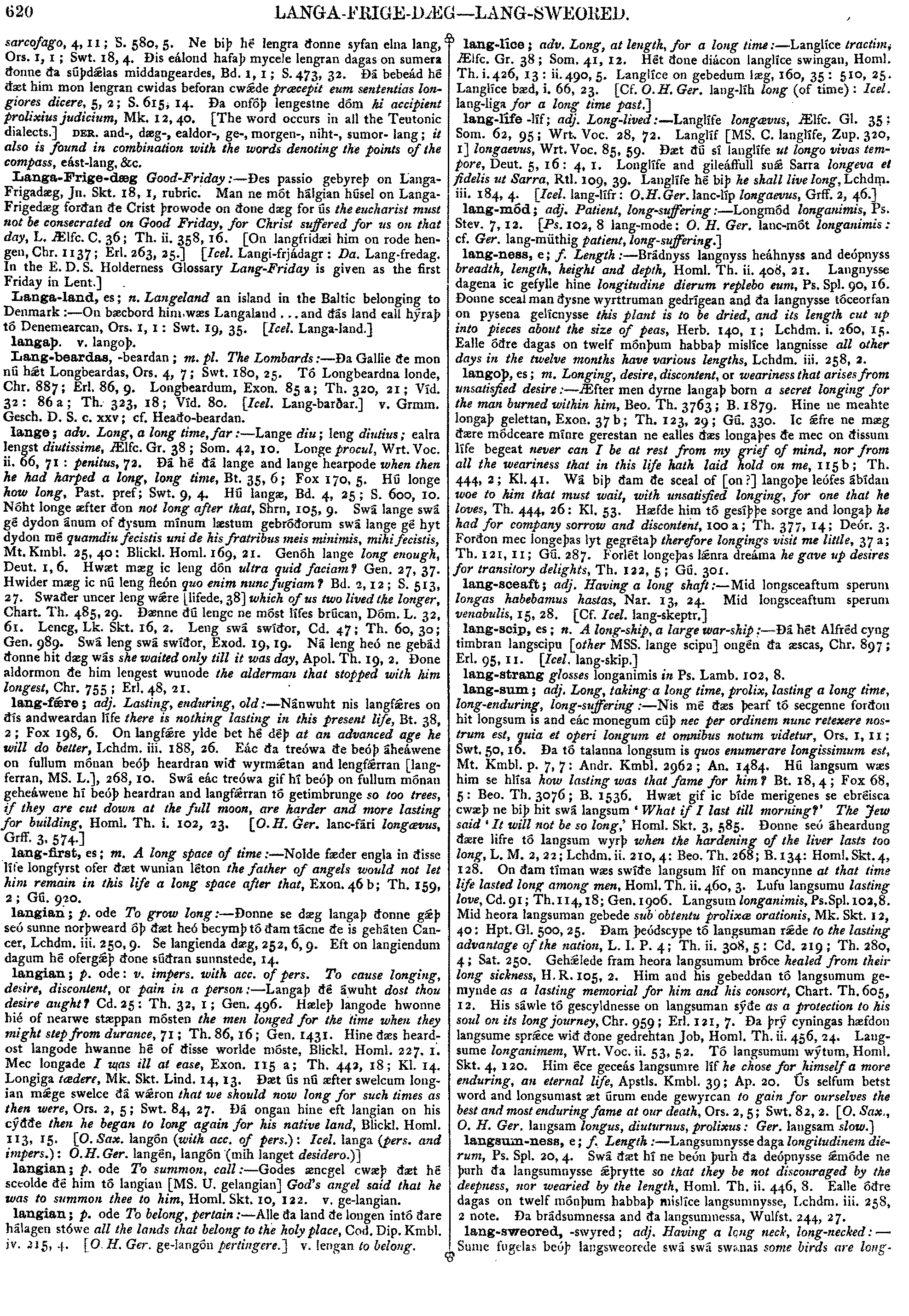
lang-fre;
adj.
Lasting,
enduring,
old
:--
Nánwuht
nis
langfres
on
ðís
andweardan
lífe
there
is
nothing
lasting
in
this
present
life,
Bt.
38,
2;
Fox
198,
6.
On
langfre
ylde
bet
hé
déþ
at
an
advanced
age
he
will
do
better,
Lchdm.
iii.
188,
26.
Eác
ða
treówa
ðe
beóþ
áheáwene
on
fullum
mónan
beóþ
heardran
wið
wyrmtan
and
lengfrran
[langferran,
MS.
L.],
268,
10.
Swá
eác
treówa
gif
hí
beóþ
on
fullum
mónan
geheáwene
hí
beóþ
heardran
and
langfrran
tó
getimbrunge
so
too
trees,
if
they
are
cut
down
at
the
full
moon,
are
harder
and
more
lasting
for
building,
Homl.
Th.
i.
102,
23.
[O.
H.
Ger.
lanc-fári
longævus,
Grff.
3,
574.]
|
Source: Bosworth/Toller, page b0620, entry 9 View original page image as: [TIFF] [PNG] [View previous entry] [View next entry] |
[Comment on this entry] [View comments] |
The following entry has been hand-corrected once. |
langian;
p.
ode:
v.
impers.
with
acc.
of
pers.
To
cause
longing,
desire,
discontent,
or
pain
in
a
person
:--
Langaþ
ðé
áwuht
dost
thou
desire
aught?
Cd.
25:
Th.
32,
1;
Gen.
496.
Hæleþ
langode
hwonne
hié
of
nearwe
stæppan
mósten
the
men
longed
for
the
time
when
they
might
step
from
durance,
71;
Th.
86,
16;
Gen.
1431.
Hine
ðæs
heardost
langode
hwanne
hé
of
ðisse
worlde
móste,
Blickl.
Homl.
227,
1.
Mec
longade
I
was
ill
at
ease,
Exon.
115
a;
Th.
442,
18;
Kl.
I4.
Longiga
tædere,
Mk.
Skt.
Lind.
14,
13.
Ðæt
ús
nú
æfter
swelcum
longian
mge
swelce
ðá
wron
that
we
should
now
long
for
such
times
as
then
were,
Ors.
2,
5;
Swt.
84,
27.
Ðá
ongan
hine
eft
langian
on
his
cýððe
then
he
began
to
long
again
for
his
native
land,
Blickl.
Homl.
113,
15.
[O.
Sax.
langón
(with
acc.
of
pers.):
Icel.
langa
(pers.
and
impers.):
O.
H.
Ger.
langén,
langón
(mih
langet
desidero.)]
|
Source: Bosworth/Toller, page b0620, entry 21 View original page image as: [TIFF] [PNG] [View previous entry] [View next entry] |
[Comment on this entry] [View comments] |
The following entry has been hand-corrected once. |
langsum-ness,
e;
f.
Length
:--
Langsumnysse
daga
longitudinem
dierum,
Ps.
Spl.
20,
4.
Swá
ðæt
hí
ne
beón
þurh
ða
deópnysse
móde
ne
þurh
ða
langsumnysse
þrytte
so
that
they
be
not
discouraged
by
the
deepness,
nor
wearied
by
the
length,
Homl.
Th.
ii.
446,
8.
Ealle
óðre
dagas
on
twelf
mónþum
habbaþ
mislíce
langsumnysse,
Lchdm.
iii.
258,
2
note.
Ða
brádsumnessa
and
ða
langsumnessa,
Wulfst.
244,
27.
|
Source: Bosworth/Toller, page b0621, entry 9 View original page image as: [TIFF] [PNG] [View previous entry] [View next entry] |
[Comment on this entry] [View comments] |
The following entry has been hand-corrected once. |
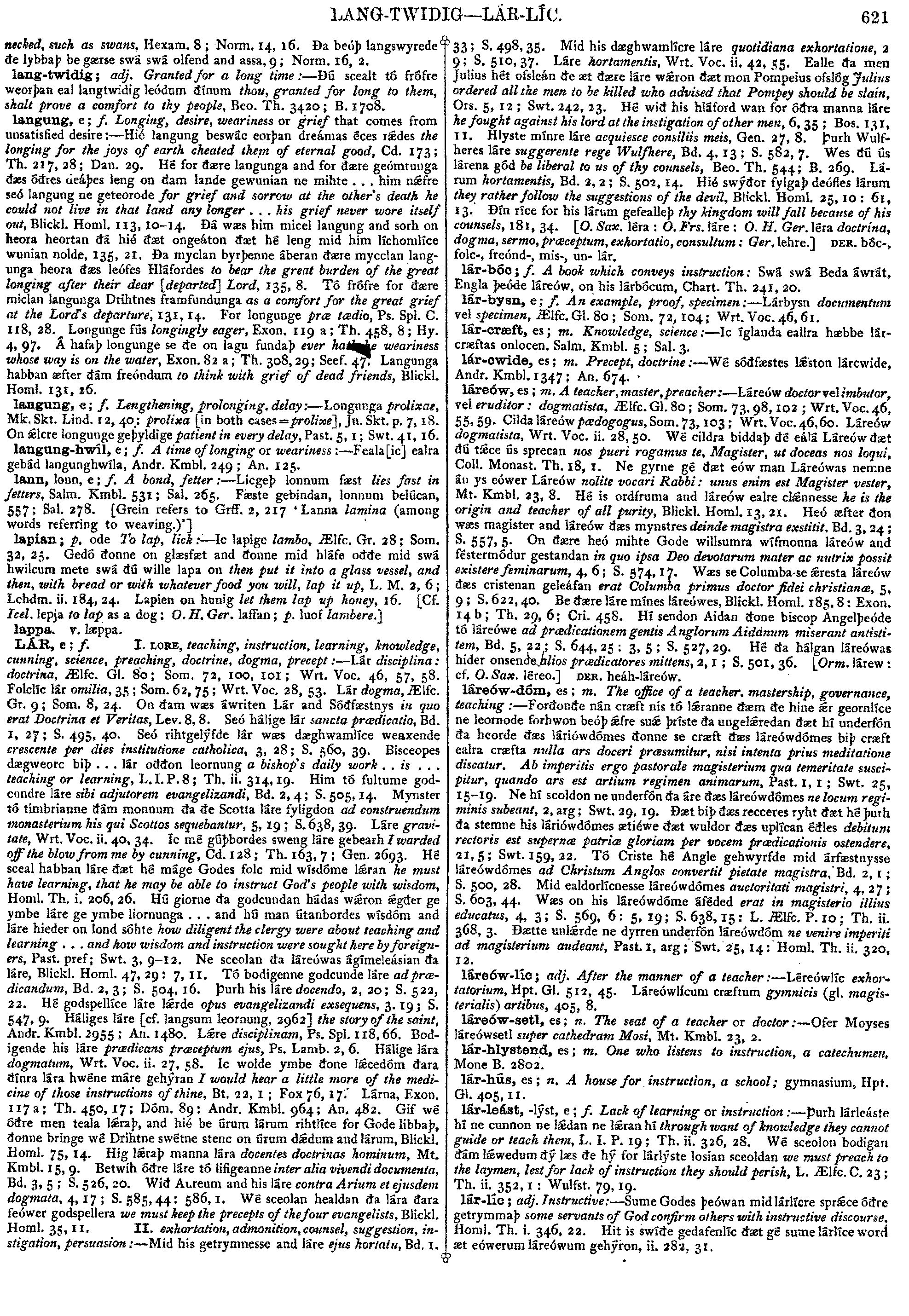
LÁR,
e;
f.
I.
LORE,
teaching,
instruction,
learning,
knowledge,
cunning,
science,
preaching,
doctrine,
dogma,
precept
:--
Lár
disciplina:
doctrina,
Ælfc.
Gl.
80;
Som.
72,
100,
101;
Wrt.
Voc.
46,
57,
58.
Folclíc
lár
omilia,
35;
Som.
62,
75;
Wrt.
Voc.
28,
53.
Lár
dogma,
Ælfc.
Gr.
9;
Som.
8,
24.
On
ðam
wæs
áwriten
lár
and
Sóðfæstnys
in
quo
erat
Doctrina
et
Veritas,
Lev.
8,
8.
Seó
hálige
lár
sancta
prædicatio,
Bd.
1,
27;
S.
495,
40.
Seó
rihtgelýfde
lár
wæs
dæghwamlíce
weaxende
crescente
per
dies
institutione
catholica,
3,
28;
S.
560,
39.
Bisceopes
dægweorc
biþ
...
lár
oððon
leornung
a
bishop's
daily
work
..
is
...
teaching
or
learning,
L.
I.
P.
8;
Th.
ii.
314,
19.
Him
tó
fultume
godcendre
láre
sibi
adjutorem
evangelizandi,
Bd.
2,
4;
S.
505,
14.
Mynster
tó
timbrianne
ðám
monnum
ða
ðe
Scotta
láre
fyligdon
ad
construendum
monasterium
his
qui
Scottos
sequebantur,
5,
19;
S.
638,
39.
Láre
gravitate,
Wrt.
Voc.
ii.
40,
34.
Ic
mé
gúþbordes
sweng
láre
gebearh
I
warded
off
the
blow
from
me
by
cunning,
Cd.
128;
Th.
163,
7;
Gen.
2693.
Hé
sceal
habban
láre
ðæt
hé
máge
Godes
folc
mid
wísdóme
lran
he
must
have
learning,
that
he
may
be
able
to
instruct
God's
people
with
wisdom,
Homl.
Th.
i.
206,
26.
Hú
giorne
ða
godcundan
hádas
wron
gðer
ge
ymbe
láre
ge
ymbe
liornunga
...
and
hú
man
útanbordes
wisdóm
and
láre
hieder
on
lond
sóhte
how
diligent
the
clergy
were
about
teaching
and
learning
...
and
how
wisdom
and
instruction
were
sought
here
by
foreigners,
Past.
pref;
Swt.
3,
9-12.
Ne
sceolan
ða
láreówas
ágímeleásian
ða
láre,
Blickl.
Homl.
47,
29:
7,
11.
Tó
bodigenne
godcunde
láre
ad
prædicandum,
Bd.
2,
3;
S.
504,
16.
Þurh
his
láre
docendo,
2,
20;
S.
522,
22.
Hé
godspellíce
láre
lrde
opus
evangelizandi
exsequens,
3,
19;
S.
547,
9.
Háliges
láre
[cf.
langsum
leornung,
2962]
the
story
of
the
saint,
Andr.
Kmbl.
2955;
An.
1480.
Lre
disciplinam,
Ps.
Spl.
118,
66.
Bodigende
his
láre
prædicans
præceptum
ejus,
Ps.
Lamb.
2,
6.
Hálige
lára
dogmatum,
Wrt.
Voc.
ii.
27,
58.
Ic
wolde
ymbe
ðone
lcedóm
ðara
ðínra
lára
hwéne
máre
gehýran
I
would
hear
a
little
more
of
the
medicine
of
those
instructions
of
thine,
Bt.
22,
1;
Fox
76,
17.
Lárna,
Exon.
117
a;
Th.
450,
17;
Dóm.
89:
Andr.
Kmbl.
964;
An.
482.
Gif
wé
óðre
men
teala
lraþ,
and
hié
be
úrum
lárum
rihtlíce
for
Gode
libbaþ,
ðonne
bringe
wé
Drihtne
swétne
stenc
on
úrum
ddum
and
lárum,
Blickl.
Homl.
75,
14.
Hig
lraþ
manna
lára
docentes
doctrinas
hominum,
Mt.
Kmbl.
15,
9.
Betwih
óðre
láre
tó
lifigeanne
inter
alia
vivendi
documenta,
Bd.
3,
5;
S.
526,
20.
Wið
Aureum
and
his
láre
contra
Arium
et
ejusdem
dogmata,
4,
17;
S.
585,
44:
586,
1.
Wé
sceolan
healdan
ða
lára
ðara
feówer
godspellera
we
must
keep
the
precepts
of
the
four
evangelists,
Blickl.
Homl.
35,
11.
II.
exhortation,
admonition,
counsel,
suggestion,
instigation,
persuasion
:--
Mid
his
getrymnesse
and
láre
ejus
hortatu,
Bd.
1,
33;
S.
498,
35.
Mid
his
dæghwamlícre
láre
quotidiana
exhortatione,
2
9;
S.
510,
37.
Láre
hortamentis,
Wrt.
Voc.
ii.
42,
55.
Ealle
ða
men
Julius
hér
ofsleán
ðe
æt
ðære
láre
wron
ðæt
mon
Pompeius
ofslóg
Julius
ordered
all
the
men
to
be
killed
who
advised
that
Pompey
should
be
slain,
Ors.
5,
12;
Swt.
242,
23.
Hé
wið
his
hláford
wan
for
óðra
manna
láre
he
fought
against
his
lord
at
the
instigation
of
other
men,
6,
35;
Bos.
131,
11.
Hlyste
mínre
láre
acquiesce
consiliis
meis,
Gen.
27,
8.
Þurh
Wulfheres
láre
suggerente
rege
Wulfhere,
Bd.
4,
13;
S.
582,
7.
Wes
ðú
ús
lárena
gód
be
liberal
to
us
of
thy
counsels,
Beo.
Th.
544;
B.
269.
Lárum
hortamentis,
Bd.
2,
2;
S.
502,
14.
Hié
swýðor
fylgaþ
deófles
lárum
they
rather
follow
the
suggestions
of
the
devil,
Blickl.
Homl.
25,
10
:
61,
13.
Ðín
ríce
for
his
lárum
gefealleþ
thy
kingdom
will
fall
because
of
his
counsels,
181,
34.
[O.
Sax.
léra:
O.
Frs.
láre:
O.
H.
Ger.
léra
doctrina,
dogma,
sermo,
præceptum,
exhortatio,
consultum:
Ger.
lehre.]
DER.
bóc-,
folc-,
freónd-,
mis-,
un-
lár.
|
Source: Bosworth/Toller, page b0621, entry 20 View original page image as: [TIFF] [PNG] [View previous entry] [View next entry] |
[Comment on this entry] [View comments] |
The following entry has been hand-corrected once. |
lár-leást,
-lýst,
e;
f.
Lack
of
learning
or
instruction
:--
Þurh
lárleáste
hí
ne
cunnon
ne
ldan
ne
lran
hí
through
want
of
knowledge
they
cannot
guide
or
teach
them,
L.
I.
P.
19;
Th.
ii.
326,
28.
Wé
sceolon
bodigan
ðám
lwedum
ðý
læs
ðe
hý
for
lárlýste
losian
sceoldan
we
must
preach
to
the
laymen,
lest
for
lack
of
instruction
they
should
perish,
L.
Ælfc.
C.
23;
Th.
ii.
352,
1:
Wulfst.
79,
19.
|
Source: Bosworth/Toller, page b0622, entry 6 View original page image as: [TIFF] [PNG] [View previous entry] [View next entry] |
[Comment on this entry] [View comments] |
The following entry has been hand-corrected once. |
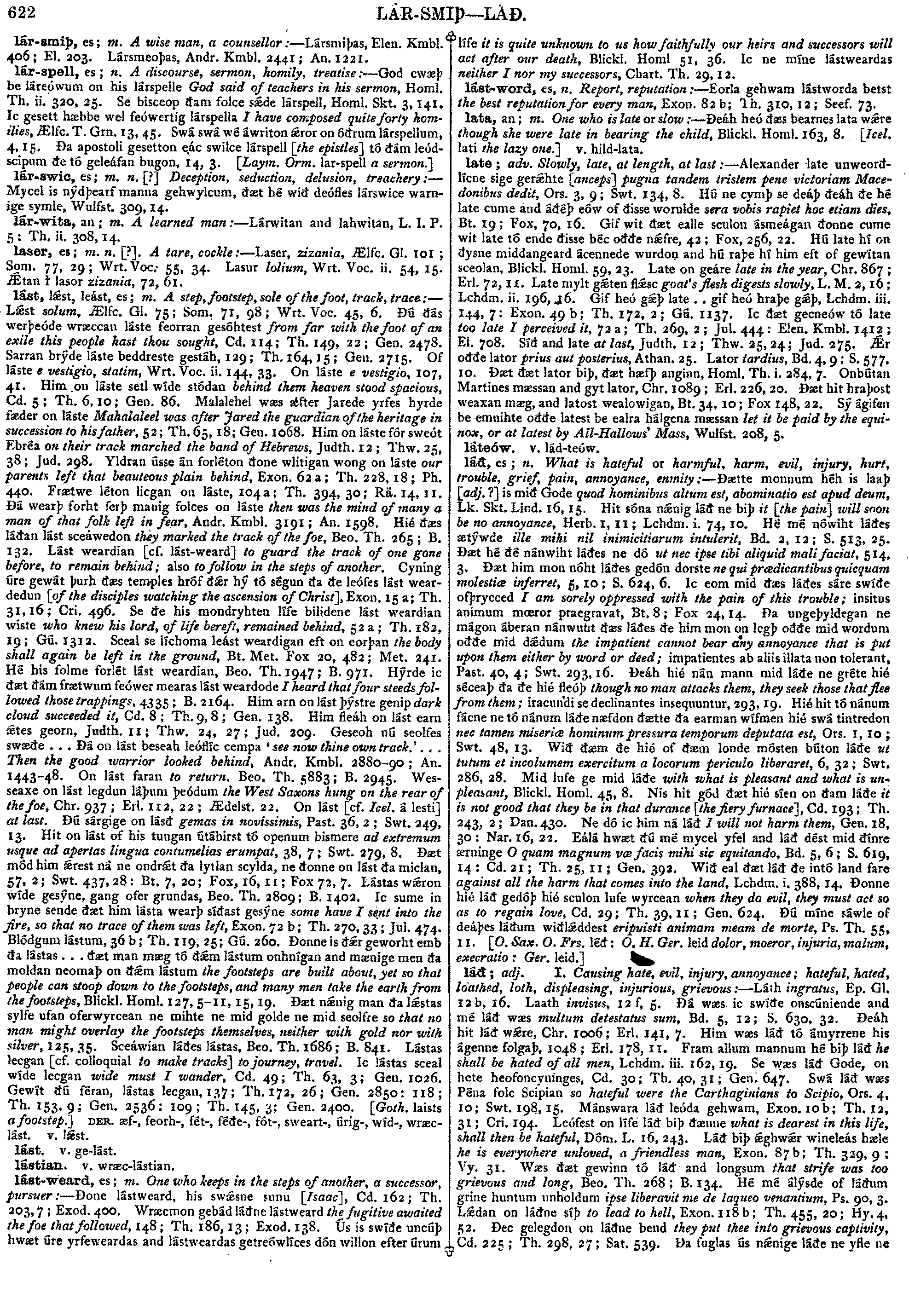
lást,
lst,
leást,
es;
m.
A
step,
footstep,
sole
of
the
foot,
track,
trace
:--
Lst
solum,
Ælfc.
Gl.
75;
Som.
71,
98;
Wrt.
Voc.
45,
6.
Ðú
ðás
werþeóde
wræccan
láste
feorran
gesóhtest
from
far
with
the
foot
of
an
exile
this
people
hast
thou
sought,
Cd.
114;
Th.
149,
22;
Gen.
2478.
Sarran
brýde
láste
beddreste
gestáh,
129;
Th.
164,
15;
Gen.
2715.
Of
láste
e
vestigio,
statim,
Wrt.
Voc.
ii.
144,
33.
On
láste
e
vestigio,
107,
41.
Him
on
láste
setl
wíde
stódan
behind
them
heaven
stood
spacious,
Cd.
5;
Th.
6,
10;
Gen.
86.
Malalehel
wæs
æfter
Jarede
yrfes
hyrde
fæder
on
láste
Mahalaleel
was
after
Jared
the
guardian
of
the
heritage
in
succession
to
his
father,
52;
Th.
65,
18;
Gen.
1068.
Him
on
láste
fór
sweót
Ebréa
on
their
track
marched
the
band
of
Hebrews,
Judth.
12;
Thw.
25,
38;
Jud.
298.
Yldran
ússe
in
forléton
ðone
wlitigan
wong
on
láste
our
parents
left
that
beauteous
plain
behind,
Exon.
62
a;
Th.
228,
18;
Ph.
440.
Frætwe
léton
licgan
on
láste,
104
a;
Th.
394,
30;
Rä.
14,
11.
Ðá
wearþ
forht
ferþ
manig
folces
on
láste
then
was
the
mind
of
many
a
man
of
that
folk
left
in
fear,
Andr.
Kmbl.
3191;
An.
1598.
Hié
ðæs
láðan
lást
sceáwedon
they
marked
the
track
of
the
foe,
Beo.
Th.
265;
B.
132.
Lást
weardian
[cf.
lást-weard]
to
guard
the
track
of
one
gone
before,
to
remain
behind;
also
to
follow
in
the
steps
of
another.
Cyning
úre
gewát
þurh
ðæs
temples
hróf
ðr
hý
tó
ségun
ða
ðe
leófes
lást
weardedun
[of
the
disciples
watching
the
ascension
of
Christ],
Exon.
15
a;
Th.
31,
16;
Cri.
496.
Se
ðe
his
mondryhten
lífe
bilidene
lást
weardian
wiste
who
knew
his
lord,
of
life
bereft,
remained
behind,
52
a;
Th.
182,
19;
Gú.
1312.
Sceal
se
líchoma
leást
weardigan
eft
on
eorþan
the
body
shall
again
be
left
in
the
ground,
Bt.
Met.
Fox
20,
482;
Met.
241.
Hé
his
folme
forlét
lást
weardian,
Beo.
Th.
1947;
B.
971.
Hýrde
ic
ðæt
ðám
frætwum
feówer
mearas
lást
weardode
I
heard
that
four
steeds
followed
those
trappings,
4335;
B.
2164.
Him
arn
on
lást
þýstre
genip
dark
cloud
succeeded
it,
Cd.
8;
Th.
9,
8;
Gen.
138.
Him
fleáh
on
lást
earn
tes
georn,
Judth.
11;
Thw.
24,
27;
Jud.
209.
Gescoh
nú
seolfes
swæðe
...
Ðá
on
lást
beseah
leóflíc
cempa
'see
now
thine
own
track.'
...
Then
the
good
warrior
looked
behind,
Andr.
Kmbl.
2880-90;
An.
1443-48.
On
lást
faran
to
return.
Beo.
Th.
5883;
B.
2945.
Wesseaxe
on
lást
legdun
láþam
þeódum
the
West
Saxons
hung
on
the
rear
of
the
foe,
Chr.
937;
Erl.
112,
22;
Ædelst.
22.
On
lást
[cf.
Icel.
á
lesti]
at
last.
Ðú
sárgige
on
lásð
gemas
in
novissimis,
Past.
36,
2;
Swt.
249,
13.
Hit
on
lást
of
his
tungan
útábirst
tó
openum
bismere
ad
extremum
usque
ad
apertas
lingua
coutumelias
erumpat,
38,
7;
Swt.
279,
8.
Ðæt
mód
him
rest
ná
ne
ondrt
ða
lytlan
scylda,
ne
ðonne
on
lást
ða
miclan,
57,
2;
Swt.
437,
28:
Bt.
7,
20;
Fox,
16,
11;
Fox
72,
7.
Lástas
wron
wíde
gesýne,
gang
ofer
grundas,
Beo.
Th.
2809;
B.
1402.
Ic
sume
in
bryne
sende
ðæt
him
lásta
wearþ
síðast
gesýne
some
have
I
sent
into
the
fire,
so
that
no
trace
of
them
was
left,
Exon.
72
b;
Th.
270,
33;
Jul.
474.
|
Source: Bosworth/Toller, page b0622, entry 15 View original page image as: [TIFF] [PNG] [View previous entry] [View next entry] |
[Comment on this entry] [View comments] |
The following entry has been hand-corrected once. |
láð,
es;
n.
What
is
hateful
or
harmful,
harm,
evil,
injury,
hurt,
trouble,
grief,
pain,
annoyance,
enmity
:--
Ðætte
monnum
héh
is
laaþ
[adj.?]
is
mið
Gode
quod
hominibus
altum
est,
abominatio
est
apud
deum,
Lk.
Skt.
Lind.
16,
15.
Hit
sóna
nnig
láð
ne
biþ
it
[the
pain]
will
soon
be
no
annoyance,
Herb.
1,
11;
Lchdm.
i.
74,
10.
Hé
mé
nówiht
láðes
ætýwde
ille
mihi
nil
inimicitiarum
intulerit,
Bd.
2,
12;
S.
513,
25.
Ðæt
hé
ðé
nánwiht
láðes
ne
dó
ut
nec
ipse
tibi
aliquid
mali
faciat,
514,
3.
Ðæt
him
mon
nóht
láðes
gedón
dorste
ne
qui
prædicantibus
quicquam
molestiæ
inferret,
5,
10;
S.
624,
6.
Ic
eom
mid
ðæs
láðes
sáre
swíðe
ofþrycced
I
am
sorely
oppressed
with
the
pain
of
this
trouble;
insitus
animum
moeror
praegravat,
Bt.
8;
Fox
24,
14.
Ða
ungeþyldegan
ne
mágon
áberan
nánwuht
ðæs
láðes
ðe
him
mon
on
legþ
oððe
mid
wordum
oððe
mid
ddum
the
impatient
cannot
bear
any
annoyance
that
is
put
upon
them
either
by
word
or
deed;
impatientes
ab
aliis
illata
non
tolerant,
Past.
40,
4;
Swt.
293,
16.
Ðeáh
hié
nán
mann
mid
láðe
ne
gréte
hié
séceaþ
ða
ðe
hié
fleóþ
though
no
man
attacks
them,
they
seek
those
that
flee
from
them;
iracundi
se
declinantes
insequuntur,
293,
19.
Hié
hit
tó
nánum
fácne
ne
tó
nánum
láðe
næfdon
ðætte
ða
earman
wífmen
hié
swá
tintredon
nec
tamen
miseriæ
hominum
pressura
temporum
deputata
est,
Ors.
1,
10;
Swt.
48,
13.
Wið
ðæm
ðe
hié
of
ðæm
londe
mósten
búton
láðe
ut
tutum
et
incolumem
exercitum
a
locorum
periculo
liberaret,
6,
32;
Swt.
286,
28.
Mid
lufe
ge
mid
láðe
with
what
is
pleasant
and
what
is
unpleasant,
Blickl.
Homl.
45,
8.
Nis
hit
gód
ðæt
hié
síen
on
ðam
láðe
it
is
not
good
that
they
be
in
that
durance
[the
fiery
furnace],
Cd.
193;
Th.
243,
2;
Dan.
430.
Ne
dó
ic
him
ná
láð
I
will
not
harm
them,
Gen.
18,
30:
Nar.
16,
22.
Eálá
hwæt
ðú
mé
mycel
yfel
and
láð
dést
mid
ðínre
ærninge
O
quam
magnum
væ
facis
mihi
sic
equitando,
Bd.
5,
6;
S.
619,
14:
Cd.
21;
Th.
25,
11;
Gen.
392.
Wið
eal
ðæt
láð
ðe
intó
land
fare
against
all
the
harm
that
comes
into
the
land,
Lchdm.
i.
388,
14.
Ðonne
hié
láð
gedóþ
hié
sculon
lufe
wyrcean
when
they
do
evil,
they
must
act
so
as
to
regain
love,
Cd.
29;
Th.
39,
11;
Gen.
624.
Ðú
míne
sáwle
of
deáþes
láðum
wiðlddest
eripuisti
animam
meam
de
morte,
Ps.
Th.
55,
11.
[O.
Sax.
O.
Frs.
léð:
O.
H.
Ger.
leid
dolor,
moeror,
injuria,
malum,
execratio:
Ger.
leid.]
|
Source: Bosworth/Toller, page b0622, entry 16 View original page image as: [TIFF] [PNG] [View previous entry] [View next entry] |
[Comment on this entry] [View comments] |
The following entry has been hand-corrected once. |
láð;
adj.
I.
Causing
hate,
evil,
injury,
annoyance;
hateful,
hated,
loathed,
loth,
displeasing,
injurious,
grievous
:--
Láth
ingratus,
Ep.
Gl.
12
b,
16.
Laath
invisus,
12
f,
5.
Ðá
wæs
ic
swíðe
onscúniende
and
mé
láð
wæs
multum
detestatus
sum,
Bd.
5,
12;
S.
630,
32.
Ðeáh
hit
láð
wre,
Chr.
1006;
Erl.
141,
7.
Him
wæs
láð
tó
ámyrrene
his
ágenne
folgaþ,
1048;
Erl.
178,
11.
Fram
allum
mannum
hé
biþ
láð
he
shall
be
hated
of
all
men,
Lchdm.
iii.
162,
19.
Se
wæs
láð
Gode,
on
hete
heofoncyninges,
Cd.
30;
Th.
40,
31;
Gen.
647.
Swá
láð
wæs
Péna
folc
Scipian
so
hateful
were
the
Carthaginians
to
Scipio,
Ors.
4,
10;
Swt.
198,
15.
Mánswara
láð
leóda
gehwam,
Exon.
10
b;
Th.
12,
31;
Cri.
194.
Leófest
on
lífe
láð
biþ
ðænne
what
is
dearest
in
this
life,
shall
then
be
hateful,
Dóm.
L.
16,
243.
Láð
biþ
ghwr
wineleás
hæle
he
is
everywhere
unloved,
a
friendless
man,
Exon.
87
b;
Th.
329,
9:
Vy.
31.
Wæs
ðæt
gewinn
tó
láð
and
longsum
that
strife
was
too
grievous
and
long,
Beo.
Th.
268;
B.
134.
Hé
mé
álýsde
of
láðum
grine
huntum
unholdum
ipse
liberavit
me
de
laqueo
venantium,
Ps.
90,
3.
Ldan
on
láðne
síþ
to
lead
to
hell,
Exon.
118
b;
Th.
455,
20;
Hy.
4,
52.
Ðec
gelegdon
on
láðne
bend
they
put
thee
into
grievous
captivity,
Cd.
225;
Th.
298,
27;
Sat.
539.
Ða
fuglas
ús
nnige
láðe
ne
yfle
ne
wæron
aves
non
nobis
perniciem
ferentes,
Nar.
16,
18.
Ða
rihtwísan
sint
láðe
and
forþrycte
the
righteous
are
hated
and
oppressed,
Bt.
3,
4;
Fox
6,
23.
Hé
hæfde
fela
hta
ðe
him
wron
láðe
tó
forltenne
he
had
many
possessions
that
he
was
loth
to
leave,
Basil
admn.
9;
Norm.
56,
7.
Gé
habbaþ
ús
gedón
láðe
Pharaone,
Ex.
5,
21.
Láð
gewidru
grievous
storms,
Beo.
Th.
2754;
B.
1375.
Næs
ic
him
láðra
ówihte
ðonne
his
bearna
hwylc
I
was
not
a
whit
less
dear
to
him
than
any
of
his
children,
4856;
B.
2432.
Ic
á
ne
geseah
láðran
landscipe
never
saw
I
scene
more
hateful,
Cd.
19;
Th.
24,
11;
Gen.
376.
Sege
ðínum
leódum
miccle
láðre
spell
tell
to
thy
people
a
tale
that
will
please
much
less,
Byrht.
Th.
133,
15;
By.
50.
Gnornsorga
mst
wyrda
láðost
greatest
of
griefs,
most
grievous
of
fates,
Elen.
Kmbl.
1953;
El.
978.
Ðr
ðé
láðast
biþ,
Exon.
41
a;
Th.
137,
17;
Gú.
560.
Áne
ða
mstan
synne
and
Gode
þa
láðustan
one
of
the
greatest
sins
and
most
displeasing
to
God,
Ex.
32,
21.
II.
bearing
hate
to
another,
hostile,
malign,
inimical
:--
Ne
leóf
ne
láð
nor
friend
nor
foe,
Beo.
Th.
1026;
B.
511.
Láð
wið
láðum
foe
with
foe,
884;
B.
440.
Láðe
cyrmdon
the
foes
shouted,
Cd.
166;
Th.
207,
3;
Exod.
461.
Wið
láðra
lygesearwum
against
false
wiles
of
foes,
Exon.
19
a;
Th.
48,
23;
Cri.
776:
Judth.
12;
Thw.
25,
38;
Jud.
304.
Ðæt
on
land
Dena
láðra
nnig
sceððan
meahte,
Beo.
Th.
490;
B.
242.
Láðan
fingrum
with
hostile
fingers,
3015;
B.
1505.
Láðum
eágan,
Cd.
151;
Th.
189,
3;
Exod.
179.
Láðum
wordum,
Exon.
28
a;
Th.
84,
17;
Cri.
1376.
Álýs
mé
fram
láðum
libera
me
a
persequentibus
me,
Ps.
Th.
141,
7.
Ðæt
hé
ðé
ne
forlte
láðum
tó
handa,
Dóm.
L.
30,
29.
Hé
ne
lteþ
míne
fét
láðe
hréran,
Ps.
Th.
65,
8.
[O.
Sax.
O.
Frs.
léð:
Icel.
leiðr:
O.
H.
Ger.
leid
exosus,
odiosus,
invisus,
tristis,
malignus,
ingratus:
Ger.
leid.]
v.
þurh-láð.
|
Source: Bosworth/Toller, page b0623, entry 3 View original page image as: [TIFF] [PNG] [View previous entry] [View next entry] |
[Comment on this entry] [View comments] |
The following entry has been hand-corrected once. |
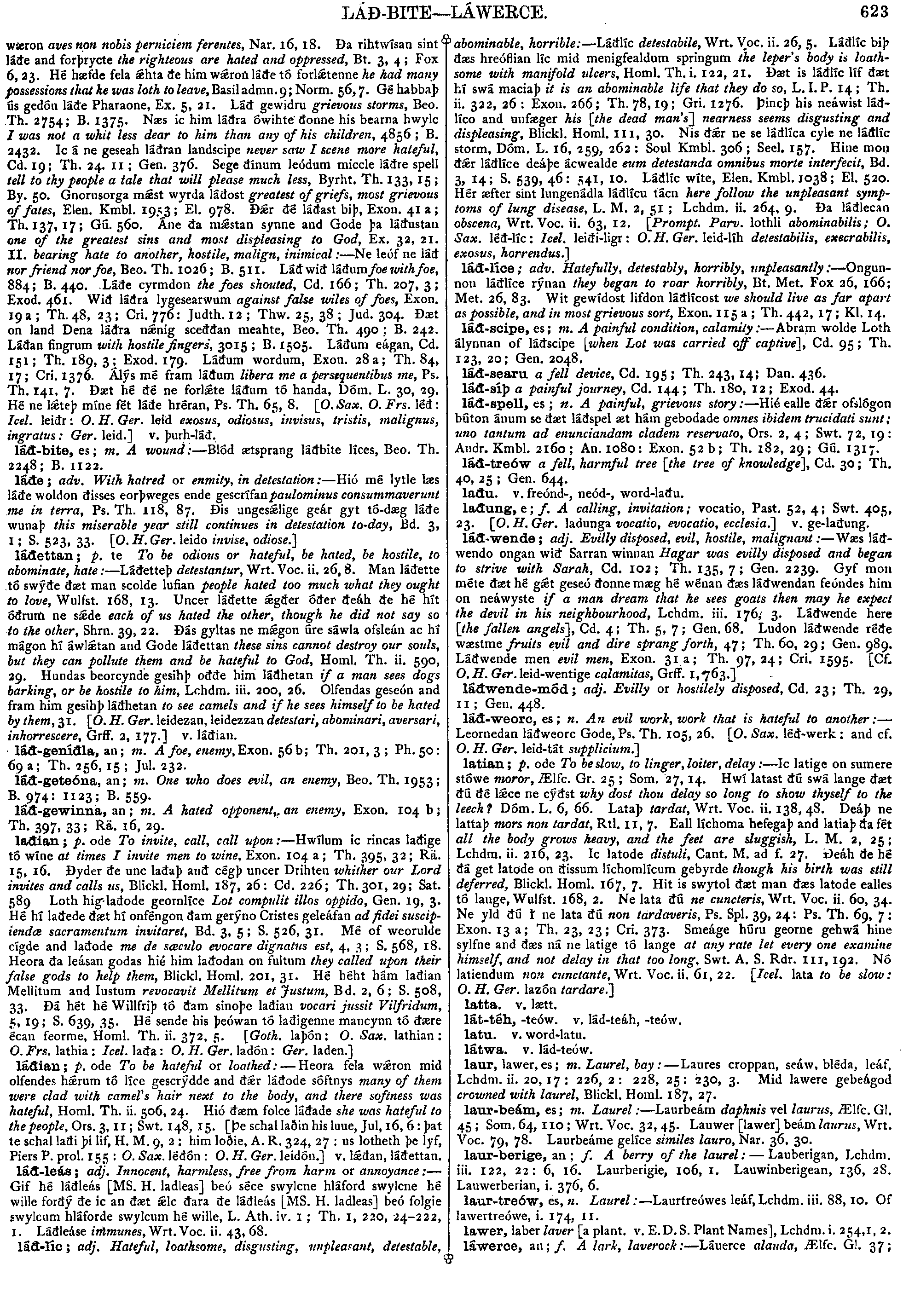
láðettan;
p.
te
To
be
odious
or
hateful,
be
hated,
be
hostile,
to
abominate,
hate
:--
Láðetteþ
detestantur,
Wrt.
Voc.
ii.
26,
8.
Man
láðette
tó
swýðe
ðæt
man
scolde
lufian
people
hated
too
much
what
they
ought
to
love,
Wulfst.
168,
13.
Uncer
láðette
gðer
óðer
ðeáh
ðe
hé
hít
óðrum
ne
sde
each
of
us
hated
the
other,
though
he
did
not
say
so
to
the
other,
Shrn.
39,
22.
Ðás
gyltas
ne
mgon
úre
sáwla
ofsleán
ac
hí
mágon
hí
áwltan
and
Gode
láðettan
these
sins
cannot
destroy
our
souls,
but
they
can
pollute
them
and
be
hateful
to
God,
Homl,
Th.
ii.
590,
29.
Hundas
beorcynde
gesihþ
oððe
him
láðhetan
if
a
man
sees
dogs
barking,
or
be
hostile
to
him,
Lchdm.
iii.
200,
26.
Olfendas
geseón
and
fram
him
gesihþ
láðhetan
to
see
camels
and
if
he
sees
himself
to
be
hated
by
them,
31.
[O.
H.
Ger.
leidezan,
leidezzan
detestari,
abominari,
aversari,
inhorrescere,
Grff.
2,
177.]
v.
láðian.
| Result Page: |  |
Previous | 151 152 153 154 155 156 157 158 159 160 161 162 163 164 165 166 167 168 169 | Next |  |
Germanic Lexicon Project (main page)
This search system was written by
Sean Crist
Please consider
volunteering
to correct the data in these online dictionaries.
No rights reserved. Feel free to use these data in any way you please.