|
|

|
Source: Cleasby/Vigfusson, page b0135, entry 19 View original page image as: [TIFF] [PNG] [View previous entry] [View next entry] |
[Comment on this entry] [View comments] |
The following entry has been hand-corrected once. |
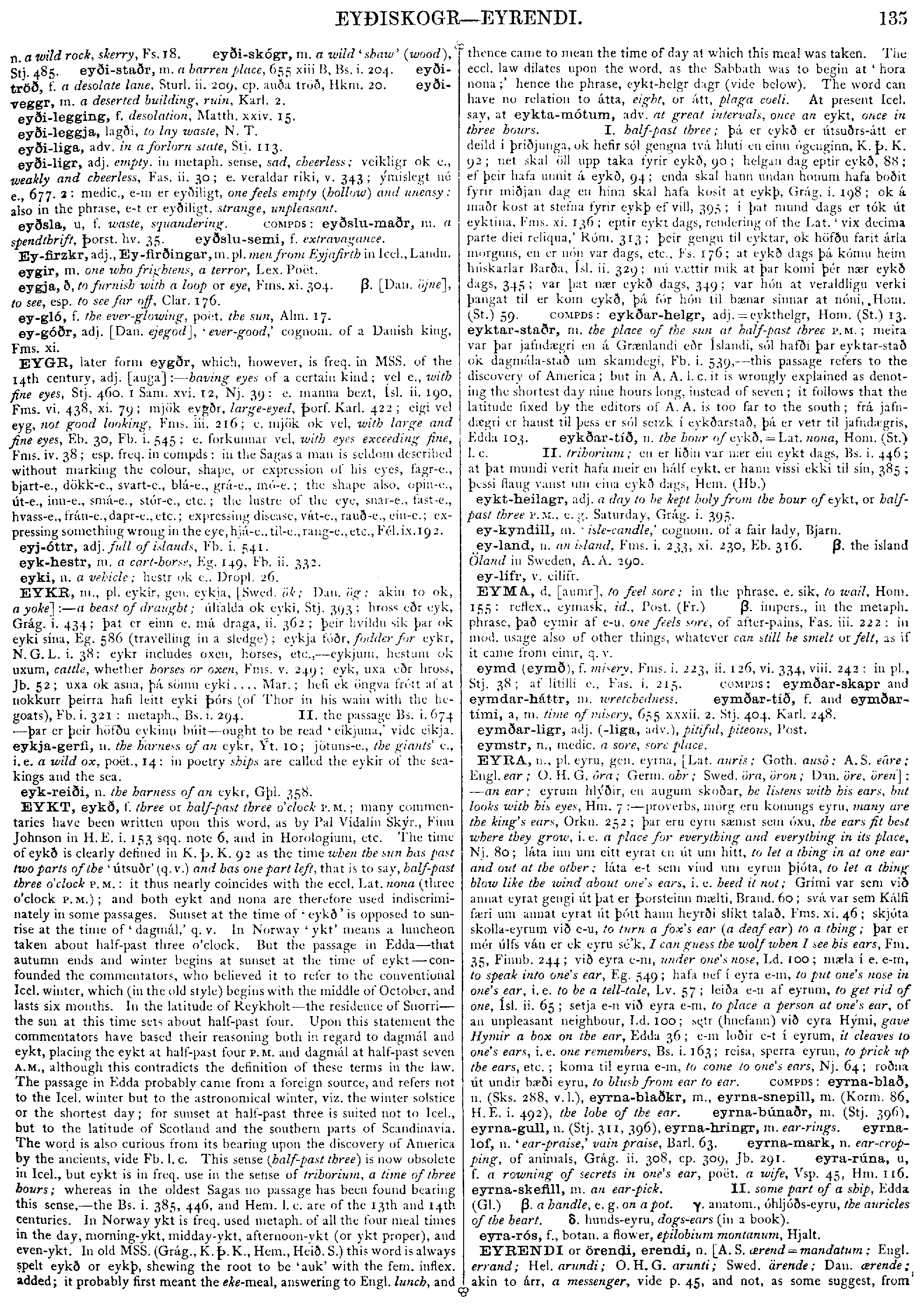
EYKT, eykð, f. three or half-past three o'clock P. M.; many commen- taries have been written upon this word, as by Pal Vidalin Skýr., Finn Johnson in H.E. i. 153 sqq. note 6, and in Horologium, etc. The time of eykð is clearly defined in K.Þ.K. 92 as the time when the sun has past two parts of the 'útsuðr' (q.v.) and has one part left, that is to say, half-past three o'clock P.M.: it thus nearly coincides with the eccl. Lat. nona (three o'clock P. M.); and both eykt and nona are therefore used indiscrimi- nately in some passages. Sunset at the time of 'eykð' is opposed to sun- rise at the time of 'dagmál,' q.v. In Norway 'ykt' means a luncheon taken about half-past three o'clock. But the passage in Edda--that autumn ends and winter begins at sunset at the time of eykt--con- founded the commentators, who believed it to refer to the conventional Icel.winter, which (in the old style) begins with the middle of October, and lasts six months. In the latitude of Reykholt--the residence of Snorri-- the sun at this time sets about half-past four. Upon this statement the commentators have based their reasoning both in regard to dagmál and eykt, placing the eykt at half-past four P.M. and dagmál at half-past seven A.M., although this contradicts the definition of these terms in the law. The passage in Edda probably came from a foreign source, and refers not to the Icel. winter but to the astronomical winter, viz. the winter solstice or the shortest day; for sunset at half-past three is suited not to Icel., but to the latitude of Scotland and the southern parts of Scandinavia. The word is also curious from its bearing upon the discovery of America by the ancients, vide Fb. 1. c. This sense (half-past three) is now obsolete in Icel., but eykt is in freq. use in the sense of trihorium, a time of three hours; whereas in the oldest Sagas no passage has been found bearing this sense, -- the Bs. i. 385, 446, and Hem. l.c. are of the 13th and 14th centuries. In Norway ykt is freq. used metaph. of all the four meal times in the day, morning-ykt, midday-ykt, afternoon-ykt (or ykt proper), and even-ykt. In old MSS. (Grág., K.Þ.K., Hem., Heið.S.) this word is always spelt eykð or eykþ, shewing the root to be 'auk' with the fem, inflex. added; it probably first meant the eke-meal, answering to Engl. lunch, and thence came to mean the time of day at which this meal was taken. The eccl. law dilates upon the word, as the Sabbath was to begin at 'hora nona;' hence the phrase, eykt-helgr dagr (vide below). The word can have no relation to átta, eight, or átt, plaga coeli. At present Icel. say, at eykta-mótum, adv. at great intervals, once an eykt, once in three hours. I. half-past three; þá er eykð er útsuðrs-átt er deild í þriðjunga, ok hefir sól gengna tvá hluti en einn ógenginn, K.Þ.K. 92; net skal öll upp taka fyrir eykð, 90; helgan dag eptir eykð, 88; ef þeir hafa unnit á eykð, 94; enda skal hann undan honum hafa boðit fyrir miðjan dag en hinn skal hafa kosit at eykþ, Grág. i. 198; ok á maðr kost at stefna fyrir eykþ ef vill, 395; í þat mund dags er tók út eyktina, Fms. xi. 136; eptir eykt dags, rendering of the Lat. 'vix decima parte diei reliqua,' Róm. 313; þeir gengu til eyktar, ok höfðu farit árla morguns, en er nón var dags, etc., Fs. 176; at eykð dags þá kómu heim húskarlar Barða. Ísl. ii. 329; nú vættir mik at þar komi þér nær eykð dags, 345; var þat nær eykð dags, 349; var hón at veraldligu verki þangat til er kom eykð, þá fór hón til bænar sinnar at nóni, . Hom. (St.) 59. COMPDS: eykðar-helgr, adj. = eykthelgr, Hom. (St.) 13. eyktar-staðr, m. the place of the sun at half-past three P. M.; meira var þar jafndægri en á Grænlandi eðr Íslandi, sól hafði þar eyktar-stað ok dagmála-stað um skamdegi, Fb. i. 539, -- this passage refers to the discovery of America; but in A.A. l.c. it is wrongly explained as denot- ing the shortest day nine hours long, instead of seven; it follows that the latitude fixed by the editors of A.A. is too far to the south; frá jafn- dægri er haust til þess er sól setzk í eykðarstað, þá er vetr til jafndægris, Edda 103. eykðar-tíð, n. the hour of eykð,=Lat. nona, Hom. (St.) 1.c. II. trihorium; en er liðin var nær ein eykt dags, Bs. i. 446; at þat mundi verit hafa meir en hálf eykt, er hann vissi ekki til sín, 385; þessi flaug vanst um eina eykð dags, Hem. (Hb.)
|
Source: Cleasby/Vigfusson, page b0137, entry 11 View original page image as: [TIFF] [PNG] [View previous entry] [View next entry] |
[Comment on this entry] [View comments] |
The following entry has been hand-corrected once. |
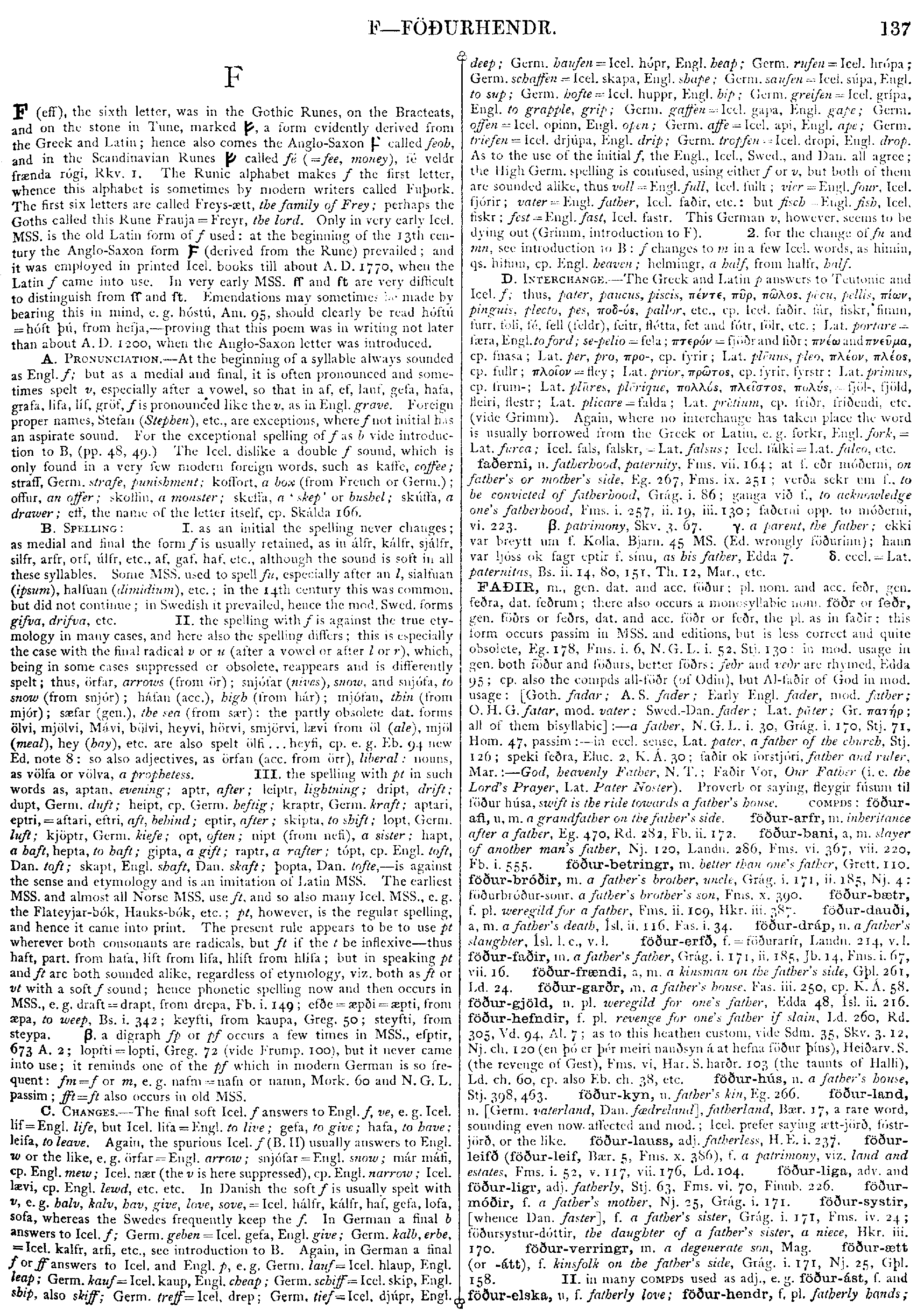
A.
to
fall;
as
in
Engl.
so
in
Icel.
falla
is
the
general
word,
used
in
the
broadest
sense;
in
the
N.
T.
it
is
therefore
used
much
in
the
same
passages
as
in
the
Engl.
V.,
e.g.
Matth.
v.
14,
vii.
25,
27,
x.
29,
xii.
11,
xiii.
4,
xxi.
44,
Luke
xiv.
5,
John
xii.
24,
Rom.
xi.
11,
xiv.
4,
1
Cor.
x.
12,
1
Tim.
vi.
9,
Rev.
viii.
10:
blómstrið
fellr,
James
i.
11:
again,
the
verbs
hrynja
and
hrapa
denote
ruin
or
sudden
fall,
detta
a
light
fall,
hrasa
stumbling;
thus
in
the
N.
T.
hrynja
is
used,
Luke
xxiii.
30,
Rev.
vi.
16;
hrapa,
Luke
x.
18,
xi.
17,
xiii.
4,
Matth.
xxiv.
29;
hrasa,
Luke
x.
30;
detta,
xvi.
21:
the
proverb,
eigi
fellr
tré
við
hit
fyrsta
högg,
a
tree
falls
not
by
the
first
stroke,
Nj.
163,
224;
hann
féll
fall
mikit,
Bs.
i.
343;
hón
féll
geigvænliga,
id.;
falla
af
baki,
to
fall
from
horseback,
344;
f.
áfram,
to
fall
forwards,
Nj.
165;
f.
á
bak
aptr,
to
fall
on
the
back,
9;
f.
um
háls
e-m,
to
fall
on
one's
neck,
Luke
xv.
20;
f.
til
jarðar,
to
fall
to
the
ground,
fall
prostrate,
Fms.
vii.
13,
Pass.
5.
4:
to
fall
on
one's
face,
Stj.
422.
Ruth
ii.
10;
f.
fram,
to
fall
down,
Matth.
iv.
9;
f.
dauðr
ofan,
to
fall
down
dead,
Fær.
31;
ok
jafnsnart
féll
á
hann
dimma
og
myrkr,
Acts
xiii.
11;
hlutr
fellr,
the
lot
fell
(vide
hlut-fall),
i.
26.
2.
to
fall
dead,
fall
in
battle,
Lat.
cadere,
Nj.
31,
Eg.
7,
495,
Dropl.
25,
36,
Hm.
159,
Fms.
i.
8,
11,
24,
38,
95,
173,
177,
178,
ii.
318,
324,
329,
iii.
5,
iv.
14,
v.
55,
59,
78,
85,
vi.
406-421,
vii-xi,
passim.
3.
of
cattle,
to
die
of
plague
or
famine,
Ann.
1341.
4.
medic.,
falla
í
brot,
to
fall
in
a
fit,
Bs.
i.
335;
f.
í
óvit,
to
swoon,
Nj.
210:
the
phrase,
f.
frá,
to
fall,
die
(frá-fall,
death),
Grág.
i.
139,
401,
Fms.
iv.
230,
vii.
275;
f.
í
svefn,
to
fall
asleep,
Acts
xx.
9.
II.
to
flow,
run,
of
water,
stream,
tide,
etc.:
of
the
tide,
særinn
féll
út
frá
landi,
ebbed,
Clem.
47;
féll
þar
sær
fyrir
hellismunnann,
the
sea
rose
higher
than
the
cave's
mouth,
Orkn.
428;
síðan
féll
sjór
at,
the
tide
rose,
Ld.
58;
ok
þá
er
út
féll
sjórinn,
Þorf.
Karl.
420;
sjórinn
féll
svá
skjótt
á
land,
at
skipin
vóru
öll
á
floti,
Fms.
iv.
65:
also
used
of
snow,
rain,
dew,
Vsp.
19;
snjó-fall,
a
fall
of
snow:
of
the
ashes
of
a
volcano,
cp.
ösku-fall,
s.v.
aska:
of
a
breaker,
to
dash,
menn
undruðusk
er
boði
féll
í
logni,
þar
sem
engi
maðr
vissi
ván
til
at
fyrri
hefði
fallit,
Orkn.
164:
of
a
river,
nema
þar
falli
á
sú
er
eigi
gengr
fé
yfir,
Grág.
ii.
256;
vötn
þau
er
ór
jöklum
höfðu
fallit,
Eg.
133;
á
féll
(flowed)
við
skála
Ásólfs,
Landn.
50,
A.
A.
285;
þeir
sá
þá
ós
(fors,
Hb.)
mikinn
falla
í
sjóinn,
Landn.
29,
v.l.,
cp.
Fms.
i.
236;
Markar-fljót
féll
í
millum
höfuð-ísa,
Nj.
142;
á
fellr
austan,
Vsp.
42;
falla
forsar,
58;
læk
er
féll
meðal
landa
þeirra,
Landn.
145:
of
sea
water,
sjár
kolblár
fellr
at
þeim,
the
ship
took
in
water,
Ld.
118,
Mar.
98;
svá
at
inn
féll
um
söxin,
that
the
tea
rushed
in
at
the
stern,
Sturl.
iii.
66.
2.
to
stream,
of
hair;
hárit
silki-bleikt
er
féll
(streamed)
á
herðar
honum
aptr,
Fms.
vii.
155.
 .
of
clothes,
drapery,
Edda
(Ht.
2)
121.
III.
to
fall,
of
the
wind;
féll
veðrit
ok
görði
logn,
the
wind
fell,
Eg.
372;
þá
féll
byrrinn,
Eb.
8;
ok
fellr
veðrit
er
þeir
koma
út
at
eyjum,
Ld.
116;
hón
kvaðsk
mundu
ráða
at
veðrit
félli
eigi,
.
of
clothes,
drapery,
Edda
(Ht.
2)
121.
III.
to
fall,
of
the
wind;
féll
veðrit
ok
görði
logn,
the
wind
fell,
Eg.
372;
þá
féll
byrrinn,
Eb.
8;
ok
fellr
veðrit
er
þeir
koma
út
at
eyjum,
Ld.
116;
hón
kvaðsk
mundu
ráða
at
veðrit
félli
eigi,
|
Source: Cleasby/Vigfusson, page b0144, entry 52 View original page image as: [TIFF] [PNG] [View previous entry] [View next entry] |
[Comment on this entry] [View comments] |
The following entry has been hand-corrected once. |
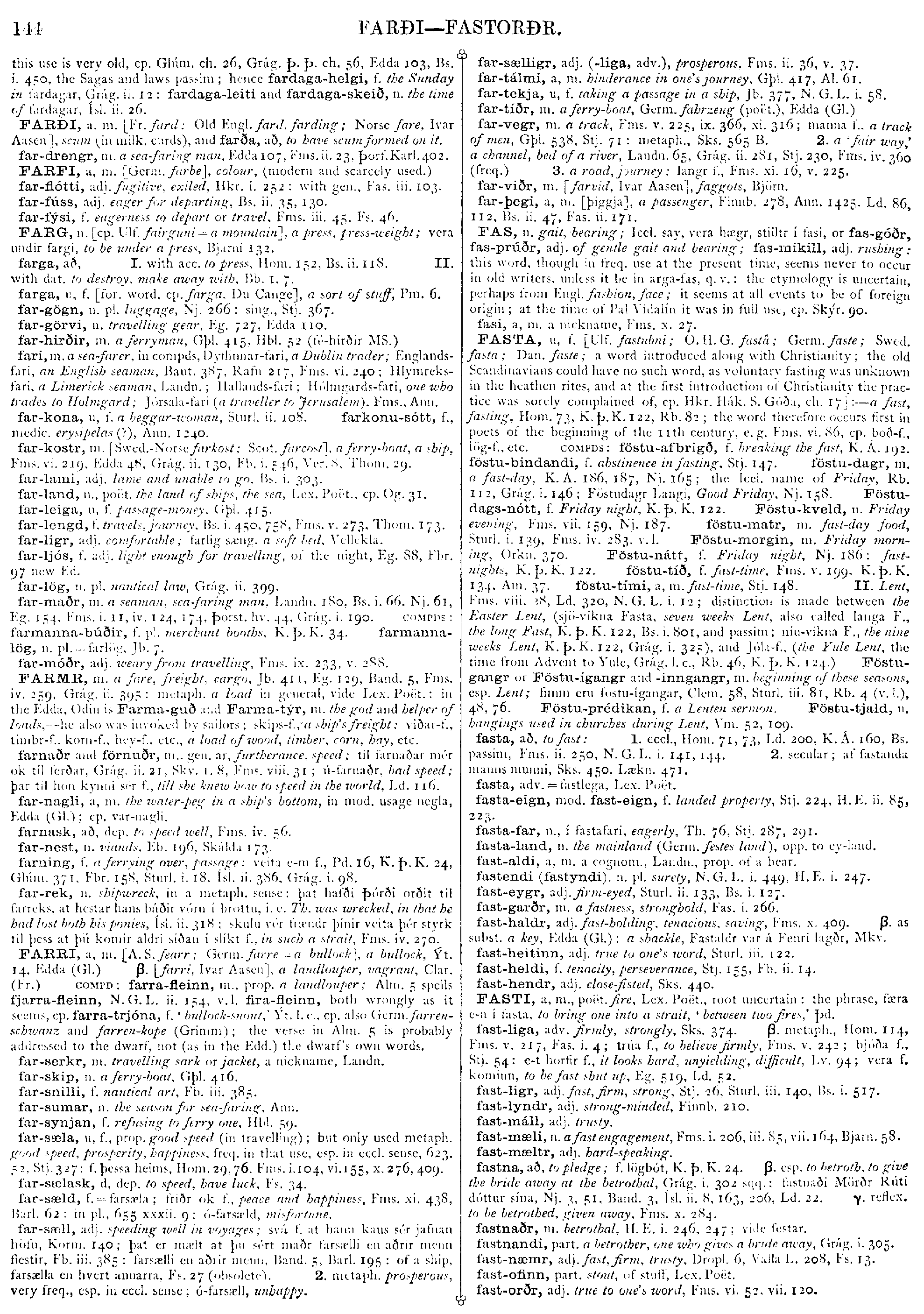
FASTA, u, f. [Ulf. fastubni; O. H. G. fastá; Germ. faste; Swed. fasta; Dan. faste; a word introduced along with Christianity; the old Scandinavians could have no such word, as voluntary fasting was unknown in the heathen rites, and at the first introduction of Christianity the practice was sorely complained of, cp. Hkr. Hák. S. Góða, ch. 17] :-- a fast, fasting, Hom. 73, K. Þ. K. 122, Rb. 82; the word therefore occurs first in poets of the beginning of the 11th century, e.g. Fms. vi. 86, cp. boð-f., lög-f., etc. COMPDS: föstu-afbrigð, f. breaking the fast, K. Á. 192. föstu-bindandi, f. abstinence in fasting, Stj. 147. föstu-dagr, m. a fast-day, K. Á. 186, 187, Nj. 165; the Icel. name of Friday, Rb. 112, Grág. i. 146; Föstudagr Langi, Good Friday, Nj. 158. Föstudags-nótt, f. Friday night, K. Þ. K. 122. Föstu-kveld, n. Friday evening, Fms. vii. 159, Nj. 187. föstu-matr, m. fast-day food, Sturl. i. 139, Fms. iv. 283, v.l. Föstu-morgin, m. Friday morning, Orkn. 370. Föstu-nátt, f. Friday night, Nj. 186: fast-nights, K. Þ. K. 122. föstu-tíð, f. fast-time, Fms. v. 199, K. Þ. K. 134, Am. 37. föstu-tími, a, m. fast-time, Stj. 148. II. Lent, Fms. viii. 28, Ld. 320, N. G. L. i. 12; distinction is made between the Easter Lent, (sjö-vikna Fasta, seven weeks Lent, also called langa F., the long Fast, K. Þ. K. 122, Bs. i. 801, and passim; níu-vikna F., the nine weeks Lent, K. Þ. K. 122, Grág. i. 325), and Jóla-f., (the Yule Lent, the time from Advent to Yule, Grág. l.c., Rb. 46, K. Þ. K. 124.) Föstu-gangr or Föstu-ígangr and -inngangr, m. beginning of these seasons, esp. Lent; fimm eru föstu-ígangar, Clem. 58, Sturl. iii. 81, Rb. 4 (v.l.), 48, 76. Föstu-prédikan, f. a Lenten sermon. Föstu-tjald, n. hangings used in churches during Lent, Vm. 52, 109.
|
Source: Cleasby/Vigfusson, page b0170, entry 1 View original page image as: [TIFF] [PNG] [View previous entry] [View next entry] |
[Comment on this entry] [View comments] |
The following entry has been hand-corrected once. |
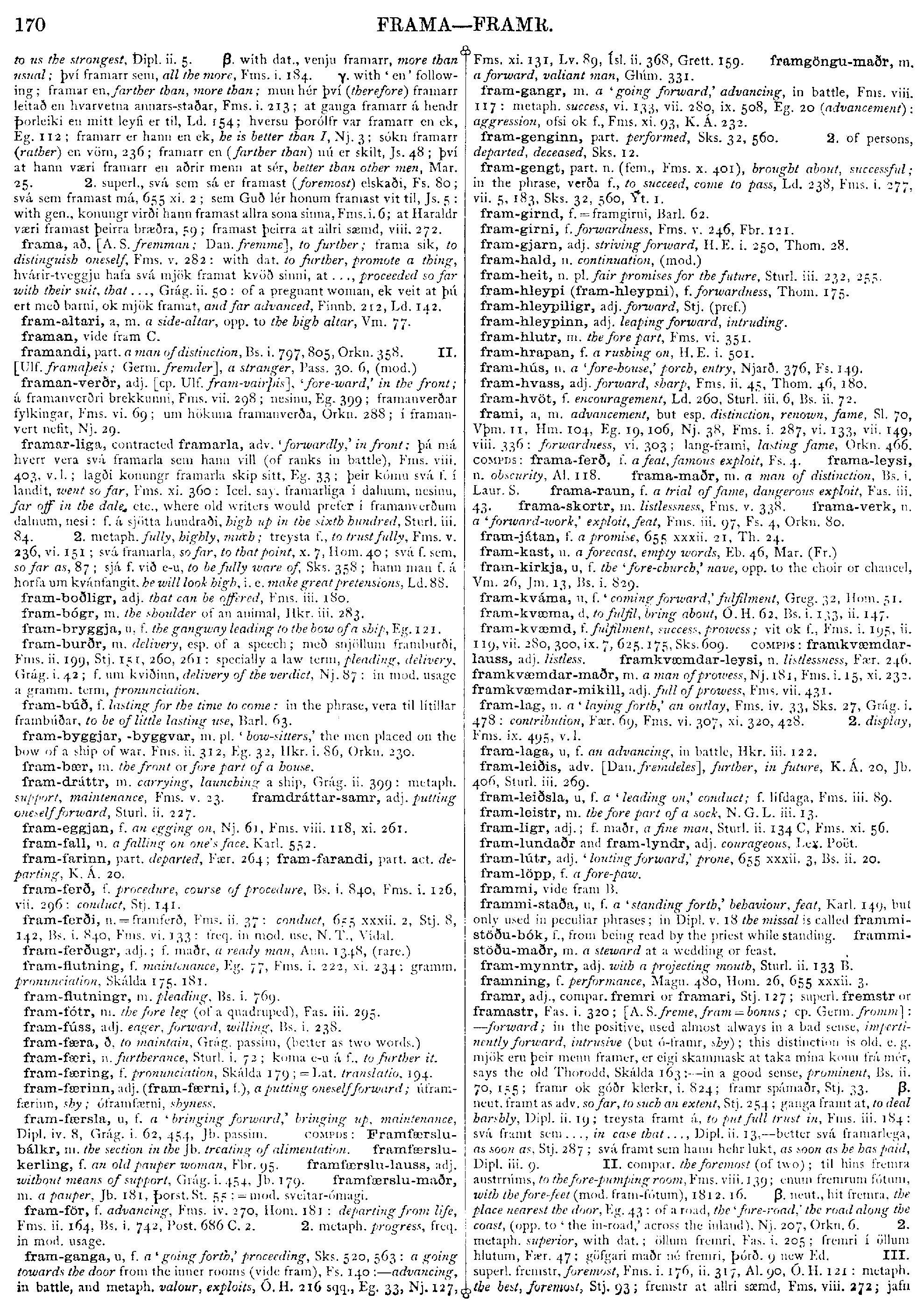
to
us
the
strongest,
Dipl.
ii.
5.
.
with
dat.,
venju
framarr,
more
than
usual;
því
framarr
sem,
all
the
more,
Fms.
i.
184.
 .
with
'en'
following;
framar
en,
farther
than,
more
than;
mun
hér
því
(therefore)
framarr
leitað
en
hvarvetna
annars-staðar,
Fms.
i.
213;
at
ganga
framarr
á
hendr
Þorleiki
en
mitt
leyfi
er
til,
Ld.
154;
hversu
Þorólfr
var
framarr
en
ek,
Eg.
112;
framarr
er
hann
en
ek,
he
is
better
than
I,
Nj.
3;
sókn
framarr
(rather)
en
vörn,
236;
framarr
en
(farther
than)
nú
er
skilt,
Js.
48;
því
at
hann
væri
framarr
en
aðrir
menn
at
sér,
better
than
other
men,
Mar.
25.
2.
superl.,
svá
sem
sá
er
framast
(foremost)
elskaði,
Fs.
80;
svá
sem
framast
má,
655
xi.
2;
sem
Guð
lér
honum
framast
vit
til,
Js.
5:
with
gen.,
konungr
virði
hann
framast
allra
sona
sinna,
Fms.
i.
6;
at
Haraldr
væri
framast
þeirra
bræðra,
59;
framast
þeirra
at
allri
sæmd,
viii.
272.
.
with
'en'
following;
framar
en,
farther
than,
more
than;
mun
hér
því
(therefore)
framarr
leitað
en
hvarvetna
annars-staðar,
Fms.
i.
213;
at
ganga
framarr
á
hendr
Þorleiki
en
mitt
leyfi
er
til,
Ld.
154;
hversu
Þorólfr
var
framarr
en
ek,
Eg.
112;
framarr
er
hann
en
ek,
he
is
better
than
I,
Nj.
3;
sókn
framarr
(rather)
en
vörn,
236;
framarr
en
(farther
than)
nú
er
skilt,
Js.
48;
því
at
hann
væri
framarr
en
aðrir
menn
at
sér,
better
than
other
men,
Mar.
25.
2.
superl.,
svá
sem
sá
er
framast
(foremost)
elskaði,
Fs.
80;
svá
sem
framast
má,
655
xi.
2;
sem
Guð
lér
honum
framast
vit
til,
Js.
5:
with
gen.,
konungr
virði
hann
framast
allra
sona
sinna,
Fms.
i.
6;
at
Haraldr
væri
framast
þeirra
bræðra,
59;
framast
þeirra
at
allri
sæmd,
viii.
272.
|
Source: Cleasby/Vigfusson, page b0174, entry 25 View original page image as: [TIFF] [PNG] [View previous entry] [View next entry] |
[Comment on this entry] [View comments] |
The following entry has been hand-corrected once. |
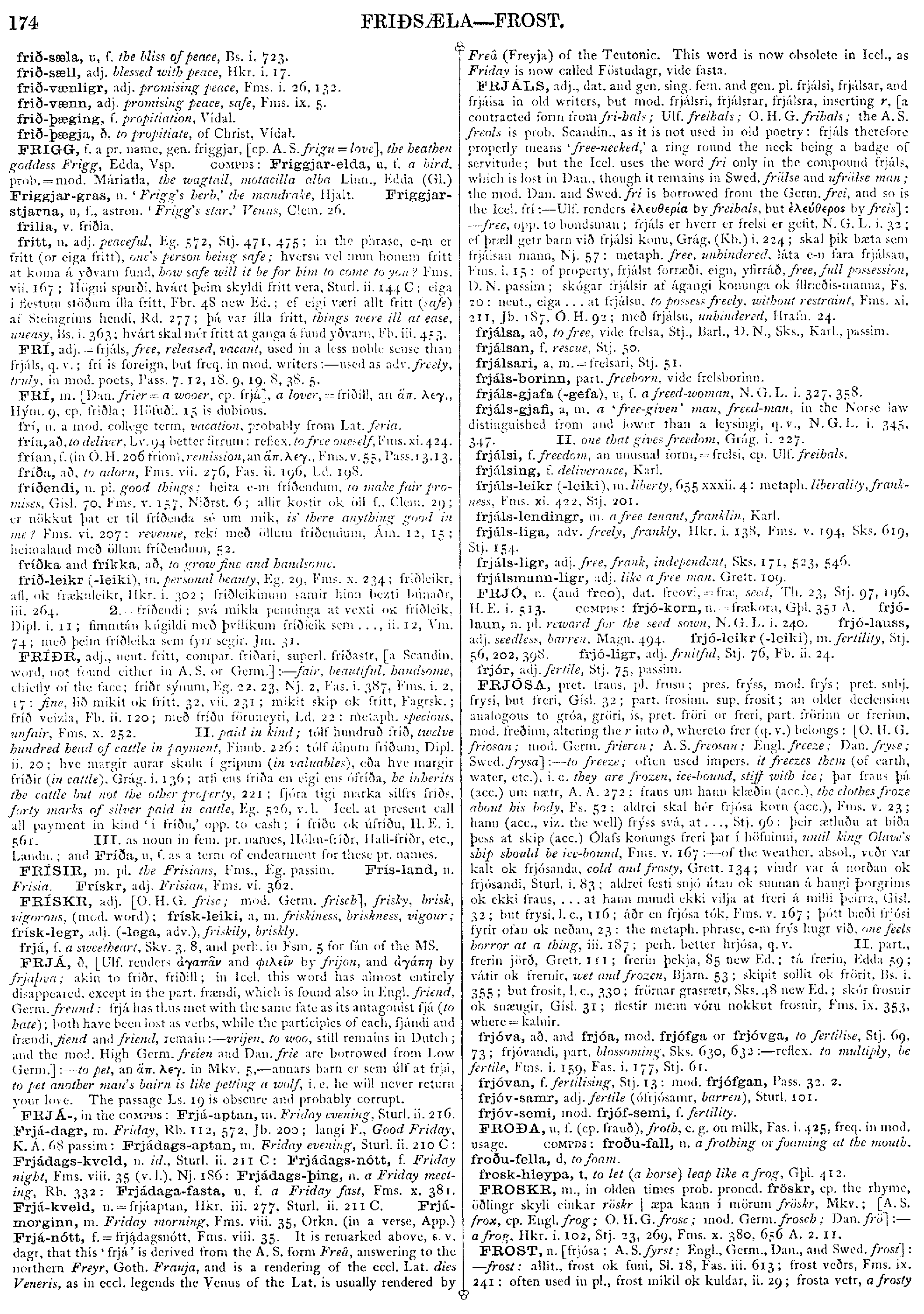
FRJÁLS, adj., dat. and gen. sing. fem. and gen. pl. frjálsi, frjálsar, and frjálsa in old writers, but mod. frjálsri, frjálsrar, frjálsra, inserting r, [a contracted form from fri-hals; Ulf. freihals; O. H. G. frihals; the A. S. freols is prob. Scandin., as it is not used in old poetry: frjáls therefore properly means 'free-necked,' a ring round the neck being a badge of servitude; but the Icel. uses the word fri only in the compound frjáls, which is lost in Dan., though it remains in Swed. frälse and ufrälse man; the mod. Dan. and Swed. fri is borrowed from the Germ. frei, and so is the Icel. frí :-- Ulf. renders GREEK by freihals, but GREEK by freis] :-- free, opp. to bondsman; frjáls er hverr er frelsi er gefit, N. G. L. i. 32; ef þræll getr barn við frjálsi konu, Grág. (Kb.) i. 224; skal þik bæta sem frjálsan mann, Nj. 57: metaph. free, unhindered, láta e-n fara frjálsan, Fms. i. 15: of property, frjálst forræði, eign, yfirráð, free, full possession, D. N. passim; skógar frjálsir af ágangi konunnga ok íllræðis-manna, Fs. 20: neut., eiga ... at frjálsu, to possess freely, without restraint, Fms. xi. 211, Jb. 187, Ó. H. 92; með frjálsu, unhindered, Hrafn. 24.
|
Source: Cleasby/Vigfusson, page b0175, entry 24 View original page image as: [TIFF] [PNG] [View previous entry] [View next entry] |
[Comment on this entry] [View comments] |
The following entry has been hand-corrected once. |
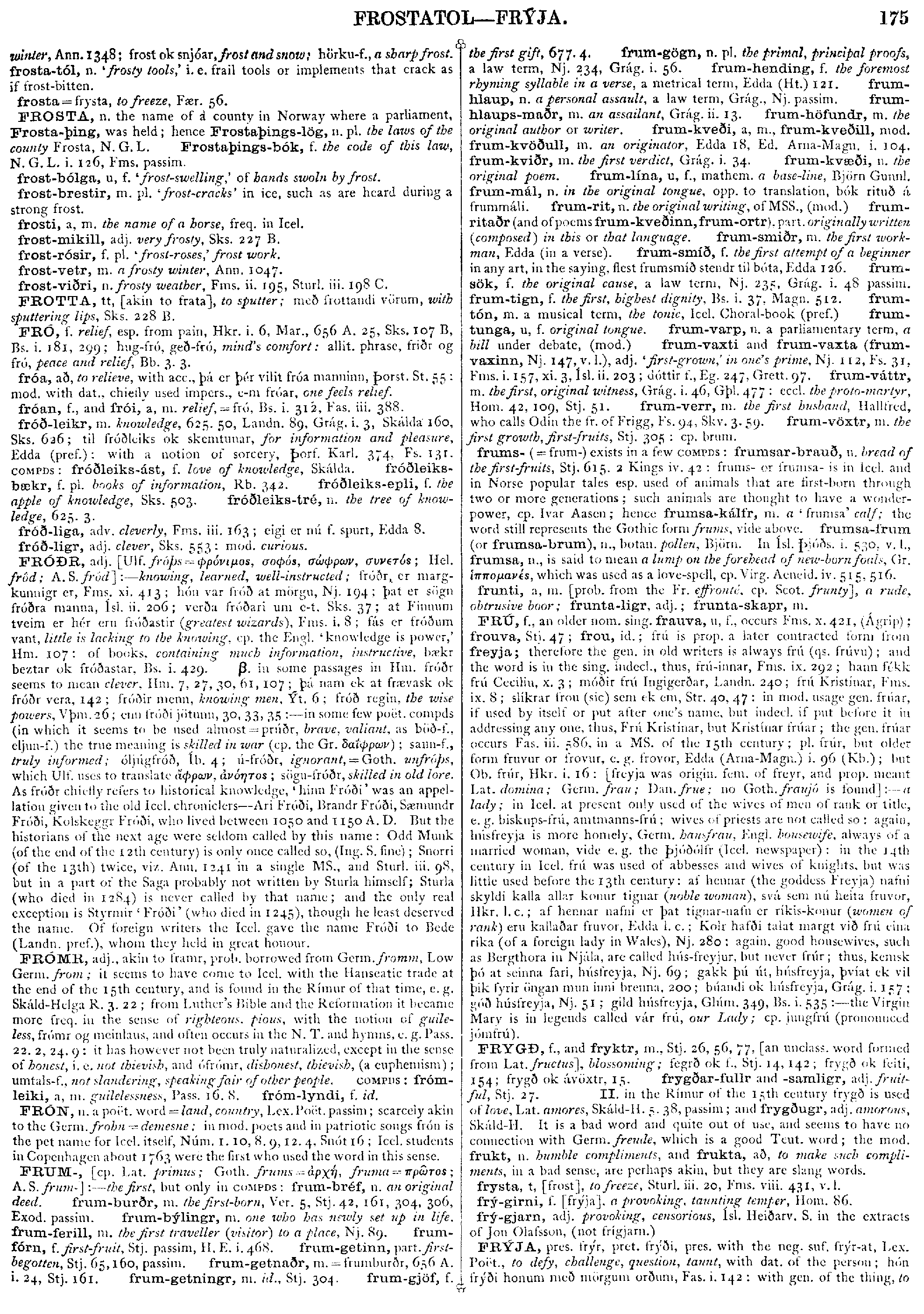
FRÚ, f., an older nom. sing. frauva, u, f., occurs Fms. x. 421, (Ágrip); frouva, Stj. 47; frou, id.; frú is prop. a later contracted form from freyja; therefore the gen. in old writers is always frú (qs. frúvu); and the word is in the sing. indecl., thus, frú-innar, Fms. ix. 292; hann fékk frú Ceciliu, x. 3; móðir frú Ingigerðar, Landn. 240; frú Kristínar, Fms. ix. 8; slíkrar frou (sic) sem ek em, Str. 40, 47: in mod. usage gen. frúar, if used by itself or put after one's name, but indecl. if put before it in addressing any one, thus, Frú Kristínar, but Kristínar frúar; the gen. frúar occurs Fas. iii. 586, in a MS. of the 15th century; pl. frúr, but older form fruvur or frovur, e.g. frovor, Edda (Arna-Magn.) i. 96 (Kb.); but Ob. frúr, Hkr. i. 16: [freyja was origin. fem. of freyr, and prop. meant Lat. domina; Germ. frau; Dan. frue; no Goth. fraujô is found] :-- a lady; in Icel. at present only used of the wives of men of rank or title, e.g. biskups-frú, amtmanns-frú; wives of priests are not called so: again, húsfreyja is more homely, Germ. hausfrau, Engl. housewife, always of a married woman, vide e.g. the Þjóðólfr (Icel. newspaper): in the 14th century in Icel. frú was used of abbesses and wives of knights, but was little used before the 13th century: af hennar (the goddess Freyja) nafni skyldi kalla allar konur tignar (noble woman), svá sem nú heita fruvor, Hkr. l.c.; af hennar nafni er þat tignar-nafn er ríkis-konur (women of rank) eru kallaðar fruvor, Edda l.c.; Kolr hafði talat margt við frú eina ríka (of a foreign lady in Wales), Nj. 280: again, good housewives, such as Bergthora in Njála, are called hús-freyjur, but never frúr; thus, kemsk þó at seinna fari, húsfreyja, Nj. 69; gakk þú út, húsfreyja, þvíat ek vil þik fyrir öngan mun inni brenna, 200; búandi ok húsfreyja, Grág. i. 157; góð húsfreyja, Nj. 51; gild húsfreyja, Glúm. 349, Bs. i. 535 :-- the Virgin Mary is in legends called vár frú, our Lady; cp. jungfrú (pronounced jómfrú).
|
Source: Cleasby/Vigfusson, page b0176, entry 8 View original page image as: [TIFF] [PNG] [View previous entry] [View next entry] |
[Comment on this entry] [View comments] |
The following entry has been hand-corrected once. |
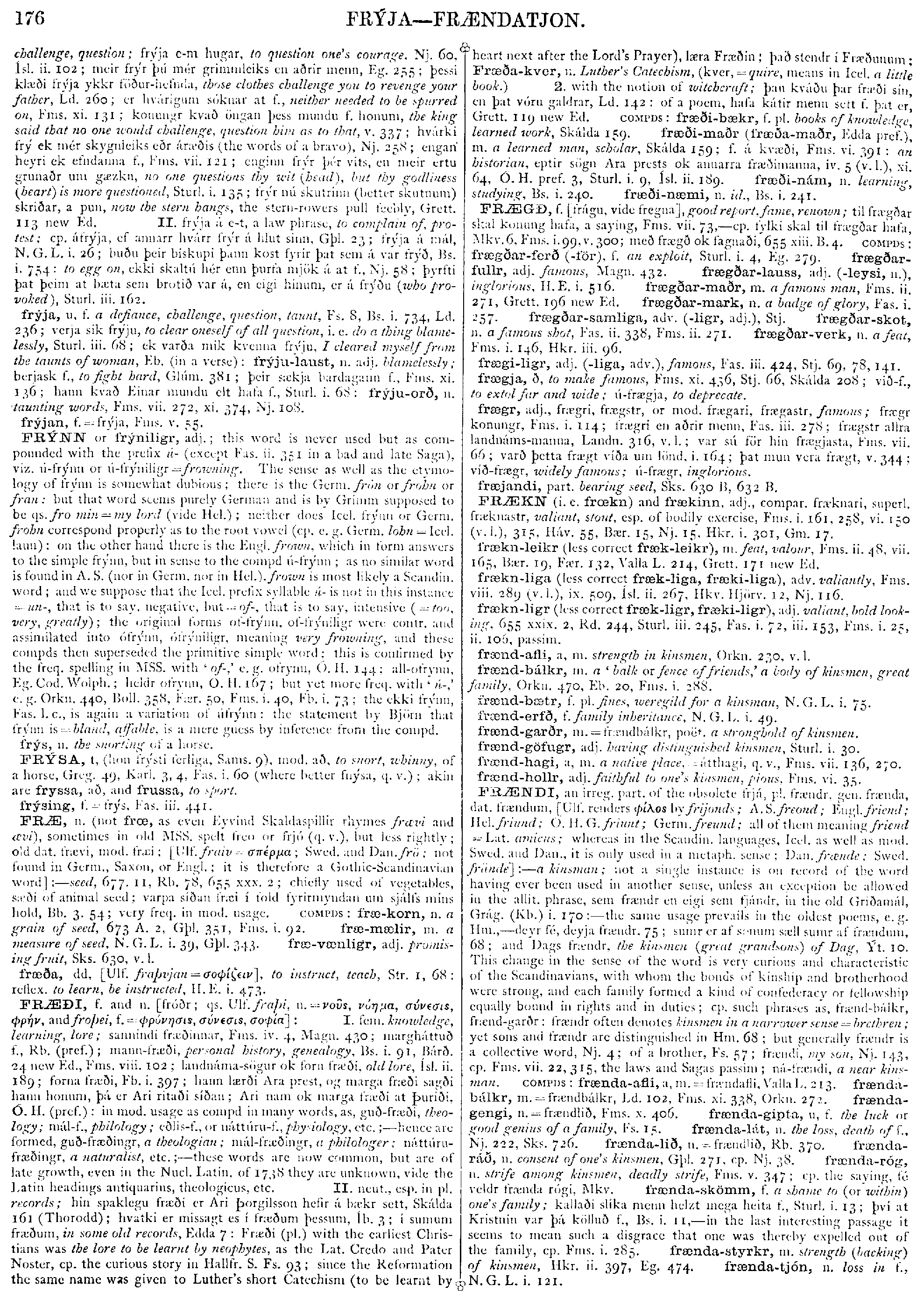
FRÆ, n. (not frœ, as even Eyvind Skaldaspillir rhymes frævi and ævi), sometimes in old MSS. spelt freo or frjó (q.v.), but less rightly; old dat. frævi, mod. fræi; [Ulf. fraiv = GREEK; Swed. and Dan. frö; not found in Germ., Saxon, or Engl.; it is therefore a Gothic-Scandinavian word] :-- seed, 677. 11, Rb. 78, 655 xxx. 2; chiefly used of vegetables, sæði of animal seed; varpa síðan fræi í fold fyrirmyndan um sjálfs míns hold, Bb. 3. 54; very freq. in mod. usage. COMPDS: fræ-korn, n. a grain of seed, 673 A. 2, Gþl. 351, Fms. i. 92. fræ-mælir, m. a measure of seed, N.G. L. i. 39, Gþl. 343. fræ-vænligr, adj. promising fruit, Sks. 630, v.l.
|
Source: Cleasby/Vigfusson, page b0199, entry 15 View original page image as: [TIFF] [PNG] [View previous entry] [View next entry] |
[Comment on this entry] [View comments] |
The following entry has not been hand-corrected. However, the page is reserved and someone is correcting it. |
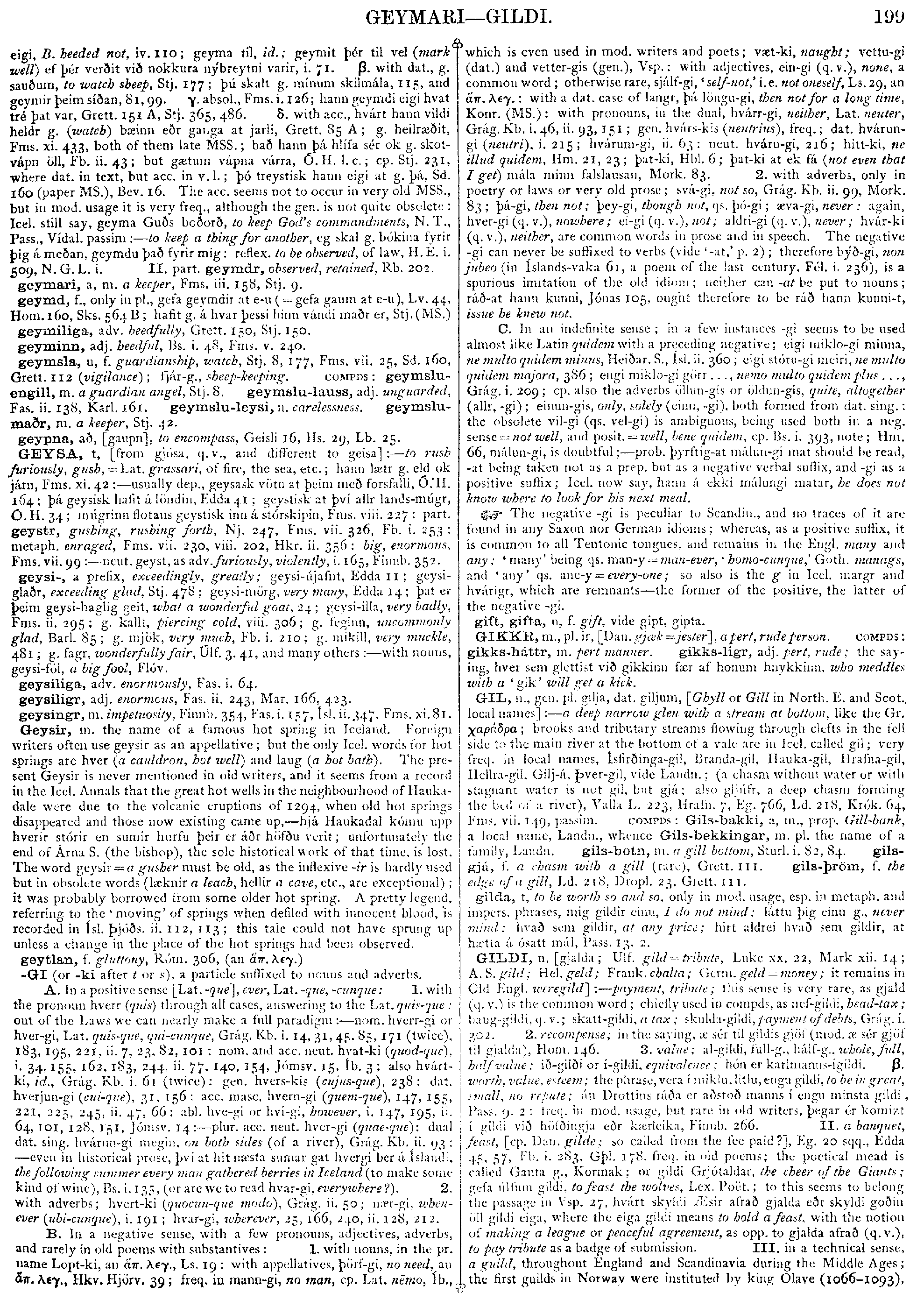
-GI (or -ki after i or s), a particle suffixed to nouns and adverbs. A. In a positive sense [Lat. -que] , ever, Lat. -que, -cimqite: 1. with the pronoun hverr (quis) through all cases, answering to the Lat. qnis-quc: out of the Laws we can nearly make a full paradigm :-- noin. hverr-gi or hver-gi, Lat. qids-que, qui-cunque, Grág. Kb. i. 14, 31, 45, 85, 171 (twice), 183, 195, 221, ii. 7, 23, 82, ioi: nom. and acc. neut. hvat-ki (quod-quc). i. 34, 155, 162, 183, 244, ii. 77, 140, 154, Jómsv. 15, Ib. 3; also hvurt- ki, id., Grág. Kb. i. 61 (twice): gen. hvers-kis (cujits-que), 238: dat. hverjun-gi (ctti-que), 31, 156: acc. inasc. hvern-gi (quem-que), 147, 155, 221, 22=;, 245, ii. 47, 66: abl. hve-gi or hvi-gi, however, . 147, 195, ii. 64, ioi, 128, 151, joinsv. 14 :-- plur. acc. neut. hver-gi (quae-que): dual dat. sing, hvarnn-gi megin, on both sides (of a river), Grug. Kb. ii. 93: -- even in historical prose, því at hit næsta surnar gat hvergi ber á íslaiuii, the following:. ummer every nian gathered berries in Iceland (to make some kind ot wine), Bs. 1. 135, (or are we to read hvar-gi, everywhere ?). 2. with adverbs; hvert-ki (quociin-que modo), Grág. ii. 50; nivr-gi. when- ever (ubi-cunyue), i. 191; hvar-gi, wherever, 25, 166, 240, ii. 128, 212. B. In a negative sense, with a few pronouns, adjectives, adverbs, and rarely in old poems with substantives: 1. witli nouns, in the pr. name Lopt-ki, an air. Aey., Ls. 19: with appellatives, þürf-gi, no need, an arr. ey., Hkv. Hjörv. 39; freq. in mann-gi, no man, cp. Lat. nêmo, íb. (which is even used in mod. writers and poets; væt-ki, naught; vettu-gi (dat.) and vettcr-gis (gen.), Vsp.: with adjectives, ein-gi (q. v.), none, a common word; otherwise rare, sjálf-gi, 'self-not, ' i. e. not oneself, Ls. 29, an air. fy.: with a dat. case of langr, þá löngu-gi, then not for a long time, Konr. (MS.): with pronouns, in the dual, hvarr-gi, neither, Lat. neuter, Grág. Kb. i. 46, ii. 93, 151; gen. hvárs-kis (netitrius), freq.; dat. hvarun- gi (jieulri), i. 215; hvarum-gi, ii. 63: neut. hvaru-gi, 216; hitt-ki, ne illud quidem. Urn. 21, 23; þat-ki, Hbl. 6; þat-ki at ek fá (not even that I get) mala minu falslausan, Mork. 83. 2. with adverbs, only in poetry or laws or very old prose; sva-gi. not so, Grág. Kb. ii. 99, Mork. 83; þá-gi, then not; þey-gi, though not, qs. þó-gi; æva-gi, never: again, hver-gi (q. v.), nowhere; ei-gi (q. v.), not; aldri-gi (q. v.), never; hvar-ki (q. v.), neither, are common words in prose and in speech. The negative -gi can never be suffixed to verbs (vide '-at, ' p. 2); therefore býð-gi, non jubeo (in Islands-vaka 61, a poem of the last century. Fél. i. 236), is a spurious imitation of the old idiom; neither can -at be put to nouns; ráð-at hann kuiini, Jónas 105, ought therefore to be ráð hann kunni-t, issue be knew not. C. In an indefinite sense; in a few instances -gi seems to be used almost like Latin quidem with a preceding negative: eigi miklo-gi miuiia, ne multo quidem minus, Ileiðar. S., Ísl. ii. 360; eigi storu-gi meiri, ne multo quidem majora, 386; engi miklo-gi görr... . nemo multo quidem plus ..., Grág. i. 209; cp. also the adverbs iillun-gis or oldun-gis, quite, altogether (allr, -gi); einun-gis, only, solely (einn, -gi). both formed from dat. sing.: the obsolete vil-gi (qs. vel-gi) is ambiguous, being used both in a nt-g. sense -- -not well, and posit. =-well, bene quidem, cp. Bs. i. 393, note; Hrn. 66, malun-gi, is doubtful; -- prob. þyrftig-at múlun-gi mat should be read, -at being taken not as a prep, but as a negative verbal suffix, and -gi as a positive suffix; Icel. now say, hann á ekki málungi matar, he does not know where to look for his next meal. igsf The negative -gi is peculiar to Scandin., and no traces of it are found in any Saxon nor German idioms; whereas, as a positive suffix, it is common to all Teutonic tongues, and remains in the Engl. many and any; ' many' being qs. man-y -- man-ever, ' homo-cunque, ' Goth, tnanags, and 'any' qs. ane-y = every-one; so also is the cf;' in Icel. margr and hvárigr, which are remnants -- the former of the positive, the latter of the negative -gi.
|
Source: Cleasby/Vigfusson, page b0213, entry 19 View original page image as: [TIFF] [PNG] [View previous entry] [View next entry] |
[Comment on this entry] [View comments] |
The following entry has not been hand-corrected. However, the page is reserved and someone is correcting it. |
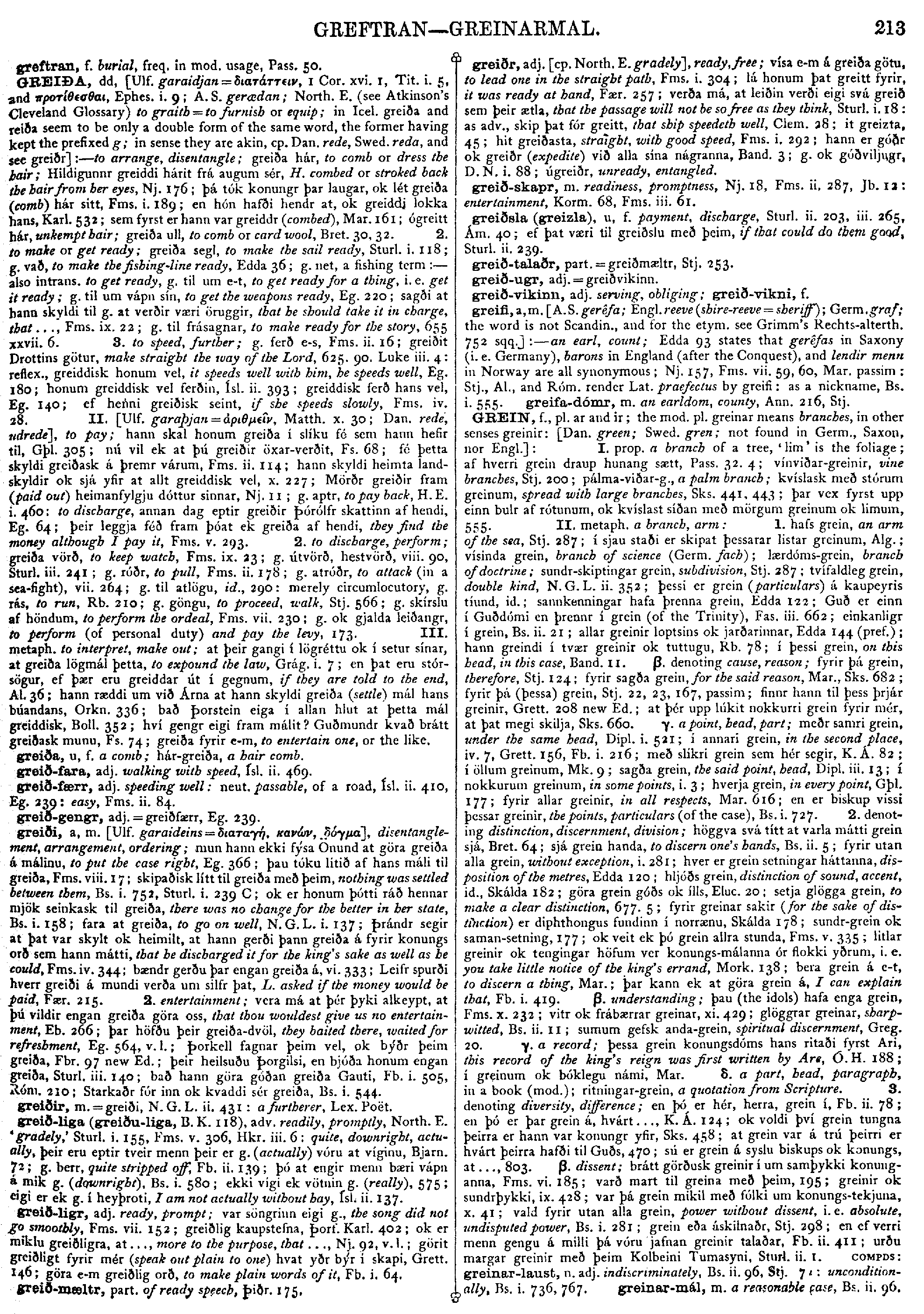
GREIN, f., pl. ar and ir; the mod. pl. greinar means branches, in other senses greinir: [Dan. green; Swed. gren; not found in Germ., Saxon, nor Engl.]: I. prop, a branch of a tree, 'lim' is the foliage; af hverri grein draup hunang sætt, Pass. 32. 4; vínviðar-greinir, vine branches, Stj, 200; pálma-viðar-g., a palm branch; kvíslask með stórum greinum, spread with large branches, Sks. 441, 443; þar vex fyrst upp einn bulr af rotunum, ok kvíslast síðan með mörgum greinum ok limum, 555. II. metaph. a branch, arm: 1. hafs grein, an arm of the sea, Stj. 287; í sjau staöi er skipat þessarar listar greinum, Alg.; visinda grein, branch of science (Germ, fach); lærdóms-grein, branch of doctrine; sundr-skiptingar grein, subdivision, Stj. 287; tvifaldleg grein, double kind, N. G. L. ii. 352; þessi er grein (particulars) á kaupeyris tiund, id.; sannkenningar hafa þrenna grein, Edda 122; Guð er einn í Guðdómi en þrennr í grein (of the Trinity), Fas. iii. 662; einkanligr i grein, Bs. ii. 21; allar greinir loptsins ok jarðarinnar, Edda 144 (pref.); hann greindi í tvær greinir ok tuttugu, Rb. 78; í þessi grein, o n thi s head, in thi s cas e, Band. 11. p. denoting cause, reason; fyrir þá grein, therefore, Stj. 124; fyrir sagða grein, for the said reason, Mar., Sks. 682; fyrir þá (þessa) grein, Stj. 22, 23, 167, passim; finnr hann til þess þrjár greinir, Grett. 208 new Ed.; at þér upp lúkit nokkurri grein fyrir mer, at þat megi skilja, Sks. 660. y. a point, bead, part; meðr samri grein, under the same head, Dipl. i. 521; í annari grein, in the second place, iv. 7, Grett. 156, Fb. i. 216; með slíkri grein sem her segir, K. Á. 82; í öllum greinum, Mk. 9; sagða grein, the said point, bead, Dipl. iii. 13; i nokkurum greinum, in some points, i. 3; hverja grein, in every point, Gþl. 177; fyrir allar greinir, in all respects, Mar. 616; en er biskup vissi þessar greinir, the points, particulars (of the case), Bs. i. 727- 2. denot- ing distinction, discernment, division; höggva svá títt at varla mátti grein sja, Bret. 64; sjá grein handa, to discern one's hands, Bs. ii. 5; fyrir utan alla grein, without exception, i. 281; hver er grein setningar háttanna, dis- posi t ion of the metres, Edda 120; hljóðs grein, distinction of sound, accent, id., Skálda 182; göra grein góðs ok ills, Eluc. 20; setja glögga grein, t o make a clear distinction, 677. 5; fyrir greinar sakir (for the sake ofdis- tïhction) er diphthongus fundinn í norraenu, Skálda 178; sundr-grein ok saman-setning, 177; ok veil ek þó grein allra stunda, Fms. v. 335; litlar greinir ok tengingar höfum ver konungs-málanna ór flokki yðrum, i. e. you take little notice of the king's errand, Mork. 138; bera grein á e-t, to discern a thing, Mar.; þar kann ek at göra grein á, I can explain that, Fb. i. 419. P. understanding; þau (the idols) hafa enga grein, Fms. x. 232; vitr ok frábærrar greinar, xi. 429; glöggrar greinar, sharp- witted, Bs. ii. II; sumum gefsk anda-grein, spiritual discernment, Greg. 20. Y- a record; þessa grein konungsdóms hans ritaði fyrst Ari, thi s record of the king's reign was first written by Are, Ó. H. 188; i greinum ok bóklegu námi, Mar. 8. a part, bead, paragraph, in a book (mod.); ritningar-grein, a quotation from Scripture. 3. denoting diversity, difference; en þó er her, herra, grein i, Fb. ii. 78; en þó er þar grein á, hvárt..., K. Á. 124; ok voldi því grein tungna þeirra er hann var konungr yfir, Sks. 458; at grein var á trú þeirri er hvárt þeirra hafði til Guðs, 470; sú er grein á syslu biskups ok konungs, at..., 803. P. dissent; brátt görðusk greinir í um samþykki konuug- anna, Fms. vi. 185; varð mart til greina með þeim, 195; greinir ok sundrþykki, ix. 428; var þá grein mikil með fólki um konungs-tekjuna, x. 41; vald fyrir utan alla grein, power without dissent, i. e. absolute, undisputed power, Bs. i. 281; grein eða áskilnaðr, Stj. 298; en ef verri menn gengu á milli þá vóru jafnan greinir talaðar, Fb. ii. 411; urðu margar greinir með þeim Kolbeini Tumasyni, Sturl. ii. I. COMPOS: greinar-laust, n. adj. indiscriminately, Bs. ii. 96, Stj. 7 * '• uncondition- ally, Bs. i. 736, 767. greinar-mal, m. a reasonable case, Bs. ii.
|
Source: Cleasby/Vigfusson, page b0226, entry 16 View original page image as: [TIFF] [PNG] [View previous entry] [View next entry] |
[Comment on this entry] [View comments] |
The following entry has been hand-corrected once. |
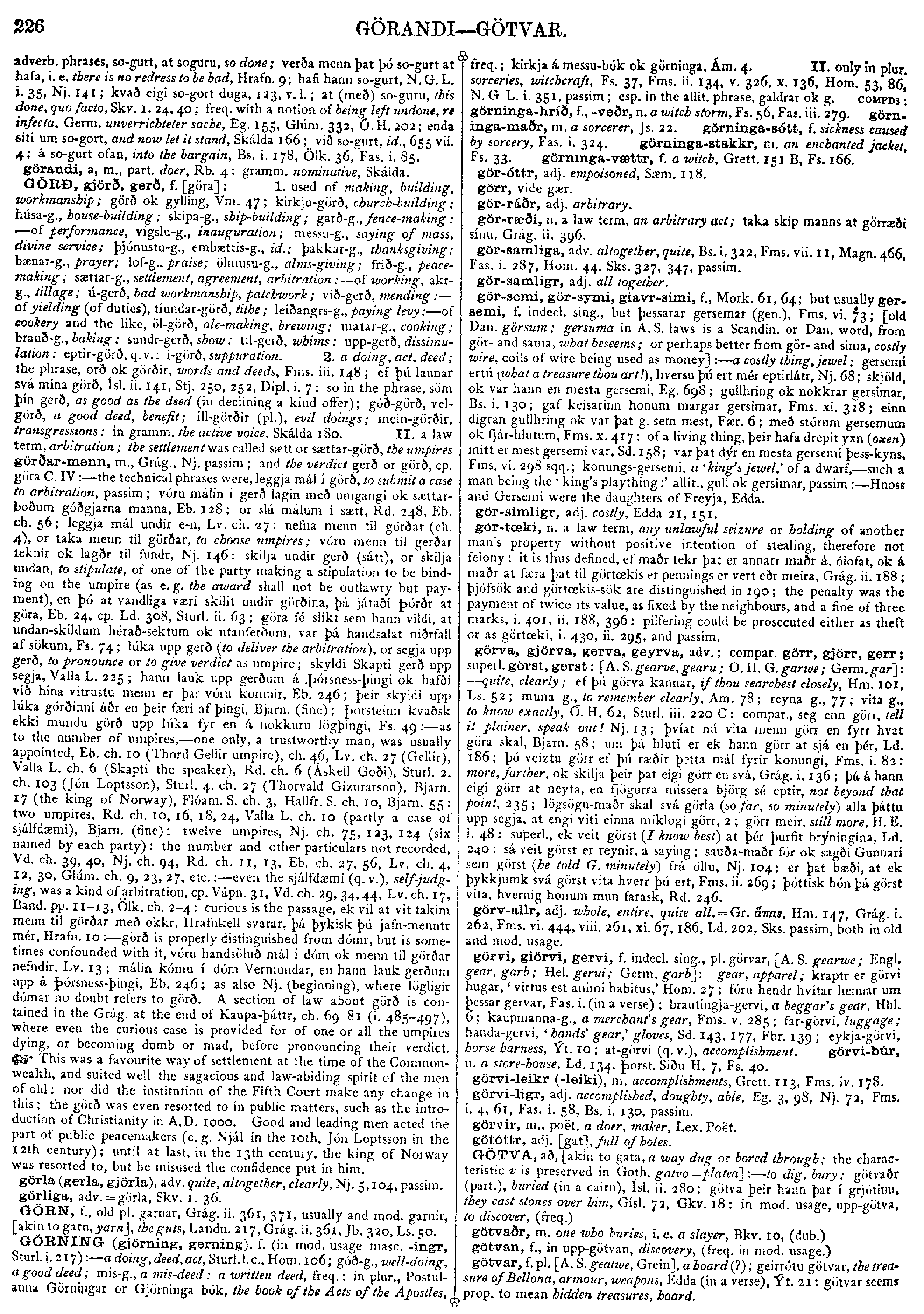
gör-tœki, n. a law term, any unlawful seizure or holding of another man's property without positive intention of stealing, therefore not felony: it is thus defined, ef maðr tekr þat er annarr maðr á, ólofat, ok á maðr at færa þat til görtœkis er pennings er vert eðr meira, Grág. ii. 188; þjófsök and görtœkis-sök are distinguished in 190; the penalty was the payment of twice its value, as fixed by the neighbours, and a fine of three marks, i. 401, ii. 188, 396: pilfering could be prosecuted either as theft or as görtœki, i. 430, ii. 295, and passim.
| Result Page: |  |
Previous | 1 2 3 4 5 6 7 8 9 10 11 12 13 14 15 16 17 18 | Next |  |
Germanic Lexicon Project (main page)
This search system was written by
Sean Crist
Please consider
volunteering
to correct the data in these online dictionaries.
No rights reserved. Feel free to use these data in any way you please.