|
|

þen (35 results)
ðen (6 results)
Search for then again, using less strict matching (1205 results)
|
Source: Cleasby/Vigfusson, page b0223, entry 38 View original page image as: [TIFF] [PNG] [View previous entry] [View next entry] |
[Comment on this entry] [View comments (1)] |
The following entry has been hand-corrected once. |
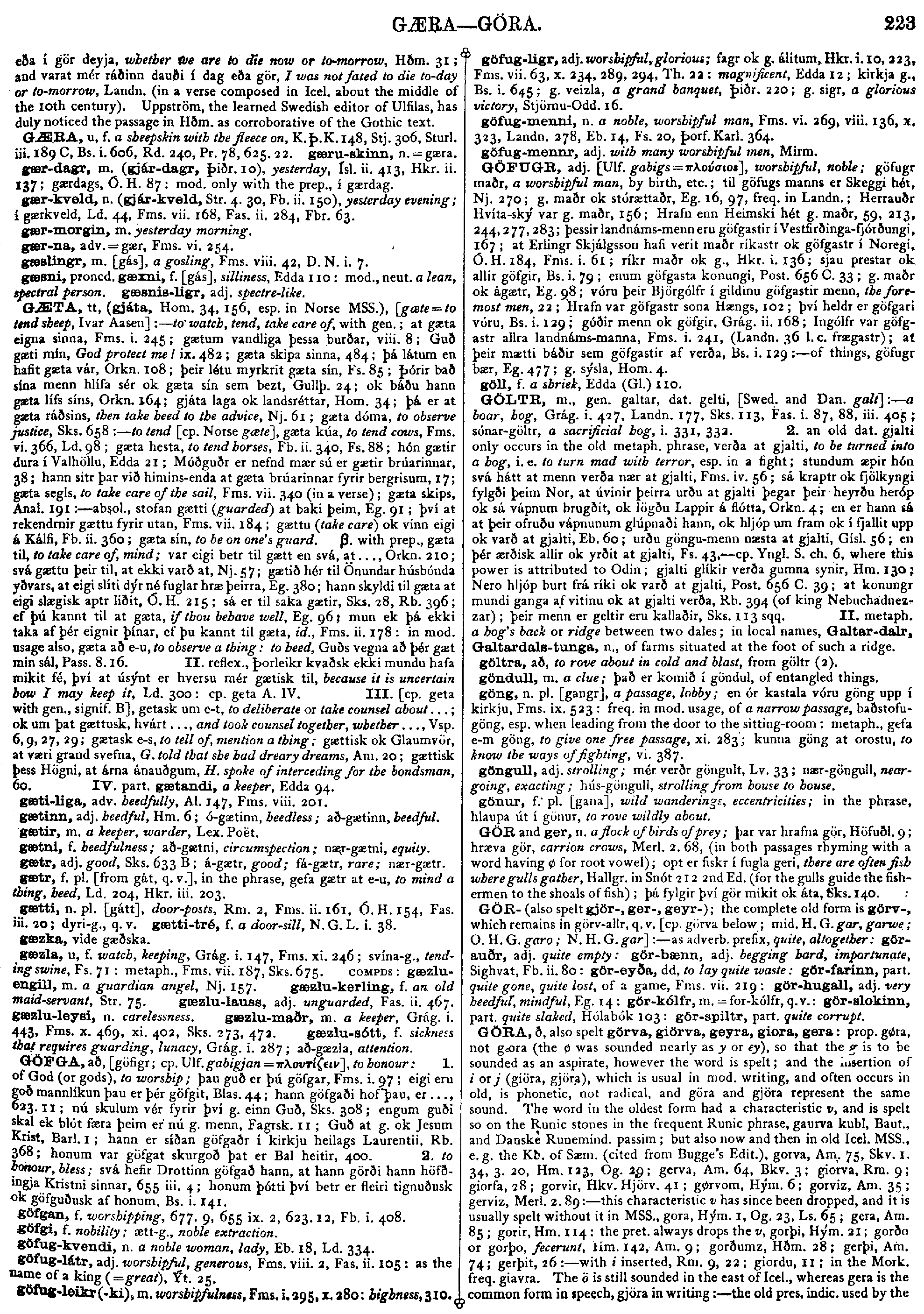
GÖRA,
ð,
also
spelt
görva,
giörva,
geyra,
giora,
gera:
prop.
gøra,
not
g ra
(the
ø
was
sounded
nearly
as
y
or
ey),
so
that
the
g
is
to
be
sounded
as
an
aspirate,
however
the
word
is
spelt;
and
the
insertion
of
i
or
j
(giöra,
gjöra),
which
is
usual
in
mod.
writing,
and
often
occurs
in
old,
is
phonetic,
not
radical,
and
göra
and
gjöra
represent
the
same
sound.
The
word
in
the
oldest
form
had
a
characteristic
v,
and
is
spelt
so
on
the
Runic
stones
in
the
frequent
Runic
phrase,
gaurva
kubl,
Baut.,
and
Danske
Runemind.
passim;
but
also
now
and
then
in
old
Icel.
MSS.,
e.g.
the
Kb.
of
Sæm.
(cited
from
Bugge's
Edit.),
gorva,
Am.
75,
Skv.
1.
34,
3.
20,
Hm.
123,
Og.
29;
gerva,
Am.
64,
Bkv.
3;
giorva,
Rm.
9;
giorfa,
28;
gorvir,
Hkv.
Hjörv.
41;
gørvom,
Hým.
6;
gorviz,
Am.
35;
gerviz,
Merl.
2.
89
:--
this
characteristic
v
has
since
been
dropped,
and
it
is
usually
spelt
without
it
in
MSS.,
gora,
Hým.
1,
Og.
23,
Ls.
65;
gera,
Am.
85;
gorir,
Hm.
114:
the
pret.
always
drops
the
v,
gorþi,
Hym.
21;
gorðo
or
gorþo,
fecerunt,
Hm.
142,
Am.
9;
gorðumz,
Hðm.
28;
gerþi,
Am.
74;
gerþit,
26
:--
with
i
inserted,
Rm.
9,
22;
giordu,
11;
in
the
Mork.
freq.
giavra.
The
ö
is
still
sounded
in
the
east
of
Icel.,
whereas
gera
is
the
common
form
in
speech,
gjöra
in
writing
:--
the
old
pres.
indic.
used
by
the
ra
(the
ø
was
sounded
nearly
as
y
or
ey),
so
that
the
g
is
to
be
sounded
as
an
aspirate,
however
the
word
is
spelt;
and
the
insertion
of
i
or
j
(giöra,
gjöra),
which
is
usual
in
mod.
writing,
and
often
occurs
in
old,
is
phonetic,
not
radical,
and
göra
and
gjöra
represent
the
same
sound.
The
word
in
the
oldest
form
had
a
characteristic
v,
and
is
spelt
so
on
the
Runic
stones
in
the
frequent
Runic
phrase,
gaurva
kubl,
Baut.,
and
Danske
Runemind.
passim;
but
also
now
and
then
in
old
Icel.
MSS.,
e.g.
the
Kb.
of
Sæm.
(cited
from
Bugge's
Edit.),
gorva,
Am.
75,
Skv.
1.
34,
3.
20,
Hm.
123,
Og.
29;
gerva,
Am.
64,
Bkv.
3;
giorva,
Rm.
9;
giorfa,
28;
gorvir,
Hkv.
Hjörv.
41;
gørvom,
Hým.
6;
gorviz,
Am.
35;
gerviz,
Merl.
2.
89
:--
this
characteristic
v
has
since
been
dropped,
and
it
is
usually
spelt
without
it
in
MSS.,
gora,
Hým.
1,
Og.
23,
Ls.
65;
gera,
Am.
85;
gorir,
Hm.
114:
the
pret.
always
drops
the
v,
gorþi,
Hym.
21;
gorðo
or
gorþo,
fecerunt,
Hm.
142,
Am.
9;
gorðumz,
Hðm.
28;
gerþi,
Am.
74;
gerþit,
26
:--
with
i
inserted,
Rm.
9,
22;
giordu,
11;
in
the
Mork.
freq.
giavra.
The
ö
is
still
sounded
in
the
east
of
Icel.,
whereas
gera
is
the
common
form
in
speech,
gjöra
in
writing
:--
the
old
pres.
indic.
used
by
the
|
Source: Cleasby/Vigfusson, page b0225, entry 3 View original page image as: [TIFF] [PNG] [View previous entry] [View next entry] |
[Comment on this entry] [View comments] |
The following entry has been hand-corrected once. |
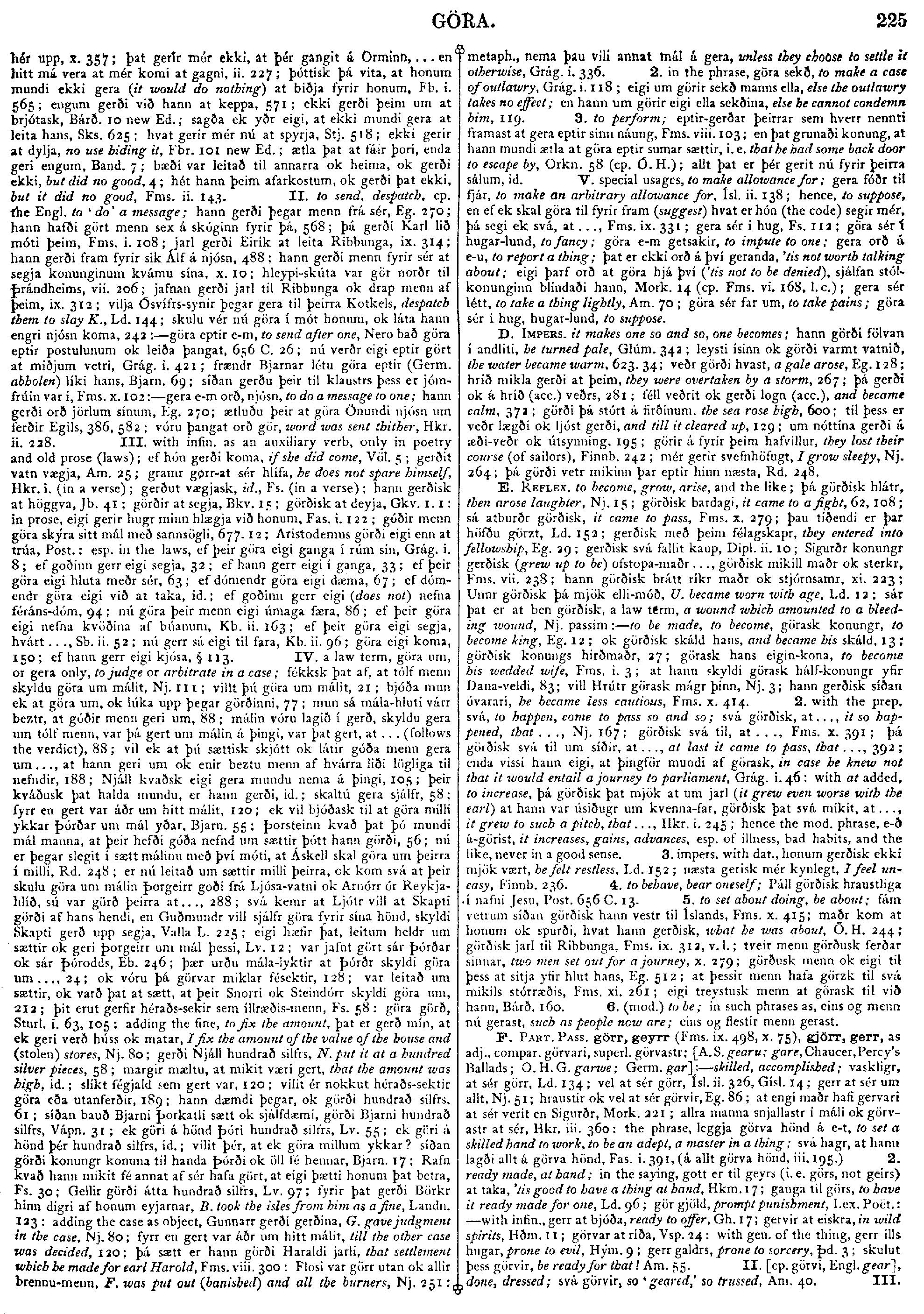
E. REFLEX, to become, grow, arise, and the like; þá görðisk hlátr, then arose laughter, Nj. 15; görðisk bardagi, it came to a fight, 62, 108; sá atburðr görðisk, it came to pass, Fms. x. 279; þau tíðendi er þar höfðu görzt, Ld. 152; gerðisk með þeim félagskapr, they entered into fellowship, Eg. 29; gerðisk svá fallit kaup, Dipl. ii. 10; Sigurðr konungr gerðisk (grew up to be) ofstopa-maðr ..., görðisk mikill maðr ok sterkr, Fms. vii. 238; hann görðisk brátt ríkr maðr ok stjórnsamr, xi. 223; Unnr görðisk þá mjök elli-móð, U. became worn with age, Ld. 12; sár þat er at ben görðisk, a law term, a wound which amounted to a bleeding wound, Nj. passim :-- to be made, to become, görask konungr, to become king, Eg. 12; ok görðisk skáld hans, and became his skáld, 13; görðisk konungs hirðmaðr, 27; görask hans eigin-kona, to become his wedded wife, Fms. i. 3; at hann skyldi görask hálf-konungr yfir Dana-veldi, 83; vill Hrútr görask mágr þinn, Nj. 3; hann gerðisk síðan óvarari, he became less cautious, Fms. x. 414. 2. with the prep. svá, to happen, come to pass so and so; svá görðisk, at ..., it so happened, that ..., Nj. 167; görðisk svá til, at ..., Fms. x. 391; þá görðisk svá til um síðir, at..., at last it came to pass. that ..., 392; enda vissi hann eigi, at þingför mundi af görask, in case he knew not that it would entail a journey to parliament, Grág. i. 46: with at added, to increase, þá görðisk þat mjök at um jarl (it grew even worse with the earl) at hann var úsiðugr um kvenna-far, görðisk þat svá mikit, at ..., it grew to such a pitch, that ..., Hkr. i. 245; hence the mod. phrase, e-ð á-görist, it increases, gains, advances, esp. of illness, bad habits, and the like, never in a good sense. 3. impers. with dat., honum gerðisk ekki mjök vært, he felt restless, Ld. 152; næsta gerisk mér kynlegt, I feel uneasy, Finnb. 236. 4. to behave, bear oneself; Páll görðisk hraustliga í nafni Jesu, Post. 656 C. 13. 5. to set about doing, be about; fám vetrum síðan görðisk hann vestr til Íslands, Fms. x. 415; maðr kom at honum ok spurði, hvat hann gerðisk, what he was about, Ó. H. 244; görðisk jarl til Ribbunga, Fms. ix. 312, v. l.; tveir menn görðusk ferðar sinnar, two men set out for a journey, x. 279; görðusk menn ok eigi til þess at sitja yfir hlut hans, Eg. 512; at þessir menn hafa görzk til svá mikils stórræðis, Fms. xi. 261; eigi treystusk menn at görask til við hann, Bárð. 160. 6. (mod.) to be; in such phrases as, eins og menn nú gerast, such as people now are; eins og flestir menn gerast.
|
Source: Cleasby/Vigfusson, page b0227, entry 1 View original page image as: [TIFF] [PNG] [View previous entry] [View next entry] |
[Comment on this entry] [View comments] |
The following entry has been hand-corrected once. |
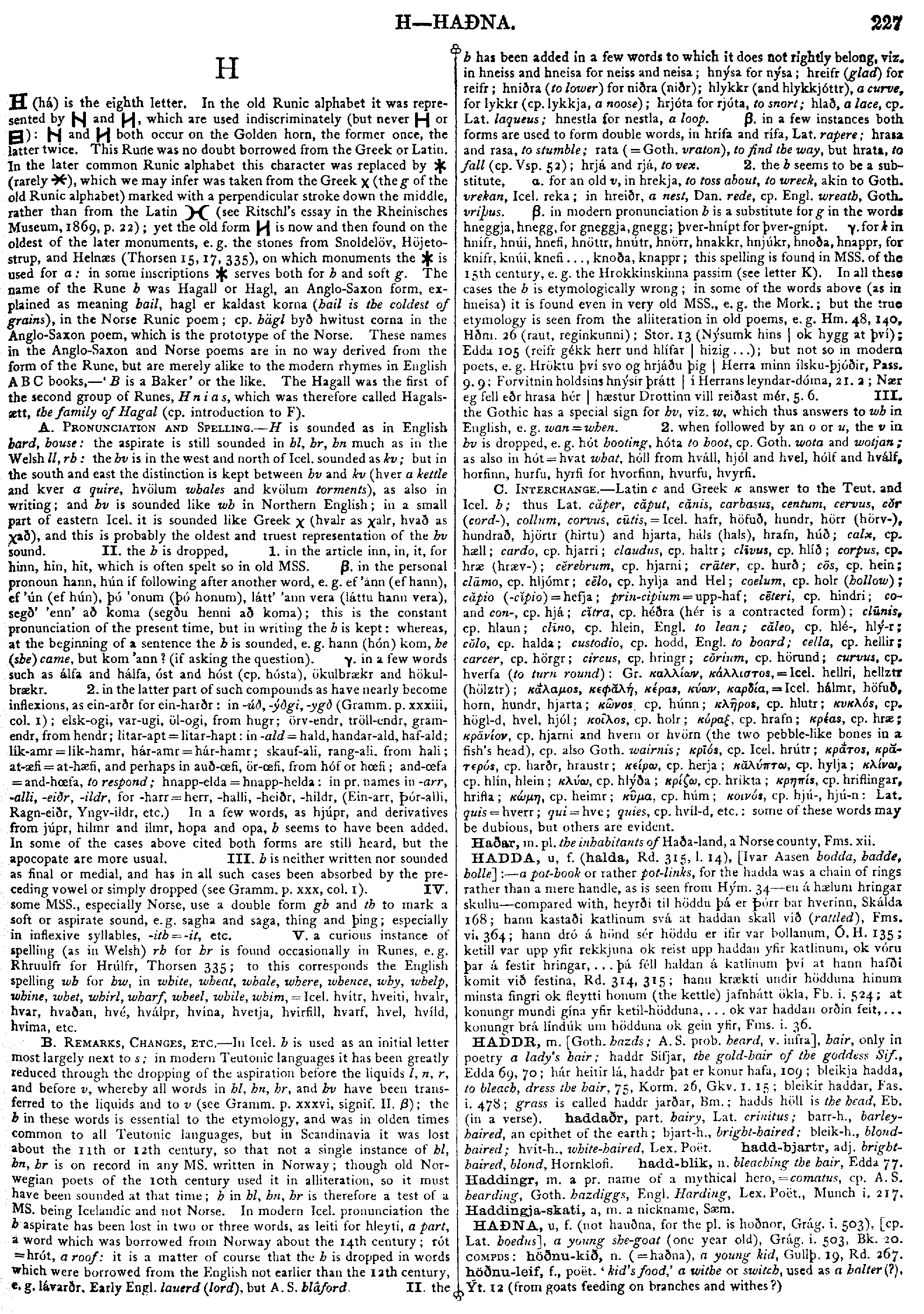
H (há) is the eighth letter. In the old Runic alphabet it was represented by RUNE and RUNE, which are used indiscriminately (but never RUNE or RUNE): RUNE and RUNE both occur on the Golden horn, the former once, the latter twice. This Rune was no doubt borrowed from the Greek or Latin. In the later common Runic alphabet this character was replaced by RUNE (rarely RUNE), which we may infer was taken from the Greek RUNE (the g of the old Runic alphabet) marked with a perpendicular stroke down the middle, rather than from the Latin RUNE (see Ritschl's essay in the Rheinisches Museum, 1869, p. 22); yet the old form RUNE is now and then found on the oldest of the later monuments, e.g. the stones from Snoldelöv, Höjetostrup, and Helnæs (Thorsen 15, 17, 335), on which monuments the RUNE is used for a: in some inscriptions RUNE serves both for h and soft g. The name of the Rune h was Hagall or Hagl, an Anglo-Saxon form, explained as meaning hail, hagl er kaldast korna (hail is the coldest of grains), in the Norse Runic poem; cp. hägl byð hwitust corna in the Anglo-Saxon poem, which is the prototype of the Norse. These names in the Anglo-Saxon and Norse poems are in no way derived from the form of the Rune, but are merely alike to the modern rhymes in English ABC books, -- 'B is a Baker' or the like. The Hagall was the first of the second group of Runes, H n i a s, which was therefore called Hagals-ætt, the family of Hagal (cp. introduction to F).
|
Source: Cleasby/Vigfusson, page b0231, entry 16 View original page image as: [TIFF] [PNG] [View previous entry] [View next entry] |
[Comment on this entry] [View comments] |
The following entry has been hand-corrected once. |
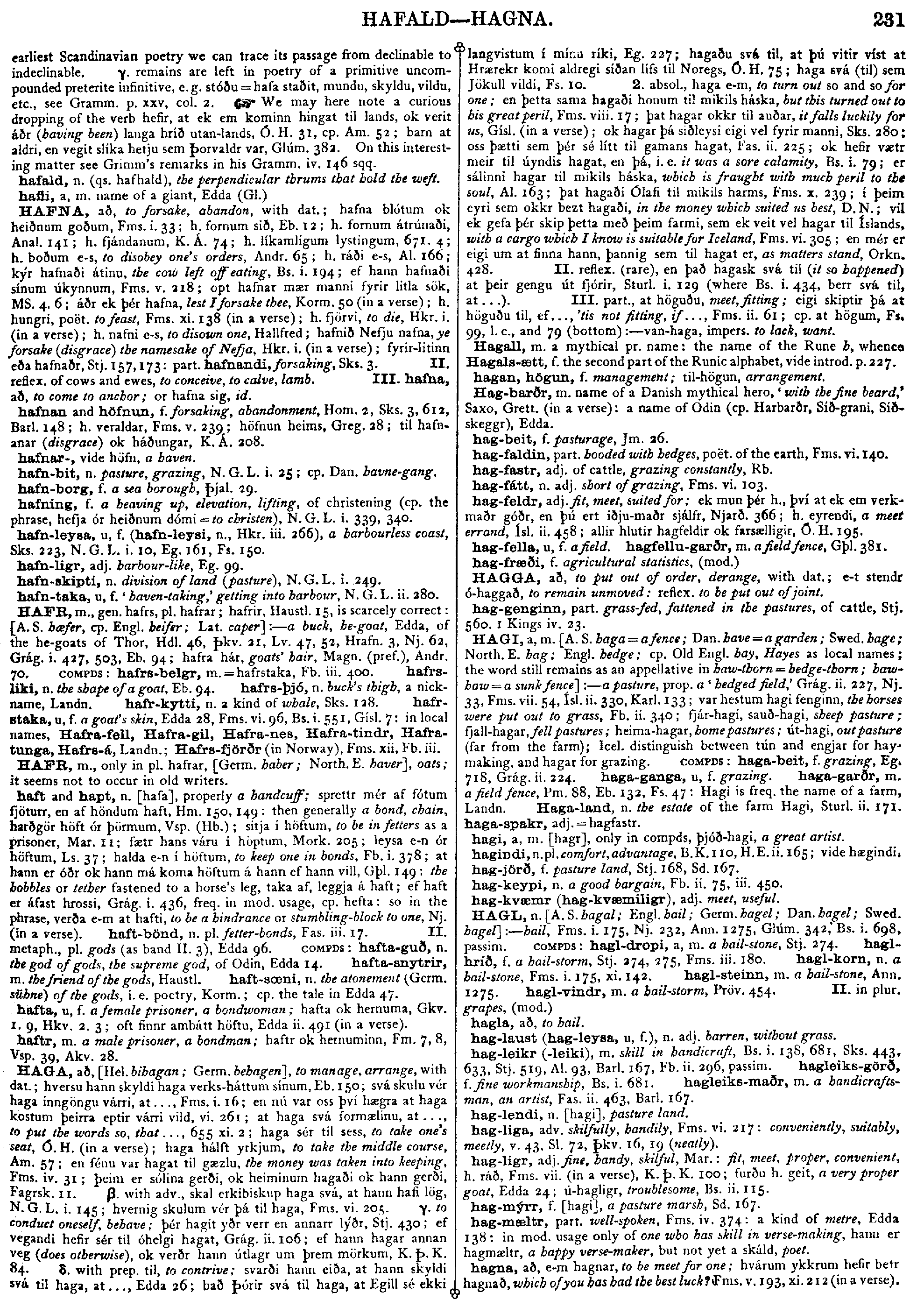
haft and hapt, n. [hafa], properly a handcuff; sprettr mér af fótum fjöturr, en af höndum haft, Hm. 150, 149: then generally a bond, chain, harðgör höft ór þörmum, Vsp. (Hb.); sitja í höftum, to be in fetters as a prisoner, Mar. 11; fætr hans váru í höptum, Mork. 205; leysa e-n ór höftum, Ls. 37; halda e-n í höftum, to keep one in bonds, Fb. i. 378; at hann er óðr ok hann má koma höftum á hann ef hann vill, Gþl. 149: the hobbles or tether fastened to a horse's leg, taka af, leggja á haft; ef haft er áfast hrossi, Grág. i. 436, freq. in mod. usage, cp. hefta: so in the phrase, verða e-m at hafti, to be a hindrance or stumbling-block to one, Nj. (in a verse). haft-bönd, n. pl. fetter-bonds, Fas. iii. 17. II. metaph., pl. gods (as band II. 3), Edda 96. COMPDS: hafta-guð, n. the god of gods, the supreme god, of Odin, Edda 14. hafta-snytrir, m. the friend of the gods, Haustl. haft-sœni, n. the atonement (Germ. sühne) of the gods, i.e. poetry, Korm.; cp. the tale in Edda 47.
|
Source: Cleasby/Vigfusson, page b0239, entry 4 View original page image as: [TIFF] [PNG] [View previous entry] [View next entry] |
[Comment on this entry] [View comments] |
The following entry has been hand-corrected once. |
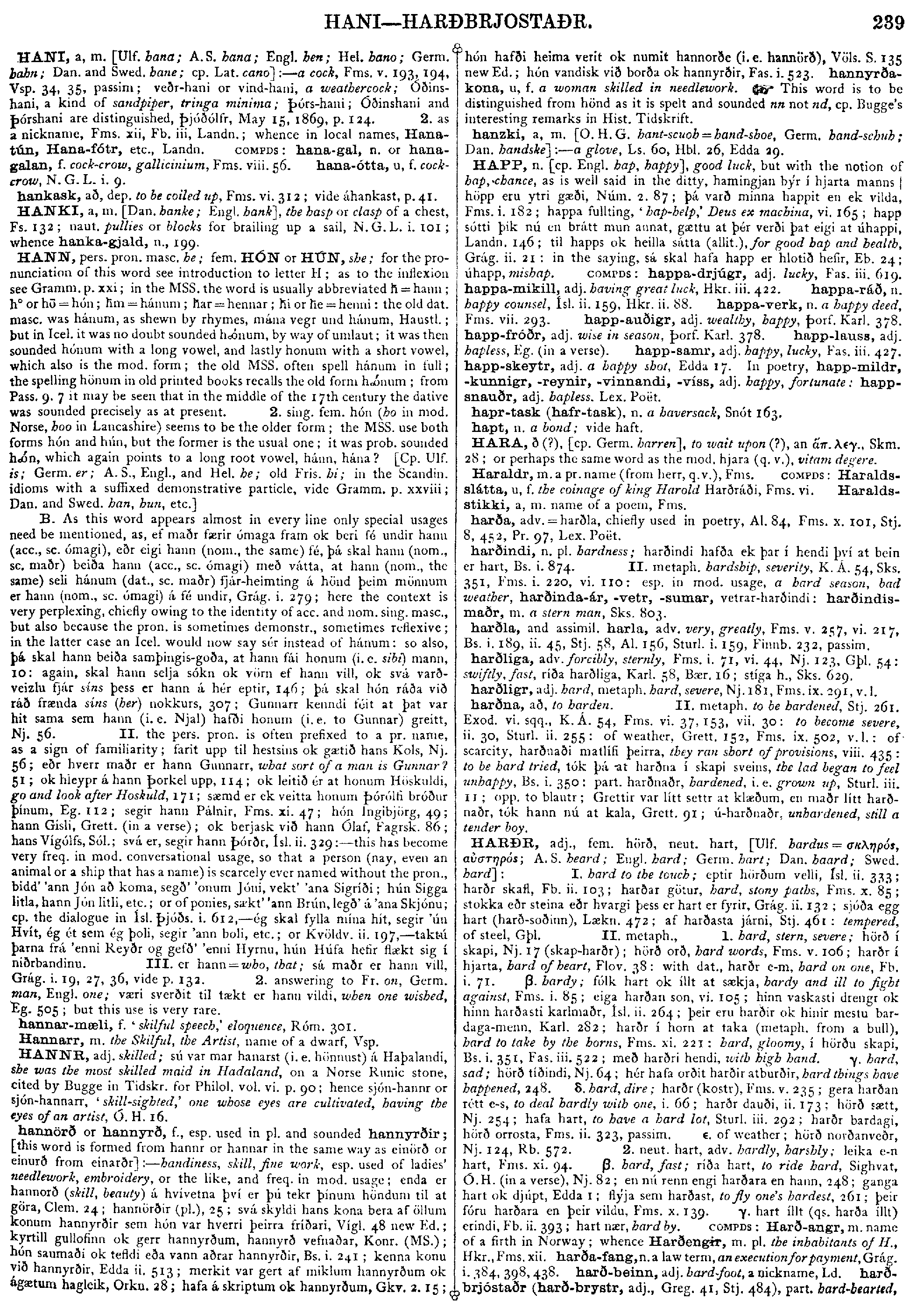
HANN,
pers.
pron.
masc.
he;
fem.
HÓN
or
HÚN,
she;
for
the
pronunciation
of
this
word
see
introduction
to
letter
H;
as
to
the
inflexion
see
Gramm.
p.
xxi;
in
the
MSS.
the
word
is
usually
abbreviated
&h-bar;
=
hann;
hº
or
h =
hón;
&h-bar;m
=
hánum;
&h-bar;ar
=
hennar;
&h-bar;i
or
&h-bar;e
=
henni:
the
old
dat.
masc.
was
hánum,
as
shewn
by
rhymes,
mána
vegr
und
hánum,
Haustl.;
but
in
Icel.
it
was
no
doubt
sounded
h
=
hón;
&h-bar;m
=
hánum;
&h-bar;ar
=
hennar;
&h-bar;i
or
&h-bar;e
=
henni:
the
old
dat.
masc.
was
hánum,
as
shewn
by
rhymes,
mána
vegr
und
hánum,
Haustl.;
but
in
Icel.
it
was
no
doubt
sounded
h num,
by
way
of
umlaut;
it
was
then
sounded
hónum
with
a
long
vowel,
and
lastly
honum
with
a
short
vowel,
which
also
is
the
mod.
form;
the
old
MSS.
often
spell
hánum
in
full;
the
spelling
hönum
in
old
printed
books
recalls
the
old
form
hnum;
from
Pass.
9.
7
it
may
be
seen
that
in
the
middle
of
the
17th
century
the
dative
was
sounded
precisely
as
at
present.
2.
sing.
fem.
hón
(ho
in
mod.
Norse,
hoo
in
Lancashire)
seems
to
be
the
older
form;
the
MSS.
use
both
forms
hón
and
hún,
but
the
former
is
the
usual
one;
it
was
prob.
sounded
hn,
which
again
points
to
a
long
root
vowel,
hánn,
hána?
[Cp.
Ulf.
is;
Germ.
er;
A.
S.,
Engl.,
and
Hel.
he;
old
Fris.
hi;
in
the
Scandin.
idioms
with
a
suffixed
demonstrative
particle,
vide
Gramm.
p.
xxviii;
Dan.
and
Swed.
han,
hun,
etc.]
num,
by
way
of
umlaut;
it
was
then
sounded
hónum
with
a
long
vowel,
and
lastly
honum
with
a
short
vowel,
which
also
is
the
mod.
form;
the
old
MSS.
often
spell
hánum
in
full;
the
spelling
hönum
in
old
printed
books
recalls
the
old
form
hnum;
from
Pass.
9.
7
it
may
be
seen
that
in
the
middle
of
the
17th
century
the
dative
was
sounded
precisely
as
at
present.
2.
sing.
fem.
hón
(ho
in
mod.
Norse,
hoo
in
Lancashire)
seems
to
be
the
older
form;
the
MSS.
use
both
forms
hón
and
hún,
but
the
former
is
the
usual
one;
it
was
prob.
sounded
hn,
which
again
points
to
a
long
root
vowel,
hánn,
hána?
[Cp.
Ulf.
is;
Germ.
er;
A.
S.,
Engl.,
and
Hel.
he;
old
Fris.
hi;
in
the
Scandin.
idioms
with
a
suffixed
demonstrative
particle,
vide
Gramm.
p.
xxviii;
Dan.
and
Swed.
han,
hun,
etc.]
|
Source: Cleasby/Vigfusson, page b0244, entry 130 View original page image as: [TIFF] [PNG] [View previous entry] [View next entry] |
[Comment on this entry] [View comments] |
The following entry has been hand-corrected once. |
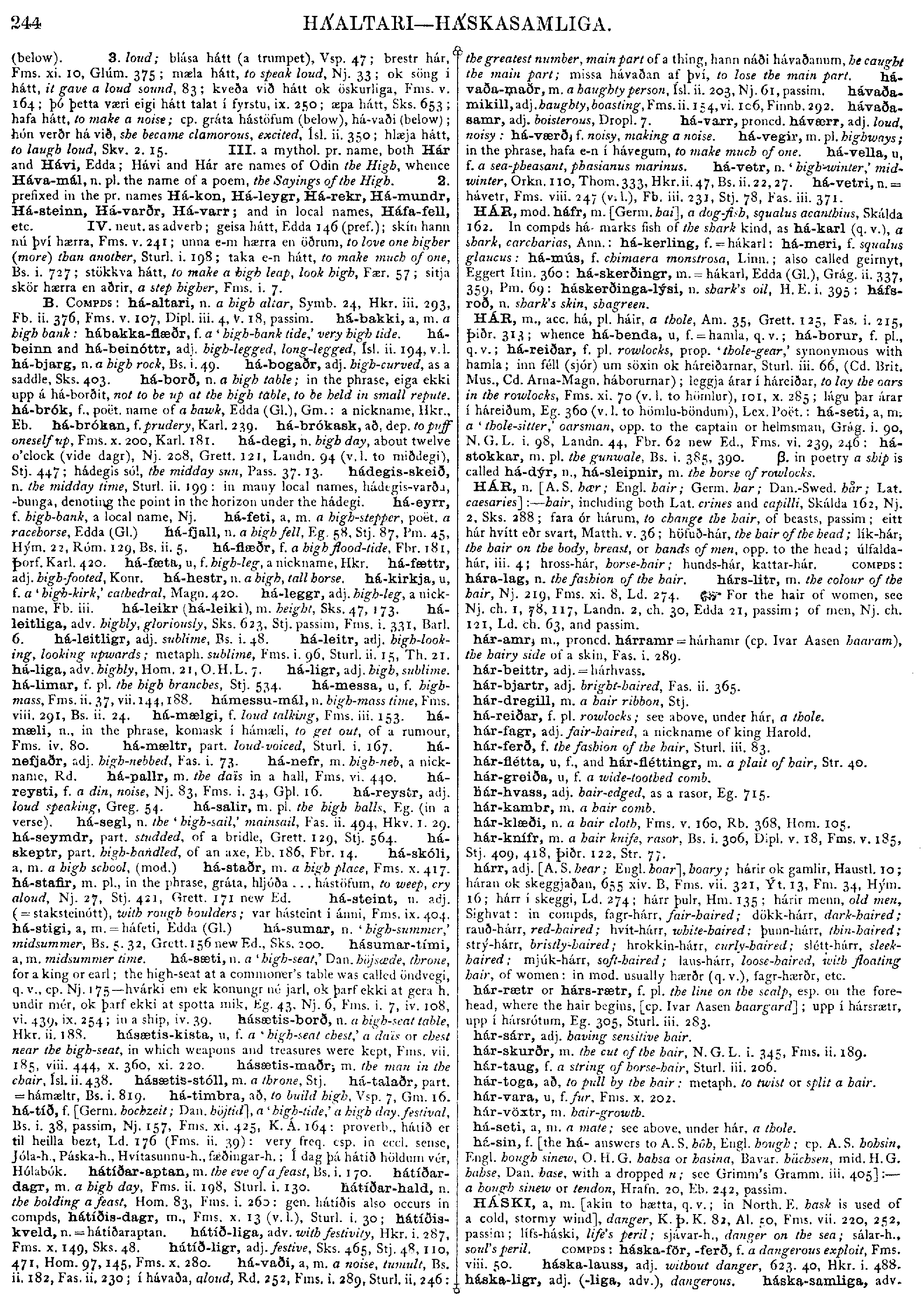
héðan, adv., hieðan in an old vellum, 655 x. 2, which shews that the pronunciation was the same then as now, [A. S. heonan; North. E. hein and hine; cp. Germ. hin] :-- hence, from this place, Gm. 28, Ls. 7, Skm. 38, Hbl. 13, Am. 36, Nj. 32, Jb. 10, Grág. i. 150, Edda 8; fyrir héðan e-t, on the hither side, Symb. 30; fyrir héðan hafit, on the hither side of the sea, Fas. ii. 240. II. temp. henceforth, Fms. vi. 279, xi. 84; héðan frá, héðan í frá (mod. héðan af), hereafter, Nj. 83, Ísl. ii. 237. héðan-kváma, u, f. departure from hence, Fas. ii. 121 (in a verse).
|
Source: Cleasby/Vigfusson, page b0247, entry 13 View original page image as: [TIFF] [PNG] [View previous entry] [View next entry] |
[Comment on this entry] [View comments] |
The following entry has been hand-corrected once. |
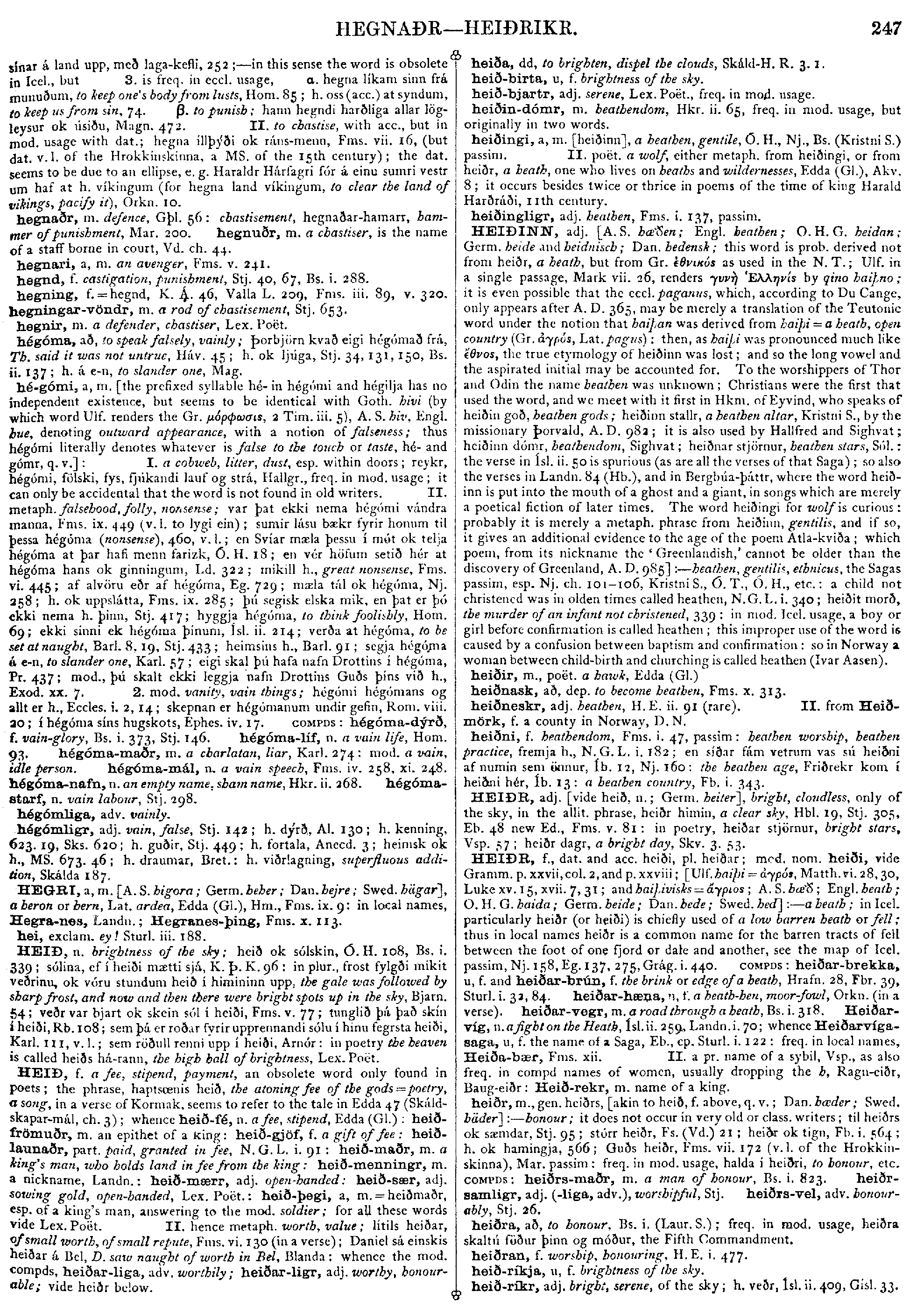
HEIÐ, n. brightness of the sky; heið ok sólskin, Ó. H. 108, Bs. i. 339; sólina, ef í heiði mætti sjá, K. Þ. K. 96: in plur., frost fylgði mikit veðrinu, ok vóru stundum heið í himininn upp, the gale was followed by sharp frost, and now and then there were bright spots up in the sky, Bjarn. 54; veðr var bjart ok skein sól í heiði, Fms. v. 77; tunglið þá það skín í heiði, Rb. 108; sem þá er roðar fyrir upprennandi sólu í hinu fegrsta heiði, Karl. 111, v.l.; sem röðull renni upp í heiði, Arnór: in poetry the heaven is called heiðs há-rann, the high hall of brightness, Lex. Poët.
|
Source: Cleasby/Vigfusson, page b0247, entry 21 View original page image as: [TIFF] [PNG] [View previous entry] [View next entry] |
[Comment on this entry] [View comments] |
The following entry has been hand-corrected once. |
HEIÐINN, adj. [A. S. hæðen; Engl. heathen; O. H. G. heidan; Germ. heide and heidnisch; Dan. hedensk; this word is prob. derived not from heiðr, a heath, but from Gr. GREEK as used in the N. T.; Ulf. in a single passage, Mark vii. 26, renders GREEK by qino haiþno; it is even possible that the eccl. paganus, which, according to Du Cange, only appears after A.D. 365, may be merely a translation of the Teutonic word under the notion that haiþan was derived from haiþi = a heath, open country (Gr. GREEK, Lat. pagus): then, as haiþi was pronounced much like GREEK, the true etymology of heiðinn was lost; and so the long vowel and the aspirated initial may be accounted for. To the worshippers of Thor and Odin the name heathen was unknown; Christians were the first that used the word, and we meet with it first in Hkm. of Eyvind, who speaks of heiðin goð, heathen gods; heiðinn stallr, a heathen altar, Kristni S., by the missionary Þorvald, A.D. 982; it is also used by Hallfred and Sighvat; heiðinn dómr, heathendom, Sighvat; heiðnar stjörnur, heathen stars, Sól.: the verse in Ísl. ii. 50 is spurious (as are all the verses of that Saga); so also the verses in Landn. 84 (Hb.), and in Bergbúa-þáttr, where the word heiðinn is put into the mouth of a ghost and a giant, in songs which are merely a poetical fiction of later times. The word heiðingi for wolf is curious: probably it is merely a metaph. phrase from heiðinn, gentilis, and if so, it gives an additional evidence to the age of the poem Atla-kviða; which poem, from its nickname the 'Greenlandish,' cannot be older than the discovery of Greenland, A.D. 985] :-- heathen, gentilis, ethnicus, the Sagas passim, esp. Nj. ch. 101-106, Kristni S., Ó. T., Ó. H., etc.: a child not christened was in olden times called heathen, N. G. L. i. 340; heiðit morð, the murder of an infant not christened, 339: in mod. Icel. usage, a boy or girl before confirmation is called heathen; this improper use of the word is caused by a confusion between baptism and confirmation: so in Norway a woman between child-birth and churching is called heathen (Ivar Aasen).
|
Source: Cleasby/Vigfusson, page b0252, entry 26 View original page image as: [TIFF] [PNG] [View previous entry] [View next entry] |
[Comment on this entry] [View comments] |
The following entry has been hand-corrected once. |
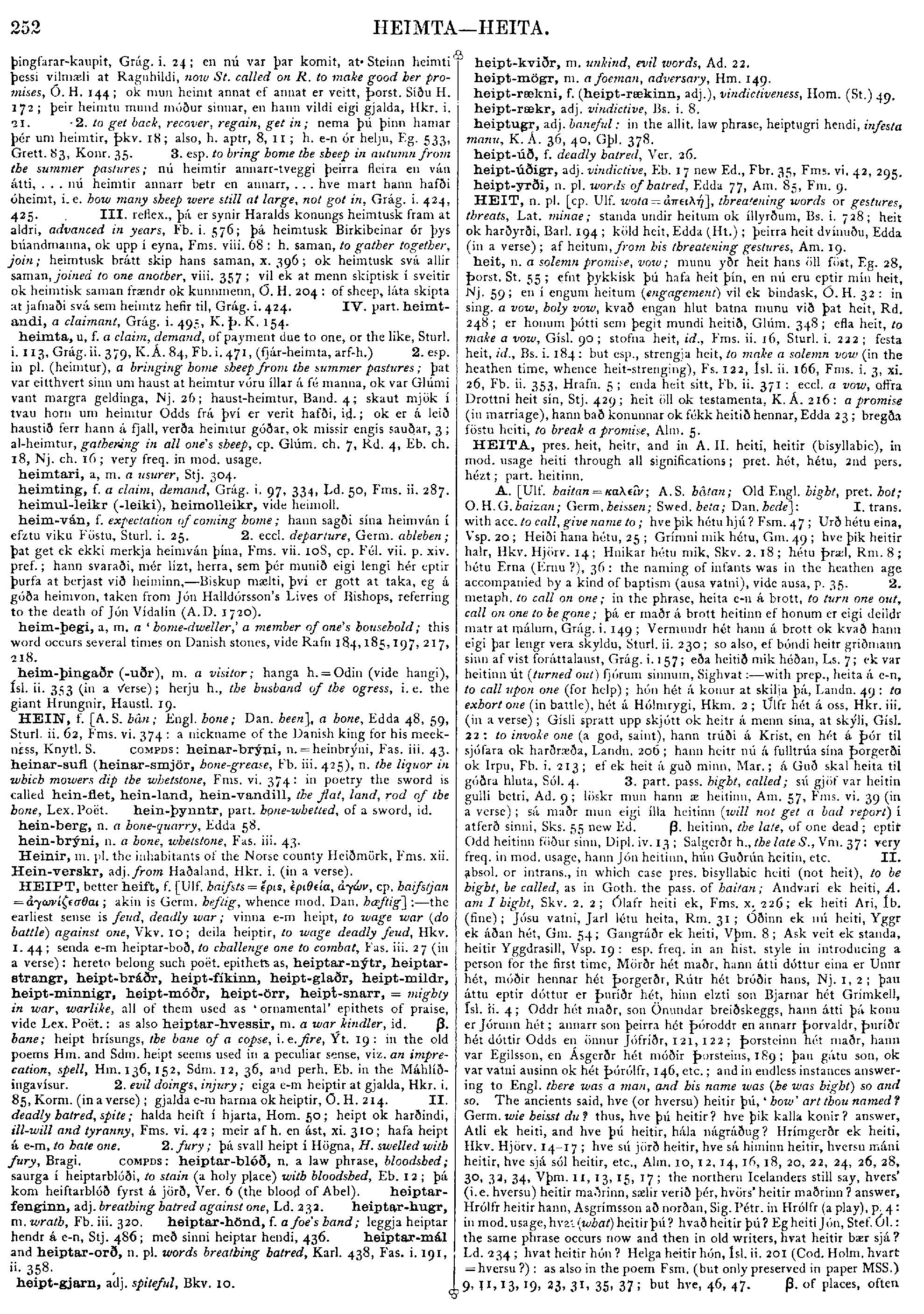
A.
[Ulf.
haitan
=
GREEK;
A.
S.
hâtan;
Old
Engl.
hight,
pret.
hot;
O.
H.
G.
haizan;
Germ.
heissen;
Swed.
heta;
Dan.
hede]:
I.
trans.
with
acc.
to
call,
give
name
to;
hve
þik
hétu
hjú?
Fsm.
47;
Urð
hétu
eina,
Vsp.
20;
Heiði
hana
hétu,
25;
Grímni
mik
hétu,
Gm.
49;
hve
þik
heitir
halr,
Hkv.
Hjörv.
14;
Hnikar
hétu
mik,
Skv.
2.
18;
hétu
Þræl,
Rm.
8;
hétu
Erna
(Ernu?),
36:
the
naming
of
infants
was
in
the
heathen
age
accompanied
by
a
kind
of
baptism
(ausa
vatni),
vide
ausa,
p.
35.
2.
metaph.
to
call
on
one;
in
the
phrase,
heita
e-n
á
brott,
to
turn
one
out,
call
on
one
to
be
gone;
þá
er
maðr
á
brott
heitinn
ef
honum
er
eigi
deildr
matr
at
málum,
Grág.
i.
149;
Vermundr
hét
hann
á
brott
ok
kvað
hann
eigi
þar
lengr
vera
skyldu,
Sturl.
ii.
230;
so
also,
ef
bóndi
heitr
griðmann
sinn
af
vist
foráttalaust,
Grág.
i.
157;
eða
heitið
mik
héðan,
Ls.
7;
ek
var
heitinn
út
(turned
out)
fjórum
sinnum,
Sighvat
:--
with
prep.,
heita
á
e-n,
to
call
upon
one
(for
help);
hón
hét
á
konur
at
skilja
þá,
Landn.
49:
to
exhort
one
(in
battle),
hét
á
Hólmrygi,
Hkm.
2;
Úlfr
hét
á
oss,
Hkr.
iii.
(in
a
verse);
Gísli
spratt
upp
skjótt
ok
heitr
á
menn
sína,
at
skýli,
Gísl.
22:
to
invoke
one
(a
god,
saint),
hann
trúði
á
Krist,
en
hét
á
Þór
til
sjófara
ok
harðræða,
Landn.
206;
hann
heitr
nú
á
fulltrúa
sína
Þorgerði
ok
Irpu,
Fb.
i.
213;
ef
ek
heit
á
guð
minn,
Mar.;
á
Guð
skal
heita
til
góðra
hluta,
Sól.
4.
3.
part.
pass.
hight,
called;
sú
gjöf
var
heitin
gulli
betri,
Ad.
9;
löskr
mun
hann
æ
heitinn,
Am.
57,
Fms.
vi.
39
(in
a
verse);
sá
maðr
mun
eigi
ílla
heitinn
(will
not
get
a
bad
report)
í
atferð
sinni,
Sks.
55
new
Ed.
 .
heitinn,
the
late,
of
one
dead;
eptir
Odd
heitinn
föður
sinn,
Dipl.
iv.
13;
Salgerðr
h.,
the
late
S.,
Vm.
37:
very
freq.
in
mod.
usage,
hann
Jón
heitinn,
hún
Guðrún
heitin,
etc.
II.
absol.
or
intrans.,
in
which
case
pres.
bisyllabic
heiti
(not
heit),
to
be
hight,
be
called,
as
in
Goth.
the
pass.
of
haitan;
Andvari
ek
heiti,
A.
am
í
hight,
Skv.
2.
2;
Ólafr
heiti
ek,
Fms.
x.
226;
ek
heiti
Ari,
Íb.
(fine);
Jósu
vatni,
Jarl
létu
heita,
Rm.
31;
Óðinn
ek
nú
heiti,
Yggr
ek
áðan
hét,
Gm.
54;
Gangráðr
ek
heiti,
Vþm.
8;
Ask
veit
ek
standa,
heitir
Yggdrasill,
Vsp.
19:
esp.
freq.
in
an
hist.
style
in
introducing
a
person
for
the
first
time,
Mörðr
hét
maðr,
hann
átti
dóttur
eina
er
Unnr
hét,
móðir
hennar
hét
Þorgerðr,
Rútr
hét
bróðir
hans,
Nj.
1,
2;
þau
áttu
eptir
dóttur
er
Þuríðr
hét,
hinn
elzti
son
Bjarnar
hét
Grímkell,
Ísl.
ii.
4;
Oddr
hét
maðr,
son
Önundar
breiðskeggs,
hann
átti
þá
konu
er
Jórunn
hét;
annarr
son
þeirra
hét
Þóroddr
en
annarr
Þorvaldr,
Þuriðr
hét
dóttir
Odds
en
önnur
Jófriðr,
121,
122;
Þorsteinn
hét
maðr,
hann
var
Egilsson,
en
Ásgerðr
hét
móðir
Þorsteins,
189;
þau
gátu
son,
ok
var
vatni
ausinn
ok
hét
Þórólfr,
146,
etc.;
and
in
endless
instances
answering
to
Engl.
there
was
a
man,
and
his
name
was
(he
was
hight)
so
and
so.
The
ancients
said,
hve
(or
hversu)
heitir
þú,
'how'
art
thou
named?
Germ.
wie
heisst
du?
thus,
hve
þú
heitir?
hve
þik
kalla
konir?
answer,
Atli
ek
heiti,
and
hve
þú
heitir,
hála
nágráðug?
Hrímgerðr
ek
heiti,
Hkv.
Hjörv.
14-17;
hve
sú
jörð
heitir,
hve
sá
himinn
heitir,
hversu
máni
heitir,
hve
sjá
sól
heitir,
etc.,
Alm.
10,
12,
14,
16,
18,
20,
22,
24,
26,
28,
30,
32,
34,
Vþm.
11,
13,
15,
17;
the
northern
Icelanders
still
say,
hvers'
(i.e.
hversu)
heitir
maðrinn,
sælir
verið
þér,
hvörs'
heitir
maðrinn?
answer,
Hrólfr
heitir
hann,
Asgrímsson
að
norðan,
Sig.
Pétr.
in
Hrólfr
(a
play),
p.
4:
in
mod.
usage,
hvat
(what)
heitir
þú?
hvað
heitir
þú?
Eg
heiti
Jón,
Stef.
Ól.:
the
same
phrase
occurs
now
and
then
in
old
writers,
hvat
heitir
bær
sjá?
Ld.
234;
hvat
heitir
hón?
Helga
heitir
hón,
Ísl.
ii.
201
(Cod.
Holm.
hvart
=
hversu?):
as
also
in
the
poem
Fsm.
(but
only
preserved
in
paper
MSS.)
9,
11,
13,
19,
23,
31,
35,
37;
but
hve,
46,
47.
.
of
places,
often
.
heitinn,
the
late,
of
one
dead;
eptir
Odd
heitinn
föður
sinn,
Dipl.
iv.
13;
Salgerðr
h.,
the
late
S.,
Vm.
37:
very
freq.
in
mod.
usage,
hann
Jón
heitinn,
hún
Guðrún
heitin,
etc.
II.
absol.
or
intrans.,
in
which
case
pres.
bisyllabic
heiti
(not
heit),
to
be
hight,
be
called,
as
in
Goth.
the
pass.
of
haitan;
Andvari
ek
heiti,
A.
am
í
hight,
Skv.
2.
2;
Ólafr
heiti
ek,
Fms.
x.
226;
ek
heiti
Ari,
Íb.
(fine);
Jósu
vatni,
Jarl
létu
heita,
Rm.
31;
Óðinn
ek
nú
heiti,
Yggr
ek
áðan
hét,
Gm.
54;
Gangráðr
ek
heiti,
Vþm.
8;
Ask
veit
ek
standa,
heitir
Yggdrasill,
Vsp.
19:
esp.
freq.
in
an
hist.
style
in
introducing
a
person
for
the
first
time,
Mörðr
hét
maðr,
hann
átti
dóttur
eina
er
Unnr
hét,
móðir
hennar
hét
Þorgerðr,
Rútr
hét
bróðir
hans,
Nj.
1,
2;
þau
áttu
eptir
dóttur
er
Þuríðr
hét,
hinn
elzti
son
Bjarnar
hét
Grímkell,
Ísl.
ii.
4;
Oddr
hét
maðr,
son
Önundar
breiðskeggs,
hann
átti
þá
konu
er
Jórunn
hét;
annarr
son
þeirra
hét
Þóroddr
en
annarr
Þorvaldr,
Þuriðr
hét
dóttir
Odds
en
önnur
Jófriðr,
121,
122;
Þorsteinn
hét
maðr,
hann
var
Egilsson,
en
Ásgerðr
hét
móðir
Þorsteins,
189;
þau
gátu
son,
ok
var
vatni
ausinn
ok
hét
Þórólfr,
146,
etc.;
and
in
endless
instances
answering
to
Engl.
there
was
a
man,
and
his
name
was
(he
was
hight)
so
and
so.
The
ancients
said,
hve
(or
hversu)
heitir
þú,
'how'
art
thou
named?
Germ.
wie
heisst
du?
thus,
hve
þú
heitir?
hve
þik
kalla
konir?
answer,
Atli
ek
heiti,
and
hve
þú
heitir,
hála
nágráðug?
Hrímgerðr
ek
heiti,
Hkv.
Hjörv.
14-17;
hve
sú
jörð
heitir,
hve
sá
himinn
heitir,
hversu
máni
heitir,
hve
sjá
sól
heitir,
etc.,
Alm.
10,
12,
14,
16,
18,
20,
22,
24,
26,
28,
30,
32,
34,
Vþm.
11,
13,
15,
17;
the
northern
Icelanders
still
say,
hvers'
(i.e.
hversu)
heitir
maðrinn,
sælir
verið
þér,
hvörs'
heitir
maðrinn?
answer,
Hrólfr
heitir
hann,
Asgrímsson
að
norðan,
Sig.
Pétr.
in
Hrólfr
(a
play),
p.
4:
in
mod.
usage,
hvat
(what)
heitir
þú?
hvað
heitir
þú?
Eg
heiti
Jón,
Stef.
Ól.:
the
same
phrase
occurs
now
and
then
in
old
writers,
hvat
heitir
bær
sjá?
Ld.
234;
hvat
heitir
hón?
Helga
heitir
hón,
Ísl.
ii.
201
(Cod.
Holm.
hvart
=
hversu?):
as
also
in
the
poem
Fsm.
(but
only
preserved
in
paper
MSS.)
9,
11,
13,
19,
23,
31,
35,
37;
but
hve,
46,
47.
.
of
places,
often
|
Source: Cleasby/Vigfusson, page b0253, entry 1 View original page image as: [TIFF] [PNG] [View previous entry] [View next entry] |
[Comment on this entry] [View comments] |
The following entry has been hand-corrected once. |
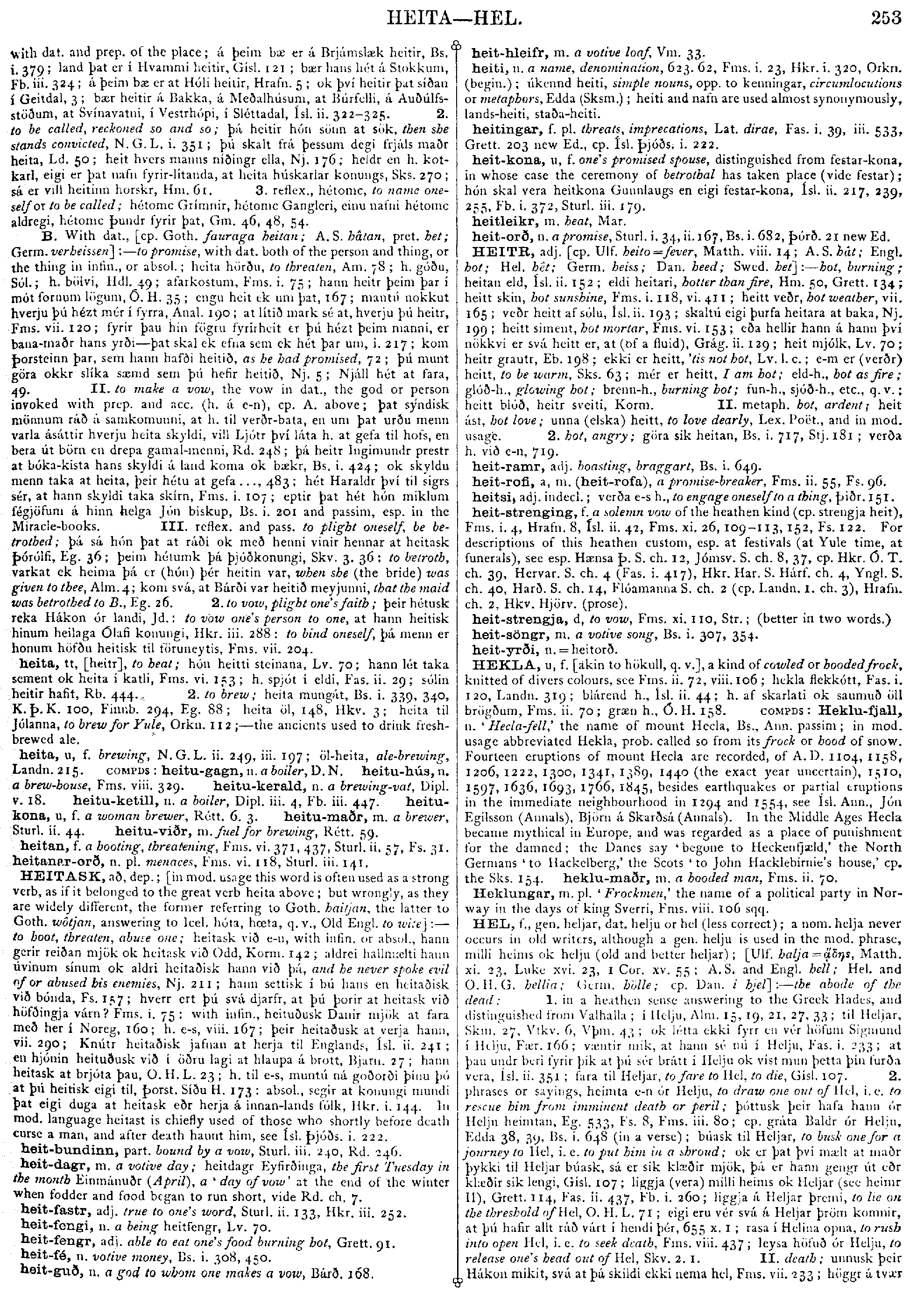
with dat. and prep. of the place; á þeim bæ er á Brjámslæk heitir, Bs. i. 379; land pat er í Hvammi heitir, Gísl. 121; bær hans hét á Stokkum, Fb. iii. 324; á þeim bæ er at Hóli heitir, Hrafn. 5; ok því heitir þat síðan í Geitdal, 3; bær heitir á Bakka, á Meðalhúsum, at Búrfelli, á Auðúlfsstöðum, at Svínavatni, í Vestrhópi, í Sléttadal, Ísl. ii. 322-325. 2. to be called, reckoned so and so; þá heitir hón sönn at sök, then she stands convicted, N. G. L. i. 351; þú skalt frá þessum degi frjáls maðr heita, Ld. 50; heit hvers manns níðingr ella, Nj. 176; heldr en h. kotkarl, eigi er þat nafn fyrir-lítanda, at heita húskarlar konungs, Sks. 270; sá er vill heitinn horskr, Hm. 61. 3. reflex., hétomc, to name oneself or to be called; hétomc Grímnir, hétomc Gangleri, einu nafni hétomc aldregi, hétomc Þundr fyrir þat, Gm. 46, 48, 54.
| Result Page: |  |
Previous | 90 91 92 93 94 95 96 97 98 99 100 101 102 103 104 105 106 107 108 | Next |  |
Germanic Lexicon Project (main page)
This search system was written by
Sean Crist
Please consider
volunteering
to correct the data in these online dictionaries.
No rights reserved. Feel free to use these data in any way you please.