|
|

þem (2 results)
ðem (14 results)
Search for them again, using less strict matching (1395 results)
|
Source: Bosworth/Toller, page b1153, entry 12 View original page image as: [TIFF] [PNG] [View previous entry] [View next entry] |
[Comment on this entry] [View comments] |
The following entry has been hand-corrected once. |
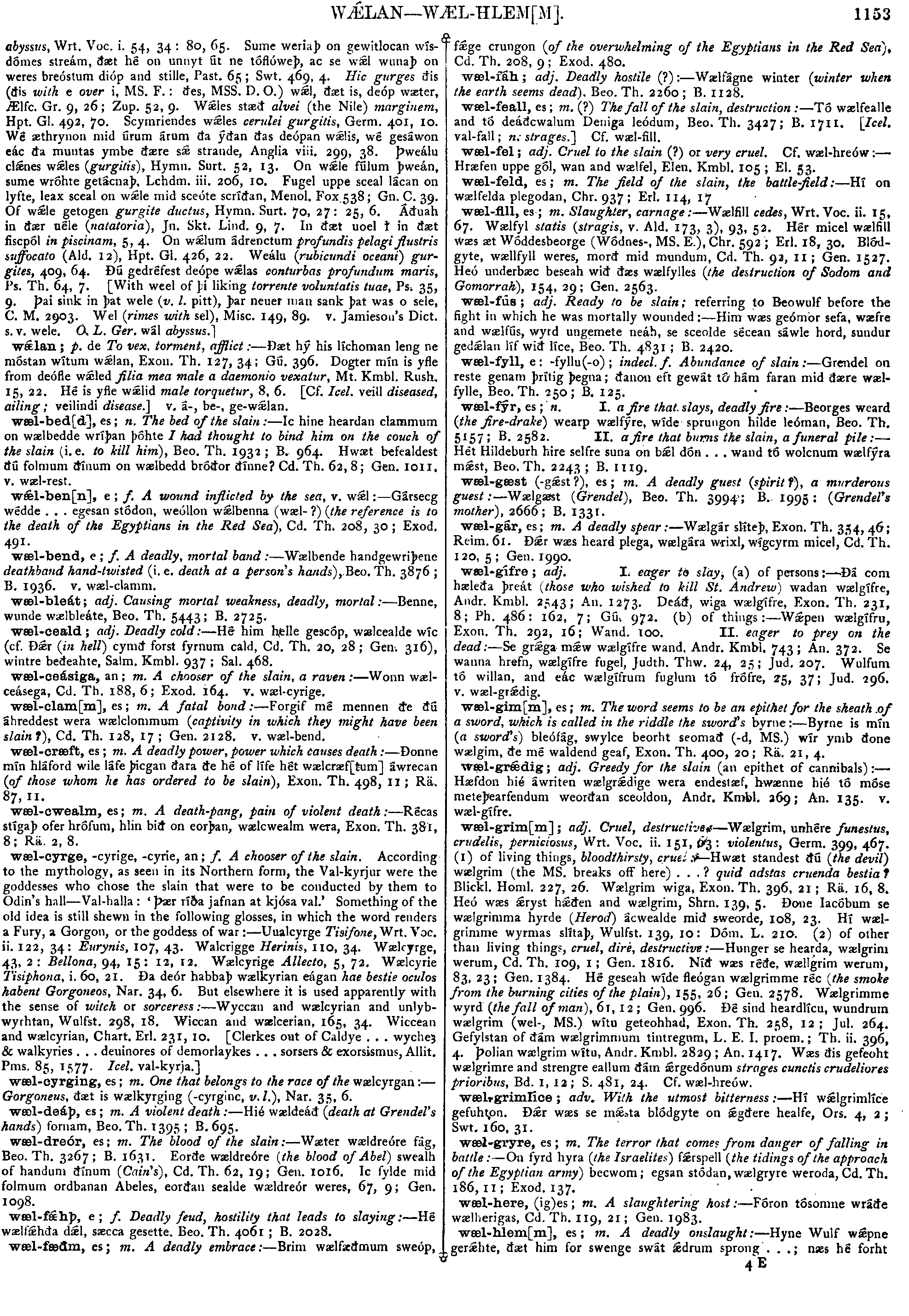
wæl-cyrge,
-cyrige,
-cyrie,
an;
f.
A
chooser
of
the
slain.
According
to
the
mythology,
as
seen
in
its
Northern
form,
the
Val-kyrjur
were
the
goddesses
who
chose
the
slain
that
were
to
be
conducted
by
them
to
Odin's
hall
--
Val-halla
:
'Þær
ríða
jafnan
at
kjósa
val.'
Something
of
the
old
idea
is
still
shewn
in
the
following
glosses,
in
which
the
word
renders
a
Fury,
a
Gorgon,
or
the
goddess
of
war
:--
Uualcyrge
Tisifone,
Wrt.
Voc.
ii.
122,
34:
Eurynis,
107,
43.
Walcrigge
Herinis,
110,
34.
Wælcyrge,
43,
2:
Bellona,
94,
15:
12,
12.
Wælcyrige
Allecto,
5,
72.
Wælcyrie
Tisiphona,
i.
60,
21.
Ða
deór
habbaþ
wælkyrian
eágan
hae
bestie
oculos
habent
Gorgoneos,
Nar.
34,
6.
But
elsewhere
it
is
used
apparently
with
the
sense
of
witch
or
sorceress
:--
Wyccan
and
wælcyrian
and
unlybwyrhtan,
Wulfst.
298,
18.
Wiccan
and
wælcerian,
165,
34.
Wiccean
and
wælcyrian,
Chart.
Erl.
231,
10.
[Clerkes
out
of
Caldye
...
wyche &
walkyries
...
deuinores
of
demorlaykes
...
sorsers
&
exorsismus,
Allit.
Pms.
85,
1577.
Icel.
val-kyrja.]
&
walkyries
...
deuinores
of
demorlaykes
...
sorsers
&
exorsismus,
Allit.
Pms.
85,
1577.
Icel.
val-kyrja.]
|
Source: Bosworth/Toller, page b1157, entry 16 View original page image as: [TIFF] [PNG] [View previous entry] [View next entry] |
[Comment on this entry] [View comments] |
The following entry has been hand-corrected once. |
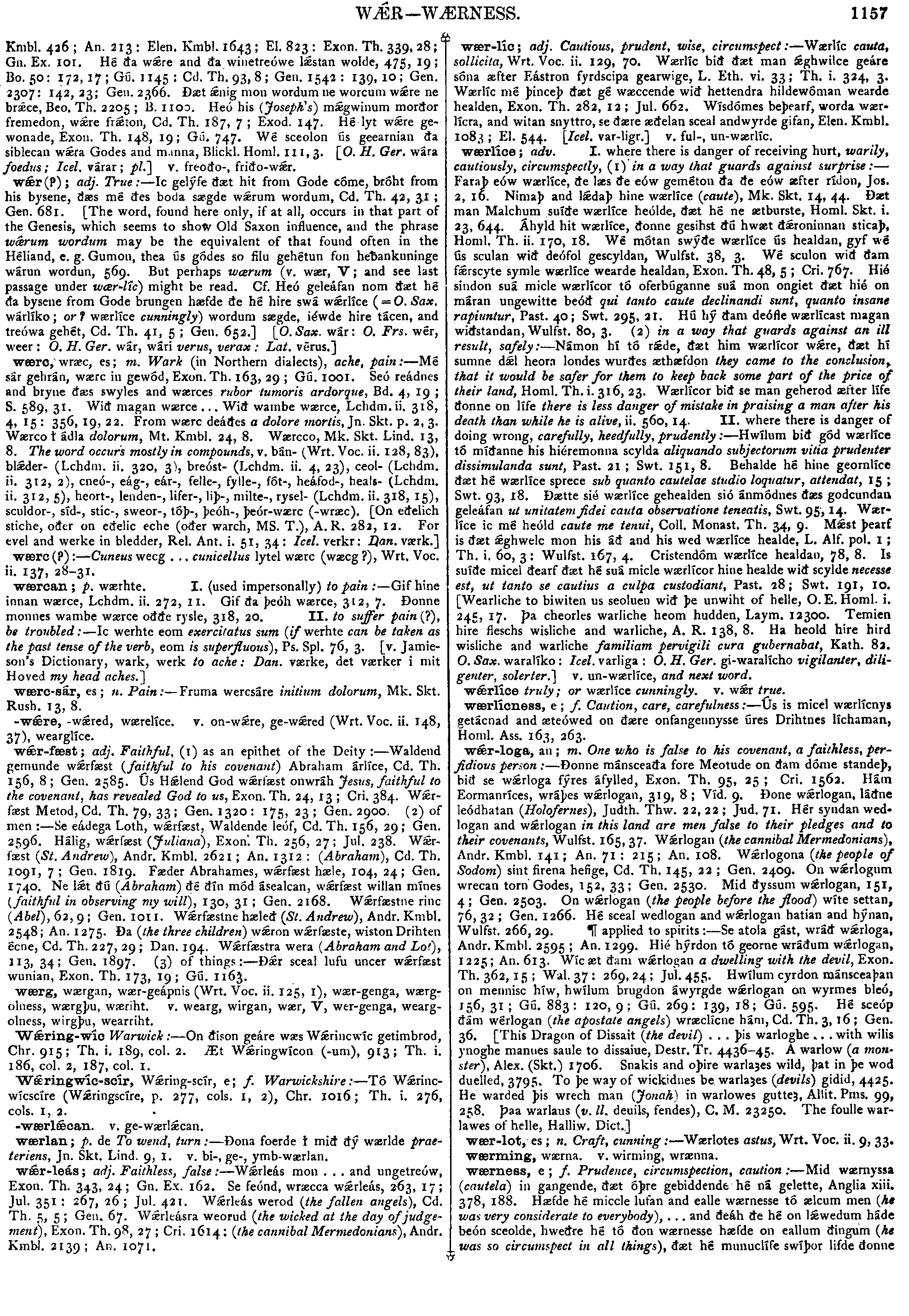
wærlíce;
adv.
I.
where
there
is
danger
of
receiving
hurt,
warily,
cautiously,
circumspectly,
(1)
in
a
way
that
guards
against
surprise:--Faraþ
eów
wærlíce,
ðe
læs
ðe
eów
geméton
ða
ðe
eów
æfter
rídon,
Jos.
2,
16.
Nimaþ
and
l daþ
hine
wærlíce
(caute),
Mk.
Skt.
14,
44.
Ðæt
man
Malchum
suíðe
wærlíce
heólde,
ðæt
hé
ne
ætburste,
Homl.
Skt.
i.
23,
644.
Áhyld
hit
wærlíce,
ðonne
gesihst
ðú
hwæt
ðroninnan
sticaþ,
Homl.
Th.
ii.
170,
18.
Wé
mótan
swýðe
wærlíce
ús
healdan,
gyf
wé
ús
sculan
wið
deófol
gescyldan,
Wulfst.
38,
3.
Wé
sculon
wið
ðam
frscyte
symle
wærlíce
wearde
healdan,
Exon.
Th.
48,
5;
Cri.
767.
Hié
sindon
suá
micle
wærlícor
tó
oferbúganne
suá
mon
ongiet
ðæt
hié
on
máran
ungewitte
beóð
qui
tanto
caute
declinandi
sunt,
quanto
insane
rapiuntur,
Past.
40;
Swt.
295,
21.
Hú
hý
ðam
deófle
wærlícast
magan
wiðstandan,
Wulfst.
80,
3.
(2)
in
a
way
that
guards
against
an
ill
result,
safely:--Námon
hí
tó
rde,
ðæt
him
wærlícor
wre,
ðæt
hí
sumne
dl
heora
londes
wurðes
æthfdon
they
came
to
the
conclusion,
that
it
would
be
safer
for
them
to
keep
back
some
part
of
the
price
of
their
land,
Homl.
Th.
i.
316,
23.
Wærlícor
bið
se
man
geherod
æfter
lífe
ðonne
on
lífe
there
is
less
danger
of
mistake
in
praising
a
man
after
his
death
than
while
he
is
alive,
ii.
560,
14.
II.
where
there
is
danger
of
doing
wrong,
carefully,
heedfully,
prudently:--Hwílum
bið
gód
wærlíce
tó
míðanne
his
hiéremonna
scylda
aliquando
subjectorum
vitia
prudenter
dissimulanda
sunt,
Past.
21;
Swt.
151,
8.
Behalde
hé
hine
geornlíce
ðæt
hé
wærlíce
sprece
sub
quanto
cautelae
studio
loquatur,
attendat,
15:
Swt.
93,
18.
Ðætte
sié
wærlíce
gehealden
sió
ánmódnes
ðæs
godcundan
geleáfan
ut
unitatem
fidei
cauta
observatione
teneatis,
Swt.
95,
14.
Wærlíce
ic
mé
heóld
caute
me
tenui,
Coll.
Monast.
Th.
34,
9.
Mst
þearf
is
ðæt
ghwelc
mon
his
áð
and
his
wed
wærlíce
healde,
L.
Alf.
pol.
1;
Th.
i.
60,
3:
Wulfst.
167,
4.
Cristendóm
wærlíce
healdan,
78,
8.
Is
suíðe
micel
ðearf
ðæt
hé
suá
micle
wærlícor
hine
healde
wið
scylde
necesse
est,
ut
tanto
se
cautius
a
culpa
custodiant,
Past.
28;
Swt.
191,
10.
[Wearliche
to
biwiten
us
seoluen
wið
þe
unwiht
of
helle,
O.
E.
Homl.
i.
245,
17.
Þa
cheorles
warliche
heom
hudden,
Laym.
12300.
Temien
hire
fleschs
wisliche
and
warliche,
A.
R.
138,
8.
Ha
heold
hire
hird
wisliche
and
warliche
familiam
pervigili
cura
gubernabat,
Kath.
82.
O.
Sax.
waralíko:
Icel.
varliga:
O.
H.
Ger.
gi-waralícho
vigilanter,
diligenter,
solerter.]
v.
un-wærlíce,
and
next
word.
daþ
hine
wærlíce
(caute),
Mk.
Skt.
14,
44.
Ðæt
man
Malchum
suíðe
wærlíce
heólde,
ðæt
hé
ne
ætburste,
Homl.
Skt.
i.
23,
644.
Áhyld
hit
wærlíce,
ðonne
gesihst
ðú
hwæt
ðroninnan
sticaþ,
Homl.
Th.
ii.
170,
18.
Wé
mótan
swýðe
wærlíce
ús
healdan,
gyf
wé
ús
sculan
wið
deófol
gescyldan,
Wulfst.
38,
3.
Wé
sculon
wið
ðam
frscyte
symle
wærlíce
wearde
healdan,
Exon.
Th.
48,
5;
Cri.
767.
Hié
sindon
suá
micle
wærlícor
tó
oferbúganne
suá
mon
ongiet
ðæt
hié
on
máran
ungewitte
beóð
qui
tanto
caute
declinandi
sunt,
quanto
insane
rapiuntur,
Past.
40;
Swt.
295,
21.
Hú
hý
ðam
deófle
wærlícast
magan
wiðstandan,
Wulfst.
80,
3.
(2)
in
a
way
that
guards
against
an
ill
result,
safely:--Námon
hí
tó
rde,
ðæt
him
wærlícor
wre,
ðæt
hí
sumne
dl
heora
londes
wurðes
æthfdon
they
came
to
the
conclusion,
that
it
would
be
safer
for
them
to
keep
back
some
part
of
the
price
of
their
land,
Homl.
Th.
i.
316,
23.
Wærlícor
bið
se
man
geherod
æfter
lífe
ðonne
on
lífe
there
is
less
danger
of
mistake
in
praising
a
man
after
his
death
than
while
he
is
alive,
ii.
560,
14.
II.
where
there
is
danger
of
doing
wrong,
carefully,
heedfully,
prudently:--Hwílum
bið
gód
wærlíce
tó
míðanne
his
hiéremonna
scylda
aliquando
subjectorum
vitia
prudenter
dissimulanda
sunt,
Past.
21;
Swt.
151,
8.
Behalde
hé
hine
geornlíce
ðæt
hé
wærlíce
sprece
sub
quanto
cautelae
studio
loquatur,
attendat,
15:
Swt.
93,
18.
Ðætte
sié
wærlíce
gehealden
sió
ánmódnes
ðæs
godcundan
geleáfan
ut
unitatem
fidei
cauta
observatione
teneatis,
Swt.
95,
14.
Wærlíce
ic
mé
heóld
caute
me
tenui,
Coll.
Monast.
Th.
34,
9.
Mst
þearf
is
ðæt
ghwelc
mon
his
áð
and
his
wed
wærlíce
healde,
L.
Alf.
pol.
1;
Th.
i.
60,
3:
Wulfst.
167,
4.
Cristendóm
wærlíce
healdan,
78,
8.
Is
suíðe
micel
ðearf
ðæt
hé
suá
micle
wærlícor
hine
healde
wið
scylde
necesse
est,
ut
tanto
se
cautius
a
culpa
custodiant,
Past.
28;
Swt.
191,
10.
[Wearliche
to
biwiten
us
seoluen
wið
þe
unwiht
of
helle,
O.
E.
Homl.
i.
245,
17.
Þa
cheorles
warliche
heom
hudden,
Laym.
12300.
Temien
hire
fleschs
wisliche
and
warliche,
A.
R.
138,
8.
Ha
heold
hire
hird
wisliche
and
warliche
familiam
pervigili
cura
gubernabat,
Kath.
82.
O.
Sax.
waralíko:
Icel.
varliga:
O.
H.
Ger.
gi-waralícho
vigilanter,
diligenter,
solerter.]
v.
un-wærlíce,
and
next
word.
|
Source: Bosworth/Toller, page b1164, entry 5 View original page image as: [TIFF] [PNG] [View previous entry] [View next entry] |
[Comment on this entry] [View comments] |
The following entry has been hand-corrected once. |
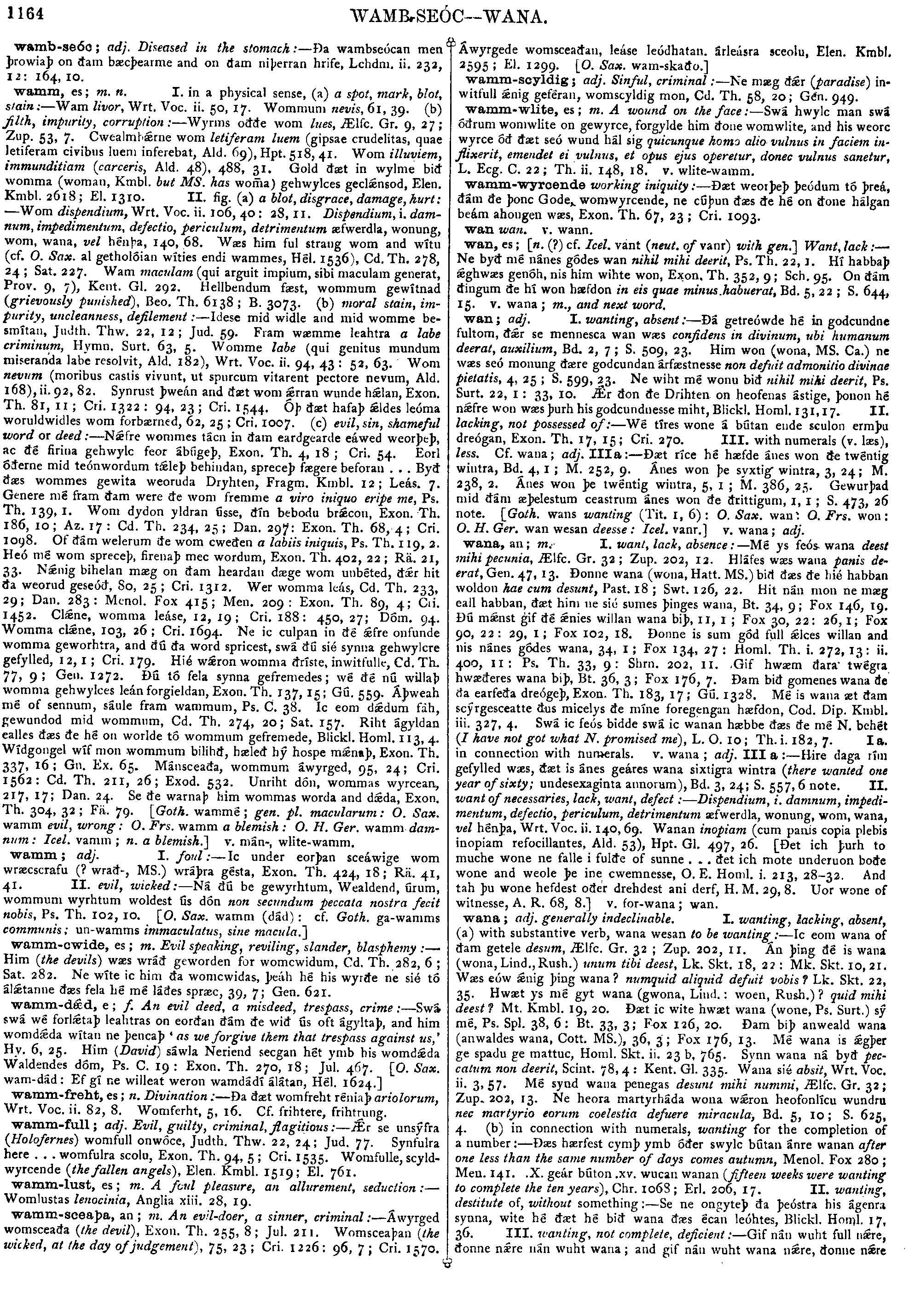
wamm-dd,
e
;
f.
An
evil
deed,
a
misdeed,
trespass,
crime
:--
Swá
swá
wé
forltaþ
leahtras
on
eorðan
ðám
ðe
wið
ús
oft
ágyltaþ,
and
womdda
wítan
ne
þencaþ
'as
we
forgive
them
that
trespass
against
us,'
Hy.
6,
25.
Him
(David)
sáwla
Neriend
secgan
hét
ymb
his
womdda
Waldendes
dóm,
Ps.
C.
19
:
Exon.
Th.
270,
18;
Jul.
467.
[O.
Sax.
wam-dád:
Ef
gí
ne
willeat
weron
wamdádí
álátan,
Hél.
1624.]
|
Source: Bosworth/Toller, page b1171, entry 20 View original page image as: [TIFF] [PNG] [View previous entry] [View next entry] |
[Comment on this entry] [View comments] |
The following entry has been hand-corrected once. |
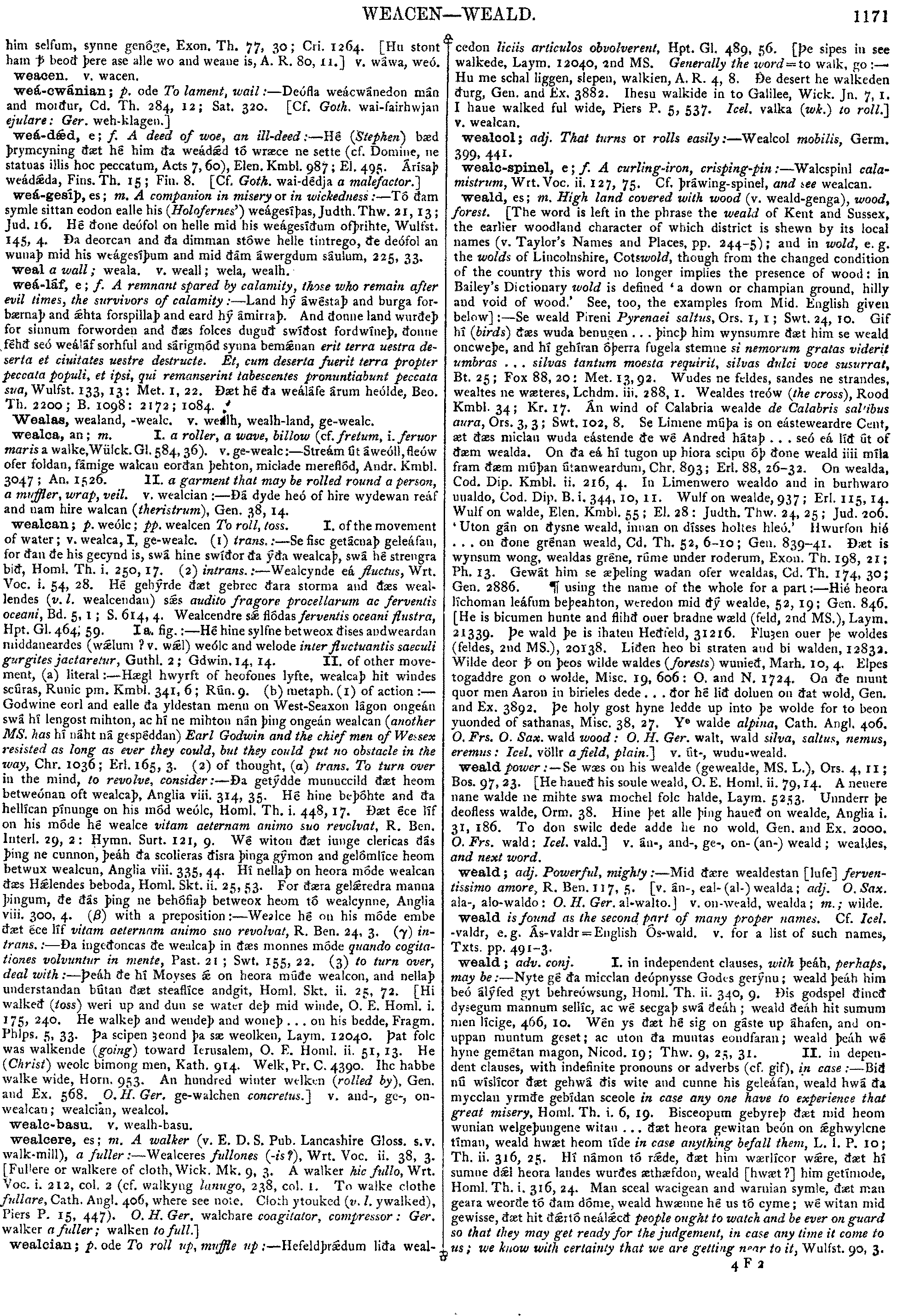
weald
;
adv.
conj.
I.
in
independent
clauses,
with
þeáh,
perhaps,
may
be
:--
Nyte
gé
ða
micclan
deópnysse
Godes
gerýnu;
weald
þeáh
him
beó
álýfed
gyt
behreówsung,
Homl.
Th.
ii.
340,
9.
Ðis
godspel
ðincð
dysegum
mannum
sellíc,
ac
wé
secgaþ
swá
ðeáh
;
weald
ðeáh
hit
sumum
men
lícige,
466,
10.
Wén
ys
ðæt
hé
sig
on
gáste
up
áhafen,
and
on uppan
muntum
geset;
ac
uton
ða
muntas
eondfaran;
weald
þeáh
wé
hyne
gemétan
magon,
Nicod.
19;
Thw.
9,
25,
31.
II.
in
dependent
clauses,
with
indefinite
pronouns
or
adverbs
(cf.
gif),
in
case
:--
Bið
nú
wíslícor
ðæt
gehwá
ðis
wile
and
cunne
his
geleáfan,
weald
hwá
ða
mycclan
yrmðe
gebídan
sceole
in
case
any
one
have
to
experience
that
great
misery,
Homl.
Th.
i.
6,
19.
Bisceopum
gebyreþ
ðæt
mid
heom
wunian
welgeþungene
witan
.
.
.
ðæt
heora
gewitan
beón
on
ghwylcne
tíman,
weald
hwæt
heom
tíde
in
case
anything
befall
them,
L.I.P.
10;
Th.
ii.
316,
25.
Hí
námon
tó
rde,
ðæt
him
wærlícor
wre,
ðæt
hí
sumne
dl
heora
landes
wurðes
æthæfdon,
weald
[hwæt
?]
him
getímode,
Homl.
Th.
i.
316,
24.
Man
sceal
wacigean
and
warnian
symle,
ðæt
man
geara
weorde
tó
ðam
dóme,
weald
hwænne
hé
us
tó
cyme;
wé
witan
mid
gewisse,
ðæt
hit
ðrtó
neálcð
people
ought
to
watch
and
be
ever
on
guard
so
that
they
may
get
ready
for
the
judgement,
in
case
any
time
it
come
to
us;
we
know
with
certainty
that
we
are
getting
near
to
it,
Wulfst.
90,
3.
uppan
muntum
geset;
ac
uton
ða
muntas
eondfaran;
weald
þeáh
wé
hyne
gemétan
magon,
Nicod.
19;
Thw.
9,
25,
31.
II.
in
dependent
clauses,
with
indefinite
pronouns
or
adverbs
(cf.
gif),
in
case
:--
Bið
nú
wíslícor
ðæt
gehwá
ðis
wile
and
cunne
his
geleáfan,
weald
hwá
ða
mycclan
yrmðe
gebídan
sceole
in
case
any
one
have
to
experience
that
great
misery,
Homl.
Th.
i.
6,
19.
Bisceopum
gebyreþ
ðæt
mid
heom
wunian
welgeþungene
witan
.
.
.
ðæt
heora
gewitan
beón
on
ghwylcne
tíman,
weald
hwæt
heom
tíde
in
case
anything
befall
them,
L.I.P.
10;
Th.
ii.
316,
25.
Hí
námon
tó
rde,
ðæt
him
wærlícor
wre,
ðæt
hí
sumne
dl
heora
landes
wurðes
æthæfdon,
weald
[hwæt
?]
him
getímode,
Homl.
Th.
i.
316,
24.
Man
sceal
wacigean
and
warnian
symle,
ðæt
man
geara
weorde
tó
ðam
dóme,
weald
hwænne
hé
us
tó
cyme;
wé
witan
mid
gewisse,
ðæt
hit
ðrtó
neálcð
people
ought
to
watch
and
be
ever
on
guard
so
that
they
may
get
ready
for
the
judgement,
in
case
any
time
it
come
to
us;
we
know
with
certainty
that
we
are
getting
near
to
it,
Wulfst.
90,
3.
|
Source: Bosworth/Toller, page b1173, entry 22 View original page image as: [TIFF] [PNG] [View previous entry] [View next entry] |
[Comment on this entry] [View comments] |
The following entry has been hand-corrected once. |
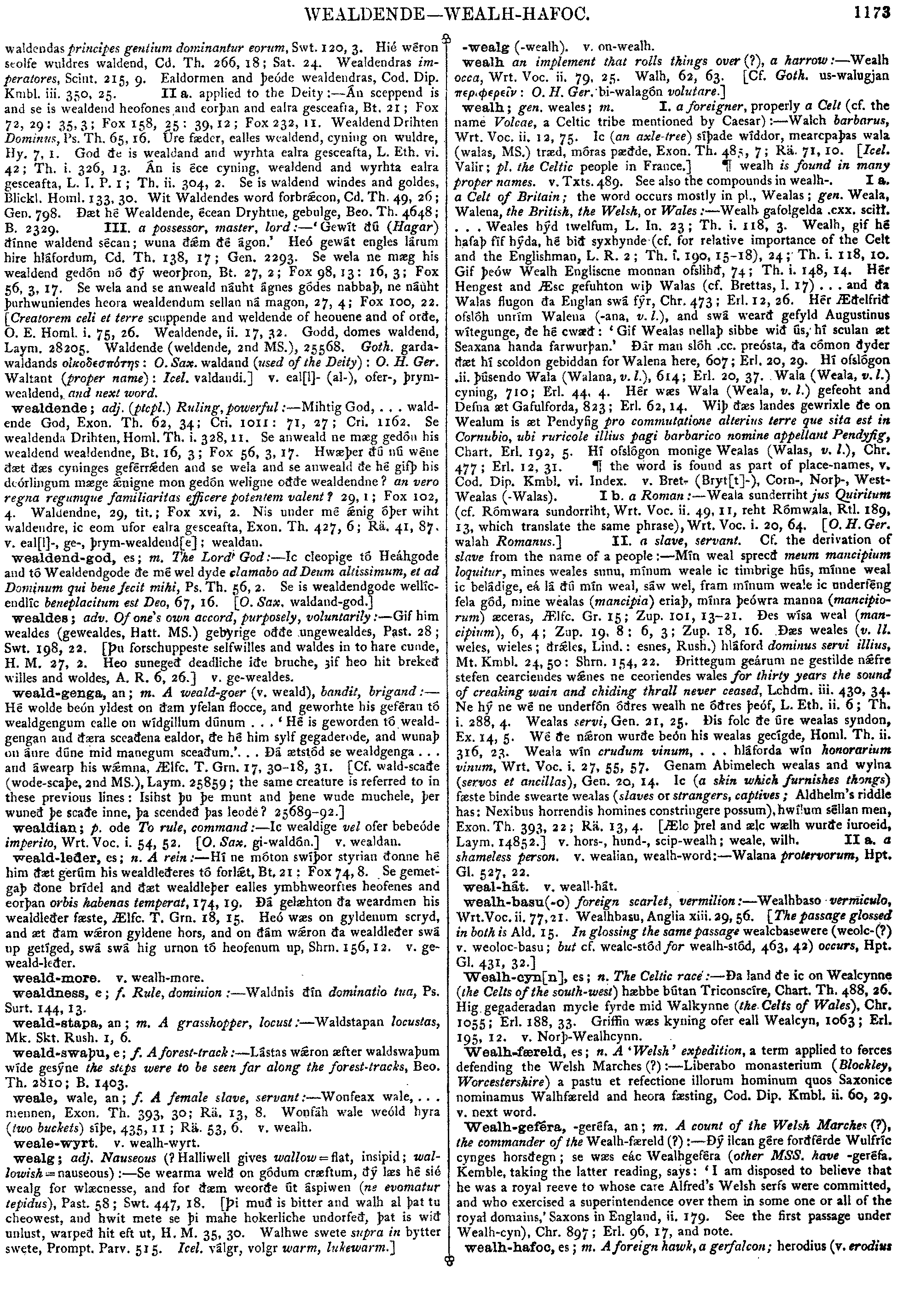
Wealh-geféra, -geréfa, an; m. A count of the Welsh Marches(?), the commander of the Wealh-færeld(?):--Ðý ilcan gére forðférde Wulfríc cynges horsðegn; se wæs eác Wealhgeféra (other MSS. have -geréfa. Kemble, taking the latter reading, says: 'I am disposed to believe that he was a royal reeve to whose care Alfred's Welsh serfs were committed, and who exercised a superintendence over them in some one or all of the royal domains,' Saxons in England, ii. 179. See the first passage under Wealh-cyn), Chr. 897; Erl. 96, 17, and note.
|
Source: Bosworth/Toller, page b1175, entry 1 View original page image as: [TIFF] [PNG] [View previous entry] [View next entry] |
[Comment on this entry] [View comments (1)] |
The following entry has been hand-corrected once. |
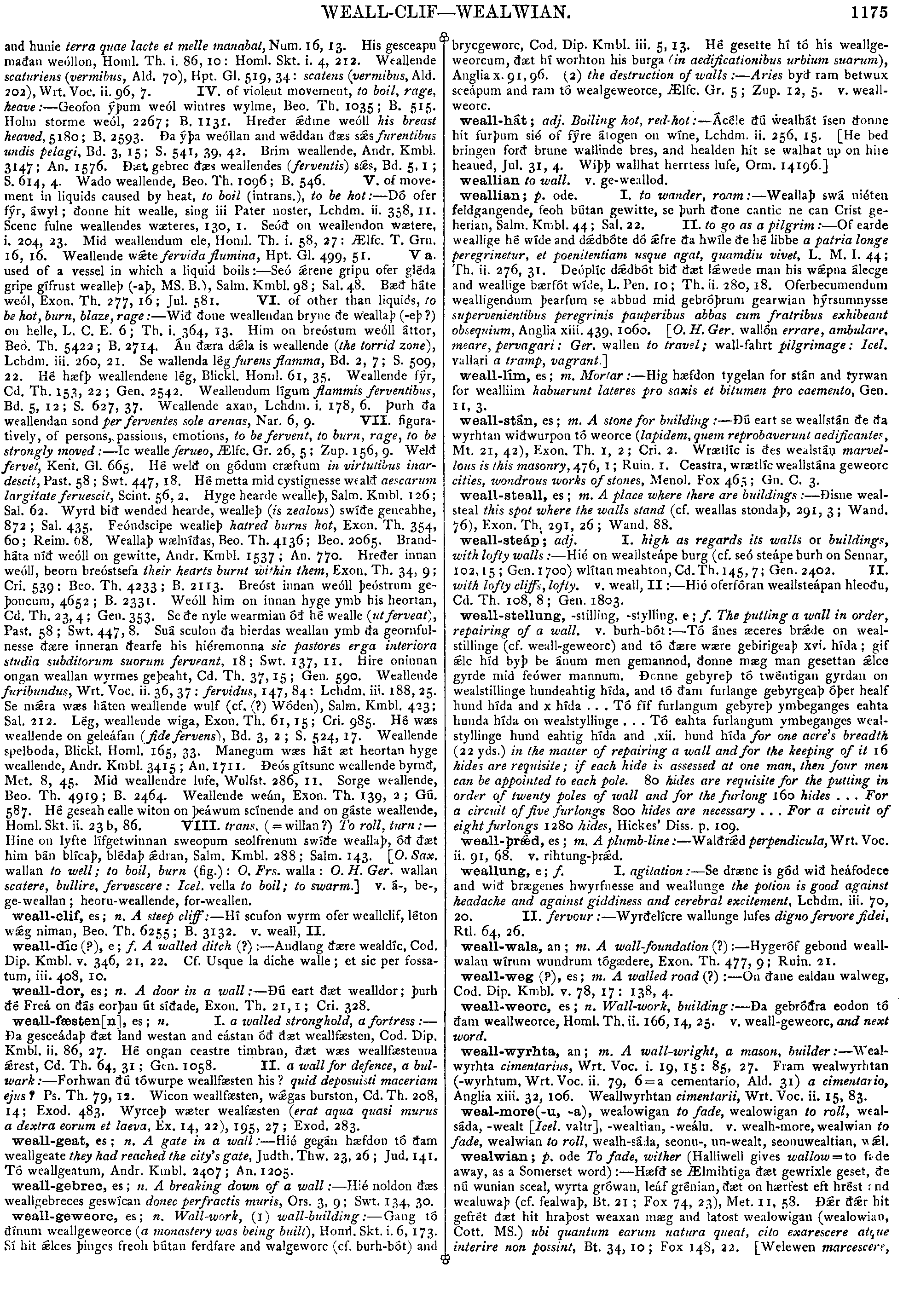
and
hunie
terra
quae
lacte
el
melle
manabat,
Num.
16,
13.
His
gesceapu
maðan
weóllon,
Homl.
Th.
i.
86,
10:
Homl.
Skt.
i.
4,
212.
Weallende
scaturiens
(vermibus,
Ald.
70),
Hpt.
Gl.
519,
34:
scatens
(vermibus,
Ald.
202),
Wrt.
Voc.
ii.
96,
7.
IV.
of
violent
movement,
to
boil,
rage,
heave:--Geofon
ýþum
weól
winlres
wylme,
Beo.
Th.
1035;
B.
515.
Holm
storme
weól,
2267;
B.
1131.
Hreðer
ðme
weóll
his
breast
heaved,
5180;
B.
2593.
Ða
ýþa
weóllan
and
wéddan
ðæs
ss
furentibus
undis
pelagi,
Bd.
3,
15;
S.
541,
39,
42.
Brim
weallende,
Andr.
Kmbl.
3147;
An.
1576.
Ðæt
gebrec
ðæs
weallendes
(ferventis)
ss,
Bd.
5,
1;
S.
614,
4.
Wado
weallende,
Beo.
Th.
1096;
B.
546.
V.
of
movement
in
liquids
caused
by
heat,
to
boil
(intrans.),
to
be
hot:--Dó
ofer
fýr,
áwyl;
ðonne
hit
wealle,
sing
iii
Pater
noster,
Lchdm.
ii.
358,
11.
Scenc
fulne
weallendes
wæteres,
130,
1.
Seóð
on
weallendon
wætere,
i.
204,
23.
Mid
weallendum
ele,
Homl.
Th.
i.
58,
27:
Ælfc.
T.
Grn.
16,
16.
Weallende
wte
fervida
flumina,
Hpt.
Gl.
499,
51.
V
a.
used
of
a
vessel
in
which
a
liquid
boils:--Seó
rene
gripu
ofer
gléda
gripe
gífrust
wealleþ
(-aþ,
MS.
B.),
Salm.
Kmbl.
98;
Sal.
48.
Bæð
háte
weól,
Exon.
Th.
277,
16;
Jul.
581.
VI.
of
other
than
liquids,
to
be
hot,
burn,
blaze,
rage:--Wið
ðone
weallendan
bryne
ðe
weallaþ
(-eþ?)
on
helle,
L.
C.
E.
6;
Th.
i.
364,
13.
Him
on
breóstum
weóll
áttor,
Beo.
Th.
5422;
B.
2714.
Án
ðæra
dla
is
weallende
(the
torrid
zone),
Lchdm.
iii.
260,
21.
Se
wallenda
lég
furens
flamma,
Bd.
2,
7;
S.
509,
22.
Hé
hæfþ
weallendene
lég,
Blickl.
Homl.
61,
35.
Weallende
fýr,
Cd.
Th.
153,
22;
Gen.
2542.
Weallendum
lígum
flammis
ferventibus,
Bd.
5,
12;
S.
627,
37.
Weallende
axan,
Lchdm.
i.
178,
6.
Þurh
ða
weallendan
sond
per
ferventes
sole
arenas,
Nar.
6,
9.
VII.
figuratively,
of
persons,
passions,
emotions,
to
be
fervent,
to
burn,
rage,
to
be
strongly
moved:--Ic
wealle
ferueo,
Ælfc.
Gr.
26,
5;
Zup.
156,
9.
Welð
fervet,
Kent.
Gl.
665.
Hé
welð
on
gódum
cræftum
in
virtutibus
inardescit,
Past.
58;
Swt.
447,
18.
Hé
metta
mid
cystignesse
wealð
aescarum
largitate
feruescit,
Scint.
56,
2.
Hyge
hearde
wealleþ,
Salm.
Kmbl.
126;
Sal.
62.
Wyrd
bið
wended
hearde,
wealleþ
(is
zealous)
swíðe
geneahhe,
872;
Sal.
435.
Feóndscipe
wealleþ
hatred
burns
hot,
Exon.
Th.
354,
60;
Reim.
68.
Weallaþ
wælníðas,
Beo.
Th.
4136;
Beo.
2065.
Brandháta
níð
weóll
on
gewitte,
Andr.
Kmbl.
1537;
An.
770.
Hreðer
innan
weóll,
beorn
breóstsefa
their
hearts
burnt
within
them,
Exon.
Th.
34,
9;
Cri.
539:
Beo.
Th.
4233;
B.
2113.
Breóst
innan
weóll
þeóstrum
geþoncum,
4652;
B.
2331.
Weóll
him
on
innan
hyge
ymb
his
heortan,
Cd.
Th.
23,
4;
Gen.
353.
Se
ðe
nyle
wearmian
óð
hé
wealle
(ut
ferveat),
Past.
58;
Swt.
447,
8.
Suá
sculon
ða
hierdas
weallan
ymb
ða
geornfulnesse
ðære
inneran
ðearfe
his
hiéremonna
sic
pastores
erga
interiora
studia
subditornm
suorum
ferveant,
18;
Swt.
137,
11.
Hire
oninnan
ongan
weallan
wyrmes
geþeaht,
Cd.
Th.
37,
15;
Gen.
590.
Weallende
furibundus,
Wrt.
Voc.
ii.
36,
37:
fervidus,
147,
84:
Lchdm.
iii.
188,
25.
Se
mra
wæs
háten
weallende
wulf
(cf.
(?)
Wóden),
Salm.
Kmbl.
423;
Sal.
212.
Lég,
weallende
wiga,
Exon.
Th.
61,
15;
Cri.
985.
Hé
wæs
weallende
on
geleáfan
(fide
fervens),
Bd.
3,
2;
S.
524,
17.
Weallende
spelboda,
Blickl.
Homl.
165,
33.
Manegum
wæs
hát
æt
heortan
hyge
weallende,
Andr.
Kmbl.
3415;
An.
1711.
Ðeós
gítsunc
weallende
byrnð,
Met.
8,
45.
Mid
weallendre
lufe,
Wulfst.
286,
11.
Sorge
weallende,
Beo.
Th.
4919;
B.
2464.
Weallende
weán,
Exon.
Th.
139,
2;
Gú.
587.
Hé
geseah
ealle
witon
on
þeáwum
scínende
and
on
gáste
weallende,
Homl.
Skt.
ii.
23
b,
86.
VIII.
trans.
(
=
willan?)
To
roll,
turn:--Hine
on
lyfte
lífgetwinnan
sweopum
seolfrenum
swíðe
weallaþ,
óð
ðæt
him
bán
blícaþ,
blédaþ
dran,
Salm.
Kmbl.
288;
Salm.
143.
[O.
Sax.
wallan
to
well;
to
boil,
burn
(fig.):
O.
Frs.
walla:
O.
H.
Ger.
wallan
scatere,
bullire,
fervescere:
Icel.
vella
to
boil;
to
swarm.]
v.
á-,
be-,
ge-weallan;
heoru-weallende,
for-weallen.
|
Source: Bosworth/Toller, page b1178, entry 7 View original page image as: [TIFF] [PNG] [View previous entry] [View next entry] |
[Comment on this entry] [View comments] |
The following entry has been hand-corrected once. |
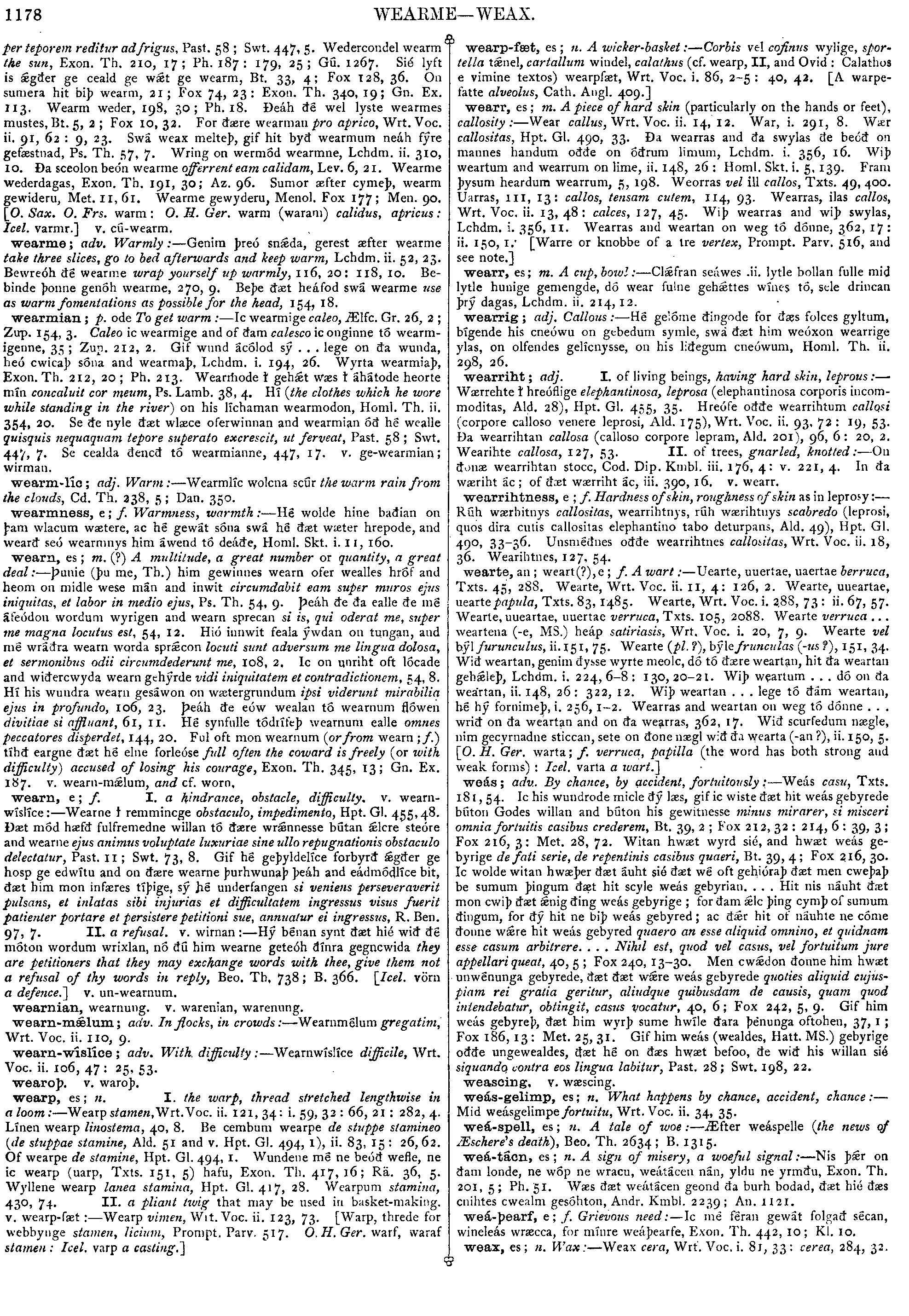
wearn,
e;
f.
I.
a
hindrance,
obstacle,
difficulty,
v.
wearn-wíslíce
:--
Wearne
 remmincge
obstaculo,
impedimento,
Hpt.
Gl.
455,
48.
Ðæt
mód
hæfð
fulfremedne
willan
tó
ðære
wrnnesse
bútan
lcre
steóre
and
wearne
ejus
animus
voluptate
luxuriae
sine
ullo
repugnationis
obstaculo
delectatur,
Past.
11;
Swt.
73,
8.
Gif
hé
geþyldelíce
forbyrð
gðer
ge
hosp
ge
edwítu
and
on
ðære
wearne
þurhwunaþ
þeáh
and
eádmódlíce
bit,
ðæt
him
mon
infæres
tíþige,
sý
hé
underfangen
si
veniens
perseveraverit
pulsans,
et
inlatas
sibi
injurias
et
difficultatem
ingressus
visus
fuerit
patienter
portare
et
persistere
petitioni
sue,
annuatur
ei
ingressus,
R.
Ben.
97,
7.
II
a
refusal,
v.
wirnan
:--
Hý
bénan
synt
ðæt
hié
wið
ðé
móton
wordum
wrixlan,
nó
dú
him
wearne
geteóh
ðínra
gegncwida
they
are
petitioners
that
they
may
exchange
words
with
thee,
give
them
not
a
refusal
of
thy
words
in
reply,
Beo.
Th.
738;
B.
366.
[Icel.
vörn
a
defence.]
v.
un-wearnum.
remmincge
obstaculo,
impedimento,
Hpt.
Gl.
455,
48.
Ðæt
mód
hæfð
fulfremedne
willan
tó
ðære
wrnnesse
bútan
lcre
steóre
and
wearne
ejus
animus
voluptate
luxuriae
sine
ullo
repugnationis
obstaculo
delectatur,
Past.
11;
Swt.
73,
8.
Gif
hé
geþyldelíce
forbyrð
gðer
ge
hosp
ge
edwítu
and
on
ðære
wearne
þurhwunaþ
þeáh
and
eádmódlíce
bit,
ðæt
him
mon
infæres
tíþige,
sý
hé
underfangen
si
veniens
perseveraverit
pulsans,
et
inlatas
sibi
injurias
et
difficultatem
ingressus
visus
fuerit
patienter
portare
et
persistere
petitioni
sue,
annuatur
ei
ingressus,
R.
Ben.
97,
7.
II
a
refusal,
v.
wirnan
:--
Hý
bénan
synt
ðæt
hié
wið
ðé
móton
wordum
wrixlan,
nó
dú
him
wearne
geteóh
ðínra
gegncwida
they
are
petitioners
that
they
may
exchange
words
with
thee,
give
them
not
a
refusal
of
thy
words
in
reply,
Beo.
Th.
738;
B.
366.
[Icel.
vörn
a
defence.]
v.
un-wearnum.
|
Source: Bosworth/Toller, page b1185, entry 7 View original page image as: [TIFF] [PNG] [View previous entry] [View next entry] |
[Comment on this entry] [View comments] |
The following entry has been hand-corrected once. |
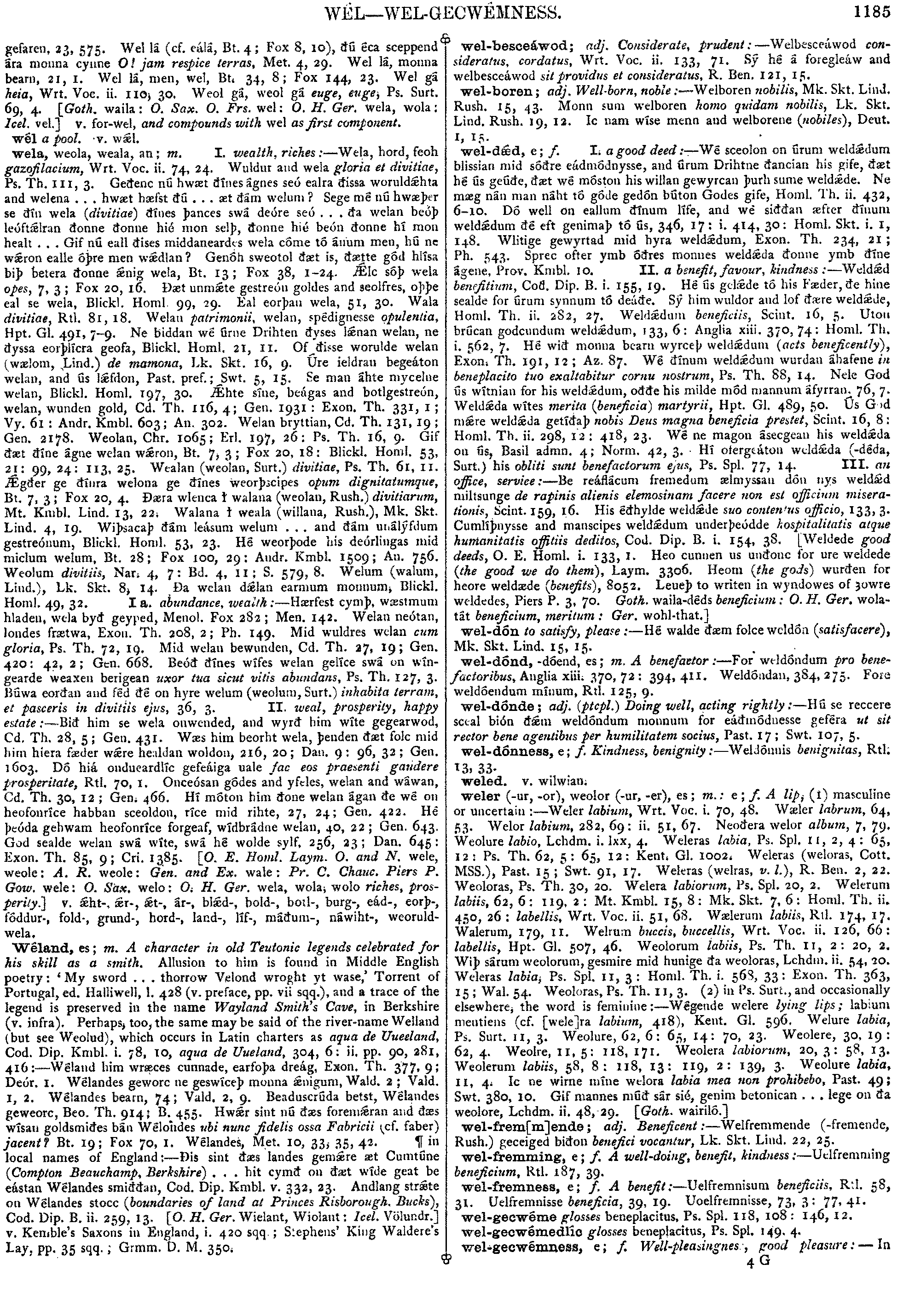
wel-dd,
e;
f.
I.
a
good
deed:--Wé
sceolon
on
úrum
welddum
blissian
mid
sóðre
eádmódnysse,
and
úrum
Drihtne
ðancian
his
gife,
ðæt
hé
ús
geúðe,
ðæt
wé
móston
his
willan
gewyrcan
þurh
sume
weldde.
Ne
mæg
nán
man
náht
tó
góde
gedón
búton
Godes
gife,
Homl.
Th.
ii.
432,
6-10.
Dó
well
on
eallum
ðínum
lífe,
and
wé
siððan
æfter
ðínum
welddum
ðé
eft
genimaþ
tó
ús,
346,
17:
i.
414,
30:
Homl.
Skt.
i.
1,
148.
Wlitige
gewyrtad
mid
hyra
welddum,
Exon.
Th.
234,
21;
Ph.
543.
Sprec
ofter
ymb
óðres
monnes
weldda
ðonne
ymb
ðíne
ágene,
Prov.
Kmbl.
10.
II.
a
benefit,
favour,
kindness:--Weldd
benefitium,
Cod.
Dip.
B.
i.
155,
19.
Hé
ús
gelde
tó
his
Fæder,
ðe
hine
sealde
for
úrum
synnum
tó
deáðe.
Sý
him
wuldor
and
lof
ðære
weldde,
Homl.
Th.
ii.
282,
27.
Welddum
beneficiis,
Scint.
16,
5.
Uton
brúcan
godcundum
welddum,
133,
6:
Anglia
xiii.
370,
74:
Homl.
Th.
i.
562,
7.
Hé
wið
monna
bearn
wyrceþ
welddum
(acts
beneficently),
Exon.
Th.
191,
12;
Az.
87.
Wé
ðínum
welddum
wurdan
áhafene
in
beneplacito
tuo
exaltabitur
cornu
nostrum,
Ps.
Th.
88,
14.
Nele
God
ús
witnian
for
his
welddum,
oððe
his
milde
mód
mannum
áfyrran,
76,
7.
Weldda
wítes
merita
(beneficia)
martyrii,
Hpt.
Gl.
489,
50.
Ús
God
mre
weldda
getíðaþ
nobis
Deus
magna
beneficia
prestet,
Scint.
16,
8:
Homl.
Th.
ii.
298,
12;
418,
23.
Wé
ne
magon
ásecgean
his
weldda
on
ús,
Basil
admn.
4;
Norm.
42,
3.
Hí
ofergeáton
weldda
(-déda,
Surt.)
his
obliti
sunt
benefactorum
ejus,
Ps.
Spl.
77,
14.
III.
an
office,
service:--Be
reáflácum
fremedum
ælmyssan
dón
nys
weldd
miltsunge
de
rapinis
alienis
elemosinam
facere
non
est
officium
miserationis,
Scint.
159,
16.
His
éðhylde
weldde
suo
contentus
officio,
133,
3.
Cumlíþnysse
and
manscipes
welddum
underþeódde
hospitalitatis
atque
humanitatis
offitiis
deditos,
Cod.
Dip.
B.
i.
154,
38.
[Weldede
good
deeds,
O.
E.
Homl.
i.
133,
1.
Heo
cunnen
us
unðonc
for
ure
weldede
(the
good
we
do
them),
Laym.
3306.
Heom
(the
gods)
wurðen
for
heore
weldæde
(benefits),
8052.
Leueþ
to
writen
in
wyndowes
of
owre
weldedes,
Piers
P.
3,
70.
Goth.
waila-déds
beneficium:
O.
H.
Ger.
wolatát
beneficium,
meritum:
Ger.
wohl-that.]
|
Source: Bosworth/Toller, page b1187, entry 14 View original page image as: [TIFF] [PNG] [View previous entry] [View next entry] |
[Comment on this entry] [View comments] |
The following entry has been hand-corrected once. |
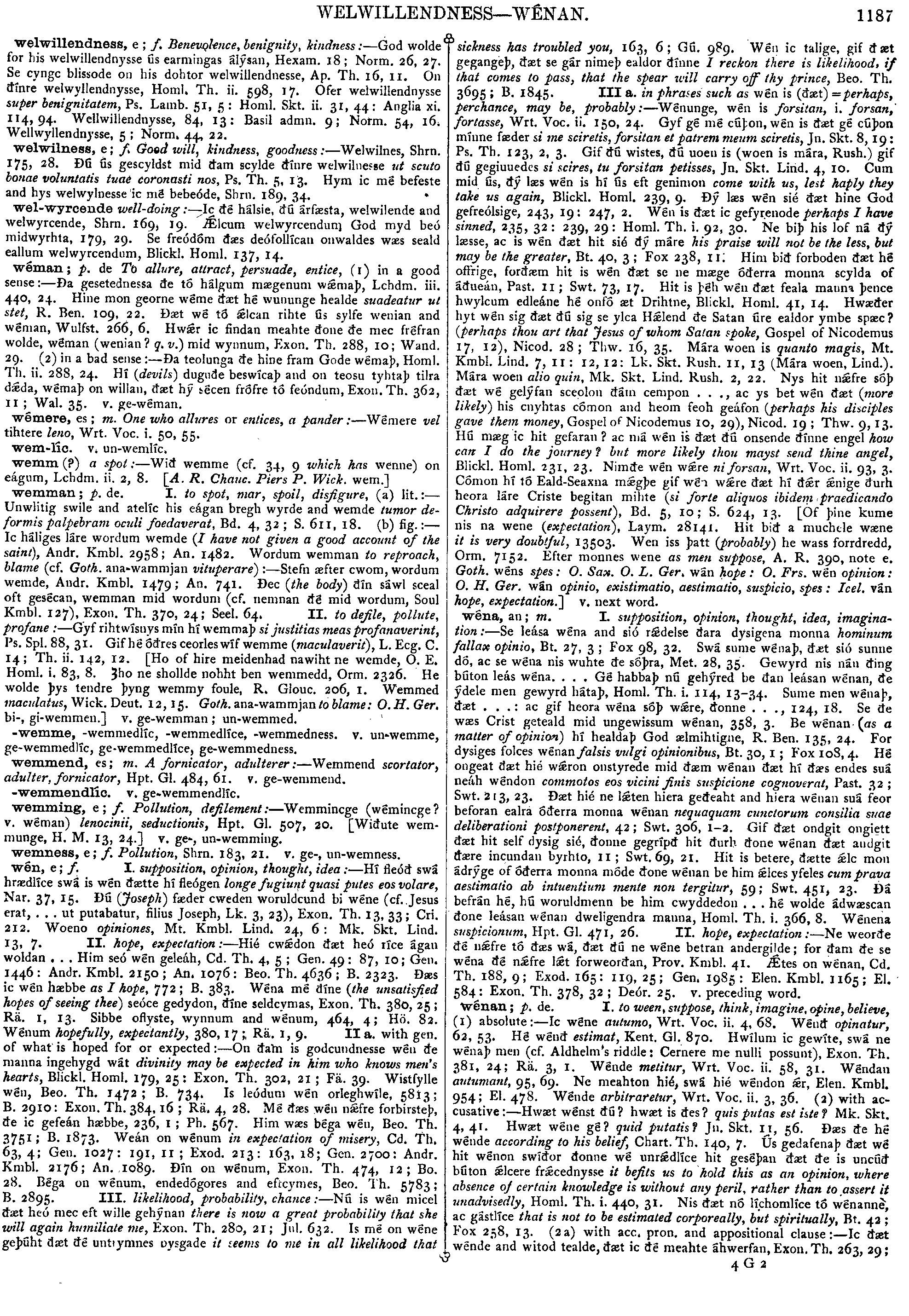
wén,
e;
f.
I.
supposition,
opinion,
thought,
idea:--Hí
fleóð
swá
hrædlíce
swá
is
wén
ðætte
hí
fleógen
longe
fugiunt
quasi
putes
eos
volare,
Nar.
37,
15.
Ðú
(Joseph)
fæder
cweden
woruldcund
bi
wéne
(cf.
Jesus
erat,
.
.
.
ut
putabatur,
filius
Joseph,
Lk.
3,
23),
Exon.
Th.
13,
33;
Cri.
212.
Woeno
opiniones,
Mt.
Kmbl.
Lind.
24,
6:
Mk.
Skt.
Lind.
13,
7.
II.
hope,
expectation:--Hié
cwdon
ðæt
heó
ríce
ágan
woldan
.
.
.
Him
seó
wén
geleáh,
Cd.
Th.
4,
5;
Gen.
49:
87,
10;
Gen.
1446:
Andr.
Kmbl.
2150;
An.
1076:
Beo.
Th.
4636;
B.
2323.
Ðæs
ic
wén
hæbbe
as
I
hope,
772;
B.
383.
Wéna
mé
ðíne
(the
unsatisfied
hopes
of
seeing
thee)
seóce
gedydon,
ðíne
seldcymas,
Exon.
Th.
380,
25;
Rä.
1,
13.
Sibbe
oflyste,
wynnum
and
wénum,
464,
4;
Hö.
82.
Wénum
hopefully,
expectantly,
380,
17;
Rä.
1,
9.
II
a.
with
gen.
of
what
is
hoped
for
or
expected:--On
ðam
is
godcundnesse
wén
ðe
manna
ingehygd
wát
divinity
may
be
expected
in
him
who
knows
men's
hearts,
Blickl.
Homl.
179,
25:
Exon.
Th.
302,
21;
Fä.
39.
Wistfylle
wén,
Beo.
Th.
1472;
B.
734.
Is
leódum
wén
orleghwíle,
5813;
B.
2910:
Exon.
Th.
384,
16;
Rä.
4,
28.
Mé
ðæs
wén
nfre
forbirsteþ,
ðe
ic
gefeán
hæbbe,
236,
1;
Ph.
567.
Him
wæs
béga
wén,
Beo.
Th.
3751;
B.
1873.
Weán
on
wénum
in
expectation
of
misery,
Cd.
Th.
63,
4;
Gen.
1027:
191,
11;
Exod.
213:
163,
18;
Gen.
2700:
Andr.
Kmbl.
2176;
An.
1089.
Ðín
on
wénum,
Exon.
Th.
474,
12;
Bo.
28.
Béga
on
wénum,
endedógores
and
eftcymes,
Beo.
Th.
5783;
B.
2895.
III.
likelihood,
probability,
chance:--Nú
is
wén
micel
ðæt
heó
mec
eft
wille
gehýnan
there
is
now
a
great
probability
that
she
will
again
humiliate
me,
Exon.
Th.
280,
21;
Jul.
632.
Is
mé
on
wéne
geþúht
ðæt
ðé
untrymnes
bysgade
it
seems
to
me
in
all
likelihood
that
sickness
has
troubled
you,
163,
6;
Gú.
989.
Wén
ic
talige,
gif
ð
æt
gegangéþ,
ðæt
se
gár
nimeþ
ealdor
ðínne
I
reckon
there
is
likelihood,
if
that
comes
to
pass,
that
the
spear
will
carry
off
thy
prince,
Beo.
Th.
3695;
B.
1845.
III
a.
in
phrases
such
as
wén
is
(ðæt)
=
perhaps,
perchance,
may
be,
probably:--Wénunge,
wén
is
forsitan,
i.
forsan,
fortasse,
Wrt.
Voc.
ii.
150,
24.
Gyf
gé
mé
cúþon,
wén
is
ðæt
gé
cúþon
mínne
fæder
si
me
sciretis,
forsitan
et
patrem
meum
sciretis,
Jn.
Skt.
8,
19:
Ps.
Th.
123,
2,
3.
Gif
ðú
wistes,
ðú
uoen
is
(woen
is
mára,
Rush.)
gif
ðú
gegiuuedes
si
scires,
tu
forsitan
petisses,
Jn.
Skt.
Lind.
4,
10.
Cum
mid
ús,
ðý
læs
wén
is
hí
ús
eft
genimon
come
with
us,
lest
haply
they
take
us
again,
Blickl.
Homl.
239,
9.
Ðý
læs
wén
sié
ðæt
hine
God
gefreólsige,
243,
19:
247,
2.
Wén
is
ðæt
ic
gefyrenode
perhaps
I
have
sinned,
235,
32:
239,
29:
Homl.
Th.
i.
92,
30.
Ne
biþ
his
lof
ná
ðý
læsse,
ac
is
wén
ðæt
hit
sié
ðý
máre
his
praise
will
not
be
the
less,
but
may
be
the
greater,
Bt.
40,
3;
Fox
238,
11.
Him
bið
forboden
ðæt
hé
offrige,
forðæm
hit
is
wén
ðæt
se
ne
mæge
óðerra
monna
scylda
of
áðueán,
Past.
11;
Swt.
73,
17.
Hit
is
þéh
wén
ðæt
feala
manna
þence
hwylcum
edleáne
hé
onfó
æt
Drihtne,
Blickl.
Homl.
41,
14.
Hwæðer
hyt
wén
sig
ðæt
ðú
sig
se
ylca
Hlend
ðe
Satan
úre
ealdor
ymbe
spæc?
(perhaps
thou
art
that
Jesus
of
whom
Satan
spoke,
Gospel
of
Nicodemus
17,
12),
Nicod.
28;
Thw.
16,
35.
Mára
woen
is
quanto
magis,
Mt.
Kmbl.
Lind.
7,
11:
12,
12:
Lk.
Skt.
Rush.
11,
13
(Mára
woen,
Lind.).
Mára
woen
alio
quin,
Mk.
Skt.
Lind.
Rush.
2,
22.
Nys
hit
nfre
sóþ
ðæt
wé
gelýfan
sceolon
ðám
cempon
.
.
.,
ac
ys
bet
wén
ðæt
(more
likely)
his
cnyhtas
cómon
and
heom
feoh
geáfon
(perhaps
his
disciples
gave
them
money,
Gospel
of
Nicodemus
10,
29),
Nicod.
19;
Thw.
9,
13.
Hú
mæg
ic
hit
gefaran?
ac
má
wén
is
ðæt
ðú
onsende
ðínne
engel
how
can
I
do
the
journey?
but
more
likely
thou
mayst
send
thine
angel,
Blickl.
Homl.
231,
23.
Nimðe
wén
wre
ni
forsan,
Wrt.
Voc.
ii.
93,
3.
Cómon
hí
tó
Eald-Seaxna
mgþe
gif
wén
wre
ðæt
hí
ðr
nige
ðurh
heora
láre
Criste
begitan
mihte
(si
forte
aliquos
ibidem
praedicando
Christo
adquirere
possent),
Bd.
5,
10;
S.
624,
13.
[Of
þine
kume
nis
na
wene
(expectation),
Laym.
28141.
Hit
bið
a
muchele
wæne
it
is
very
doubtful,
13503.
Wen
iss
þatt
(probably)
he
wass
forrdredd,
Orm.
7152.
Efter
monnes
wene
as
men
suppose,
A.
R.
390,
note
e.
Goth.
wéns
spes:
O.
Sax.
0.
L.
Ger.
wán
hope:
O.
Frs.
wén
opinion:
O.
H.
Ger.
wán
opinio,
existimatio,
aestimatio,
suspicio,
spes:
Icel.
ván
hope,
expectation.]
v.
next
word.
|
Source: Bosworth/Toller, page b1189, entry 14 View original page image as: [TIFF] [PNG] [View previous entry] [View next entry] |
[Comment on this entry] [View comments] |
The following entry has been hand-corrected once. |
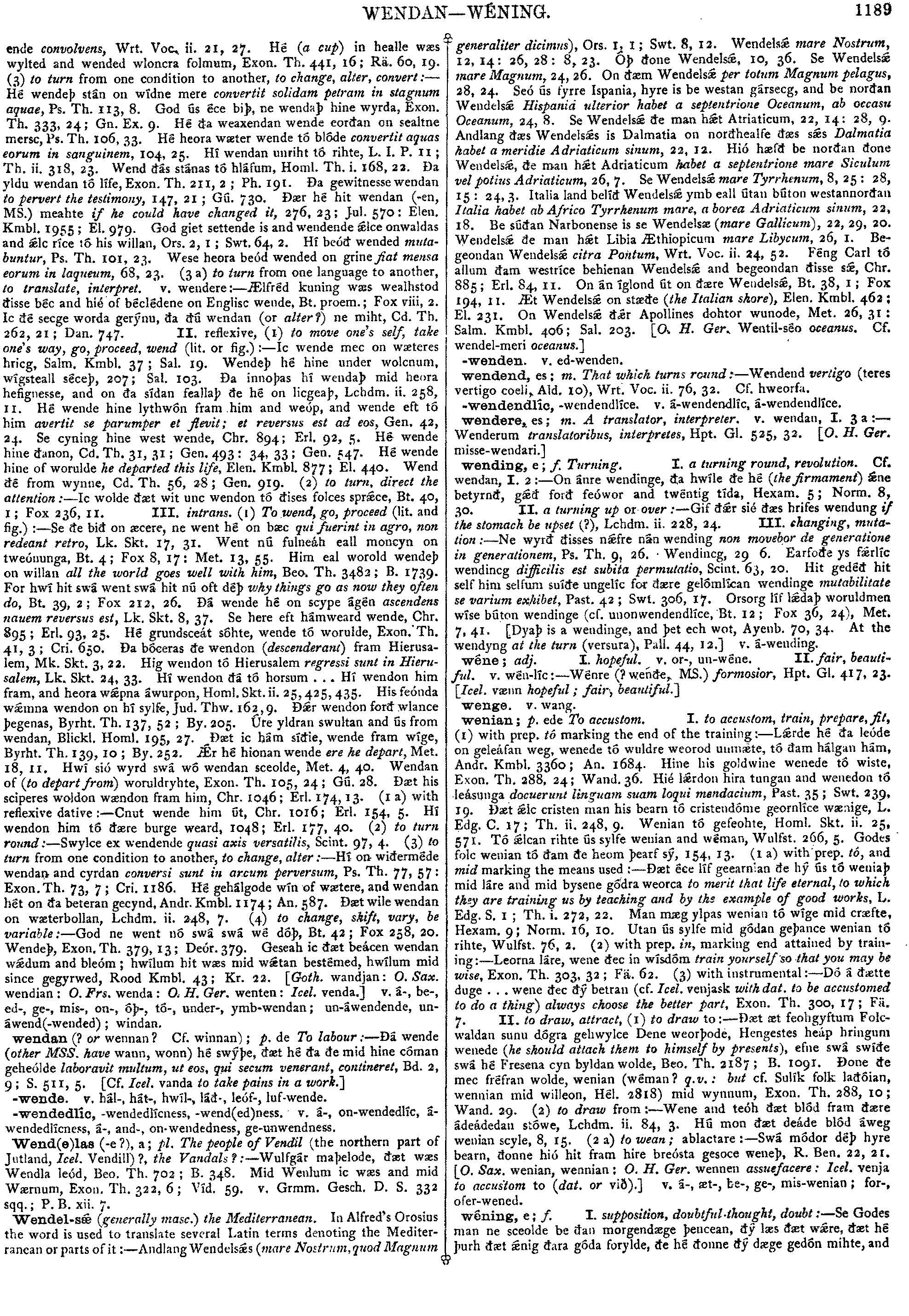
wenian;
p.
ede
To
accustom.
I.
to
accustom,
train,
prepare,
fit,
(1)
with
prep.
tó
marking
the
end
of
the
training:--Lrde
hé
ða
leóde
on
geleáfan
weg,
wenede
tó
wuldre
weorod
unmæte,
tó
ðam
hálgan
hám,
Andr.
Kmbl.
3360;
An.
1684.
Hine
his
goldwine
wenede
tó
wiste,
Exon.
Th.
288,
24;
Wand.
36.
Hié
lrdon
hira
tungan
and
wenedon
tó
leásunga
docuerunt
linguam
suam
loqui
mendacium,
Past.
35;
Swt.
239,
19.
Ðæt
lc
cristen
man
his
bearn
tó
cristendóme
geornlíce
waenige,
L.
Edg.
C.
17;
Th.
ii.
248,
9.
Wenian
tó
gefeohte,
Homl.
Skt.
ii.
25,
571.
Tó
lcan
rihte
ús
sylfe
wenian
and
wéman,
Wulfst.
266,
5.
Godes
folc
wenian
tó
ðam
ðe
heom
þearf
sý,
154,
13.
(1
a)
with
prep.
tó,
and
mid
marking
the
means
used:--Ðæt
éce
líf
geearnian
ðe
hý
ús
tó
weniaþ
mid
láre
and
mid
þysene
gódra
weorca
to
merit
that
life
eternal,
to
which
they
are
training
us
by
teaching
and
by
the
example
of
good
works,
L.
Edg.
S.
1;
Th.
i.
272,
22.
Man
mag
ylpas
wenian
tó
wíge
mid
cræfte,
Hexam.
9;
Norm.
16,
10.
Utan
ús
sylfe
mid
gódan
geþance
wenian
tó
rihte,
Wulfst.
76,
2.
(2)
with
prep,
in,
marking
end
attained
by
training:--Leorna
láre,
wene
ðec
in
wísdóm
train
yourself
so
that
you
may
be
wise,
Exon.
Th.
303,
32;
Fä.
62.
(3)
with
instrumental:--Dó
á
ðætte
duge
.
.
.
wene
ðec
ðý
betran
(cf.
Icel.
venjask
with
dat.
to
be
accustomed
to
do
a
thing)
always
choose
the
better
part,
Exon.
Th.
300,
17;
Fä.
7.
II.
to
draw,
attract,
(1)
to
draw
to:--Ðæt
æt
feohgyftum
Folcwaldan
sunu
dógra
gehwylce
Dene
weorþode,
Hengestes
heáp
hringum
wenede
(he
should
attach
them
to
himself
by
presents),
efne
swá
swíðe
swá
hé
Fresena
cyn
byldan
wolde,
Beo.
Th.
2187;
B.
1091.
Ðone
ðe
mec
fréfran
wolde,
wenian
(wéman?
q.
v.:
but
cf.
Sulík
folk
laðóian,
wennian
mid
willeon,
Hél.
2818)
mid
wynnum,
Exon.
Th.
288,
10;
Wand.
29.
(2)
to
draw
from:--Wene
and
teóh
ðæt
blód
fram
ðære
ádeádedan
stówe,
Lchdm.
ii.
84,
3.
Hú
mon
ðæt
deáde
blód
áweg
wenian
scyle,
8,
15.
(2
a)
to
wean;
ablactare:--Swá
módor
déþ
hyre
bearn,
ðonne
hió
hit
fram
hire
breósta
gesoce
weneþ,
R.
Ben.
22,
21.
[O.
Sax.
wenian,
wennian:
O.
H.
Ger.
wennen
assuefacere:
Icel.
venja
to
accustom
to
(dat.
or
við).]
v.
á-,
æt-,
be-,
ge-,
mis-wenian;
for-,
ofer-wened.
| Result Page: |  |
Previous | 82 83 84 85 86 87 88 89 90 91 92 93 94 95 96 97 98 99 100 | Next |  |
Germanic Lexicon Project (main page)
This search system was written by
Sean Crist
Please consider
volunteering
to correct the data in these online dictionaries.
No rights reserved. Feel free to use these data in any way you please.