|
|

|
Source: Bosworth/Toller, page b0005, entry 43 View original page image as: [TIFF] [PNG] [View previous entry] [View next entry] |
[Comment on this entry] [View comments] |
The following entry has been hand-corrected once. |
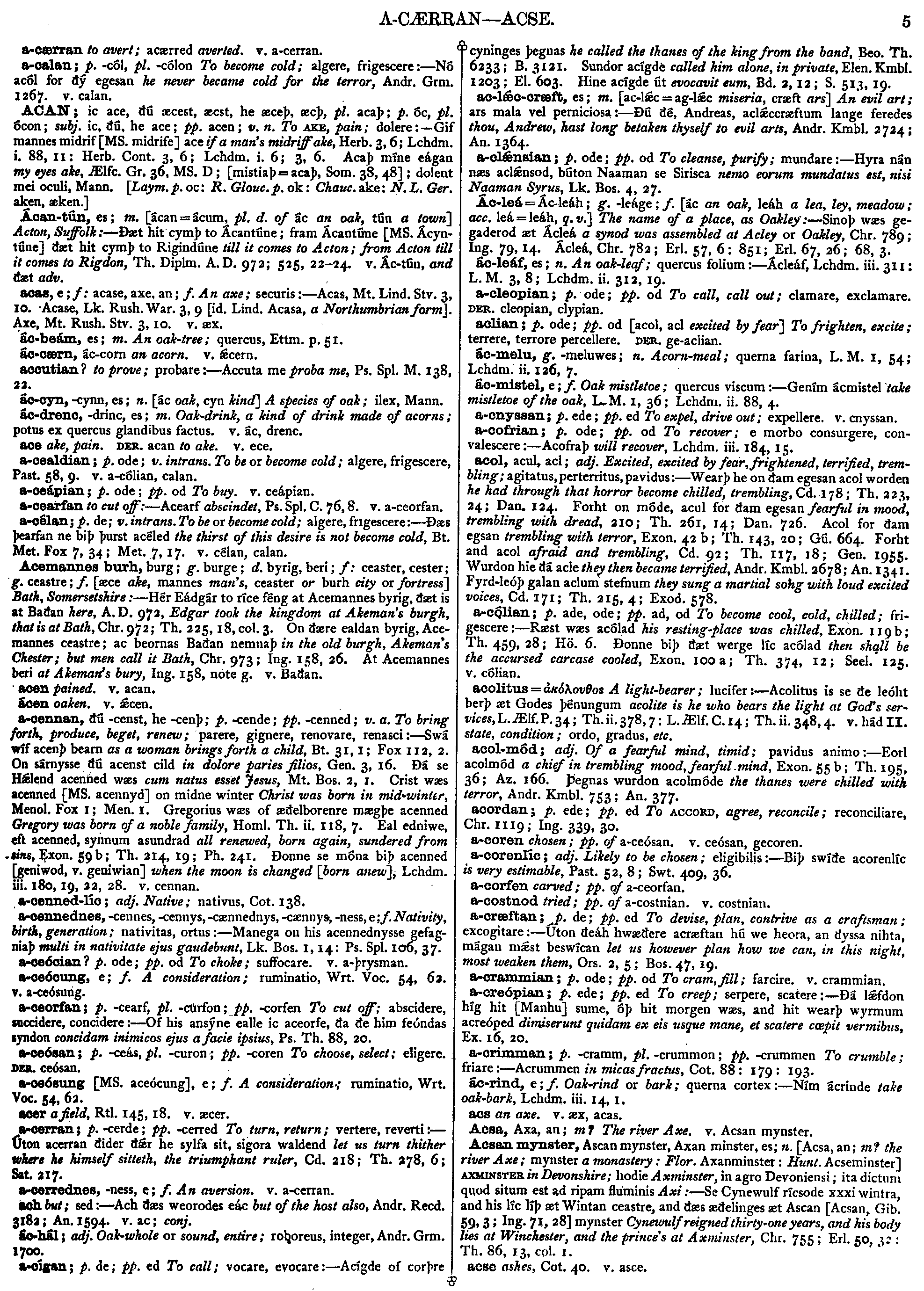
acol, acul, acl; adj. Excited, excited by fear, frightened, terrified, trembling; agitatus, perterritus, pavidus :-- Wearþ he on ðam egesan acol worden he had through that horror become chilled, trembling, Cd. 178; Th. 223, 24; Dan. 124. Forht on móde, acul for ðam egesan fearful in mood, trembling with dread, 210; Th. 261, 14; Dan. 726. Acol for ðam egsan trembling with terror. Exon. 42 b; Th. 143, 20; Gú. 664. Forht and acol afraid and trembling. Cd. 92; Th. 117, 18; Gen. 1955. Wurdon hie ðá acle they then became terrified, Andr. Kmbl. 2678; An. 1341. Fyrd-leóþ galan aclum stefnum they sung a martial song with loud excited voices, Cd. 171; Th. 215, 4; Exod. 578.
|
Source: Bosworth/Toller, page b0085, entry 3 View original page image as: [TIFF] [PNG] [View previous entry] [View next entry] |
[Comment on this entry] [View comments] |
The following entry has been hand-corrected once. |
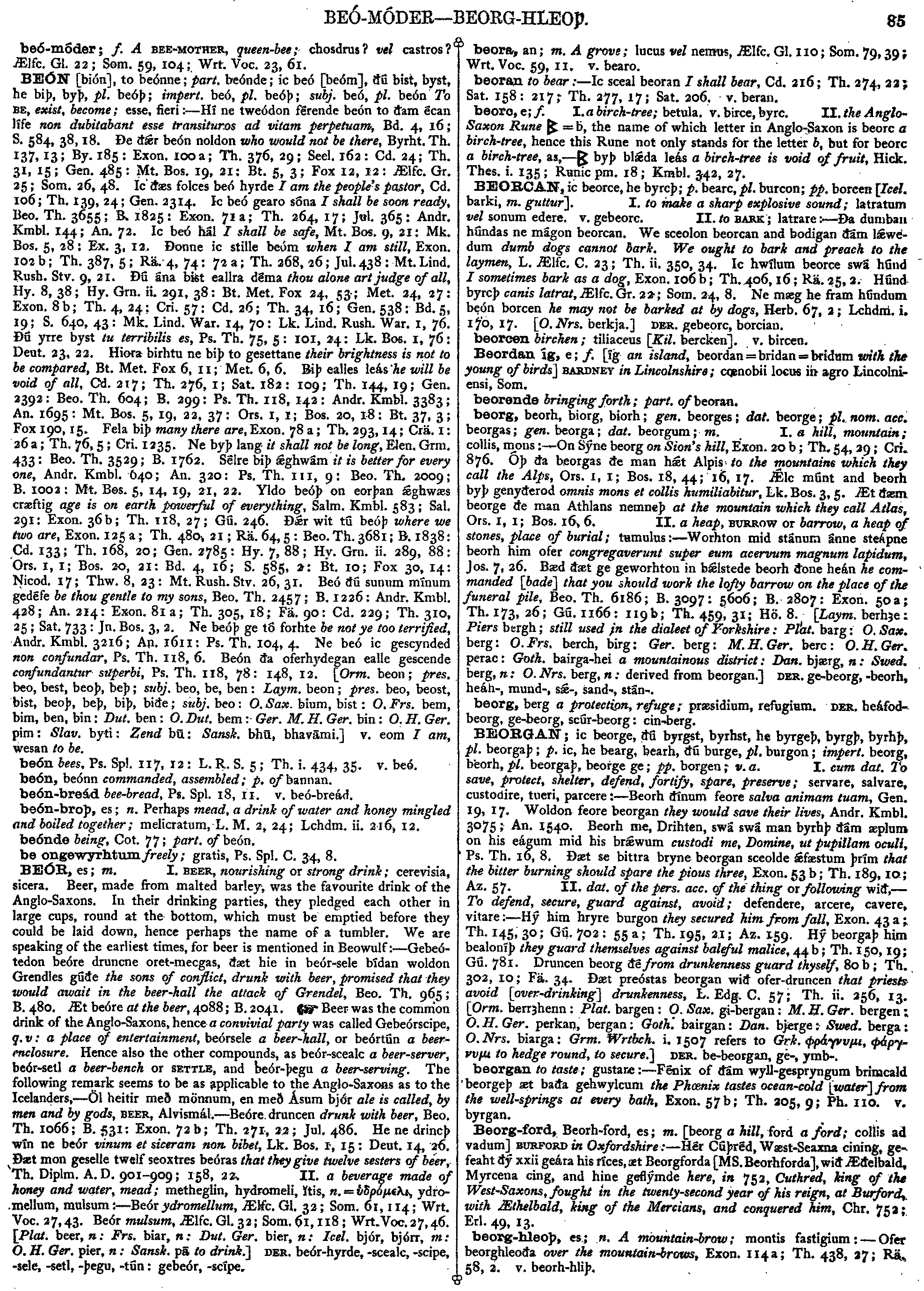
Fox
190,
15.
Fela
biþ
many
there
are,
Exon.
78
a;
Th.
293,14;
Crä.
1
:
26
a;
Th.
76,
5;
Cri.
1235.
Ne
byþ
lang
it
shall
not
be
long,
Elen.
Grm.
433
:
Beo.
Th.
3529;
B.
1762.
Sélre
biþ
 ghwám
it
is
better
for
every
one,
Andr.
Kmbl.
640;
An.
320
:
Ps.
Th.
111,
9
:
Beo.
Th.
2009;
B.
1002
:
Mt.
Bos.
5,
14,
19,
21,
22.
Yldo
beóþ
on
eorþan
ghwæs
cræftig
age
is
on
earth
powerful
of
everything,
Salm.
Kmbl.
583;
Sal.
291
:
Exon.
36
b;
Th.
118,
27;
Gú.
246.
Ðr
wit
tú
beóþ
where
we
two
are,
Exon.125
a;
Th.
480,
21;
Rä.
64,
5
:
Beo.
Th.
3681;
B.
1838
:
Cd.
133;
Th.
168,
20;
Gen.
2785
:
Hy.
7,
88;
Hy.
Grn.
ii.
289,
88
:
Ors.
1,
1;
Bos.
20,
21
:
Bd.
4,
16;
S.
585,
2
:
Bt.
10;
Fox
30,
14
:
Nicod.
17;
Thw.
8,
23
:
Mt.
Rush.
Stv.
26,
31.
Beó
ðú
sunum
mínum
gedéfe
be
thou
gentle
to
my
sons,
Beo.
Th.
2457;
B.
1226
:
Andr.
Kmbl.
428;
An.
214
:
Exon.
81
a;
Th.
305,
18;
Fä.
90
:
Cd.
229;
Th.
310,
25;
Sat.
733
:
Jn.
Bos.
3,
2.
Ne
beóþ
ge
tó
forhte
be
not
ye
too
terrified,
Andr.
Kmbl.
3216;
An.
1611
:
Ps.
Th.
104,
4.
Ne
beó
ic
gescynded
non
confundar,
Ps.
Th.
118,
6.
Beón
ða
oferhydegan
ealle
gescende
confundantur
superbi,
Ps.
Th.
118,
78
:
148,
12.
[Orm.
beon;
pres.
beo,
best,
beoþ,
beþ;
subj.
beo,
be,
ben
:
Laym.
beon;
pres.
beo,
beost,
bist,
beoþ,
beþ,
biþ,
biðe;
subj.
beo
:
O.
Sax.
bium,
bist
:
O.
Frs.
bem,
bim,
ben,
bin
:
Dut.
ben
:
O.
Dut.
bem
:
Ger.
M.
H.
Ger.
bin
:
O.
H.
Ger.
pim
:
Slav.
byti
:
Zend
b
ghwám
it
is
better
for
every
one,
Andr.
Kmbl.
640;
An.
320
:
Ps.
Th.
111,
9
:
Beo.
Th.
2009;
B.
1002
:
Mt.
Bos.
5,
14,
19,
21,
22.
Yldo
beóþ
on
eorþan
ghwæs
cræftig
age
is
on
earth
powerful
of
everything,
Salm.
Kmbl.
583;
Sal.
291
:
Exon.
36
b;
Th.
118,
27;
Gú.
246.
Ðr
wit
tú
beóþ
where
we
two
are,
Exon.125
a;
Th.
480,
21;
Rä.
64,
5
:
Beo.
Th.
3681;
B.
1838
:
Cd.
133;
Th.
168,
20;
Gen.
2785
:
Hy.
7,
88;
Hy.
Grn.
ii.
289,
88
:
Ors.
1,
1;
Bos.
20,
21
:
Bd.
4,
16;
S.
585,
2
:
Bt.
10;
Fox
30,
14
:
Nicod.
17;
Thw.
8,
23
:
Mt.
Rush.
Stv.
26,
31.
Beó
ðú
sunum
mínum
gedéfe
be
thou
gentle
to
my
sons,
Beo.
Th.
2457;
B.
1226
:
Andr.
Kmbl.
428;
An.
214
:
Exon.
81
a;
Th.
305,
18;
Fä.
90
:
Cd.
229;
Th.
310,
25;
Sat.
733
:
Jn.
Bos.
3,
2.
Ne
beóþ
ge
tó
forhte
be
not
ye
too
terrified,
Andr.
Kmbl.
3216;
An.
1611
:
Ps.
Th.
104,
4.
Ne
beó
ic
gescynded
non
confundar,
Ps.
Th.
118,
6.
Beón
ða
oferhydegan
ealle
gescende
confundantur
superbi,
Ps.
Th.
118,
78
:
148,
12.
[Orm.
beon;
pres.
beo,
best,
beoþ,
beþ;
subj.
beo,
be,
ben
:
Laym.
beon;
pres.
beo,
beost,
bist,
beoþ,
beþ,
biþ,
biðe;
subj.
beo
:
O.
Sax.
bium,
bist
:
O.
Frs.
bem,
bim,
ben,
bin
:
Dut.
ben
:
O.
Dut.
bem
:
Ger.
M.
H.
Ger.
bin
:
O.
H.
Ger.
pim
:
Slav.
byti
:
Zend
b :
Sansk.
bh,
bhav
:
Sansk.
bh,
bhav mi.]
v.
eom
I
am,
wesan
to
be.
mi.]
v.
eom
I
am,
wesan
to
be.
|
Source: Bosworth/Toller, page b0122, entry 22 View original page image as: [TIFF] [PNG] [View previous entry] [View next entry] |
[Comment on this entry] [View comments] |
The following entry has been hand-corrected once. |
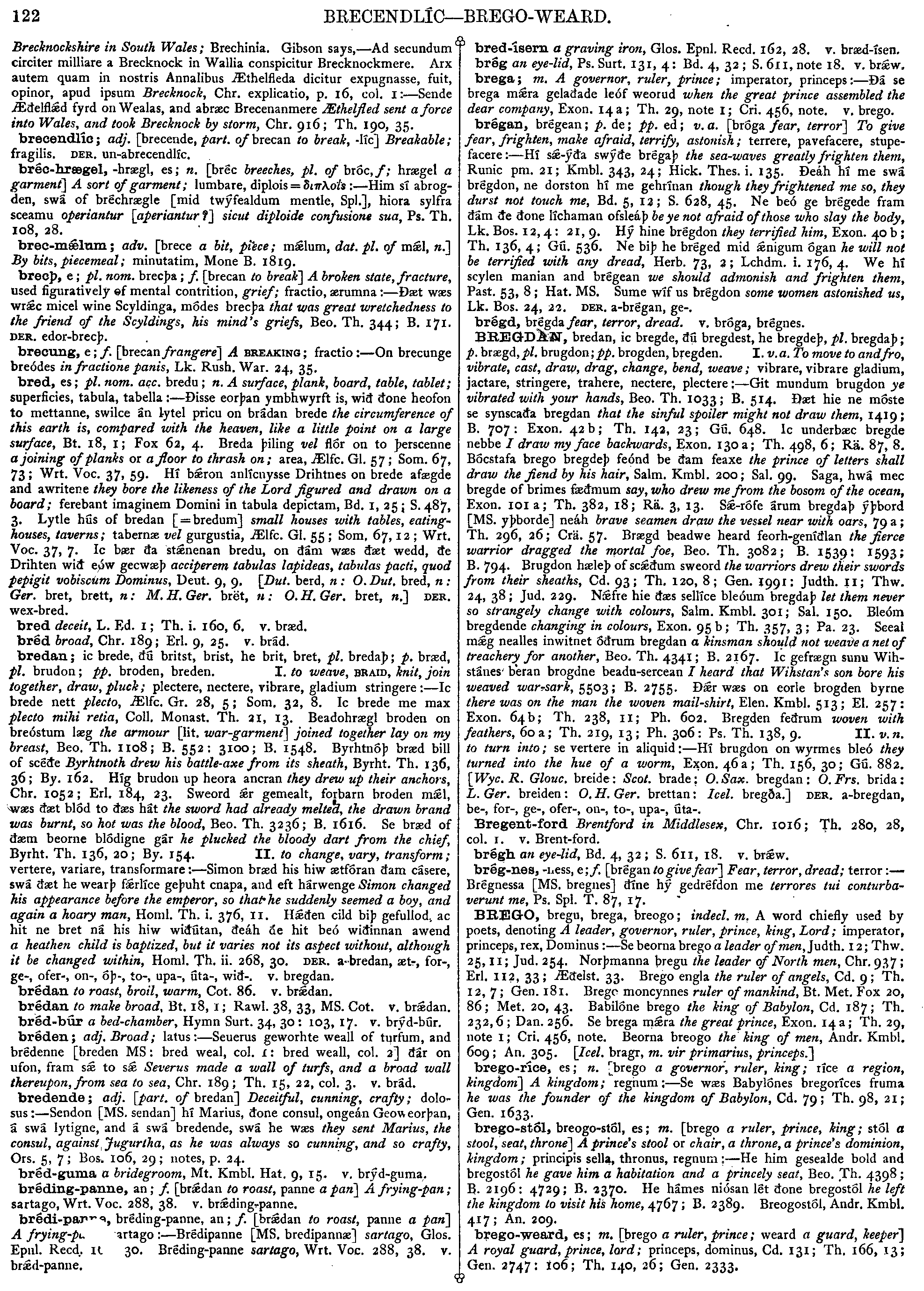
brégan,
brégean;
p.
de;
pp.
ed;
v.
a.
[bróga
fear,
terror]
To
give
fear,
frighten,
make
afraid,
terrify,
astonish;
terrere,
pavefacere,
stupefacere
:--
Hí
s-ýða
swýðe
brégaþ
the
sea-waves
greatly
frighten
them,
Runic
pm.
21;
Kmbl.
343,
24;
Hick.
Thes.
i.
135.
Ðeáh
hí
me
swá
brégdon,
ne
dorston
hí
me
gehrínan
though
they
frightened
me
so,
they
durst
not
touch
me,
Bd.
5,
12;
S.
628,
45.
Ne
beó
ge
brégede
fram
ðám
ðe
ðone
líchaman
ofsleáþ
be
ye
not
afraid
of
those
who
slay
the
body,
Lk.
Bos.
12,
4:
21,
9.
Hý
hine
brégdon
they
terrified
him,
Exon.
40b;
Th.
136,
4;
Gú.
536.
Ne
biþ
he
bréged
mid
nigum
ógan
he
will
not
be
terrified
with
any
dread,
Herb.
73,
2;
Lchdm.
i.
176,
4.
We
hí
scylen
manian
and
brégean
we
should
admonish
and
frighten
them,
Past.
53,
8;
Hat.
MS.
Sume
wíf
us
brégdon
some
women
astonished
us,
Lk.
Bos.
24,
22.
DER.
a-brégan,
ge-.
|
Source: Bosworth/Toller, page b0243, entry 44 View original page image as: [TIFF] [PNG] [View previous entry] [View next entry] |
[Comment on this entry] [View comments] |
The following entry has been hand-corrected once. |
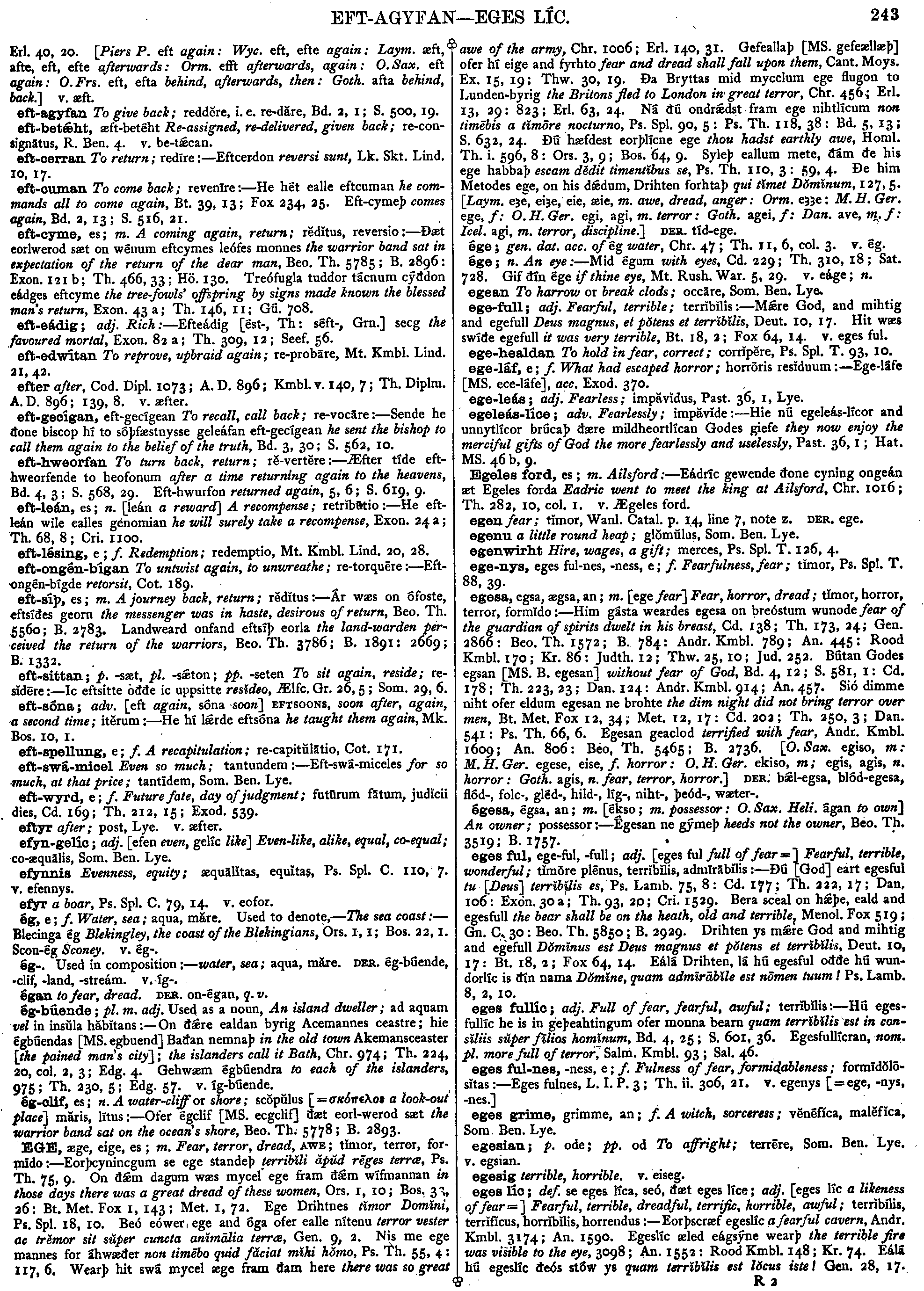
egesa,
egsa,
ægsa,
an;
m.
[ege
fear]
Fear,
horror,
dread;
t mor,
horror,
terror,
form
mor,
horror,
terror,
form do
:--
Him
gásta
weardes
egesa
on
breóstum
wunode
fear
of
the
guardian
of
spirits
dwelt
in
his
breast,
Cd.
138;
Th.
173,
24;
Gen.
2866:
Beo.
Th.
1572;
B.
784:
Andr.
Kmbl.
789;
An.
445:
Rood
Kmbl.
170;
Kr.
86:
Judth.
12;
Thw.
25,
10;
Jud.
252.
Bútan
Godes
egsan
[MS.
B.
egesan]
without
fear
of
God,
Bd.
4,
12;
S.
581,
1:
Cd.
178;
Th.
223,
23;
Dan.
124:
Andr.
Kmbl.
914;
An.
457.
Sió
dimme
niht
ofer
eldum
egesan
ne
brohte
the
dim
night
did
not
bring
terror
over
men,
Bt.
Met.
Fox
12,
34;
Met.
12,
17:
Cd.
202;
Th.
250,
3;
Dan.
541:
Ps.
Th.
66,
6.
Egesan
geaclod
terrified
with
fear,
Andr.
Kmbl.
1609;
An.
806:
Beo.
Th.
5465;
B.
2736.
[O.
Sax.
egiso,
m:
M.
H.
Ger.
egese,
eise,
f.
horror:
O.
H.
Ger.
ekiso,
m;
egis,
agis,
n.
horror:
Goth.
agis,
n.
fear,
terror,
horror.]
DER.
bl-egsa,
blód-egesa,
flód-,
folc-,
gléd-,
hild-,
líg-,
niht-,
þeód-,
wæter-.
do
:--
Him
gásta
weardes
egesa
on
breóstum
wunode
fear
of
the
guardian
of
spirits
dwelt
in
his
breast,
Cd.
138;
Th.
173,
24;
Gen.
2866:
Beo.
Th.
1572;
B.
784:
Andr.
Kmbl.
789;
An.
445:
Rood
Kmbl.
170;
Kr.
86:
Judth.
12;
Thw.
25,
10;
Jud.
252.
Bútan
Godes
egsan
[MS.
B.
egesan]
without
fear
of
God,
Bd.
4,
12;
S.
581,
1:
Cd.
178;
Th.
223,
23;
Dan.
124:
Andr.
Kmbl.
914;
An.
457.
Sió
dimme
niht
ofer
eldum
egesan
ne
brohte
the
dim
night
did
not
bring
terror
over
men,
Bt.
Met.
Fox
12,
34;
Met.
12,
17:
Cd.
202;
Th.
250,
3;
Dan.
541:
Ps.
Th.
66,
6.
Egesan
geaclod
terrified
with
fear,
Andr.
Kmbl.
1609;
An.
806:
Beo.
Th.
5465;
B.
2736.
[O.
Sax.
egiso,
m:
M.
H.
Ger.
egese,
eise,
f.
horror:
O.
H.
Ger.
ekiso,
m;
egis,
agis,
n.
horror:
Goth.
agis,
n.
fear,
terror,
horror.]
DER.
bl-egsa,
blód-egesa,
flód-,
folc-,
gléd-,
hild-,
líg-,
niht-,
þeód-,
wæter-.
|
Source: Bosworth/Toller, page b0264, entry 3 View original page image as: [TIFF] [PNG] [View previous entry] [View next entry] |
[Comment on this entry] [View comments] |
The following entry has been hand-corrected once. |
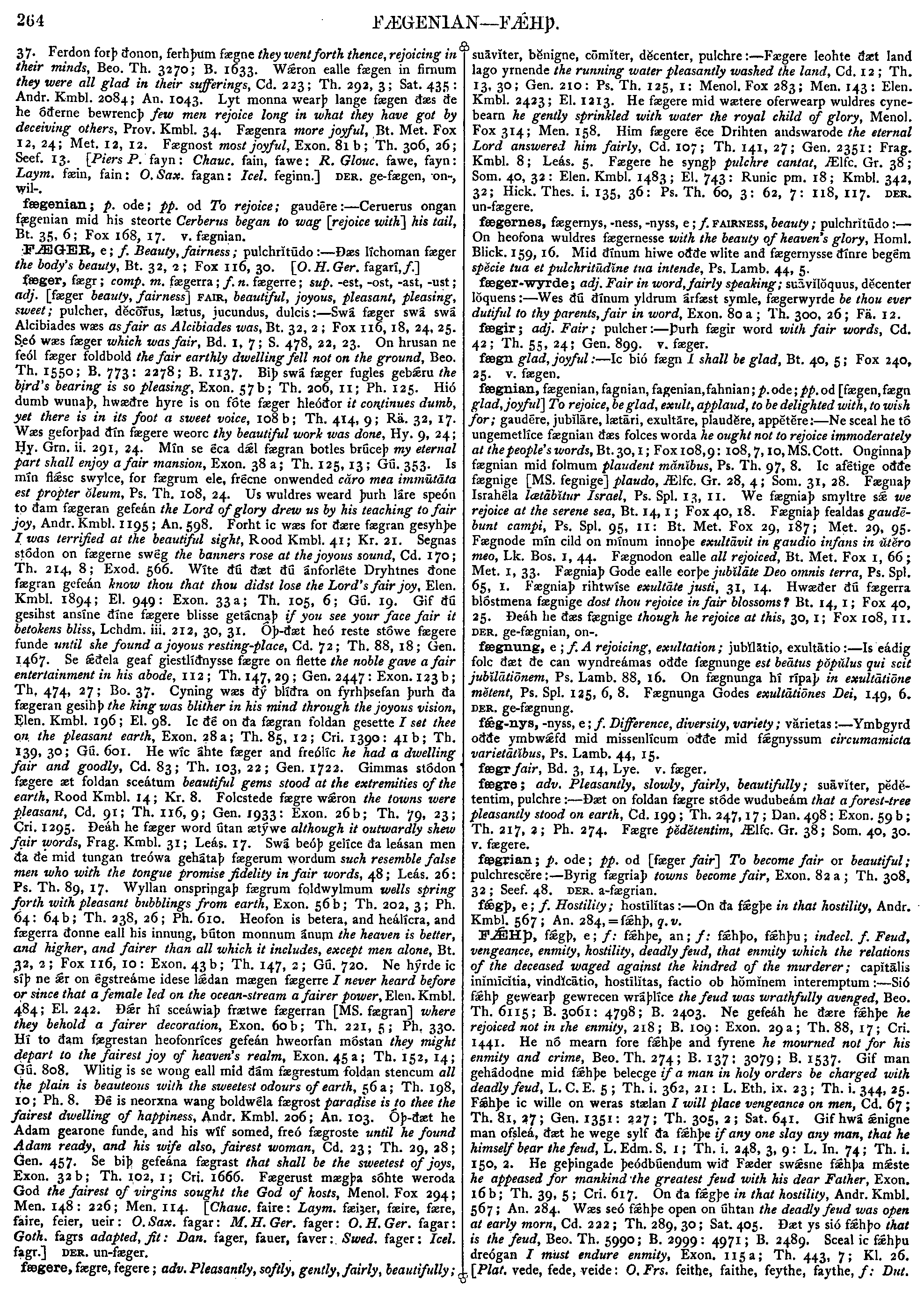
fæger,
fægr;
comp.
m.
fægerra;
f.
n.
fægerre;
sup.
-est,
-ost,
-ast,
-ust;
adj.
[fæger
beauty,
fairness]
FAIR,
beautiful,
joyous,
pleasant,
pleasing,
sweet;
pulcher,
d c
c rus,
lætus,
jucundus,
dulcis
:--
Swá
fæger
swá
swá
Alcibiades
wæs
as
fair
as
Alcibiades
was,
Bt.
32,
2;
Fox
116,
18,
24,
25.
Seó
wæs
fæger
which
was
fair,
Bd.
1,
7;
S.
478,
22,
23.
On
hrusan
ne
feól
fæger
foldbold
the
fair
earthly
dwelling
fell
not
on
the
ground,
Beo.
Th.
1550;
B.
773:
2278;
B.
1137.
Biþ
swá
fæger
fugles
gebru
the
bird's
bearing
is
so
pleasing,
Exon.
57
b;
Th.
206,
11;
Ph.
125.
Hió
dumb
wunaþ,
hwæðre
hyre
is
on
fóte
fæger
hleóðor
it
continues
dumb,
yet
there
is
in
its
foot
a
sweet
voice,
108
b;
Th.
414,
9;
Rä.
32,
17.
Wæs
geforþad
ðín
fægere
weorc
thy
beautiful
work
was
done,
Hy.
9,
24;
Hy.
Grn
ii.
291,
24.
Mín
se
éca
dl
fægran
botles
brúceþ
my
eternal
part
shall
enjoy
a
fair
mansion,
Exon.
38
a;
Th.
125,
13;
Gú.
353.
Is
mín
flsc
swylce,
for
fægrum
ele,
frécne
onwended
c
rus,
lætus,
jucundus,
dulcis
:--
Swá
fæger
swá
swá
Alcibiades
wæs
as
fair
as
Alcibiades
was,
Bt.
32,
2;
Fox
116,
18,
24,
25.
Seó
wæs
fæger
which
was
fair,
Bd.
1,
7;
S.
478,
22,
23.
On
hrusan
ne
feól
fæger
foldbold
the
fair
earthly
dwelling
fell
not
on
the
ground,
Beo.
Th.
1550;
B.
773:
2278;
B.
1137.
Biþ
swá
fæger
fugles
gebru
the
bird's
bearing
is
so
pleasing,
Exon.
57
b;
Th.
206,
11;
Ph.
125.
Hió
dumb
wunaþ,
hwæðre
hyre
is
on
fóte
fæger
hleóðor
it
continues
dumb,
yet
there
is
in
its
foot
a
sweet
voice,
108
b;
Th.
414,
9;
Rä.
32,
17.
Wæs
geforþad
ðín
fægere
weorc
thy
beautiful
work
was
done,
Hy.
9,
24;
Hy.
Grn
ii.
291,
24.
Mín
se
éca
dl
fægran
botles
brúceþ
my
eternal
part
shall
enjoy
a
fair
mansion,
Exon.
38
a;
Th.
125,
13;
Gú.
353.
Is
mín
flsc
swylce,
for
fægrum
ele,
frécne
onwended
c ro
mea
immtta
est
propter
ro
mea
immtta
est
propter
 leum,
Ps.
Th.
108,
24.
Us
wuldres
weard
þurh
láre
speón
to
ðam
fægeran
gefeán
the
Lord
of
glory
drew
us
by
his
teaching
to
fair
joy,
Andr.
Kmbl.
1195;
An.
598.
Forht
ic
wæs
for
ðære
fægran
gesyhþe
I
was
terrified
at
the
beautiful
sight,
Rood
Kmbl.
41;
Kr.
21.
Segnas
stódon
on
fægere
swég
the
banners
rose
at
the
joyous
sound,
Cd.
170;
Th.
214,
8;
Exod.
566.
Wíte
ðú
ðæt
ðú
ánforléte
Dryhtnes
ðone
fægran
gefeán
know
thou
that
thou
didst
lose
the
Lord's
fair
joy,
Elen.
Kmbl.
1894;
El.
949:
Exon.
33
a;
Th.
105,
6;
Gú.
19.
Gif
ðú
gesihst
ansíne
ðíne
fægere
blisse
getácnaþ
if
you
see
your
face
fair
it
betokens
bliss,
Lchdm.
iii.
212,
30,
31.
Óþ-ðæt
heó
reste
stówe
fægere
funde
until
she
found
a
joyous
resting-place,
Cd.
72;
Th.
88,
18;
Gen.
1467.
Se
ðela
geaf
giestlíðnysse
fægre
on
flette
the
noble
gave
a
fair
entertainment
in
his
abode,
112;
Th.
147,
29;
Gen.
2447:
Exon.
123
b;
Th.
474,
27;
Bo.
37.
Cyning
wæs
ðý
blíðra
on
fyrhþsefan
þurh
ða
fægeran
gesihþ
the
king
was
blither
in
his
mind
through
the
joyous
vision,
Elen.
Kmbl.
196;
El.
98.
Ic
ðé
on
ða
fægran
foldan
gesette
I
set
thee
on
the
pleasant
earth,
Exon.
28
a;
Th.
85,
12;
Cri.
1390:
41
b;
Th.
139,
30;
Gú.
601.
He
wíc
áhte
fæger
and
freólíc
he
had
a
dwelling
fair
and
goodly,
Cd.
83;
Th.
103,
22;
Gen.
1722.
Ginsmas
stódon
fægere
æt
foldan
sceátum
beautiful
gems
stood
at
the
extremities
of
the
earth,
Rood
Kmbl.
14;
Kr.
8.
Folcstede
fægre
wron
the
towns
were
pleasant,
Cd.
91;
Th.
116,
9;
Gen.
1933:
Exon.
26
b;
Th.
79,
23;
Cri.
1295.
Ðeáh
he
fæger
word
útan
ætýwe
although
it
outwardly
shew
fair
words,
Frag.
Kmbl.
31;
Leás.
17.
Swá
beóþ
gelíce
ða
leásan
men
ða
ðe
mid
tungan
treówa
gehátaþ
fægerum
wordum
such
resemble
false
men
who
with
the
tongue
promise
fidelity
in
fair
words,
48;
Leás.
26:
Ps.
Th.
89,
17.
Wyllan
onspringaþ
fægrum
foldwylmum
wells
spring
forth
with
pleasant
bubblings
from
earth,
Exon.
56
b;
Th.
202,
3;
Ph.
64:
64
b;
Th.
238,
26;
Ph.
610.
Heofon
is
betera,
and
heálícra,
and
fægerra
ðonne
eall
his
innung,
búton
monnum
ánum
the
heaven
is
better,
and
higher,
and
fairer
than
all
which
it
includes,
except
men
alone,
Bt.
32,
2;
Fox
116,
10:
Exon.
43
b;
Th.
147,
2;
Gú.
720.
Ne
hýrde
ic
síþ
ne
r
on
égstreáme
idese
ldan
mægen
fægerre
I
never
heard
before
or
since
that
a
female
led
on
the
ocean-stream
a
fairer
power,
Elen.
Kmbl.
484;
El.
242.
Ðr
hí
sceáwiaþ
frætwe
fægerran
[MS.
fægran]
where
they
behold
a
fairer
decoration,
Exon.
60
b;
Th.
221,
5;
Ph.
330.
Hí
to
ðam
fægrestan
heofonríces
gefeán
hweorfan
móstan
they
might
depart
to
the
fairest
joy
of
heaven's
realm,
Exon.
45
a;
Th.
152,
14;
Gú.
808.
Wlitig
is
se
wong
eall
mid
ðám
fægrestum
foldan
stencum
all
the
plain
is
beauteous
with
the
sweetest
odours
of
earth,
56
a;
Th.
198,
10;
Ph.
8.
Ðé
is
neorxna
wang
boldwéla
fægrost
paradise
is
to
thee
the
fairest
dwelling
of
happiness,
Andr.
Kmbl.
206;
An.
103.
Óþ-ðæt
he
Adam
gearone
funde,
and
his
wíf
somed,
freó
fægroste
until
he
found
Adam
ready,
and
his
wife
also,
fairest
woman,
Cd.
23;
Th.
29,
28;
Gen.
457.
Se
biþ
gefeán
fægrast
that
shall
be
the
sweetest
of
joys,
Exon.
32
b;
Th.
102,
1;
Cri.
1666.
Fægerust
mægþa
sóhte
weroda
God
the
fairest
of
virgins
sought
the
God
of
hosts,
Menol.
Fox
294;
Men.
148:
226;
Men.
114.
[Chauc.
faire:
Laym.
fæi
leum,
Ps.
Th.
108,
24.
Us
wuldres
weard
þurh
láre
speón
to
ðam
fægeran
gefeán
the
Lord
of
glory
drew
us
by
his
teaching
to
fair
joy,
Andr.
Kmbl.
1195;
An.
598.
Forht
ic
wæs
for
ðære
fægran
gesyhþe
I
was
terrified
at
the
beautiful
sight,
Rood
Kmbl.
41;
Kr.
21.
Segnas
stódon
on
fægere
swég
the
banners
rose
at
the
joyous
sound,
Cd.
170;
Th.
214,
8;
Exod.
566.
Wíte
ðú
ðæt
ðú
ánforléte
Dryhtnes
ðone
fægran
gefeán
know
thou
that
thou
didst
lose
the
Lord's
fair
joy,
Elen.
Kmbl.
1894;
El.
949:
Exon.
33
a;
Th.
105,
6;
Gú.
19.
Gif
ðú
gesihst
ansíne
ðíne
fægere
blisse
getácnaþ
if
you
see
your
face
fair
it
betokens
bliss,
Lchdm.
iii.
212,
30,
31.
Óþ-ðæt
heó
reste
stówe
fægere
funde
until
she
found
a
joyous
resting-place,
Cd.
72;
Th.
88,
18;
Gen.
1467.
Se
ðela
geaf
giestlíðnysse
fægre
on
flette
the
noble
gave
a
fair
entertainment
in
his
abode,
112;
Th.
147,
29;
Gen.
2447:
Exon.
123
b;
Th.
474,
27;
Bo.
37.
Cyning
wæs
ðý
blíðra
on
fyrhþsefan
þurh
ða
fægeran
gesihþ
the
king
was
blither
in
his
mind
through
the
joyous
vision,
Elen.
Kmbl.
196;
El.
98.
Ic
ðé
on
ða
fægran
foldan
gesette
I
set
thee
on
the
pleasant
earth,
Exon.
28
a;
Th.
85,
12;
Cri.
1390:
41
b;
Th.
139,
30;
Gú.
601.
He
wíc
áhte
fæger
and
freólíc
he
had
a
dwelling
fair
and
goodly,
Cd.
83;
Th.
103,
22;
Gen.
1722.
Ginsmas
stódon
fægere
æt
foldan
sceátum
beautiful
gems
stood
at
the
extremities
of
the
earth,
Rood
Kmbl.
14;
Kr.
8.
Folcstede
fægre
wron
the
towns
were
pleasant,
Cd.
91;
Th.
116,
9;
Gen.
1933:
Exon.
26
b;
Th.
79,
23;
Cri.
1295.
Ðeáh
he
fæger
word
útan
ætýwe
although
it
outwardly
shew
fair
words,
Frag.
Kmbl.
31;
Leás.
17.
Swá
beóþ
gelíce
ða
leásan
men
ða
ðe
mid
tungan
treówa
gehátaþ
fægerum
wordum
such
resemble
false
men
who
with
the
tongue
promise
fidelity
in
fair
words,
48;
Leás.
26:
Ps.
Th.
89,
17.
Wyllan
onspringaþ
fægrum
foldwylmum
wells
spring
forth
with
pleasant
bubblings
from
earth,
Exon.
56
b;
Th.
202,
3;
Ph.
64:
64
b;
Th.
238,
26;
Ph.
610.
Heofon
is
betera,
and
heálícra,
and
fægerra
ðonne
eall
his
innung,
búton
monnum
ánum
the
heaven
is
better,
and
higher,
and
fairer
than
all
which
it
includes,
except
men
alone,
Bt.
32,
2;
Fox
116,
10:
Exon.
43
b;
Th.
147,
2;
Gú.
720.
Ne
hýrde
ic
síþ
ne
r
on
égstreáme
idese
ldan
mægen
fægerre
I
never
heard
before
or
since
that
a
female
led
on
the
ocean-stream
a
fairer
power,
Elen.
Kmbl.
484;
El.
242.
Ðr
hí
sceáwiaþ
frætwe
fægerran
[MS.
fægran]
where
they
behold
a
fairer
decoration,
Exon.
60
b;
Th.
221,
5;
Ph.
330.
Hí
to
ðam
fægrestan
heofonríces
gefeán
hweorfan
móstan
they
might
depart
to
the
fairest
joy
of
heaven's
realm,
Exon.
45
a;
Th.
152,
14;
Gú.
808.
Wlitig
is
se
wong
eall
mid
ðám
fægrestum
foldan
stencum
all
the
plain
is
beauteous
with
the
sweetest
odours
of
earth,
56
a;
Th.
198,
10;
Ph.
8.
Ðé
is
neorxna
wang
boldwéla
fægrost
paradise
is
to
thee
the
fairest
dwelling
of
happiness,
Andr.
Kmbl.
206;
An.
103.
Óþ-ðæt
he
Adam
gearone
funde,
and
his
wíf
somed,
freó
fægroste
until
he
found
Adam
ready,
and
his
wife
also,
fairest
woman,
Cd.
23;
Th.
29,
28;
Gen.
457.
Se
biþ
gefeán
fægrast
that
shall
be
the
sweetest
of
joys,
Exon.
32
b;
Th.
102,
1;
Cri.
1666.
Fægerust
mægþa
sóhte
weroda
God
the
fairest
of
virgins
sought
the
God
of
hosts,
Menol.
Fox
294;
Men.
148:
226;
Men.
114.
[Chauc.
faire:
Laym.
fæi er,
fæire,
fære,
faire,
feier,
ueir:
O.
Sax.
fagar:
M.
H.
Ger.
fager:
O.
H.
Ger.
fagar:
Goth.
fagrs
adapted,
fit:
Dan.
fager,
fauer,
faver:
Swed.
fager:
Icel.
fagr.]
DER.
un-fæger.
er,
fæire,
fære,
faire,
feier,
ueir:
O.
Sax.
fagar:
M.
H.
Ger.
fager:
O.
H.
Ger.
fagar:
Goth.
fagrs
adapted,
fit:
Dan.
fager,
fauer,
faver:
Swed.
fager:
Icel.
fagr.]
DER.
un-fæger.
|
Source: Bosworth/Toller, page b0364, entry 4 View original page image as: [TIFF] [PNG] [View previous entry] [View next entry] |
[Comment on this entry] [View comments] |
The following entry has been hand-corrected once. |
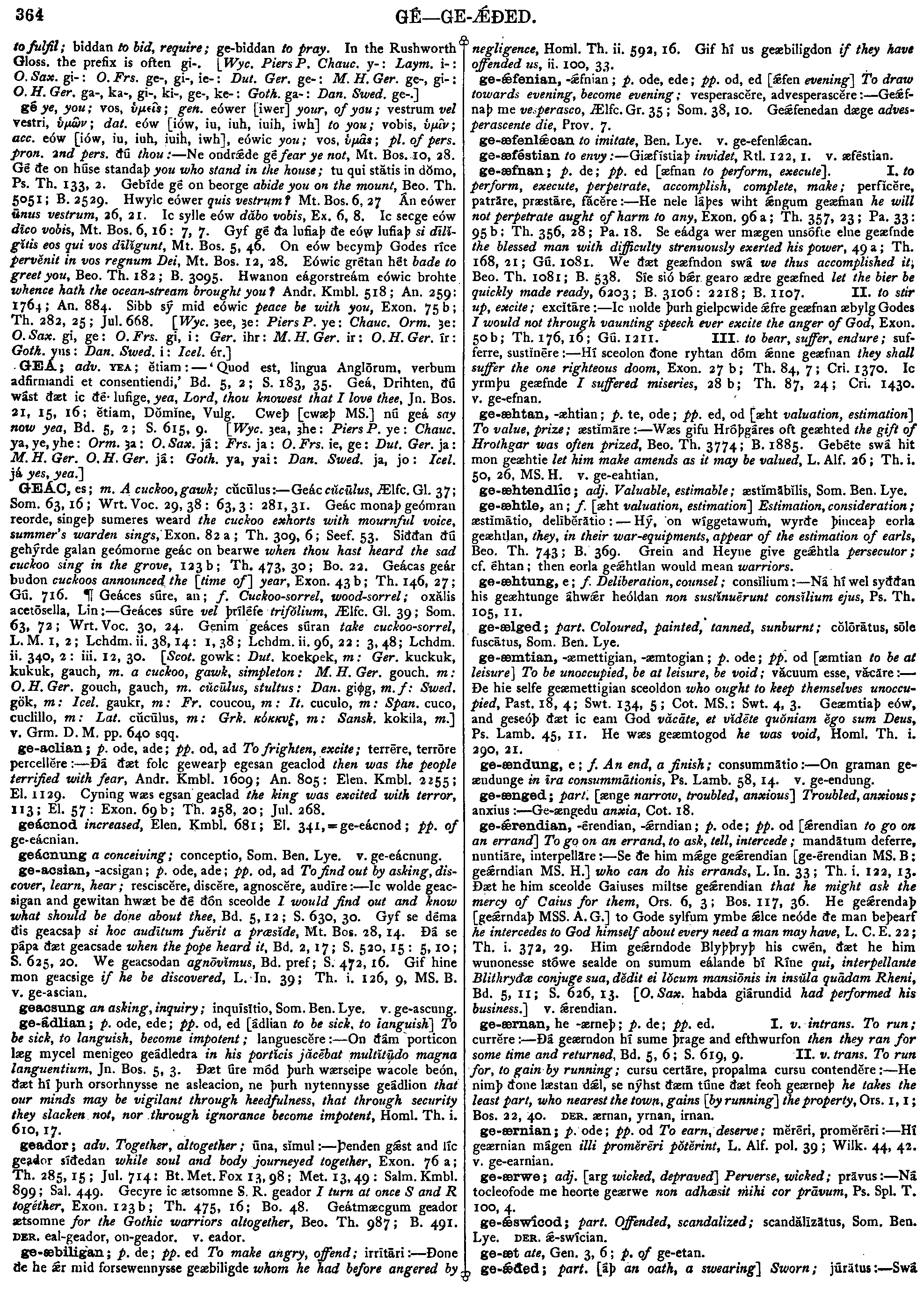
ge-aclian;
p.
ode,
ade;
pp.
od,
ad
To
frighten,
excite;
terr re,
terrre
percellre
:--
Ðá
ðæt
folc
gewearþ
egesan
geaclod
then
was
the
people
terrified
with
fear,
Andr.
Kmbl.
1609;
An.
805
:
Elen.
Kmbl.
2255;
El.
1129.
Cyning
wæs
egsan
geaclad
the
king
was
excited
with
terror,
113;
El.
57
:
Exon.
69
b;
Th.
258,
20;
Jul.
268.
re,
terrre
percellre
:--
Ðá
ðæt
folc
gewearþ
egesan
geaclod
then
was
the
people
terrified
with
fear,
Andr.
Kmbl.
1609;
An.
805
:
Elen.
Kmbl.
2255;
El.
1129.
Cyning
wæs
egsan
geaclad
the
king
was
excited
with
terror,
113;
El.
57
:
Exon.
69
b;
Th.
258,
20;
Jul.
268.
|
Source: Bosworth/Toller, page b0376, entry 3 View original page image as: [TIFF] [PNG] [View previous entry] [View next entry] |
[Comment on this entry] [View comments] |
The following entry has been hand-corrected once. |
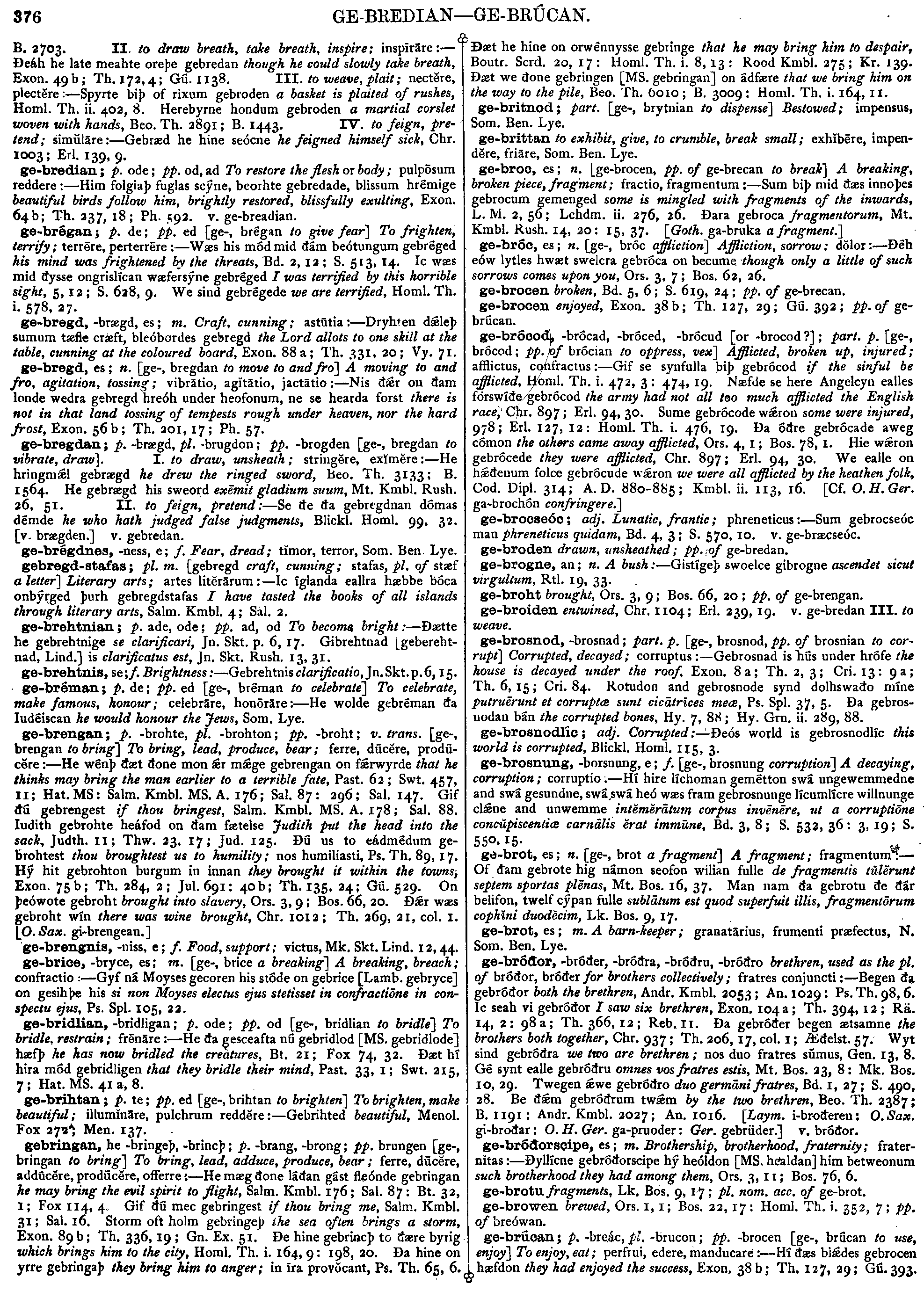
ge-brégan; p. de; pp. ed [ge-, brégan to give fear] To frighten, terrify; terrére, perterrére :-- Wæs his mód mid ðám beótungum gebréged his mind was frightened by the threats, Bd. 2, 12; S. 513, 14. Ic wæs mid ðysse ongrislícan wæfersýne gebréged I was terrified by this horrible sight, 5, 12; S. 628, 9. We sind gebrégede we are terrified, Homl. Th. i. 578, 27.
|
Source: Bosworth/Toller, page b0395, entry 11 View original page image as: [TIFF] [PNG] [View previous entry] [View next entry] |
[Comment on this entry] [View comments] |
The following entry has been hand-corrected once. |
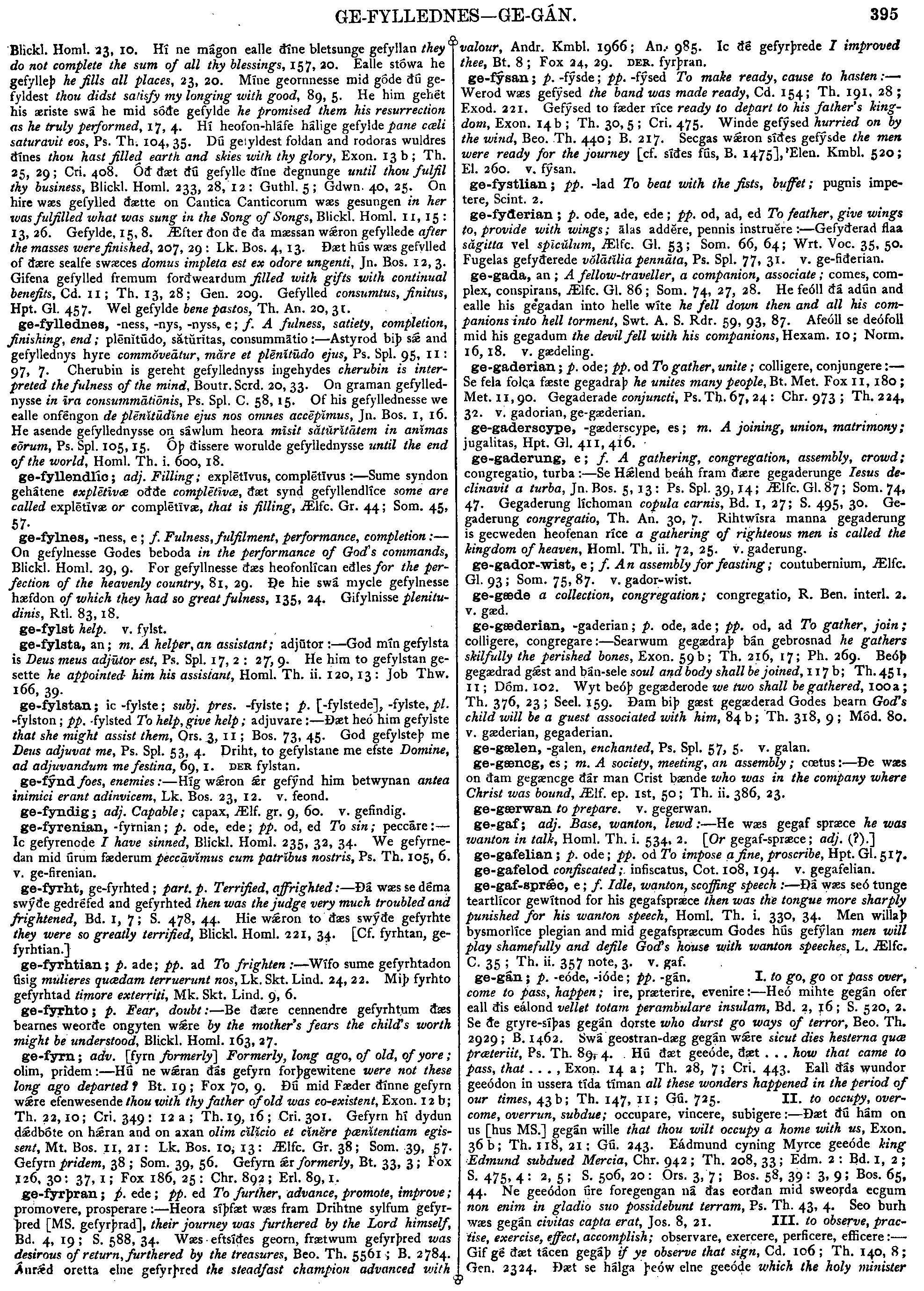
ge-fyrht,
ge-fyrhted;
part.
p.
Terrified,
affrighted
:--
Ðá
wæs
se
déma
swýðe
gedréfed
and
gefyrhted
then
was
the
judge
very
much
troubled
and
frightened,
Bd.
1,
7;
S.
478,
44.
Hie
wron
to
ðæs
swýðe
gefyrhte
they
were
so
greatly
terrified,
Blickl.
Homl.
221,
34.
[Cf.
fyrhtan,
gefyrhtian.]
|
Source: Bosworth/Toller, page b0441, entry 20 View original page image as: [TIFF] [PNG] [View previous entry] [View next entry] |
[Comment on this entry] [View comments] |
The following entry has been hand-corrected once. |
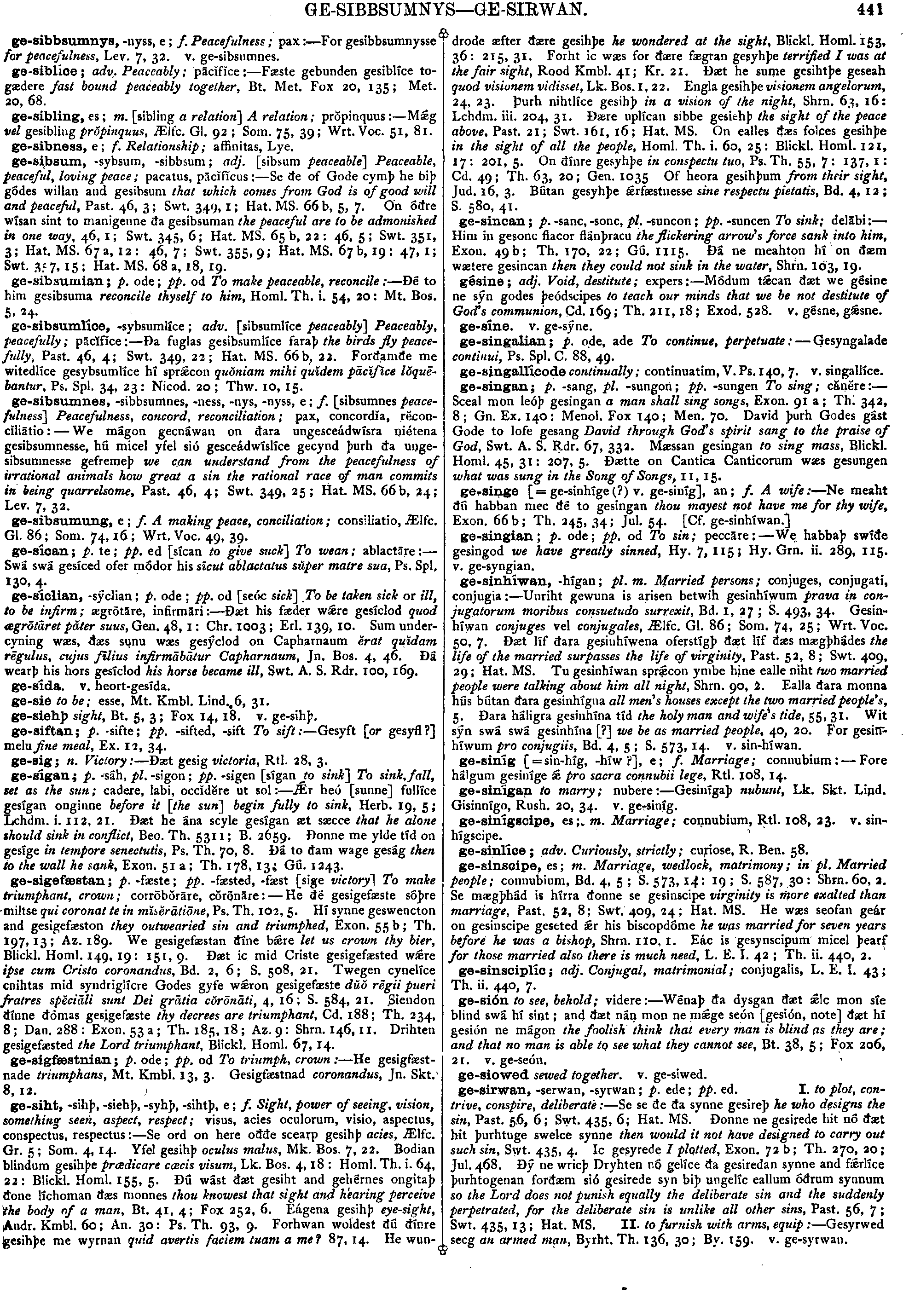
ge-siht,
-sihþ,
-siehþ,
-syhþ,
-sihtþ,
e;
f.
Sight,
power
of
seeing,
vision,
something
seen,
aspect,
respect;
visus,
acies
oculorum,
visio,
aspectus,
conspectus,
respectus
:--
Se
ord
on
here
oððe
scearp
gesihþ
acies,
Ælfc.
Gr.
5;
Som.
4,
14.
Yfel
gesihþ
oculus
malus,
Mk.
Bos.
7,
22.
Bodian
blindum
gesihþe
prædicare
cæcis
visum,
Lk.
Bos.
4,
18:
Homl.
Th.
i.
64,
22:
Blickl.
Homl.
155,
5.
Ðú
wást
ðæt
gesiht
and
gehérnes
ongitaþ
ðone
líchoman
ðæs
monnes
thou
knowest
that
sight
and
hearing
perceive
the
body
of
a
man,
Bt.
41,
4;
Fox
252,
6.
Eágena
gesihþ
eye-sight,
Andr.
Kmbl.
60;
An.
30:
Ps.
Th.
93,
9.
Forhwan
woldest
ðú
ðínre
gesihþe
me
wyrnan
quid
avertis
faciem
tuam
a
me?
87,
14.
He
wundrode
æfter
ðære
gesihþe
he
wondered
at
the
sight,
Blickl.
Homl.
153,
36:
215,
31.
Forht
ic
wæs
for
ðære
fægran
gesyhþe
terrified
I
was
at
the
fair
sight,
Rood
Kmbl.
41;
Kr.
21.
Ðæt
he
sume
gesihtþe
geseah
quod
visionem
vidisset,
Lk.
Bos.
1,
22.
Engla
gesihþe
visionem
angelorum,
24,
23.
Þurh
nihtlíce
gesihþ
in
a
vision
of
the
night,
Shrn.
63,
16:
Lchdm.
iii.
204,
31.
Ðære
uplícan
sibbe
gesiehþ
the
sight
of
the
peace
above,
Past.
21;
Swt.
161,
16;
Hat.
MS.
On
ealles
ðæs
folces
gesihþe
in
the
sight
of
all
the
people,
Homl.
Th.
i.
60,
25:
Blickl.
Homl.
121,
17:
201,
5.
On
ðínre
gesyhþe
in
conspectu
tuo,
Ps.
Th.
55,
7:
137,
1:
Cd.
49;
Th.
63,
20;
Gen.
1035
Of
heora
gesihþum
from
their
sight,
Jud.
16,
3.
Bútan
gesyhþe
rfæstnesse
sine
respectu
pietatis,
Bd.
4,
12
;
S.
580,
41.
|
Source: Bosworth/Toller, page b0729, entry 14 View original page image as: [TIFF] [PNG] [View previous entry] [View next entry] |
[Comment on this entry] [View comments] |
The following entry has been hand-corrected once. |
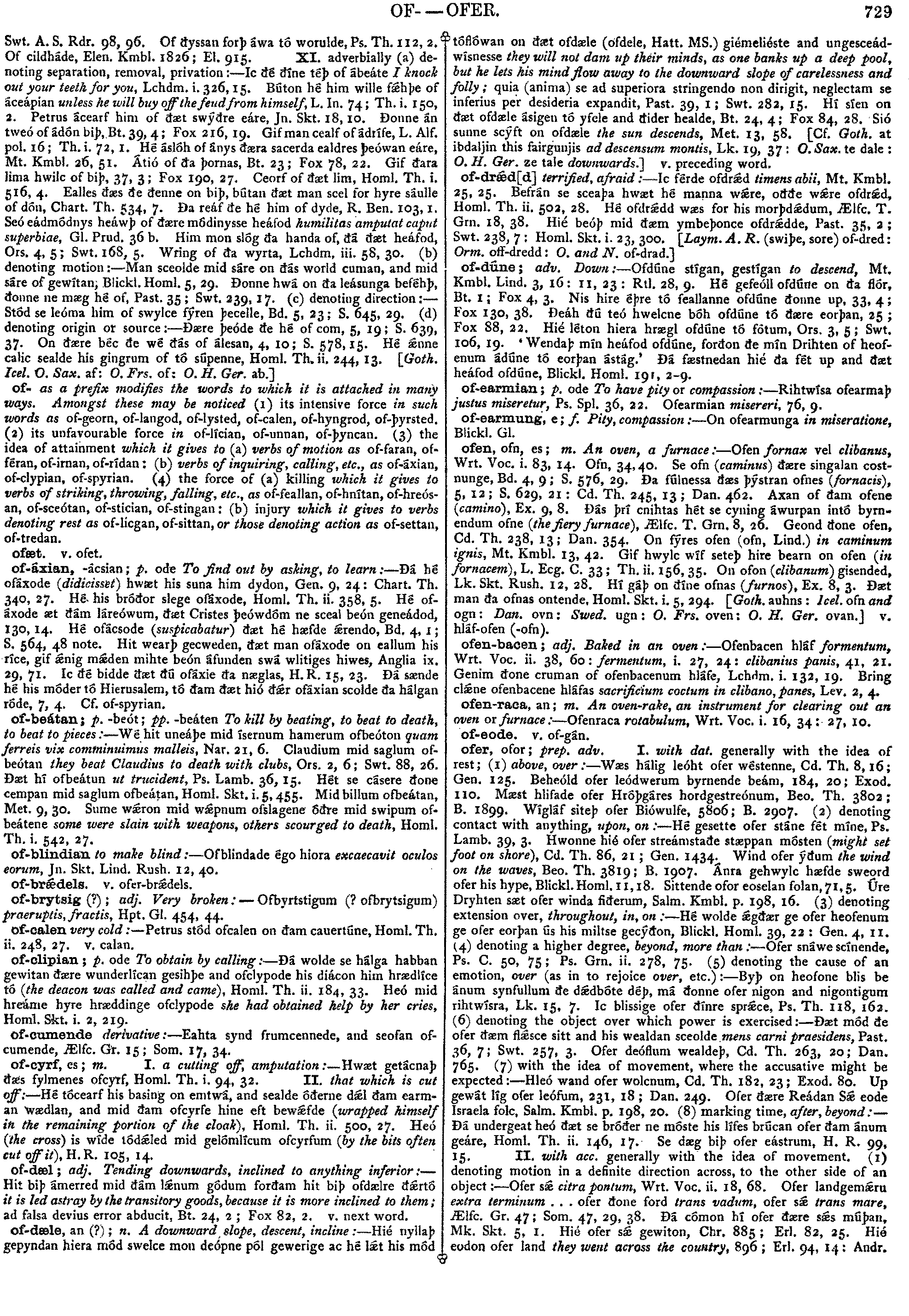
of-drd[d]
terrified,
afraid
:--
Ic
férde
ofdrd
timens
abii,
Mt.
Kmbl.
25,
25.
Befrán
se
sceaþa
hwæt
hé
manna
wre,
oððe
wre
ofdrd,
Homl.
Th.
ii.
502,
28.
Hé
ofdrdd
wæs
for
his
morþddum,
Ælfc.
T.
Grn.
18,
38.
Hié
beóþ
mid
ðæm
ymbeþonce
ofdrdde,
Past.
35,
2;
Swt.
238,
7:
Homl.
Skt.
i.
23,
300.
[Laym.
A.
R.
(swiþe,
sore)
of-dred:
Orm.
off-dredd:
O.
and
N.
of-drad.]
| Result Page: | 1 2 | Next |  |
Germanic Lexicon Project (main page)
This search system was written by
Sean Crist
Please consider
volunteering
to correct the data in these online dictionaries.
No rights reserved. Feel free to use these data in any way you please.