|
|

Search for te again, using less strict matching (837 results)
|
Source: Bosworth/Toller, page b0972, entry 10 View original page image as: [TIFF] [PNG] [View previous entry] [View next entry] |
[Comment on this entry] [View comments] |
The following entry has been hand-corrected once. |
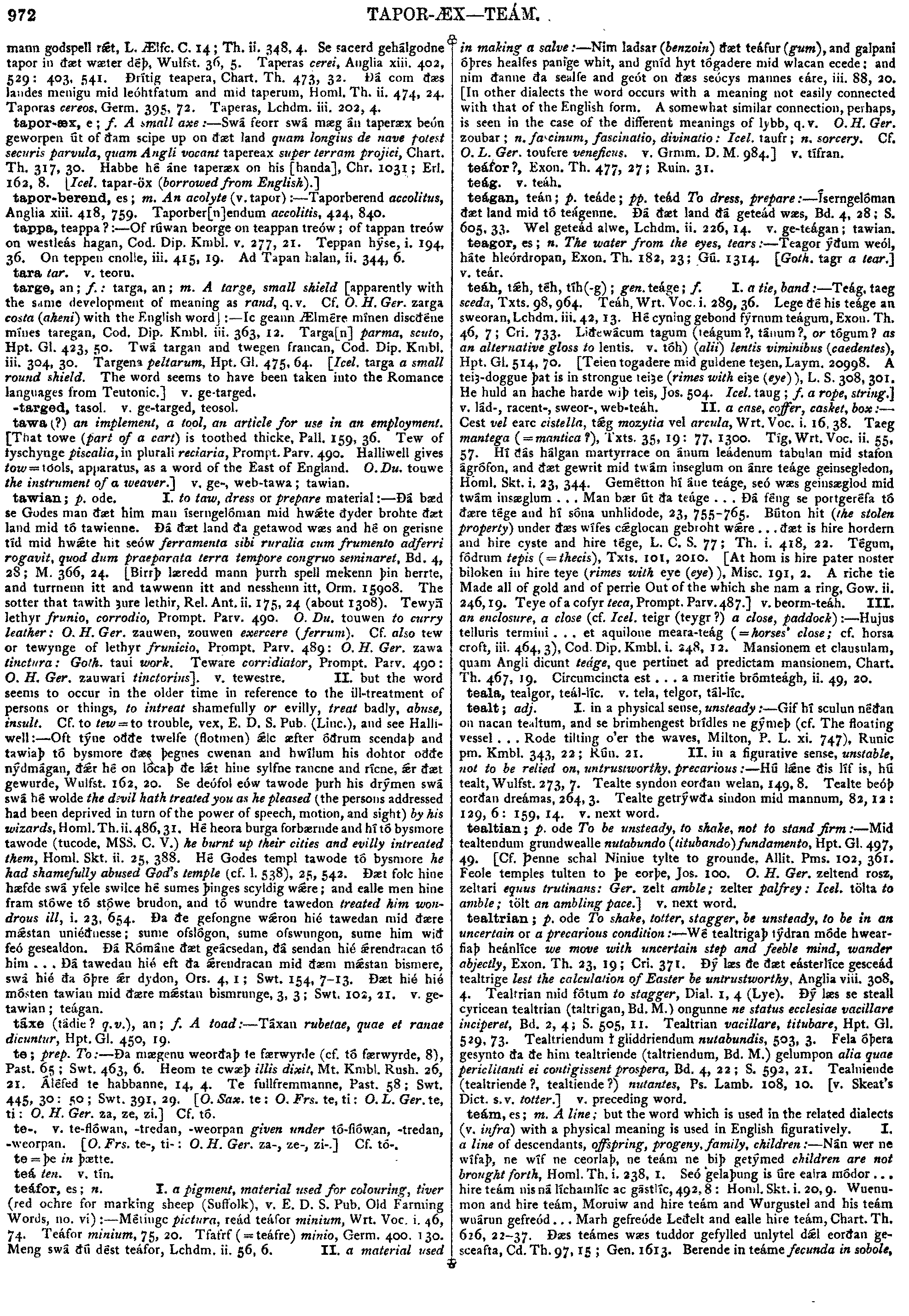
te; prep. To :-- Ða mægenu weorðaþ to færwyrde (cf. tó færwyrde, 8), Past. 65; Swt, 463, 6. Heom te cwæþ illis dixit, Mt. Kmbl. Rush. 26, 21. Áléfed te habbanne, 14, 4. Te fullfremmanne, Past. 58; Swt. 445, 30: 50; Swt. 391, 29. [O. Sax. te: O. Frs. te, ti: O. L. Ger. te, ti: O. H. Ger. za, ze, zi.] Cf. tó.
|
Source: Bosworth/Toller, page b0972, entry 12 View original page image as: [TIFF] [PNG] [View previous entry] [View next entry] |
[Comment on this entry] [View comments] |
The following entry has been hand-corrected once. |
|
Source: Torp, page b0020, entry 3 View original page image as: [TIFF] [PNG] [View previous entry] [View next entry] |
[Comment on this entry] [View comments] |
The following entry has been hand-corrected once. |
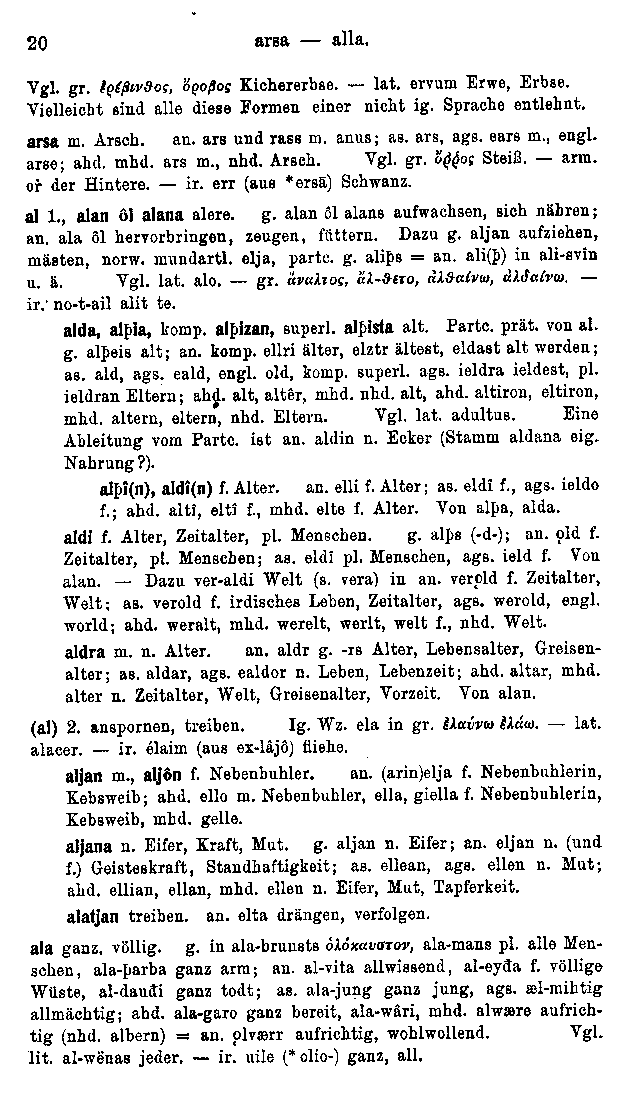
al 1., alan ôl alana alere. g. alan ôl alans aufwachsen, sich nähren; an. ala ôl hervorbringen, zeugen, füttern. Dazu g. aljan aufziehen, mästen, norw. mundartl. elja, partc. g. aliþs = an. ali(þ) in ali-svîn u. ä. Vgl. lat. alo. - gr. [a)'naltos, a)'l-qeto, a)lqai'nw, a)ldai'nw]. - ir. no-t-ail alit te.
[Translate the German words]
|
Source: Torp, page b0030, entry 8 View original page image as: [TIFF] [PNG] [View previous entry] [View next entry] |
[Comment on this entry] [View comments] |
The following entry has been hand-corrected once. |

und
präpos.
bis,
bis
zu,
bis
an.
g.
und
präpos.
mit
akk.
bis,
bis
zu,
bis
an;
an.
in
unz
(=
und
es)
bis
dass;
as.
afries.
und.
Auch
erweitert
mit
der
Präpos.
te
(tô)
in
ahd.
unza,
unzi,
mhd.
unz,
untze
mit
akk.
und
dat.
bis
zu,
as.
unti,
unt.
Vgl.
arm.
 nd.
-
Ig.
nd.
-
Ig.
 tí
in
Ablaut
zu
anti,
s.
and.
tí
in
Ablaut
zu
anti,
s.
and.
[Translate the German words]
|
Source: Torp, page b0114, entry 2 View original page image as: [TIFF] [PNG] [View previous entry] [View next entry] |
[Comment on this entry] [View comments] |
The following entry has been hand-corrected once. |

h(ve),
- h
(aus
*un-he
<
-qe)
und,
und
verallgemeinernde
Partikel.
g.
in
ni-h,
hwaz-ûh,
sa-h
u.
s.
w.;
an.
nê,
þenna
diesen
(aus
þen-h);
as.
ahd.
noh
auch
nicht,
nhd.
noch.
Ig.
qe
und,
wohl
eigentlich
wie.
Vgl.
lat.
que,
quis-que.
-
gr.
[te',
o('s-te]
u.
s.
w.
-
ir.
cá-ch
quivis.
-
skr.
ca,
káç-ca.
h
(aus
*un-he
<
-qe)
und,
und
verallgemeinernde
Partikel.
g.
in
ni-h,
hwaz-ûh,
sa-h
u.
s.
w.;
an.
nê,
þenna
diesen
(aus
þen-h);
as.
ahd.
noh
auch
nicht,
nhd.
noch.
Ig.
qe
und,
wohl
eigentlich
wie.
Vgl.
lat.
que,
quis-que.
-
gr.
[te',
o('s-te]
u.
s.
w.
-
ir.
cá-ch
quivis.
-
skr.
ca,
káç-ca.
[Translate the German words]
|
Source: Torp, page b0164, entry 9 View original page image as: [TIFF] [PNG] [View previous entry] [View next entry] |
[Comment on this entry] [View comments] |
The following entry has been hand-corrected once. |

tô
praep.,
adv.,
praefix
zu.
as.
tô
(te,
ti)
praep.
m.
dat.
instr.
zu,
ags.
tô
praep.
m.
dat.
zu
(engl.
to),
afries.
te,
ti;
ahd.
zuo
(za,
zi),
mhd.
zuo
(ze)
praep.
mit
dat.
instr.,
nhd.
zu.
Ig.
d :
d
:
d .
Vgl.
lett.
da
bis
zu,
lit.
do
praep.
und
praefix;
asl.
do
bis
zu.
ir.
do-.
-
lat.
dê,
dô-nique,
in-du.
-
gr.
[e)nqa'-de,
o)iko'nde,
Me'gara'-de].
-
zend.
vaêçmen-da.
Pronominalstamm
do,
vgl.
gr.
[o('-de]
.
Vgl.
lett.
da
bis
zu,
lit.
do
praep.
und
praefix;
asl.
do
bis
zu.
ir.
do-.
-
lat.
dê,
dô-nique,
in-du.
-
gr.
[e)nqa'-de,
o)iko'nde,
Me'gara'-de].
-
zend.
vaêçmen-da.
Pronominalstamm
do,
vgl.
gr.
[o('-de]
[Translate the German words]
|
Source: Torp, page b0427, entry 4 View original page image as: [TIFF] [PNG] [View previous entry] [View next entry] |
[Comment on this entry] [View comments] |
The following entry has been hand-corrected once. |

seþla Sitz, Wohnsitz. as. sethal m. Sitzen, Sitz (in sethal gân obire), sedal, sedel (nur im. dat. sedle) Sonnenuntergang (sîgan te sedle, vgl. ags. tô setle gân), ags. (angl.) seþel, sedel n. = westsächs. setl; ahd. sethal, sedal, sedil, sedel, mhd. sedel n. m. Sitz, Wohnsitz, Ruhesitz, Sattel, mhd. ze sedele gân vom Untergange der Sonne. Aus ig. sód-tlo- (vgl. sadle). Vgl. asl. selo fundus (aus sed-lo-).
[Translate the German words]
|
Source: Torp, page b0430, entry 1 View original page image as: [TIFF] [PNG] [View previous entry] [View next entry] |
[Comment on this entry] [View comments] |
The following entry has been hand-corrected once. |

sanþa
wahr,
schuldig,
subst.
des
Wahre,
Rechte.
an.
sannr,
sa r
wahr,
recht,
billig,
sannr
(at
s
r
wahr,
recht,
billig,
sannr
(at
s k)
schuldig,
sannr
m.
das
Wahre,
Rechte,
das
gute
Recht;
as.
sôth
wahr,
n.
Wahrheit,
te
sôe,
te
sôon
in
Wahrheit,
ags.
sôþ
wahr,
subst.
n.
das
Wahre,
Wahrheit,
Recht,
Gerechtigkeit
(engl.
for
sooth).
Devon
germ.
sanþôn
:
an.
sanna
aa
versichern,
bestätigen;
ags.
sôþian
beweisen;
und
germ.
senþian
(sendian)
:
an.
senna
aussprechen,
disputieren,
subst.
senna
Aussage,
Wortstreit,
afries.
san
Wortstreit,
sannia
streiten.
Hiermit
zu
vergleichen
lat.
sons
(vgl.
an.
sannr
at
sk
schuldig)
sontica
causa,
triftiger
Entschuldigungsgrund.
k)
schuldig,
sannr
m.
das
Wahre,
Rechte,
das
gute
Recht;
as.
sôth
wahr,
n.
Wahrheit,
te
sôe,
te
sôon
in
Wahrheit,
ags.
sôþ
wahr,
subst.
n.
das
Wahre,
Wahrheit,
Recht,
Gerechtigkeit
(engl.
for
sooth).
Devon
germ.
sanþôn
:
an.
sanna
aa
versichern,
bestätigen;
ags.
sôþian
beweisen;
und
germ.
senþian
(sendian)
:
an.
senna
aussprechen,
disputieren,
subst.
senna
Aussage,
Wortstreit,
afries.
san
Wortstreit,
sannia
streiten.
Hiermit
zu
vergleichen
lat.
sons
(vgl.
an.
sannr
at
sk
schuldig)
sontica
causa,
triftiger
Entschuldigungsgrund.
[Translate the German words]
|
Source: Torp, page b0433, entry 7 View original page image as: [TIFF] [PNG] [View previous entry] [View next entry] |
[Comment on this entry] [View comments] |
The following entry has been hand-corrected once. |

samana-
adv.
zusammen
(ursprüngl.
Casusformen
eines
Adj.).
g.
samana,
beisammen
(dat.
sing.?);
an.
saman
adv.
zusammen
(acc.
sing.?),
til
samans
dass.;
as.
saman
(acc.?),
te
samne
zusammen,
afries.
semin,
samin,
tô
semine,
ags.
samen,
tô
samne
zusammen;
ahd.
saman
(acc.?),
zi
samene,
mhd.
samen,
ze
samen(e),
nhd.
zusammen.
Vgl.
ir.
samain
(aus
samani)
die
Zeit
des
Festes
von
Tara
(urspr.
Zusammenkunft).
-
skr.
samana
Zusammenkunft,
Festversammlung,
saman adv.
zusammen,
gleichzeitig,
ebenmäßig.
adv.
zusammen,
gleichzeitig,
ebenmäßig.
[Translate the German words]
|
Source: Bosworth/Toller, page b0001, entry 3 View original page image as: [TIFF] [PNG] [View previous entry] [View next entry] |
[Comment on this entry] [View comments (1)] |
The following entry has been hand-corrected once. |
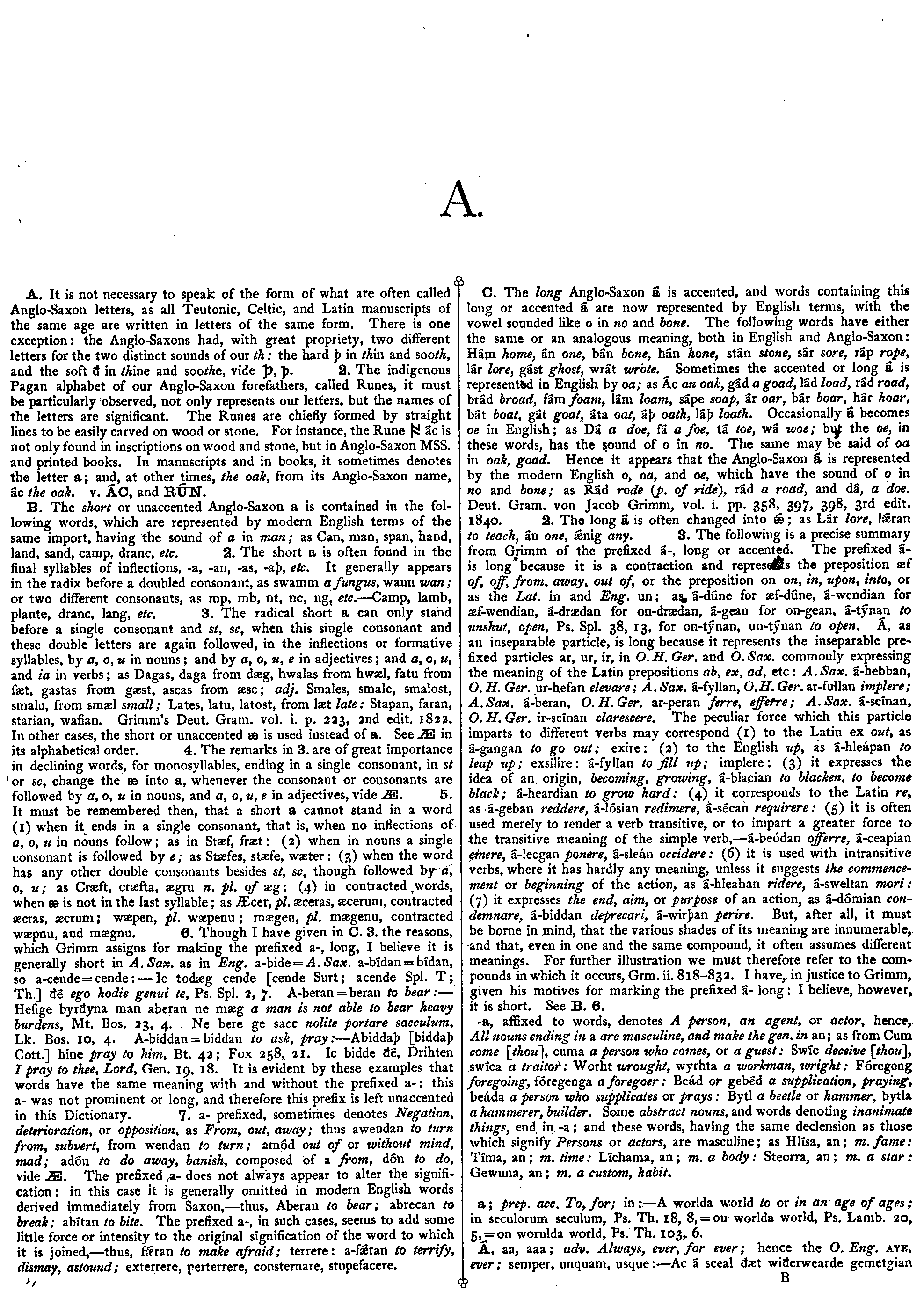
B.
The
short
or
unaccented
Anglo-Saxon
a
is
contained
in
the
following
words,
which
are
represented
by
modern
English
terms
of
the
same
import,
having
the
sound
of
a
in
man;
as
Can,
man,
span,
hand,
land,
sand,
camp,
dranc,
etc.
2.
The
short
a
is
often
found
in
the
final
syllables
of
inflections,
-a,
-an,
-as,
-aþ,
etc.
It
generally
appears
in
the
radix
before
a
doubled
consonant,
as
swamm
a
fungus,
wann
wan;
or
two
different
consonants,
as
mp,
mb,
nt,
nc,
ng,
etc.
--
Camp,
lamb,
plante,
dranc,
lang,
etc.
3.
The
radical
short
a
can
only
stand
before
a
single
consonant
and
st,
sc,
when
this
single
consonant
and
these
double
letters
are
again
followed,
in
the
inflections
or
formative
syllables,
by
a,
o,
u
in
nouns;
and
by
a,
o,
u,
e
in
adjectives;
and
a,
o,
u,
and
ia
in
verbs;
as
Dagas,
daga
from
dæg,
hwalas
from
hwæl,
fatu
from
fæt,
gastas
from
gæst,
ascas
from
æsc;
adj.
Smales,
smale,
smalost,
smalu,
from
smæl
small;
Lates,
latu,
latost,
from
læt
late:
Stapan,
faran,
starian,
wafian.
Grimm's
Deut.
Gram.
vol.
i.
p.
223,
2nd
edit.
1822.
In
other
cases,
the
short
or
unaccented
æ
is
used
instead
of
a.
See
Æ
in
its
alphabetical
order.
4.
The
remarks
in
3.
are
of
great
importance
in
declining
words,
for
monosyllables,
ending
in
a
single
consonant,
in
st
or
sc,
change
the
æ
into
a,
whenever
the
consonant
or
consonants
are
followed
by
a,
o,
u
in
nouns,
and
a,
o,
u,
e
in
adjectives,
vide
Æ.
5.
It
must
be
remembered
then,
that
a
short
a
cannot
stand
in
a
word
(1)
when
it
ends
in
a
single
consonant,
that
is,
when
no
inflections
of
a,
o,
u
in
nouns
follow;
as
in
Stæf,
fræt:
(2)
when
in
nouns
a
single
consonant
is
followed
by
e;
as
Stæfes,
stæfe,
wæter:
(3)
when
the
word
has
any
other
double
consonants
besides
st,
sc,
though
followed
by
a,
o,
u;
as
Cræft,
cræfta,
ægru
n.
pl.
of
æg:
(4)
in
contracted
words,
when
æ
is
not
in
the
last
syllable;
as
Æcer,
pl.
æceras,
æcerum,
contracted
æcras,
æcrum;
wæpen,
pl.
wæpenu
;
mægen,
pl.
mægenu,
contracted
wæpnu,
and
mægnu.
6.
Though
I
have
given
in
C.
3.
the
reasons,
which
Grimm
assigns
for
making
the
prefixed
a-
UNCERTAIN
long,
I
believe
it
is
generally
short
in
A.
Sax.
as
in
Eng.
a-bide
=
A.
Sax.
a-bídan
=
bídan,
so
a-cende
=
cende:--
Ic
todæg
cende
[cende
Surt;
acende
Spl.
T;
Th.]
ðé
ego
hodie
genui
te,
Ps.
Spl.
2,
7.
A-beran=beran
to
bear
:--
Hefige
byrðyna
man
aberan
ne
mæg
a
man
is
not
able
to
bear
heavy
burdens,
Mt.
Bos.
23,
4.
Ne
here
ge
sacc
nolite
fortare
sacculum,
Lk.
Bos.
10,
4.
A-biddan
=
biddan
to
ask,
pray
:--
Abiddaþ
[biddaþ
Cott.]
hine
pray
to
him.
Bt.
42
;
Fox
258,
21.
Ic
bidde
ðé,
Drihten
I
pray
to
thee,
Lord,
Gen.
19,
18.
It
is
evident
by
these
examples
that
words
have
the
same
meaning
with
and
without
the
prefixed
a-:
this
a-
was
not
prominent
or
long,
and
therefore
this
prefix
is
left
unaccented
in
this
Dictionary.
7.
a-
prefixed,
sometimes
denotes
Negation,
deterioration,
or
opposition,
as
From,
out,
away;
thus
awendan
to
turn
from,
subvert,
from
wendan
to
turn;
amód
out
of
or
without
mind,
mad;
adón
to
do
away,
banish,
composed
of
a
from,
dón
to
do,
vide
Æ.
The
prefixed
a-
does
not
always
appear
to
alter
the
signification
:
in
this
case
it
is
generally
omitted
in
modern
English
words
derived
immediately
from
Saxon,
--
thus,
Aberan
to
bear;
abrecan
to
break;
abítan
to
bite.
The
prefixed
a-,
in
such
cases,
seems
to
add
some
little
force
or
intensity
to
the
original
signification
of
the
word
to
which
it
is
joined,
--
thus,
f ran
to
make
afraid;
terrere:
a-fran
to
terrify,
dismay,
astound;
exterrere,
perterrere,
consternare,
stupefacere.
ran
to
make
afraid;
terrere:
a-fran
to
terrify,
dismay,
astound;
exterrere,
perterrere,
consternare,
stupefacere.
| Result Page: | 1 2 3 4 5 6 7 8 9 10 | Next |  |
Germanic Lexicon Project (main page)
This search system was written by
Sean Crist
Please consider
volunteering
to correct the data in these online dictionaries.
No rights reserved. Feel free to use these data in any way you please.