|
|

Tip: In the search results, you can click on any word or abbreviation for more information.
|
Source: Cleasby/Vigfusson, page b0347, entry 48 View original page image as: [TIFF] [PNG] [View previous entry] [View next entry] |
[Comment on this entry] [View comments] |
The following entry has been hand-corrected once. |
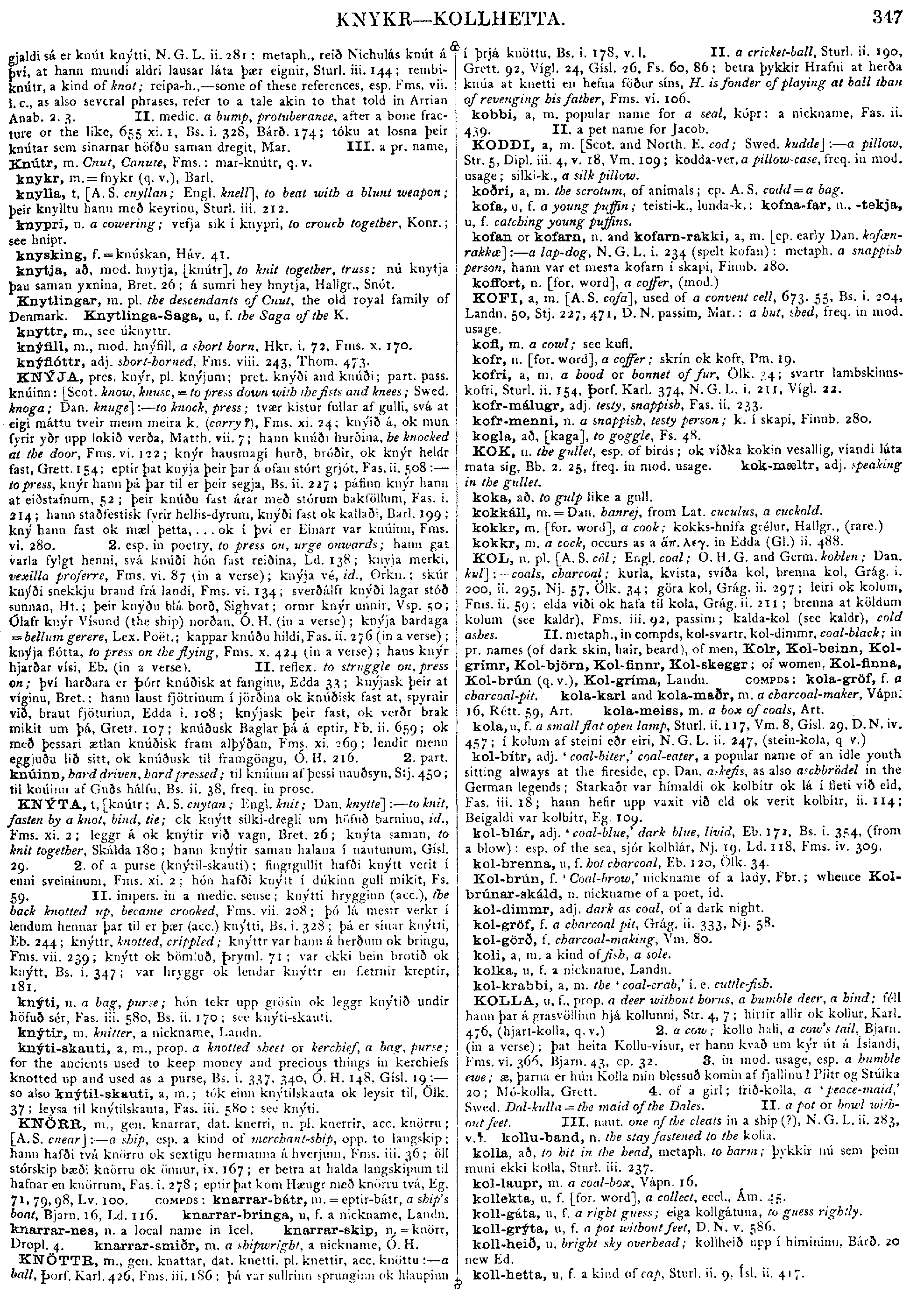
KOLLA, u, f., prop. a deer without horns, a humble deer, a hind; féll hann þar á grasvöllinn hjá kollunni, Str. 4, 7; hirtir allir ok kollur, Karl. 476, (hjart-kolla, q.v.) 2. a cow; kollu hali, a cow's tail, Bjarn. (in a verse); þat heita Kollu-vísur, er hann kvað um kýr út á Íslandi, Fms. vi. 366, Bjarn. 43, cp. 32. 3. in mod. usage, esp. a humble ewe; æ, þarna er hún Kolla mín blessuð komin af fjallinu! Piltr og Stúlka 20; Mó-kolla, Grett. 4. of a girl; frið-kolla, a 'peace-maid,' Swed. Dal-kulla = the maid of the Dales. II. a pot or bowl without feet. III. naut. one of the cleats in a ship (?), N. G. L. ii. 283, v.l. kollu-band, n. the stay fastened to the kolla.
|
Source: Cleasby/Vigfusson, page b0356, entry 37 View original page image as: [TIFF] [PNG] [View previous entry] [View next entry] |
[Comment on this entry] [View comments] |
The following entry has been hand-corrected once. |
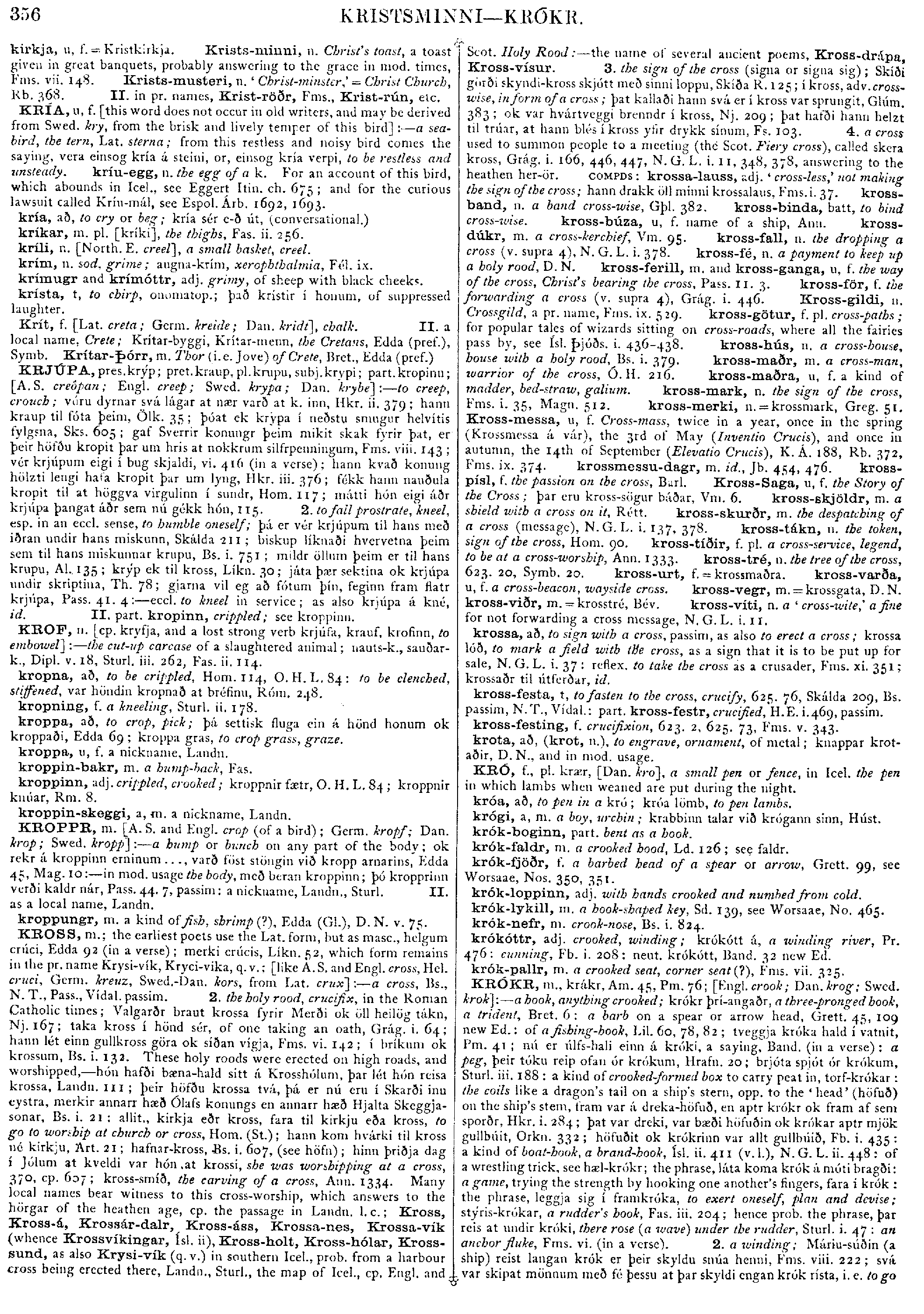
KRÓKR, m., krákr, Am. 45, Pm. 76; [Engl. crook; Dan. krog; Swed. krok] :-- a hook, anything crooked; krókr þrí-angaðr, a three-pronged hook, a trident, Bret. 6: a barb on a spear or arrow head, Grett. 45, 109 new Ed.: of a fishing-hook, Lil. 60, 78, 82; tveggja króka hald í vatnit, Pm. 41; nú er úlfs-hali einn á króki, a saying, Band, (in a verse): a peg, þeir tóku reip ofan ór krókum, Hrafn. 20; brjóta spjót ór krókum, Sturl. iii. 188: a kind of crooked-formed box to carry peat in, torf-krókar: the coils like a dragon's tail on a ship's stern, opp. to the 'head' (höfuð) on the ship's stem, fram var á dreka-höfuð, en aptr krókr ok fram af sem sporðr, Hkr. i. 284; þat var dreki, var bæði höfuðin ok krókar aptr mjök gullbúit, Orkn. 332; höfuðit ok krókrinn var allt gullbúið, Fb. i. 435: a kind of boat-hook, a brand-hook, Ísl. ii. 411 (v.l.), N. G. L. ii. 448: of a wrestling trick, see hæl-krókr; the phrase, láta koma krók á móti bragði: a game, trying the strength by hooking one another's fingers, fara í krók: the phrase, leggja sig í framkróka, to exert oneself, plan and devise; stýris-krókar, a rudder's hook, Fas. iii. 204; hence prob. the phrase, þar reis at undir króki, there rose (a wave) under the rudder, Sturl. i. 47: an anchor fluke, Fms. vi. (in a verse). 2. a winding; Máriu-súðin (a ship) reist langan krók er þeir skyldu snúa henni, Fms. viii. 222; svá var skipat mönnum með fé þessu at þar skyldi engan krók rísta, i.e. to go
|
Source: Cleasby/Vigfusson, page b0368, entry 44 View original page image as: [TIFF] [PNG] [View previous entry] [View next entry] |
[Comment on this entry] [View comments] |
The following entry has been hand-corrected once. |
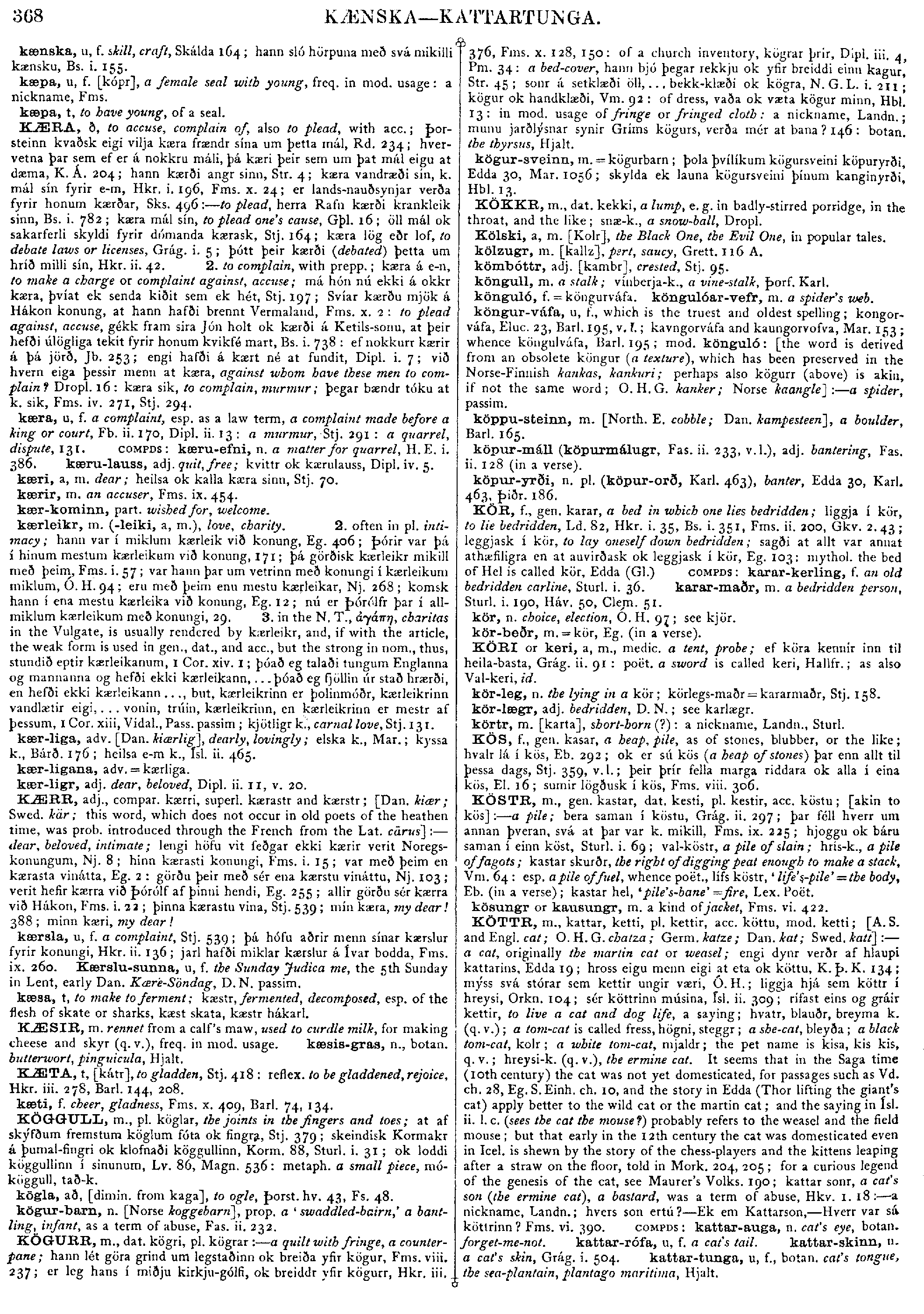
KÖTTR, m., kattar, ketti, pl. kettir, acc. köttu, mod. ketti; [A. S. and Engl. cat; O. H. G. chatza; Germ. katze; Dan. kat; Swed. katt] :-- a cat, originally the martin cat or weasel; engi dynr verðr af hlaupi kattarins, Edda 19; hross eigu menn eigi at eta ok köttu, K. Þ. K. 134; mýss svá stórar sem kettir ungir vaeri, Ó. H.; liggja hjá sem köttr í hreysi, Orkn. 104; sér köttrinn músina, Ísl. ii. 309; rífast eins og gráir kettir, to live a cat and dog life, a saying; hvatr, blauðr, breyma k. (q.v.); a tom-cat is called fress, högni, steggr; a she-cat, bleyða; a black tom-cat, kolr; a white tom-cat, mjaldr; the pet name is kisa, kis kis, q.v.; hreysi-k. (q.v.), the ermine cat. It seems that in the Saga time (10th century) the cat was not yet domesticated, for passages such as Vd. ch. 28, Eg. S. Einh. ch. 10, and the story in Edda (Thor lifting the giant's cat) apply better to the wild cat or the martin cat; and the saying in Ísl. ii. l.c. (sees the cat the mouse?) probably refers to the weasel and the field mouse; but that early in the 12th century the cat was domesticated even in Icel. is shewn by the story of the chess-players and the kittens leaping after a straw on the floor, told in Mork. 204, 205; for a curious legend of the genesis of the cat, see Maurer's Volks. 190; kattar sonr, a cat's son (the ermine cat), a bastard, was a term of abuse, Hkv. 1. 18 :-- a nickname, Landn.; hvers son ertú? -- Ek em Kattarson, -- Hverr var sá kottrinn? Fms. vi. 390. COMPDS: kattar-auga, n. cat's eye, botan. forget-me-not. kattar-rófa, u, f. a cat's tail. kattar-skinn, n. a cat's skin, Grág. i. 504. kattar-tunga, u, f., botan. cat's tongue, the sea-plantain, plantago maritima, Hjalt.
|
Source: Cleasby/Vigfusson, page b0404, entry 75 View original page image as: [TIFF] [PNG] [View previous entry] [View next entry] |
[Comment on this entry] [View comments] |
The following entry has been hand-corrected once. |
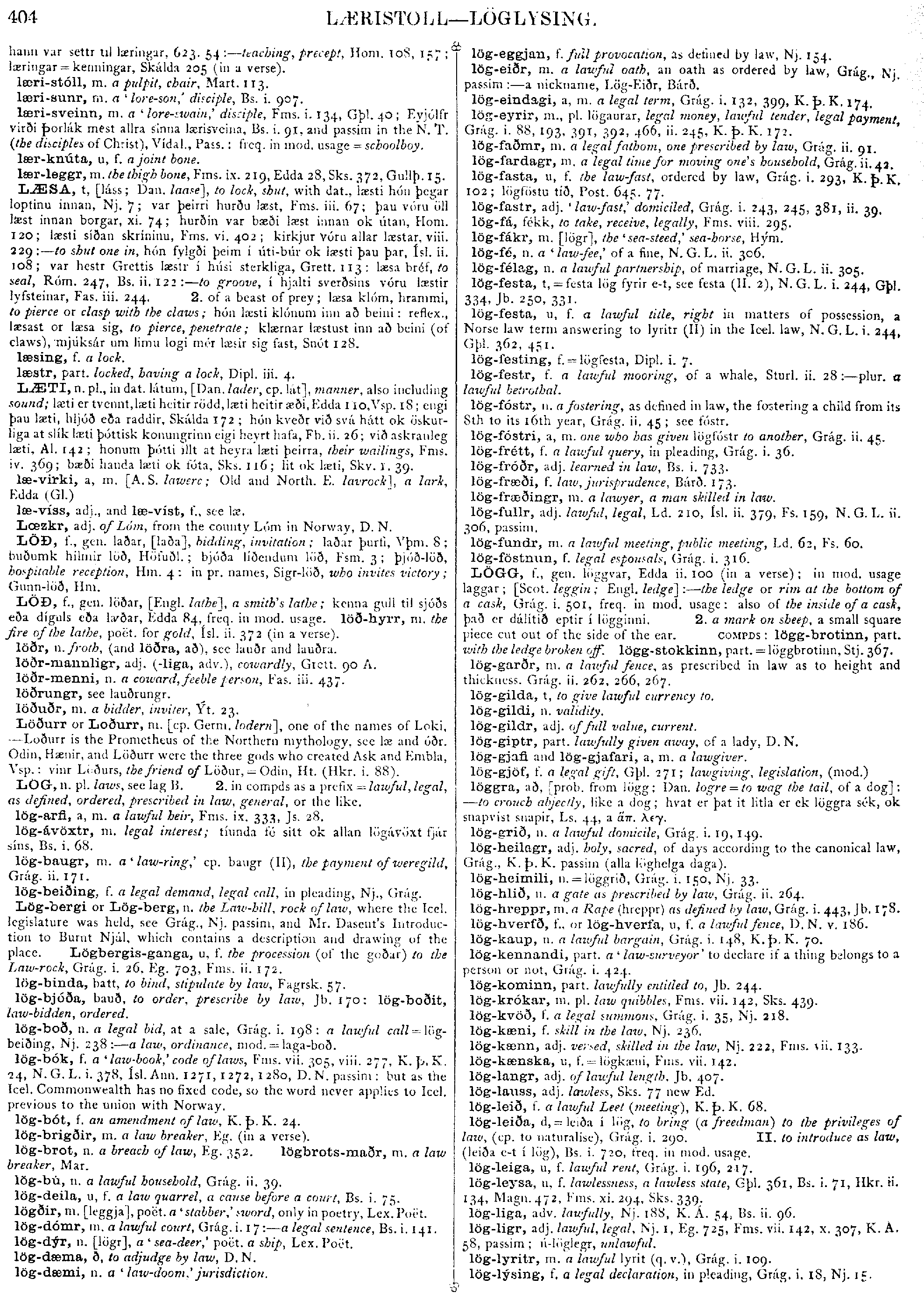
löggra,
að,
[prob.
from
lögg;
Dan.
logre
=
to
wag
the
tail,
of
a
dog]:--
to
crouch
abjectly,
like
a
dog;
hvat
er
þat
it
litla
er
ek
löggra
sék,
ok
snapvíst
snapir,
Ls.
44,
a

 .
.


 .
.
|
Source: Cleasby/Vigfusson, page b0440, entry 3 View original page image as: [TIFF] [PNG] [View previous entry] [View next entry] |
[Comment on this entry] [View comments] |
The following entry has been hand-corrected once. |
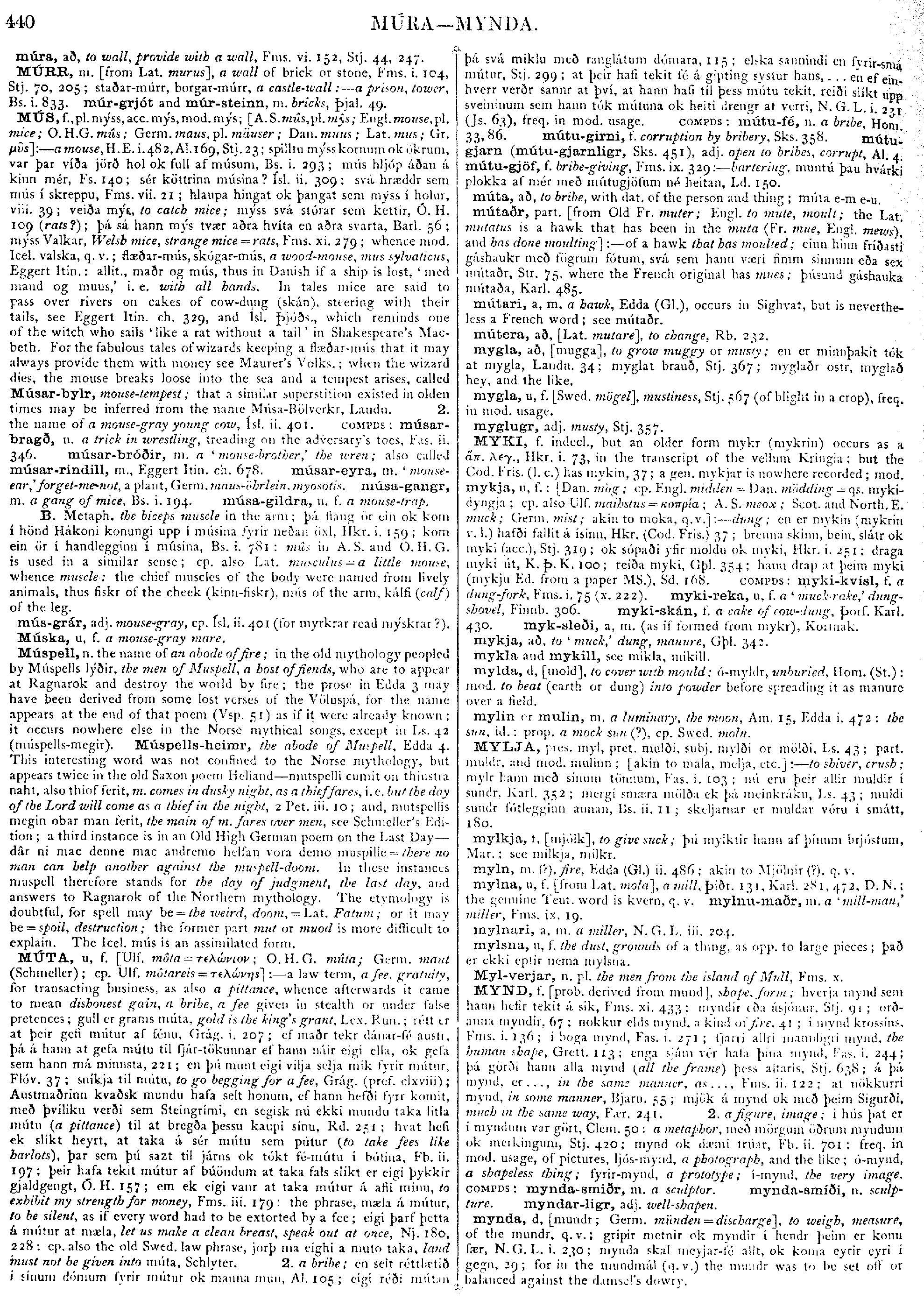
MÚS, f., pl. mýss, acc. mýs, mod. mýs; [A.S. mûs, pl. mýs; Engl. mouse, pl. mice; O.H.G. mûs; Germ. maus, pl. mäuser; Dan. muus; Lat. mus; Gr. GREEK] :-- a mouse, H.E. i. 482, Al. 169, Stj. 23; spilltu mýss kornum ok ökrum, var þar víða jörð hol ok full af músum, Bs. i. 293; mús hljóp áðan á kinn mér, Fs. 140; sér köttrinn músina? Ísl. ii. 309; svá hræddr sem mús í skreppu, Fms. vii. 21; hlaupa hingat ok þangat sem mýss í holur, viii. 39; veiða mýs, to catch mice; mýss svá stórar sem kettir, Ó.H. 109 (rats?); þá sá hann mýs tvær aðra hvíta en aðra svarta, Barl. 56; mýss Valkar, Welsh mice, strange mice = rats, Fms. xi. 279; whence mod. Icel. valska, q.v.; flæðar-mús, skógar-mús, a wood-mouse, mus sylvaticus, Eggert Itin.: allit., maðr og mús, thus in Danish if a ship is lost, 'med mand og muus,' i.e. with all hands. In tales mice are said to pass over rivers on cakes of cow-dung (skán), steering with their tails, see Eggert Itin. ch. 329, and Ísl. Þjóðs., which reminds one of the witch who sails 'like a rat without a tail' in Shakespeare's Macbeth. For the fabulous tales of wizards keeping a flæðar-mús that it may always provide them with money see Maurer's Volks.; when the wizard dies, the mouse breaks loose into the sea and a tempest arises, called Músar-bylr, mouse-tempest; that a similar superstition existed in olden times may be inferred from the name Músa-Bölverkr, Landn. 2. the name of a mouse-gray young cow, Ísl. ii. 401. COMPDS: músar-bragð, n. a trick in wrestling, treading on the adversary's toes, Fas. ii. 346. músar-bróðir, m. a 'mouse-brother,' the wren; also called músar-rindill, m., Eggert Itin. ch. 678. músar-eyra, m. 'mouse-ear,' forget-me-not, a plant, Germ. maus-öhrlein. myosotis. músa-gangr, m. a gang of mice, Bs. i. 194. músa-gildra, u. f. a mouse-trap. B. Metaph. the biceps muscle in the arm; þá flaug ör ein ok kom í hönd Hákoni konungi upp í músina fyrir neðan öxl, Hkr. i. 159; kom ein ör í handlegginn í músina, Bs. i. 781: mûs in A.S. and O.H.G. is used in a similar sense; cp. also Lat. musculus = a little mouse, whence muscle: the chief muscles of the body were named from lively animals, thus fiskr of the cheek (kinn-fiskr), mús of the arm, kálfi (calf) of the leg.
|
Source: Cleasby/Vigfusson, page b0502, entry 20 View original page image as: [TIFF] [PNG] [View previous entry] [View next entry] |
[Comment on this entry] [View comments] |
The following entry has been hand-corrected once. |
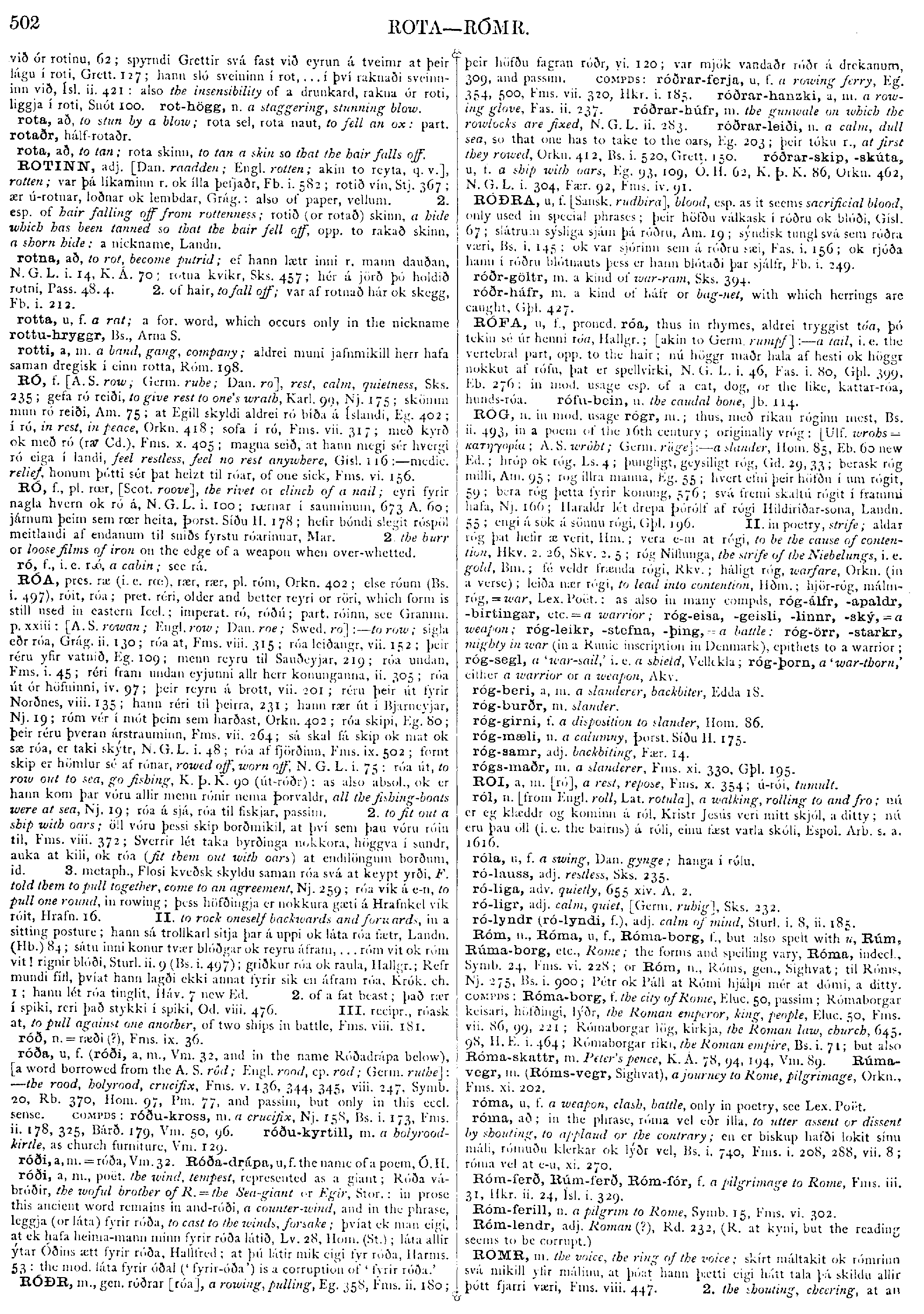
RÓFA, u, f., proncd. róa, thus in rhymes, aldrei tryggist tóa, þó tekin sé úr henni róa, Hallgr.; [akin to Germ. rumpf] :-- a tail, i.e. the vertebral part, opp. to the hair; nú höggr maðr hala af hesti ok höggr nokkut af rófu, þat er spellvirki, N.G.L. i. 46, Fas. i. 80, Gpl. 399, Kb. 276: in mod, usage esp. of a cat, dog, or the like, kattar-róa, hunds-róa. rófu-bein, n. the caudal bone, Jb. 114.
|
Source: Cleasby/Vigfusson, page b0539, entry 1 View original page image as: [TIFF] [PNG] [View previous entry] [View next entry] |
[Comment on this entry] [View comments] |
The following entry has been hand-corrected once. |
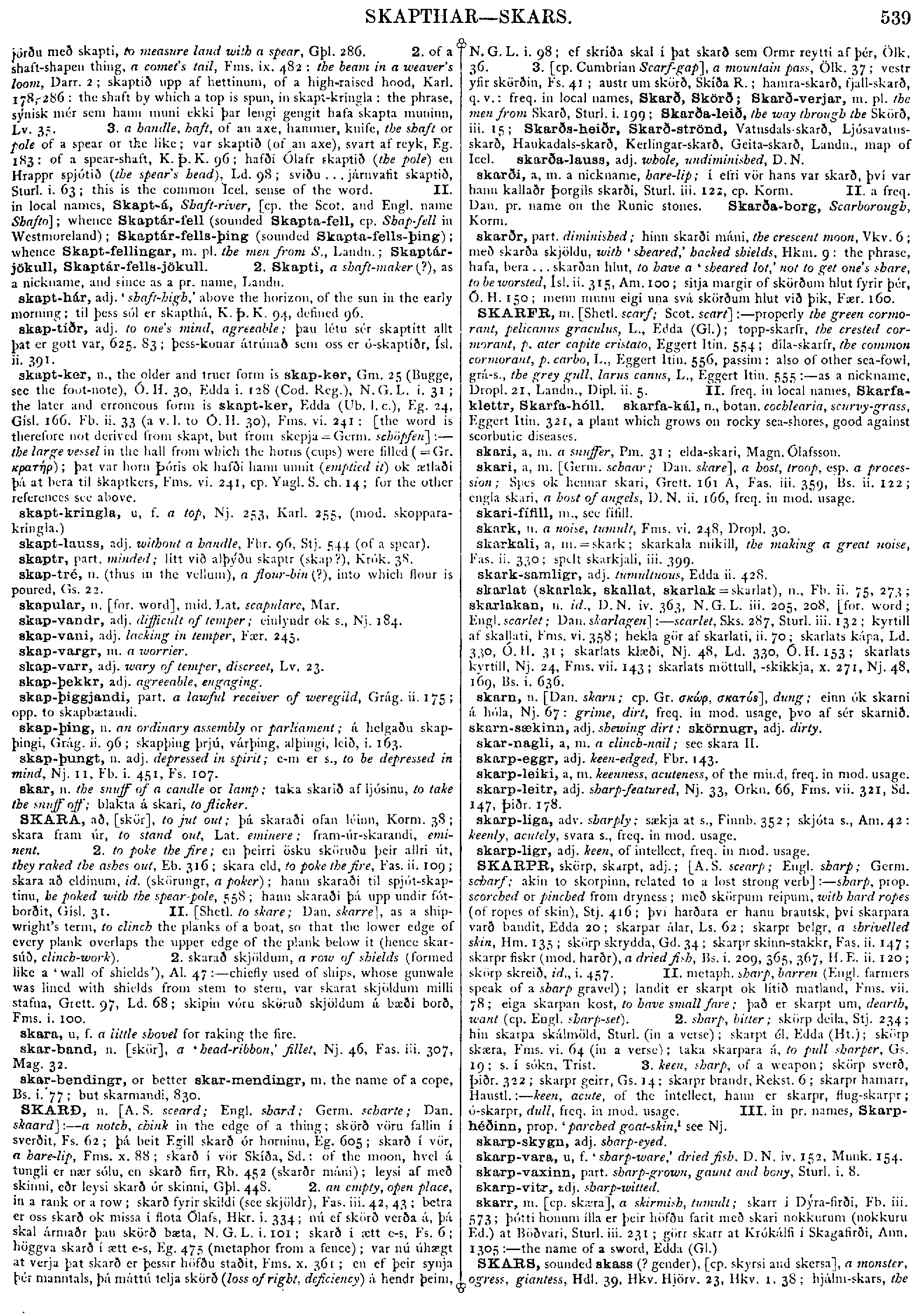
jörðu með skapti, to measure land with a spear, Gþl. 286. 2. of a shaft-shapen thing, a comet's tail, Fms. ix. 482: the beam in a weaver's loom, Darr. 2; skaptið upp af hettinum, of a high-raised hood, Karl. 178, 286: the shaft by which a top is spun, in skapt-kringla: the phrase, sýnisk mér sem hann muni ekki þar lengi gengit hafa skapta muninn, Lv. 35. 3. a handle, haft, of an axe, hammer, knife, the shaft or pole of a spear or the like; var skaptið (of an axe), svart af reyk, Eg. 183: of a spear-shaft, K.Þ.K. 96; hafði Ólafr skaptið (the pole) en Hrappr spjótið (the spear's head), Ld. 98; sviðu ... járnvafit skaptið, Sturl. i. 63; this is the common Icel. sense of the word. II. in local names, Skapt-á, Shaft-river, [cp. the Scot. and Engl. name Shafto]; whence Skaptár-fell (sounded Skapta-fell, cp. Shap-fell in Westmoreland); Skaptar-fells-þing (sounded Skapta-fells-þing); whence Skapt-fellingar, m. pl. the men from S., Landn.; Skaptár-jökull, Skaptár-fells-jökull. 2. Skapti, a shaft-maker(?), as a nickname, and since as a pr. name, Landn.
|
Source: Cleasby/Vigfusson, page b0540, entry 40 View original page image as: [TIFF] [PNG] [View previous entry] [View next entry] |
[Comment on this entry] [View comments] |
The following entry has been hand-corrected once. |
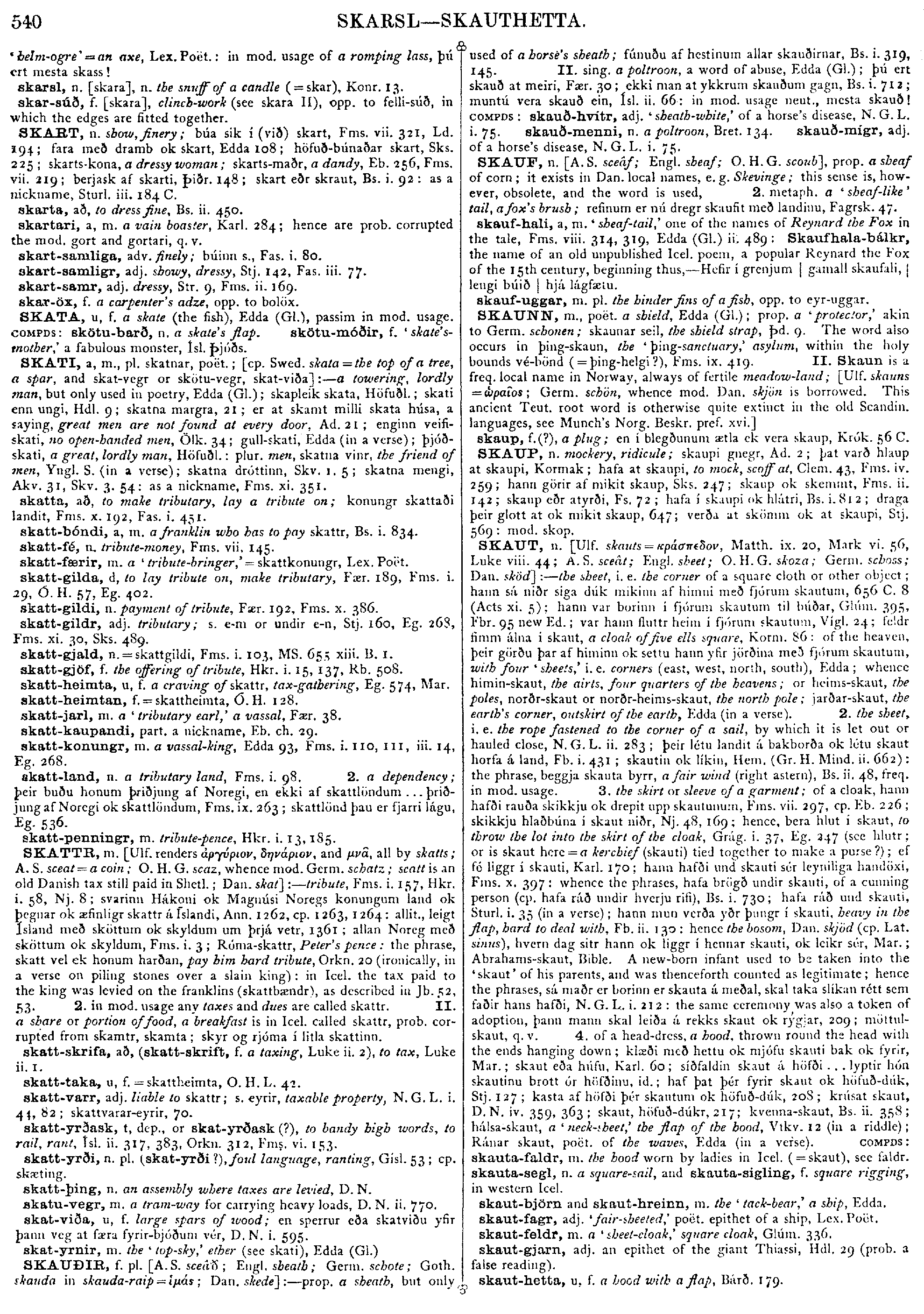
SKAUF, n. [A.S. sceâf; Engl. sheaf; O.H.G. scoub], prop. a sheaf of corn; it exists in Dan. local names, e.g. Skevinge; this sense is, however, obsolete, and the word is used, 2. metaph. a 'sheaf-like' tail, a fox's brush; refinum er nú dregr skaufit með landinu, Fagrsk. 47.
|
Source: Cleasby/Vigfusson, page b0555, entry 18 View original page image as: [TIFF] [PNG] [View previous entry] [View next entry] |
[Comment on this entry] [View comments] |
The following entry has not been hand-corrected. However, the page is reserved and someone is correcting it. |
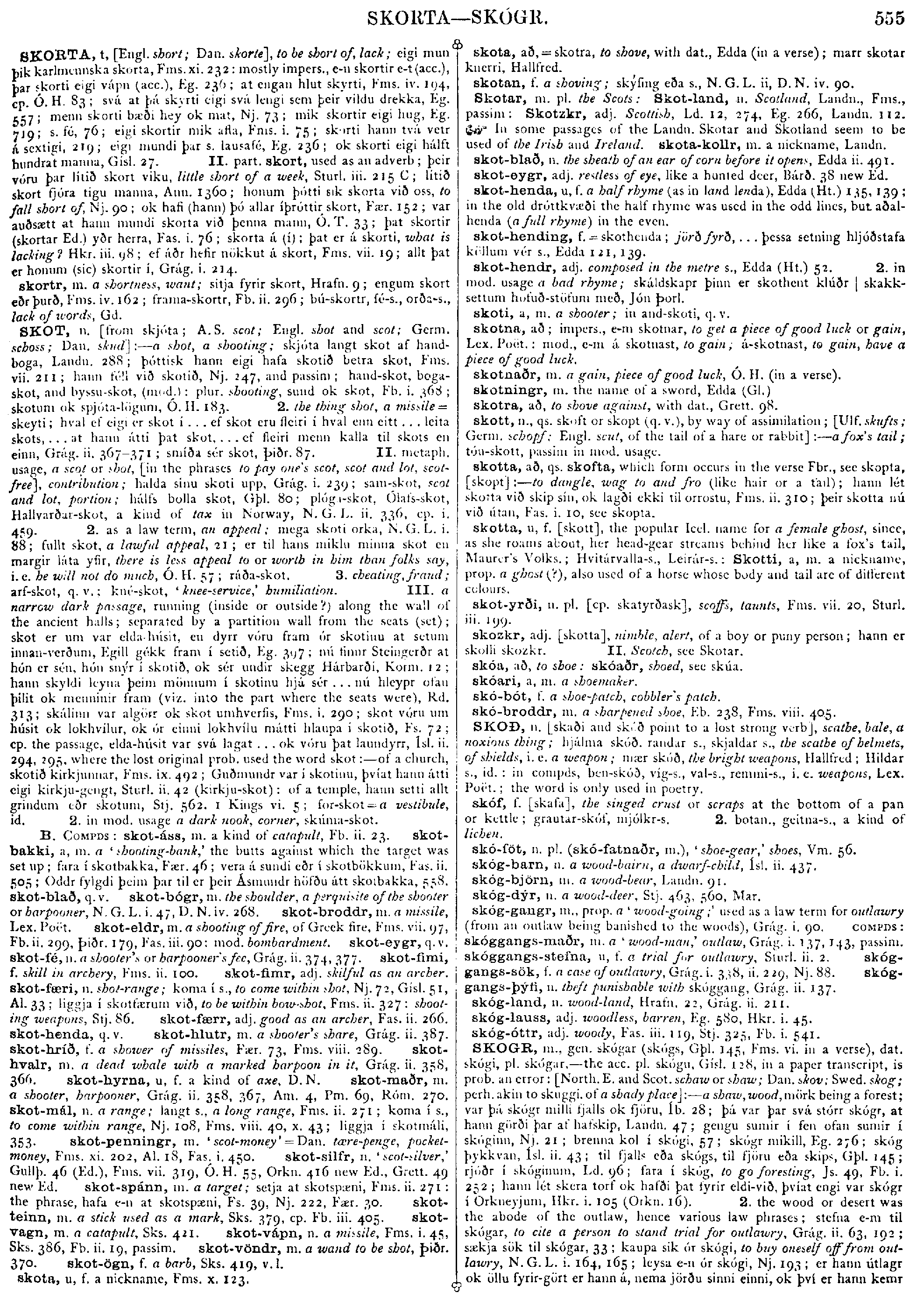
skott, n., qs. skoft or skopt (q. v.), by way of assimilation; [LHf. skufts; Germ, schopf; Engl. scut, of the- tail of a hare or rabbit] :-- a fox's tail; t'ju-skott, passim in mod. usage.
|
Source: Cleasby/Vigfusson, page b0555, entry 19 View original page image as: [TIFF] [PNG] [View previous entry] [View next entry] |
[Comment on this entry] [View comments] |
The following entry has not been hand-corrected. However, the page is reserved and someone is correcting it. |
skotta, að, qs. skofta, which form occurs in the verse Fbr., see skopta, [skopt] :-- to dangle, wag to and fro (like hair or a tail); hann let skotta við skip sin, ok lagdi ekki til orrostu, Fms. ii. 310; þeir skotta DÚ við útan, Fas. i. 10, see skopta.
| Result Page: |  |
Previous | 1 2 3 4 5 6 7 | Next |  |
Germanic Lexicon Project (main page)
This search system was written by
Sean Crist
Please consider
volunteering
to correct the data in these online dictionaries.
No rights reserved. Feel free to use these data in any way you please.