|
|

|
Source: Bosworth/Toller, page b0495, entry 7 View original page image as: [TIFF] [PNG] [View previous entry] [View next entry] |
[Comment on this entry] [View comments] |
The following entry has been hand-corrected once. |
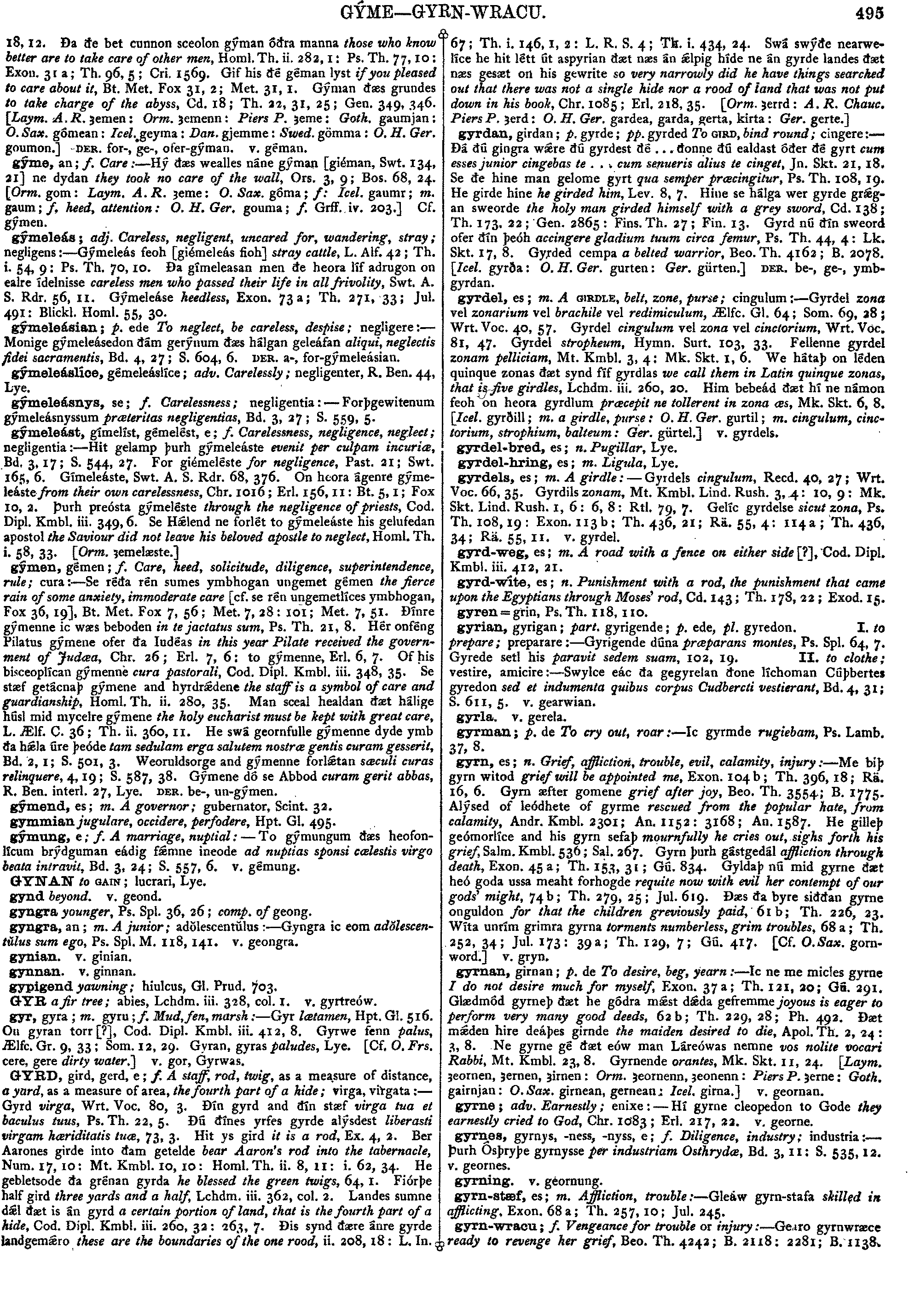
gýmen,
gémen;
f.
Care,
heed,
solicitude,
diligence,
superintendence,
rule;
cura
:--
Se
réða
rén
sumes
ymbhogan
ungemet
gémen
the
fierce
rain
of
some
anxiety,
immoderate
care
[cf.
se
rén
ungemetlíces
ymbhogan,
Fox
36,
19],
Bt.
Met.
Fox
7,
56;
Met.
7,
28:
101;
Met.
7,
51.
Ðínre
gýmenne
ic
wæs
beboden
in
te
jactatus
sum,
Ps.
Th.
21,
8.
Hér
onféng
Pilatus
gýmene
ofer
ða
Iudéas
in
this
year
Pilate
received
the
government
of
Judæa,
Chr.
26;
Erl.
7,
6:
to
gýmenne,
Erl.
6,
7.
Of
his
bisceoplícan
gýmenne
cura
pastorali,
Cod.
Dipl.
Kmbl.
iii.
348,
35.
Se
stæf
getácnaþ
gýmene
and
hyrdr dene
the
staff
is
a
symbol
of
care
and
guardianship,
Homl.
Th.
ii.
280,
35.
Man
sceal
healdan
ðæt
hálige
húsl
mid
mycelre
gýmene
the
holy
eucharist
must
be
kept
with
great
care,
L.
Ælf.
C.
36;
Th.
ii.
360,
11.
He
swá
geornfulle
gýmenne
dyde
ymb
ða
hla
úre
þeóde
tam
sedulam
erga
salutem
nostræ
gentis
curam
gesserit,
Bd.
2,
1;
S.
501,
3.
Weoruldsorge
and
gýmenne
forltan
sæculi
curas
relinquere,
4,
19;
S.
587,
38.
Gýmene
dó
se
Abbod
curam
gerit
abbas,
R.
Ben.
interl.
27,
Lye.
DER.
be-,
un-gýmen.
dene
the
staff
is
a
symbol
of
care
and
guardianship,
Homl.
Th.
ii.
280,
35.
Man
sceal
healdan
ðæt
hálige
húsl
mid
mycelre
gýmene
the
holy
eucharist
must
be
kept
with
great
care,
L.
Ælf.
C.
36;
Th.
ii.
360,
11.
He
swá
geornfulle
gýmenne
dyde
ymb
ða
hla
úre
þeóde
tam
sedulam
erga
salutem
nostræ
gentis
curam
gesserit,
Bd.
2,
1;
S.
501,
3.
Weoruldsorge
and
gýmenne
forltan
sæculi
curas
relinquere,
4,
19;
S.
587,
38.
Gýmene
dó
se
Abbod
curam
gerit
abbas,
R.
Ben.
interl.
27,
Lye.
DER.
be-,
un-gýmen.
|
Source: Bosworth/Toller, page b0538, entry 15 View original page image as: [TIFF] [PNG] [View previous entry] [View next entry] |
[Comment on this entry] [View comments (1)] |
The following entry has been hand-corrected once. |
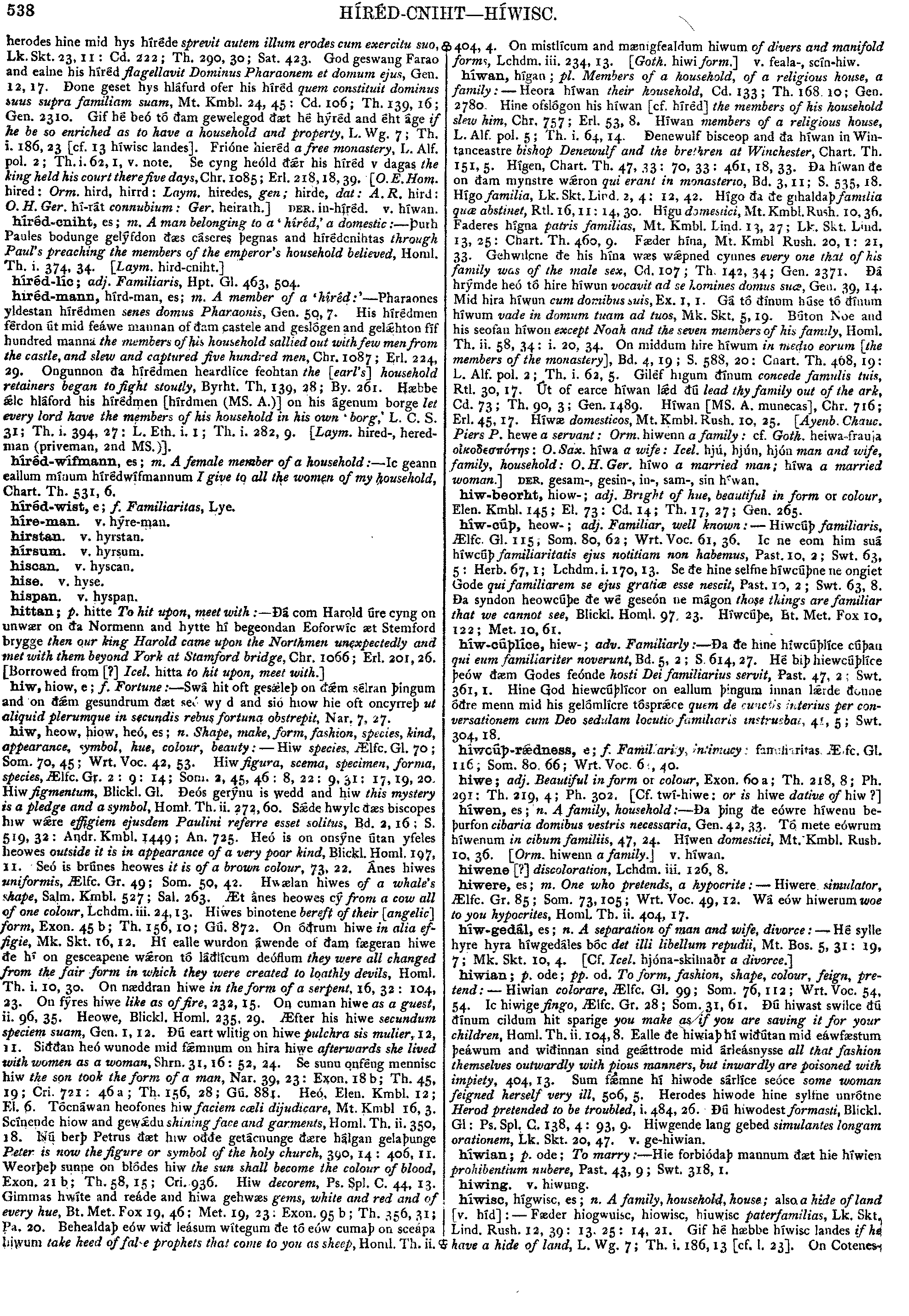
hiw,
heow,
hiow,
heó,
es;
n.
Shape,
make,
form,
fashion,
species,
kind,
appearance,
symbol,
hue,
colour,
beauty
:--
Hiw
species,
Ælfc.
Gl.
70;
Som.
70,
45;
Wrt.
Voc.
42,
53.
Hiw
figura,
scema,
specimen,
forma,
species,
Ælfc.
Gr.
2:
9:
14;
Som.
2,
45,
46:
8,
22:
9,
31:
17,
19,
20.
Hiw
figmentum,
Blickl.
Gl.
Ðeós
gerýnu
is
wedd
and
hiw
this
mystery
is
a
pledge
and
a
symbol,
Homl.
Th.
ii.
272,
60.
Sde
hwylc
ðæs
biscopes
hiw
wre
effigiem
ejusdem
Paulini
referre
esset
solitus,
Bd.
2,
16;
S.
519,
32:
Andr.
Kmbl.
7449;
An.
725.
Heó
is
on
onsýne
útan
yfeles
heowes
outside
it
is
in
appearance
of
a
very
poor
kind,
Blickl.
Homl.
197,
11.
Seó
is
brúnes
heowes
it
is
of
a
brown
colour,
73,
22.
Ánes
hiwes
uniformis,
Ælfc.
Gr.
49;
Som.
50,
42.
Hwælan
hiwes
of
a
whale's
shape,
Salm.
Kmbl.
527;
Sal.
263.
Æt
ánes
heowes
cý
from
a
cow
all
of
one
colour,
Lchdm.
iii.
24,
13.
Hiwes
binotene
bereft
of
their
[angelic]
form,
Exon.
45
b;
Th.
156,
10;
Gú.
872.
On
óðfum
hiwe
in
alia
effigie,
Mk.
Skt.
16,
12.
Hí
ealle
wurdon
áwende
of
ðam
fægeran
hiwe
ðe
hí
on
gesceapene
wron
tó
láðlícum
deóflum
they
were
all
changed
from
the
fair
form
in
which
they
were
created
to
loathly
devils,
Homl.
Th.
i.
10,
30.
On
næddran
hiwe
in
the
form
of
a
serpent,
16,
32:
104,
23.
On
fýres
hiwe
like
as
of
fire,
232,
15.
On
cuman
hiwe
as
a
guest,
ii.
96,
35.
Heowe,
Blickl.
Homl.
235,
29.
Æfter
his
hiwe
secundum
speciem
suam,
Gen.
1,
12.
Ðú
eart
wlitig
on
hiwe
pulchra
sis
mulier,
12,
11.
Siððan
heó
wunode
mid
fmnum
on
hira
hiwe
afterwards
she
lived
with
women
as
a
woman,
Shrn.
31,
16:
52,
24.
Se
sunn
onféng
mennisc
hiw
the
son
took
the
form
of
a
man,
Nar.
39,
23:
Exon.
18
b;
Th.
45,
19;
Cri.
721:
46
a;
Th.
156,
28;
Gú.
881.
Heó,
Elen.
Kmbl.
12;
El.
6.
Tócnáwan
heofones
hiw
faciem
cæli
dijudicare,
Mt.
Kmbl
16,
3.
Scínende
hiow
and
gewdu
shining
face
and
garments,
Homl.
Th.
ii.
350,
18.
Nú
berþ
Petrus
ðæt
hiw
oððe
getácnunge
ðære
hálgan
gelaþunge
Peter
is
now
the
figure
or
symbol
of
the
holy
church,
390,
14:
406,
11.
Weorþeþ
sunne
on
blódes
hiw
the
sun
shall
become
the
colour
of
blood,
Exon.
21
b;
Th.
58,
15;
Cri.
936.
Hiw
decorem,
Ps.
Spl.
C.
44,
13.
Gimmas
hwíte
and
reáde
and
hiwa
gehwæs
gems,
white
and
red
and
of
every
hue,
Bt.
Met.
Fox
19,
46;
Met.
19,
23:
Exon.
95
b;
Th.
356,
31;
Pa.
20.
Behealdaþ
eów
wið
leásum
wítegum
ðe
tó
eów
cumaþ
on
sceápa
hiwum
take
heed
of
false
prophets
that
come
to
you
as
sheep,
Homl.
Th.
ii.
404,
4.
On
mistlícum
and
mænigfealdum
hiwum
of
divers
and
manifold
forms,
Lchdm.
iii.
234,
13.
[Goth.
hiwi
form.]
v.
feala-,
scín-hiw.
|
Source: Bosworth/Toller, page b0652, entry 22 View original page image as: [TIFF] [PNG] [View previous entry] [View next entry] |
[Comment on this entry] [View comments] |
The following entry has been hand-corrected once. |
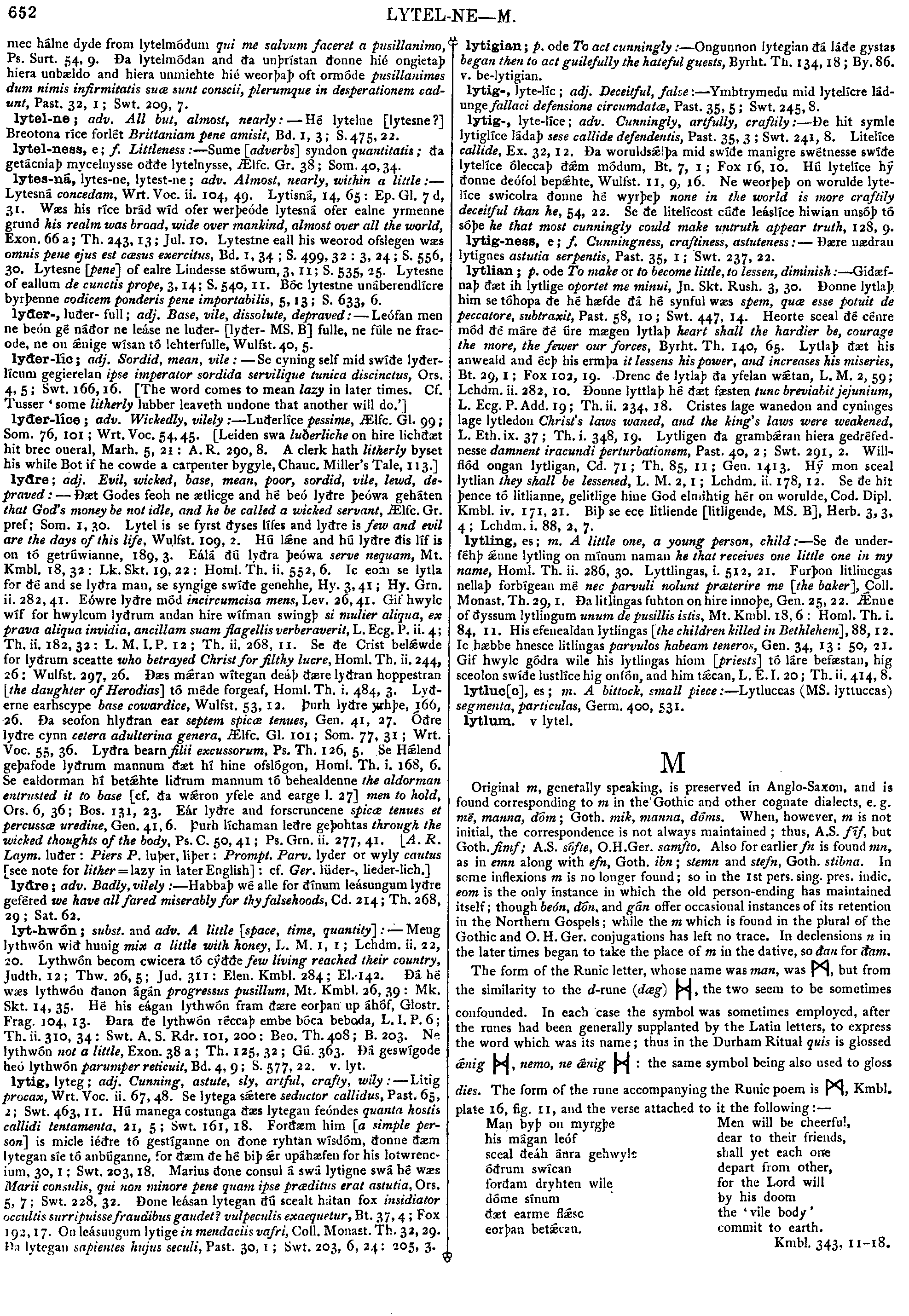
The
form
of
the
Runic
letter,
whose
name
was
man,
was
&m-rune;
,
but
from
the
similarity
to
the
d-rune
(dæg)
&d-rune;
,
the
two
seem
to
be
sometimes
confounded.
In
each
case
the
symbol
was
sometimes
employed,
after
the
runes
had
been
generally
supplanted
by
the
Latin
letters,
to
express
the
word
which
was
its
name;
thus
in
the
Durham
Ritual
quis
is
glossed
nsig
&d-rune;
,
nemo,
ne
nig
&d-rune;
:
the
same
symbol
being
also
used
to
gloss
dies.
The
form
of
the
rune
accompanying
the
Runic
poem
is
&m-rune;
,
Kmbl.
plate
16,
fig.
11,
and
the
verse
attached
to
it
the
following
:--
|
Source: Bosworth/Toller, page b0717, entry 10 View original page image as: [TIFF] [PNG] [View previous entry] [View next entry] |
[Comment on this entry] [View comments] |
The following entry has been hand-corrected once. |
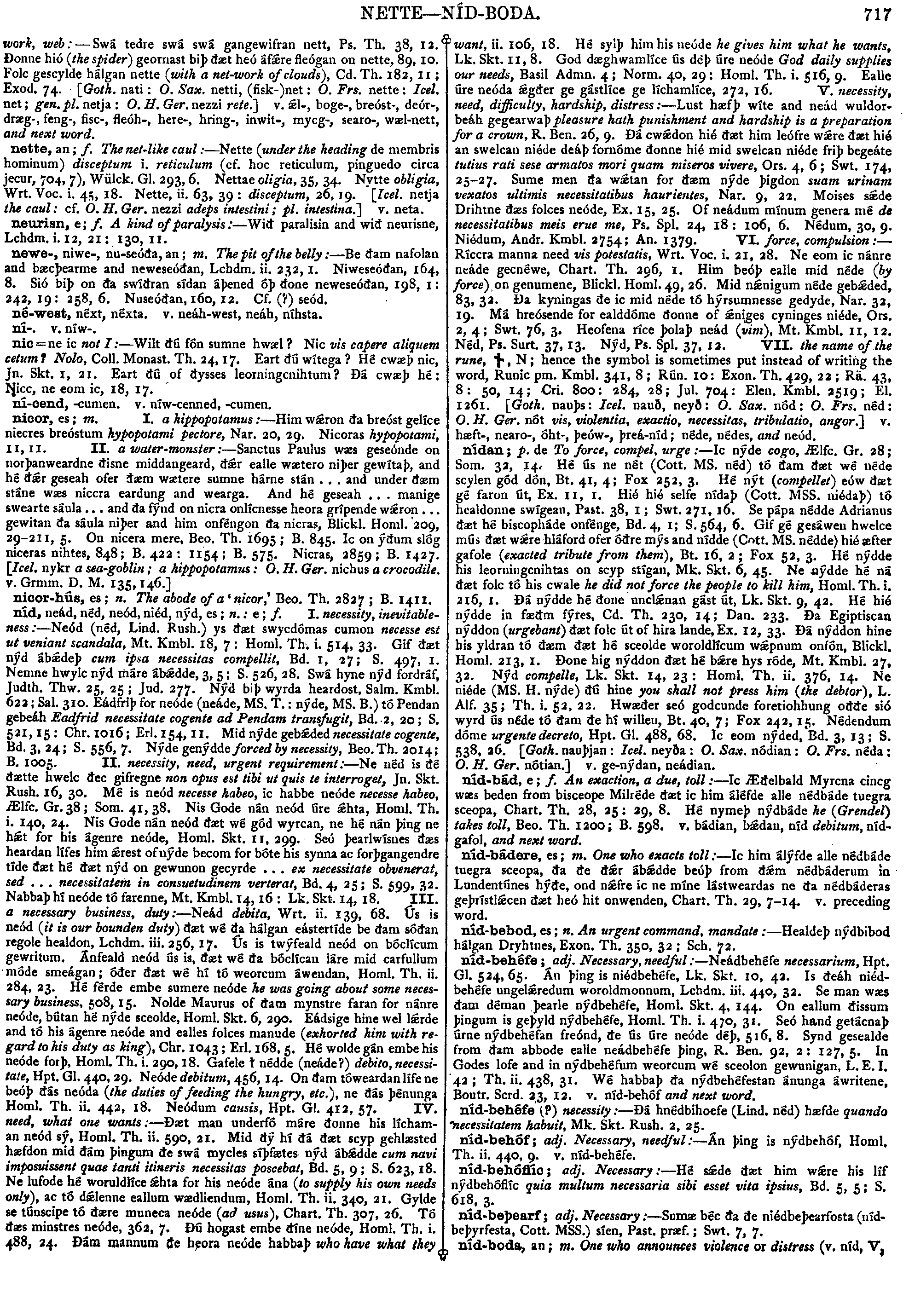
níd,
neád,
néd,
neód,
niéd,
nýd,
es
;
n.:
e
;
f.
I.
necessity,
inevitableness
:--
Neód
(néd,
Lind.
Rush.)
ys
ðæt
swycdómas
cumon
necesse
est
ut
veniant
scandala,
Mt.
Kmbl.
18,
7
:
Homl.
Th.
i.
514,
33.
Gif
ðæt
nýd
ábdeþ
cum
ipsa
necessitas
compellit,
Bd.
1,
27;
S.
497,
1.
Nemne
hwylc
nýd
máre
ábdde,
3,
5;
S.
526,
28.
Swá
hyne
nýd
fordráf,
Judth.
Thw.
25,
25
;
Jud.
277.
Nýd
biþ
wyrda
heardost,
Salm.
Kmbl.
622;
Sal.
310.
Eádfriþ
for
neóde
(neáde,
MS.
T.:
nýde,
MS.
B.)
tó
Pendan
gebeáh
Eadfrid
necessitate
cogente
ad
Pendam
transfugit,
Bd.
2,
20;
S.
521,
15
:
Chr.
1016
;
Erl.
154,
11.
Mid
nýde
gebded
necessitate
cogente,
Bd.
3,
24;
S.
556,
7.
Nýde
genýdde
forced
by
necessity,
Beo.
Th.
2014;
B.
1005.
II.
necessity,
need,
urgent
requirement
:--
Ne
néd
is
ðé
ðætte
hwelc
ðec
gifregne
non
opus
est
tibi
ut
quis
te
interroget,
Jn.
Skt.
Rush.
16,
30.
Mé
is
neód
necesse
habeo,
ic
habbe
neóde
necesse
habeo,
Ælfc.
Gr.
38;
Som.
41,
38.
Nis
Gode
nán
neód
úre
hta,
Homl.
Th.
i.
140,
24.
Nis
Gode
nán
neód
ðæt
wé
gód
wyrcan,
ne
hé
nán
þing
ne
ht
for
his
ágenre
neóde,
Homl.
Skt.
11,
299.
Seó
þearlwísnes
ðæs
heardan
lífes
him
rest
of
nýde
becom
for
bóte
his
synna
ac
forþgangendre
tíde
ðæt
hé
ðæt
nýd
on
gewunon
gecyrde
...
ex
necessitate
obvenerat,
sed
...
necessitatem
in
consuetudinem
verterat,
Bd.
4,
25;
S.
599,
32,
Nabbaþ
hí
neóde
tó
farenne,
Mt.
Kmbl.14,
16
:
Lk.
Skt.
14,
18.
III.
a
necessary
business,
duty
:--
Neád
debita,
Wrt.
ii.
139,
68.
Ús
is
neód
(it
is
our
bounden
duty)
ðæt
wé
ða
hálgan
eástertíde
be
ðam
sóðan
regole
healdon,
Lchdm.
iii.
256,
17.
Ús
is
twýfeald
neód
on
bóclícum
gewritum.
Ánfeald
neód
ús
is,
ðæt
wé
ða
bóclícan
láre
mid
carfullum
móde
smeágan;
óðer
ðæt
wé
hí
tó
weorcum
áwendan,
Homl.
Th.
ii.
284,
23.
Hé
férde
embe
sumere
neóde
he
was
going
about
some
necessary
business,
508,
15.
Nolde
Maurus
of
ðam
mynstre
faran
for
nánre
neóde,
bútan
hé
nýde
sceolde,
Homl.
Skt.
6,
290.
Eádsige
hine
wel
lrde
and
tó
his
ágenre
neóde
and
ealles
folces
manude
(exhorted
him
with
regard
to
his
duty
as
king),
Chr.
1043;
Erl.168,
5.
Hé
wolde
gán
embe
his
neóde
forþ,
Homl.
Th.
i.
290,
18.
Gafele
 nédde
(neáde?)
debito,
necessitate,
Hpt.
Gl.
440,
29.
Neóde
debitum,
456,
14.
On
ðam
tóweardan
lífe
ne
beóþ
ðás
neóda
(the
duties
of
feeding
the
hungry,
etc.),
ne
ðás
þénunga
Homl.
Th.
ii.
442,
18.
Neódum
causis,
Hpt.
Gl.
412,
57.
IV.
need,
what
one
wants
:--
Ðæt
man
underfó
máre
ðonne
his
líchaman
neód
sý,
Homl.
Th.
ii.
590,
21.
Mid
ðý
hí
ðá
ðæt
scyp
gehlæsted
hæfdon
mid
ðám
þingum
ðe
swá
mycles
síþfætes
nýd
ábdde
cum
navi
imposuissent
quae
tanti
itineris
necessitas
poscebat,
Bd.
5,
9
;
S.
623,
18.
Ne
lufode
hé
woruldlíce
rehta
for
his
neóde
ána
(to
supply
his
own
needs
only),
ac
tó
dlenne
eallum
wædliendum,
Homl.
Th.
ii.
340,
21.
Gylde
se
túnscipe
tó
ðære
muneca
neóde
(ad
usus),
Chart.
Th.
307,
26.
Tó
ðæs
minstres
neóde,
362,
7.
Ðú
hogast
embe
ðíne
neóde,
Homl.
Th.
i.
488,
24.
Ðám
mannum
ðe
heora
neóde
habbaþ
who
have
what
they
want,
ii.
106,
18.
Hé
sylþ
him
his
neóde
he
gives
him
what
he
wants,
Lk.
Skt.
11,
8.
God
dæghwamlíce
ús
déþ
úre
neóde
God
daily
supplies
our
needs,
Basil
Admn.
4;
Norm.
40,
29
:
Homl.
Th.
i.
516,
9.
Ealle
úre
neóda
gðer
ge
gástlíce
ge
líchamlíce,
272,
16.
V.
necessity,
need,
difficulty,
hardship,
distress
:--
Lust
hæfþ
wíte
and
neád
wuldor-beáh
gegearwaþ
pleasure
hath
punishment
and
hardship
is
a
preparation
for
a
crown,
R.
Ben.
26,
9.
Ðá
cwdon
hié
ðæt
him
leófre
wre
ðæt
hié
an
swelcan
niéde
ðeáþ
fornóme
ðonne
hié
mid
swelcan
niéde
friþ
begeáte
tutius
rati
sese
armatos
mori
quam
miseros
vivere,
Ors.
4,
6;
Swt.
174,
25-27,
Sume
men
ða
wtan
for
ðæm
nýde
þigdon
suam
urinam
vexatos
ultimis
necessitatibus
haurientes,
Nar.
9,
22.
Moises
sde
Drihtne
ðæs
folces
neóde,
Ex.
15,
25.
Of
neádum
mínum
genera
mé
de
necessitatibus
meis
erue
me,
Ps.
Spl.
24,
18
:
106,
6.
Nédum,
30,
9.
Niédum,
Andr.
Kmbl.
2754;
An.
1379.
VI.
force,
compulsion
:--
Ríccra
manna
need
vis
potestatis,
Wrt.
Voc.
i.
21,
28.
Ne
eom
ic
nánre
neáde
gecnéwe,
Chart.
Th.
296,
1.
Him
beóþ
ealle
mid
néde
(by
force),
on
genumene,
Blickl.
Homl.
49,
26.
Mid
nnigum
néde
gebded,
83,
32.
Ða
kyningas
ðe
ic
mid
néde
tó
hýrsumnesse
gedyde,
Nar.
32,
19.
Má
hreósende
for
ealddóme
ðonne
of
niges
cyninges
niéde,
Ors.
2,
4
;
Swt,
76,
3.
Heofena
ríce
þolaþ
neád
(vim),
Mt.
Kmbl.
11,
12.
Néd,
Ps.
Surt.
37,
13.
Nýd,
Ps.
Spl.
37,
12.
VII.
the
name
of
the
rune,
&n-rune;
,
N;
hence
the
symbol
is
sometimes
put
instead
of
writing
the
word,
Runic
pm.
Kmbl.
341,
8
;
Rún.
10
:
Exon.
Th.
429,
22
;
Rä.
43,
8
:
50,
14;
Cri.
800
:
284,
28;
Jul.
704
:
Elen.
Kmbl.
2519
;
El.
1261.
[Goth.
nauþs
:
Icel.
nauð,
neyð
:
O.
Sax.
nód
:
O.
Frs.
néd
:
O.
H.
Ger.
nót
vis,
violentia,
exactio,
necessitas,
tribulatio,
angor.]
v.
hæft-,
nearo-,
óht-,
þeów-,
þreá-níd;
néde,
nédes,
and
neód.
nédde
(neáde?)
debito,
necessitate,
Hpt.
Gl.
440,
29.
Neóde
debitum,
456,
14.
On
ðam
tóweardan
lífe
ne
beóþ
ðás
neóda
(the
duties
of
feeding
the
hungry,
etc.),
ne
ðás
þénunga
Homl.
Th.
ii.
442,
18.
Neódum
causis,
Hpt.
Gl.
412,
57.
IV.
need,
what
one
wants
:--
Ðæt
man
underfó
máre
ðonne
his
líchaman
neód
sý,
Homl.
Th.
ii.
590,
21.
Mid
ðý
hí
ðá
ðæt
scyp
gehlæsted
hæfdon
mid
ðám
þingum
ðe
swá
mycles
síþfætes
nýd
ábdde
cum
navi
imposuissent
quae
tanti
itineris
necessitas
poscebat,
Bd.
5,
9
;
S.
623,
18.
Ne
lufode
hé
woruldlíce
rehta
for
his
neóde
ána
(to
supply
his
own
needs
only),
ac
tó
dlenne
eallum
wædliendum,
Homl.
Th.
ii.
340,
21.
Gylde
se
túnscipe
tó
ðære
muneca
neóde
(ad
usus),
Chart.
Th.
307,
26.
Tó
ðæs
minstres
neóde,
362,
7.
Ðú
hogast
embe
ðíne
neóde,
Homl.
Th.
i.
488,
24.
Ðám
mannum
ðe
heora
neóde
habbaþ
who
have
what
they
want,
ii.
106,
18.
Hé
sylþ
him
his
neóde
he
gives
him
what
he
wants,
Lk.
Skt.
11,
8.
God
dæghwamlíce
ús
déþ
úre
neóde
God
daily
supplies
our
needs,
Basil
Admn.
4;
Norm.
40,
29
:
Homl.
Th.
i.
516,
9.
Ealle
úre
neóda
gðer
ge
gástlíce
ge
líchamlíce,
272,
16.
V.
necessity,
need,
difficulty,
hardship,
distress
:--
Lust
hæfþ
wíte
and
neád
wuldor-beáh
gegearwaþ
pleasure
hath
punishment
and
hardship
is
a
preparation
for
a
crown,
R.
Ben.
26,
9.
Ðá
cwdon
hié
ðæt
him
leófre
wre
ðæt
hié
an
swelcan
niéde
ðeáþ
fornóme
ðonne
hié
mid
swelcan
niéde
friþ
begeáte
tutius
rati
sese
armatos
mori
quam
miseros
vivere,
Ors.
4,
6;
Swt.
174,
25-27,
Sume
men
ða
wtan
for
ðæm
nýde
þigdon
suam
urinam
vexatos
ultimis
necessitatibus
haurientes,
Nar.
9,
22.
Moises
sde
Drihtne
ðæs
folces
neóde,
Ex.
15,
25.
Of
neádum
mínum
genera
mé
de
necessitatibus
meis
erue
me,
Ps.
Spl.
24,
18
:
106,
6.
Nédum,
30,
9.
Niédum,
Andr.
Kmbl.
2754;
An.
1379.
VI.
force,
compulsion
:--
Ríccra
manna
need
vis
potestatis,
Wrt.
Voc.
i.
21,
28.
Ne
eom
ic
nánre
neáde
gecnéwe,
Chart.
Th.
296,
1.
Him
beóþ
ealle
mid
néde
(by
force),
on
genumene,
Blickl.
Homl.
49,
26.
Mid
nnigum
néde
gebded,
83,
32.
Ða
kyningas
ðe
ic
mid
néde
tó
hýrsumnesse
gedyde,
Nar.
32,
19.
Má
hreósende
for
ealddóme
ðonne
of
niges
cyninges
niéde,
Ors.
2,
4
;
Swt,
76,
3.
Heofena
ríce
þolaþ
neád
(vim),
Mt.
Kmbl.
11,
12.
Néd,
Ps.
Surt.
37,
13.
Nýd,
Ps.
Spl.
37,
12.
VII.
the
name
of
the
rune,
&n-rune;
,
N;
hence
the
symbol
is
sometimes
put
instead
of
writing
the
word,
Runic
pm.
Kmbl.
341,
8
;
Rún.
10
:
Exon.
Th.
429,
22
;
Rä.
43,
8
:
50,
14;
Cri.
800
:
284,
28;
Jul.
704
:
Elen.
Kmbl.
2519
;
El.
1261.
[Goth.
nauþs
:
Icel.
nauð,
neyð
:
O.
Sax.
nód
:
O.
Frs.
néd
:
O.
H.
Ger.
nót
vis,
violentia,
exactio,
necessitas,
tribulatio,
angor.]
v.
hæft-,
nearo-,
óht-,
þeów-,
þreá-níd;
néde,
nédes,
and
neód.
|
Source: Bosworth/Toller, page b0874, entry 12 View original page image as: [TIFF] [PNG] [View previous entry] [View next entry] |
[Comment on this entry] [View comments] |
The following entry has been hand-corrected once. |
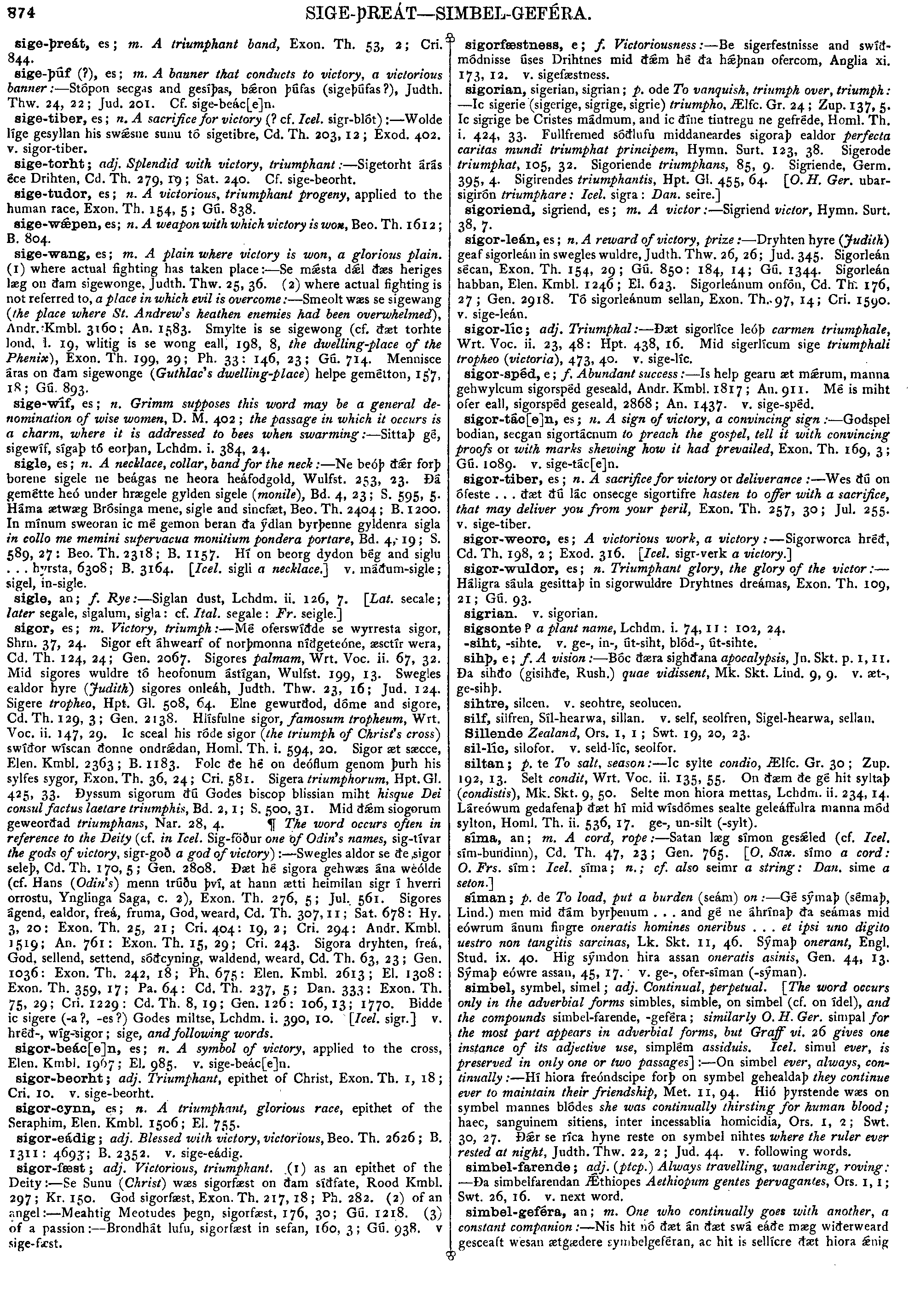
sigor-beác[e]n, es ; n. A symbol of victory, applied to the cross. Elen. Kmbl. 1967 ; El. 985. v. sige-beác[e]n.
|
Source: Bosworth/Toller, page b0966, entry 23 View original page image as: [TIFF] [PNG] [View previous entry] [View next entry] |
[Comment on this entry] [View comments] |
The following entry has been hand-corrected once. |
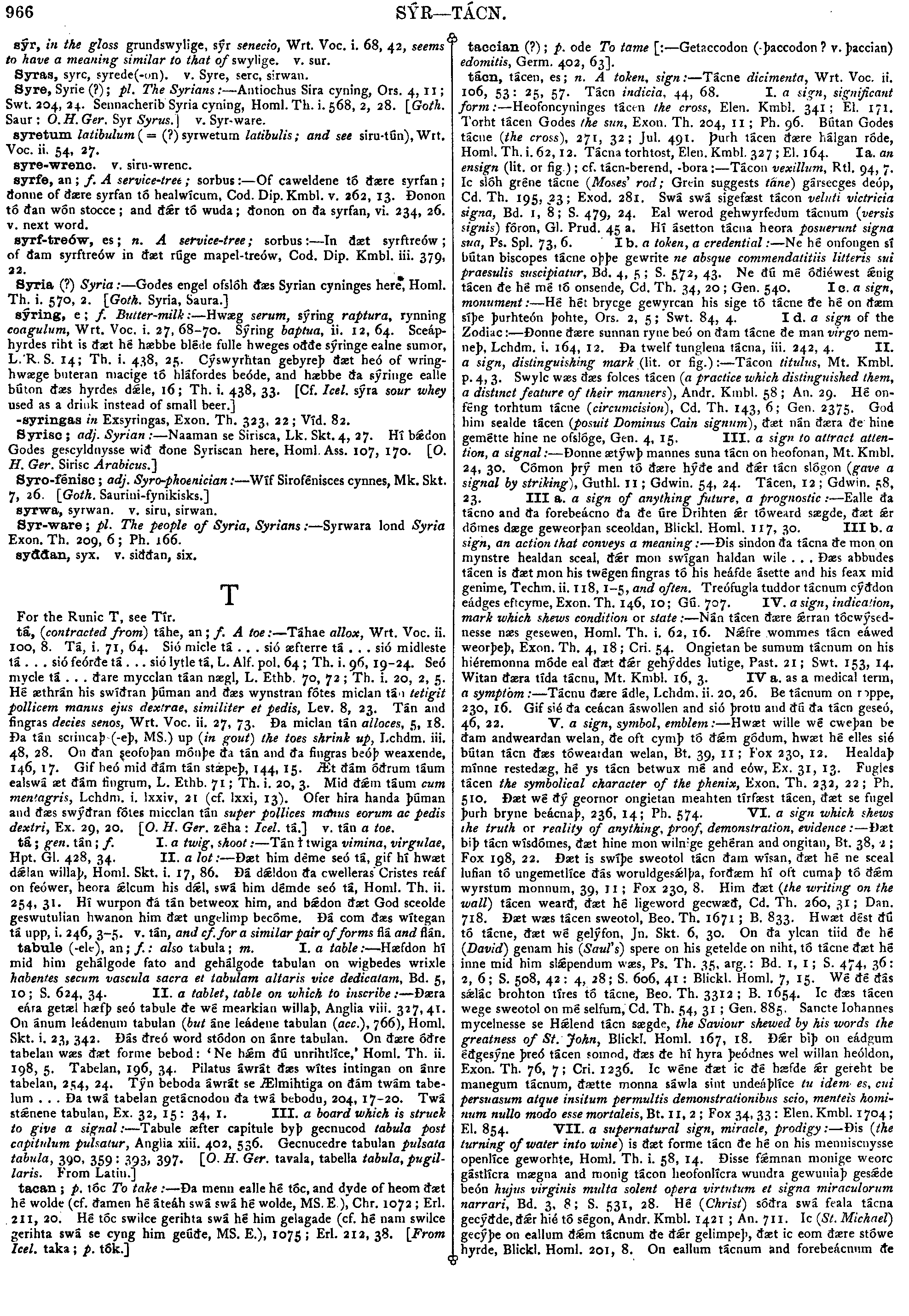
tácn,
tácen,
es;
n.
A
token,
sign
:--
Tácne
dicimenta,
Wrt.
Voc.
ii.
106,
53:
25,
57.
Tácn
indicia,
44,
68.
I.
a
sign,
significant
form
:--
Heofoncyninges
tácen
the
cross,
Elen.
Kmbl.
341;
El.
171.
Torht
tácen
Godes
the
sun,
Exon.
Th.
204,
11;
Ph.
96.
Bútan
Godes
tácne
(the
cross),
271,
32;
Jul.
491.
Þurh
tácen
ðære
hálgan
róde,
Homl.
Th.
i.
62,
12.
Tácna
torhtost,
Elen.
Kmbl.
327;
El.
164.
I
a.
an
ensign
(lit.
or
fig.);
cf.
tácn-berend,
-bora
:--
Tácon
vexillum,
Rtl.
94,
7.
Ic
slóh
gréne
tácne
(Moses'
rod;
Grein
suggests
táne)
gársecges
deóp,
Cd.
Th.
195,
23;
Exod.
281.
Swá
swá
sigefæst
tácon
veluti
victricia
signa,
Bd.
1,
8;
S.
479,
24.
Eal
werod
gehwyrfedum
tácnum
(versis
signis)
fóron,
Gl.
Prud.
45
a.
Hí
ásetton
tácna
heora
posuerunt
signa
sua,
Ps.
Spl.
73,
6.
I
b.
a
token,
a
credential
:--
Ne
hé
onfongen
si
bútan
biscopes
tácne
oþþe
gewrite
ne
absque
commendatitiis
litteris
sui
praesulis
suscipiatur,
Bd.
4,
5;
S.
572,
43.
Ne
ðú
mé
óðiéwest
nig
tácen
ðe
hé
mé
tó
onsende,
Cd.
Th.
14,
20;
Gen.
540.
I
c.
a
sign,
monument
:--
Hé
hét
brycge
gewyrcan
his
sige
tó
tácne
ðe
he
on
ðæm
síþe
þurhteón
þohte,
Ors.
2,
5;
Swt.
84,
4.
I
d.
a
sign
of
the
Zodiac
:--
Ðonne
ðære
sunnan
ryne
beó
on
ðam
tácne
ðe
man
virgo
nemneþ,
Lchdm.
i.
164,
12.
Ða
twelf
tunglena
tácna,
iii.
242,
4.
II.
a
sign,
distinguishing
mark
(lit.
or
fig.)
:--
Tácon
titulus,
Mt.
Kmbl.
p.
4,
3.
Swylc
wæs
ðæs
folces
tácen
(a
practice
which
distinguished
them,
a
distinct
feature
of
their
manners),
Andr.
Kmbl.
58;
An.
29.
Hé
onféng
torhtum
tácne
(circumcision),
Cd.
Th.
143,
6;
Gen.
2375.
God
him
sealde
tácen
(posuit
Dominus
Cain
signum),
ðæt
nán
ðæra
ðe
hine
gemétte
hine
ne
ofslóge,
Gen.
4,
15.
III.
a
sign
to
attract
attention,
a
signal
:--
Ðonne
ætýwþ
mannes
suna
tácn
on
heofonan,
Mt.
Kmbl.
24,
30.
Cómon
þrý
men
tó
ðære
hýðe
and
ðær
tácn
slógon
(gave
a
signal
by
striking),
Guthl.
11;
Gdwin.
54,
24.
Tácen,
12;
Gdwin.
58,
23.
III
a.
a
sign
of
anything
future,
a
prognostic
:--
Ealle
ða
tácno
and
ða
forebeácno
ða
ðe
úre
Drihten
r
tóweard
sægde,
ðæt
r
dómes
dæge
geweorþan
sceoldan,
Blickl.
Homl.
117,
30.
III
b.
a
sign,
an
action
that
conveys
a
meaning
:--
Ðis
sindon
ða
tácna
ðe
mon
on
mynstre
healdan
sceal,
ðr
mon
swígan
haldan
wile
...
Ðæs
abbudes
tácen
is
ðæt
mon
his
twégen
fingras
tó
his
heáfde
ásette
and
his
feax
mid
genime,
Techm.
ii.
118,
1-5,
and
often.
Treófugla
tuddor
tácnum
cýðdon
eádges
eftcyme,
Exon.
Th.
146,
10;
Gú.
707.
IV.
a
sign,
indication,
mark
which
shews
condition
or
state
:--
Nán
tácen
ðære
rran
tócwýsednesse
næs
gesewen,
Homl.
Th.
i.
62,
16.
Nfre
wommes
tácn
eáwed
weorþeþ,
Exon.
Th.
4,
18;
Cri.
54.
Ongietan
be
sumum
tácnum
on
his
hiéremonna
móde
eal
ðæt
ðr
gehýddes
lutige,
Past.
21;
Swt.
153,
14.
Witan
ðæra
tída
tácnu,
Mt.
Kmbl.
16,
3.
IV
a.
as
a
medical
term,
a
symptom
:--
Tácna
ðære
ádle,
Lchdm.
ii.
20,
26.
Be
tácnum
on
roppe,
230,
16.
Gif
sié
ða
ceácan
áswollen
and
sió
þrotu
and
ðú
ða
tácn
geseó,
46,
22.
V.
a
sign,
symbol,
emblem
:--
Hwæt
wille
wé
cweþan
be
ðam
andweardan
welan,
ðe
oft
cymþ
tó
ðm
gódum,
hwæt
hé
elles
sié
bútan
tácn
ðæs
tóweardan
welan,
Bt.
39,
11;
Fox
230,
12.
Healdaþ
mínne
restedæg,
hé
ys
tácn
betwux
mé
and
eów,
Ex.
31,
13.
Fugles
tácen
the
symbolical
character
of
the
phenix,
Exon.
Th.
232,
22;
Ph.
510.
Ðæt
wé
ðý
geornor
ongietan
meahten
tírfæst
tácen,
ðæt
se
fugel
þurh
bryne
beácnaþ,
236,
14;
Ph.
574.
VI.
a
sign
which
shews
the
truth
or
reality
of
anything,
proof,
demonstration,
evidence
:--
Ðæt
biþ
tácn
wísdómes,
ðæt
hine
mon
wilnige
gehéran
and
ongitan,
Bt.
38,
2;
Fox
198,
22.
Ðæt
is
swíþe
sweotol
tácn
ðam
wísan,
ðæt
hé
ne
sceal
lufian
tó
ungemetlíce
ðás
woruldgeslþa,
forðæm
hí
oft
cumaþ
tó
ðm
wyrstum
monnum,
39,
11;
Fox
230,
8.
Him
ðæt
(the
writing
on
the
wall)
tácen
wearð,
ðæt
hé
ligeword
gecwæð,
Cd.
Th.
260,
31;
Dan.
718.
Ðæt
wæs
tácen
sweotol,
Beo.
Th.
1671;
B.
833.
Hwæt
dést
ðú
tó
tácne,
ðæt
wé
gelýfon,
Jn.
Skt.
6,
30.
On
ða
ylcan
tiid
ðe
hé
(David)
genam
his
(Saul's)
spere
on
his
getelde
on
niht,
tó
tácne
ðæt
hé
inne
mid
him
slpendum
wæs,
Ps.
Th.
35,
arg.:
Bd.
1,
1;
S.
474,
36:
2,
6;
S.
508,
42;
4,
28;
S.
606,
41:
Blickl.
Homl.
7,
15.
Wé
ðé
ðás
slíc
brohton
tíres
tó
tácne,
Beo.
Th.
3312;
B.
1654.
Ic
ðæs
tácen
wege
sweotol
on
mé
selfum;
Cd.
Th.
54,
31;
Gen.
885.
Sancte
Iohannes
mycelnesse
se
Hlend
tácn
sægde,
the
Saviour
shewed
by
his
words
the
greatness
of
St.
John,
Blickl.
Homl.
167,
18.
Ðr
biþ
on
eádgum
édgesýne
þreó
tácen
somod,
ðæs
ðe
hí
hyra
þeódnes
wel
willan
heóldon,
Exon.
Th.
76,
7;
Cri.
1236.
Ic
wéne
ðæt
ic
ðé
hæfde
r
gereht
be
manegum
tácnum,
ðætte
monna
sáwla
sint
undeáþlíce
tu
idem
es,
cui
persuasum
atque
insitum
permultis
demonstrationibus
scio,
menteis
hominum
nullo
modo
ease
mortaleis,
Bt.
11,
2;
Fox
34,
33:
Elen.
Kmbl.
1704;
El.
854.
VII.
a
supernatural
sign,
miracle,
prodigy
:--
Ðis
(the
turning
of
water
into
wine)
is
ðæt
forme
tácn
ðe
hé
on
his
menniscnysse
openlíce
geworhte,
Homl.
Th.
i.
58,
14.
Ðisse
fmnan
monige
weorc
gástlícra
mægna
and
monig
tácon
heofonlícra
wundra
gewuniaþ
gesde
beón
hujus
virginis
multa
solent
opera
virtutum
et
signa
miraculorum
narrari,
Bd.
3,
8;
S.
531,
28.
Hé
(Christ)
sóðra
swá
feala
tácna
gecýðde,
ðr
hié
tó
ségon,
Andr.
Kmbl.
1421;
An.
711.
Ic
(St.
Michael)
gecýþe
on
eallum
ðm
tácnum
ðe
ðr
gelimpeþ,
ðæt
ic
eom
ðære
stówe
hyrde,
Blickl.
Homl.
201,
8.
On
eallum
tácnum
and
forebeácnum
ðe
God
sende
þurh
hine,
Deut.
34,
11.
Gif
nig
wítega
secge
tácnu
and
forebeácnu,
13,
1.
Tácna,
Homl.
Th.
i.
44,
24.
Noldan
hí
ða
torhtan
tácen
oncnáwan
ðe
him
beforan
fremede
freóbearn
Godes,
Exon.
Th.
40,
22;
Cri.
642.
Gesiáþ
werc
Dryhtnes
ða
set[t]e
tácen
ofer
eórðan
videte
opera
Domini
quae
posuit
prodigia
super
terram,
Ps.
Surt.
45,
9.
VII
a.
a
signal
event,
remarkable
circumstance
:--
Andsware
cýðan
tácna
gehwylces
ðe
ic
him
tó
séce
to
give
me
an
answer
in
reference
to
every
remarkable
circumstance
about
which
I
enquire
of
them
(cf.
mé
þinga
gehwylc
gecýðan,
ðe
ic
him
tó
séce,
817;
El.
409),
Elen.
Kmbl.
637;
El.
319.
Wé
on
gemynd
witon
álra
tácna
gehwylc
swá
Tróiána
þurh
gefeoht
fremedon,
1286;
El.
645.
[Goth.
taikns;
f.:
O.
Sax.
tékan;
n.:
O.
Frs.
téken:
O.
H.
Ger.
zeihhan
signum,
signaculum,
nota,
titulus,
miraculum:
Icel.
teikn,
tákn
a
token,
sign,
wonder.]
v.
andgit-,
bell-,
fácen-,
fore-,
friðo-,
luf-,
sige-,
sigor-,
sóþ-,
weá-,
weder-,
wer-,
wundor-tácn.
|
Source: Bosworth/Toller, page b0967, entry 4 View original page image as: [TIFF] [PNG] [View previous entry] [View next entry] |
[Comment on this entry] [View comments] |
The following entry has been hand-corrected once. |
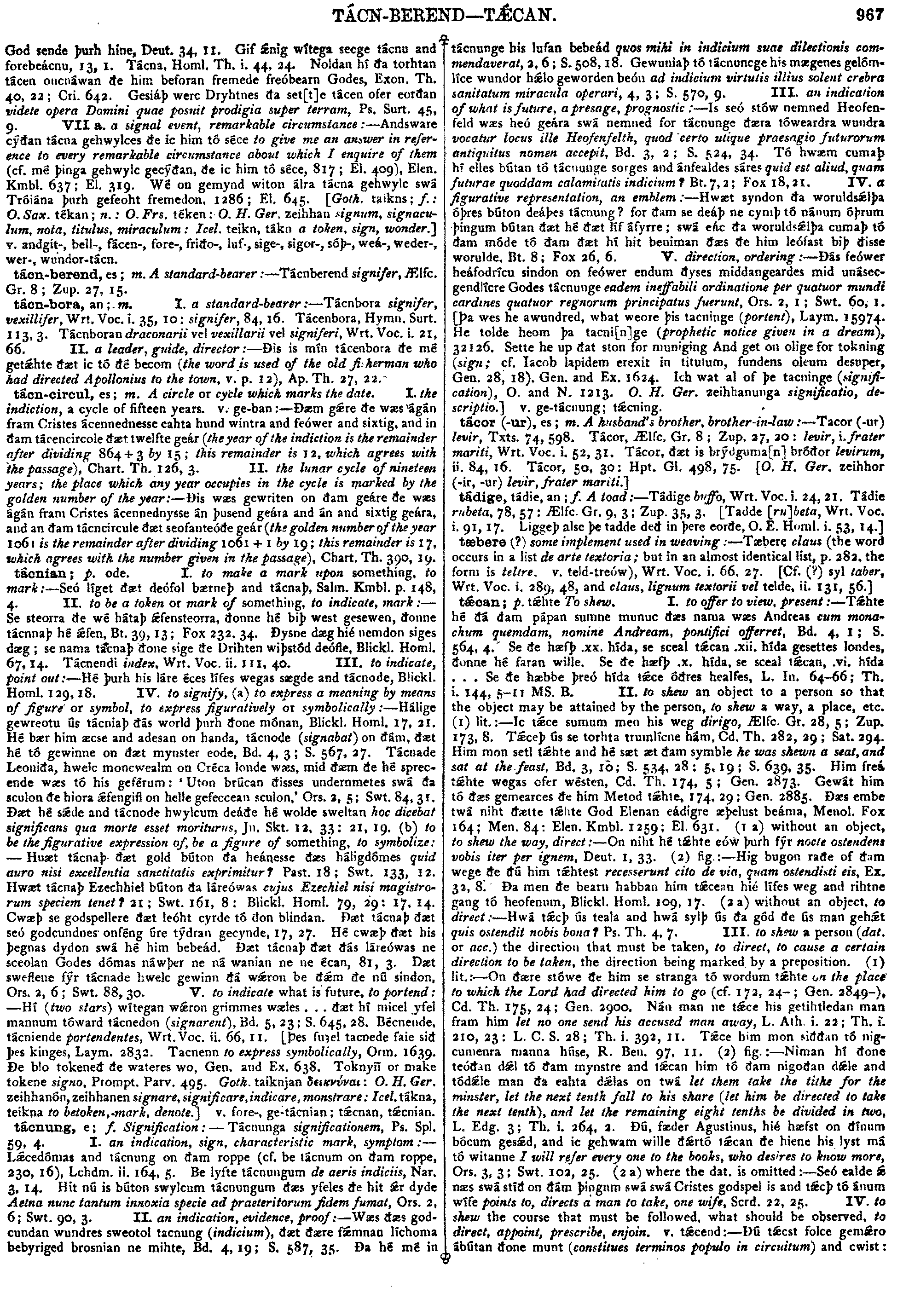
tácnian;
p.
ode.
I.
to
make
a
mark
upon
something,
to
mark
:--
Seó
líget
ðæt
deófol
bærneþ
and
tácnaþ,
Salm.
Kmbl.
p.
148,
4.
II.
to
be
a
token
or
mark
of
something,
to
indicate,
mark
:--
Se
steorra
ðe
wé
hátaþ
fensteorra,
ðonne
hé
biþ
west
gesewen,
ðonne
tácnaþ
hé
fen,
Bt.
39,
13;
Fox
232,
34.
Ðysne
dæg
hié
nemdon
siges
dæg;
se
nama
tácnaþ
ðone
sige
ðe
Drihten
wiþstód
deófle,
Blickl.
Homl.
67,
14.
Tácnendi
index,
Wrt.
Voc.
ii.
111,
40.
III.
to
indicate,
point
out
:--
Hé
þurh
his
láre
éces
lífes
wegas
sægde
and
tácnode,
Blickl.
Homl.
129,
18.
IV.
to
signify,
(a)
to
express
a
meaning
by
means
of
figure
or
symbol,
to
express
figuratively
or
symbolically
:--
Hálige
gewreotu
ús
tácniaþ
ðás
world
þurh
ðone
mónan,
Blickl.
Homl.
17,
21.
Hé
bær
him
æcse
and
adesan
on
handa,
tácnode
(signabat)
on
ðám,
ðæt
hé
tó
gewinne
on
ðæt
mynster
eode,
Bd.
4,
3;
S.
567,
27.
Tácnade
Leoniða,
hwelc
moncwealm
on
Créca
londe
wæs,
mid
ðæm
ðe
hé
sprecende
wæs
tó
his
geférum:
'Uton
brúcan
ðisses
undernmetes
swá
ða
sculon
ðe
hiora
fengifl
on
helle
gefeccean
sculon,'
Ors.
2,
5;
Swt,
84,
31.
Ðæt
hé
sde
and
tácnode
hwylcum
deáðe
hé
wolde
sweltan
hoc
dicebat
significans
qua
morte
esset
moriturus,
Jn.
Skt.
12,
33:
21,
19.
(b)
to
be
the
figurative
expression
of,
be
a
figure
of
something,
to
symbolize
:--
Huæt
tácnaþ
ðæt
gold
búton
ða
heánesse
ðæs
háligdómes
quid
aura
nisi
excellentia
sanctitatis
exprimitur?
Past.
18;
Swt.
133,
12.
Hwæt
tácnaþ
Ezechhiel
búton
ða
láreówas
cujus
Ezechiel
nisi
magistrorum
speciem
tenet?
21;
Swt.
161,
8:
Blickl.
Homl.
79,
29:
17,
14.
Cwæþ
se
godspellere
ðæt
leóht
cyrde
tó
ðon
blindan.
Ðæt
tácnaþ
ðæt
seó
godcundnes
onféng
úre
týdran
gecynde,
17,
27.
Hé
cwæþ
ðæt
his
þegnas
dydon
swá
hé
him
bebeád.
Ðæt
tácnaþ
ðe
ðás
láreówas
ne
sceolan
Godes
dómas
náwþer
ne
ná
wanian
ne
ne
écan,
81,
3.
Ðæt
sweflene
fýr
tácnode
hwelc
gewinn
ðá
wron
be
ðm
ðe
nú
sindon,
Ors.
2,
6;
Swt.
88,
30.
V.
to
indicate
what
is
future,
to
portend
:--
Hí
(two
stars)
wítegan
wron
grimmes
wæles
...
ðæt
hí
micel
yfel
mannum
tóward
tácnedon
(signarent),
Bd.
5,
23;
S.
645,
28.
Bécneude,
tácniende
portendentes,
Wrt.
Voc.
ii.
66,
11.
[Þes
fu el
tacnede
faie
sið
þes
kinges,
Laym.
2832.
Tacnenn
to
express
symbolically,
Orm.
1639.
Ðe
blo
tokeneð
ðe
wateres
wo,
Gen.
and
Ex.
638.
Toknyn
or
make
tokene
signo,
Prompt.
Parv.
495.
Goth.
taiknjan
el
tacnede
faie
sið
þes
kinges,
Laym.
2832.
Tacnenn
to
express
symbolically,
Orm.
1639.
Ðe
blo
tokeneð
ðe
wateres
wo,
Gen.
and
Ex.
638.
Toknyn
or
make
tokene
signo,
Prompt.
Parv.
495.
Goth.
taiknjan


 &upsilon-tonos;
 :
O.
H.
Ger.
zeihhanón,
zeihhanen
signare,
significare,
indicare,
monstrare:
Icel.
tákna,
teikna
to
betoken,
mark,
denote.]
v.
fore-,
ge-tácnian;
tcnan,
tcnian.
:
O.
H.
Ger.
zeihhanón,
zeihhanen
signare,
significare,
indicare,
monstrare:
Icel.
tákna,
teikna
to
betoken,
mark,
denote.]
v.
fore-,
ge-tácnian;
tcnan,
tcnian.
|
Source: Bosworth/Toller, page b0988, entry 23 View original page image as: [TIFF] [PNG] [View previous entry] [View next entry] |
[Comment on this entry] [View comments (1)] |
The following entry has been hand-corrected once. |
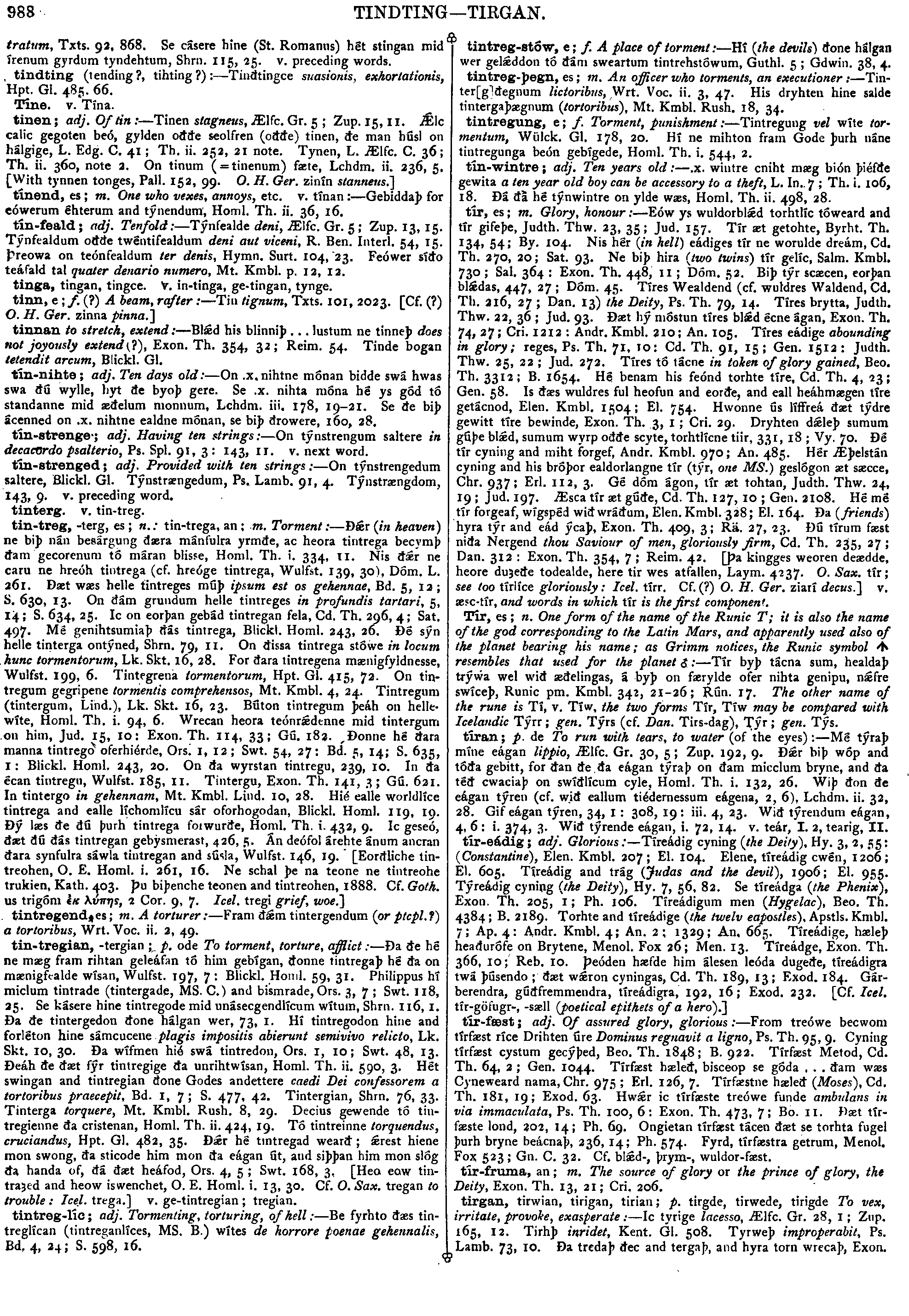
Tír,
es;
n.
One
form
of
the
name
of
the
Runic
T;
it
is
also
the
name
of
the
god
corresponding
to
the
Latin
Mars,
and
apparently
used
also
of
the
planet
bearing
his
name;
as
Grimm
notices,
the
Runic
symbol
RUNE
resembles
that
used
for
the
planet
UNCERTAIN
:--
Tír
byþ
tácna
sum,
healdaþ
trýwa
wel
wið
æðelingas,
á
byþ
on
færylde
ofer
nihta
genipu,
nfre
swíceþ,
Runic
pm.
Kmbl.
342,
21-26;
Rún.
17.
The
other
name
of
the
rune
is
Tí,
v.
Tíw,
the
two
forms
Tír,
Tíw
may
be
compared
with
Icelandic
Týrr;
gen.
Týrs
(cf.
Dan.
Tirs-dag),
Týr;
gen.
Týs.
|
Source: Bosworth/Toller, page b0989, entry 23 View original page image as: [TIFF] [PNG] [View previous entry] [View next entry] |
[Comment on this entry] [View comments] |
The following entry has been hand-corrected once. |
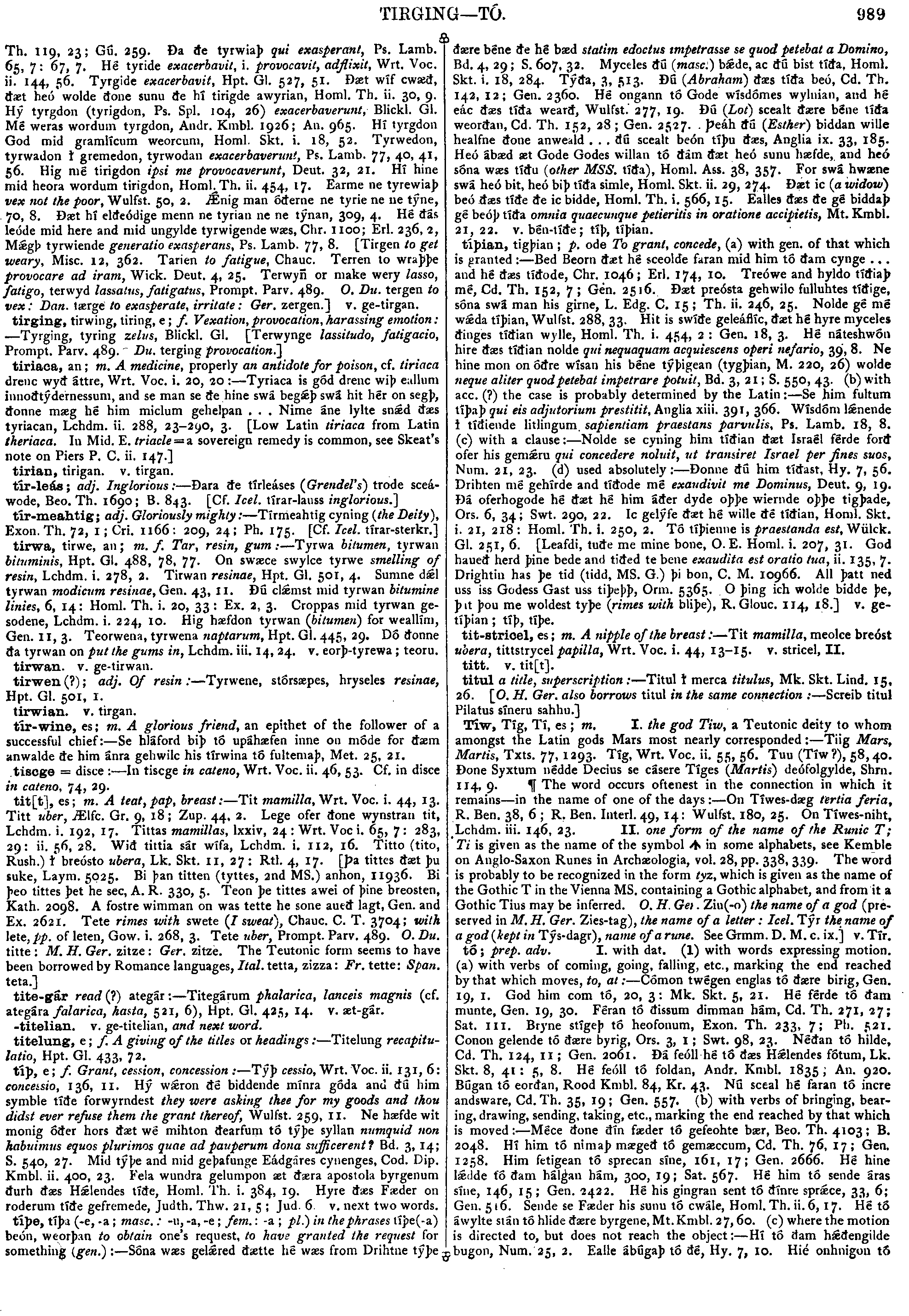
Tíw, Tíg, Tí, es; m. I. the god Tiw, a Teutonic deity to whom amongst the Latin gods Mars most nearly corresponded:--Tiig Mars, Martis, Txts. 77, 1293. Tíg, Wrt. Voc. ii. 55, 56. Tuu (Tíw?), 58, 40. Ðone Syxtum nédde Decius se cásere Tíges (Martis) deófolgylde, Shrn. 114, 9. ¶ The word occurs oftenest in the connection in which it remains--in the name of one of the days:--On Tíwes-dæg tertia feria, R. Ben. 38, 6; R. Ben. Interl. 49, 14: Wulfst. 180, 25. On Tíwes-niht, Lchdm. iii. 146, 23. II. one form of the name of the Runic T; Ti is given as the name of the symbol RUNE in some alphabets, see Kemble on Anglo-Saxon Runes in Archæologia, vol. 28, pp. 338, 339. The word is probably to be recognized in the form tyz, which is given as the name of the Gothic T in the Vienna MS. containing a Gothic alphabet, and from it a Gothic Tius may be inferred. O. H. Ger. Ziu(-o) the name of a god (preserved in M. H. Ger. Zies-tag), the name of a letter: Icel. Týr the name of a god (kept in Týs-dagr), name ofa rune. See Grmm. D. M. c. ix.] v. Tír.
|
Source: Bosworth/Toller, page b1285, entry 21 View original page image as: [TIFF] [PNG] [View previous entry] [View next entry] |
[Comment on this entry] [View comments] |
The following entry has been hand-corrected once. |
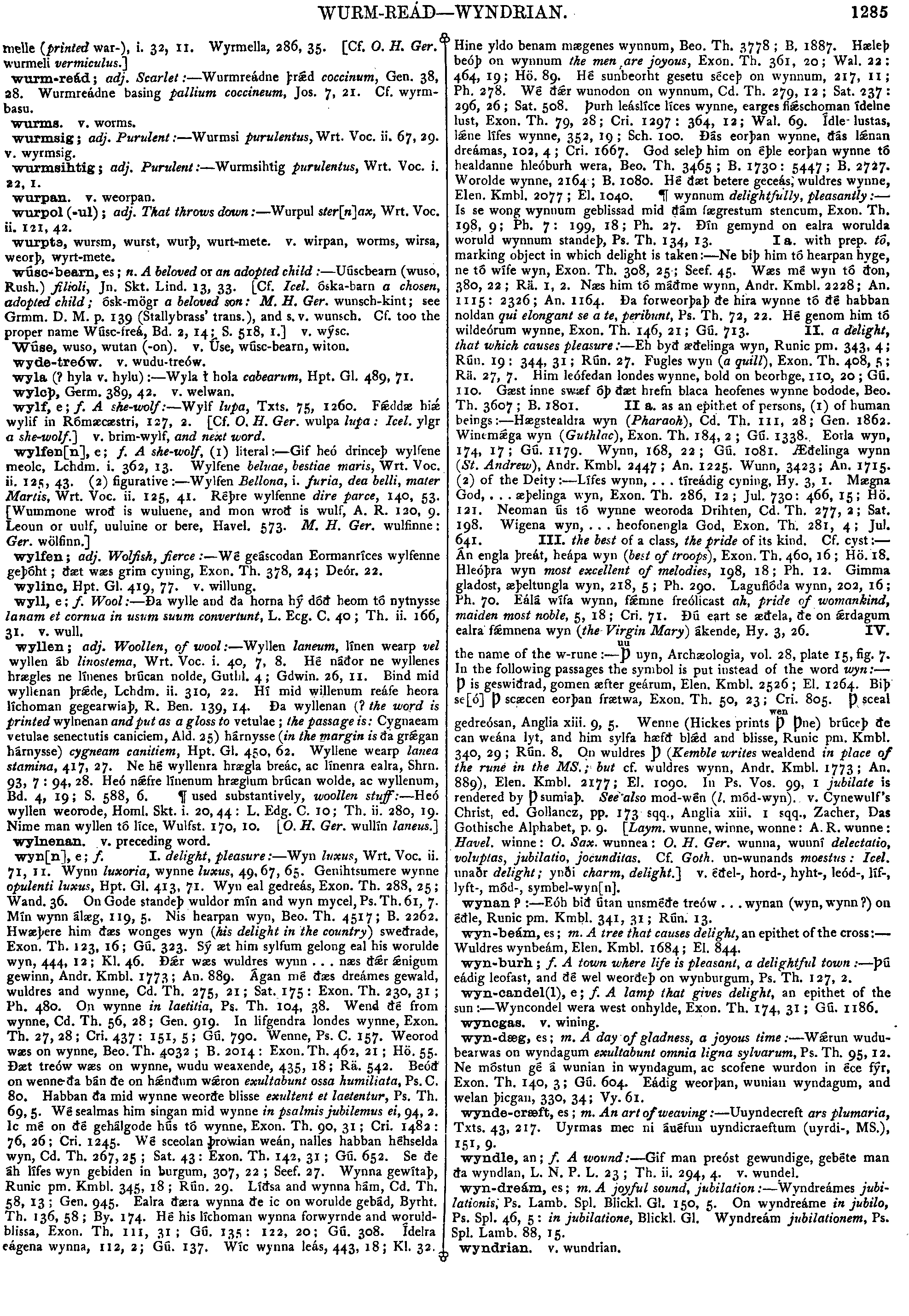
beóþ
on
wynnum
the
men
are
joyous,
Exon.
Th.
361,
20;
Wal.
22
:
464,
19;
Hö.
89.
Hé
sunbeorht
gesetu
séceþ
on
wynnum,
217,
11;
Ph.
278.
Wé
ðr
wunodon
on
wynnum,
Cd.
Th.
279,
12;
Sat.
237
:
296,
26;
Sat.
508.
Þurh
leáslíce
líces
wynne,
earges
flschoman
ídelne
lust,
Exon.
Th.
79,
28;
Cri.
1297
:
364,
12;
Wal.
69.
Ídle
lustas,
lne
lífes
wynne,
352,
19;
Sch.
100.
Ðás
eorþan
wynne,
ðás
lnan
dreámas,
102,
4;
Cri.
1667.
God
seleþ
him
on
éþle
eorþan
wynne
tó
healdanne
hleóburh
wera,
Beo.
Th.
3465;
B.
1730
:
5447;
B.
2727.
Worolde
wynne,
2164;
B.
1080.
Hé
ðæt
betere
geceás,
wuldres
wynne,
Elen.
Kmhl.
2077;
El.
1040.

wynnum
delightfully,
pleasantly
:--
Is
se
wong
wynnum
geblissad
mid
ðám
fægrestum
stencum,
Exon.
Th.
198,
9;
Ph.
7
:
199,
18;
Ph.
27.
Ðín
gemynd
on
ealra
worulda
woruld
wynnum
standeþ,
Ps.
Th.
134,
13.
I
a.
with
prep.
tó,
marking
object
in
which
delight
is
taken
:--
Ne
biþ
him
tó
hearpan
hyge,
ne
tó
wife
wyn,
Exon.
Th.
308,
25;
Seef.
45.
Wæs
mé
wyn
tó
ðon,
380,
22;
Rä.
1,
2.
Næs
him
tó
máðme
wynn,
Andr.
Kmbl.
2228;
An.
1115
:
2326;
An.
1164.
Ða
forweorþaþ
ðe
hira
wynne
tó
ðé
habban
noldan
qui
elongant
se
a
te,
peribunt,
Ps.
Th.
72,
22.
Hé
genom
him
tó
wildeórum
wynne,
Exon.
Th.
146,
21;
Gú.
713.
II.
a
delight,
that
which
causes
pleasure
:--
Eh
byð
æðelinga
wyn,
Runic
pm.
343,
4;
Rún.
19
:
344.
31;
Rún.
27.
Fugles
wyn
(a
quill),
Exon.
Th.
408,
5;
Rä.
27,
7.
Him
leófedan
londes
wynne,
bold
on
beorhge,
110,
20;
Gú.
110.
Gæst
inne
swæf
óþ
ðæt
hrefn
blaca
heofenes
wynne
bodode,
Beo.
Th.
3607;
B.
1801.
II
a.
as
an
epithet
of
persons,
(1)
of
human
beings
:--
Hægstealdra
wyn
(Pharaoh),
Cd.
Th.
111,
28;
Gen.
1862.
Winemga
wyn
(Guthlac),
Exon.
Th.
184,
2;
Gú.
1338.
Eorla
wyn,
174,
17;
Gú.
1179.
Wynn,
168,
22;
Gú.
1081.
Æðelinga
wynn
(St.
Andrew),
Andr.
Kmbl.
2447;
An.
1225.
Wunn,
3423;
An.
1715.
(2)
of
the
Deity
:--
Lífes
wynn,
.
.
.
tíreádig
cyning,
Hy.
3,
1.
Mægna
God,
.
.
.
æþelinga
wyn,
Exon.
Th.
286,
12;
Jul.
730
:
466,
15;
Hö.
121.
Neoman
ús
tó
wynne
weoroda
Drihten,
Cd.
Th.
277,
2;
Sat.
198.
Wigena
wyn,
.
.
.
heofonengla
God,
Exon.
Th.
281,
4;
Jul.
641.
III.
the
best
of
a
class,
the
pride
of
its
kind.
Cf.
cyst
:--
Án
engla
þreát,
heápa
wyn
(best
of
troops),
Exon.
Th.
460,
16;
Hö.
18.
Hleóþra
wyn
most
excellent
of
melodies,
198,
18;
Ph.
12.
Gimma
gladost,
æþeltungla
wyn,
218,
5;
Ph.
290.
Laguflóda
wynn,
202,
16;
Ph.
70.
Eálá
wífa
wynn,
fmne
freólicast
ah,
pride
of
womankind,
maiden
most
noble,
5,
18;
Cri.
71.
Ðú
eart
se
æðela,
ðe
on
rdagum
ealra
fmnena
wyn
(the
Virgin
Mary)
ákende,
Hy.
3,
26.
IV.
the
name
of
the
w-rune
:--
RUNE
uyn,
Archæologia,
vol.
28,
plate
15,
fig.
7.
In
the
following
passages
the
symbol
is
put
instead
of
the
word
wyn
:--
&w-rune;
is
geswiðrad,
gomen
æfter
geárum,
Elen.
Kmbl.
2526;
El.
1264.
Biþ
se[ó]
&w-rune;
scæcen
eorþan
frætwa,
Exon.
Th.
50,
23;
Cri.
805.
&w-rune;
,
sceal
gedreósan,
Anglia
xiii.
9,
5.
Wenne
(Hickes
prints
RUNE
&w-rune;
ne)
brúceþ
ðe
can
weána
lyt,
and
him
sylfa
hæfð
bld
and
blisse,
Runic
pm.
Kmbl.
340,
29;
Rún.
8.
On
wuldres
&w-rune;
(Kemble
writes
wealdend
in
place
of
the
rune
in
the
MS.;
but
cf.
wuldres
wynn,
Andr.
Kmbl.
1773;
An.
889),
Elen.
Kmbl.
2177;
El.
1090.
In
Ps.
Vos.
99,
1
jubilate
is
rendered
by
&w-rune;
sumiaþ.
See
also
mod-wén
(l.
mód-wyn).
v.
Cynewulf's
Christ,
ed.
Gollancz,
pp.
173
sqq.,
Anglia
xiii.
1
sqq.,
Zacher,
Das
Gothische
Alphabet,
p.
9.
[Laym.
wunne,
winne,
wonne
:
A.
R.
wunne
:
Havel.
winne
:
O.
Sax.
wunnea
:
O.
H.
Ger.
wunna,
wunní
delectatio,
voluptas,
jubilatio,
jocunditas.
Cf.
Goth.
un-wunands
moestus
:
Icel.
unaðr
delight;
ynði
charm,
delight.]
v.
éðel-,
hord-,
hyht-,
leód-,
líf-,
lyft-,
mód-,
symbel-wyn[n].
| Result Page: | 1 2 3 | Next |  |
Germanic Lexicon Project (main page)
This search system was written by
Sean Crist
Please consider
volunteering
to correct the data in these online dictionaries.
No rights reserved. Feel free to use these data in any way you please.