|
|

Tip: In the search results, you can click on any word or abbreviation for more information.
|
Source: Bosworth/Toller, page d0245, entry 24 View original page image as: [TIFF] [PNG] [View previous entry] [View next entry] |
[Comment on this entry] [View comments] |
The following entry has been hand-corrected once. |
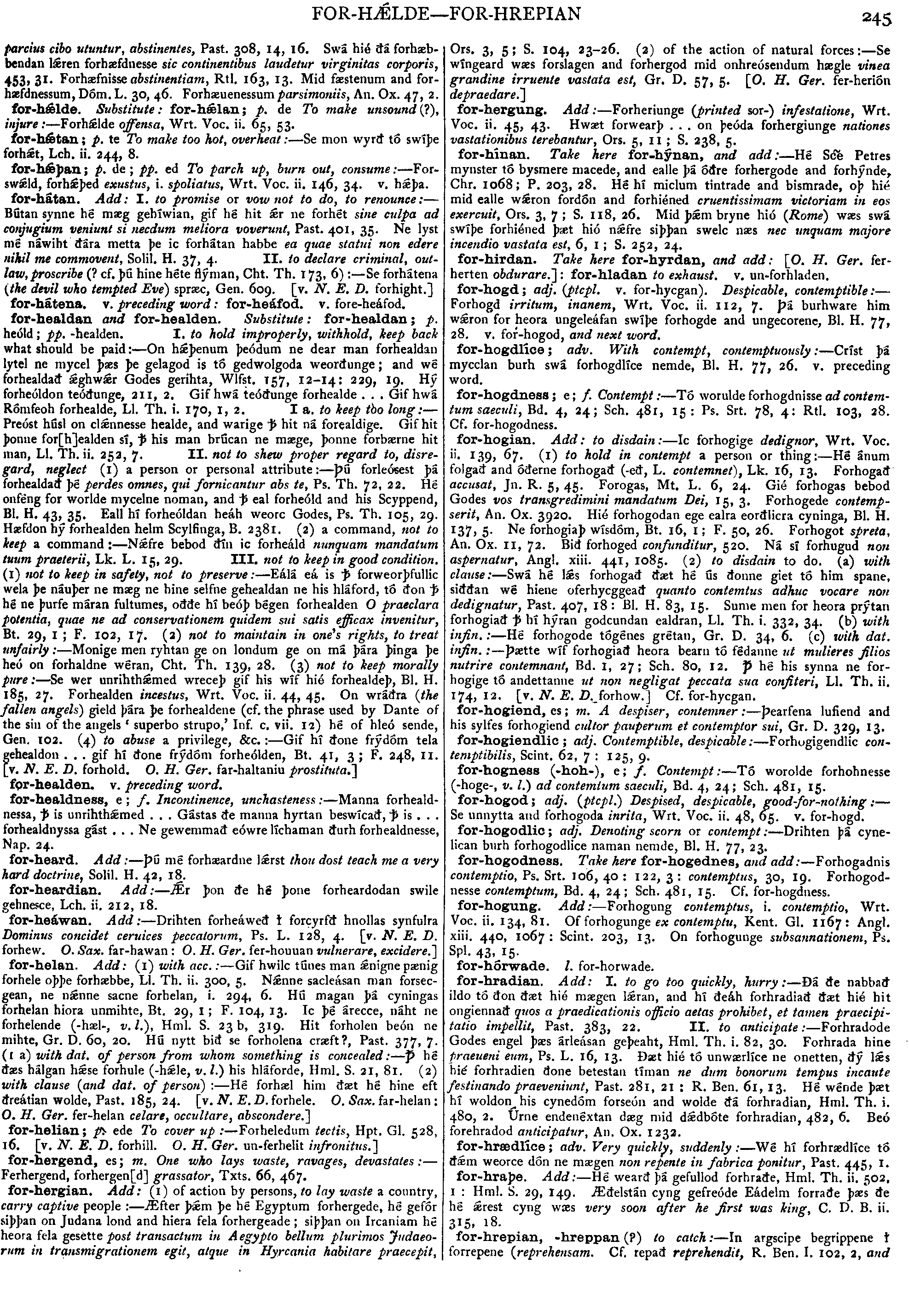
for-hogiend, es; m. A despiser, contemner:--Þearfena lufiend and his sylfes forhogiend cultor pauperum et contemptor sui, Gr. D. 329, 13.
|
Source: Bosworth/Toller, page d0275, entry 1 View original page image as: [TIFF] [PNG] [View previous entry] [View next entry] |
[Comment on this entry] [View comments] |
The following entry has been hand-corrected once. |
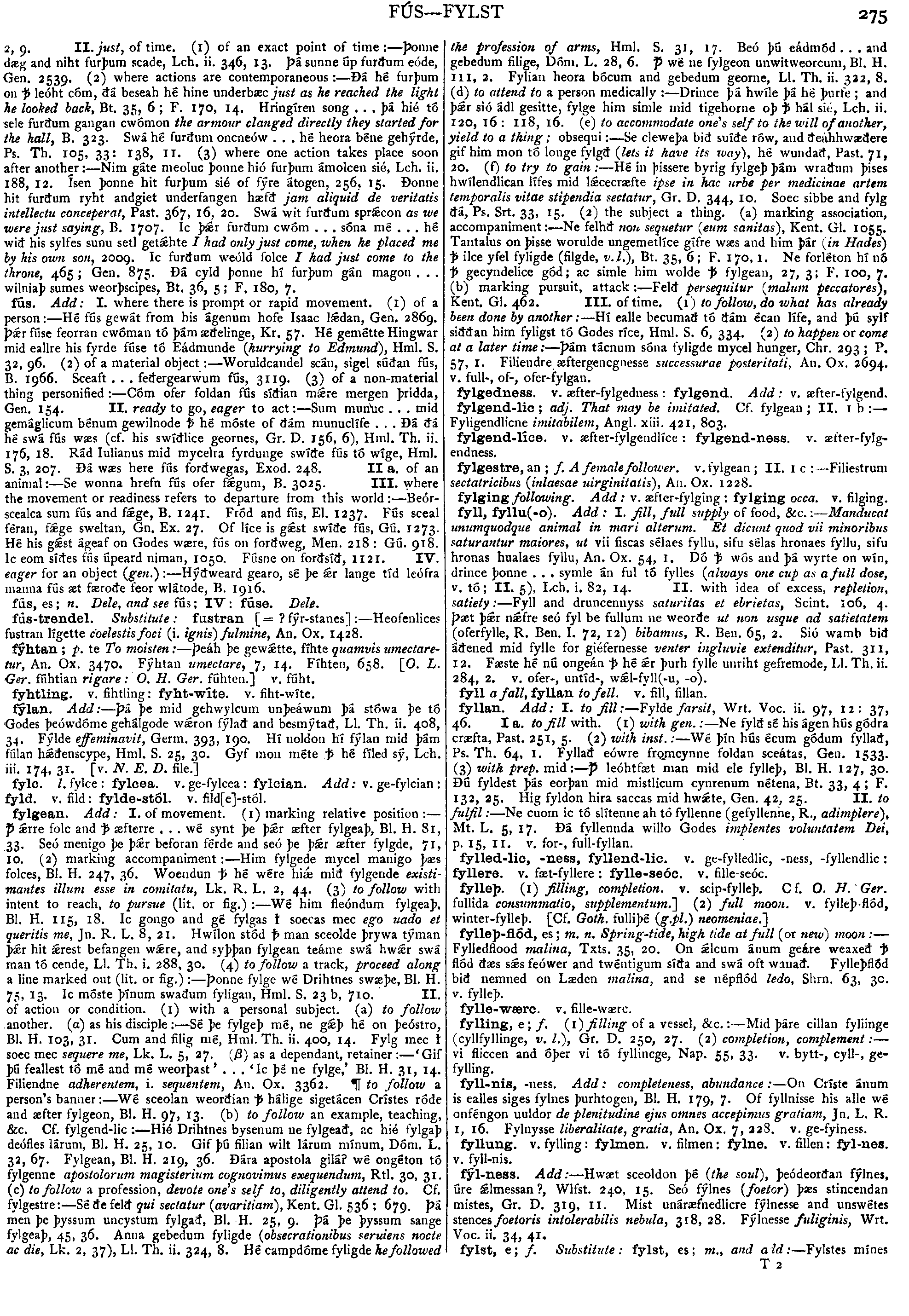
2,
9.
II.
just,
of
time.
(1)
of
an
exact
point
of
time:--Þonne
dæg
and
niht
furþum
scade,
Lch.
ii.
346,
13.
Þá
sunne
úp
furðum
eóde,
Gen.
2539.
(2)
where
actions
are
contemporaneous:--Ðá
hé
furþum
on
 leóht
cóm,
ðá
beseah
hé
hine
underbæc
just
as
he
reached
the
light
he
looked
back,
Bt.
35,
6;
F.
170,
14.
Hringíren
song
.
.
.
þá
hié
tó
sele
furðum
gangan
cwómon
the
armour
clanged
directly
they
started
for
the
hall,
B.
323.
Swá
hé
furðum
oncneów
.
.
.
hé
heora
béne
gehýrde,
Ps.
Th.
105,
33:
138,
11.
(3)
where
one
action
takes
place
soon
after
another:--Nim
gáte
meoluc
þonne
hió
furþum
ámolcen
sié,
Lch.
ii.
188,
12.
Ísen
þonne
hit
furþum
sié
of
fýre
átogen,
256,
15.
Ðonne
hit
furðum
ryht
andgiet
underfangen
hæfð
jam
aliquid
de
veritatis
intellectu
conceperat,
Past.
367,
16,
20.
Swá
wit
furðum
spr
leóht
cóm,
ðá
beseah
hé
hine
underbæc
just
as
he
reached
the
light
he
looked
back,
Bt.
35,
6;
F.
170,
14.
Hringíren
song
.
.
.
þá
hié
tó
sele
furðum
gangan
cwómon
the
armour
clanged
directly
they
started
for
the
hall,
B.
323.
Swá
hé
furðum
oncneów
.
.
.
hé
heora
béne
gehýrde,
Ps.
Th.
105,
33:
138,
11.
(3)
where
one
action
takes
place
soon
after
another:--Nim
gáte
meoluc
þonne
hió
furþum
ámolcen
sié,
Lch.
ii.
188,
12.
Ísen
þonne
hit
furþum
sié
of
fýre
átogen,
256,
15.
Ðonne
hit
furðum
ryht
andgiet
underfangen
hæfð
jam
aliquid
de
veritatis
intellectu
conceperat,
Past.
367,
16,
20.
Swá
wit
furðum
spr con
as
we
were
just
saying,
B.
1707.
Ic
þr
furðum
cwóm
.
.
.
sóna
mé
.
.
.
hé
wið
his
sylfes
sunu
setl
gethte
I
had
only
just
come,
when
he
placed
me
by
his
own
son,
2009.
Ic
furðum
weóld
folce
I
had
just
come
to
the
throne,
465;
Gen.
875.
Ðá
cyld
þonne
hí
furþum
gán
magon
.
.
.
wilniaþ
sumes
weorþscipes,
Bt.
36,
5;
F.
180,
7.
con
as
we
were
just
saying,
B.
1707.
Ic
þr
furðum
cwóm
.
.
.
sóna
mé
.
.
.
hé
wið
his
sylfes
sunu
setl
gethte
I
had
only
just
come,
when
he
placed
me
by
his
own
son,
2009.
Ic
furðum
weóld
folce
I
had
just
come
to
the
throne,
465;
Gen.
875.
Ðá
cyld
þonne
hí
furþum
gán
magon
.
.
.
wilniaþ
sumes
weorþscipes,
Bt.
36,
5;
F.
180,
7.
|
Source: Bosworth/Toller, page d0281, entry 3 View original page image as: [TIFF] [PNG] [View previous entry] [View next entry] |
[Comment on this entry] [View comments] |
The following entry has been hand-corrected once. |
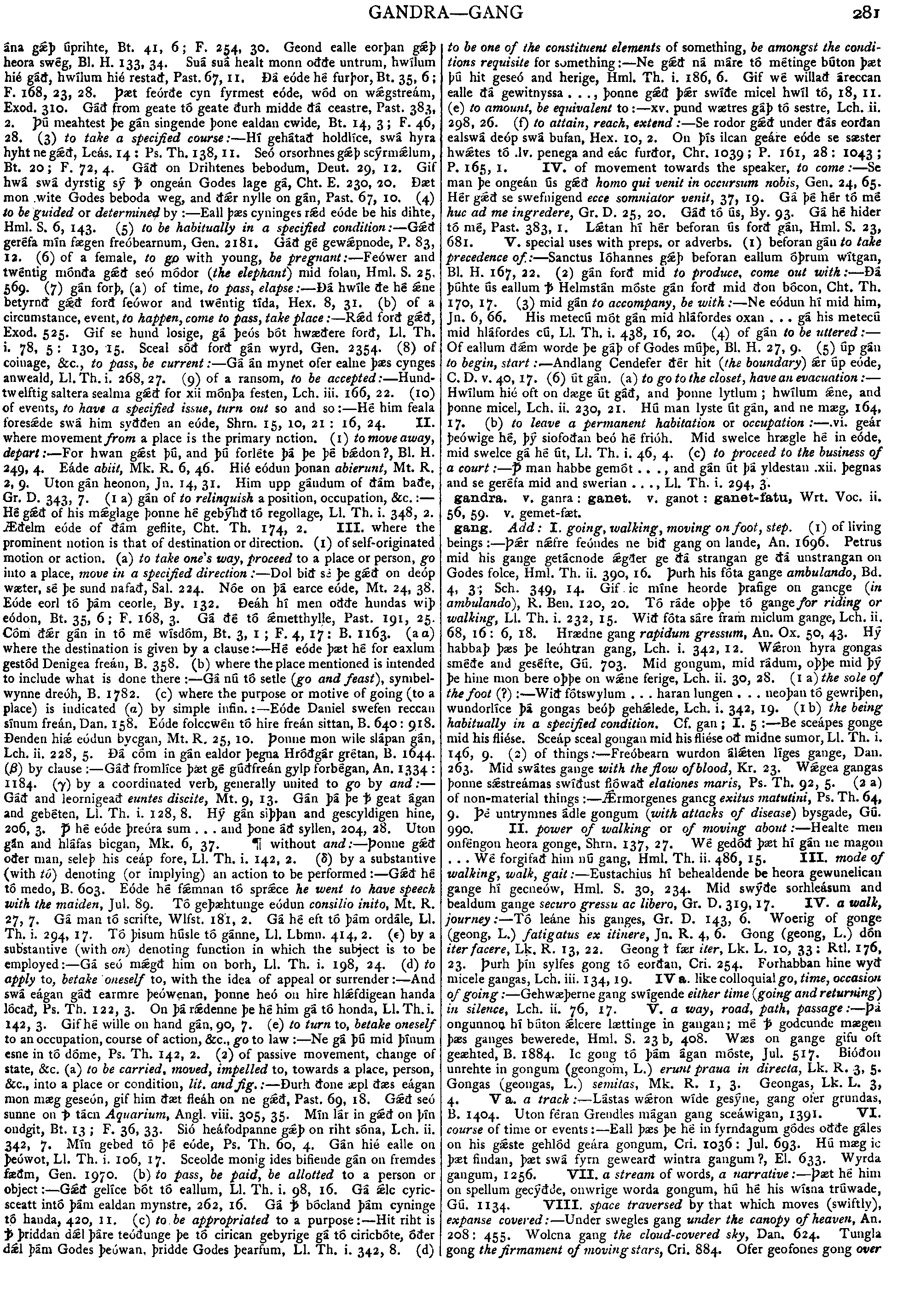
gang.
Add:
I.
going,
walking,
moving
on
foot,
step.
(1)
of
living
beings
:--
Þ r
nfre
feóndes
ne
bi
r
nfre
feóndes
ne
bi gang
on
lande,
An.
1696.
Petrus
mid
his
gange
get
gang
on
lande,
An.
1696.
Petrus
mid
his
gange
get cnode
ger
ge
strangan
ge
unstrangan
on
Godes
folce,
Hml.
Th.
ii.
390,
16.
Þurh
his
f
cnode
ger
ge
strangan
ge
unstrangan
on
Godes
folce,
Hml.
Th.
ii.
390,
16.
Þurh
his
f ta
gange
ambulando,
Bd.
4,
3;
Sch.
349,
14.
Gif
ic
m
ta
gange
ambulando,
Bd.
4,
3;
Sch.
349,
14.
Gif
ic
m ne
heorde
þrafige
on
gancge
(in
ambulando),
R.
Ben.
120,
20.
T
rde
oþþe
t
gange
for
riding
or
walking,
Ll.
Th.
i.
232,
15.
Wi
fta
sre
fram
miclum
gange,
Lch.
ii.
68,
16
:
6,
18.
Hrædne
gang
rapidum
gressum.
An.
Ox.
50,
43.
H
ne
heorde
þrafige
on
gancge
(in
ambulando),
R.
Ben.
120,
20.
T
rde
oþþe
t
gange
for
riding
or
walking,
Ll.
Th.
i.
232,
15.
Wi
fta
sre
fram
miclum
gange,
Lch.
ii.
68,
16
:
6,
18.
Hrædne
gang
rapidum
gressum.
An.
Ox.
50,
43.
H habbaþ
þæs
þe
leóhtran
gang,
Lch.
i.
342,
12.
Wron
hyra
gongas
sm
habbaþ
þæs
þe
leóhtran
gang,
Lch.
i.
342,
12.
Wron
hyra
gongas
sm e
and
gesfte,
G
e
and
gesfte,
G .
703.
Mid
gongum,
mid
rdum,
oþþe
mid
þ
þe
hine
mon
here
oþþe
on
wne
ferige,
Lch.
ii.
30,
28.
(l
a)
the
sole
of
the
foot
(?)
:--
Wi
ftswylum
.
.
.
haran
lungen
.
.
.
neoþan
t
gewriþen,
wundorlce
þ
gongas
beóþ
gehlede,
Lch.
i.
342,
19.
(1
b)
the
being
habitually
in
a
specified
condition.
Cf.
gan;
I.
5
:--
Be
sceápes
gonge
mid
his
fliése.
Sceáp
sceal
gongan
mid
his
fliése
o
midne
sumor,
Ll.
Th.
i.
146,
9.
(2)
of
things
:--
Freóbearn
wurdon
lten
lges
gange,
Dan.
263.
Mid
swtes
gange
with
the
flow
of
blood,
Kr.
23.
Wgea
gangas
þonne
sstreámas
swust
flwa
elationes
maris,
Ps.
Th.
92,
5.
(2
a)
of
non-material
things
:--
Æ-long;rmorgenes
gancg
exitus
matutini,
Ps.
Th.
64,
9.
Þ
untrymnes
dle
gongum
(with
attacks
of
disease)
bysgade,
G.
990.
II.
power
of
walking
or
of
moving
about
:--
Healte
men
onfngon
heora
gonge.
Shrn.
137,
27.
W
ged
þæt
h
gn
ne
magon
.
.
.
W
forgifa
him
n
gang.
Hml.
Th.
ii.
486,
15.
III.
mode
of
walking,
walk,
gait
:--
Eustachius
h
behealdende
be
heora
gewunelican
gange
h
gecneów,
Hml.
S.
30,
234.
Mid
swe
sorhleásum
and
bealdum
gange
secure
gressu
ac
libero.
Gr.
D.
319,
17.
IV.
a
walk,
journey
:--
T
leáne
his
gauges,
Gr.
D.
143,
6.
Woerig
of
gonge
(geong,
L.)
fatigatus
ex
itinere,
Jn.
R.
4,
6.
Gong
(geong,
L.)
dn
iter
facere,
Lk.
R.
13,
22.
Geong
.
703.
Mid
gongum,
mid
rdum,
oþþe
mid
þ
þe
hine
mon
here
oþþe
on
wne
ferige,
Lch.
ii.
30,
28.
(l
a)
the
sole
of
the
foot
(?)
:--
Wi
ftswylum
.
.
.
haran
lungen
.
.
.
neoþan
t
gewriþen,
wundorlce
þ
gongas
beóþ
gehlede,
Lch.
i.
342,
19.
(1
b)
the
being
habitually
in
a
specified
condition.
Cf.
gan;
I.
5
:--
Be
sceápes
gonge
mid
his
fliése.
Sceáp
sceal
gongan
mid
his
fliése
o
midne
sumor,
Ll.
Th.
i.
146,
9.
(2)
of
things
:--
Freóbearn
wurdon
lten
lges
gange,
Dan.
263.
Mid
swtes
gange
with
the
flow
of
blood,
Kr.
23.
Wgea
gangas
þonne
sstreámas
swust
flwa
elationes
maris,
Ps.
Th.
92,
5.
(2
a)
of
non-material
things
:--
Æ-long;rmorgenes
gancg
exitus
matutini,
Ps.
Th.
64,
9.
Þ
untrymnes
dle
gongum
(with
attacks
of
disease)
bysgade,
G.
990.
II.
power
of
walking
or
of
moving
about
:--
Healte
men
onfngon
heora
gonge.
Shrn.
137,
27.
W
ged
þæt
h
gn
ne
magon
.
.
.
W
forgifa
him
n
gang.
Hml.
Th.
ii.
486,
15.
III.
mode
of
walking,
walk,
gait
:--
Eustachius
h
behealdende
be
heora
gewunelican
gange
h
gecneów,
Hml.
S.
30,
234.
Mid
swe
sorhleásum
and
bealdum
gange
secure
gressu
ac
libero.
Gr.
D.
319,
17.
IV.
a
walk,
journey
:--
T
leáne
his
gauges,
Gr.
D.
143,
6.
Woerig
of
gonge
(geong,
L.)
fatigatus
ex
itinere,
Jn.
R.
4,
6.
Gong
(geong,
L.)
dn
iter
facere,
Lk.
R.
13,
22.
Geong
 fær
iter,
Lk.
L.
10,
33:
Rtl.
176,
23.
Þurh
þn
sylfes
gong
t
eoran,
Cri.
254.
Forhabban
hine
wy
micele
gangas,
Lch.
iii.
134,
19.
IV
a.
like
colloquial
go,
time,
occasion
of
going
:--
Gehwæþerne
gang
swgende
either
time
(going
and
returning)
in
silence,
Lch.
ii.
76,
17.
V.
a
way,
road,
path,
passage
:--
Þ
ongunnon
h
bton
lcere
lættinge
in
gangan;
m
thorn-bar;
godcunde
mægen
þæs
ganges
bewerede.
Hml.
S.
23
b,
408.
Wæs
on
gange
gifu
oft
geæhted,
B.
1884.
Ic
gong
t
þm
gan
mste,
Jul.
517.
Bióon
unrehte
in
gongum
(geongom,
L.)
erunt
praua
in
directa,
Lk.
R.
3,
5.
Gongas
(geongas.
L.)
semitas,
Mk.
R.
1,
3.
Geongas,
Lk.
L.
3,
4.
V
a.
a
track
:--
Lstas
wton
wde
gesne,
gang
ofer
grundas,
B.
1404.
Uton
fran
Grendles
mgan
gang
sceáwigan,
1391.
VI.
course
of
time
or
events
:--
Eall
þæs
þe
h
in
fyrndagum
gdes
oe
gles
on
his
gste
gehld
geára
gongum,
Cri.
1036
:
Jul.
693.
H
mæg
ic
þæt
findan,
þæt
sw
fyrn
gewear
wintra
gangum
?,
El.
633.
Wyrda
gangum,
1256.
VII.
a
stream
of
words,
a
narrative
:--
Þæt
h
him
on
spellum
gecde,
onwrige
worda
gongum,
h
h
his
wsna
trwade,
G.
1134.
VIII.
space
traversed
by
that
which
moves
(swiftly),
expanse
covered
:--
Under
swegles
gang
under
the
canopy
of
heaven,
An.
208:
455.
Wolcna
gang
the
cloud-covered
sky,
Dan.
624.
Tungla
gong
the
firmament
of
moving
stars,
Cri.
884.
Ofer
geofones
gong
over
fær
iter,
Lk.
L.
10,
33:
Rtl.
176,
23.
Þurh
þn
sylfes
gong
t
eoran,
Cri.
254.
Forhabban
hine
wy
micele
gangas,
Lch.
iii.
134,
19.
IV
a.
like
colloquial
go,
time,
occasion
of
going
:--
Gehwæþerne
gang
swgende
either
time
(going
and
returning)
in
silence,
Lch.
ii.
76,
17.
V.
a
way,
road,
path,
passage
:--
Þ
ongunnon
h
bton
lcere
lættinge
in
gangan;
m
thorn-bar;
godcunde
mægen
þæs
ganges
bewerede.
Hml.
S.
23
b,
408.
Wæs
on
gange
gifu
oft
geæhted,
B.
1884.
Ic
gong
t
þm
gan
mste,
Jul.
517.
Bióon
unrehte
in
gongum
(geongom,
L.)
erunt
praua
in
directa,
Lk.
R.
3,
5.
Gongas
(geongas.
L.)
semitas,
Mk.
R.
1,
3.
Geongas,
Lk.
L.
3,
4.
V
a.
a
track
:--
Lstas
wton
wde
gesne,
gang
ofer
grundas,
B.
1404.
Uton
fran
Grendles
mgan
gang
sceáwigan,
1391.
VI.
course
of
time
or
events
:--
Eall
þæs
þe
h
in
fyrndagum
gdes
oe
gles
on
his
gste
gehld
geára
gongum,
Cri.
1036
:
Jul.
693.
H
mæg
ic
þæt
findan,
þæt
sw
fyrn
gewear
wintra
gangum
?,
El.
633.
Wyrda
gangum,
1256.
VII.
a
stream
of
words,
a
narrative
:--
Þæt
h
him
on
spellum
gecde,
onwrige
worda
gongum,
h
h
his
wsna
trwade,
G.
1134.
VIII.
space
traversed
by
that
which
moves
(swiftly),
expanse
covered
:--
Under
swegles
gang
under
the
canopy
of
heaven,
An.
208:
455.
Wolcna
gang
the
cloud-covered
sky,
Dan.
624.
Tungla
gong
the
firmament
of
moving
stars,
Cri.
884.
Ofer
geofones
gong
over
|
Source: Bosworth/Toller, page d0298, entry 24 View original page image as: [TIFF] [PNG] [View previous entry] [View next entry] |
[Comment on this entry] [View comments] |
The following entry has been hand-corrected once. |
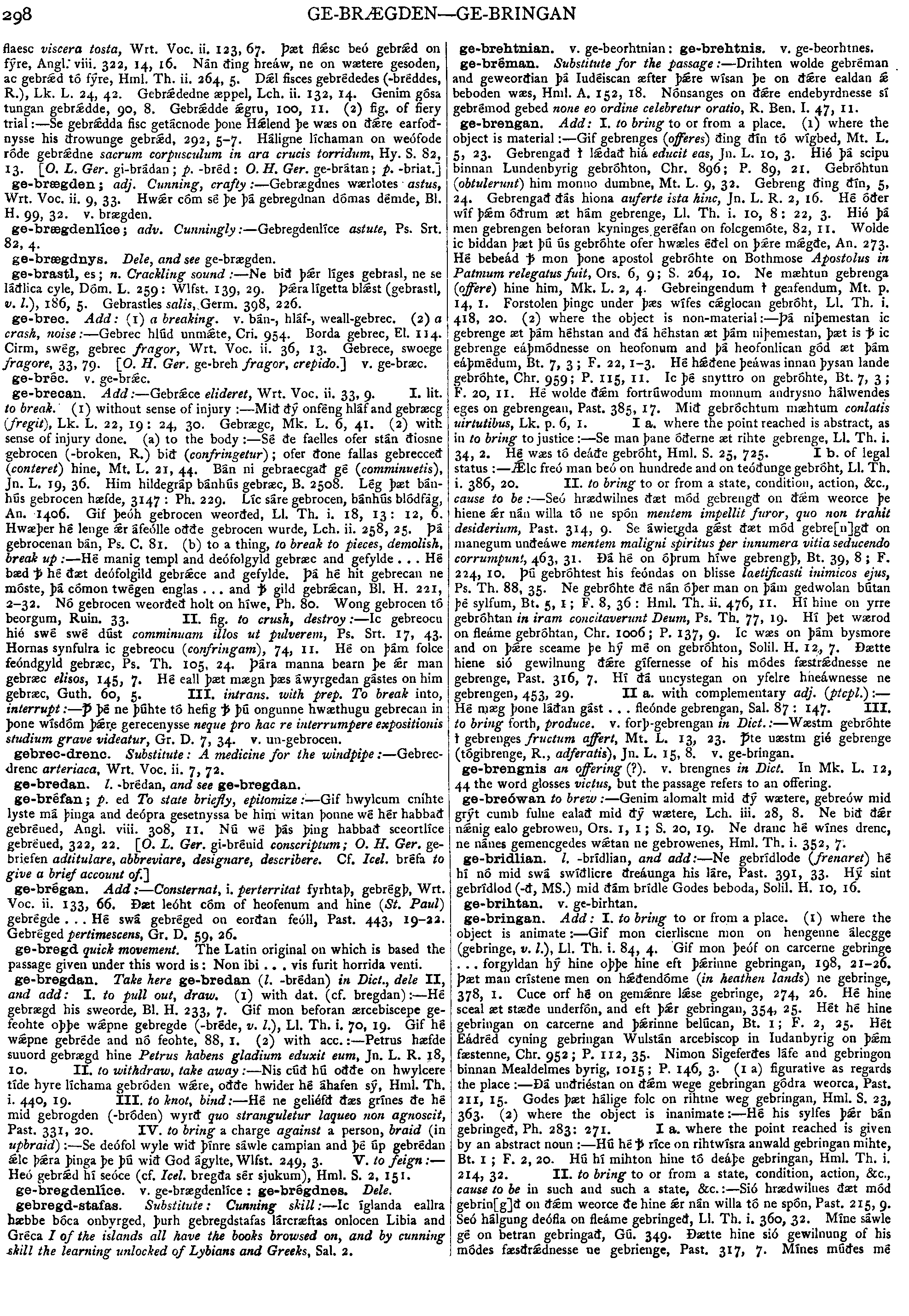
ge-bringan.
Add;
I.
to
bring
to
or
from
a
place.
(1)
where
the
object
is
animate
:--
Gif
mon
cierliscne
mon
on
hengenne
álecgge
(gebringe,
v.
l.),
Ll.
Th.
i.
84,
4.
Gif
mon
þeóf
on
carcerne
gebringe
.
.
.
forgyldan
hý
hine
oþþe
hine
eft
þrinne
gebringan,
198,
21-26.
Þæt
man
crístene
men
on
hðendóme
(in
heathen
lands)
ne
gebringe,
378,
1.
Cuce
orf
hé
on
gemnre
lse
gebringe,
274,
26.
Hé
hine
sceal
æt
stæðe
underfón,
and
eft
þr
gebringan,
354,
25.
Hét
hé
hine
gebringan
on
carcerne
and
þrinne
belúcan,
Bt.
1;
F.
2,
25.
Hét
Eádréd
cyning
gebringan
Wulstán
arcebiscop
in
Iudanbyrig
on
þm
fæstenne,
Chr.
952;
P.
112,
35.
Nimon
Sigeferðes
láfe
and
gebringon
binnan
Mealdelmes
byrig,
1015;
P.
146,
3.
(I
a)
figurative
as
regards
the
place
:--
Ðá
unðriéstan
on
ðm
wege
gebringan
gódra
weorca,
Past.
211,
15.
Godes
þæt
hálige
folc
on
rihtne
weg
gebringan,
Hml.
S.
23,
363.
(2)
where
the
object
is
inanimate
:--
Hé
his
sylfes
þr
bán
gebringeð,
Ph.
283:
271.
I
a.
where
the
point
reached
is
given
by
an
abstract
noun
:--
Hú
hé
ríce
on
rihtwísra
anwald
gebringan
mihte,
Bt.
1
;
F.
2,
20.
Hú
hí
mihton
hine
tó
deáþe
gebringan,
Hml.
Th.
i.
214,
32.
II.
to
bring
to
or
from
a
state,
condition,
action,
&c.,
cause
to
be
in
such
and
such
a
state,
&c.
:--
Sió
hrædwilnes
ðæt
mod
gebrin[g]ð
on
ðm
weorce
ðe
hine
r
nán
willa
tó
ne
spón,
Past.
215,
9.
Seó
haigung
deófla
on
fleáme
gebringed,
Ll.
Th.
i.
360,
32.
Míne
sáwle
gé
on
betran
gebringað,
Gú.
349.
Ðætte
hine
sió
gewilnung
of
his
módes
fæsðrdnesse
ne
gebrienge,
Past.
317,
7.
Mínes
múðes
mé
|
Source: Bosworth/Toller, page d0301, entry 1 View original page image as: [TIFF] [PNG] [View previous entry] [View next entry] |
[Comment on this entry] [View comments] |
The following entry has been hand-corrected once. |
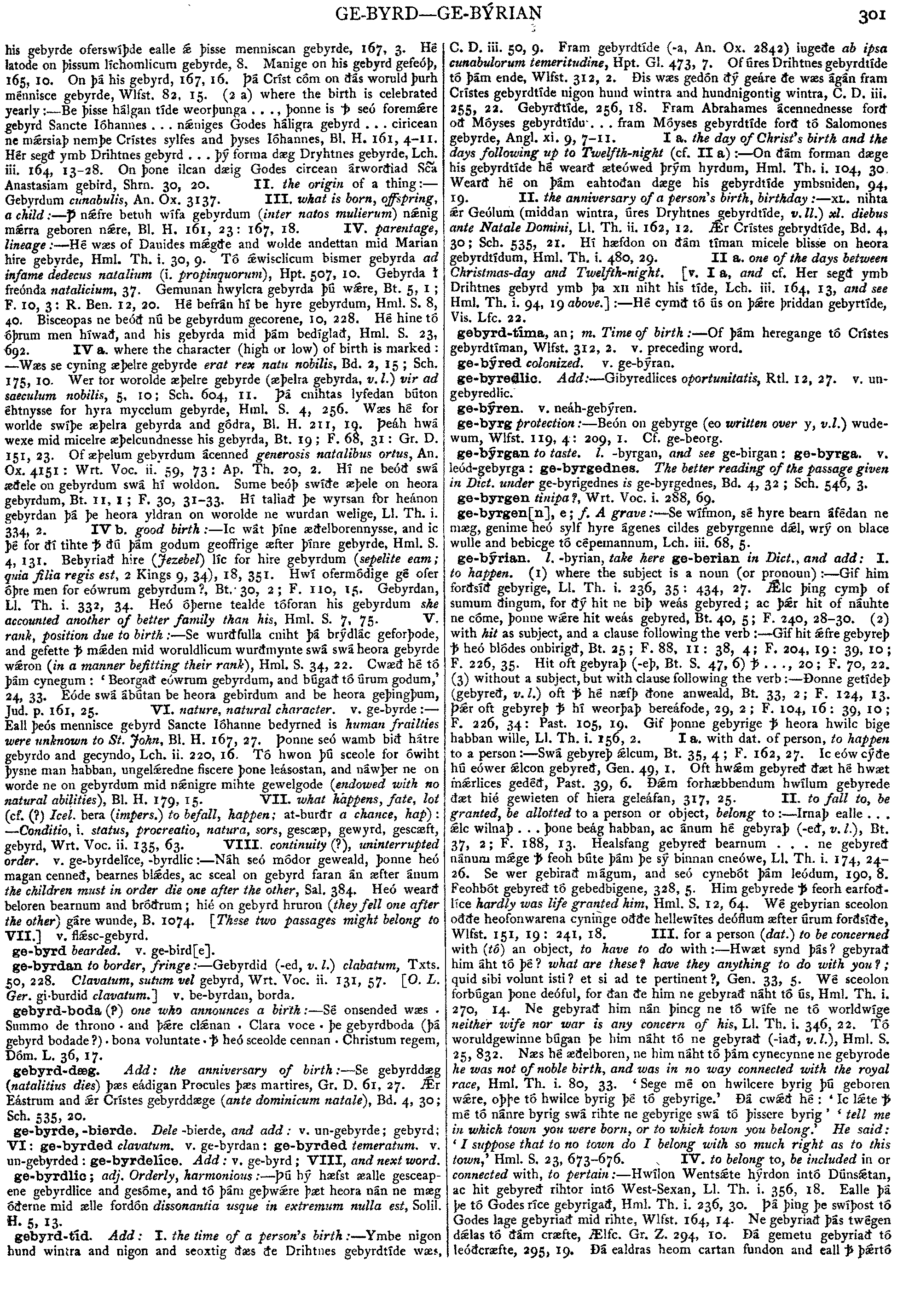
his
gebyrde
oferswíþde
ealle
þisse
menniscan
gebyrde,
167,
3.
Hé
latode
on
þissum
líchomlicum
gebyrde,
8.
Manige
on
his
gebyrd
gefeóþ,
165,
10.
On
þá
his
gebyrd,
167,
16.
Þa
Críst
com
on
ðás
woruld
þurh
ménnisce
gebyrde,
Wlfst.
82,
15.
(2
a)
where
the
birth
is
celebrated
yearly
:--
Be
þisse
hálgan
tíde
weorþunga
...,
þonne
is
seó
foremre
gebyrd
Sancte
Ióhannes
...
nniges
Godes
háligra
gebyrd
...
ciricean
ne
mrsiaþ
nemþe
Crístes
sylfes
and
þyses
Ióhannes,
Bl.
H.
161,
4-11.
Hér
segð
ymb
Drihtnes
gebyrd
...
þý
forma
dæg
Dryhtnes
gebyrde.
Lch.
iii.
164,
13-28.
On
þone
ilcan
dæig
Godes
circean
árworðiad
Sca
UNCERTAIN
Anastasiam
gebird,
Shrn.
30,
20.
II.
the
origin
of
a
thing
:--
Gebyrdum
cunabulis,
An.
Ox.
3137.
III.
what
is
born,
offspring,
a
child
:--
nfre
betuh
wífa
gebyrdum
(inter
natos
mulierim)
nnig
mrra
geboren
nre.
Bl.
H.
161,
23:
167,
18.
IV.
parentage,
lineage
:--
Hé
wæs
of
Dauides
mgðe
and
wolde
andettan
mid
Marian
hire
gebyrde,
Hml.
Th.
i.
30,
9.
Tó
wisclicum
bismer
gebyrda
ad
infame
dedecus
natalium
(i.
propinquorum),
Hpt.
507,
10.
Gebyrda
freónda
natalicium,
37.
Gemunan
hwylcra
gebyrda
þú
wre,
Bt.
5,
1;
F.
10,
3:
R.
Ben.
12,
20.
Hé
befrán
hí
be
hyre
gebyrdum,
Hml.
S.
8,
40.
Bisceopas
ne
beóð
nú
be
gebyrdum
gecorene,
10,
228.
Hé
hine
tó
óþrum
men
híwað,
and
his
gebyrda
mid
þám
bedíglað,
Hml.
S.
23,
692.
IV
a.
where
the
character
(high
or
low)
of
birth
is
marked
:--
Wæs
se
cyning
æþelre
gebyrde
erat
rex
natu
nobilis,
Bd.
2,
15;
Sch.
175,
10.
Wer
tor
worolde
æþelre
gebyrde
(æþelra
gebyrda,
v.l.)
vir
ad
saeculum
nobilis,
5,
10;
Sch.
604,
11.
Þá
cnihtas
lyfedan
búton
éhtnysse
for
hyra
mycclum
gebyrde,
Hml.
S.
4,
256.
Wæs
hé
for
worlde
swíþe
æþelra
gebyrda
and
gódra,
Bl.
H.
211,
19.
Þeán
hwá
wexe
mid
micelre
æþelcundnesse
his
gebyrda,
Bt.
19;
F.
68,
31:
Gr.
D.
151
23.
Of
æþelum
gebyrdum
ácenned
generosis
natalibus
ortus,
An.
Ox.
4151:
Wrt.
Voc.
ii.
59,
73:
Ap.
Th.
20,
2.
Hí
ne
beóð
swá
æðele
on
gebyrdum
swá
hí
woldon.
Sume
beóþ
swíðe
æþele
on
heora
gebyrdum,
Bt.
11,
1;
F.
30,
31-33.
Hí
taliað
þe
wyrsan
for
heánon
gebyrdan
þá
þe
heora
yldran
on
worolde
ne
wurdan
welige,
Ll.
Th.
i.
334,
2.
IV
b.
good
birth
:--
Ic
wát
þíne
æðelborennysse,
and
ic
þé
for
ðí
tihte
ðú
þám
godum
geoffrige
æfter
þínre
gebyrde,
Hml.
S.
4,
131.
Bebyriað
hire
(Jezebel)
líc
for
hire
gebyrdum
(sepelite
eam;
quia
filia
regis
est,
2
Kings
9,
34),
18,
351.
Hwí
ofermódige
gé
ofer
óþre
men
for
eówrum
gebyrdum?,
Bt.
30,
2;
F.
110,
15.
Gebyrdan,
Ll.
Th.
i.
332,
34.
Heó
óþerne
tealde
tóforan
his
gebyrdum
she
accounted
another
of
better
family
than
his,
Hml.
S.
7.
75.
V.
rank,
position
due
to
birth
:--
Se
wurðfulla
cniht
þá
brýdlác
geforþode,
and
gefette
mden
mid
woruldlicum
wurðmynte
swá
swá
heora
gebyrde
wron
(in
a
manner
befitting
their
rank),
Hml.
S.
34,
22.
Cwæð
hé
tó
þám
cynegum:
'Beorgað
eówrum
gebyrdum,
and
búgað
tó
úrum
godum,'
24,
33.
Eóde
swá
ábútan
be
heora
gebirdum
and
be
heora
geþingþum,
Jud.
p.
161,
25.
VI.
nature,
natural
character,
v.
ge-byrde
:--
Eall
þeós
ménnisce
gebyrd
Sancte
Ióhanne
bedyrned
is
human
frailties
were
unknown
to
St.
John,
Bl.
H.
167,
27.
Þonne
seó
wamb
bið
hátre
gebyrdo
and
gecyndo,
Lch.
ii.
220,
16.
Tó
hwon
þú
sceole
for
ówiht
þysne
man
habban,
ungelredne
fiscere
þone
leásostan,
and
náwþer
ne
on
worde
ne
on
gebyrdum
mid
nnigre
mihte
gewelgode
(endowed
with
no
natural
abilities),
Bl.
H.
179,
15.
VII.
what
happens,
fate,
lot
(cf.
(?)
Icel.
bera
(impers.)
to
befall,
happen;
at-burðr
a
chance,
hap)
:--
Conditio,
i.
status,
procreatio,
natura,
sors,
gescæp,
gewyrd,
gescæft,
gebyrd,
Wrt.
Voc.
ii.
135,
63.
VIII.
continuity
(?),
uninterrupted
order.
v.
ge-byrdelíce,
-byrdlic
:--
Náh
seó
módor
geweald,
þonne
heó
magan
cenneð,
bearnes
bldes,
ac
sceal
on
gebyrd
faran
án
æfter
ánum
the
children
must
in
order
die
one
after
the
other,
Sal.
384.
Heó
wearð
beloren
bearnum
and
bróðrum;
hié
on
gebyrd
hruron
(they
fell
one
after
the
other)
gáre
wunde,
B.
1074.
[Thsse
two
passages
might
belong
to
VII.]
v.
flsc-gebyrd.
|
Source: Bosworth/Toller, page d0316, entry 26 View original page image as: [TIFF] [PNG] [View previous entry] [View next entry] |
[Comment on this entry] [View comments] |
The following entry has been hand-corrected once. |
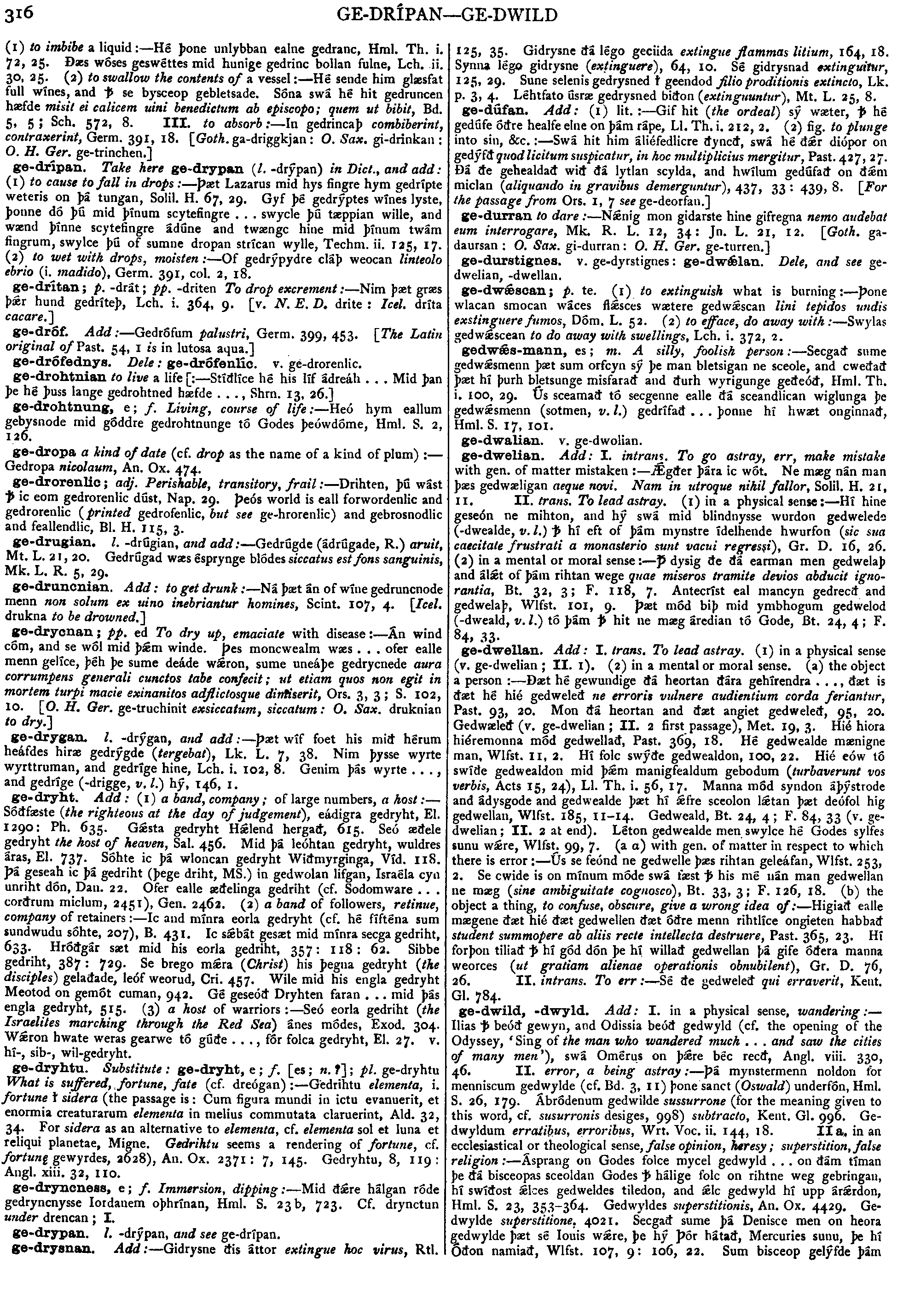
ge-dwellan.
Add:
I.
Trans.
To
lead
astray.
(1)
in
a
physical
sense
(v.
ge-dwelian
;
II.
1),
(2)
in
a
mental
or
moral
sense,
(a)
the
object
a
person
:--
Ðæt
hé
gewundige
ðá
heortan
ðára
gehírendra
.
.
.,
ðæt
is
ðæt
hé
hié
gedweleð
ne
erroris
vulnere
audientium
corda
feriantur,
Past.
93,
20.
Mon
ðá
heortan
and
ðæt
angiet
gedweleð,
95,
20.
Gedwæleí
(v.
ge-dwelian
;
II.
2
first
passage),
Met.
19,
3.
Hié
hiora
hiéremonna
mód
gedwellað,
Past.
369,
18.
Hé
gedwealde
mænigne
man.
Wlfst.
Ii,
2.
Hî
folc
swýðe
gedwealdon,
100,
22.
Hié
eów
tó
swíðe
gedwealdon
mid
þm
manigfealdum
gebodum
(turbaverunt
vos
verbis,
Acts
15,
24),
Ll.
Th.
i.
56,
17.
Manna
mód
syndon
áþýstrode
and
ádysgode
and
gedwealde
þæt
hí
fre
sceolon
ltan
þæt
deófol
hig
gedwellan,
Wlfst.
185,
11-14.
Gedweald,
Bt.
24,
4;
F.
84,
33
(v.
ge-dwelian;
II.
2
at
end).
Léton
gedwealde
men
swylce
hé
Godes
sylfes
sunu
wre,
Wlfst.
99,
7.
(a
 )
with
gen.
of
matter
in
respect
to
which
there
is
error
:--
Ús
se
feónd
ne
gedwelle
þæs
rihtan
geleáfan,
Wlfst.
253,
2.
Se
cwide
is
on
mínum
móde
swá
fæst
his
mé
nán
man
gedwellan
ne
mæg
(sine
ambiguitate
cognosco),
Bt.
33,
3;
F.
126,
18.
(b)
the
object
a
thing,
to
confuse,
obscure,
give
a
wrong
idea
of
:--
Higiað
ealle
mægene
ðæt
hié
ðæt
gedwellen
ðæt
óðre
menn
rihtlíce
ongieten
habbað
student
summopere
ab
aliis
recte
intellecta
destruere,
Past.
365,
23.
Hî
forþon
tiliað
hí
gód
dón
þe
hí
willað
gedwellan
þá
gife
óðera
manna
weorces
(ut
gratiam
alienae
operationis
obnubilent),
Gr.
D.
76,
26.
II.
intrans.
To
err
:--
-Sé
ðe
gedweleð
qui
erraverit,
Kent.
Gl.
784.
)
with
gen.
of
matter
in
respect
to
which
there
is
error
:--
Ús
se
feónd
ne
gedwelle
þæs
rihtan
geleáfan,
Wlfst.
253,
2.
Se
cwide
is
on
mínum
móde
swá
fæst
his
mé
nán
man
gedwellan
ne
mæg
(sine
ambiguitate
cognosco),
Bt.
33,
3;
F.
126,
18.
(b)
the
object
a
thing,
to
confuse,
obscure,
give
a
wrong
idea
of
:--
Higiað
ealle
mægene
ðæt
hié
ðæt
gedwellen
ðæt
óðre
menn
rihtlíce
ongieten
habbað
student
summopere
ab
aliis
recte
intellecta
destruere,
Past.
365,
23.
Hî
forþon
tiliað
hí
gód
dón
þe
hí
willað
gedwellan
þá
gife
óðera
manna
weorces
(ut
gratiam
alienae
operationis
obnubilent),
Gr.
D.
76,
26.
II.
intrans.
To
err
:--
-Sé
ðe
gedweleð
qui
erraverit,
Kent.
Gl.
784.
|
Source: Bosworth/Toller, page d0361, entry 15 View original page image as: [TIFF] [PNG] [View previous entry] [View next entry] |
[Comment on this entry] [View comments] |
The following entry has been hand-corrected once. |
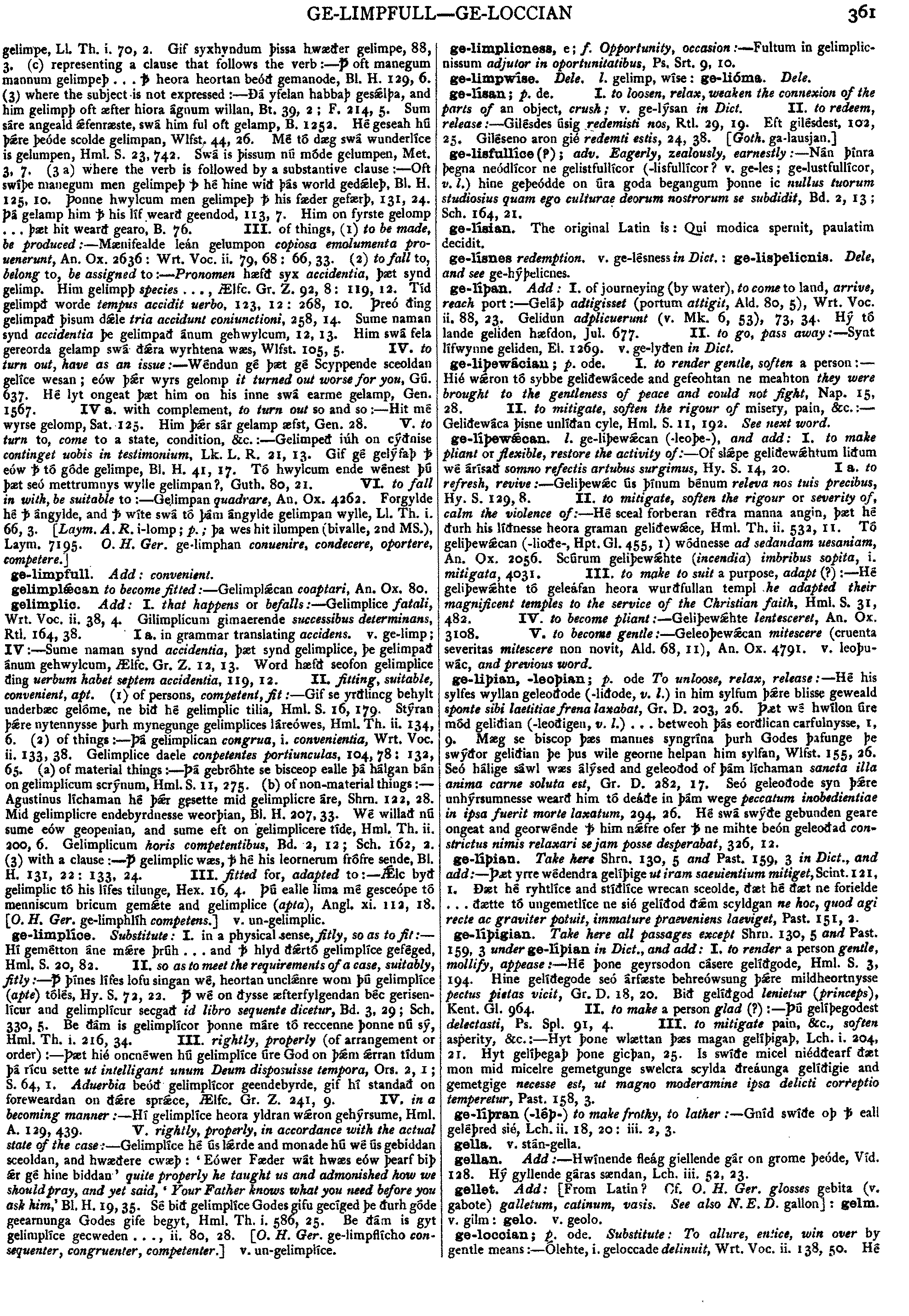
ge-liþian,
-leoþian;
p.
ode
To
unloose,
relax,
release
:--
Hé
his
sylfes
wyllan
geleoðode
(-liðode,
v.
l.)
in
him
sylfum
þre
blisse
geweald
sponte
sibi
laetitiae
frena
laxabat,
Gr.
D.
203,
26.
Þæt
wé
hwílon
úre
mód
geliðian
(-leoðigen,
v.
l.)
.
.
.
betweoh
þás
eorðlican
carfulnysse,
l,
9.
Mæg
se
biscop
þæs
mannes
syngrína
þurh
Godes
þafunge
þe
swýðor
geliðian
þe
þus
wile
georne
helpan
him
sylfan,
Wlfst.
155,
26.
Seó
hálige
sáwl
wæs
álysed
and
geleoðod
of
þám
líchaman
sancta
illa
anima
carne
soluta
est,
Gr.
D.
282,
17.
Seó
geleoðode
syn
þre
unhýrsumnesse
wearð
him
tó
deáde
in
þám
wege
peccatum
inobedientiae
in
ipsa
fuerit
morte
laxatum,
294,
26.
Hé
swá
swýðe
gebunden
geare
ongeat
and
georwénde
him
nfre
ofer
ne
mihte
beón
geleoðad
con-strictus
nimis
relaxari
sejam
posse
desperabat,
326,
12.
|
Source: Bosworth/Toller, page d0370, entry 13 View original page image as: [TIFF] [PNG] [View previous entry] [View next entry] |
[Comment on this entry] [View comments] |
The following entry has been hand-corrected once. |
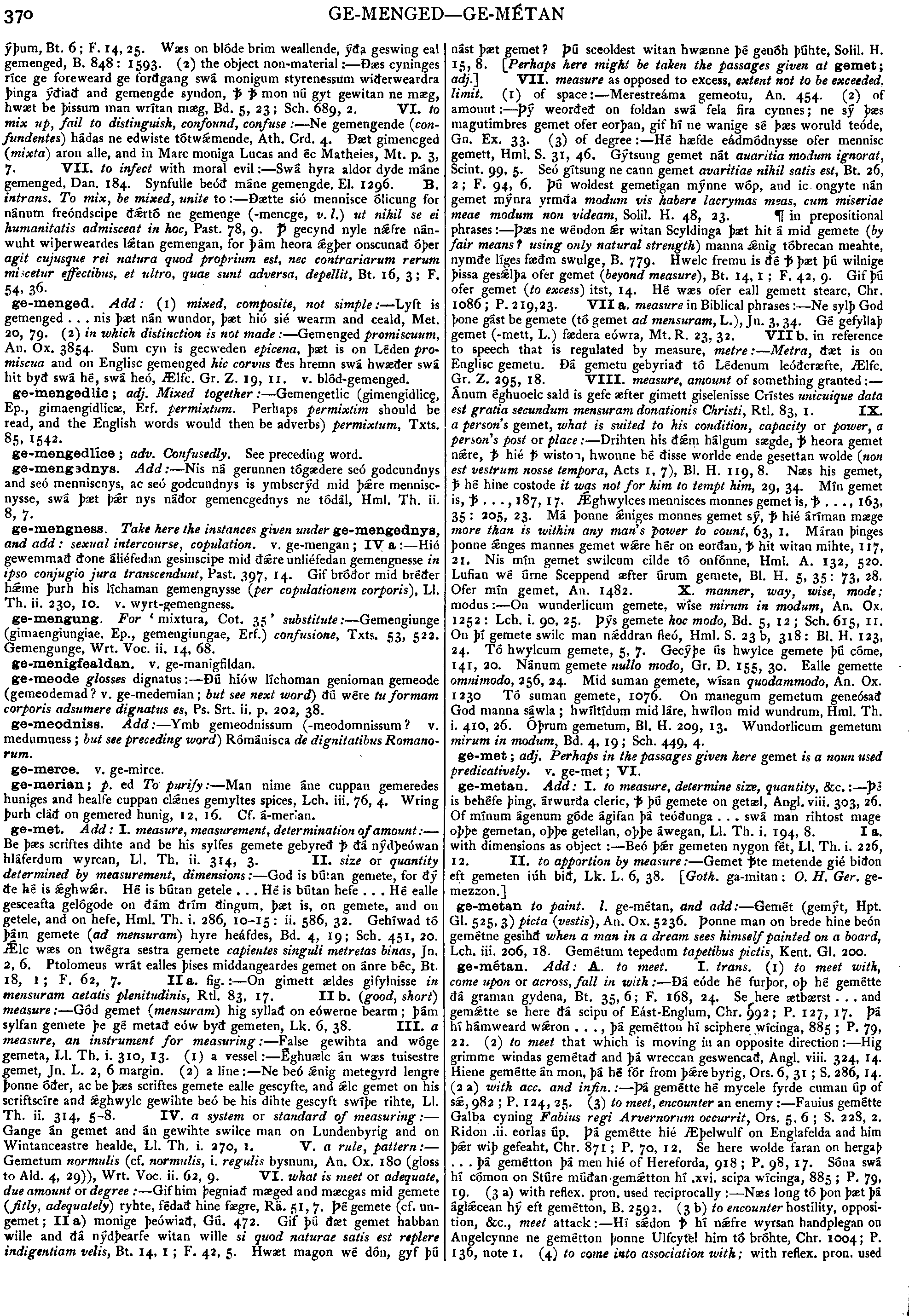
ge-met.
Add:
I.
measure,
measurement,
determination
of
amount
:--
Be
þæs
scriftes
dihte
and
be
his
sylfes
gemete
gebyreð
ðá
nýdþeówan
hláferdum
wyrcan,
Ll.
Th.
ii.
314,
3.
II.
size
or
quantity
determined
by
measurement,
dimensions
:--
God
is
bútan
gemete,
for
ðý
ðe
hé
is
ghwr.
Hé
is
bútan
getele
.
.
.
Hé
is
bútan
hefe
.
.
.
Hé
ealle
gesceafta
gelógode
on
ðám
ðrím
ðingum,
þæt
is,
on
gemete,
and
on
getele,
and
on
hefe,
Hml.
Th.
i.
286,
10-15
:
ii.
586,
32.
Gehíwad
tó
þám
gemete
(ad
mensuram)
hyre
heáfdes,
Bd.
4,
19;
Sch.
451,
20.
Æ-acute;lc
wæs
on
twégra
sestra
gemete
capientes
singuli
metretas
binas,
Jn.
2,
6.
Ptolomeus
wrát
ealles
þises
middangeardes
gemet
on
ánre
béc,
Bt.
18,
l
;
F.
62,
7.
II
a.
fig.
:--
On
gimett
ældes
gifylnisse
in
mensuram
aetatis
plenitudinis,
Rtl.
83,
17.
II
b.
(good,
short)
measure
:--
Gód
gemet
(mensuram)
hig
syllað
on
eówerne
bearm
;
þám
sylfan
gemete
þe
gé
metað
eów
byð
gemeten,
Lk.
6,
38.
III.
a
measure,
an
instrument
for
measuring
:--
False
gewihta
and
wóge
gemeta,
Ll.
Th.
i.
310,
13.
(1)
a
vessel
:--
Éghuælc
án
wæs
tuisestre
gemet,
Jn.
L.
2,
6
margin.
(2)
a
line
:--
Ne
beó
nig
metegyrd
lengre
þonne
óðer,
ac
be
þæs
scriftes
gemete
ealle
gescyfte,
and
lc
gemet
on
his
scriftscíre
and
æghwylc
gewihte
beó
be
his
dihte
gescyft
swíþe
rihte,
Ll.
Th.
ii.
314,
5-8.
IV.
a
system
or
standard
of
measuring
:--
Gange
án
gemet
and
án
gewihte
swilce
man
on
Lundenbyrig
and
on
Wintanceastre
healde,
Ll.
Th.
i.
270,
1.
V.
a
rule,
pattern
:--
Gemetum
normulis
(cf.
normulis,
i.
regulis
bysnum,
An.
Ox.
180
(gloss
to
Ald.
4,
29),
Wrt.
Voc.
ii.
62,
9.
VI.
what
is
meet
or
adequate,
due
amount
or
degree
:--
Gif
him
þegniað
mæged
and
mæcgas
mid
gemete
(fitly,
adequately)
ryhte,
fédað
hine
fægre,
Rä.
51,
7.
Þé
gemete
(cf.
un-gemet;
II
a)
monige
þeówiað,
Gú.
472.
Gif
þú
ðæt
gemet
habban
wille
and
ðá
nýdþearfe
witan
wille
si
quod
naturae
satis
est
replere
indigentiam
velis,
Bt.
14,
I
;
F.
42,
5.
Hwæt
magon
wé
dón,
gyf
þú
nást
þæt
gemet?
Þú
sceoldest
witan
hwænne
þé
genóh
þúhte,
Solil.
H.
15,
8.
[Perhaps
here
might
be
taken
the
passages
given
at
gemet;
adj.]
VII.
measure
as
opposed
to
excess,
extent
not
to
be
exceeded,
limit.
(1)
of
space
:--
Merestreáma
gemeotu,
An.
454.
(2)
of
amount
:--
Þý
weorðeð
on
foldan
swá
fela
fira
cynnes;
ne
sý
þæs
magutimbres
gemet
ofer
eorþan,
gif
hí
ne
wanige
sé
þæs
woruld
teóde,
Gn.
Ex.
33.
(3)
of
degree
:--
Hé
hæfde
eádmódnysse
ofer
mennisc
gemett,
Hml.
S.
31,
46.
Gýtsung
gemet
nát
auaritia
modum
ignorat,
Scint.
99,
5.
Seó
gítsung
ne
cann
gemet
avartiae
nihil
satis
est,
Bt.
26,
2;
F.
94,
6.
Þú
woldest
gemetigan
mýnne
wóp,
and
ic
ongyte
nán
gemet
mýnra
yrmða
modum
vis
habere
lacrymas
meas,
cum
miseriae
meae
modum
non
videam,
Solil.
H.
48,
23.

in
prepositional
phrases
:--
þæs
ne
wéndon
r
witan
Scyldinga
þæt
hit
á
mid
gemete
(by
fair
means
?
using
only
natural
strength)
manna
ánig
tóbrecan
meahte,
nymðe
líges
fæðm
swulge,
B.
779.
Hwelc
frenm
is
ðé
þæt
þú
wilnige
þissa
geslþa
ofer
gemet
(beyond
measure),
Bt.
14,
l
;
F.
42,
9.
Gif
þú
ofer
gemet
(to
excess)
itst,
14.
Hé
wæs
ofer
eall
gemett
stearc,
Chr.
1086;
P.
219,
23.
VII
a.
measure
in
Biblical
phrases
:--
Ne
sylþ
God
þone
gást
be
gemete
(tó
gemet
ad
mensuram,
L.
),
Jn.
3,
34.
Gé
gefyllaþ
gemet
(-mett,
L.
)
fædera
eówra,
Mt.
R.
23,
32.
VII
b.
in
reference
to
speech
that
is
regulated
by
measure,
metre
:--
Metra,
ðæt
is
on
Englisc
gemetu.
Ðá
gemetu
gebyriað
tó
Lédenum
leóðcræfte,
Ælfc.
Gr.
Z.
295,
18.
VIII.
measure,
amount
of
something
granted
:--
Ánum
éghuoelc
sald
is
gefe
æfter
gimett
giselenisse
Crístes
unicuique
data
est
gratia
secundum
mensuram
donationis
Christi,
Rtl.
83,
l.
IX.
a
person
s
gemet,
what
is
suited
to
his
condition,
capacity
or
power,
a
person's
post
or
place
:--
Drihten
his
ðm
hálgum
sægde,
heora
gemet
nre,
hié
wiston,
hwonne
hé
ðisse
worlde
ende
gesettan
wolde
(non
est
vestrum
nosse
tempora,
Acts
I.
7),
Bl.
H.
119,
8.
Næs
his
gemet,
P
hé
hine
costode
it
was
not
for
him
to
tempt
him,
29,
34.
Mfn
gemet
is,
,
,
.
,
187,
17.
Æ-acute;ghwylces
mennisces
monnes
gemet
is,
.
.
.
,
163,
35
:
205,
23.
Má
þonne
niges
monnes
gemet
sý,
hié
áríman
mæge
more
than
is
within
any
man's
power
to
count,
63,
I.
Máran
þinges
þonne
nges
mannes
gemet
wre
hér
on
eorðan,
hit
witan
mihte,
117,
21.
Nis
mín
gemet
swilcum
cilde
tó
onfónne,
Hml.
A.
132,
520.
Lufian
wé
úrne
Sceppend
æfter
úrum
gemete,
Bl.
H.
5,
35:
73,
28.
Ofer
mín
gemet,
An.
1482.
X.
manner,
way,
wise,
mode;
modus
:--
On
wunderlicum
gemete,
wíse
mirum
in
modum,
An.
Ox.
1252
:
Lch.
i.
90,
25.
Þýs
gemete
hoc
modo,
Bd.
5,
12
;
Sch.
615,
ii.
On
þí
gemete
swilc
man
nddran
fleó,
Hml.
S.
23
b,
318:
Bl.
H.
123,
24.
Tó
hwylcum
gemete,
5,
7-
Gecýþe
ús
hwylce
gemete
þú
cóme,
141,
20.
Nánum
gemete
nullo
modo,
Gr.
D.
155,
30.
Ealle
gemette
omnimodo,
256,
24.
Mid
suman
gemete,
wísan
quodammodo,
An.
Ox.
1230
Tó
suman
gemete,
1076.
On
manegum
gemetum
geneósað
God
manna
sáwla
;
hwíltídum
mid
láre,
hwílon
mid
wundrum,
Hml.
Th.
i.
410,
26.
Oþrum
gemetum.
Bl.
H.
209,
13.
Wundorlicum
gemetum
mirum
in
modum,
Bd.
4,
19;
Sch.
449,
4.
|
Source: Bosworth/Toller, page d0375, entry 2 View original page image as: [TIFF] [PNG] [View previous entry] [View next entry] |
[Comment on this entry] [View comments] |
The following entry has been hand-corrected once. |
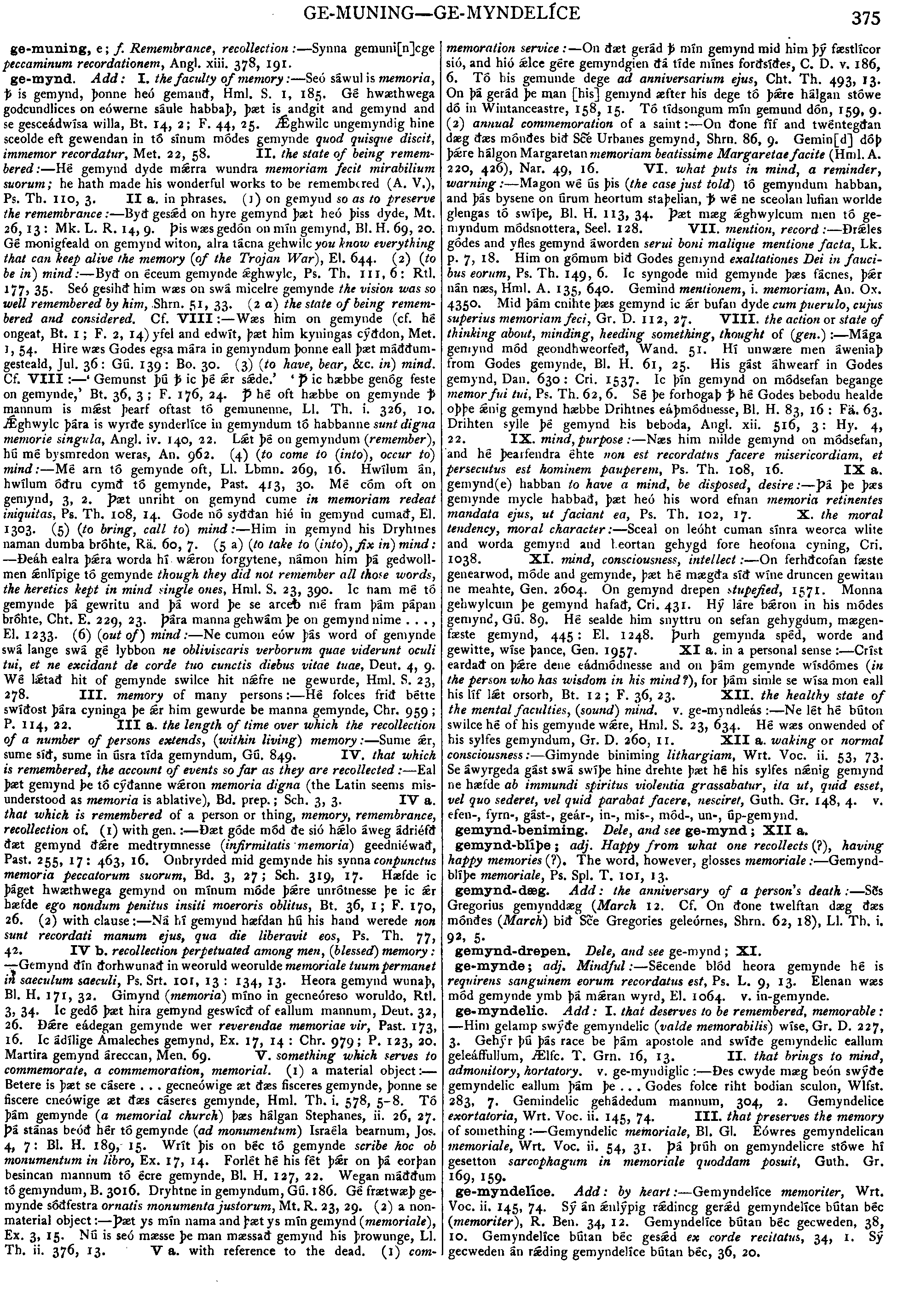
ge-mynd.
Add:
I.
the
faculty
of
memory
:--
Seó
sáwul
is
memoria,
is
gernynd,
þonne
heó
gemanð,
Hml.
S.
I.
185.
Gé
hwæthwega
godcundlices
on
eówerne
sáule
habbaþ,
þæt
is
andgit
and
gemynd
and
se
gesceádwísa
willa,
Bt.
14,
2;
F.
44,
25.
Æ-acute;ghwilc
ungemyndig
hine
sceolde
eft
gewendan
in
tó
sínum
módes
gemynde
quod
quisque
discit,
immemor
recordatur.
Met.
22,
58.
II,
the
state
of
being
remembered
:--
Hé
gemynd
dyde
mrra
wundra
memoriam
fecit
mirabilium
suorum;
he
hath
made
his
wonderful
works
to
be
remembered
(A.
V.),
Ps.
Th.
110,
3.
II
a.
in
phrases.
(1)
on
gemynd
so
as
to
preserve
the
remembrance
:--
Byð
gesd
on
hyre
gemynd
þæt
heó
þiss
dyde,
Mt.
26,
13:
Mk.
L.
R.
14,
9.
Þis
wæs
gedón
on
mín
gemynd,
Bl.
H.
69,
20.
Gé
monigfeald
on
gemynd
witon,
alra
tácna
gehwilc
you
know
everything
that
can
keep
alive
the
memory
(of
the
Trojan
War),
El.
644.
(2)
(to
be
in)
mind
:--
Byð
on
éceum
gemynde
ghwylc,
Ps.
Th.
111,
6:
Rtl.
177,
35.
Seó
gesihð
him
wæs
on
swá
micelre
gemynde
the
vision
was
so
well
remembered
by
him,
Shrn.
51,
33.
(2
a)
the
state
of
being
remembered
and
considered.
Cf.
VIII
:--
Wæs
him
on
gemynde
(cf.
hé
ongeat,
Bt.
l;
F.
2,
14)
yfel
and
edwít,
þæt
him
kyningas
cýðdon,
Met.
l,
54.
Hire
wæs
Godes
egsa
mára
in
gemyndum
þonne
eall
þæt
máððum-gesteald,
Jul.
36:
Gú.
139:
Bo.
30.
(3)
(to
have,
bear,
&
c.
in)
mind.
Cf.
VIII
:--
'
Gemunst
þú
ic
þé
r
sde.
'
'
ic
hæbbe
genóg
feste
on
gemynde,
'
Bt.
36,
3
;
F.
176,
24.
hé
oft
hæbbe
on
gemynde
mannum
is
mst
þearf
oftast
tó
gemunenne,
Ll.
Th.
i.
326,
10.
Æghwylc
þára
is
wyrðe
synderlíce
in
gemyndum
tó
habbanne
sunt
digna
memorie
singula,
Angl.
iv.
140,
22.
Lt
þé
on
gemyndum
(remember),
hú
mé
bysmredon
weras,
An.
962.
(4)
(to
come
to
(into)
,
occur
to)
mind
:--
Mé
arn
tó
gemynde
oft,
Ll.
Lbmn.
269,
16.
Hwílum
án,
hwílum
óðru
cymð
tó
gemynde,
Past.
413,
30.
Mé
cóm
oft
on
gemynd,
3,
2.
Þæt
unriht
on
gemynd
cume
in
memoriam
redeat
iniquitas.
Ps.
Th.
108,
14.
Gode
nó
syððan
hié
in
gemynd
cumað,
El.
-303-
(5)
(to
bring,
call
to]
mind
:--
Him
in
gemynd
his
Dryhtnes
naman
dumba
bróhte,
Rä.
60,
7.
(5
a)
(to
take
to
(into]
,
fix
in)
mind
:--
Ðeáh
ealra
þra
worda
hí
wron
forgytene,
námon
him
þá
gedwoll-men
nlípige
tó
gemynde
though
they
did
not
remember
all
those
words,
the
heretics
kept
in
mind
single
ones,
Hml.
S.
23,
390.
Ic
nam
mé
tó
gemynde
þá
gewritu
and
þá
word
þe
se
arce mé
fram
þám
pápan
bróhte,
Cht.
E.
229,
23.
Þára
manna
gehwám
þe
on
gemynd
nime
.
.
.
,
El.
1233.
(6)
(out
of)
mind
:--
Ne
cumon
eów
þás
word
of
gemynde
swá
lange
swá
gé
lybbon
ne
obliviscaris
verborum
quae
viderunt
oculi
tui,
et
ne
excidant
de
corde
tuo
cunctis
diebus
vitae
tuae,
Deut.
4,
9.
Wé
ltað
hit
of
gemynde
swilce
hit
nfre
ne
gewurde,
Hml.
S.
23,
278.
III.
memory
of
many
persons
:--
Hé
folces
frið
bétte
swíðost
þára
cyninga
þe
r
him
gewurde
be
manna
gemynde,
Chr.
959
;
P.
114,
22.
III
a.
the
length
of
time
over
which
the
recollection
of
a
number
of
persons
extends,
(within
living)
memory
:--
Sume
r,
sume
síð,
sume
in
úsra
tída
gemyndum,
Gfl.
849.
IV.
that
which
is
remembered,
the
account
of
events
so
far
as
they
are
recollected
:--
Eal
þæt
gemynd
þe
tó
cýðanne
wron
memoria
digna
(the
Latin
seems
misunderstood
as
memoria
is
ablative),
Bd.
prep.
;
Sch.
3,
3.
IV
a.
that
which
is
remembered
of
a
person
or
thing,
memory,
remembrance,
recollection
of.
(1)
with
gen.
:--
Ðæt
góde
mód
ðe
sió
hlo
áweg
ádriéfð
ðæt
gemynd
ðre
medtrymnesse
(infirmitatis
memoria]
geedniéwað,
Past.
255,
17
:
463,
16.
Onbryrded
mid
gemynde
his
synna
conpunctus
memoria
peccatorum
suorum,
Bd.
3,
27;
Sch.
319,
17.
Hæfde
ic
þáget
hwæthwega
gemynd
on
mínum
móde
þre
unrótnesse
þe
ic
r
hæfde
ego
nondum
penitus
insiti
moeroris
oblitus,
Bt.
36,
l;
F.
170,
26.
(2)
with
clause
:--
Ná
hí
gemynd
hæfdan
hú
his
hand
werede
non
sunt
recordati
manum
ejus,
qua
die
liberavit
eos,
Ps.
Th.
77,
42.
IV
b.
recollection
perpetuated
among
men,
(blessed)
memory
:--
Gemynd
ðín
ðorhwunað
in
weoruld
weorulde
memoriale
tuum
permanet
in
saeculum
saeculi,
Ps.
Srt.
101,
13
:
134,
13.
Heora
gemynd
wunaþ,
Bl.
H.
171,
32.
Gimynd
(memoria)
míno
in
gecneóreso
woruldo.
Rtl.
3,
34.
Ic
gedó
þæt
hira
gemynd
geswícð
of
eallum
mannum,
Deut.
32,
26.
Ðre
eádegan
gemynde
wer
reverendae
memoriae
vir,
Past.
173,
16.
Ic
ádílige
Amaleches
gemynd,
Ex.
17,
14
:
Chr.
979;
P.
123,
20.
Martira
gemynd
áreccan,
Men.
69.
V.
something
which
serves
to
commemorate,
a
commemoration,
memorial,
(l)
a
material
object
:--
Betere
is
þæt
se
cásere
.
.
.
gecneówige
æt
ðæs
fisceres
gemynde,
þonne
se
fiscere
cneówige
æt
ðæs
cáseres
gemynde,
Hml.
Th.
i.
578,
5-8.
Tó
þám
gemynde
(a
memorial
church)
þæs
hálgan
Stephanes,
ii.
26,
27.
Þa
stánas
beóð
hér
tó
gemynde
(ad
monumentum]
Israéla
bearnum,
Jos.
4,
7:
Bl.
H.
189,
15.
Wrít
þis
on
béc
tó
gemynde
scribe
hoc
ob
monumentum
in
libro,
Ex.
17,
14.
Forlét
hé
his
fét
þr
on
þá
eorþan
besincan
mannum
tó
écre
gemynde.
Bl.
H.
127,
22.
Wegan
máððum
tó
gemyndum,
B.
3016.
Dryhtne
in
gemyndum,
Gú.
186.
Gé
frætwæþ
gemynde
sóðfestra
ornatis
monumenta
justorum,
Mt.
R.
23,
29.
(2)
a
non-material
object
:--
Þæt
ys
mín
nama
and
þæt
ys
mín
gemynd
(memoriale),
Ex-
3,
15.
Nú
is
seó
mæsse
þe
man
mæssað
gemynd
his
þrowunge,
Ll.
Th.
ii.
376,
13.
V
a.
with
reference
to
the
dead,
(1)
commemoration
service
:--
On
ðæt
gerád
mín
gemynd
mid
him
þý
fæstlícor
sió,
and
hió
lce
gére
gemyndgien
ðá
tíde
mínes
forðsíðes,
C.
D.
v.
186,
6.
Tó
his
gemunde
dege
ad
anniversarium
ejus,
Cht.
Th.
493,
13.
On
þá
gerád
þe
man
[his]
gemynd
æfter
his
dege
tó
þre
hálgan
stówe
dó
in
Wintanceastre,
158,
15.
Tó
tídsongum
mín
gemund
dón,
159,
9.
(2)
annual
commemoration
of
a
saint
:--
On
ðone
fíf
and
twéntegðan
dæg
ðæs
mónðes
bið
Sce
UNCERTAIN
Urbanes
gemynd,
Shrn.
86,
9.
Gemin[d]
dóþ
þre
hálgon
Margaretan
memoriam
beatissime
Margaretae
facile
(Hml.
A.
220,
426),
Nar.
49,
16.
VI.
what
puts
in
mind,
a
reminder,
warning
:--
Magon
wé
ús
þis
(the
case
just
told)
tó
gemyndum
habban,
and
þás
bysene
on
úrum
heortum
staþelian,
wé
ne
sceolan
lufian
worlde
glengas
tó
swíþe,
Bl.
H.
113,
34.
Þæt
mæg
ghwylcum
men
tÓ
gemyndum
módsnottera,
Seel.
128.
VII.
mention,
record
:--
Ðrles
gódes
and
yfles
gemynd
áworden
serui
boni
maliqne
mentione
facta,
Lk.
p.
7,
18.
Him
on
gómum
bið
Godes
gemynd
exaltationes
Dei
in
faucibus
eorum,
Ps.
Th.
149,
6.
Ic
syngode
mid
gemynde
þæs
fácnes,
þr
nán
næs,
Hml.
A.
135,
640.
Gemind
mentionem,
i.
memoriam,
An.
Ox.
4350.
Mid
þám
cnihte
þæs
gemynd
ic
r
bufan
dyde
cum
puerulo,
cujus
superius
memoriam
feci,
Gr.
D.
112,
27.
VIII.
the
action
or
state
of
thinking
about,
minding,
heeding
something,
thought
of
(gen.]
:--
Mága
gemynd
mód
geondhweorfeð,
Wand.
51.
Hí
unwære
men
áweniaþ
from
Godes
gemynde,
Bl.
H.
61,
25.
His
gást
áhwearf
in
Godes
gemynd,
Dan.
630
:
Cri.
1537.
Ic
þín
gemynd
on
módsefan
begange
memor
fui
tui,
Ps.
Th.
62,
6.
Sé
þe
forhogaþ
hé
Godes
bebodu
healde
oþþe
nig
gemynd
hæbbe
Drihtnes
eáþmódnesse,
Bl.
H.
83,
16
:
Fä.
63.
Drihten
sylle
þé
gemynd
his
beboda,
Angl.
xii.
516,
3:
Hy.
4,
22.
IX.
mind,
purpose
:--
Næs
him
milde
gemynd
on
módsefan,
and
hé
þearfendra
éhte
non
est
recordatus
facere
misericordiam,
et
persecutus
est
hominem
pauperem,
Ps.
Th.
108,
16.
IX
a.
gemynd(e)
habban
to
have
a
mind,
be
disposed,
desire
:--
Þá
þe
þæs
gemynde
mycle
habbað,
þæt
heó
his
word
efnan
memoria
retinentes
mandata
ejus,
ut
faciant
ea,
Ps.
Th.
102,
17.
X.
the
moral
tendency,
moral
character
:--
Sceal
on
leóht
cuman
sínra
weorca
wlite
and
worda
gemynd
and
heortan
gehygd
fore
heofona
cyning,
Cri.
1038.
XI.
mind,
consciousness,
intellect
:--
On
ferhðcofan
fæste
genearwod,
móde
and
gemynde,
þæt
hé
mægða
síð
wíne
druncen
gewitan
ne
meahte,
Gen.
2604.
On
gemynd
drepen
stupefied,
1571.
Monna
gehwylcum
þe
gemynd
hafað,
Cri.
431.
Hý
láre
bron
in
his
módes
gemynd
,
Gú.
89.
Hé
sealde
him
snyttru
on
sefan
gehygdum,
mægen-fæste
gemynd,
445:
El.
1248.
Þurh
gemynda
spéd,
worde
and
gewitte,
wÍse
þance,
Gen.
1957.
XI
a.
in
a
personal
sense
:--
Críst
eardað
on
þre
dene
eádmódnesse
and
on
þám
gemvnde
wísdómes
(in
the
person
who
has
wisdom
in
his
mind
?),
for
þám
simle
se
wísa
mon
eall
his
líf
lt
orsorh,
Bt.
12
;
F.
36,
23.
XII.
the
healthy
state
of
the
mental
faculties,
(sound)
mind,
v.
ge-myndleás
:--
Ne
lét
hé
búton
swilce
hé
of
his
gemynde
wre,
Hml.
S.
23,
634.
Hé
wæs
onwended
of
his
sylfes
gemyndum,
Gr.
D.
260,
II.
XII
a.
waking
or
normal
consciousness
:--
Gimynde
biniming
lithargiam,
Wrt.
Voc.
ii.
53,
73,
Se
áwyrgeda
gást
swá
swíþe
hine
drehte
þæt
hé
his
sylfes
nnig
gemynd
ne
hæfde
ab
immundi
spiritus
violentia
grassabatur,
ita
ut,
quid
esset,
vel
quo
sederet,
vel
quid
parabat
facere,
nesciret,
Guth.
Gr.
148,
4.
v.
efen-,
fyrn-,
gást-,
geár-,
in-,
mis-,
mód-,
un-,
úp-gemynd.
mé
fram
þám
pápan
bróhte,
Cht.
E.
229,
23.
Þára
manna
gehwám
þe
on
gemynd
nime
.
.
.
,
El.
1233.
(6)
(out
of)
mind
:--
Ne
cumon
eów
þás
word
of
gemynde
swá
lange
swá
gé
lybbon
ne
obliviscaris
verborum
quae
viderunt
oculi
tui,
et
ne
excidant
de
corde
tuo
cunctis
diebus
vitae
tuae,
Deut.
4,
9.
Wé
ltað
hit
of
gemynde
swilce
hit
nfre
ne
gewurde,
Hml.
S.
23,
278.
III.
memory
of
many
persons
:--
Hé
folces
frið
bétte
swíðost
þára
cyninga
þe
r
him
gewurde
be
manna
gemynde,
Chr.
959
;
P.
114,
22.
III
a.
the
length
of
time
over
which
the
recollection
of
a
number
of
persons
extends,
(within
living)
memory
:--
Sume
r,
sume
síð,
sume
in
úsra
tída
gemyndum,
Gfl.
849.
IV.
that
which
is
remembered,
the
account
of
events
so
far
as
they
are
recollected
:--
Eal
þæt
gemynd
þe
tó
cýðanne
wron
memoria
digna
(the
Latin
seems
misunderstood
as
memoria
is
ablative),
Bd.
prep.
;
Sch.
3,
3.
IV
a.
that
which
is
remembered
of
a
person
or
thing,
memory,
remembrance,
recollection
of.
(1)
with
gen.
:--
Ðæt
góde
mód
ðe
sió
hlo
áweg
ádriéfð
ðæt
gemynd
ðre
medtrymnesse
(infirmitatis
memoria]
geedniéwað,
Past.
255,
17
:
463,
16.
Onbryrded
mid
gemynde
his
synna
conpunctus
memoria
peccatorum
suorum,
Bd.
3,
27;
Sch.
319,
17.
Hæfde
ic
þáget
hwæthwega
gemynd
on
mínum
móde
þre
unrótnesse
þe
ic
r
hæfde
ego
nondum
penitus
insiti
moeroris
oblitus,
Bt.
36,
l;
F.
170,
26.
(2)
with
clause
:--
Ná
hí
gemynd
hæfdan
hú
his
hand
werede
non
sunt
recordati
manum
ejus,
qua
die
liberavit
eos,
Ps.
Th.
77,
42.
IV
b.
recollection
perpetuated
among
men,
(blessed)
memory
:--
Gemynd
ðín
ðorhwunað
in
weoruld
weorulde
memoriale
tuum
permanet
in
saeculum
saeculi,
Ps.
Srt.
101,
13
:
134,
13.
Heora
gemynd
wunaþ,
Bl.
H.
171,
32.
Gimynd
(memoria)
míno
in
gecneóreso
woruldo.
Rtl.
3,
34.
Ic
gedó
þæt
hira
gemynd
geswícð
of
eallum
mannum,
Deut.
32,
26.
Ðre
eádegan
gemynde
wer
reverendae
memoriae
vir,
Past.
173,
16.
Ic
ádílige
Amaleches
gemynd,
Ex.
17,
14
:
Chr.
979;
P.
123,
20.
Martira
gemynd
áreccan,
Men.
69.
V.
something
which
serves
to
commemorate,
a
commemoration,
memorial,
(l)
a
material
object
:--
Betere
is
þæt
se
cásere
.
.
.
gecneówige
æt
ðæs
fisceres
gemynde,
þonne
se
fiscere
cneówige
æt
ðæs
cáseres
gemynde,
Hml.
Th.
i.
578,
5-8.
Tó
þám
gemynde
(a
memorial
church)
þæs
hálgan
Stephanes,
ii.
26,
27.
Þa
stánas
beóð
hér
tó
gemynde
(ad
monumentum]
Israéla
bearnum,
Jos.
4,
7:
Bl.
H.
189,
15.
Wrít
þis
on
béc
tó
gemynde
scribe
hoc
ob
monumentum
in
libro,
Ex.
17,
14.
Forlét
hé
his
fét
þr
on
þá
eorþan
besincan
mannum
tó
écre
gemynde.
Bl.
H.
127,
22.
Wegan
máððum
tó
gemyndum,
B.
3016.
Dryhtne
in
gemyndum,
Gú.
186.
Gé
frætwæþ
gemynde
sóðfestra
ornatis
monumenta
justorum,
Mt.
R.
23,
29.
(2)
a
non-material
object
:--
Þæt
ys
mín
nama
and
þæt
ys
mín
gemynd
(memoriale),
Ex-
3,
15.
Nú
is
seó
mæsse
þe
man
mæssað
gemynd
his
þrowunge,
Ll.
Th.
ii.
376,
13.
V
a.
with
reference
to
the
dead,
(1)
commemoration
service
:--
On
ðæt
gerád
mín
gemynd
mid
him
þý
fæstlícor
sió,
and
hió
lce
gére
gemyndgien
ðá
tíde
mínes
forðsíðes,
C.
D.
v.
186,
6.
Tó
his
gemunde
dege
ad
anniversarium
ejus,
Cht.
Th.
493,
13.
On
þá
gerád
þe
man
[his]
gemynd
æfter
his
dege
tó
þre
hálgan
stówe
dó
in
Wintanceastre,
158,
15.
Tó
tídsongum
mín
gemund
dón,
159,
9.
(2)
annual
commemoration
of
a
saint
:--
On
ðone
fíf
and
twéntegðan
dæg
ðæs
mónðes
bið
Sce
UNCERTAIN
Urbanes
gemynd,
Shrn.
86,
9.
Gemin[d]
dóþ
þre
hálgon
Margaretan
memoriam
beatissime
Margaretae
facile
(Hml.
A.
220,
426),
Nar.
49,
16.
VI.
what
puts
in
mind,
a
reminder,
warning
:--
Magon
wé
ús
þis
(the
case
just
told)
tó
gemyndum
habban,
and
þás
bysene
on
úrum
heortum
staþelian,
wé
ne
sceolan
lufian
worlde
glengas
tó
swíþe,
Bl.
H.
113,
34.
Þæt
mæg
ghwylcum
men
tÓ
gemyndum
módsnottera,
Seel.
128.
VII.
mention,
record
:--
Ðrles
gódes
and
yfles
gemynd
áworden
serui
boni
maliqne
mentione
facta,
Lk.
p.
7,
18.
Him
on
gómum
bið
Godes
gemynd
exaltationes
Dei
in
faucibus
eorum,
Ps.
Th.
149,
6.
Ic
syngode
mid
gemynde
þæs
fácnes,
þr
nán
næs,
Hml.
A.
135,
640.
Gemind
mentionem,
i.
memoriam,
An.
Ox.
4350.
Mid
þám
cnihte
þæs
gemynd
ic
r
bufan
dyde
cum
puerulo,
cujus
superius
memoriam
feci,
Gr.
D.
112,
27.
VIII.
the
action
or
state
of
thinking
about,
minding,
heeding
something,
thought
of
(gen.]
:--
Mága
gemynd
mód
geondhweorfeð,
Wand.
51.
Hí
unwære
men
áweniaþ
from
Godes
gemynde,
Bl.
H.
61,
25.
His
gást
áhwearf
in
Godes
gemynd,
Dan.
630
:
Cri.
1537.
Ic
þín
gemynd
on
módsefan
begange
memor
fui
tui,
Ps.
Th.
62,
6.
Sé
þe
forhogaþ
hé
Godes
bebodu
healde
oþþe
nig
gemynd
hæbbe
Drihtnes
eáþmódnesse,
Bl.
H.
83,
16
:
Fä.
63.
Drihten
sylle
þé
gemynd
his
beboda,
Angl.
xii.
516,
3:
Hy.
4,
22.
IX.
mind,
purpose
:--
Næs
him
milde
gemynd
on
módsefan,
and
hé
þearfendra
éhte
non
est
recordatus
facere
misericordiam,
et
persecutus
est
hominem
pauperem,
Ps.
Th.
108,
16.
IX
a.
gemynd(e)
habban
to
have
a
mind,
be
disposed,
desire
:--
Þá
þe
þæs
gemynde
mycle
habbað,
þæt
heó
his
word
efnan
memoria
retinentes
mandata
ejus,
ut
faciant
ea,
Ps.
Th.
102,
17.
X.
the
moral
tendency,
moral
character
:--
Sceal
on
leóht
cuman
sínra
weorca
wlite
and
worda
gemynd
and
heortan
gehygd
fore
heofona
cyning,
Cri.
1038.
XI.
mind,
consciousness,
intellect
:--
On
ferhðcofan
fæste
genearwod,
móde
and
gemynde,
þæt
hé
mægða
síð
wíne
druncen
gewitan
ne
meahte,
Gen.
2604.
On
gemynd
drepen
stupefied,
1571.
Monna
gehwylcum
þe
gemynd
hafað,
Cri.
431.
Hý
láre
bron
in
his
módes
gemynd
,
Gú.
89.
Hé
sealde
him
snyttru
on
sefan
gehygdum,
mægen-fæste
gemynd,
445:
El.
1248.
Þurh
gemynda
spéd,
worde
and
gewitte,
wÍse
þance,
Gen.
1957.
XI
a.
in
a
personal
sense
:--
Críst
eardað
on
þre
dene
eádmódnesse
and
on
þám
gemvnde
wísdómes
(in
the
person
who
has
wisdom
in
his
mind
?),
for
þám
simle
se
wísa
mon
eall
his
líf
lt
orsorh,
Bt.
12
;
F.
36,
23.
XII.
the
healthy
state
of
the
mental
faculties,
(sound)
mind,
v.
ge-myndleás
:--
Ne
lét
hé
búton
swilce
hé
of
his
gemynde
wre,
Hml.
S.
23,
634.
Hé
wæs
onwended
of
his
sylfes
gemyndum,
Gr.
D.
260,
II.
XII
a.
waking
or
normal
consciousness
:--
Gimynde
biniming
lithargiam,
Wrt.
Voc.
ii.
53,
73,
Se
áwyrgeda
gást
swá
swíþe
hine
drehte
þæt
hé
his
sylfes
nnig
gemynd
ne
hæfde
ab
immundi
spiritus
violentia
grassabatur,
ita
ut,
quid
esset,
vel
quo
sederet,
vel
quid
parabat
facere,
nesciret,
Guth.
Gr.
148,
4.
v.
efen-,
fyrn-,
gást-,
geár-,
in-,
mis-,
mód-,
un-,
úp-gemynd.
|
Source: Bosworth/Toller, page d0406, entry 3 View original page image as: [TIFF] [PNG] [View previous entry] [View next entry] |
[Comment on this entry] [View comments] |
The following entry has been hand-corrected once. |
ge-secgan.
Take
here
forms
under
ge-sagian,
and
add:
I.
with
acc.
(l)
where
the
object
denotes
a
collection
of
words,
to
say
words,
tell
a
tale,
give
a
list,
account,
&c.
:--
Herenisse
hiora
gisæcge
ðió
cirica
laudem
eorum
pronunciet
ecclesia,
Rtl.
61,
26.
Gesd
prolatum
(quod
cum
calumniae
gannitura
prolatum],
An.
Ox.
4505.
Ondetnis
lofes
hlendes
gesægd
is
(v.
Mt.
II,
25)
confessio
laudis
Iesu
refertur.
Mt.
p.
16,
ll.
Gesægd
is
foresægdnisse
explicit
praefatio,
12,
6.
Cynnresuu
feórtig
tuá
endebrednise
gesaegd
is
(v.
Mt.
l,
1-17)
generationum
quadraginta
duarum
ordo
narratur,
13,
15.
Gesaegd
aron
heáfudwearda
ðára
réda
exbliciunt
cabitula
lectionum,
20,
9.
(2)
where
the
object
denotes
what
is
spoken
about,
(a)
to
give
an
account
of,
speak
of,
tell,
narrate
:--
Ic
nú
his
dda
gesugian
scyle,
oþ
ic
Rómána
gesecge,
Ors.
3,
17;
S.
120,
18.
Ðá
ðing
ðá
gehérde
æfter
lufu
wundara
gesaegde
ea
quae
audierat
juxta
fidem
gestorum
narravit,
Mt.
p.
8,
12.
.
Nnigum
menn
ðú
gecuoeðe
ðis
gesæge
(dixeris),
Mk.
L.
8,
26.
Sanctus
Ióhannes
lífes
weorþunga
gesecgan,
Bl.
H.
163,
36.
Úneáðe
mæg
mon
tó
geleáfsuman
gesecgan
swá
monigfeald
yfel
in
tanta
malorum
multitudine
difficillima
dictis
fides.
Ors.
3,
9
;
S.
128,
20.
Þ
UNCERTAIN
mste
wæl
on
hðene
here
þe
wé
fre
gesecgan
hérdon,
Chr.
851;
P.
65,
16.
Nnig
mennisc
tunge
ne
geneah
þæs
engles
mægen
tó
gesecgenne,
Bl.
H.
165,
6.
Tó
gesecganne,
Angl.
ix.
265,
4.
Bið
gesægd
ti
ðiós
dyde,
Mt.
L.
26,
13.
Hwí
wæs
þra
engla
synne
forsuwod
on
þre
béc
Genesis,
and
þæs
mannes
wæs
gesd
(patefactum)
?,
Angl.
vii.
4,
27.
(b)
to
give
notice
of,
make
known,
announce
:--
Hé
gesægeð
(cýð,
W.
S.)
alle
adnuntiabit
omnia,
Jn.
L.
R.
4,
25
:
Jn.
L.
16,
14.
Ðá
ðe
tówearde
aron
hé
gesæges
iúh,
16,
13.
Ðá
hiorda
gesæigdon
(nuntiaverunt)
alle,
Mt.
L.
8,
33.
Gisægi
(annuncia)
folce
mínum
héhsynna
hiara,
Rtl.
5,
16.
Hé
hine
monnum
gecýþan
and
gesecgan
teolode,
Bl.
H.
165,
31.
Ðá
hérde
Ægelríc
þet
gesecgon.
Chr.
1070;
P.
207,
26.
(c)
to
speak
of,
expound,
discuss
:--
Bisen
gesægde
getrahtade
parabolam
exponit,
Mt.
p.
17,
3.
Syndriga
stówa
gewutta
ðú
mæht
and
mid
sóððe
gesæcca
propria
loca
scire
possis
ac
vere
disserere,
ii.
2.
Ic
gehére
hwæt
þú
woldest
witan,
ac
ic
hyt
ne
mæg
myd
feáwum
wordum
gesecgan.
Solil.
H.
64,
23.
(3)
the
subject
a
pronoun
referring
to
a
clause
:--
Þæt
is
gesægd,
hé
wre
gewis
his
sylfes
forðfóre,
Bd.
4,
24;
Sch.
491,
19.
(4)
where
the
verb
is
of
incomplete
predication
:--
Hé
þone
Hlend
on
þysne
middangeard
cumendne
gesecgean
wolde,
Bl.
H.
165,
35.
Wéron
gesægd
sum
óðero
ofslægeno
nuntiatis
quibusdam
occisis,
Lk.
p.
8,
I.
II.
where
the
object
is
a
clause,
to
say,
tell,
declare
:--
Stefn
þte
hé
wére
clioppendes
in
uoestern
gesaegeð
vocem
esse
clamantis
in
deserto
enuntiat,
Jn.
p.
3,
6.
Gesege
hwæþer
þé
betere
þince,
hwæþer
þe
.
.
.
,
þe
.
.
.
,
Bt.
8
;
F.
26,
10.
Gesecge
hé
his
móde,
hit
mæg
findan
.
.
.
,
35,
I;
F.
154,
23.
Ic
ðé
mæg
mid
feáum
wordum
gesecgan
hú
manegra
yfela
ðá
welan
sint
gefylde,
32,
l
;
F.
114,
6.
Mé
ðincð
þæt
þú
hæbbe
genóh
sweotole
gesd,
þæt
lces
mannes
sáwl
nú
sí
and
á
beó,
Solil.
H.
63,
29.
Him
wæs
gesd,
Willelm
eorll
wolde
hider
cuman,
Chr.
1066
;
P.
196,
4.
II
a.
in
the
passive
with
an
infinitive
complementary
to
the
subject
:--
Hé
is
gesd
memoratur
(hoc
fecisse),
An.
Ox.
3873:
1514
Heó
wæs
gesd
narretur
(superstitionis
coniemptrix
extitisse),
4432.
Gesde
memorantur,
i.
dicuntur,
1610.
III.
used
absolutely
:--
Lóca
ðú
nigum
menn
gesæcga
vide
nemini
dixeris,
Mt.
L.
8,
4.
Bebeád
þte
ne
nigum
men
hiá
ne
gesægde,
Mk.
L.
R.
7,
36.
Miððý
uæs
ongeten
geháten
is
ðegnum
gesaeccanne
qua
cognito
iubetur
discipulis
nuntiare,
Jn.
p.
8,
4.
III
a.
with
prep.
to
speak,
tell
about
:--
Hió
ne
cúðon
gesecggan
be
þám
sigebeácne,
El.
165.
Scortlíce
ic
hæbbe
nú
gesd
ymb
þá
þrié
dlas
þises
middangeardes
breviter
tripartiti
orbis
divisiones
dedi,
Ors.
l,
l
;
S.
10,
3.
Hwæðer
ðé
nú
sí
genóh
sweotole
geséd
be
þám
wísdóme,
Solil.
H.
66,
2.
[O.
Sax.
gi-seggian
:
O.H.Ger.
ge-sagén,
-segen
dicere,
de-,
pro-,
re-ferre,
exponere,
digerere,
memorare.]
v.
fore-gesægd.
| Result Page: |  |
Previous | 1 2 3 4 5 6 7 8 9 10 11 12 | Next |  |
Germanic Lexicon Project (main page)
This search system was written by
Sean Crist
Please consider
volunteering
to correct the data in these online dictionaries.
No rights reserved. Feel free to use these data in any way you please.