|
|

|
Source: Bosworth/Toller, page b0954, entry 12 View original page image as: [TIFF] [PNG] [View previous entry] [View next entry] |
[Comment on this entry] [View comments (1)] |
The following entry has been hand-corrected once. |
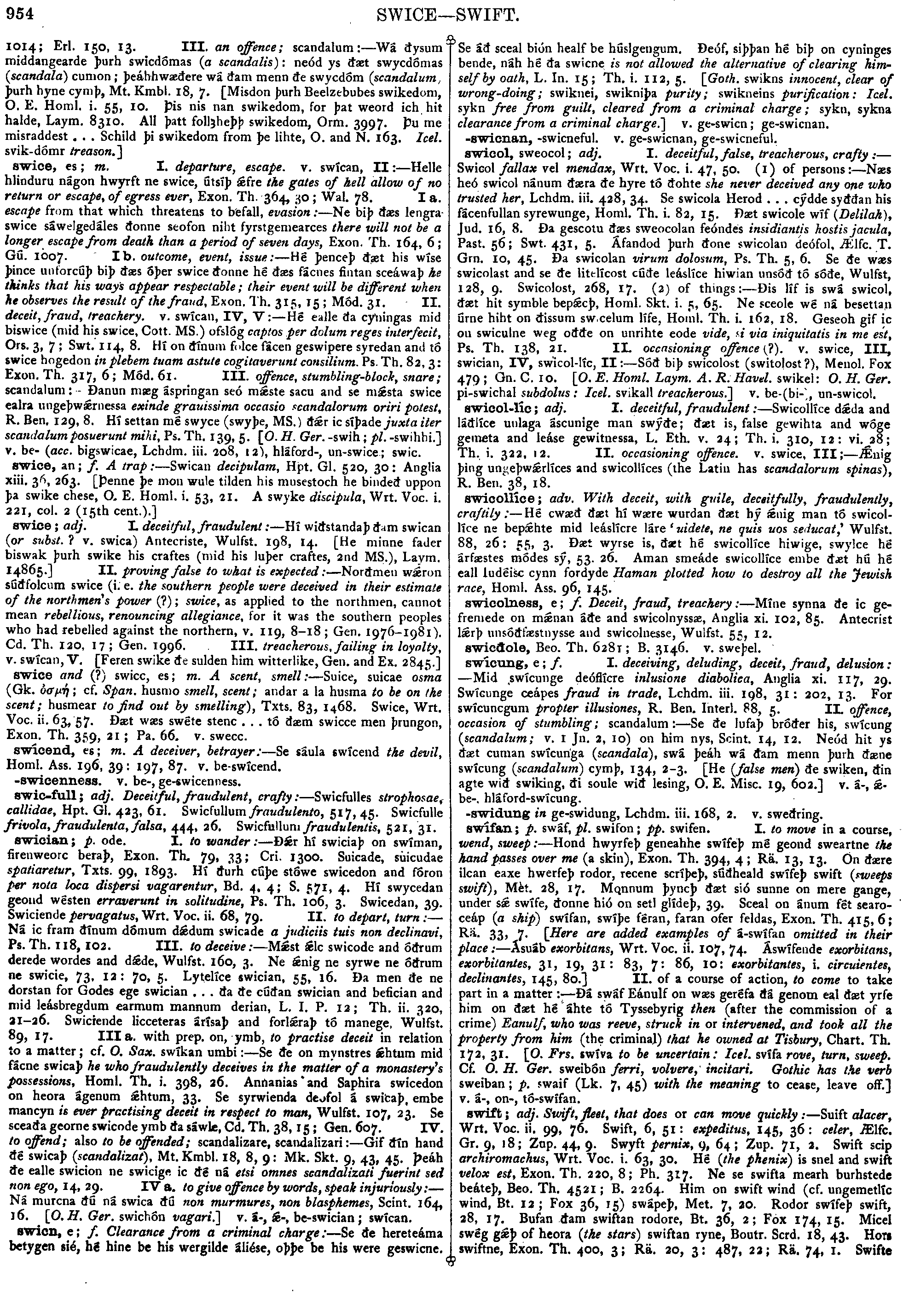
swicol,
sweocol;
ad;
.
I.
deceitful,
false,
treacherous,
crafty
:--
Swicol
fallax
vel
mendax,
Wrt.
Voc.
i.
47,
50.
(I)
of
persons
:--
Næs
heó
swicol
nánum
ðæra
ðe
hyre
tó
ðohte
she
never
deceived
any
one
who
trusted
her,
Lchdm.
iii.
428,
34.
Se
swicola
Herod
.
.
.
cýdde
syððan
his
fácenfullan
syrewunge,
Homl.
Th.
i.
82,
15.
Ðæt
swicole
wíf
(Delilah),
Jud.
16,
8.
Ða
gescotu
ðæs
sweocolan
feóndés
insidiantis
hostis
jacula,
Past.
56;
Swt.
431,
5.
Áfandod
þurh
ðone
swicolan
deofol,
Ælfc.
T.
Grn.
10,
45.
Ða
swicolan
virum
dolosum,
Ps.
Th.
5,
6.
Se
ðe
wæs
swicolast
and
se
ðe
litelícost
cúðe
leáslíce
hiwian
unsóð
tó
sóðe.
Wulfst.
128,
9.
Swicolost,
268,
17.
(2)
of
things
:--
Ðis
líf
is
swá
swicol,
ðæt
hit
symble
bep cþ,
Homl.
Skt.
i.
5,
65.
Ne
sceole
wé
ná
besettan
úrne
hiht
on
ðissum
swicelum
lífe,
Homl.
Th.
i.
162,
18.
Geseoh
gif
ic
on
swiculne
weg
oððe
on
unrihte
eode
vide,
si
via
iniquitatis
in
me
est,
Ps.
Th.
138,
21.
II
occasioning
offence
(f),
v.
swice,
III.
swician,
IV,
swicol-líc,
II
:--
Sóð
biþ
swicolost
(switolost?),
Menol.
Fox
479;
Gn.
C.
10.
[O.
E.
Homl.
Laym.
A.
R.
Havel.
swikel:
O.
H.
Ger.
pi-swichal
subdolus;
Icel.
svikall
treacherous.]
v.
be-(bi-,
,
un-swicol.
cþ,
Homl.
Skt.
i.
5,
65.
Ne
sceole
wé
ná
besettan
úrne
hiht
on
ðissum
swicelum
lífe,
Homl.
Th.
i.
162,
18.
Geseoh
gif
ic
on
swiculne
weg
oððe
on
unrihte
eode
vide,
si
via
iniquitatis
in
me
est,
Ps.
Th.
138,
21.
II
occasioning
offence
(f),
v.
swice,
III.
swician,
IV,
swicol-líc,
II
:--
Sóð
biþ
swicolost
(switolost?),
Menol.
Fox
479;
Gn.
C.
10.
[O.
E.
Homl.
Laym.
A.
R.
Havel.
swikel:
O.
H.
Ger.
pi-swichal
subdolus;
Icel.
svikall
treacherous.]
v.
be-(bi-,
,
un-swicol.
|
Source: Bosworth/Toller, page b1114, entry 24 View original page image as: [TIFF] [PNG] [View previous entry] [View next entry] |
[Comment on this entry] [View comments] |
The following entry has been hand-corrected once. |
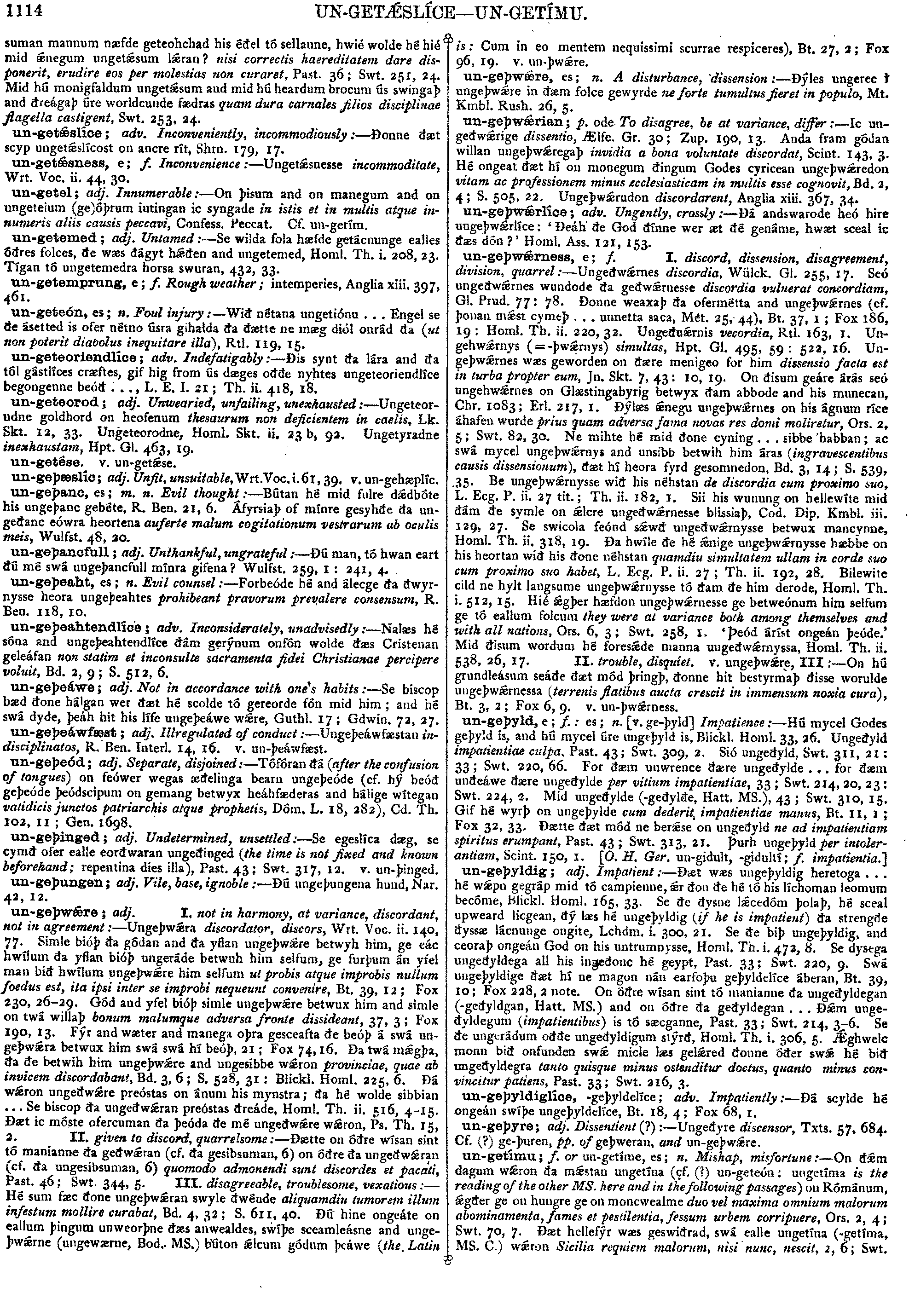
un-geþwrness,
e;
f.
I.
discord,
dissension,
disagreement,
division,
quarrel
:--
Ungeðwrnes
discordia,
Wülck.
Gl.
255,
17.
Seó
ungeðwrnes
wundode
ða
geðwrnesse
discordia
vuluerat
concordiam,
Gl.
Prud.
77:
78.
Ðonne
weaxaþ
ða
ofermétta
and
ungeþwrnes
(cf.
þonan
mst
cymeþ
...
unnetta
saca,
Met.
25,
44),
Bt.
37,
1;
Fox
186,
19:
Homl.
Th.
ii.
220,
32.
Ungeðurnis
vecordia,
Rtl.
163,
1.
Ungehwrnys
(
=
-þwrnys)
simultas,
Hpt.
Gl.
495,
59:
522,
16.
Ungeþwrnes
wæs
geworden
on
ðære
menigeo
for
him
dissensio
facta
est
in
turbo
propter
eum,
Jn.
Skt.
7,
43:
10,
19.
On
ðisum
geáre
árás
seó
ungehwrnes
on
Glæstingabyrig
betwyx
ðam
abbode
and
his
munecan,
Chr.
1083;
Erl.
217,
1.
Ðýlæs
negu
ungeþwrnes
on
his
ágnum
ríce
áhafen
wurde
prius
quam
adversa
fama
novas
res
domi
moliretur,
Ors.
2,
5;
Swt.
82,
30.
Ne
mihte
hé
mid
ðone
cyning
...
sibbe
habban;
ac
swá
mycel
ungeþwrnys
and
unsibb
betwih
him
áras
(ingravescentibus
causis
dissensionum),
ðæt
hí
heora
fyrd
gesomnedon,
Bd.
3,
14;
S.
539,
35.
Be
ungeþwrnysse
wið
his
néhstan
de
discordia
cum
proximo
suo,
L.
Ecg.
P.
ii.
27
tit.;
Th.
ii.
182,
1.
Sii
his
wunung
on
hellewíte
mid
ðám
ðe
symle
on
lcre
ungeðwrnesse
blissiaþ,
Cod.
Dip.
Kmbl.
iii.
129,
27.
Se
swicola
feónd
swð
ungeðwrnysse
betwux
mancynne,
Homl.
Th.
ii.
328,
19.
Ða
hwíle
ðe
hé
nige
ungeþwrnysse
hæbbe
on
his
heortan
wið
his
ðone
néhstan
quamdiu
simultatem
ullam
in
corde
suo
cum
proximo
suo
habet,
L.
Ecg.
P.
ii.
27;
Th.
ii.
192,
28.
Bilewite
cild
ne
hylt
langsume
ungeþwrnysse
tó
ðam
ðe
him
derode,
Homl.
Th.
i.
522,
15.
Hié
gþer
hæfdon
ungeþwrnesse
ge
betweónum
him
selfum
ge
tó
eallum
folcum
they
were
at
variance
both
among
themselves
and
with
all
nations,
Ors.
6,
3;
Swt.
258,
1.
'Þeód
áríst
ongeán
þeóde:'
Mid
ðisum
wordum
hé
foresde
manna
ungeðwrnyssa,
Homl.
Th.
ii.
538,
26,
17.
II.
trouble,
disquiet.
v.
ungeþwre,
III
:--
On
hú
grundleásum
seáðe
ðæt
mód
þringþ,
ðonne
hit
bestyrmaþ
ðisse
worulde
ungeþwrnessa
(terrenis
flatibus
aucta
crescit
in
immensum
noxia
cura),
Bt.
3,
2;
Fox
6,
9.
v.
un-þwrness.
|
Source: Bosworth/Toller, page b1158, entry 4 View original page image as: [TIFF] [PNG] [View previous entry] [View next entry] |
[Comment on this entry] [View comments] |
The following entry has been hand-corrected once. |
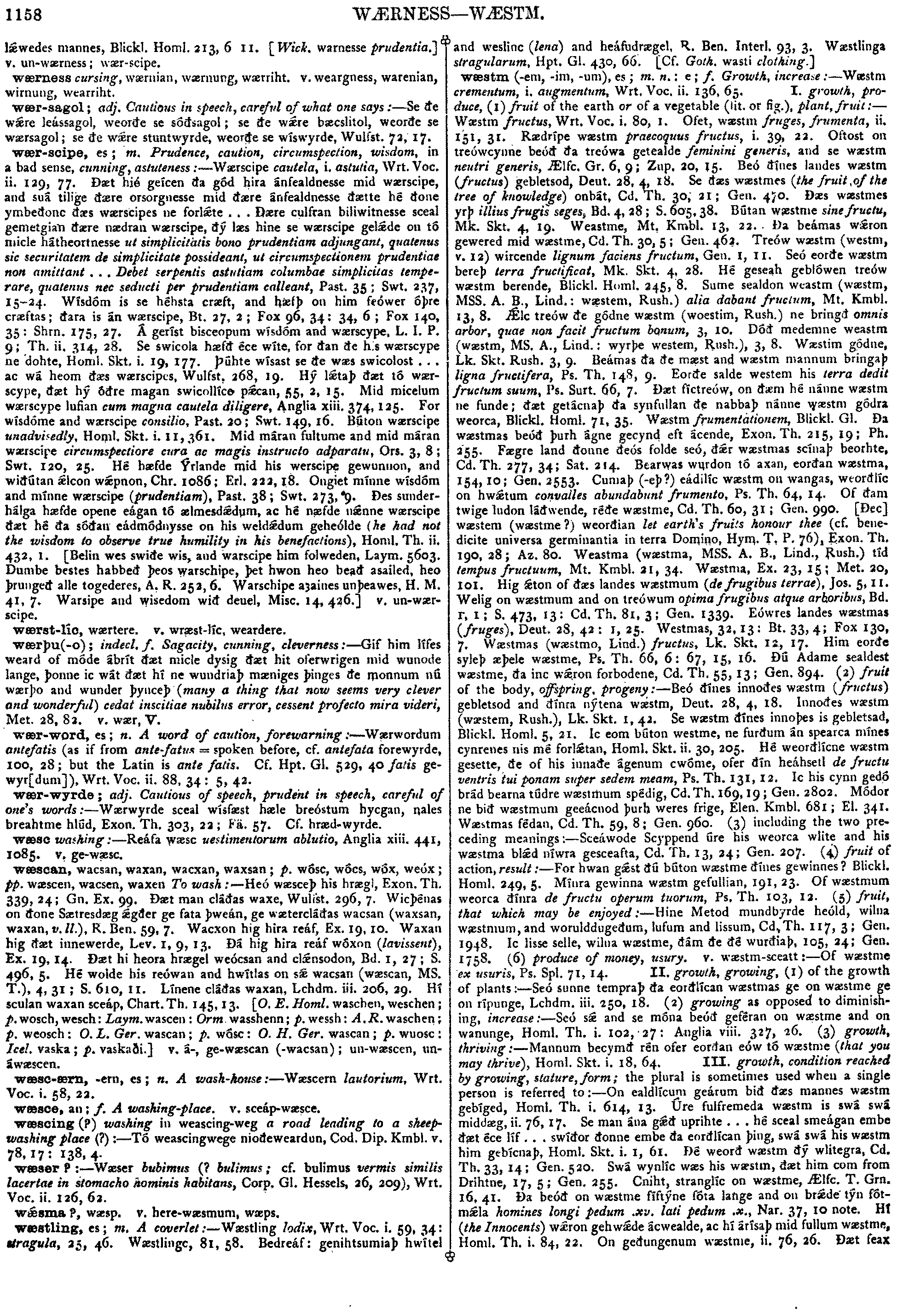
wær-scipe,
es;
m.
Prudence,
caution,
circumspection,
wisdom,
in
a
bad
sense,
cunning,
astuteness:--Wærscipe
cautela,
i.
astutia,
Wrt.
Voc.
ii.
129,
77.
Ðæt
hié
geícen
ða
gód
hira
ánfealdnesse
mid
wærscipe,
and
suá
tilige
ðære
orsorgnesse
mid
ðære
ánfealdnesse
ðætte
hé
ðone
ymbeðonc
ðæs
wærscipes
ne
forlte
.
.
.
Ðære
culfran
biliwitnesse
sceal
gemetgian
ðære
nædran
wærscipe,
ðý
læs
hine
se
wærscipe
gelde
on
tó
micle
hátheortnesse
ut
simplicitatis
bono
prudentiam
adjungant,
quatenus
sic
securitatem
de
simplicitate
possideant,
ut
circumspectionem
prudentiae
non
amittant
.
.
.
Debet
serpentis
astutiam
columbae
simplicitas
temperare,
quatenus
nec
seducti
per
prudentiam
calleant,
Past.
35;
Swt.
237,
15-24.
Wísdóm
is
se
héhsta
cræft,
and
hæfþ
on
him
feówer
óþre
cræftas;
ðara
is
án
wærscipe,
Bt.
27,
2;
Fox
96,
34:
34,
6;
Fox
140,
35:
Shrn.
175,
27.
Á
geríst
bisceopum
wísdóm
and
wærscype,
L.
I.
P.
9;
Th.
ii.
314,
28.
Se
swicola
hæfð
éce
wíte,
for
ðan
ðe
his
wærscype
ne
dohte,
Homl.
Skt.
i.
19,
177.
Þúhte
wísast
se
ðe
wæs
swicolost
.
.
.
ac
wá
heom
ðæs
wærscipes,
Wulfst.
268,
19.
Hý
ltaþ
ðæt
tó
wærscype,
ðæt
hý
óðre
magan
swicollíce
pcan,
55,
2,
15.
Mid
micelum
wærscype
lufian
cum
magna
cautela
diligere,
Anglia
xiii.
374,
125.
For
wísdóme
and
wærscipe
consilio,
Past.
20;
Swt.
149,
16.
Búton
wærscipe
unadvisedly,
Homl.
Skt.
i.
11,
361.
Mid
máran
fultume
and
mid
máran
wærscipe
circumspectiore
cura
ac
magis
instructo
adparatu,
Ors.
3,
8;
Swt.
120,
25.
Hé
hæfde
Ýrlande
mid
his
werscipe
gewunnon,
and
wiðútan
lcon
wpnon,
Chr.
1086;
Erl.
222,
18.
Ongiet
mínne
wísdóm
and
mínne
wærscipe
(prudentiam),
Past.
38;
Swt.
273,
9.
Ðes
sunder-hálga
hæfde
opene
eágan
tó
ælmesddum,
ac
hé
næfde
nnne
wærscipe
ðæt
hé
ða
sóðan
eádmódnysse
on
his
welddum
geheólde
(he
had
not
the
wisdom
to
observe
true
humility
in
his
benefactions),
Homl.
Th.
ii.
432,
1.
[Belin
wes
swiðe
wis,
and
warscipe
him
folweden,
Laym.
5603.
Dumbe
bestes
habbeð
þeos
warschipe,
þet
hwon
heo
beað
asailed,
heo
þrungeð
alle
togederes,
A.
R.
252,
6.
Warschipe
a aines
unþeawes,
H.
M.
41,
7.
Warsipe
and
wisedom
wið
deuel,
Misc.
14,
426.]
v.
un-wær
aines
unþeawes,
H.
M.
41,
7.
Warsipe
and
wisedom
wið
deuel,
Misc.
14,
426.]
v.
un-wær scipe.
|
Source: Bosworth/Toller, page d0069, entry 26 View original page image as: [TIFF] [PNG] [View previous entry] [View next entry] |
[Comment on this entry] [View comments] |
The following entry has been hand-corrected once. |
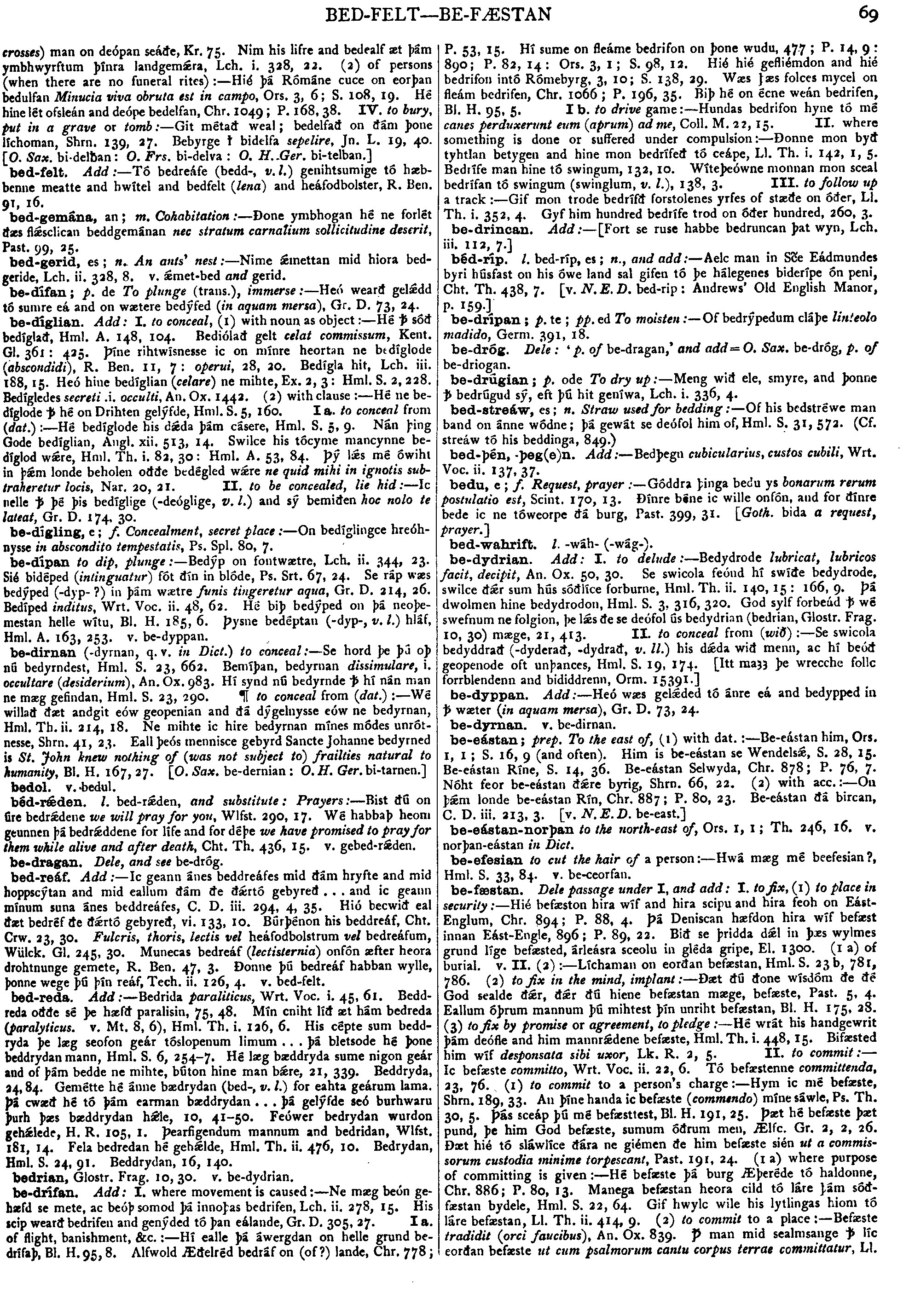
be-dydrian.
Add:
I.
to
delude:--Bedydrode
lubricat,
lubricos
facit,
decipit,
An.
Ox.
50,
30.
Se
swicola
feónd
hí
swíðe
bedydrode,
swilce
ðr
sum
hús
sóðlíce
forburne,
Hml.
Th.
ii.
140,
15:
166,
9.
Þá
dwolmen
hine
bedydrodon,
Hml.
S.
3,
316,
320.
God
sylf
forbeád
 wé
swefnum
ne
folgion,
þe
ls
ðe
se
deófol
ús
bedydrian
(bedrian,
Glostr.
Frag.
10,
30)
mæge,
21,
413.
II.
to
conceal
from
(wið):--Se
swicola
bedyddrað
(-dyderað,
-dydrað,
v.
ll.)
his
dda
wið
menn,
ac
hí
beóð
geopenode
oft
unþances,
Hml.
S.
19,
174.
[Itt
ma
þe
wrecche
follc
forrblendenn
and
bididdrenn,
Orm.
15391.]
wé
swefnum
ne
folgion,
þe
ls
ðe
se
deófol
ús
bedydrian
(bedrian,
Glostr.
Frag.
10,
30)
mæge,
21,
413.
II.
to
conceal
from
(wið):--Se
swicola
bedyddrað
(-dyderað,
-dydrað,
v.
ll.)
his
dda
wið
menn,
ac
hí
beóð
geopenode
oft
unþances,
Hml.
S.
19,
174.
[Itt
ma
þe
wrecche
follc
forrblendenn
and
bididdrenn,
Orm.
15391.]
|
Source: Bosworth/Toller, page d0697, entry 22 View original page image as: [TIFF] [PNG] [View previous entry] [View next entry] |
[Comment on this entry] [View comments] |
The following entry has been hand-corrected once. |
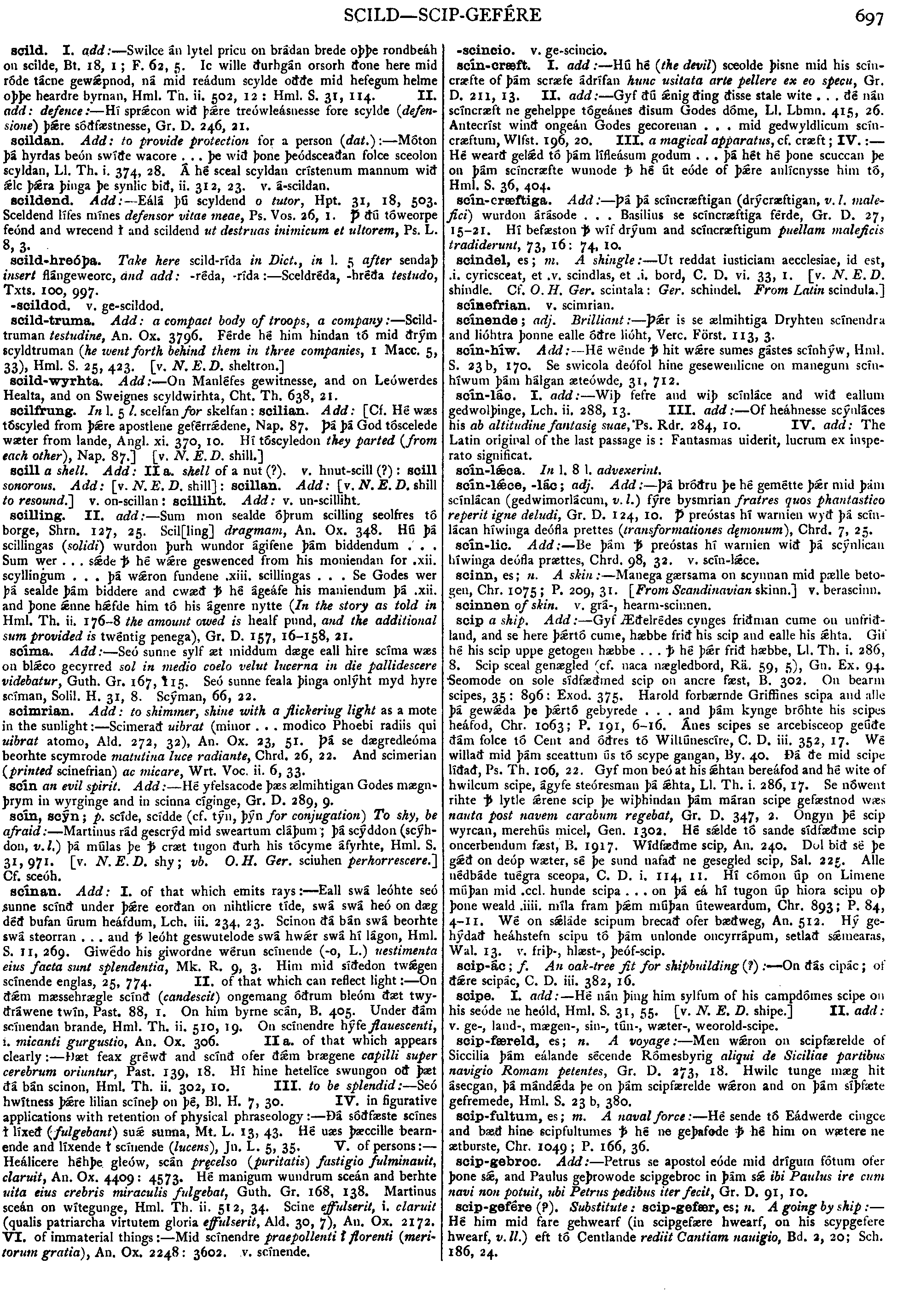
scín-híw.
Add
:--
Hé
wénde
hit
wre
sumes
gástes
scínhýw,
Hml.
S.
23
b,
170.
Se
swicola
deófol
hine
gesewenlicne
on
manegum
scínhíwum
þám
hálgan
æteówde,
31,
712.
Germanic Lexicon Project (main page)
This search system was written by
Sean Crist
Please consider
volunteering
to correct the data in these online dictionaries.
No rights reserved. Feel free to use these data in any way you please.