|
|

Tip: In the search results, you can click on any word or abbreviation for more information.
|
Source: Bosworth/Toller, page b0937, entry 18 View original page image as: [TIFF] [PNG] [View previous entry] [View next entry] |
[Comment on this entry] [View comments] |
The following entry has been hand-corrected once. |
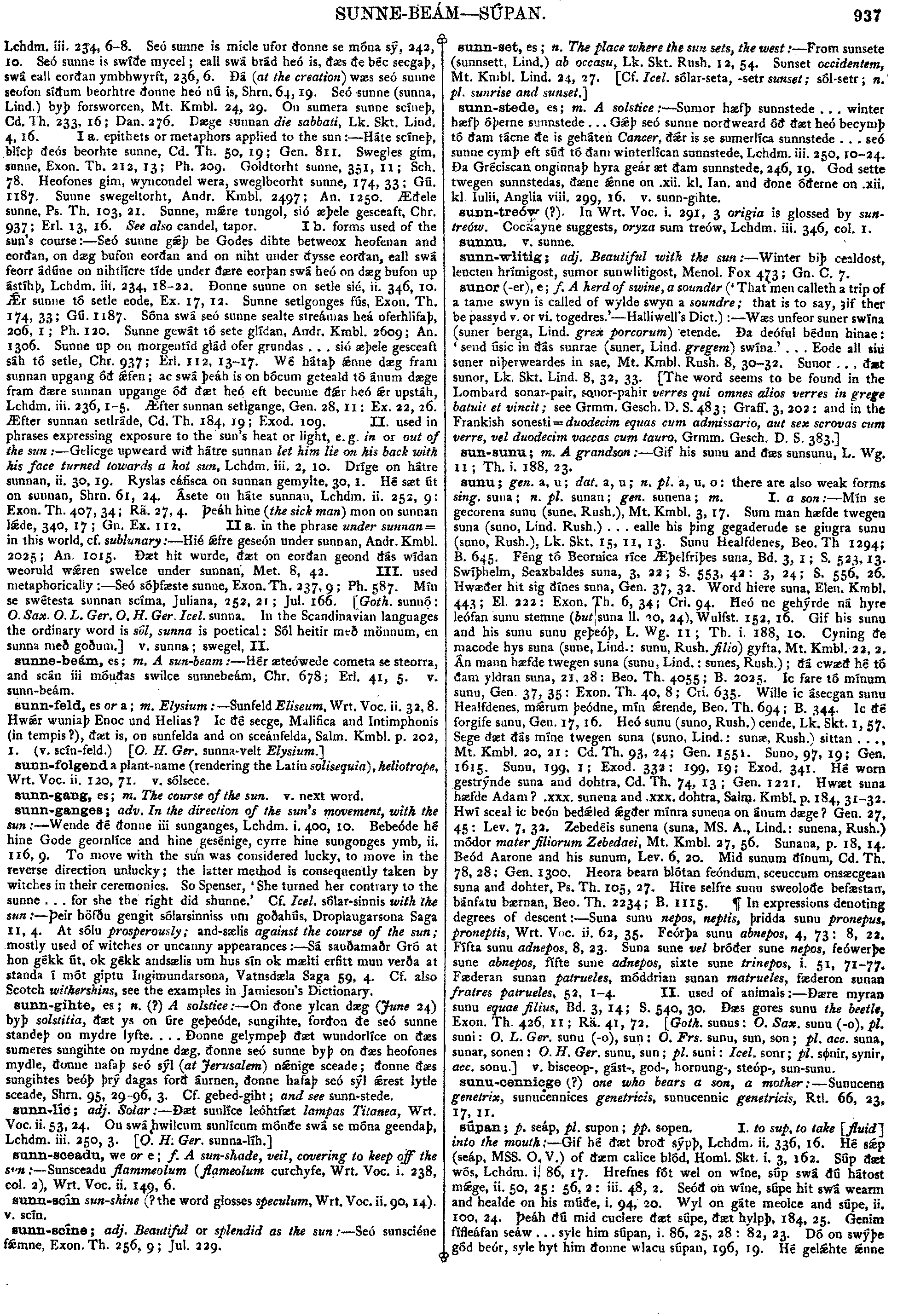
sun-sunnu; m. A grandson:--Gif his sunu and ðæs sunsunu, L. Wg. 11; Th. i. 188, 23.
|
Source: Bosworth/Toller, page b1032, entry 25 View original page image as: [TIFF] [PNG] [View previous entry] [View next entry] |
[Comment on this entry] [View comments (1)] |
The following entry has been hand-corrected once. |
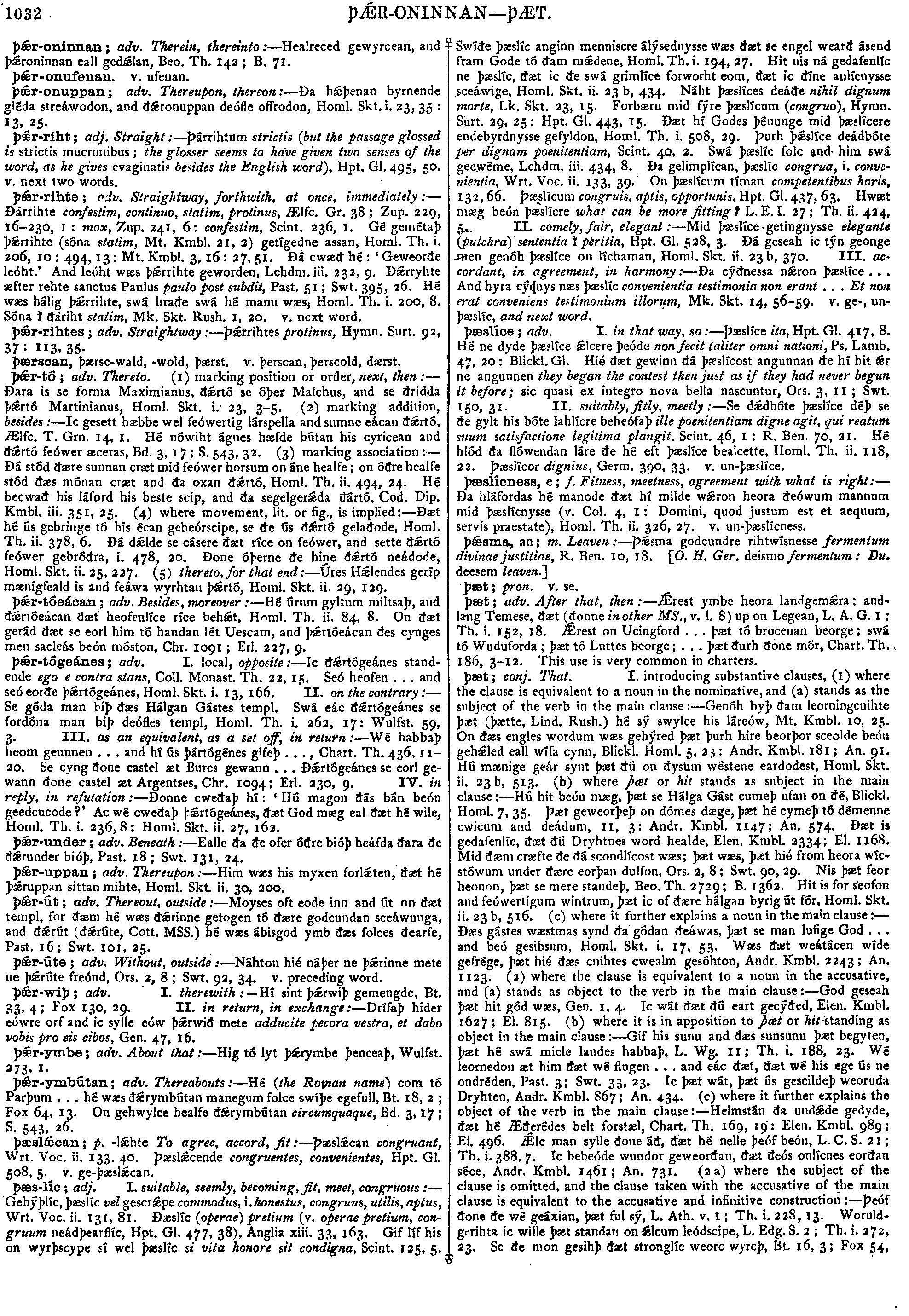
þæt;
conj.
That.
I.
introducing
substantive
clauses,
(1)
where
the
clause
is
equivalent
to
a
noun
in
the
nominative,
and
(a)
stands
as
the
subject
of
the
verb
in
the
main
clause
:--
Genóh
byþ
ðam
leorningcnihte
þæt
(þætte,
Lind.
Rush.)
hé
sý
swylce
his
láreów,
Mt.
Kmbl.
10.
25.
On
ðæs
engles
wordum
wæs
gehýred
þæt
þurh
hire
beorþor
sceolde
beón
geh led
wall
wífa
cynn,
Blickl.
Homl.
5,
23
:
Andr.
Kmbl.
181;
An.
91.
Hú
mænige
geár
synt
þæt
ðú
on
ðysúm
wéstene
eardodest,
Homl.
Skt.
ii.
23
b,
513.
(b)
where
þæt
or
hit
stands
as
subject
in
the
main
clause
:--
Hú
hit
beón
mæg,
þæt
se
Hálga
Gást
cumeþ
ufan
on
ðé,
Blickl.
Homl.
7,
35.
Þæt
geweorþeþ
on
dómes
dæge,
þæt
hé
cymeþ
tó
démenne
cwicum
and
deádum,
11,
3
:
Andr.
Kmbl.
1147;
An.
574.
Ðæt
is
gedafenlíc,
ðæt
ðú
Dryhtnes
word
healde,
Elen.
Kmbl.
2334;
El.
1168.
Mid
ðæm
cræfte
ðe
ðá
scondlícost
wæs;
þæt
wæs,
þæt
hié
from
heora
wícstówum
under
ðære
eorþan
dulfon,
Ors.
2,
8;
Swt.
90,
29.
Nis
þæt
feor
heonon,
þæt
se
mere
standeþ,
Beo.
Th.
2729;
B.
1362.
Hit
is
for
seofon
and
feówertigum
wintrum,
þæt
ic
of
ðære
hálgan
byrig
út
fór,
Homl.
Skt.
ii.
23
b,
516.
(c)
where
it
further
explains
a
noun
in
the
main
clause
:--
Ðæs
gástes
wæstmas
synd
ða
gódan
ðeáwas,
þæt
se
man
lufige
God
...
and
beó
gesibsum,
Homl.
Skt.
i.
17,
53.
Wæs
ðæt
weátácen
wíde
gefrége,
þæt
hié
ðæs
cnihtes
cwealm
gesóhton,
Andr.
Kmbl.
2243;
An.
1123.
(2)
where
the
clause
is
equivalent
to
a
noun
in
the
accusative,
and
(a)
stands
as
object
to
the
verb
in
the
main
clause
:--
God
geseah
þæt
hit
gód
wæs,
Gen.
1,
4.
Ic
wát
ðæt
ðú
eart
gecýðed,
Elen.
Kmbl.
1627;
El.
815.
(b)
where
it
is
in
apposition
to
þæt
or
hit
standing
as
object
in
the
main
clause
:--
Gif
his
sunu
and
ðæs
sunsunu
þæt
begyten,
þæt
hé
swá
micle
landes
habbaþ,
L.
Wg.
11;
Th.
i.
188,
23.
Wé
leornedon
æt
him
ðæt
wé
flugen
.
.
.
and
eác
ðæt,
ðæt
wé
his
ege
ús
ne
ondréden,
Past.
3;
Swt.
33,
23,
Ic
þæt
wát,
þæt
ús
gescildeþ
weoruda
Dryhten,
Andr.
Kmbl.
867;
An.
434.
(c)
where
it
further
explains
the
object
of
the
verb
in
the
main
clause
:--
Helmstán
ða
undde
gedyde,
ðæt
hé
Æðerédes
belt
forstæl,
Chart.
Th.
169,
19
:
Elen.
Kmbl.
989;
El.
496.
Æ-acute;lc
man
sylle
ðone
áð,
ðæt
hé
nelle
þeóf
beón,
L.
C.
S.
21;
Th.
i.
388,
7.
Ic
bebeóde
wundor
geweorðan,
ðæt
ðeós
onlícnes
eorðan
séce,
Andr.
Kmbl.
1461;
An.
731.
(2
a)
where
the
subject
of
the
clause
is
omitted,
and
the
clause
taken
with
the
accusative
of
the
main
clause
is
equivalent
to
the
accusative
and
infinitive
construction
:--
Þeóf
ðone
ðe
wé
geáxian,
þæt
ful
sý,
L.
Ath.
v.
1;
Th.
i.
228,
13.
Woruld-gerihta
ic
wille
þæt
standan
on
lcum
leódscipe,
L.
Edg.
S.
2;
Th.
i.
272,
23.
Se
ðe
mon
gesihþ
ðæt
stronglíc
weorc
wyrcþ,
Bt.
16,
3;
Fox
54,
29
:
Homl.
Th.
i.
234,
3.
Gif
gé
gesáwen
hwelce
mús
þæt
wre
hláford
ofer
óþre
mýs,
Bt.
16,
2;
Fox
52,
2.
Ealle
ða
weód
ðe
hé
geseó
ðæt
ðám
æcerum
derigen,
23;
Fox
78,
23.
Swá
fela
manna
swá
man
wite
þæt
ungelygne
sýn,
L.
Ath.
iv.
1;
Th.
i.
222,
10.
(3)
where
the
clause
is
equivalent
to
a
noun
in
the
genitive
or
dative.
(a)
where
in
the
main
clause
is
a
verb,
verbal
noun,
or
adjective
taking
after
it
such
a
case,
and
(a)
where
the
substantive
clause
stands
as
object
:--
Æ-acute;nig
ne
wénde,
ðæt
hé
lifgende
land
begéte,
Andr.
Kmbl.
755;
An.
378.
Saga
þonc
ðæt
ic
his
módor
gewearð,
Exon.
Th.
13,
30;
Cri.
210.
Is
nú
þearf
micel
þæt
wé
wísfæstra
wordum
hýran,
Andr.
Kmbl.
2335;
An.
1169.
Ic
áhebbe
míne
hand
.
.
.
þæt
is
ne
underfó
ánne
þwang
I
lift
my
hand
(in
testimony
of
this)
that
I
will
not
take
a
thing,
Gen.
14,
23.
Ðonne
hió
geornast
biþ
þæt
heó
áfre
fleógan,
Ps.
Th.
89,
10
:
Elen.
Kmbl.
536;
El.
268.
(a
1)
where
the
subject
is
omitted
:--
Æ-acute;lc
mynetere
ðe
man
tíhþ
þæt
fals
feoh
slóge,
L.
Eth.
iii.
8;
Th.
i.
296,
12.
(b)
where
the
main
clause
contains
a
case
of
a
pronoun
in
apposition
to
the
substantive
clause
:--
Ne
ðurfon
wé
ðæs
wénan,
þæt
ús
wuldorcyning
wille
eard
áléfan,
Cd.
Th.
272,
5;
Sat.
115.
Nánne
mon
ðæs
ne
tweóþ,
ðæt
se
seó
strong,
Bt.
16,
3;
Fox
54,
28.
Hié
þæs
ðone
willan
næfdon,
þæt
hié
heora
noman
hié
benmon,
Ors.
2,
8;
Swt.
94,
7.
Gif
þæs
geweorðe
gesíðcundne
mannan,
þæt
hé
unrihthmed
genime,
L.
Wih.
5;
Th.
i.
38,
4
:
Andr.
Kmbl.
615;
An.
308.
Ne
magon
wé
þæs
wrace
gefremman,
þæt
he
ús
hafaþ
ðæs
leóhtes
bescyrede,
Cd.
Th.
25,
16;
Gen.
394.
(c)
where
the
clause
explains
the
noun
in
the
main
clause
:--
Wolde
ic
ánes
tó
ðé
cræftes
neósan,
þæt
ðú
mé
gethte
hú
.
.
.,
Andr.
Kmbl.
969;
An.
485.
Gé
wiðsócon
sóðe
and
rihte,
ðæt
in
Bethleme
bearn
cenned
wre,
Elen.
Kmbl.
781;
El.
391.
(
led
wall
wífa
cynn,
Blickl.
Homl.
5,
23
:
Andr.
Kmbl.
181;
An.
91.
Hú
mænige
geár
synt
þæt
ðú
on
ðysúm
wéstene
eardodest,
Homl.
Skt.
ii.
23
b,
513.
(b)
where
þæt
or
hit
stands
as
subject
in
the
main
clause
:--
Hú
hit
beón
mæg,
þæt
se
Hálga
Gást
cumeþ
ufan
on
ðé,
Blickl.
Homl.
7,
35.
Þæt
geweorþeþ
on
dómes
dæge,
þæt
hé
cymeþ
tó
démenne
cwicum
and
deádum,
11,
3
:
Andr.
Kmbl.
1147;
An.
574.
Ðæt
is
gedafenlíc,
ðæt
ðú
Dryhtnes
word
healde,
Elen.
Kmbl.
2334;
El.
1168.
Mid
ðæm
cræfte
ðe
ðá
scondlícost
wæs;
þæt
wæs,
þæt
hié
from
heora
wícstówum
under
ðære
eorþan
dulfon,
Ors.
2,
8;
Swt.
90,
29.
Nis
þæt
feor
heonon,
þæt
se
mere
standeþ,
Beo.
Th.
2729;
B.
1362.
Hit
is
for
seofon
and
feówertigum
wintrum,
þæt
ic
of
ðære
hálgan
byrig
út
fór,
Homl.
Skt.
ii.
23
b,
516.
(c)
where
it
further
explains
a
noun
in
the
main
clause
:--
Ðæs
gástes
wæstmas
synd
ða
gódan
ðeáwas,
þæt
se
man
lufige
God
...
and
beó
gesibsum,
Homl.
Skt.
i.
17,
53.
Wæs
ðæt
weátácen
wíde
gefrége,
þæt
hié
ðæs
cnihtes
cwealm
gesóhton,
Andr.
Kmbl.
2243;
An.
1123.
(2)
where
the
clause
is
equivalent
to
a
noun
in
the
accusative,
and
(a)
stands
as
object
to
the
verb
in
the
main
clause
:--
God
geseah
þæt
hit
gód
wæs,
Gen.
1,
4.
Ic
wát
ðæt
ðú
eart
gecýðed,
Elen.
Kmbl.
1627;
El.
815.
(b)
where
it
is
in
apposition
to
þæt
or
hit
standing
as
object
in
the
main
clause
:--
Gif
his
sunu
and
ðæs
sunsunu
þæt
begyten,
þæt
hé
swá
micle
landes
habbaþ,
L.
Wg.
11;
Th.
i.
188,
23.
Wé
leornedon
æt
him
ðæt
wé
flugen
.
.
.
and
eác
ðæt,
ðæt
wé
his
ege
ús
ne
ondréden,
Past.
3;
Swt.
33,
23,
Ic
þæt
wát,
þæt
ús
gescildeþ
weoruda
Dryhten,
Andr.
Kmbl.
867;
An.
434.
(c)
where
it
further
explains
the
object
of
the
verb
in
the
main
clause
:--
Helmstán
ða
undde
gedyde,
ðæt
hé
Æðerédes
belt
forstæl,
Chart.
Th.
169,
19
:
Elen.
Kmbl.
989;
El.
496.
Æ-acute;lc
man
sylle
ðone
áð,
ðæt
hé
nelle
þeóf
beón,
L.
C.
S.
21;
Th.
i.
388,
7.
Ic
bebeóde
wundor
geweorðan,
ðæt
ðeós
onlícnes
eorðan
séce,
Andr.
Kmbl.
1461;
An.
731.
(2
a)
where
the
subject
of
the
clause
is
omitted,
and
the
clause
taken
with
the
accusative
of
the
main
clause
is
equivalent
to
the
accusative
and
infinitive
construction
:--
Þeóf
ðone
ðe
wé
geáxian,
þæt
ful
sý,
L.
Ath.
v.
1;
Th.
i.
228,
13.
Woruld-gerihta
ic
wille
þæt
standan
on
lcum
leódscipe,
L.
Edg.
S.
2;
Th.
i.
272,
23.
Se
ðe
mon
gesihþ
ðæt
stronglíc
weorc
wyrcþ,
Bt.
16,
3;
Fox
54,
29
:
Homl.
Th.
i.
234,
3.
Gif
gé
gesáwen
hwelce
mús
þæt
wre
hláford
ofer
óþre
mýs,
Bt.
16,
2;
Fox
52,
2.
Ealle
ða
weód
ðe
hé
geseó
ðæt
ðám
æcerum
derigen,
23;
Fox
78,
23.
Swá
fela
manna
swá
man
wite
þæt
ungelygne
sýn,
L.
Ath.
iv.
1;
Th.
i.
222,
10.
(3)
where
the
clause
is
equivalent
to
a
noun
in
the
genitive
or
dative.
(a)
where
in
the
main
clause
is
a
verb,
verbal
noun,
or
adjective
taking
after
it
such
a
case,
and
(a)
where
the
substantive
clause
stands
as
object
:--
Æ-acute;nig
ne
wénde,
ðæt
hé
lifgende
land
begéte,
Andr.
Kmbl.
755;
An.
378.
Saga
þonc
ðæt
ic
his
módor
gewearð,
Exon.
Th.
13,
30;
Cri.
210.
Is
nú
þearf
micel
þæt
wé
wísfæstra
wordum
hýran,
Andr.
Kmbl.
2335;
An.
1169.
Ic
áhebbe
míne
hand
.
.
.
þæt
is
ne
underfó
ánne
þwang
I
lift
my
hand
(in
testimony
of
this)
that
I
will
not
take
a
thing,
Gen.
14,
23.
Ðonne
hió
geornast
biþ
þæt
heó
áfre
fleógan,
Ps.
Th.
89,
10
:
Elen.
Kmbl.
536;
El.
268.
(a
1)
where
the
subject
is
omitted
:--
Æ-acute;lc
mynetere
ðe
man
tíhþ
þæt
fals
feoh
slóge,
L.
Eth.
iii.
8;
Th.
i.
296,
12.
(b)
where
the
main
clause
contains
a
case
of
a
pronoun
in
apposition
to
the
substantive
clause
:--
Ne
ðurfon
wé
ðæs
wénan,
þæt
ús
wuldorcyning
wille
eard
áléfan,
Cd.
Th.
272,
5;
Sat.
115.
Nánne
mon
ðæs
ne
tweóþ,
ðæt
se
seó
strong,
Bt.
16,
3;
Fox
54,
28.
Hié
þæs
ðone
willan
næfdon,
þæt
hié
heora
noman
hié
benmon,
Ors.
2,
8;
Swt.
94,
7.
Gif
þæs
geweorðe
gesíðcundne
mannan,
þæt
hé
unrihthmed
genime,
L.
Wih.
5;
Th.
i.
38,
4
:
Andr.
Kmbl.
615;
An.
308.
Ne
magon
wé
þæs
wrace
gefremman,
þæt
he
ús
hafaþ
ðæs
leóhtes
bescyrede,
Cd.
Th.
25,
16;
Gen.
394.
(c)
where
the
clause
explains
the
noun
in
the
main
clause
:--
Wolde
ic
ánes
tó
ðé
cræftes
neósan,
þæt
ðú
mé
gethte
hú
.
.
.,
Andr.
Kmbl.
969;
An.
485.
Gé
wiðsócon
sóðe
and
rihte,
ðæt
in
Bethleme
bearn
cenned
wre,
Elen.
Kmbl.
781;
El.
391.
( )
where
the
clause
is
equivalent
to
a
phrase,
preposition
and
noun,
with
adjectival
force,
(a)
defining
the
noun
in
the
main
clause
:--
Hit
wæs
ðá
se
tíma,
þæt
wínberian
rípodon
now
the
time
was
the
time
of
the
first-ripe
grapes
(A.
V.),
Num.
13,
21.
Nis
seó
þráh
micel,
þæt
ðé
wrlogan
swencan
móton
the
time
of
your
affliction
is
not
long,
Andr.
Kmbl.
215;
An.
108.
Nis
seó
stund
latu,
þæt
ðé
wælreówe
wítum
belecgaþ,
2423;
An.
1213.
Nú
is
se
dæg
cumen,
þæt
úre
mandryhten
mægenes
behófaþ,
Beo.
Th.
5297;
B.
2646
:
Val.
1,
9.
(b)
in
apposition
to
a
pronoun
in
the
main
clause
:--
Wæs
seó
hwíl
þæs
lang,
þæt
ic
Gode
þegnode
the
time
of
my
serving
God
was
long
(or
þæs
=
so?),
Cd.
Th.
37,
5;
Gen.
585.
II.
introducing
clauses
expressing
end
or
purpose,
that,
in
order
that
:--
Sete
ðíne
hand
ofer
hí
þæt
(þætte,
Lind.
Rush.)
heó
hál
sý
ut
salva
sit,
Mk.
Skt.
5,
23.
Ðr
se
bisceop
oft
wæs,
þæt
hé
fullade
ðæt
folc,
Bd.
2,
14;
S.
518,
15.
Se
deófol
genam
ðæt
wíf
him
tó
gefylstan,
þæt
hé
ðone
hálgan
wer
ðurh
hí
geswice,
Homl.
Th.
ii.
454,
1.
Hí
cómon
him
tó,
þæt
hí
hine
geneósodon,
7.
II
a.
with
a
negative,
that
...
not,
lest
:--
Ic
ne
underfó
ánne
þwang,
þæt
ðú
ne
secge
eft
(ne
dicas)
:
'Ic
gewelegode
Abram,'
Gen.
14,
23
:
Lk.
Skt.
8,
12.
Waciaþ
and
gebiddaþ
þæt
(þætte,
Lind.
Rush.)
gé
on
costnunge
ne
gán
(ut
non
intretis),
Mk.
Skt.
14,
38.
Hig
ne
eodon
intó
ðam
dómerne,
þæt
(þætte,
Lind.
Rush.)
hyg
nron
besmitene
ut
non
contaminarentur,
Jn.
Skt.
18,
28.
III.
introducing
clauses
denoting
result,
manner,
kind,
degree,
(1)
where
no
demonstrative
word
in
the
main
clause
is
antecedent
to
the
subordinate
clause,
that,
so
that,
so
as
(with
infin.)
:--
Hú
mihtest
ðú
sittan
on
middum
gemnum
ríce,
þæt
ðú
ne
sceoldest
ðæt
ilce
geþolian
ðæt
óðre
men?
Bt.
7,
3;
Fox
22,
17
:
Homl.
Skt.
ii.
23
b,
522.
Asyrie
hæfdon
LX
wintra
and
án
hund
and
án
þúsend,
þæt
hit
ná
búton
gewinne
næs,
Ors.
1,
8;
Swt.
42,
4.
Nis
nnigu
gecynd,
....
ðæt
he
ne
sý
fýres
cynnes,
Salm.
Kmbl.
847;
Sal.
423.
Hé
rád
þæt
hé
wæs
et
Ceastre
he
rode
so
that
he
was
at
Worcester,
Chart.
Th.
71,
11
:
Andr.
Kmbl.
1576;
An.
789
:
1474;
An.
738.
Man
gecwman
ne
mæg
twám
hláfordum
ætsomne,
þæt
hé
ne
forseó
þone
óðerne,
Homl.
Skt.
i.
17,
220,
224.
Þr
is
án
mgð
þæt
hí
magon
cyle
gewyrcan,
Ors.
1,
1;
Swt.
21,
13.
Tó
ðám
handum
ðæt
ðæt
fel
of
gþ,
Lchdm.
iii.
114,
3.
Hwylc
man
is
þonne
fre,
þæt
hé
wéne
...
whatever
man
is
there
(of
such
a
kind),
that
he
can
suppose
...
,
Wulfst.
214,
14
:
Cd.
Th.
227,
20;
Dan.
189.
Hyge
wæs
oncyrred,
þæt
hié
ne
murndon,
Andr.
Kmbl.
73;
An.
37.
Gif
mon
sié
dumb
oþþe
deáf
geboren,
þæt
hé
ne
mæge
his
synna
andettan,
L.
Alf.
pol.
14;
Th.
i.
70,
14.
Æfter
ðære
gebysnunge
wurdon
árrede
muneclíf
mid
ðære
gehealdsumnysse,
þæt
hí
drohtnian
on
clnnesse,
Homl.
Th.
i.
318,
8.
Gewunige
hé
fæstende,
þæt
hé
wite
þæt
seó
mæsse
sý
gesungen
let
him
continue
his
fast
so,
that
he
may
know
the
mass
has
been
sung,
L.
E.
I.
39;
Th.
ii.
438,
3.
Gif
ceorlisc
man
geþeó,
þæt
hé
hæbbe
.v.
hída
landes,
L.
Wg.
9;
Th.
i.
188,
5
:
10;
Th.
i.
188,
7.
Ða
Gotan
læssan
hwíle
hergedan,
þæt
hié
þurh
Godes
ege
þæt
hié
náþer
ne
þa
burg
ne
bærndon
ne
þæs
þone
willan
næfdon
....
Ors.
2,
8;
Swt.
94,
5.
(1
a)
where
the
subject
of
the
clause
is
omitted
:--
Nemne
him
mon
.v.
men,
and
begite
þara
.v.
.1.,
þæt
him
mid
swerige,
L.
Ath.
i.
9;
Th.
i.
204,
11.
Hwylc
is
manna
þæt
feores
neóte
.
.
.
oððe
hwylc
manna
is
þæt
his
ágene
sáwle
genérige,
Ps.
Th.
88,
41
:
Elen.
Kmbl.
750;
El.
375
:
Exon.
Th.
273,
20;
Jul.
519.
(2)
where
the
clause
stands
as
relative
to
a
preceding
demonstrative
word
:--
Hé
lrde
hig
swá
þæt
(ita
ut)
hig
wundredon,
Mt.
Kmbl.
13,
54.
Þæt
wíte
wæs
tó
þæs
strang,
ðæt
ghwelc
man
sceolde
mid
sáre
on
þás
world
cuman,
Blickl.
Homl.
5,
28.
Swelc
wæs
þeáw
hira
þæt
hié
ghwylcne
ellþeódigra
dydon
him
tó
móse,
Andr.
Kmbl.
51;
An.
26.
Swá
is
þære
menigo
þeáw,
þæt
.
.
.
,
355;
An.
178.
Ðýn
mægen
is
swá
mre,
mihtig
Drihten,
swá
þæt
nig
ne
wát
eorðbúende
þa
deópnesse
Drihtnes
mihta,
ne
þæt
nig
ne
wát
engla
hádes
þa
heáhnisse
heofena
kyninges,
Hy.
3,
31-35.
Gif
his
sunu
and
his
sunu
sunu
þæt
geþeóþ,
þæt
hí
swá
micel
landes
habban,
L.
Wg.
11;
Th.
i.
188,
10.
(2
a)
where
the
subject
of
the
clause
is
omitted
:--
Nis
nnig
swá
snotor,
ne
þæs
swá
gleáw,
þæt
ásecgan
mæge,
Cd.
Th.
286,
12;
Sat.
351.
(See
also
se,
V,
swá.)
IV.
introducing
clauses
expressing
cause,
reason
:--
Hwæt
þence
gé
betwux
eów,
þæt
(forðon,
Lind.
:
forþon
þæt,
Rush.)
gé
hláfas
nabbaþ
why
reason
ye
among
yourselves,
because
ye
have
brought
no
bread?
Mt.
Kmbl.
16,
8.
Byþ
ðé
meorð,
þæt
ðú
ús
on
láde
líðe
weorðe,
Andr.
Kmbl.
551;
An.
276.
V.
where
the
main
clause
is
not
expressed,
(1)
in
narrative
:--
Æ-acute;rþon
ðe
seó
heánnes
ðæs
walles
gefylled
wre,
þæt
se
cyning
ofslegen
wæs
and
þæt
ylce
geweorc
Óswalde
forlét
(some
form
equivalent
to
it
happened
appears
necessary
before
þæt,
which
word
there
is
nothing
in
the
Latin
to
suggest
:
Priusquam
altitudo
parietis
esset
consummata,
rex
ipse
occisus
opus
idem
Osualdo
reliquit),
Bd.
2,
14;
S.
517,
31.
Ðá
æt
nýhstan
mid
fultume
his
freónda
þæt
hé
gelýfde,
3,
22;
S.
552,
26
:
3,
24;
S.
556,
21
:
4,
27;
S.
604,
32
(cf.
3,
9;
S.
533,
16-19
:
4,
3;
S.
569,
1-3).
And
þæs
embe
áne
niht
ðæt
wé
Marian
mæssan
healdaþ,
Menol.
Fox
39;
Men.
20
and
often.
Nó
þæt
ðín
aldor
wolde
Godes
goldfatu
in
gylp
beran,
Cd.
Th.
262,
34;
Dan.
754
:
288,
9;
Sat.
378
:
304,
24;
Sat.
634.
(2)
in
the
titles
of
chapters
:--
Caput
II.
Ðæt
se
rra
Rómwara
Cásere
Breotene
gesóhte,
Bd.
1,
2;
S.
475,
2
and
often.
(3)
in
exclamations
:--
Wá
þæt
ðes
tówyrpþ
Godes
templ,
Mt.
Kmbl.
27,
40.
Eálá
þæt
nán
wuht
nis
fæste
stondendes
weorces,
Bt.
9;
Fox
26,
21
:
Met.
9,
55
:
18,
1.
Eálá,
mín
Drihten,
þæt
ðú
eart
ælmihtig,
20,
1.
Eálá,
þæt
ic
eam
ealles
leás
écan
dreámes,
Cd.
Th.
275,
7;
Sat.
168.
VI.
where
the
construction
is
elliptical
:--
Þrý
dagas
tó
láfe
syndon
þæt
hié
þé
willaþ
acwellan
three
days
remain
before
the
day
comes
on
which
they
mean
to
kill
you,
Blickl.
Homl.
237,
26.
[O.
Sax.
that
:
O.
Frs.
thet
:
O.
H.
Ger.
daz
:
Icel.
at.]
v.
þætte;
conj.
)
where
the
clause
is
equivalent
to
a
phrase,
preposition
and
noun,
with
adjectival
force,
(a)
defining
the
noun
in
the
main
clause
:--
Hit
wæs
ðá
se
tíma,
þæt
wínberian
rípodon
now
the
time
was
the
time
of
the
first-ripe
grapes
(A.
V.),
Num.
13,
21.
Nis
seó
þráh
micel,
þæt
ðé
wrlogan
swencan
móton
the
time
of
your
affliction
is
not
long,
Andr.
Kmbl.
215;
An.
108.
Nis
seó
stund
latu,
þæt
ðé
wælreówe
wítum
belecgaþ,
2423;
An.
1213.
Nú
is
se
dæg
cumen,
þæt
úre
mandryhten
mægenes
behófaþ,
Beo.
Th.
5297;
B.
2646
:
Val.
1,
9.
(b)
in
apposition
to
a
pronoun
in
the
main
clause
:--
Wæs
seó
hwíl
þæs
lang,
þæt
ic
Gode
þegnode
the
time
of
my
serving
God
was
long
(or
þæs
=
so?),
Cd.
Th.
37,
5;
Gen.
585.
II.
introducing
clauses
expressing
end
or
purpose,
that,
in
order
that
:--
Sete
ðíne
hand
ofer
hí
þæt
(þætte,
Lind.
Rush.)
heó
hál
sý
ut
salva
sit,
Mk.
Skt.
5,
23.
Ðr
se
bisceop
oft
wæs,
þæt
hé
fullade
ðæt
folc,
Bd.
2,
14;
S.
518,
15.
Se
deófol
genam
ðæt
wíf
him
tó
gefylstan,
þæt
hé
ðone
hálgan
wer
ðurh
hí
geswice,
Homl.
Th.
ii.
454,
1.
Hí
cómon
him
tó,
þæt
hí
hine
geneósodon,
7.
II
a.
with
a
negative,
that
...
not,
lest
:--
Ic
ne
underfó
ánne
þwang,
þæt
ðú
ne
secge
eft
(ne
dicas)
:
'Ic
gewelegode
Abram,'
Gen.
14,
23
:
Lk.
Skt.
8,
12.
Waciaþ
and
gebiddaþ
þæt
(þætte,
Lind.
Rush.)
gé
on
costnunge
ne
gán
(ut
non
intretis),
Mk.
Skt.
14,
38.
Hig
ne
eodon
intó
ðam
dómerne,
þæt
(þætte,
Lind.
Rush.)
hyg
nron
besmitene
ut
non
contaminarentur,
Jn.
Skt.
18,
28.
III.
introducing
clauses
denoting
result,
manner,
kind,
degree,
(1)
where
no
demonstrative
word
in
the
main
clause
is
antecedent
to
the
subordinate
clause,
that,
so
that,
so
as
(with
infin.)
:--
Hú
mihtest
ðú
sittan
on
middum
gemnum
ríce,
þæt
ðú
ne
sceoldest
ðæt
ilce
geþolian
ðæt
óðre
men?
Bt.
7,
3;
Fox
22,
17
:
Homl.
Skt.
ii.
23
b,
522.
Asyrie
hæfdon
LX
wintra
and
án
hund
and
án
þúsend,
þæt
hit
ná
búton
gewinne
næs,
Ors.
1,
8;
Swt.
42,
4.
Nis
nnigu
gecynd,
....
ðæt
he
ne
sý
fýres
cynnes,
Salm.
Kmbl.
847;
Sal.
423.
Hé
rád
þæt
hé
wæs
et
Ceastre
he
rode
so
that
he
was
at
Worcester,
Chart.
Th.
71,
11
:
Andr.
Kmbl.
1576;
An.
789
:
1474;
An.
738.
Man
gecwman
ne
mæg
twám
hláfordum
ætsomne,
þæt
hé
ne
forseó
þone
óðerne,
Homl.
Skt.
i.
17,
220,
224.
Þr
is
án
mgð
þæt
hí
magon
cyle
gewyrcan,
Ors.
1,
1;
Swt.
21,
13.
Tó
ðám
handum
ðæt
ðæt
fel
of
gþ,
Lchdm.
iii.
114,
3.
Hwylc
man
is
þonne
fre,
þæt
hé
wéne
...
whatever
man
is
there
(of
such
a
kind),
that
he
can
suppose
...
,
Wulfst.
214,
14
:
Cd.
Th.
227,
20;
Dan.
189.
Hyge
wæs
oncyrred,
þæt
hié
ne
murndon,
Andr.
Kmbl.
73;
An.
37.
Gif
mon
sié
dumb
oþþe
deáf
geboren,
þæt
hé
ne
mæge
his
synna
andettan,
L.
Alf.
pol.
14;
Th.
i.
70,
14.
Æfter
ðære
gebysnunge
wurdon
árrede
muneclíf
mid
ðære
gehealdsumnysse,
þæt
hí
drohtnian
on
clnnesse,
Homl.
Th.
i.
318,
8.
Gewunige
hé
fæstende,
þæt
hé
wite
þæt
seó
mæsse
sý
gesungen
let
him
continue
his
fast
so,
that
he
may
know
the
mass
has
been
sung,
L.
E.
I.
39;
Th.
ii.
438,
3.
Gif
ceorlisc
man
geþeó,
þæt
hé
hæbbe
.v.
hída
landes,
L.
Wg.
9;
Th.
i.
188,
5
:
10;
Th.
i.
188,
7.
Ða
Gotan
læssan
hwíle
hergedan,
þæt
hié
þurh
Godes
ege
þæt
hié
náþer
ne
þa
burg
ne
bærndon
ne
þæs
þone
willan
næfdon
....
Ors.
2,
8;
Swt.
94,
5.
(1
a)
where
the
subject
of
the
clause
is
omitted
:--
Nemne
him
mon
.v.
men,
and
begite
þara
.v.
.1.,
þæt
him
mid
swerige,
L.
Ath.
i.
9;
Th.
i.
204,
11.
Hwylc
is
manna
þæt
feores
neóte
.
.
.
oððe
hwylc
manna
is
þæt
his
ágene
sáwle
genérige,
Ps.
Th.
88,
41
:
Elen.
Kmbl.
750;
El.
375
:
Exon.
Th.
273,
20;
Jul.
519.
(2)
where
the
clause
stands
as
relative
to
a
preceding
demonstrative
word
:--
Hé
lrde
hig
swá
þæt
(ita
ut)
hig
wundredon,
Mt.
Kmbl.
13,
54.
Þæt
wíte
wæs
tó
þæs
strang,
ðæt
ghwelc
man
sceolde
mid
sáre
on
þás
world
cuman,
Blickl.
Homl.
5,
28.
Swelc
wæs
þeáw
hira
þæt
hié
ghwylcne
ellþeódigra
dydon
him
tó
móse,
Andr.
Kmbl.
51;
An.
26.
Swá
is
þære
menigo
þeáw,
þæt
.
.
.
,
355;
An.
178.
Ðýn
mægen
is
swá
mre,
mihtig
Drihten,
swá
þæt
nig
ne
wát
eorðbúende
þa
deópnesse
Drihtnes
mihta,
ne
þæt
nig
ne
wát
engla
hádes
þa
heáhnisse
heofena
kyninges,
Hy.
3,
31-35.
Gif
his
sunu
and
his
sunu
sunu
þæt
geþeóþ,
þæt
hí
swá
micel
landes
habban,
L.
Wg.
11;
Th.
i.
188,
10.
(2
a)
where
the
subject
of
the
clause
is
omitted
:--
Nis
nnig
swá
snotor,
ne
þæs
swá
gleáw,
þæt
ásecgan
mæge,
Cd.
Th.
286,
12;
Sat.
351.
(See
also
se,
V,
swá.)
IV.
introducing
clauses
expressing
cause,
reason
:--
Hwæt
þence
gé
betwux
eów,
þæt
(forðon,
Lind.
:
forþon
þæt,
Rush.)
gé
hláfas
nabbaþ
why
reason
ye
among
yourselves,
because
ye
have
brought
no
bread?
Mt.
Kmbl.
16,
8.
Byþ
ðé
meorð,
þæt
ðú
ús
on
láde
líðe
weorðe,
Andr.
Kmbl.
551;
An.
276.
V.
where
the
main
clause
is
not
expressed,
(1)
in
narrative
:--
Æ-acute;rþon
ðe
seó
heánnes
ðæs
walles
gefylled
wre,
þæt
se
cyning
ofslegen
wæs
and
þæt
ylce
geweorc
Óswalde
forlét
(some
form
equivalent
to
it
happened
appears
necessary
before
þæt,
which
word
there
is
nothing
in
the
Latin
to
suggest
:
Priusquam
altitudo
parietis
esset
consummata,
rex
ipse
occisus
opus
idem
Osualdo
reliquit),
Bd.
2,
14;
S.
517,
31.
Ðá
æt
nýhstan
mid
fultume
his
freónda
þæt
hé
gelýfde,
3,
22;
S.
552,
26
:
3,
24;
S.
556,
21
:
4,
27;
S.
604,
32
(cf.
3,
9;
S.
533,
16-19
:
4,
3;
S.
569,
1-3).
And
þæs
embe
áne
niht
ðæt
wé
Marian
mæssan
healdaþ,
Menol.
Fox
39;
Men.
20
and
often.
Nó
þæt
ðín
aldor
wolde
Godes
goldfatu
in
gylp
beran,
Cd.
Th.
262,
34;
Dan.
754
:
288,
9;
Sat.
378
:
304,
24;
Sat.
634.
(2)
in
the
titles
of
chapters
:--
Caput
II.
Ðæt
se
rra
Rómwara
Cásere
Breotene
gesóhte,
Bd.
1,
2;
S.
475,
2
and
often.
(3)
in
exclamations
:--
Wá
þæt
ðes
tówyrpþ
Godes
templ,
Mt.
Kmbl.
27,
40.
Eálá
þæt
nán
wuht
nis
fæste
stondendes
weorces,
Bt.
9;
Fox
26,
21
:
Met.
9,
55
:
18,
1.
Eálá,
mín
Drihten,
þæt
ðú
eart
ælmihtig,
20,
1.
Eálá,
þæt
ic
eam
ealles
leás
écan
dreámes,
Cd.
Th.
275,
7;
Sat.
168.
VI.
where
the
construction
is
elliptical
:--
Þrý
dagas
tó
láfe
syndon
þæt
hié
þé
willaþ
acwellan
three
days
remain
before
the
day
comes
on
which
they
mean
to
kill
you,
Blickl.
Homl.
237,
26.
[O.
Sax.
that
:
O.
Frs.
thet
:
O.
H.
Ger.
daz
:
Icel.
at.]
v.
þætte;
conj.
Germanic Lexicon Project (main page)
This search system was written by
Sean Crist
Please consider
volunteering
to correct the data in these online dictionaries.
No rights reserved. Feel free to use these data in any way you please.